
Key Takeaways
- Entity Management Software Market Growth: The global entity management software market is projected to reach USD 9.73 billion in 2026 and USD 22.50 billion by 2033, reflecting a 15.0% CAGR, although industry forecasts vary by market definition.
- AI Automation and Cloud Adoption: Cloud-based entity management software is estimated to capture 63.7% of the market in 2026, while AI-powered solutions are transforming corporate governance, document management, regulatory reporting, and compliance workflows.
- Regulatory Compliance and Regional Expansion: North America is projected to lead with a 48.6% market share in 2026, while Asia Pacific emerges as a high-growth region, driven by increasing regulatory complexity, digital transformation, and demand for centralized legal entity management.
Entity management software helps businesses manage legal entities, automate compliance, and streamline corporate governance. In 2026, the global market is projected to reach USD 9.73 billion, with some forecasts predicting 15.0% annual growth through 2033. Key trends include AI-powered automation, cloud adoption, regulatory compliance, and increasing demand for centralized corporate records.
Entity management software has become an increasingly important component of modern corporate governance, helping businesses manage legal entities, maintain regulatory compliance, streamline administrative workflows, and oversee complex organizational structures across multiple jurisdictions. As multinational corporations face growing regulatory scrutiny, expanding compliance obligations, and increasing demands for operational transparency, the global entity management software market is experiencing significant transformation in 2026.
Also, read our article on the Top 10 Entity Management Software To Use.


According to industry forecasts, the global entity management software market could reach USD 9.73 billion in 2026, with projections suggesting growth to USD 22.50 billion by 2033, representing a compound annual growth rate (CAGR) of approximately 15.0%. However, market estimates vary considerably depending on research methodology and software categories, with other forecasts placing the market at USD 1.75 billion or USD 8.46 billion in 2026. These differences highlight the evolving scope of entity management solutions and their increasing integration with broader enterprise governance, risk, and compliance technologies.
Geographically, North America is projected to account for 48.6% of the global entity management software market in 2026, supported by established corporate governance frameworks, advanced digital infrastructure, and substantial enterprise technology investments. Meanwhile, Asia Pacific is emerging as a major growth region, with an estimated 28.7% market share and forecasts indicating a 13.4% CAGR through 2033. Growing regulatory complexity, corporate expansion, and digital transformation initiatives are contributing to demand across both developed and emerging economies.

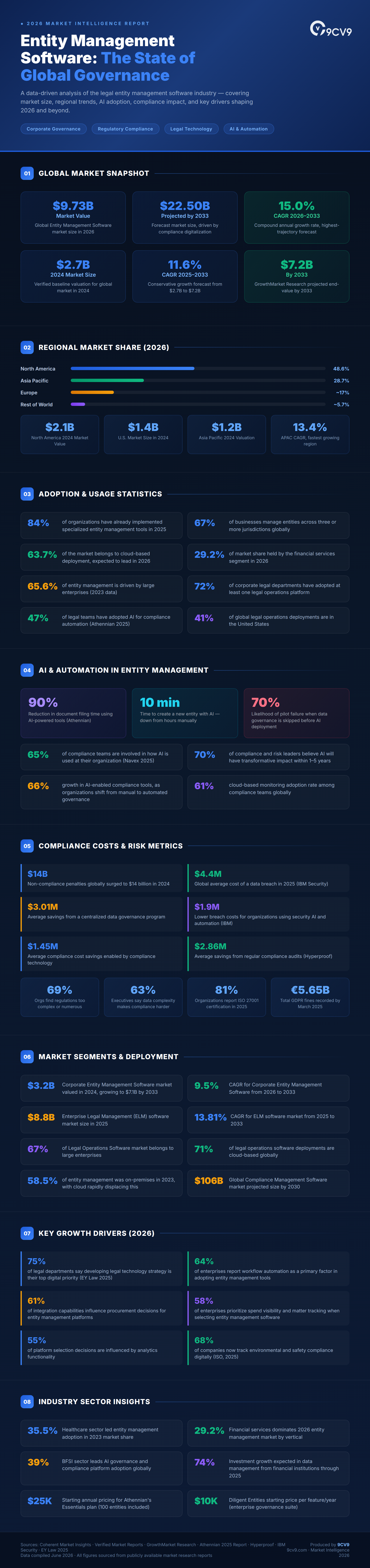
Cloud adoption and artificial intelligence are also reshaping how organizations manage their corporate entities. Cloud-based deployment is estimated to represent 63.7% of the entity management software market in 2026, reflecting increasing demand for centralized data access, real-time collaboration, and scalable compliance infrastructure. At the same time, AI-powered automation is helping legal and compliance teams reduce repetitive administrative tasks, improve document processing, and strengthen regulatory monitoring. Some AI-enabled entity management solutions report reductions of up to 90% in document filing time, demonstrating the potential productivity benefits of intelligent automation.
The growing financial consequences of regulatory non-compliance further reinforce the importance of effective entity management. With GDPR penalties potentially reaching 4% of annual global turnover and the global average cost of a data breach estimated at USD 4.4 million in 2025, organizations are placing greater emphasis on governance technology, data security, and compliance automation. These pressures are encouraging businesses to move beyond fragmented spreadsheets and manual recordkeeping toward integrated entity management platforms.
Beyond compliance, organizations increasingly evaluate entity management software based on its ability to support corporate restructuring, subsidiary governance, ownership tracking, document management, regulatory reporting, and integration with existing enterprise systems. The convergence of legal technology, AI-driven analytics, cloud computing, and governance automation is creating new opportunities for software vendors while changing how corporate legal departments operate.
This comprehensive guide to the Top 110 Entity Management Software Statistics, Data & Trends in 2026 examines the latest market size estimates, industry growth forecasts, regional market shares, software adoption rates, AI automation trends, compliance costs, security challenges, pricing benchmarks, and enterprise investment patterns. By exploring these quantitative insights, business leaders, legal professionals, compliance officers, technology vendors, and investors can better understand the forces shaping the entity management software industry and identify emerging opportunities in the evolving corporate governance technology landscape.
Before we venture further into this article, we would like to share who we are and what we do.
About 9cv9
9cv9 is a business tech startup based in Singapore and Asia, with a strong presence all over the world.
With over ten years of startup and business experience, and being highly involved in connecting with thousands of companies and startups, the 9cv9 team has listed some of the top and best companies/tools in this review.
If you like to get your company listed in our top B2B software reviews, check out our world-class 9cv9 Media and PR service and pricing plans here.
Top 110 Entity Management Software Statistics, Data & Trends in 2026
📊 MARKET SIZE & VALUATION
- $9.73 Billion — The global Entity Management Software market is expected to be valued at USD 9.73 billion in 2026, signaling massive enterprise investment in governance and compliance infrastructure.
- $22.50 Billion — The market is projected to reach USD 22.50 billion by 2033, reflecting the accelerating demand for centralized legal entity oversight across multinational corporations.
- 15.0% CAGR (2026–2033) — Entity management software is growing at a 15.0% compound annual growth rate through 2033, making it one of the fastest-expanding segments in enterprise legal technology.
- $2.7 Billion — The global Entity Management Software market size stood at USD 2.7 billion in 2024, establishing a strong foundation for near-term hypergrowth.
- 11.6% CAGR (2025–2033) — A conservative forecast by GrowthMarket Research projects an 11.6% CAGR, rising from $2.7 billion to $7.2 billion by 2033, underscoring sustained double-digit growth.
- $7.2 Billion — GrowthMarket Research projects the global market will reach USD 7.2 billion by 2033, as legal teams shift from spreadsheets to purpose-built governance platforms.
- $1.75 Billion — Business Research Insights estimates the global market at approximately USD 1.75 billion in 2026, reflecting mid-range analyst consensus for the current year.
- $3.5 Billion — The entity management software market is projected to reach USD 3.5 billion by 2035, expanding at an 8% CAGR according to Business Research Insights.
- $8.46 Billion — One forecast models the global entity management software market at USD 8.46 billion in 2026, driven by a 14.8% CAGR from 2020 to 2034.
- $177.98 Million — The Insight Partners valued the global Entity Management Software Market at USD 177.98 million in 2025 (narrower product scope), with a 6.80% CAGR through 2034.
- $301.29 Million — The Insight Partners projects the narrower entity management market to reach USD 301.29 million by 2034, focusing on core governance and minute-book solutions.
- $2,257.96 Million — The total addressable market (TAM) for entity management software from 2026–2034 is estimated at approximately USD 2.26 billion, creating significant revenue runway for vendors.
🌍 REGIONAL MARKET BREAKDOWN
- 48.6% — North America leads the global entity management software market with a 48.6% share in 2026, driven by mature digital infrastructure and stringent regulatory mandates.
- 28.7% — Asia Pacific holds a 28.7% market share in 2026 and is projected to be the fastest-growing region, fueled by Digital India initiatives and expanding corporate governance reforms.
- 13.4% CAGR — Asia Pacific is projected to grow at a 13.4% CAGR through 2033, making it the highest-velocity regional market for entity management software investment.
- $2.1 Billion — North America’s entity management software market was valued at USD 2.1 billion in 2024 and is forecast to reach USD 3.2 billion by 2033 at a 6.3% CAGR.
- $1.4 Billion — The U.S. entity management software market was valued at USD 1.4 billion in 2024, reflecting the country’s dominant position in global legal technology adoption.
- 6.4% CAGR (U.S.) — The U.S. market is growing at approximately 6.4% CAGR from 2026 to 2033, reaching USD 2.1 billion, supported by Fortune 500 compliance digitalization.
- $1.2 Billion — The Asia Pacific market was valued at USD 1.2 billion in 2024, growing rapidly to USD 2.5 billion by 2033 at an 8.1% CAGR.
- 8.1% CAGR (APAC) — Asia Pacific entity management spending is growing at an 8.1% CAGR through 2033, propelled by regulatory reforms and enterprise SaaS adoption across Southeast Asia.
- $0.9 Billion — Japan’s entity management market was valued at USD 0.9 billion in 2024, growing at 6.2% CAGR to USD 1.6 billion by 2033.
- 6.2% CAGR (Japan) — Japan’s digital transformation (DX) push and corporate governance reforms are sustaining a 6.2% CAGR in entity management software demand.
- $810 Million — Europe’s entity management software market was valued at approximately USD 810 million in 2024, with GDPR and ESG mandates accelerating software uptake.
- 10.7% CAGR (Europe) — Europe is growing at a 10.7% CAGR through 2033, one of the strongest regional growth rates, driven by stringent GDPR compliance requirements.
- 46.8% — North America held over 46.8% global market share in 2023, generating approximately USD 58.6 billion in revenue across entity-related governance solutions.
- $540 Million — Asia Pacific’s entity management market was valued at USD 540 million in 2024, with a 13.4% CAGR making it the fastest-growing region globally.
🏢 ADOPTION & DEPLOYMENT STATISTICS
- 84% — A full 84% of organizations had already implemented specialized entity management tools by 2025, per the Athennian State of Entity Management Report.
- 67% — 67% of businesses manage legal entities across three or more jurisdictions, increasing the complexity and cost of manual compliance processes.
- 63.7% — Cloud-based deployment accounts for 63.7% of the entity management software market in 2026, with its flexibility and remote-access features making it the preferred model.
- 29.2% — Financial services dominates entity management software verticals with a 29.2% sector share in 2026, driven by KYC, AML, and CTF compliance demands.
- 65.6% — Large enterprises captured 65.6% of the entity management software market in 2023, reflecting the technology’s historical orientation toward complex corporate structures.
- 72% — Over 72% of corporate legal departments have adopted at least one legal operations platform, signaling mainstream acceptance of legal technology in enterprise governance.
- 47% — 47% of legal teams have adopted artificial intelligence for compliance automation in 2025, according to Athennian’s Global Entity Management Report.
- 41% — Approximately 41% of all global legal operations software deployments are based in the United States, highlighting America’s leadership in legal tech modernization.
- 58.5% — On-premises deployment accounted for 58.5% of entity management installations in 2023, but cloud solutions are rapidly displacing this legacy model.
- 67% (legal ops cloud) — 71% of legal operations software deployments are now cloud-based globally, demonstrating a decisive industry-wide shift away from on-premise systems.
- 35.5% — The healthcare sector led entity management software adoption in 2023 with a 35.5% market share, driven by HIPAA compliance and complex entity structures.
🤖 AI & AUTOMATION TRENDS
- 90% — AI-powered entity management tools such as Athennian achieve a 90% reduction in document filing time, enabling legal teams to process records in minutes rather than hours.
- 10 minutes — With AI, entity creation time is reduced to just 10 minutes, compared to several hours using traditional manual processes.
- 70% — Organizations that skip data governance before deploying AI face a 70% likelihood of pilot failure, underscoring the critical link between data integrity and AI success.
- 65% — 65% of compliance teams are actively involved in how AI is used within their organizations, reflecting growing awareness of AI governance responsibilities (Navex 2025).
- 70% (impact expectation) — 70% of compliance and risk management leaders believe AI will have a transformative or major impact on their functions within the next 1–5 years.
- 66% — There has been 66% growth in AI-enabled compliance tools, as organizations transition from reactive to proactive governance using machine learning.
- 61% — Cloud-based AI monitoring has been adopted by 61% of compliance teams globally, enabling real-time regulatory surveillance across entity portfolios.
- 63% (real-time reporting) — A 63% increase in real-time reporting tools has been recorded as organizations demand instant visibility into compliance status and entity health.
- 87% — 87% of large enterprises were implementing AI solutions of some form in 2025, providing the demand base for AI-powered entity management capabilities.
- 78% — 78% of organizations use AI in at least one business function as of 2025, up from 55% in 2023, reflecting rapid AI mainstreaming across enterprise operations.
- 23% — 23% of respondents report their organizations are actively scaling AI agent systems in at least one enterprise function, including compliance and governance.
- 74% (AI ROI) — 74% of organizations that deployed AI achieved ROI within the first year of deployment, validating the business case for AI-powered entity management.
📋 COMPLIANCE COSTS & PENALTIES
- $14 Billion — Non-compliance penalties globally surged to USD 14 billion in 2024, making robust entity management software a financial necessity rather than a luxury.
- $4.4 Million — The global average cost of a data breach reached USD 4.4 million in 2025, reinforcing the ROI case for proactive compliance and governance platforms.
- $375 Million — Mega-breaches involving over 50 million records cost organizations approximately USD 375 million on average, highlighting catastrophic financial exposure for unprepared firms.
- €5.65 Billion — Total GDPR fines recorded globally reached approximately €5.65 billion by March 2025, with major penalties levied on Meta and Uber for data privacy violations.
- 4% — GDPR non-compliance fines can reach up to 4% of a company’s annual global turnover, making regulatory entity management a board-level financial priority.
- $3.01 Million — Implementing a centralized data governance program saves organizations an average of USD 3.01 million in compliance-related costs (Ponemon Institute).
- $2.86 Million — Regular compliance audits save businesses an average of USD 2.86 million, validating the financial returns from systematic governance processes.
- $2.54 Million — A corporate data security training program yields average savings of USD 2.54 million, reinforcing the value of employee-level compliance awareness.
- $2.27 Million — In-house legal expertise saves businesses an average of USD 2.27 million in compliance costs compared to relying entirely on external counsel.
- $1.9 Million — Organizations using security AI and automation extensively reported USD 1.9 million lower data breach costs than non-AI-using counterparts (IBM 2025).
- $1.89 Million — A formal incident response process saves businesses an average of USD 1.89 million, demonstrating the compound savings from systematic compliance investment.
- $1.45 Million — Companies that enable compliance technology save an average of USD 1.45 million in compliance costs, according to Hyperproof research.
- $1.43 Million — Enabling GRC technology specifically saves businesses an average of USD 1.43 million in annual compliance expenditure.
- $1.25 Million — Appointing a C-level compliance leader saves businesses an average of USD 1.25 million in compliance costs per year.
- $1.08 Million — CEO and board-level compliance reporting saves organizations an average of USD 1.08 million annually in avoided penalties and breaches.
- $1.03 Million — Regulatory monitoring programs save businesses USD 1.03 million on average per year in compliance costs.
- 80 days — Organizations using security AI and automation identified and contained data breaches 80 days faster than organizations not using AI, per IBM’s 2025 report.
🏦 MARKET SEGMENTS & VERTICALS
- $3.2 Billion — The Corporate Entity Management Software market was valued at USD 3.2 billion in 2024, growing to a projected USD 7.1 billion by 2033.
- 9.5% CAGR — The Corporate Entity Management Software segment is growing at a 9.5% CAGR from 2026 to 2033, driven by M&A activity and subsidiary governance complexity.
- $8.8 Billion — The Enterprise Legal Management (ELM) software market was valued at USD 8.8 billion in 2025, anchored by demand from Fortune 500 legal and compliance departments.
- 13.81% CAGR (ELM) — The ELM software segment is forecast to grow at 13.81% CAGR from 2025 to 2033, accelerated by AI-driven contract management and e-discovery automation.
- $2.5 Billion — The Corporate Entity Management Software market is estimated at USD 2.5 billion in 2025, projected to reach USD 6.8 billion by 2033 at a 12% CAGR.
- 12% CAGR (corporate) — Corporate entity management software is growing at a 12% CAGR through 2033, as digital governance becomes standard practice for compliance-intensive sectors.
- $106 Billion — The global Compliance Management Software market is projected to reach USD 106.76 billion by 2030, growing at an 11.8% CAGR driven by digital compliance mandates.
- $60.35 Billion — The global Compliance Software market was valued at USD 60.35 billion in 2025 and is expected to reach USD 229.02 billion by 2035 at a 14.2% CAGR.
- 67% (large enterprise) — Large enterprises represent 67% of Legal Operations Software market share, due to complex multi-jurisdictional legal portfolios spanning 75% of their business operations.
- 33% (SMEs) — SMEs account for 33% of legal operations software adoption, as cost-effective cloud-based solutions lower the entry barrier for smaller organizations.
- $23.14 Billion — SME adoption of legal operations software is expected to reach USD 23.14 billion by 2035, up from USD 5.15 billion in 2024, a staggering 4.5x expansion.
- $18.3 Billion (GRC) — The eGRC market was estimated at USD 18.3 billion in 2024 and is projected to reach USD 34.5 billion by 2029, growing at 13.4% CAGR.
📈 DRIVER & ADOPTION STATISTICS
- 75% — 75% of legal departments say developing their legal technology and data strategy is their top digital priority in 2025 (EY Law General Counsel Study).
- 64% — 64% of enterprises report workflow automation as the primary driver of entity management software adoption, replacing error-prone manual processes.
- 61% — Integration capabilities influence 61% of procurement decisions for entity management platforms, as organizations demand seamless connectivity with ERP and HR systems.
- 58% — 58% of enterprises prioritize spend visibility and matter tracking when selecting entity management and legal operations software platforms.
- 55% — Analytics functionality directly impacts 55% of platform selection decisions, as legal teams demand data-driven insights into entity health and compliance performance.
- 68% — Over 68% of companies now track environmental and safety compliance digitally, driven by ESG reporting mandates and digital governance initiatives (ISO, 2025).
- 71% (regulatory automation) — 71% of organizations are adopting regulatory automation tools, recognizing that manual compliance processes cannot scale with regulatory complexity.
- 49% (CLM adoption) — Contract lifecycle management adoption exceeds 49% among legal operations platforms, as organizations automate the full contract journey from draft to renewal.
- 67% (e-billing) — E-billing penetration stands at 67% among legal operations platforms, reflecting the digitization of legal spend management and invoice approval workflows.
- 62% — 62% of large enterprises use integrated e-billing and matter management solutions, generating measurable ROI through reduced overbilling and faster dispute resolution.
- 57% — Regulatory compliance automation influences 57% of adoption decisions for legal operations platforms among U.S.-based enterprises.
🔒 SECURITY & RISK STATISTICS
- 69% — 69% of organizations find current regulations too complex or numerous, or experience difficulty verifying whether third-party suppliers comply with requirements (Secureframe 2026).
- 63% (data complexity) — 63% of executives say the complexity and disaggregated nature of data across their organization has made compliance more difficult (PwC Global Compliance Survey 2025).
- 81% — 81% of organizations report current or planned ISO 27001 certification in 2025, up from 67% in 2024, signaling growing maturity in information security governance.
- 57% (compliance maturity) — 57% of compliance programs describe themselves as “managing” or “optimizing,” the two highest maturity levels, indicating increased organizational investment.
- 65% (AI importance) — Nearly two-thirds (65%) of organizations say AI is important to their compliance program, driving integration of AI tools into entity management workflows.
- 72% (AI automation) — 72% of organizations employ some level of security AI and automation, with 32% reporting they use it extensively in their operations (IBM 2025).
- 97% — Among organizations that suffered an AI-related security incident, 97% lacked proper AI access controls, highlighting a critical governance gap in AI deployment.
- 63% (AI governance gap) — 63% of organizations that experienced an AI-related incident lacked AI governance policies, underscoring the need for embedded compliance in entity management platforms.
💰 PRICING & MARKET ECONOMICS
- $400/month — Entry-level compliance software pricing starts at approximately USD 400 per month, making basic entity management tools accessible to early-stage companies.
- $24,500–$34,000+/year — Broader GRC platforms typically list annual platform costs in the $24,500 to $34,000+ range for a single compliance use case, with services billed separately.
- $25,000/year — Athennian’s Essentials plan starts at USD 25,000 per year for up to 100 entities, positioning it as a mid-market entry point for growing legal teams.
- $10,000/feature/year — Diligent Entities, the enterprise governance suite, has a starting price of approximately USD 10,000 per feature per year, per Capterra listings.
- $34.5 Billion — The GRC software market is projected to reach USD 34.5 billion by 2029, growing from USD 18.3 billion in 2024 at a 13.4% CAGR, reflecting strong enterprise investment.
- 61% (GRC spend increase) — 61% of organizations currently using GRC technology plan to increase their spending on GRC platforms over the next three years.
- $6.5 Million — Annual AI investment averages USD 6.5 million per organization in 2025, with process automation leading at 76% of AI use cases.
- $4.6 Billion — Enterprise buyers invested USD 4.6 billion in generative AI applications in 2024 alone — nearly 8x the USD 600 million invested in 2023.
🌐 ADDITIONAL TRENDS & MARKET DYNAMICS
- £9.5 Million — Kuberno, a global entity management software provider, raised £9.5 million in Series A funding in November 2024, validating investor confidence in the sector.
- 21.3% — Legislative and regulatory actions across 75 countries increased by 21.3% in 2024, directly expanding the compliance burden and entity management software opportunity.
- 75 countries — Regulatory activity expanded across 75 countries in 2024, making multi-jurisdictional entity management a universal enterprise requirement rather than a niche capability.
- 1–3 professionals — Most compliance teams include only 1 to 3 legal professionals, creating intense productivity pressure that makes entity management software essential for scale.
- $2.55 Billion — Enterprise AI Governance and Compliance market demand is estimated at USD 2.55 billion in 2026, growing to USD 11.05 billion by 2036 at a 15.8% CAGR.
Conclusion
The Top 110 Entity Management Software Statistics, Data & Trends in 2026 highlight an industry undergoing significant transformation, driven by increasing regulatory complexity, accelerating digital adoption, artificial intelligence, and the growing need for centralized corporate governance. As businesses expand across international markets and manage increasingly complex legal entity structures, entity management software is evolving from a specialized administrative tool into an essential component of enterprise governance, risk management, and compliance strategies.
Market growth forecasts reinforce the expanding importance of this technology. Some industry estimates place the global entity management software market at USD 9.73 billion in 2026, with projections reaching USD 22.50 billion by 2033 at a compound annual growth rate (CAGR) of 15.0%. Although market valuations differ significantly across research providers due to variations in market definitions and methodologies, the broader outlook points toward sustained investment in digital governance infrastructure, legal operations automation, and regulatory compliance solutions.
Regional developments further demonstrate the industry’s global expansion. North America is projected to hold 48.6% of the market in 2026, supported by mature enterprise technology ecosystems and established regulatory frameworks. Meanwhile, Asia Pacific is positioned as a major growth opportunity, with an estimated 28.7% market share and forecasts suggesting a 13.4% CAGR through 2033. As businesses expand internationally, demand for software capable of managing multiple subsidiaries, jurisdictions, ownership structures, and regulatory obligations is expected to increase.
One of the most significant entity management software trends in 2026 is the growing convergence of cloud computing, artificial intelligence, and compliance automation. Cloud-based solutions are estimated to account for 63.7% of the market, reflecting enterprise preferences for scalable infrastructure, centralized information management, and real-time collaboration. AI-powered capabilities are also transforming administrative workflows, with some software providers reporting document filing time reductions of up to 90%. These developments suggest that automation, intelligent document processing, and predictive compliance monitoring will become increasingly important differentiators among entity management software vendors.
Financial and regulatory pressures are also influencing enterprise investment decisions. With GDPR penalties potentially reaching 4% of annual global turnover and the average global data breach cost estimated at USD 4.4 million in 2025, organizations face substantial incentives to strengthen their governance and compliance capabilities. Centralized entity management platforms can help businesses improve record accuracy, monitor filing deadlines, maintain audit trails, and reduce operational risks associated with fragmented corporate information.
Looking ahead, the future of entity management software beyond 2026 will likely be shaped by several interconnected developments: greater AI integration, increased cloud adoption, stronger cybersecurity requirements, deeper integration with enterprise resource planning and legal technology systems, and growing demand for real-time regulatory intelligence. Software providers that combine automation, data security, user-friendly interfaces, and multi-jurisdictional compliance capabilities will be better positioned to serve increasingly complex enterprise requirements.
For corporate legal departments, compliance professionals, business executives, and investors, these statistics underscore the importance of adopting a proactive, technology-driven approach to legal entity governance. Selecting the right entity management software requires evaluating not only pricing and functionality but also scalability, regulatory coverage, integration capabilities, security standards, and long-term operational efficiency.
Ultimately, entity management software in 2026 represents a growing opportunity for organizations seeking to modernize corporate governance, reduce administrative burdens, and improve regulatory compliance. Businesses that strategically invest in centralized, cloud-based, and AI-enabled entity management solutions will be better equipped to navigate evolving regulations, support international expansion, and maintain greater visibility and control over their corporate structures.
As the market continues to develop, understanding the latest entity management software statistics, adoption trends, market forecasts, and technological innovations will remain essential for making informed investment decisions and building more efficient, resilient, and compliant organizations.
If you find this article useful, why not share it with your hiring manager and C-level suite friends and also leave a nice comment below?
We, at the 9cv9 Research Team, strive to bring the latest and most meaningful data, guides, and statistics to your doorstep.
To get access to top-quality guides, click over to 9cv9 Blog.
To hire top talents using our modern AI-powered recruitment agency, find out more at 9cv9 Modern AI-Powered Recruitment Agency.
People Also Ask
What is entity management software?
Entity management software is a digital platform that helps organizations manage legal entities, corporate records, ownership structures, regulatory filings, and compliance obligations across multiple jurisdictions.
What is the global entity management software market size in 2026?
The global entity management software market is projected to reach USD 9.73 billion in 2026. However, industry estimates vary significantly depending on market definitions, research methodologies, and software categories.
How fast is the entity management software market growing?
Some industry forecasts project a 15.0% compound annual growth rate (CAGR) from 2026 to 2033, with the global market potentially reaching USD 22.50 billion by 2033.
What are the biggest entity management software trends in 2026?
Major trends include AI-powered compliance automation, cloud-based deployment, centralized corporate records, real-time regulatory monitoring, enhanced cybersecurity, and integration with enterprise governance systems.
Which region dominates the entity management software market?
North America is projected to lead the global entity management software market in 2026 with a 48.6% market share, supported by advanced digital infrastructure and established corporate governance frameworks.
Which region has the fastest-growing entity management software market?
Asia Pacific is identified as a high-growth region, with some forecasts projecting a 13.4% CAGR through 2033, driven by corporate expansion, regulatory reforms, and enterprise digital transformation.
What percentage of entity management software is cloud-based in 2026?
Cloud-based deployment is estimated to account for 63.7% of the global entity management software market in 2026, reflecting growing demand for scalability, remote accessibility, and centralized compliance management.
How is artificial intelligence transforming entity management software?
AI improves entity management through automated document processing, compliance monitoring, data extraction, regulatory reporting, and workflow optimization, helping legal teams reduce manual administrative tasks.
How much time can AI-powered entity management software save?
Some AI-powered entity management solutions report reductions of up to 90% in document filing time. Actual productivity improvements depend on workflow complexity, implementation quality, and existing processes.
What percentage of organizations use entity management software?
According to the uploaded research, 84% of surveyed organizations had implemented specialized entity management tools by 2025, indicating substantial adoption among businesses managing corporate governance obligations.
Why is entity management software important for corporate governance?
Entity management software centralizes corporate information, improves record accuracy, tracks regulatory deadlines, maintains audit trails, and supports transparent governance across subsidiaries and legal entities.
How much does entity management software cost in 2026?
Pricing varies by vendor, features, and entity volume. The research cites entry-level compliance software at approximately USD 400 monthly and Athennian Essentials starting at USD 25,000 annually for up to 100 entities.
What industries use entity management software the most?
Financial services, healthcare, manufacturing, technology, and multinational corporations are major users. Financial services is estimated to represent 29.2% of the entity management software market in 2026.
What is the difference between entity management software and legal management software?
Entity management software focuses on legal entities, ownership structures, and corporate compliance. Enterprise legal management software covers broader legal operations, including matters, contracts, legal spending, and outside counsel.
How does entity management software improve regulatory compliance?
Entity management platforms help organizations monitor filing deadlines, maintain statutory records, track regulatory changes, organize compliance documentation, and reduce administrative errors across jurisdictions.
What are the benefits of cloud-based entity management software?
Cloud-based platforms provide centralized access, remote collaboration, scalable storage, automated updates, and integration capabilities, helping distributed legal and compliance teams manage corporate information efficiently.
How does entity management software support multinational companies?
Entity management software helps multinational businesses oversee subsidiaries, track ownership structures, manage jurisdiction-specific filings, and maintain consistent corporate records across international operations.
What percentage of businesses manage entities across multiple jurisdictions?
The uploaded research reports that 67% of businesses manage legal entities across three or more jurisdictions, highlighting the growing complexity of international corporate governance and compliance administration.
How does entity management software reduce compliance costs?
Entity management software can reduce compliance expenses by automating repetitive tasks, improving record accuracy, preventing missed deadlines, simplifying audits, and reducing dependence on manual administrative processes.
What role does cybersecurity play in entity management software?
Cybersecurity protects sensitive corporate records, ownership information, and compliance documents. Important capabilities include encryption, role-based access controls, audit logging, and secure document storage.
How much can regulatory non-compliance cost businesses?
GDPR penalties can reach 4% of annual global turnover. The research also cites an average global data breach cost of USD 4.4 million in 2025, emphasizing the financial importance of effective governance and security.
What percentage of enterprises use AI for compliance automation?
The research reports that 47% of legal teams adopted AI for compliance automation in 2025, reflecting growing interest in automated regulatory monitoring, document processing, and corporate governance workflows.
What is the projected entity management software market size by 2033?
One industry forecast projects the global entity management software market will reach USD 22.50 billion by 2033. Other estimates are lower because research providers use different market definitions and forecasting assumptions.
How does entity management software help with mergers and acquisitions?
Entity management software supports mergers and acquisitions by organizing subsidiary records, ownership structures, corporate documents, and governance information needed for due diligence and post-acquisition integration.
What features should businesses look for in entity management software?
Important features include entity tracking, ownership visualization, compliance calendars, document management, automated reporting, audit trails, role-based permissions, integrations, and multi-jurisdictional support.
How does entity management software integrate with ERP systems?
Entity management platforms can integrate with ERP, finance, HR, and legal operations systems through APIs or connectors, improving data consistency, reducing duplicate entries, and supporting enterprise-wide reporting.
What is the role of automation in entity management software?
Automation streamlines regulatory filings, document approvals, compliance reminders, entity updates, and reporting workflows, helping organizations reduce manual work and improve operational efficiency.
Is entity management software suitable for small businesses?
Yes. Cloud-based entity management solutions can help small and medium-sized businesses maintain corporate records, track compliance deadlines, and manage subsidiaries without requiring large internal legal teams.
What challenges affect entity management software adoption in 2026?
Major challenges include implementation costs, data migration, integration complexity, cybersecurity requirements, regulatory differences, employee training, and maintaining accurate corporate information across jurisdictions.
What is the future of entity management software beyond 2026?
The industry is expected to advance through AI-driven compliance, predictive analytics, cloud infrastructure, automated regulatory reporting, stronger cybersecurity, and deeper integration with enterprise governance technologies.
Sources
Coherent Market Insights
Verified Market Reports
GrowthMarket Research
The Insight Partners
Business Research Insights
Market.us
Athennian
Verified Market Research
DataInsightsMarket
Market Research Future
MarketGrowthReports
Hyperproof
Secureframe
Sprinto
MetricStream
IBM
NAVEX Global
EY Law
Future Market Insights
McKinsey & Company
ContractZen
The Business Research Company