

Key Takeaways
- GDPR Compliance Software Market Growth: The global GDPR compliance software market is projected to reach USD 4.17 billion in 2026 and USD 28.43 billion by 2035, driven by rising demand for privacy automation and data protection solutions.
- GDPR Fines and Data Breach Risks: Cumulative GDPR fines surpassed €7.1 billion by January 2026, highlighting the growing importance of regulatory compliance, cybersecurity, and automated data privacy management.
- AI and GDPR Compliance Automation Trends: Approximately 60% of organizations are implementing AI-based compliance systems, accelerating the adoption of automated risk assessments, consent management, and data governance technologies.
GDPR compliance software is a growing market, projected to reach USD 4.17 billion in 2026 and USD 28.43 billion by 2035. The top 104 GDPR compliance software statistics for 2026 highlight market growth, regulatory fines, data breach costs, AI adoption, and privacy automation trends. Explore these insights to understand the future of data protection.
As data privacy regulations become increasingly complex and organizations face growing pressure to protect personal information, GDPR compliance software has emerged as an essential component of modern business operations. In 2026, businesses across industries are investing in automated privacy management, data protection technologies, consent management platforms, and artificial intelligence-powered compliance solutions to navigate evolving regulatory requirements while strengthening customer trust.
Also, read our article on the Top 10 Best GDPR Compliance Software To Use.


The General Data Protection Regulation (GDPR), which came into effect in May 2018, continues to influence how organizations collect, process, store, and manage personal data. Although originally established by the European Union, its impact extends worldwide, affecting companies that process the personal information of individuals within its territorial scope. With increasingly sophisticated cyber threats, expanding digital ecosystems, and greater regulatory scrutiny, GDPR compliance has evolved beyond a legal obligation into a strategic business priority.
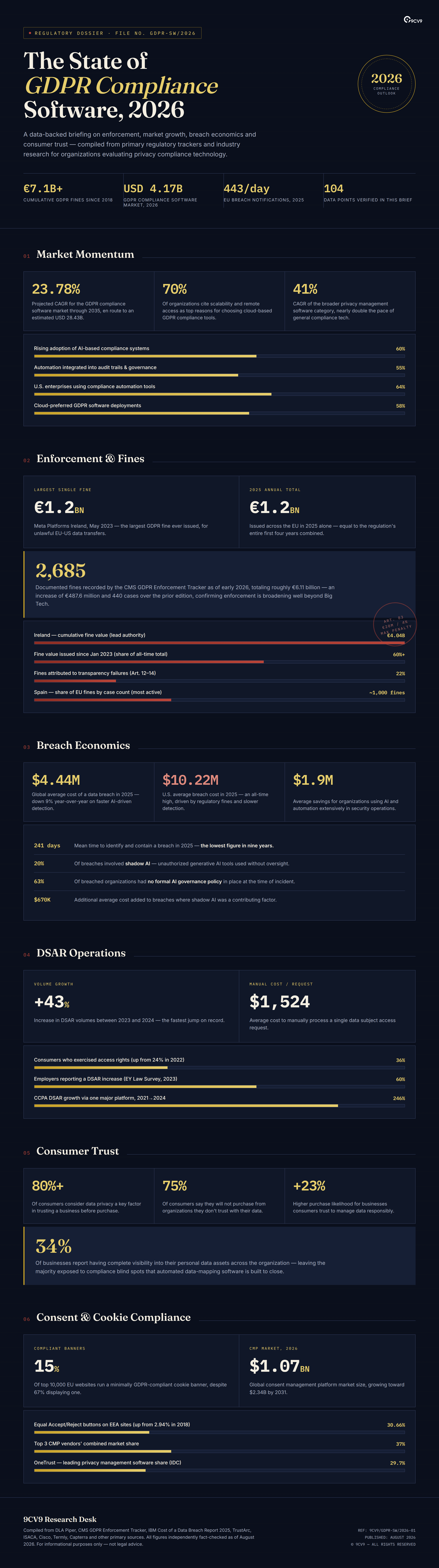
According to market estimates included in this analysis, the global GDPR compliance software market was valued at approximately USD 3.37 billion in 2025 and is projected to reach USD 4.17 billion in 2026. Longer-term forecasts suggest the market could expand to USD 28.43 billion by 2035, representing a compound annual growth rate of approximately 23.78%. These projections highlight the increasing demand for technologies that simplify regulatory compliance, automate privacy workflows, and reduce the operational burden associated with managing sensitive information.

However, the growing adoption of GDPR compliance software is driven by more than regulatory requirements alone. Organizations are increasingly recognizing the financial, operational, and reputational consequences of inadequate data protection.
GDPR enforcement statistics demonstrate the scale of these risks. By January 2026, cumulative GDPR fines had surpassed €7.1 billion since the regulation’s introduction, while approximately €1.2 billion in penalties were issued during 2025 alone. Major enforcement actions, including the €1.2 billion fine against Meta in 2023 and the €530 million penalty against TikTok in 2025, illustrate the significant financial exposure associated with failures in data protection and international data transfers.
For businesses operating in highly regulated environments, these developments reinforce the importance of implementing comprehensive GDPR compliance management systems capable of monitoring data processing activities, maintaining audit trails, managing consent records, and supporting regulatory reporting.
At the same time, the increasing frequency and financial impact of data breaches are accelerating investment in privacy compliance technology. European data protection authorities now receive an average of 443 personal data breach notifications daily, representing a 22% year-over-year increase. Meanwhile, IBM’s 2025 research placed the global average cost of a data breach at USD 4.44 million, demonstrating the substantial financial risks associated with inadequate cybersecurity and data governance.
These challenges are encouraging organizations to move beyond manual compliance processes toward integrated platforms that combine data discovery, risk assessment, breach monitoring, and automated reporting.
Artificial Intelligence and Automation Are Transforming GDPR Compliance
One of the most significant GDPR compliance software trends in 2026 is the growing integration of artificial intelligence and automation into privacy management systems.
The statistics examined in this report indicate that approximately 60% of organizations are implementing AI-based compliance systems, while 55% are integrating automation into audit trails and data governance processes. Additionally, 97% of surveyed governance, risk, and compliance professionals reported using AI to streamline at least part of their workflows.
These developments reflect a broader transition from reactive compliance management toward continuous monitoring, automated risk detection, and proactive data protection.
AI-powered GDPR compliance software can help organizations identify sensitive information, classify personal data, detect potential privacy risks, automate data subject access requests (DSARs), and improve the efficiency of compliance assessments.
However, artificial intelligence also introduces new privacy challenges. Research cited in this analysis indicates that 63% of organizations lacked formal AI governance policies, while shadow AI contributed to 20% of the data breaches examined in IBM’s 2025 report.
Consequently, organizations increasingly need compliance platforms that address both traditional GDPR obligations and emerging risks associated with generative AI, automated decision-making, and AI-driven data processing.
Growing Consumer Privacy Concerns Are Reshaping Business Priorities
Beyond regulatory enforcement and technological innovation, consumer expectations are becoming an increasingly important factor influencing GDPR compliance software adoption.
The statistics compiled for this report suggest that more than 80% of consumers consider data privacy important when deciding whether to trust a business, while approximately 75% report being unwilling to purchase from organizations they do not trust with their personal information.
Furthermore, around 47% of consumers have reportedly switched companies because of poor data practices, highlighting the relationship between responsible information management, customer retention, and brand reputation.
For businesses, these findings suggest that GDPR compliance is no longer exclusively the responsibility of legal, cybersecurity, or information technology departments. Privacy management increasingly influences marketing strategies, customer experience, digital transformation, and long-term business competitiveness.
Organizations that demonstrate transparency, implement effective consent management practices, and provide consumers with greater control over personal information may be better positioned to build lasting customer relationships.
What the Top 104 GDPR Compliance Software Statistics Reveal
The GDPR compliance software landscape in 2026 is characterized by expanding market opportunities, increasing regulatory complexity, rapid technological innovation, and growing demand for automated privacy management solutions.
From multinational enterprises managing complex cross-border data transfers to small and medium-sized businesses seeking affordable compliance tools, organizations are reassessing how they approach data protection.
Cloud-based compliance platforms, automated DSAR management, consent management software, AI-powered risk assessment, and integrated governance solutions are becoming increasingly important components of modern privacy programs.
Nevertheless, significant compliance gaps remain. The data compiled in this report indicates that only 58% of organizations consider themselves fully GDPR-compliant, while 34% continue relying on spreadsheets to manage third-party privacy risks. These findings illustrate the challenges businesses face when attempting to maintain regulatory compliance across increasingly complex digital environments.
This comprehensive collection of the top 104 GDPR compliance software statistics, data, and trends for 2026 examines the most important developments shaping the global privacy technology industry, including market size and growth projections, GDPR enforcement and fines, data breach costs, consumer privacy attitudes, AI adoption, compliance automation, DSAR management, and consent management platforms.
By exploring these statistics, business leaders, compliance professionals, data protection officers, IT decision-makers, software vendors, and investors can gain valuable insights into the evolving GDPR compliance software market, identify emerging opportunities, evaluate regulatory risks, and make more informed decisions about their data privacy strategies.
As organizations prepare for an increasingly data-driven future, understanding these GDPR compliance software trends and statistics in 2026 will be essential for building resilient privacy programs, improving operational efficiency, maintaining regulatory accountability, and strengthening trust in the digital economy.
Before we venture further into this article, we would like to share who we are and what we do.
About 9cv9
9cv9 is a business tech startup based in Singapore and Asia, with a strong presence all over the world.
With over ten years of startup and business experience, and being highly involved in connecting with thousands of companies and startups, the 9cv9 team has listed some of the top and best companies/tools in this review.
If you like to get your company listed in our top B2B software reviews, check out our world-class 9cv9 Media and PR service and pricing plans here.
Top 104 GDPR Compliance Software Statistics, Data & Trends in 2026
Market Size & Growth
1. The global GDPR compliance software market was valued at approximately USD 3.37 billion in 2025 and is projected to reach USD 4.17 billion in 2026, reflecting sustained double-digit demand for privacy automation tools. This trajectory signals that organizations of all sizes are treating GDPR compliance software as a core infrastructure investment rather than a discretionary purchase.
2. Some market forecasts place the GDPR compliance software sector on a path toward USD 28.43 billion by 2035, implying a compound annual growth rate near 23.78% through the next decade. Such an aggressive CAGR underscores how rapidly enterprises are shifting compliance workflows from manual spreadsheets to dedicated software platforms.
3. A separate analysis pegs the broader GDPR/CCPA privacy compliance software category at USD 4.21 billion in 2025, growing to USD 5.38 billion in 2026 before reaching USD 32.67 billion by 2034. The wide variance across market reports highlights how differently analysts scope “GDPR software” versus the broader privacy-tech stack.
4. The adjacent GDPR services market (consulting, audits, and managed compliance) is forecast to hit USD 4.16 billion in 2026, expanding to USD 12.41 billion by 2031. This parallel growth in services demonstrates that software alone is not replacing human compliance expertise, but rather working alongside it.
5. More than 70% of organizations are strengthening their privacy infrastructure investments as a direct driver of GDPR compliance software adoption. This trend confirms that privacy tooling has moved from a reactive legal necessity to a proactive business strategy.
6. Approximately 60% of organizations are now implementing AI-based compliance systems as part of their GDPR strategy. This shift illustrates how artificial intelligence is becoming a standard feature expectation in modern GDPR compliance software rather than an add-on.
7. Around 55% of businesses are integrating automation into their audit trails and data governance frameworks. This statistic shows automation is no longer optional for organizations seeking to withstand regulatory scrutiny efficiently.
8. Roughly 64% of U.S. enterprises have adopted compliance automation tools for risk management and privacy audits. This adoption rate reveals that GDPR-style compliance software has found strong demand even outside the EU, driven by extraterritorial GDPR applicability.
9. Cloud-based GDPR compliance software is increasingly preferred, with approximately 70% of organizations citing scalability and remote access as their primary reasons for choosing cloud deployment. This preference reflects a broader enterprise SaaS shift away from on-premise compliance infrastructure.
10. Roughly 58% of all recent GDPR software deployments now favor cloud-based delivery models over on-premise installations. This majority cloud adoption pattern suggests that vendors prioritizing cloud-native architecture will likely capture the largest share of future market growth.
GDPR Enforcement & Fines
11. Cumulative GDPR fines issued since the regulation took effect in 2018 have surpassed €7.1 billion, according to the DLA Piper GDPR Fines and Data Breach Survey published in January 2026. This milestone illustrates that GDPR enforcement has evolved from sporadic penalties into a sustained, high-value regulatory regime.
12. European regulators issued approximately €1.2 billion in GDPR fines during 2025 alone, matching the entire cumulative total from the regulation’s first four years combined. This single-year figure demonstrates that enforcement intensity has accelerated dramatically since GDPR’s early implementation period.
13. The CMS GDPR Enforcement Tracker Report 2025/2026 documents 2,685 individually recorded fines totaling around €6.11 billion, an increase of €487.6 million and 440 new cases compared to the prior edition. This steady rise in both fine count and value confirms enforcement is broadening beyond isolated high-profile cases.
14. More than 60% of all GDPR fine value recorded since 2018 has been imposed since January 2023, signaling a clear inflection point in regulatory aggressiveness. This concentration of penalties in recent years should push organizations to treat GDPR compliance software adoption as increasingly urgent.
15. The largest single GDPR fine ever issued remains the €1.2 billion penalty against Meta Platforms Ireland in May 2023, imposed by the Irish Data Protection Commission for unlawful EU-US data transfers. This case remains the benchmark example cited across the industry when explaining the maximum financial exposure of non-compliance.
16. The largest GDPR fine issued specifically during 2025 was €530 million against TikTok, levied by the Irish Data Protection Commission for unlawful EU-China data transfers. This penalty reinforces those cross-border data transfer mechanisms remain one of the highest-risk compliance areas software vendors must address.
17. The Irish Data Protection Commission has issued cumulative GDPR fines of roughly €4.04 billion since 2018, representing about 57% of the EU’s total fine value. Ireland’s outsized enforcement role stems largely from its position as lead supervisory authority for major U.S. technology companies headquartered there.
18. France’s CNIL overtook Luxembourg in 2025 to become the second-largest GDPR enforcer by cumulative value, becoming only the second country besides Ireland to exceed €1 billion in total fines. This shift highlights how enforcement leadership can change rapidly as regulators intensify specific campaigns.
19. CNIL issued a €325 million fine against Google and a €150 million fine against Shein, both in September 2025, specifically targeting cookie-consent and ad-tech violations. These decisions underscore that consent management remains one of the most heavily scrutinized areas under GDPR.
20. Spain’s Data Protection Authority remains the most active regulator globally by fine count, having issued nearly 1,000 individual fines since GDPR came into force, more than the combined totals of Italy, Romania, and Poland. This volume-based enforcement style, in contrast with Ireland’s high-value approach, shows that no organization size is too small to attract regulatory attention.
21. The average GDPR fine issued since 2018 stands at approximately €2.4 million. Even though headline fines against Big Tech dominate news coverage, this average reflects a wide distribution of penalties affecting organizations of many different sizes.
22. Maximum GDPR penalties remain fixed at €20 million or 4% of global annual turnover, whichever is higher, for the most severe violations. This ceiling continues to serve as the single most persuasive financial argument for adopting dedicated GDPR compliance software.
23. Transparency failures under GDPR Articles 12-14 account for approximately 22% of all fines issued, making them the third-largest violation category tracked by regulators. This statistic points directly to the value of software tools that automate privacy notice generation and consent documentation.
24. The EDPB has launched a coordinated 2026 enforcement action specifically targeting transparency violations across member states. Organizations relying on manual policy management are especially exposed given this heightened, coordinated regulatory focus.
25. The EU AI Act reaches full enforcement for high-risk systems on August 2, 2026, introducing a parallel penalty structure of up to €35 million or 7% of global turnover. This overlapping enforcement layer means GDPR compliance software increasingly needs to address AI governance requirements alongside traditional data protection.
Data Breaches & Financial Impact
26. European data protection authorities now receive an average of 443 personal data breach notifications per day, a 22% year-over-year increase and the first time the daily average has exceeded 400 since GDPR began. This surge in breach reporting volume is a leading driver of demand for automated breach-notification workflows within GDPR compliance software.
27. The global average cost of a data breach fell 9% in 2025, from USD 4.88 million in 2024 to USD 4.44 million, largely attributed to faster detection and containment enabled by security AI and automation. This decline demonstrates measurable ROI for organizations investing in automated compliance and security tooling.
28. In stark contrast to the global trend, the average cost of a U.S. data breach reached an all-time high of USD 10.22 million in 2025, a 9% year-over-year increase driven by regulatory fines and slower detection times. This divergence illustrates that regulatory exposure, not just technical remediation cost, is now a dominant driver of breach expense.
29. Organizations that used AI and automation extensively in their security operations saved nearly USD 1.9 million on average compared to those without such tools. This figure provides a compelling business case for GDPR compliance software vendors who embed AI-driven monitoring capabilities.
30. The mean time to identify and contain a data breach dropped to 241 days in 2025, the lowest figure recorded in nine years. Faster containment cycles are strongly correlated with the deployment of automated compliance and security monitoring platforms.
31. Shadow AI — unauthorized use of generative AI tools by employees — was a contributing factor in 20% of all data breaches analyzed in IBM’s 2025 report. This finding highlights an emerging compliance blind spot that GDPR software vendors are beginning to address through AI usage governance modules.
32. Breaches involving shadow AI carried notably worse outcomes, with a 247-day average lifecycle versus the 241-day global average, and a 65% rate of customer PII compromise compared to 53% overall. This gap demonstrates the compounding risk of ungoverned AI tools within organizations that lack formal data governance controls.
33. Roughly 63% of organizations studied in IBM’s Cost of a Data Breach Report lacked formal AI governance policies altogether. This governance gap represents a significant opportunity for GDPR compliance platforms that extend their scope to cover AI-related data processing.
34. Only 37% of surveyed organizations had approval processes or oversight mechanisms for AI tool usage in place. This low adoption rate of AI oversight processes reinforces the urgency of embedding AI governance features directly into compliance software roadmaps.
35. Shadow AI usage added an estimated USD 670,000 to average breach costs in IBM’s 2025 analysis. This additional financial exposure gives GDPR compliance software buyers a concrete, quantifiable reason to prioritize AI-aware data discovery capabilities.
36. Data breaches spanning multiple environments cost an average of USD 5.05 million, compared to USD 4.01 million for breaches confined to on-premises systems. This cost differential highlights the growing complexity — and growing compliance risk — of hybrid and multi-cloud data architectures.
37. The healthcare sector recorded an average breach cost of USD 7.42 million in IBM’s 2025 study, remaining among the most expensive industries for data incidents. This figure explains why GDPR compliance software vendors frequently build dedicated healthcare-focused compliance modules.
Data Subject Access Requests (DSARs)
38. DSAR volumes increased by a striking 43% between 2023 and 2024 alone, reflecting rapidly growing public awareness of data access rights. This surge in request volume is one of the clearest indicators that manual DSAR handling processes are becoming operationally unsustainable.
39. Approximately 36% of internet users worldwide exercised their data subject access rights in the most recent reporting year, up sharply from 24% in 2022. This nearly 50% relative increase in consumer engagement with privacy rights signals long-term structural demand for DSAR automation software.
40. Manual DSAR processing costs organizations an average of USD 1,524 per individual request. This per-request cost provides a direct, calculable justification for automated DSAR fulfillment tools embedded in modern GDPR compliance platforms.
41. A separate Gartner survey found that manually processing a single DSAR costs organizations approximately USD 1,400 on average, with most requests taking more than two weeks to complete. The convergence of independent studies around the $1,400-$1,500 range strengthens the case for automation as a cost-control measure.
42. UK companies collectively spend between £70,000 and £330,000 annually on DSAR compliance, with an average cost per request of roughly £1,200. This wide spending range illustrates how DSAR compliance costs scale dramatically with organizational size and request volume.
43. The UK’s Information Commissioner’s Office received more than 15,300 DSAR-related complaints in 2023, a 13.5% increase from the prior year. This steady rise in regulator-level complaints demonstrates that inadequate DSAR handling carries direct enforcement risk, not just operational cost.
44. Under GDPR, organizations generally have just 20-22 working days in practice to complete and respond to a data subject access request within the standard one-month window. This narrow operational window leaves little room for manual, spreadsheet-based data discovery processes.
45. A 2023 EY Law survey found that 60% of surveyed employers reported an increase in DSAR volume over the preceding year. This employer-side data reinforces that DSAR growth is a cross-industry phenomenon extending well beyond consumer-facing sectors.
46. DSAR requests submitted under the CCPA through one major platform grew by 246% between 2021 and 2024, nearly doubling between 2023 and 2024 alone. Although CCPA-specific, this trend closely mirrors the trajectory being observed for GDPR-driven access requests in the EU.
47. GDPR generally requires a response to a DSAR within 30 days of receipt, extendable to 90 days for particularly complex requests. This tightly regulated timeline is a primary reason organizations increasingly deploy automated workflow tools rather than relying on manual case tracking.
48. Fulfilling DSARs manually most frequently proves difficult when locating personal data stored in unstructured formats, according to Gartner-sourced compliance research. This finding validates the growing market for GDPR software that includes automated, cross-system data discovery and mapping features.
Consumer Trust & Privacy Attitudes
49. More than 80% of consumers now consider data privacy a key factor in deciding whether to trust a business. This figure shows privacy has become a competitive differentiator, not simply a legal checkbox, further validating investment in visible compliance infrastructure.
50. Roughly 75% of consumers report they will not purchase from organizations they don’t trust with their personal data. This statistic directly links GDPR compliance to revenue outcomes rather than purely regulatory risk avoidance.
51. About 48% of consumers say they have stopped buying from a business specifically because of privacy concerns. This behavior confirms that poor data practices carry a measurable, ongoing commercial cost beyond potential fines.
52. Approximately 63% of consumers believe most companies are not transparent about how they use personal information. This persistent transparency gap represents a significant opportunity for organizations that use GDPR compliance software to visibly demonstrate accountability.
53. Consumers who trust a business to manage their data responsibly are 23% more likely to purchase from that business. This premium associated with trusted data handling reframes GDPR compliance investment as a growth lever rather than a cost center.
54. Only about 34% of businesses report having complete visibility into their personal data assets across the entire organization. This visibility gap is precisely the operational weakness that data discovery and mapping modules within GDPR compliance software are designed to close.
55. Roughly 86% of global consumers say data privacy is a growing concern for them personally. This near-universal level of concern signals that privacy-conscious product design and communication will only become more commercially important over time.
56. As many as 94% of customers say they refuse to do business with organizations that lack secure data handling practices, according to one 2026 survey. This extremely high figure reinforces that data security failures now carry an almost automatic customer-attrition penalty.
57. Around 47% of consumers report having switched companies specifically because of poor data practices. This churn statistic gives customer retention teams, not just legal departments, a direct stake in GDPR compliance outcomes.
58. Roughly 64% of consumers globally believe they have little control over how companies use and share their personal data. This persistent sense of powerlessness underscores the market opportunity for privacy tools that give consumers self-service access and control features.
59. Only about 21% of U.S. adults say they trust companies to handle their personal data responsibly. This low baseline trust level highlights an outsized opportunity for organizations that can credibly differentiate themselves through demonstrable compliance practices.
60. Approximately 73% of consumers say they are more concerned about their data privacy today than they were just a few years ago. This rising concern trendline suggests regulatory and reputational pressure around data handling will likely continue intensifying rather than plateauing.
61. Around 68% of global consumers report being more concerned about their online privacy compared to a year earlier. This year-over-year increase in concern reflects the compounding effect of frequent high-profile data breach headlines.
62. Just 22% of Americans say they read privacy policies in full before accepting them. This low engagement rate highlights why regulators increasingly focus enforcement on the clarity and design of consent mechanisms rather than the mere existence of a privacy policy.
63. Data privacy laws now protect over 79% of the global population, following continued legislative expansion inspired by GDPR’s original framework. This statistic illustrates GDPR’s role as the effective global template for data protection regulation worldwide.
64. As of 2025, 144 countries had enacted some form of data protection or privacy legislation. This proliferation of GDPR-inspired laws globally is a major reason compliance software vendors increasingly build multi-jurisdictional support into a single platform.
AI, Automation & Compliance Technology
65. 97% of GRC (governance, risk, and compliance) professionals reported using AI to streamline at least part of their workflows in 2026. This near-universal adoption rate confirms AI has moved from experimental feature to baseline expectation within compliance software.
66. Despite rising automation, 34% of organizations still rely on spreadsheets to identify and manage third-party privacy risk. This gap between available automation and actual practice represents continued headroom for GDPR compliance software adoption.
67. 64% of organizations report that compliance technology has provided them with better visibility into organizational risk. This improved visibility is frequently cited as the single most valued outcome of deploying dedicated compliance platforms.
68. 53% of organizations say compliance technology has enabled faster identification of, and response to, compliance issues. This speed advantage is increasingly critical given GDPR’s strict 72-hour breach notification requirement.
69. 92% of organizations now conduct at least two formal compliance audits or assessments annually. This shift toward continuous, rather than annual, compliance monitoring reflects the operational model that modern GDPR software platforms are built to support.
70. 35% of enterprise-level organizations now conduct six or more compliance audits annually, compared to just 15% of non-enterprise firms. This disparity illustrates how compliance burden scales disproportionately with organizational size and complexity.
71. The Global Privacy Index — a composite benchmark of organizational privacy maturity — fell to 53% in 2026, down from 61% in 2025, according to TrustArc’s annual benchmarking report. This decline suggests that the pace of AI adoption is currently outstripping many organizations’ privacy governance capabilities.
72. Organizations with fully integrated privacy programs — including automated data inventory, consent management, and centralized trust centers — achieved an average privacy maturity score of 75%, roughly four times higher than organizations relying on fragmented, manual processes. This gap is one of the clearest quantified arguments for consolidating compliance operations onto a single integrated software platform.
73. 90% of organizations cite AI adoption as a major driver behind the expansion of their privacy programs. This statistic confirms that AI and privacy compliance investment are increasingly intertwined rather than separate initiatives.
74. Privacy risks specifically tied to generative AI usage rose from 22% in 2025 to 34% in 2026 among surveyed organizations. This sharp year-over-year increase highlights an urgent, fast-emerging compliance category that GDPR software vendors are racing to address.
75. The median privacy team size has shrunk to just five employees, down from eight the previous year, according to ISACA’s State of Privacy 2026 report. This staffing contraction is a major structural driver pushing organizations toward automation to maintain compliance coverage.
76. 11% of organizations report having just one full-time employee dedicated to privacy across the entire enterprise. This extreme understaffing pattern makes automated GDPR compliance software effectively mandatory for maintaining adequate coverage.
77. 47% of respondents say their technical privacy team is understaffed, while 37% report the same for their legal and compliance privacy function. This dual staffing shortfall across both technical and legal privacy roles reinforces the case for software that bridges both domains.
78. In Cisco’s 2026 Data and Privacy Benchmark Study, respondents ranked regulatory compliance (41%), workflow automation (25%), and data discovery and classification (15%) as the top three benefits of integrating AI into privacy functions. This ranking closely mirrors the core feature set that leading GDPR compliance software platforms now offer.
79. 75% of organizations identify risk classification as the top benefit realized through data privacy law compliance, according to Cisco’s 2026 study. This finding validates risk-scoring and classification as a foundational software capability rather than an optional add-on feature.
80. 34% of organizations cite data leaks tied to generative AI tools as their top security concern heading into 2026. This concern ranks among the highest-priority risks organizations expect their compliance and security tooling to address going forward.
SME Compliance Gaps & Organizational Readiness
81. Only 58% of organizations report being fully GDPR-compliant, despite the regulation having been in force since 2018. This persistent compliance gap, more than six years after enforcement began, illustrates that achieving full compliance remains genuinely difficult without dedicated software support.
82. Roughly 96% of SME owners do not know the maximum fine percentage of global turnover that can be levied under GDPR. This widespread lack of awareness among small business leaders represents a significant education and market opportunity for accessible compliance software.
83. Around 39% of SME owners are unaware of which types of businesses are legally required to comply with GDPR at all. This fundamental knowledge gap suggests many smaller organizations are operating with unrecognized regulatory exposure.
84. GDPR compliance for a small business can typically be achieved within two to three weeks when using a dedicated compliance automation platform. This relatively short implementation window makes GDPR software an increasingly attractive option compared to lengthy manual or consultant-led compliance projects.
85. GDPR-related compliance risk has historically reduced venture capital investment interest by up to 26% in non-optimized technology companies relative to firms with automated compliance already in place. This “privacy debt” discount demonstrates that GDPR compliance software adoption can materially affect a company’s fundraising and valuation prospects.
86. As of early 2026, 90% of high-value GDPR fines were found to stem specifically from “insufficient legal basis” for data processing, as regulators increasingly deploy automated scans that verify backend system behavior against stated privacy policies. This trend signals that regulators themselves are adopting compliance-verification technology, raising the bar organizations must meet.
87. Under the EU’s Digital Omnibus proposal circulated in late 2025, the Records of Processing Activities exemption threshold was proposed to expand from organizations under 250 employees to those under 750 employees. If adopted, this change would meaningfully reduce documentation burden for a large tier of mid-sized companies currently reliant on manual record-keeping.
88. Only about 19% of enterprises report having full visibility into their end-to-end data processing chains. This low visibility rate across even large organizations demonstrates that data mapping remains one of the most persistently under-solved challenges in GDPR compliance.
Cookie Consent & Consent Management Platforms
89. Only 15% of the top 10,000 websites analyzed across 31 EU and ePrivacy jurisdictions run a minimally GDPR-compliant cookie consent banner, despite 67% of sites displaying some form of consent interface. This gap between “having a banner” and “having a compliant banner” is a major enforcement risk area that consent management software directly targets.
90. The share of websites offering both an equally prominent “Accept” and “Reject” button rose from just 2.94% in 2018 to 30.66% by 2024 across the European Economic Area. This six-year improvement trend shows steady, if incomplete, progress toward compliant consent design practices.
91. Approximately 25.4% of website visitors accept all cookies on their first interaction with a consent banner, while 33.6% ignore the banner entirely. This behavioral split illustrates why banner design choices have such an outsized impact on both compliance posture and data collection outcomes.
92. Banner design has a dramatic effect on outcomes: 55.16% of banners built on one leading consent management platform include a genuine reject button, compared to just 13.39% for generic, non-specialized plugin banners. This gap demonstrates the tangible compliance value of purpose-built consent management software over generic implementations.
93. Just three consent management platform vendors collectively control 37% of the CMP market. This concentration highlights the extent to which a small number of specialized providers now shape cookie consent experiences across the majority of GDPR-affected websites.
94. The global consent management platform market was valued at approximately USD 0.91 billion in 2025, projected to reach USD 1.07 billion in 2026 and USD 2.34 billion by 2031. This steady growth trajectory reflects consent management’s position as one of the most mature and widely adopted subcategories of GDPR compliance software.
95. Leading consent management vendors OneTrust, TrustArc, and BigID collectively hold an estimated 55% share of the broader consent management market. This concentration among top-tier vendors reflects strong enterprise preference for established, full-suite privacy platforms.
96. The software segment specifically accounted for 68.3% of total consent management market revenue in 2025, versus services and consulting. This split confirms that organizations increasingly prefer to self-serve consent compliance through software rather than relying primarily on outside consultants.
Software Landscape & Capterra Category Insights
97. The Capterra GDPR Compliance Software directory lists 25+ actively reviewed products on its first page alone, spanning specialized cookie consent tools, full privacy management suites, and broader governance-risk-compliance (GRC) platforms. This breadth demonstrates that “GDPR compliance software” functions as an umbrella category rather than a single tool type.
98. Among the highest Capterra-rated GDPR compliance products is Pandectes GDPR Compliance, holding a perfect 5.0-out-of-5 rating across 60 reviews, reflecting strong satisfaction within its Shopify-focused niche. This high satisfaction score for a narrowly scoped tool suggests vertical-specific GDPR solutions can achieve exceptional user sentiment.
99. Scrut Automation holds a 4.9-out-of-5 Capterra rating across 139 reviews, positioning it among the top-reviewed broader GDPR automation platforms on the directory. Its strong volume-adjusted rating reflects growing enterprise appetite for platforms that combine policy automation, risk checks, and evidence collection in one interface.
100. Axeptio, a consent management-focused GDPR tool, holds a 4.9-out-of-5 Capterra rating across 61 reviews, reinforcing that consent-specific tools continue to earn strong user satisfaction within the broader compliance category. This performance suggests focused, single-purpose consent tools remain highly competitive against larger all-in-one suites.
101. Cookiebot CMP reports facilitating over 6.7 billion user consent interactions monthly and is trusted by more than 2.1 million websites globally, according to vendor-reported figures. This scale illustrates just how deeply consent management technology has been embedded into everyday web infrastructure worldwide.
102. OneTrust, one of the most widely recognized names in the GDPR compliance software space, is used by more than 5,000 companies to manage compliance with GDPR, CCPA, ISO 27001, and hundreds of other global privacy and security regulations. This multi-regulation coverage exemplifies the industry trend toward consolidated, all-in-one privacy management platforms rather than single-regulation point solutions.
103. IDC estimated OneTrust’s market share within the broader privacy management software category at 29.7%, more than double that of its nearest competitor. This commanding lead illustrates significant market consolidation at the top of the GDPR and privacy software category, even as the long tail of specialized vendors remains highly fragmented.
104. The broader privacy management software market was projected to grow from USD 2.7 billion in 2023 to USD 15.2 billion by 2028, representing a 41% compound annual growth rate. This exceptionally high growth rate for the privacy management subsegment specifically underscores just how much faster privacy-focused software is expanding relative to the broader compliance software category overall.
Conclusion
The top 104 GDPR compliance software statistics, data, and trends in 2026 reveal an industry experiencing significant transformation, driven by stricter regulatory enforcement, growing cybersecurity threats, increasing consumer privacy expectations, and rapid advancements in artificial intelligence and automation. As organizations manage increasingly complex data environments, GDPR compliance software is evolving from a specialized regulatory tool into an essential component of enterprise risk management, data governance, and digital business operations.
The global GDPR compliance software market, projected to reach approximately USD 4.17 billion in 2026 and potentially USD 28.43 billion by 2035, demonstrates the expanding demand for automated privacy management solutions. Businesses are increasingly adopting platforms that simplify regulatory reporting, automate data subject access requests (DSARs), manage cookie consent, monitor data processing activities, and improve compliance visibility across multiple jurisdictions.
Meanwhile, GDPR enforcement continues to reinforce the financial importance of effective data protection. With cumulative GDPR fines surpassing €7.1 billion by January 2026 and approximately €1.2 billion in penalties issued during 2025, organizations face substantial consequences for inadequate privacy practices. These figures highlight why investing in comprehensive GDPR compliance management software is increasingly viewed as a strategic risk mitigation measure rather than merely an administrative expense.
Artificial intelligence and compliance automation are also reshaping the future of GDPR software. With approximately 60% of organizations implementing AI-based compliance systems and 97% of surveyed governance, risk, and compliance professionals using AI to streamline workflows, automation is becoming increasingly important for managing privacy obligations efficiently. AI-powered data discovery, automated risk assessments, continuous compliance monitoring, and intelligent breach detection offer opportunities to reduce manual workloads and improve operational responsiveness.
However, emerging technologies also introduce additional challenges. The growing use of generative AI, shadow AI applications, and complex cloud infrastructures creates new privacy risks that traditional compliance processes may struggle to address. Organizations must therefore balance technological innovation with responsible data governance, transparent processing practices, and effective human oversight.
Consumer expectations further emphasize the commercial importance of GDPR compliance. With more than 80% of consumers considering data privacy important when evaluating business trustworthiness and approximately 75% unwilling to purchase from companies they do not trust with personal information, privacy protection has become closely connected to brand reputation, customer loyalty, and long-term business growth.
Despite increasing investment in privacy technology, meaningful compliance gaps remain. The statistics examined in this report indicate that only 58% of organizations consider themselves fully GDPR-compliant, while 34% continue using spreadsheets to manage third-party privacy risks. These findings suggest considerable opportunities for businesses to modernize their compliance processes through integrated privacy management platforms, automated documentation, and centralized data governance systems.
Looking ahead, several developments are likely to shape the GDPR compliance software market beyond 2026, including greater adoption of cloud-based privacy solutions, increased integration between cybersecurity and compliance platforms, expanding AI governance capabilities, more sophisticated consent management technologies, and growing demand for affordable compliance software among small and medium-sized enterprises.
For organizations evaluating GDPR compliance software, the priority should not simply be purchasing additional technology. Instead, businesses should focus on selecting solutions that align with their regulatory obligations, data processing activities, operational complexity, cybersecurity requirements, and long-term privacy objectives. Effective implementation, employee training, ongoing monitoring, and regular compliance assessments remain essential because software alone cannot guarantee GDPR compliance.
Ultimately, the GDPR compliance software statistics for 2026 demonstrate that data privacy is becoming a fundamental pillar of sustainable digital business growth. Organizations that proactively invest in privacy automation, strengthen data governance, and establish transparent information management practices will be better positioned to navigate regulatory changes, reduce operational risks, and maintain customer confidence.
As the global privacy technology landscape continues to evolve, businesses that treat GDPR compliance as an ongoing strategic responsibility rather than a one-time regulatory exercise will be better equipped to build resilient operations, protect sensitive information, and compete successfully in an increasingly privacy-conscious digital economy.
If you find this article useful, why not share it with your hiring manager and C-level suite friends and also leave a nice comment below?
We, at the 9cv9 Research Team, strive to bring the latest and most meaningful data, guides, and statistics to your doorstep.
To get access to top-quality guides, click over to 9cv9 Blog.
To hire top talents using our modern AI-powered recruitment agency, find out more at 9cv9 Modern AI-Powered Recruitment Agency.
People Also Ask
What is GDPR compliance software?
GDPR compliance software helps organizations manage personal data, automate privacy workflows, maintain compliance records, process data subject requests, and support compliance with the European Union’s General Data Protection Regulation.
How big is the GDPR compliance software market in 2026?
The global GDPR compliance software market is projected to reach approximately USD 4.17 billion in 2026, up from USD 3.37 billion in 2025, reflecting growing demand for automated data privacy and regulatory compliance solutions.
What is the projected growth rate of the GDPR compliance software market?
The GDPR compliance software market is forecast to grow at a compound annual growth rate of approximately 23.78%, potentially reaching USD 28.43 billion by 2035.
What are the biggest GDPR compliance software trends in 2026?
Major GDPR software trends include AI-powered compliance automation, cloud-based privacy management, automated data discovery, consent management platforms, continuous risk monitoring, and integrated data governance solutions.
How much have companies paid in GDPR fines since 2018?
Cumulative GDPR fines surpassed €7.1 billion by January 2026. Major penalties involving international data transfers, consent violations, and inadequate data protection demonstrate the financial risks of non-compliance.
What is the maximum GDPR fine a company can receive?
For the most serious GDPR violations, organizations can face fines of up to €20 million or 4% of their total worldwide annual turnover, whichever is higher.
What was the largest GDPR fine ever issued?
The largest GDPR fine recorded in the report was €1.2 billion, imposed on Meta Platforms Ireland in May 2023 over unlawful transfers of European users’ personal data to the United States.
How many GDPR fines were issued in 2025?
The source report records approximately €1.2 billion in GDPR fines during 2025. It also cites 2,685 individually recorded enforcement penalties in the CMS GDPR Enforcement Tracker 2025/2026.
How much does a data breach cost businesses in 2026?
IBM’s 2025 Cost of a Data Breach Report estimated the global average breach cost at USD 4.44 million. In the United States, the average reached USD 10.22 million, highlighting substantial financial exposure.
How many data breaches are reported under GDPR each day?
European data protection authorities received an average of 443 personal data breach notifications daily, representing a 22% year-over-year increase, according to figures cited in the 2026 report.
How does GDPR compliance software help prevent data breaches?
GDPR compliance software supports data discovery, privacy risk assessments, processing records, and breach reporting. Some platforms integrate security monitoring, although compliance software alone cannot prevent every cyberattack.
What percentage of organizations use AI for GDPR compliance?
Approximately 60% of organizations are implementing AI-based compliance systems, reflecting growing interest in automated risk assessments, privacy monitoring, data classification, and regulatory reporting.
How is artificial intelligence transforming GDPR compliance software?
AI helps automate personal data discovery, classify sensitive information, identify privacy risks, streamline compliance assessments, and support data subject access request management.
What percentage of compliance professionals use AI in 2026?
According to the report, 97% of surveyed governance, risk, and compliance professionals used AI to streamline at least part of their workflows in 2026.
What are the benefits of GDPR compliance automation?
GDPR compliance automation can reduce manual administration, improve audit readiness, streamline consent management, accelerate privacy request processing, and provide greater visibility into data protection risks.
What is a Data Subject Access Request (DSAR)?
A Data Subject Access Request allows individuals to request access to personal information an organization processes about them. GDPR compliance software can help manage request tracking, data discovery, and responses.
How much does manual DSAR processing cost?
The report cites an average manual DSAR processing cost of approximately USD 1,524 per request. A separate Gartner estimate places the average at around USD 1,400.
How long do businesses have to respond to GDPR data access requests?
Organizations generally must respond to GDPR data access requests within one month. This deadline may be extended by two additional months when requests are complex or numerous, subject to GDPR requirements.
Are data subject access requests increasing?
Yes. The report indicates that DSAR volumes increased by approximately 43% between 2023 and 2024, reflecting greater consumer awareness of privacy rights and increasing demand for automated request management.
What percentage of organizations are fully GDPR-compliant?
Approximately 58% of organizations surveyed reported being fully GDPR-compliant, according to the source report. This highlights continuing challenges in data governance, privacy documentation, and regulatory readiness.
Why is GDPR compliance software important for small businesses?
GDPR compliance software helps small businesses organize privacy records, manage consent, respond to personal data requests, and reduce administrative workloads while supporting compliance with applicable regulations.
How long does GDPR compliance software implementation take?
The report suggests that some small businesses can implement GDPR compliance automation within two to three weeks. Actual timelines depend on organizational complexity, existing systems, data processing activities, and compliance gaps.
What percentage of organizations use cloud-based GDPR compliance software?
Approximately 58% of recent GDPR software deployments favor cloud-based solutions, while around 70% of organizations cite scalability and remote accessibility as important reasons for choosing cloud deployment.
What is consent management software under GDPR?
Consent management software helps organizations collect, record, manage, and demonstrate user consent for personal data processing. It commonly supports cookie preferences, consent withdrawal, and privacy compliance documentation.
How big is the consent management platform market in 2026?
The global consent management platform market is projected to reach approximately USD 1.07 billion in 2026, increasing from USD 0.91 billion in 2025 and potentially reaching USD 2.34 billion by 2031.
What percentage of websites have GDPR-compliant cookie banners?
The report cites research indicating that only 15% of the top 10,000 websites analyzed across 31 European jurisdictions displayed minimally compliant cookie consent banners.
What are the most important features of GDPR compliance software?
Important features include data mapping, consent management, DSAR automation, privacy impact assessments, breach reporting, audit trails, vendor risk assessments, and regulatory compliance monitoring.
How does GDPR compliance software improve customer trust?
GDPR compliance software supports transparent data handling, privacy rights management, and documented accountability. The report indicates that more than 80% of consumers consider data privacy important when evaluating business trustworthiness.
What challenges do organizations face with GDPR compliance in 2026?
Major challenges include increasing regulatory complexity, limited privacy staffing, shadow AI risks, fragmented personal data, manual compliance processes, rising DSAR volumes, and managing information across multiple cloud environments.
What is the future of GDPR compliance software beyond 2026?
GDPR compliance software is expected to evolve through greater AI integration, automated privacy monitoring, cloud adoption, advanced consent management, and multi-jurisdictional support as businesses strengthen their data protection strategies.
Sources
Available upon request