Key Takeaways
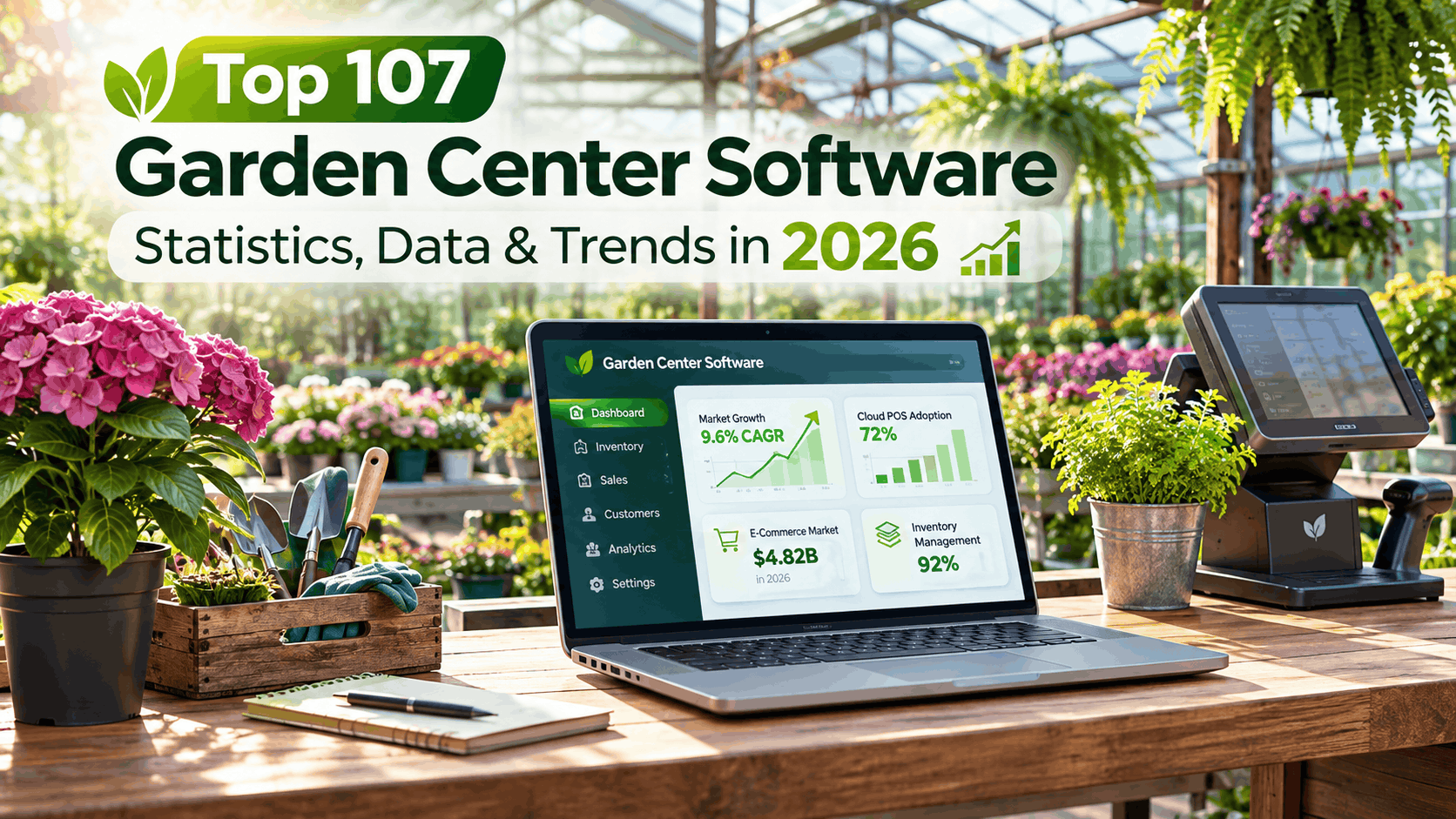
- Garden Center Software Market Growth: The global garden center software market is projected to grow from $1.80 billion in 2025 to $4.12 billion by 2034, at a 9.6% CAGR, driven by digital transformation and demand for specialized horticultural retail solutions.
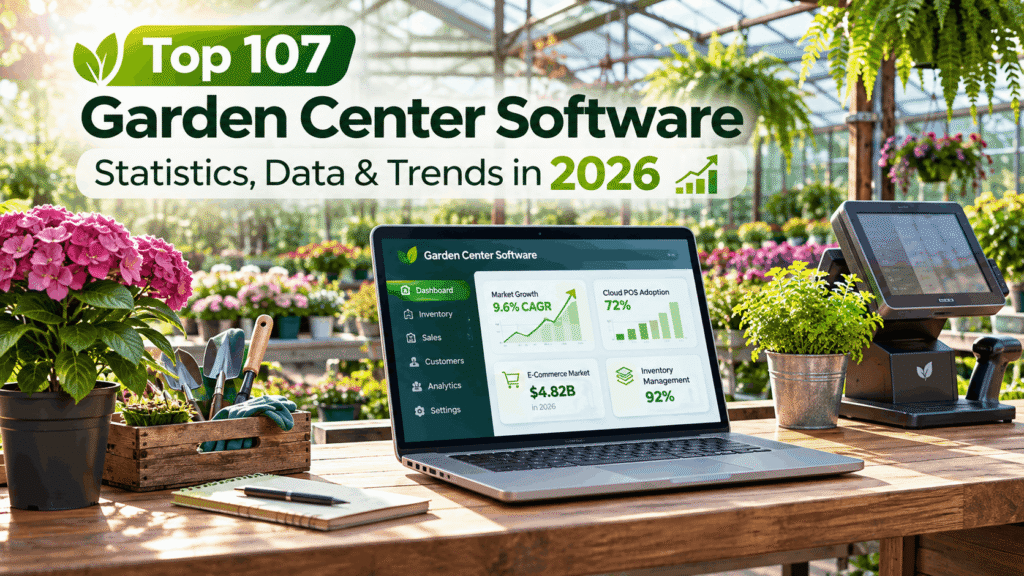
- Cloud POS and Inventory Management Adoption: Approximately 72% of retailers use cloud-based POS systems, while 92% of garden center software products offer inventory management features, highlighting the importance of automation and real-time stock tracking.
- AI and E-Commerce Trends: The online plant nursery market is projected to reach $6.49 billion by 2030, while only 4% of garden center software products offer native generative AI capabilities, revealing significant opportunities for innovation.
Garden center software in 2026 helps nurseries, greenhouses, and plant retailers manage inventory, sales, and customer relationships. The global market is projected to grow from $1.80 billion in 2025 to $4.12 billion by 2034, driven by cloud-based POS systems, e-commerce integration, automation, and emerging artificial intelligence technologies.
The garden center industry is undergoing a significant digital transformation as nurseries, greenhouses, plant retailers, and independent garden centers increasingly adopt specialized software to streamline operations, manage inventory, improve customer experiences, and drive profitability. In 2026, garden center software has become an increasingly important investment for horticultural businesses looking to remain competitive in a rapidly evolving retail environment.

From cloud-based point-of-sale (POS) systems and inventory management platforms to artificial intelligence (AI), customer relationship management (CRM), and e-commerce integrations, modern garden center software is changing how businesses manage their daily operations.
According to industry estimates, the global garden center software market was valued at approximately $1.80 billion in 2025 and is projected to reach $4.12 billion by 2034, representing a compound annual growth rate (CAGR) of 9.6%. This projected expansion reflects growing demand for specialized retail technology, automated inventory tracking, omnichannel commerce, and data-driven business management.
Despite these developments, digital adoption remains uneven. An estimated 58% of independent garden centers across North America and Europe continue to rely on outdated POS systems or generic enterprise resource planning (ERP) solutions that lack horticulture-specific capabilities. This creates substantial opportunities for software providers offering specialized solutions for plant inventory, seasonal pricing, supplier management, and customer engagement.
The broader retail technology landscape also highlights the growing importance of digital transformation. Industry estimates suggest that:
- 72% of retailers were using cloud-based POS systems by 2025, reflecting the shift toward flexible, subscription-based retail management platforms.
- 92% of garden center software products listed on Capterra offer inventory management functionality, demonstrating its importance in horticultural retail operations.
- 80% of POS providers offer subscription-based SaaS pricing, making modern retail technology more accessible to small and medium-sized businesses.
- 65% of retailers consider real-time inventory tracking essential for reducing shrinkage and improving stock management.
- Only approximately 4% of garden center software products currently advertise native generative AI capabilities, highlighting significant opportunities for future innovation.
These figures illustrate how garden center management software is evolving beyond traditional checkout systems into integrated business platforms supporting inventory control, customer loyalty, financial management, online sales, and operational analytics.
Meanwhile, changing consumer purchasing behaviors are accelerating demand for omnichannel capabilities. The global online plant nursery market is estimated at $4.82 billion in 2026 and projected to reach $6.49 billion by 2030, growing at approximately 7.7% annually. As more consumers purchase plants, gardening supplies, and horticultural products online, garden centers increasingly need software that connects physical stores with digital storefronts, payment processing, inventory databases, and delivery management systems.
However, technology adoption is not simply about increasing sales. Garden centers face distinctive operational challenges, including seasonal demand fluctuations, perishable inventory, plant labeling requirements, unpredictable weather conditions, and fluctuating customer spending.
For example, only 43% of garden centers reported increased spring sales in 2025, while 75% raised plant prices by between 1% and 10%. These market conditions reinforce the importance of accurate demand forecasting, efficient inventory planning, flexible pricing, and stronger financial visibility.
Artificial intelligence is also emerging as a potential growth driver for the garden center software market. Although native generative AI functionality remains relatively uncommon among specialized platforms, AI-powered demand forecasting, personalized plant recommendations, automated customer support, and intelligent inventory optimization could reshape the industry over the coming years.
For garden center owners, nursery operators, greenhouse managers, software developers, technology vendors, and investors, understanding these developments is essential for identifying opportunities and making informed business decisions.
This comprehensive guide to the Top 107 Garden Center Software Statistics, Data & Trends in 2026 examines the latest available market estimates, industry benchmarks, software adoption patterns, pricing models, customer preferences, and emerging technologies shaping the horticultural retail software landscape.
It explores key areas including garden center software market size and growth, POS technology adoption, cloud-based SaaS solutions, inventory management, software pricing, e-commerce integration, consumer gardening trends, sustainability, and artificial intelligence.
Whether a business is evaluating the best garden center software, planning a digital transformation strategy, comparing nursery management systems, or researching investment opportunities in horticultural technology, these 107 statistics provide a data-driven foundation for understanding where the garden center software industry stands in 2026 and how it may evolve beyond 2027.
Before we venture further into this article, we would like to share who we are and what we do.
About 9cv9
9cv9 is a business tech startup based in Singapore and Asia, with a strong presence all over the world.
With over ten years of startup and business experience, and being highly involved in connecting with thousands of companies and startups, the 9cv9 team has listed some of the top and best companies/tools in this review.
If you like to get your company listed in our top B2B software reviews, check out our world-class 9cv9 Media and PR service and pricing plans here.
Top 107 Garden Center Software Statistics, Data & Trends in 2026
A. Market Size, Growth & Industry Value
- The global garden center software market was valued at $1.80 billion in 2025 and is projected to reach $4.12 billion by 2034, growing at a 9.6% CAGR.
- An estimated 58% of independent garden centers in North America and Europe still run on outdated POS or generic ERP systems that lack horticulture-specific functionality, creating a multi-year modernization opportunity.
- Separate market analysts place the garden centre software category’s CAGR anywhere between roughly 7% and 11% depending on scope and forecast window, reflecting how fragmented and early-stage this software niche still is.
- The global cloud POS market — the infrastructure layer underlying most modern garden center software — could surpass $5 billion by 2026.
- North America held the largest share of the global cloud POS market in 2025, at 33.1% of total revenue.
- U.S. garden center retail sales totaled $28.5 billion in 2022, representing the addressable base for horticultural retail software vendors.
- The broader U.S. nursery and garden stores industry expanded to roughly $50.1 billion in 2026.
- U.S. lawn & garden retail sales are projected to reach nearly $94 billion in 2026.
- The global gardening equipment market reached $95.2 billion in 2023 and is projected to hit $132.4 billion by 2030, a 4.8% CAGR.
- The U.S. plant and flower growing industry is projected to reach $20.9 billion in revenue by 2025, underscoring the scale of inventory that garden center software must track.
B. Capterra Garden Center Software Category Landscape
- Capterra’s Garden Center Software directory lists 25 distinct vendor products as of 2026, spanning POS, greenhouse ERP, labeling, and nursery-specific tools.
- Bindo POS is the most-reviewed product in the category, holding a 3.8-out-of-5 rating across 146 verified reviews.
- POS Nation for Retail holds a 4.6-out-of-5 rating from 133 reviews, at a flat starting rate of $149/month.
- KORONA POS earns a 4.7-out-of-5 rating from 80 reviews and starts at just $59/month, the most accessible flat monthly entry price among the category’s most-reviewed products.
- eposbuddy posts the highest rating among products with 50+ reviews, at 4.8 out of 5 across 66 reviews.
- ACE Retail POS scores 4.4 out of 5 from 38 reviews, with a one-time flat fee starting at $675.
- ACCEO Smart Vendor, built specifically to optimize garden centre inventory, CRM and omnichannel operations, holds a 4.3-out-of-5 rating from 32 reviews at CA$1,095 one-time.
- Cash Register Express records the lowest average rating among the ten most-reviewed products in the category, at 3.3 out of 5 from 30 reviews.
- Paladin Point of Sale and Inventory Management earns 4.6 out of 5 from 20 reviews and connects with 11+ third-party tools.
- GroundsKeeper Pro, aimed at small-to-medium lawn and landscaping businesses, rates 4.1 out of 5 from 14 reviews with no recurring monthly fees.
- Rapid Garden POS, purpose-built for garden centers, nurseries, greenhouses and landscaping businesses, carries the highest disclosed starting price in the category at $8,000 one-time.
- RealTime POS connects with 17+ software tools — the most of any product in the category — while holding a 4.2-out-of-5 rating from 11 reviews.
- Epicor Propello holds a 4.0-out-of-5 rating from 5 reviews among hardgoods-focused retail management solutions.
- MyPlantShop achieves a perfect 5.0-out-of-5 rating across its 3 published reviews.
- Picas, a greenhouse management platform serving the floriculture and horticulture industries since 1991, rates 4.0 out of 5 from 3 reviews.
- Both Gardenware Labeling Software and SLICEplus post perfect 5.0-out-of-5 ratings, though each currently has only a single published review.
- The average overall rating across the 11 garden center software products with 10 or more reviews is approximately 4.3 out of 5.
- The three most-reviewed products in the category — Bindo POS, POS Nation, and KORONA POS — together account for 359 combined verified reviews.
- At least 8 of the 25 listed products (roughly 32%) have fewer than 10 published reviews, pointing to a long tail of niche or regional horticultural software vendors.
- Atlas Core is currently the only product in the category listing both “AI Copilot” and “Generative AI” as available features.
C. Pricing & Integration Ecosystem on Capterra
- Starting prices for garden center software listed on Capterra range from $59/month (KORONA POS) up to an $8,000 one-time license (Rapid Garden POS), a more than 130x spread.
- Seven of the vendors reviewed disclose a free-trial option, giving prospective buyers a no-commitment way to test horticultural-specific POS workflows.
- Shopify is the single most commonly cited e-commerce integration across the category, appearing among the top integrations of at least five separate garden center software products.
- QuickBooks Online Advanced ranks among the top disclosed integrations for at least four different garden center software platforms.
- WooCommerce integration is listed among the most popular connections for at least five garden center software products, reflecting strong demand for hybrid in-store/online plant sales.
- RealTime POS’s 17+ integrations include five separate e-commerce storefront platforms — Shopify, WooCommerce, BigCommerce, PrestaShop, and OpenCart — the broadest e-commerce integration spread in the category.
- Rapid Garden POS integrates with shipping-focused tools including ShipStation and ShippingEasy, reflecting the growing importance of live-plant fulfillment logistics.
D. Feature Adoption Across Garden Center Software
- Inventory Management is listed as an available feature in roughly 92% of garden center software products on Capterra, confirming it as the category’s baseline requirement.
- Customer Management functionality is available in the large majority of listed garden center products, reflecting the retail-CRM roots of the category.
- Billing & Invoicing capability is present in most listed garden center software platforms.
- Barcoding/RFID support is available in roughly half of the category’s most-reviewed products, a gap that matters most for high-SKU nurseries handling live plant tagging.
- Loyalty Program functionality appears as an available feature in nearly all top-tier POS-focused listings in the category.
- Discount Management is broadly available across the category, supporting seasonal plant markdowns and perishable-inventory clearance pricing.
- Accounting functionality (native or via integration) is available in roughly half of listed products.
- Only about 4% of garden center software products currently advertise native Generative AI capability, showing AI adoption remains nascent in horticultural retail software relative to broader retail tech.
- Electronic Signature support is present in roughly 40% of listed products.
- Employee Management functionality is present in the majority of top-tier POS-focused garden center products.
E. POS & Retail Technology Trends (Broader Context)
- Over 60% of retailers now operate cloud-based POS systems.
- 78% of small businesses prefer cloud POS specifically because of lower upfront costs.
- Mobile POS adoption cuts checkout times by 41% on average.
- 53% of retail transactions in 2024 were contactless.
- 82% of POS terminals now accept tap-to-pay payments.
- Multi-system integration improves operational efficiency by 28% across multi-store retail enterprises.
- Cloud-connected POS systems enable inventory accuracy exceeding 97%, virtually eliminating manual stock-count errors.
- Roughly 71 million POS terminals were deployed globally in 2024.
- 72% of retailers reported using cloud-based POS systems as of 2025.
- 80% of POS providers now offer subscription-based SaaS pricing, with entry tiers starting as low as $29/month.
- 65% of U.S. small businesses had adopted cloud POS solutions by 2023.
- 70% of UK retailers had adopted cloud POS solutions by the same year.
- Intuitive POS interfaces can cut new-staff training time by up to 40% — a meaningful factor for garden centers with heavy seasonal hiring.
- Scalable POS platforms with advanced inventory and CRM capabilities are associated with roughly 25% faster growth among small retailers.
- 78% of retailers cite customer data-breach prevention as a top POS security priority.
- 65% of retailers say real-time inventory tracking is crucial for reducing shrinkage — especially relevant for perishable plant stock.
F. Cloud, SaaS & IT Spending Benchmarks
- The global SaaS market is valued at roughly $465 billion in 2026.
- Retail-sector SaaS budgets grew approximately 22% in 2025, a trend continuing into 2026.
- SMB SaaS subscription costs have grown 25% year-over-year since 2022.
- Small businesses typically allocate 4% to 6% of annual revenue to IT spending overall.
- Retail and light-manufacturing businesses tend to sit at the lower end of that range, spending 2% to 4% of revenue on IT.
- A practical SMB IT budget benchmark is $1,500–$3,500 per employee per year.
- Worldwide IT spending is projected to grow 10.8% in 2026.
- 69% of organizations expect their IT budgets to increase in 2026.
- The average company now manages 106 SaaS applications, down from a 2022 peak of 130 — a sign of software-stack consolidation that favors purpose-built vertical tools over generic ones.
- Global software spending is growing at 15.1% as licensing shifts from perpetual models to SaaS subscriptions.
G. E-Commerce & Online Plant Sales
- The global online plant nursery market is estimated at $4.82 billion in 2026, projected to reach $6.49 billion by 2030 at a 7.7% CAGR.
- Online houseplant sales in the U.S. grew 42% in 2023 compared to the prior year.
- Traditional brick-and-mortar garden centers retained 50.1% market share of nursery/plant sales in 2025 despite e-commerce growth, pointing to a hybrid retail model that favors omnichannel-capable software.
- Roughly 19% of plant buyers expect to increase their spending at online plant shops going forward.
- Online plant e-commerce sales are projected to grow at a 10.05% CAGR through 2031, outpacing the broader indoor plant market.
- Millennials and Gen Z together account for over 60% of new online plant buyers.
- Roughly 20% of online plant orders face delivery or damage issues, a persistent operational challenge that shipping-integrated garden center software aims to reduce.
H. Independent Garden Center Industry Performance (U.S.)
- Only 43% of garden centers reported an increase in spring 2025 sales versus the prior year — the second-smallest share reporting growth in the past decade.
- 2020 marked the decade’s high point, with 87% of garden centers reporting a spring sales increase.
- 2022 recorded the decade’s lowest share of garden centers reporting a spring sales increase, at just 39%.
- 75% of garden centers raised plant prices by 1–10% in 2025, roughly on par with the prior year.
I. Gardening Consumer Demographics & Spending
- 55% of U.S. households participated in food gardening in 2022.
- An estimated 80 million U.S. households maintain a garden, spending an average of $500 per year.
- Women account for 57% of U.S. gardening participants.
- Gen Z (ages 18–24) gardening participation rose 25% in the U.S. in 2023.
- The U.S. gardening industry directly employs 1.2 million people.
- U.S. gardening activity contributes an estimated $200 billion to GDP annually.
- 78% of U.S. gardeners adopted container gardening after 2020.
- Hydroponic home system usage rose 45% globally since 2021.
- Native plant usage in U.S. gardens rose 32% in 2023.
- AI-powered garden apps were downloaded 15 million times globally in 2023.
- Home centers captured a 43.0% share of U.S. lawn & garden spend in 2025, up 5 points year-over-year.
- Online delivery channels hit a record 45.9% share of U.S. lawn & garden spend in 2025.
- The U.S. gardening participant base actually contracted in 2025 for the first time since 2019 — even as total category spending hit an all-time high, showing fewer but higher-spending “committed” gardeners.
- 88% of Americans grow plants or grass at home.
- 94% of 16–34-year-olds actively engage in DIY/home-improvement shopping, a category closely tied to garden retail.
- UK garden centers employ approximately 250,000 seasonal workers.
J. Sustainability, AI & Future Trends
- 65% of U.S. gardeners report using sustainable practices such as composting.
- 52% of Australian gardeners have adopted water-saving irrigation practices.
- EU restrictions on peat-based compost drove an 80% shift toward alternative growing media.
- 75% of millennials say they prioritize eco-friendly products when gardening.
- Nearly half of retailers overall are targeting AI implementation in their operations by 2026.
- 63% of organizations already manage AI-related software spend as of 2025, with adoption projected to reach 96% by 2026.
- Just 4% of garden center software vendors on Capterra currently ship native generative-AI features — signaling significant headroom for AI-driven plant care recommendations, demand forecasting, and dynamic seasonal pricing in the years ahead.
Conclusion
The garden center software industry in 2026 is experiencing significant transformation as horticultural retailers, nurseries, greenhouses, and independent garden centers increasingly embrace digital technologies to improve operational efficiency, enhance customer experiences, and support sustainable business growth.
The Top 107 Garden Center Software Statistics, Data & Trends in 2026 highlight a market driven by cloud-based point-of-sale (POS) systems, advanced inventory management, e-commerce integration, artificial intelligence (AI), and growing demand for specialized horticultural retail solutions.
With the global garden center software market projected to grow from $1.80 billion in 2025 to $4.12 billion by 2034, at a CAGR of 9.6%, the industry presents substantial opportunities for software developers, technology providers, investors, and garden center operators.
Several important findings illustrate the industry’s direction:
- Cloud-Based Software Adoption: Approximately 72% of retailers were using cloud-based POS systems by 2025, demonstrating growing demand for scalable, accessible, and subscription-based retail technology.
- Inventory Management Priorities: Roughly 92% of garden center software products listed on Capterra include inventory management capabilities, reinforcing the importance of accurate stock tracking, seasonal planning, and inventory optimization.
- E-Commerce Expansion: The global online plant nursery market is projected to reach $6.49 billion by 2030, creating opportunities for garden centers to integrate physical retail operations with online sales channels.
- Artificial Intelligence Opportunities: Only approximately 4% of garden center software products currently advertise native generative AI functionality, indicating considerable potential for intelligent forecasting, personalized customer experiences, and automated business processes.
- Digital Modernization: An estimated 58% of independent garden centers in North America and Europe still use outdated POS systems or generic ERP solutions, suggesting substantial opportunities for specialized software adoption.
- Software Pricing Accessibility: Garden center software pricing ranges from approximately $59 per month for entry-level POS solutions to $8,000 for certain one-time licensing options, allowing businesses to evaluate different deployment and investment models.
Beyond these statistics, the industry’s evolution reflects a broader shift toward integrated, data-driven garden center management systems that connect inventory, sales, customer relationships, accounting, supplier management, and digital commerce within unified platforms.
However, successful technology adoption requires more than purchasing software. Garden center operators must evaluate their business requirements, seasonal demand patterns, integration capabilities, employee training needs, cybersecurity risks, and total cost of ownership before implementing new systems.
For smaller independent garden centers, affordable cloud-based POS and inventory management solutions may offer the most immediate operational benefits. Larger nurseries, greenhouse operators, and multi-location retailers may benefit from comprehensive garden center ERP software, automated purchasing, advanced analytics, and omnichannel inventory synchronization.
Looking toward 2027 and beyond, several technologies are likely to influence the next phase of garden center software development. AI-powered demand forecasting, automated plant inventory tracking, mobile POS systems, personalized loyalty programs, real-time business intelligence, and sustainability-focused management tools could become increasingly important competitive differentiators.
As consumer expectations evolve and competition intensifies, garden centers that invest strategically in appropriate digital solutions may be better positioned to reduce operational inefficiencies, improve inventory accuracy, strengthen customer retention, and respond more effectively to changing market conditions.
Ultimately, the 107 garden center software statistics and trends for 2026 demonstrate that digital transformation is becoming an increasingly important consideration for the horticultural retail industry.
Businesses that combine reliable garden center management software with effective inventory strategies, omnichannel retail capabilities, and data-driven decision-making will be better equipped to navigate market uncertainty and pursue long-term growth.
The future of garden center software lies in smarter automation, connected retail operations, and technology that helps horticultural businesses operate more efficiently while delivering better customer experiences.
If you find this article useful, why not share it with your hiring manager and C-level suite friends and also leave a nice comment below?
We, at the 9cv9 Research Team, strive to bring the latest and most meaningful data, guides, and statistics to your doorstep.
To get access to top-quality guides, click over to 9cv9 Blog.
To hire top talents using our modern AI-powered recruitment agency, find out more at 9cv9 Modern AI-Powered Recruitment Agency.
People Also Ask
What is garden center software?
Garden center software is a specialized business management solution that helps nurseries, greenhouses, and garden retailers manage inventory, sales, customer relationships, payments, and daily operations through integrated digital platforms.
How big is the global garden center software market in 2026?
The global garden center software market was valued at approximately $1.80 billion in 2025 and is projected to reach $4.12 billion by 2034, reflecting growing demand for horticultural retail technology.
What is the projected growth rate of the garden center software market?
The global garden center software market is projected to grow at a compound annual growth rate (CAGR) of 9.6% between 2025 and 2034, driven by cloud POS adoption, inventory automation, and digital transformation.
What are the biggest garden center software trends in 2026?
Major trends include cloud-based POS systems, real-time inventory tracking, e-commerce integration, mobile payments, customer loyalty programs, AI-powered analytics, and automated nursery management.
What percentage of garden centers use outdated software?
An estimated 58% of independent garden centers across North America and Europe still rely on outdated POS systems or generic ERP solutions without specialized horticultural management features.
What are the most important features of garden center management software?
Essential features include inventory management, POS processing, barcode scanning, customer relationship management, supplier tracking, seasonal pricing, accounting integrations, and e-commerce synchronization.
How much does garden center software cost in 2026?
Garden center software pricing varies significantly. KORONA POS starts at approximately $59 per month, while specialized solutions such as Rapid Garden POS list starting prices of around $8,000 for a one-time license.
What is the best garden center POS software in 2026?
Popular options include KORONA POS, POS Nation, Bindo POS, ACCEO Smart Vendor, and Rapid Garden POS. The best choice depends on inventory complexity, business size, pricing, integrations, and horticultural requirements.
How widely adopted is cloud-based POS software in 2026?
Industry estimates indicate that 72% of retailers used cloud-based POS systems by 2025, reflecting increasing demand for scalable, subscription-based retail management solutions.
What percentage of garden center software includes inventory management?
Approximately 92% of garden center software products listed on Capterra offer inventory management functionality, making it one of the most widely available features in the category.
How does garden center inventory management software work?
Garden center inventory software tracks plant quantities, product categories, stock movements, supplier purchases, and sales transactions. Advanced systems can support barcode scanning, stock alerts, and real-time inventory updates.
Why is inventory management important for garden centers?
Inventory management helps garden centers reduce plant waste, prevent stock shortages, manage seasonal demand, monitor perishable products, and improve purchasing decisions.
What is cloud-based garden center software?
Cloud-based garden center software stores business information on remotely hosted systems, allowing authorized employees to access inventory, sales, customer records, and operational reports across connected devices.
What are the benefits of garden center POS software?
Garden center POS software streamlines checkout, processes payments, tracks sales, updates inventory, supports customer loyalty programs, and provides reporting tools for better retail management.
How many garden center software products are available in 2026?
Capterra’s garden center software directory lists approximately 25 products in the supplied 2026 dataset, covering retail POS, greenhouse management, nursery operations, inventory tracking, and plant labeling.
Which garden center software has the highest customer ratings?
MyPlantShop, Gardenware Labeling Software, and SLICEplus each have reported 5.0-out-of-5 ratings on Capterra, although their review counts are small. eposbuddy scores 4.8 out of 5 across 66 reviews.
What is the average customer rating for garden center software?
The average rating across 11 garden center software products with at least 10 published Capterra reviews is approximately 4.3 out of 5, according to the supplied category analysis.
How does garden center software support e-commerce?
Garden center software can connect physical stores with online platforms such as Shopify and WooCommerce, enabling synchronized inventory, online orders, payment processing, and improved omnichannel retail operations.
How big is the online plant nursery market in 2026?
The global online plant nursery market is estimated at $4.82 billion in 2026 and projected to reach $6.49 billion by 2030, representing a compound annual growth rate of approximately 7.7%.
What role does artificial intelligence play in garden center software?
AI can support demand forecasting, inventory optimization, personalized plant recommendations, customer service automation, and pricing analysis. However, native generative AI functionality remains uncommon in specialized garden center software.
What percentage of garden center software uses generative AI?
Approximately 4% of garden center software products listed on Capterra advertise native generative AI capabilities, indicating substantial opportunities for future AI integration and innovation.
How can garden center software reduce operational costs?
Garden center software can reduce manual administrative work, improve stock accuracy, streamline purchasing, minimize inventory waste, and automate routine sales and accounting processes.
What is the difference between nursery management software and garden center POS software?
Nursery management software focuses on plant production, growing operations, inventory, and supplier coordination. Garden center POS software primarily manages retail transactions, payments, customer relationships, and store-level inventory.
Can small garden centers afford modern management software?
Yes. Subscription-based POS solutions can start at approximately $59 per month, allowing smaller garden centers to access inventory tracking, payment processing, and customer management without major upfront software investments.
How does garden center software improve customer loyalty?
Garden center software can maintain purchase histories, support loyalty programs, manage customer profiles, and enable targeted promotions, helping retailers encourage repeat purchases and strengthen customer relationships.
What integrations should garden center software support?
Important integrations include Shopify, WooCommerce, QuickBooks, payment processors, accounting platforms, shipping services, and inventory management tools. Integration requirements depend on the retailer’s sales channels and operational needs.
How does garden center software help manage seasonal demand?
Garden center software helps businesses monitor seasonal sales patterns, track inventory turnover, adjust pricing, plan purchasing, and identify high-demand products during spring gardening and holiday shopping periods.
What are the biggest challenges facing garden centers in 2026?
Major challenges include seasonal demand fluctuations, rising operating costs, plant inventory losses, changing consumer preferences, e-commerce competition, staffing requirements, and outdated retail management systems.
How does garden center software support sustainability?
Garden center software can support sustainability by improving inventory planning, reducing unsold plant waste, monitoring resource usage, optimizing purchasing, and providing better visibility into environmentally responsible product categories.
What is the future of garden center software beyond 2026?
Garden center software is expected to evolve through AI-powered forecasting, automated inventory management, cloud-based ERP systems, omnichannel retail integration, mobile POS technology, and sustainability-focused business analytics.
Sources
- Capterra
- Dataintelo
- Garden Center Magazine
- National Gardening Association
- Garden Research
- Swell
- ConnectPOS
- POSZeo
- LeadingIT
- Ashton Solutions
- Zylo
- Mordor Intelligence
- IBISWorld
- Amra & Elma
- Gitnux
- Mintel