Key Takeaways
- The best GDPR compliance software in 2026 automates consent management, DSARs, data mapping, DPIAs, RoPA, and privacy risk management.
- Leading GDPR compliance tools such as OneTrust, TrustArc, Securiti, BigID, and DataGrail help organizations manage complex privacy requirements at scale.
- Choosing the right GDPR software depends on business size, data complexity, integrations, regulatory coverage, automation capabilities, and compliance budget.
OneTrust leads the best GDPR compliance software in 2026 for organizations seeking comprehensive privacy management. The platform automates consent management, data subject requests, data mapping, DPIAs, Records of Processing Activities, vendor risk, and regulatory compliance, making it a strong option for enterprises managing complex GDPR requirements across multiple jurisdictions.
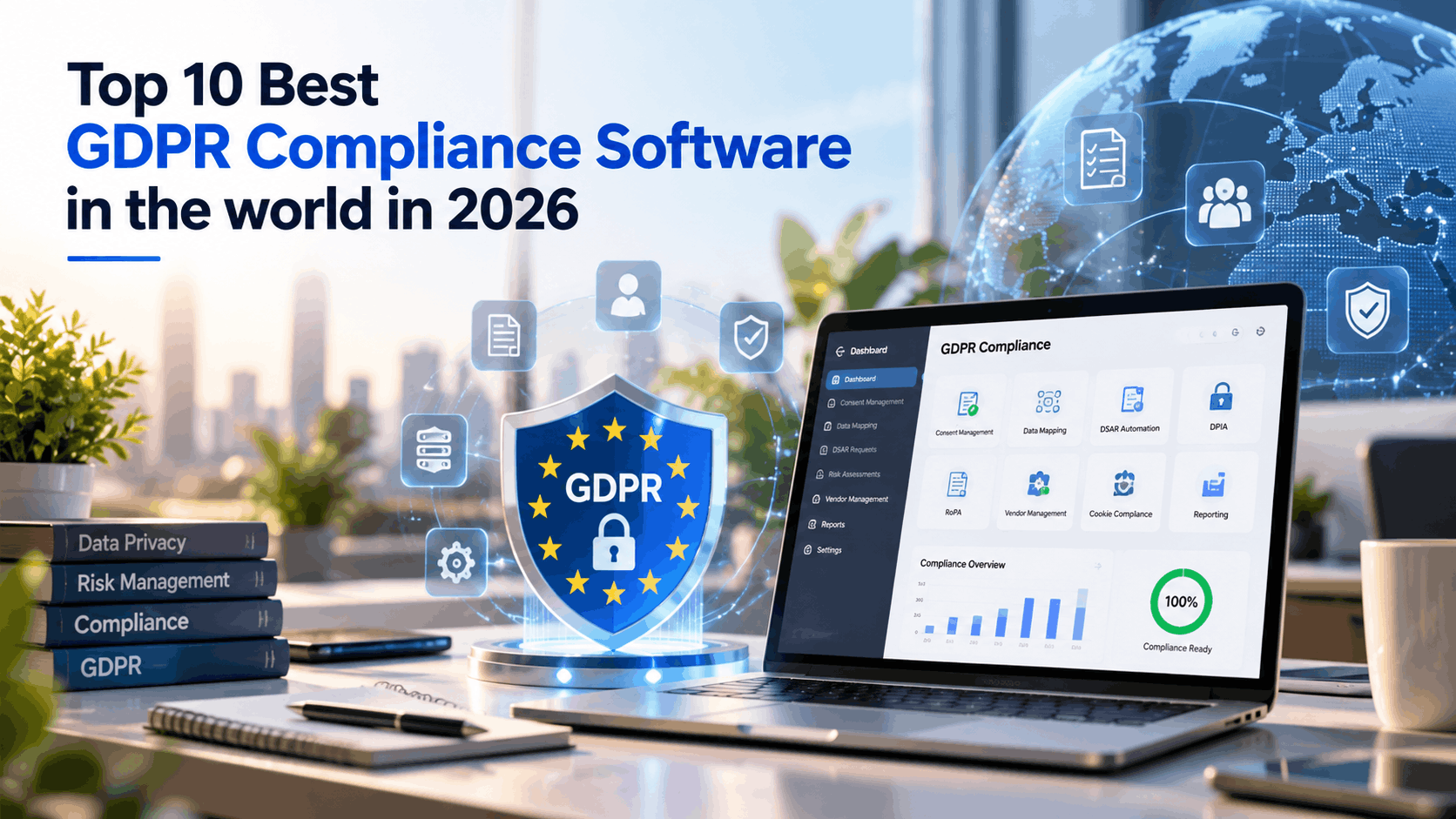
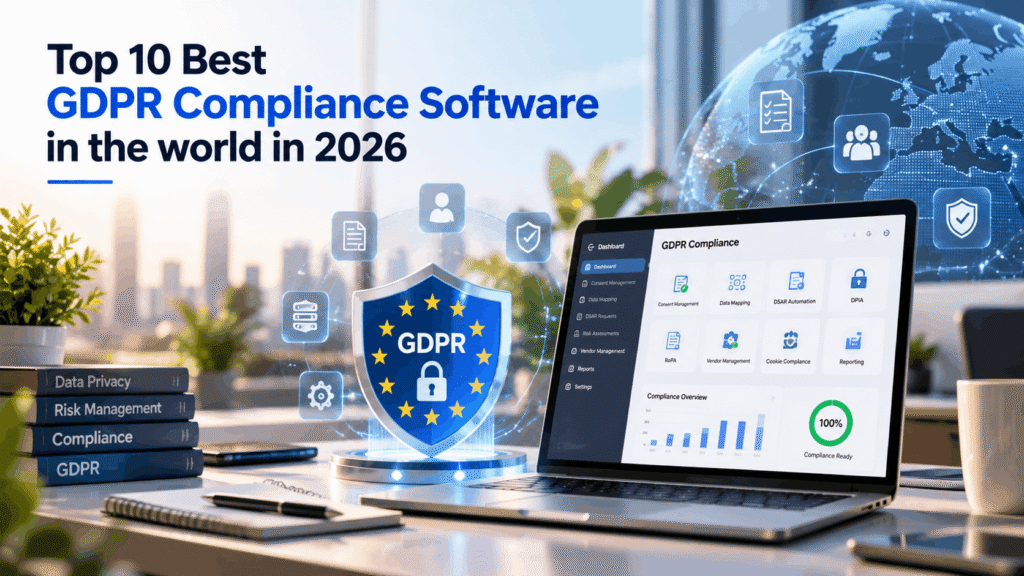
The Top 10 Best GDPR Compliance Software in the world in 2026 reflects a major shift in how organizations approach data privacy, consent management, and regulatory compliance. GDPR compliance is no longer limited to publishing a privacy policy or displaying a cookie banner. Modern businesses must understand where personal data resides, document how it is processed, manage consent, respond to data subject requests, conduct privacy assessments, monitor third parties, and maintain defensible compliance records.

As organizations adopt cloud infrastructure, SaaS applications, artificial intelligence, data warehouses, and increasingly complex digital advertising ecosystems, maintaining GDPR compliance manually becomes significantly more difficult. Personal information can be distributed across hundreds of applications and databases, making traditional spreadsheets and periodic compliance reviews increasingly inadequate.
This growing complexity has accelerated demand for GDPR compliance software that can automate privacy operations and provide continuous visibility into organizational data practices.
What Is GDPR Compliance Software?
GDPR compliance software helps organizations manage obligations arising from the General Data Protection Regulation through centralized privacy tools and automated workflows.
Depending on the platform, these solutions can provide Consent Management Platforms, automated cookie scanning, Data Subject Access Request automation, Records of Processing Activities, Data Protection Impact Assessments, data discovery, privacy risk management, vendor assessments, retention controls, and audit reporting.
| GDPR Requirement | How Compliance Software Can Help |
|---|---|
| Consent Management | Collects, stores, and manages user consent |
| Cookie Compliance | Detects and controls website trackers |
| Data Subject Rights | Automates access, deletion, and related requests |
| RoPA | Maintains processing activity records |
| DPIA | Standardizes privacy impact assessments |
| Data Mapping | Identifies where personal information resides |
| Vendor Management | Evaluates third-party privacy risks |
| Data Retention | Helps enforce retention and deletion policies |
| Audit Evidence | Maintains records demonstrating compliance |
| Data Discovery | Finds personal and sensitive information |
Why GDPR Compliance Software Matters in 2026
GDPR remains one of the world’s most influential privacy frameworks, while privacy enforcement and regulatory expectations continue to place significant pressure on organizations handling personal information.
At the same time, the technology environment has become considerably more complicated. Generative AI systems, customer data platforms, cloud warehouses, advertising technologies, mobile applications, shadow SaaS, and multi-cloud infrastructure can introduce new locations where personal information is collected, copied, analyzed, or transferred.
The best GDPR compliance software in 2026 therefore goes beyond static compliance documentation. Leading platforms increasingly provide automated data discovery, continuous monitoring, real-time consent orchestration, DSAR automation, AI governance, and integrations capable of connecting privacy requirements directly with operational systems.
Different GDPR Software for Different Organizations
There is no single GDPR compliance platform that is ideal for every organization.
Large multinational enterprises may require sophisticated data discovery, privacy governance, DSPM, international transfer management, and automated data lifecycle controls. Mid-market companies may prioritize DSAR automation, data mapping, vendor management, and rapid implementation. Small businesses may primarily need affordable cookie consent, privacy policies, tracker blocking, and reliable consent records.
| Organization Type | Typical GDPR Software Priority |
|---|---|
| Global Enterprise | Privacy governance and data discovery |
| Multi-Cloud Enterprise | DSPM, classification, and data mapping |
| SaaS Company | Integrations and DSAR automation |
| Digital Publisher | Consent and advertising compliance |
| E-commerce Business | Cookie consent and customer privacy |
| Mobile App Business | Mobile consent management |
| Mid-Market Company | End-to-end privacy automation |
| Small Business | Affordable website compliance |
| Web Agency | Multi-domain consent management |
| AI-Driven Enterprise | Privacy, data, and AI governance |
What This GDPR Compliance Software Comparison Covers
This guide examines the Top 10 Best GDPR Compliance Software in the world in 2026, including OneTrust, TrustArc, Securiti, Osano, BigID, DataGrail, Ketch, iubenda, Usercentrics, and CookieYes.
Each GDPR compliance tool serves a different segment of the market, ranging from comprehensive enterprise privacy governance and advanced data discovery to real-time consent orchestration and affordable website compliance.
The comparison examines key capabilities, GDPR use cases, integrations, automation, data management, consent functionality, user feedback, pricing considerations, advantages, limitations, and organizational fit.
The objective is not simply to identify the GDPR software with the longest feature list. It is to help businesses determine which privacy management platform best matches their data complexity, regulatory exposure, technical infrastructure, organizational resources, and compliance budget in 2026.
Before we venture further into this article, we would like to share who we are and what we do.
About 9cv9
9cv9 is a business tech startup based in Singapore and Asia, with a strong presence all over the world.
With over ten years of startup and business experience, and being highly involved in connecting with thousands of companies and startups, the 9cv9 team has listed some of the top and best companies/tools in this review.
If you like to get your company listed in our top B2B software reviews, check out our world-class 9cv9 Media and PR service and pricing plans here.
Top 10 Best GDPR Compliance Software To Use in 2026
1. OneTrust
OneTrust remains one of the most comprehensive GDPR compliance software platforms in 2026, particularly for large enterprises, multinational organizations, financial institutions, and businesses operating across multiple regulatory jurisdictions. Rather than functioning as a standalone GDPR checklist tool, the platform combines privacy operations, consent management, data governance, third-party risk management, AI governance, and broader compliance workflows within a unified ecosystem.
Its enterprise-oriented architecture makes OneTrust particularly relevant for organizations that need to demonstrate continuous GDPR accountability across complex data environments. The platform can maintain Records of Processing Activities (RoPA), automate Data Protection Impact Assessments (DPIAs), manage consent, map personal data, coordinate Data Subject Access Requests (DSARs), assess vendors, and document privacy risks.
| Category | OneTrust Capability | GDPR Compliance Value |
|---|---|---|
| Records of Processing | Automated RoPA creation and maintenance | Supports Article 30 documentation |
| Privacy Assessments | PIA, DPIA and transfer assessment workflows | Identifies and documents privacy risks |
| Data Subject Rights | Automated DSAR workflows | Helps manage access, deletion and other requests |
| Consent Management | Centralized consent and preference controls | Maintains evidence of user consent |
| Data Mapping | Automated discovery and processing inventories | Improves visibility into personal data |
| Cookie Compliance | Automated cookie and tracker scanning | Supports compliant digital consent management |
| Vendor Risk | Third-party assessment workflows | Strengthens processor and supplier oversight |
| Incident Management | Privacy incident workflows | Supports structured breach management |
| Governance | Policy, risk and accountability records | Creates auditable compliance evidence |
GDPR Privacy Operations and Automation
A major strength of OneTrust is its ability to transform GDPR compliance from a collection of spreadsheets and manual assessments into continuously maintained workflows.
Organizations can connect processing activities, systems, vendors, assessments and data assets within a central privacy inventory. These relationships can then be used to maintain RoPA documentation and initiate privacy assessments when processing activities change.
OneTrust also supports automated PIA, DPIA and transfer-related assessments. This is particularly useful for enterprises with numerous business units because privacy teams can standardize questionnaires, approval processes, remediation tasks and risk documentation instead of conducting each assessment manually.
| GDPR Workflow | Manual Approach | OneTrust Approach |
|---|---|---|
| RoPA | Spreadsheet maintenance | Centralized, continuously updated inventory |
| DPIA | Documents and email approvals | Automated assessment workflow |
| Data Mapping | Department questionnaires | Integrations and automated discovery |
| DSAR | Manual coordination | Workflow-driven request management |
| Consent | Separate website tools | Centralized consent infrastructure |
| Vendor Assessments | Individual questionnaires | Standardized third-party workflows |
| Audit Evidence | Documents assembled manually | Centralized compliance records |
Consent and Cookie Management
OneTrust provides a sophisticated Consent Management Platform designed for organizations operating websites, mobile applications and other digital services across multiple jurisdictions.
Its technology can automatically discover and categorize cookies, SDKs, trackers and third parties. OneTrust states that its tracker database contains more than 45 million tracking technologies.
Organizations can create geolocation-aware consent experiences while supporting regulatory and industry frameworks such as GDPR-related ePrivacy requirements, Global Privacy Control, Google Consent Mode and IAB consent standards.
Consent can also extend beyond the initial cookie banner. Permission and preference information can be propagated into downstream CRM, customer data, analytics, advertising, warehouse and AI environments, helping organizations establish a centralized source of truth for customer privacy choices.
Data Subject Rights Management
OneTrust is particularly capable in Data Subject Access Request management, an area that can become operationally demanding for large organizations.
The platform can coordinate request intake, identity verification, internal routing, data discovery, redaction, fulfillment and activity logging. These capabilities help privacy teams manage GDPR rights involving access, rectification, erasure, restriction, portability and objection.
Every stage can be documented with timestamps and audit records, reducing reliance on manually coordinated email and spreadsheet processes.
| DSAR Stage | OneTrust Support |
|---|---|
| Request Intake | Centralized request portal and workflows |
| Identity Verification | Verification processes and integrations |
| Data Discovery | Search and discovery capabilities |
| Internal Coordination | Automated task routing |
| Redaction | Supported fulfillment workflows |
| Approval | Configurable review processes |
| Response Tracking | Deadline and workflow monitoring |
| Audit Evidence | Timestamped activity records |
OneTrust Ratings and User Feedback
Independent software reviews continue to position OneTrust strongly for functionality, although experiences differ considerably between individual products.
G2 reports an overall OneTrust seller rating of approximately 4.4 out of 5 from more than 280 reviews. OneTrust Privacy Automation is rated around 4.3 out of 5, while Consent and Preferences receives a lower rating of approximately 3.5 out of 5.
Gartner Peer Insights reports approximately 4.2 out of 5 for OneTrust Privacy Automation.
| Review Category | Approximate Rating | General Interpretation |
|---|---|---|
| OneTrust Overall on G2 | 4.4 / 5 | Strong overall customer sentiment |
| Privacy Automation on G2 | 4.3 / 5 | Strong privacy management capabilities |
| Consent and Preferences on G2 | 3.5 / 5 | More mixed customer experience |
| Privacy Automation on Gartner | 4.2 / 5 | Positive enterprise-level assessment |
| Consent and Preferences on Gartner | 4.2 / 5 | Generally positive enterprise feedback |
Users frequently highlight OneTrust’s extensive functionality, configurability, privacy workflows and integration capabilities. At the same time, complexity remains an important consideration. G2 feedback for Privacy Automation identifies learning difficulty and complexity among recurring concerns.
Pricing and Total Cost Considerations
OneTrust generally follows a customized enterprise pricing model rather than publishing a simple standardized GDPR compliance subscription.
Pricing can depend on the products selected, organizational scale, number of jurisdictions, implementation requirements, integrations and broader governance requirements. Consequently, businesses comparing the best GDPR compliance software in 2026 should evaluate OneTrust based on total implementation and operating cost rather than subscription price alone.
Large organizations may require several modules covering Privacy Automation, Consent and Preferences, third-party management, data governance or technology risk and compliance. Implementation, configuration, integrations, administrator training and ongoing privacy operations can further increase total ownership costs.
| Cost Factor | Potential Impact |
|---|---|
| Number of Modules | Higher costs for broader governance coverage |
| Company Size | Enterprise deployments require greater scale |
| Geographic Coverage | More jurisdictions increase complexity |
| Integrations | Advanced connections can increase implementation work |
| Custom Workflows | Additional configuration may be required |
| Data Discovery | Large data estates increase deployment complexity |
| Training | Administrator expertise may be necessary |
| Ongoing Administration | Dedicated privacy resources may be required |
Advantages of OneTrust
OneTrust’s biggest competitive advantage is breadth. Organizations can manage multiple components of GDPR compliance without assembling numerous disconnected privacy applications.
The platform is particularly strong where privacy compliance intersects with data governance, consent, third-party risk, AI governance and enterprise risk management. This makes it suitable for organizations seeking a strategic privacy infrastructure rather than a basic GDPR compliance tool.
| Strength | Business Value |
|---|---|
| Broad GDPR Coverage | Consolidates multiple compliance processes |
| Automated RoPA | Reduces manual documentation |
| DPIA Automation | Standardizes privacy risk assessments |
| Advanced DSAR Management | Improves rights-request operations |
| Consent Management | Supports complex digital ecosystems |
| Data Mapping | Improves personal-data visibility |
| Enterprise Scalability | Supports multinational environments |
| Integrations | Connects privacy controls with business systems |
| Auditability | Creates centralized compliance evidence |
Limitations of OneTrust
The breadth that makes OneTrust attractive to enterprises can also make it excessive for smaller organizations.
Implementation may require considerable configuration, stakeholder involvement and administrator training. Businesses looking only for a cookie banner, privacy policy generator or lightweight GDPR checklist may find more specialized platforms easier and less expensive to operate.
Its quote-based pricing also makes straightforward cost comparison more difficult than with GDPR compliance software offering transparent subscription tiers.
Best Suited For
| Organization Type | Suitability |
|---|---|
| Global Enterprise | Excellent |
| Highly Regulated Organization | Excellent |
| Financial Institution | Excellent |
| Multinational Technology Company | Excellent |
| Large E-commerce Business | Very Good |
| Mid-Market Organization | Good |
| Small Business | Moderate |
| Microbusiness | Limited |
| Basic Cookie Compliance Only | Often Excessive |
OneTrust Verdict for 2026
OneTrust deserves consideration among the best GDPR compliance software platforms in the world in 2026 because it addresses GDPR as an ongoing governance program rather than simply a collection of compliance tasks.
Its combination of automated RoPA management, DPIAs, data mapping, DSAR workflows, consent management, vendor oversight and audit documentation makes it especially powerful for large and highly regulated organizations.
The principal trade-off is complexity. OneTrust is best suited to businesses that can justify an enterprise privacy infrastructure and have the resources to configure and administer it effectively. For those organizations, its extensive regulatory coverage and interconnected governance capabilities make it one of the strongest enterprise GDPR compliance platforms available in 2026.
2. TrustArc
TrustArc is a long-established privacy management and GDPR compliance software provider designed primarily for mid-sized and large organizations managing complex privacy programs across multiple jurisdictions. With more than 28 years of privacy industry experience, TrustArc combines compliance automation, regulatory intelligence, consent management, privacy assessments, data mapping, data subject rights management, and independent privacy assurance services.
Its positioning differs from broader governance platforms by maintaining a strong specialization in privacy operations. This makes TrustArc particularly relevant for organizations with dedicated privacy, compliance and legal teams that require structured GDPR governance alongside international privacy frameworks.
TrustArc’s current generation is built around Arc, a unified privacy management environment incorporating AI-assisted regulatory intelligence, centralized evidence management and guided privacy workflows.
| Platform Area | TrustArc Capability | GDPR Compliance Value |
|---|---|---|
| Privacy Governance | Centralized privacy program management | Creates structured GDPR accountability |
| Regulatory Intelligence | Nymity Research and Arc Intelligence | Connects legal requirements with operations |
| Privacy Assessments | DPIA, PIA and risk assessment workflows | Supports documented privacy risk management |
| International Transfers | Transfer assessments and assurance | Supports cross-border data governance |
| DSAR Management | Request intake and fulfillment workflows | Supports GDPR data subject rights |
| Data Mapping | Systems, vendors and processing inventories | Improves visibility into personal data |
| Consent Management | Cookie and digital consent controls | Supports consent and preference governance |
| Evidence Management | Central Evidence Library | Consolidates compliance documentation |
| Privacy Certifications | TRUSTe assurance programs | Provides independent privacy validation |
| AI Governance | AI risk and governance capabilities | Extends privacy controls into AI systems |
Arc Privacy Management Platform
Arc represents a significant modernization of the TrustArc platform. It brings privacy operations into a unified workspace intended to reduce the navigation and administrative complexity traditionally associated with enterprise privacy software.
A central component is the Evidence Library, which provides a single repository for documents, assessments, records and other compliance evidence. This structure can help GDPR teams establish a more defensible audit trail instead of maintaining evidence across spreadsheets, shared drives and disconnected systems.
Arc also incorporates Quick Actions that guide users through common activities such as creating vendors, updating systems, maintaining business processes, creating assessments and configuring cookie banners.
| Arc Capability | Primary Function | Operational Benefit |
|---|---|---|
| Evidence Library | Central compliance repository | Consolidates GDPR evidence |
| Quick Actions | Guided privacy workflows | Reduces repetitive administrative work |
| Universal Command Bar | Natural-language navigation | Accelerates access to privacy functions |
| Tasks and Notifications | Centralized workflow monitoring | Improves deadline and responsibility tracking |
| Unified Settings | Central administration | Simplifies enterprise governance |
| Arc Intelligence | Embedded privacy-focused AI | Assists research and operational decisions |
| Ask Arc | Conversational privacy assistant | Provides contextual privacy guidance |
Regulatory Intelligence and Nymity Research
One of TrustArc’s strongest differentiators is its regulatory intelligence layer.
Arc Intelligence combines AI technology with TrustArc’s privacy expertise and Nymity Research. The underlying regulatory knowledge environment contains more than 50,000 privacy references and covers more than 1,000 laws and regulatory frameworks.
TrustArc also reports that Nymity Research provides legal summaries covering more than 240 jurisdictions alongside hundreds of operational templates.
For multinational organizations, this can reduce the burden of independently researching regulatory developments and translating them into internal privacy controls.
| Regulatory Challenge | TrustArc Approach |
|---|---|
| Monitoring changing laws | Continuously maintained privacy intelligence |
| Interpreting obligations | Regulatory research and legal summaries |
| Connecting laws to controls | Citation and framework mapping |
| Compliance research | AI-assisted privacy research |
| Evidence validation | Centralized Evidence Library |
| Multi-jurisdiction operations | Global regulatory coverage |
| Operational implementation | Templates and structured workflows |
GDPR Assessments and Risk Management
TrustArc provides structured privacy assessment capabilities for organizations conducting DPIAs, privacy impact assessments, vendor assessments and international data transfer reviews.
These tools allow organizations to standardize questionnaires, assign responsibilities, identify compliance gaps, document remediation and retain evidence of decision-making.
For GDPR programs, this is particularly useful when high-risk processing activities require repeatable DPIA procedures or when organizations need to demonstrate that privacy risks were identified and addressed before processing commenced.
Data Mapping and International Data Transfers
TrustArc combines data mapping with privacy risk management to help organizations understand how personal information moves between systems, vendors, business processes and geographic regions.
Its international transfer capabilities can identify transfer risks and support Transfer Impact Assessments. This is particularly valuable for multinational GDPR programs that regularly move European personal data into other jurisdictions.
TrustArc also provides assurance and certification services related to recognized international transfer frameworks.
| International Transfer Function | Business Purpose |
|---|---|
| Data Flow Mapping | Identifies where personal information travels |
| Transfer Risk Identification | Highlights potentially problematic transfers |
| Transfer Impact Assessments | Documents transfer-related privacy risks |
| Data Privacy Framework Support | Assists qualifying cross-border transfers |
| CBPR Programs | Supports international privacy accountability |
| Privacy Assurance | Provides independent compliance verification |
TRUSTe Privacy Certification and Assurance
TrustArc has an important differentiator that conventional GDPR compliance software providers generally cannot replicate: its TRUSTe privacy certification and assurance services.
Organizations can pursue independent privacy verification and display applicable TRUSTe certification where program requirements are satisfied. TrustArc’s assurance portfolio encompasses GDPR-related privacy programs, Data Privacy Framework requirements, cross-border privacy frameworks and other regulatory standards.
This creates a combination of privacy management software and independent assurance capabilities within the same ecosystem.
Consent and Data Subject Rights Management
TrustArc supports two of the most operationally demanding areas of GDPR compliance: digital consent and data subject requests.
Its consent management capabilities help organizations discover tracking technologies, configure consent experiences and manage privacy preferences across websites and digital properties.
For data subject requests, TrustArc provides workflows supporting request intake, identity-related processes, data discovery, internal coordination and fulfillment.
| GDPR Requirement | TrustArc Support |
|---|---|
| Right of Access | DSAR intake and fulfillment |
| Right to Erasure | Request workflow management |
| Right to Rectification | Structured privacy request processing |
| Data Portability | Data request management |
| Consent | Consent and preference management |
| Cookie Governance | Tracker and cookie controls |
| DPIA | Automated assessment workflows |
| Accountability | Evidence and audit documentation |
TrustArc Ratings and User Feedback
TrustArc maintains a strong position within the privacy management software market in 2026. G2 reports an overall rating of approximately 4.2 out of 5 from more than 300 reviews.
Recent G2 assessments also position TrustArc as a leading Data Privacy Management product, with 92% of reviewed users in one 2026 Grid assessment awarding the platform four or five stars.
| Review Metric | 2026 Position |
|---|---|
| Overall G2 Rating | Approximately 4.2 / 5 |
| G2 Review Volume | More than 300 reviews |
| Four or Five-Star Users | Approximately 92% |
| Ease of Administration | Approximately 8.3 / 10 |
| Data Access Governance | Approximately 8.0 / 10 |
| DSAR Capabilities | Approximately 8.1 / 10 |
Positive feedback commonly emphasizes privacy functionality, usability, regulatory coverage and customer support. However, enterprise users also report a learning curve and potentially time-consuming configuration, particularly when deploying the platform across numerous websites, systems and business units.
TrustArc Pricing and Total Cost Considerations
TrustArc primarily targets organizations that require enterprise privacy infrastructure, meaning buyers should expect customized pricing rather than a simple low-cost GDPR subscription.
Total cost can vary according to selected privacy applications, organizational scale, regulatory coverage, websites, integrations, assurance services, implementation requirements and the complexity of the organization’s data environment.
| Cost Driver | Potential Impact |
|---|---|
| Privacy Modules | Additional capabilities increase licensing scope |
| Number of Websites | Expands consent management requirements |
| Jurisdiction Coverage | Increases regulatory complexity |
| Data Mapping | Larger environments require greater configuration |
| Integrations | Can increase implementation requirements |
| Assurance Services | Adds independent certification costs |
| Training | Enterprise teams may require onboarding |
| Ongoing Administration | Requires privacy program resources |
Advantages of TrustArc
TrustArc’s strongest advantage is the combination of specialized privacy technology, deep regulatory intelligence and independent assurance capabilities.
Its Nymity research foundation makes it particularly attractive to organizations operating internationally, while Arc improves accessibility through AI assistance, Quick Actions, unified navigation and centralized evidence management.
| Strength | Business Value |
|---|---|
| Deep Privacy Specialization | Built specifically around privacy operations |
| Arc Intelligence | Adds privacy-specific AI assistance |
| Nymity Research | Provides extensive regulatory intelligence |
| Evidence Library | Centralizes compliance documentation |
| GDPR Assessments | Supports repeatable privacy risk processes |
| International Transfers | Strengthens cross-border compliance |
| TRUSTe Certification | Provides independent privacy assurance |
| Consent Management | Supports complex digital environments |
| DSAR Management | Automates data subject request workflows |
Limitations of TrustArc
TrustArc’s privacy specialization can also represent a limitation for organizations seeking a much broader enterprise governance platform.
Its functionality is primarily concentrated around privacy, consent, regulatory intelligence and related governance rather than attempting to cover every ESG, security and operational risk function within one product.
Implementation can also require meaningful configuration, particularly for organizations with complex data inventories and global digital properties. User reviews indicate that new administrators may encounter a learning curve despite improvements introduced through Arc.
Best Suited For
| Organization Type | Suitability |
|---|---|
| Multinational Enterprise | Excellent |
| Dedicated Privacy Team | Excellent |
| Highly Regulated Business | Excellent |
| Global Technology Company | Excellent |
| Cross-Border Data Processor | Excellent |
| Mid-Market Organization | Very Good |
| Small Business | Moderate |
| Microbusiness | Limited |
| Basic Cookie Compliance Only | Often Excessive |
TrustArc Verdict for 2026
TrustArc ranks among the strongest GDPR compliance software options in 2026 for organizations that prioritize specialized privacy management, regulatory intelligence and demonstrable compliance.
Its combination of Arc Intelligence, Nymity Research, centralized evidence management, data mapping, DPIA workflows, DSAR management, consent controls, international transfer capabilities and TRUSTe assurance creates a particularly compelling proposition for multinational privacy teams.
Compared with broader governance platforms such as OneTrust, TrustArc is more tightly concentrated on privacy management and assurance rather than attempting to encompass every area of enterprise governance, ESG and operational risk. That narrower specialization can be an advantage for organizations seeking deep privacy expertise, although businesses wanting a wider integrated governance ecosystem may prefer a more expansive platform.
For mid-sized and large enterprises with dedicated privacy or legal teams, TrustArc provides a mature combination of technology, regulatory intelligence and independent assurance that makes it a strong contender among the best GDPR compliance software platforms in the world in 2026.
3. Securiti
Securiti is an enterprise-grade data privacy, security and governance platform designed for organizations managing sensitive information across cloud, SaaS, on-premises and hybrid environments. For businesses evaluating the best GDPR compliance software in 2026, Securiti stands out because it connects traditional privacy management with Data Security Posture Management (DSPM), automated data discovery and AI governance.
Rather than relying primarily on manually maintained privacy inventories, Securiti discovers and classifies sensitive information within underlying enterprise data systems. This allows privacy teams to connect GDPR obligations directly with the locations, identities, permissions and risks associated with actual personal data.
| Platform Area | Securiti Capability | GDPR Compliance Value |
|---|---|---|
| Data Discovery | Automated sensitive data discovery | Identifies where personal data resides |
| Data Classification | Automated classification and tagging | Categorizes GDPR-relevant information |
| Data Mapping | Cross-environment data intelligence | Improves processing visibility |
| RoPA | Processing activity management | Supports Article 30 documentation |
| Privacy Assessments | DPIA and assessment automation | Standardizes privacy risk analysis |
| DSAR Management | Automated request orchestration | Supports data subject rights |
| Consent Management | Cookie and preference controls | Supports consent compliance |
| DSPM | Continuous data security monitoring | Identifies privacy and security exposure |
| AI Governance | AI and generative AI controls | Extends governance into enterprise AI |
| Risk Management | Continuous risk assessment | Prioritizes sensitive-data exposure |
DataAI Command Center
At the center of Securiti’s technology is its DataAI Command Center, which provides organizations with a unified layer for understanding and controlling enterprise data.
The platform brings together data intelligence, security, privacy, governance and AI-related controls. This architecture is particularly relevant for GDPR compliance because privacy obligations frequently depend on accurately identifying what personal information an organization possesses, where it is stored, who can access it and how it is being processed.
| Data Environment | Securiti Function | Business Benefit |
|---|---|---|
| Public Cloud | Sensitive data discovery | Identifies cloud-based personal information |
| SaaS Applications | Data scanning and classification | Extends visibility into business applications |
| Databases | Structured data discovery | Maps regulated information |
| File Repositories | Unstructured data discovery | Identifies hidden sensitive information |
| On-Premises Systems | Hybrid discovery | Supports legacy environments |
| Multi-Cloud Infrastructure | Unified data intelligence | Reduces fragmented governance |
| AI Systems | Data and AI governance | Controls sensitive information used by AI |
Automated Data Discovery and Classification
Securiti’s strongest GDPR differentiator is its ability to combine privacy management with automated data discovery.
DSPM technology can discover previously unknown structured and unstructured information, classify sensitive data and evaluate access patterns and exposure. For GDPR teams, this provides a technical foundation for maintaining more accurate data inventories.
Instead of asking individual departments to manually report every system containing personal information, automated discovery can help identify previously undocumented data stores and expose potential compliance gaps.
| GDPR Data Challenge | Traditional Approach | Securiti Approach |
|---|---|---|
| Finding Personal Data | Manual questionnaires | Automated discovery |
| Classifying Information | Spreadsheet categorization | Machine-assisted classification |
| Maintaining Inventories | Periodic manual updates | Continuous data intelligence |
| Identifying Exposure | Manual security review | Continuous risk monitoring |
| Mapping Data Locations | Department interviews | Automated environment scanning |
| Finding Shadow Data | Difficult to identify | DSPM discovery |
| Access Analysis | Separate security processes | Integrated access intelligence |
GDPR Records of Processing and Assessments
Securiti provides privacy management capabilities for Records of Processing Activities, DPIAs, privacy assessments and related regulatory workflows.
Organizations can connect privacy documentation with underlying systems and data assets, helping establish a more dynamic GDPR compliance model.
This is particularly valuable for large enterprises where hundreds or thousands of processing activities may involve interconnected applications, vendors, databases and cloud environments.
Privacy teams can also automate assessment workflows, assign responsibilities, identify gaps and maintain evidence of remediation.
DSAR and Data Subject Rights Automation
Securiti provides automated workflows for managing GDPR data subject requests.
The platform can coordinate request intake, identity-related processes, data discovery, internal workflows and fulfillment. Automated discovery becomes particularly valuable during DSAR processing because the system can help identify relevant personal information across connected enterprise environments.
| Data Subject Right | Securiti Support |
|---|---|
| Right of Access | Automated request workflows |
| Right to Erasure | Data discovery and deletion workflows |
| Right to Rectification | Request orchestration |
| Right to Portability | Data retrieval workflows |
| Right to Restriction | Processing-related workflows |
| Right to Object | Privacy request management |
| Request Tracking | Centralized workflow monitoring |
| Compliance Evidence | Auditable fulfillment records |
Consent and Cookie Management
Securiti also provides consent and preference management capabilities for websites and digital properties.
Its cookie consent technology can discover tracking technologies, categorize cookies, manage consent banners and automatically block technologies according to user choices and applicable policies.
This allows organizations to connect front-end consent collection with broader privacy governance rather than operating cookie compliance as an isolated process.
DSPM and GDPR Compliance
Securiti’s DSPM capabilities distinguish it from many conventional privacy management products.
DSPM continuously identifies sensitive data, analyzes permissions and evaluates exposure. This brings privacy and security operations closer together because GDPR compliance depends not only on documenting processing activities but also on ensuring personal information is appropriately protected.
| DSPM Capability | GDPR Relevance |
|---|---|
| Sensitive Data Discovery | Identifies GDPR-regulated information |
| Classification | Determines data sensitivity |
| Access Analysis | Identifies excessive permissions |
| Exposure Detection | Highlights privacy and security risks |
| Continuous Monitoring | Detects environmental changes |
| Risk Prioritization | Helps teams focus on high-risk data |
| Data Mapping | Supports processing documentation |
| Remediation | Helps reduce unnecessary exposure |
AI Governance and Enterprise AI Security
Securiti has expanded beyond conventional privacy management into enterprise AI governance.
The platform helps organizations identify sensitive information interacting with generative AI systems and establish controls around AI applications, models and enterprise data.
This increasingly matters for GDPR compliance as organizations introduce large language models, AI assistants and retrieval-augmented generation systems that may process personal or confidential information.
Securiti can therefore provide a governance layer spanning conventional enterprise data and emerging AI workloads.
Securiti Ratings and User Feedback
Securiti maintains particularly strong enterprise customer ratings in the DSPM category.
Gartner Peer Insights reports approximately 4.7 out of 5 across 52 ratings for Securiti Data Security Posture Management. Approximately 73% of those ratings are five stars and another 23% are four stars.
Gartner’s customer-experience measurements also place evaluation and contracting, integration and deployment, service and support, and product capabilities at approximately 4.7 out of 5.
| Review Metric | Approximate Rating |
|---|---|
| Gartner Peer Insights Overall | 4.7 / 5 |
| Gartner Ratings | 52 |
| Five-Star Ratings | 73% |
| Four-Star Ratings | 23% |
| Integration and Deployment | 4.7 / 5 |
| Service and Support | 4.7 / 5 |
| Product Capabilities | 4.7 / 5 |
Enterprise reviewers frequently highlight the breadth of functionality, sensitive data intelligence, privacy center, data subject request management and assessment automation.
However, user feedback also indicates that implementation quality and support experiences can vary. As with many enterprise data governance platforms, successful deployment depends heavily on organizational data architecture, integration requirements and implementation planning.
Securiti Pricing and Total Cost
Securiti generally uses customized enterprise subscription pricing rather than publishing standardized plans for smaller organizations.
Pricing can vary according to the scale of the data environment, number of connected data sources, deployment requirements and selected capabilities.
Public UK government procurement information lists a Securiti service at approximately £14,876 per unit annually, although this should be treated as a specific procurement-framework reference rather than a universal commercial price.
| Pricing Factor | Potential Cost Impact |
|---|---|
| Data Environment Scale | Larger estates increase deployment scope |
| Number of Data Sources | More connections increase coverage requirements |
| Cloud Platforms | Multi-cloud deployments increase complexity |
| Privacy Modules | Additional capabilities expand licensing |
| DSPM Coverage | Broader scanning increases platform requirements |
| Scan Requirements | Greater monitoring frequency can affect scope |
| AI Governance | Adds AI-specific governance requirements |
| Implementation | Complex integrations increase initial costs |
Advantages of Securiti
Securiti’s primary advantage is the connection between privacy management and technical data intelligence.
Traditional GDPR software can document what an organization believes it possesses. Securiti’s discovery architecture helps determine what data actually exists across enterprise infrastructure.
| Strength | Business Value |
|---|---|
| Advanced Data Discovery | Finds sensitive data automatically |
| DSPM Integration | Connects security posture with privacy |
| Automated Classification | Reduces manual data categorization |
| Multi-Cloud Support | Suitable for complex enterprises |
| DSAR Automation | Streamlines rights-request processing |
| Privacy Assessments | Automates compliance workflows |
| Consent Management | Covers digital privacy requirements |
| AI Governance | Extends controls into enterprise AI |
| Continuous Monitoring | Detects changing data risks |
| Unified Architecture | Reduces privacy and security silos |
Limitations of Securiti
Securiti’s sophistication can also create implementation challenges.
Organizations with poorly documented systems, fragmented ownership structures or immature data governance practices may need significant preparation before achieving the full value of automated discovery and governance.
Scanning very large repositories can also introduce operational considerations around indexing time, connector performance and deployment architecture. Consequently, organizations should test representative high-volume environments during proof-of-concept evaluations rather than assessing the platform only against small sample datasets.
The platform may also be excessive for small businesses whose GDPR requirements are limited to cookie consent, basic privacy documentation and occasional data subject requests.
Best Suited For
| Organization Type | Suitability |
|---|---|
| Large Global Enterprise | Excellent |
| Multi-Cloud Organization | Excellent |
| Data-Intensive Business | Excellent |
| Financial Institution | Excellent |
| Enterprise Using Generative AI | Excellent |
| Dedicated Privacy and Security Teams | Excellent |
| Mid-Market Organization | Very Good |
| Small Business | Moderate |
| Microbusiness | Limited |
| Basic Cookie Compliance Only | Often Excessive |
Securiti Verdict for 2026
Securiti is a strong contender among the best GDPR compliance software platforms in the world in 2026, particularly for organizations where privacy compliance, data security and AI governance increasingly overlap.
Its defining advantage is the ability to connect GDPR workflows with automated discovery and classification of the underlying data. Privacy teams can manage RoPA records, DPIAs, DSARs and consent while security and governance teams gain continuous visibility into sensitive information across cloud, SaaS, hybrid and on-premises environments.
Compared with privacy-first platforms that concentrate primarily on regulatory workflows, Securiti offers a more technically integrated approach centered on discovering, understanding and protecting enterprise data.
For large organizations operating complex multi-cloud environments or deploying generative AI at scale, that combination of DSPM, privacy automation and AI governance makes Securiti one of the more technically sophisticated GDPR compliance platforms to consider in 2026.
4. Osano
Osano is an all-in-one data privacy and GDPR compliance platform designed for mid-market organizations, growing digital businesses and privacy teams that want enterprise-grade functionality without the complexity typically associated with large governance suites.
The platform combines cookie consent, subject rights management, automated data mapping, privacy assessments, Records of Processing Activities (RoPA), vendor privacy risk management and regulatory guidance within a unified environment. In 2026, Osano supports compliance workflows spanning more than 95 privacy regulations across over 50 countries.
Its positioning is particularly attractive for organizations that have outgrown standalone cookie consent tools but do not necessarily require the extensive security, ESG and enterprise GRC functionality offered by larger governance platforms.
| Platform Area | Osano Capability | GDPR Compliance Value |
|---|---|---|
| Cookie Consent | Automated consent management | Supports GDPR consent requirements |
| Subject Rights | DSAR workflow automation | Helps manage GDPR individual rights |
| Data Mapping | Automated data-store discovery | Identifies where personal information resides |
| RoPA | Processing activity documentation | Supports Article 30 requirements |
| Privacy Assessments | DPIA and assessment workflows | Documents privacy risks |
| Vendor Management | Continuous privacy risk monitoring | Strengthens processor oversight |
| Data Flows | Transfer visualization | Supports international transfer analysis |
| Regulatory Guidance | Privacy compliance resources | Helps teams respond to regulatory change |
| UK/EU Representation | Representative services | Supports qualifying non-European organizations |
Consent Management and Cookie Compliance
Consent management is one of Osano’s strongest capabilities. The platform is designed to simplify cookie compliance across organizations operating websites in multiple jurisdictions.
Deployment requires a single line of code, making implementation considerably less technically demanding than many enterprise privacy systems. Osano provides preconfigured compliance rules covering more than 95 regulations across over 50 countries.
The platform can discover website technologies and vendors, classify tracking activity and enforce consent preferences before relevant tracking technologies are activated.
| Consent Capability | Business Value |
|---|---|
| Single-Script Deployment | Reduces technical implementation requirements |
| Automated Discovery | Identifies cookies, scripts and vendors |
| Global Rules | Supports multinational websites |
| Consent Records | Creates defensible consent evidence |
| Tracker Controls | Prevents unauthorized tracking |
| Regulatory Updates | Adapts compliance configurations |
| Central Administration | Simplifies multi-site management |
| Consent Analytics | Provides visibility into consent activity |
No Fines, No Penalties Guarantee
One of Osano’s most distinctive features is its contractual “No Fines, No Penalties” Guarantee.
For qualifying paying customers, Osano provides coverage of up to $500,000 when a regulatory fine or penalty results from a compliance failure involving the Osano platform, subject to contractual conditions.
This should not be interpreted as universal insurance against GDPR penalties. Customers must remain in good standing, correctly implement applicable Osano products, maintain required updates and follow the platform’s configuration requirements.
Nevertheless, the guarantee creates a notable point of differentiation because Osano financially backs specified aspects of its compliance technology rather than placing the entire platform-related compliance risk on the customer.
| Guarantee Element | Coverage |
|---|---|
| Maximum Coverage | Up to $500,000 |
| Eligible Customers | Qualifying paid plans |
| Platform Configuration | Must follow approved implementation requirements |
| Required Updates | Customers must implement required updates |
| Regulatory Contact | Osano must be notified according to applicable terms |
| Historical Violations | Generally excluded |
| Customer Misconfiguration | May invalidate applicable coverage |
Data Subject Rights and DSAR Automation
Osano provides end-to-end Subject Rights Management for organizations processing GDPR requests at scale.
Workflows can cover intake, identity verification, communication, internal routing, fulfillment, data delivery and audit documentation. Integrations with more than 100 commonly used data-store vendors can further reduce the manual effort required to locate and process personal information.
| DSAR Stage | Osano Support |
|---|---|
| Request Intake | Centralized request workflow |
| Identity Verification | Verification processes |
| Internal Routing | Automated workflow assignment |
| Data Discovery | Integrations with business systems |
| Communication | Structured request correspondence |
| Deletion Requests | Automated workflow support |
| Data Delivery | Secure fulfillment processes |
| Audit Logging | Documented request history |
Automated Data Mapping and RoPA
Osano’s data mapping capabilities help privacy teams move away from manually maintained spreadsheets.
The platform can integrate with organizational identity systems to identify applications processing personal information. Data stores can then be classified, prioritized according to privacy risk and visualized through interactive data maps.
These inventories can feed other compliance processes, including DSAR fulfillment, DPIAs and Records of Processing Activities.
| Data Management Function | GDPR Application |
|---|---|
| Data Store Discovery | Identifies systems containing personal data |
| Data Categorization | Classifies privacy-relevant information |
| Data Flow Visualization | Shows movement between systems |
| Risk Prioritization | Highlights higher-risk data stores |
| Transfer Mapping | Identifies cross-border data movements |
| RoPA Automation | Supports Article 30 documentation |
| Assessment Integration | Connects inventories with DPIAs |
| Vendor Integration | Associates data with third parties |
Privacy Assessments and DPIAs
Osano provides centralized privacy assessment capabilities covering DPIAs, RoPAs, vendor reviews and other privacy risk processes.
Organizations can use predefined assessment templates or develop customized workflows. Assessment results can be retained centrally, enabling privacy teams to monitor outcomes and demonstrate how identified risks were evaluated.
This makes Osano particularly useful for smaller privacy teams that need repeatable governance processes without implementing a highly complex enterprise GRC environment.
Vendor Privacy Risk Management
Third-party privacy management represents another important component of Osano.
The platform maintains privacy information for more than 11,000 vendors and assigns privacy risk scores that organizations can use during vendor evaluation.
Osano can also monitor changes affecting existing suppliers, including privacy policy developments, litigation, incidents and other risk indicators. Website scanning can identify previously unknown third-party technologies and add associated providers to the vendor inventory.
| Vendor Risk Capability | Business Purpose |
|---|---|
| Vendor Privacy Scores | Accelerates preliminary risk assessment |
| 11,000+ Vendor Profiles | Provides established privacy intelligence |
| Automated Vendor Discovery | Identifies unknown website vendors |
| Policy Monitoring | Detects privacy policy changes |
| Incident Monitoring | Identifies emerging vendor risks |
| Subprocessor Visibility | Improves supply-chain transparency |
| Vendor Assessments | Standardizes due diligence |
| Continuous Monitoring | Moves oversight beyond annual reviews |
Osano Ratings and User Feedback
Osano maintains strong customer satisfaction ratings in 2026, particularly around usability, administration and customer support.
Its overall rating is approximately 4.5 out of 5 from more than 175 reviews. G2 comparison data also gives Osano approximately 8.8 out of 10 for ease of use, 8.7 for ease of setup, 8.9 for ease of administration and 9.2 for quality of support.
| User Experience Metric | Approximate Score |
|---|---|
| Overall Rating | 4.5 / 5 |
| Ease of Use | 8.8 / 10 |
| Ease of Setup | 8.7 / 10 |
| Ease of Administration | 8.9 / 10 |
| Quality of Support | 9.2 / 10 |
| Meets Requirements | 9.0 / 10 |
| Business Partnership | 9.3 / 10 |
These scores reinforce Osano’s positioning as a comparatively approachable privacy platform. Its accessibility can be especially important for organizations where privacy programs are managed by small legal or compliance teams rather than dedicated privacy engineering departments.
Implementation and Time to Value
Osano also performs well in deployment speed.
Current customer benchmarking indicates an average implementation period of approximately one month and an average ROI period of around ten months. Osano itself reports that migrations from legacy privacy platforms commonly take approximately two to four weeks.
| Implementation Metric | Typical Benchmark |
|---|---|
| Average Implementation | Approximately 1 month |
| Typical Legacy Migration | Approximately 2–4 weeks |
| Average ROI Period | Approximately 10 months |
| Deployment Model | Cloud |
| Technical Entry Requirement | Single-script deployment for consent |
Osano Pricing and Plans
Osano combines accessible entry-level consent options with customized pricing for its broader privacy management platform.
A free option provides an entry point for basic cookie consent requirements, while the Plus tier has been publicly listed at $199 per month. Full privacy functionality, including advanced subject rights, data mapping, assessments and broader enterprise capabilities, moves organizations toward sales-quoted plans.
| Pricing Level | Indicative Position | Best For |
|---|---|---|
| Free | $0 entry point | Small websites testing consent management |
| Plus | Approximately $199/month | Growing websites requiring advanced consent |
| Start | Custom Quote | Organizations beginning broader privacy management |
| Trust | Custom Quote | Mature privacy programs |
| Scale | Custom Quote | Enterprise privacy operations |
Organizations should pay particular attention to traffic, domain and functionality thresholds when comparing plans. A company may initially find Osano inexpensive for cookie compliance but require a significantly broader commercial agreement once DSAR automation, data mapping, assessments and enterprise governance become necessary.
Advantages of Osano
Osano’s primary advantage is its balance between comprehensive privacy management and usability.
It provides substantially more functionality than a basic cookie consent platform while avoiding some of the administrative complexity associated with the largest enterprise GRC suites.
| Strength | Business Value |
|---|---|
| Simple Deployment | Reduces implementation workload |
| $500,000 Guarantee | Adds contractual compliance assurance |
| Strong Consent Management | Supports global digital compliance |
| DSAR Automation | Reduces manual request processing |
| Automated Data Mapping | Improves personal-data visibility |
| RoPA Support | Helps satisfy Article 30 requirements |
| Vendor Risk Monitoring | Strengthens third-party oversight |
| Strong Support Ratings | Benefits smaller privacy teams |
| Fast Implementation | Shortens time to value |
| Global Regulatory Coverage | Supports multinational businesses |
Limitations of Osano
Osano is less suitable for organizations seeking a comprehensive security, ESG or enterprise-wide GRC ecosystem. Its primary focus remains privacy management rather than the broader governance scope available from platforms such as OneTrust.
Entry-level plans can also become restrictive as website traffic, domain counts and privacy requirements increase. Businesses requiring DSAR automation, automated data mapping, assessments and extensive enterprise capabilities should therefore evaluate the complete commercial proposal rather than comparing Osano solely on its publicly available consent pricing.
Advanced enterprises may also find its customization and security-governance depth less extensive than platforms specifically designed for highly complex global data estates.
Best Suited For
| Organization Type | Suitability |
|---|---|
| Mid-Market Business | Excellent |
| Growing Privacy Team | Excellent |
| Digital Business | Excellent |
| E-commerce Company | Excellent |
| SaaS Company | Excellent |
| Small Privacy Department | Excellent |
| Large Enterprise | Very Good |
| Highly Complex Multi-Cloud Enterprise | Good |
| Small Website | Good |
| Full Enterprise GRC Requirement | Moderate |
Osano Verdict for 2026
Osano ranks among the best GDPR compliance software platforms in 2026 for organizations seeking a practical balance between sophisticated privacy automation and ease of use.
Its combination of consent management, DSAR automation, automated data mapping, RoPA capabilities, DPIAs, vendor risk monitoring and international privacy support creates an end-to-end environment capable of supporting a growing GDPR program.
The $500,000 “No Fines, No Penalties” Guarantee provides an unusual additional layer of contractual assurance, although organizations should carefully review its eligibility requirements and exclusions rather than treating it as blanket protection against regulatory penalties.
Compared with larger enterprise governance platforms, Osano’s strongest proposition is simplicity. It is particularly compelling for mid-market organizations and lean privacy teams that require significantly more than a cookie banner but want to avoid the implementation burden of a sprawling enterprise GRC suite.
For organizations prioritizing rapid deployment, strong customer support, accessible privacy workflows and broad GDPR functionality, Osano is a strong contender for the Top 10 Best GDPR Compliance Software in the world in 2026.
5. BigID
BigID is an enterprise data intelligence, privacy and security platform designed for organizations managing large, complex data estates across cloud, SaaS, on-premises and hybrid infrastructure. Within the GDPR compliance software market in 2026, BigID differentiates itself through its data-first approach: discovering and understanding personal information before applying privacy, governance and security controls.
The platform combines enterprise data discovery, machine-learning classification, identity-aware correlation, privacy automation, DSPM, data lifecycle management and AI governance. This architecture makes BigID particularly relevant for multinational organizations that need to locate personal information across thousands of data sources rather than relying primarily on manually maintained privacy inventories.
| Platform Area | BigID Capability | GDPR Compliance Value |
|---|---|---|
| Data Discovery | Enterprise-wide automated discovery | Locates personal and regulated data |
| Data Classification | ML and context-aware classification | Identifies sensitive information |
| Identity Correlation | Identity-aware data relationships | Connects information with data subjects |
| RoPA | Automated processing activity mapping | Supports GDPR Article 30 |
| Data Rights | DSAR workflow automation | Supports access, deletion and portability |
| DPIA and PIA | Privacy assessment workflows | Evaluates high-risk processing |
| Data Retention | Policy-driven lifecycle management | Supports storage limitation |
| Data Minimization | Identification and remediation of unnecessary data | Reduces GDPR exposure |
| Data Transfers | Residency and movement intelligence | Identifies cross-border risks |
| AI Governance | AI data discovery and risk controls | Extends privacy governance into AI |
Enterprise Data Discovery and Classification
BigID’s strongest differentiator is its discovery and classification architecture.
The platform can discover structured, unstructured and semi-structured information across cloud infrastructure, SaaS applications, databases, file repositories, data lakes, on-premises environments and AI-connected systems.
Classification goes beyond conventional pattern matching. BigID combines machine learning, natural language processing, metadata, custom classifiers, graph-based analysis and contextual information to determine what data represents and how sensitive it may be.
| Data Environment | BigID Coverage | GDPR Application |
|---|---|---|
| Structured Databases | Discovery and classification | Identifies customer and employee records |
| Unstructured Files | Content-level classification | Finds personal data inside documents |
| SaaS Platforms | Connected data discovery | Extends visibility into cloud applications |
| Cloud Storage | Large-scale scanning | Identifies exposed or forgotten data |
| Data Lakes | Classification and context | Finds personal data at scale |
| On-Premises Systems | Enterprise discovery | Supports legacy infrastructure |
| AI Data Pipelines | AI-connected data discovery | Identifies privacy risks entering AI systems |
| Hybrid Environments | Unified intelligence | Consolidates fragmented data visibility |
Identity-Aware Data Intelligence
BigID places particular emphasis on identity-aware discovery.
Traditional classification tools can identify that a database contains names, telephone numbers or email addresses. BigID’s approach additionally focuses on relationships between information, identities, systems, ownership, lineage, location and exposure.
For GDPR compliance, this distinction can be significant because data subject rights concern information relating to a particular person rather than simply identifying categories of personally identifiable information.
The platform can correlate identifiers and contextual relationships across different systems, helping organizations construct a more complete view of information associated with an individual.
GDPR Records of Processing Activities
BigID supports automated Records of Processing Activities by connecting privacy documentation with discovered enterprise data.
Processing activities can incorporate information about systems, purposes, owners, residency, data subjects and data categories. This allows organizations to build RoPA records around information detected within their actual technology environment rather than depending entirely on questionnaires and manually updated spreadsheets.
| RoPA Requirement | BigID Capability |
|---|---|
| Processing Activities | Centralized activity mapping |
| Data Categories | Discovery-driven classification |
| Data Subjects | Identity and category context |
| Systems | Automated data-source visibility |
| Ownership | Business and technical ownership context |
| Data Location | Residency intelligence |
| Retention | Policy-linked lifecycle information |
| Transfers | Location and movement analysis |
| Accountability | Audit-ready documentation |
Data Subject Rights and DSAR Automation
BigID is particularly strong in GDPR data subject rights management because DSAR workflows are connected directly to its discovery technology.
The platform can collect requests, validate identities, correlate requestors with relevant personal information, search connected systems, coordinate review and redaction, route tasks, support deletion and maintain evidence of fulfillment.
This approach addresses one of the biggest operational problems with DSARs: finding all information relating to one individual across numerous disconnected systems.
| DSAR Stage | BigID Support |
|---|---|
| Request Intake | Multi-channel request collection |
| Identity Validation | Identity-aware workflows |
| Identity Correlation | Matches individuals with related information |
| Data Discovery | Searches connected enterprise systems |
| Review | Centralized information review |
| Redaction | Supports controlled disclosure |
| Deletion | Integrates with deletion workflows |
| Fulfillment | Generates comprehensive reports |
| Audit Evidence | Maintains request and action history |
Data Retention and Minimization
BigID extends GDPR compliance beyond documentation by connecting privacy requirements with actual data lifecycle actions.
The platform can identify stale, redundant, obsolete, trivial, duplicate and unnecessarily retained information. Organizations can then apply retention, legal hold, quarantine, archival, minimization and deletion policies.
This capability directly supports GDPR principles concerning storage limitation and data minimization.
| Lifecycle Stage | BigID Function | GDPR Benefit |
|---|---|---|
| Discover | Locate enterprise information | Establishes data visibility |
| Classify | Determine sensitivity and context | Identifies regulated information |
| Assess | Evaluate lifecycle risk | Finds over-retention |
| Retain | Apply retention requirements | Standardizes retention periods |
| Minimize | Remove unnecessary information | Supports data minimization |
| Delete | Execute controlled deletion | Reduces unnecessary exposure |
| Prove | Maintain evidence and audit trails | Demonstrates accountability |
Dark Data Discovery
Another significant BigID capability is dark and shadow data discovery.
Large enterprises frequently accumulate abandoned databases, duplicate files, historical backups, forgotten cloud repositories and unmanaged information. Such data can create GDPR exposure because an organization may remain responsible for personal information even when operational teams no longer know that it exists.
BigID can identify dark, shadow, sensitive and high-risk information across cloud and on-premises environments, allowing privacy and security teams to determine whether that data should be protected, retained, archived or deleted.
DSPM and Data Security
BigID increasingly combines privacy management with Data Security Posture Management.
Its DSPM capabilities connect data sensitivity with identities, permissions, access patterns, locations and exposure. Organizations can therefore prioritize risks according to the importance of the underlying information rather than treating every infrastructure finding equally.
| DSPM Capability | Privacy and Security Value |
|---|---|
| Sensitive Data Discovery | Identifies high-value information |
| Access Intelligence | Reveals excessive access |
| Exposure Analysis | Identifies risky data locations |
| Identity Context | Connects access with users and services |
| Risk Prioritization | Focuses remediation on sensitive data |
| Policy Enforcement | Converts findings into action |
| Dark Data Detection | Finds forgotten information |
| Continuous Monitoring | Detects changing data risks |
AI Privacy and Governance
BigID has expanded its data intelligence architecture to cover AI systems, agents, copilots, prompts, retrieval systems and AI data pipelines.
Organizations can discover sensitive or regulated information that AI applications may access and classify training datasets, retrieval sources and other AI-connected information.
This capability is increasingly relevant for GDPR compliance because enterprises deploying generative AI must understand whether personal information is entering models, retrieval systems or automated decision-making processes.
Data Lifecycle and Automated Remediation
BigID does more than generate reports about data risk. Its platform can connect findings with remediation workflows involving deletion, redaction, labeling, access reduction, retention and policy enforcement.
This creates a significant distinction between data intelligence and conventional compliance documentation software.
| Discovery Finding | Potential BigID Action |
|---|---|
| Excessive Personal Data | Data minimization |
| Expired Records | Controlled deletion |
| Duplicate Information | Cleanup or consolidation |
| Excessive Permissions | Access remediation |
| Sensitive Dark Data | Review, quarantine or deletion |
| Retention Violation | Policy enforcement |
| AI Data Exposure | AI governance controls |
| Misclassified Information | Classification remediation |
BigID Ratings and User Feedback
BigID maintains strong customer sentiment within enterprise data privacy, discovery and security markets. G2 places the platform at approximately 4.3 out of 5 based on customer reviews.
Users frequently highlight its data discovery capabilities, broad integration coverage, classification functionality and ability to provide visibility across large data environments.
| Review Area | General Assessment |
|---|---|
| Overall G2 Rating | Approximately 4.3 / 5 |
| Data Discovery | Major strength |
| Data Classification | Major strength |
| Integration Breadth | Strong enterprise capability |
| Privacy Automation | Strong |
| Large Data Environment Support | Strong |
| Implementation Complexity | Important consideration |
| Learning Curve | Moderate to significant |
BigID Pricing and Total Cost
BigID follows an enterprise sales model, with pricing generally provided through customized quotations rather than standardized public subscription plans.
Total cost can depend on the number and type of data sources, applications, deployment architecture, data volumes, selected capabilities and organizational requirements.
Consequently, BigID should be evaluated based on total cost of ownership rather than software licensing alone.
| Pricing Factor | Potential Cost Impact |
|---|---|
| Number of Data Sources | Greater coverage increases deployment scope |
| Data Volume | Large estates require greater resources |
| Selected Applications | Additional modules increase licensing |
| Cloud Environments | Multi-cloud deployments increase complexity |
| Deployment Architecture | SaaS and private environments differ |
| Scan Requirements | Deeper or frequent scanning increases resources |
| Integrations | Custom environments may require engineering |
| Implementation | Large deployments require specialist resources |
| Ongoing Administration | Dedicated governance resources may be necessary |
Advantages of BigID
BigID’s primary competitive advantage is the depth of its underlying data intelligence.
Where traditional privacy software may begin with questionnaires and compliance records, BigID starts by discovering the information that actually exists across the enterprise.
| Strength | Business Value |
|---|---|
| Deep Data Discovery | Finds personal information across complex estates |
| Unstructured Data Classification | Identifies sensitive content inside files |
| Identity Correlation | Connects information with individuals |
| Data Minimization | Helps eliminate unnecessary information |
| Retention Automation | Operationalizes lifecycle policies |
| DSAR Automation | Improves rights-request completeness |
| Dark Data Discovery | Finds previously unknown privacy exposure |
| DSPM Integration | Connects privacy with data security |
| AI Data Intelligence | Extends governance into AI environments |
| Enterprise Scalability | Supports highly complex data estates |
Limitations of BigID
BigID’s enterprise capabilities also create substantial implementation requirements.
Organizations typically need mature data ownership, security and governance structures to extract maximum value from the platform. Connecting large numbers of repositories, configuring classification policies, tuning discovery and integrating remediation workflows can require meaningful engineering and governance resources.
This makes BigID less appropriate for small organizations seeking straightforward cookie consent, basic GDPR documentation or lightweight privacy request management.
Its enterprise pricing model can also make the platform significantly more expensive than privacy products designed for small and mid-market organizations.
Best Suited For
| Organization Type | Suitability |
|---|---|
| Global Enterprise | Excellent |
| Petabyte-Scale Data Estate | Excellent |
| Multi-Cloud Organization | Excellent |
| Financial Institution | Excellent |
| Highly Regulated Enterprise | Excellent |
| Data-Intensive Technology Company | Excellent |
| Enterprise AI Deployment | Excellent |
| Mid-Market Organization | Good |
| Small Business | Limited |
| Basic Cookie Compliance Requirement | Poor |
BigID Verdict for 2026
BigID deserves a strong position among the best GDPR compliance software platforms in the world in 2026, particularly for enterprises where the central privacy challenge is discovering and controlling personal information across an enormous data estate.
Its combination of identity-aware discovery, machine-learning classification, automated RoPA management, DSAR fulfillment, DPIAs, retention enforcement, data minimization, dark data discovery, DSPM and AI governance provides substantially more technical depth than conventional privacy workflow software.
BigID is therefore particularly compelling for multinational organizations with complex cloud infrastructure, extensive unstructured information and strict data sovereignty requirements.
The trade-off is complexity and cost. Organizations require sufficient engineering, privacy and data governance maturity to implement the platform effectively. For enterprises that possess those resources, however, BigID provides one of the most powerful data-centric approaches to GDPR compliance available in 2026.
6. DataGrail
DataGrail is an automated privacy management and GDPR compliance platform designed for mid-market and enterprise organizations, particularly technology companies, SaaS providers, e-commerce businesses and digitally focused brands.
Its primary differentiator is an integration-first architecture that connects privacy operations directly with the applications where personal information resides. In 2026, DataGrail reports an integration ecosystem covering more than 2,500 applications, making its current network considerably larger than the previously cited 1,800 integrations.
This connectivity powers Live Data Map, Request Manager, consent management, privacy assessments, responsible data discovery and risk management, allowing privacy teams to reduce their dependence on spreadsheets, questionnaires and manually coordinated compliance workflows.
| Platform Area | DataGrail Capability | GDPR Compliance Value |
|---|---|---|
| Data Mapping | Live Data Map | Maintains visibility into personal data systems |
| System Discovery | Automated application detection | Identifies new and shadow systems |
| RoPA | Dynamic processing records | Supports GDPR Article 30 |
| DSAR Management | Request Manager | Automates data subject rights workflows |
| Data Discovery | PII and sensitive data discovery | Identifies regulated information |
| DPIA and PIA | Automated assessments | Supports GDPR Article 35 |
| Consent Management | Automated consent enforcement | Supports digital consent compliance |
| Vendor Risk | System and vendor intelligence | Strengthens processor oversight |
| Risk Management | Centralized risk register | Documents risks and remediation |
| Privacy Requests | Branded Privacy Request Center | Centralizes GDPR request intake |
Live Data Map
Live Data Map is one of DataGrail’s defining capabilities. Instead of depending entirely on periodic questionnaires to determine which applications process personal information, DataGrail can connect with organizational systems and continuously maintain a privacy inventory.
Detected systems can feed directly into other DataGrail capabilities, including Request Manager, data discovery and Records of Processing Activities.
The platform’s Live Data Map covers system inventory, system profiles, processing activities, RoPA, system detection and data classification.
| Live Data Map Function | GDPR Application |
|---|---|
| System Inventory | Identifies systems processing personal data |
| System Detection | Finds newly introduced applications |
| System Profiles | Documents system-level privacy information |
| Processing Activities | Maps how personal data is processed |
| RoPA | Maintains Article 30 documentation |
| Data Classification | Categorizes relevant information |
| Vendor Visibility | Identifies external processors |
| Continuous Updates | Reduces outdated privacy inventories |
Extensive Integration Network
DataGrail’s integration ecosystem is a major competitive advantage.
The platform currently reports more than 2,500 application integrations for automated privacy workflows. Supported environments include widely used enterprise platforms spanning CRM, HR, marketing, customer support, productivity and cloud infrastructure.
Integrations can support system detection as well as programmatic extraction and deletion of personal information during privacy requests.
| Integration Function | Operational Benefit |
|---|---|
| System Detection | Identifies applications automatically |
| Personal Data Retrieval | Accelerates access requests |
| Automated Deletion | Reduces manual erasure workflows |
| Data Discovery | Improves privacy visibility |
| Live Data Map Updates | Keeps inventories current |
| Consent Deployment | Extends privacy controls across properties |
| DSAR Automation | Reduces application-by-application work |
| Privacy Risk Detection | Identifies emerging data exposure |
Request Manager and DSAR Automation
Request Manager is another major reason DataGrail ranks strongly among GDPR compliance software platforms.
The system automates data subject request workflows covering intake, identity verification, data retrieval, deletion, deadlines and response tracking.
DataGrail’s Privacy Request Center can be hosted on an organization’s own domain and dynamically present relevant privacy rights according to the requester’s location. GDPR workflows can include access, deletion, rectification, restriction, portability and objection requests.
| DSAR Stage | DataGrail Capability |
|---|---|
| Request Intake | Branded Privacy Request Center |
| Geographic Rules | Location-specific privacy rights |
| Identity Verification | Requester verification workflows |
| System Search | Queries connected applications |
| Data Retrieval | Automated extraction where supported |
| Deletion | Automated deletion through integrations |
| Internal Review | Approval workflows |
| Deadline Management | Request lifecycle tracking |
| Fulfillment | Structured response workflow |
| Audit Evidence | Centralized request records |
Automated GDPR Records of Processing
DataGrail uses Live Data Map to support dynamic Records of Processing Activities.
The platform can connect systems, vendors, purposes, processing activities and data categories to help maintain GDPR Article 30 documentation.
This approach reduces one of the common weaknesses of spreadsheet-based RoPAs: records becoming obsolete as departments introduce new SaaS applications or modify existing processing activities.
Privacy Assessments and DPIAs
DataGrail also provides automated privacy and risk assessments covering DPIAs and PIAs.
Assessment fields can be populated using information already available about systems, vendors and processing activities. This reduces repetitive data entry while helping organizations maintain more consistent assessments.
| Assessment Capability | Compliance Benefit |
|---|---|
| DPIA | Supports high-risk processing assessments |
| PIA | Evaluates broader privacy implications |
| Pre-Populated Information | Reduces repetitive questionnaires |
| System Context | Connects assessments with actual applications |
| Vendor Context | Incorporates processor information |
| Risk Register | Centralizes identified risks |
| Remediation Tracking | Documents corrective actions |
| Evidence Retention | Supports regulatory accountability |
Consent Management
DataGrail extends its privacy platform into website consent management.
Organizations can configure consent experiences, manage tracking technologies and maintain consent enforcement as regulations change. Its no-code-oriented approach is intended to reduce the continuous administrative work associated with maintaining compliant websites.
This allows organizations to combine consumer-facing consent controls with their broader data mapping, request management and privacy risk program.
Responsible Data Discovery
DataGrail’s Responsible Data Discovery functionality provides deeper visibility into personal and sensitive information held within connected data sources.
This capability complements Live Data Map. Live Data Map establishes which systems and processing activities exist, while deeper discovery can help determine what sensitive information actually resides within those environments.
| Discovery Layer | Primary Question |
|---|---|
| System Detection | Which applications are being used? |
| Live Data Map | How are those systems processing information? |
| Data Classification | What categories of information are involved? |
| Responsible Data Discovery | What sensitive data actually exists? |
| Request Manager | Which information relates to a requester? |
| Risk Management | Where are the resulting privacy risks? |
DataGrail Ratings and Customer Feedback
DataGrail maintains particularly strong customer ratings in 2026.
G2 reports an overall rating of approximately 4.7 out of 5 from 206 reviews, with roughly 82% awarding five stars and another 16% awarding four stars.
Gartner Peer Insights currently reports approximately 4.8 out of 5 for DataGrail Request Manager. This is slightly below the previously cited 5.0 rating but remains an exceptionally strong result.
| Review Metric | 2026 Position |
|---|---|
| G2 Overall Rating | 4.7 / 5 |
| G2 Review Volume | 206 reviews |
| G2 Five-Star Reviews | Approximately 82% |
| G2 Four-Star Reviews | Approximately 16% |
| Gartner Request Manager | Approximately 4.8 / 5 |
| Gartner Rating Volume | 11 ratings |
G2 feedback consistently highlights customer support, ease of use, integrations and automation as major advantages. Reported limitations include customization constraints, occasional integration issues and some workflows that can still require manual intervention.
DataGrail Pricing and Total Cost
DataGrail does not provide a straightforward public enterprise price card for its complete privacy platform.
Pricing and packaging depend on organizational requirements and the products being deployed. Organizations can purchase broader privacy functionality or select individual capabilities, while managed services and privacy consulting can add to the overall implementation scope.
As a result, buyers should evaluate DataGrail based on total privacy-program requirements rather than relying on unverified market estimates for a standard annual contract.
| Pricing Driver | Potential Impact |
|---|---|
| Selected Products | Broader deployments increase licensing scope |
| Integration Requirements | More systems expand implementation work |
| Request Volume | High DSAR activity increases operational requirements |
| Data Discovery | Deeper discovery expands platform scope |
| Consent Management | Multiple properties increase complexity |
| Risk Assessments | Adds governance functionality |
| Managed Services | Adds operational support costs |
| Privacy Consulting | Adds specialist implementation support |
Advantages of DataGrail
DataGrail’s strongest competitive advantage is the connection between integrations and automation.
Instead of requiring privacy teams to manually coordinate every system owner whenever an individual submits a GDPR request, supported integrations can programmatically retrieve or delete information from connected applications.
| Strength | Business Value |
|---|---|
| 2,500+ Integrations | Extensive enterprise application coverage |
| Live Data Map | Maintains continuously updated inventories |
| Automated DSARs | Reduces manual privacy operations |
| System Detection | Identifies new and shadow applications |
| Dynamic RoPA | Improves Article 30 documentation |
| Automated DPIAs | Reduces assessment administration |
| Consent Management | Adds digital privacy enforcement |
| Data Discovery | Identifies personal and sensitive information |
| Strong Customer Support | Benefits lean privacy teams |
| High User Ratings | Indicates strong customer satisfaction |
Limitations of DataGrail
The effectiveness of DataGrail’s automation depends partly on the organization’s technology environment and available integrations. Proprietary internal systems or uncommon applications may require additional integration work or manual processes.
Advanced privacy programs may also require configuration during initial deployment, particularly when establishing system ownership, approval processes, request policies and customized assessment workflows.
Some customer reviews additionally identify limited customization and occasional integration-related challenges as areas for improvement.
Organizations with highly complex petabyte-scale data discovery requirements may also find data-intelligence-focused platforms such as BigID more specialized for deep enterprise classification.
Best Suited For
| Organization Type | Suitability |
|---|---|
| SaaS Company | Excellent |
| Technology Company | Excellent |
| E-commerce Business | Excellent |
| Mid-Market Organization | Excellent |
| Enterprise Using Many SaaS Applications | Excellent |
| Lean Privacy Team | Excellent |
| High-Volume DSAR Environment | Excellent |
| Large Global Enterprise | Very Good |
| Complex Legacy Enterprise | Good |
| Small Business | Moderate |
DataGrail Verdict for 2026
DataGrail ranks among the strongest GDPR compliance software platforms in 2026 for organizations seeking to automate privacy operations across a modern SaaS-heavy technology stack.
Its key differentiator is no longer simply having a large integration catalog. The combination of more than 2,500 integrations, Live Data Map, automated DSAR fulfillment, dynamic RoPA management, DPIAs, consent management, responsible data discovery and centralized risk management creates a highly interconnected privacy ecosystem.
DataGrail is particularly compelling for technology companies, SaaS businesses and e-commerce organizations where personal information is distributed across dozens or hundreds of cloud applications.
Its 4.7 out of 5 G2 rating further supports its strong market position, while customer feedback consistently identifies support and automation among its strengths.
For organizations prioritizing real-time data mapping and highly automated GDPR request fulfillment without adopting an exceptionally broad enterprise GRC suite, DataGrail is a strong candidate for the Top 10 Best GDPR Compliance Software in the world in 2026.
7. Ketch
Ketch is a modern privacy management and data permissioning platform designed for digital-first enterprises, consumer brands, media companies, SaaS businesses and organizations operating complex advertising and customer-data ecosystems.
Within the GDPR compliance software market in 2026, Ketch differentiates itself by treating privacy as an infrastructure and data orchestration problem rather than simply a cookie-banner requirement. Its platform connects consent, identity, privacy rights and policy decisions with the downstream systems where personal information is actually processed.
The architecture spans data discovery, consent management, Data Subject Request (DSR) automation, data mapping, risk management, marketing preferences and AI governance. Ketch also reports more than 1,000 pre-built connections across applications, data systems and AI models.
| Platform Area | Ketch Capability | GDPR Compliance Value |
|---|---|---|
| Consent Management | Jurisdiction-aware consent controls | Supports GDPR consent requirements |
| Data Permissioning | Real-time policy enforcement | Ensures choices follow personal data |
| Identity Management | Cross-device identity synchronization | Connects preferences with individuals |
| DSR Automation | Automated rights workflows | Supports GDPR data subject rights |
| Data Mapping | Automated system and data visibility | Improves processing transparency |
| Data Discovery | Discovery and classification | Identifies sensitive information |
| Risk Management | Privacy risk workflows | Supports compliance governance |
| Marketing Preferences | Preference orchestration | Maintains permissioned marketing data |
| AI Governance | AI-related data controls | Extends privacy governance into AI |
| Auditability | Permission and interaction records | Provides compliance evidence |
Consent Management Beyond the Cookie Banner
Ketch’s central differentiator is that consent does not stop at the website interface.
When an individual accepts or rejects a particular purpose, Ketch can propagate that decision into connected marketing platforms, customer data systems, data warehouses and other downstream infrastructure.
This approach is particularly relevant for GDPR compliance because recording consent is only one component of effective governance. Organizations must also ensure subsequent processing reflects the individual’s choices.
| Consent Stage | Traditional CMP | Ketch Approach |
|---|---|---|
| Display Banner | Yes | Yes |
| Collect Consent | Yes | Yes |
| Store Consent Record | Yes | Yes |
| Identify Individual | Limited | Identity synchronization |
| Update Downstream Systems | Often integration-dependent | Programmatic orchestration |
| Enforce Data Usage | Limited | Permission-based enforcement |
| Manage Marketing Preferences | Often separate | Integrated |
| Maintain Audit Evidence | Basic records | Centralized permission records |
Permission Vault and Real-Time Orchestration
Ketch uses its Permission Vault as a server-side source of truth for consent, privacy rights, preferences, identity and policy decisions.
This architecture allows downstream systems to reference consistent permission information rather than maintaining disconnected consent states across numerous applications.
Its orchestration technology then carries privacy instructions into connected systems, APIs, advertising technologies and data environments.
For organizations with complex customer-data architectures, this turns GDPR consent from a front-end interaction into an operational data control.
Identity Sync
Privacy preferences become considerably harder to enforce when one individual appears under different identifiers across browsers, devices and applications.
Ketch Identity Sync is designed to connect these identities so that a privacy choice made in one context can be respected elsewhere.
| Identity Challenge | Ketch Approach |
|---|---|
| Multiple Browsers | Cross-context identity synchronization |
| Multiple Devices | Identity relationship management |
| Anonymous Website Sessions | Permission and identity signals |
| Logged-In Customers | Persistent preference association |
| Marketing Platforms | Downstream permission propagation |
| Data Warehouses | Identity-aware policy enforcement |
| Changing Preferences | Updated permissions distributed downstream |
Snowflake and Data Warehouse Integration
Ketch is particularly relevant for organizations using modern cloud data warehouses.
Its Snowflake integration can connect consent information with data governance controls inside the warehouse. Privacy choices can therefore influence how information is subsequently processed or activated rather than remaining isolated within the consent platform.
Ketch can also support DSR workflows involving Snowflake and use data warehouse functionality for privacy enforcement.
| Data Warehouse Function | GDPR Application |
|---|---|
| Consent Synchronization | Carries privacy choices downstream |
| Data Mapping | Improves visibility into personal information |
| Data Discovery | Identifies relevant information |
| DSR Processing | Supports access and deletion workflows |
| Policy Enforcement | Applies permission-based controls |
| Data Masking Integration | Supports controlled data processing |
| Data Lineage | Improves processing visibility |
Data Subject Request Automation
Ketch provides automated workflows for fulfilling data subject rights requests.
Organizations can configure workflows for access, deletion and other privacy rights while connecting those workflows with the systems containing personal information.
Its integrations and APIs can reduce the need for privacy teams to manually contact individual system owners for every request.
| DSR Stage | Ketch Capability |
|---|---|
| Request Intake | Configurable privacy request experiences |
| Identity Recognition | Identity-aware processing |
| Workflow Design | Customizable workflow automation |
| System Connections | Pre-built integrations and APIs |
| Data Retrieval | Automated workflows where supported |
| Deletion | Connected deletion processes |
| Internal Tasks | Workflow-based coordination |
| Fulfillment | End-to-end rights management |
| Auditability | Request and action records |
Data Discovery and Mapping
Ketch has expanded beyond consent management into broader privacy intelligence.
Its platform includes Data Sentry, data mapping, discovery and classification capabilities designed to identify data, understand how it moves and detect privacy risks.
This gives privacy teams greater context when creating inventories, managing GDPR accountability and investigating whether actual data practices match documented policies.
| Discovery Capability | Privacy Benefit |
|---|---|
| Website Scanning | Detects privacy and tracking risks |
| System Inventory | Identifies relevant applications |
| Data Mapping | Documents information movement |
| Data Classification | Identifies sensitive information |
| Processing Visibility | Supports GDPR accountability |
| Risk Diagnostics | Highlights potential compliance gaps |
| Automated Context | Reduces reliance on manual research |
AI Governance and Permissioned Data
Ketch has increasingly positioned its permissioning infrastructure for enterprise AI environments.
The same concept used for marketing consent can be extended to AI: organizations need to understand whether personal information has appropriate permission for particular downstream uses.
Ketch can connect permission signals with systems and AI workflows, providing a governance layer between data collection and subsequent AI processing.
This capability is increasingly relevant for enterprises implementing generative AI, AI agents, personalization systems and other applications that rely heavily on customer information.
Ketch Switch for OneTrust Migration
Ketch provides a dedicated migration capability known as Ketch Switch for organizations replacing OneTrust.
The migration process is designed to preserve existing consent information while minimizing disruption to integrations already configured around OneTrust protocols.
Ketch can initially operate alongside OneTrust in a quiet mode, capture existing preference information and then transition consent management to Ketch. Its compatibility approach can reduce the need to immediately rewrite integrations designed around existing OneTrust interfaces.
| Migration Stage | Ketch Switch Approach |
|---|---|
| Connect | Deploy Ketch alongside OneTrust |
| Quiet Mode | Prevent immediate customer-facing changes |
| Collect | Capture existing consent and preference states |
| Preserve | Retain historical preference information |
| Validate | Prepare configurations before cutover |
| Deploy | Transition active consent management |
| Integrations | Reduce immediate rewriting requirements |
Ketch Integrations
Ketch currently reports more than 1,000 pre-built connections across systems, applications and models.
These integrations cover analytics, customer data platforms, CRM systems, e-commerce, marketing and advertising, productivity applications, tag management, data warehouses and other enterprise infrastructure.
This connectivity is essential to Ketch’s value proposition because real-time permission orchestration becomes substantially more useful when privacy choices can reach the systems consuming the underlying data.
Ketch Ratings and User Feedback
Ketch maintains strong customer satisfaction in 2026. Its current public pricing information reports a G2 rating of approximately 4.6 out of 5 from more than 170 verified reviews.
The company also holds multiple G2 recognition badges, including strong positioning for enterprise usability, results and customer relationships within consent management.
| Review Metric | 2026 Position |
|---|---|
| G2 Overall Rating | Approximately 4.6 / 5 |
| Verified G2 Reviews | More than 170 |
| Enterprise Usability | Strong G2 positioning |
| Enterprise Results | Strong G2 positioning |
| Enterprise Relationship | Strong G2 positioning |
| Common Strength | Modern privacy infrastructure |
| Common Advantage | Implementation and usability |
Ketch Pricing
Ketch offers considerably more transparent entry-level pricing than many enterprise GDPR compliance platforms.
The Free plan supports up to 5,000 unique monthly users. Starter costs $150 per month and supports up to 30,000 unique monthly users. Plus starts at $499 per month when billed annually and supports up to 100,000 unique monthly users.
Organizations exceeding 100,000 monthly users or requiring the complete privacy platform move to custom-priced Pro deployments.
| Plan | Starting Price | Monthly Unique Users | Positioning |
|---|---|---|---|
| Free | $0 | Up to 5,000 | Basic consent management |
| Starter | $150/month | Up to 30,000 | Moderate-traffic websites and apps |
| Plus | From $499/month | Up to 100,000 | Higher-traffic digital businesses |
| Pro | Custom | 100,000+ | Enterprise privacy infrastructure |
The published pricing primarily reflects consent management. DSR automation, data mapping, marketing preference management, risk assessments and other advanced capabilities can be priced separately or included within broader enterprise arrangements.
Advantages of Ketch
Ketch’s biggest advantage is its ability to connect privacy decisions with actual downstream data use.
| Strength | Business Value |
|---|---|
| Real-Time Permissioning | Makes privacy choices operational |
| Modern API Architecture | Fits contemporary technology stacks |
| 1,000+ Connections | Reduces custom integration requirements |
| Identity Sync | Maintains choices across contexts |
| Snowflake Integration | Connects consent with warehouse governance |
| DSR Automation | Reduces manual rights processing |
| Data Mapping | Improves GDPR visibility |
| AI Governance | Extends permissioning into AI workflows |
| Transparent Entry Pricing | Simplifies initial procurement |
| Ketch Switch | Reduces OneTrust migration friction |
Limitations of Ketch
Ketch’s most sophisticated capabilities become valuable when they are integrated deeply into an organization’s data architecture. Consequently, organizations seeking advanced permission orchestration may need participation from engineering, data and marketing technology teams.
Although basic consent deployment can be relatively straightforward, full data orchestration involving warehouses, APIs, identity synchronization and downstream enforcement naturally requires greater implementation work. Ketch indicates that standard consent deployments can typically take two to four weeks, while broader data orchestration implementations generally require six to eight weeks with some engineering support.
The platform may therefore be excessive for businesses requiring only a simple GDPR cookie banner.
Best Suited For
| Organization Type | Suitability |
|---|---|
| Digital-First Enterprise | Excellent |
| Media Company | Excellent |
| E-commerce Brand | Excellent |
| SaaS Company | Excellent |
| Adtech-Heavy Business | Excellent |
| Snowflake-Centric Enterprise | Excellent |
| OneTrust Migration | Excellent |
| Enterprise AI Environment | Very Good |
| Mid-Market Digital Business | Very Good |
| Small Website | Good |
Ketch Verdict for 2026
Ketch is a strong contender among the best GDPR compliance software platforms in the world in 2026, particularly for organizations that view consent as a data infrastructure requirement rather than merely a cookie-banner obligation.
Its strongest differentiator is real-time data permissioning. Consent and privacy choices can follow an individual across identities, applications, advertising systems, data warehouses and increasingly AI environments.
The combination of Permission Vault, Identity Sync, more than 1,000 system connections, DSR automation, data discovery, Snowflake integration, AI governance and Ketch Switch gives the platform a distinctive position within the privacy software market.
For digital-first enterprises with sophisticated marketing and data architectures, Ketch provides a modern approach to GDPR compliance that connects what users permit with what organizations actually do with their data. Its comparatively transparent pricing and dedicated OneTrust migration pathway further strengthen its position as one of the Top 10 Best GDPR Compliance Software platforms to consider in 2026.
8. iubenda
iubenda is a digital compliance and GDPR software platform designed primarily for small and mid-sized businesses, e-commerce companies, SaaS providers, agencies and website operators that need an accessible way to manage privacy requirements.
Trusted by more than 150,000 businesses, iubenda takes a different approach from enterprise-focused privacy platforms such as BigID or Securiti. Its core strength is simplifying website and application compliance through automatically maintained legal documents, cookie consent management, consent records, compliance scanning and increasingly broader privacy-management functionality.
For businesses evaluating the best GDPR compliance software in 2026, iubenda is particularly attractive where affordability, rapid deployment and minimal legal or technical overhead are priorities.
| Platform Area | iubenda Capability | GDPR Compliance Value |
|---|---|---|
| Privacy Policy | Automated policy generation | Supports transparency requirements |
| Cookie Policy | Automated cookie disclosures | Documents tracking technologies |
| Consent Management | Privacy Controls and Cookie Solution | Supports GDPR consent requirements |
| Consent Records | Centralized consent database | Maintains evidence of consent |
| Website Scanning | Automated compliance scans | Identifies website compliance issues |
| Terms and Conditions | Guided document generation | Supports broader digital compliance |
| Data Processing Register | Processing activity documentation | Supports GDPR Article 30 |
| Data Subject Rights | Rights management tools | Supports individual GDPR rights |
| Geo-Targeting | Location-based consent configuration | Supports multi-jurisdiction compliance |
| Google Consent Mode | Consent Mode v2 support | Connects consent with Google services |
Automated Privacy and Cookie Policies
One of iubenda’s most recognizable features is its automated legal document generation.
Businesses can build Privacy Policies and Cookie Policies using a library containing more than 2,400 prepared clauses covering commonly used third-party technologies and processing activities.
The documents are designed to remain connected with iubenda’s compliance infrastructure so that businesses do not have to rewrite their policies manually whenever supported legal requirements change.
| Document Function | Business Benefit |
|---|---|
| Privacy Policy Generator | Simplifies privacy disclosures |
| Cookie Policy Generator | Documents cookies and tracking services |
| 2,400+ Clauses | Covers numerous third-party technologies |
| Automatic Updates | Reduces manual regulatory maintenance |
| Custom Clauses | Supports organization-specific processing |
| Multiple Languages | Supports international websites |
| Embedded Documents | Keeps published policies synchronized |
| Terms and Conditions | Extends compliance beyond privacy |
Privacy Controls and Cookie Consent
iubenda’s Privacy Controls and Cookie Solution provides consent management for websites and applications.
The system can scan websites for cookies and trackers, display appropriate consent interfaces, prevent applicable tracking technologies from operating before consent and maintain evidence of users’ choices.
Consent configurations can also change according to visitor location, allowing businesses to apply different privacy mechanisms to European and non-European visitors.
| Consent Capability | GDPR Application |
|---|---|
| Cookie Banner | Collects visitor choices |
| Prior Blocking | Restricts trackers before consent |
| Consent Storage | Maintains proof of user choices |
| Geo-Targeting | Applies region-specific configurations |
| Website Scanning | Detects cookies and trackers |
| Preference Controls | Allows consent changes |
| Multi-Language Support | Supports international visitors |
| Consent Analytics | Measures consent interactions |
Google Consent Mode v2
iubenda provides native support for Google Consent Mode v2 across its plans, including its free offering.
This makes the platform particularly useful for small and mid-sized organizations using Google Analytics or advertising technologies while serving European visitors.
The consent platform communicates user choices to compatible Google services so that advertising and analytics behavior can respond to the consent state.
| Google Ecosystem Requirement | iubenda Support |
|---|---|
| Google Consent Mode v2 | Included |
| Google CMP Integration | Supported |
| Google Analytics | Consent-aware implementation |
| Google Advertising | Consent signal support |
| European Traffic | GDPR-oriented consent configuration |
| Consent Records | Stored evidence of choices |
Centralized Consent Database
GDPR compliance requires organizations to demonstrate that valid consent was obtained where consent forms the legal basis for processing.
iubenda provides a centralized consent database capable of recording consent evidence for cookies, trackers, forms and other interactions.
Records can contain relevant contextual information such as the user’s choice, time of consent, applicable notices and consent configuration.
This provides substantially stronger evidence than simply recording whether a visitor clicked an “Accept” button.
Website Compliance Scanning
Automated scanning provides another useful layer of compliance monitoring.
iubenda can periodically scan websites for services, cookies and potential configuration problems. Essentials and Advanced plans include monthly scanning, while Ultimate increases scanning frequency to hourly monitoring with notifications when issues are detected.
| Plan | Compliance Scan Frequency |
|---|---|
| Free | Included, frequency not guaranteed |
| Essentials | Monthly |
| Advanced | Monthly |
| Ultimate | Hourly |
| Tailored | Hourly |
Register of Data Processing Activities
A notable improvement in iubenda’s higher-tier offering is support for a Register of Data Processing Activities.
This functionality enables organizations to document how personal information is collected, stored, processed and managed, helping support GDPR Article 30 record-keeping requirements.
The feature is included with the Ultimate and tailored plans.
This means iubenda should no longer be characterized purely as a cookie banner and policy generator. Its 2026 product portfolio has moved further into broader privacy operations, although its data mapping and enterprise governance depth remains below specialist platforms built for highly complex multinational environments.
Data Subject Rights Management
iubenda’s Ultimate offering also includes a Data Subject Rights Management Tool.
This addresses an important historical gap between lightweight website compliance products and comprehensive privacy management platforms.
Organizations can use the functionality to help manage GDPR rights requests rather than relying exclusively on email and manually maintained spreadsheets.
However, enterprises requiring extensive identity correlation, automated discovery across thousands of internal applications or highly sophisticated DSAR orchestration may still find platforms such as BigID, DataGrail or Securiti better suited to those requirements.
International and Multi-Language Compliance
iubenda is particularly well suited to businesses operating websites across multiple markets.
Advanced and Ultimate plans provide access to all available languages, while geo-targeting enables organizations to change consent behavior according to visitor location.
The platform supports compliance configurations spanning GDPR, UK GDPR, ePrivacy requirements, US privacy legislation, Brazil’s LGPD and Switzerland’s FADP, among other requirements.
| International Capability | Business Value |
|---|---|
| Multiple Languages | Supports international websites |
| Geo-Targeting | Adapts consent according to location |
| GDPR | European privacy compliance |
| UK GDPR | United Kingdom privacy requirements |
| US Privacy Laws | Supports multiple state requirements |
| LGPD | Brazilian privacy requirements |
| FADP | Swiss privacy compliance |
| Automatic Updates | Reduces ongoing legal maintenance |
iubenda Ratings and User Feedback
iubenda maintains strong customer satisfaction ratings in 2026.
Capterra reports approximately 4.7 out of 5 from around 190 reviews, while G2 reports approximately 4.4 out of 5.
Users commonly highlight the platform’s ease of deployment, broad compliance functionality, automated legal-document maintenance and ability to consolidate several website compliance requirements.
| Review Platform | Approximate Rating | Review Position |
|---|---|---|
| Capterra | 4.7 / 5 | Strong customer satisfaction |
| G2 | 4.4 / 5 | Strong overall rating |
| Common Strength | Ease of implementation | Suitable for smaller teams |
| Common Strength | Automated updates | Reduces compliance maintenance |
| Common Limitation | Advanced configuration | Can introduce a learning curve |
iubenda Pricing in 2026
One of iubenda’s strongest advantages is transparent and comparatively affordable pricing.
The platform currently offers Free, Essentials, Advanced and Ultimate plans, alongside customized enterprise arrangements.
| Plan | Price When Billed Annually | Included Monthly Pageviews | Best For |
|---|---|---|---|
| Free | $0 | Up to 1,000 | Very small websites |
| Essentials | $5.99/site/month | Up to 25,000 | Small businesses |
| Advanced | $24.99/site/month | Up to 50,000 | International and growing websites |
| Ultimate | $99.99/site/month | Up to 150,000 | Advanced compliance requirements |
| Tailored | Custom | Custom | Agencies and enterprises |
This means Essentials costs approximately $71.88 per site annually, Advanced approximately $299.88 and Ultimate approximately $1,199.88 when using the listed annual-billing monthly rates.
The Ultimate plan is significantly more comprehensive, adding features such as unlimited service clauses, hourly scanning, detailed analytics, consent recovery, white-label functionality, mobile integration, the processing activity register and data subject rights management.
Agency and Enterprise Scalability
iubenda also offers tailored arrangements for agencies and larger organizations.
Agencies managing multiple customer websites can access volume pricing and centralized management capabilities, while enterprises can obtain customized plans for more complex requirements.
This makes iubenda particularly attractive to web development, marketing and digital agencies that need to deploy repeatable privacy configurations across numerous customer websites.
| Organization Type | iubenda Value Proposition |
|---|---|
| Freelancer | Affordable basic compliance |
| Small Business | Low-cost GDPR and cookie management |
| E-commerce Store | Policies, consent and terms |
| SaaS Business | Multi-market website compliance |
| Web Agency | Multi-client compliance management |
| Growing Mid-Market Business | Advanced privacy functionality |
| Large Enterprise | Tailored deployment available |
| Complex Data Enterprise | May require deeper governance software |
Advantages of iubenda
The platform’s biggest advantage is the amount of practical digital compliance functionality available at a comparatively low price.
| Strength | Business Value |
|---|---|
| Affordable Entry Pricing | Accessible to small organizations |
| Automated Legal Documents | Reduces manual legal maintenance |
| 2,400+ Policy Clauses | Covers extensive digital services |
| Cookie Auto-Blocking | Supports GDPR consent requirements |
| Google Consent Mode v2 | Useful for advertising and analytics |
| Multi-Language Support | Supports international expansion |
| Geo-Targeting | Enables jurisdiction-specific experiences |
| Consent Evidence | Strengthens accountability |
| RoPA Functionality | Extends beyond website compliance |
| Data Subject Rights Tool | Adds broader privacy management |
| Agency Plans | Supports multi-client deployment |
Limitations of iubenda
Although iubenda has expanded substantially beyond basic cookie compliance, it remains less sophisticated than enterprise data intelligence and privacy orchestration platforms.
Large organizations requiring continuous discovery across thousands of internal systems, deep identity correlation, automated enterprise-wide DSAR retrieval, DSPM, AI governance or advanced third-party risk management will generally require more specialized technology.
Costs can also increase as organizations add numerous websites, generate high traffic or require multiple advanced compliance capabilities.
The platform’s extensive configuration options can introduce a learning curve for users attempting to implement more sophisticated consent arrangements.
Best Suited For
| Organization Type | Suitability |
|---|---|
| Small Business | Excellent |
| E-commerce Store | Excellent |
| Web Agency | Excellent |
| Freelancer or Creator | Excellent |
| SaaS Company | Very Good |
| International Website | Excellent |
| Mid-Market Business | Very Good |
| Large Enterprise | Good |
| Complex Multi-Cloud Enterprise | Limited |
| Petabyte-Scale Data Environment | Limited |
iubenda Verdict for 2026
iubenda earns its position among the best GDPR compliance software platforms in 2026 by making sophisticated digital compliance accessible to organizations that cannot justify the cost and complexity of enterprise privacy suites.
Its combination of automatically maintained Privacy and Cookie Policies, consent management, tracker blocking, Google Consent Mode v2, centralized consent evidence, geo-targeting, multi-language support and compliance scanning provides an unusually comprehensive toolkit at its price point.
Importantly, iubenda has also evolved beyond its traditional reputation as primarily a policy generator and cookie consent solution. Its Ultimate tier now includes a Register of Data Processing Activities and Data Subject Rights Management Tool, giving growing organizations a broader foundation for GDPR operations.
It does not match platforms such as BigID or Securiti for enterprise data discovery, or DataGrail for deeply integrated DSAR automation. However, that is not its primary market.
For SMBs, e-commerce businesses, digital agencies and growing companies seeking affordable, rapidly deployable and internationally oriented GDPR compliance software, iubenda represents one of the strongest value propositions in the Top 10 Best GDPR Compliance Software in the world in 2026.
9. Usercentrics
Usercentrics is a European Consent Management Platform designed for organizations that need to collect, document and optimize user consent across websites, mobile applications and connected digital experiences.
Within the GDPR compliance software market in 2026, Usercentrics is particularly strong for advertisers, publishers, e-commerce businesses, mobile app developers and enterprises whose privacy requirements center on cookies, advertising technologies, analytics and consent signals.
The platform supports GDPR and multiple international privacy regulations while integrating with major advertising and analytics ecosystems. Usercentrics reports that its technology is deployed across millions of websites and applications globally and processes billions of consent interactions every month.
| Platform Area | Usercentrics Capability | GDPR Compliance Value |
|---|---|---|
| Web Consent | Web CMP | Collects and manages GDPR consent |
| Mobile Consent | App CMP SDK | Extends compliance into mobile applications |
| Consent Mode | Google Consent Mode v2 | Communicates consent to Google services |
| Advertising Standards | IAB TCF support | Supports publisher and adtech consent |
| Cookie Discovery | Automated website scanning | Identifies tracking technologies |
| Geo-Targeting | Location-specific banners | Supports jurisdiction-specific experiences |
| Consent Analytics | Interaction and acceptance analytics | Measures consent performance |
| A/B Testing | Banner experimentation | Optimizes consent interactions |
| Cross-Device Consent | Consent sharing | Reduces repeated consent prompts |
| Audit Records | Consent documentation | Supports compliance evidence |
Web Consent Management Platform
The Usercentrics Web CMP provides the foundation of its GDPR compliance offering.
Organizations can identify data-processing services, configure consent banners, block applicable tracking technologies before permission is granted and maintain records of user choices.
The platform supports multiple privacy regulations and can use geolocation rules to display different configurations depending on where visitors are located.
| Web CMP Function | Business Benefit |
|---|---|
| Consent Banner | Captures visitor preferences |
| Prior Blocking | Restricts tracking before consent |
| Automated Scanning | Detects data-collecting technologies |
| Geo-Targeting | Applies regional consent requirements |
| Consent Storage | Maintains evidence of user choices |
| Banner Customization | Aligns consent UI with branding |
| Multiple Languages | Supports international audiences |
| Analytics | Measures user interaction |
Google Consent Mode v2
Usercentrics is particularly well suited to organizations heavily dependent on Google’s advertising and analytics ecosystem.
Google Consent Mode v2 is supported across Usercentrics CMP plans. Consent signals can control the behavior of compatible Google tags according to the choices made by visitors.
Usercentrics is also a Google-certified CMP and has achieved Google’s Gold Tier CMP Partner recognition.
| Google Requirement | Usercentrics Support |
|---|---|
| Google Consent Mode v2 | Supported |
| Google-Certified CMP | Yes |
| Gold Tier CMP Partner | Yes |
| Google Ads | Consent signal integration |
| Google Analytics | Consent-aware configuration |
| Google Ad Manager | Publisher consent support |
| Google AdSense | Compatible consent framework |
| Google AdMob | Supported through mobile ecosystem |
IAB Transparency and Consent Framework
Usercentrics supports the IAB Transparency and Consent Framework, making it particularly relevant for publishers, media companies and advertising-dependent digital businesses.
Importantly, the current 2026 implementation has progressed beyond TCF 2.2. Usercentrics supports IAB TCF v2.3, which replaced the earlier framework version for applicable implementations.
This enables consent information to be communicated between publishers and participating advertising technology vendors using standardized consent strings.
| Advertising Environment | Usercentrics Capability |
|---|---|
| Digital Publishers | IAB TCF support |
| Advertising Networks | Standardized consent signals |
| Programmatic Advertising | Vendor consent communication |
| Mobile Advertising | App CMP support |
| Google Advertising | Certified CMP integration |
| Consent Strings | Standardized TCF records |
| Vendor Selection | Global Vendor List integration |
Mobile App Consent Management
Mobile consent management is another major strength of Usercentrics.
Its App CMP provides SDK support for iOS, Android, Flutter, React Native and Unity, allowing developers to implement privacy controls within native and cross-platform applications.
The SDK can continue functioning offline in many scenarios, caching information locally and synchronizing changes when connectivity returns.
| Mobile Environment | Usercentrics Support |
|---|---|
| iOS | Supported |
| Android | Supported |
| Flutter | Supported |
| React Native | Supported |
| Unity | Supported |
| Offline Operation | Supported |
| Geo-Targeting | Supported |
| Consent Analytics | Supported |
| A/B Testing | Supported |
| Cross-Device Consent | Available on higher tiers |
Consent Banner A/B Testing
Usercentrics goes beyond basic regulatory compliance by allowing organizations to optimize how users interact with consent interfaces.
Higher-tier functionality includes A/B testing that compares different CMP visual variants. Businesses can evaluate interaction and acceptance rates across different countries, devices, CMP layers and banner configurations.
This capability is particularly relevant for publishers and advertisers because poor consent-banner design can reduce the amount of permissioned data available for analytics and advertising.
| Optimization Metric | Potential Business Value |
|---|---|
| Acceptance Rate | Measures successful consent collection |
| Interaction Rate | Shows whether users engage with the CMP |
| Device Performance | Identifies desktop and mobile differences |
| Country Comparison | Reveals geographic behavior differences |
| Banner Variant | Determines stronger-performing designs |
| CMP Layer | Evaluates consent journey performance |
Cross-Device Consent Sharing
Usercentrics Corporate and premium mobile offerings provide cross-device consent sharing.
This capability helps organizations synchronize privacy choices between devices, reducing the need to repeatedly display consent interfaces to the same individual.
For large digital brands operating websites, applications and other connected experiences, this can improve both privacy consistency and customer experience.
Automated Website Scanning
Usercentrics can automatically scan websites to identify cookies and other data-processing technologies that should be incorporated into CMP configurations.
Scanning frequency varies according to plan.
| Plan | Automated Scanning |
|---|---|
| Free | Initial setup scan |
| Essential | Monthly |
| Plus | Monthly |
| Pro | Monthly |
| Business | Monthly |
| Corporate | Weekly |
The platform also provides more than 2,200 Data Processing Service templates covering third-party technologies that organizations may need to disclose within their consent interfaces.
Consent Auditability
Consent evidence is a fundamental GDPR requirement when organizations rely on consent as a lawful basis for processing.
Usercentrics records consent information so organizations can demonstrate user choices and maintain an auditable consent history.
Enterprise capabilities further strengthen governance through features such as review and release workflows, bulk editing, SSO and centralized administration.
Usercentrics Ratings and User Feedback
Usercentrics maintains strong customer satisfaction in 2026.
Current G2 category information places Usercentrics at approximately 4.4 out of 5 from more than 220 reviews. The platform receives solid ratings for administration and end-user management, although integration and audit-trail scores are somewhat below the broader category averages.
| G2 Metric | Approximate Score |
|---|---|
| Overall Rating | 4.4 / 5 |
| Review Volume | 220+ |
| End-User Management | 8.4 / 10 |
| Ease of Administration | 8.4 / 10 |
| Integrations | 8.0 / 10 |
| Audit Trails | 7.5 / 10 |
Customer feedback generally favors the platform’s comprehensive consent capabilities, configuration flexibility and integration with important advertising ecosystems. More sophisticated configurations can introduce complexity, particularly for businesses managing multiple domains, regulations and technology stacks.
Usercentrics Pricing in 2026
Usercentrics offers considerably more transparent pricing than many enterprise privacy platforms.
Pricing for Web CMP is primarily structured around monthly sessions, domains and required functionality.
| Plan | Starting Price | Domains | Monthly Sessions |
|---|---|---|---|
| Free | €0 | 1 | Up to 1,000 |
| Essential | €7/month | 1 | Up to 1,500 |
| Plus | Tier-Based | 1 | Up to 3,000 |
| Pro | €30/month | 3 | Up to 15,000 |
| Business | Tier-Based | 10 | Up to 50,000 and higher tiers |
| Corporate | Custom | Unlimited | From 1 million |
The Essential plan therefore starts at approximately €84 annually at the listed monthly rate.
Organizations should carefully evaluate session volumes because Usercentrics counts sessions rather than simply unique monthly visitors. Plans can also automatically adjust when usage exceeds applicable limits.
Mobile App CMP Pricing
Mobile consent uses a separate usage model based primarily on Daily Active Users.
| App CMP Plan | Starting Position | Usage |
|---|---|---|
| Advanced | From €49/month | Up to 500,000 DAU |
| Premium | Custom Pricing | From 500,000 DAU |
The Advanced App CMP provides access to all supported SDKs, unlimited apps and configurations, analytics, customization, A/B testing and an App Scanner.
Enterprise and High-Traffic Capabilities
Corporate deployments add capabilities designed for major publishers, advertisers and global brands.
| Corporate Capability | Enterprise Value |
|---|---|
| Unlimited Domains | Supports extensive digital portfolios |
| 1M+ Sessions | Handles high-traffic properties |
| Unlimited Regulations | Supports multinational compliance |
| 60 Banner Languages | Enables global deployment |
| A/B Testing | Optimizes consent experiences |
| Cross-Device Consent | Reduces repeated prompts |
| Bulk Editing | Simplifies large-scale administration |
| SSO | Supports enterprise identity management |
| Dedicated Customer Success | Improves deployment support |
| Review and Release | Adds governance over configuration changes |
Advantages of Usercentrics
Usercentrics’ biggest advantage is the depth of its consent management ecosystem across websites, applications and advertising technologies.
| Strength | Business Value |
|---|---|
| Google Gold Tier CMP | Strong Google ecosystem integration |
| Consent Mode v2 | Supports modern advertising requirements |
| IAB TCF v2.3 | Strong publisher and adtech compatibility |
| Mobile SDKs | Extends consent into native applications |
| A/B Testing | Helps optimize consent performance |
| Cross-Device Consent | Improves multi-device experiences |
| Automated Scanning | Detects tracking technologies |
| 2,200+ DPS Templates | Simplifies service configuration |
| Transparent Pricing | Easier procurement for smaller organizations |
| Enterprise Scalability | Supports very high traffic volumes |
Limitations of Usercentrics
Usercentrics is primarily a consent management platform rather than a complete enterprise privacy operations suite.
Organizations requiring sophisticated backend DSAR automation, enterprise data discovery, automated Records of Processing Activities, DPIA management, retention enforcement or petabyte-scale data classification will generally need additional privacy software.
This distinction is important when comparing Usercentrics with platforms such as OneTrust, Securiti, BigID or DataGrail. Usercentrics may offer deeper specialization around consent and digital advertising while those platforms provide broader internal privacy governance.
Pricing can also rise as traffic, domain counts and enterprise requirements increase.
Best Suited For
| Organization Type | Suitability |
|---|---|
| Digital Publisher | Excellent |
| Enterprise Advertiser | Excellent |
| Mobile App Developer | Excellent |
| E-commerce Business | Excellent |
| Media Network | Excellent |
| Google Ads-Dependent Business | Excellent |
| Programmatic Advertising Business | Excellent |
| Multi-Domain Enterprise | Very Good |
| Small Website | Very Good |
| Complex Backend Privacy Program | Moderate |
Usercentrics Verdict for 2026
Usercentrics earns a place among the best GDPR compliance software platforms in 2026 through its specialization in consent management across websites, mobile applications and advertising ecosystems.
Its combination of Google Consent Mode v2, Google Gold Tier CMP recognition, IAB TCF v2.3 support, native mobile SDKs, automated website scanning, geolocation, consent analytics, A/B testing and cross-device consent sharing makes it particularly powerful for organizations whose business models depend on digital advertising and permissioned customer data.
The key distinction is scope. Usercentrics should primarily be evaluated as a sophisticated Consent Management Platform rather than an end-to-end enterprise privacy governance system. Organizations requiring extensive DSAR orchestration, deep data discovery or internal RoPA automation may need complementary software.
For publishers, advertisers, mobile developers, e-commerce businesses and international digital brands, however, Usercentrics provides one of the strongest consent-focused approaches to GDPR and ePrivacy compliance available in 2026.
10. CookieYes
CookieYes is a cloud-based Consent Management Platform designed for small and mid-sized businesses, website owners, e-commerce stores, marketers and digital agencies that need a straightforward way to manage GDPR cookie consent.
The platform focuses on front-end privacy compliance rather than full enterprise privacy governance. It automatically scans websites for cookies and trackers, categorizes detected technologies, blocks applicable scripts before consent, records visitor choices and displays geographically appropriate consent experiences.
CookieYes integrates with major website platforms, including WordPress, Shopify and Wix, making it particularly accessible to organizations without dedicated privacy engineering teams.
| Platform Area | CookieYes Capability | GDPR Compliance Value |
|---|---|---|
| Cookie Scanning | Automated tracker discovery | Identifies website tracking technologies |
| Cookie Classification | Automated categorization | Organizes cookies by processing purpose |
| Consent Banner | GDPR opt-in controls | Collects visitor consent |
| Auto-Blocking | Blocks applicable scripts before consent | Supports prior-consent requirements |
| Consent Logging | Cloud-based consent records | Provides evidence of user choices |
| Geo-Targeting | Region-specific banners | Supports international privacy requirements |
| Consent Mode | Google Consent Mode v2 | Integrates consent with Google services |
| IAB Framework | IAB TCF v2.3 | Supports advertising ecosystems |
| Policy Generation | Cookie and Privacy Policy tools | Improves website transparency |
| CMS Integration | WordPress, Shopify, Wix and others | Simplifies implementation |
Automated Cookie Scanning
CookieYes automatically scans websites to identify cookies and tracking technologies.
Its scanner checks detected technologies against a database containing more than 100,000 categorized cookies and trackers. CookieYes can then generate an audit containing information about detected cookies, their purposes and classifications.
Scheduled scanning is available on paid plans, helping businesses identify tracking technologies introduced through new plugins, advertising scripts or website changes.
| Scanning Capability | Business Benefit |
|---|---|
| Automated Discovery | Finds cookies without manual auditing |
| 100,000+ Tracker Database | Accelerates cookie identification |
| Automated Classification | Reduces manual categorization |
| Scheduled Scanning | Detects website changes |
| Login-Protected Scanning | Available for more complex websites |
| Static IP Scanning | Supports restricted environments |
| Cookie Audit Reports | Creates structured compliance records |
Automatic Cookie Blocking
CookieYes can automatically prevent applicable third-party scripts from executing before visitors provide consent.
This includes common technologies such as analytics and advertising trackers. Organizations can also configure additional scripts manually when greater control is required.
This is an important GDPR capability because simply displaying a cookie banner does not necessarily prevent non-essential trackers from loading before the visitor has made a choice.
| Visitor Status | CookieYes Behavior |
|---|---|
| Before Consent | Applicable non-essential trackers can be blocked |
| Consent Granted | Approved tracking categories can activate |
| Consent Rejected | Relevant tracking remains restricted |
| Preferences Changed | Tracking behavior follows updated choices |
| Consent Withdrawn | Updated preference can be enforced |
Google Consent Mode v2
CookieYes is a Google-certified CMP and supports Google Consent Mode v2.
Consent signals can be communicated to compatible Google services, including Google Analytics, Google Ads and Google Tag Manager. This allows measurement and advertising technologies to adjust their behavior according to visitor consent choices.
Importantly, Google Consent Mode v2 is available even on the CookieYes Free plan in 2026.
| Google Ecosystem Feature | CookieYes Support |
|---|---|
| Google Consent Mode v2 | Yes |
| Google Tag Manager | Yes |
| Google Analytics | Consent-aware implementation |
| Google Ads | Consent signals |
| Google-Certified CMP | Yes |
| Microsoft UET Consent Mode | Yes |
Geo-Targeted Consent Management
CookieYes supports geographic targeting on its higher plans, enabling organizations to apply different consent configurations according to visitor location.
This is useful for international businesses because European GDPR requirements differ from opt-out-oriented privacy frameworks in several US jurisdictions.
CookieYes supports consent configurations for GDPR, US state privacy legislation and other international requirements.
| Region | Typical Consent Approach |
|---|---|
| European Union | GDPR-oriented opt-in consent |
| United Kingdom | UK privacy and cookie requirements |
| United States | State-specific opt-out requirements |
| Other Regions | Configurable privacy experience |
Consent Logs and Audit Evidence
CookieYes maintains detailed consent records that businesses can use as evidence of visitor choices.
Records can include an anonymized IP address, country, consent status, date and time. Consent records can also be exported for external retention or compliance review.
| Consent Record | Audit Value |
|---|---|
| Consent ID | Identifies individual consent event |
| Consent Status | Shows visitor choices |
| Date and Time | Establishes when consent occurred |
| Country | Provides geographic context |
| Anonymized IP | Adds contextual evidence |
| Exportable Records | Supports external audit retention |
Banner Customization and Multi-Language Support
CookieYes provides extensive customization options for businesses that want consent interfaces to match their websites.
Depending on the subscription tier, organizations can modify layouts, colors, content, CSS, branding and languages.
The platform supports banners in more than 170 languages, with automatic translation available for more than 40 languages.
This makes CookieYes particularly useful for international e-commerce stores and businesses serving visitors across multiple countries.
CMS and Website Integrations
Ease of implementation is one of CookieYes’s strongest advantages.
The platform can be deployed across custom websites and major content management systems without requiring a complex enterprise integration project.
| Platform | CookieYes Compatibility |
|---|---|
| WordPress | Supported |
| Shopify | Supported |
| Wix | Supported |
| Google Tag Manager | Supported |
| Custom Websites | Supported |
| E-commerce Websites | Supported |
| Other CMS Platforms | Supported |
Its WordPress plugin alone has more than one million active installations, demonstrating the platform’s significant presence among website owners.
IAB TCF and Advertising Compliance
CookieYes Pro and Ultimate plans support IAB TCF v2.3, strengthening the platform’s suitability for publishers and websites participating in programmatic advertising ecosystems.
The platform also supports Global Privacy Control and Do Not Track signals.
| Privacy Technology | CookieYes Support |
|---|---|
| IAB TCF v2.3 | Pro and Ultimate |
| Global Privacy Control | Supported on higher plans |
| Do Not Track | Supported |
| Google Consent Mode v2 | Supported |
| Microsoft UET Consent Mode | Supported |
| Cookie Auto-Blocking | Supported |
Cookie and Privacy Policy Generators
CookieYes includes Cookie Policy and Privacy Policy generation tools.
Cookie policies can be updated based on website scanning results, helping ensure that published disclosures remain aligned with detected tracking technologies.
For small businesses, combining policy generation, cookie scanning, blocking and consent collection within one service reduces the need to assemble multiple separate compliance tools.
CookieYes Ratings and User Feedback
CookieYes maintains one of the strongest customer satisfaction profiles among lightweight consent management platforms.
G2 reports an overall rating of approximately 4.8 out of 5 from close to 300 customer reviews in 2026.
Reviewers frequently highlight ease of setup, responsive customer support, customization options and overall usability as major strengths.
| Review Metric | 2026 Position |
|---|---|
| G2 Overall Rating | Approximately 4.8 / 5 |
| G2 Review Volume | Approximately 290 reviews |
| Common Strength | Ease of setup |
| Common Strength | Customer support |
| Common Strength | Customization |
| Common Strength | Overall value |
| Common Limitation | Advanced features require higher tiers |
CookieYes Pricing in 2026
CookieYes maintains a transparent per-domain subscription model with four primary tiers.
| Plan | Monthly Price Per Domain | Monthly Pageviews | Positioning |
|---|---|---|---|
| Free | $0 | 5,000 | Blogs and personal websites |
| Basic | $10 | 100,000 | Small businesses and startups |
| Pro | $25 | 300,000 | Growing medium-sized businesses |
| Ultimate | $55 | Unlimited | High-traffic businesses |
The Pro plan therefore costs approximately $300 annually at the listed monthly rate, while Ultimate costs approximately $660 annually before applicable discounts or taxes.
This corrects the earlier estimate of $480 annually for Ultimate. Current 2026 pricing lists Ultimate at $55 per month per domain.
Basic and Pro customers exceeding their included traffic allocation can pay approximately $0.30 for every additional 1,000 pageviews. Ultimate provides unlimited pageviews subject to applicable fair-use terms.
Plan Comparison
| Capability | Free | Basic | Pro | Ultimate |
|---|---|---|---|---|
| Cookie Auto-Blocking | Yes | Yes | Yes | Yes |
| Consent Mode v2 | Yes | Yes | Yes | Yes |
| Monthly Pageviews | 5,000 | 100,000 | 300,000 | Unlimited |
| Pages Per Scan | 100 | 600 | 4,000 | 8,000 |
| Custom CSS | No | Yes | Yes | Yes |
| Multilingual Banner | No | Yes | Yes | Yes |
| Geo-Targeting | No | No | Yes | Yes |
| IAB TCF v2.3 | No | No | Yes | Yes |
| Scheduled Scanning | Limited | No | Monthly | Weekly |
| Remove CookieYes Branding | No | No | No | Yes |
Agency Considerations
CookieYes uses per-domain pricing, which can increase costs for agencies managing numerous client websites.
However, CookieYes also operates an Agency Partner Program offering centralized client management and partner discounts of up to 50%.
This means agencies should compare the dedicated partner arrangement rather than simply multiplying standard retail pricing across every client domain.
| Agency Requirement | CookieYes Position |
|---|---|
| Multiple Client Domains | Supported |
| Centralized Management | Available |
| Agency Discounts | Up to 50% |
| White-Label Requirements | Higher-tier capabilities |
| High Client Volume | Agency program recommended |
| Per-Domain Licensing | Important cost consideration |
Advantages of CookieYes
CookieYes’s primary advantage is its combination of simplicity, affordability and mature consent-management functionality.
| Strength | Business Value |
|---|---|
| 4.8/5 G2 Rating | Strong customer satisfaction |
| Free Plan | Accessible to small websites |
| Fast Deployment | Minimal technical implementation |
| Automated Cookie Scanning | Reduces manual auditing |
| Cookie Auto-Blocking | Supports prior consent |
| Consent Mode v2 | Strong Google ecosystem compatibility |
| Consent Logs | Provides compliance evidence |
| Geo-Targeting | Supports international websites |
| CMS Integrations | Easy deployment across popular platforms |
| Transparent Pricing | Simplifies purchasing decisions |
Limitations of CookieYes
CookieYes is primarily a Consent Management Platform rather than an end-to-end GDPR privacy operations suite.
It does not provide the deep enterprise DSAR orchestration, automated RoPA management, DPIA workflows, enterprise data mapping, DSPM or identity-aware data discovery available from broader platforms such as OneTrust, Securiti, BigID or DataGrail.
Its per-domain licensing can also increase costs for organizations managing large website portfolios, although the agency program can reduce this disadvantage.
Organizations should therefore distinguish between website consent compliance and complete GDPR governance when evaluating CookieYes.
Best Suited For
| Organization Type | Suitability |
|---|---|
| Small Business | Excellent |
| WordPress Website | Excellent |
| Shopify Store | Excellent |
| Wix Website | Excellent |
| Digital Marketer | Excellent |
| E-commerce Business | Excellent |
| Web Agency | Very Good |
| Publisher | Very Good |
| Mid-Market Business | Very Good |
| Large Enterprise Privacy Program | Limited |
CookieYes Verdict for 2026
CookieYes is one of the strongest GDPR compliance software options in 2026 for businesses whose primary requirement is website cookie consent rather than comprehensive enterprise privacy governance.
Its combination of automated cookie scanning, prior script blocking, geo-targeted banners, consent records, Google Consent Mode v2, IAB TCF v2.3 support and straightforward CMS integrations provides a comprehensive consent-management toolkit without the implementation complexity associated with enterprise privacy platforms.
The platform is also competitively priced, beginning with a functional free tier and progressing to $10, $25 and $55 monthly per-domain plans. Its approximately 4.8 out of 5 G2 rating reinforces its reputation for usability and customer satisfaction.
For SMBs, e-commerce stores, marketers, publishers and agencies seeking rapid deployment and strong website-level GDPR consent management, CookieYes deserves consideration among the Top 10 Best GDPR Compliance Software platforms in the world in 2026.
Conclusion
Choosing the best GDPR compliance software in 2026 depends heavily on an organization’s size, data architecture, regulatory exposure, digital footprint, and privacy program maturity. As GDPR compliance evolves beyond basic cookie banners and privacy policies, organizations increasingly need platforms capable of automating consent management, data discovery, DSAR fulfillment, Records of Processing Activities, DPIAs, vendor oversight, and ongoing privacy governance.
The Top 10 Best GDPR Compliance Software in the world in 2026 demonstrates how different platforms address these requirements from distinct perspectives. OneTrust and TrustArc provide comprehensive enterprise privacy governance, while Securiti and BigID combine privacy management with sophisticated data discovery and security capabilities. DataGrail emphasizes automated privacy operations and integrations, whereas Ketch specializes in real-time consent and data permission orchestration.
For organizations seeking more accessible solutions, Osano offers a balanced privacy management platform for growing businesses, while iubenda provides cost-effective digital compliance and policy management. Usercentrics specializes in sophisticated consent management for advertisers, publishers, and mobile applications, while CookieYes provides an affordable and user-friendly option for SMBs, e-commerce businesses, marketers, and agencies.
| GDPR Compliance Need | Strong Options to Consider |
|---|---|
| Enterprise Privacy Governance | OneTrust, TrustArc |
| Data Discovery and DSPM | Securiti, BigID |
| Automated DSAR Management | DataGrail, Securiti |
| Consent and Data Orchestration | Ketch |
| Mid-Market Privacy Management | Osano |
| Affordable Digital Compliance | iubenda |
| Advertising and Mobile Consent | Usercentrics |
| SMB Cookie Compliance | CookieYes |
Ultimately, there is no single GDPR compliance platform that is ideal for every organization. A multinational enterprise managing petabytes of sensitive information has fundamentally different requirements from an e-commerce store that primarily needs cookie consent, privacy policies, and reliable consent records.
Businesses evaluating the best GDPR compliance software in 2026 should therefore compare platforms based on regulatory coverage, automation capabilities, integrations, data discovery, DSAR workflows, consent management, scalability, implementation requirements, and total cost of ownership. The strongest solution is one that not only helps achieve GDPR compliance today but can continuously adapt as regulations, data environments, AI technologies, and organizational privacy requirements evolve.
If you find this article useful, why not share it with your hiring manager and C-level suite friends and also leave a nice comment below?
We, at the 9cv9 Research Team, strive to bring the latest and most meaningful data, guides, and statistics to your doorstep.
To get access to top-quality guides, click over to 9cv9 Blog.
To hire top talents using our modern AI-powered recruitment agency, find out more at 9cv9 Modern AI-Powered Recruitment Agency.
People Also Ask
What is the best GDPR compliance software in 2026?
OneTrust is a leading GDPR compliance software option in 2026 for enterprises needing consent management, DSAR automation, RoPA, DPIAs, data governance, vendor risk, and privacy management within one platform.
What are the Top 10 Best GDPR Compliance Software in the world in 2026?
Leading options include OneTrust, TrustArc, Securiti, Osano, BigID, DataGrail, Ketch, iubenda, Usercentrics, and CookieYes. Each targets different privacy, consent, data discovery, and GDPR compliance requirements.
What is GDPR compliance software?
GDPR compliance software helps organizations manage privacy obligations under the General Data Protection Regulation through tools for consent, data mapping, DSARs, RoPA, DPIAs, cookie management, risk assessments, and compliance records.
How does GDPR compliance software work?
GDPR software centralizes privacy processes and automates tasks such as consent collection, data discovery, DSAR fulfillment, processing records, risk assessments, cookie management, and compliance reporting.
Why do businesses need GDPR compliance software?
GDPR software reduces manual privacy administration, improves visibility into personal data, creates compliance evidence, tracks requests and consent, and helps organizations manage regulatory obligations more consistently.
Which GDPR compliance software is best for large enterprises?
OneTrust, TrustArc, Securiti, and BigID are strong choices for large enterprises because they support complex privacy programs, multiple jurisdictions, extensive data environments, and enterprise governance requirements.
Which GDPR compliance software is best for small businesses?
CookieYes and iubenda are strong choices for small businesses seeking affordable cookie consent, privacy policies, tracker blocking, consent records, and straightforward GDPR website compliance.
Which GDPR compliance software is best for mid-sized businesses?
Osano and DataGrail are strong options for mid-sized organizations that need broader privacy automation without the complexity of a large enterprise governance platform.
Which GDPR compliance software is best for cookie consent?
Usercentrics and CookieYes are strong GDPR cookie consent solutions. They provide cookie scanning, consent banners, tracker controls, consent records, and integrations with major advertising and analytics technologies.
Which GDPR software is best for data discovery?
BigID and Securiti are particularly strong for enterprise data discovery. Both can identify, classify, and analyze sensitive information across complex cloud, SaaS, on-premises, and hybrid environments.
Which GDPR compliance tool is best for DSAR automation?
DataGrail is a strong choice for DSAR automation because its integration-focused architecture connects privacy request workflows with numerous business applications containing personal information.
What is DSAR automation in GDPR software?
DSAR automation streamlines Data Subject Access Requests by managing intake, identity verification, data discovery, internal routing, retrieval, deletion, fulfillment, deadlines, and audit records.
Can GDPR compliance software automate Records of Processing Activities?
Yes. Enterprise GDPR platforms can automate or streamline Records of Processing Activities by connecting processing purposes, systems, personal data categories, vendors, retention policies, and other compliance information.
What is RoPA software?
RoPA software helps organizations create and maintain Records of Processing Activities required under GDPR Article 30. It documents processing purposes, data categories, recipients, transfers, retention periods, and security information.
Can GDPR software automate DPIAs?
Yes. Platforms such as OneTrust, TrustArc, Securiti, and DataGrail provide workflows for Data Protection Impact Assessments, helping organizations identify risks, document decisions, assign remediation tasks, and retain compliance evidence.
What is a GDPR Consent Management Platform?
A GDPR Consent Management Platform collects, stores, and manages user consent for cookies and other data processing. Advanced CMPs can also block trackers, synchronize preferences, maintain consent records, and transmit signals to downstream systems.
Which GDPR software supports Google Consent Mode v2?
Usercentrics, CookieYes, iubenda, and other modern CMPs support Google Consent Mode v2, helping websites communicate visitor consent choices to compatible Google advertising and analytics services.
What is the best GDPR compliance software for e-commerce?
Osano, iubenda, CookieYes, and Usercentrics are strong options for e-commerce businesses, depending on whether the company needs full privacy management or primarily website and marketing consent compliance.
What is the best GDPR compliance software for SaaS companies?
DataGrail, Ketch, Osano, and Securiti are strong choices for SaaS companies because they support modern cloud environments, integrations, consent management, data discovery, and automated privacy operations.
What is the best GDPR software for multi-cloud enterprises?
Securiti and BigID are particularly suitable for multi-cloud enterprises because their data discovery and classification technologies provide visibility into sensitive information across complex enterprise data environments.
How much does GDPR compliance software cost?
Pricing ranges from free or inexpensive website consent tools to enterprise platforms costing tens or hundreds of thousands of dollars annually. Costs depend on traffic, domains, data volume, integrations, modules, users, and implementation complexity.
Is there free GDPR compliance software?
Yes. Platforms such as CookieYes and iubenda provide free entry-level options for basic website consent requirements. Free plans usually have limits on traffic, domains, scanning, customization, or advanced privacy functionality.
Can GDPR software guarantee full GDPR compliance?
No software can guarantee complete GDPR compliance by itself. Technology can automate privacy processes and provide compliance controls, but organizations remain responsible for lawful processing, governance, policies, security, and regulatory obligations.
Does GDPR compliance software automatically block cookies?
Many Consent Management Platforms can automatically block non-essential tracking technologies until the visitor provides appropriate consent. The exact behavior depends on the platform, website configuration, jurisdiction, and tracking technology.
Can GDPR compliance software manage third-party vendor risk?
Yes. Platforms such as OneTrust, TrustArc, and Osano include vendor privacy or third-party risk capabilities that help organizations assess suppliers, monitor privacy risks, document processors, and manage compliance evidence.
What features should GDPR compliance software have?
Important features include consent management, DSAR automation, data mapping, RoPA, DPIAs, cookie scanning, vendor management, data discovery, audit trails, regulatory updates, integrations, retention controls, and compliance reporting.
What is the difference between GDPR software and a cookie consent tool?
A cookie consent tool primarily manages website trackers and visitor consent. Full GDPR software can additionally manage DSARs, RoPA, DPIAs, data inventories, vendor risk, retention, privacy assessments, and broader governance workflows.
Can GDPR compliance software help with AI governance?
Yes. Enterprise platforms such as Securiti, BigID, and OneTrust increasingly provide AI governance capabilities that help organizations identify sensitive data, evaluate AI risks, document AI systems, and apply privacy controls to AI-related processing.
How should a company choose GDPR compliance software?
Companies should compare regulatory coverage, consent tools, DSAR automation, data discovery, integrations, scalability, implementation requirements, security, reporting, support, customization, and total cost of ownership.
Is GDPR compliance software worth it in 2026?
GDPR compliance software can be valuable for organizations processing significant amounts of personal data. Automation reduces repetitive privacy work, improves compliance visibility, creates stronger audit evidence, and helps privacy teams manage increasingly complex data environments.
Sources
Fortune Business InsightsMordor IntelligenceGrand View ResearchRegDossierIMARC GroupStraits ResearchResearch and MarketsMarket Research FutureMarket Data ForecastSD StudioGDPR Enforcement TrackerSecure PrivacyPrivacyTermsOsanoG2SecuritiAWS MarketplaceBigIDCheckThatTermsFeedEnzuzoPrivado AIConsentlyVendrHung-Yi ChenCapterraSprintoTrustArcTrustpilotGartnerUK Digital MarketplaceNightfall AIRFP WikiKetchiubendaUsercentrics