Key Takeaways
- General Ledger Software Market Growth: The global general ledger accounting software market is estimated at $7.63 billion in 2026, driven by cloud adoption, financial automation, and growing demand for integrated accounting solutions.
- AI and Cloud Accounting Adoption: Approximately 97% of finance departments have adopted AI in some capacity, accelerating automated reconciliation, financial reporting, anomaly detection, and cloud-based general ledger management.
- Financial Close Efficiency and Future Trends: Automated general ledger software can help finance teams reduce month-end closing times from the 6.4-day industry median to as little as 1–3 business days, improving accounting accuracy and operational efficiency.
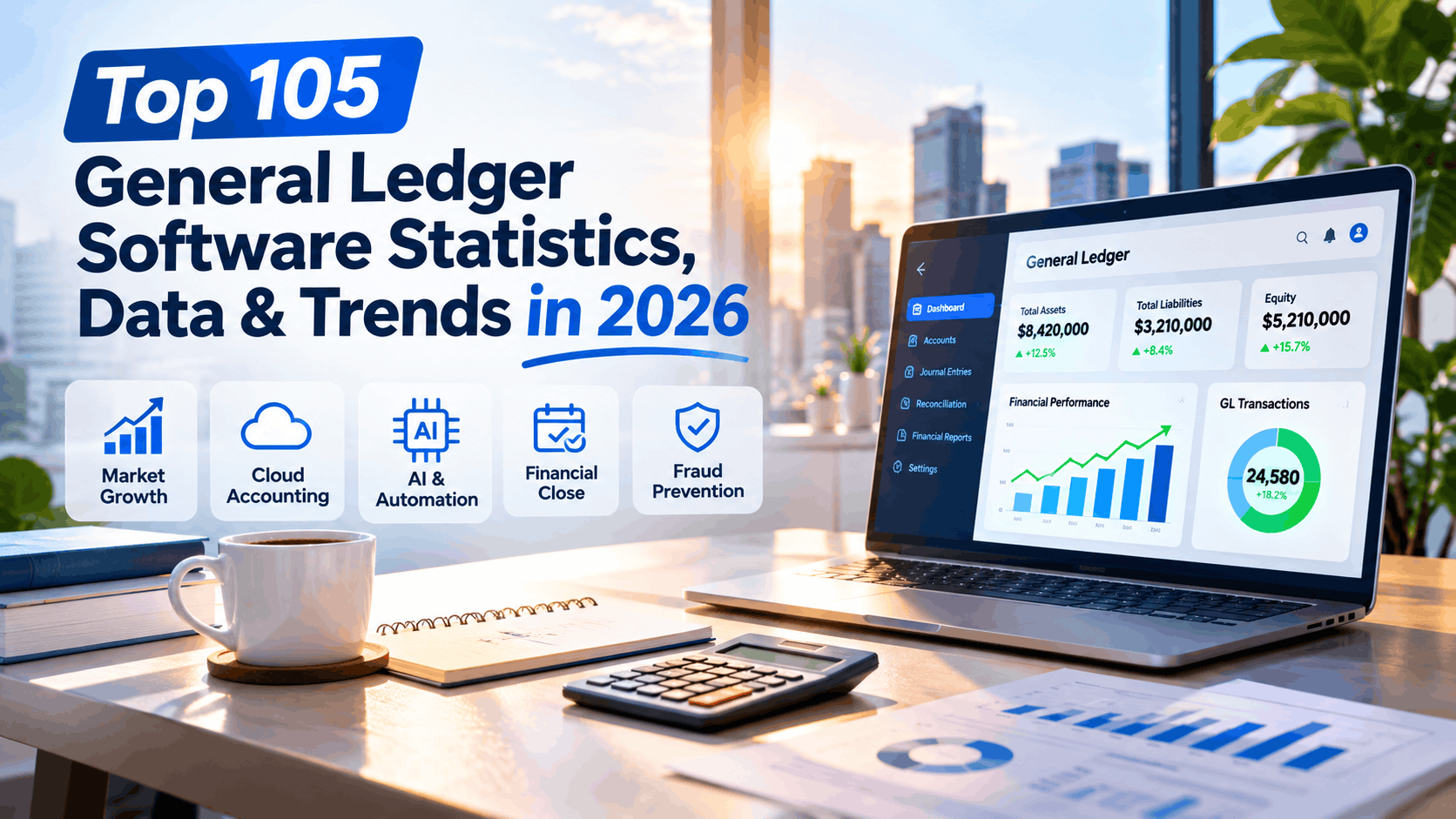
General ledger software in 2026 is a growing market valued at approximately $7.63 billion globally. Explore 105 general ledger software statistics covering market growth, cloud accounting adoption, AI automation, financial close efficiency, fraud prevention, and software pricing. Key trends highlight increasing demand for automated financial reporting, improved accounting accuracy, and real-time financial management.
The global general ledger software market is undergoing a significant transformation in 2026, driven by the rapid adoption of cloud accounting platforms, artificial intelligence (AI), financial automation, and increasingly complex regulatory requirements. As businesses seek greater financial transparency, faster reporting, and improved operational efficiency, general ledger software has evolved from a traditional bookkeeping solution into a critical component of modern financial management.
Also, read our article on the Top 10 Best General Ledger Software To Know.

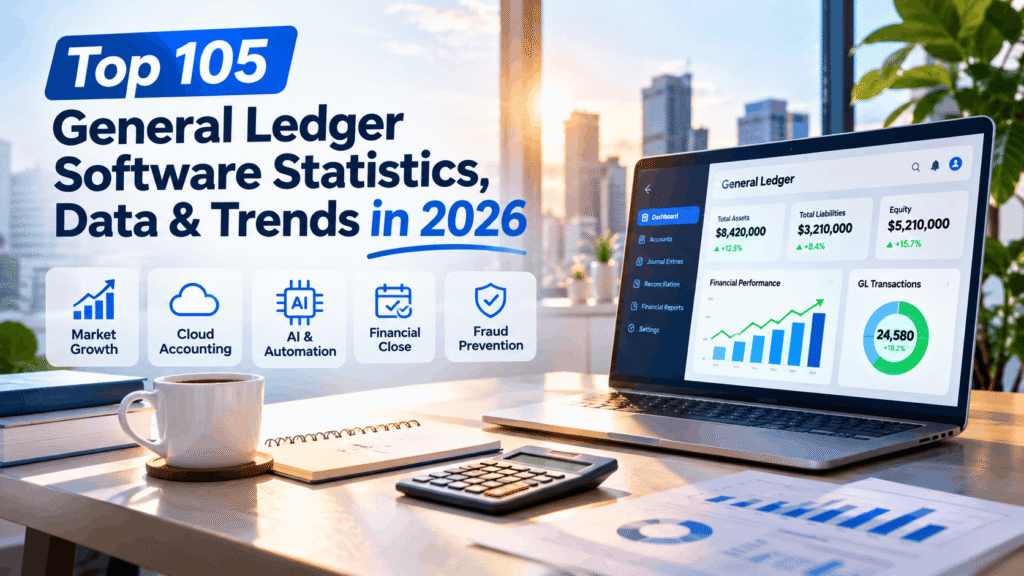
According to industry market research, the global general ledger accounting software market is estimated at $7.63 billion in 2026, up from approximately $7 billion in 2025. Some market research providers offer substantially higher valuations, including an estimated $18.7 billion in 2026, reflecting differences in market definitions and research methodologies. Despite these variations, industry forecasts consistently indicate sustained growth as organizations invest in cloud-based accounting systems, automated financial reporting, and integrated enterprise resource planning (ERP) solutions.
Cloud adoption remains one of the most influential trends shaping the general ledger software industry. Market estimates place the global cloud accounting software market at approximately $5.88 billion in 2026, with projections reaching $8.03 billion by 2030. Industry research also suggests that approximately 75% of US small and medium-sized businesses have adopted cloud accounting solutions, highlighting the growing preference for real-time financial visibility, remote accessibility, and scalable accounting infrastructure.

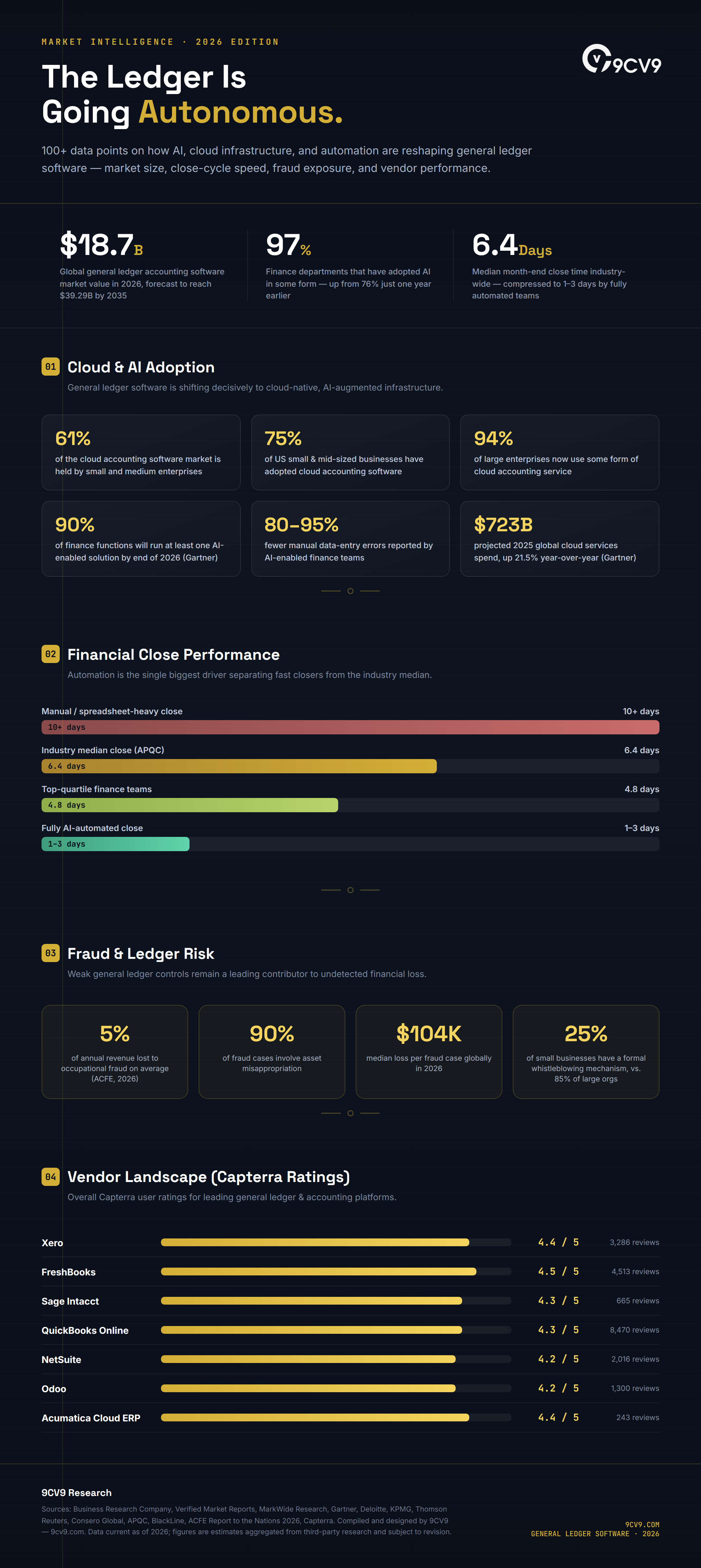
Artificial intelligence is accelerating this transformation. The Consero Global 2026 CFO Report indicates that 97% of finance departments have adopted AI in some capacity, compared with 76% in 2025. Meanwhile, Gartner forecasts that 90% of finance functions will operate at least one AI-enabled technology solution by the end of 2026. These developments demonstrate how AI-powered general ledger software is increasingly supporting automated journal entries, transaction categorization, anomaly detection, account reconciliation, and financial forecasting.
Financial close automation is another major area of investment. Industry benchmarking data indicates that the median month-end financial close takes approximately 6.4 business days, while highly automated finance teams can complete the process in as little as one to three business days. Research cited in the industry also suggests that AI-enabled financial automation can reduce close-cycle durations by 30% to 50%, helping finance departments minimize manual workloads and improve reporting timeliness.
However, the increasing complexity of financial operations also creates challenges involving accounting accuracy, internal controls, cybersecurity, and regulatory compliance. The Association of Certified Fraud Examiners (ACFE) estimates that organizations lose approximately 5% of annual revenue to occupational fraud, emphasizing the importance of reliable general ledger controls, transaction monitoring, audit trails, and financial governance.
Competition among general ledger software providers is also intensifying. Established accounting and ERP platforms such as QuickBooks Online, Xero, Oracle NetSuite, Sage Intacct, FreshBooks, Odoo, and Acumatica continue to compete on automation capabilities, integration options, reporting functionality, pricing, and user experience. Capterra customer review data highlights the importance of usability, bank reconciliation, financial reporting, and subscription affordability when businesses evaluate accounting software solutions.
For small businesses, the priority is often finding affordable general ledger software that simplifies bookkeeping, automates recurring transactions, and supports accurate financial reporting. Mid-sized companies increasingly require multi-entity accounting, advanced reconciliation, and customizable reporting capabilities. Large enterprises, meanwhile, are investing in sophisticated ERP-integrated general ledger platforms that support international operations, complex financial consolidation, regulatory compliance, and AI-driven analytics.
Understanding these developments is essential for CFOs, finance directors, accountants, business owners, software vendors, and technology decision-makers evaluating the future of accounting technology.
This comprehensive guide to the Top 105 General Ledger Software Statistics, Data & Trends in 2026 examines the latest industry estimates, market growth forecasts, cloud accounting adoption rates, AI and automation trends, financial close benchmarks, accounting risks, software pricing, and customer satisfaction metrics. It also explores the competitive landscape of leading general ledger software providers and the emerging technologies expected to shape financial management through 2030 and beyond.
Whether an organization is selecting its first accounting platform, replacing legacy financial systems, or investing in enterprise-wide financial automation, these 105 general ledger software statistics provide valuable insights into the technologies, market dynamics, and operational priorities influencing the accounting software industry in 2026.
Before we venture further into this article, we would like to share who we are and what we do.
About 9cv9
9cv9 is a business tech startup based in Singapore and Asia, with a strong presence all over the world.
With over ten years of startup and business experience, and being highly involved in connecting with thousands of companies and startups, the 9cv9 team has listed some of the top and best companies/tools in this review.
If you like to get your company listed in our top B2B software reviews, check out our world-class 9cv9 Media and PR service and pricing plans here.
Top 105 General Ledger Software Statistics, Data & Trends in 2026
Market Size & Growth
- $7.63 billion — global general ledger accounting software market size in 2026, up from $7 billion in 2025. The general ledger accounting software market is expanding at a 9% compound annual growth rate as businesses replace legacy bookkeeping tools with integrated financial platforms.
- $10.26 billion — projected general ledger accounting software market size by 2030, growing at a 7.7% CAGR. Rising demand for AI-driven financial analytics and scalable cloud accounting is expected to keep the general ledger software market on a steady upward trajectory through the end of the decade.
- $8.5 billion — alternate 2025 valuation of the general ledger accounting software market, forecast to reach $15.2 billion by 2034 at a 7.5% CAGR. Divergent analyst estimates reflect differing methodologies, but all major reports agree the general ledger software category is in a sustained multi-year growth phase.
- $18.7 billion — 2026 valuation of the general ledger accounting software market according to MarkWide Research, forecast to reach $39.29 billion by 2035 at an 8.60% CAGR. Mid-market enterprises migrating from spreadsheets to automated ledger systems are cited as a primary growth driver.
- $1.32 billion to $3.42 billion — narrower general ledger software market forecast (2025–2035) at a 10% CAGR from one market intelligence provider. Even the more conservative general ledger software market estimates point to double-digit annual growth this decade.
- United States, Germany, and India — the three countries identified as leading general ledger software demand growth in 2026. Modernizing tax reporting infrastructure and mandatory digital audit trails are accelerating general ledger software adoption in these markets.
- European Union data residency rules — cited as a reshaping force for general ledger software vendor certification requirements in 2026. Cloud security standards in the EU are pushing general ledger software vendors toward stricter compliance and hosting architectures.
Cloud Accounting & GL Software Adoption
- $5.88 billion — global cloud accounting software market value in 2026, projected to reach $8.03 billion by 2030 at an 8.1% CAGR. Cloud-based general ledger and accounting tools continue to outpace on-premises software in growth rate.
- $6.29 billion to $10.63 billion — alternate cloud accounting software market trajectory from 2026 to 2035 at a 6.1% CAGR. Analysts attribute this growth to remote work, real-time data access, and improved cybersecurity in cloud accounting platforms.
- 61% — share of the cloud accounting software market held by small and medium enterprises (SMEs). SMEs remain the primary driver of cloud-based general ledger software development and pricing competition.
- 75% — approximate share of US small and mid-sized businesses that have adopted cloud accounting software. Three in four US SMBs have already shifted away from spreadsheets and legacy desktop general ledger tools.
- 94% — share of accounting managers and large enterprises reportedly using some form of cloud accounting service. Cloud-based general ledger adoption among large enterprises has effectively become the industry standard rather than the exception.
- 10% — projected CAGR for the US cloud accounting software market through 2028, when it is expected to exceed $10 billion. Sustained double-digit growth signals long-term structural adoption of cloud general ledger platforms rather than a short-term pandemic-driven spike.
- $723.4 billion — projected global end-user spending on cloud services in 2025, up 21.5% from $595.7 billion in 2024 (Gartner). Broader enterprise cloud spending trends are reinforcing the shift toward cloud-native general ledger and accounting software.
- 15% — year-over-year revenue growth reported by organizations using cloud accounting exclusively, according to industry analysis. Businesses relying fully on cloud-based general ledger systems report measurably stronger growth than those on legacy infrastructure.
- Up to 50% — labor cost reduction reported by businesses adopting cloud accounting platforms, driven by automation and reduced rework. Cloud general ledger software is directly linked to leaner, more efficient finance department staffing models.
AI & Automation in Accounting
- 97% — share of finance departments that have adopted AI in some form, according to the Consero Global 2026 CFO Report, up from 76% in 2025. This 21-point jump marks one of the fastest technology adoption curves recorded in finance software history.
- 90% — share of finance functions Gartner forecasts will run at least one AI-enabled technology solution by the end of 2026. General ledger and accounting platforms are increasingly embedding AI features as a baseline expectation rather than a premium add-on.
- 71% — share of organizations worldwide that have deployed AI within their finance function, per KPMG’s 2025 Global AI in Finance survey. AI deployment in core finance and general ledger workflows has moved well past the pilot stage for most organizations.
- 74% — share of organizations with AI already implemented in finance who say their AI investments met or exceeded expectations. Early results suggest AI-enabled general ledger and finance tools are delivering measurable value for the majority of adopters.
- 63% — share of finance teams that report fully deploying and actively using AI solutions, per Deloitte’s Finance Trends 2026 report. Full AI deployment in finance functions is now a majority practice rather than an emerging trend.
- 21% — share of finance teams reporting clear, measurable ROI from AI despite widespread deployment. A persistent gap between AI adoption and proven ROI remains one of the biggest challenges facing general ledger software buyers evaluating AI features.
- 14% — share of finance organizations that have fully integrated AI agents into the finance function. Full agentic AI integration into general ledger and close workflows remains a minority practice even as broader AI adoption accelerates.
- 88% — share of finance professionals who expect AI to be the most transformative accounting technology over the next 12–24 months, per the AICPA and CIMA Future-Ready Finance survey. Confidence in AI’s transformative potential for general ledger and accounting work is now near-universal among finance professionals.
- Only 8% — share of organizations describing themselves as “very well prepared” for AI adoption in finance, despite high expectations for its impact. A significant readiness gap exists between anticipated AI benefits and actual organizational preparedness.
- 69% — share of AP departments that have implemented invoice data capture automation (OCR or AI extraction), per IOFM’s 2025 benchmarking survey of 421 AP departments. Automated invoice capture is fast becoming a standard feature expectation for general ledger-adjacent accounts payable workflows.
- 54% — share of AP departments that have automated three-way matching. Automated matching between purchase orders, receipts, and invoices continues to reduce manual reconciliation work feeding into the general ledger.
- 37% — share of finance respondents citing accounts payable automation as an AI use case actually running in production, per Gartner’s November 2025 survey — the second most common AI use case after knowledge management (49%).
- 34% — share of finance teams using AI specifically for error and anomaly detection, a use case directly relevant to general ledger accuracy and audit readiness.
- 25–40% — range of lower operational costs reported by organizations implementing AI across finance functions, based on aggregated McKinsey and Gartner finance research. AI-enabled general ledger and close automation consistently delivers meaningful cost efficiency across company sizes.
- 40–60% — range of faster financial close reported by AI-adopting organizations. Faster close cycles are among the most commonly cited benefits of AI-enhanced general ledger software.
- 80–95% — reduction range in manual data entry errors reported by organizations using AI-enabled finance tools. This is one of the most significant accuracy gains attributable to AI within general ledger and bookkeeping workflows.
- 30–50% — range of improved cash flow forecast accuracy reported by AI-adopting finance teams, underscoring the connection between clean general ledger data and reliable forecasting.
- 98% — share of accounting professionals globally reporting AI usage, per Karbon’s 2026 State of AI in Accounting report. AI use among accounting professionals has effectively reached market saturation.
- 84% — share of US accountants using AI for document summarization, workflow routing, validation, and client advisory support, per Progress Software’s 2026 research.
- 40% — organizational AI adoption rate in 2026 per Thomson Reuters, up from 22% in 2025 — nearly doubling year-over-year. This acceleration reflects how quickly AI features are being embedded into general ledger and broader accounting software stacks.
- 64% — share of accounting firms planning to invest in or upgrade AI systems this year, up from 57% in 2024, per CPA Practice Advisor.
- 79% — share of finance leaders who expect AI to automate more than half of routine accounting work, per Thomson Reuters research.
- 49% — share of CFOs prioritizing automation of routine work specifically to free staff for higher-value analytical tasks, per Deloitte’s 2025 survey.
- Neutral through 2026 — Gartner’s assessment of AI’s near-term net impact on finance jobs, with augmentation (making workers faster) outweighing outright job replacement in the general ledger and accounting function.
Financial Close & Reconciliation Performance
- 6.4 business days — median month-end close time across organizations, based on APQC benchmarking data. This remains the most widely cited industry benchmark for evaluating general ledger and close-process efficiency.
- 25% — share of organizations that take more than 10 days to complete their month-end close, highlighting a significant efficiency gap between top-performing and lagging finance teams.
- 1–3 business days — close time achieved by leading finance teams with full automation, versus the 6+ day industry median. Automated general ledger and close software is directly linked to dramatically faster financial reporting cycles.
- 4.8 business days — close time achieved by top-quartile finance teams, according to APQC data cited by CFO.com.
- 6.1 days — average month-end close time across industries in 2026 without AI automation, per BlackLine’s 2025 Finance Benchmark Report.
- 40–55% — close-cycle compression achieved through AI deployment, consistent across industries, entity structures, and ERP environments, per BlackLine benchmark data.
- Under 3 days — close time reported by finance teams that deployed AI agents between 2023 and 2025, compared with 6–8 days for teams that have not yet adopted AI-enabled general ledger tools.
- ~50% — approximate share of finance teams that still complete month-end close in 6 days or more, indicating that slow, manual close processes remain common despite available automation.
- 8–12+ business days — average close time for industries with complex revenue recognition requirements, such as SaaS, construction, and healthcare.
- 4–7 business days — average close time for professional services and simple retail businesses, which typically have less complex general ledger structures.
- 30–50% — reduction in close cycle length attributable to automation, according to CFO advisory benchmarking research.
Accounting Errors, Bookkeeping Risk & Financial Restatements
- Only 26% — share of small business owners who consider themselves “very knowledgeable” about accounting, suggesting a majority of small businesses are at elevated risk of general ledger errors without dedicated software or professional support.
- 140 firms — number of US public companies forced to withdraw and reissue financial statements in the first ten months of 2024, marking a nine-year high in financial restatements.
- 11% — increase in financial restatements recorded in 2022, part of a trend that has continued into 2025 and 2026 as accounting rules and compliance requirements grow more complex.
- 5–10% — average penalty range, as a percentage of annual earnings, faced by growing consumer brands earning $5 million+ in revenue due to accounting and compliance errors.
- Transposed numbers, incorrect account selection, and duplicate entries — identified as the most common data-entry errors in manual general ledger management, all of which automated bank-feed matching is designed to eliminate.
Fraud, Internal Controls & Governance
- 5% — estimated share of annual organizational revenue lost to occupational fraud each year globally, per the ACFE’s Occupational Fraud 2026 Report to the Nations.
- 2,402 cases across 143 countries — the scope of the ACFE’s 2026 global fraud study, collectively representing more than $3.4 billion in documented losses.
- $104,000 — median loss per occupational fraud case in the ACFE’s 2026 report; average loss per case exceeded $1.4 million.
- 90% — share of occupational fraud cases in 2026 involving asset misappropriation, making it by far the most common fraud category relevant to general ledger and cash-handling controls.
- 43% — share of fraud cases detected via employee or third-party tips in the 2026 ACFE report — nearly three times more than the next most common detection method (internal audit, 15%).
- ~12 months — average duration a fraud scheme continues before being detected, underscoring the importance of real-time general ledger visibility and automated anomaly detection.
- 85% vs. 25% — share of large organizations with an established whistleblowing mechanism compared with small businesses, revealing a major governance gap that leaves small businesses more exposed to undetected fraud.
- 48% — share of fraud cases in the ACFE’s prior study involving corruption schemes such as kickbacks and bribes.
- $766,000 — median loss from financial statement fraud, the least common but most financially damaging fraud category, directly tied to general ledger and financial reporting integrity.
- $120,000 — median loss from asset misappropriation schemes, the most frequent but comparatively lower-value fraud category.
- More than half — share of occupational fraud cases correlated with a lack of internal controls or management override of existing controls, reinforcing the role of general ledger access controls and approval workflows in fraud prevention.
- Web-based reporting (40%) — now the most popular fraud whistleblowing channel, surpassing email (37%) and telephone hotlines (30%) for the first time in ACFE study history.
Vendor & Product Data (Capterra — General Ledger & Accounting Software Directory)
- 8,470 user reviews — total Capterra reviews for QuickBooks Online, with an overall rating of 4.3 out of 5. QuickBooks Online remains one of the most heavily reviewed general ledger and accounting platforms on Capterra.
- 86% positive sentiment — share of QuickBooks Online reviews rated positive on Capterra, versus 8% neutral and 5% negative.
- 7 million+ users worldwide — reported user base of QuickBooks Online, reflecting its position as one of the most widely adopted general ledger and small-business accounting platforms globally.
- $38/month — starting price for QuickBooks Online (Simple Start plan), scaling to $275/month for the Advanced tier with workflow automation and revenue recognition features.
- 4.2 — QuickBooks Online’s Ease of Use rating based on 7,704 Capterra reviews.
- 4.0 — QuickBooks Online’s Customer Service rating based on 6,317 Capterra reviews, with users citing mixed experiences on support responsiveness.
- 90% — share of QuickBooks Online Capterra reviewers identified as small businesses, confirming its core market fit.
- 3,286 user reviews — total Capterra reviews for Xero, with an overall rating of 4.4 out of 5 — the highest overall rating among major general ledger platforms with a large review base.
- 88% positive sentiment — share of Xero reviews rated positive on Capterra, versus 7% neutral and 5% negative.
- $25/month — starting price for Xero’s Starter plan, rising to $90/month for the Premium tier with 180-day cash flow forecasting.
- 4.4 — Xero’s Ease of Use rating based on 2,786 Capterra reviews, among the highest usability scores in the general ledger software category.
- 4.2 — Xero’s Value for Money rating based on 2,405 Capterra reviews.
- $1,221/month — average SMB accounting software budget cited by Capterra, against which Xero’s $25 entry price positions it as a notably cost-efficient general ledger option for small teams.
- 4.2 (2,016+ reviews) — NetSuite’s Capterra rating, with 85% of reviewers rating it above 4 stars, reflecting strong satisfaction among mid-market and enterprise general ledger users.
- 4.3 (665–705 reviews) — Sage Intacct’s Capterra rating, with 86% of reviewers rating it above 4 stars, particularly among organizations with multi-entity and multi-currency general ledger requirements.
- 4.5 (4,513 reviews) — FreshBooks’ Capterra rating, the highest among commonly compared alternatives, with 92% of reviewers rating it above 4 stars.
- 4.2 (1,300+ reviews) — Odoo’s Capterra rating, with 83% of reviewers rating it above 4 stars.
- 4.4 (243 reviews) — Acumatica Cloud ERP’s Capterra rating, with 92% of reviewers rating it above 4 stars, the highest positive-rating share among enterprise-oriented alternatives reviewed.
- 4.0 (554 reviews) — Sage 50cloud’s Capterra rating, with 75% of reviewers rating it above 4 stars.
- 2.5 million+ — total verified user reviews Capterra has processed across its software directory, underpinning the credibility of general ledger software ratings and rankings on the platform.
- 4.6 (102 reviewers) — Xero’s highest-rated individual feature, “Profit or loss statement,” reflecting strong user confidence in its core general ledger reporting output.
- 4.5 (303 reviewers) — Xero’s Invoice Creation feature rating, one of its most heavily reviewed capabilities.
- 67.99% of 578 reviewers — share of Xero users rating bank reconciliation as important or highly important, making it one of the most valued features tied directly to general ledger accuracy.
- 4.4 (1,321 reviews) — QuickBooks Online’s Bank Reconciliation feature rating on Capterra.
- 4.4 (1,316 reviews) — QuickBooks Online’s Expense Tracking feature rating on Capterra.
- 4.4 (1,300 reviews) — QuickBooks Online’s Financial Reporting feature rating on Capterra.
- 4.5 (964 reviews) — QuickBooks Online’s Income & Balance Sheet feature rating, one of its highest-rated general ledger-adjacent capabilities.
- 55% negative sentiment (out of 832 reviews) — share of QuickBooks Online reviewers citing rising subscription costs as a pain point, the platform’s most commonly flagged con.
- 55% negative sentiment (out of 133 reviews) — share of Xero reviewers citing recurring technical glitches, its most commonly flagged con.
Multi-Entity, ERP & Enterprise General Ledger Trends
- $20,000 to $300,000+ per year — typical cost range for mid-market multi-entity ERP platforms with native general ledger consolidation, depending on entity count, users, and modules.
- 4–9 months — typical implementation timeline for mid-market multi-entity ERP/general ledger platforms; global enterprise rollouts across many entities can take 12+ months or longer.
- 6–18 months — implementation timeline range specifically for large-scale platforms such as NetSuite and Microsoft Dynamics 365 in multi-entity general ledger consolidation projects.
- One general ledger, one chart of accounts, one set of financial statements — the structural limitation of standard single-entity accounting software (e.g., QuickBooks Online, Xero) that drives growing businesses toward dedicated multi-entity general ledger platforms.
- 40+ country localizations — number of jurisdictional configurations supported by leading ERP consolidation modules for general ledger data aggregation across international subsidiaries.
Small Business Bookkeeping & Manual Process Risk
- 6–15 days — typical duration of a traditional, largely manual month-end close for small and mid-sized businesses without dedicated general ledger automation.
- 3–5 days — close duration achievable with automation-led, standardized general ledger workflows, roughly a 60–70% reduction versus fully manual processes.
- DIY/manual bookkeeping breakdown threshold — commonly cited around $100,000 in annual revenue, the point at which businesses typically outgrow spreadsheet-based general ledger management and require dedicated software.
Conclusion
The top 105 general ledger software statistics, data, and trends in 2026 highlight an accounting software industry undergoing rapid transformation as businesses increasingly prioritize cloud adoption, artificial intelligence, financial automation, and real-time reporting. General ledger software is no longer simply a tool for recording financial transactions. It has become an essential component of modern financial management, helping organizations improve accounting accuracy, strengthen internal controls, accelerate financial close processes, and make more informed business decisions.
With the global general ledger accounting software market estimated at $7.63 billion in 2026 and projected to experience sustained growth through the coming decade, demand for advanced accounting solutions continues to increase. The expansion of cloud accounting, alongside growing investments in integrated enterprise resource planning (ERP) platforms, reflects the shift away from fragmented spreadsheets and legacy financial systems toward scalable, automated financial infrastructure.
One of the most significant general ledger software trends in 2026 is the widespread adoption of AI-powered accounting technology. Industry research indicates that 97% of finance departments have adopted AI in some capacity, while Gartner forecasts that 90% of finance functions will use at least one AI-enabled technology solution by the end of 2026. These developments demonstrate the growing importance of intelligent automation in journal entry processing, transaction classification, account reconciliation, anomaly detection, and financial reporting.
Financial close efficiency is another critical performance indicator. With the median month-end close taking approximately 6.4 business days, organizations have considerable opportunities to improve productivity through automated reconciliation, standardized workflows, and integrated accounting systems. Leading finance teams are demonstrating that close cycles of one to three business days are achievable with effective financial automation and process optimization.
However, the statistics also reveal important challenges. Despite increasing AI adoption, relatively few finance organizations have fully integrated autonomous AI agents into their operations, and demonstrating measurable returns on AI investments remains difficult for many businesses. Accounting errors, occupational fraud, regulatory complexity, implementation costs, and cybersecurity risks continue to influence general ledger software purchasing decisions.
The competitive landscape is also evolving as established providers such as QuickBooks Online, Xero, Oracle NetSuite, Sage Intacct, FreshBooks, Odoo, and Acumatica expand their capabilities to address different business requirements. While small businesses typically prioritize affordability, ease of use, and automated bookkeeping, larger organizations increasingly require multi-entity consolidation, advanced financial controls, international accounting capabilities, and sophisticated analytics.
Looking ahead, several developments are expected to shape the future of general ledger software beyond 2026, including deeper AI integration, continuous accounting, automated financial reconciliation, predictive analytics, enhanced fraud detection, and greater interoperability between accounting platforms and enterprise applications. Organizations that successfully combine these technologies with effective financial governance will be better positioned to improve reporting accuracy, reduce administrative workloads, and respond to changing business conditions.
Ultimately, the 105 general ledger software statistics presented in this guide demonstrate that cloud accounting, AI-driven automation, financial transparency, and operational efficiency are central to the future of accounting technology. For CFOs, finance professionals, accountants, business owners, and enterprise decision-makers, understanding these market trends is essential when evaluating accounting software investments and developing long-term financial technology strategies.
As the general ledger software market continues to evolve, businesses should focus on selecting solutions that align with their operational complexity, integration requirements, compliance obligations, scalability needs, and financial objectives. Rather than adopting new technologies solely for their advanced features, organizations should prioritize measurable improvements in accounting accuracy, financial close performance, reporting efficiency, and overall financial management.
The future of general ledger software will be defined not simply by how efficiently businesses record financial transactions, but by how effectively they transform financial data into accurate, timely, and actionable business intelligence.
If you find this article useful, why not share it with your hiring manager and C-level suite friends and also leave a nice comment below?
We, at the 9cv9 Research Team, strive to bring the latest and most meaningful data, guides, and statistics to your doorstep.
To get access to top-quality guides, click over to 9cv9 Blog.
To hire top talents using our modern AI-powered recruitment agency, find out more at 9cv9 Modern AI-Powered Recruitment Agency.
People Also Ask
What is the global general ledger software market size in 2026?
The global general ledger accounting software market is estimated at $7.63 billion in 2026, up from approximately $7 billion in 2025. Growth is driven by cloud accounting adoption, financial automation, and increasing demand for integrated accounting platforms.
How fast is the general ledger software market growing?
The general ledger software market is experiencing steady growth, with industry estimates suggesting annual growth rates between 7.5% and 10%. Increasing investment in AI-powered accounting, cloud infrastructure, and automated financial reporting supports this expansion.
What is the projected general ledger software market size by 2030?
The global general ledger accounting software market is projected to reach approximately $10.26 billion by 2030, according to one industry forecast. Growth is supported by cloud migration, AI-driven financial analytics, and enterprise accounting modernization.
What are the biggest general ledger software trends in 2026?
Major general ledger software trends in 2026 include cloud accounting adoption, AI-powered automation, real-time financial reporting, automated reconciliation, multi-entity accounting, predictive analytics, and stronger financial security controls.
What is general ledger software used for?
General ledger software records, organizes, and manages financial transactions. It supports journal entries, account reconciliation, financial statements, audit trails, and reporting, helping businesses maintain accurate financial records and meet accounting requirements.
How many businesses use cloud accounting software in 2026?
Industry estimates suggest approximately 75% of US small and medium-sized businesses use cloud accounting software. Cloud platforms offer remote accessibility, automated updates, real-time financial information, and integration with other business applications.
What is the cloud accounting software market worth in 2026?
The global cloud accounting software market is estimated at approximately $5.88 billion in 2026. Industry forecasts project growth to $8.03 billion by 2030, supported by increasing demand for scalable financial management and automated accounting solutions.
How is artificial intelligence transforming general ledger software?
Artificial intelligence improves general ledger software through automated transaction classification, journal entry processing, anomaly detection, financial reconciliation, and reporting. These capabilities help reduce repetitive tasks and improve accounting efficiency.
What percentage of finance departments use AI in 2026?
According to the Consero Global 2026 CFO Report cited in the industry data, 97% of finance departments have adopted AI in some capacity, compared with 76% in 2025. Adoption includes financial automation, analytics, and reporting applications.
What are the benefits of AI-powered general ledger software?
AI-powered general ledger software can reduce manual data entry, improve transaction accuracy, accelerate reconciliation, detect unusual activity, and streamline financial reporting. These benefits help finance teams focus on analysis and strategic decision-making.
How long does the average month-end financial close take?
Industry benchmarking data indicates that the median month-end financial close takes approximately 6.4 business days. Organizations with automated accounting workflows can achieve faster closing cycles through improved reconciliation and reporting processes.
Can general ledger software reduce month-end closing time?
Yes. Automated general ledger software can shorten financial close cycles by reducing manual reconciliation, journal entry processing, and reporting tasks. Highly automated finance teams may complete month-end closing in one to three business days.
How much can accounting automation reduce operational costs?
Industry research cited in the data suggests that AI-enabled finance automation can reduce operational costs by approximately 25% to 40% in some organizations. Actual savings depend on implementation quality, transaction volumes, and existing workflows.
What are the most important features of general ledger software?
Essential general ledger software features include journal entry management, bank reconciliation, financial reporting, automated transaction categorization, audit trails, role-based access controls, multi-currency support, and integration with accounting applications.
What is the best general ledger software for small businesses?
QuickBooks Online, Xero, and FreshBooks are popular accounting software options for small businesses. The best choice depends on pricing, bookkeeping requirements, reporting features, integration capabilities, and ease of use.
Which general ledger software platforms are popular in 2026?
Popular general ledger and accounting platforms include QuickBooks Online, Xero, Oracle NetSuite, Sage Intacct, FreshBooks, Odoo, Acumatica, and Sage 50cloud. These solutions serve businesses with different financial management requirements.
How much does general ledger software cost in 2026?
General ledger software pricing varies by provider and functionality. The source data lists starting monthly prices of $25 for Xero and $38 for QuickBooks Online, while enterprise ERP solutions can cost tens or hundreds of thousands of dollars annually.
What is the difference between general ledger software and accounting software?
General ledger software focuses on recording financial transactions and maintaining account balances. Accounting software typically includes broader functions such as invoicing, payroll, accounts payable, accounts receivable, and financial management.
What is the difference between general ledger software and ERP software?
General ledger software manages core accounting records and financial reporting. ERP software integrates accounting with broader business operations, including procurement, inventory, manufacturing, human resources, and enterprise financial management.
How does cloud-based general ledger software work?
Cloud-based general ledger software stores accounting information on remotely hosted systems accessible through the internet. It enables authorized users to manage transactions, reconcile accounts, generate reports, and collaborate without relying on local installations.
What percentage of accounting professionals use AI in 2026?
Karbon’s 2026 State of AI in Accounting report, as cited in the source data, indicates that 98% of accounting professionals surveyed use AI. Applications include document processing, workflow automation, financial analysis, and administrative support.
How does general ledger software improve accounting accuracy?
General ledger software improves accounting accuracy through automated calculations, transaction validation, reconciliation, standardized journal entries, and audit trails. These features help reduce duplicate transactions, incorrect account classifications, and manual errors.
Can general ledger software help prevent financial fraud?
Yes. General ledger software can strengthen fraud prevention through access controls, transaction monitoring, approval workflows, audit logs, and anomaly detection. However, effective fraud prevention also requires internal controls, oversight, and regular audits.
How much revenue do organizations lose to occupational fraud?
The Association of Certified Fraud Examiners estimates that organizations lose approximately 5% of annual revenue to occupational fraud. This estimate highlights the importance of financial controls, transaction monitoring, and reliable accounting records.
What is multi-entity general ledger software?
Multi-entity general ledger software allows businesses to manage accounting records across multiple subsidiaries, locations, or legal entities. It supports consolidated financial reporting, intercompany transactions, multi-currency accounting, and centralized financial oversight.
How long does it take to implement enterprise general ledger software?
Mid-market ERP and general ledger implementations typically take four to nine months, according to the source data. Larger enterprise projects involving multiple entities, complex integrations, and international operations may require 12 months or longer.
Why are businesses switching from spreadsheets to general ledger software?
Businesses replace spreadsheets with general ledger software to improve accounting accuracy, automate repetitive tasks, strengthen financial controls, simplify reconciliation, and generate reliable reports. Dedicated platforms also support collaboration and business growth.
What are the biggest challenges facing general ledger software adoption?
Major challenges include implementation costs, data migration, employee training, integration complexity, cybersecurity risks, regulatory compliance, and resistance to organizational change. Businesses must also evaluate the measurable return on automation investments.
How does general ledger software support financial reporting and compliance?
General ledger software supports financial reporting by organizing transactions, maintaining account balances, generating financial statements, and preserving audit trails. It also helps businesses apply consistent accounting procedures and meet applicable reporting requirements.
What is the future of general ledger software beyond 2026?
The future of general ledger software will likely involve greater AI automation, continuous accounting, predictive financial analytics, real-time reconciliation, advanced fraud detection, and deeper ERP integration. Cloud platforms and stronger financial controls will remain important growth drivers.
Sources
Available Upon Request