

Key Takeaways
- Strong Gymnastics Software Market Growth: The global gymnastics software market was estimated at $1.5 billion in 2025, with a projected CAGR of 12.5% through 2033, driven by increasing demand for digital club management solutions.
- AI and Cloud-Based Software Adoption: Artificial intelligence, automated scheduling, mobile applications, and cloud-based platforms are transforming gymnastics management, improving operational efficiency, athlete tracking, and parent engagement.
- Financial Automation and Membership Retention: Modern gymnastics management software helps clubs streamline recurring payments, reduce administrative workloads, strengthen customer retention, and support sustainable business growth.
Gymnastics software streamlines club management through automated scheduling, membership administration, payment processing, athlete performance tracking, and parent communication. In 2026, the industry’s growth outlook includes an estimated global market value of $1.5 billion in 2025 and a projected compound annual growth rate of 12.5% through 2033.
The gymnastics industry is undergoing a significant digital transformation in 2026, driven by the growing demand for automated club management, intelligent scheduling, athlete performance tracking, streamlined payment processing, and enhanced customer experiences. As gymnastics clubs, recreational centres, competitive academies, and multi-location sports facilities face increasingly complex operational requirements, gymnastics software has emerged as an essential technological investment for improving administrative efficiency, financial performance, athlete development, and long-term business sustainability.

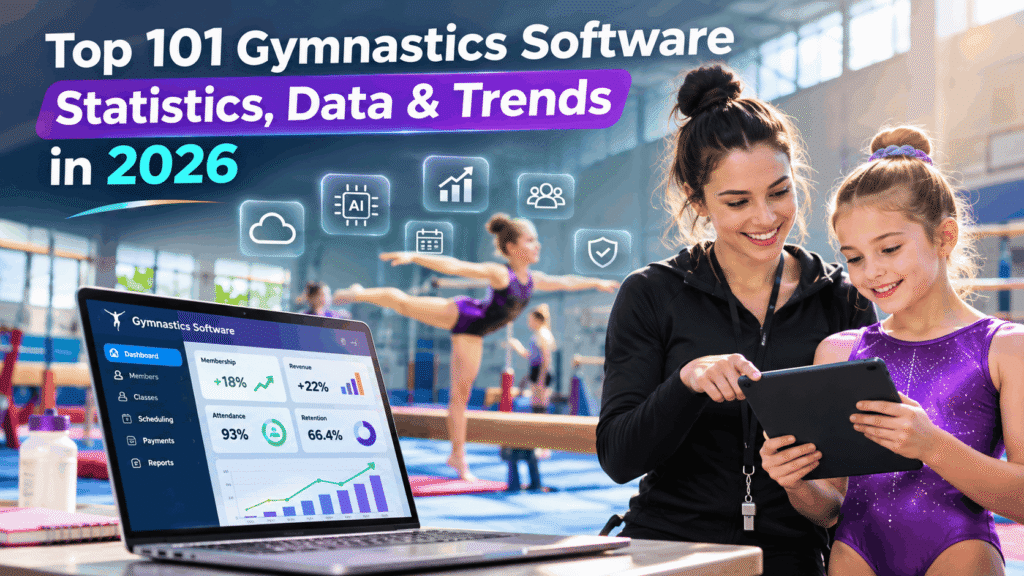
Gymnastics management software is no longer limited to basic class scheduling and membership administration. Modern platforms incorporate cloud computing, artificial intelligence (AI), automated billing, customer relationship management (CRM), digital registration, mobile applications, skill progression tracking, advanced reporting, and safeguarding compliance tools. These technological advancements are transforming how gymnastics businesses manage daily operations, communicate with parents, monitor athlete development, and maintain competitive advantages in an increasingly technology-driven sports industry.
The Growing Global Gymnastics Software Market in 2026

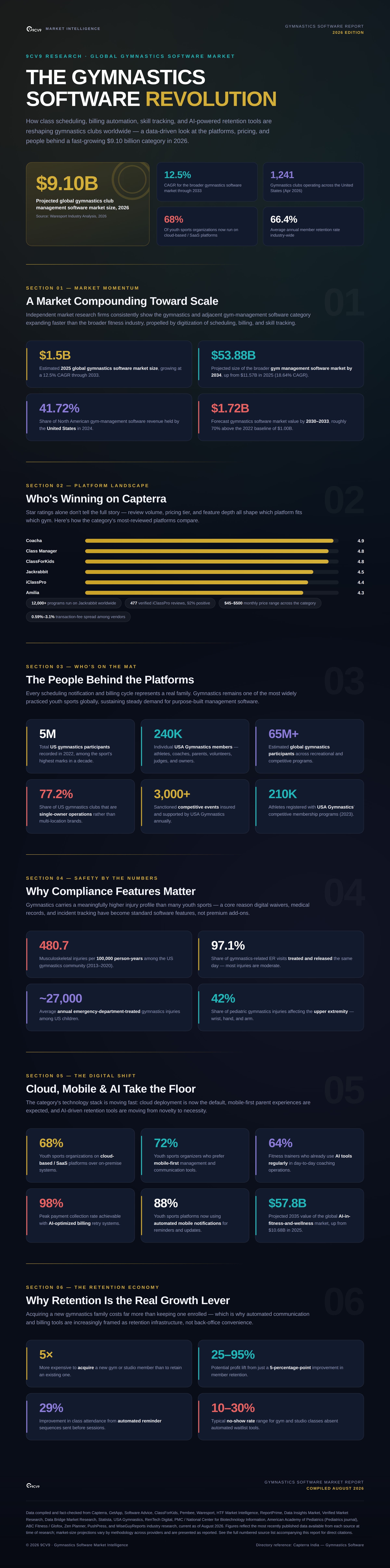
The global gymnastics software market is experiencing substantial expansion as sports organisations increasingly prioritise digital transformation and operational automation. One industry estimate valued the broader gymnastics software market at approximately $1.5 billion in 2025, with a projected compound annual growth rate (CAGR) of 12.5% through 2033. Another market assessment estimates the gymnastics software market at $1.02 billion, with its value expected to reach $1.7 billion by 2033.
Although market valuations vary according to research methodologies, software classifications, and market definitions, these projections collectively indicate sustained demand for specialised gymnastics technology solutions.
The expansion of adjacent software markets further illustrates the growing commercial opportunities within the gymnastics technology ecosystem. The global gym management software market was valued at $11.57 billion in 2025 and is projected to reach $53.88 billion by 2034, growing at a CAGR of 18.64%. Meanwhile, one estimate places the youth sports software market at $1.84 billion in 2025, with its value expected to reach $4.06 billion by 2034.
These developments highlight the increasing convergence of sports management software, fitness technology, youth activity management platforms, and digital business administration systems.
Rising Gymnastics Participation Is Driving Software Demand
The substantial global participation in gymnastics represents an important growth opportunity for gymnastics software providers. Industry estimates place worldwide gymnastics participation at between 65 million and more than 80 million athletes, although the exact figures vary between market assessments.
In the United States alone, approximately 5 million people participated in gymnastics in 2022, while around 210,000 athletes were registered with USA Gymnastics by 2023. USA Gymnastics also reports nearly 240,000 individual members across athletes, coaches, judges, volunteers, parents, and club owners, alongside sanctioning more than 3,000 competitive events annually.
As of April 2026, approximately 1,241 gymnastics clubs were estimated to be operating across the United States, with 77.20% classified as single-owner operations and 22.80% belonging to larger multi-location organisations.
This distribution demonstrates the importance of affordable, scalable, and user-friendly gymnastics management software for independent business owners. Smaller gymnastics clubs increasingly require digital solutions that reduce administrative workloads without introducing excessive implementation costs, while larger academies demand sophisticated reporting, centralised management, and multi-location operational capabilities.
Growing participation also creates demand for specialised features such as online enrolment, automated attendance monitoring, competition management, athlete assessments, family billing, and parent communication systems.
Cloud-Based and Mobile-First Gymnastics Software Adoption Is Accelerating
Cloud computing and mobile technology are becoming increasingly important components of the modern gymnastics software ecosystem. More than 68% of youth sports organisations reportedly favour cloud-based software-as-a-service (SaaS) platforms over traditional on-premises solutions, reflecting growing preferences for scalability, accessibility, and operational flexibility.
Additionally, approximately 72% of youth sports organisers prefer mobile-first management solutions, while 88% of youth sports platforms utilise mobile notifications to deliver real-time updates and reminders.
These broader youth sports technology adoption trends have significant implications for gymnastics businesses. Parents increasingly expect convenient access to class schedules, payment information, registration forms, attendance records, and athlete progress reports through smartphones and dedicated mobile applications.
Gymnastics coaches also benefit from tablet-based workflows that enable real-time attendance recording, skill assessments, lesson planning, and athlete development monitoring directly from the training floor.
By replacing fragmented spreadsheets, paper-based documentation, and disconnected administrative systems, cloud-based gymnastics software can help organisations improve data accessibility, reduce repetitive tasks, and deliver more consistent customer experiences.
Artificial Intelligence Is Reshaping Gymnastics Management Software
Artificial intelligence is emerging as an influential technological trend across gymnastics software, fitness management platforms, and sports technology solutions in 2026.
The global AI in fitness and wellness market was valued at approximately $10.68 billion in 2025 and is projected to reach $57.80 billion by 2035, representing a CAGR of 19.3%. Furthermore, approximately 64% of fitness trainers reportedly use AI tools regularly, while 49% of surveyed fitness consumers use AI-powered fitness and wellness applications daily.
Although these statistics reflect the broader fitness and wellness industry rather than gymnastics exclusively, they demonstrate the growing acceptance of AI-powered technologies across closely related markets.
Within gymnastics management software, artificial intelligence is creating opportunities to improve class scheduling, predict membership cancellations, automate customer communication, optimise payment collection, and identify operational inefficiencies.
Advanced gymnastics-specific scheduling solutions can also help prevent apparatus-booking conflicts by coordinating training sessions across vaults, uneven bars, balance beams, and floor exercise areas.
As AI capabilities continue to evolve, gymnastics software providers are increasingly exploring intelligent automation that addresses the unique operational requirements of gymnastics facilities rather than relying exclusively on generic fitness management functionality.
Automation Is Becoming Essential for Gymnastics Business Profitability
Financial management, membership retention, and operational efficiency remain critical priorities for gymnastics club owners in 2026. Increasing competition and administrative complexity are encouraging businesses to invest in software that automates repetitive processes and supports sustainable revenue growth.
Industry estimates suggest that manual payment reconciliation across disconnected systems can consume between 10 and 15 staff hours per week. Meanwhile, AI-optimised billing retry systems within fitness and gymnastics software can reportedly achieve payment collection rates of up to 98%.
Software pricing and transaction fees also play an important role in purchasing decisions. Many mid-market gymnastics management platforms cost between $49 and $139 per month, excluding payment processing fees, while enterprise-level solutions may exceed $500 per month. Reported platform transaction fees range from approximately 0.59% to 3.1%, depending on the provider and payment arrangement.
Membership retention represents another significant business challenge. The reported average annual member retention rate across fitness and gymnastics-adjacent facilities stands at approximately 66.4%, illustrating the importance of proactive customer engagement and retention strategies.
Automated class reminders, digital waitlist management, personalised communication, recurring billing, and customer relationship management tools can help gymnastics businesses address these challenges while improving administrative productivity and customer satisfaction.
Safety, Compliance and Athlete Development Are Increasingly Important
Unlike many conventional fitness businesses, gymnastics facilities must manage complex athlete safety requirements, skill progression standards, safeguarding responsibilities, and competition-related documentation.
Research estimates that youth gymnastics injury rates range from 0.5 to 1.3 injuries per 1,000 hours of sport-specific exposure. Additionally, an estimated 27,000 gymnastics-related injuries are treated annually in emergency departments across the United States.
These statistics reinforce the importance of comprehensive digital incident reporting, medical documentation, electronic waivers, staff certification tracking, and safeguarding compliance management.
Modern gymnastics software increasingly incorporates functionality that enables coaches to monitor individual athlete development, document skill achievements, assess training progression, and communicate performance updates to parents.
Such capabilities distinguish specialised gymnastics software from conventional gym management systems, particularly for competitive academies and facilities managing multiple athlete development programmes.
Understanding the Competitive Gymnastics Software Landscape in 2026
The gymnastics software industry features a diverse and increasingly competitive vendor ecosystem, including established platforms such as Jackrabbit Class, iClassPro, GymnasticsBiz, Class Manager, Coacha, ClassForKids, Amilia, and emerging technology providers.
Jackrabbit Class reportedly serves more than 12,000 gymnastics, dance, cheer, and swim programmes worldwide, while GymnasticsBiz reports supporting over 2,000 gymnastics businesses globally.
Competition among gymnastics software providers is increasingly centred on functionality, affordability, customer support, mobile accessibility, integration capabilities, artificial intelligence, and industry-specific customisation.
The market is also segmented into three principal software categories: gymnastics management software, gymnastics scoring software, and gymnastics training and performance analysis software. Each category addresses distinct operational requirements, ranging from business administration and competition management to athlete development and coaching effectiveness.
As software capabilities expand, gymnastics business owners must carefully evaluate platform features, subscription costs, transaction fees, implementation requirements, scalability, and long-term return on investment before selecting a technology solution.
Why Gymnastics Software Statistics Matter in 2026
Understanding the latest gymnastics software statistics, data, and industry trends is essential for gymnastics club owners, sports administrators, coaches, software developers, technology investors, and entrepreneurs seeking to navigate the evolving digital sports management landscape.
Reliable industry data can help stakeholders identify emerging market opportunities, evaluate software investments, benchmark operational performance, understand customer expectations, and develop more effective digital transformation strategies.
This comprehensive guide to the Top 101 Gymnastics Software Statistics, Data & Trends in 2026 explores the most important developments shaping the global gymnastics technology industry, including:
- Global gymnastics software market size, growth forecasts, and revenue opportunities.
- Gymnastics management software adoption, subscription pricing, and vendor competition.
- Cloud-based platforms, mobile applications, and digital transformation trends.
- Artificial intelligence, intelligent scheduling, and emerging sports technologies.
- Automated payments, recurring billing, and financial management solutions.
- Global gymnastics participation, club demographics, and industry growth.
- Athlete safety, injury statistics, safeguarding, and regulatory compliance.
- Membership retention, customer communication, and operational efficiency.
- Gymnastics software features, performance tracking, and athlete development.
- Competitive market segmentation and specialised software innovations.
By examining these 101 gymnastics software statistics, businesses and industry professionals can gain a comprehensive understanding of the technological, economic, and operational forces shaping gymnastics management in 2026 and beyond.
As digital transformation continues to accelerate, gymnastics software is positioned to become an increasingly important foundation for efficient facility management, improved athlete experiences, stronger customer relationships, enhanced operational resilience, and sustainable business growth across the global gymnastics industry.
Before we venture further into this article, we would like to share who we are and what we do.
About 9cv9
9cv9 is a business tech startup based in Singapore and Asia, with a strong presence all over the world.
With over ten years of startup and business experience, and being highly involved in connecting with thousands of companies and startups, the 9cv9 team has listed some of the top and best companies/tools in this review.
If you like to get your company listed in our top B2B software reviews, check out our world-class 9cv9 Media and PR service and pricing plans here.
Top 101 Gymnastics Software Statistics, Data & Trends in 2026
Market Size & Growth
- The global gymnastics club management software market is projected to reach $9.10 billion in 2026. Facility operators worldwide are shifting from debating whether to digitize toward deciding which platform delivers the best competitive advantage in 2026.
- The broader gymnastics software market was estimated at $1,500 million in 2025, growing at a 12.5% CAGR through 2033. This robust expansion reflects rising demand for class scheduling, member management, payment processing, and performance-tracking tools across gymnastics academies.
- One market analysis pegs the gymnastics studio management software segment at roughly $1.02 billion, projected to reach $1.7 billion by 2033. Despite the growing number of available tools, many studios still stitch together three or four separate systems instead of one unified platform.
- A separate HTF Market Intelligence report values the global gymnastics software market at $1.02 billion, forecasting 7.5% growth toward $1.7 billion by 2033. Advanced analytics, athlete monitoring, and coach-athlete interaction tools are expanding the scope of what gymnastics software now covers.
- The Gymnastics Software Market was estimated to grow from $1.00 billion in 2022 to $1.72 billion by 2030, at a 7.00% CAGR. Segmentation by facility size — from 0–100 users to 501–1,000 users — shows demand scaling across both boutique studios and large multi-location academies.
- Gymnastics software pricing tiers span single-user, multi-user, and enterprise licenses priced at roughly $2,900, $4,350, and $5,800 respectively. These tiered models let gymnastics facilities of varying sizes select a license structure that matches their operational scale.
- The adjacent gym management software market was valued at $11.57 billion in 2025 and is projected to reach $53.88 billion by 2034, at an 18.64% CAGR. This broader fitness-technology category, which overlaps significantly with gymnastics-specific platforms, is expanding nearly five times faster than the standalone gymnastics segment.
- The U.S. dominated the North American gym management software market with a 41.72% revenue share in 2024. Widespread internet penetration and early SaaS adoption have made American gymnastics and fitness facilities early movers on digital management tools.
- The youth sports software market — a category closely tied to gymnastics management platforms — was valued at $1.84 billion in 2025 and is projected to reach $4.06 billion by 2034. A 9.2% CAGR reflects accelerating digital transformation among youth sports organizations, including gymnastics clubs.
- A separate youth sports technology report values the market at $2.1 billion in 2025, projected to reach $6.4 billion by 2034 at a 13.2% CAGR. North America alone commanded $810 million, or 38.6%, of global revenue in 2025, driven by high smartphone penetration among parents.
- The youth sports software market is alternatively estimated at $1.53 billion in 2026, rising to $4.43 billion by 2035 at a 12.5% CAGR. Budget constraints still keep 20–25% of small or rural gymnastics and youth-sports organizations from adopting advanced software solutions.
Platform Adoption, Pricing & Vendors
- Jackrabbit Class serves over 12,000 gymnastics, dance, cheer, and swim programs worldwide as of 2026. Its scale as the category incumbent in North America makes it one of the most widely deployed gymnastics-specific management systems on the market.
- Jackrabbit’s tiered pricing starts at $49 per month, scaling to $93 per month for Jackrabbit Plus and $245 per month for its Enterprise plan. This structure lets small recreational gyms and large multi-location competitive programs each find a matching price point.
- iClassPro’s starting price is listed at $139 per month on Capterra as of 2026. Its pricing sits at the higher end of the category, reflecting its position as a feature-dense platform built for midsize and large gymnastics studios.
- iClassPro holds an overall Capterra rating built on 477 verified user reviews, with 92% positive sentiment. Responsive customer assistance and efficient staff-scheduling tools are the most frequently cited strengths among reviewers.
- Pembee’s transaction-fee model, at 0.59% plus Stripe fees, is positioned as one of the most competitive in the category as of April 2026. By comparison, competitors ClassForKids and LoveAdmin charge transaction fees of roughly 3.1% and 3% respectively.
- Most mid-market gymnastics management tools cost between $49 and $139 per month, plus processing fees, as of April 2026. Pricing across the category ranges as low as $45–£30 monthly for entry-level plans up to over $500 monthly for large-gym enterprise tiers.
- Class Manager holds a 4.8-star Capterra rating based on 175 reviews. Its built-in AI assistant is cited as a key differentiator for gymnastics club owners comfortable with more advanced software features.
- Coacha holds a 4.9-star Capterra rating based on 83 reviews. The platform is best suited to gymnastics clubs prioritizing team management, safeguarding records, and membership record-keeping over marketing tools.
- ClassForKids holds a 4.8-star Capterra rating based on 99 reviews and is described as the only ISO-certified gymnastics software platform in the UK. More than 10 years of category-specific development underpins its bookings, payments, and safeguarding feature set.
- A separate review of gymnastics club software found one leading platform earning a 4.5-star Capterra rating, with skill tracking cited as its most praised feature. Some users noted that punch-pass and pro-shop functionality were less intuitive than other modules.
- Amilia, a platform built for YMCAs, JCCs, and gymnastics clubs, holds a 4.3-star Capterra rating. Reviewers highlight responsive customer support and continuous feature updates as consistent strengths.
- iClassPro is also cited as being used by studios managing over 1,500 families across two locations from a single platform. Long-tenured users report having used the software for over 15 years, citing consistent reliability across that span.
- Gymnastics-specific listings on Capterra’s directory span dozens of vendors, including Intrac, FitGymSoftware, GymnasticsBiz, Studio Pro, Udio, Vagaro, ClassJuggler, and BookyWay. This breadth of options reflects a highly fragmented vendor landscape rather than a market dominated by one or two players.
- GymnasticsBiz reports being trusted by over 2,000 gymnastics businesses globally. The platform emphasizes automated timetabling, online registration, and unlimited staff logins as core selling points.
- Jackrabbit does not offer a free version but does provide a free trial without requiring credit card details. This lowers the barrier for gymnastics studio owners to evaluate the platform before committing to a paid subscription.
- Jackrabbit integrates natively with QuickBooks Online, Constant Contact, Mailchimp, and Zapier. These integrations let gymnastics studio owners connect accounting, email marketing, and workflow automation without manual data entry.
Software Features & Functionality
- Skill tracking and progression monitoring are repeatedly identified as the most valued feature category among gymnastics software users. Coaches use these tools to log individual skill checklists, track level advancement, and generate parent-facing progress reports.
- Automated waitlist management is a standard feature across leading gymnastics platforms, automatically texting the next parent in line when a class spot opens. This functionality helps studios maximize enrollment capacity without manual staff intervention.
- Point-of-sale functionality integrated with credit card swipe readers is now a baseline feature among gymnastics management platforms. This lets gym owners sell merchandise and process in-person transactions from the same system used for tuition billing.
- Barcode-based attendance scanning is offered by several major gymnastics platforms, allowing students to check in and out of classes automatically. This reduces manual attendance tracking while automatically flagging eligibility for make-up classes.
- Family account structures supporting sibling billing and multi-student discounts are considered a must-have feature for class-based gymnastics software in 2026. Platforms lacking this functionality often require workarounds that increase administrative overhead.
- Digital waivers completed before a student’s first class are now a standard onboarding requirement across modern gymnastics platforms. Mobile-first sign-up flows with legally binding digital waivers reduce liability risk for gym owners.
- Staff scheduling with clock-in/clock-out functionality and payroll integration is a core module in most gymnastics management suites. This allows studio owners to track coach hours and overtime without a separate HR system.
- Tablet-based coaching workflows — where coaches log attendance, skill progression, and lesson plans directly from the gym floor — are becoming standard practice. This real-time data entry model replaces end-of-day paperwork with instant record updates.
- Executive dashboards and reporting tools that summarize class performance, enrollment trends, and revenue are now expected features, not premium add-ons. These give gymnastics facility owners a bird’s-eye view of business health without manual spreadsheet work.
- Multi-location and franchise support is a differentiating feature among enterprise-tier gymnastics platforms. This functionality is critical for gymnastics brands operating several facilities under one centralized administrative system.
- AI-powered smart scheduling designed specifically for gymnastics facilities can now prevent apparatus-booking conflicts — for example, ensuring two teams cannot be scheduled on the same vault simultaneously. This addresses a scheduling complexity unique to gymnastics, where facilities must coordinate rotations across bars, beam, and floor.
- Branded mobile apps — distinct from basic parent portals — are cited as the biggest functionality gap in legacy gymnastics software as of 2026. Newer entrants to the category are prioritizing native branded apps over web-based parent portals to improve engagement.
- Flat-rate pricing models with no per-student add-on fees are gaining traction as an alternative to per-student pricing structures. This pricing approach changes the unit economics for gymnastics programs as they scale student enrollment.
Payments, Billing & Financial Operations
- AI-optimized billing retry systems in fitness and gymnastics software can achieve payment collection rates of up to 98%. This significantly reduces the manual reconciliation work associated with failed or missed recurring tuition payments.
- Manual payment reconciliation across disconnected systems is estimated to consume 10 to 15 staff hours per week for fitness and gymnastics facility operators. Integrated billing software directly addresses this administrative burden by centralizing payment data.
- Transaction fees for gymnastics management platforms range from roughly 0.59% to 3.1%, depending on the vendor. This variance can meaningfully affect a gymnastics studio’s net revenue at higher transaction volumes.
- Automated recurring billing is now considered foundational rather than optional in gymnastics studio software, given that billing errors and missed payments are among the most common drivers of member cancellations. Consistent, friction-free billing directly supports retention.
- One multi-location gym operator reported using AI-powered billing outreach to make over 3,000 collections calls per month. This illustrates the scale at which automated financial communication now operates within fitness and gymnastics management software.
Participation & Industry Context (USA & Global)
- Gymnastics participation in the U.S. reached approximately 5 million people in 2022. This scale of participation underscores the sizable addressable market for gymnastics-specific studio management software.
- Approximately 210,000 athletes were registered with USA Gymnastics by 2023. This registered-athlete base represents the core competitive segment that gymnastics software vendors specifically target with skill-tracking and meet-management tools.
- USA Gymnastics reports nearly 240,000 individual members overall, spanning athletes, coaches, parents, volunteers, judges, and club owners. This multi-stakeholder membership base illustrates why gymnastics software must serve far more than just athletes alone.
- USA Gymnastics provides sanctioning and insurance coverage to more than 3,000 competitive events annually. Event and meet-management functionality within gymnastics software directly supports this high volume of sanctioned competitions.
- In 2021, 4.27 million people participated in gymnastics across the United States, representing 10.9% year-over-year growth. This growth trajectory has historically outpaced several other youth recreational sports.
- 2016 was recorded as the most popular year for gymnastics participation in the U.S., with over 5.3 million participants. Even with some year-to-year fluctuation, participation has remained in the multi-million range for the past decade.
- Roughly 10% of the U.S. population follows gymnastics, a higher following than cycling, table tennis, or cricket. This spectator interest reinforces gymnastics’ position as one of the most-followed Olympic sports in America.
- There are approximately 1,241 gymnastics clubs operating in the United States as of April 2026. This represents a modest 0.56% increase from 2023, reflecting a mature but still-growing facility base.
- 77.20% of U.S. gymnastics clubs are single-owner operations, while 22.80% belong to larger multi-location brands. This ownership split shows that most of the addressable software market consists of independent small-business operators rather than large chains.
- California, Texas, and Florida lead U.S. states by gymnastics club count, with 174, 160, and 83 clubs respectively. Software vendors targeting the U.S. market often prioritize these high-density states for growth and marketing efforts.
- The average age of a U.S. gymnastics club is 6 years and 9 months. This relatively young average facility age suggests continued new-studio formation, each representing a fresh software-buying decision.
- Global gymnastics participation is estimated at over 65 million athletes by some industry analyses, and over 80 million by others. Regardless of the exact figure, gymnastics remains one of the most widely practiced sports worldwide, sustaining sizable global demand for management software.
- More than 600,000 children participate in school-sponsored and club-level gymnastics competitions annually in the United States. This scale of youth competitive participation drives demand for meet-logistics and scoring-adjacent software functionality.
- Just 15 NCAA men’s gymnastics programs remained as of 2024, down from over 200 programs in the 1960s. This long-term collegiate decline contrasts with continued growth at the club and recreational levels, shifting software demand toward independent studios rather than institutional athletics departments.
- NCAA collegiate gymnastics carries an injury rate second only to wrestling among tracked collegiate sports, surpassing football. This elevated injury risk is a key reason safety and waiver-documentation features are prioritized within gymnastics management software.
Injuries, Safety & Compliance
- Youth gymnastics injury rates are estimated at 0.5 to 1.3 per 1,000 hours of sport-specific exposure among competitive club, high school, and collegiate gymnasts. These figures inform why digital safety and medical-record documentation are increasingly built into gymnastics management platforms.
- Female collegiate gymnasts experience an injury rate of 9.7 per 1,000 athlete-exposures, compared to 8.8 for male collegiate gymnasts. Female collegiate gymnasts were also found to be more than twice as likely to require surgery following injury.
- The pediatric gymnastics injury incidence rate was 4.8 per 1,000 participants annually, based on a long-term emergency department study. Injury rates were notably higher among 12-to-17-year-olds (7.4 per 1,000) than among 6-to-11-year-olds (3.6 per 1,000).
- An estimated 27,000 gymnastics-related injuries are treated in U.S. emergency departments each year on average. Over a 16-year study period, this totaled nearly 426,000 documented pediatric gymnastics injuries nationwide.
- 97.1% of gymnastics-related emergency department patients were treated and released without hospital admission. This high release rate suggests most gymnastics injuries, while frequent, tend toward moderate rather than catastrophic severity.
- The incidence of gymnastics-related musculoskeletal injuries presenting to U.S. emergency departments was 480.7 per 100,000 person-years between 2013 and 2020. Children between ages 6 and 15 accounted for 84.0% of these emergency department visits.
- Strain and sprain injuries account for 44.5% of documented pediatric gymnastics injuries, followed by fractures and dislocations at 30.4%. This injury-type distribution shapes the medical-record and incident-documentation fields built into gymnastics safety modules.
- Collegiate gymnasts experience an injury rate of 9.22 injuries per 1,000 athlete-exposures, with ankle injuries and ligament sprains the most common site and diagnosis respectively. This data point is frequently cited to justify built-in injury and incident-tracking features in gymnastics club software.
- A domestic USA Gymnastics background check screening costs $30 and remains valid for two years. Digital compliance tracking within club management software helps ensure coaching staff and volunteers maintain current, verifiable screening status.
- Organizations applying for USA Gymnastics Member Club status must maintain comprehensive general liability insurance coverage. Documentation and compliance-tracking features within gymnastics software directly support clubs in meeting these membership requirements.
Mobile, Cloud & Digital Adoption
- Over 68% of youth sports organizations now choose cloud-based SaaS platforms over on-premise deployment for scalability and mobile access. This cloud-first preference mirrors the broader shift seen specifically within gymnastics facility management as well.
- 72% of youth sports organizers report a preference for mobile-first management solutions. This preference is closely tied to the rise of mobile notification systems, which 88% of youth sports platforms now use for real-time updates and reminders.
- 78% of community sports leagues and school programs in the U.S. reported transitioning to digital platforms for team and event management in 2023. This broad digital-transformation trend extends directly to gymnastics clubs managing registration, billing, and communication.
- 61% of youth sports parents and organizers report climbing engagement with mobile-based communication tools. Gymnastics-specific platforms increasingly build parent-facing mobile apps to meet this expectation.
- 35% of sports organizations report using mobile and cloud-based platforms for scheduling, registration, and performance tracking as of 2026 market analysis. This adoption rate is expected to climb further as legacy, spreadsheet-based systems continue to be phased out.
- North America leads global youth sports software adoption with a 40% regional share, ahead of Europe’s 25% and Asia’s 30–35%. This regional distribution reflects North America’s earlier and deeper SaaS adoption curve within youth sports and gymnastics management specifically.
AI & Emerging Technology
- 64% of fitness trainers report already using AI tools regularly, according to a 2026 State of the PT Industry report. This adoption rate signals rapid AI integration across fitness-adjacent categories that overlap with gymnastics coaching and administration.
- 49% of fitness consumers use AI-powered fitness and wellness apps daily, with an additional 30% using them weekly. This high engagement level demonstrates strong end-user appetite for AI-enhanced features within fitness and gymnastics platforms.
- The global AI-in-fitness-and-wellness market was valued at $10.68 billion in 2025 and is projected to reach $57.80 billion by 2035, at a 19.3% CAGR. This rapid growth trajectory suggests AI features will become a standard differentiator among gymnastics software vendors within the decade.
- AI-powered churn prediction tools are now embedded in leading fitness management platforms to flag at-risk members before they cancel. Gym operators report using these weekly “at-risk” reports to proactively follow up with disengaging families.
- The industry-average annual member retention rate across fitness and gymnastics-adjacent facilities sits at 66.4%, meaning roughly one in three members churns annually. This churn rate underscores why retention-focused automation has become a central selling point for gymnastics software vendors.
- A 5% improvement in member retention can lift a fitness or gymnastics business’s profits by 25% to 95%. This oft-cited Harvard Business Review-derived figure is a key justification gymnastics software vendors use to promote automated retention and communication tools.
- 38% of Millennials and 33% of Gen Z parents strongly agree that AI supports their health and fitness goals, compared to just 12% of Boomers. This generational trust gap is relevant to gymnastics studios, where Millennial parents represent a growing share of the primary customer base.
- The global fitness app market was valued at $10.59 billion in 2024 and is projected to reach $23.21 billion by 2030. AI-powered features are cited as a significant contributor to this projected market expansion.
Retention, Communication & Operational Efficiency
- Automated appointment and class reminders have been shown to produce a 29% improvement in non-attendance rates, based on a review of 29 studies. Reminder timing matters: sending reminders both three days and one day before a scheduled class produced the strongest results.
- No-show rates for gym and studio classes typically range from 10% to 30%, depending on class type and whether pre-payment is required. This variance highlights why automated reminder and waitlist-management features are considered high-impact investments for gymnastics studios.
- No-show rates across booking-based fitness services specifically run between 15% and 30% according to a 2026 industry analysis. Automated waitlist management is cited as the primary software-driven solution for recapturing this lost capacity.
- It costs approximately five times more to acquire a new gym or studio member than to retain an existing one. This cost differential is a central argument gymnastics software vendors use to justify investment in retention-focused CRM tools.
- Fitness and gymnastics businesses can lose up to 50% of their members annually without structured retention efforts. Automated communication and engagement tracking within management software are positioned as direct countermeasures to this churn risk.
- Manual, unautomated follow-up communication is cited as a key operational gap, with many gym and studio owners still texting leads from personal phones or copy-pasting welcome messages dozens of times per month. CRM automation within modern gymnastics software directly replaces this manual workload.
- Members who go 14 days without checking in are flagged by modern fitness CRM systems as being at high risk of cancellation. Automated detection allows staff to intervene with a personalized outreach message before a member formally cancels.
Competitive Landscape & Category Structure
- The gymnastics software market is segmented into three primary software types: management software, scoring software, and training/performance analysis software. This tripartite structure reflects the distinct operational needs of running a facility versus scoring competitions versus tracking athlete development.
- Gymnastics software applications are further segmented by facility size, spanning categories from 0–100 users up to 501–1,000 users. This segmentation allows vendors to tailor feature sets and pricing to studios ranging from single-location startups to large multi-program academies.
- Regional market segmentation for gymnastics software spans North America, LATAM, Western Europe, Central & Eastern Europe, Northern Europe, Southern Europe, East Asia, Southeast Asia, South Asia, Central Asia, Oceania, and MEA. This granular geographic breakdown reflects gymnastics software’s genuinely global customer base.
- Capterra’s directory for gymnastics software has independently verified over 2.5 million reviews across its broader platform, using human moderators and AI-detection tools to confirm review authenticity. This scale of review verification gives prospective gymnastics software buyers a credible basis for platform comparison.
- Gymnastics-specific platforms are increasingly differentiated from general dance-studio or multi-discipline software by features like meet-fee management, apparatus rotation scheduling, and skill-level progression tracking. This specialization reflects buyers’ growing preference for purpose-built tools over generalized class-scheduling software.
- The Studio Director and similar dance-plus-gymnastics platforms are positioned specifically for programs offering both disciplines under one roof. This dual-discipline support addresses a common real-world business model among youth activity studios.
- Multiple gymnastics software vendors — including Jackrabbit, iClassPro, and Waresport — maintain dedicated product lines calibrated separately for gymnastics, cheer, dance, and swim, rather than a single generalized offering. This calibration reduces studio owners’ initial configuration time compared to adapting a fully generic platform.
- Enrollsy and similar cloud-based enrollment platforms specifically target adjacent categories like preschools and before/after-school camps alongside gymnastics centers. This cross-category positioning reflects overlapping operational needs among youth-facing service businesses.
- Vendor-sponsored placement is disclosed transparently on Capterra’s gymnastics software directory, with sponsored listings marked by an orange “Visit Website” button distinct from organically ranked results. This disclosure practice is relevant for gymnastics studio owners evaluating whether a top-ranked listing reflects genuine user consensus or paid placement.
- Waresport specifically markets AI-powered scheduling designed to prevent apparatus-booking conflicts across facilities with complex layouts, such as those with 14 rotating bars. This level of gymnastics-specific technical detail illustrates how vendor feature sets are increasingly tailored to the sport’s unique operational complexity, rather than borrowed from generic fitness software.
Conclusion
The gymnastics software industry is experiencing a significant transformation in 2026, driven by technological innovation, increasing sports participation, changing customer expectations, and the growing need for efficient business management solutions. As gymnastics clubs, competitive academies, recreational centres, and multi-location sports facilities continue to embrace digital transformation, specialised gymnastics management software is becoming an increasingly important investment for operational efficiency, financial sustainability, athlete development, and long-term business growth.
The Top 101 Gymnastics Software Statistics, Data & Trends in 2026 reveal an evolving industry in which automation, cloud computing, artificial intelligence, mobile accessibility, and data-driven decision-making are reshaping traditional gymnastics management practices. From simplifying class registration and recurring payments to monitoring athlete progression and managing safeguarding requirements, modern gymnastics software is transforming nearly every aspect of facility administration.
The Gymnastics Software Market Demonstrates Strong Long-Term Growth Potential
The global gymnastics software market presents substantial growth opportunities for technology providers, investors, sports organisations, and gymnastics business owners. One market assessment valued the broader gymnastics software industry at approximately $1.5 billion in 2025, with a projected compound annual growth rate of 12.5% through 2033. Another industry estimate anticipates market expansion from $1.02 billion to $1.7 billion by 2033.
Although these market estimates differ according to research methodologies and software category definitions, they collectively demonstrate positive long-term growth expectations for gymnastics technology solutions.
The rapid expansion of adjacent software industries further reinforces this outlook. The global gym management software market is projected to grow from $11.57 billion in 2025 to $53.88 billion by 2034, while the youth sports software market is expected to increase from $1.84 billion to $4.06 billion during the same period, according to separate industry estimates.
These developments reflect a broader transformation across the sports, fitness, recreation, and youth activity management sectors, where digital platforms are increasingly replacing traditional administrative processes.
Gymnastics software providers that develop scalable, affordable, and industry-specific solutions are well positioned to capitalise on these expanding market opportunities.
Digital Transformation Is Becoming a Competitive Necessity for Gymnastics Businesses
The growing adoption of cloud-based gymnastics management software demonstrates how sports organisations are moving beyond conventional spreadsheets, paper-based registration systems, and disconnected administrative applications.
More than 68% of youth sports organisations reportedly prefer cloud-based SaaS platforms, while approximately 72% of youth sports organisers favour mobile-first management solutions. Furthermore, 88% of youth sports platforms reportedly utilise mobile notifications for real-time communication and reminders.
These statistics illustrate the increasing importance of accessibility, convenience, and real-time information management across the broader youth sports ecosystem.
For gymnastics businesses, digital transformation provides opportunities to centralise essential operational functions, including:
- Online class registration and membership management.
- Automated attendance tracking and waitlist administration.
- Recurring tuition payments and financial reconciliation.
- Coach scheduling and workforce management.
- Athlete skill progression and performance monitoring.
- Digital waivers and safeguarding documentation.
- Parent communication and mobile notifications.
- Multi-location management and business performance reporting.
By integrating these capabilities into a unified gymnastics management platform, organisations can reduce administrative complexity, improve operational visibility, and allocate more resources towards coaching quality and athlete experiences.
Artificial Intelligence Will Shape the Future of Gymnastics Software
Artificial intelligence represents one of the most influential emerging technology trends within the gymnastics software industry.
The global AI in fitness and wellness market was valued at approximately $10.68 billion in 2025 and is projected to reach $57.80 billion by 2035, expanding at a CAGR of 19.3%. Additionally, approximately 64% of fitness trainers reportedly use AI tools regularly, while 49% of surveyed fitness consumers engage with AI-powered fitness and wellness applications daily.
Although these figures relate to the wider fitness and wellness industry, they highlight the technological developments that could influence future gymnastics software innovation.
AI-powered gymnastics management platforms are increasingly capable of supporting intelligent scheduling, automated customer communication, payment collection optimisation, membership retention analysis, and predictive business reporting.
Specialised scheduling algorithms can also address operational challenges unique to gymnastics facilities, including apparatus allocation, training rotations, coach availability, and simultaneous class scheduling.
As artificial intelligence becomes more sophisticated, gymnastics software developers are likely to place greater emphasis on industry-specific automation rather than generic administrative functionality.
However, successful AI adoption will depend on the reliability of underlying data, appropriate human oversight, responsible information management, and the ability of software platforms to deliver measurable operational improvements.
Financial Automation and Membership Retention Remain Essential Business Priorities
The statistics surrounding gymnastics software pricing, payment processing, and customer retention demonstrate the importance of selecting technology solutions that deliver measurable financial value.
Many mid-market gymnastics management software platforms cost between $49 and $139 per month, excluding payment processing fees, while advanced enterprise solutions may exceed $500 per month. Reported platform transaction fees range from approximately 0.59% to 3.1%, depending on the software provider and payment arrangement.
These differences can have significant implications for gymnastics businesses processing substantial volumes of recurring membership payments, competition fees, merchandise purchases, and class registrations.
Operational efficiency represents another important consideration. Manual payment reconciliation across disconnected systems can reportedly consume between 10 and 15 staff hours per week, while AI-optimised billing retry systems can achieve payment collection rates of up to 98% in certain fitness and gymnastics software applications.
Membership retention is equally important. The reported annual member retention rate across fitness and gymnastics-adjacent businesses stands at approximately 66.4%, highlighting the potential financial consequences of customer disengagement and membership cancellations.
Modern gymnastics CRM software, automated reminders, intelligent waitlist management, recurring billing, and personalised communication tools can help businesses strengthen customer relationships and reduce avoidable administrative inefficiencies.
Rather than evaluating gymnastics software solely according to subscription prices, business owners should consider total ownership costs, payment processing expenses, administrative time savings, customer retention capabilities, and potential long-term returns on investment.
Growing Gymnastics Participation Supports Demand for Specialised Software
The substantial scale of global gymnastics participation provides a strong foundation for continued gymnastics software market development.
Industry estimates suggest that worldwide gymnastics participation ranges from approximately 65 million to more than 80 million athletes. In the United States, approximately 5 million people participated in gymnastics in 2022, while USA Gymnastics reported around 210,000 registered athletes by 2023.
USA Gymnastics also reports nearly 240,000 individual members across various stakeholder groups and provides sanctioning and insurance coverage for more than 3,000 competitive events annually.
These figures illustrate the diverse operational requirements of the gymnastics ecosystem, extending beyond athletes to include coaches, parents, judges, volunteers, facility owners, and competition organisers.
Furthermore, approximately 77.20% of US gymnastics clubs are classified as single-owner operations, compared with 22.80% belonging to larger multi-location organisations.
This ownership distribution highlights the importance of affordable and accessible gymnastics software for independent clubs, alongside more advanced enterprise management solutions for larger organisations.
Software providers that accommodate different facility sizes, operational requirements, and budget constraints will be better positioned to serve the diverse needs of the global gymnastics industry.
Athlete Safety, Safeguarding and Compliance Will Remain Critical
Gymnastics software plays an increasingly important role in supporting athlete safety, safeguarding responsibilities, staff compliance, and incident documentation.
Research estimates that youth gymnastics injury rates range from 0.5 to 1.3 injuries per 1,000 hours of sport-specific exposure. Additionally, approximately 27,000 gymnastics-related injuries are treated annually in emergency departments across the United States.
These statistics reinforce the importance of maintaining accurate athlete records, accessible emergency contact information, digital medical documentation, electronic waivers, and structured incident reporting systems.
Gymnastics facilities must also manage coaching qualifications, background screening requirements, insurance documentation, and safeguarding procedures.
Specialised gymnastics management software can help organisations centralise these records, monitor compliance deadlines, and improve administrative accountability.
Although technology cannot eliminate injury risks or replace qualified coaching, effective supervision, and appropriate safety procedures, it can support more consistent documentation and informed decision-making.
As gymnastics organisations place greater emphasis on athlete welfare, software platforms offering comprehensive safety and compliance management capabilities are likely to become increasingly valuable.
Competition Among Gymnastics Software Providers Will Continue to Intensify
The gymnastics software market features an increasingly diverse competitive landscape, with established providers and emerging technology companies developing solutions for different segments of the industry.
Platforms such as Jackrabbit Class, iClassPro, GymnasticsBiz, Class Manager, Coacha, ClassForKids, and Amilia demonstrate the variety of software solutions available to gymnastics businesses.
Jackrabbit Class reportedly serves more than 12,000 gymnastics, dance, cheer, and swim programmes worldwide, while GymnasticsBiz reports supporting over 2,000 gymnastics businesses globally.
However, market competition extends beyond customer numbers and subscription pricing. Gymnastics software providers are increasingly differentiated by mobile application capabilities, artificial intelligence, customer support, third-party integrations, payment processing arrangements, reporting functionality, and specialised gymnastics management features.
Purpose-built capabilities such as apparatus rotation scheduling, competition fee management, family billing, athlete skill progression tracking, and safeguarding documentation are becoming important competitive differentiators.
Gymnastics businesses should therefore evaluate software solutions according to their specific operational requirements rather than relying exclusively on vendor popularity, online ratings, or initial subscription costs.
The Future of Gymnastics Software Beyond 2026
Looking beyond 2026, the gymnastics software industry is expected to continue evolving alongside advancements in artificial intelligence, cloud infrastructure, mobile technology, business intelligence, and workflow automation.
Several developments are likely to influence the future direction of gymnastics technology, including increasingly intelligent scheduling systems, more sophisticated athlete performance analytics, personalised parent communication, predictive membership retention tools, automated financial operations, and integrated safety management capabilities.
The convergence of gymnastics management software, youth sports technology, fitness management platforms, and digital customer relationship management systems may also create opportunities for more comprehensive software ecosystems.
Nevertheless, successful digital transformation will require gymnastics businesses to balance technological sophistication with affordability, usability, data protection, staff training, and operational practicality.
The most suitable gymnastics software solutions will be those that address genuine business challenges, simplify administrative workflows, support athlete development, and deliver sustainable value without introducing unnecessary complexity.
Final Thoughts
The Top 101 Gymnastics Software Statistics, Data & Trends in 2026 demonstrate that the future of gymnastics management is becoming increasingly digital, automated, mobile-first, and data-driven.
Strong market growth forecasts, substantial global sports participation, rising cloud adoption, expanding artificial intelligence capabilities, and increasing demand for operational efficiency are collectively shaping the next generation of gymnastics management solutions.
For gymnastics club owners, investing in suitable software can support improved productivity, streamlined financial operations, stronger membership retention, enhanced parent experiences, and more effective athlete development programmes.
For software developers and technology investors, the industry presents opportunities to create innovative, scalable, and specialised solutions that address the distinctive operational requirements of gymnastics organisations.
For coaches and sports administrators, digital tools can reduce administrative workloads while providing greater visibility into athlete progression, attendance, safety documentation, and training activities.
Ultimately, gymnastics software should be viewed not merely as an administrative expense but as a strategic investment in organisational efficiency, customer satisfaction, athlete development, and sustainable business growth.
As the gymnastics industry continues to embrace technological innovation, organisations that adopt appropriate digital management solutions, evaluate software performance through meaningful business metrics, and remain responsive to changing customer expectations will be better positioned to strengthen their competitiveness and achieve long-term success in 2026 and beyond.
If you find this article useful, why not share it with your hiring manager and C-level suite friends and also leave a nice comment below?
We, at the 9cv9 Research Team, strive to bring the latest and most meaningful data, guides, and statistics to your doorstep.
To get access to top-quality guides, click over to 9cv9 Blog.
To hire top talents using our modern AI-powered recruitment agency, find out more at 9cv9 Modern AI-Powered Recruitment Agency.
People Also Ask
What is gymnastics software?
Gymnastics software is a digital solution that helps gymnastics clubs manage class scheduling, membership registration, payments, attendance, athlete performance, staff administration, and parent communication through a centralised platform.
How big is the global gymnastics software market in 2026?
One market estimate projects the global gymnastics club management software market to reach $9.10 billion in 2026. Other estimates differ considerably because of variations in market definitions and software classifications.
What is the growth rate of the gymnastics software market?
The broader gymnastics software market is projected to grow at a CAGR of 12.5% from 2025 through 2033, driven by increasing demand for digital management, automated scheduling, and athlete tracking solutions.
What are the major gymnastics software trends in 2026?
Major gymnastics software trends include AI-powered scheduling, cloud-based management, mobile applications, automated billing, predictive analytics, digital safeguarding, athlete performance tracking, and personalised parent communication.
What are the best gymnastics management software platforms in 2026?
Popular gymnastics management software platforms include Jackrabbit Class, iClassPro, GymnasticsBiz, Class Manager, Coacha, ClassForKids, and Amilia. The best choice depends on facility size, budget, and operational requirements.
How much does gymnastics management software cost?
Most mid-market gymnastics management software platforms cost between $49 and $139 per month, excluding payment processing fees. Enterprise-level solutions may exceed $500 monthly, depending on functionality and facility requirements.
How many businesses use Jackrabbit Class software?
Jackrabbit Class reportedly serves more than 12,000 gymnastics, dance, cheer, and swim programmes worldwide, making it an established provider of class-based business management software.
What are the main features of gymnastics management software?
Key features include online registration, automated billing, class scheduling, attendance tracking, skill progression monitoring, digital waivers, staff scheduling, parent portals, financial reporting, and waitlist management.
How is artificial intelligence transforming gymnastics software?
Artificial intelligence supports gymnastics software through intelligent scheduling, predictive membership retention, automated communication, payment collection optimisation, and data analysis that helps identify operational inefficiencies.
What percentage of youth sports organisations use cloud-based software?
More than 68% of youth sports organisations reportedly favour cloud-based SaaS platforms over on-premises solutions because of their scalability, accessibility, and mobile management capabilities.
Why is cloud-based gymnastics software important?
Cloud-based gymnastics software provides remote access, centralised data management, real-time updates, and scalable functionality, helping gymnastics clubs manage operations without maintaining extensive on-site technology infrastructure.
How many people participate in gymnastics worldwide?
Industry estimates place global gymnastics participation between approximately 65 million and more than 80 million athletes, highlighting the substantial potential market for gymnastics management and training software.
How many gymnastics clubs operate in the United States?
Approximately 1,241 gymnastics clubs were estimated to operate in the United States as of April 2026. California, Texas, and Florida have some of the highest reported concentrations of gymnastics facilities.
What percentage of gymnastics clubs are independently owned?
Approximately 77.20% of US gymnastics clubs are classified as single-owner operations, while 22.80% belong to larger multi-location brands, highlighting the importance of affordable software for independent businesses.
How does gymnastics software improve membership retention?
Gymnastics software supports membership retention through automated reminders, personalised communication, attendance monitoring, recurring billing, customer engagement tracking, and early identification of potentially disengaged members.
What is the average membership retention rate in the fitness industry?
The reported average annual membership retention rate across fitness and gymnastics-adjacent facilities is approximately 66.4%, meaning roughly one-third of members leave each year.
How does gymnastics software automate payment processing?
Gymnastics software automates recurring tuition payments, membership subscriptions, digital invoicing, payment reminders, failed transaction retries, and financial reconciliation, reducing repetitive administrative tasks.
What are the average transaction fees for gymnastics software?
Reported gymnastics software transaction fees range from approximately 0.59% to 3.1%, depending on the provider. Additional payment processor charges may apply, making total transaction costs important when comparing platforms.
Can gymnastics software improve payment collection rates?
AI-optimised billing retry systems in fitness and gymnastics software can reportedly achieve payment collection rates of up to 98%, although actual results depend on payment arrangements, customer behaviour, and platform capabilities.
How much administrative time can gymnastics software save?
Manual payment reconciliation across disconnected systems can reportedly consume 10 to 15 staff hours weekly. Integrated gymnastics software can reduce this workload through automated billing and centralised financial records.
How does gymnastics software improve athlete performance tracking?
Gymnastics software enables coaches to record skill achievements, monitor athlete progression, maintain individual performance records, assess training milestones, and share development updates with parents.
What is gymnastics scoring software?
Gymnastics scoring software is a specialised digital tool for recording competition scores, managing judging results, organising athlete rankings, and supporting efficient gymnastics meet administration.
How does gymnastics software support athlete safety?
Gymnastics software supports athlete safety through digital medical records, incident reporting, electronic waivers, emergency contact management, staff certification tracking, and safeguarding documentation.
What is the average injury rate among youth gymnasts?
Research estimates youth gymnastics injury rates at approximately 0.5 to 1.3 injuries per 1,000 hours of sport-specific exposure, highlighting the importance of safety management and incident documentation.
Why are mobile applications important for gymnastics clubs?
Mobile applications allow parents to register for classes, manage payments, receive notifications, access schedules, and monitor athlete progress, while helping coaches and administrators maintain real-time operational records.
What percentage of youth sports organisers prefer mobile-first software?
Approximately 72% of youth sports organisers reportedly prefer mobile-first management solutions, while 88% of youth sports platforms use mobile notifications for real-time updates and reminders.
Can gymnastics software manage multiple facility locations?
Yes, enterprise gymnastics software can support multiple locations through centralised scheduling, financial reporting, membership management, staff administration, and facility-level performance monitoring.
How does gymnastics software reduce class no-shows?
Gymnastics software can reduce class no-shows through automated reminders, mobile notifications, attendance tracking, advance payments, and intelligent waitlist management that helps fill available class spaces.
What is the future of gymnastics software beyond 2026?
The future of gymnastics software is expected to feature more advanced AI automation, predictive analytics, mobile-first experiences, integrated payment systems, personalised athlete tracking, and comprehensive safeguarding management.
How should gymnastics clubs choose the best management software?
Gymnastics clubs should evaluate software based on pricing, ease of use, scheduling capabilities, payment processing fees, athlete tracking, mobile accessibility, customer support, data security, scalability, and integration options.
Sources
- Waresport
- ReportPrime
- Data Insights Market
- HTF Market Intelligence
- Verified Market Research
- Data Bridge Market Research
- Precedence Research
- WiseGuyReports
- Capterra
- GetApp
- Pembee
- ClassForKids
- GymnasticsBiz
- Software Advice
- Statista
- USA Gymnastics
- RenTech Digital
- NCAA
- PubMed Central
- National Center for Biotechnology Information
- American Academy of Pediatrics
- Pediatrics
- ABC Fitness
- Glofox
- Zen Planner
- PushPress
- State of the PT Industry Report
- Harvard Business Review


