
Key Takeaways
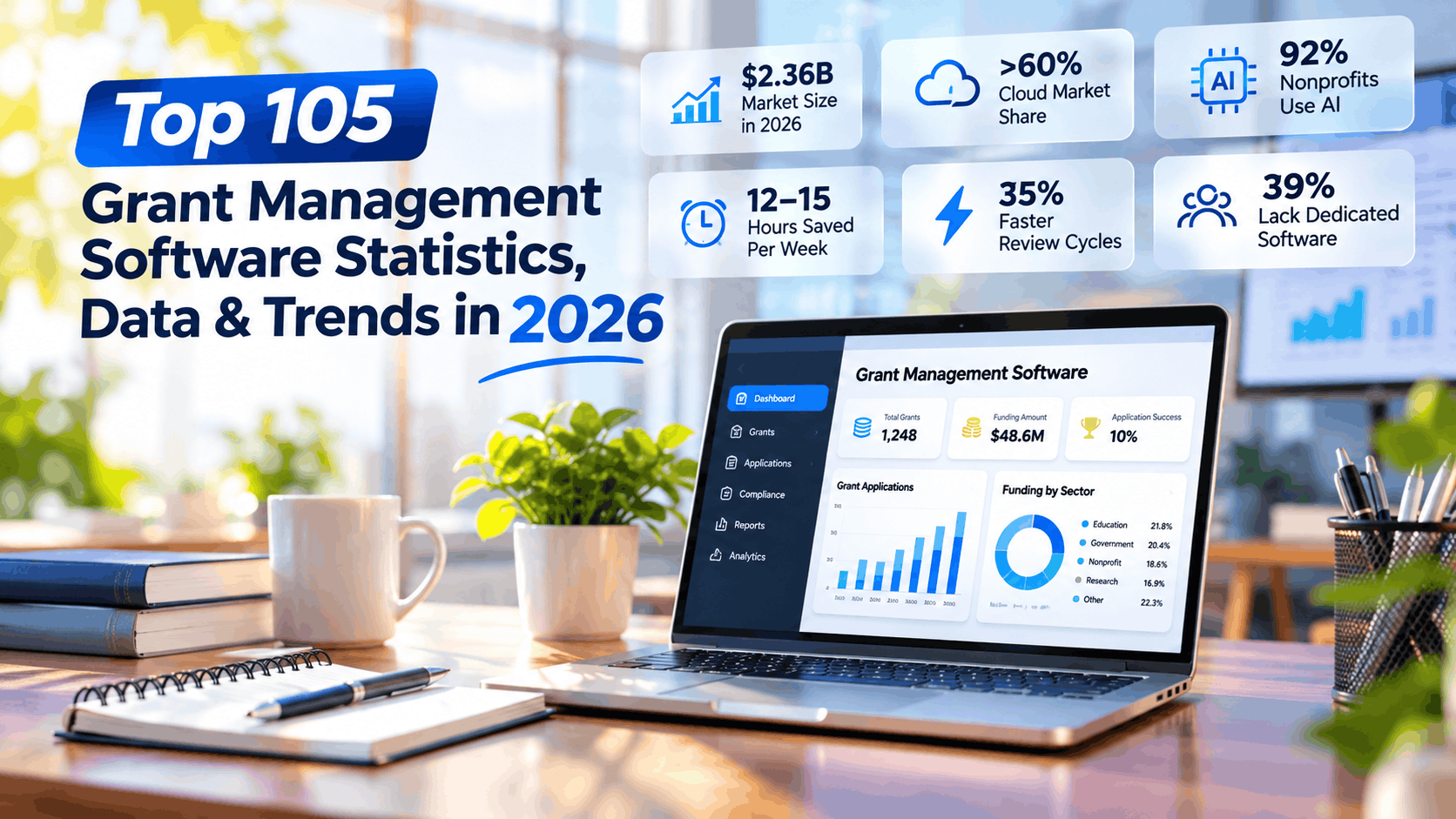
- Strong Grant Management Software Market Growth: The global market is valued at USD 2.36 billion in 2026 and is projected to reach USD 4.40 billion by 2032, growing at a CAGR of 10.86%, driven by digital transformation and increasing compliance requirements.
- AI and Cloud Adoption Are Accelerating: Cloud-based grant management solutions are expected to capture over 60% of market share in 2026, while 73% of grant managers express demand for AI-assisted proposal drafting capabilities.
- Grant Management Automation Improves Operational Efficiency: Organizations using dedicated grant management software report saving 12–15 administrative hours weekly and achieving 35% faster review cycles, while 39% of organizations still lack dedicated software, highlighting significant market growth opportunities.
Grant management software streamlines funding administration through automated workflows, cloud-based platforms, and AI-powered capabilities. The global market, valued at an estimated USD 2.36 billion in 2026, has a projected value of USD 4.40 billion by 2032, with a 10.86% CAGR and increasing demand for regulatory compliance, financial transparency, and operational efficiency.
The global grant management software market is undergoing a significant transformation in 2026, driven by accelerating digital adoption, artificial intelligence (AI), cloud-based technologies, increasing regulatory requirements, and the growing complexity of grant administration. As governments, nonprofit organizations, educational institutions, research organizations, and corporate foundations manage increasingly substantial funding portfolios, grant management software has become an essential component of modern financial and operational infrastructure.
Grant management software enables organizations to streamline the entire grant lifecycle, from funding opportunity identification, application submission, and proposal evaluation to award distribution, budget monitoring, compliance management, and impact reporting. By replacing fragmented spreadsheets, manual documentation, and disconnected administrative systems with centralized digital platforms, organizations can improve operational efficiency, strengthen financial accountability, reduce administrative costs, and enhance funding transparency.

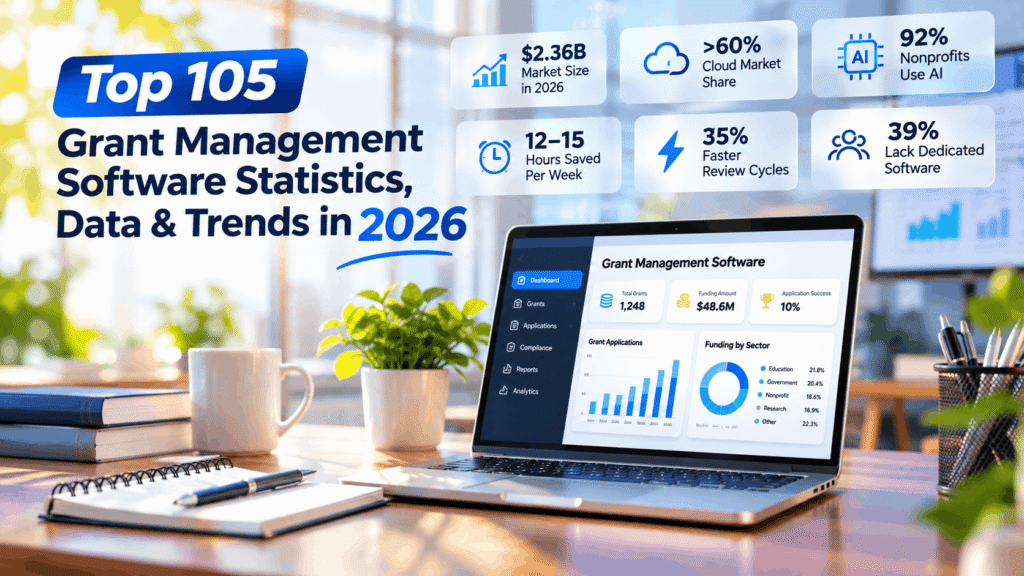
The latest grant management software statistics highlight the considerable economic potential of this rapidly expanding industry. The global grant management software market is estimated to be worth USD 2.36 billion in 2026 and is projected to reach USD 4.40 billion by 2032, registering a compound annual growth rate (CAGR) of 10.86%. Alternative market forecasts suggest that the industry could reach USD 8.09 billion by 2035, reflecting sustained demand for sophisticated grant administration, automated compliance reporting, and integrated financial management solutions. Although market valuations vary according to research methodologies and market definitions, the forecasts consistently indicate strong long-term industry expansion.
Cloud computing remains one of the most influential forces shaping the grant management software landscape. Cloud-based solutions are expected to account for more than 60% of the global market in 2026, while one industry estimate indicates that cloud deployment already represented 72% of the market in 2024. The growing preference for cloud-based grant management platforms reflects increasing demand for remote accessibility, real-time collaboration, scalable infrastructure, lower upfront implementation costs, and seamless integration with existing enterprise systems.

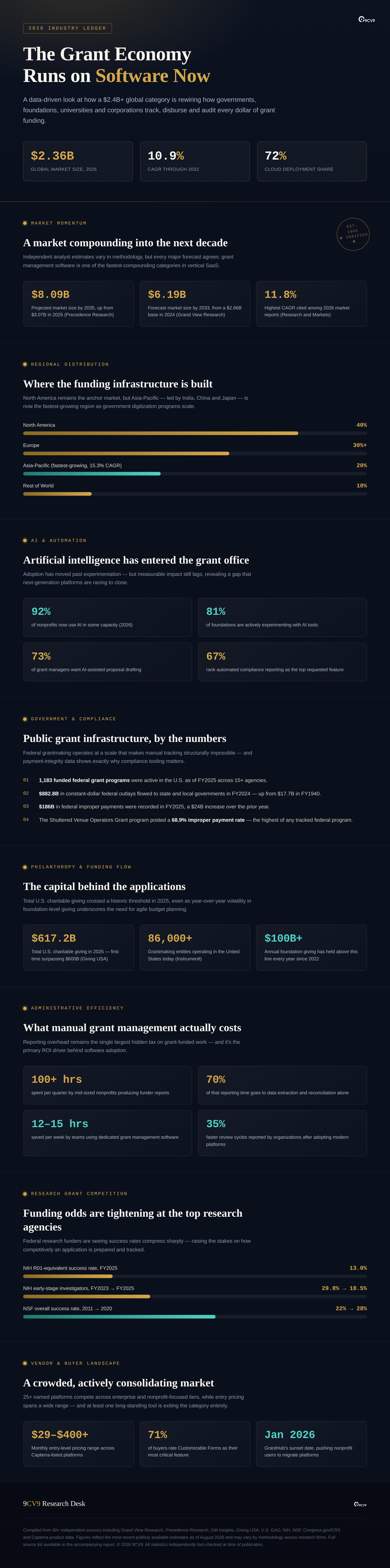
Artificial intelligence and automation are also fundamentally reshaping how organizations administer grants. Approximately 92% of nonprofits reportedly use AI in some capacity, while 81% of foundations are experimenting with AI-powered tools in their grantmaking processes. Furthermore, 73% of grant managers express interest in AI-assisted proposal drafting capabilities, and 43% report actively using AI-assisted tools in their daily workflows. These statistics demonstrate the growing importance of intelligent automation, predictive analytics, automated applicant screening, risk assessment, and generative AI within the grant management ecosystem.
However, significant opportunities for digital transformation remain. Approximately 39% of organizations reportedly operate without dedicated grant management software, highlighting a substantial untapped market. Organizations adopting modern grant management platforms report administrative time savings of approximately 12 to 15 hours per week, while automated workflows have contributed to 35% faster grant review cycles. Such improvements demonstrate the potential return on investment associated with digitizing grant administration and reducing dependence on resource-intensive manual processes.
The expansion of government funding and philanthropic activities is another major factor supporting grant management software adoption. Total charitable giving in the United States reached a record USD 617.2 billion in 2025, representing a 5.7% year-over-year increase in current dollars. Meanwhile, more than 86,000 grantmaking entities operate across the United States, and at least 1,183 funded federal grant programs were identified in FY2025. The enormous scale of these funding ecosystems underscores the need for reliable, scalable, and transparent grant management infrastructure.
Regulatory compliance, fraud prevention, and financial accountability have also emerged as critical priorities. The U.S. federal government recorded an estimated USD 186 billion in improper payments across federal programs in FY2025, representing a 15% increase compared with the previous fiscal year. Although these payments extend beyond grant programs and do not necessarily constitute fraud, they illustrate the broader challenges associated with public funding oversight, financial controls, and payment integrity. Consequently, automated compliance reporting, audit trails, financial reconciliation, and intelligent risk monitoring are becoming increasingly important capabilities within modern grant management systems.
From a regional perspective, North America continues to dominate the global grant management software market, accounting for an estimated 35% to 40% of market share. Europe represents more than 30% of the market, supported by stringent regulatory requirements and public-sector digital transformation initiatives. Meanwhile, Asia-Pacific is emerging as the fastest-growing regional market, with one forecast projecting a CAGR of 15.3% between 2023 and 2028, driven by expanding research funding, digital governance initiatives, and educational investments.
The competitive landscape is evolving alongside these technological and economic developments. Established enterprise software providers and specialized grant management vendors are increasingly investing in AI-powered capabilities, customizable application forms, automated reporting, mobile accessibility, financial system integrations, and multi-jurisdictional compliance support. With entry-level grant management software pricing ranging from USD 29 to more than USD 400 per month, organizations have access to an increasingly diverse selection of solutions tailored to different operational requirements, budgets, and funding volumes.
Understanding the latest grant management software statistics, market data, and industry trends is therefore essential for nonprofit executives, government administrators, university research departments, philanthropic foundations, software developers, investors, and corporate social responsibility professionals seeking to make informed technology investment decisions.
This comprehensive guide to the Top 105 Grant Management Software Statistics, Data & Trends in 2026 examines the most important developments shaping the industry, including:
- Global grant management software market size, growth rates, and long-term forecasts.
- Cloud-based, on-premises, and hybrid deployment trends.
- Artificial intelligence, machine learning, and grant workflow automation.
- Regional market shares and emerging growth opportunities.
- Federal government grant programs and research funding statistics.
- Nonprofit organizations, philanthropic foundations, and charitable giving trends.
- Grant compliance, improper payments, financial transparency, and fraud prevention.
- Administrative efficiency, grant reporting costs, and operational productivity.
- Corporate social responsibility and employee giving platforms.
- Grant management software pricing, vendor competition, and buyer preferences.
- Emerging technologies and future grant management industry developments.
By exploring these 105 grant management software statistics, organizations can gain a deeper understanding of the industry’s current trajectory, identify opportunities to improve grant administration, evaluate emerging technologies, and develop more effective funding management strategies.
As the global grant ecosystem becomes increasingly digital, data-driven, interconnected, and compliance-focused, grant management software is evolving beyond traditional application tracking into a comprehensive platform for financial stewardship, intelligent decision-making, operational efficiency, and measurable social impact. Organizations that successfully embrace these technological advancements will be better positioned to navigate the complexities of modern grant administration and maximize the value of their funding resources in 2026 and beyond.
Before we venture further into this article, we would like to share who we are and what we do.
About 9cv9
9cv9 is a business tech startup based in Singapore and Asia, with a strong presence all over the world.
With over ten years of startup and business experience, and being highly involved in connecting with thousands of companies and startups, the 9cv9 team has listed some of the top and best companies/tools in this review.
If you like to get your company listed in our top B2B software reviews, check out our world-class 9cv9 Media and PR service and pricing plans here.
Top 105 Grant Management Software Statistics, Data & Trends in 2026
Market Size & Growth Forecasts
1. The global grant management software market is valued at USD 2.36 billion in 2026. This steady valuation confirms grant management software has matured into an essential digital infrastructure category rather than a niche tool.
2. The market is projected to reach USD 4.40 billion by 2032 at a 10.86% CAGR. Organizations evaluating long-term software investments can expect sustained double-digit growth in this space through the early 2030s.
3. An alternate forecast pegs the market at USD 3.07 billion in 2025, rising to USD 8.09 billion by 2035 (10.17% CAGR). The wide range across analyst estimates reflects differing methodologies but a consistent growth trajectory.
4. The U.S. grant management software market alone was worth USD 752.15 million in 2025 and is projected to hit USD 2,035.20 million by 2035. This 10.47% CAGR underscores America’s outsized role in driving global category demand.
5. NIH committed over USD 48 billion to medical research funding in 2023 alone, a scale of spending that has directly boosted urgency for platforms capable of handling extensive applicant volumes.
6. Another leading estimate values the market at USD 2.88 billion in 2025, climbing to USD 3.22 billion in 2026 — an 11.8% CAGR. This is among the highest growth rates cited across research firms, reflecting rapid digitization of grant workflows.
7. That same report forecasts the market reaching USD 4.98 billion by 2030 at an 11.5% CAGR, driven by smart government initiatives and real-time grant monitoring demand.
8. DataM Intelligence recorded the market at USD 1.5 billion in 2022, growing to an expected USD 3.3 billion by 2030. This more than doubling in under a decade illustrates the category’s accelerating adoption curve.
9. Grand View Research estimated the market at USD 2.66 billion in 2024, forecasting USD 6.19 billion by 2033 at a 10.0% CAGR. Rising regulatory scrutiny around fund allocation is cited as a primary growth catalyst.
10. Market Research Future projects the market growing from USD 2.2 billion in 2025 to USD 5.8 billion by 2035 (10.2% CAGR). Deeper adoption of AI/ML and blockchain-based audit capabilities are flagged as key differentiators for vendors going forward.
11. GMInsights confirms the market exceeded USD 2.2 billion in 2024, with a projected 10.2% CAGR through 2034. Compliance and auditability requirements remain the leading purchase drivers cited by buyers.
12. Verified Market Reports values the category at USD 2.5 billion in 2024, forecasting USD 5.2 billion by 2033 (9.2% CAGR). AI-driven fraud detection and predictive analytics are identified as the fastest-growing functional segment.
13. Business Research Insights forecasts the Grant Management System market starting at USD 1.94 billion in 2026 and reaching USD 3.91 billion by 2035 (8% CAGR). Even the more conservative estimates in the industry confirm consistent, durable expansion.
14. Credence Research pegs the market at USD 2,534.1 million in 2024, projected to reach USD 5,551.72 million by 2032 (10.3% CAGR). Blockchain-enabled transparency features are increasingly cited as a differentiator among enterprise buyers.
Deployment Model & Technology Trends
15. Cloud-based solutions are expected to command over 60% of total market share by 2026. The shift toward SaaS delivery reflects organizations’ preference for lower upfront costs and remote accessibility.
16. The cloud deployment segment held a dominant 72% share of the market in 2024. This confirms cloud has decisively overtaken on-premises deployment as the default choice for new grant management software buyers.
17. On-premises grant management deployments are still expected to grow at a 9.5% CAGR between 2025 and 2034. Large government entities with strict data residency requirements continue to sustain demand for this deployment model.
18. The software/solutions segment accounted for an 88% share of the grant management ecosystem in 2024, versus services, showing that most organizational spend goes toward the platform itself rather than implementation support.
19. The solution segment held a 61% market share in 2025, according to Precedence Research, with the services segment expected to grow fastest through 2035 as implementation complexity increases.
20. Adopters of grant management software report a 45%+ increase in grants submitted online. Digital intake portals are directly correlated with higher application volumes for grant-issuing organizations.
21. Organizations using modern grant platforms report 35% faster review cycles. Workflow automation is measurably compressing the time between application submission and funding decisions.
22. A 60%+ shift toward cloud deployment has been documented as a core growth driver of the category. This transition is reshaping vendor product roadmaps toward subscription-based, continuously updated platforms.
Market Segmentation by Function, Organization & End-User
23. Educational institutions represent the leading adopter segment, accounting for 21.8% of grant management software adoption. Universities managing complex, multi-source research funding are among the heaviest users of dedicated grant platforms.
24. Application tracking is cited as the leading functional segment by market share in 2025. This reflects that intake and applicant management remain the most universally adopted feature set across grant software buyers.
25. Corporate foundations are identified as a fast-catching-up adopter segment, as enterprise CSR and philanthropic giving programs increasingly formalize their grantmaking operations with dedicated software.
Regional Market Breakdown
26. North America holds the largest global market share, estimated between 35% and 40% depending on the source. The region’s mature nonprofit sector and extensive federal/state grant infrastructure anchor this dominant position.
27. Europe accounts for over 30% of the global grant management software market. Stringent EU compliance regulations and government-led digital transformation initiatives are cited as primary regional demand drivers.
28. Asia-Pacific holds roughly 20% of the global market and is recognized as the fastest-growing region. Rising government funding for education, healthcare, and research in China, India, and Japan is fueling this expansion.
29. The Asia-Pacific grant management software market was valued at USD 371.21 million in 2023, projected to reach USD 755.55 million by 2028 (15.3% CAGR). This is among the highest regional growth rates recorded in any market study.
30. India’s grant management software market growth is being driven by expanding digital governance initiatives and increased CSR funding schemes. Government-led social welfare programs are increasingly channeled through digital grant platforms to improve fraud verification and fund tracking.
31. Chinese universities are adopting grant management systems specifically to strengthen research grant administration effectiveness. Institutional research funding oversight is a key APAC regional growth theme.
AI, Automation & Emerging Technology Adoption
32. 92% of nonprofits now use AI in some capacity as of 2026. Artificial intelligence has moved from experimental status to mainstream operational use across the nonprofit grant-seeking ecosystem.
33. 81% of foundations are actively experimenting with AI tools in their grantmaking processes. Funders themselves are adopting AI at nearly the same pace as the organizations applying to them.
34. Despite widespread adoption, only 7% of organizations report major capability improvements from AI use so far. This gap between adoption and measurable impact represents a significant opportunity for better-integrated AI grant tools.
35. 73% of grant managers say they want AI-assisted proposal drafting capabilities. Demand for generative AI features in grant software has become a top purchasing criterion.
36. 43% of grant managers report they now actively use AI-assisted tools in their daily workflows. Adoption has moved well past the early-experimentation phase for a substantial share of the professional grant management workforce.
37. 39% of organizations still operate without any dedicated grant management software at all. This gap represents a substantial greenfield opportunity for vendors targeting under-digitized nonprofits and agencies.
38. Automated compliance reporting is the top requested feature, cited by 67% of grant software users. Compliance automation has emerged as the single most in-demand capability across the buyer landscape.
39. Organizations adopting dedicated grant software report saving an average of 12–15 hours per week on administrative tasks. This time-savings figure is among the most quantifiable ROI metrics cited by vendors and buyers alike.
40. Ten major U.S. foundations launched the “Humanity AI” coalition in October 2025 — a USD 500 million, five-year initiative. This represents one of the largest coordinated philanthropic bets on AI-related grantmaking to date.
41. The U.S. federal government’s core AI research budget reached USD 3.3 billion for FY2025, split between direct R&D funding and crosscutting support programs.
42. The European Commission’s AI-related work programme is valued at approximately €14 billion. International public funders are matching or exceeding U.S. philanthropic AI commitments at scale.
43. KPMG Foundation committed USD 6 million specifically to help nonprofits integrate AI into daily operations. Capacity-building grants focused on AI literacy are an emerging philanthropic funding category.
44. GitLab Foundation offers grants of USD 250,000 plus six months of technical support from engineering partners for AI-focused nonprofit projects. This “grant-plus-services” model reflects a broader trend toward hybrid funding-and-capacity-building programs.
Federal & Government Grant Programs
45. There were at least 1,183 funded federal grant programs in the United States as of FY2025. The sheer scale of federal grant infrastructure underscores why dedicated management software has become indispensable for grant-issuing agencies.
46. Federal outlays for grants to state and local governments grew from USD 17.7 billion in FY1940 to USD 882.8 billion in FY2024 (in constant FY2017 dollars), reflecting an extraordinary long-term expansion in the scale of intergovernmental grant funding.
47. A November 2023 GAO review of approximately 6 million subaward records found that roughly a quarter may have contained duplicated entries. This finding highlights the persistent data-integrity challenges that grant management software is specifically designed to solve.
48. A March 2025 GAO report reviewing 3,680 federal grant pass-through audits found that 36% showed indications of incomplete subaward reporting or inadequate subrecipient monitoring. Compliance automation features directly address this widely documented audit gap.
49. Approximately 1,800 NIH grants were terminated between February and June 2025. Rapid shifts in federal funding priorities are increasing the operational complexity that grant administrators must manage.
50. NIH distributes approximately USD 38.8 billion annually in extramural grants to more than 300,000 researchers across 2,500+ institutions. This makes NIH one of the single largest grant-disbursing entities tracked by any grant management platform globally.
51. HHS’s Centers for Medicare & Medicaid Services (CMS) alone disbursed over USD 704 billion in grant funding in 2025. This single agency’s spend illustrates the massive financial scale that federal grant management infrastructure must support.
52. NIH awarded 82,328 individual grants totaling roughly USD 35.17 billion in 2025. The sheer volume of individual awards demonstrates the necessity of automated tracking and reporting systems at federal scale.
Research Grant Success Rates (NIH & NSF)
53. The NIH R01-equivalent grant success rate fell to 13.0% in FY2025 — the lowest level in two decades. Increasingly competitive funding environments are raising the stakes for well-organized, professionally managed grant applications.
54. NIH early-stage investigator success rates dropped from 29.8% in FY2023 to 18.5% in FY2025, an 11-percentage-point collapse in just two years.
55. The number of investigators winning R01-equivalent NIH grants fell from 7,720 in 2024 to 5,885 in 2025. This steep decline reflects intensifying competition for a comparatively static pool of federal research funding.
56. Established NIH investigators saw success rates drop from approximately 27% to 20% over the same period. Even veteran grant recipients are facing materially lower odds of renewed funding.
57. NSF application volume fell 17% over the decade from 2011 to 2020 (51,562 to 42,723 applications). Fewer applications combined with steady budgets pushed NSF success rates upward even as overall research funding pressure increased elsewhere.
58. NSF’s overall grant success rate rose from 22% to 28% between 2011 and 2020 as application volumes declined, illustrating how funding-rate dynamics can shift independent of budget changes.
59. NSF’s Biology directorate saw success rates double from 18% in 2011 to 36% in 2020. Directorate-level variation in funding rates is a critical data point for researchers deciding where to target applications.
Philanthropy & Foundation Giving
60. Total U.S. charitable giving reached a record USD 617.2 billion in 2025 — the first time giving has exceeded USD 600 billion. This milestone confirms the philanthropic sector’s continued expansion despite broader economic uncertainty.
61. Total giving grew 5.7% in current dollars in 2025 (3.0% adjusted for inflation). Sustained real-dollar growth signals healthy underlying demand for grant administration capacity across the funding ecosystem.
62. Individual giving totaled an estimated USD 394.2 billion in 2025, up 4.1% from the prior year. Individual donors remain the single largest source of charitable capital that eventually flows through grant programs.
63. Giving to grantmaking foundations fell 16.2% in 2025, following a 36.5% surge in 2024. Year-over-year volatility in foundation funding levels reinforces the need for agile, data-driven grant budgeting tools.
64. “Mega-gifts” (gifts exceeding 0.1% of annual total giving) reached USD 19.22 billion in 2025, up sharply from USD 11.72 billion in 2024. Large-scale philanthropic commitments are increasingly reshaping the funding landscape that grant software must accommodate.
65. Giving by foundations has remained above USD 100 billion every year since 2022. This sustained, high baseline of foundation giving represents a durable and growing addressable market for grant management platforms.
66. Foundation giving represented 19% of all charitable gifts made in 2024. Foundations remain one of the most institutionally structured — and software-dependent — segments of the philanthropic ecosystem.
67. There are more than 86,000 grantmaking entities operating in the United States, the vast majority of which are independent foundations.
68. Independent foundations represent approximately 17% of total U.S. charitable giving. This concentrated funding source underscores why foundation-facing grant management tools remain a critical software category.
Grant Fraud, Compliance & Improper Payments
69. The U.S. federal government made an estimated USD 186 billion in improper payments in Fiscal Year 2025. This figure represents payments that should not have been made, were incorrect in amount, or failed to comply with program requirements.
70. FY2025 improper payments rose 15% (USD 24 billion) compared to FY2024. The upward trend in improper payments reinforces growing institutional demand for stronger compliance and audit-readiness tooling.
71. Cumulative federal improper payments have totaled approximately USD 3 trillion since FY2003. This two-decade running total illustrates the scale of the payment-integrity challenge across all federally funded programs, including grants.
72. The SBA’s Shuttered Venue Operators Grant program posted a 68.9% improper payment rate — the highest of any federal program tracked. This extreme outlier illustrates the acute risk profile of emergency and pandemic-era grant disbursement programs.
73. Approximately 82% (USD 153.1 billion) of FY2025 federal improper payments resulted from overpayments. Overpayment — rather than underpayment or fraud — remains the dominant category of payment error across government programs.
74. About 73% (USD 136 billion) of total FY2025 improper payments were concentrated in just five program areas. This concentration suggests targeted software-driven compliance interventions could meaningfully reduce the government-wide error rate.
Administrative Burden & Grant Reporting Efficiency
75. Mid-sized nonprofits routinely spend 100+ staff hours per quarter producing funder reports. Manual reporting processes continue to consume a disproportionate share of program staff capacity.
76. Roughly 70% of nonprofit grant-reporting time is spent on data extraction and reconciliation rather than analysis or writing. This finding directly supports the business case for automated reporting infrastructure within grant management software.
77. One documented case found a nonprofit spending 31% of a grant’s total value on administering the grant itself, against a funder-specified indirect cost cap of just 13%.
78. Nonprofits commonly juggle 40–60 grant applications and equally numerous unique reporting requirements from 20–30 different funders simultaneously. Centralized grant tracking systems are increasingly essential simply to avoid missed deadlines and compliance failures.
79. Foundation grant proposals typically require 15–20 hours of writing and preparation time. Even smaller, private-foundation grant applications represent a meaningful staff-time investment for applicant organizations.
80. Federal grant applications typically require over 100 hours of preparation time. The scale of effort required for federal funding underscores the value proposition of workflow and document-management tools built into grant software.
81. Average grant application success rates across the sector hover around 10%. With such competitive odds, organizations increasingly rely on software-driven prospect research and application tracking to maximize their limited grant-writing capacity.
Corporate Social Responsibility (CSR) & Employee Giving
82. One leading CSR/grantmaking platform reported powering USD 28 billion in total giving during 2025 alone. Corporate philanthropy platforms are now processing sums comparable to mid-sized national grantmaking programs.
83. Of that total, USD 8.94 billion was disbursed specifically through corporate grants. Corporate grantmaking has become a substantial and measurable component of the broader philanthropic funding ecosystem.
84. The same platform recorded USD 958 million in employee donations during 2025. Workplace giving programs, closely integrated with corporate grant software, represent a fast-growing complementary funding channel.
85. That platform also tracked 16.2 million volunteer hours in 2025. Volunteer-hour tracking has become a standard reporting metric alongside financial grant disbursement within integrated CSR platforms.
86. One major corporate giving platform maintains a database of over 1.65 million vetted global charities eligible to receive grants. Vetted-recipient databases are becoming a key differentiator for enterprise-grade corporate grant management tools.
Pricing, Vendor Landscape & Buyer Behavior (Capterra Data)
87. Entry-level grant management software pricing on Capterra ranges from USD 29 to USD 400+ per month. This wide pricing spread reflects the category’s applicability to organizations ranging from small nonprofits to large government agencies.
88. Customizable Forms is the single most valued feature among grant management software buyers, rated “critical” by 71% of Capterra reviewers. Flexible application design consistently outranks other features as the top purchasing criterion.
89. Capterra has verified over 2.5 million reviews across its software marketplace, providing one of the largest independent datasets on real-world grant software user experience.
90. One popular entry-level grantmaking platform reports that 90% of its reviewers come from small businesses, with 43% specifically representing nonprofit organization management use cases.
91. A mid-market grant lifecycle platform carries a starting price of USD 9,900 per year and holds a 98% positive review sentiment score based on 51 verified reviews. Positive sentiment scores in this range are a strong signal of category-wide user satisfaction among established platforms.
92. A leading application and review management platform holds a 4.8-out-of-5 rating across 398 verified reviews — among the highest-rated tools tracked in the category.
93. The grant management software competitive landscape includes 25+ named platforms, spanning enterprise players like Salesforce, Blackbaud, Oracle, Workday, and Microsoft alongside specialized vendors such as Instrumentl, Foundant Technologies, AmpliFund, WizeHive, and Award Force.
94. GrantHub, a widely used standalone nonprofit grant-tracking tool, is being formally discontinued, with sunset effective January 31, 2026. This significant vendor exit is actively pushing thousands of nonprofit users to migrate to alternative platforms in 2026.
Federal Student Aid Grants (Pell Grant Program)
95. 32.4% of U.S. college students received Pell Grants during the 2023–24 academic year. Federal student grant programs represent one of the largest single categories of grant disbursement tracked by government financial-aid systems.
96. The average Pell Grant award was USD 5,300 for the 2023–24 academic year. Award-size benchmarking data like this is commonly used by institutional grant administrators for budget planning.
97. The maximum Pell Grant award for the 2025–26 academic year is USD 7,395. Annual increases in the maximum award reflect ongoing federal adjustments tied to cost-of-attendance and inflation factors.
98. Total Pell Grant disbursements reached USD 27.215 billion in the 2022–23 academic year. This figure represents one of the single largest annually recurring federal grant disbursement streams in the U.S. education sector.
99. 68.2% of all Pell Grants go to students attending public postsecondary institutions. Public institution grant offices consequently manage a disproportionate share of total federal student grant volume.
Additional Market & Functional Data Points
100. Blockchain technology is increasingly cited as an emerging capability for enhancing transparency and reducing fraud risk in grant distribution. Vendors are beginning to integrate blockchain-based audit trails as a premium compliance feature.
101. Hybrid deployment models — combining on-premises data control with cloud-based analytics — are emerging as a compromise deployment strategy for multi-jurisdictional compliance needs. This approach allows organizations to balance security requirements with the collaboration benefits of cloud software.
102. Latin America’s grant management software market is advancing primarily through public-sector modernization and international development funding programs. Anti-fraud controls and simplified reporting are the leading demand drivers cited for the region.
103. Mobile access and integration with CRM and finance systems are cited as standard expectations among cloud-based grant management vendors in 2026. Buyers increasingly treat these integrations as baseline requirements rather than premium add-ons.
104. Multi-jurisdictional support — including multiple languages, currencies, and reporting formats — is identified as a key growth requirement as grant programs globalize. Vendors serving international NGOs and multinational foundations are prioritizing this capability in 2026 product roadmaps.
105. Predictive analytics and automated applicant screening are identified as the fastest-growing functional capabilities within grant management platforms. AI-enabled risk scoring is transforming how reviewers triage large applicant pools before human evaluation begins.
Conclusion
The Top 105 Grant Management Software Statistics, Data & Trends in 2026 reveal an industry experiencing substantial growth, technological innovation, and widespread digital transformation. As governments, nonprofit organizations, educational institutions, research agencies, philanthropic foundations, and corporate enterprises increasingly prioritize operational efficiency, financial transparency, and regulatory compliance, grant management software is becoming an indispensable component of modern funding administration.
The global grant management software market demonstrates considerable long-term growth potential. With an estimated market valuation of USD 2.36 billion in 2026 and a projected value of USD 4.40 billion by 2032, the industry is expected to expand at a compound annual growth rate (CAGR) of 10.86%. Alternative market forecasts project the industry reaching as much as USD 8.09 billion by 2035. Although these estimates differ according to market definitions and research methodologies, they consistently demonstrate sustained demand for advanced grant management technologies across multiple industries and geographical regions.
Cloud-Based Grant Management Software Is Shaping the Future of Funding Administration
One of the most significant findings from the latest grant management software statistics is the continued dominance of cloud-based deployment models. Cloud-based solutions are expected to account for more than 60% of the market in 2026, while one industry estimate recorded a 72% market share for cloud deployment in 2024.
The growing adoption of cloud-based grant management platforms reflects increasing organizational demand for:
- Centralized grant application and funding management.
- Real-time collaboration and remote accessibility.
- Scalable and flexible software infrastructure.
- Automated software updates and maintenance.
- Integration with accounting, CRM, and enterprise resource planning systems.
- Improved financial reporting and data accessibility.
- Reduced dependence on manual administrative processes.
Nevertheless, on-premises grant management solutions remain relevant, particularly among government agencies and large institutions operating under stringent data sovereignty, security, and regulatory requirements. With on-premises deployments projected to grow at a CAGR of 9.5% between 2025 and 2034, hybrid deployment models may become increasingly important for organizations seeking to balance operational flexibility with data governance.
Artificial Intelligence and Automation Are Transforming Grant Management
Artificial intelligence represents another major technological development influencing the grant management software industry in 2026.
Approximately 92% of nonprofits reportedly use AI in some capacity, while 81% of foundations are experimenting with AI tools in their grantmaking processes. Furthermore, 73% of grant managers express interest in AI-assisted proposal drafting capabilities, and 43% report actively using AI-assisted tools in their daily workflows.
These statistics indicate that artificial intelligence is moving beyond experimental applications and becoming increasingly integrated into grant administration activities. AI-powered grant management software offers considerable potential to improve funding opportunity identification, proposal preparation, applicant screening, compliance monitoring, predictive analytics, and financial risk assessment.
However, the finding that only 7% of organizations report major capability improvements from AI adoption highlights an important distinction between technology adoption and measurable operational outcomes. Organizations must therefore prioritize effective implementation, employee training, data quality, responsible AI governance, and human oversight rather than adopting artificial intelligence solely because of its growing popularity.
The future of AI in grant management will increasingly depend on its ability to deliver tangible improvements in administrative productivity, funding decisions, financial accountability, and organizational performance.
Grant Management Software Is Delivering Measurable Operational Benefits
The operational benefits associated with dedicated grant management platforms represent a compelling reason for continued software adoption.
Organizations implementing modern grant management software report saving approximately 12 to 15 hours per week on administrative activities, while automated workflows have contributed to 35% faster grant review cycles. Digital grant platforms have also been associated with increases of more than 45% in grants submitted online.
These improvements are particularly significant given the substantial administrative burden associated with traditional grant management processes. Mid-sized nonprofits reportedly spend more than 100 staff hours per quarter preparing funder reports, with approximately 70% of grant reporting time devoted to data extraction and reconciliation rather than analysis or writing.
Federal grant applications can require more than 100 hours of preparation, while private foundation grant proposals typically require between 15 and 20 hours. With average grant application success rates estimated at approximately 10% across the sector, organizations face considerable pressure to allocate their administrative resources efficiently.
Grant management automation can help organizations reduce repetitive tasks, minimize documentation errors, improve deadline management, streamline application workflows, and redirect valuable employee time toward strategic funding activities and program delivery.
Despite these potential benefits, approximately 39% of organizations reportedly continue to operate without dedicated grant management software. This substantial adoption gap presents significant growth opportunities for software providers targeting underserved nonprofits, educational institutions, government departments, and philanthropic organizations.
Regulatory Compliance and Financial Transparency Will Remain Critical Growth Drivers
The increasing complexity of regulatory compliance and financial oversight is expected to remain a fundamental driver of grant management software demand.
The U.S. federal government recorded an estimated USD 186 billion in improper payments across federal programs in FY2025, representing a 15% increase compared with FY2024. Cumulative federal improper payments have reached approximately USD 3 trillion since FY2003.
Although these figures encompass federal programs beyond grant funding and improper payments do not necessarily constitute fraud, they demonstrate the considerable challenges associated with public financial management, payment accuracy, regulatory compliance, and institutional accountability.
Additional findings reinforce the importance of improving grant oversight. A government review of approximately six million subaward records found that roughly one-quarter may have contained duplicate entries. Another review of 3,680 federal grant pass-through audits identified indications of incomplete subaward reporting or inadequate subrecipient monitoring in 36% of the audits examined.
Against this backdrop, it is unsurprising that automated compliance reporting is identified as a leading requested feature, cited by 67% of grant software users.
Grant management software providers that deliver robust audit trails, automated compliance monitoring, financial reconciliation, configurable approval workflows, secure documentation management, and advanced risk detection capabilities are likely to remain well-positioned to address evolving organizational requirements.
Emerging technologies such as blockchain-enabled audit trails and AI-powered fraud risk assessment may further strengthen financial transparency, although their practical effectiveness will depend on implementation quality and institutional adoption.
Expanding Government Funding and Philanthropy Are Supporting Market Growth
The enormous scale of global government funding, charitable giving, and corporate philanthropy provides a strong foundation for the continued expansion of the grant management software market.
Total charitable giving in the United States reached a record USD 617.2 billion in 2025, representing a 5.7% increase in current dollars compared with the previous year. Foundation giving has remained above USD 100 billion annually since 2022, while more than 86,000 grantmaking entities operate across the United States.
Government funding programs also represent a substantial source of demand for sophisticated grant administration technologies. At least 1,183 funded federal grant programs operated in the United States during FY2025, while federal grants to state and local governments reached USD 882.8 billion in FY2024 when measured in constant FY2017 dollars.
Corporate philanthropy is similarly contributing to the expansion of the grant management ecosystem. One leading corporate giving platform reported facilitating USD 28 billion in total giving during 2025, including USD 8.94 billion distributed through corporate grants.
As funding organizations manage increasingly complex portfolios, diverse recipient populations, and extensive reporting obligations, centralized grant management systems will become increasingly valuable for coordinating funding distribution, monitoring program performance, and demonstrating measurable social impact.
Regional Growth Opportunities Are Reshaping the Global Market
North America continues to lead the global grant management software market, accounting for an estimated 35% to 40% of total market share. Its established nonprofit ecosystem, extensive government funding infrastructure, mature technology industry, and sophisticated philanthropic sector support continued demand for grant administration solutions.
Europe accounts for more than 30% of the global market, with regulatory compliance requirements and government-led digital transformation initiatives supporting software adoption.
Meanwhile, Asia-Pacific represents one of the most promising regional growth opportunities. The regional grant management software market was valued at USD 371.21 million in 2023 and is projected to reach USD 755.55 million by 2028, registering a CAGR of 15.3%.
Expanding government funding programs, educational investments, research initiatives, corporate social responsibility activities, and digital governance strategies are expected to accelerate adoption across emerging economies.
These regional developments highlight the growing importance of multilingual capabilities, multi-currency support, localized regulatory compliance, flexible reporting formats, and scalable software architecture for grant management vendors seeking international expansion.
Grant Management Software Purchasing Decisions Are Becoming More Strategic
The increasingly competitive grant management software landscape provides organizations with a diverse range of solutions designed to accommodate different funding volumes, administrative requirements, and operational budgets.
Entry-level grant management software pricing ranges from approximately USD 29 to more than USD 400 per month, while more sophisticated grant lifecycle platforms can cost thousands of dollars annually.
Customizable application forms are rated as critical by 71% of grant management software reviewers in one marketplace dataset, highlighting the importance of flexibility and adaptability in software purchasing decisions.
Organizations evaluating grant management software in 2026 should therefore consider total cost of ownership, implementation complexity, scalability, security, integration capabilities, reporting functionality, customer support, and long-term vendor reliability.
The most suitable grant management software is not necessarily the platform offering the greatest number of features or the lowest subscription price. Instead, it is the solution that aligns most effectively with an organization’s funding objectives, regulatory obligations, administrative capacity, and long-term digital transformation strategy.
The Future of Grant Management Software Beyond 2026
Looking ahead, the grant management software industry is expected to evolve from traditional application tracking and administrative reporting systems into comprehensive, intelligent platforms supporting the entire funding lifecycle.
Artificial intelligence, predictive analytics, cloud computing, automated compliance reporting, intelligent applicant screening, financial system integrations, and emerging transparency technologies are likely to shape the next generation of grant management solutions.
Organizations that successfully integrate these capabilities into their operations may benefit from improved administrative efficiency, stronger financial controls, faster funding decisions, enhanced collaboration, and more effective resource allocation.
For software developers and technology investors, the combination of sustained market growth, substantial untapped adoption opportunities, increasing compliance requirements, and rising demand for intelligent automation presents considerable opportunities for innovation and market expansion.
Ultimately, the 105 grant management software statistics examined in this article demonstrate that digital grant administration is becoming increasingly important to the effectiveness, sustainability, and accountability of modern funding ecosystems.
As the industry continues to expand throughout 2026 and beyond, grant management software will play an increasingly influential role in helping organizations maximize funding efficiency, strengthen institutional transparency, reduce administrative burdens, and deliver measurable outcomes for the communities and stakeholders they serve.
The organizations that prioritize scalable technology, responsible AI adoption, reliable data management, and continuous process improvement will be better positioned to navigate the evolving grant management landscape and achieve sustainable long-term funding success.
Market forecasts and reported adoption statistics should nevertheless be interpreted within their respective research methodologies, survey populations, and reporting periods, particularly when using them to guide technology investments and strategic business decisions.
If you find this article useful, why not share it with your hiring manager and C-level suite friends and also leave a nice comment below?
We, at the 9cv9 Research Team, strive to bring the latest and most meaningful data, guides, and statistics to your doorstep.
To get access to top-quality guides, click over to 9cv9 Blog.
To hire top talents using our modern AI-powered recruitment agency, find out more at 9cv9 Modern AI-Powered Recruitment Agency.
People Also Ask
What is grant management software?
Grant management software is a digital solution that helps organizations manage grant applications, funding opportunities, award distribution, compliance, financial reporting, and performance monitoring throughout the grant lifecycle.
What is the global grant management software market size in 2026?
The global grant management software market is estimated at USD 2.36 billion in 2026, driven by increasing digital adoption, regulatory compliance requirements, workflow automation, and demand for financial transparency.
How fast is the grant management software market growing?
The global grant management software market is projected to grow at a CAGR of 10.86% between 2026 and 2032, reaching approximately USD 4.40 billion by 2032.
What are the major grant management software trends in 2026?
Major trends include AI-powered automation, cloud-based deployment, predictive analytics, automated compliance reporting, intelligent applicant screening, financial system integration, and blockchain-enabled audit trails.
What percentage of grant management software is cloud-based?
Cloud-based grant management solutions are expected to account for over 60% of the global market in 2026. One industry estimate recorded a 72% cloud deployment market share in 2024.
How is artificial intelligence transforming grant management software?
AI supports grant management through automated proposal drafting, applicant screening, funding opportunity identification, predictive analytics, risk assessment, and intelligent compliance monitoring.
What percentage of grant managers use AI tools in 2026?
Approximately 43% of grant managers reportedly use AI-assisted tools in their daily workflows, while 73% express interest in AI-powered proposal drafting capabilities.
How many nonprofits use artificial intelligence in 2026?
Approximately 92% of nonprofits reportedly use AI in some capacity in 2026, reflecting growing adoption of intelligent technologies across nonprofit administration, fundraising, and operational management.
What percentage of foundations use AI in grantmaking?
Approximately 81% of foundations are reportedly experimenting with AI tools in their grantmaking processes to improve application evaluation, administrative efficiency, and funding decisions.
How many organizations lack dedicated grant management software?
Approximately 39% of organizations reportedly operate without dedicated grant management software, highlighting significant opportunities for digital transformation and software market expansion.
How much time can grant management software save?
Organizations adopting dedicated grant management software report saving approximately 12–15 hours per week on administrative activities through automated workflows, centralized documentation, and streamlined reporting.
Does grant management software improve application review efficiency?
Organizations using modern grant management platforms report approximately 35% faster review cycles, supported by automated application screening, standardized evaluation workflows, and centralized collaboration.
What is the most requested grant management software feature?
Automated compliance reporting is a leading requested feature, cited by 67% of grant software users. It helps organizations streamline regulatory reporting, monitor funding requirements, and maintain audit readiness.
Which region dominates the global grant management software market?
North America dominates the global grant management software market, accounting for an estimated 35% to 40% of market share due to its extensive government funding and established nonprofit ecosystem.
Which region has the fastest-growing grant management software market?
Asia-Pacific is identified as the fastest-growing regional market, with one forecast projecting a CAGR of 15.3% between 2023 and 2028, supported by digital governance and expanding research funding.
How large is the European grant management software market?
Europe accounts for over 30% of the global grant management software market, supported by stringent regulatory requirements, government digital transformation initiatives, and institutional funding programs.
How much does grant management software cost in 2026?
Entry-level grant management software pricing ranges from approximately USD 29 to over USD 400 per month. Advanced enterprise platforms may cost thousands of dollars annually, depending on functionality and scale.
What industries use grant management software the most?
Educational institutions, government agencies, nonprofit organizations, research institutions, philanthropic foundations, and corporate social responsibility departments are major users of grant management software.
What percentage of grant management software adoption comes from educational institutions?
Educational institutions account for approximately 21.8% of grant management software adoption, reflecting demand for centralized research funding administration, financial reporting, and compliance management.
How many federal grant programs exist in the United States?
At least 1,183 funded federal grant programs operated in the United States during FY2025, highlighting the extensive scale and complexity of government grant administration.
How much charitable giving occurred in the United States in 2025?
Total U.S. charitable giving reached a record USD 617.2 billion in 2025, representing a 5.7% increase in current dollars and a 3% increase after adjusting for inflation.
How many grantmaking organizations operate in the United States?
More than 86,000 grantmaking entities operate in the United States, with independent foundations representing the majority of these organizations.
How does grant management software help prevent fraud?
Grant management software supports fraud prevention through automated verification, financial reconciliation, secure audit trails, duplicate detection, configurable approval workflows, and AI-powered risk assessment.
How much did the U.S. government lose through improper payments in 2025?
The U.S. federal government reported approximately USD 186 billion in improper payments across federal programs in FY2025, up 15% from FY2024. Improper payments do not necessarily represent fraud or financial losses.
What is the average grant application success rate?
The average grant application success rate is estimated at approximately 10% across the sector, although success rates vary considerably depending on funding programs, eligibility requirements, and applicant competition.
How long does it take to prepare a grant application?
Private foundation grant proposals typically require 15–20 hours of preparation, while federal grant applications can require more than 100 hours due to extensive documentation and compliance requirements.
How much time do nonprofits spend on grant reporting?
Mid-sized nonprofits reportedly spend over 100 staff hours per quarter preparing funder reports, with approximately 70% of reporting time devoted to data extraction and reconciliation.
What features should organizations look for in grant management software?
Essential features include customizable application forms, automated workflows, budget tracking, compliance reporting, document management, audit trails, applicant screening, analytics, and accounting system integration.
What are the leading grant management software providers in 2026?
Prominent providers include Salesforce, Blackbaud, Oracle, Workday, Microsoft, Instrumentl, Foundant Technologies, AmpliFund, WizeHive, and Award Force, spanning enterprise and specialized grant management solutions.
What is the future of grant management software beyond 2026?
Grant management software is expected to evolve toward AI-powered automation, predictive analytics, cloud-based infrastructure, intelligent compliance monitoring, integrated financial management, and enhanced funding transparency.
Sources
- 360iResearch
- Precedence Research
- Research and Markets
- OpenPR
- DataM Intelligence
- GII Research
- The Business Research Company
- Grand View Research
- Market Research Future
- SlideShare
- Business Research Insights
- Global Market Insights
- Data Insights Market
- Global Growth Insights
- Verified Market Reports
- Credence Research
- Business Market Insights
- GlobeNewswire
- Instrumentl
- Submittable
- Submit
- FundRobin
- LiveImpact
- GrantBite
- Artic Consulting
- Congress
- Congressional Research Service
- HHS TAGGS
- Grants.gov
- Granted AI
- Science
- American Association for the Advancement of Science
- Grantsights
- NIH Office of Extramural Research
- Candid
- Giving USA Foundation
- CCS Fundraising
- Foundation Source
- BBB Wise Giving Alliance
- Indiana University Lilly Family School of Philanthropy
- Committee for a Responsible Federal Budget
- U.S. Government Accountability Office
- Global Government Forum
- Federal News Network
- Nextgov/FCW
- Legis1
- FundEasy
- Stanford Social Innovation Review
- Exponent Philanthropy
- Grant Assistant
- Black Onyx Management
- Charitable Advisors
- Philea
- PEXforum
- Grants
- Capterra
- GetApp
- Bonterra
- Workplace Giving
- Guideflow
- YourCause
- Blackbaud
- SmartSimple Cloud
- Education Data Initiative
- Future Market Insights


