

Key Takeaways
- Strong Graphic Design Software Market Growth: The global graphic design software market is valued at an estimated $10.13 billion in 2026 and is projected to reach $14.26 billion by 2030, driven by digital transformation and increasing demand for visual content.
- AI-Powered Graphic Design Adoption Accelerates: With 91% of surveyed designers using AI tools weekly and 78% reporting faster workflows, artificial intelligence is revolutionising creative automation, design productivity, and content creation.
- Cloud-Based Design Platforms Reshape Business Operations: Leading graphic design software providers such as Adobe, Canva, and Figma are transforming collaborative workflows, digital marketing, brand management, and enterprise creative productivity through cloud-based and AI-powered solutions.
The global graphic design software market, valued at an estimated $10.13 billion in 2026, supports visual content creation, digital marketing, branding, and business collaboration. With projected market growth to $14.26 billion by 2030, artificial intelligence, cloud-based platforms, creative automation, and increasing demand for professional visual content remain key industry growth drivers.
The global graphic design software industry is undergoing a significant transformation in 2026, driven by the rapid adoption of artificial intelligence (AI), cloud-based design platforms, collaborative creative workflows, and the growing demand for high-quality visual content. From multinational corporations and digital marketing agencies to small businesses, freelancers, and educational institutions, graphic design software has become an essential component of modern business operations, brand development, digital marketing, and customer engagement strategies.
Also, read our article on the Top 10 Best Graphic Design Software To Try.

The increasing importance of visual communication across websites, social media platforms, e-commerce marketplaces, mobile applications, and digital advertising channels has accelerated demand for sophisticated graphic design solutions. Businesses are investing in advanced creative tools to streamline content production, strengthen brand consistency, improve operational efficiency, and deliver more engaging customer experiences in an increasingly competitive digital economy.
The global graphic design software market is estimated to reach $10.13 billion in 2026 and is projected to grow to $14.26 billion by 2030, registering a compound annual growth rate (CAGR) of 8.9%. Another industry forecast values the market at $10.51 billion in 2026, with expectations of reaching $19.59 billion by 2033 at a CAGR of 9.3%. Although market estimates vary according to research methodologies and category definitions, these projections highlight the sustained expansion of the global graphic design software industry.

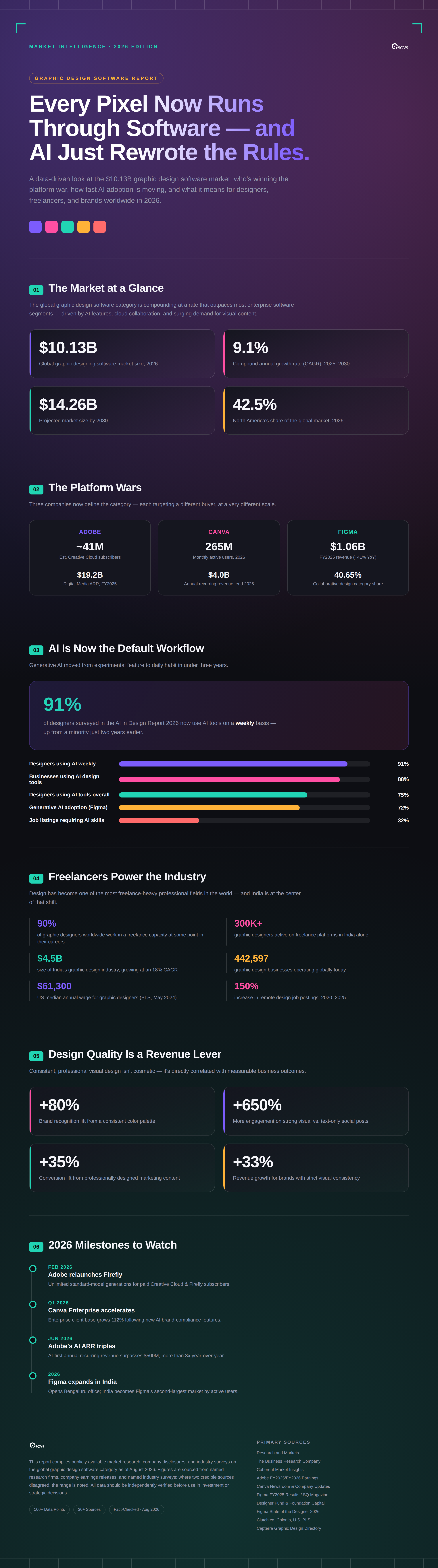
Regional market developments further demonstrate the increasing importance of digital design technologies. North America accounts for approximately 42.5% of the global graphic design software market in 2026, while Asia Pacific represents 21.3% and is identified as the fastest-growing region. Expanding digital economies, increasing marketing expenditure, growing e-commerce adoption, and the emergence of technology startups across India, China, and Southeast Asia are contributing to this growth.
Artificial Intelligence Is Transforming the Graphic Design Software Industry
One of the most influential graphic design software trends in 2026 is the widespread integration of generative AI and intelligent design automation. AI-powered image generation, automated background removal, intelligent layout recommendations, text-to-image capabilities, and automated content resizing are fundamentally changing how designers and businesses approach creative production.
A survey covering more than 900 designers found that 91% of designers use AI tools weekly, while 78% of design professionals report that AI significantly accelerates their daily workflows. Furthermore, 88% of businesses surveyed by Clutch reported using AI design tools, although only 18% indicated that AI had reduced their need for human designers.
These findings suggest that artificial intelligence is increasingly complementing human creativity rather than completely replacing professional design expertise. Businesses are leveraging AI-powered graphic design software to automate repetitive tasks, reduce production times, generate creative concepts, and scale visual content creation while retaining human oversight for strategic decision-making, brand development, and creative direction.
However, AI adoption also introduces important challenges. Approximately 45% of designers identify data privacy as their primary concern when using AI-powered design tools, while 26% report difficulties integrating AI technologies into existing workflows. These concerns are encouraging software providers to develop more secure, interoperable, and enterprise-ready creative solutions.
Leading Graphic Design Software Platforms Are Reshaping Market Competition
The competitive landscape of the graphic design software industry continues to evolve as established providers and rapidly growing cloud-based platforms compete for individual users, creative professionals, marketing departments, and enterprise customers.
Adobe remains a major force in the global creative software ecosystem. The company recorded total revenue of $23.77 billion in fiscal year 2025, representing an 11% year-over-year increase. Adobe Photoshop also holds an estimated 41.74% share within the graphic design software category tracked by technographic research, reinforcing its position as a widely adopted professional image-editing solution.
Meanwhile, Canva has emerged as one of the world’s largest accessible graphic design platforms, reaching approximately 265 million monthly active users by early-to-mid 2026 and more than 31 million paid subscribers. Its annual recurring revenue reached approximately $4 billion by the end of 2025, reflecting growing demand for user-friendly, template-driven, and AI-powered design solutions.
Figma is similarly transforming collaborative design and digital product development. The company generated $1.056 billion in fiscal year 2025 revenue, representing 41% year-over-year growth. Its estimated 40.65% market share within the collaborative design and prototyping software category demonstrates the increasing importance of browser-based design, real-time collaboration, and integrated product development workflows.
Together, these developments illustrate how the graphic design software market is expanding beyond traditional desktop applications into comprehensive creative ecosystems that support professional designers, non-designers, marketing teams, developers, and enterprise users.
Cloud-Based Graphic Design Software and Collaborative Workflows Are Gaining Momentum
The continued expansion of remote work, hybrid employment models, and geographically distributed creative teams has increased demand for cloud-based graphic design software. More than 68% of businesses reportedly prioritize cloud-based design platforms to improve collaboration across remote and hybrid working environments.
Modern organizations increasingly require graphic design solutions that enable real-time collaboration, centralized digital asset management, consistent brand governance, cross-device accessibility, and seamless integration with existing marketing and productivity software.
These requirements are driving the adoption of subscription-based graphic design software, browser-based creative applications, collaborative prototyping platforms, and enterprise design management systems.
At the same time, free and freemium graphic design software solutions are lowering barriers to entry for startups, small businesses, independent creators, and educational institutions. The democratization of digital design is enabling organizations with limited budgets and technical expertise to produce professional-quality visual content more efficiently.
Graphic Design Software Is Becoming Essential for Business Growth and Digital Marketing
The commercial importance of graphic design extends far beyond visual aesthetics. Professional design influences brand recognition, customer trust, website engagement, advertising effectiveness, e-commerce conversions, and overall marketing performance.
Approximately 90% of businesses consider visual content crucial to their marketing strategies. Industry studies also associate consistent visual branding with revenue growth advantages of up to 20–33%, while professionally designed marketing content has been linked to conversion rate improvements of up to 35%.
In the e-commerce industry, 75% of online shoppers report relying on product photographs when making purchasing decisions. Meanwhile, approximately 22% of e-commerce returns are attributed to products not visually matching their listing photographs, demonstrating the importance of accurate and high-quality visual representation.
Graphic design software also plays an increasingly important role in search engine optimisation (SEO) and content marketing. Infographic-based blog content reportedly attracts 178% more inbound links than standard text-only articles, while approximately 65% of brands incorporate infographics into their broader content marketing strategies.
These statistics highlight why businesses are increasingly treating graphic design software as a strategic investment rather than simply a creative production expense.
Emerging Graphic Design Technologies and Workforce Trends in 2026
The graphic design industry is also experiencing growing demand for motion graphics, three-dimensional design, animation, computer-generated imagery (CGI), interactive visual experiences, and multimedia content production.
The global motion design software market is estimated to be worth approximately $891 million in 2026 and is projected to reach $1.53 billion by 2032, growing at a CAGR of 9.59%. Furthermore, approximately 71% of brands reportedly incorporate motion graphics or video-based design into their core marketing activities.
The expansion of these creative formats is reshaping workforce requirements across the global graphic design industry. Employers increasingly seek professionals with expertise in AI-assisted design, UX/UI design, motion graphics, digital product design, visual storytelling, and collaborative creative technologies.
Job listings requiring AI-related design skills reportedly increased from 3% to 32% within two years, while 85% of designers and developers surveyed by Figma believe AI will be essential to their future career success.
These emerging graphic design employment trends demonstrate the growing importance of continuous professional development, technical adaptability, and multidisciplinary creative expertise.
Understanding the Most Important Graphic Design Software Statistics in 2026
As the global creative technology ecosystem continues to evolve, understanding the latest graphic design software statistics, market data, adoption patterns, and emerging industry trends is essential for businesses, software buyers, graphic designers, marketing professionals, investors, and technology providers.
This comprehensive guide to the Top 103 Graphic Design Software Statistics, Data & Trends in 2026 examines the most significant developments shaping the industry, including:
- Global graphic design software market size, growth forecasts, and regional market shares.
- Adobe Creative Cloud, Photoshop, Canva, and Figma revenue, adoption, and market statistics.
- Artificial intelligence and generative AI adoption in graphic design.
- Cloud-based graphic design software and collaborative creative workflows.
- Graphic design software purchasing behaviour and feature preferences.
- Graphic designer employment, salaries, freelancing, and emerging skills.
- Visual branding, digital marketing, and business performance statistics.
- Motion graphics, animation, 3D design, and emerging creative technologies.
- E-commerce product design and visual content conversion statistics.
- Small business graphic design, SEO, and content marketing trends.
By examining these 103 graphic design software statistics, businesses and creative professionals can gain a deeper understanding of the industry’s current direction, identify emerging investment opportunities, evaluate software solutions more effectively, and develop informed strategies for improving creative productivity and business performance.
As artificial intelligence, cloud computing, design automation, and immersive visual technologies continue to converge, the graphic design software industry is positioned to become an increasingly influential pillar of the global digital economy. Organizations that successfully combine advanced creative technologies with human expertise, strategic brand management, and data-driven decision-making will be better positioned to remain competitive throughout 2026 and beyond.
Before we venture further into this article, we would like to share who we are and what we do.
About 9cv9
9cv9 is a business tech startup based in Singapore and Asia, with a strong presence all over the world.
With over ten years of startup and business experience, and being highly involved in connecting with thousands of companies and startups, the 9cv9 team has listed some of the top and best companies/tools in this review.
If you like to get your company listed in our top B2B software reviews, check out our world-class 9cv9 Media and PR service and pricing plans here.
Top 103 Graphic Design Software Statistics, Data & Trends in 2026
Market Size & Growth
1. The global graphic designing software market is valued at $10.13 billion in 2026, growing at a 9.1% CAGR. This steady double-digit growth confirms graphic design software has become a core, non-negotiable line item in modern business technology budgets.
2. By 2030, the graphic designing software market is forecast to reach $14.26 billion at an 8.9% CAGR. Businesses planning multi-year software investments can expect continued price and feature competition as the category nearly doubles this decade.
3. A separate market analysis pegs the 2026 graphic design software market at $10.51 billion, growing to $19.59 billion by 2033 at a 9.3% CAGR. Even accounting for methodology differences across research firms, every major estimate agrees the category is expanding briskly.
4. Pixel image editors (raster tools like Photoshop) hold the largest software segment share at 32.2% in 2026. Raster-based editing remains the backbone use case despite the rise of vector and template-driven platforms.
5. North America commands the largest regional share of the graphic design software market at 42.5% in 2026. Buyers in mature markets like the US and Canada continue to set the pace for enterprise design-tool adoption.
6. Asia Pacific holds a 21.3% share of the graphic design software market in 2026 and is the fastest-growing region. Rising digital marketing budgets across India, Southeast Asia, and China are driving this acceleration.
7. A broader graphic design software market report values the category at $11.13 billion in 2026, projected to reach $22.26 billion (note: figure varies by source methodology) by 2035 at a 9.8% CAGR. Regardless of the exact figure, the long-term growth trajectory across independent reports is consistently upward.
8. Over 68% of businesses now prioritize cloud-based design platforms to improve collaboration in remote and hybrid work environments. This cloud-first preference is reshaping how vendors package and price their software.
9. The top five vendors collectively control 52% of the graphic design software market, reflecting a moderately consolidated competitive landscape. Buyers evaluating new tools should weigh switching costs against the dominant incumbents’ ecosystem lock-in.
10. The broader graphic design market (software plus services) is estimated at $56.93 billion in 2026, growing to $62.18 billion by 2035 at a 5.4% CAGR. Software is only one slice of a much larger creative economy built around design output.
11. The graphic design market (services-inclusive) supports over 1.9 billion digital design projects annually worldwide. That volume illustrates just how embedded visual content creation has become in everyday business operations.
Adobe Creative Cloud
12. Adobe’s fiscal year 2025 total revenue reached $23.77 billion, up 11% year-over-year. Adobe’s continued double-digit growth shows enterprise design software spend remains resilient even amid broader software-budget scrutiny.
13. Adobe’s Digital Media segment ARR hit $19.20 billion exiting FY2025, up 11.5% year-over-year. This subscription base is the financial engine behind Photoshop, Illustrator, and the rest of the Creative Cloud suite.
14. Industry reconstruction from Adobe’s Digital Media ARR estimates approximately 41 million Creative Cloud subscribers by year-end 2025. Adobe stopped disclosing precise subscriber counts after 2018, so analysts now infer figures from disclosed revenue.
15. Adobe’s FY2026 revenue guidance targets $25.9–$26.1 billion, with total ending ARR growth of roughly 10.2% year-over-year. Adobe management remains confident in sustaining double-digit growth into the new fiscal year.
16. Adobe Photoshop holds an estimated 41.74% market share within the graphic design software category, according to technographic tracking. Photoshop’s dominance as the raster-editing standard has proven remarkably durable.
17. Adobe InDesign ranks second in graphic design software category share at roughly 26.13%, followed by Adobe Illustrator at about 12.25%. Together, Adobe’s core creative apps account for the large majority of tracked category usage.
18. An estimated 166,764 companies use Photoshop globally as of 2026, according to technographic tracking. This wide distribution across company sizes underlines Photoshop’s status as an enterprise-standard tool.
19. Adobe’s AI-first annual recurring revenue has more than tripled year-over-year, surpassing $500 million as of Q2 FY2026. Generative AI features are quickly becoming a meaningful, separately trackable revenue stream for Adobe.
20. Firefly, Adobe’s generative AI engine, contributed 11% of all new Creative Cloud annual recurring revenue in 2024 — the highest single-feature ARR contribution in the platform’s history. This signals that AI-assisted creation is now a primary purchase driver, not just a feature add-on.
21. Direct Firefly subscription revenue exceeded $400 million combined across 2024 and 2025. Even as a standalone product outside the bundled Creative Cloud suite, Firefly is generating meaningful independent revenue.
22. Adobe relaunched Firefly in February 2026 with unlimited standard-model generations for paid Creative Cloud and Firefly subscribers. Removing generation caps positions Adobe to compete more aggressively against unlimited-generation rivals.
Canva
23. Canva reported approximately $4 billion in annual recurring revenue by the end of 2025, per company confirmation from co-founder Cliff Obrecht. Canva’s revenue has roughly doubled in under two years, reflecting rapid monetization of its enormous free user base.
24. Canva’s monthly active user base reached 265 million by early-to-mid 2026. This makes Canva one of the largest active user bases of any creative software platform in the world.
25. Canva counts more than 31 million paid subscribers across its Pro, Teams, and Enterprise plans. Paid conversion, while still a minority of total users, now represents a substantial and growing revenue base.
26. Canva’s Enterprise tier grew its client base by 112% following Q1 2026 feature releases focused on AI brand compliance and multi-channel publishing. This surge suggests large organizations are prioritizing brand-governance features when selecting design platforms.
27. Canva’s B2B segment, covering companies with 25+ seats, grew roughly 100% to about $500 million in annualized recurring revenue. Team and enterprise adoption is becoming a core growth pillar alongside Canva’s original consumer base.
28. Approximately 95% of Fortune 500 companies now use Canva in some capacity. What began as a tool for non-designers has clearly penetrated deep into large-enterprise workflows.
29. Canva’s most recent employee share sale valued the company at approximately $42 billion. This valuation places Canva among the most valuable privately held design-technology companies globally.
30. An estimated 42% of all designs created on Canva now use at least one AI-powered feature. Canva’s Magic Studio suite has rapidly become a default part of the design workflow rather than an optional extra.
31. Canva operates in 190 countries and serves more than 60 million students and teachers through Canva for Education. This global education footprint is building brand familiarity with the platform from a very early age.
32. Canva raised its annual Teams subscription price from $300 to $500, lifting average contract value by roughly 66%. This repricing move reflects Canva’s shift toward capturing more value from its growing enterprise base.
33. Users create an estimated 445 new designs every second on the Canva platform. That pace of content creation illustrates the sheer scale of daily design activity happening on a single tool.
34. Canva has now been profitable for eight consecutive years, a rarity among venture-backed software companies of its scale. This financial discipline strengthens Canva’s negotiating position ahead of an anticipated public listing.
Figma
35. Figma’s fiscal year 2025 revenue reached $1.056 billion, up 41% year-over-year. Crossing the billion-dollar revenue mark cements Figma’s position as a major standalone design-software company, not just a niche tool.
36. Figma’s Q4 2025 revenue hit $303.8 million, growing 40% year-over-year and marking the company’s best quarter for net-new revenue since going public. Momentum has clearly continued to build in the quarters following Figma’s IPO.
37. Figma disclosed 13 million monthly active users and over 10 million individual users as of its March 2025 S-1 filing. Collaborative, browser-based design has scaled Figma’s user base well beyond traditional desktop-only tools.
38. Figma holds an estimated 40.65% market share within the collaborative design and prototyping software category. This is more than double the combined share of its nearest tracked competitors.
39. Figma’s net dollar retention rate stood at 136% as of December 31, 2025. A rate well above 100% shows existing customers are consistently expanding their spend rather than churning.
40. Figma counts 67 customers paying more than $1 million in annual recurring revenue, up 68% year-over-year. Large-account expansion at this scale signals Figma has moved firmly into enterprise-grade software territory.
41. Figma priced its NYSE debut at $33.00 per share on July 30, 2025, closing its first trading day at $115.50 — a roughly 250% gain that valued the company near $68 billion on a fully diluted basis. The IPO’s reception reflected strong public-market appetite for collaborative design software.
42. Figma opened an office in Bengaluru in November 2025 and named India its second-largest market by monthly active users. This underscores how significant Indian design teams have become to Figma’s global growth strategy.
AI in Graphic Design
43. An AI in Design Report covering more than 900 designers found that 91% now use AI tools weekly. Weekly AI usage has effectively become the professional-design default rather than the exception.
44. Figma’s own State of the Designer research puts generative AI adoption among designers at 72%, with 98% of that group reporting increased usage year-over-year. Adoption isn’t just widening — existing users are also deepening how much they rely on AI.
45. Roughly three-quarters of designers report using AI tools daily, a higher daily-use rate than the 51% reported among software developers. Design work appears to be integrating generative AI even faster than the coding profession.
46. In a Clutch industry survey, 88% of businesses reported using AI design tools, yet only 18% said AI had reduced their need for human designers. Adoption is near-universal, but wholesale job replacement remains the exception rather than the rule.
47. 75% of graphic designers report using AI tools in 2026, up sharply from 35% in 2023. This three-year jump represents one of the fastest tool-adoption curves the design profession has seen.
48. 36% of companies report having replaced at least one design task with AI, while 67% of designers still view AI as a complement to their work rather than a threat. The data paints a task-level substitution pattern rather than wholesale role elimination.
49. Stock photo sites have seen a 20–30% revenue decline as AI-generated imagery increasingly substitutes for licensed stock purchases. This is one of the clearest commercial disruptions AI has caused within the design supply chain so far.
50. Job listings requiring AI-related design skills rose from just 3% to 32% of postings within two years. Employers are rapidly rewriting hiring criteria to prioritize AI fluency alongside traditional design craft.
51. 85% of designers and developers surveyed by Figma say AI will be essential to their future career success. This forward-looking confidence suggests the profession broadly expects AI skills to become table stakes.
52. 78% of design professionals say AI tools significantly speed up their day-to-day workflows. Speed, more than novelty, appears to be the primary value driver behind AI adoption in design teams.
53. Designers who actively use AI report being 25% more likely to say their job satisfaction is growing, compared with designers who don’t use it. This links AI adoption not just to output speed but to reported career wellbeing.
54. In 2025, only 39% of surveyed designers used AI in the final delivery stage of a project; by 2026 that has expanded to meaningful adoption across every stage of the design workflow. AI has moved from an early-stage ideation aid to a tool used throughout the entire creative process.
55. 26% of designers report difficulty integrating AI tools into existing workflows due to compatibility issues. Tooling friction remains a real adoption barrier even as overall usage climbs.
56. 45% of designers cite data privacy as their top concern when using AI-powered design tools. Privacy and IP concerns continue to temper otherwise-enthusiastic AI adoption.
57. The global AI-in-graphic-design software market was valued at roughly $1.2 billion in 2023 and is projected to grow at a CAGR in the high-30% to 40%+ range through 2030 across multiple analyst estimates. Even accounting for wide variance between forecasts, every model agrees AI-design tooling is one of the fastest-growing software subsegments in the industry.
Capterra & Software Buying Behavior
58. Capterra’s Graphic Design software directory ranks products using a combined Ratings Score and Popularity Score sourced from verified user reviews, public data, and vendor-submitted data. This dual-scoring approach helps buyers separate genuinely well-reviewed tools from simply well-marketed ones.
59. Content Import/Export is rated a critical feature by 43% of Capterra reviewers evaluating graphic design software. Interoperability with other file formats and platforms remains one of the top-weighted purchase criteria for buyers.
60. Design Templates are flagged as an important feature by roughly a third of Capterra reviewers assessing graphic design tools. Ready-made templates continue to be a key differentiator, particularly for non-designer buyers.
61. Capterra’s Graphic Design Software directory groups related categories including Video Editing, Photo Editing, and Video Making Software as adjacent buyer research paths. This reflects how modern design purchases increasingly span multiple overlapping content-creation needs.
62. Capterra explicitly screens for authenticity, using human moderators and AI-detection technology to verify that submitted graphic design software reviews are written by real, verified users. This verification layer is central to why buyers treat Capterra ratings as a trustworthy purchase signal.
63. Capterra’s directory lists free-tier graphic design software as a distinct filterable segment for cost-conscious buyers. Free and freemium graphic design tools remain a significant entry point, especially for small businesses and solopreneurs.
64. Vendors on Capterra can pay for “Featured Partner” placement, but Capterra states it lists all providers — paying or not — so buyers see the full competitive set. This transparency distinguishes sponsored placement from organic ranking within the directory.
Freelance, Employment & Skills
65. There are an estimated 442,597 graphic design businesses operating globally, up roughly 1.8% year-over-year. The sheer number of independent design businesses underscores how fragmented and entrepreneurial the industry remains.
66. As many as 90% of graphic designers worldwide are estimated to work in a freelance capacity at some point in their careers. Freelancing has effectively become the default, not the exception, within the design profession.
67. India is home to more than 300,000 graphic designers active on freelance platforms. This makes India one of the largest single pools of freelance design talent anywhere in the world.
68. The UK, by comparison, has approximately 66,000 professional graphic designers. The scale gap between India’s freelance-heavy market and the UK’s more traditionally employed market highlights very different industry structures by region.
69. The graphic design industry in India is valued at approximately $4.5 billion, with an 18% projected CAGR through 2030. India’s design sector is growing roughly twice as fast as most global graphic design software market forecasts.
70. Indian e-commerce and tech startups reportedly allocate 12–15% of their marketing budgets specifically to graphic design services. Visual content clearly commands a meaningful and rising share of Indian marketing spend.
71. The median annual wage for graphic designers in the United States was $61,300 as of May 2024 government wage data. This places graphic design squarely in the middle of the broader creative-professional pay scale.
72. The top 10% of US graphic designers earned above $103,030 annually, while the bottom 10% earned under $37,600. This wide spread reflects how specialization, seniority, and freelance vs. agency status dramatically affect design earnings.
73. The average graphic designer salary in India ranges from roughly ₹3 lakh to ₹7 lakh per year depending on experience. Entry-level Indian design salaries remain modest compared to specialized digital roles like UX/UI.
74. Experienced freelance graphic designers in India can earn ₹1 lakh or more per month by serving multiple clients simultaneously. Freelancing, particularly with international clients, offers a clear income ceiling above typical local full-time salaries.
75. UX/UI and Product Design roles in India command salaries between ₹8 lakh and ₹25 lakh per year — substantially above traditional graphic design pay. This salary gap is accelerating the shift of Indian design talent toward digital product specializations.
76. US Bureau of Labor Statistics projections for traditional graphic designer employment show roughly flat-to-slightly-declining growth through the early 2030s, even as digital and UX/UI-adjacent design roles grow faster than average. The overall design profession is shifting shape rather than shrinking uniformly.
77. Multimedia artist and animator roles, which overlap heavily with motion and game design, are projected to grow faster than the average for all US occupations. Streaming, gaming, and short-form video content are the primary drivers behind this above-average growth.
78. Remote design job postings increased by an estimated 150% between 2020 and 2025. The design profession has proven unusually well-suited to fully distributed, remote-first work arrangements.
Branding, Visual Content & Business Impact
79. Businesses that maintain strict visual brand consistency across channels report revenue growth as high as 20–33% higher than those with inconsistent branding, according to multiple independent industry studies. The financial case for professional, consistent design has never been more clearly documented.
80. A consistent color palette alone can boost brand recognition by up to 80%. Color consistency is repeatedly cited across brand-recognition research as one of the single highest-leverage design decisions a business can make.
81. It typically takes five to seven brand impressions before a consumer reliably remembers a brand. This repetition threshold reinforces why consistent, recurring visual assets matter more than one-off creative bursts.
82. Roughly 90% of businesses say visual content is now crucial to their marketing strategy. Visual-first thinking has moved from a marketing “nice-to-have” to a stated business priority for the vast majority of companies.
83. Social media posts with strong visual design can receive up to 650% more engagement than text-only posts. This engagement gap alone justifies continued investment in dedicated design software and skilled operators.
84. Businesses using professionally designed marketing content report conversion rate increases of up to 35% compared with amateur or unstyled visuals. Professional design quality translates directly into measurable commercial performance, not just aesthetic polish.
85. Demand for infographic-style content has grown by an estimated 25% year-over-year. Data-driven visual storytelling, like infographics, continues to outpace growth in plainer content formats.
86. As many as 71% of brands now use motion graphics or video-based design as part of their core marketing mix. Static graphics alone are no longer considered sufficient for a competitive brand marketing strategy.
87. Brands with poorly designed or unappealing logos are avoided by an estimated 60% of consumers, regardless of the underlying product’s review quality. This shows first-impression visual design can override otherwise-strong product fundamentals.
88. About 95% of the world’s top 100 brands limit their primary logo palette to just one or two colors. Restraint, not complexity, defines the visual identity strategy of the world’s most recognized companies.
Motion, 3D & Emerging Formats
89. The global motion design software market was valued at roughly $891 million in 2026 and is projected to reach $1.53 billion by 2032 at a 9.59% CAGR. Motion and animation tooling is now one of the fastest-growing adjacent categories to traditional graphic design software.
90. Motion graphics usage in broader design output has risen an estimated 28%, driven largely by the popularity of short-form video formats. Short-form video platforms have become a direct growth engine for motion-capable design tools.
91. 3D design and CGI adoption among designers has increased an estimated 21%, with roughly 1.9 million designers now incorporating 3D workflows into their output. 3D is transitioning from a specialist niche into a mainstream design skill set.
92. After Effects is reportedly used by more than 80% of professional motion designers as their primary animation tool. Despite growing competitors, Adobe’s motion tooling remains the de facto professional standard.
93. The global motion graphics design services market was valued at $3.44 billion in 2025 and is projected to reach $4.83 billion by 2034. Motion design services, distinct from the software itself, represent a substantial and separately growing commercial category.
94. Viewers reportedly retain around 95% of a message delivered through video, compared with roughly 10% retention when reading equivalent text. This retention gap is one of the strongest arguments driving continued investment in motion and video-capable design tools.
E-Commerce, Product & Marketplace Design
95. 75% of online shoppers say they rely on product photos when making a purchase decision. Product imagery quality functions as a direct sales-conversion lever for e-commerce businesses.
96. Adding videos to e-commerce product pages has been linked to sales increases of up to 144% in some retail studies. Motion-capable product content appears to meaningfully outperform static imagery alone.
97. Roughly 22% of e-commerce returns are attributed to a product not visually matching its listing photos. Accurate, well-produced product design and photography can directly reduce costly return rates.
98. Product pages featuring customer-submitted images see roughly 30% higher conversion rates than pages with only official brand photography. User-generated visual content is proving to be a powerful, low-cost complement to professionally designed assets.
Small Business & SEO/Content Marketing Use
99. 43% of small businesses report struggling with consistent content creation. This persistent pain point is a core reason template-driven platforms like Canva have found such rapid small-business adoption.
100. Only 55% of small businesses report having a documented social media strategy in place. The lack of formal strategy documentation suggests design and content decisions are frequently made ad hoc rather than systematically.
101. Infographic-based blog content reportedly receives 178% more inbound links than standard text-only posts. From an SEO standpoint, investing in custom infographic design continues to pay measurable organic-traffic dividends.
102. Roughly 65% of brands say they now use infographics as part of their broader content marketing strategy. Infographics have moved from a marketing experiment into a mainstream, expected content format.
103. Infographic content is shared approximately three times more often than any other content type, according to widely cited content-marketing research. High shareability makes infographics a particularly efficient format for organic reach.
Conclusion
The global graphic design software industry in 2026 stands at a pivotal stage of technological innovation, market expansion, and digital transformation. As demonstrated by these 103 graphic design software statistics, data, and trends, the industry is evolving beyond traditional image editing and visual content creation into a comprehensive ecosystem powered by artificial intelligence, cloud computing, real-time collaboration, intelligent automation, and advanced multimedia technologies.
Graphic design software has become an indispensable business technology that supports digital marketing, brand development, customer engagement, e-commerce growth, product development, and organizational productivity. Its increasing adoption across enterprises, small businesses, educational institutions, creative agencies, and independent professionals reflects the growing importance of visual communication in the global digital economy.
Strong Market Growth Reflects the Increasing Importance of Graphic Design Software
The global graphic design software market is estimated to reach $10.13 billion in 2026 and is projected to expand to $14.26 billion by 2030, growing at a compound annual growth rate of 8.9%. Alternative market research estimates suggest that the industry could reach $19.59 billion by 2033, further reinforcing its substantial long-term growth potential.
North America continues to lead the global graphic design software market, accounting for approximately 42.5% of market share, while Asia Pacific represents 21.3% and is emerging as the fastest-growing regional market.
Several factors are expected to support continued industry expansion, including:
- Increasing investment in digital marketing and visual content production.
- Growing adoption of AI-powered graphic design software.
- Rising demand for cloud-based creative platforms.
- Expansion of global e-commerce and digital advertising markets.
- Increasing accessibility of professional design tools for small businesses.
- Growing demand for motion graphics, animation, and 3D design.
- Greater emphasis on brand consistency and personalized customer experiences.
These developments demonstrate that graphic design software is increasingly becoming a strategic investment for organizations seeking to strengthen their digital presence, improve operational efficiency, and achieve sustainable business growth.
Artificial Intelligence Is Redefining the Future of Graphic Design
Among the most significant graphic design software trends in 2026 is the accelerating adoption of artificial intelligence and generative AI technologies. With 91% of designers in one industry survey using AI tools weekly and 78% of design professionals reporting significant workflow improvements through AI adoption, intelligent creative technologies are fundamentally transforming the design process.
AI-powered graphic design software enables businesses and creative professionals to automate repetitive tasks, generate visual concepts, accelerate image editing, produce marketing assets, and scale content creation with greater efficiency.
However, the statistics also indicate that human creativity remains essential. Although 88% of businesses surveyed by Clutch reported using AI design tools, only 18% indicated that artificial intelligence had reduced their need for human designers. Furthermore, approximately 67% of designers consider AI a complementary technology rather than a threat to their profession.
These findings suggest that the future of graphic design will increasingly depend on collaboration between human expertise and artificial intelligence. While AI can enhance productivity and automate routine creative tasks, human designers remain important for strategic thinking, creative direction, emotional storytelling, cultural understanding, and brand differentiation.
Organizations that effectively integrate AI-powered design capabilities while maintaining human oversight will be better positioned to maximize creative productivity without compromising originality, quality, or brand integrity.
Adobe, Canva, and Figma Are Driving Competitive Transformation
The graphic design software market continues to experience significant competitive developments as established technology providers and innovative cloud-based platforms expand their capabilities.
Adobe remains a dominant force within the professional creative software ecosystem, generating $23.77 billion in total revenue during fiscal year 2025. Adobe Photoshop’s estimated 41.74% share of tracked graphic design software usage highlights the continued importance of established professional image-editing applications.
Meanwhile, Canva’s expansion to approximately 265 million monthly active users and more than 31 million paid subscribers demonstrates the growing demand for accessible, intuitive, and template-driven graphic design software. Its approximately $4 billion in annual recurring revenue by the end of 2025 also reflects the increasing commercial significance of design platforms serving both individual and enterprise customers.
Figma’s fiscal year 2025 revenue of $1.056 billion, representing 41% year-over-year growth, further illustrates the rapid expansion of collaborative design and digital product development platforms.
The success of these major graphic design software providers highlights several broader industry developments:
- The democratization of professional graphic design capabilities.
- Increasing demand for collaborative and browser-based creative tools.
- Growing enterprise investment in brand management and design governance.
- Expansion of subscription-based creative software business models.
- Accelerating integration of generative AI into mainstream design applications.
- Increasing competition between specialized design tools and comprehensive creative ecosystems.
For businesses evaluating graphic design software in 2026, selecting the most appropriate platform will increasingly require consideration of collaboration capabilities, AI functionality, scalability, interoperability, security, pricing, and long-term organizational requirements.
Cloud-Based Design Software Is Becoming a Business Standard
The growing adoption of remote and hybrid working arrangements has accelerated the transition towards cloud-based graphic design software. With more than 68% of businesses reportedly prioritizing cloud-based design platforms, accessibility and collaboration have become important considerations in software purchasing decisions.
Cloud-based creative platforms enable geographically distributed teams to collaborate in real time, manage shared design assets, maintain consistent branding, and streamline project approval processes.
These capabilities are particularly valuable for multinational organizations, digital marketing agencies, distributed product development teams, and businesses managing multiple brands across different markets.
As organizations continue to prioritize operational flexibility and digital transformation, cloud-native graphic design software is expected to play an increasingly important role in enterprise technology ecosystems.
Graphic Design Software Delivers Measurable Business and Marketing Value
The business impact of graphic design software extends considerably beyond creative production. High-quality visual content plays an influential role in customer acquisition, brand recognition, consumer trust, digital engagement, and conversion performance.
Approximately 90% of businesses consider visual content crucial to their marketing strategies, while consistent visual branding has been associated with revenue growth advantages of up to 20–33%. Professionally designed marketing content has also been linked to conversion rate improvements of up to 35%.
In e-commerce, the importance of visual content is particularly evident. Approximately 75% of online shoppers rely on product photographs when making purchasing decisions, while around 22% of e-commerce returns are attributed to products not visually matching their listing photographs.
These statistics highlight the commercial importance of investing in accurate product imagery, professional visual branding, compelling advertising assets, and consistent digital experiences.
Graphic design software also supports search engine optimisation (SEO) and content marketing performance. Infographic-based blog content reportedly receives 178% more inbound links than standard text-only articles, while approximately 65% of brands incorporate infographics into their content marketing strategies.
Although individual marketing outcomes depend on factors such as audience preferences, execution quality, distribution channels, and campaign objectives, these findings demonstrate the potential value of integrating professional graphic design into broader business growth strategies.
Emerging Creative Technologies Will Shape the Next Phase of Industry Growth
The future of graphic design software will increasingly extend beyond static visual content into motion graphics, animation, 3D design, computer-generated imagery, and interactive digital experiences.
The global motion design software market is estimated to reach approximately $891 million in 2026 and is projected to grow to $1.53 billion by 2032, registering a CAGR of 9.59%. Meanwhile, approximately 71% of brands reportedly incorporate motion graphics or video-based design into their core marketing activities.
The increasing popularity of short-form video, interactive advertising, digital product experiences, and multimedia storytelling is creating new opportunities for creative software providers and design professionals.
Businesses that invest in versatile graphic design platforms capable of supporting multiple content formats will be better positioned to adapt to changing consumer expectations and emerging digital communication channels.
Graphic Design Employment and Skills Are Undergoing Significant Changes
The evolution of graphic design software is also transforming employment opportunities, professional skill requirements, and career development pathways.
Traditional graphic design expertise remains valuable, but employers are increasingly seeking professionals with capabilities in AI-assisted design, UX/UI design, motion graphics, digital product development, collaborative creative workflows, and multimedia production.
Job listings requiring AI-related design skills reportedly increased from 3% to 32% within two years, while 85% of designers and developers surveyed by Figma believe artificial intelligence will be essential to their future career success.
These workforce trends emphasize the importance of continuous learning and professional development. Graphic designers who combine traditional creative expertise with emerging technologies, strategic business knowledge, and digital communication skills will be better positioned to remain competitive in an evolving employment landscape.
For employers, investing in employee training, modern creative software, and multidisciplinary design capabilities can help organizations build more productive, adaptable, and innovative creative teams.
Key Considerations for Businesses Investing in Graphic Design Software in 2026
As the graphic design software market becomes increasingly competitive and technologically sophisticated, businesses should evaluate creative platforms according to their specific operational requirements and long-term strategic objectives.
Important considerations include:
- Artificial intelligence capabilities: Assess whether AI-powered features deliver meaningful productivity improvements and support existing creative workflows.
- Cloud accessibility and collaboration: Prioritize platforms that enable efficient teamwork, shared asset management, and remote accessibility.
- Data privacy and intellectual property protection: Evaluate how software providers manage confidential information, generated content, and creative assets.
- Integration and interoperability: Select solutions that support relevant file formats and integrate with existing business technologies.
- Brand management capabilities: Consider centralized brand guidelines, reusable templates, and enterprise-level governance features.
- Scalability and pricing: Evaluate subscription costs, licensing flexibility, and the long-term financial implications of software adoption.
- Multimedia design capabilities: Consider support for motion graphics, animation, video production, and emerging visual formats.
- Employee training and usability: Ensure that creative professionals and non-designers can effectively utilize the selected software.
These considerations are particularly important given that 45% of designers identify data privacy as their primary concern when using AI-powered design tools, while 26% report compatibility-related challenges when integrating AI into existing workflows.
A comprehensive software evaluation strategy can help organizations maximize their return on investment while minimizing operational risks and unnecessary technology expenditure.
The Future Outlook for Graphic Design Software Beyond 2026
Looking beyond 2026, the global graphic design software industry is expected to continue expanding as artificial intelligence, cloud computing, intelligent automation, collaborative technologies, and advanced multimedia capabilities become increasingly integrated into creative workflows.
The distinction between professional graphic design software and general business productivity tools is also becoming less pronounced. As intuitive design platforms make visual content creation accessible to a wider audience, marketing teams, sales professionals, educators, entrepreneurs, and other business users are gaining greater independence in producing creative assets.
Nevertheless, professional design expertise will remain essential for developing distinctive brand identities, sophisticated visual experiences, strategic marketing campaigns, and high-quality digital products.
The next phase of industry growth will likely be characterized by a combination of greater design accessibility, more intelligent creative automation, stronger enterprise governance, and deeper collaboration between human designers and AI-powered technologies.
Businesses that proactively adapt to these developments will be better positioned to improve creative efficiency, strengthen brand differentiation, reduce production bottlenecks, and respond to evolving customer expectations.
Ultimately, these Top 103 Graphic Design Software Statistics, Data & Trends in 2026 reveal an industry that is not merely experiencing technological advancement but undergoing a fundamental transformation in how visual content is created, managed, distributed, and monetized.
For business leaders, marketing professionals, software buyers, graphic designers, technology investors, and creative agencies, understanding these market statistics and emerging trends provides a valuable foundation for making informed decisions about software investments, workforce development, digital marketing strategies, and long-term business growth.
As visual communication becomes increasingly central to the global digital economy, graphic design software will continue to serve as a critical enabler of innovation, productivity, customer engagement, and competitive differentiation.
Organizations that successfully combine advanced graphic design technologies, artificial intelligence, human creativity, and data-driven business strategies will be better equipped to capitalize on emerging opportunities and achieve sustainable success in 2026 and beyond.
If you find this article useful, why not share it with your hiring manager and C-level suite friends and also leave a nice comment below?
We, at the 9cv9 Research Team, strive to bring the latest and most meaningful data, guides, and statistics to your doorstep.
To get access to top-quality guides, click over to 9cv9 Blog.
To hire top talents using our modern AI-powered recruitment agency, find out more at 9cv9 Modern AI-Powered Recruitment Agency.
People Also Ask
What is the global graphic design software market size in 2026?
The global graphic design software market is valued at an estimated $10.13 billion in 2026, driven by AI-powered design tools, cloud-based platforms, digital marketing, and increasing demand for visual content.
How fast is the graphic design software market growing?
The graphic design software market is projected to grow at a CAGR of 8.9%, reaching $14.26 billion by 2030 as businesses increasingly invest in digital design and creative automation.
What are the biggest graphic design software trends in 2026?
Major trends include generative AI, cloud-based design platforms, real-time collaboration, creative automation, motion graphics, 3D design, and integrated brand management solutions.
Which region dominates the global graphic design software market?
North America leads the global graphic design software market with an estimated 42.5% market share in 2026, supported by widespread enterprise adoption and advanced digital infrastructure.
Which region has the fastest-growing graphic design software market?
Asia Pacific is the fastest-growing region, accounting for approximately 21.3% of the global market in 2026, driven by digital transformation, e-commerce expansion, and rising marketing expenditure.
What are the most popular graphic design software platforms in 2026?
Adobe Photoshop, Adobe Illustrator, Adobe InDesign, Canva, and Figma are among the leading graphic design platforms, offering professional editing, content creation, collaboration, and AI-powered capabilities.
What is Adobe Photoshop’s market share in 2026?
Adobe Photoshop holds an estimated 41.74% share within the graphic design software category tracked by technographic research, maintaining a leading position in professional image editing.
How many people use Canva in 2026?
Canva has approximately 265 million monthly active users and more than 31 million paid subscribers in 2026, making it one of the world’s largest digital design platforms.
How much revenue does Canva generate?
Canva reached approximately $4 billion in annual recurring revenue by the end of 2025, supported by growing paid subscriptions, enterprise adoption, and AI-powered design capabilities.
How fast is Figma growing in the graphic design software industry?
Figma generated $1.056 billion in fiscal year 2025 revenue, representing 41% year-over-year growth, driven by collaborative design, prototyping, and enterprise adoption.
What is Figma’s market share in collaborative design software?
Figma holds an estimated 40.65% market share within the collaborative design and prototyping software category, reflecting strong adoption among digital product teams.
How many graphic designers use artificial intelligence in 2026?
An industry survey covering more than 900 designers found that 91% use AI tools weekly, demonstrating the widespread integration of artificial intelligence into professional creative workflows.
How does AI improve graphic design productivity?
Approximately 78% of surveyed design professionals report that AI significantly accelerates their workflows by automating repetitive tasks, generating visual concepts, and simplifying image editing.
Will artificial intelligence replace graphic designers?
AI is more likely to transform design tasks than completely replace designers. Although 88% of surveyed businesses use AI design tools, only 18% report a reduced need for human designers.
What are the biggest challenges of AI-powered graphic design software?
Major challenges include data privacy, intellectual property protection, content originality, output accuracy, and software compatibility. Approximately 45% of designers identify data privacy as their primary AI-related concern.
How popular is cloud-based graphic design software?
More than 68% of businesses reportedly prioritise cloud-based graphic design platforms to improve collaboration, accessibility, asset management, and productivity across remote and hybrid teams.
What are the most important graphic design software features?
Important features include AI-powered editing, design templates, content import and export, real-time collaboration, vector editing, brand management, cloud storage, and multimedia content creation.
Why is graphic design software important for businesses?
Graphic design software helps businesses strengthen brand identity, improve marketing performance, create professional visual content, streamline creative workflows, and enhance customer engagement.
How does graphic design affect business revenue?
Industry studies associate consistent visual branding with revenue growth advantages of up to 20–33%. However, actual financial results depend on design quality, marketing strategy, and customer preferences.
How does graphic design improve brand recognition?
Consistent visual branding, including colours, typography, and logos, strengthens brand recognition. A consistent colour palette alone has reportedly been associated with recognition improvements of up to 80%.
How important is visual content in digital marketing?
Approximately 90% of businesses consider visual content crucial to their marketing strategies, highlighting the importance of graphic design software for advertising, social media, and customer engagement.
How does graphic design influence e-commerce sales?
Approximately 75% of online shoppers rely on product photographs when making purchasing decisions, making professional graphic design and accurate product imagery important for e-commerce performance.
Can graphic design software improve conversion rates?
Professionally designed marketing content has been associated with conversion rate improvements of up to 35%, although results vary depending on audience preferences, campaign execution, and design quality.
How does graphic design contribute to SEO performance?
Graphic design supports SEO through engaging infographics, optimised images, and visual content. Infographic-based articles reportedly attract 178% more inbound links than standard text-only content.
What is the global motion design software market size in 2026?
The global motion design software market is estimated at $891 million in 2026 and is projected to reach $1.53 billion by 2032, growing at a CAGR of 9.59%.
How popular are motion graphics in digital marketing?
Approximately 71% of brands reportedly use motion graphics or video-based design in their core marketing activities, reflecting growing demand for engaging multimedia content.
What is the average salary of a graphic designer?
The median annual wage for graphic designers in the United States was $61,300 as of May 2024. Salaries vary depending on experience, location, specialisation, and employment arrangements.
What graphic design skills are most in demand in 2026?
In-demand skills include AI-assisted design, UX/UI design, motion graphics, 3D modelling, digital product design, visual storytelling, brand management, and collaborative design software proficiency.
Is graphic design software suitable for small businesses?
Yes. Free and affordable graphic design platforms help small businesses create professional marketing materials, maintain brand consistency, produce social media content, and reduce creative production costs.
What is the future of graphic design software beyond 2026?
The future of graphic design software will be shaped by generative AI, intelligent automation, cloud collaboration, immersive 3D experiences, multimedia production, and closer integration between human creativity and advanced design technologies.
Sources
Available upon request


