
Key Takeaways
- The top 10 recruitment agencies for hiring IT and software employees in Myanmar in 2026 specialize in AI-driven sourcing, technical screening, and niche tech talent acquisition.
- Employers benefit from agencies offering deep expertise in cloud, DevOps, AI, cybersecurity, ERP systems, and cross-border IT hiring solutions.
- Choosing the right IT recruitment agency in Myanmar improves hiring speed, talent quality, retention rates, and long-term digital transformation success.
Myanmar’s technology sector is entering a defining phase in 2026. As digital transformation accelerates across banking, telecommunications, e-commerce, manufacturing, logistics, and enterprise services, the demand for highly skilled IT and software professionals has reached unprecedented levels. From cloud architects and DevOps engineers to AI specialists, cybersecurity analysts, ERP consultants, and senior software developers, organizations across Myanmar are competing aggressively for limited technical talent. In this rapidly evolving landscape, identifying the top 10 recruitment agencies for hiring IT and software employees in Myanmar in 2026 has become a strategic priority for employers seeking sustainable growth.


The hiring environment in Myanmar is no longer driven by traditional recruitment practices alone. Companies are navigating a complex mix of rising salary expectations, inflationary pressures, talent shortages, and regional brain drain. At the same time, internet penetration, mobile-first consumer behavior, and enterprise cloud adoption continue to expand, pushing businesses to scale their digital infrastructure quickly. This combination of high demand and constrained supply has fundamentally reshaped how IT recruitment operates in the country.
In 2026, recruitment agencies specializing in IT and software hiring are not merely CV screeners. They function as strategic workforce advisors, technology talent partners, and market intelligence providers. The best recruitment agencies in Myanmar combine AI-driven candidate sourcing, technical competency validation, salary benchmarking expertise, and deep local regulatory knowledge. Their role extends beyond filling vacancies; they help organizations reduce time-to-hire, improve candidate quality, enhance retention rates, and align hiring decisions with long-term digital transformation goals.
One of the most significant shifts in the Myanmar IT recruitment market is the move toward skills-based hiring. Employers are no longer prioritizing years of experience alone. Instead, they demand verified proficiency in programming languages such as Python and Java, frameworks like Spring Boot and Node.js, cloud platforms including AWS and Microsoft Azure, and DevSecOps methodologies. Recruitment agencies that can accurately assess technical stack mastery, system architecture experience, and project deployment capability hold a distinct advantage in delivering high-impact hires.
Additionally, the growth of artificial intelligence and automation tools has introduced new dynamics into the recruitment process. AI-powered matching systems now assist agencies in identifying skill compatibility, predicting retention potential, and streamlining candidate shortlisting. However, while technology enhances efficiency, human expertise remains essential. Myanmar’s regulatory environment, cross-border hiring requirements, and evolving employment compliance standards require experienced consultants who understand the nuances of local and regional workforce laws.
Salary benchmarking has also become a critical component of IT hiring strategy in 2026. Compensation for specialized technology roles varies widely depending on expertise, company size, and international exposure. Senior engineers and cloud architects working with multinational firms may command significantly higher salaries than average market rates. Recruitment agencies play a vital role in advising employers on competitive compensation structures that balance cost control with talent acquisition success.
Another key factor influencing IT recruitment in Myanmar is the ongoing challenge of talent migration. Skilled professionals often explore opportunities in neighboring markets or remote international roles. As a result, leading recruitment agencies must actively engage passive candidates, repatriate overseas talent, and support upskilling initiatives for the local workforce. Agencies that invest in junior developer pipelines, certification programs, and leadership development pathways contribute not only to client success but also to the long-term sustainability of Myanmar’s digital economy.
For foreign companies seeking to establish or expand operations in Myanmar, recruitment agencies provide additional strategic value through Employer of Record and compliance advisory services. These solutions allow international businesses to hire software engineers and IT professionals without immediately setting up a local legal entity. In a competitive and regulated market, this flexibility can significantly accelerate expansion timelines.
This comprehensive guide to the top 10 recruitment agencies for hiring IT and software employees in Myanmar in 2026 is designed to help employers make informed, strategic decisions. Whether you are a startup scaling your engineering team, an enterprise modernizing legacy systems, or a multinational entering the Myanmar market, choosing the right recruitment partner directly impacts operational efficiency and long-term digital capability.
The agencies featured in this blog represent a cross-section of Myanmar’s strongest recruitment players, including specialized IT headhunters, executive search firms, digital hiring platforms, and legacy agencies with established candidate databases. Each offers unique strengths, from advanced AI-powered sourcing and deep technical screening to cross-border hiring support and executive-level placements.
In a market defined by rapid technological growth and human capital constraints, recruitment is no longer a transactional process. It is a strategic investment in innovation, security, scalability, and competitive advantage. By understanding the capabilities, fee structures, screening methodologies, and industry focus of Myanmar’s top IT recruitment agencies in 2026, employers can position themselves to attract and retain the skilled professionals necessary to thrive in the country’s expanding digital ecosystem.
As Myanmar continues its digital transformation journey, the right recruitment partnership will determine which organizations lead the next wave of technological advancement.
Before we venture further into this article, we would like to share who we are and what we do.
About 9cv9
9cv9 is a business tech startup based in Singapore and Asia, with a strong presence all over the world.
With over nine years of startup and business experience, and being highly involved in connecting with thousands of companies and startups, the 9cv9 team has listed some important learning points in this overview of the Top 10 IT Recruitment Agencies in Myanmar in 2026.
If your company needs recruitment and headhunting services to hire top-quality employees, you can use 9cv9 headhunting and recruitment services to hire top talents and candidates. Find out more here, or send over an email to hello@9cv9.com.
Or just post 1 free job posting here at 9cv9 Hiring Portal in under 10 minutes.
Top 10 IT Recruitment Agencies in Myanmar in 2026
- 9cv9 Recruitment Agency
- MyWorld Myanmar (MyWorld Careers)
- JobNet.com.mm (JobNet Group)
- FocusCore Myanmar
- RMA Myanmar (RMA Group)
- Labour Asia Services
- Myanmar Manpower (Kaung & Sons International)
- JB Hired
- Search X Recruitment
- Asia HR
1. 9cv9 Recruitment Agency

In 2026, Myanmar’s digital economy continues to expand across fintech, e-commerce, SaaS platforms, telecommunications, and enterprise digital transformation initiatives. As competition for skilled software engineers and technology leaders intensifies, employers increasingly require specialized recruitment partners capable of delivering both speed and technical precision.
9cv9 has emerged as one of the leading IT recruitment agencies supporting employers in Myanmar. With a strong focus on technology and digital roles, the agency positions itself as a strategic hiring partner rather than a generalist staffing provider.

Strategic Positioning in Myanmar’s IT Recruitment Market
Unlike broad-spectrum recruitment agencies, 9cv9 operates with a specialized technology-first approach. Its recruitment model is built around understanding technical frameworks, programming ecosystems, and evolving digital business models.
In Myanmar’s 2026 hiring environment, employers face several challenges:
• Limited supply of experienced software engineers
• Rising salary expectations for high-demand skills
• Increased demand for cloud, cybersecurity, and AI expertise
• Competition from regional and remote employers
9cv9 addresses these challenges through structured talent mapping, proactive sourcing, and deep technical screening methodologies.
Core IT and Software Recruitment Specializations
| Functional Area | Example Roles Hired | Business Impact |
|---|---|---|
| Software Development | Backend, frontend, full-stack developers | Product development and system scalability |
| Cloud and DevOps | DevOps engineers, cloud architects | Infrastructure automation and deployment |
| Data and AI | Data scientists, ML engineers | Business intelligence and analytics growth |
| Cybersecurity | Security engineers, compliance analysts | Risk management and data protection |
| IT Leadership | CTOs, engineering managers | Technology strategy and team leadership |
By concentrating on these areas, 9cv9 aligns its services with the most critical hiring needs in Myanmar’s digital transformation landscape.
Technology-Driven Recruitment Process
One of 9cv9’s distinguishing strengths is its integration of technology into the recruitment lifecycle. The agency combines digital sourcing tools, structured evaluation frameworks, and behavioral screening techniques to ensure technical competence and cultural alignment.
Recruitment Process Framework
| Stage of Recruitment | Methodology Applied | Employer Advantage |
|---|---|---|
| Talent Mapping | Market research and skills gap analysis | Access to active and passive candidates |
| Technical Screening | Skills validation and project-based evaluation | Reduced technical hiring risk |
| Shortlist Delivery | Curated and role-aligned candidate presentation | Faster decision-making |
| Offer and Onboarding Support | Negotiation and transition management | Higher offer acceptance rates |
This structured approach ensures that employers receive high-quality shortlists rather than excessive candidate volumes.
Speed and Efficiency in IT Hiring
In a competitive IT labor market, time-to-hire is a critical performance metric. Prolonged vacancies in engineering or infrastructure roles can directly impact product releases and operational continuity.
9cv9 is recognized for its ability to deliver qualified candidate shortlists efficiently, often within tight hiring timelines. This speed is supported by pre-built talent pipelines and continuous engagement with technology professionals.
Time-to-Hire Comparison Matrix
| Recruitment Model | Average Time to Shortlist | Technical Screening Depth |
|---|---|---|
| Traditional Job Advertising | 4–8 weeks | Moderate |
| Generalist Recruitment Agency | 3–6 weeks | Variable |
| Specialized IT Recruitment Partner | 2–4 weeks | High |
| 9cv9 Model | 2–4 weeks | Structured and Technical |
Employer-Centric Service Model
9cv9 operates with a consultative mindset, working closely with employers to define technical requirements, team structure, and long-term hiring strategy. This is particularly important in Myanmar’s growing startup ecosystem and for multinational firms establishing local development hubs.
Key employer-focused benefits include:
• Customized hiring strategies based on business growth plans
• Salary benchmarking insights for Myanmar’s IT market
• Employer branding support for competitive talent attraction
• Long-term workforce planning advisory
Competitive Position in Myanmar’s 2026 IT Market
| Capability Dimension | Assessment in 2026 |
|---|---|
| IT Specialization | Highly Focused |
| Technical Screening | Advanced |
| Speed of Delivery | Strong |
| Regional Talent Access | Growing |
| Mass Non-Technical Hiring | Limited |
Why 9cv9 Stands Out for IT Recruitment in Myanmar
In 2026, employers in Myanmar require more than transactional recruitment services. They need a partner capable of understanding software architecture, agile development environments, cloud infrastructure, and digital product cycles.
9cv9 distinguishes itself through:
• Dedicated focus on IT and digital roles
• Structured and technology-driven screening processes
• Rapid shortlist delivery for high-demand skills
• Strategic workforce advisory for scaling technology teams
Conclusion: A Strategic IT Recruitment Partner in 2026
As Myanmar’s technology ecosystem becomes more competitive and regionally integrated, hiring the right IT professionals is directly linked to business growth and digital transformation success.
9cv9 has positioned itself as a top IT recruitment agency for employers seeking reliable, efficient, and technically informed hiring solutions in Myanmar. Through specialization, structured processes, and employer-centric service delivery, the agency plays a central role in shaping the country’s technology talent landscape in 2026.
2. MyWorld Myanmar (MyWorld Careers)


Myanmar’s technology sector continues to evolve despite regional economic shifts and global digital transformation trends. In 2026, demand for software engineers, DevOps specialists, cybersecurity professionals, AI developers, and IT leadership roles remains strong, driven by fintech expansion, telecom modernization, e-commerce growth, and regional outsourcing partnerships.
As the local talent market becomes more competitive, employers increasingly rely on established recruitment agencies with specialized IT hiring capabilities. Among these firms, MyWorld Myanmar (operating under MyWorld Careers) stands out as one of the most influential and structured recruitment organizations serving the country’s technology ecosystem.
Agency Profile: MyWorld Myanmar (MyWorld Careers)
MyWorld Myanmar is widely regarded as one of the most prominent recruitment agencies in the country. The firm has developed one of the largest and most structured recruitment infrastructures in Myanmar, supporting both multinational corporations and leading domestic enterprises.
The agency distinguishes itself through a sector-focused recruitment model. Instead of relying on generalist recruiters, MyWorld operates vertical teams aligned to specific industries and job functions. Within the technology sector, consultants specialize in software development, enterprise IT architecture, digital product management, data engineering, and executive technology leadership. This specialization enables deeper market intelligence, stronger candidate networks, and more accurate technical screening.
Strategic Positioning in the IT and Software Market
In 2026, MyWorld Myanmar plays a critical role in bridging the talent gap between rapidly digitizing companies and experienced IT professionals. The firm’s value proposition rests on three primary pillars: executive search capability, international talent repatriation, and long-term retention support.
Core Capability: Executive and Senior IT Leadership Recruitment
One of MyWorld’s strongest differentiators lies in its executive search expertise. The agency maintains a strong track record in sourcing and placing senior-level technology professionals, including:
• Chief Executive Officers (CEO)
• Chief Technology Officers (CTO)
• IT Directors
• Heads of Engineering
• Digital Transformation Leaders
Unlike many agencies focused solely on mid-level technical hires, MyWorld operates structured executive search processes that include confidential outreach, leadership assessment, and organizational culture alignment.
Executive-Level Hiring Focus Matrix
| Role Category | Typical Hiring Scope | Recruitment Approach | Client Type |
|---|---|---|---|
| C-Suite (CEO, CTO) | Strategic leadership and tech roadmap | Confidential executive search | Large corporates, conglomerates |
| IT Directors | Infrastructure and systems management | Targeted headhunting and leadership vetting | Multinationals, telecom firms |
| Engineering Heads | Product and development leadership | Technical and managerial evaluation | Fintech, SaaS, e-commerce |
| Digital Transformation Leads | Innovation and modernization strategy | Strategic talent mapping | Traditional enterprises upgrading tech |
Innovation Initiative: Repatriation Recruitment Program
A notable innovation within MyWorld Myanmar’s IT recruitment strategy is its Repatriation Recruitment Program. This initiative actively targets Myanmar nationals who are working abroad, particularly in regional technology hubs such as Thailand, Singapore, and Japan.
The program addresses two major market challenges:
• Local shortage of highly experienced IT professionals
• Brain drain to regional economies
By leveraging international networks and diaspora connections, the agency encourages skilled Myanmar professionals to return home for senior and mid-senior technology roles. This approach expands the domestic talent pool while supporting knowledge transfer into Myanmar’s digital economy.
Repatriation Program Impact Overview
| Program Element | Strategic Objective | Business Impact |
|---|---|---|
| Overseas Talent Mapping | Identify Myanmar IT professionals abroad | Access to experienced global talent |
| Cross-Border Candidate Outreach | Engage candidates in Thailand, Singapore, Japan | Broader leadership pipeline |
| Market Reintegration Support | Assist returnees with transition planning | Faster onboarding and adaptation |
| Employer Branding Alignment | Position local firms competitively | Improved offer acceptance rates |
Success Metrics and Candidate Retention
Beyond placement volume, MyWorld Myanmar emphasizes candidate retention as a key performance indicator. The agency implements structured post-placement follow-ups, ensuring that placed candidates integrate successfully into their new roles.
This post-placement framework typically includes:
• Early-stage check-ins during probation periods
• Performance feedback alignment between employer and candidate
• Cultural and expectation adjustment support
By monitoring both client and candidate satisfaction after placement, the firm aims to reduce turnover risks and strengthen long-term employment outcomes. High retention rates reinforce its reputation among employers seeking sustainable IT workforce solutions rather than short-term hires.
Recruitment Infrastructure and Sector Specialization
The scale of MyWorld’s recruitment infrastructure supports large hiring mandates, including bulk IT hiring and project-based technology recruitment.
Key Infrastructure Elements
| Infrastructure Component | Description |
|---|---|
| Vertical Industry Teams | Dedicated consultants for IT, engineering, and digital roles |
| Candidate Database | Extensive database of technology professionals across levels |
| Screening Methodology | Function-specific assessment and competency evaluation |
| Market Intelligence Reporting | Salary benchmarking and hiring trend insights |
Through its structured model and specialized consultants, MyWorld Myanmar remains a central player in the country’s IT recruitment landscape in 2026. For companies seeking senior leadership, specialized technical talent, or internationally experienced Myanmar professionals, the agency continues to serve as a strategic recruitment partner within the evolving technology ecosystem.
3. JobNet.com.mm (JobNet Group)


Within Myanmar’s digital recruitment ecosystem, JobNet.com.mm, operated by JobNet Group, holds a dominant position as the country’s primary online hiring platform for white-collar professionals. By 2026, it has evolved beyond a traditional job board into a comprehensive talent marketplace powered by data analytics, employer branding tools, and integrated recruitment solutions.
JobNet serves as a central hub connecting employers with skilled professionals across industries, including software engineering, IT infrastructure, cybersecurity, digital marketing, and corporate management. With more than 650,000 monthly visits and over 3,000 registered employers, the platform plays a foundational role in Myanmar’s formal employment market.
Strategic Position in Myanmar’s IT and Software Recruitment Market
As digital transformation accelerates across fintech, telecom, e-commerce, and enterprise IT modernization, companies require scalable and efficient hiring channels. JobNet.com.mm provides a high-visibility platform that enables employers to access a broad pool of active and passive technology candidates.
The platform’s primary strengths in IT hiring include:
• Wide digital reach among urban professionals
• Strong employer branding capabilities
• Data-driven recruitment decision support
• Market salary and hiring trend visibility
Digital Recruitment Platform Overview
| Platform Feature | Description | Relevance to IT Hiring |
|---|---|---|
| High Traffic Volume | Over 650,000 monthly visits | Large exposure for IT vacancies |
| Extensive Employer Base | 3,000+ registered companies | Competitive IT job marketplace |
| White-Collar Specialization | Focus on professional and technical roles | Ideal for software and engineering roles |
| Search & Filter Capabilities | Advanced job-matching and candidate search tools | Efficient shortlisting of tech talent |
| Employer Branding Tools | Company profile pages and visibility features | Attracts high-quality developers and managers |
Integrated Recruitment Ecosystem
One of JobNet Group’s major differentiators is its broader employment ecosystem, which extends beyond a single platform.
Alote.com.mm
Alote.com.mm focuses on blue-collar and vocational workers, complementing JobNet’s white-collar specialization. While not directly IT-focused, it supports companies that require both technical and operational staff within larger technology-driven operations, such as logistics, telecom infrastructure deployment, and manufacturing technology integration.
JobNATION Career Fair
JobNATION is recognized as Myanmar’s largest career fair, bringing together employers and job seekers in both physical and digital formats. For IT and software recruitment, JobNATION offers:
• Direct engagement with fresh graduates in computer science and engineering
• Employer branding exposure to mid-level professionals
• On-site interviews and networking opportunities
• Tech talent pipeline development for entry-level roles
Recruitment Ecosystem Structure
| Ecosystem Component | Target Audience | Strategic Hiring Benefit |
|---|---|---|
| JobNet.com.mm | White-collar professionals | Core IT and software recruitment platform |
| Alote.com.mm | Blue-collar and vocational workforce | Operational workforce support |
| JobNATION | Graduates and professionals | Talent pipeline development and branding |
Data Analytics and HR Benchmarking Capabilities
In 2026, recruitment decisions in Myanmar increasingly rely on data-driven insights rather than intuition. JobNet Group strengthens its market position by offering HR analytics and benchmarking tools that assist employers in making informed hiring strategies.
These tools provide insights into:
• Salary benchmarks by industry and role
• Job market supply and demand trends
• Candidate behavior patterns (application trends, job search frequency)
• Competitor hiring activities
HR Analytics Capability Matrix
| Analytics Function | Insight Provided | Business Impact for IT Hiring |
|---|---|---|
| Salary Benchmarking | Compensation trends for developers and IT managers | Competitive offer structuring |
| Market Demand Analysis | High-demand technical skills | Strategic workforce planning |
| Application Data Tracking | Candidate response rates and behavior patterns | Optimized job advertisement performance |
| Industry Comparison Reports | Sector-based hiring movement | Competitive talent positioning |
Value Proposition for IT and Software Employers
For technology companies operating in Myanmar, JobNet.com.mm offers a scalable and transparent recruitment solution. It is particularly effective for:
• Mid-level software engineers
• IT support and infrastructure roles
• Business analysts and product managers
• Entry-level technology graduates
While executive-level hiring may require more specialized headhunting services, JobNet’s digital reach and analytical capabilities make it an essential recruitment channel for volume hiring and talent market intelligence.
Competitive Strength Summary
| Capability Area | Assessment |
|---|---|
| Market Reach | Very High |
| Data and Analytics | Advanced |
| Employer Branding | Strong |
| Executive Search | Limited compared to boutique agencies |
| Graduate Talent Access | Strong via JobNATION |
In Myanmar’s evolving IT employment landscape in 2026, JobNet.com.mm remains a cornerstone of professional recruitment. Through its integrated ecosystem, extensive employer network, and data-driven tools, JobNet Group continues to shape the country’s technology hiring environment by providing structure, transparency, and scale to digital talent acquisition.
4. FocusCore Myanmar


In 2026, FocusCore Myanmar is widely regarded as a strategic market-entry and recruitment partner for foreign companies expanding into Myanmar. Unlike traditional recruitment firms that focus solely on candidate placement, FocusCore integrates talent acquisition with regulatory advisory and workforce structuring services.
The firm has built its reputation by guiding international investors through Myanmar’s often complex and evolving regulatory environment. For companies unfamiliar with local compliance requirements, labor regulations, and licensing procedures, FocusCore provides a highly personalized, end-to-end support model that combines recruitment with operational setup.
Strategic Position in Myanmar’s IT and Technical Hiring Market
Myanmar’s regulatory framework and administrative processes can present significant challenges to foreign enterprises. FocusCore positions itself as a facilitator that reduces entry barriers by aligning recruitment strategies with company formation, licensing, and workforce management structures.
This approach is particularly valuable for infrastructure, energy, and technical project delivery companies that require both engineering expertise and specialized IT support roles to execute projects effectively.
Integrated Market-Entry and Recruitment Model
| Service Component | Description | Strategic Benefit for IT Hiring |
|---|---|---|
| Company Registration Support | Assistance with legal entity formation | Faster operational setup |
| Licensing Advisory | Guidance on regulatory approvals | Reduced compliance risk |
| Recruitment Services | Sourcing technical and IT professionals | Access to specialized local talent |
| PEO/EOR Solutions | Payroll and employment outsourcing | Immediate workforce deployment without entity setup |
| Ongoing Compliance Support | Advisory on labor and employment law | Sustainable long-term operations |
Sector Focus: Infrastructure, Energy, and Technical Project Delivery
FocusCore Myanmar concentrates heavily on industries such as infrastructure development, energy production, engineering services, and industrial projects. These sectors often require advanced IT capabilities to support:
• Enterprise resource planning systems
• Project management software
• Cybersecurity and network infrastructure
• Data management and analytics
• Automation and digital monitoring systems
As major infrastructure and energy projects become more digitized, demand for IT professionals who understand both technology and engineering environments increases significantly. FocusCore bridges this gap by sourcing candidates with hybrid expertise suited for technically complex project environments.
Sector and Role Alignment Matrix
| Industry Sector | Typical Project Type | IT Support Roles Commonly Required |
|---|---|---|
| Infrastructure | Construction, transport systems | IT systems administrators, network engineers |
| Energy | Power generation, renewables | SCADA IT specialists, cybersecurity engineers |
| Engineering Services | Industrial automation projects | Software developers, systems integration leads |
| Technical Consulting | Project delivery management | Data analysts, ERP implementation specialists |
Personalized “Handholding” Service Model
One of FocusCore Myanmar’s distinguishing features is its highly personalized, consultative service model. Rather than offering standardized recruitment packages, the firm tailors solutions based on each client’s market entry timeline, industry, and compliance requirements.
For foreign companies entering Myanmar for the first time, this model often includes:
• Strategic workforce planning aligned with licensing timelines
• Advice on local versus expatriate hiring structures
• Contract drafting aligned with Myanmar labor law
• Payroll structuring through Professional Employer Organization (PEO) or Employer of Record (EOR) frameworks
This comprehensive approach enables organizations to recruit IT and technical talent while maintaining regulatory compliance and minimizing operational risk.
Customized Solutions for Rapid Market Entry
Speed and compliance are critical success factors for foreign investors. FocusCore’s service model is designed to reduce delays and administrative bottlenecks that can otherwise hinder project timelines.
Rapid Market Entry Enablement Framework
| Operational Phase | FocusCore Support Role | Business Outcome |
|---|---|---|
| Pre-Entry Planning | Regulatory advisory and workforce design | Informed investment decisions |
| Entity Formation | Registration and licensing coordination | Legal operational status |
| Initial Recruitment | Sourcing technical and IT professionals | Project team assembly |
| Workforce Deployment | PEO/EOR payroll management | Immediate hiring capability |
| Ongoing Operations | Compliance monitoring and advisory | Reduced legal and financial risk |
Value Proposition for IT and Software Recruitment
Although FocusCore Myanmar is not exclusively an IT recruitment agency, its strength lies in supporting technology hiring within technically demanding sectors. It is particularly relevant for:
• Infrastructure technology integration projects
• Energy sector digital transformation
• Industrial automation and systems integration
• Cross-border project implementation requiring hybrid IT-engineering expertise
By combining regulatory navigation with tailored recruitment and employment structuring, FocusCore Myanmar provides a comprehensive solution for international companies seeking both operational compliance and specialized IT talent in Myanmar’s evolving 2026 market landscape.
5. RMA Myanmar (RMA Group)


RMA Myanmar, part of the broader RMA Group conglomerate, operates as a significant industrial and business services organization in Myanmar. While widely known for its diversified operations across automotive, infrastructure, distribution, and financial services, its recruitment division has gained recognition as a structured and forward-looking talent attraction leader.
In 2026, RMA Myanmar plays a dual role within the country’s workforce ecosystem: as a large-scale employer and as a strategic recruiter of technical, engineering, and IT professionals who support complex business systems and infrastructure projects.
Strategic Role in Myanmar’s Technical and IT Recruitment Market
RMA Myanmar’s recruitment capability is closely aligned with the technical demands of large-scale infrastructure and enterprise operations. Unlike traditional staffing agencies, its recruitment arm functions within a corporate environment that directly understands the operational requirements of engineering-driven and system-intensive industries.
This embedded industry exposure allows RMA Myanmar to design recruitment strategies that focus on long-term capability building rather than short-term vacancy fulfillment.
Core Technical Recruitment Areas
| Functional Area | Typical Roles Recruited | Business Application |
|---|---|---|
| Infrastructure Support | Systems engineers, IT infrastructure specialists | Enterprise network and hardware support |
| Business Systems Development | Software developers, ERP specialists | Internal digital transformation initiatives |
| Engineering Technology | Automation engineers, technical analysts | Industrial and operational optimization |
| Project Technology Management | Technical project coordinators, IT project managers | Large-scale implementation projects |
Talent Attraction Strategy and Employer Branding
RMA Myanmar’s recruitment division has earned recognition for its structured and innovative talent attraction strategies. Rather than relying solely on conventional job advertising, the organization leverages employer branding, campus outreach, and structured graduate development programs to build a sustainable talent pipeline.
The company’s approach emphasizes:
• Long-term workforce planning
• Structured assessment of technical aptitude
• Early-career talent identification
• Investment in internal capability development
This strategy has positioned RMA Myanmar as an employer of choice for junior and mid-level technical professionals seeking career growth within structured corporate environments.
Training Focus: Building Junior IT Talent
A distinctive feature of RMA Myanmar’s recruitment philosophy is its emphasis on identifying junior candidates with strong learning potential. Instead of focusing exclusively on experienced developers, the organization actively recruits early-career professionals who demonstrate analytical ability, adaptability, and foundational technical knowledge.
Selected candidates are often placed into structured technical training programs, particularly in:
• Java development
• Spring Boot framework
• Enterprise application architecture
• Backend systems integration
By investing in technical upskilling, RMA Myanmar addresses talent shortages in Myanmar’s software development market while fostering internal loyalty and long-term retention.
Junior Talent Development Model
| Development Stage | Recruitment Focus | Training Component | Outcome |
|---|---|---|---|
| Screening Phase | Aptitude and problem-solving assessment | Technical baseline evaluation | Identification of high-potential talent |
| Onboarding Phase | Structured orientation | Introduction to Java fundamentals | Foundational skill alignment |
| Technical Training | Guided development track | Java and Spring Boot specialization | Enterprise-ready junior developers |
| Deployment Phase | Project-based assignments | Mentorship and performance review | Practical skill consolidation |
Recognition and Industry Awards
RMA Myanmar’s systematic approach to recruitment and talent development has been formally recognized within the national HR community. The organization received the Recruitment Strategy for Talent Attraction Award at the Myanmar Employer Awards, reflecting its commitment to structured workforce planning and sustainable talent pipelines.
This recognition underscores the company’s ability to combine:
• Strategic workforce planning
• Employer branding excellence
• Structured graduate development
• Long-term capability investment
Competitive Position in IT and Technical Hiring
| Capability Dimension | Assessment in 2026 Market |
|---|---|
| Executive-Level Hiring | Moderate |
| Mid-Level Technical Hiring | Strong |
| Junior Developer Pipeline | Very Strong |
| Technical Training Integration | Highly Structured |
| Employer Branding Strength | Recognized and Award-Winning |
Value Proposition for IT and Software Recruitment
In Myanmar’s 2026 technology hiring landscape, RMA Myanmar stands out for its structured approach to technical talent development rather than pure recruitment volume. Its strength lies in cultivating junior IT professionals through targeted Java and Spring Boot training programs, supporting enterprise systems and infrastructure-driven operations.
For organizations seeking a recruitment partner with deep operational understanding and a long-term talent development mindset, RMA Myanmar represents a model that integrates hiring, training, and business strategy into a cohesive workforce solution within Myanmar’s evolving digital economy.
6. Labour Asia Services


Established in 2012, Labour Asia Services has developed into a well-recognized recruitment agency operating across both domestic and international workforce placement markets. Over more than a decade of operations, the firm has built a reputation for reliability, regulatory compliance, and structured recruitment processes.
In 2026, Labour Asia Services is considered a preferred recruitment partner for companies operating in Information Technology and Telecommunications, particularly those requiring a registered and compliant agency with a track record of ethical hiring practices.
Strategic Position in Myanmar’s IT and Telecommunications Recruitment Market
Myanmar’s IT and telecommunications sectors continue to require technical professionals capable of supporting network infrastructure, digital platforms, enterprise systems, and customer-facing technologies. Labour Asia Services plays a role in bridging this talent demand by sourcing candidates for both operational IT support and more specialized technical roles.
The agency’s experience in handling overseas placements and compliance documentation enhances its ability to manage structured recruitment processes, which is especially valuable for companies subject to strict regulatory oversight.
Core Recruitment Focus Areas
| Sector Category | Typical Roles Recruited | Business Application |
|---|---|---|
| Information Technology | IT support specialists, system administrators | Corporate IT operations and infrastructure |
| Telecommunications | Network technicians, telecom IT engineers | Network expansion and service delivery |
| Manufacturing | IT operations coordinators, ERP support staff | Factory systems and supply chain automation |
| Retail and Distribution | POS system support, IT helpdesk engineers | Large-scale distribution and retail networks |
Compliance and Ethical Recruitment Standards
A defining feature of Labour Asia Services is its commitment to ethical recruitment standards. The agency is a signee of the MOEAF Code of Conduct, reinforcing its adherence to regulated recruitment practices and transparent employment procedures.
This compliance framework provides employers with additional assurance in areas such as:
• Transparent contract documentation
• Fair candidate screening processes
• Proper licensing and registration
• Ethical international placement practices
Compliance and Governance Framework
| Compliance Element | Description | Employer Benefit |
|---|---|---|
| MOEAF Code of Conduct | Adherence to regulated recruitment standards | Reduced legal and reputational risk |
| Registered Agency Status | Officially recognized recruitment operator | Greater credibility with corporate clients |
| Ethical Screening Procedures | Structured candidate verification processes | Improved workforce reliability |
| International Placement Oversight | Documentation and cross-border compliance support | Smooth global workforce mobility |
Extensive Network Across Manufacturing and Retail
Beyond core IT and telecommunications recruitment, Labour Asia Services maintains an extensive client base within manufacturing and retail sectors. These industries increasingly depend on digital systems to manage logistics, inventory control, and supply chain operations.
As a result, the agency frequently sources IT support professionals who manage:
• Enterprise resource planning systems
• Distribution network monitoring platforms
• Retail point-of-sale infrastructure
• Warehouse automation systems
This cross-sector presence gives Labour Asia Services access to a diverse candidate pool with experience in large-scale operational environments.
Cross-Sector IT Support Demand Matrix
| Industry Segment | Digital System Requirements | IT Roles Commonly Sourced |
|---|---|---|
| Manufacturing | ERP, automation, production monitoring | ERP support analysts, systems engineers |
| Retail Chains | POS systems, customer data management | Helpdesk engineers, application support |
| Distribution Networks | Inventory tracking and logistics software | Network administrators, IT coordinators |
| Telecommunications | Network infrastructure and service platforms | Telecom IT engineers, NOC specialists |
Value Proposition for IT and Software Employers in 2026
For employers in Myanmar’s evolving digital economy, Labour Asia Services offers a combination of regulatory compliance, multi-sector experience, and structured recruitment operations. While not exclusively focused on high-level executive IT search, the agency is particularly effective for:
• IT infrastructure support roles
• Telecom-related technical positions
• ERP and systems support professionals
• Operational IT roles within large enterprises
Competitive Strength Overview
| Capability Dimension | Assessment in 2026 Market |
|---|---|
| Regulatory Compliance | Strong |
| Domestic Placement | Well-Established |
| International Placement | Experienced |
| Executive IT Search | Limited |
| Operational IT Recruitment | Strong |
In Myanmar’s 2026 IT and telecommunications hiring landscape, Labour Asia Services remains a dependable recruitment partner for organizations prioritizing compliance, operational reliability, and access to technical professionals who support large-scale business systems and infrastructure networks.
7. Myanmar Manpower (Kaung & Sons International)


Myanmar Manpower, operating under Kaung & Sons International, is widely regarded as one of the country’s most established and respected legacy recruitment agencies. With a track record dating back to 2004, the firm has witnessed and adapted to multiple phases of Myanmar’s economic transformation, regulatory evolution, and labor market development.
In 2026, Myanmar Manpower continues to play a significant role in the recruitment landscape by serving a broad spectrum of industries, including Information Technology, healthcare, and engineering. Its longevity and operational continuity have allowed it to build a stable employer network and a mature candidate database that remains highly relevant in today’s competitive hiring environment.
Strategic Position in Myanmar’s IT and Engineering Recruitment Market
Unlike newer digital-first platforms, Myanmar Manpower’s strength lies in its long-standing market relationships and accumulated candidate records. Over two decades of recruitment activity have enabled the agency to develop extensive knowledge of mid-to-senior level professionals across technical disciplines.
For IT and software hiring in 2026, this historical depth is particularly valuable for employers seeking experienced engineers, IT managers, and specialized technical professionals who may not be actively visible on public job platforms.
Sector Coverage and Technical Recruitment Focus
| Industry Sector | Recruitment Scope | Relevance to IT Hiring |
|---|---|---|
| Information Technology | Software engineers, IT managers, system specialists | Core technical recruitment |
| Engineering | Mechanical, electrical, project engineers | Overlapping technical and systems roles |
| Healthcare | Technical healthcare systems and support roles | IT system integration in medical facilities |
While Myanmar Manpower does not exclusively specialize in IT, its cross-sector experience enhances its ability to source candidates who operate at the intersection of technology and engineering, particularly in infrastructure-driven or enterprise environments.
Mature Candidate Database Advantage
One of the defining strengths of Myanmar Manpower is its access to one of the most mature and historically developed candidate databases in Myanmar. Since 2004, the agency has accumulated detailed records of professionals across various career stages.
In 2026, this database provides strategic advantages in mid-to-senior level recruitment, where experienced professionals may not be actively applying for jobs but remain open to confidential opportunities.
Database Strength and Utilization Matrix
| Database Attribute | Strategic Value | Employer Benefit |
|---|---|---|
| Historical Candidate Records | Long-term data on career progression | Better assessment of experience depth |
| Mid-Level Engineer Pool | Established network of 5–10 year experienced staff | Faster shortlisting for technical roles |
| Senior Professional Profiles | Access to managers and technical leaders | Support for succession and leadership hiring |
| Cross-Industry Candidate Links | Candidates with multi-sector exposure | Versatile IT-engineering hybrid talent |
Ideal Hiring Use Cases in 2026
Myanmar Manpower is particularly effective for organizations seeking:
• Mid-to-senior level software engineers
• IT infrastructure managers
• Engineering professionals with IT integration experience
• Long-term, stable technical hires
Its recruitment model tends to emphasize relationship-based placements rather than high-volume digital job advertising. This makes the agency especially suitable for employers looking for experienced professionals with proven track records and stable career histories.
Competitive Position Overview
| Capability Dimension | Assessment in 2026 Market |
|---|---|
| Market Experience | Very High |
| Database Maturity | Highly Established |
| Executive Search | Moderate |
| Mid-Senior Technical Hiring | Strong |
| Digital Platform Scale | Moderate |
Value Proposition for IT and Software Employers
In Myanmar’s increasingly competitive IT hiring landscape in 2026, Myanmar Manpower offers a legacy advantage built on trust, long-term data accumulation, and established employer relationships. For companies prioritizing experienced engineers and technical professionals with substantial career backgrounds, the agency’s mature candidate database and industry continuity make it a reliable recruitment partner within Myanmar’s evolving digital economy.
8. JB Hired


JB Hired is an international headhunting agency that operates exclusively within the technology and digital sector. Unlike generalist recruitment firms, its singular focus on tech-enabled roles has positioned it as a specialized partner for companies seeking highly skilled software engineers, product leaders, data professionals, and digital transformation experts.
In 2026, as Myanmar’s technology market becomes increasingly integrated with the broader Asia-Pacific ecosystem, JB Hired serves as a strategic bridge between local employers and world-class regional talent. Its cross-border recruitment capability makes it particularly relevant for multinational corporations, fast-scaling startups, and digital-first enterprises operating in Myanmar.
Exclusive Focus on Technology and Digital Roles
JB Hired differentiates itself through its exclusive specialization in the tech and digital domain. By concentrating entirely on technology-driven recruitment, the firm maintains in-depth knowledge of programming languages, frameworks, emerging digital trends, and technical role evolution.
Key functional areas include:
• Software engineering and full-stack development
• Data science and analytics
• Cybersecurity and cloud infrastructure
• Product management and UX/UI
• Artificial intelligence and machine learning
Technology Recruitment Focus Matrix
| Functional Domain | Example Roles Targeted | Business Application |
|---|---|---|
| Software Development | Backend, frontend, full-stack developers | Digital product development |
| Data and Analytics | Data scientists, data engineers | Business intelligence and AI systems |
| Cloud and Infrastructure | DevOps engineers, cloud architects | Scalable system deployment |
| Cybersecurity | Security analysts, penetration testers | Enterprise risk mitigation |
| Digital Product Management | Product managers, UX strategists | Customer-centric innovation |
Advanced Data-Driven Headhunting Process
One of JB Hired’s defining characteristics is its use of advanced data extraction and profiling systems. Rather than relying solely on job board applications or inbound candidates, the agency proactively identifies and approaches passive talent.
Passive candidates—professionals who are not actively searching for new roles—often represent some of the highest-performing individuals in the market. By leveraging digital profiling tools, talent mapping databases, and behavioral analysis techniques, JB Hired builds targeted candidate pipelines tailored to each client’s technical requirements.
Headhunting Process Framework
| Recruitment Phase | Methodology Applied | Strategic Advantage |
|---|---|---|
| Talent Mapping | Regional and global tech talent research | Broader candidate visibility |
| Data Extraction Profiling | Identification of passive candidates | Access to high-performing professionals |
| Technical Evaluation | Role-specific screening and competency validation | Quality-controlled shortlist |
| Client Alignment | Culture-fit and technical requirement matching | Reduced hiring risk |
Efficiency and Time-to-Shortlist
Speed and quality are central performance indicators in technology recruitment. JB Hired is recognized for its ability to deliver high-quality shortlists for most technical roles within a month or less. This efficiency is particularly valuable in competitive IT markets where skilled professionals are often quickly secured by competing employers.
The agency’s structured approach, combined with pre-existing regional talent pipelines, allows for:
• Rapid identification of qualified candidates
• Reduced time-to-hire
• Lower opportunity cost due to prolonged vacancies
• Improved candidate engagement rates
Time-to-Hire Performance Comparison
| Recruitment Model | Average Shortlist Delivery Time | Candidate Quality Control Level |
|---|---|---|
| Traditional Job Advertising | 4–8 weeks | Variable |
| Generalist Recruitment Agency | 3–6 weeks | Moderate |
| Specialized Tech Headhunter | 2–4 weeks | High |
| JB Hired Model | 4 weeks or less | Highly Structured |
Strategic Value for Myanmar Employers in 2026
As Myanmar’s digital economy aligns more closely with regional innovation hubs in Asia-Pacific, companies increasingly require access to internationally competitive talent. JB Hired’s cross-border reach enables:
• Regional candidate sourcing beyond local limitations
• Recruitment for niche and emerging technologies
• Executive-level digital leadership search
• Market benchmarking against Asia-Pacific standards
Competitive Position Overview
| Capability Dimension | Assessment in 2026 Market |
|---|---|
| International Reach | Very Strong |
| Technology Specialization | Exclusive Focus |
| Passive Candidate Access | Advanced |
| Executive Digital Search | Strong |
| Local Mass Hiring | Limited |
Value Proposition for IT and Software Recruitment
In Myanmar’s evolving technology recruitment environment in 2026, JB Hired represents a premium, specialist headhunting solution. Its exclusive focus on digital roles, data-driven candidate identification systems, and efficient shortlist delivery make it particularly suitable for organizations seeking high-impact technical hires and digital leadership talent.
For companies aiming to compete regionally and secure world-class technology professionals, JB Hired offers a globally aligned recruitment approach tailored to the demands of the modern digital workforce.
9. Search X Recruitment

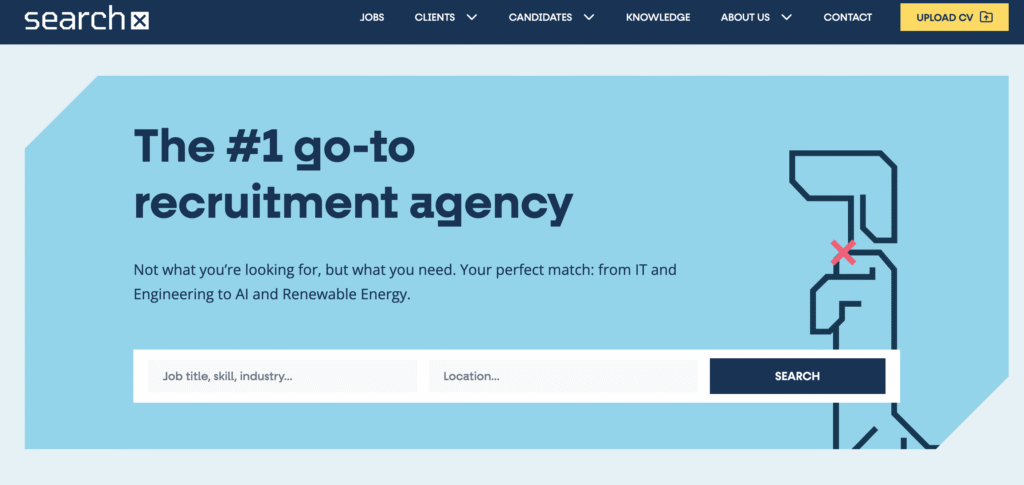
Search X Recruitment has established itself as a boutique specialist agency dedicated exclusively to IT, Renewable Energy, and Engineering professionals. In Myanmar’s increasingly competitive 2026 hiring environment, where demand for specialized technical expertise continues to rise, Search X differentiates itself through a focused, relationship-driven recruitment philosophy.
Rather than operating as a high-volume CV distribution service, the firm emphasizes quality matching, long-term career alignment, and sustained professional relationships between employers and candidates. This consultative approach appeals particularly to organizations seeking veteran-level professionals for complex or mission-critical roles.
Strategic Specialization in Technical Sectors
Search X maintains a narrow but deep sector focus. By concentrating solely on technology-driven and engineering-intensive industries, the agency builds domain-specific knowledge and curated talent networks within its chosen verticals.
Core Specialization Areas
| Sector Focus | Recruitment Emphasis | Market Relevance in 2026 |
|---|---|---|
| Information Technology | Software engineers, system architects, IT managers | Digital transformation and enterprise systems |
| Renewable Energy | Technical engineers, systems integration specialists | Sustainable energy projects and automation |
| Engineering | Infrastructure and technical project specialists | Industrial modernization and infrastructure |
Within the IT domain, Search X is particularly recognized for sourcing experienced professionals who possess both technical depth and leadership capability.
Expertise in Veteran-Level IT Recruitment
Search X has developed a reputation for identifying seasoned IT professionals who bring substantial field experience. These include individuals with proven records in enterprise system deployment, large-scale infrastructure management, and product lifecycle leadership.
Commonly Sourced IT Roles
| Role Category | Typical Experience Level | Organizational Impact |
|---|---|---|
| Veteran IT Specialists | 8–15+ years | Technical oversight and architecture planning |
| System Engineers | Mid-to-senior level | Infrastructure reliability and scalability |
| Product Owners | Senior-level digital leaders | Strategic product direction and delivery |
| IT Project Leads | Experienced cross-functional managers | Complex project coordination |
This focus on experienced candidates makes Search X particularly valuable for organizations that require stability, technical maturity, and strategic insight rather than entry-level hiring volume.
Relationship-Driven Recruitment Philosophy
A defining principle of Search X Recruitment is its emphasis on long-term commitment and personal engagement. The firm explicitly prioritizes relationship-building over transactional recruitment practices commonly described as “CV shopping.”
Key characteristics of its service model include:
• In-depth role consultation before candidate sourcing
• Thorough candidate interviews beyond technical screening
• Cultural fit and long-term alignment assessment
• Limited but highly curated candidate shortlists
This model often results in fewer but more carefully evaluated candidate submissions, supporting higher placement stability and reduced turnover.
Recruitment Process Comparison Matrix
| Recruitment Approach | Candidate Volume | Screening Depth | Long-Term Fit Focus | Turnover Risk |
|---|---|---|---|---|
| High-Volume CV Distribution | High | Moderate | Low | Higher |
| Generalist Recruitment Model | Moderate | Moderate | Moderate | Variable |
| Search X Relationship Model | Selective | High | Strong | Lower |
Standard Fee Structure
Search X Recruitment typically operates on a standard fee of 25 percent for technical placements. This fee structure reflects its boutique positioning and the intensive headhunting effort required to secure veteran-level professionals.
Fee Positioning Overview
| Agency Type | Typical Fee Range | Value Proposition |
|---|---|---|
| Mass Recruitment Agency | 15–20 percent | Volume hiring and entry-level roles |
| Generalist Executive Search | 20–30 percent | Mid-to-senior recruitment |
| Specialized Technical Headhunter | Around 25 percent | Deep expertise and curated candidate matching |
| Search X Recruitment | 25 percent | Veteran IT and engineering expertise |
Strategic Value for IT Employers in 2026
In Myanmar’s 2026 IT recruitment landscape, companies increasingly seek senior professionals capable of navigating complex system environments, digital transformation projects, and integrated infrastructure initiatives. Search X’s specialization in experienced IT specialists, system engineers, and product owners makes it particularly suited for:
• Enterprise system modernization
• Renewable energy technology integration
• High-stakes product development initiatives
• Infrastructure and digital transformation leadership
Competitive Position Overview
| Capability Dimension | Assessment in 2026 Market |
|---|---|
| Sector Specialization | Highly Focused |
| Veteran IT Talent Access | Strong |
| Volume Hiring Capability | Limited |
| Executive-Level Search | Moderate to Strong |
| Relationship-Based Recruitment | Core Strength |
Value Proposition for IT and Software Recruitment
Search X Recruitment represents a specialized, high-touch option within Myanmar’s technology hiring ecosystem in 2026. Its emphasis on long-term alignment, curated candidate selection, and veteran-level technical expertise positions it as a strategic partner for organizations seeking stability, depth, and commitment in their IT and engineering hires.
10. Asia HR


Asia HR is positioned as a regional recruitment and workforce solutions provider supporting businesses across Asia that seek to expand or strengthen their operations in Myanmar. In 2026, as workforce mobility, remote collaboration, and regional integration accelerate, Asia HR offers comprehensive and strategic hiring solutions designed to meet the evolving demands of Myanmar’s digital economy.
Unlike purely domestic recruitment firms, Asia HR operates with a broader regional outlook. Its approach integrates cross-border talent sourcing, compliance advisory, and structured workforce planning to support multinational corporations, regional enterprises, and technology-driven organizations entering or expanding within Myanmar.
Strategic Position in Myanmar’s Digital Talent Market
Myanmar’s technology sector in 2026 is increasingly influenced by regional investment, outsourcing partnerships, and cross-border digital collaboration. Asia HR aligns its recruitment strategy with these trends by focusing on highly skilled professionals who can operate in internationally integrated business environments.
The agency is particularly active in sourcing talent for:
• Software development and digital product teams
• Regional IT operations and shared service centers
• Data and analytics functions
• Cloud infrastructure and cybersecurity roles
Digital Economy Talent Focus Matrix
| Functional Area | Targeted Roles | Regional Relevance |
|---|---|---|
| Software Engineering | Backend, frontend, full-stack developers | Cross-border digital projects |
| Data and Analytics | Data analysts, business intelligence specialists | Regional reporting and integration |
| Cloud and DevOps | Cloud engineers, DevOps specialists | Scalable multi-country operations |
| Cybersecurity | Security analysts and compliance engineers | Data protection and regulatory compliance |
| IT Leadership | Regional IT managers, digital transformation leads | Multi-market technology strategy |
Cross-Border Talent Sourcing Capabilities
A defining strength of Asia HR lies in its cross-border recruitment model. As companies in Myanmar increasingly collaborate with regional headquarters or external technology partners, access to talent with international exposure becomes essential.
Asia HR leverages regional networks to source:
• Myanmar professionals working abroad
• Expatriate talent with Southeast Asia experience
• Remote professionals supporting Myanmar-based operations
• Bilingual and multicultural digital specialists
Cross-Border Recruitment Framework
| Recruitment Component | Operational Focus | Employer Benefit |
|---|---|---|
| Regional Talent Mapping | Identification of Asia-based professionals | Expanded candidate pool |
| International Screening | Assessment of cross-cultural adaptability | Stronger team integration |
| Remote Workforce Structuring | Support for distributed teams | Flexible hiring models |
| Repatriation and Relocation | Facilitation of relocation processes | Smooth workforce transition |
Regional Compliance and Workforce Advisory
Operating across Asia requires adherence to multiple regulatory systems, labor laws, and cross-border employment standards. Asia HR incorporates compliance advisory into its recruitment services, ensuring that workforce strategies align with both Myanmar regulations and regional employment frameworks.
This integrated compliance focus is particularly important for:
• Companies establishing representative offices
• Regional IT hubs operating across multiple jurisdictions
• Organizations hiring remote or hybrid employees
• Multinationals aligning global HR standards with local laws
Compliance Support Matrix
| Compliance Area | Advisory Scope | Business Impact |
|---|---|---|
| Labor Law Alignment | Myanmar employment regulations | Reduced legal exposure |
| Cross-Border Employment | Regional contract structuring | Consistent employment practices |
| Payroll Structuring Guidance | Multi-country compensation models | Operational transparency |
| Data Protection Considerations | IT and digital workforce compliance | Regulatory risk mitigation |
Strategic Hiring Solutions for 2026
Asia HR’s service model extends beyond traditional recruitment by incorporating workforce planning and long-term talent strategy. In Myanmar’s competitive IT landscape, where skilled digital professionals are limited, strategic workforce design becomes a critical differentiator.
Key solution components include:
• Workforce capability assessment
• Strategic talent pipeline planning
• Regional benchmarking of compensation
• Long-term digital workforce scaling strategies
Competitive Position Overview
| Capability Dimension | Assessment in 2026 Market |
|---|---|
| Cross-Border Talent Access | Strong |
| Digital Economy Focus | Highly Relevant |
| Regional Compliance Expertise | Advanced |
| Executive IT Recruitment | Moderate to Strong |
| Local Mass Hiring | Moderate |
Value Proposition for IT and Software Recruitment
In Myanmar’s increasingly regionalized technology market in 2026, Asia HR offers a strategic advantage for organizations seeking highly skilled professionals with cross-border exposure. Its combination of digital economy focus, regional compliance advisory, and cross-border talent sourcing positions it as a forward-looking recruitment partner for companies navigating the complexities of multi-country operations and evolving workforce demands within Myanmar’s growing digital ecosystem.
Strategic Analysis of the Myanmar IT and Software Recruitment Sector: Market Projections, Agency Performance, and Human Capital Dynamics in 2026
Myanmar’s Information and Communications Technology sector in 2026 is shaped by a dual reality: rapid digital acceleration alongside persistent human capital shortages. While broader macroeconomic and socio-political challenges continue to influence the business climate, the digital economy has emerged as a structural pillar of resilience and adaptation.
By the end of 2025, the digital economy’s contribution to national GDP is projected to reach approximately 2.5 percent, reflecting a structural transition toward a mobile-first and digitally integrated commercial environment. Enterprises across fintech, telecommunications, logistics, manufacturing, and retail increasingly rely on digital platforms, enterprise systems, and cloud-based infrastructure to sustain operations.
Within this context, the recruitment of software engineers, cloud architects, cybersecurity specialists, and data scientists has evolved from a routine human resources activity into a strategic function directly linked to competitiveness, operational continuity, and regional integration.
Macroeconomic Foundations and ICT Market Valuation (2024–2032)
The Myanmar ICT market demonstrates sustained expansion driven by telecommunications infrastructure upgrades, demographic advantages, and enterprise digital transformation.
Market indicators suggest:
• ICT market valuation estimated at approximately USD 1.86 trillion (broad regional or local-equivalent valuation metrics) in 2024
• Projected long-term expansion toward approximately USD 3.47 trillion equivalent by 2032
• Compound Annual Growth Rate (CAGR) of approximately 8.1 percent from 2026 to 2032
• IT services segment expanding at a CAGR of approximately 5.95 percent
The expansion of 4G and 5G networks, combined with a young, digitally adaptable population, continues to stimulate demand for digital services. IT outsourcing for system migration, enterprise integration, managed security, and cloud deployment is increasing steadily.
Myanmar ICT Market Size and Forecast (USD Billions)
| Year | Market Valuation (USD Billion) | Growth Percentage (Year-over-Year) |
|---|---|---|
| 2025 | 2.450 | Base Year Assessment |
| 2026 | 2.795 | 14.1% (Forecasted Growth) |
| 2027 | 3.190 | 14.1% (Forecasted Growth) |
| 2028 | 3.639 | 14.1% (Forecasted Growth) |
| 2030 | 4.738 | Mid-term Valuation |
| 2032 | 3.47 (Trillion Equivalent) | Long-term Strategic Forecast |
While communication services accounted for approximately 53.12 percent of ICT revenue in 2025, the software segment is projected to outpace other categories over the next five years. Yangon, as the country’s primary economic and technology hub, remains the focal point of software development, enterprise systems deployment, and digital platform growth.
The rapid expansion of the e-commerce market, projected to reach USD 4.5 billion by the end of 2025 with an annual growth rate of 18.2 percent, further intensifies demand for backend engineers, DevOps professionals, and digital product managers.
Human Capital Constraints and Brain Drain Dynamics
Despite strong market growth, Myanmar’s ICT sector faces structural talent shortages. A significant number of experienced technical professionals have migrated to regional markets such as Singapore, Thailand, and Japan, contributing to a widening skills gap.
Human Capital Challenges Matrix
| Constraint Factor | Description | Impact on Recruitment Sector |
|---|---|---|
| Regional Brain Drain | Migration of mid-to-senior IT professionals | Reduced availability of experienced engineers |
| Skills Mismatch | Gap between academic training and industry needs | Increased employer training costs |
| Rapid Technology Evolution | Growing demand for cloud, AI, and cybersecurity | Shortage of specialized professionals |
| Remote Work Competition | Regional employers hiring Myanmar talent remotely | Salary inflation and retention challenges |
As a result, recruitment agencies in 2026 function not merely as intermediaries but as strategic talent brokers. Their role increasingly includes cross-border sourcing, repatriation initiatives, and passive candidate engagement.
Agency Performance and Strategic Positioning
The IT recruitment ecosystem in Myanmar consists of several distinct agency archetypes:
• Large domestic recruitment platforms with strong employer networks
• Boutique technical headhunters specializing in veteran-level roles
• International technology-focused agencies with cross-border reach
• Workforce solution providers integrating compliance and PEO services
Agency Capability Comparison Matrix
| Agency Type | Core Strength | Ideal Hiring Use Case |
|---|---|---|
| Domestic Full-Service Agency | Broad candidate database | Mid-level software and IT operations roles |
| Digital Recruitment Platform | High visibility and applicant volume | Volume hiring and entry-level tech roles |
| Specialized IT Headhunter | Deep technical screening | Senior engineers and product leaders |
| International Tech Agency | Cross-border talent access | Niche and advanced technology roles |
| Compliance-Integrated Recruiter | Market entry and regulatory support | MNC expansion and infrastructure projects |
High-performing agencies in 2026 are characterized by:
• Advanced candidate profiling systems
• Passive talent sourcing capabilities
• Technical competency evaluation frameworks
• Regional and diaspora talent networks
• Structured post-placement retention monitoring
Recruitment as a Strategic Infrastructure Function
In a multi-billion-dollar digital economy, recruitment agencies effectively supply the human architects of digital infrastructure. Software engineers build scalable platforms, cloud architects design enterprise systems, and data scientists generate predictive insights that shape business models.
The shift from transactional recruitment to strategic talent advisory reflects several macro trends:
• Increasing cost of vacancy in high-demand IT roles
• Greater importance of technical leadership for digital transformation
• Competitive pressure from regional outsourcing markets
• Heightened need for cybersecurity and regulatory compliance
Digital Talent Demand Forecast by Role Category (2026–2030)
| Role Category | Demand Growth Outlook | Strategic Importance |
|---|---|---|
| Software Engineers | High | Core product and system development |
| Cloud Architects | Very High | Infrastructure scalability and resilience |
| Data Scientists | High | Data-driven business strategy |
| Cybersecurity Experts | Very High | Regulatory and operational risk mitigation |
| IT Project Managers | Moderate to High | Cross-functional system implementation |
Conclusion: Recruitment as a Catalyst of Digital Resilience
Myanmar’s ICT market in 2026 reflects structural digital transformation supported by telecommunications expansion, rising e-commerce activity, and enterprise modernization. However, persistent human capital constraints limit the pace of growth.
Recruitment agencies occupy a pivotal role within this ecosystem. They are no longer passive intermediaries but strategic facilitators of economic modernization. By addressing talent shortages, sourcing cross-border expertise, and aligning technical skillsets with enterprise objectives, these agencies directly influence the scalability and sustainability of Myanmar’s digital economy.
In this evolving landscape, agency performance, talent intelligence, and human capital strategy will remain central determinants of how effectively Myanmar can translate ICT market expansion into long-term digital competitiveness.
Infrastructure, Connectivity, and the Mobile-First Imperative in Myanmar’s ICT Sector (2026)
The demand for software engineers, cloud specialists, and digital product developers in Myanmar in 2026 is directly tied to the expansion of national digital infrastructure. Connectivity is no longer a supporting utility; it is the foundational layer upon which the country’s digital economy operates.
Internet penetration reached approximately 61.1 percent in early 2025 and is forecasted to rise to 64.7 percent by 2026. This represents connectivity access for more than 33.4 million active users. The rapid expansion of mobile internet usage reinforces Myanmar’s identity as a mobile-first economy, where smartphones serve as the primary gateway to commerce, financial services, and digital communication.
As connectivity expands, downstream demand for digital solutions intensifies, particularly in the following areas:
• Mobile application development for e-commerce and fintech
• Cloud-based enterprise resource planning (ERP) systems
• Digital payment integration platforms
• Logistics and supply chain management software
• Data analytics platforms supporting online marketplaces
This surge in digital consumption directly translates into sustained hiring demand for backend engineers, frontend developers, DevOps specialists, and cybersecurity professionals.
Impact of 4G and 5G Infrastructure Expansion
The rollout of 5G networks and improvements to 4G infrastructure are expected to provide measurable acceleration to ICT market growth over the medium term. In addition, the landing of new subsea cables strengthens international bandwidth capacity, reducing latency and improving reliability for cloud services and cross-border digital operations.
Estimated Impact of Infrastructure Developments on ICT CAGR
| Infrastructure Component | Type | Estimated Effect on CAGR (%) |
|---|---|---|
| 5G Network Expansion | Driver | +0.8% |
| Subsea Cable Connectivity | Driver | +0.4% |
| Community Wireless Networks | Driver | +0.6% |
Improved connectivity infrastructure enhances:
• Cloud computing adoption
• Remote work integration
• SaaS platform scalability
• Digital outsourcing competitiveness
These developments reinforce the structural demand for highly skilled IT professionals capable of building and maintaining scalable systems.
Systemic Risks and Structural Constraints
While infrastructure growth creates upward momentum, systemic challenges continue to moderate overall sector expansion. Political uncertainty, regulatory volatility, and chronic power supply disruptions impose measurable constraints on ICT performance.
Estimated Impact of Market Restraints on ICT CAGR (2026)
| Constraint Factor | Type | Estimated Effect on CAGR (%) |
|---|---|---|
| Political Instability and Sanctions | Restraint | -0.9% |
| Chronic Power Outages | Restraint | -0.7% |
| Technical Brain Drain | Restraint | -0.5% |
These constraints affect not only enterprise operations but also recruitment dynamics. Companies face higher infrastructure costs, increased reliance on backup power systems, and elevated retention risks for skilled professionals.
In this environment, recruitment agencies must factor macro-risk considerations into talent planning strategies, particularly when advising multinational corporations or digital startups scaling operations in Yangon and other urban centers.
The Mobile-First Economy and Downstream Talent Demand
Myanmar’s economic digitization is overwhelmingly mobile-centric. Unlike markets that transitioned gradually from desktop-based systems to mobile, Myanmar leapfrogged directly into a smartphone-dominated ecosystem.
Mobile-first behaviors include:
• Mobile banking and digital wallet usage
• Social commerce transactions
• App-based logistics and delivery platforms
• Online education and freelance marketplaces
This behavioral shift generates technical demand across multiple verticals.
Mobile-Driven Talent Demand Matrix
| Digital Activity Area | Required Technical Skillset | Recruitment Impact |
|---|---|---|
| Fintech and Digital Payments | Backend APIs, cybersecurity, cloud integration | High demand for secure system architects |
| E-commerce Platforms | Full-stack development, UI/UX optimization | Increased hiring of product engineers |
| Logistics Applications | Real-time data systems, mobile integration | Demand for scalable backend engineers |
| Cloud ERP Adoption | Cloud architecture, DevOps automation | Rising need for infrastructure specialists |
The Youth Demographic and the Rise of Digital Natives
Myanmar’s youth demographic represents a critical strategic advantage. Individuals aged 18 to 24 account for approximately 11.4 percent of the population and demonstrate the highest levels of digital engagement, social media activity, and freelance platform participation.
This cohort is not solely composed of technology consumers. Many are actively developing digital skills in:
• Python programming
• Java development
• Web and mobile app frameworks
• Digital marketing and analytics
The growth of freelance marketplaces and remote gig opportunities has created a new generation of digitally self-taught professionals who operate within regional and global ecosystems.
Shift in Recruitment Strategies Toward Junior Talent
Given the combined pressures of brain drain and rising salary expectations for senior engineers, recruitment agencies in 2026 are increasingly focusing on identifying high-potential junior candidates. Rather than competing solely for limited experienced talent, agencies are investing in predictive assessment and early-career talent mapping.
Modern recruitment methodologies include:
• AI-driven candidate profiling systems
• Skills-based assessments rather than credential-only screening
• Coding challenge evaluations
• Behavioral analytics for growth potential identification
• Partnerships with training academies and bootcamps
Junior Talent Development Strategy Framework
| Recruitment Stage | Strategic Focus | Long-Term Employer Benefit |
|---|---|---|
| Early Talent Identification | Digital aptitude and coding proficiency | Pipeline creation |
| Skills Assessment | Technical testing and project simulation | Reduced hiring risk |
| Structured Upskilling | Java, Python, cloud certification tracks | Workforce capability building |
| Project Deployment | Supervised integration into live systems | Practical skill consolidation |
Conclusion: Infrastructure as a Catalyst for Talent Transformation
Myanmar’s ICT expansion in 2026 is inseparable from infrastructure growth and mobile connectivity acceleration. Increased internet penetration, 5G rollout, and subsea cable integration create structural demand for software engineering and digital system expertise.
However, political risks, power instability, and brain drain continue to moderate growth potential. In response, recruitment agencies have evolved into strategic talent architects, balancing experienced professional sourcing with junior talent development initiatives.
The mobile-first imperative, combined with a digitally engaged youth population, ensures that Myanmar’s ICT recruitment sector will remain dynamic. Agencies capable of aligning infrastructure growth, human capital strategy, and predictive talent analytics will play a decisive role in shaping the country’s long-term digital competitiveness.
Human Capital Scarcity: The Paradox of the Skills Gap in Myanmar’s IT Sector (2026)
Myanmar’s IT and software recruitment market in 2026 is defined by a widening imbalance between demand and supply. Technology job openings are estimated to have increased by approximately 25 percent between 2022 and 2024, reflecting aggressive digital expansion across fintech, telecommunications, e-commerce, and enterprise transformation initiatives.
However, the talent pipeline has not expanded at a comparable rate. Critical shortages persist in specialized disciplines such as:
• Software engineering (particularly backend and full-stack development)
• Cloud architecture and distributed systems
• Data science and analytics engineering
• Cybersecurity and enterprise risk management
This imbalance has created a paradox: while digital investment continues to grow, project execution is increasingly constrained by human capital limitations.
Regional Skills Readiness Indicators
Survey data across regional technology leadership communities suggests that only 7 percent of technology leaders believe their organizations currently possess the required skillsets to execute top-priority projects effectively. Meanwhile, 65 percent report that their teams require additional training to meet the demands of artificial intelligence integration, data governance compliance, and advanced automation initiatives.
Technology Workforce Readiness Snapshot (2026)
| Indicator | Percentage |
|---|---|
| Leaders confident in current team capabilities | 7% |
| Teams requiring additional upskilling | 65% |
| Growth in tech job openings (2022–2024) | 25% |
These figures highlight the structural depth of the skills gap, extending beyond entry-level shortages into advanced technical domains.
Specialized Skills Deficit Areas
The most acute shortages are concentrated in roles that combine technical depth with system-level oversight. As enterprises modernize their digital infrastructure, demand is shifting toward professionals who can architect, secure, and govern increasingly complex ecosystems.
High-Demand Skill Clusters
| Specialized Domain | Market Condition in 2026 | Strategic Importance |
|---|---|---|
| Cloud Architecture | Severe Shortage | Scalable and resilient infrastructure |
| Data Science and AI Engineering | High Demand | Predictive analytics and automation |
| DevSecOps | Growing Scarcity | Secure development lifecycle integration |
| Enterprise Software Governance | Underdeveloped Talent Pool | Regulatory and compliance alignment |
| CI/CD Pipeline Management | Rising Demand | Continuous delivery and deployment efficiency |
These competencies are foundational to sustainable digital transformation. Without them, organizations face operational bottlenecks, increased cybersecurity risks, and delayed innovation cycles.
Evolution of Recruitment Agencies into Talent Advisors
Given the scarcity of advanced IT talent, recruitment agencies in Myanmar are no longer functioning solely as candidate sourcing intermediaries. Instead, they are evolving into hybrid headhunters and workforce strategy advisors.
Modern agency responsibilities increasingly include:
• Skills gap diagnostics for client organizations
• Market benchmarking for compensation competitiveness
• Advisory on workforce upskilling pathways
• Cross-border and diaspora talent sourcing
• Retention strategy consultation
Recruitment agencies must balance immediate hiring needs with long-term capability development strategies, particularly in high-impact roles such as cloud engineering and AI system design.
The Rise of Human-Centered Skills in a Technical Market
As artificial intelligence tools become embedded in software development workflows, the definition of a high-value IT professional is shifting. Technical knowledge remains essential, but employers increasingly prioritize human-centered competencies.
These include:
• Interpreting analytical outputs and contextualizing results
• Communicating technical implications to non-technical stakeholders
• Managing ethical considerations in AI deployment
• Leading cross-functional collaboration
• Guiding responsible data governance practices
Human-Centered Skill Prioritization Matrix
| Skill Category | Traditional Weight (Pre-2023) | Current Weight (2026) |
|---|---|---|
| Pure Coding Proficiency | High | High |
| AI Tool Utilization | Moderate | Very High |
| Stakeholder Communication | Moderate | High |
| Ethical AI Oversight | Low | High |
| Data Governance Interpretation | Moderate | Very High |
The integration of AI-assisted development environments means that automation handles repetitive coding tasks, while human professionals are increasingly valued for oversight, validation, and strategic interpretation.
DevSecOps and Enterprise Governance as Critical Value Drivers
The convergence of development, security, and operations has elevated the importance of DevSecOps expertise. Organizations require professionals capable of embedding security protocols directly into development pipelines while maintaining agile release cycles.
Similarly, enterprise software governance has become a core competency as data protection regulations and compliance requirements grow more complex. The ability to design, monitor, and audit enterprise-wide software ecosystems is now a strategic differentiator.
Strategic Competency Impact on Organizational Performance
| Competency Area | Organizational Benefit |
|---|---|
| DevSecOps Integration | Reduced vulnerability exposure and faster releases |
| CI/CD Pipeline Management | Improved deployment efficiency and scalability |
| Cloud Cost Optimization | Enhanced operational efficiency |
| Data Governance Leadership | Regulatory compliance and risk mitigation |
| AI Oversight and Ethics | Sustainable and responsible innovation |
Conclusion: Structural Skills Gap as a Market Catalyst
Myanmar’s IT sector in 2026 operates within a structurally constrained talent ecosystem. The rapid expansion of digital infrastructure and enterprise transformation initiatives has outpaced the development of specialized human capital.
This scarcity intensifies competition for qualified professionals and compels recruitment agencies to assume a strategic advisory role. The market’s emphasis is shifting from purely technical proficiency toward a blended skillset that combines advanced engineering capabilities with governance, communication, and ethical oversight competencies.
In this environment, organizations that invest in both targeted recruitment and structured upskilling initiatives will be better positioned to navigate the paradox of rising digital opportunity amid persistent human capital scarcity.
Salary Benchmarks and Compensation Models in Myanmar’s IT Sector (2026)
Inflationary Pressures and Wage Adjustments
In 2026, Myanmar’s IT compensation landscape is shaped by sustained inflationary pressure exceeding 30 percent. To remain competitive and mitigate talent migration, local companies have increased entry-level technology salaries by approximately 12 percent annually. These adjustments are not merely reactive but strategic, aimed at preventing further loss of skilled professionals to regional markets and remote international employers.
As demand intensifies for advanced digital capabilities—particularly in cloud infrastructure, AI engineering, and cybersecurity—salary differentiation has become increasingly pronounced across experience levels and specialization tiers.
Monthly and Annual Salary Benchmarks for IT Professionals (MMK)
| Role | Average Monthly (MMK) | Annual Range (MMK) | Monthly (USD Approx.) |
|---|---|---|---|
| Cloud Architect | 4,000,000 | Up to 48,000,000 | N/A |
| Data Scientist | 3,500,000 | 10,900,000 – 48,000,000 | N/A |
| AI / ML Engineer | 4,000,000 | 24,000,000 – 54,000,000 | N/A |
| Software Engineer (Senior) | 2,000,000 – 3,500,000 | 18,000,000 – 42,000,000 | N/A |
| Software Engineer (Average) | 510,000 | 6,120,000 | 241 |
| DevOps Engineer | 2,500,000 | 25,000,000 – 35,000,000 | N/A |
| Cybersecurity Analyst | 1,500,000+ | 18,000,000+ | N/A |
| Data Analyst | 489,000 | 5,868,000 | 232 |
| UX Designer | 388,000 | 4,656,000 | 184 |
These figures illustrate a sharply tiered compensation hierarchy. Roles directly tied to digital infrastructure scalability and automation command premium salaries, particularly cloud architects and AI/ML engineers, reflecting their strategic importance in enterprise modernization.
Extreme Variance in Software Engineering Compensation
One of the most significant insights from 2026 data is the broad salary dispersion within software engineering roles. While the reported average monthly salary stands near 510,000 MMK, the top 10 percent of earners exceed 6.5 million MMK per month.
This disparity is influenced by several factors:
• Employment with multinational corporations or foreign-funded startups
• Expertise in high-demand stacks such as microservices architecture and AI integration
• Experience managing distributed systems and DevSecOps environments
• Remote contracts denominated in foreign currency
The salary structure therefore reflects a bifurcated market: domestic SME compensation bands versus internationally benchmarked remuneration models.
Salary Distribution by Age and Experience (MMK Monthly)
| Age Group | 10th Percentile | Median | 90th Percentile |
|---|---|---|---|
| 24 – 34 Years | 384,000 | 699,000 | 1,200,000 |
| 35 – 44 Years | 333,000 | 709,000 | 1,400,000 |
| 45 – 54 Years | 320,000 | 628,000 | 1,200,000 |
The highest earning concentration appears in the 35–44 age bracket, where professionals typically transition into technical leadership, solution architecture, and enterprise oversight roles. This cohort often combines deep technical expertise with strategic execution capability, positioning them at the apex of compensation bands.
Compensation Models in 2026
Beyond base salary, organizations are increasingly adopting diversified compensation structures to remain competitive. These include:
- Performance-Based Incentives
Bonuses tied to product delivery milestones, uptime metrics, or AI deployment success rates. - Skill-Based Premiums
Additional compensation for certifications in cloud platforms, cybersecurity frameworks, or AI governance. - Retention Allowances
Annual loyalty bonuses structured to reduce mid-project attrition. - Remote Work and Hybrid Flexibility
While not monetary, flexible arrangements significantly influence talent retention decisions. - Foreign Currency Components
Select companies—particularly export-oriented tech firms—offer partial USD-based compensation to hedge against local currency volatility.
Gender Pay Dynamics
Although Myanmar’s IT sector remains male-dominated, early 2026 data indicates progress toward standardized pay scales within specialized roles. Compensation is increasingly benchmarked against technical capability, certification level, and project complexity rather than demographic profile. This normalization is most evident in high-demand roles such as data science and cybersecurity, where market scarcity overrides traditional biases.
Strategic Implications for Employers
The 2026 compensation environment reveals several key realities:
• Inflation-adjusted salary planning is essential for retention.
• Mid-career professionals represent the highest-value hiring segment.
• Skill-based pay differentiation is widening, not narrowing.
• International competition continues to elevate upper-tier salary bands.
Organizations that rely solely on average market salary data risk underestimating the premium required to secure top-decile talent. In a constrained labor market, compensation strategy is no longer an administrative function—it is a core competitive lever in digital transformation success.
Overall, Myanmar’s IT salary ecosystem in 2026 reflects a maturing yet polarized market, where expertise in cloud, AI, DevSecOps, and enterprise governance commands substantial financial reward, and where strategic compensation modeling directly influences organizational resilience and innovation capacity.
The Cost of Specialized Recruitment in Myanmar’s IT Sector (2026)
Percentage-Based Recruitment Fee Structures
In Myanmar’s 2026 hiring landscape, recruitment agencies predominantly operate on a contingency-based pricing model calculated as a percentage of the candidate’s first-year annual gross salary.
For general industry placements, fees typically range between 15 percent and 20 percent. However, when hiring for specialized IT and software engineering roles, fee structures shift upward to a 20 percent to 30 percent range.
This premium reflects several structural realities:
• Scarcity of qualified technical professionals
• Extended time-to-fill for senior or niche roles
• Advanced technical screening and assessment processes
• Access to passive candidate networks
• Salary negotiation expertise in a volatile market
High-complexity roles such as cloud architects, AI/ML engineers, DevSecOps specialists, and cybersecurity leads require significantly deeper vetting than general administrative or commercial positions. Agencies must often deploy technical interviews, coding assessments, and multi-stage evaluation frameworks, increasing the operational cost of successful placements.
Contingency vs. Retained Models
In the upper tier of the IT recruitment market, agencies may also offer retained search arrangements. These models involve an upfront engagement fee (often a portion of the projected total fee), particularly for:
• Executive-level CTO or Head of Engineering roles
• Confidential replacement hires
• Strategic transformation leadership positions
Retained models provide employers with dedicated research resources and proactive headhunting of passive candidates, which is critical in a constrained talent ecosystem.
Employer of Record (EOR) and PEO Services
For international companies seeking to hire in Myanmar without establishing a local legal entity, Employer of Record (EOR) and Professional Employer Organization (PEO) services have become integral to workforce expansion strategies.
These services allow foreign firms to legally employ local staff while outsourcing compliance, payroll, tax administration, and statutory benefits management.
EOR and PEO Service Cost Comparison (2026)
| Provider | Monthly Base Fee (Per Employee) | Key Differentiators |
|---|---|---|
| Borderless AI | USD 579 | AI-powered HR systems, 5-day payroll cycle |
| Horizons (JoinHorizons) | USD 299 | In-house recruitment, 24–48h onboarding |
| Contractor of Record (Various Providers) | USD 249 | Compliance and payroll for gig/freelance talent |
| Talent Sourcing (SaaS Platforms) | 2% of gross monthly salary | Monthly retainer for passive candidate sourcing |
Cost Structure Implications
- Fixed Monthly EOR Fees
Suitable for long-term, full-time hires where compliance certainty is prioritized. These fees are predictable and scalable. - Contractor of Record Models
More cost-efficient for short-term projects, freelance developers, or specialized consultants. - SaaS Talent Sourcing Platforms
Often used for continuous pipeline building. A 2 percent monthly fee may appear lower than agency placement costs, but it typically excludes deep screening and end-to-end recruitment management. - Traditional Recruitment Agencies
Higher upfront percentage fees but generally lower long-term overhead compared to EOR structures if a company has an established local entity.
Strategic Cost Considerations for Employers
When evaluating recruitment costs in 2026, employers must weigh more than the headline percentage.
Key considerations include:
• Time-to-hire efficiency
• Quality of candidate shortlist
• Retention rates post-placement
• Compliance risk exposure
• Administrative burden reduction
• Currency volatility management
In Myanmar’s highly competitive IT labor market, the cost of a failed hire or prolonged vacancy often exceeds the premium paid for specialized recruitment expertise. Delays in filling key roles—particularly in infrastructure, cloud migration, or cybersecurity—can stall revenue-generating digital initiatives.
Total Talent Acquisition Cost Framework (Illustrative)
| Cost Component | Impact Level |
|---|---|
| Agency Placement Fee (20–30%) | High upfront |
| EOR/PEO Monthly Service Fee | Ongoing operational |
| Internal HR Time Allocation | Hidden internal cost |
| Project Delay Due to Vacancy | Potentially critical |
| Compliance Risk Exposure | Strategic risk factor |
Conclusion
The elevated recruitment fees for specialized IT roles in Myanmar reflect structural talent scarcity rather than market inefficiency. Agencies are compensating for deeper sourcing complexity, higher technical validation requirements, and intensified salary negotiations.
Meanwhile, EOR and PEO models provide a strategic alternative for foreign companies seeking rapid market entry without local incorporation. The optimal approach depends on an employer’s expansion timeline, legal footprint, and long-term workforce strategy.
In 2026, recruitment cost is best understood not as an isolated HR expense, but as a strategic investment in digital continuity, operational resilience, and competitive capability within Myanmar’s evolving technology ecosystem.
10 Detailed Real Reviews of 10 Real Recruitment Agencies in Myanmar (2026)
The following reviews provide an in-depth look at the operational strengths, client satisfaction levels, and market positioning of Myanmar’s leading recruitment agencies in 2026.
Review 1: 9cv9 Recruitment Agency
Client: BP Healthcare
BP Healthcare praised 9cv9 for its specialized capability in sourcing professionals for complex infrastructure and digital transformation projects. The client highlighted the agency’s advanced digital hiring platform as a major differentiator, enabling access to highly qualified engineering and IT professionals.
Particular emphasis was placed on 9cv9’s AI-enhanced sourcing methodology, which matches candidates based on skill compatibility, certification requirements, and project readiness. According to the client, this approach significantly reduced hiring cycles while improving placement accuracy—resulting in faster onboarding and strong long-term retention.
Review 2: MyWorld Myanmar
Client: British Chamber of Commerce Myanmar
The British Chamber of Commerce engaged MyWorld Careers for a critical role that other organizations had struggled to fill. Feedback described the team as highly professional and structured in their approach, delivering a strong shortlist of vetted candidates.
The selected candidate exceeded senior management expectations, contributing meaningfully to the Chamber’s strategic initiatives. The organization subsequently recommended MyWorld’s services for businesses seeking sustainable growth in Myanmar.
Review 3: FocusCore Myanmar
Client Testimonial: Oil & Gas Industry
A client entering Myanmar’s oil and gas sector during a market downturn described FocusCore’s support as “handholding” in the most positive sense. With limited local market familiarity and cross-border travel constraints, the client valued the team’s attentiveness and responsiveness.
Beyond recruitment, FocusCore assisted in simplifying incorporation processes and local hiring logistics, making market entry significantly more manageable during a challenging economic period.
Review 4: RMA Myanmar
Employee Testimonial: Nay Lin Aung
Nay Lin Aung, a Service Supervisor, shared his decade-long journey from junior engineer to leadership within RMA’s services division. He credited the company’s structured training programs, strong leadership guidance, and emphasis on continuous learning for his career advancement.
His review emphasized a collaborative work culture that encourages knowledge sharing and cross-functional communication—key factors in sustaining long-term employee growth.
Review 5: JB Hired
Client Testimonial: Tech Manager
A technology manager working with JB Hired reported a rapid and seamless hiring process for a critical technical position. The agency’s recruiters were described as highly trained in sourcing and negotiating with senior-level technology professionals.
The speed and precision of the shortlist ensured that business operations did not suffer prolonged disruption. The client noted that JB Hired’s specialization in tech roles significantly outperformed generalist recruitment firms.
Review 6: JobNet.com.mm
Client/Employee Perspective: Su Nyein
Su Nyein, Assistant Business Development Director at JobNet, described the platform as the most effective online hiring solution in Myanmar. The testimonial highlighted JobNet’s ambitious internal culture and commitment to innovation within the digital recruitment ecosystem.
The organization’s ability to support thousands of firms while nurturing internal career growth reinforces its strong positioning in the country’s employment marketplace.
Review 7: Search X Recruitment
Industry Sentiment: Technical Sourcing
Clients consistently describe Search X as personal, reliable, and deeply committed to long-term fit rather than transactional hiring. Their philosophy centers on finding not just “what you’re looking for, but what you need.”
Feedback often references the agency’s thorough and persistent recruitment processes. Their selective partnership model—working only with organizations they believe in—has strengthened their reputation for integrity and quality placements.
Review 8: Keller Executive Search
Client: Melissa D., Senior Director of HR
After unsuccessful attempts with other firms, Melissa D. turned to Keller for executive-level recruitment. She praised the consultants’ proactive communication and strategic understanding of leadership dynamics.
The agency delivered a curated list of CEO candidates aligned with organizational culture and long-term objectives. The focus on quality over quantity ultimately strengthened the company’s executive team.
Review 9: Myanmar Manpower
Industry Benchmark: Kaung & Sons International
With operations dating back to 2004, Myanmar Manpower is frequently recognized for its established track record and reliability. Clients value the agency’s mature candidate database and consistent ability to match technical professionals with precise organizational requirements.
Their longevity in the market has reinforced trust, particularly among employers seeking experienced IT and engineering talent.
Review 10: Labour Asia Services
Executive Perspective: U Khin Aung Htun
Labour Asia Services is widely regarded as a reliable partner for both domestic and international workforce placements. Employers commend the agency’s ability to assess role requirements carefully while balancing cost-effectiveness for both employers and candidates.
Feedback highlights their structured evaluation methods and ethical recruitment practices, particularly for companies managing cross-border workforce mobility.
Technical Competencies and the Recruitment Process in Myanmar’s IT Sector (2026)
In 2026, the recruitment process for software and IT professionals in Myanmar has evolved into a highly technical, competency-driven system. Agencies no longer rely primarily on years of experience as a filtering mechanism. Instead, validated technical capabilities, framework mastery, and practical application experience have become the dominant evaluation criteria.
In a market defined by skills scarcity and rapid digital transformation, technical competencies function as the primary currency of employability.
Essential Skills and Software Competencies for 2026
The following matrix outlines the most in-demand skill clusters shaping hiring decisions across Myanmar’s digital economy.
| Category | High-Demand Skills / Technologies |
|---|---|
| Programming Languages | Python, Java, JavaScript, PHP, Ruby |
| Frameworks | Spring Boot, React Native, Node.js |
| Data & AI | Machine Learning, Model Design, Python, R |
| Cloud & DevOps | AWS, Microsoft Azure, Google Cloud, CI/CD, DevSecOps |
| ERP & Business Systems | SAP, Oracle, Microsoft Dynamics, Mendix |
| Cybersecurity | Advanced Threat Detection, AI-driven Security, Infrastructure Protection |
1. Programming and Backend Development
Languages such as Python and Java remain dominant, particularly in backend systems and enterprise applications. Java paired with Spring Boot continues to be a preferred stack for scalable enterprise platforms and government-linked digital transformation initiatives.
JavaScript ecosystems, including React Native and Node.js, are central to Myanmar’s mobile-first development landscape, where cross-platform performance and rapid deployment are critical.
2. Data Science and AI Engineering
AI integration has shifted from experimental adoption to mainstream enterprise implementation. Employers now prioritize:
• Machine learning model architecture design
• Predictive analytics capability
• Production-level deployment experience
• Data pipeline construction
Proficiency in Python and R is often mandatory for analytics-driven roles. Beyond coding, professionals must demonstrate the ability to interpret outputs and communicate insights to non-technical stakeholders.
3. Cloud and DevOps Competency
Cloud-native infrastructure is now foundational rather than optional. High-demand capabilities include:
• Deployment on AWS, Azure, or Google Cloud
• CI/CD pipeline design and management
• Infrastructure-as-code practices
• DevSecOps integration for secure development
Cloud engineers and DevOps specialists are frequently evaluated through scenario-based technical assessments, where they must design scalable architectures under defined constraints.
4. ERP and Enterprise Systems Expertise
As larger enterprises modernize legacy systems, ERP specialists are increasingly sought after. Experience with SAP, Oracle, and Microsoft Dynamics is particularly valuable in sectors such as manufacturing, logistics, and finance.
Low-code platforms like Mendix are also gaining traction, especially among firms accelerating digital transformation with limited engineering bandwidth.
5. Cybersecurity and Infrastructure Protection
Cybersecurity capabilities have become mission-critical due to increased digital adoption and regulatory scrutiny. High-demand competencies include:
• Advanced threat detection
• AI-assisted security monitoring
• Infrastructure vulnerability assessment
• Security governance frameworks
Cybersecurity analysts are now often required to demonstrate familiarity with compliance standards and incident response simulations during the screening process.
The 2026 Recruitment Screening Process
Recruitment agencies have significantly upgraded their technical validation frameworks. A typical screening process for a senior-level position—such as an IT Leader and Trainer—may involve the following:
Minimum Technical Requirements Example
• 5+ years of hands-on Java and Spring Boot experience
• Strong database design expertise (MySQL, PostgreSQL)
• 2+ years of team leadership or mentoring experience
• Demonstrated system architecture exposure
• CI/CD and version control familiarity
Screening Stages Typically Include
- Technical CV Audit
Verification of stack consistency, project depth, and technology progression. - Live Technical Assessments
Coding tests, system design exercises, or debugging simulations. - Architecture Scenario Evaluation
Candidates may be asked to design scalable systems or propose migration strategies. - Leadership & Communication Assessment
Particularly for senior roles, evaluating stakeholder communication and mentoring ability. - Cultural and Strategic Fit Interview
Alignment with organizational digital roadmap and governance standards.
Candidate Preparation and Advisory Services
Leading recruitment firms in Myanmar have expanded their role beyond sourcing. For example, agencies such as MyWorld Myanmar provide structured pre-interview preparation services.
These often include:
• Guidance on technical focus areas likely to be evaluated
• Insights into the interviewer’s background and expectations
• Mock interview simulations
• Advice on articulating project impact rather than listing tasks
This advisory approach enhances candidate performance and increases placement success rates—benefiting both employers and professionals.
From Experience-Based Hiring to Skills-Based Validation
The core transformation in 2026 recruitment is the shift from tenure-based evaluation to skill-based validation.
| Traditional Model | 2026 Model |
|---|---|
| Years of experience | Demonstrated stack mastery |
| Role title history | Verified technical output |
| General interviews | Scenario-based assessment |
| CV keyword screening | Competency mapping & benchmarking |
Employers increasingly prioritize demonstrable impact—such as successful deployments, uptime improvements, security incident reduction, or AI model accuracy improvements—over generic role descriptions.
Conclusion
Myanmar’s IT recruitment ecosystem in 2026 reflects a maturing and technically rigorous hiring environment. Specialized agencies have adapted to a landscape where:
• Skills outweigh tenure
• Validation outweighs assumption
• Architecture thinking outweighs simple coding
• Communication skills complement technical expertise
In a market shaped by digital acceleration and human capital constraints, recruitment success depends on precise competency validation, structured assessment frameworks, and advisory-driven talent alignment.
Strategic Imperatives for the Myanmar Tech Workforce (2026 and Beyond)
By 2026, Myanmar’s recruitment ecosystem has undergone structural transformation. Faced with persistent brain drain, regulatory uncertainty, and economic volatility, leading agencies have pivoted toward digital-first, AI-augmented talent strategies. The most successful firms are those that integrate international recruitment best practices with deep, on-the-ground understanding of Myanmar’s labor market realities.
For employers, selecting a recruitment partner is no longer a transactional procurement decision. It is a strategic investment directly tied to digital resilience, innovation velocity, and long-term competitiveness.
1. AI-Augmented Talent Strategy as a Competitive Baseline
Approximately 67 percent of hiring professionals now recognize AI integration as a core efficiency driver in talent acquisition. AI-powered systems are increasingly used for:
• Skill compatibility matching
• Behavioral and competency mapping
• Predictive retention analysis
• Automated CV parsing and ranking
• Talent pool segmentation
This technological integration has shortened hiring cycles and improved shortlist accuracy. However, AI alone is insufficient in Myanmar’s complex operating environment.
2. The Enduring Value of Human-Centered Recruitment
While automation enhances efficiency, the human-centered capabilities of recruitment professionals remain the ultimate differentiator. Myanmar’s regulatory landscape, shifting compliance expectations, and cross-border employment challenges require:
• Regulatory interpretation and risk mitigation
• Cultural alignment assessment
• Candidate career advisory and relocation support
• Employer brand positioning within a cautious labor market
Recruiters increasingly function as strategic navigators—offering structured guidance to both employers and candidates. This advisory role is particularly critical for multinational corporations entering or scaling within Myanmar.
3. Repatriation and Brain Drain Mitigation
One of the most pressing structural issues facing Myanmar’s tech workforce is the migration of skilled professionals to regional markets. To counteract this trend, agencies must develop strategies focused on:
• Re-engaging diaspora professionals
• Structuring competitive, inflation-adjusted compensation models
• Offering remote and hybrid international collaboration pathways
• Highlighting leadership and impact opportunities unavailable abroad
Agencies capable of facilitating talent repatriation will hold a decisive advantage in rebuilding high-level technical capacity.
4. Upskilling the Youth Demographic
Myanmar’s youth demographic—particularly those entering the workforce between 18 and 24 years old—represents a strategic opportunity. Digital fluency among this segment is strong, but structured enterprise-ready skill development remains uneven.
The next phase of workforce competitiveness depends on:
• Accelerated Java, Python, and cloud training programs
• Mentorship pipelines linking senior engineers to junior developers
• AI and data literacy integration into early-career pathways
• Certification-backed skill validation frameworks
Agencies that collaborate with employers to design upskilling pipelines rather than merely filling vacancies will shape the long-term sustainability of Myanmar’s tech sector.
5. Digital Economy Contribution and Long-Term Outlook
As Myanmar’s digital economy contribution trends toward the 2030 projection of 2.5 percent of GDP, recruitment agencies become indirect architects of national productivity. The quality of talent placement directly influences:
• Infrastructure scalability
• Enterprise cybersecurity resilience
• AI adoption maturity
• E-commerce platform reliability
• Cross-border digital trade enablement
The agencies that succeed in balancing speed, compliance, and strategic foresight will define the next decade of technological advancement.
6. Strategic Implications for Employers
Employers operating in Myanmar’s technology ecosystem must adopt a partnership mindset when engaging recruitment firms. Key evaluation criteria should include:
• Depth of technical screening capability
• AI-enabled sourcing infrastructure
• Regulatory and compliance expertise
• Access to diaspora and regional networks
• Advisory support beyond placement
The most effective recruitment partnerships are those aligned with long-term digital transformation objectives, not merely immediate hiring needs.
Conclusion: Defining the Next Decade of Myanmar Tech
Myanmar’s recruitment sector in 2026 stands at a pivotal intersection of digital acceleration and structural constraint. AI integration has modernized candidate matching and job search efficiency, yet human expertise remains indispensable in navigating regulatory complexity and cultural nuance.
As the digital economy expands, the agencies that successfully:
• Repatriate global talent
• Upskill local youth
• Embed AI responsibly into recruitment systems
• Align hiring strategy with enterprise transformation
will shape Myanmar’s technological trajectory through 2030 and beyond.
In this environment, recruitment is no longer an administrative function—it is a strategic pillar of national digital development and corporate resilience.
Conclusion
As Myanmar’s digital economy accelerates toward deeper integration with regional and global markets, the role of recruitment agencies in shaping the country’s IT and software workforce has never been more strategic. In 2026, hiring technology professionals in Myanmar is no longer a straightforward HR function. It is a high-stakes, data-driven, and highly specialized process that directly impacts innovation capacity, cybersecurity resilience, cloud scalability, and long-term business sustainability.
This comprehensive analysis of the top 10 recruitment agencies for hiring IT and software employees in Myanmar in 2026 demonstrates a clear shift in how talent acquisition is executed. The agencies leading the market are those that combine advanced sourcing technologies, AI-powered screening tools, deep technical expertise, and strong local regulatory knowledge. They are not merely filling vacancies; they are enabling digital transformation across industries including fintech, telecommunications, e-commerce, manufacturing, healthcare, and enterprise services.
The Evolution of IT Recruitment in Myanmar
The Myanmar IT recruitment landscape has evolved significantly in response to rapid internet penetration, mobile-first consumer behavior, and expanding cloud adoption. As organizations invest in software engineering, DevOps, data science, artificial intelligence, ERP systems, and cybersecurity, the demand for skilled professionals continues to outpace supply.
This talent imbalance has elevated the importance of specialized recruitment agencies such as 9cv9 Recruitment Agency, MyWorld Myanmar, FocusCore Myanmar, JB Hired, Search X Recruitment, JobNet.com.mm, Myanmar Manpower, Labour Asia Services, RMA Myanmar, and Keller Executive Search. Each of these agencies represents a different strength within the broader recruitment ecosystem—ranging from AI-enhanced sourcing platforms and executive search specialization to deep legacy databases and cross-border hiring solutions.
For employers seeking to hire IT and software employees in Myanmar in 2026, selecting the right recruitment partner requires a strategic evaluation of technical validation processes, talent pipeline access, and advisory capabilities.
Why Specialized IT Recruitment Agencies Matter in 2026
Hiring for roles such as cloud architects, senior software engineers, DevSecOps specialists, AI/ML engineers, ERP consultants, and cybersecurity analysts demands more than keyword matching on a CV. It requires:
• Competency-based technical validation
• Architecture-level scenario assessment
• Verification of real-world deployment experience
• Evaluation of leadership and cross-functional communication skills
• Understanding of evolving salary benchmarks and compensation expectations
The top recruitment agencies in Myanmar have responded by building structured screening methodologies that include coding tests, system design interviews, cloud deployment simulations, and behavioral leadership assessments.
This specialization is critical in a market affected by technical brain drain, inflationary pressure, and increasing competition from remote international employers.
Strategic Value Beyond Candidate Placement
One of the defining characteristics of the leading recruitment agencies for IT hiring in Myanmar in 2026 is their expanded advisory role. Employers increasingly rely on recruitment partners for:
• Salary benchmarking and compensation modeling
• Workforce planning aligned with digital transformation goals
• Market intelligence on skill scarcity trends
• Employer branding support in a competitive tech talent market
• Cross-border compliance and Employer of Record guidance
In many cases, recruitment firms now act as workforce consultants rather than simple intermediaries. Their insights directly influence organizational strategy, especially for companies building long-term software engineering teams or launching new digital platforms.
Balancing AI-Driven Efficiency with Human Expertise
AI-powered recruitment systems have improved sourcing speed, shortlist precision, and candidate-job matching accuracy. However, technology alone does not define success in Myanmar’s recruitment market.
The ability of experienced consultants to navigate regulatory ambiguity, manage sensitive negotiations, assess cultural alignment, and guide candidates through career transitions remains indispensable. The top 10 recruitment agencies identified in this blog are those that successfully combine AI augmentation with human-centered advisory services.
This hybrid model ensures that hiring decisions are both data-informed and strategically sound.
Compensation Realities and Talent Retention
Myanmar’s IT salary landscape in 2026 reflects high demand for specialized roles. Significant salary variance exists between entry-level developers and top-tier senior engineers working for multinational corporations or high-growth startups.
Recruitment agencies that understand these compensation dynamics help employers avoid underbidding critical talent while maintaining cost efficiency. Furthermore, strategic guidance on retention bonuses, performance incentives, and hybrid work structures has become essential in preventing attrition in a volatile economic climate.
For employers, partnering with a knowledgeable IT recruitment agency reduces the risk of failed hires, prolonged vacancies, and project delays.
The Importance of Long-Term Workforce Development
As Myanmar’s digital economy continues to expand, sustainable workforce development becomes a national priority. The agencies leading the IT recruitment sector are those actively contributing to:
• Junior talent identification and structured training pathways
• Repatriation of overseas Myanmar tech professionals
• Upskilling programs in Java, Spring Boot, Python, cloud technologies, and AI
• Leadership pipeline development for mid-career engineers
Recruitment agencies that invest in talent ecosystem growth rather than purely transactional placements will define Myanmar’s technological competitiveness over the next decade.
Final Thoughts on the Top 10 Recruitment Agencies for Hiring IT and Software Employees in Myanmar in 2026
The search for the best recruitment agencies in Myanmar for IT and software hiring in 2026 ultimately depends on organizational needs, hiring complexity, and long-term digital objectives. Whether a company requires executive-level technology leadership, large-scale software engineering teams, niche cybersecurity expertise, or rapid cross-border hiring solutions, the agencies highlighted in this report represent the strongest options available in the current market.
Employers must view recruitment not as a cost center, but as a strategic enabler of growth, innovation, and resilience. The right recruitment partner accelerates product development, strengthens infrastructure security, improves system scalability, and enhances overall organizational performance.
In a market shaped by digital acceleration, talent scarcity, and increasing global competition, the top 10 recruitment agencies for hiring IT and software employees in Myanmar in 2026 are not just service providers. They are long-term partners in building the country’s next generation of technological leadership.
Companies that invest in the right recruitment strategy today will be the ones that lead Myanmar’s digital transformation tomorrow.
If you find this article useful, why not share it with your hiring manager and C-level suite friends and also leave a nice comment below?
We, at the 9cv9 Research Team, strive to bring the latest and most meaningful data, guides, and statistics to your doorstep.
To get access to top-quality guides, click over to 9cv9 Blog.
To hire top talents using our modern AI-powered recruitment agency, find out more at 9cv9 Modern AI-Powered Recruitment Agency.
People Also Ask
What are the top recruitment agencies for hiring IT and software employees in Myanmar in 2026?
The top agencies include specialized IT recruitment firms, executive search companies, and digital hiring platforms known for sourcing software engineers, cloud experts, and AI professionals in Myanmar.
Why should companies use IT recruitment agencies in Myanmar?
IT recruitment agencies provide technical screening, faster shortlisting, salary benchmarking, and access to passive candidates, reducing hiring risks and time-to-fill for tech roles.
How do recruitment agencies in Myanmar screen software engineers?
They use coding tests, system design interviews, technical assessments, and competency-based evaluations to verify programming skills, frameworks expertise, and real project experience.
What is the average recruitment fee for IT hiring in Myanmar?
Specialized IT recruitment agencies typically charge 20% to 30% of the candidate’s first-year annual salary, reflecting the complexity of sourcing tech talent.
Which IT roles are most in demand in Myanmar in 2026?
High-demand roles include cloud architects, DevOps engineers, AI/ML specialists, cybersecurity analysts, ERP consultants, and senior software developers.
How long does it take to hire IT professionals in Myanmar?
Hiring timelines vary, but specialized agencies can deliver qualified shortlists within 2 to 4 weeks for most technical roles.
What programming languages are most sought after in Myanmar?
Python, Java, JavaScript, PHP, and frameworks like Spring Boot and Node.js are highly requested across enterprise and startup environments.
Are there agencies specializing only in tech recruitment in Myanmar?
Yes, several agencies focus exclusively on IT, digital, and engineering roles, offering deeper technical validation and niche talent networks.
Do Myanmar recruitment agencies offer Employer of Record services?
Some agencies and global providers offer EOR solutions, allowing foreign companies to hire IT staff in Myanmar without setting up a local entity.
What is the average salary of software engineers in Myanmar in 2026?
Salaries vary widely. Entry-level engineers earn lower ranges, while senior professionals in specialized roles can command significantly higher monthly compensation.
How can companies attract top IT talent in Myanmar?
Competitive salaries, clear career progression, hybrid work options, and strong employer branding significantly improve hiring success.
Are recruitment agencies in Myanmar suitable for startups?
Yes, agencies help startups scale quickly by sourcing pre-vetted developers and technical leaders aligned with growth objectives.
Do agencies help with hiring senior IT leaders in Myanmar?
Executive search firms specialize in CTO, Head of Engineering, and IT Director placements using retained search models.
What industries hire the most IT professionals in Myanmar?
Fintech, telecommunications, e-commerce, manufacturing, and digital services are leading sectors hiring software and tech talent.
How is AI changing recruitment in Myanmar?
AI improves candidate matching, shortlisting accuracy, and predictive hiring insights, while recruiters still manage negotiations and compliance.
Can recruitment agencies help reduce employee turnover?
Yes, by ensuring cultural fit, realistic salary benchmarking, and proper skill validation, agencies improve long-term retention.
Is there a tech talent shortage in Myanmar in 2026?
Yes, demand for specialized skills in cloud computing, AI, DevOps, and cybersecurity exceeds supply, creating a competitive hiring market.
What is DevSecOps and why is it in demand in Myanmar?
DevSecOps integrates security into development and operations processes, ensuring secure and scalable software systems.
Do agencies provide salary benchmarking for IT roles?
Many top agencies offer market salary insights to help employers remain competitive in attracting software professionals.
Are remote IT hires common in Myanmar?
Yes, remote and hybrid roles are increasingly common, especially for companies collaborating with international clients.
How do agencies verify cloud and DevOps skills?
They assess certifications, practical deployment experience, CI/CD knowledge, and real-world infrastructure management capabilities.
What are the benefits of using a tech headhunter in Myanmar?
Tech headhunters access passive candidates, negotiate offers effectively, and provide strategic workforce advice.
Can foreign companies hire software engineers in Myanmar easily?
Yes, through recruitment agencies and EOR services, foreign firms can legally employ IT professionals without complex setup processes.
What is the difference between general and IT recruitment agencies?
IT recruitment agencies specialize in technical screening, industry trends, and niche talent pools, unlike generalist firms.
How competitive is the Myanmar IT job market in 2026?
The market is highly competitive due to digital growth, talent shortages, and international remote job opportunities.
Do agencies support junior developer hiring in Myanmar?
Yes, many agencies identify high-potential junior developers and support structured training pathways.
How important is cybersecurity talent in Myanmar?
Cybersecurity is critical due to rising digital adoption and enterprise risk exposure, making security professionals highly sought after.
Are ERP consultants in demand in Myanmar?
Yes, ERP specialists with experience in SAP, Oracle, and Microsoft Dynamics are essential for enterprise modernization projects.
What should employers look for in a Myanmar IT recruitment agency?
Employers should assess technical screening rigor, market knowledge, salary insights, and proven placement success rates.
Why is choosing the right recruitment agency crucial for digital transformation?
The right agency accelerates hiring, improves talent quality, reduces project delays, and strengthens long-term digital capabilities.
Sources
Nucamp
Verified Market Research
Mordor Intelligence
Data Insights Market
National CIO Review
9cv9 Career Blog
Multiplier
Paylab
PayScale
Search X Recruitment
Borderless AI
JoinHorizons
MyWorld Careers
Manatal
EIN Presswire
FocusCore Myanmar
JobNet Myanmar
Alote Myanmar
Tools for Transformation
Quora
FocusCore Cambodia
Keller Executive Search
Scribd
ISHIR
Executive Search Myanmar