Key Takeaways
- AI tools for multilingual SEO in 2026 enhance global content optimization, regional visibility, and international search compliance.
- Platforms like Semrush, Peec AI, and Surfer SEO enable automated hreflang management, language-specific SERP tracking, and content localization.
- Brands using these tools gain higher rankings in global search engines, boost traffic from non-English queries, and improve ROI through AI-powered automation.
In 2026, businesses aiming for global visibility face a rapidly changing digital environment where multilingual and international SEO strategies are more important than ever. As search engines continue to evolve and artificial intelligence becomes deeply embedded in digital marketing, organisations must adapt their SEO approaches to stay competitive across diverse languages, regions, and platforms. The traditional one-size-fits-all approach to search engine optimisation no longer delivers sustainable results, especially in a world where user behavior, search engine algorithms, and content consumption vary drastically between countries and cultures.


AI-powered SEO tools have emerged as transformative solutions to these challenges, offering advanced capabilities for real-time translation, geo-targeting, language tagging, technical optimisation, and international search performance tracking. These tools allow businesses to create hyper-localised content experiences while maintaining a unified global strategy. By leveraging automation, machine learning, and natural language processing, these platforms simplify complex tasks such as hreflang management, content localisation, competitor benchmarking, and regional keyword research—making it easier for marketers to optimise websites for Baidu in China, Naver in South Korea, Yandex in Russia, or even Google’s AI-enhanced systems globally.

What makes 2026 particularly pivotal is the rise of AI models like LLMs (Large Language Models) influencing how content is discovered and ranked. AI-generated content is now widely used, but platforms must ensure this content aligns with human search intent, cultural nuances, and semantic accuracy in multiple languages. Tools that integrate both linguistic expertise and technical SEO automation are essential for bridging the gap between user relevance and algorithmic compliance.

This global shift in digital strategy is also driven by the rise of “zero-click searches,” AI Answer Engines, and featured snippets, which require marketers to think beyond simple keyword stuffing. Instead, the focus is on structured data, conversational SEO, and entity-based content frameworks that work seamlessly across multiple languages. With AI tools capable of recognising patterns, generating insights, and automating localisation, brands can now reach global audiences more efficiently than ever before.

In this comprehensive guide, we explore the top 10 AI tools leading the charge in multilingual and international SEO in 2026. These platforms are not only helping brands gain visibility in local markets but also streamlining their operations across continents. Whether you are an enterprise expanding into new territories or a digital agency managing diverse client portfolios, understanding the strengths, features, and use cases of these AI tools can significantly boost your global SEO strategy.
From automatic translation engines with contextual relevance to real-time SERP tracking tools built for regional platforms, each AI SEO tool featured here plays a unique role in shaping the future of international digital marketing. As businesses grow beyond borders, investing in the right AI technologies is not just a competitive advantage—it is now a necessity. Dive into this in-depth analysis to discover which tools are setting the standard for international SEO success in 2026.
Before we venture further into this article, we would like to share who we are and what we do.
About 9cv9
9cv9 is a business tech startup based in Singapore and Asia, with a strong presence all over the world.
With over nine years of startup and business experience, and being highly involved in connecting with thousands of companies and startups, the 9cv9 team has listed some important learning points in this overview of the Top 10 AI Tools For Multilingual and International SEO in 2026.
If you like to get your company listed in our top B2B software reviews, check out our world-class 9cv9 Media and PR service and pricing plans here.
Top 10 AI Tools For Multilingual and International SEO in 2026
- Semrush
- Ahrefs
- SE Ranking (includes SE Visible)
- Profound
- Alli AI
- Advanced Web Ranking (AWR)
- Peec AI
- MarketMuse
- Surfer SEO
- Airefs / Scrunch AI
1. Semrush


In the rapidly evolving world of digital marketing, Semrush has secured its position as one of the most advanced and reliable platforms for multilingual and international SEO in 2026. Recognized for its vast and continually expanding ecosystem, Semrush serves as a centralized AI-powered hub for predictive SEO intelligence, helping businesses manage visibility, traffic growth, and competitive positioning in over 190 global markets.
Why Semrush Stands Out in Multilingual and International SEO
Semrush offers a powerful suite of AI features tailored to support SEO campaigns across different languages and regions. Its tools are designed to help users understand regional search behaviors, tailor content based on local keyword intent, and optimize for technical elements like hreflang tags to avoid content duplication across language versions. This makes it particularly effective for companies expanding into new international markets or operating multilingual websites.
Key Features for Global SEO in 2026
- Predictive Intelligence Engine
Semrush has evolved beyond traditional keyword tracking by integrating AI-driven predictive capabilities. It monitors brand mentions and “Share of Voice” across generative platforms like ChatGPT and Perplexity, offering a broader view of visibility in the AI search landscape. - Real-Time Competitive Gap Suggestions
Its writing assistant uses live competitor data to suggest content topics and keyword clusters based on missing opportunities in your content strategy. - AI-Powered Keyword Clustering
The platform can process thousands of international and local keywords simultaneously, sorting them by searcher intent to inform region-specific strategies. - Market-Specific Research Tools
Users gain access to location-targeted insights such as keyword trends, regional volume metrics, and localized SERP analysis. - Hreflang Implementation Checker
Semrush simplifies the technical side of multilingual SEO by auditing hreflang attributes to ensure correct language and regional URL targeting. - Impact Score Prioritization
Technical SEO tasks are now ranked by their potential impact on rankings, enabling users to focus on actions that deliver the highest ROI.
Global SEO Reach and User Base
- Over 10 million registered users globally
- Trusted by enterprises and digital agencies alike
- Offers keyword and SERP data coverage for more than 190 countries
- Supports local SEO as well as complex multinational campaigns
Pricing and Plans for 2026
The platform offers multiple tiers suited for individuals, growing teams, and large-scale enterprises:
| Plan Name | Monthly Cost (USD) | Ideal For |
|---|---|---|
| Pro | $139.95 | Freelancers, bloggers, small teams |
| Guru | $249.95 | SMBs, content marketers |
| Business | $499.95 | Agencies, enterprises, global teams |
International SEO Capabilities Matrix
| Capability | Semrush Feature | Availability |
|---|---|---|
| Multilingual Keyword Research | AI-driven keyword clustering by region and language | Yes |
| Global Rank Tracking | SERP insights across 190+ countries | Yes |
| Hreflang Auditing | Hreflang implementation checker | Yes |
| Local Content Suggestions | Region-specific content topic generation | Yes |
| Voice & AI Platform Visibility | Share of Voice across ChatGPT, Perplexity, others | Yes |
| Regional Market Intelligence | Competitor benchmarking by country | Yes |
| International Backlink Analysis | Global link building insights | Yes |
Summary
In 2026, Semrush continues to lead the field of international SEO by combining traditional keyword and content tools with advanced AI capabilities. Its predictive analytics, real-time visibility tracking, and support for multilingual and multi-regional SEO make it one of the top choices for businesses seeking to scale globally. From startups looking to expand into new regions to global enterprises managing multiple language websites, Semrush delivers the depth and scalability required for success.
2. Ahrefs


Ahrefs stands out in 2026 as one of the most advanced AI-driven platforms for global SEO professionals focused on link authority, multilingual optimization, and real-time brand visibility. Known for its unmatched backlink intelligence, Ahrefs has become essential for businesses aiming to build search visibility in international markets.
Its innovations in AI and intent-based analysis help users understand not just what is ranking, but why it’s ranking. This strategic depth makes Ahrefs a leading tool for international SEO teams managing multilingual websites and global content strategies.
Core Features for International and Multilingual SEO
Ahrefs offers a wide range of advanced tools that support search visibility in over 170 countries and across more than 170 languages. The platform now goes beyond basic keyword tracking by introducing intent-driven insights, AI summary triggers, and strategic link analysis—all key for multilingual content success.
- AI-Driven Link Intelligence
Ahrefs continues to offer the most powerful backlink crawler, now enhanced with “Link Intent” technology. This feature helps SEO professionals understand why certain backlinks are created, which is especially important for aligning with Google’s trust signals and AI-powered ranking systems. - Brand Radar for Global Presence
The new “Brand Radar” feature monitors how a company’s brand appears in AI-generated responses on tools like ChatGPT, Google AI Overviews, and Perplexity. This gives businesses insight into their real-time brand visibility across emerging AI platforms. - Search Intent Classification by AI
Ahrefs segments traffic by AI-inferred intent—such as informational, commercial, navigational, or transactional—across countries and regions. This helps teams build region-specific content based on local search behaviors. - AI Content Helper for Multilingual Copy
This tool compares user content with top-ranking competitors in each region and language. It suggests improvements to ensure better coverage, relevance, and localization. - AI Citation Triggers in SERPs
A standout feature called “AI Citations” detects keywords likely to prompt AI-generated overviews in search results. This allows SEO teams to optimize for visibility in zero-click or summary-rich environments.
Global SEO Coverage and Reach
- Covers over 170 countries
- Supports keyword research and link tracking across 173 languages
- Country-filtered backlink data available
- Localized SERP analysis and language-specific keyword volumes
Ahrefs Pricing Structure for 2026
Ahrefs provides flexible plans tailored to the needs of freelancers, SEO teams, and enterprise agencies. It also includes a content credit model to support AI-driven writing and analysis at scale.
| Plan Type | Monthly Price (USD) | Ideal Users |
|---|---|---|
| Lite | $99 | Freelancers, individual bloggers |
| Standard | $199 | Growing teams and content marketers |
| Advanced | $399 | Enterprises, agencies, and global SEO teams |
Additional usage for large content teams can be handled via a per-article AI credit system, ideal for managing multilingual publications.
Multilingual SEO Capabilities Matrix
| Feature | Description | Supported By Ahrefs |
|---|---|---|
| Keyword Research in 170+ Countries | Local keyword search volumes, trends, and competitive metrics | Yes |
| Backlink Data by Region | Country-specific link analysis | Yes |
| AI Search Intent Segmentation | Understand user motivation behind queries across regions | Yes |
| Language-Specific Competitor Analysis | Content benchmarking in over 173 languages | Yes |
| Brand Appearance in AI Search | Tracks brand mentions in AI-generated answers globally | Yes |
| Hreflang or Localization Recommendations | Assists with structured multilingual content optimization | Indirectly |
| SERP-Based AI Citation Mapping | Identifies keywords that trigger AI summaries on major search engines | Yes |
Conclusion
Ahrefs has redefined what it means to run international and multilingual SEO campaigns in 2026. With its deep AI integrations, regional intent modeling, and unmatched backlink database, it empowers businesses to compete more strategically in global search markets. From keyword localization to brand positioning in AI overviews, Ahrefs delivers critical insights needed by modern SEO professionals aiming to succeed at scale.
3. SE Ranking (includes SE Visible)

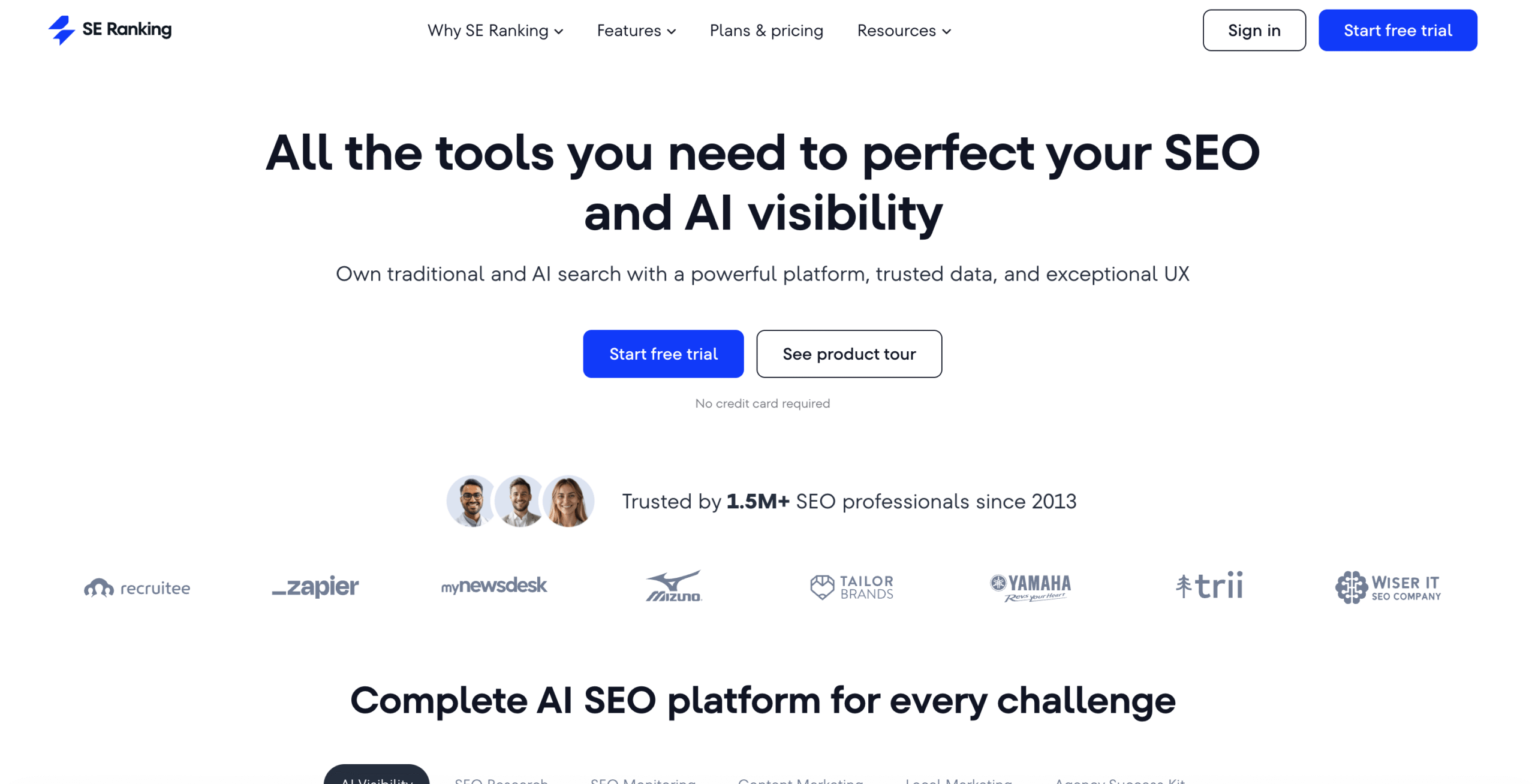
In 2026, SE Ranking has evolved into one of the most accessible and precise SEO platforms for companies looking to improve their search visibility across multiple countries and languages. Its integration with SE Visible has further strengthened its capabilities, particularly in helping small to mid-sized businesses and marketing agencies monitor how their brand appears in AI-generated answers across new search engines powered by artificial intelligence.
By focusing on real AI-generated outputs rather than data from simulated APIs, SE Ranking delivers highly accurate insights into how a brand or website performs within AI-powered environments like Google AI Mode, Gemini, and Perplexity. This makes it a highly valuable platform for international SEO efforts.
Advanced Features for Multilingual and International SEO
SE Ranking is packed with features that specifically address the growing complexity of global search engine optimisation. It offers real-time keyword tracking in over 190 countries, helping users understand local search dynamics and optimise their strategies accordingly.
- AI-Powered Content and Audit Toolkit
SE Ranking includes an AI Writer for content creation and an AI Technical Audit system that not only identifies SEO issues but also predicts changes in organic traffic based on ranking history. - Real AI-Based Visibility Tracking
The platform uses actual AI-generated search results rather than predictive API simulations. This gives SEO teams a more realistic and up-to-date view of how their brand is positioned in AI search environments worldwide. - Global Rank Tracking and Local Pack Insights
Users can track SERP positions and local business listings across more than 190 countries, allowing teams to tailor their SEO strategies to specific markets and languages. - White-Label Reporting for International Agencies
SE Ranking supports agencies with white-label features, enabling them to deliver custom-branded reports to clients in different regions. - SE Visible Module
A specialised add-on that tracks brand mentions, backlinks, and competitor activities inside AI-driven platforms. It focuses heavily on visibility within Google’s AI search engine, Gemini, and Perplexity, giving businesses a clearer understanding of where they stand.
User Base and Market Position
- Over 1.5 million users globally
- Popular among agencies, consultants, and corporate in-house SEO teams
- Highly adopted by small-to-medium enterprises seeking cost-effective yet scalable SEO tools
Pricing Breakdown for 2026
SE Ranking is known for its competitive and scalable pricing, making it accessible for a wide range of users.
| Plan Name | Monthly Price (USD) | Best For |
|---|---|---|
| Essential | $52 | Freelancers, early-stage businesses |
| Pro | $95 | Mid-sized agencies, content strategists |
| Business | $207 | Enterprises managing multiple domains |
| SE Visible | $89 (add-on) | Users needing deep AI search tracking |
International SEO Feature Matrix
| Feature | Description | Included in SE Ranking |
|---|---|---|
| Rank Tracking in 190+ Countries | Monitor global SERP positions for international websites | Yes |
| AI Writer for Content Creation | Generate SEO-optimised content tailored to local markets | Yes |
| AI-Based Technical Audits | Identify issues and predict traffic based on past ranking trends | Yes |
| White-Label Reporting | Generate branded reports for clients worldwide | Yes |
| AI Visibility Tracking | Detect brand presence in real-time AI-generated answers | Yes |
| Local Pack Monitoring | Analyse local business listings for region-specific visibility | Yes |
| Competitor Tracking in AI Search | See how competitors rank in platforms like Google AI Mode and Gemini | Yes |
Conclusion
SE Ranking, combined with SE Visible, has become a robust and intelligent choice for businesses looking to succeed in the multilingual and international SEO space. Its ability to provide real AI-based data, coupled with comprehensive content, technical, and visibility tools, empowers organisations to manage their global digital presence effectively. With powerful local and international tracking, affordable pricing, and continuous AI enhancements, it is well-positioned among the top 10 AI tools for multilingual and global SEO strategies in 2026.
4. Profound

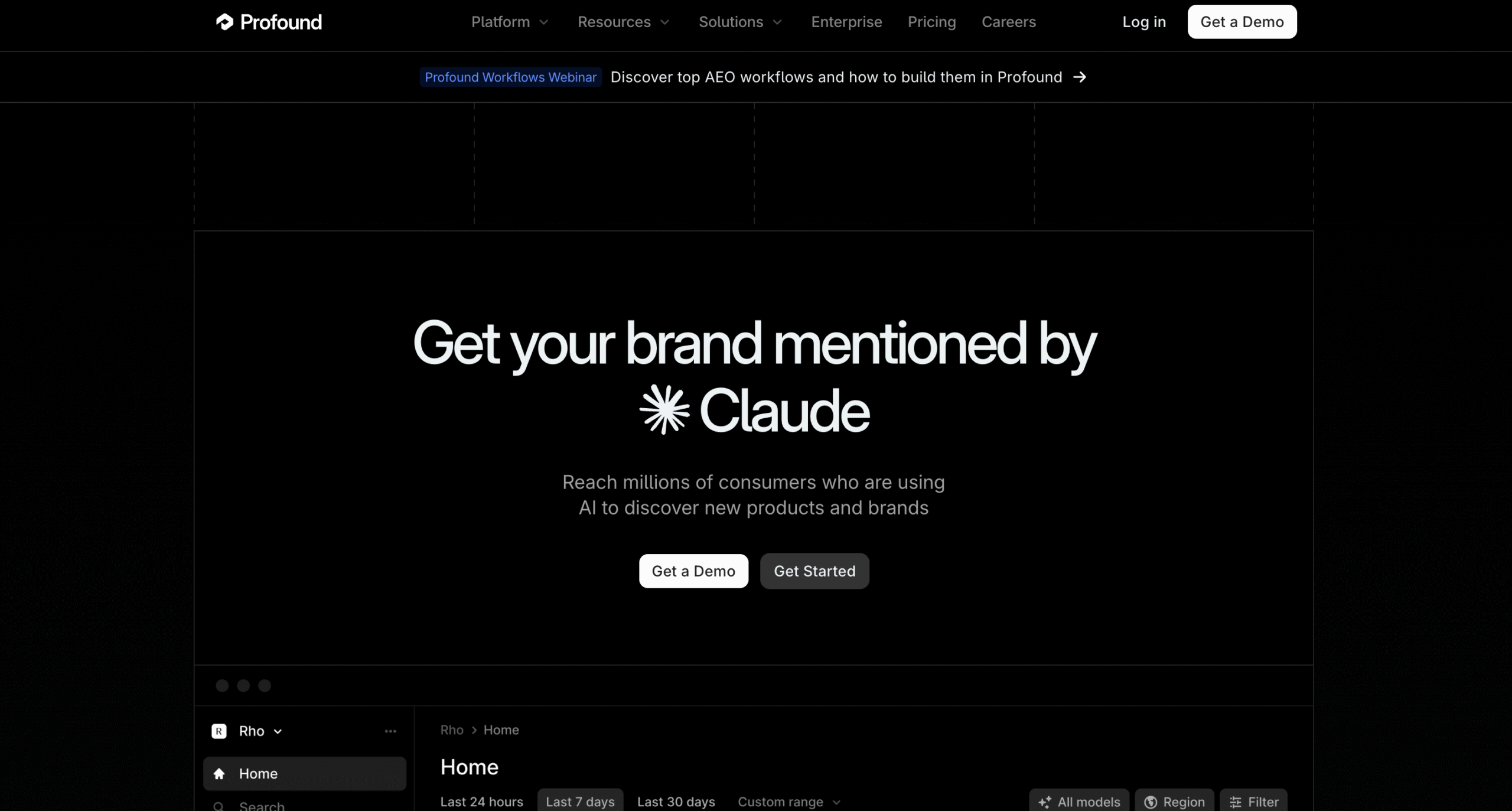
Profound has quickly emerged as one of the most advanced platforms for understanding brand performance within AI-generated search environments. As artificial intelligence becomes more integrated into global search ecosystems, this platform plays a vital role in helping large businesses and marketing leaders monitor, control, and improve how their brand is represented across generative engines.
With its robust AI analytics and multilingual search tracking capabilities, Profound is positioned as a leading solution for enterprise-level multilingual and international SEO in 2026.
Strategic Role in Global SEO and AI Visibility
Profound was specifically created to address the “Selection Problem”—a critical challenge where AI platforms must choose which brand or product to recommend when responding to user prompts. In this context, Profound empowers marketers and SEO professionals with real-time data about their brand’s visibility, reputation, and performance across more than 15 major generative engines simultaneously.
- Conversation Explorer for Real User Analysis
The platform includes a tool called “Conversation Explorer” that analyses more than 200 million real user prompts. This helps global SEO teams understand how people search in natural language across different countries and AI platforms. - AI Health Checker for Compliance and Control
Profound’s AI Health Checker and LLMs.txt Generator offer control over how AI bots interact with content. This allows teams to manage and guide AI crawler behavior, ensuring brand messaging remains accurate across borders. - Cross-Engine Visibility and Competitive Benchmarks
Brands can compare how their products or services are recommended differently across ChatGPT, Perplexity, Google’s AI Overview (AIO), and others. This insight is particularly important for multinational campaigns where user behavior, AI engine behavior, and narrative presentation vary widely by market. - Sentiment and Citation Monitoring by Country
Profound tracks not only if a brand is mentioned, but also how it is mentioned—evaluating sentiment, position, and contextual use across languages and regions. This is key for building global trust and enhancing brand equity in local markets.
Designed for Large and High-Growth Enterprises
- Primarily used by large corporations and high-growth brands with global operations
- Trusted by marketing teams seeking precise control over brand presentation in AI responses
- Used across industries such as e-commerce, finance, travel, and software
Pricing Structure and Plan Tiers in 2026
Profound offers a tiered pricing structure tailored to the scale of AI engine tracking and the depth of insights required.
| Plan Name | Monthly Price (USD) | Included Features | Best For |
|---|---|---|---|
| Starter | $99 | ChatGPT visibility tracking, basic conversation insights | New adopters, mid-size teams |
| Growth | $399 | Track 3 AI engines, includes basic citation and sentiment metrics | Multinational mid-sized businesses |
| Enterprise | Custom Pricing | Monitor 10+ AI engines, LLMs.txt tool, full sentiment control | Global corporations and large brands |
International SEO Capabilities Overview
| Feature | Description | Supported by Profound |
|---|---|---|
| Cross-Engine Brand Monitoring | Visibility across 15+ generative search engines | Yes |
| Conversation Explorer | Analyse prompts from over 200M real users globally | Yes |
| Country-Level Sentiment Tracking | Understand how the brand is perceived across different markets | Yes |
| AI Health Checker and LLMs.txt Control | Manage how AI crawlers treat your multilingual content | Yes |
| Platform Comparison for SEO Narrative Analysis | Compare brand messaging on ChatGPT, Perplexity, Google AIO | Yes |
| Multinational Product Recommendation Insight | See where and why products are suggested in different AI ecosystems | Yes |
| Competitive Benchmarking by Region | Evaluate brand vs. competitor presence in AI responses per country | Yes |
Conclusion
Profound has established itself as a high-value tool for multilingual and international SEO in 2026, especially for enterprise brands operating in AI-integrated search environments. With its advanced AI visibility features, deep sentiment analytics, and real-time prompt analysis, Profound enables companies to understand and influence how they are represented to a global audience through AI-driven search platforms. For businesses looking to secure their place in AI search results worldwide, Profound delivers the intelligence and control necessary to lead.
5. Alli AI

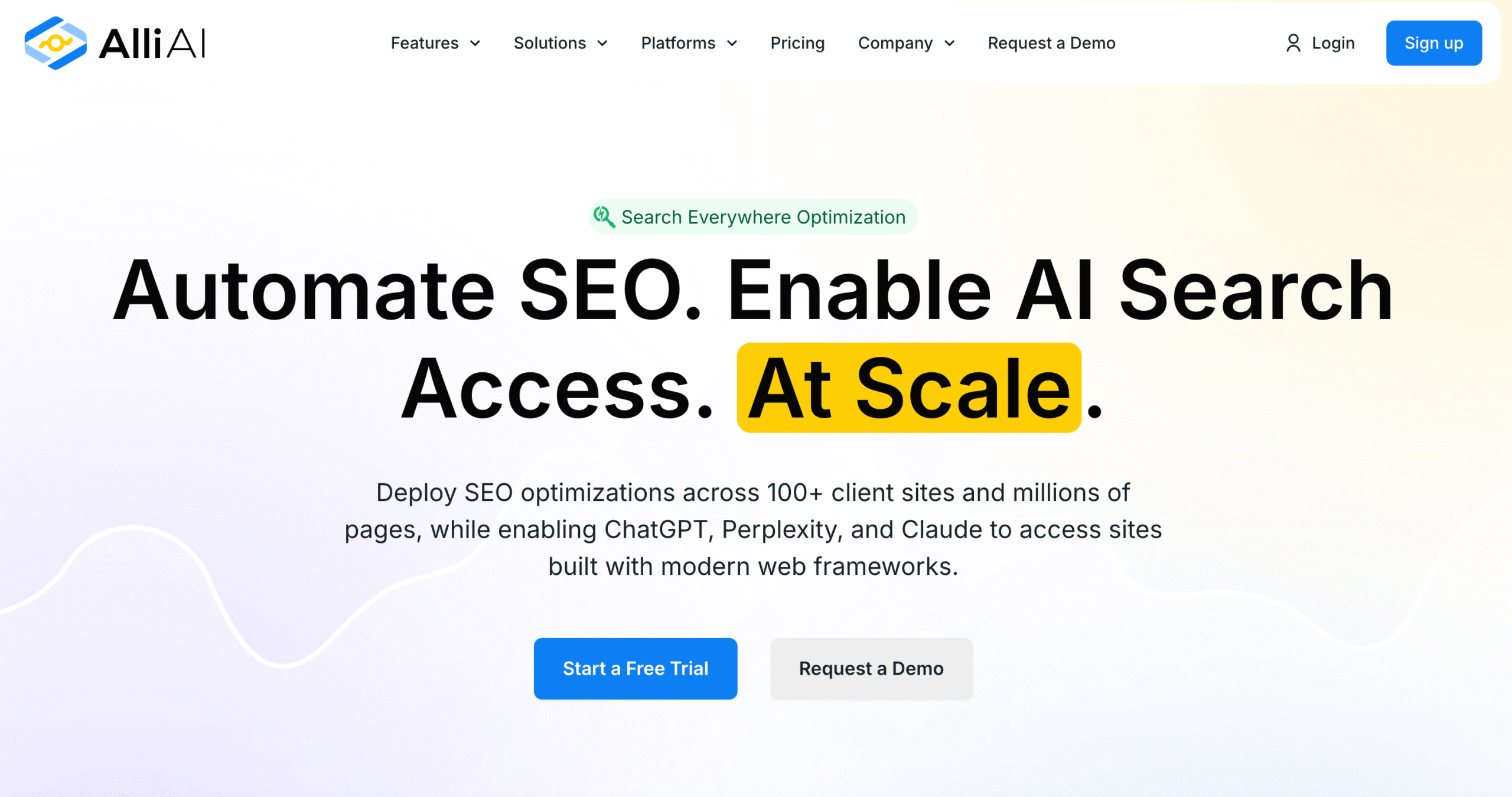
Alli AI has become a vital tool for large organisations that require fast, scalable, and reliable automation for technical SEO. In 2026, as global digital competition grows and AI search platforms dominate user journeys, Alli AI plays a strategic role by helping enterprises ensure that their websites are technically optimised and ready for multilingual markets.
Built for brands with complex domain structures and high-volume content, Alli AI simplifies technical SEO by automating tasks that previously required extensive developer resources. This is especially useful for international SEO teams managing multiple language versions or regional domains.
Automation Engine for Global Technical SEO Management
Alli AI offers one of the most powerful automation frameworks in the SEO space, specifically focused on on-page elements and large-scale technical enhancements. Its core functionality lies in a secure code snippet that enables bulk edits—such as meta descriptions, schema, and header tags—across thousands of pages instantly.
- Secure Code Snippet Deployment
Users can implement structural changes without needing developer help. This is especially useful for brands with multiple country domains or language variants, where manual updates would be time-consuming and error-prone. - AI-Based Internal Linking and Technical Prioritisation
Alli AI automates internal link structures across language-specific pages. Its AI consultant then detects technical SEO issues and ranks them based on their potential effect on search visibility, helping teams focus on the changes that matter most. - Financial Risk Modeling for AI Search Visibility
The platform includes an AI Search Revenue Impact Calculator that estimates the revenue loss associated with underperformance in AI-generated search results—especially useful for e-commerce businesses competing in multilingual markets. - Scalable SEO Execution Across Markets
It supports mass optimisation across multiple international domains, subfolders, or language-specific pages. This ensures consistent SEO performance and alignment with regional search engine requirements.
Designed for Agencies and High-Traffic Global Websites
- Commonly used by e-commerce platforms operating across multiple countries
- Ideal for agencies managing dozens of websites and keyword portfolios
- Trusted by enterprise SEO teams that prioritise speed and accuracy in execution
Pricing Plans in 2026
Alli AI offers tiered pricing suitable for different business sizes, from marketing agencies to global enterprise teams. Plans scale with the number of websites and keywords monitored.
| Plan Name | Monthly Price (USD) | Inclusions | Ideal For |
|---|---|---|---|
| Business | $299 | 5 websites, 500 keywords, full feature access | Growing e-commerce teams |
| Agency | $599 | 15 websites, 2,000 keywords | SEO agencies with multiple client sites |
| Enterprise | Custom Pricing | Unlimited support, multi-domain rollout | Global corporations with high-scale needs |
Multilingual SEO Automation Matrix
| Feature | Description | Supported by Alli AI |
|---|---|---|
| Bulk Meta and Header Deployment | Apply SEO changes across thousands of pages simultaneously | Yes |
| Schema Markup Implementation | Add structured data for rich results globally | Yes |
| Internal Linking Optimisation | Build multilingual linking structures based on AI patterns | Yes |
| AI Technical Audit with Prioritisation | Identify and rank SEO issues by projected impact | Yes |
| Multinational Domain Architecture Support | Automate SEO for global sites, domains, and languages | Yes |
| Financial Impact Calculator for AI Visibility | Estimate revenue lost from poor AI SERP presence | Yes |
Conclusion
Alli AI offers a powerful and scalable solution for managing technical SEO across global web properties. Its automation-first design allows enterprises to optimise multilingual websites with minimal manual input, improving performance in both traditional and AI-driven search ecosystems. With built-in financial forecasting, international-ready architecture, and reliable automation tools, Alli AI stands as one of the top AI tools for multilingual and international SEO in 2026.
6. Advanced Web Ranking (AWR)

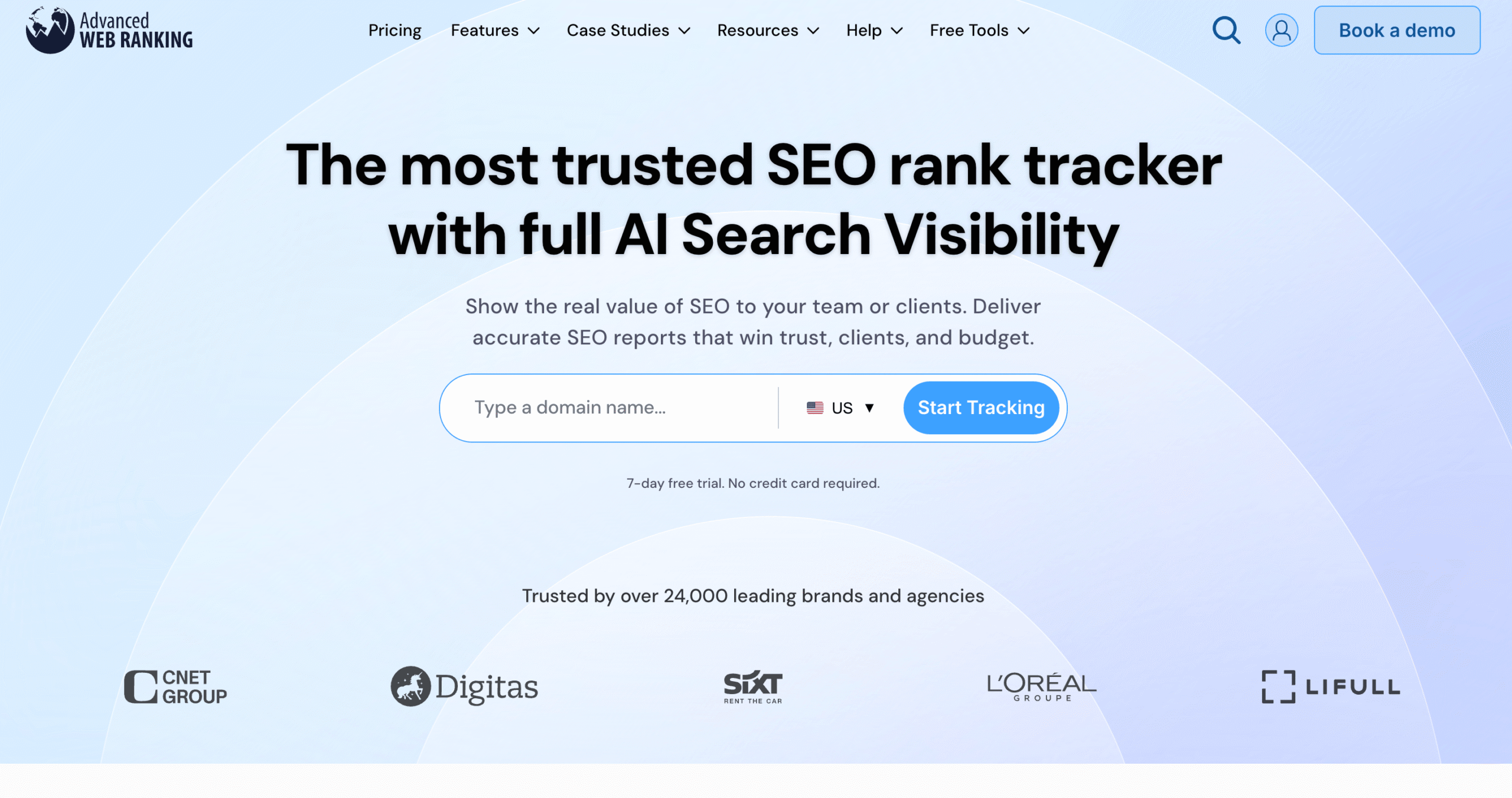
Advanced Web Ranking (AWR) has positioned itself as one of the most comprehensive AI-powered tools for multilingual and international SEO in 2026. It is uniquely designed for businesses that operate in varied global markets where search behavior extends beyond Google. With the ability to monitor keyword rankings across more than 4,000 search engines in over 190 countries, AWR stands out as a leader for companies aiming to build visibility in complex and regionally diverse search ecosystems.
This platform is especially valuable for enterprises and agencies targeting countries like China, South Korea, the Czech Republic, and Russia—regions where Baidu, Naver, Seznam, and Yandex play a more dominant role than Google.
AI-Driven International Visibility and Market Insights
AWR provides deep AI-driven insights that go far beyond basic keyword tracking. By combining traditional rank monitoring with new AI visibility tools, AWR helps global SEO teams understand how their brands are performing across both classic and generative search engines.
- Multi-Engine Rank Tracking
AWR offers unmatched access to search ranking data across thousands of search engines, making it a vital tool for brands that need to maintain visibility outside of major Western markets. - AI Overviews and Brand Visibility Monitors
The platform includes a dedicated AI Overviews Tracker that checks brand mentions in answers generated by AI platforms such as ChatGPT, Claude, Gemini, and Perplexity. This ensures that companies stay informed about how they are featured in new AI-based SERPs. - Forecasting Organic Traffic by Market
AWR’s SEO forecasting tool predicts future traffic trends using historical data. This helps businesses allocate resources effectively across countries, regions, and language-specific campaigns.
Trusted by Global SEO Teams and Agencies
- Used by international SEO agencies, in-house teams at multinational enterprises, and digital marketing teams managing region-specific campaigns
- Particularly strong in supporting SEO efforts in markets with non-Google dominant engines
- A go-to platform for businesses seeking high-volume keyword tracking in multiple languages and geographies
Pricing Tiers and Keyword Capacity in 2026
AWR is priced to scale with the complexity of the user’s SEO strategy. Whether a business needs regional tracking or global enterprise support, the platform offers suitable plans.
| Plan Name | Monthly Price (USD) | Keyword Capacity | Ideal Users |
|---|---|---|---|
| Pro | $139 | 7,000 keywords | Medium businesses and growing agencies |
| Enterprise | $699 | 35,500 keywords | Global agencies, multilingual campaign managers |
| Ent Plus | $980 | 50,000 keywords | Large corporations with extensive keyword needs |
International and Multilingual SEO Capability Matrix
| Feature | Description | Supported by AWR |
|---|---|---|
| Search Engine Coverage | Tracks rankings across 4,000+ global and regional search engines | Yes |
| AI Search Visibility Monitoring | Monitors brand mentions in ChatGPT, Gemini, Perplexity, Claude | Yes |
| Multi-Country and Language Rank Tracking | Supports tracking across 190+ countries with language-level granularity | Yes |
| Local Engine Targeting | Enables visibility tracking in Baidu, Naver, Seznam, Yandex, and other niche platforms | Yes |
| Historical Data-Driven SEO Forecasting | Predicts traffic growth based on regional and multilingual search data trends | Yes |
| Scalable Keyword Management | Manages tens of thousands of keywords in multiple countries and languages | Yes |
Conclusion
Advanced Web Ranking offers global SEO teams a powerful combination of scale, precision, and AI integration. In an era where AI-driven answers are influencing user decisions across various search engines and languages, AWR provides the visibility and forecasting needed to succeed in local and international SEO. With its exceptional regional engine support and predictive analytics, AWR ranks among the top AI tools for multilingual and international SEO in 2026.
7. Peec AI

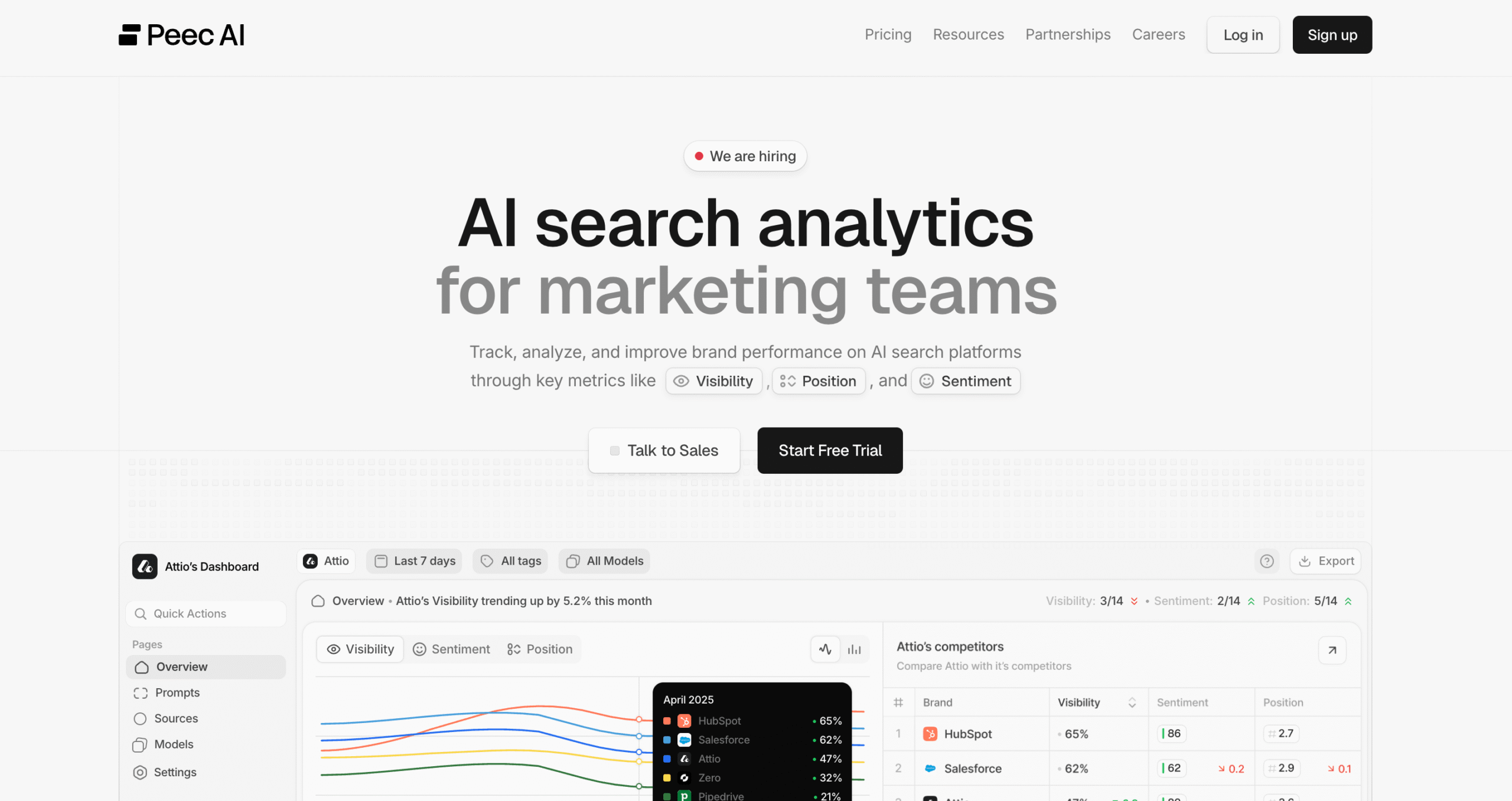
Peec AI has emerged as a powerful and innovative platform tailored for brands that want to understand and influence how they appear in AI-generated answers globally. Unlike traditional SEO tools that focus on keywords and SERP rankings, Peec AI shifts its approach to concentrate on prompts—the actual questions people are asking AI platforms. This gives marketers a clearer understanding of what influences brand visibility in AI-driven search engines like ChatGPT, Perplexity, Claude, Gemini, and Google’s AI Overview.
Peec AI is especially relevant in 2026, where Generative Engine Optimization (GEO) has become an essential part of international SEO. It supports global tracking and helps teams monitor brand sentiment, detect key source mentions, and manage performance across regions with different AI behaviours and content ecosystems.
Prompt-Based AI Visibility for Global SEO Campaigns
Peec AI’s unique framework allows SEO and content teams to track brand appearances not by keyword, but by the types of prompts and questions people pose to generative AI engines. This provides a more realistic measure of visibility in the emerging AI-driven user journey.
- Prompt-Centric Analysis for Global Reach
Instead of focusing on search engine keywords, Peec AI looks at real AI prompts to determine when and how a brand is mentioned. It tracks mentions across a growing list of AI platforms and provides sentiment insights at both the prompt and country level. - Source Attribution Engine
One of Peec AI’s most valuable features is its ability to detect the original sources—such as media articles, Reddit threads, or online reviews—that influence AI-generated answers. This allows marketers to shape their content and PR strategies toward sources that actually move the needle in AI search. - AI Share-of-Voice and Competitor Monitoring
The platform continuously monitors how often a brand appears in comparison to its competitors across different AI platforms. This is vital for multinational companies competing in fragmented digital environments. - Global Campaign Flexibility
Peec AI includes international coverage and flexible pricing, allowing marketing teams to adjust their campaigns based on regional performance metrics. It supports multilingual content monitoring and allows segmentation by country or language.
Adopted by Fast-Growing Global Enterprises
- Currently used by more than 1,300 companies around the world
- Growing quickly with over 300 new business users per month
- Serves both business-to-business (B2B) and business-to-consumer (B2C) brands in diverse industries
- Trusted by major international names like Chanel, Axel Springer, and TUI
Pricing Options for Multinational Teams in 2026
Peec AI offers scalable subscription options that are well-suited for marketing teams of all sizes, including entry-level access and enterprise-grade intelligence.
| Plan Tier | Monthly Price (USD) Approx. | Features Included | Ideal For |
|---|---|---|---|
| Starter | $95 | Monitor 25 prompts and AI responses | Small teams and freelancers |
| Pro | $215 | Track up to 100 prompts across platforms | Mid-sized businesses with international needs |
| Enterprise | $493+ | Custom usage, advanced AI insights, source-level data | Large global brands with multilingual markets |
Multilingual and International SEO Capabilities Table
| Feature | Description | Supported by Peec AI |
|---|---|---|
| Prompt-Based AI Monitoring | Tracks brand visibility through real user queries across AI engines | Yes |
| Regional and Language-Based Reporting | Supports segmentation by country and language for multilingual campaign management | Yes |
| Source Attribution for AI Mentions | Identifies original articles, forums, and reviews that feed into AI-generated responses | Yes |
| Share-of-Voice Analytics Across AI Platforms | Compares brand mentions to competitors in ChatGPT, Gemini, Perplexity, and others | Yes |
| Sentiment Analysis by Region | Detects how brand mentions are positioned (positive/negative) in local AI answers | Yes |
| Monthly Reporting and Market Expansion Insights | Provides country-specific reports and global AI exposure growth metrics | Yes |
Conclusion
Peec AI is redefining the way companies approach multilingual and international SEO in 2026. With its prompt-based tracking system, advanced source mapping capabilities, and real-time visibility monitoring across AI-driven engines, it empowers marketing teams to manage their brand presence more strategically. For companies looking to succeed in an AI-dominated search environment, especially across varied regions and languages, Peec AI delivers a comprehensive and forward-thinking solution.
8. MarketMuse

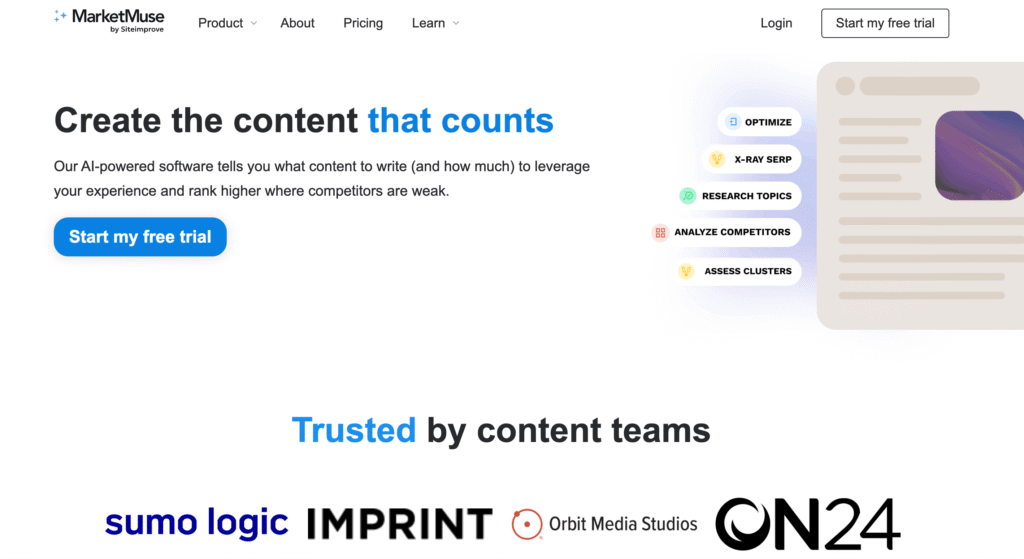
MarketMuse stands out as a highly specialised AI platform focused on helping businesses achieve strong topical authority across their websites. As SEO in 2026 becomes increasingly reliant on AI interpretation and trust signals, MarketMuse provides brands with a strategic advantage by guiding content planning and optimisation at the domain level. Its approach is especially relevant for multinational companies managing websites across different regions and languages, where maintaining subject-matter authority is key to consistent visibility.
Rather than looking at individual keywords or pages, MarketMuse evaluates an entire website’s topical strength and recommends what content needs to be created, updated, or retired to build authority in a specific area. This capability aligns closely with the principles of Google’s E-E-A-T model (Expertise, Experience, Authoritativeness, Trust), which plays a major role in both traditional and AI-powered search rankings.
Strategic Content Planning for Multilingual Markets
MarketMuse uses AI to generate what it calls “Topical Maps”—blueprints of interconnected content clusters that help websites dominate a specific niche or subject. This is especially beneficial for international SEO campaigns, where localised content must also align with core authority themes.
- Topical Mapping Across Entire Domains
The platform scans the entire content inventory and builds a strategic roadmap, identifying content gaps and clusters for each niche. This ensures regional content strategies stay aligned with broader brand authority goals. - AI-Powered Page Prioritisation
MarketMuse uses machine learning to assess which pages should be written, updated, or removed. This helps marketing teams save time and focus resources on content that will deliver the highest SEO value across different regions. - Entity-Based SEO for Global Relevance
The platform understands Google’s entity-driven ranking approach and optimises for related concepts, making it highly effective for multilingual content structures where consistent topical signals are required. - Difficulty Scores and Content Advantage Analysis
A standout feature is its personalised “Difficulty Score,” which analyses how likely a website is to rank for a topic based on its existing authority. This helps international teams decide which markets or languages are most strategic to target first.
Built for Global Enterprises and Large Content Teams
- Widely used by enterprise SEO teams, global publishers, and high-volume marketing departments
- Especially valuable for companies with thousands of pages in multiple languages
- Provides long-term support for regional content expansion and market-specific authority development
MarketMuse Pricing Tiers in 2026
MarketMuse offers pricing models that cater to small content teams, mid-sized global brands, and enterprise publishers managing multilingual platforms.
| Plan Name | Monthly Price (USD) | Key Features Included | Best Suited For |
|---|---|---|---|
| Free | $0 | Limited content audits and topic suggestions | Small teams and content freelancers |
| Standard | $149 | Topical Maps, basic content scoring | Mid-sized global marketing departments |
| Team | $399 | Full-scale topical modelling and difficulty scoring | Large enterprises and international publishers |
Multilingual and Global SEO Capability Matrix
| Feature | Description | Supported by MarketMuse |
|---|---|---|
| Domain-Level Topical Authority Mapping | Evaluates entire sites and builds interrelated content clusters for international strategies | Yes |
| Multilingual Content Alignment | Supports regional adaptation of content clusters for multiple markets | Yes |
| Personalised Topic Difficulty Scoring | Calculates ranking chances based on brand’s current topical weight | Yes |
| E-E-A-T Oriented Strategy Framework | Helps meet AI and Google trust criteria across different content markets | Yes |
| Content Creation and Update Recommendations | AI-driven suggestions for what to write, update, or remove | Yes |
| Entity-Based Ranking Support | Aligns with Google’s entity-centric algorithms for multilingual optimisation | Yes |
Conclusion
MarketMuse offers a long-term and data-driven solution for companies looking to build and maintain topical authority across international SEO campaigns. In a digital environment increasingly influenced by AI trust signals and content depth, MarketMuse provides the structure and insight needed to manage multilingual websites effectively. Its topical maps, entity-based strategies, and prioritisation tools make it one of the most advanced AI solutions for international SEO in 2026.
9. Surfer SEO


Surfer SEO continues to lead in the area of on-page optimisation, providing a comprehensive suite of AI-driven tools designed to help global brands and SEO professionals create content that ranks highly across different languages and regions. As international search behaviour becomes more dynamic and AI-driven search engines shape the future of visibility, Surfer SEO’s technology bridges the gap between algorithmic requirements and user-friendly content.
With built-in support for content generation in 11 languages, real-time competitor analysis, and AI-based visibility tracking, Surfer SEO has positioned itself as a top solution for businesses looking to scale multilingual SEO campaigns effectively.
Blueprint-Driven On-Page Optimisation with AI Precision
Surfer SEO uses live search engine results to provide precise guidelines for content creation. By analysing top-ranking pages for any keyword, it delivers detailed recommendations that include keyword usage, content structure, and semantic alignment. These insights help users produce content that is competitive both for traditional search engines and AI-generated summaries.
- Real-Time SERP-Based Blueprints
The platform analyses the top-performing pages in each market and generates a blueprint for new content. These blueprints include ideal word count, keyword frequency, header structure, paragraph spacing, and visual content recommendations. - Cruise Mode: Automated Content Creation
Surfer’s Cruise Mode enables users to automatically generate complete articles based on keyword input. The generated content is optimised for both search engines and user readability, and can be customised to match a brand’s tone or local market trends. - NLP-Based Content Scoring System
One of Surfer’s standout features is its Natural Language Processing (NLP) algorithm, which grades content based on how well it aligns semantically with top-ranking results. This helps multilingual SEO teams produce language-specific content that mirrors high-performing pages in each target region. - AI Visibility Tracking and Internal Linking
The updated AI Brand Visibility Tracker monitors how brands appear in AI search results across platforms like ChatGPT and Gemini. Additionally, the AI Link Manager provides internal linking suggestions to enhance site authority and topic coverage.
Ideal for SEO-Driven Content Teams Globally
- Extensively used by copywriters, SEO teams, and agencies creating international and multilingual content
- Valuable for marketing departments seeking fast, high-quality content that meets both AI and human readability standards
- Frequently adopted by companies looking to launch content at scale in multiple regions
Surfer SEO Pricing for 2026
Surfer SEO’s pricing tiers accommodate a wide range of users, from freelance writers to enterprise-scale digital marketing departments.
| Plan Name | Monthly Price (USD) | Key Features Included | Best For |
|---|---|---|---|
| Essential | $79 | SERP data, content editor, limited keyword inputs | Freelancers and small teams |
| Scale | $175 | Includes AI Brand Visibility Tracker and Cruise Mode | Marketing departments and SEO consultants |
| Enterprise | $999 | High-volume usage, team access, multilingual performance tracking | Large agencies and international brands |
Multilingual and International SEO Feature Matrix
| Feature | Description | Supported by Surfer SEO |
|---|---|---|
| SERP Blueprint Generation | Provides real-time data-driven content structure for any keyword across regions | Yes |
| Cruise Mode for Article Creation | Automates content generation tailored to different brand voices or regional tones | Yes |
| NLP-Based Content Grading | Scores content based on semantic similarity to top-ranking pages | Yes |
| AI Brand Visibility Tracking | Monitors how the brand is presented across AI search platforms like ChatGPT and Gemini | Yes |
| Internal Link Suggestions | Offers link-building guidance based on content structure and topical relevance | Yes |
| 11-Language Content Support | Enables content generation and optimisation in multiple languages for global campaigns | Yes |
| Region-Specific Localisation Adjustments | Allows teams to tailor structure and tone for different international markets | Yes |
Conclusion
Surfer SEO delivers an intelligent and scalable solution for brands focused on multilingual and international SEO in 2026. With its deep integration of real-time SERP data, NLP-driven content scoring, and AI-powered brand visibility monitoring, the platform supports content strategies that are both locally relevant and globally competitive. For companies aiming to reach diverse audiences while meeting the complex standards of AI-influenced search algorithms, Surfer SEO remains one of the top AI tools available.
10. Airefs / Scrunch AI

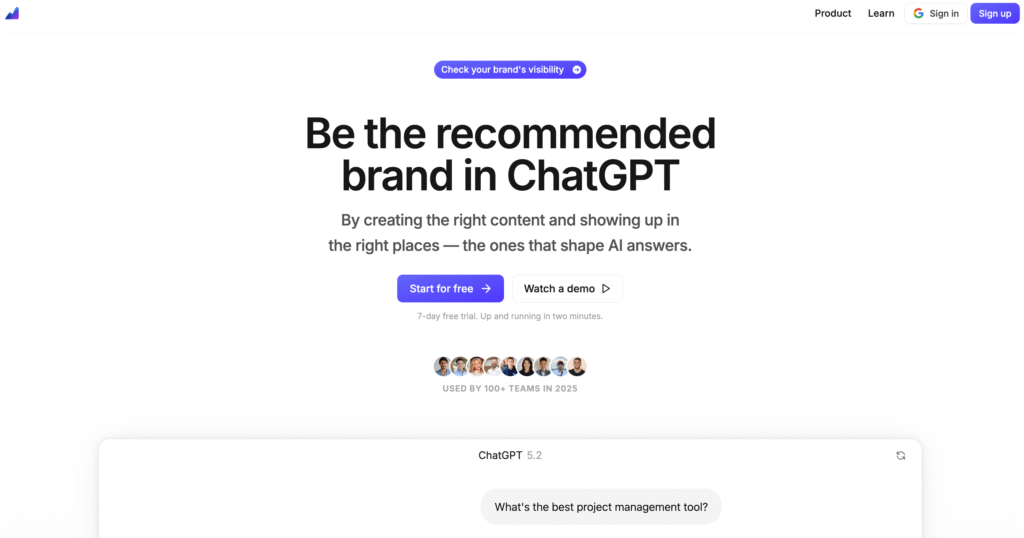
Airefs and its enterprise-focused sibling, Scrunch AI, have emerged as key platforms in 2026 for brands that want to improve their visibility within AI-generated search answers. As the SEO landscape shifts away from traditional search engines and more toward generative platforms like ChatGPT, Perplexity, Claude, and Google’s AI Overview (AIO), these tools enable businesses to strategically influence the content that LLMs (Large Language Models) rely on when generating responses.
These platforms are built around the concept of Answer Engine Optimisation (AEO)—a new field that focuses on shaping the narratives LLMs create when responding to user prompts. Instead of targeting keywords and ranking positions, Airefs and Scrunch AI identify and track the exact online sources that influence generative answers, giving marketers an actionable path to improving brand visibility in this emerging environment.
AI Source Intelligence and Answer Control for Global Markets
Both Airefs and Scrunch AI operate by mapping the content ecosystem that LLMs pull from. This includes forums, review platforms, blog posts, and niche content hubs across the internet. Their goal is to help companies understand and influence where and how their brand is mentioned in AI answers around the world.
- Source-Level Discovery Engine
Airefs and Scrunch AI pinpoint the exact source URLs being cited in AI-generated content. This enables marketing teams to refine their digital PR, link-building, and content distribution to target the most influential sources within generative models. - Cross-Platform AI Brand Monitoring
Scrunch AI tracks brand presence across a wide range of platforms including ChatGPT, Claude, Meta AI, Google AIO, and Perplexity. It helps enterprises understand the variation in brand perception across countries and engines. - Strategic Engagement with Trusted LLM Sources
By understanding which sources are shaping AI responses, teams can engage directly with platforms like Reddit, G2, Quora, or industry-specific review sites to boost the presence of branded content in future AI-generated summaries. - Geo-Targeted AEO Campaign Management
These tools provide insights across global regions, allowing teams to track how their brand is perceived in different languages and countries, making it ideal for multilingual campaigns and international SEO strategies.
Used by Startups and Enterprise Marketing Teams Globally
- Airefs is popular among B2B SaaS teams, growth marketers, and agencies that want to challenge established competitors in AI search environments
- Scrunch AI supports larger enterprises managing hundreds of brand interactions across AI engines
- Both tools provide direct, data-backed strategies for improving presence in zero-click, AI-generated answers
Pricing and Access in 2026
These platforms are priced to serve different segments—from individual marketers to large multinational teams. Airefs provides affordable tiers, while Scrunch AI caters to businesses requiring enterprise-scale controls and analytics.
| Platform | Plan Name | Monthly Price (USD Approx.) | Features Included | Suitable For |
|---|---|---|---|---|
| Airefs | Lite | $24 | Basic source tracking, limited prompts | Freelancers and individual marketers |
| Airefs | Pro | $49 | More prompt tracking, source insights, light geo-segmentation | Small teams and agencies |
| Airefs | Expert | $83 | Full prompt list, export features, custom sources | Mid-sized digital marketing teams |
| Scrunch AI | Starter | $250+ | Full multi-engine tracking, global monitoring | Enterprises and multinational brands |
Multilingual and International AEO Capabilities Table
| Feature | Description | Supported by Airefs/Scrunch AI |
|---|---|---|
| Source-Level Discovery | Tracks and reveals exact URLs used by LLMs to generate brand-related content | Yes |
| Multi-Engine Brand Visibility Monitoring | Analyzes brand mentions across ChatGPT, Perplexity, Claude, Meta AI, and Google AIO | Yes |
| AI-Focused Digital PR Strategy | Enables targeted outreach to forums and reviews that feed AI models | Yes |
| Geo-Targeted Brand Perception Analysis | Tracks brand visibility and tone across countries and languages | Yes |
| Cross-Market Answer Variation Reports | Shows how brand narratives differ from one engine or language to another | Yes |
| Enterprise-Level Data Governance | Provides secure, scalable data access for large teams across multiple global regions | Yes (Scrunch AI only) |
Conclusion
Airefs and Scrunch AI are redefining international SEO strategy by helping brands take control of their presence in generative search environments. These platforms give marketers a clear map of the sources and prompts that AI models rely on, allowing them to influence AI-driven visibility across languages and markets. For businesses focused on staying relevant in AI-powered search ecosystems worldwide, these tools provide a vital edge in 2026’s rapidly evolving digital landscape.
Strategic Overview of the Global AI SEO Landscape in 2026: Evaluating the Leading Multilingual and International AI Optimization Platforms
The global SEO landscape in 2026 has entered a transformative phase, reshaping how brands approach digital visibility across international markets. Traditional keyword-driven SEO is no longer sufficient on its own. Instead, global enterprises are now adapting to an ecosystem influenced heavily by entity-based relevance, semantic depth, and AI-driven answer generation. This major shift is supported by the rapid evolution of search engines into AI-powered answer engines, transforming how content is found, interpreted, and ranked.
According to industry projections, the SEO industry is now valued at $83.98 billion, with a projected compound annual growth rate (CAGR) of 12.12% from 2026 to 2031. A primary force behind this growth is the rise of AI-powered search algorithms and the surge in cross-border e-commerce, which demands localisation, multilingual optimisation, and advanced visibility strategies across multiple search platforms.
The Emergence of Generative Engine Optimization (GEO) and Decline of Traditional Search
A substantial shift is underway as traditional search engines are losing query volume to AI-generated answer platforms. Estimates indicate that by 2026, zero-click searches represent over 83% of all user interactions, driven by platforms such as Google’s AI Overviews, which now serve content to more than 2 billion monthly users.
This has given rise to a new optimisation paradigm: Generative Engine Optimization (GEO). Unlike traditional SEO, which focuses on keyword rankings, GEO targets the placement and influence of brand mentions within AI-synthesised answers generated by large language models like ChatGPT, Claude, and Gemini.
In this context, multilingual and international SEO requires more than translation. Brands must become entities recognised and trusted by AI. To succeed, companies need to adopt structured content, clear semantic layering, and machine-readable formats, while also monitoring which sources AI engines pull from and how their brand appears within those narratives.
Global SEO Landscape Drivers in 2026
| Strategic Trend | Description |
|---|---|
| Rise of Answer Engines | Conversational AI now responds directly to most user queries, replacing traditional results |
| Fragmented Discovery Platforms | Visibility must span across multiple LLMs and country-specific AI engines |
| E-E-A-T as a Ranking Currency | Expertise, Experience, Authoritativeness, and Trust define how brands are cited in AI answers |
| Structured Data and Schema Optimization | Machine-ingestible content is essential for ranking in AI-generated summaries |
| Zero-Click Search Dominance | Over 80% of queries never lead to website clicks, requiring brand presence inside the answer |
Top Drivers of International SEO Tool Adoption
| Key Challenge | Enterprise SEO Tool Response |
|---|---|
| Cross-language Content Creation | AI-assisted multilingual content editors and auto-localisation engines |
| Generative SERP Tracking | Platforms that monitor brand mentions in AI Overviews, ChatGPT, Gemini, etc. |
| Regional SERP Diversity | Tools that cover engines beyond Google (e.g., Baidu, Naver, Seznam, Yandex) |
| AI Citations and Source Discovery | Solutions identifying content and domains influencing LLM-generated responses |
| Entity and Semantic-Based Optimisation | Systems that model topical clusters and domain-wide authority strategies |
Strategic Importance for Global Businesses
With traditional keyword rankings losing value in zero-click environments, the core challenge in 2026 is no longer visibility on a search results page, but influence within the answers themselves. For multinational companies, this calls for precision in content architecture, ongoing localisation support, and tools capable of managing visibility across languages, engines, and AI platforms.
Organisations must now deploy AI SEO platforms that offer:
- Prompt and entity monitoring across generative engines
- Real-time AI visibility scoring and competitor benchmarking
- AI search-specific schema deployment and link structuring
- Multilingual keyword clustering and region-specific optimisation
Conclusion
The global SEO environment in 2026 demands a multi-dimensional approach that combines traditional keyword strategies with advanced AI-centric methods. Generative Engine Optimization has redefined what it means to “rank,” shifting the focus toward machine trust, data integrity, and citation accuracy in AI responses.
Businesses seeking success in this new landscape must adopt AI SEO tools built for multilingual markets, international visibility, and AI-driven search models. The right platforms not only support global content expansion—they enable brands to shape the narrative wherever modern users ask questions and AI delivers answers.
Quantitative Trends Shaping the Global AI SEO Market in 2026: International Expansion and Platform Investment Outlook
In 2026, the global SEO landscape is being reshaped by the accelerating adoption of artificial intelligence and the growing demand for multilingual and international content visibility. As brands expand into new markets and compete across borders, AI-powered SEO tools have become essential for success in both traditional search and generative engine environments.
The economic and technological momentum in this sector is significant. Data shows that 75% of marketers are now actively using AI tools to streamline SEO workflows, highlighting a shift toward automation and predictive optimisation across both B2B and B2C campaigns. This widespread adoption is supported by measurable growth in platform funding, global usage patterns, and outcome-focused delivery models.
Growth Trajectory of AI SEO Platforms and Software Investments
The global AI SEO software market is projected to grow from $1.99 billion in 2024 to $4.97 billion by 2033, driven by demand for scalable multilingual content optimisation, AI-assisted analysis, and generative engine visibility. In parallel, the broader SEO services market is forecast to double from $74.90 billion in 2025 to $148.86 billion by 2031, growing at a CAGR of 12.12%.
AI is enabling faster content localisation, real-time SERP monitoring, and performance tracking across different regions. These developments are transforming how companies plan and execute international SEO, making tools that support AI integration indispensable.
Global Market Projections and Regional Dynamics
The table below outlines projected market figures and regional expansion patterns that define the AI SEO ecosystem in 2026:
Table 1: Global SEO Market Forecasts and Regional Insights (2025–2033)
| Market Metric | 2025/2026 Value | 2031/2033 Projected Value | CAGR (Forecast) |
|---|---|---|---|
| Global SEO Services Market Size | $74.90 Billion | $148.86 Billion | 12.12% |
| AI SEO Software Market Size | $2.45 Billion | $4.97 Billion (by 2033) | 16.50% |
| Voice & Visual Search SEO Market | Not Available | Not Available | 20.10% |
| APAC Regional SEO Market Growth | Not Available | Not Available | 13.55% |
| SME Contribution to SEO Market | 58.40% | Not Applicable | Not Applicable |
| Enterprise/MNC SEO Market Share Forecast | Not Available | Not Available | 16.10% |
Surging Investment in AI SEO Platforms and Tools
The investment landscape has matured rapidly, with more than $77 million in funding injected into specialised AI SEO tools during the mid-2025 period alone. Key funding events include:
Table 2: Major AI SEO Platform Funding Highlights (2025)
| Company/Platform | Investment Round | Amount Raised | Notable Focus Area |
|---|---|---|---|
| Profound | Series A | $23.5 Million | AI visibility and answer engine analytics |
| Peec AI | Series A | $21 Million | Prompt-based generative engine tracking |
| Others Combined | Various | $32.5 Million (est.) | Source discovery, multilingual PR optimisation |
This capital influx is enabling product expansion, enhanced multilingual capabilities, and stronger integration with global LLMs. As clients increasingly shift away from vanity metrics, the rise of outcome-based contracts (CAGR: 18.40%) reflects the market’s focus on business impact and measurable SEO performance.
The Challenge of Semantic Collapse in AI-Driven Search
A unique challenge confronting international SEO in 2026 is the issue of semantic collapse. In the context of AI-powered search, many LLMs compress multilingual input into shared semantic structures. This often leads to a prioritisation of the most “confident” content versions—usually the English-language page—across global results.
As a result, translated or localised pages without distinct search intent or cultural relevance are often ignored, reducing their visibility. This phenomenon means that international SEO is no longer just about local ranking—it is also about selection and representation within AI-curated answers.
Strategic Considerations for AI-Powered Multilingual SEO in 2026
| SEO Challenge | Strategic Solution Provided by AI SEO Tools |
|---|---|
| Semantic Collapse in Translated Content | Generate unique, culturally contextualised local content |
| Dominance of English-Language Pages in AI SERPs | Build local entity authority and optimise non-English sources |
| Measurement of AI Answer Visibility | Use AI SERP trackers and source citation mapping platforms |
| Complexity of Regional SEO Requirements | Employ scalable AI SEO software with language and market support |
| Growing Demand for Business-Outcome Delivery | Leverage tools that provide forecasting and impact scoring |
Conclusion
The 2026 global SEO market reflects a highly dynamic, AI-led evolution in digital marketing strategy. With the rapid rise of generative search engines, the decline of click-based discovery, and the complexity of multilingual AI visibility, businesses now require tools that go beyond traditional SEO functions.
AI-powered SEO platforms are not just enhancing automation—they are redefining how brands earn trust, achieve relevance, and maintain visibility across languages, devices, and AI engines. The investment trends, adoption rates, and technical challenges outlined here confirm that mastering international SEO in 2026 requires a new generation of tools designed for performance in an AI-first world.
AI and Multilingual Visibility in 2026: The Measurable Power of Localization in Global SEO Performance
In the evolving AI search ecosystem of 2026, multilingual SEO has become far more than just translation. The shift from traditional keyword ranking to AI-driven citation-based visibility means brands must now focus on full localization to secure meaningful presence in AI-generated summaries. Emerging data confirms that brands prioritising professionally localised content significantly outperform those relying on untranslated or machine-translated materials.
Extensive research based on over 1.3 million citations across AI platforms such as ChatGPT, Google AI Overviews, and Perplexity demonstrates a consistent visibility and authority advantage for translated pages. The performance gap between translated and untranslated content is not only noticeable but quantifiable—impacting search visibility, brand trust, and citation-driven traffic.
Localization and Visibility in AI Overviews
Brands that invest in full localization—adapting both language and cultural context—are reaping substantial visibility gains in the generative search landscape. When users search in languages where content has not been translated, the chances of a brand appearing are drastically reduced.
For example, if a brand appears 100 times in AI answers in its original language, it may only appear 36 times in a different market if the content remains untranslated. This visibility loss can critically affect traffic acquisition and customer engagement across international markets.
Citation and Trust Performance by Language
AI models tend to prioritise content that matches the language of the user’s prompt. As a result, professional translation acts as a trust signal, encouraging algorithms to surface localised results. Notably, localised English content experienced a 33% increase in citations, while Spanish versions recorded a 16% boost in AI-generated mentions.
The data also reveals that translated websites receive 24% more citations per AI prompt, reinforcing their algorithmic authority. These citations also direct users to official language-specific pages instead of generic Google Translate proxies, which preserves brand ownership of the user journey.
Table 1: Visibility and Citation Impact of Localised vs Untranslated Content (2025–2026)
| Metric Category | Untranslated Content Performance | Translated Content Performance | Visibility or Citation Increase |
|---|---|---|---|
| AI Overviews Visibility (Global Avg) | Baseline | 327% Higher | +327% |
| Total Citations per Prompt | Baseline | 24% Higher | +24% |
| English Query Visibility (Spanish Page) | 36% surfacing rate | 100% surfacing rate | +177% |
| Citation Performance (English Pages) | Baseline | 33% Higher | +33% |
| Citation Performance (Spanish Pages) | Baseline | 16% Higher | +16% |
| User Trust and Brand Authority | Low | High | Qualitative Advantage |
Behavioral Shifts in AI Search and Click Engagement
User interaction with search results has changed dramatically. On average, people now review only one to three AI responses before making a decision—a notable drop from five to seven in 2024. AI has also reduced the need to click on simple queries by 15–25%, creating a “zero-click” environment where visibility inside AI responses is far more valuable than organic ranking alone.
However, when a brand is cited directly in an AI Overview, the quality of traffic improves. These mentions result in a 35% higher click-through rate (CTR) than traditional blue links, indicating that fewer, better-qualified users are visiting brand websites.
Table 2: User Behavior and Click Impact (2026)
| Behavior Metric | 2024 Benchmark | 2026 Data | Change Summary |
|---|---|---|---|
| Avg. Results Viewed Before Decision | 5–7 results | 1–3 results | Significant Decrease |
| Reduction in Need for Click (Simple Queries) | Baseline | 15–25% Less Clicks Needed | Moderate Decrease |
| CTR When Cited in AI Overview vs Traditional SERP | Baseline CTR | 35% Higher CTR | Substantial Improvement |
Conclusion
In 2026, success in multilingual and international SEO is measured not just by where a brand ranks—but whether it is cited, surfaced, and trusted by the world’s most powerful AI engines. Full localization, beyond mere translation, has become a non-negotiable strategy for brands seeking to appear consistently across global markets.
Companies that prioritise language-specific optimisation, structured markup, and source-level authority are positioned to thrive in the era of AI-powered citation economies. Tools that measure multilingual visibility and track AI search citations are no longer optional—they are foundational to any international SEO strategy that aims to perform in this highly selective and zero-click landscape.
Comprehensive Comparison of Leading AI SEO Tools for Multilingual and International Optimization in 2026
As multilingual content and international visibility become increasingly vital for global digital growth, businesses in 2026 are adopting AI-powered SEO tools that not only streamline optimisation workflows but also enhance brand presence across diverse search engines and AI platforms. Each tool within the top 10 category brings a unique strength—whether through advanced content generation, technical SEO automation, global rank tracking, or AI citation monitoring.
To help organisations select the most suitable platform, the following summary table offers a side-by-side comparison of the leading AI SEO tools, highlighting their starting prices, primary use cases, and standout features for international SEO.
Table 1: Summary Matrix of Top AI SEO Tools for Multilingual and International SEO (2026)
| Tool Name | Ideal User Segment | Key International SEO Feature | Starting Price (USD) |
|---|---|---|---|
| Semrush | Enterprise SEO Teams | Databases for 140+ countries, global SERP visibility | $139.95 per month |
| Ahrefs | Data-Driven SEO Analysts | Keyword and link tracking across 173+ languages | $99 per month |
| SE Ranking | SMBs and Digital Agencies | Rank tracking in 190+ countries | $52 per month |
| Profound | CMOs and Enterprise Teams | AI engine visibility scores across ChatGPT, Gemini | $99 per month |
| Alli AI | Technical SEO Professionals | No-code bulk deployment for global websites | $299 per month |
| AWR | Multinational Corporations | Tracking across 4,000+ regional search engines | $139 per month |
| Peec AI | GEO Strategy Teams | Prompt and source-based AI citation tracking | ~ $95 per month (€89) |
| MarketMuse | Content and Strategy Leaders | Domain-wide topical authority modelling | $149 per month |
| Surfer SEO | SEO Writers and Editors | NLP optimisation in 11 languages with localisation | $79 per month |
| Airefs | AEO and PR-Focused Teams | Tracks exact sources (Reddit, G2, Quora) used in AI | $24 per month |
Matrix 1: Core Strengths by Use Case and International Coverage
| Tool Name | Content Strategy | Technical SEO | AI SERP Tracking | Multilingual Support | GEO/AEO Capabilities |
|---|---|---|---|---|---|
| Semrush | ✔️ | ✔️ | ✔️ | ✔️ (140+ countries) | Limited |
| Ahrefs | ✔️ | ✔️ | ✔️ | ✔️ (173+ languages) | Moderate |
| SE Ranking | ✔️ | ✔️ | ✔️ | ✔️ (190+ countries) | Moderate |
| Profound | ❌ | ❌ | ✔️ (AI-focused) | ✔️ | ✔️ (Multi-engine AI) |
| Alli AI | ❌ | ✔️ (automation) | ❌ | ✔️ | Limited |
| AWR | ✔️ | ❌ | ✔️ (4,000+ engines) | ✔️ | Moderate |
| Peec AI | ❌ | ❌ | ✔️ (Prompt-level) | ✔️ | ✔️ (GEO insights) |
| MarketMuse | ✔️ (Topical maps) | ❌ | ❌ | ✔️ | Limited |
| Surfer SEO | ✔️ (NLP focus) | ❌ | ❌ | ✔️ (11 languages) | Limited |
| Airefs | ❌ | ❌ | ✔️ (Source tracing) | ✔️ | ✔️ (AEO and PR) |
Conclusion
Each of the top AI SEO tools reviewed brings unique capabilities to help brands optimise for multilingual audiences and AI-based discovery. Whether the goal is to rank content across 190 countries, manage visibility across generative engines, or identify the sources that influence LLM outputs, these platforms equip international SEO teams with the advanced features required to compete and scale in 2026’s fast-evolving digital ecosystem.
Companies should evaluate these solutions not only based on price but also on how well the platform aligns with their strategic goals—be it technical automation, multilingual content generation, or AI answer engine influence.
Strategic Implementation of AI SEO for Regional Search Engines: Baidu, Naver, and Yandex in 2026
In 2026, businesses targeting international markets must move beyond a Google-centric approach and adapt to the distinct technical and algorithmic ecosystems of major regional search engines. Baidu (China), Naver (South Korea), and Yandex (Russia) each require tailored optimisation strategies due to their unique ranking factors, content ecosystems, and local digital behaviours. AI-powered SEO tools now play a vital role in helping brands effectively manage localisation, technical compliance, and visibility in these markets.
Regional Search Engine Requirements and Tool Mapping Matrix
| Search Engine | Market Location | Core Ranking Focus | AI SEO Tools Recommended | Key Localisation Features Supported |
|---|---|---|---|---|
| Baidu | China | Local hosting, Chinese metadata, freshness | Advanced Web Ranking (AWR) | Mobile-first indexing, Baidu “Bear Paw” tracking |
| Naver | South Korea | Native platforms (Blog, Cafe), local SERP | SE Ranking, Advanced Web Ranking | Multi-platform visibility, Naver Search Guide data |
| Yandex | Russia | Technical performance, user behaviour | Alli AI | Schema automation, dwell time optimisation |
AI SEO Strategy for Baidu (China)
Optimising for Baidu requires businesses to follow several region-specific rules, such as:
- Hosting content on servers located in mainland China
- Ensuring that all metadata is in simplified Chinese
- Incorporating Baidu V verification for authority signalling
- Using Baidu’s “Bear Paw” platform to manage brand reputation and indexing
Tools like Advanced Web Ranking (AWR) offer integration for Baidu’s mobile-first index, allowing marketers to track rankings and site performance based on local user devices and search behaviour.
AI SEO Strategy for Naver (South Korea)
South Korea’s dominant engine, Naver, is structured more like a content portal than a traditional search engine. SERPs are heavily populated with Naver’s own properties, including:
- Naver Blog
- Naver Cafe
- Naver Knowledge-iN
As a result, SEO in Korea requires a multi-platform strategy—not just optimising for external websites but also publishing directly on Naver’s internal systems.
Platforms like SE Ranking and AWR support South Korea-specific location tracking and provide monitoring of placements within Naver’s Search Guide and Local Pack, offering insights into non-Google content discovery models.
AI SEO Strategy for Yandex (Russia)
Russia’s Yandex engine is driven by sophisticated machine learning systems like MatrixNet and Ilya, which prioritise:
- User engagement signals such as click-through rates and dwell time
- Technical SEO hygiene, including clean code, fast loading, and low bounce rates
- Proper schema markup and localisation of interface elements
For this, tools like Alli AI are highly effective. With its no-code bulk deployment capabilities, teams can implement schema, fix errors, and roll out performance upgrades across large-scale Russian-language domains—all essential for improving authority and relevance in Yandex’s AI-driven algorithms.
Table: Localised Technical and Behavioural Ranking Priorities
| Search Engine | Local Hosting | Language Metadata | Platform Integration | User Signals | AI SEO Tools Aligned |
|---|---|---|---|---|---|
| Baidu | Required | Simplified Chinese | Baidu Bear Paw, Baidu V | Moderate | AWR |
| Naver | Optional | Korean | Naver Blog, Naver Cafe | High | SE Ranking, AWR |
| Yandex | Optional | Russian | External Site Focus | Very High | Alli AI |
Conclusion
In the 2026 AI SEO ecosystem, brands aiming for true international reach must take into account the regional variations in search algorithms, SERP formats, and AI training data used by engines like Baidu, Naver, and Yandex. Applying a one-size-fits-all SEO strategy will no longer suffice. Instead, success depends on localising not just content, but also infrastructure, engagement strategies, and technical SEO practices using specialised AI SEO tools that offer regional compatibility and insights.
Leveraging platforms such as Advanced Web Ranking, SE Ranking, and Alli AI, companies can execute a smarter, geo-specific SEO approach that aligns with the structural and behavioural preferences of each regional search engine, ensuring visibility and authority where it matters most.
Technical Foundations of AI-Driven Multilingual SEO in 2026: Automation, Architecture, and Structured Optimization
In 2026, multilingual and international SEO is no longer just about translating content and targeting keywords. The foundation of high-performing global SEO now depends on how effectively a website is structured for machine readability. This involves a mix of semantic clarity, automated hreflang management, and the deployment of structured data that AI systems can easily process. With the rise of AI-powered search engines and zero-click answers, getting these technical details right is essential for brand visibility across borders and languages.
The best AI SEO platforms in 2026 support these complex tasks with automation, reducing human error, saving time, and enabling global-scale deployment of optimisation strategies.
Hreflang Management and International Architecture
Proper implementation of hreflang tags ensures that users in different regions are served the correct language or country-specific version of a webpage. This remains a key technical challenge for large international websites, especially when managing hundreds or thousands of URLs.
Today’s advanced tools, such as Screaming Frog and Sitebulb, use AI-powered pattern detection to automatically detect:
- Missing return hreflang tags
- Conflicts between multiple language versions
- Errors in alternate language mapping
For large enterprises, platforms like Lumar (formerly DeepCrawl) offer continuous auditing of site structure across global subdirectories, subdomains, and ccTLDs. This proactive monitoring helps brands avoid costly visibility issues before they affect search performance.
Structured Data and Schema Markup for Entity Clarity
In the world of generative search engines, structured data is the language that AI understands best. Through JSON-LD schema, businesses can define products, services, reviews, FAQs, and more in a way that search engines and LLMs can easily summarise and cite.
Tools like Alli AI allow companies to:
- Deploy site-wide schema markup automatically
- Tag thousands of pages with product, review, and event schemas
- Avoid direct code edits through a secure no-code interface
This ensures that AI bots consistently interpret content with precision, boosting visibility in AI summaries and featured answer panels.
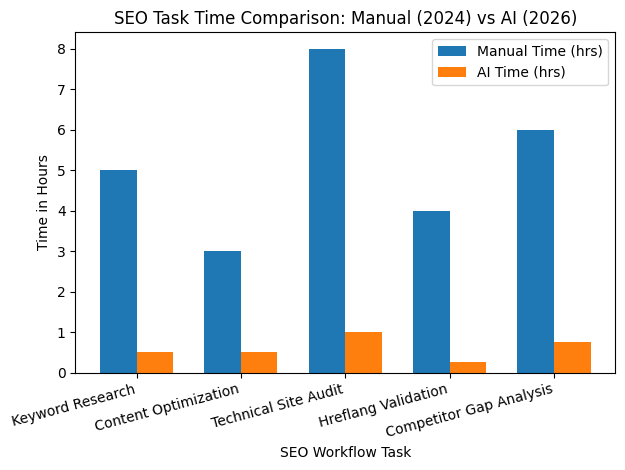
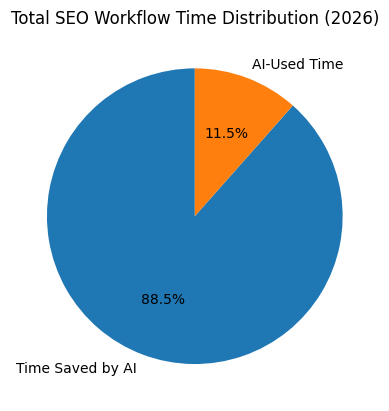
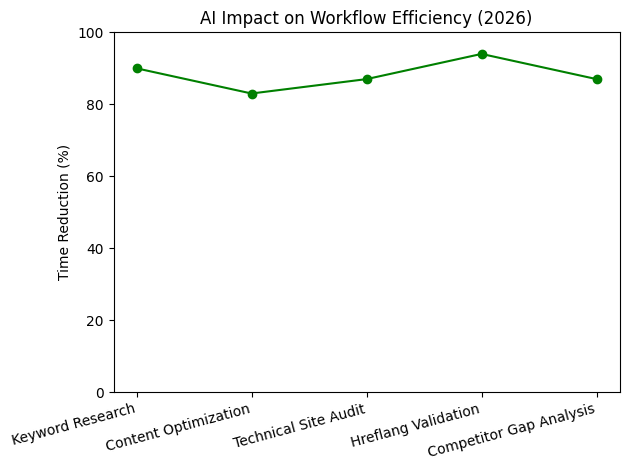
Table 1: Time Savings From AI-Driven Technical SEO Automation (2026 vs 2024)
| SEO Task | Manual Time (2024) | AI-Automated Time (2026) | Time Saved (%) |
|---|---|---|---|
| Keyword Research | 5 Hours | 30 Minutes | 90% |
| Content Optimisation | 3 Hours per Page | 30 Minutes per Page | 83% |
| Technical Site Audit | 8 Hours | 1 Hour | 87% |
| Hreflang Validation | 4 Hours | 15 Minutes | 94% |
| Competitor Gap Analysis | 6 Hours | 45 Minutes | 87% |
AI-Driven Architecture and Semantic SEO for Global Audiences
In the current environment, it is not enough for content to be well-written. It must be structured in a way that large language models (LLMs) and AI search engines can interpret with confidence. This means:
- Clear entity tagging (e.g., persons, places, products)
- Defined relationships between pages through internal linking
- Marking content types such as FAQs, breadcrumbs, or how-to articles using schema
SEO platforms that offer these capabilities at scale, such as Alli AI, Lumar, and SE Ranking, empower brands to deliver optimised content consistently across multiple languages and regions—without the need for extensive manual updates.
Table 2: Technical Readiness Features for AI-Powered International SEO
| Feature | Description | Tools Supporting This Function |
|---|---|---|
| Automated Hreflang Auditing | Detects errors in language targeting across global pages | Screaming Frog, Sitebulb, Lumar |
| Site-Wide Schema Deployment | Applies JSON-LD markup to thousands of URLs | Alli AI |
| Real-Time Technical Error Monitoring | Continuously scans architecture across regions | Lumar |
| Pattern-Based Language Mapping Fixes | Uses AI to resolve hreflang and duplication issues | Sitebulb, Screaming Frog |
| Semantic Entity Definition | Marks up products, services, events for AI clarity | Alli AI, MarketMuse |
Conclusion
The technical layer of AI-powered international SEO in 2026 is built on three pillars: automation, semantic structure, and performance efficiency. AI SEO tools now allow brands to optimise thousands of multilingual pages with significantly less time and effort than ever before.
To remain competitive in global search environments powered by AI, businesses must prioritise making their sites fully machine-readable, ensuring every page is correctly mapped, structured, and semantically defined. Platforms like Alli AI, Screaming Frog, and Lumar lead this evolution—enabling smarter, faster, and scalable international SEO for the AI era.
Economic Performance and ROI Analysis of AI-Powered SEO Tools for Multilingual and International Campaigns in 2026
In 2026, the integration of AI-powered SEO tools into global digital strategies is no longer viewed as optional—it is a clear financial and operational necessity. Brands operating across multiple countries and languages are adopting these technologies not only to scale content and improve visibility but also to achieve superior economic outcomes. The return on investment (ROI) associated with AI SEO implementation extends far beyond cost savings—it also includes higher conversion rates, better revenue forecasting, and significant efficiency improvements.
AI SEO vs Traditional SEO: Conversion Rate and Performance Comparison
AI-based SEO strategies significantly outperform traditional SEO in terms of lead quality and conversion success. Current data shows that brands using AI-driven optimisation achieve an average conversion rate of 14.6%, compared to only 1.7% for manually executed campaigns. This dramatic difference is driven by the ability of AI tools to target user intent more precisely, personalise content, and adjust in real time to changes in SERP dynamics.
Table 1: Conversion Rate Comparison – AI SEO vs Traditional SEO (2026)
| Optimisation Approach | Average Conversion Rate (%) | Performance Uplift (%) |
|---|---|---|
| Manual SEO (Traditional) | 1.7% | Baseline |
| AI-Driven SEO Strategy | 14.6% | +759% |
Key ROI Drivers for Global AI SEO Implementation
Global organisations integrating AI SEO tools are realising tangible economic benefits across several dimensions. These tools are designed not just to save time, but to enhance profitability and reduce risk in increasingly complex multilingual markets.
Table 2: Financial Value Drivers of AI SEO Adoption in 2026
| ROI Category | Description | Average Improvement (%) |
|---|---|---|
| Lower Cost-Per-Acquisition | Smarter audience targeting reduces cost by 50% | –50% CPA |
| Increased Revenue Predictability | Predictive ranking insights improve budget and goal accuracy | High |
| Productivity and Output Gains | AI automation allows 60–80% more content production | +60–80% Efficiency |
| Faster Speed-to-Market | Automated technical audits and localisations accelerate deployment cycles | High |
| Multilingual Campaign Scaling | Localised AI workflows reduce time and translation dependency | High |
AI SEO ROI Calculation Model
Business leaders now use a standardised formula to justify investments in AI SEO platforms, especially in high-budget, international marketing operations. The calculation is based on direct revenue gains and cost reductions relative to the cost of AI software, talent, and infrastructure.
Formula:
ROI (%) = ((Revenue Lift + Cost Savings) – Total AI SEO Cost) ÷ Total AI SEO Cost × 100
Example ROI Projection:
| Metric | Estimated Value (USD) |
|---|---|
| Revenue Lift from AI SEO | $500,000 |
| Cost Savings via Automation | $150,000 |
| Total Cost of AI SEO Stack | $250,000 |
| Calculated ROI | 160% |
This formula provides a transparent framework to measure the economic impact of AI SEO adoption, allowing CMOs and digital leaders to present data-backed proposals.
Expected Sales ROI Uplift After AI SEO Integration
Research shows that companies implementing full-scale AI SEO systems can expect a sales ROI increase between 10% and 20% in the first year alone. This early uplift is typically attributed to:
- Better alignment of content with high-conversion queries
- Reduction in wasteful spend across non-performing regions
- Greater scalability of multilingual assets without increasing team size
Table 3: First-Year Sales ROI Uplift for AI SEO Integration (Global Brands)
| Brand Type | Average First-Year ROI Increase (%) |
|---|---|
| Mid-Sized Multilingual B2C Brand | +10% |
| Enterprise B2B SaaS Company | +15% |
| Global E-Commerce Retailer | +20% |
Conclusion
AI SEO tools are delivering measurable economic value in 2026, especially for brands managing content and campaigns across languages, markets, and platforms. The efficiency, accuracy, and predictive power of these tools enable companies to gain more conversions, reduce operational costs, and increase ROI at a pace traditional SEO workflows cannot match.
For enterprises looking to improve performance across multiple regions while maintaining cost efficiency, adopting AI SEO platforms is a strategic investment with proven financial return.
Strategic Recommendations for Implementing AI SEO Tools in Multilingual and International Campaigns (2026)
In 2026, mastering global SEO requires far more than traditional keyword optimisation. As search engines increasingly rely on AI to interpret user intent and deliver instant answers, companies must restructure their SEO strategies to fit an environment where visibility depends on structured automation, real-time citation, and LLM (Large Language Model) awareness. The most successful global brands are those that adapt to this new landscape with the right combination of tools, processes, and team-wide alignment.
The following strategic recommendations outline how to effectively use the Top 10 AI SEO Tools for Multilingual and International SEO in 2026 to maximise discoverability, conversion, and long-term relevance.
Adopt an AI-Native Technical Infrastructure
To ensure that global websites are machine-readable and indexable across both traditional and AI-driven search platforms, companies must deploy a technical stack optimised for international scale.
Key Actions:
- Use Alli AI for bulk schema deployment and hreflang validation across multilingual domains
- Implement Advanced Web Ranking (AWR) to track visibility in over 4,000 global and regional engines
- Ensure structured data, mobile-first design, and clean site architecture
Tool Alignment Table:
| Objective | Recommended Tool | Capability |
|---|---|---|
| Schema and Hreflang Automation | Alli AI | Global no-code technical SEO deployment |
| International Rank Tracking | AWR | 4,000+ search engines, including Baidu, Yandex, Naver |
| Continuous Technical Monitoring | Lumar | Real-time auditing of multilingual site structures |
Expand into Generative Engine Optimization (GEO)
Traditional SEO tracking alone is no longer enough. Brands must now monitor how they are cited, interpreted, and ranked by AI models such as ChatGPT, Gemini, and Perplexity.
Key Actions:
- Deploy Peec AI to track brand mentions by prompt, language, and model
- Use Profound to evaluate AI Share-of-Voice across engines
- Prioritise content sources known to influence LLM responses
Tool Alignment Table:
| GEO Focus Area | Recommended Tool | Use Case |
|---|---|---|
| Prompt-Level Citation Monitoring | Peec AI | Measures LLM visibility and influence by language/region |
| AI Share-of-Voice Benchmarking | Profound | Tracks brand presence across major generative engines |
| Source Influence in AI Responses | Airefs | Identifies and optimises content feeding AI-generated output |
Implement a Hybrid Content Production Strategy
AI speeds up the content lifecycle, but human insight is essential to maintain quality, relevance, and credibility—especially in regions where trust signals matter for E-E-A-T (Expertise, Experience, Authoritativeness, Trust).
Recommended Approach:
- Follow a 30/70 model where 30% of content development is automated and 70% refined by human experts
- Use Surfer SEO to structure and optimise AI-generated content
- Apply MarketMuse to build topical authority across international content clusters
Content Workflow Table:
| Function | AI Tool Used | Human Role Added |
|---|---|---|
| Topic Planning | MarketMuse | Validate with market-specific insights |
| First Draft Generation | Surfer SEO | Optimise tone and intent alignment per region |
| Final Review and E-E-A-T Layering | Manual Editing | Add original quotes, citations, and personalisation |
Optimise for AI Answer Engines
As zero-click search and answer engine usage increases, it becomes essential to be the brand featured in summarised AI responses. Answer Engine Optimization (AEO) requires proactive targeting of high-intent conversational queries.
Key Actions:
- Use Airefs to detect which forums, review sites, or articles are used as sources by LLMs
- Publish structured, answer-focused content that directly addresses target prompts
- Influence perception through platforms frequently cited by AI, such as Reddit and G2
AEO Implementation Table:
| Task | Recommended Tool | Outcome |
|---|---|---|
| Source-Level Discovery | Airefs | Identifies top-cited domains in AI-generated responses |
| Prompt-Centric Content Planning | Peec AI | Aligns SEO strategy with high-impact LLM prompts |
| AI-Specific Link Building | Manual + AI SEO | Target authoritative sources that feed AI models |
Embed AI SEO into Cross-Departmental Workflows
To unlock full ROI from AI SEO tools, companies must integrate search intelligence into every stage of digital operations—from CMS deployment to PR distribution and product development.
Implementation Guidance:
- Integrate tools like SE Ranking or Surfer SEO with CMS platforms such as Shopify or Adobe Experience Manager
- Use AI insights to guide what features products need based on search demand
- Equip PR and content teams with tools like Peec AI to monitor how earned media impacts AI visibility
Search Integration Matrix:
| Department | Integrated Tool(s) | Search Intelligence Use Case |
|---|---|---|
| Web Development | Alli AI, Lumar | Deploy technical fixes directly into CMS workflows |
| PR & Comms | Peec AI, Airefs | Target media sources that influence AI narratives |
| Product Marketing | Surfer SEO, Profound | Align messaging with high-intent prompts and visibility |
Conclusion
In 2026, global SEO is no longer just about search engine rankings—it is about managing how AI models interpret, cite, and deliver your brand to users across languages and platforms. Success requires a carefully integrated strategy that blends AI automation with human refinement, technical discipline with content creativity, and global scalability with local nuance.
By using the right AI SEO tools outlined in this report—from Alli AI and Peec AI to Surfer SEO and Profound—brands can build the infrastructure and intelligence needed to remain visible, credible, and competitive in every market they enter.
ConclusionAs we navigate a rapidly evolving global digital landscape, the role of AI in multilingual and international SEO has become more than just a competitive advantage—it is now an essential pillar for sustainable growth, relevance, and brand visibility across borders. In 2026, global businesses are no longer judged solely by how well they rank on Google but by how accurately and authoritatively they are interpreted by AI models powering search experiences across platforms like ChatGPT, Gemini, Perplexity, and Google’s AI Overviews.
The shift from keyword-centric strategies to entity-based, prompt-aware optimisation requires a complete rethinking of traditional SEO. Success now depends on a brand’s ability to align its content, technical architecture, and visibility footprint with AI systems that dominate how modern users search, ask questions, and make decisions.
The top 10 AI SEO tools reviewed in this report—Semrush, Ahrefs, SE Ranking, Profound, Alli AI, Advanced Web Ranking (AWR), Peec AI, MarketMuse, Surfer SEO, and Airefs—represent the most advanced solutions available for brands seeking visibility in a multilingual and generative-first search ecosystem. These platforms are not only optimised for local language content creation and technical deployment—they also help brands understand how they are cited, ranked, and trusted by machines.
Why These AI Tools Matter in 2026:
- They empower companies to scale content production across multiple languages without sacrificing quality.
- They ensure proper technical execution with structured data, hreflang management, and schema markup.
- They give visibility into how brands appear in AI-generated answers—a core battleground for brand discovery.
- They provide real-time insights into content performance, prompt-level influence, and regional authority gaps.
- They reduce operational costs while increasing speed-to-market and content localisation accuracy.
Table: AI SEO Tool Value Alignment for Global Strategy
| Strategic Goal | Supported By | Value Delivered |
|---|---|---|
| Scalable Multilingual Content Creation | Surfer SEO, MarketMuse | Fast, optimised content generation across languages |
| Technical SEO Automation at Scale | Alli AI, Lumar | Bulk schema, hreflang, and sitewide fixes |
| Rank and SERP Monitoring Globally | AWR, SE Ranking, Semrush | Search engine coverage in 140+ to 4,000+ international markets |
| GEO and AEO Tracking | Peec AI, Profound, Airefs | Monitor brand visibility across LLMs and answer engines |
| Prompt and Source-Level Optimisation | Airefs, Peec AI | Influence citation sources that LLMs depend on |
| Strategic Content Planning and Authority | MarketMuse, Ahrefs | Build topical coverage and long-term E-E-A-T authority |
The future of SEO is no longer about simply showing up—it is about being selected, cited, and trusted by AI. This requires a precise blend of automation, localisation, and semantic strategy delivered through the best-in-class tools available today.
In conclusion, brands that prioritise the use of these AI-powered SEO platforms will be best positioned to lead in a world where discovery happens in multiple languages, through multiple engines, and increasingly through machines interpreting intent instead of text. The organisations that embrace this shift—those that invest in intelligent infrastructure, multilingual adaptability, and AI-aligned content strategies—will not only secure international reach but define the standards of global visibility in the AI era.
If you find this article useful, why not share it with your hiring manager and C-level suite friends and also leave a nice comment below?
We, at the 9cv9 Research Team, strive to bring the latest and most meaningful data, guides, and statistics to your doorstep.
To get access to top-quality guides, click over to 9cv9 Blog.
To hire top talents using our modern AI-powered recruitment agency, find out more at 9cv9 Modern AI-Powered Recruitment Agency.
People Also Ask
What are the top AI tools for multilingual SEO in 2026?
Leading tools include Semrush, Ahrefs, SE Ranking, Peec AI, Surfer SEO, Profound, MarketMuse, Alli AI, AWR, and Airefs for global search optimization.
Why is multilingual SEO important for global brands?
It helps brands reach international audiences by optimizing content in different languages, increasing visibility and conversions.
How do AI tools improve international SEO strategies?
AI tools automate hreflang tags, optimize multilingual content, and track rankings across global search engines with greater precision.
Which AI tool is best for tracking rankings in multiple countries?
SE Ranking offers extensive rank tracking across 190+ countries, making it ideal for monitoring global visibility.
Can AI tools help with hreflang implementation?
Yes, tools like Screaming Frog and Alli AI automate hreflang tag validation and management, reducing manual errors.
Do AI SEO tools support Baidu, Naver, and Yandex?
Yes, tools like AWR and Alli AI support optimization for regional engines like Baidu, Naver, and Yandex with custom features.
Is localization better than translation for SEO?
Yes, localized content performs better in search rankings as it aligns with cultural and linguistic nuances, boosting engagement.
Which tool offers the best value for multilingual SEO on a budget?
Airefs provides strong multilingual SEO features starting at just $24/month, making it ideal for smaller teams.
How does Peec AI help with international SEO?
Peec AI specializes in GEO visibility and citation tracking, helping brands understand how they’re perceived across global markets.
What’s the role of schema markup in multilingual SEO?
Schema markup helps AI understand the content context, and tools like Alli AI deploy it at scale for better global discoverability.
Which AI tool is best for large enterprise SEO teams?
Semrush and Profound offer enterprise-level analytics, international databases, and integrations ideal for global organizations.
Can AI SEO tools increase ROI for international campaigns?
Yes, companies using AI SEO tools report lower acquisition costs, better targeting, and higher conversion rates.
Are AI SEO tools compatible with CMS platforms?
Most leading tools integrate with CMS platforms like WordPress, Shopify, and Adobe Experience Manager for streamlined workflows.
What is GEO in the context of AI SEO?
Generative Engine Optimization (GEO) focuses on enhancing brand visibility in AI-powered search results and conversational queries.
How does AI SEO differ from traditional SEO methods?
AI SEO is faster, automated, and more accurate, reducing manual work and improving performance through machine learning.
Which tools help optimize content for multiple languages?
Surfer SEO, MarketMuse, and Ahrefs provide multilingual NLP optimization and content gap analysis across regions.
Can AI tools detect gaps in international keyword strategy?
Yes, many tools like Profound and Ahrefs offer competitor gap analysis for global keyword opportunities.
What are the common challenges in multilingual SEO?
Common challenges include hreflang errors, translation inconsistencies, duplicate content, and local keyword targeting.
Is there a way to test localized pages with AI tools?
Yes, platforms like SE Ranking and Screaming Frog simulate searches from different regions to test local visibility.
Which tool offers no-code SEO deployments across regions?
Alli AI allows bulk no-code SEO deployment, making it easier for technical and non-technical users alike.
Can AI tools help track visibility on AI-generated answers?
Yes, Airefs and Profound help monitor how often your content appears in AI answers across platforms like ChatGPT and Google.
What languages are supported by Surfer SEO?
Surfer SEO supports 11 languages with NLP optimization to help content rank better in localized search results.
How often should global brands audit their international SEO?
Brands should audit their SEO quarterly using tools like Lumar or Sitebulb to maintain performance across regions.
Do AI SEO tools help with mobile-first indexing in other countries?
Yes, tools like AWR and Baidu-optimized platforms focus on mobile-first strategies essential for emerging markets.
Can MarketMuse help with international content strategy?
MarketMuse offers site-wide topical mapping that supports content strategy across multiple language domains.
Are multilingual SEO tools useful for small businesses?
Yes, platforms like SE Ranking and Airefs provide cost-effective multilingual SEO solutions for smaller organizations.
How do AI SEO tools ensure compliance with local search engine guidelines?
They adapt strategies based on search engine algorithms like Baidu’s trust system or Yandex’s machine learning models.
What KPIs should brands track with AI SEO tools?
Key KPIs include global search visibility, citation frequency, conversion rates, and localized keyword rankings.
How can brands appear in AI answer engines internationally?
By using tools like Airefs and Peec AI to optimize content structure, citations, and local relevance across languages.
What makes 2026 different for multilingual SEO strategies?
In 2026, AI search engines prioritize content that is fully localized, technically optimized, and semantically structured.
Sources
Mordor Intelligence
AResourcePool
Dot Com Infoway
SEAtongue
Search Influence
AI Business Weekly
Search Engine Land
Weglot
Medium
SEOmator
LuxSite Digital Agency
DesignRush
Veza Digital
Justwords
Single Grain
MADX Digital
GoMage
Airtop AI
Onrec
SE Visible
SE Ranking
SitePoint
Relixir
Nick Lafferty
NudgeNow
Fyresite
The Night Marketer
Salesmate CRM
Airefs
Leads Technologies
The S Marketers
Capital Numbers
DeepL
PR Newswire
The DigiCrawl
ClickRank AI