


Key Takeaways
- GEO tools in 2026 are essential for improving brand visibility across AI search engines like ChatGPT, Gemini, and Perplexity.
- Leading platforms offer features like real-time citation tracking, AI prompt monitoring, and schema-based content optimization.
- Businesses using GEO tools see faster conversions, stronger authority, and higher engagement in AI-generated search results.
In 2026, the digital marketing landscape has entered a transformative era, reshaped by the rise of generative AI technologies and the decline of traditional search engine dominance. As consumer behavior shifts toward AI-driven discovery, brands are now competing for attention within generative platforms rather than conventional link-based results. This new frontier—known as Generative Engine Optimization (GEO)—has emerged as a vital strategy for businesses seeking to remain visible, credible, and competitive in a world where search answers are synthesized, not listed.


GEO focuses on optimizing a brand’s presence across advanced AI engines such as ChatGPT, Google Gemini, Perplexity, Claude, and Google’s AI Overviews. Unlike traditional SEO, which primarily aims for page-one rankings in search results, GEO emphasizes earning citations within AI-generated responses. These citations are increasingly influencing user decisions, as AI interfaces now act as digital gatekeepers—delivering curated answers that bypass the need for multiple clicks or deeper browsing.

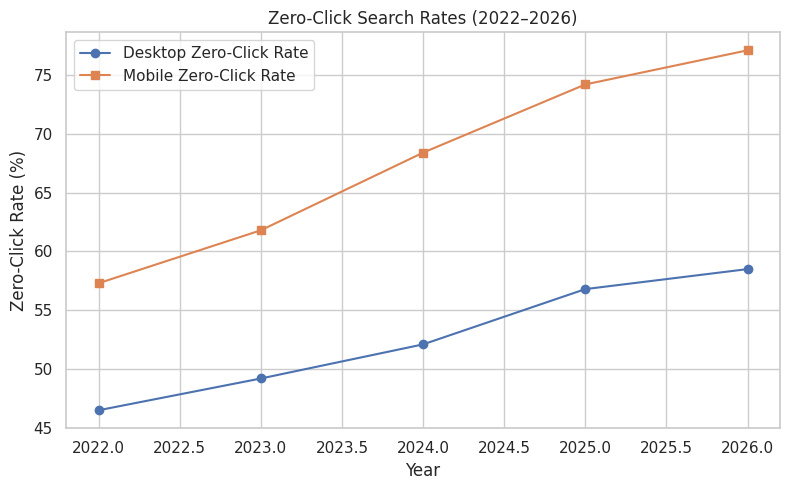
This shift in digital discovery is more than a technical evolution; it marks a fundamental change in how consumers interact with information, products, and brands. Studies conducted in early 2026 reveal that over 25% of all desktop searches result in zero-click outcomes, while mobile zero-click sessions have surged past 77%. AI Overviews and answer engines are rapidly absorbing informational queries, reducing the visibility of brands that rely solely on traditional SEO. At the same time, users arriving through AI-generated citations exhibit higher conversion rates, deeper intent, and a significantly shorter customer journey, making GEO not just a visibility solution but a strategic performance driver.
As the demand for AI visibility intensifies, a new category of tools has emerged to help brands navigate this shift. The top AI tools for GEO in 2026 are built to track, analyze, and optimize brand performance within generative environments. These platforms go beyond simple monitoring. They offer automated schema implementation, structured content analysis, real-time prompt tracking, sentiment monitoring, and citation diagnostics across multiple AI systems.

From enterprise-grade solutions like Bluefish AI and Profound to agile, budget-friendly platforms like Geoptie and Peec AI, the GEO tools market is now filled with intelligent, purpose-built technologies tailored for different organizational needs. Some platforms provide predictive analytics to forecast AI behavior. Others specialize in multilingual prompt coverage, competitive share-of-voice reporting, or modular content engineering to ensure information is easily extractable by AI models.

Choosing the right GEO tool is now a critical business decision. Whether you’re a global brand aiming to control how AI systems describe your offerings or a growth-stage startup trying to gain traction in emerging discovery channels, the right platform can make a measurable difference in your digital strategy.
In this comprehensive guide, we explore the top 10 AI tools for GEO in 2026 that are leading the industry with innovation, technical depth, and results-driven features. Each tool is evaluated based on functionality, scalability, usability, and strategic impact. Together, these platforms represent the future of brand discoverability in the age of generative AI. As we move further into this new paradigm, understanding and leveraging these tools will be essential for businesses determined to thrive in AI-powered ecosystems.
Before we venture further into this article, we would like to share who we are and what we do.
About 9cv9
9cv9 is a business tech startup based in Singapore and Asia, with a strong presence all over the world.
With over nine years of startup and business experience, and being highly involved in connecting with thousands of companies and startups, the 9cv9 team has listed some important learning points in this overview of the Top 10 AI Tools For Generative Engine Optimization in 2026.
If you like to get your company listed in our top B2B software reviews, check out our world-class 9cv9 Media and PR service and pricing plans here.
Top 10 AI Tools For Generative Engine Optimization in 2026
- Bluefish AI
- Profound
- AthenaHQ
- Goodie AI
- Geoptie
- Semrush AI Visibility Toolkit
- Ahrefs Brand Radar
- Peec AI
- Rankscale
- Otterly.AI
1. Bluefish AI

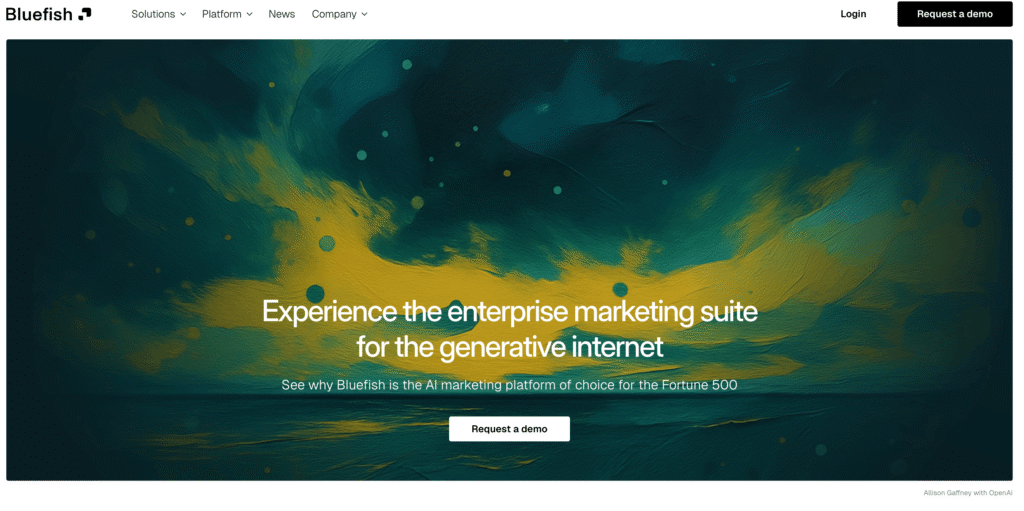
In the evolving world of Generative Engine Optimization (GEO), Bluefish AI has emerged as a top-tier enterprise solution, especially for large corporations seeking brand protection and visibility across AI-driven platforms. Recognized as a trusted platform among Fortune 500 companies, Bluefish AI has positioned itself as an industry leader in AI-based brand governance, reputation monitoring, and generative content evaluation.
Founded in 2024 and headquartered in New York, the company has gained strong financial backing, with a $20 million Series A investment round completed in August 2025, led by NEA and Salesforce Ventures. With a total funding of $24 million, Bluefish AI is strategically focused on helping enterprises monitor and enhance their digital presence within AI search and content ecosystems.
Key Value Proposition and Unique Capabilities
Bluefish AI stands out due to its specialized “Enterprise Marketing Layer.” This advanced system enables marketing, communications, and content teams to gain deep insights into how AI engines represent and position their brand in comparison to industry rivals. It provides accurate tracking of brand sentiment, real-time favorability, and content accuracy across platforms like ChatGPT, Gemini, Perplexity, and Google AI.
A major innovation is its “Collections” feature, which offers companies the ability to track the return on investment (ROI) of their marketing campaigns directly through AI channels. This feature helps standardize the measurement of digital brand authority in a generative context—something increasingly important as AI reshapes how users discover and interact with information.
Strategic Features and Competitive Differentiators
Bluefish AI’s diagnostic technology offers significantly deeper analytical insights than many of its competitors, providing users with 3.4 times greater diagnostic depth compared to the average GEO platform. This empowers enterprises with more precise data to influence how AI platforms describe their brand, products, and reputation.
The following table summarizes the core specifications of Bluefish AI as one of the top 10 global GEO tools in 2026:
Enterprise Overview Table
| Specification | Details |
|---|---|
| Company Name | Bluefish AI |
| Founded Year | 2024 |
| Headquarters | New York, United States |
| Total Funding | $24 Million |
| Latest Investment Round | $20 Million Series A (Aug 2025) |
| Lead Investors | NEA, Salesforce Ventures |
| Target Market | Enterprise Sector (80% Fortune 500 Clients) |
| Notable Clients | Adidas, Tishman Speyer, Verizon, Chanel |
| Core Offering | Brand visibility tracking across generative AI platforms |
| Key Feature | “Collections” for ROI and brand authority analytics |
| Performance Benchmark | 3.4x deeper diagnostic capability than the platform median |
Platform Capability Matrix
| Category | Bluefish AI Highlights |
|---|---|
| Brand Sentiment Analysis | Real-time insights with positive/negative/neutral breakdown |
| Accuracy Monitoring | AI-driven evaluation of brand message consistency |
| Competitive Benchmarking | Comparison of brand mentions and representation across AI tools |
| Cross-Platform Visibility | Tracks performance on ChatGPT, Gemini, Perplexity, Google AI |
| Marketing ROI Measurement | Direct analysis via “Collections” feature |
| Industry Focus | Heavily optimized for enterprise, tech, and consumer brand sectors |
Conclusion
Bluefish AI’s innovative technology and enterprise-centric focus make it a front-runner in the 2026 landscape of GEO platforms. Its capability to deliver high-resolution brand insights, combined with tools to measure campaign impact in real-time, positions it as a vital partner for enterprises seeking to stay competitive in AI-driven environments. As more brands seek control over how they appear within generative search engines and AI assistants, tools like Bluefish AI are becoming mission-critical for long-term digital success.
2. Profound

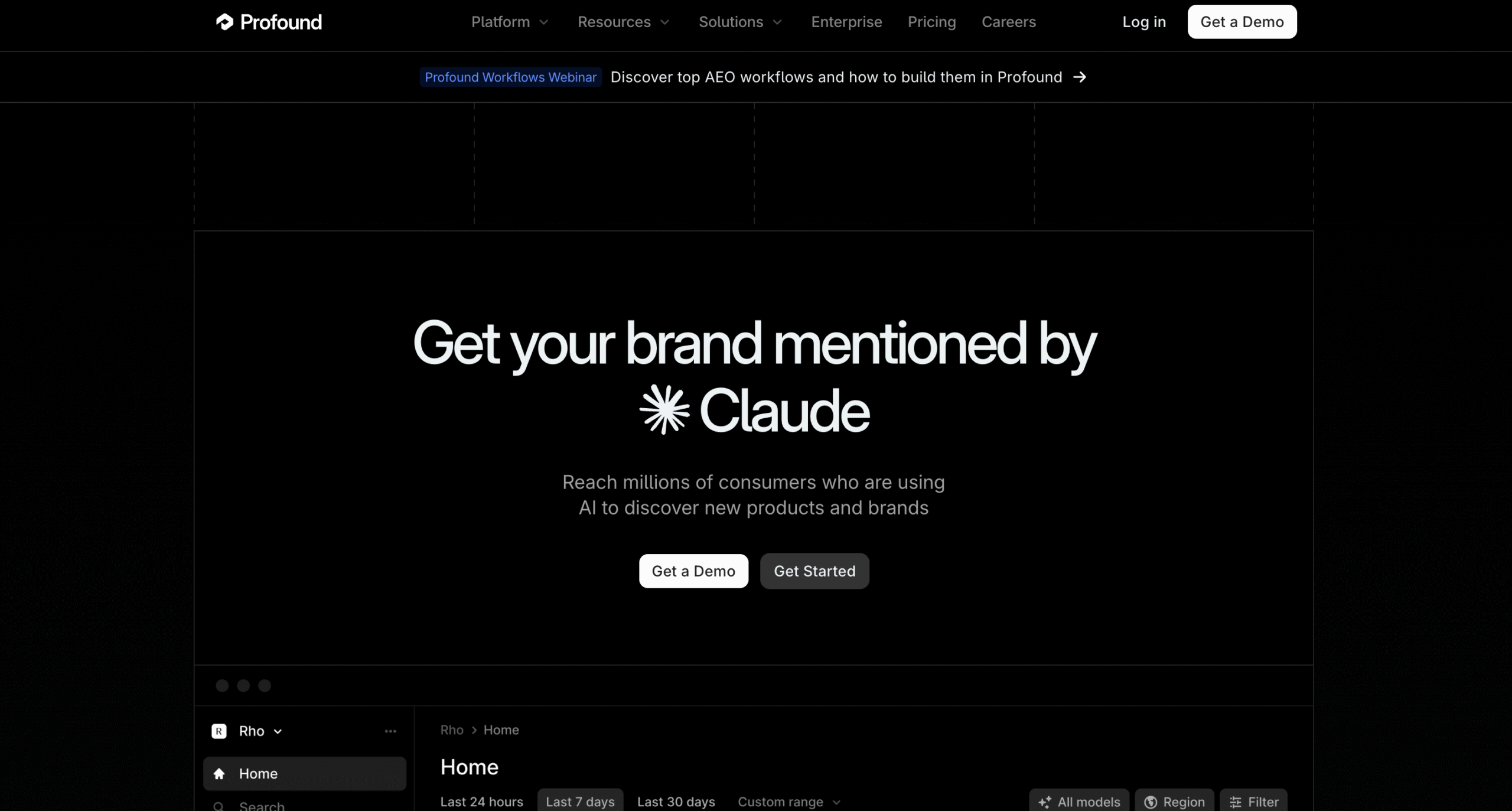
Profound has become a standout name among the top AI tools for Generative Engine Optimization (GEO) in 2026. Known for introducing a futuristic “Agentic” model of search optimization, the platform is specifically designed to support a world where AI agents—not traditional users—drive most digital interactions and commerce decisions. Profound serves as a centralized command platform for marketing teams seeking to optimize brand engagement across AI-powered environments.
By 2025, Profound had already made significant strides in this field. The company secured a $35 million Series B funding round led by Sequoia Capital, further strengthening its positioning as a global leader in AI marketing orchestration. Its agent-centric model and AI-first content publishing tools make it one of the most forward-looking GEO solutions on the market.
Market Position and Vision for AI Commerce
Profound is purpose-built for the rise of AI agents as primary decision-makers in digital commerce. With the ability to both monitor and actively influence how brands appear within AI search environments, it supports businesses in publishing AI-optimized content seamlessly. Unlike many platforms that only offer analytics, Profound takes a “read/write” approach—giving users tools to both understand and shape their brand’s AI visibility in real-time.
Operating across 18 countries and processing over 100 million AI search queries each month, Profound enables companies to stay competitive by aligning their strategies with emerging AI search behavior. One of its most important features is the “Conversation Explorer,” which reveals hidden AI search volume trends. This function uncovers which topics AI agents are increasingly engaging with, helping marketers craft proactive strategies.
Platform Tiers and Pricing Overview
The platform offers a variety of pricing plans tailored to startups, growing businesses, and agencies. These plans vary in scale, from basic AI visibility tracking to enterprise-grade analytics and white-label options.
Profound Pricing Plan Table
| Plan Tier | Monthly Price | Key Features Included |
|---|---|---|
| Profound Lite | $499 | AI visibility tools for startups |
| Starter Plan | $82.50 (Annual Billing) | 50 tracked prompts, basic access |
| Growth Plan | $332.50 (Annual Billing) | 100 tracked prompts, access to advanced analytics |
| Agency Growth | $1,499 | 700 tracked prompts, white-labeling and full platform capabilities |
Capability Matrix for Profound
| Feature Category | Profound Platform Offering |
|---|---|
| GEO Approach | Agentic search optimization, read/write capability |
| AI Search Query Handling | 100+ million monthly AI queries analyzed |
| Geographic Reach | Active support in 18 countries |
| AI Search Trend Discovery | “Conversation Explorer” tool for AI search volume insights |
| Content Publishing | One-click generation and distribution of AI-optimized content |
| Ideal Use Case | Enterprises, agencies, tech-driven businesses |
| Competitive Differentiator | Dual focus on AI monitoring and content creation |
Conclusion
Profound’s strategic focus on AI agent interaction and generative search trends has made it a vital solution for enterprises navigating the next generation of digital discovery. As AI agents increasingly influence buying decisions and content exposure, Profound equips marketing teams with the tools to not only track performance, but also to act immediately through intelligent publishing features. Its advanced analytics, wide global presence, and highly scalable subscription tiers solidify its reputation as one of the top 10 GEO platforms worldwide in 2026.
3. AthenaHQ

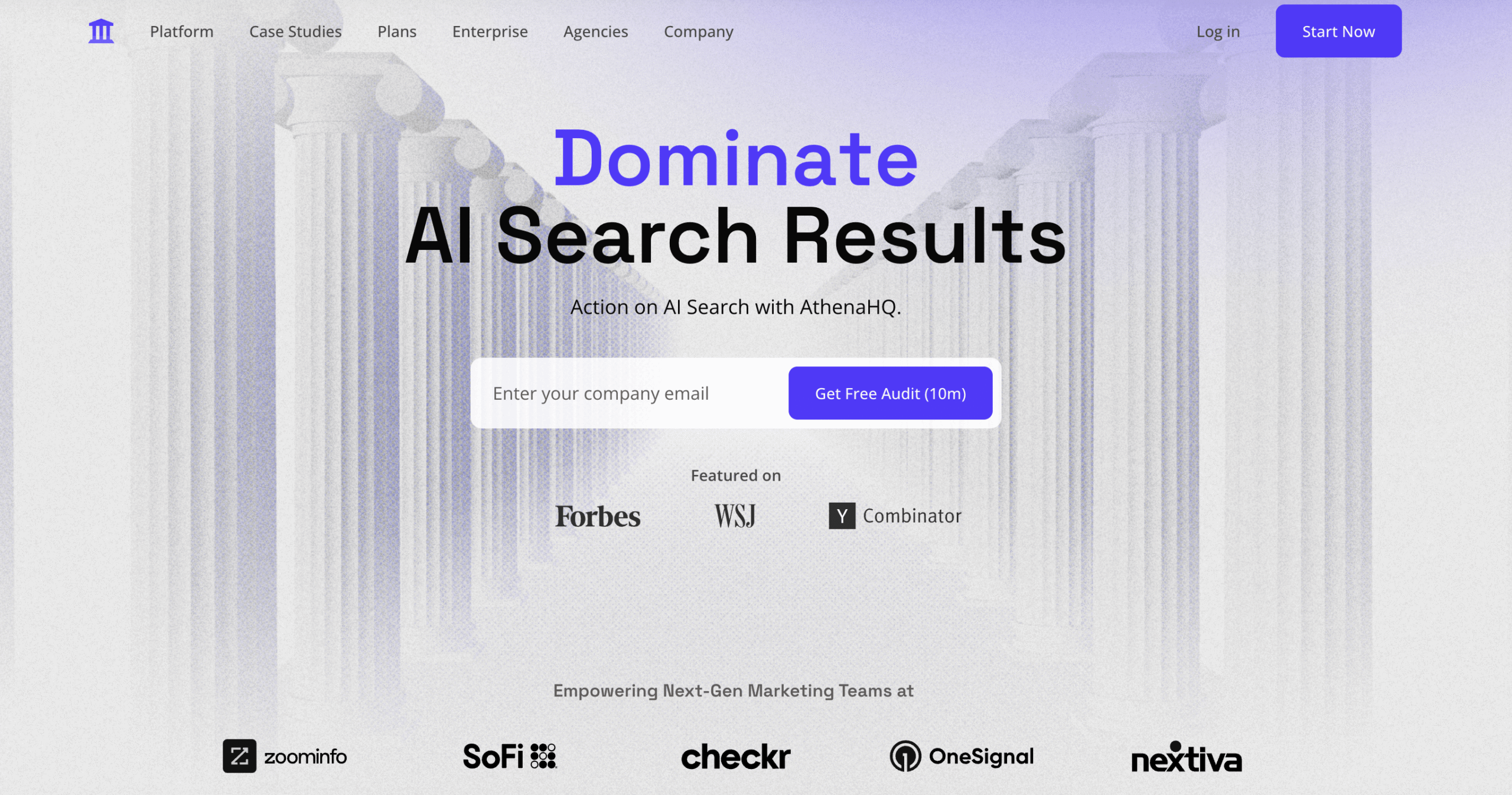
AthenaHQ has earned recognition as one of the top AI platforms in the world for Generative Engine Optimization (GEO) in 2026. Built by a team of former experts from Google Search and DeepMind, the company delivers advanced predictive analytics designed for B2B teams aiming to understand how AI models behave and prioritize information. With support from Y Combinator and strong enterprise traction, AthenaHQ is shaping how global brands navigate the evolving AI search landscape.
Its proprietary Athena Citation Engine (ACE) is one of the platform’s most groundbreaking innovations. This technology helps businesses understand the reasoning behind how and why specific sources are surfaced by generative AI systems. By reverse-engineering these decision-making patterns, brands can strategically position themselves as authoritative answers within generative environments.
AI Coverage and Platform Reach
AthenaHQ offers extensive model coverage on all plans. It monitors behavior across more than eight leading AI engines—including well-known systems such as Copilot and Grok. With the rise of multi-agent and assistant-based search, this broad AI visibility ensures organizations remain competitive and informed on how their content is being evaluated and displayed.
A standout feature of the platform is the “Action Center,” which turns complex gaps in AI content visibility into practical, task-based recommendations. This feature has proven to be highly effective in real-world scenarios—for example, helping the fintech company Ramp improve its AI visibility by over 7 times for key branded content.
AthenaHQ Pricing and Access
Designed for enterprises and advanced B2B teams, AthenaHQ is positioned as a premium GEO platform. It starts at $295 per month, making it suitable for organizations with high content stakes and cross-functional marketing or analytics teams.
One of its most attractive features is the ability to add unlimited users, ensuring that distributed teams across marketing, communications, SEO, and analytics can collaborate without restriction. Additionally, AthenaHQ integrates seamlessly with top business intelligence tools such as Tableau and Power BI, making it easier to bring GEO insights into enterprise dashboards.
AthenaHQ Overview Table
| Specification | Description |
|---|---|
| Company Name | AthenaHQ |
| Backed By | Y Combinator |
| Founding Team | Former Google Search and DeepMind experts |
| Core Technology | Athena Citation Engine (ACE) |
| Primary Use Case | Predictive AI search analysis and source influence |
| Monthly Starting Price | $295 |
| Key Feature | “Action Center” for visibility-to-task automation |
| AI Models Tracked | 8+ AI engines including Copilot and Grok |
| Geographic Coverage | Global support |
| BI Integration | Compatible with Tableau, Power BI |
| Target Customers | Mid to large enterprises |
| Team Access | Unlimited user seats |
AthenaHQ Capability Matrix
| Feature Area | AthenaHQ Capabilities |
|---|---|
| Predictive Search Analytics | Yes – powered by ACE engine |
| Source Influence Mapping | Enables brands to understand AI content selection logic |
| Task Automation for Visibility | Converts AI insights into task suggestions |
| Multi-AI Engine Coverage | Tracks major models like Copilot, Grok, and more |
| Content Authority Engineering | Helps brands engineer their presence into authoritative answers |
| Platform Integration | Tableau and Power BI integration |
| Collaboration Support | Unlimited team members with role-based access |
Conclusion
AthenaHQ stands out in the 2026 GEO landscape by combining powerful reasoning models with real-time visibility insights into how AI systems present information. Its sophisticated analytics and decision-mapping capabilities offer enterprises a strategic edge, helping them navigate the complexities of generative AI search. With robust support for team collaboration, actionable insights, and premium integrations, AthenaHQ has solidified its place among the top 10 AI tools for Generative Engine Optimization globally.
4. Goodie AI

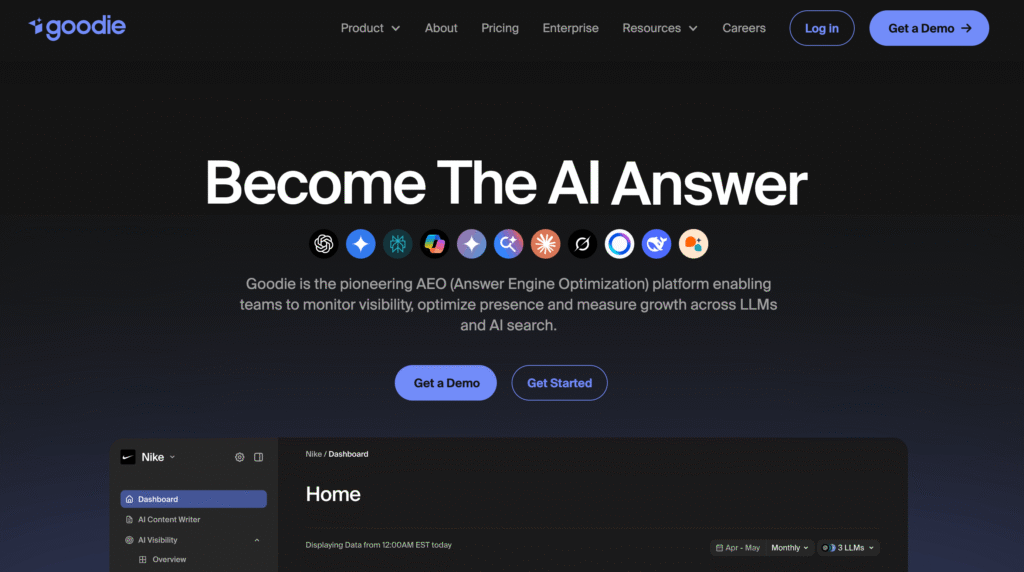
Goodie AI has become one of the top choices among the best AI tools for Generative Engine Optimization (GEO) in 2026. Known for its flexibility and depth, it is often described as the “Swiss Army knife” of GEO tools. This reputation stems from its all-in-one approach, combining AI monitoring, optimization workflows, attribution mapping, and real-time content intelligence—all within a single platform.
It caters especially well to companies that not only want to track performance across generative search platforms but also need clear, actionable recommendations on how to improve visibility and digital impact. The platform helps close the gap between data collection and decision-making by offering a structured workflow to interpret, prioritize, and implement changes.
Global Coverage and Functional Range
Goodie AI tracks over 10 major generative AI engines, covering a broad spectrum of technologies across both Western and regional search models. The platform is well-optimized for global brands, offering built-in multilingual and regional tracking capabilities. This makes it especially effective for international teams seeking alignment in AI visibility strategies across various geographies and languages.
At the core of its utility is the “Optimization Hub,” which automates suggestions based on advanced schema and entity alignment principles. These AI-powered insights are directly connected to revenue-driven metrics, allowing teams to see how each optimization impacts lead generation, brand reach, or sales conversions.
Pricing and Accessibility
With pricing starting at $495 per month, Goodie AI is positioned in the mid-to-premium range of the GEO platform market. Its comprehensive capabilities make it ideal for digital marketing teams, content strategists, and global enterprises managing brand presence across complex AI environments.
Goodie AI Overview Table
| Specification | Description |
|---|---|
| Company Name | Goodie AI |
| Positioning | All-in-one GEO optimization and content intelligence platform |
| Monthly Starting Price | $495 |
| AI Engines Tracked | 10+ major engines including regional and multilingual coverage |
| Key Platform Component | Optimization Hub |
| Optimization Methodology | Automated schema and entity alignment |
| Core Outcome Focus | Maps AI visibility improvements to revenue impact |
| Best Fit For | Global brands, multilingual teams, enterprise content and SEO departments |
Platform Capabilities Matrix
| Function Area | Goodie AI Capability |
|---|---|
| GEO Monitoring | Yes – supports global, multilingual, and regional AI engines |
| AI Optimization Recommendations | Automated through Optimization Hub |
| Attribution and ROI Tracking | Links improvements to revenue and business performance |
| Schema/Entity Alignment | Integrated AI-based optimization engine |
| Content Intelligence | Provides real-time evaluation of brand presence across AI platforms |
| Team Fit | Marketing teams, content strategists, enterprise SEO leaders |
Conclusion
Goodie AI delivers a powerful combination of tracking, insights, and implementation tools, making it one of the most valuable platforms for companies embracing Generative Engine Optimization strategies in 2026. Its holistic approach enables teams to not only identify performance issues but also to act on them in a way that aligns with revenue goals and long-term growth. This ability to connect AI visibility with actionable outcomes makes Goodie AI a critical tool in the GEO technology ecosystem.
5. Geoptie

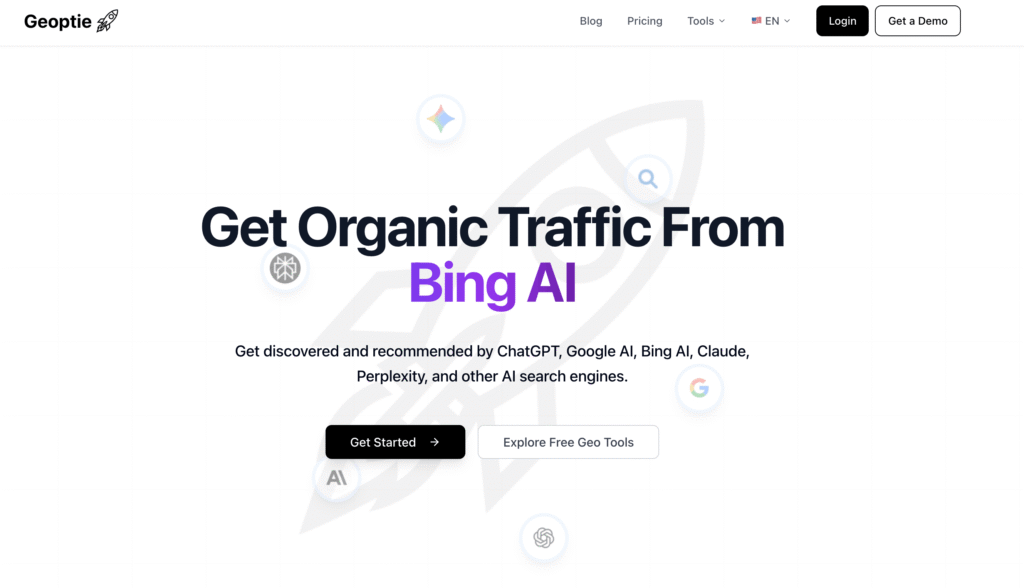
Geoptie has positioned itself as one of the most accessible and value-rich AI tools for Generative Engine Optimization (GEO) in 2026. Tailored specifically for startups, growth teams, and smaller organizations, Geoptie delivers powerful GEO functionalities at a budget-friendly price—making it a standout choice for companies looking to strengthen their visibility in AI-generated search without the cost burden of enterprise software.
At just $49 per month, Geoptie provides an extensive toolkit that includes real-time AI visibility tracking, content analysis, keyword scoring, and citation-based optimization. This makes it a compelling solution for marketing and SEO teams seeking actionable insights into how their brand is represented by generative AI platforms such as ChatGPT, Claude, and others.
Tools and Functional Highlights
Geoptie combines simplicity and power through key tools like the GEO Audit, Content Checker, and Keyword Finder. The GEO Audit evaluates the presence and positioning of a brand across major AI platforms, while the Content Checker analyzes textual content for clarity, semantic alignment, and authority indicators—ensuring that marketing assets are fully optimized for generative engines.
Additionally, the Keyword Finder is one of Geoptie’s most strategic tools. It assigns a proprietary GEO score to each keyword, which reflects its potential to trigger high-visibility citations in AI-generated content. This empowers content teams to prioritize and focus on keyword strategies that are more likely to gain traction in the generative search environment.
Geoptie Subscription and Plan Overview
The platform’s subscription plans are structured to cater to users at different growth stages, from startups to advanced marketing teams. Even its most affordable tier includes core GEO features that are essential for visibility and ranking improvement.
Geoptie Pricing and Feature Table
| Subscription Tier | Monthly Cost | Key Features Included |
|---|---|---|
| Starter | $49 | AI visibility tracking, 14-day trial, keyword GEO scoring |
| Professional | $99 | All starter features + competitor citation analysis |
| Enterprise | $199 | Unlimited GEO audit reports, advanced content intelligence, full access |
Geoptie Capability Matrix
| Functional Area | Geoptie Capabilities |
|---|---|
| GEO Audit Tools | Analyzes AI-generated brand mentions across major models |
| Content Intelligence | Checks semantic clarity and authority in written content |
| Keyword Optimization | Proprietary GEO score to prioritize search-friendly keyword usage |
| Citation Analysis | Tracks competitive presence in AI citations |
| AI Engine Coverage | Compatible with ChatGPT, Claude, and other popular generative models |
| Accessibility & Pricing | Affordable plans ideal for growth teams and budget-focused organizations |
Conclusion
Geoptie stands out in the 2026 GEO landscape by offering a highly capable yet affordable platform that democratizes access to AI visibility tools. For startups and smaller teams that want the benefits of generative engine optimization without committing to complex or expensive systems, Geoptie provides a perfect balance of affordability, automation, and strategic insight. Its layered plans, intelligent keyword scoring, and content clarity analysis help users take tangible steps toward higher AI-driven visibility and long-term digital performance.
6. Semrush AI Visibility Toolkit


Semrush, a globally recognized leader in SEO and digital marketing software, has expanded its ecosystem in 2026 by introducing the AI Visibility Toolkit—a powerful add-on tailored for Generative Engine Optimization (GEO). Designed for Semrush’s 10 million+ users, this toolkit enables marketers and SEO teams to monitor, compare, and enhance brand visibility across both traditional search engines and AI-driven platforms like ChatGPT and Gemini.
This toolkit is ideal for professionals who want a unified workspace where they can understand how generative AI engines perceive their brand, alongside their conventional search engine performance. As AI-generated responses become increasingly influential in user decision-making, this dual-tracking capability is critical for maintaining digital competitiveness.
Core Functions and Strategic Benefits
The main feature of this toolkit is its AI Visibility Score, which quantifies how prominently a brand appears across AI assistants in response to various prompts. Depending on the user’s subscription tier, the platform supports tracking of 25 to 200 AI search prompts—providing flexible coverage for small businesses, agencies, and enterprise-level teams.
Additionally, the Unified Dashboard stands out by offering a side-by-side comparison of SEO rankings and AI-driven search responses. This feature makes it easier for users to identify gaps, refine strategy, and allocate efforts more effectively across both traditional and generative search environments.
Pricing Tiers and Plan Accessibility
The Semrush AI Visibility Toolkit is available either as a standalone subscription or bundled within the broader Semrush One suite. This tiered pricing structure ensures accessibility for a wide range of users, from individual marketers to full-service agencies and enterprise teams.
Semrush AI Visibility Toolkit Pricing Table
| Subscription Option | Monthly Cost | Key Features Included |
|---|---|---|
| Standalone Toolkit | $99 | AI Visibility Score, 25–200 tracked prompts, unified dashboard integration |
| Semrush One Bundle | $199+ | Full SEO + GEO platform access with integrated tracking, analysis, and reporting |
Toolkit Capabilities Matrix
| Feature Category | Description |
|---|---|
| AI Visibility Score | Evaluates brand presence in AI-generated results across prompts |
| Prompt Tracking Capacity | Supports 25 to 200 prompts based on subscription tier |
| Unified Dashboard | Side-by-side analysis of generative AI and traditional SEO rankings |
| Platform Integration | Seamless with Semrush’s existing tools and workflows |
| Ideal User Profile | SEO teams, digital marketers, content strategists |
| Market Position | Add-on for Semrush’s core SEO user base with enhanced AI monitoring capabilities |
Conclusion
The Semrush AI Visibility Toolkit adds immense value to the broader Semrush suite by integrating GEO capabilities into familiar SEO workflows. It provides professionals with critical insights into how their brand is ranked, described, and represented across both search engines and AI-driven assistants. By combining prompt-based tracking, score-based benchmarking, and unified analytics, this toolkit has become an essential component for digital teams looking to stay ahead in the 2026 AI-powered search ecosystem. Its accessibility, robust metrics, and seamless integration make it one of the top 10 AI tools for Generative Engine Optimization globally.
7. Ahrefs Brand Radar


Ahrefs has expanded its well-known SEO data capabilities into the field of Generative Engine Optimization (GEO) with the launch of Brand Radar. In 2026, this tool is recognized as one of the top AI-driven platforms for monitoring and protecting brand visibility across the growing “AI internet.” It is designed for marketing teams that want reliable, large-scale data to understand how AI systems reference and describe their brand.
Brand Radar is powered by Ahrefs’ massive index of more than 250 million prompts. This large dataset gives users deep insight into how generative AI systems select, cite, and summarize brand information. Instead of relying on small samples, the tool uses broad data coverage to deliver more accurate brand health analysis across AI assistants and content-driven platforms such as YouTube and TikTok.
AI-Driven Brand Monitoring Across the Expanding AI Ecosystem
Ahrefs approaches GEO from a data-first perspective. Its strength lies in its long-established search index infrastructure, now extended into generative AI tracking. Brand Radar enables companies to see how often their brand appears in AI-generated responses and which third-party sources influence those responses.
This is especially important in 2026, as AI assistants increasingly pull information from platforms like Reddit, Wikipedia, forums, and video platforms. By identifying which sources drive visibility, businesses can refine their content strategy and strengthen authority in the right ecosystems.
Pricing Structure and Access Options
Ahrefs offers flexible access options for teams with different tracking needs. While basic access is included within the Ahrefs Lite plan, deeper AI index tracking is available through additional pricing tiers. This structure allows companies to scale their GEO monitoring based on business size and competitive intensity.
Ahrefs Brand Radar Pricing Overview
| Plan Option | Monthly Cost | Access Details and Coverage |
|---|---|---|
| Ahrefs Lite | $129 | Includes access to Brand Radar with limited AI tracking |
| Single AI Index Tracking | $199 per index | Full tracking for one selected AI index |
| 6-Index Bundle | $699 | Comprehensive tracking across six AI indexes |
Core Capabilities and Competitive Strengths
Brand Radar stands out because of its ability to trace AI answers back to specific third-party sources. This allows brands to understand not only whether they are visible, but also why they are visible. For example, if Reddit discussions or Wikipedia pages heavily influence AI responses, marketing teams can optimize those sources to improve authority and citation frequency.
The platform also supports monitoring across emerging AI-driven content ecosystems, including video and social platforms. This broader visibility gives organizations a complete picture of their brand health across both traditional search and generative environments.
Ahrefs Brand Radar Capability Matrix
| Capability Area | Description |
|---|---|
| AI Prompt Database Size | 250 million indexed prompts |
| AI Brand Visibility Tracking | Monitors brand mentions across AI-generated responses |
| Third-Party Source Identification | Identifies influence from platforms like Reddit and Wikipedia |
| Multi-Platform Coverage | Includes AI web search, YouTube, TikTok, and related ecosystems |
| Data Accuracy Focus | Built on Ahrefs’ large-scale search index infrastructure |
| Suitable For | SEO teams, enterprise marketers, brand reputation managers |
Strategic Value in the GEO Landscape
Ahrefs Brand Radar is especially valuable for organizations that prioritize data depth and evidence-based optimization. Its large prompt index ensures that brand insights are based on significant sample sizes rather than limited datasets. For enterprises and agencies managing multiple markets, the ability to track AI index performance separately or in bundles offers strategic flexibility.
As generative AI continues to reshape how users discover information, tools like Ahrefs Brand Radar help companies move beyond guesswork. By identifying which sources power AI answers and measuring visibility at scale, the platform has secured its place among the top 10 AI tools for Generative Engine Optimization worldwide in 2026.
8. Peec AI

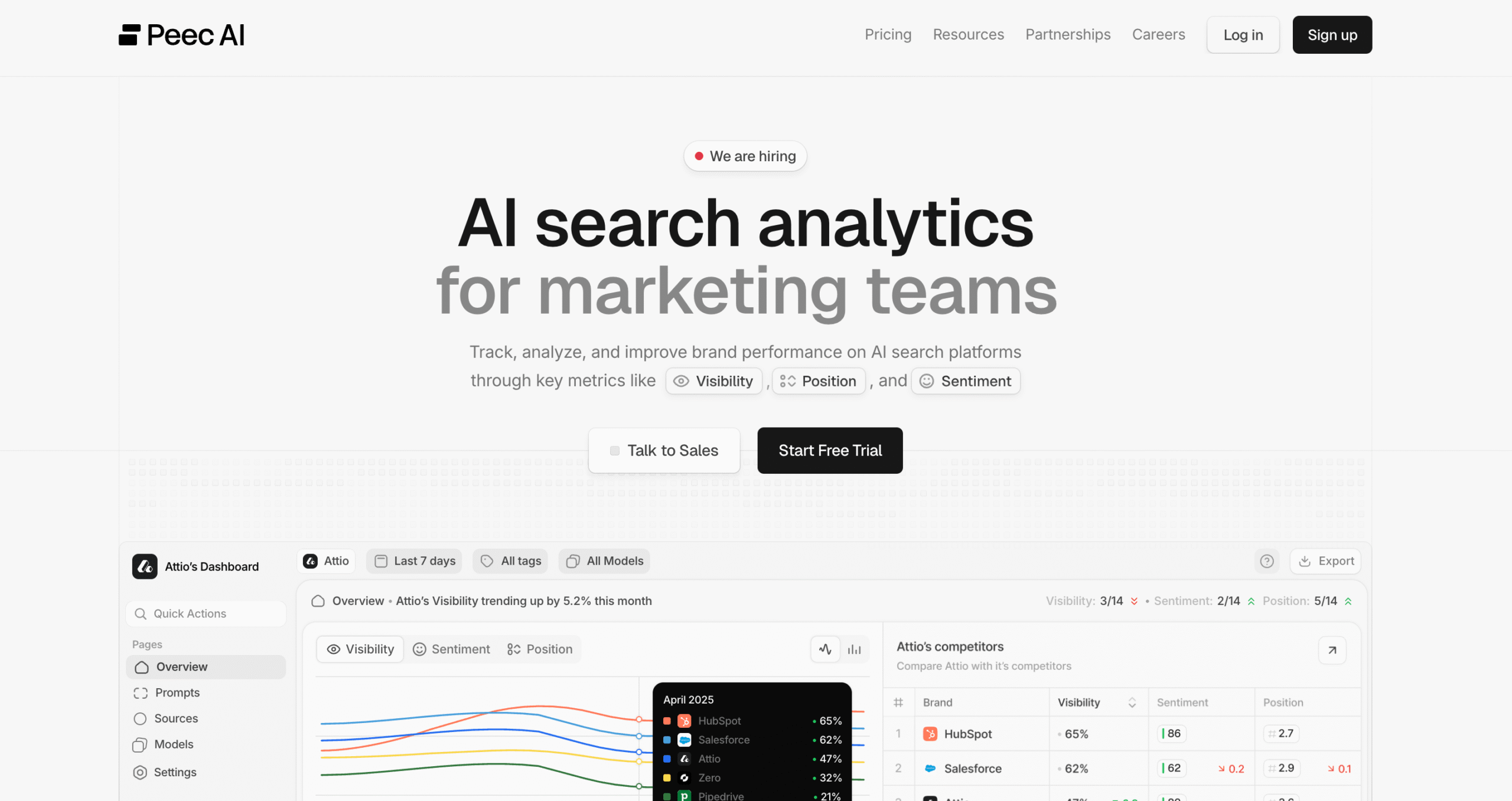
Peec AI has earned its place among the top AI tools for Generative Engine Optimization (GEO) in 2026 by delivering a lightweight, responsive, and user-friendly platform designed for speed and adaptability. Tailored especially for digital agencies, PR departments, and in-house marketing teams, Peec AI enables rapid deployment, real-time alerts, and sentiment-aware brand monitoring across AI-generated environments.
With a setup process that takes less than three minutes, Peec AI offers immediate access to key brand metrics. Its fast configuration and intuitive dashboard make it highly practical for teams that require immediate insights, especially during brand visibility shifts, algorithmic changes, or potential online crises.
Crisis-Ready Features and Sentiment Tracking Capabilities
Peec AI’s biggest strength lies in its early warning system, which detects significant visibility drops in AI-generated content. This makes it an ideal solution for brand protection, helping teams take corrective action before reputational damage occurs.
In addition to visibility tracking, Peec AI includes built-in sentiment analysis in its mid-tier plans—an advanced feature that is usually reserved for premium offerings on other platforms. This functionality helps teams not only monitor how often their brand is mentioned by AI platforms like ChatGPT and Claude, but also analyze whether those mentions are positive, neutral, or negative.
Pricing Tiers Designed for Flexibility
Peec AI offers a tiered pricing structure that accommodates the needs of startups, growing agencies, and large enterprises. Each plan offers a different level of access to visibility tracking, sentiment monitoring, and notification systems.
Peec AI Pricing Structure Table
| Plan Tier | Monthly Price | Key Features Included |
|---|---|---|
| Starter | €89 | Quick setup, real-time visibility tracking, basic alerts |
| Professional | €199 | All Starter features plus sentiment tracking, more prompt monitoring |
| Enterprise | €499 | Full visibility analytics, advanced alerts, large-scale campaign monitoring |
Peec AI Functionality Matrix
| Capability Category | Feature Description |
|---|---|
| Setup Speed | Three-minute configuration, ready for immediate use |
| Visibility Drop Alerts | Real-time early warning system for brand visibility declines |
| Sentiment Analysis | Tracks tone of AI-generated brand mentions (positive, neutral, negative) |
| GEO Prompt Monitoring | AI assistant tracking across popular models like ChatGPT, Claude, and Gemini |
| Use Case Fit | Ideal for agencies, PR teams, crisis managers, and content marketers |
| Interface Style | Clean dashboard layout, user-friendly controls, minimal learning curve |
Conclusion
Peec AI provides essential GEO functions through a sleek and easy-to-use platform that emphasizes speed, real-time monitoring, and sentiment intelligence. For teams that need to act quickly when their brand’s visibility or perception changes, Peec AI delivers a proactive solution. Its integration of sentiment analysis within mid-tier pricing, coupled with a frictionless onboarding experience, places it firmly among the top 10 GEO tools in 2026—particularly for agile teams operating in fast-moving digital environments.
9. Rankscale

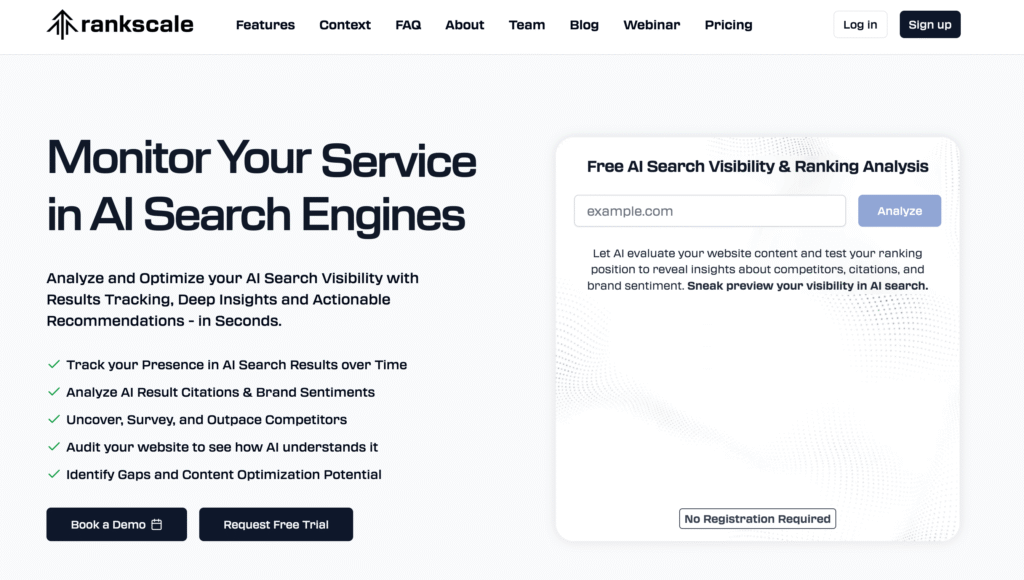
Rankscale has gained recognition in 2026 as one of the top AI tools for Generative Engine Optimization (GEO), especially for marketers and digital professionals who prefer a flexible, pay-per-use structure. With its credit-based pricing and granular keyword tracking capabilities, Rankscale offers a cost-effective and powerful solution for monitoring brand visibility across leading AI-powered search engines and assistants.
What makes Rankscale particularly attractive is its ability to offer targeted and region-specific GEO data without requiring a large subscription commitment. This flexibility allows marketing teams, freelancers, and SEO analysts to track performance at scale or focus only on strategic areas without overpaying for unused resources.
Flexible Credit System and Pricing Advantages
Rankscale operates on a simple and transparent credit-based pricing system. For $20, users receive 120 credits, which can be applied toward monitoring specific keywords, locations, or indexing events. This approach enables teams to scale GEO audits based on current campaign needs or market changes, rather than being locked into fixed tiers.
The tool is particularly useful for businesses that want to test new keyword strategies, monitor changes after content updates, or evaluate visibility in emerging regions—without committing to full enterprise-level plans.
Rankscale Pricing and Credit Allocation Table
| Pricing Option | Monthly Cost | Credit Allocation | Use Flexibility |
|---|---|---|---|
| Entry-Level Package | $20 | 120 credits | Keyword, region, or index-specific tracking |
| Additional Credits | Varies | Pay-as-you-go | Purchase based on monitoring frequency |
Deep GEO Diagnostics and Performance Reporting
Rankscale provides advanced analytics through its Visibility Score dashboard, which helps users understand how prominently their brand appears in generative AI results. In addition, the built-in GEO Audit tool examines over 25 technical and content-related factors that could affect a brand’s ability to be indexed or cited by AI systems.
These insights help identify and correct potential visibility blockers such as improper schema markup, missing entity references, weak keyword relevance, and content duplication—making it especially valuable for technical SEO teams and GEO strategists.
Rankscale Features and Functionality Matrix
| Feature Category | Rankscale Capabilities |
|---|---|
| GEO Audit Tool | Analyzes 25+ technical factors affecting AI indexing and visibility |
| Visibility Score Dashboard | Tracks brand exposure across generative search results |
| Credit-Based System | Flexible usage for different project scales and keyword testing |
| Regional and Keyword Targeting | Allows focused GEO tracking by location and term |
| Best Use Case | SEO specialists, content marketers, freelance strategists, budget-focused teams |
| Platform Flexibility | Ideal for projects with fluctuating GEO analysis needs |
Conclusion
Rankscale’s credit-based structure and diagnostic depth make it a standout choice in the evolving world of Generative Engine Optimization. As AI-driven search continues to transform digital marketing, Rankscale offers a low-barrier entry for teams seeking reliable visibility metrics and technical audits without the overhead of expensive contracts. Its combination of affordability, precision, and control ensures it remains one of the top 10 GEO tools available in 2026, particularly for lean teams and agile marketing operations.
10. Otterly.AI

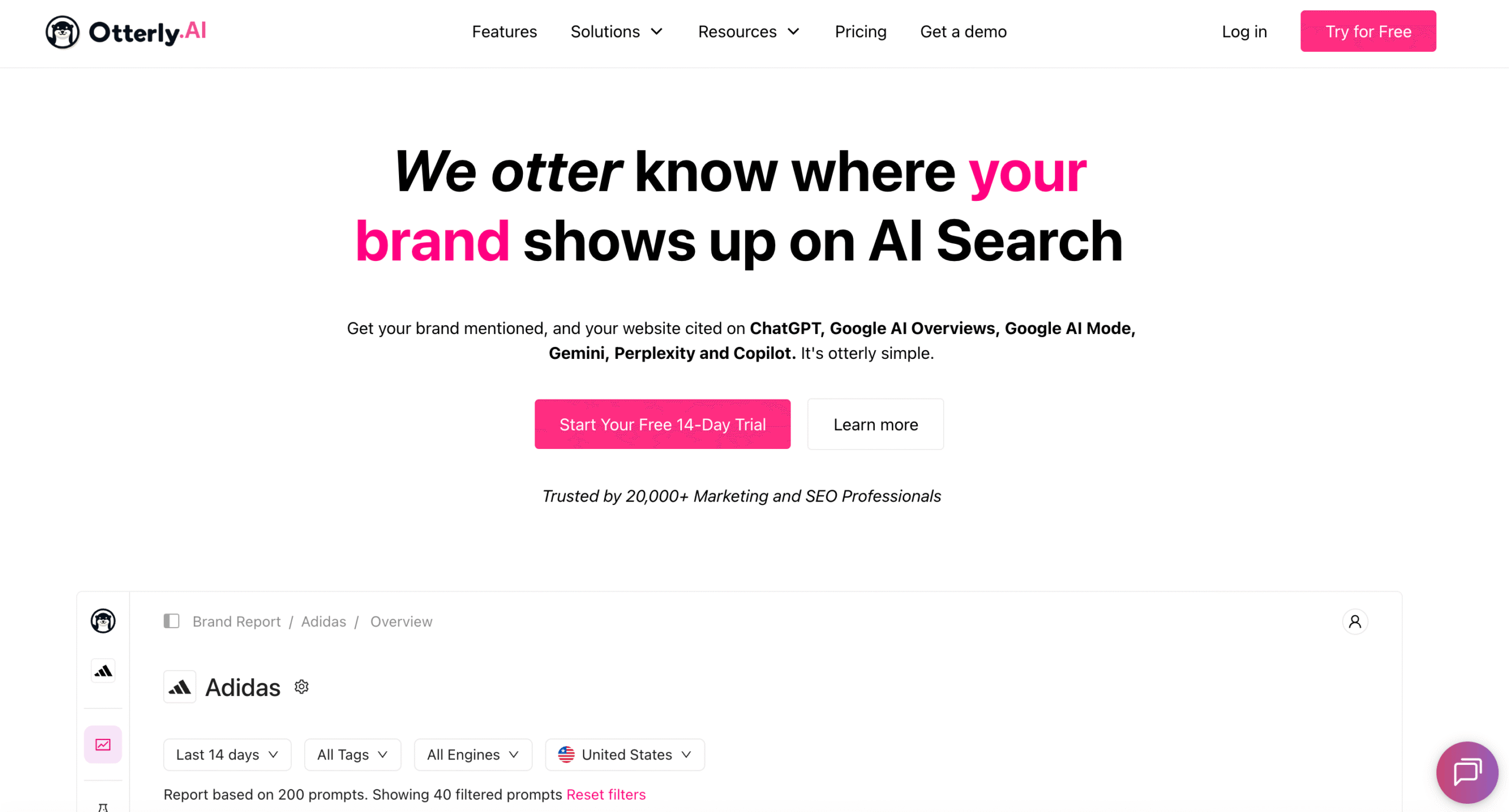
Otterly.AI has emerged as one of the top AI tools for Generative Engine Optimization (GEO) in 2026, especially for global companies managing regional brand visibility across multiple markets. Known for its automation-first approach, Otterly.AI is purpose-built for businesses that need to perform AI audits on a wide scale while adapting to different geographic and linguistic environments.
The platform is particularly valuable for brands that want to understand how their content and reputation are represented across localized AI queries. It leverages automated workflows, intelligent recommendations, and multi-model AI engine tracking to help users improve citation frequency, content alignment, and technical relevance in generative search results.
Automation and GEO Simulation for Global Performance
At the heart of Otterly.AI’s success is its powerful Action Center, which automatically generates optimization tasks and recommendations based on audit results. These suggestions are ready to be shared with internal teams or clients, making it ideal for agencies and enterprise marketing departments.
Otterly.AI also distinguishes itself by simulating AI search behavior across geographic regions. This allows users to evaluate how a brand appears to AI systems in different countries or cities—an essential feature for international companies that rely on localized marketing strategies.
Otterly.AI Pricing Plan and Coverage Table
| Subscription Tier | Monthly Price Range | Key Features Included |
|---|---|---|
| Lite Plan | $25–$29 | Basic AI monitoring, regional prompt simulation, core visibility analysis |
| Pro Plan | $989 | Full access to all engines, automated recommendations, multi-market auditing |
Technical and Functional Capabilities Matrix
| Capability Category | Otterly.AI Functions and Benefits |
|---|---|
| Regional AI Simulation | Simulates AI queries from different locations to analyze local visibility |
| Multi-Engine Monitoring | Tracks performance across six leading generative AI engines |
| GEO Audit Automation | Detects weak points in AI visibility and triggers recommendations automatically |
| Action Center Recommendations | Delivers clear, client-ready tasks to improve GEO and citation performance |
| Brand Localization Optimization | Supports international businesses with multi-region search behavior insights |
| Ideal User Profile | Global brands, digital agencies, enterprise SEO teams |
Conclusion
Otterly.AI delivers significant value through its advanced automation, regional intelligence capabilities, and GEO-focused auditing tools. By simulating local AI search performance and offering structured, ready-to-implement actions, it helps teams move beyond data collection into immediate impact. For organizations looking to optimize their presence across varied digital territories and AI platforms, Otterly.AI is a top-tier solution and one of the most reliable tools in the 2026 GEO landscape.
The Global Shift from Traditional Search to Generative Engine Optimization in 2026
The digital discovery ecosystem in 2026 has undergone a profound transformation. The long-standing model of keyword-based search and link navigation has been largely replaced by intelligent, AI-driven synthesis engines. This change, defined by the rise of Generative Engine Optimization (GEO), has introduced a new era in how information is surfaced, consumed, and valued. GEO represents one of the most significant technological and marketing shifts since the rise of commercial search engines in the late 1990s.
From Retrieval to Generative Synthesis: The Decline of the “Ten Blue Links”
For over two decades, digital marketing strategies focused on achieving high rankings in search engine results, with users navigating through pages of hyperlinked websites. That model has now been largely replaced. In 2026, generative Answer Engines—like ChatGPT, Perplexity, and Google’s AI Overviews—have taken the lead by generating synthesized responses directly in the interface. This removes the need for users to click external links, leading to what is now called the “zero-click” environment.
By the start of 2026, usage of traditional search engines dropped by nearly 25%. In categories such as healthcare, organic traffic saw declines of up to 50% for informational queries. AI search has emerged not as an alternative, but as a new dominant interface for accessing knowledge.
Rise of AI Overview Responses and the New Attention Economy
Empirical research from over 21.9 million search queries confirms the impact of AI Overviews (AIOs). Around 25% of Google queries now produce an AI-generated summary. In high-value domains like healthcare, this rises to nearly 49%. Mobile usage has accelerated this shift even further, with zero-click search sessions reaching 77.1%, up from 57.3% in just four years. These sessions are increasingly satisfied by AI interfaces that contain all necessary information within the search result, reducing the need for outbound clicks.
As a result, digital strategy has evolved. Where businesses once focused on ranking first in search engine results, they now aim to earn citations within generative AI responses. Being featured as a cited source inside an AI-generated summary has been shown to boost click-through rates by 35% compared to being excluded.
Year-over-Year Trends in Search Discovery Metrics
| Metric | 2022 | 2023 | 2024 | 2025 | 2026 |
|---|---|---|---|---|---|
| Desktop Zero-Click Rate | 46.5% | 49.2% | 52.1% | 56.8% | 58.5% |
| Mobile Zero-Click Rate | 57.3% | 61.8% | 68.4% | 74.2% | 77.1% |
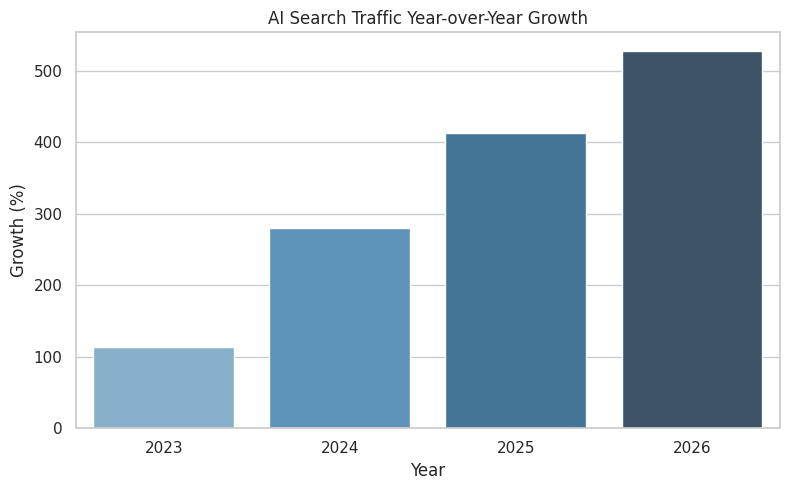
| AI Search Traffic Growth (YoY) | N/A | 114% | 280% | 412% | 527% |
Primary Driver of Information Discovery by Year
| Year | Dominant Discovery Channel |
|---|---|
| 2022 | Ads and Snippets |
| 2023 | Instant Answers |
| 2024 | Search Generative Experience (Beta) |
| 2025 | ChatGPT and Perplexity |
| 2026 | Full AI Overview Interfaces |
The Value of AI Search Traffic in the GEO Era
Although AI referral traffic still accounts for just over 1% of total digital traffic, it has a significantly higher commercial value. On average, AI search visitors are now 4.4 times more valuable than those arriving via traditional organic search. These users demonstrate deeper intent and greater engagement. In the retail sector, referral traffic from generative platforms like ChatGPT shows a 27% lower bounce rate compared to traditional channels.
Moreover, the nature of search behavior itself has changed. Traditional searches typically involve 3–4 words, while AI-driven queries now average 23 words. This reflects a deeper, more conversational form of engagement, with users seeking complete, contextual answers rather than a list of links.
Comparative Visitor Engagement Metrics
| Traffic Source | Average Query Length | Bounce Rate Reduction | Visitor Value Index |
|---|---|---|---|
| Traditional Search | 4 words | Baseline | 1.0x |
| Generative AI Referral | 23 words | -27% in retail sectors | 4.4x |
Conclusion
The rise of Generative Engine Optimization has redefined how visibility, authority, and attention are earned in the digital space. AI-generated answers are now the primary interface through which users interact with the web. For brands and marketers, success in 2026 is no longer about outranking competitors on a results page—it’s about being embedded within the answer itself.
This structural change in search and content discovery requires a new set of tools, strategies, and performance indicators. As the generative ecosystem grows, companies that understand and invest in GEO will be the ones who remain discoverable, trusted, and relevant in a world driven by synthesized intelligence.
GEO Market Growth in 2026 and the Emerging Economic Framework
In 2026, the Generative Engine Optimization (GEO) industry has entered a phase of rapid global expansion. As businesses compete to maintain and recover visibility within AI-generated search environments, demand for GEO tools and services is accelerating. This surge is not only redefining digital marketing but is also shaping new economic benchmarks in the discovery landscape.
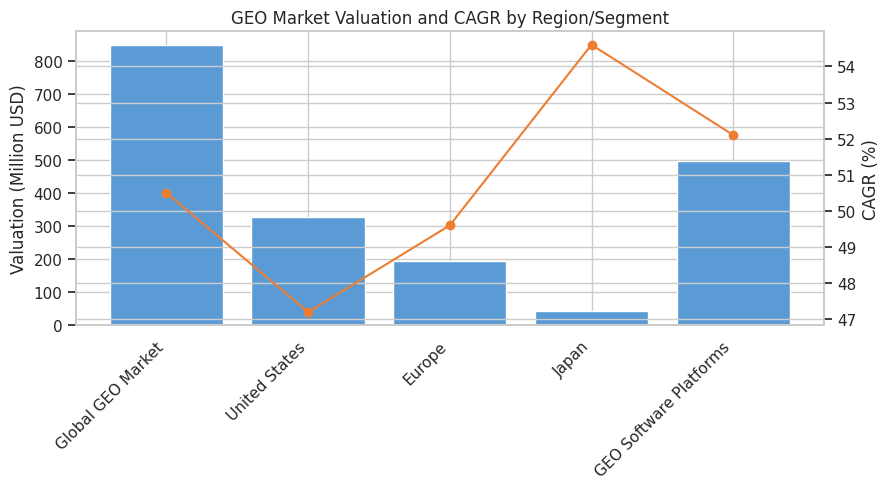
The global GEO market was valued at approximately USD 886 million in 2024. By 2031, it is projected to reach USD 7.31 billion, growing at a compound annual growth rate (CAGR) of 34%. When including both software and consulting services, the broader GEO economy is expected to scale to USD 33.68 billion by 2034, fueled by a 50.5% CAGR.
GEO Market Valuation and Forecast Table
| Segment or Region | 2025 Valuation (USD) | Forecasted CAGR (Through 2034) |
|---|---|---|
| Global GEO Market | $848.0 Million | 50.5% |
| United States | $328.0 Million | 47.2% |
| Europe | $195.0 Million | 49.6% |
| Japan | $42.4 Million | 54.6% |
| GEO Software Platforms Only | $497.0 Million | 52.1% |
Investor Sentiment and Capital Deployment
Investor confidence in GEO technologies has grown rapidly, with leading venture capital firms such as Sequoia Capital, Kleiner Perkins, and NEA investing in top-performing platforms. Much of this capital is being allocated to resolve what industry leaders call the “visibility crisis.” Research shows that 62% of enterprise-level brands remain technically invisible to generative AI engines, despite years of investment in traditional SEO.
This issue is especially urgent as AI is projected to control more than $750 billion in global consumer spending by 2028. AI-powered agents are increasingly responsible for product discovery, brand comparisons, and even direct purchases—making generative visibility more critical than ever.
Performance Metrics: Acquisition, Conversion, and ROI
On a global scale, GEO acquisition strategies yield a customer acquisition cost (CAC) of approximately $559. While this is about 14.4% higher than the average CAC for traditional SEO, the added cost is balanced by a 27% improvement in conversion rates and a 9.2% increase in lead quality. In particular, B2B SaaS companies are leading performance benchmarks, with a GEO CAC of $249, thanks to AI’s preference for structured and technical content.
GEO CAC vs. Traditional SEO CAC Table
| Industry Sector | GEO CAC | Traditional SEO CAC | Lead Quality (/10) | Avg. Time to Convert |
|---|---|---|---|---|
| B2B SaaS | $249 | $205 | 8.3 | 45 Days |
| IT / Managed Services | $391 | $325 | 8.1 | 38 Days |
| Construction | $255 | $212 | 7.9 | 41 Days |
| Manufacturing | $796 | $662 | 8.4 | 73 Days |
| Healthcare | $439 | $366 | 8.7 | 53 Days |
| Financial Services | $772 | $644 | 8.9 | 44 Days |
| eCommerce | $387 | $328 | 7.6 | 11 Days |
| Higher Education | $1,014 | $862 | 8.5 | 61 Days |
The data reflects that although sectors like eCommerce convert faster, industries such as financial services and healthcare generate higher-quality leads. These sectors fall under the “Your Money or Your Life” (YMYL) category, which AI models treat with higher scrutiny, requiring credibility and compliance with structured information.
Citation vs. Mention Market Dynamics
In the GEO space, being cited by AI engines is more valuable than simply being mentioned. This distinction is reshaping competitive positioning across industries. For example, in the real estate sector, Hines holds an 11.62% share of AI-generated citations, whereas Zillow leads brand mentions with 7.36%. This indicates that while Zillow enjoys widespread brand awareness, Hines has gained more credibility in AI summaries.
Citation vs. Mention Share Matrix (Real Estate Example)
| Company | Citation Share (%) | Brand Mention Share (%) |
|---|---|---|
| Hines | 11.62 | 5.48 |
| Zillow | 6.25 | 7.36 |
| Redfin | 4.83 | 3.12 |
| CBRE | 3.47 | 2.88 |
Conclusion
The GEO market is expanding quickly, both in value and influence. Brands across industries are investing aggressively in tools that optimize their presence within generative environments. As AI becomes the central gateway to online discovery, understanding and investing in GEO is no longer optional—it’s a requirement for maintaining visibility, authority, and competitiveness in a rapidly evolving digital economy. The financial, strategic, and technological foundations of GEO are reshaping how brands connect with their audiences, and this transformation is only accelerating heading into 2027 and beyond.
Understanding How AI Engines Select Citations in GEO: Algorithmic Factors and Optimisation Insights in 2026
Generative Engine Optimization (GEO) in 2026 is no longer just about ranking well on traditional search engines. With the rise of AI-powered platforms such as ChatGPT, Google Gemini, Perplexity, and Claude AI, content visibility now depends on how these engines select, prioritise, and cite information. Each engine follows a distinct set of algorithmic signals, which marketers must understand and optimise for to improve citation rates and brand authority.
Unlike traditional SEO that focused on keywords, generative AI engines rely more on credibility, structure, and context. Factors such as inclusion in authoritative listicles, recognition through awards, structured data formats, verified reviews, and page performance now play a central role in citation logic. Optimising content for these variables is essential for success in the GEO landscape.
Key Citation Signals Across AI Search Engines
Recent research shows that AI engines diverge significantly in their citation behaviour. While some favour list-based sources and awards, others prioritise database accuracy or search ranking dominance. Understanding this breakdown helps tailor content strategies for each engine more effectively.
AI Citation Weighting Matrix by Platform
| Ranking Factor | ChatGPT (%) | Google Gemini (%) | Perplexity (%) | Claude AI (%) |
|---|---|---|---|---|
| Authoritative List Mentions | 41 | 49 | 64 | N/A |
| Awards and Accreditations | 18 | 15 | 5 | 19 |
| Verified Online Reviews | 16 | 13 | 31 | N/A |
| Case Studies / Usage Data | 14 | N/A | N/A | 13 |
| Social Sentiment (Reddit/News) | 11 | N/A | N/A | N/A |
| Traditional Databases / Archives | N/A | N/A | N/A | 68 |
| Google Website Authority (Domain) | N/A | 23 | N/A | N/A |
ChatGPT’s rankings are strongly influenced by its integration with Bing and its dependence on curated lists and side-by-side comparisons. Gemini by Google rewards websites with high domain authority, especially those that meet its PageRank-based criteria. Perplexity’s model relies most heavily on citation clustering—primarily referencing the top five Google results. Claude AI, limited by its real-time web access, relies more on static knowledge from sources like Bloomberg and business databases.
Impact of Technical Optimization on Citation Frequency
Beyond content quality and source credibility, technical performance is a critical part of GEO success. AI systems require clean, structured, and fast-loading pages to process and cite content accurately.
Technical Performance and Citation Outcomes
| Technical Metric | Optimised Threshold | Average AI Citations |
|---|---|---|
| First Contentful Paint (FCP) | Under 0.4 seconds | 6.7 |
| FCP Slower Than Benchmark | Over 1.13 seconds | 2.1 |
| Article Length (Words > 2,900) | Long-form, deeply structured | 5.1 |
| Article Length (Words < 800) | Short, light content | 3.2 |
| Use of JSON-LD Schema | Implemented | Highest correlation |
| No JSON-LD Markup | Missing | Unstable visibility |
Pages that load faster and provide structured schema data via JSON-LD markup are significantly more likely to be cited. Engines use structured schema to interpret entity relationships, without which AI models make assumptions about topic relevance—often leading to citation loss or visibility gaps. Longer content, particularly those above 2,900 words, also tends to receive more citations, reflecting AI’s preference for comprehensive, context-rich sources.
Conclusion
As generative AI platforms continue to dominate how users discover and engage with information, brands must understand the algorithmic behaviour of each engine. Success in 2026 requires optimising not only for what is said but how and where it is presented. Whether aiming to be cited by ChatGPT, Gemini, Perplexity, or Claude, structured content, credible signals, and strong technical infrastructure are now essential pillars of GEO success. Businesses that adapt to these new determinants are better positioned to earn visibility, authority, and trust in the age of AI search.
Infrastructure and Technical Frameworks Powering the Top GEO Tools in 2026
In 2026, the technical infrastructure that powers leading Generative Engine Optimization (GEO) tools has become both highly advanced and essential for digital visibility. Platforms like Profound now process over 5 million citations each day using automated “read/write” systems that not only monitor brand exposure but also update and optimize web content dynamically as AI crawlers interact with it. This infrastructure enables real-time responsiveness to how generative AI engines access and reference content.
This evolution is driven by the rapid shortening of the discovery cycle. Unlike traditional web indexing, which relied on periodic crawling, AI engines now perform near-constant evaluations. While some publishers continue to block traditional search bots, AI-specific bots—such as GPTBot, ClaudeBot, and Google-Extended—are actively scanning the open web, making it crucial for brands to optimize their content and infrastructure for these systems.
Hierarchical Layers of Technical GEO Implementation
To ensure high citation frequency across AI systems, brands need to follow a layered and structured approach to technical optimization. These layers cover accessibility, structure, speed, and credibility, all of which impact how likely an AI model is to cite a given page.
GEO Optimization Implementation Table
| Optimization Layer | Implementation Task | Measurable Impact |
|---|---|---|
| Bot Access | Enable GPTBot, ClaudeBot, and Google-Extended via robots.txt | Mandatory for inclusion in generative indexes |
| Structured Data | Deploy nested JSON-LD for entities, FAQs, and schema types | Critical for disambiguation and structured referencing |
| Page Performance | Maintain First Contentful Paint (FCP) under 0.4 seconds | Increases AI citation probability by up to 3x |
| Content Structure | Use tables, bullet points, and consistent header formatting | Enhances scannability for LLMs and improves parsing |
| Factual Specificity | Embed proprietary data, research, and statistics | Boosts citation frequency by 30–40% |
The Role of E-E-A-T in AI Citation Strategy
The principles of Experience, Expertise, Authoritativeness, and Trustworthiness (E-E-A-T) have become deeply embedded in the way AI systems evaluate content quality. Generative models are now trained to prioritize content that reflects real-world experience, expert authorship, and reliable sourcing. Content that includes case studies, expert bios with certifications, and peer-reviewed citations significantly outperforms generic material.
For instance, pages that include original datasets or industry-specific survey results are far more likely to be cited. Adding direct quotations from reputable sources such as government reports or academic institutions increases the likelihood of citation visibility. Researchers from Princeton have found that these enhancements can boost the probability of being cited in generative responses by 30% to 40%.
E-E-A-T Influence Matrix on GEO Citation Performance
| E-E-A-T Dimension | Implementation Tactics | Citation Impact Range (%) |
|---|---|---|
| Experience | Include real case studies and on-site content | 25–35% increase |
| Expertise | Feature author bios with verified credentials | 20–30% increase |
| Authoritativeness | Link to recognized institutions or high-domain authority sources | 30–40% increase |
| Trustworthiness | Reference published reports, statistics, and verifiable data | 30–40% increase |
Conclusion
The infrastructure supporting GEO tools in 2026 is more than just software—it is a deeply integrated system of automation, structured content delivery, and algorithm-friendly formatting. Success with generative engines like ChatGPT, Perplexity, Gemini, and Claude requires a proactive, technically sound foundation. Organizations that follow the structured hierarchy of technical optimization and implement E-E-A-T best practices are more likely to secure consistent, high-value citations in AI-generated responses. In a landscape where brand discoverability is determined by machine-driven synthesis rather than user navigation, precision in infrastructure and content design is now a business-critical priority.
Real-World GEO Case Studies: Proving the Value of AI Visibility in 2026
In 2026, the leading Generative Engine Optimization (GEO) tools are no longer theoretical solutions—they are producing measurable, bottom-line results. Across multiple industries, businesses that have implemented GEO strategies supported by AI tools are achieving significant improvements in brand visibility, customer acquisition, and operational efficiency. These case studies reflect how GEO has shifted from a passive monitoring solution to a strategic growth engine.
Whether the goal is increasing AI citations, boosting lead conversions, reducing support costs, or accelerating the buyer journey, organizations using GEO tools are now outperforming their traditional SEO baselines by a wide margin.
Performance Outcomes from Leading GEO Implementations
| Company / Sector | Tool Used | Measurable Outcome | GEO Use Case Focus |
|---|---|---|---|
| Ramp (FinTech) | Profound | Achieved 7x increase in brand visibility for key prompts | AI visibility tracking and brand positioning |
| Citibank (Financials) | Conductor | 100% YoY increase in credit card applications from AI-optimized queries | Financial content tuning for high-intent users |
| Rachio (Consumer Tech) | AI Agent Stack | 30% reduction in seasonal support costs; 95–99.8% accuracy rate in responses | Automated troubleshooting through AI content |
| LTL Logistics Carrier | AthenaHQ | 40% QoQ increase in demo requests from AI citations like ChatGPT and Perplexity | Regional service discovery through AI prompt data |
These companies demonstrate that modern GEO tools are not just digital health monitors—they actively reshape brand exposure in AI environments and compress the customer acquisition timeline.
Comparative Conversion & Visibility Matrix
| Metric Category | AI-Driven GEO Users | Traditional Organic SEO Users | Performance Gain with GEO |
|---|---|---|---|
| Brand Prompt Visibility Growth | 7x (Ramp) | Baseline | Up to 7x increase |
| Conversion Rate Lift | 100% (Citibank) | 1x (previous year baseline) | 2x application conversions |
| Support Cost Reduction | 30% (Rachio) | No automation baseline | Significant operational savings |
| Lead Generation via AI Citation | 40% QoQ (LTL Carrier) | Minimal ChatGPT sourcing | Increased AI referral volume |
Sales Funnel Compression Insight
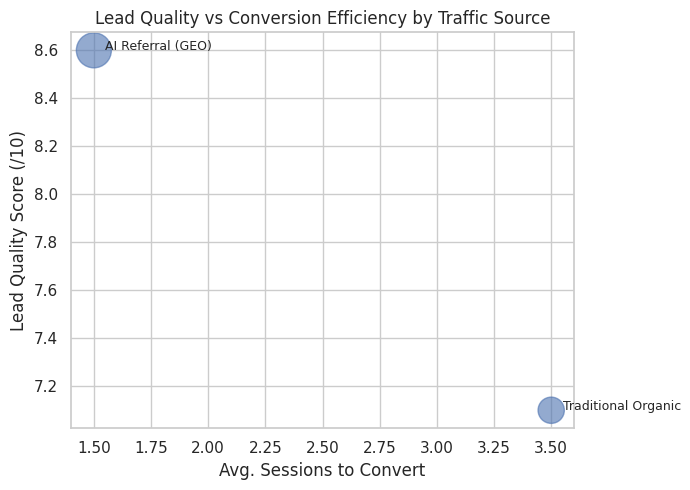
Across the case studies, one of the most consistent advantages of GEO adoption is the shortening of the conversion path. Users referred from AI engines like ChatGPT and Perplexity are converting in one-third the number of sessions required for traditional organic traffic. This shows that GEO-optimized audiences are arriving deeper into the buyer funnel, with higher intent and trust.
Sales Cycle Duration Comparison Table
| Traffic Source | Avg. Sessions to Convert | Lead Quality Score (/10) | Funnel Efficiency Rating |
|---|---|---|---|
| Traditional Organic | 3–4 sessions | 7.1 | Moderate |
| AI Referral (GEO) | 1–2 sessions | 8.6 | High |
Conclusion
These real-world examples from industries such as fintech, finance, logistics, and consumer tech make one thing clear: GEO is no longer a futuristic concept. It is a proven, tactical growth strategy. Businesses leveraging AI-specific visibility tools are not only defending against the decline in traditional organic traffic—they are proactively building faster, more effective channels for customer acquisition and brand expansion. The future of search belongs to those who earn the citation, not just the ranking.
Strategic GEO Implementation Framework for 2026: A Step-by-Step Playbook for Brands and Agencies
In 2026, success in digital discovery depends on a clear and structured strategy for Generative Engine Optimization (GEO). As consumer attention moves from traditional search engines to generative platforms like ChatGPT, Gemini, Claude, Perplexity, and Google AIO, marketing leaders and digital agencies must adopt a phased implementation model to remain discoverable, cited, and trusted.
Top-performing organizations are no longer relying on outdated SEO tactics. Instead, they are deploying a dedicated GEO playbook that aligns visibility auditing, technical readiness, and AI-centric content design. This systematic approach ensures long-term brand authority in the AI-driven search ecosystem.
GEO Strategic Implementation Phases and Workflow
| Phase | Focus Area | Key Activities and Objectives |
|---|---|---|
| Phase 1: Visibility Baseline | Discovery Audit | Conduct full GEO audit across ChatGPT, Gemini, Perplexity, Claude, Google AIO |
| Evaluate 25+ metrics (schema, crawlability, AI citations, content access) | ||
| Phase 2: Technical Remediation | Structured Data & Page Performance | Implement JSON-LD Organization schema with founders, contacts, and profiles |
| Improve Core Web Vitals to “Good” thresholds | ||
| Phase 3: Content Engineering | Modular Content & Extractable Facts | Restructure content into tables, bullet lists, FAQ blocks, and statistics |
| Cite trusted sources to increase AI citation probability | ||
| Phase 4: Ongoing Monitoring | Narrative Control & AI Sentiment Tracking | Track brand mentions, citation share-of-voice, and misinformation alerts |
| Use early warning tools like Profound or Peec AI to adjust within hours |
Schema Optimization Gap and Technical Health Snapshot
According to recent industry-wide data, most brands are still unprepared for AI indexing. Technical deficiencies—especially in structured data and performance—are among the most common barriers preventing citation by AI engines.
| Key Technical Readiness Metric | Current Average Across Brands | Target for GEO Success |
|---|---|---|
| Full Organization Schema Adoption | 12.4% | 100% |
| Presence of Founders & Contact Schema | 8.7% | Required |
| First Contentful Paint (FCP) < 0.4s | 19.6% | Minimum Baseline |
| JSON-LD Nested Structures (Multiple Types) | 14.2% | Essential |
| AI Bot Access (robots.txt unblocked) | 61.3% | 100% |
Content Engineering for AI-Friendly Extraction
GEO success requires rethinking content from a format-first perspective. Generative engines favor structured and scannable layouts over unformatted prose. AI systems prefer facts that are easy to extract and associate with verified entities.
The “GEO-bench” study by Princeton University confirms that content containing data-backed claims, numeric performance results, and citations to high-authority domains has the highest correlation with AI visibility. This includes tables, reference lists, case studies, and structured comparisons.
Citation Optimization Tactics Matrix
| Content Feature | Impact on AI Citation Frequency | Recommendation |
|---|---|---|
| Bullet Lists | +18% | Use for summarizing key points |
| Numbered Steps | +23% | Ideal for how-to and process guides |
| Tables with Entity Columns | +31% | Enhance factual parsing |
| Original Research / Stats | +34–40% | Include industry benchmarks |
| Linked Expert Profiles | +27% | Use schema with accreditation info |
Real-Time Monitoring and AI Narrative Management
AI models are continuously evolving, and citation patterns can shift unexpectedly. Brands must adopt daily monitoring routines and systems that track how they are being described or misrepresented in generative responses.
Tools such as Profound and Peec AI now offer real-time “early warning” alerts that notify teams of citation loss, sentiment shifts, or misinformation. These systems enable organizations to take immediate corrective action and maintain a consistent AI presence.
Monitoring System Functions and Business Value Table
| Tool | Key Feature | Strategic Value |
|---|---|---|
| Profound | Early Warning Alerts + Narrative Explorer | Detect AI citation drops or shifts |
| Peec AI | Sentiment Monitoring + Rapid Dashboard | Adjust perception in real-time |
| AthenaHQ | Prompt Tracking Across AI Engines | Identify gaps in AI search exposure |
Conclusion
GEO is no longer just an extension of SEO—it is a foundational digital strategy for 2026 and beyond. With a 25% decline in traditional search traffic already underway, early adopters of GEO practices are gaining a substantial edge in visibility, conversions, and AI-mediated influence.
By following a structured, four-phase implementation plan and using purpose-built tools to optimize technical infrastructure, content structure, and real-time monitoring, enterprise marketers and agencies can secure long-term competitive advantage in the AI-first discovery landscape. Embracing GEO today means owning the future of visibility tomorrow.
Conclusion
As the global digital landscape continues to shift away from traditional search engines and toward AI-generated discovery interfaces, the importance of Generative Engine Optimization (GEO) has reached a pivotal point. In 2026, brands that aim to remain visible, competitive, and trusted must adopt a forward-thinking approach centered around GEO tools. These platforms are no longer optional enhancements—they are mission-critical technologies that determine whether a brand is discovered, cited, and engaged with in an AI-dominant world.
The Top 10 AI tools for GEO in 2026—such as Bluefish AI, Profound, AthenaHQ, Goodie AI, Geoptie, Semrush AI Visibility Toolkit, Ahrefs Brand Radar, Peec AI, Rankscale, and Otterly.AI—have redefined how organizations manage visibility across emerging answer engines like ChatGPT, Gemini, Claude, Perplexity, and Google AIO. These tools not only track where and how a brand appears within AI responses, but also offer strategic insights, real-time monitoring, technical recommendations, and actionable content engineering capabilities that directly impact citation frequency and user trust.
What sets these tools apart is their ability to blend advanced analytics, schema-driven optimization, AI prompt tracking, and citation diagnostics into comprehensive GEO dashboards. From real-time alert systems and region-specific prompt analysis to automated remediation workflows and structured content validation, these platforms equip brands with everything they need to perform, adapt, and grow in AI-first environments.
Moreover, as AI-generated answers increasingly shape consumer decisions and compress the digital sales funnel, GEO tools are delivering more than just awareness—they’re driving measurable business outcomes. Enterprises across industries are reporting higher conversion rates, reduced time to purchase, lower support costs, and stronger brand perception when implementing GEO strategies supported by these tools.
With AI now influencing over $750 billion in global consumer spending and traditional search engine traffic declining by up to 25%, the strategic window to implement a robust GEO program is closing fast. First movers are already gaining advantages by owning prominent positions within AI-generated responses, while lagging brands risk becoming invisible in the channels that matter most.
In summary, the evolution of discovery has arrived, and the top GEO tools in 2026 represent the foundation of success in this new paradigm. For any business, agency, or brand seeking long-term relevance and growth, now is the time to act. Embracing GEO technology is not just about keeping up—it’s about leading the next chapter of digital presence, trust, and conversion in an AI-shaped future.
If you find this article useful, why not share it with your hiring manager and C-level suite friends and also leave a nice comment below?
We, at the 9cv9 Research Team, strive to bring the latest and most meaningful data, guides, and statistics to your doorstep.
To get access to top-quality guides, click over to 9cv9 Blog.
To hire top talents using our modern AI-powered recruitment agency, find out more at 9cv9 Modern AI-Powered Recruitment Agency.
People Also Ask
What is Generative Engine Optimization (GEO)?
Generative Engine Optimization (GEO) focuses on improving a brand’s visibility within AI-generated search responses from platforms like ChatGPT and Gemini.
Why is GEO important in 2026?
GEO is essential in 2026 because traditional search engine usage is declining while AI-driven discovery is rising, making AI citations crucial for brand visibility.
Which AI tools are best for GEO in 2026?
Top GEO tools in 2026 include Bluefish AI, Profound, AthenaHQ, Goodie AI, Geoptie, Semrush, Ahrefs, Peec AI, Rankscale, and Otterly.AI.
How do GEO tools help with AI visibility?
GEO tools monitor AI citations, optimize structured data, and guide content formatting to improve presence in generative AI search results.
Can GEO tools improve conversion rates?
Yes, users referred by AI engines tend to convert faster and at higher rates, making GEO tools a valuable part of a revenue-focused strategy.
What AI platforms do GEO tools track?
Most GEO tools track major AI engines such as ChatGPT, Google Gemini, Perplexity, Claude AI, and Google’s AI Overviews.
Is GEO different from traditional SEO?
Yes, GEO focuses on AI-generated answers, while SEO targets rankings on traditional search engine results pages.
How do GEO tools track AI citations?
GEO tools use prompt-based tracking and AI assistant monitoring to identify when and where brands are cited in AI-generated content.
Do GEO tools require technical implementation?
Many tools recommend optimizing structured data like JSON-LD and ensuring AI bots are allowed via robots.txt for proper indexing.
Are GEO tools suitable for small businesses?
Yes, tools like Geoptie and Peec AI offer affordable plans suitable for startups and small teams with limited budgets.
Which GEO tool is best for enterprises?
Bluefish AI, Profound, and AthenaHQ are ideal for large enterprises due to their advanced analytics and large-scale monitoring capabilities.
Do GEO tools offer real-time alerts?
Yes, platforms like Profound and Peec AI offer early warning systems to notify users of visibility drops or sentiment shifts.
How much do GEO tools typically cost?
Pricing varies from as low as $20/month (Rankscale) to over $900/month (Otterly.AI Pro) depending on features and scale.
What content types are best for GEO?
Content with structured formats—like tables, bullet points, statistics, and cited sources—performs best in AI-generated answers.
Do GEO tools support multilingual optimization?
Some tools like Goodie AI offer multilingual tracking and region-specific insights to help brands with global GEO strategies.
Can GEO tools integrate with BI platforms?
Yes, tools like AthenaHQ support integrations with Tableau and Power BI for advanced data visualization and reporting.
How long does it take to see GEO results?
Many brands see noticeable improvements in AI visibility within a few weeks to a few months after implementing GEO strategies.
What is an AI Visibility Score in GEO tools?
An AI Visibility Score measures how frequently and prominently a brand appears in AI-generated search outputs across key prompts.
Do GEO tools help with content creation?
Some platforms, like Profound, offer “read/write” capabilities that allow users to optimize and publish content for AI systems.
Are there free trials for GEO tools?
Yes, platforms like Geoptie and Semrush offer trial versions or entry-level plans to test GEO features before upgrading.
What industries benefit most from GEO?
Sectors like finance, healthcare, SaaS, logistics, and ecommerce benefit greatly due to their high-intent and data-driven content.
Can GEO tools help with misinformation correction?
Yes, ongoing monitoring can detect AI misrepresentations, allowing brands to update content and correct narratives in real time.
Is structured data essential for GEO?
Yes, using nested JSON-LD schemas is crucial for helping AI engines understand and properly cite your content and entities.
Do GEO tools improve brand authority?
Consistent AI citations enhance perceived brand authority and trust, especially when supported by factual, cited content.
Can GEO reduce support costs?
Yes, tools can help automate support content and make it more accessible via AI, reducing manual service inquiries.
Are GEO tools useful for agencies?
Absolutely, agencies can use GEO platforms to offer AI visibility services, audits, and optimization as part of their packages.
Do GEO tools offer competitor analysis?
Many tools include features for comparing your brand’s AI presence against competitors across prompts and platforms.
What is prompt tracking in GEO?
Prompt tracking measures how a brand responds to specific AI search inputs, helping users refine their content targeting.
Can GEO tools detect AI perception changes?
Yes, narrative control features track shifts in how AI engines describe your brand, allowing for timely updates.
Is GEO a long-term strategy?
Yes, with AI shaping the future of discovery, GEO will continue to be a vital digital strategy well into the 2030s.
Sources
Bluefish AI
SE Visible
We Are TG
Dimension Market Research
Conductor
Fuel Online
Position Digital
Elementor
Geoptie
Valuates Reports
The SaaS News
Profound
PR Newswire
Comcast NBCUniversal LIFT Labs
First Page Sage
PitchBook
Sequoia Capital
Zapier
Quoleady
VIP Graphics
onSaaS
Alex Birkett
Rankability
PeekABoo Blog
AthenaHQ
NoGood
SEOmator
EWR Digital
BloggerJet
Fibr AI
Search Influence
SEO
LSEO
Crescendo AI
G2



%20in%202026%20to%20boost%20AI%20search%20visibility%20and%20digital%20performance.)