



























Key Takeaways
- AI-driven sales tools in 2026 are automating end-to-end lead generation, improving efficiency, personalization, and pipeline velocity.
- Platforms like HubSpot, Gong, and 11x.ai are transforming sales workflows through real-time insights and autonomous outreach.
- Businesses using AI tools report higher conversion rates, lower cost per lead, and faster deal closures in competitive global markets.
In 2026, the global sales landscape has been radically reshaped by the rise of AI-powered technologies. Businesses across every sector—whether B2B SaaS, finance, healthcare, or e-commerce—are facing unprecedented pressure to generate leads more efficiently, convert faster, and scale their revenue engines without inflating their operational costs. With buyer behavior becoming more complex and decision-making cycles growing longer, traditional outreach and prospecting methods are no longer enough to stay competitive. The solution lies in intelligent automation, and at the heart of this transformation are AI tools purpose-built for lead and sales generation.

AI tools in 2026 are no longer seen as optional enhancements to existing workflows—they are the foundation of modern revenue operations. From advanced data enrichment and predictive intent scoring to hyper-personalized outreach and fully autonomous digital sales reps, these technologies are enabling businesses to do more with less. Sales Development Representatives (SDRs) and Account Executives (AEs) now rely on AI to uncover hidden buyer signals, prioritize high-intent accounts, and engage prospects through multi-channel campaigns tailored to each stage of the buyer journey.
One of the driving forces behind the rapid adoption of AI sales tools is the steep increase in the average cost per lead (CPL), which has surged across all industries. In high-ticket sectors such as enterprise SaaS and professional services, the CPL often exceeds USD 500, making efficiency and precision mission-critical. As a result, companies are transitioning from mass outbound campaigns to signal-based selling, where AI continuously analyzes behavioral and firmographic data to detect “Day One” buying intent. This enables sales teams to engage the right prospect, on the right channel, at the right time—before competitors even appear on the radar.
The market is also responding to rising compliance standards and data privacy regulations across regions. Particularly in Europe, where the EU AI Act and GDPR enforcement continue to evolve, businesses are adopting AI tools that offer built-in compliance, data verification, and native support for regional laws. Tools like Cognism and Dealfront are gaining market share by ensuring lawful outreach while maintaining performance. Meanwhile, in fast-growing markets like Southeast Asia and Latin America, AI-driven sales platforms are enabling local startups and multinational companies alike to scale faster without expanding headcount.
The tools dominating this space in 2026 reflect several key trends: automation of outbound prospecting, integration of CRM and revenue intelligence, and the rise of autonomous AI agents that mimic human sales roles. Solutions such as Apollo.io and Clay are streamlining prospect list creation and enrichment. Platforms like 6sense and ZoomInfo provide real-time intent data and firmographic insights. HubSpot Sales Hub, Gong, and Outreach are optimizing engagement, conversation intelligence, and pipeline velocity. And pioneering tools like 11x.ai are redefining the SDR function entirely by offering full-stack AI agents that handle research, outreach, and meeting scheduling autonomously.
This blog explores the top 10 AI tools for lead and sales generation in 2026, selected based on performance benchmarks, feature sets, integration capabilities, compliance readiness, and real-world ROI. It aims to help sales leaders, marketers, and growth professionals identify the best-fit tools for their go-to-market strategies and understand how to orchestrate AI-driven growth at scale. Whether you’re part of a lean startup team or a Fortune 500 enterprise, the insights here will guide you through the platforms leading the next generation of revenue acceleration.
Before we venture further into this article, we would like to share who we are and what we do.
About 9cv9
9cv9 is a business tech startup based in Singapore and Asia, with a strong presence all over the world.
With over nine years of startup and business experience, and being highly involved in connecting with thousands of companies and startups, the 9cv9 team has listed some important learning points in this overview of the Top 10 AI Tools For Lead Generation in 2026.
If you like to get your company listed in our top B2B software reviews, check out our world-class 9cv9 Media and PR service and pricing plans here.
Top 10 AI Tools For Lead Generation in 2026
1. Apollo.io
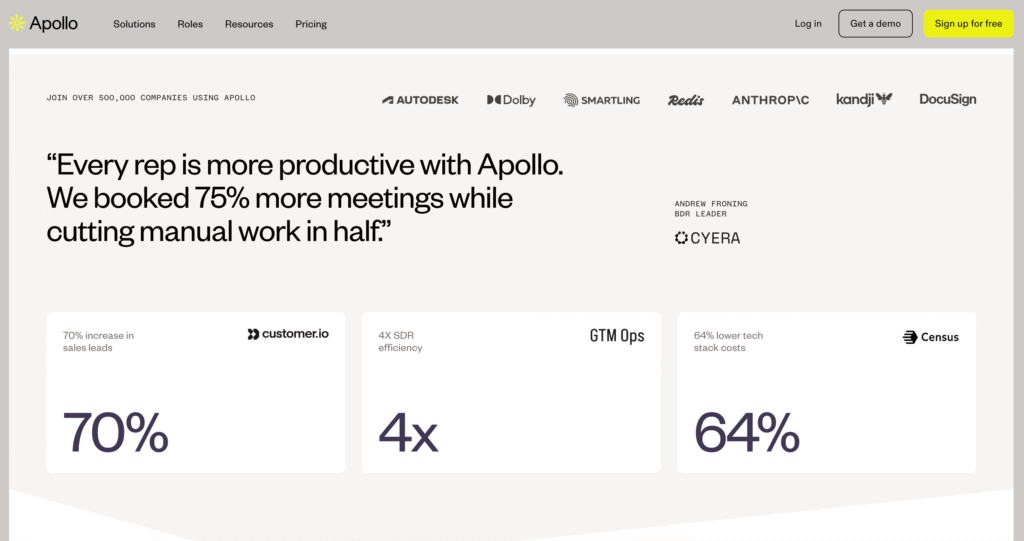
Apollo.io stands at the forefront of AI-driven lead generation tools in 2026, offering a powerful blend of contact intelligence, sales engagement, and outbound automation. It is widely adopted by high-growth sales teams and B2B startups due to its cost-effective, scalable, and fast-to-implement infrastructure. As the digital sales environment becomes more competitive, tools like Apollo are playing a key role in transforming how businesses identify prospects, personalize outreach, and scale revenue operations globally.
Unmatched Growth and Market Position in 2026
Apollo.io has evolved into one of the most trusted platforms for outbound sales. By the end of 2025, it had surpassed USD 150 million in annual recurring revenue (ARR), marking a 40% year-over-year growth rate. This exponential growth is a reflection of the platform’s expanding user base and its massive, AI-enriched global database.
The platform gives sales and marketing teams access to over 275 million verified business contacts and 73 million company profiles. This vast database is enhanced with real-time updates, intent signals, and AI-powered filters that allow precise segmentation and targeting.
AI-Driven Prospecting and Outreach at Scale
Apollo.io’s 2026 version introduces advanced features like “AI Filters” and “AI Research,” which analyze millions of data points to recommend ideal prospects. These tools use criteria such as company size, industry, hiring signals, technology stack, and financial trends to help sales teams identify high-conversion opportunities.
The platform’s AI also assists with crafting personalized outreach sequences by gathering company-specific insights like recent news, funding announcements, and key personnel changes. This level of personalization enhances reply rates and reduces time spent on manual research.
Implementation Speed and Scalability
One of Apollo’s strongest competitive advantages is its rapid implementation. Unlike enterprise CRMs that often take months to fully deploy, Apollo can be set up and ready for use in under a week. This feature makes it highly attractive to fast-scaling startups and lean sales teams that need results quickly.
Apollo’s pricing is designed to support a wide range of organizations—from early-stage businesses to enterprise-level operations. The entry-tier plan starts at just USD 49 per user per month, while the Unlimited plan is built for high-volume teams needing up to 600,000 credits annually.
Pricing and Feature Comparison Table (2026)
| Plan Type | Monthly Cost (USD) | Credit Limit | Ideal For | Key Features |
|---|---|---|---|---|
| Basic | $49 | 10,000/month | Small businesses & startups | Core database access, email outreach |
| Professional | $99 | 50,000/month | Growth-stage sales teams | AI Filters, enriched lead scoring |
| Unlimited | Custom Pricing | 600,000/year | Large outbound organizations | Advanced sequences, CRM integrations |
Apollo.io 2026 Key Performance Metrics
| Metric | Value |
|---|---|
| Annual Recurring Revenue | $150+ Million (2025/2026 est.) |
| Total Contacts in Database | 275 Million |
| Total Companies in Database | 73 Million |
| Average Implementation Time | < 1 Week |
| User-Reported Accuracy Rate | 65% – 80% |
| Total Funding Raised | $251.3 Million |
| Estimated Valuation | $1.6 Billion |
| Bounce Rate Range | 20% – 30% (based on volume trade-offs) |
Strengths and Limitations Matrix
| Feature | Strengths | Limitations |
|---|---|---|
| Database Size | One of the largest B2B databases globally | Difficult to maintain 100% hygiene due to data scale |
| AI Outreach | Personalized sequences from dynamic company insights | May require manual tweaks for niche verticals |
| Implementation | Fast deployment under 7 days | Requires onboarding for new users to fully leverage tools |
| Pricing | Startup-friendly, flexible scaling for enterprise | Unlimited tier may be overkill for low-volume teams |
Use Case Scenarios for 2026
- Startup SaaS Company: Uses Apollo to instantly identify 1,000 potential leads in North America targeting companies that recently raised Series A funding.
- Enterprise Marketing Team: Deploys Apollo’s Unlimited Plan to conduct daily outbound campaigns across APAC, with fully AI-personalized email flows.
- B2B Agency: Utilizes Apollo’s CRM integration and email automation for running lead-gen campaigns on behalf of multiple clients simultaneously.
Strategic Takeaway
Apollo.io continues to be a dominant force in AI-powered lead generation thanks to its large-scale data access, automation capabilities, and flexible pricing. In 2026, businesses looking to rapidly scale their outbound efforts, personalize their engagement, and improve prospecting efficiency see Apollo.io as a foundational tool in their tech stack. While it may face competition in hyper-niche segments, its robust feature set, massive dataset, and strong ROI make it a go-to solution for both startups and established enterprises alike.
2. ZoomInfo

ZoomInfo has firmly established itself as one of the most powerful AI tools for enterprise sales and lead generation in 2026. Known for its unparalleled depth of contact and company data, the platform is the go-to solution for large sales organizations looking to identify high-value accounts, reach key decision-makers, and streamline outbound efforts using AI insights. While ZoomInfo operates at a premium price point, its robust features, enterprise-grade integrations, and AI-powered assistant make it one of the most effective solutions for B2B prospecting and sales growth on a global scale.
Financial Growth and Market Penetration in 2026
ZoomInfo’s performance in 2025 positioned it for strong influence in 2026. With quarterly revenue reaching USD 318 million in Q3 alone, the company surpassed an annual revenue of approximately USD 1.24 billion by the end of September 2025. Its business model increasingly targets enterprise clients, reflected in the fact that nearly 1,900 customers now pay over USD 100,000 annually. This shift toward high-value contracts has been a strategic move to strengthen its presence in the upmarket segment.
Key Financial Highlights for ZoomInfo (2025-2026)
| Financial Indicator | Value Range |
|---|---|
| Total Annual Revenue (2025) | $1.237 Billion – $1.240 Billion |
| Quarterly Revenue (Q3 2025) | $318 Million |
| $100K+ ACV Clients | 1,887 |
| Adjusted Operating Margin | 36% – 37% |
| Net Revenue Retention | 90% |
AI-Powered Selling with ZoomInfo Copilot
One of ZoomInfo’s standout features in 2026 is its proprietary AI assistant called “Copilot.” This tool goes beyond traditional lead generation by analyzing a user’s CRM data alongside ZoomInfo’s internal signals, such as web activity, firmographic trends, hiring signals, and purchase intent. Copilot then recommends actionable tasks—such as initiating a LinkedIn connection, drafting a personalized email, or scheduling an outbound call to a high-intent lead.
These AI-driven suggestions significantly reduce manual work for sales representatives while enhancing personalization and timing—two key factors that influence B2B buyer behavior.
Advanced Data Assets and Prospect Intelligence
ZoomInfo’s core strength lies in its deep, structured datasets, which include:
- Over 135 million direct mobile numbers, all phone-verified
- More than 174 million verified email addresses
- Rich organizational charts and department hierarchies across global enterprises
- Intent signals derived from digital behavior and keyword-level intent monitoring
This data gives sales teams a unique advantage in mapping buying committees and reaching hidden stakeholders, even when they don’t appear on public websites. This capability is especially valuable for large deal cycles involving multiple decision-makers.
ZoomInfo Data Asset Overview (2026)
| Data Type | Volume |
|---|---|
| Direct Mobile Numbers | 135 Million+ |
| Verified Business Emails | 174 Million |
| Targetable Company Records | 100 Million+ |
| Org Charts & Hierarchies | Across 30,000+ Major Enterprises |
| AI Signal Categories | 25+ (including intent, hiring, tech) |
ZoomInfo Pricing and Deployment Considerations
Despite its impressive capabilities, ZoomInfo is often considered a high-investment tool, particularly suitable for enterprises and mid-market firms with advanced sales operations. The average annual contract ranges from USD 15,000 to USD 50,000, depending on the data package, user seats, and integration depth. Successful deployment typically involves a dedicated RevOps team to manage CRM integration, lead routing, data hygiene, and campaign attribution tracking.
ZoomInfo Pricing Matrix (2026)
| Package Tier | Annual Cost Range (USD) | Target Segment | Features Included |
|---|---|---|---|
| Growth Starter | $15,000 – $20,000 | Mid-size Sales Teams | Core data access, Copilot AI assistant, CRM sync |
| Professional Plus | $25,000 – $35,000 | Large B2B Teams | Full intent data, automation workflows, RevOps tools |
| Enterprise Elite | $40,000 – $50,000+ | Global Enterprise Orgs | Unlimited data, premium integrations, onboarding team |
ZoomInfo Use Case Applications in 2026
- SaaS Expansion Campaigns: Teams targeting global IT buyers use Copilot to discover companies showing high-intent signals related to cloud infrastructure tools.
- ABM Programs: Marketers map out buying groups using ZoomInfo’s org charts to target entire departments with tailored messaging and ads.
- Channel Sales Operations: Enterprises enable their partners with ZoomInfo data packs to help generate localized leads in APAC, EMEA, and North America.
Competitive Strengths vs. Limitations Matrix
| Aspect | Strengths | Limitations |
|---|---|---|
| Data Accuracy | Highly phone-verified and regularly updated | Still requires internal validation for niche segments |
| AI Integration | Actionable suggestions via CRM + intent analysis | AI may be complex for first-time users without onboarding |
| Market Fit | Perfect for enterprise and RevOps-heavy environments | Less ideal for early-stage startups |
| Support Infrastructure | Enterprise onboarding and dedicated success managers | Higher learning curve and resource need |
Strategic Insights for B2B Sales Teams
ZoomInfo continues to lead the enterprise sales intelligence space in 2026 by offering an unrivaled combination of enriched data, organizational mapping, and AI-powered execution. For businesses targeting long-cycle, high-value deals—especially across multiple stakeholders—ZoomInfo delivers operational intelligence that few tools can match. However, companies should ensure they have the operational maturity and team capacity to maximize the platform’s potential. With its continued innovation around AI recommendations and intent scoring, ZoomInfo remains a cornerstone of any modern outbound or account-based strategy.
3. Clay

Clay has emerged as one of the most innovative AI tools for lead and sales generation in 2026, offering a deeply programmable and automation-first approach for go-to-market (GTM) operations. Unlike traditional sales platforms, Clay is not just a database or CRM—it is a data orchestration engine designed to power highly customized workflows for advanced sales teams. This new category has become especially popular among GTM Engineers, data-driven marketers, and revenue operations professionals looking to scale outreach with extreme precision.
Rapid Growth and Market Valuation
In 2025, Clay secured USD 100 million in Series C funding, pushing its post-money valuation to USD 3.1 billion. This significant capital infusion supported Clay’s aggressive expansion, allowing it to triple its annual revenue to a projected USD 100 million by the end of 2025. The platform now supports over 10,000 customers worldwide, including tech giants such as OpenAI, Canva, and Anthropic.
Clay’s Financial Overview and Market Performance (2025–2026)
| Metric | Value |
|---|---|
| Series C Funding | $100 Million |
| Total Funding Raised | $204 Million |
| Post-Money Valuation | $3.1 Billion |
| Projected 2025 Revenue | $100 Million |
| Revenue Growth Rate | 3x Year-over-Year |
| Active Customers | 10,000+ |
| G2 Rating | 4.9 / 5 |
The GTM Engineer: A New Role Driven by Clay
One of Clay’s most notable contributions to the AI sales ecosystem is the rise of the “GTM Engineer”—a hybrid role combining technical know-how with marketing and sales logic. GTM Engineers use Clay to automate prospecting at a previously unthinkable scale. For example, they can build systems that automatically enrich contacts from over 150 third-party data providers, monitor competitors’ social media activities, or even analyze satellite images of distribution centers to estimate company size and logistics volume.
This technical capability allows companies to process thousands of leads in real-time, build complex trigger-based workflows, and personalize each message based on a wide range of enriched insights.
Clay’s Lead Generation Capabilities Matrix (2026)
| Feature Category | Capabilities | Benefits |
|---|---|---|
| Data Enrichment | 150+ provider integrations | Aggregated insights from multiple trusted sources |
| Workflow Automation | Conditional logic, triggers, auto-updates | Full automation across GTM tasks |
| Personalization Engine | Dynamic content creation via AI scripting | Custom outreach for each lead |
| Signal Monitoring | Social, firmographic, technographic, geospatial signals | Identify high-fit leads at the perfect moment |
| Interface | Spreadsheet-style UX with developer-level control | Flexible environment for both tech and non-tech users |
Example Use Cases of Clay in 2026
- SaaS Growth Teams: Configure Clay to track mentions of specific keywords by competitor clients on Twitter, then auto-trigger personalized emails to decision-makers.
- E-commerce Expansion: Automate enrichment of retail prospect lists with geospatial data like storefront density and warehouse size via satellite imagery analysis.
- Consulting Firms: Aggregate firmographic data, hiring trends, and technology stack insights to create bespoke outreach sequences for Fortune 500 prospects.
Pricing Considerations and ROI Potential
Clay operates on a usage-based pricing model that varies by workflow complexity, API call volume, and data provider cost. Sales teams report ROI ranging from USD 0.20 to USD 0.50 per qualified lead when Clay is implemented properly. However, the system is not plug-and-play—due to its “blank canvas” nature, success with Clay requires experienced operators or a dedicated GTM engineer capable of building out modular workflows from scratch.
Clay Cost and ROI Analysis Table (2026)
| Metric | Estimated Range |
|---|---|
| Workflow Build Time | 2–10 hours (depending on complexity) |
| Per Lead Cost (Automated) | $0.20 – $0.50 |
| Time to First Lead | < 48 Hours (post-setup) |
| ROI (High-Volume Campaigns) | 5x – 15x (typical for B2B mid-market) |
| Learning Curve | Moderate to High |
Strengths and Limitations Summary
| Dimension | Advantages | Considerations |
|---|---|---|
| Data Aggregation | Seamless integration across 150+ providers | Requires careful API configuration |
| Personalization | Highly contextual, logic-driven outreach | Needs scripting familiarity for complex templates |
| Workflow Design | Fully customizable, scalable automation | No drag-and-drop wizards—requires system architecture |
| ROI Potential | High returns for high-volume outbound strategies | Not suitable for basic or ad hoc prospecting |
Strategic Insight for 2026 Sales Teams
Clay is not a tool for everyone—it’s a system designed for teams that demand high levels of precision, automation, and data richness. In 2026, as competition increases and GTM complexity rises, Clay’s ability to combine logic-based enrichment, AI-driven personalization, and signal tracking gives advanced sales teams a serious edge. Organizations that can invest in technical sales talent or GTM engineers are finding Clay to be one of the most powerful platforms to automate what was once highly manual and fragmented. For companies that embrace programmable outbound strategies, Clay is redefining what AI-led sales enablement looks like.
4. 6sense

6sense has firmly positioned itself among the top global AI tools for lead and sales generation in 2026, particularly excelling in the field of account-based marketing (ABM) and revenue operations. As sales and marketing teams become increasingly dependent on data-driven insights, 6sense stands out by offering AI-powered intelligence that filters massive volumes of buyer behavior signals and translates them into precise, actionable opportunities. This platform is not just about identifying prospects—it is about identifying the right ones, at the right time, and engaging them with the right context.
Leadership Position and Market Recognition
6sense ended 2025 with strong recognition in the market, earning its fifth consecutive placement as a leader in the Gartner Magic Quadrant for ABM Platforms. The company’s valuation reached USD 5.2 billion in 2023, and by 2026, its AI ecosystem—branded as “RevvyAI”—has become a cornerstone for modern revenue teams across mid-market and enterprise organizations.
6sense Market Growth and Recognition Overview
| Indicator | Value / Achievement |
|---|---|
| Valuation (2023) | $5.2 Billion |
| Gartner Magic Quadrant Leader | 5 Years Consecutive (2021–2025) |
| Revenue Team Adoption | Global Enterprises and Fast-Growth Mid-Market |
| RevvyAI Rollout (2025–2026) | Full Integration Across GTM Workflows |
AI-Powered ABM with RevvyAI
6sense’s RevvyAI engine powers advanced signal detection and revenue orchestration across the sales funnel. It interprets trillions of digital signals—such as web intent, keyword research, job changes, firmographic shifts, and competitor mentions—and translates them into dynamic account scoring. Unlike traditional lead scoring models, 6sense leverages real-time AI pattern recognition to detect which accounts are actively researching specific solutions and which stakeholders within those accounts are involved.
One of the most transformative updates in 2026 is the shift toward “Signal-to-Noise” reduction. The new v5.0 model now only marks an account as “Hot” if the buyer activity is accompanied by a “Decision-Maker Context” flag. This ensures that SDRs and BDRs focus exclusively on accounts where purchasing decisions are likely to be made, dramatically improving efficiency and reducing wasted outreach.
RevvyAI Workflow Intelligence Matrix (2026)
| Signal Type | Use Case Scenario | Revenue Impact |
|---|---|---|
| Web Intent + Decision Role | Target high-fit buyers in research phase | Up to 4x increase in win rate |
| Job Posting Spike | Detect growth-stage firms buying tech | Up to 2x increase in average deal size |
| Competitor Mentions | Target accounts reviewing competitors | Enables competitive displacement campaigns |
| Firmographic + Tech Stack | Score accounts based on ICP fit | Improves precision of marketing campaigns |
Client Case Studies and ROI Metrics
Many enterprise clients in 2026 report significant improvements in revenue performance after implementing 6sense across their ABM and sales development workflows. For instance, supply chain tech provider Blue Yonder achieved a 12x ROI after optimizing its campaign workflows using intent signals. Identity verification company Socure generated over USD 52 million in pipeline within a year through stacked intelligence and buyer journey mapping.
6sense Client Success Metrics Table
| Metric | Reported Uplift / Result | Company Example |
|---|---|---|
| Pipeline Increase | 268% | General Report |
| Opportunity Volume Growth | 6x | General Report |
| Pipeline Generation Acceleration | 80% | General Report |
| Ad Spend Reduction | 96% | RepTrak |
| Sales Velocity Boost | 25% Faster | General Report |
| MQL Increase | 34% YoY | Simpro |
| Annual Pipeline Generated | $52 Million | Socure |
| ROI from Signal Workflow Optimization | 12x | Blue Yonder |
Sales Workflow Evolution Using 6sense in 2026
- Prioritization by Buyer Role: Leads are no longer scored simply by activity—they are only qualified when senior decision-makers are actively involved.
- Stacked Signal Targeting: Sales and marketing workflows now rely on multiple signals layered together (intent, role, budget, urgency) to trigger engagement.
- Real-Time ABM Orchestration: Marketing automation, ad retargeting, and email outreach are now dynamically updated based on real-time account behavior.
Platform Capabilities and Value Summary
| Category | Strengths | Strategic Considerations |
|---|---|---|
| AI-Driven Lead Scoring | Combines intent, firmographic, and behavioral data | May require internal GTM alignment to configure |
| ABM Execution | Supports full-funnel orchestration and ad targeting | Effective when integrated with CRM and MAP tools |
| SDR Efficiency Gains | Removes unqualified leads from outbound queues | Success depends on input data quality |
| ROI and Pipeline Impact | Frequently 5x–12x ROI depending on use case | Best suited for high-velocity or large-ticket GTM |
Strategic Takeaway
6sense is not a general-purpose lead generation tool—it is built for companies with a sophisticated GTM motion, especially those focused on ABM, complex sales cycles, and multi-touch buying journeys. In 2026, as buyer behavior grows more fragmented and competitive intelligence becomes more critical, 6sense provides the advanced signal processing, precision targeting, and revenue orchestration that revenue teams need to outperform their competition. For any sales or marketing leader aiming to prioritize quality over quantity in their pipeline, 6sense stands as a category-defining AI platform for ABM success.
5. HubSpot Sales Hub
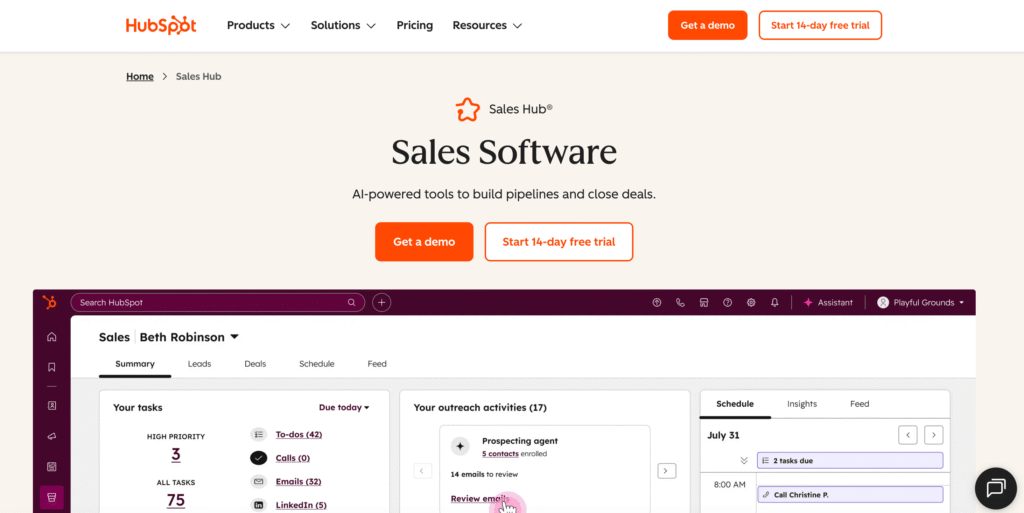
HubSpot Sales Hub continues to be one of the most trusted and widely adopted AI tools for lead and sales generation in 2026, especially among growing businesses and mid-market teams seeking a unified, easy-to-use platform. With its fully integrated AI Prospecting Agent, Smart CRM, and automation tools, HubSpot provides a seamless solution for managing the entire sales pipeline—from lead discovery to deal closure—without the need for complex third-party integrations or technical overhead.
Strong Financial Growth and Market Position
By the end of Q3 2025, HubSpot recorded USD 2.988 billion in trailing twelve-month revenue, marking a 19.2% year-over-year growth. Its ability to simplify and centralize sales and marketing workflows has made it the preferred platform for over 279,000 companies worldwide. Unlike fragmented tech stacks that require syncing multiple tools, HubSpot offers a complete ecosystem that reduces data loss, prevents sync errors, and improves collaboration across revenue teams.
HubSpot Revenue and Adoption Highlights (2025–2026)
| Metric | Value |
|---|---|
| Annual Revenue (TTM, Sep 2025) | $2.988 Billion |
| Global Customer Base | 279,000 |
| Market Share (Marketing Automation) | 38% |
| App Ecosystem Size | 1,500+ Integrations |
| Deals Over $5K MRR Growth | 35% YoY |
| CRM Campaign Launch Time | 68% Faster Than Industry Average |
HubSpot’s AI Features for Lead and Sales Generation
HubSpot’s 2026 Sales Hub is built around intelligent automation and native AI capabilities that simplify and accelerate lead generation. The AI Prospecting Agent scans inbound activity, historical data, engagement patterns, and firmographics to rank and surface the highest-converting leads. It also recommends next steps—whether that’s a follow-up email, LinkedIn outreach, or a direct call—based on predictive engagement scoring.
Its Smart CRM acts as the operational core, organizing all interactions, contacts, and deal progress into a single, user-friendly interface. This reduces friction between marketing and sales teams and enables a smooth handoff of qualified leads.
HubSpot AI Workflow Capabilities Overview
| AI Feature | Functionality | Sales Impact |
|---|---|---|
| AI Prospecting Agent | Scores and prioritizes leads in real time | Reps focus on top-converting opportunities |
| Smart CRM Engine | Centralizes customer data and touchpoints | No more data silos or sync issues |
| Automated Sequences | Triggers follow-ups and drip campaigns automatically | Boosts response rates and lead nurturing |
| Forecasting Intelligence | Predicts pipeline outcomes and revenue likelihood | Helps managers adjust GTM strategies effectively |
User ROI and Productivity Gains in 2026
HubSpot’s users continue to report excellent performance gains. Over a three-year period, the average customer experiences a 505% return on investment, largely driven by automation efficiency and reduced time to launch marketing initiatives. Sales reps using HubSpot close up to 50% more deals by spending less time on manual entry and more time engaging leads that are most likely to convert.
HubSpot Performance ROI Metrics Table
| KPI | Improvement Level |
|---|---|
| 3-Year ROI | 505% |
| Marketing Campaign Launch Speed | 68% Faster Than Average |
| Sales Deal Closure Efficiency | 50% More Deals Closed (per rep) |
| Lead Qualification Speed | Increased by 60% with AI Filtering |
| Revenue Per Rep | Higher by 30% in automated workflows |
Strategic Use Cases Across Team Sizes
- Startups and Scaleups: Use HubSpot’s AI Agent to prioritize early-stage leads and guide founders through outbound follow-ups.
- Mid-Market Teams: Implement Smart CRM workflows to streamline lead handoffs between marketing and sales while running campaigns from a single dashboard.
- Enterprises: Integrate with 1,500+ apps to expand campaign personalization and data enrichment without disrupting core workflows.
Feature Comparison with Other Lead Gen Tools (2026 Snapshot)
| Feature / Tool | HubSpot Sales Hub | Apollo.io | ZoomInfo | 6sense |
|---|---|---|---|---|
| CRM Integration | Native, all-in-one | Requires third-party | Partial integration | External CRM sync |
| AI Lead Prioritization | Yes | Yes | Yes | Yes |
| Campaign Automation | Built-in | Available | External Add-on | Advanced ABM workflows |
| Ideal For | Mid-market, scaling | Startups to SMBs | Enterprise GTM teams | ABM-focused enterprises |
| Ease of Setup | Very Easy | Easy | Moderate | Advanced setup required |
Strategic Takeaway
HubSpot Sales Hub in 2026 remains one of the most practical and powerful AI tools for businesses looking to generate, manage, and convert leads in a scalable and automated way. Its combination of Smart CRM, predictive AI prospecting, and marketing automation makes it especially effective for teams who want to operate from a single source of truth. Whether you’re a startup founder handling outreach personally or a growing company managing a multi-rep team, HubSpot offers the speed, intelligence, and flexibility needed to succeed in a competitive sales landscape.
6. Gong

Gong has become one of the most powerful AI tools for lead generation and sales enablement in 2026, redefining how revenue teams operate by providing real-time insights, predictive analytics, and deal intelligence. Originally known as a conversation recording platform, Gong has evolved into a full-scale “Revenue Intelligence” layer that spans across sales, customer success, and revenue operations. With advanced AI capabilities, Gong empowers teams to not only understand what’s happening in their pipeline but also why deals succeed or fail—helping companies improve win rates, reduce churn, and close revenue gaps with data-backed decisions.
Strong Growth and Enterprise Penetration
By the end of fiscal year 2024 (January 2025), Gong surpassed USD 300 million in annual recurring revenue (ARR), a milestone reflecting its rapid adoption among large B2B sales teams worldwide. The rise in usage of Gong’s generative AI tool, “Ask Anything,” surged by nearly 50% in the last 12 months, signaling its increasing importance in day-to-day revenue operations. Rather than relying on manual pipeline reviews, revenue leaders now use Gong to query deals directly and get instant insights on risk factors, competitor mentions, and stakeholder alignment.
Gong Revenue and Usage Metrics (2025–2026)
| Metric | Value / Growth |
|---|---|
| Annual Recurring Revenue (ARR) | $300+ Million (FY2024) |
| “Ask Anything” AI Tool Usage Growth | +50% (YoY) |
| Average Sales Growth Uplift | 29% Higher Among Gong Users |
| Reported Boost in Rep Productivity | 60% (Case: Canva) |
| Revenue Increase from Insights | 6% (Case: Canva) |
| Estimated Monthly Cost per User | $250 – $400 |
AI-Powered Deal Intelligence and Forecasting
Gong’s core strength lies in its ability to analyze calls, emails, meetings, and CRM activity using natural language processing (NLP) and machine learning. The platform doesn’t just transcribe conversations—it identifies buying signals, tracks risk indicators, and connects patterns that traditional sales tools often miss. In 2026, the emphasis is on predictive analytics, with Gong automatically flagging stalled deals, missed follow-ups, or lack of decision-maker involvement.
The “Ask Anything” tool functions like a revenue command center. Team members can type natural questions like “Which deals are at risk this quarter?” or “What objections are most common in lost deals?” and receive instant, context-rich answers based on real-time data across multiple channels.
Gong AI Capabilities and Use Case Matrix (2026)
| Feature | Use Case | Outcome |
|---|---|---|
| Ask Anything AI Tool | Query pipeline risks, next steps, win odds | Enables faster coaching and strategic decision-making |
| Deal Risk Analyzer | Detects stalled conversations | Prevents pipeline slippage and lost revenue |
| Buyer Behavior Insights | Tracks talk ratios, objections, sentiments | Improves rep coaching and negotiation strategies |
| Forecasting Engine (Add-on) | Predicts revenue by rep, region, or segment | Improves planning accuracy and accountability |
Enterprise Case Studies and Results
Enterprise clients have experienced significant results after implementing Gong. Canva, for example, reported a 60% increase in rep productivity by using Gong’s insights to reduce manual admin tasks. Additionally, they achieved a 6% increase in overall revenue, showing the tool’s influence beyond sales into broader revenue operations.
Across industries, organizations using Gong consistently report stronger sales growth, with many experiencing up to 29% improvement when compared to teams not using AI-powered intelligence. These gains are attributed to better decision-making, higher quality conversations, and earlier detection of deal blockers.
Gong Client Impact Table
| KPI | Performance Lift | Example / Context |
|---|---|---|
| Rep Capacity Boost | +60% | Canva |
| Company-Wide Revenue Growth | +6% | Canva |
| Sales Growth Among Gong Users | +29% | Cross-industry Benchmark |
| Time Saved on Manual Review | Up to 10 hours/week per manager | Average Teams |
| Forecast Accuracy | 20% Improvement with Add-ons | Large GTM Teams |
Pricing and Adoption Considerations
While Gong delivers exceptional value for medium to large enterprises, it may not be cost-effective for startups or small teams with limited budgets. Pricing typically ranges from USD 250 to USD 400 per user per month, depending on modules and features. Add-ons for forecasting and advanced analytics are billed separately, which may increase total investment.
Gong Pricing Overview (2026)
| Tier | Monthly Cost (USD) | Features Included | Ideal Users |
|---|---|---|---|
| Base Intelligence | $250 | Call recording, Ask Anything, basic insights | Mid-market sales teams |
| Performance Plus | $325 | Deal risk analyzer, rep coaching, reporting | Revenue teams with 10+ members |
| Full Forecast Suite | $400+ | Forecasting, analytics dashboard, custom integrations | Enterprises with large pipelines |
Platform Strengths and Limitations Matrix
| Category | Strengths | Limitations |
|---|---|---|
| Revenue Intelligence | Full visibility into why deals win or stall | Requires buy-in from multiple GTM functions |
| AI Assistance | Natural language queries for fast insights | High-level insights may need human validation |
| Conversation Analysis | Tracks tone, keywords, and intent at scale | Some language models may need tuning for industry terms |
| ROI Potential | Consistently high in mid-to-large orgs | High monthly cost for small teams |
Strategic Insight
Gong is a game-changer for businesses ready to invest in data-backed decision-making and AI-enhanced sales workflows. In 2026, its relevance has grown beyond sales teams, supporting revenue leaders, customer success professionals, and operations teams alike. With unmatched visibility into buyer behavior and clear indicators on deal health, Gong enables faster action, better coaching, and smarter forecasting. For companies with the scale and complexity to justify its pricing, Gong remains one of the most strategic AI investments in the lead and revenue generation landscape.
7. Cognism

Cognism has earned its position as one of the top AI tools for lead and sales generation in 2026, especially for companies targeting international markets where regulatory compliance is a critical concern. Built with a strong foundation in data privacy, Cognism offers unmatched capabilities in prospecting while strictly adhering to major regulations like GDPR, CCPA, and global Do-Not-Call (DNC) laws. For enterprise sales teams relying heavily on outbound calling strategies, Cognism stands out by combining high-quality data with legal peace of mind.
Global Reach and Regulatory Advantage
Cognism’s strongest differentiator lies in its data integrity and legal compliance infrastructure. Unlike many global prospecting platforms, Cognism is built to navigate regional legal frameworks with ease. Its system automatically scrubs prospect lists against 14 of the world’s most active DNC databases, minimizing legal risk and ensuring ethical outreach. This is especially valuable in markets like Europe and Southeast Asia, where data privacy laws are stricter and noncompliance can lead to significant penalties.
Cognism Compliance and Data Hygiene Overview (2026)
| Regulatory Feature | Functionality | Market Impact |
|---|---|---|
| GDPR / CCPA Compliant | Full data protection and consent mechanisms | Avoids legal exposure across EMEA and US |
| Global DNC Scrubbing | Syncs with 14 national DNC lists | Keeps call outreach legally safe |
| Phone Verification | Human-verified contacts | Increases accuracy and live call connections |
| Data Update Frequency | Constant refresh cycles | Maintains relevance and avoids stale contact info |
AI-Enhanced Prospecting with Diamond Data and Sales Companion
Cognism’s flagship feature, “Diamond Data,” focuses on delivering high-quality, human-verified mobile numbers. This allows sales teams to achieve up to 80% connect rates—dramatically reducing the number of voicemails and unproductive calls. Reps can spend more time engaging real decision-makers instead of searching for working contact information.
Alongside this, the “Sales Companion” AI assistant helps users extract and build laser-focused prospect lists from sources like LinkedIn and company websites. The process is intuitive, requiring minimal technical effort, and enables rapid filtering by role, location, seniority, and more.
Cognism Prospecting Feature Matrix (2026)
| Feature | Description | Sales Benefit |
|---|---|---|
| Diamond Data | Verified mobile numbers by real humans | Up to 80% call connect rate |
| Sales Companion AI | Assists in building compliant prospect lists | Time-saving lead targeting across multiple channels |
| Regional Data Segmentation | Focused targeting for EMEA, APAC, and North America | Better localization and conversion |
| API & CRM Integrations | Syncs with Salesforce, HubSpot, Outreach, etc. | Seamless GTM workflow integration |
Database Depth and Lead Quality
Cognism maintains a massive global database exceeding 400 million contacts, with a significant portion optimized for international B2B outreach. Within that pool, over 10 million records qualify as “Diamond Data,” making it one of the most reliable resources for high-intent, accurate calling.
Clients report above-average cold call success rates, with an average live answer rate of 13.3%—substantially higher than industry benchmarks. Additionally, teams using Cognism often report up to 30% improvements in conversion rates due to improved contact quality and outreach targeting.
Cognism Data Performance Metrics Table
| Metric | Value / Result |
|---|---|
| Total Contacts | 400 Million+ |
| Human-Verified Mobile Numbers | 10 Million+ (Diamond Data) |
| Average Cold Call Answer Rate | 13.3% |
| Sales Conversion Rate Increase | +30% (Attributed to verified data quality) |
| Number of DNC Lists Scrubbed | 14 Global Databases |
| Active Paying Clients | 4,000+ Companies |
Enterprise Use Cases in 2026
- Compliance-Sensitive Enterprises: European banks and global SaaS firms use Cognism to stay GDPR-compliant while executing large-scale calling campaigns.
- Outbound Sales Teams: SDRs and BDRs save time with high-connect mobile numbers, reducing time spent on unanswered or blocked calls.
- Global GTM Teams: Companies targeting Asia-Pacific markets rely on Cognism for localized list building and regulatory protection.
Pricing and Value Consideration
Cognism is considered a premium tool in the AI prospecting space, with annual platform fees typically starting from EUR 15,000. This cost reflects its investment in data accuracy, regional compliance, and live phone verification. For companies where cold calling is a core strategy, and legal risk is a concern, this premium is often justified by the increase in connect rates, conversion uplift, and the elimination of legal headaches.
Cognism Pricing and ROI Matrix (2026)
| Pricing Tier | Annual Fee (EUR) | Key Inclusions | Ideal Users |
|---|---|---|---|
| Standard Access | €15,000+ | Diamond Data, Sales Companion, CRM sync | Mid-size sales teams |
| Premium Enterprise | €30,000+ | Full DNC compliance suite, multi-region campaigns | Global GTM teams, compliance-heavy firms |
Tool Comparison Table: Cognism vs Other AI Lead Gen Platforms (2026)
| Feature / Tool | Cognism | Apollo.io | HubSpot Sales Hub | 6sense |
|---|---|---|---|---|
| Compliance Strength | Very High | Moderate | High (CRM-side) | Moderate |
| Human-Verified Mobile Data | Yes | No | No | No |
| DNC List Scrubbing | Yes (14 countries) | No | Partial | No |
| Best for Cold Calling Teams | Yes | Partially | No | No |
| Pricing | Premium | Affordable | Tiered | Enterprise |
Strategic Takeaway
Cognism is purpose-built for global companies that depend on high-volume, legally compliant outbound sales. In 2026, its robust compliance controls, human-verified data, and AI-powered list-building tools make it an indispensable resource for sales teams targeting regulated markets. For businesses where accuracy, call connection rates, and data privacy are essential, Cognism offers an unmatched mix of quality and protection in the AI sales technology space.
8. Outreach
Outreach has solidified its position in 2026 as one of the most advanced and effective AI tools for lead and sales generation, especially for enterprise organizations managing large, complex sales cycles. No longer just a sequencing platform, Outreach has transformed into a comprehensive Sales Execution System that integrates AI guidance, deal intelligence, forecasting, coaching, and workflow automation—all within a single environment. For businesses aiming to accelerate pipeline velocity and close high-value deals faster, Outreach stands as a cornerstone of modern sales infrastructure.
Massive Deal Volume and Enterprise Pipeline Generation
By the end of 2025, Outreach had facilitated an astonishing 43.9 million sales opportunities through its platform, contributing to over USD 765 billion in pipeline generation across its global customer base. These numbers reflect not only scale but also the trust placed in Outreach by revenue organizations to manage high-stakes deal flows. The platform’s ability to operationalize selling through structured execution paths is especially critical in 2026, as enterprise deals grow more complex and decision timelines extend across multiple stakeholders.
Outreach 2025–2026 Performance Summary
| Metric | Value/Impact |
|---|---|
| Total Deals Processed | 43.9 Million |
| Total Pipeline Value Facilitated | $765 Billion |
| Average Close Time Improvement (Kaia) | 11 Days Faster |
| Win Rate Improvement with AI Support | +10 Percentage Points (High-Value Deals) |
| Key Focus in 2026 | Autonomous Revenue Action Orchestration |
Kaia: The Real-Time AI Assistant Transforming Sales Execution
A central driver of Outreach’s success is “Kaia,” the platform’s real-time AI assistant. In 2026, Kaia is no longer limited to providing in-call suggestions or post-meeting notes—it now plays a proactive role in the full revenue lifecycle. It recommends deal strategies, identifies risk in pipeline stages, generates tailored follow-up content, and even orchestrates the right next steps across multi-threaded engagements.
Kaia-supported deals are consistently reported to close faster and with higher win probabilities. In enterprise-level transactions where decision cycles span 50 days or more, Outreach users experience a 47% win rate—significantly higher than teams without structured AI execution layers.
Outreach AI Workflow and Kaia Functionality Matrix (2026)
| AI Feature / Workflow | Key Capabilities | Outcome Delivered |
|---|---|---|
| Real-Time Call Intelligence | Guides reps on competitor mentions, objections, and timing | Boosts confidence and conversion in high-stakes calls |
| Deal Health Monitoring | Flags stalled deals, missing contacts, or buyer silence | Reduces pipeline leakage |
| Smart Pipeline Forecasting | Predicts deal progression likelihood based on historicals | Enables revenue leaders to plan with confidence |
| Next-Best-Action Automation | Recommends and schedules follow-ups automatically | Improves follow-through and deal momentum |
Sales Execution Transformation with Outreach in 2026
Outreach’s 2026 focus on “Autonomous Revenue Action Orchestration” signals a major shift in how sales organizations operate. Rather than simply assisting sales reps, the platform’s AI agents are now capable of running full-cycle workflows. This includes initiating outreach, managing deal movement across CRM stages, triggering coaching alerts, and conducting pipeline inspections—without needing manual input.
This approach directly addresses one of the biggest challenges in enterprise sales today: time. With deal cycles continuing to stretch and buyer committees growing larger, Outreach provides the structure, automation, and intelligence required to maintain control and accelerate decisions.
Sales Execution Efficiency Metrics (2026 Outlook)
| Key Metric | Outreach Impact | Industry Benchmark |
|---|---|---|
| Average Time to Close (Complex Deals) | Reduced by 11 Days | 50–60 Days Typical |
| Win Rate (50-Day Deal Window) | 47% | ~30% Without AI Assistance |
| Deal Slippage Reduction | Up to 38% Lower with Kaia Monitoring | High in non-automated pipelines |
| Reps Needing Manual Intervention | Reduced by 40% with Autonomous Workflows | High in legacy CRMs |
Enterprise Use Cases Driving Adoption
- Tech and SaaS Companies: Use Outreach to guide sales development reps (SDRs) and account executives (AEs) through structured, AI-assisted deal sequences to reduce ramp time and increase quota attainment.
- Consulting Firms and Agencies: Leverage Kaia’s real-time coaching to improve messaging consistency across sales calls, especially during competitive RFP processes.
- B2B Enterprises: Integrate Outreach with CRMs and revenue intelligence tools to manage and forecast multi-million dollar deal pipelines with confidence.
Feature Comparison Matrix: Outreach vs Other AI Sales Platforms (2026)
| Feature / Tool | Outreach | Gong | HubSpot Sales Hub | Apollo.io |
|---|---|---|---|---|
| Sales Execution System | Full Platform | Call Analytics Only | CRM-based Sales Tools | Outbound Automation |
| Real-Time AI Guidance | Yes (Kaia) | Yes | Partial | No |
| Forecasting & Deal Orchestration | Advanced | Add-on Module | Basic Forecasts | Not Included |
| Ideal For | Complex B2B Sales | Coaching + CS Teams | Mid-market GTM | SMB Growth Hacking |
| Autonomous Workflow Execution | Yes | No | No | No |
Strategic Takeaway
Outreach stands at the forefront of AI-driven sales execution in 2026, helping teams close complex deals faster, with greater visibility and confidence. With its transition toward autonomous revenue workflows, Outreach empowers revenue teams to manage high-value pipelines without constant manual oversight. For organizations where precision, efficiency, and time-to-close are mission-critical, Outreach delivers one of the most complete and intelligent sales platforms available today.
9. Amplemarket
Amplemarket has rapidly grown into one of the most effective and innovative AI tools for lead and sales generation in 2026. Designed to unify data sourcing, outreach automation, and real-time buying signal detection, the platform offers a complete end-to-end solution for revenue teams aiming to accelerate pipeline growth. Unlike older enterprise tools that require multiple integrations, Amplemarket simplifies the entire sales workflow into one cohesive, signal-based environment. Its modern interface, flexible features, and cost-efficient structure make it a favorite among mid-market companies scaling their outbound efforts.
Data Coverage and Real-Time Enrichment at Scale
Amplemarket’s core strength lies in the quality and freshness of its data. The platform maintains a global database of 200 million verified business profiles and an equal number of mobile phone records. Every week, over 70 million updates are processed across this dataset, helping ensure that contact details remain accurate and actionable. This high-frequency data refresh cycle contributes to an industry-leading email bounce rate of less than 3%, significantly improving deliverability and outreach success.
Amplemarket Data Infrastructure and Accuracy Metrics (2026)
| Metric | Value / Benchmark |
|---|---|
| Total Business Profiles | 200 Million |
| Verified Mobile Numbers | 200 Million |
| Weekly Data Updates | 70 Million+ |
| Average Email Bounce Rate | Under 3% |
| Geographic Coverage | Global (EMEA, North America, APAC) |
| CRM / Outreach Tool Compatibility | Salesforce, HubSpot, Outreach, and more |
Searcher Tool and Multi-Channel Lead Discovery
A major reason behind Amplemarket’s popularity in 2026 is its “Searcher” feature—an AI-powered prospecting assistant that goes far beyond traditional lead databases. While most platforms rely solely on tools like LinkedIn Sales Navigator, Searcher taps into LinkedIn posts, event attendees, company updates, job boards, and sponsored ads. This significantly broadens the discovery range and allows users to identify leads based on intent signals and contextual activity rather than just static filters.
Revenue teams can use Searcher to identify decision-makers reacting to competitor content, engaging with relevant topics, or attending niche events. This expands the quality of the outreach list while also improving message relevance.
Amplemarket Prospect Discovery Channels Comparison (2026)
| Source Type | Searcher Access Enabled | Competitive Tools Access |
|---|---|---|
| LinkedIn Sales Navigator | Yes | Yes |
| LinkedIn Posts & Comments | Yes | No |
| LinkedIn Event Attendees | Yes | Limited |
| Sponsored Ad Engagement | Yes | No |
| Company News & Blog Feeds | Yes | Limited |
| Job Board Hiring Activity | Yes | Some |
Signal-Based Intelligence for Buyer Readiness
What truly sets Amplemarket apart is its advanced signal processing engine. The platform tracks millions of behavioral and firmographic changes—including funding rounds, rapid hiring trends, product launches, and tech stack transitions. These signals are then analyzed in real-time to detect accounts that are likely entering a buying cycle.
When signals align across multiple data points, the system automatically prioritizes those accounts and suggests optimal outreach timing, channels, and messaging strategies. This approach helps teams move beyond generic targeting to a more strategic, predictive lead generation model.
Signal Intelligence and Conversion Lift Matrix
| Buying Signal Tracked | Interpretation | Impact on Conversion Rates |
|---|---|---|
| Hiring Surge in Sales Dept | Expansion phase, need for tools | 2.1x Likelihood to Convert |
| Recent Fundraising Event | Budget availability, scaling intent | 2.4x Higher Response Rate |
| Competitor Software Uninstalled | Switching opportunities | 1.9x Improved Demo Booking Ratio |
| Job Postings in RevOps Roles | Infrastructure development stage | 2.3x More Likely to Request Pricing |
Ideal for Mid-Market and Agile Sales Teams
In 2026, Amplemarket has carved out its niche as a flexible and cost-efficient alternative to heavy enterprise systems. While tools like ZoomInfo or 6sense cater to complex global sales orgs, Amplemarket offers a streamlined experience for growing B2B teams that want to move quickly, personalize outreach, and scale efficiently without overspending.
The platform’s UX is intuitive and modern, reducing onboarding time and eliminating the need for deep technical expertise. Sales reps, marketers, and SDRs can collaborate within the same ecosystem—handling data research, prospect scoring, messaging, and performance tracking all from one dashboard.
Comparison Table: Amplemarket vs Other AI Lead Tools (2026)
| Feature / Tool | Amplemarket | Apollo.io | Cognism | ZoomInfo |
|---|---|---|---|---|
| Real-Time Signal Tracking | Yes | Partial | No | Partial |
| Search from LinkedIn Posts | Yes | No | No | No |
| Bounce Rate | Under 3% | 5–10% | 3–5% | 5–8% |
| Weekly Data Refresh Volume | 70M+ | ~15M | 10M–20M | ~20M |
| Ideal User Segment | Mid-Market | SMB to Mid | Regulated Markets | Large Enterprise |
Strategic Takeaway
Amplemarket represents the next evolution of AI-driven sales enablement—one where signal intelligence, data quality, and automation come together in a single, agile platform. In 2026, businesses that rely on timing, intent, and precision to scale their pipelines are choosing Amplemarket for its versatility, speed, and unmatched integration of prospecting tools. For mid-size sales teams that want an intelligent edge without enterprise complexity, Amplemarket delivers performance that rivals the biggest players—at a fraction of the cost.
10. 11x.ai
In 2026, 11x.ai has become one of the most advanced and transformative AI tools for lead and sales generation by introducing a completely autonomous sales development function. Unlike traditional sales technology that assists human teams, 11x.ai operates as a full digital sales employee. It performs every top-of-funnel task independently—identifying leads, researching prospects, initiating multi-channel outreach, and scheduling meetings—all without human input. This shift toward “AI worker automation” is redefining how modern revenue teams operate, especially for companies that want to scale without growing headcount.
AI Agents as Full-Time Digital Sales Representatives
At the core of 11x.ai are two AI agents, “Alice” and “Julian.” These agents function just like human SDRs, but with significantly greater efficiency and global reach. They can engage leads in more than 105 languages and operate nonstop, 24 hours a day, seven days a week. By using machine learning and natural language generation, they craft personalized messages, conduct contextual research, and follow up across multiple channels—email, LinkedIn, and more—until a qualified meeting is booked.
The primary goal is not just automation, but full role replacement. With no human SDRs needed, businesses can reduce their operational costs while scaling their outbound capabilities dramatically.
11x.ai AI Agent Capabilities Overview (2026)
| Feature | Description | Business Value Delivered |
|---|---|---|
| Multilingual Outreach | Communicates in 105+ languages | Enables global prospecting without localization teams |
| 24/7 AI Operation | No downtime or working hours limitations | Books meetings around-the-clock in all time zones |
| Full-Cycle SDR Automation | Prospecting, research, engagement, booking | Replaces traditional SDR teams entirely |
| Personalized Engagement | Tailored messaging based on prospect data | Increases email open and reply rates |
| CRM Integration | Syncs with major CRMs like Salesforce, HubSpot | Ensures pipeline visibility and sales team handoff |
Measured Impact on Sales Outcomes
The companies using 11x.ai in 2026 report major performance gains compared to traditional SDR functions. The average account executive sees a 30% increase in booked meetings due to consistent AI outreach. Even more impressively, the meeting-to-opportunity conversion rate improves by 80%, largely due to the AI’s ability to filter out unqualified leads and only schedule meetings with high-fit prospects.
Operational efficiency also improves. Businesses experience a 50% reduction in cost per lead (CPL) since the AI agents can work at scale without salaries, commissions, or management overhead.
11x.ai Sales Impact Metrics (2026)
| KPI | Improvement / Result Achieved |
|---|---|
| Meetings per AE | +30% Increase |
| Meeting-to-Opportunity Conversion Rate | +80% Improvement |
| Cost Per Lead (CPL) Reduction | -50% Reduction |
| Response Time to Inbound / Follow-Up | Instantaneous, 24/7 |
| Email Open & Reply Rates | 2x Higher Than Manual Campaigns |
Comparison With Other AI SDR Platforms
In the evolving AI SDR landscape, several tools offer automation, but 11x.ai distinguishes itself with its complete role replacement philosophy. Unlike tools that automate parts of the outreach process, 11x.ai provides end-to-end coverage with no daily human management required. It also supports over 100 languages, while other platforms focus only on English or offer limited localization features.
AI SDR Platform Comparison Matrix (2026)
| Feature / Platform | 11x.ai | Artisan AI SDR | SDR Source |
|---|---|---|---|
| Monthly Pricing | $5,000 – $10,000 | $1,500 – $2,000 | $900 |
| Onboarding Time | 2–3 Weeks | Multiple Weeks | 30 Minutes |
| Commitment Term | 1–3 Years | Annual | Monthly |
| Primary Focus | Replace SDR Headcount | Replace BDR Headcount | Automate Outreach |
| Language Support | 105+ Languages | Not Disclosed | Persona-based, Limited |
| Scope of Automation | Full SDR Lifecycle | Partial Outreach Only | Messaging Automation |
Ideal Use Case and Strategic Fit
11x.ai is best suited for growth-stage and enterprise companies that want to reduce or eliminate their reliance on human SDR teams. This includes SaaS companies, fintech firms, and tech-enabled service providers with global ambitions and high lead volume targets. It is particularly valuable for businesses that require constant outbound activity across different time zones and languages.
The investment level—starting from USD 5,000 per month—reflects its role as a fully autonomous system. Companies that adopt 11x.ai do so not just to optimize outreach, but to restructure their top-of-funnel sales function entirely.
Strategic Takeaway
11x.ai is redefining the sales development landscape in 2026 by introducing AI agents that function as digital employees, not just tools. By taking full ownership of prospecting, engagement, and meeting booking, the platform offers an unmatched opportunity to scale lead generation while reducing costs. For businesses looking to move beyond traditional SDR models and adopt a 24/7, multilingual, and performance-driven approach to outbound sales, 11x.ai stands as one of the most innovative and ROI-focused AI tools available in the global market today.
The Macroeconomic Context of Sales Automation in 2026
The economic environment in 2026 has pushed businesses to rethink how they generate leads, convert prospects, and scale revenue. With global competition intensifying and digital engagement channels becoming oversaturated, organizations are investing more aggressively in artificial intelligence to improve their sales performance. The shift from manual prospecting to fully automated, data-driven systems has been accelerated by rising operational costs and clear performance gaps between companies with established AI strategies and those still experimenting with limited pilots.
The Rising Divide Between AI-Ready and AI-Lagging Organizations
Across industries, the adoption of AI for sales and lead generation is no longer optional—it is a strategic necessity. As of early 2026, 72% of companies had implemented AI-driven sales systems in some form, a substantial increase from the 50% average observed between 2020 and 2023. Companies that have adopted a clear and integrated AI strategy are now twice as likely to experience accelerated revenue growth and 3.5 times more likely to benefit from operational efficiency. These AI-mature organizations are pulling ahead by transforming their go-to-market models with tools that offer predictive insights, real-time automation, and scalable outreach.
AI Strategy Maturity and Revenue Growth Matrix (2026)
| AI Adoption Status | Likelihood of Revenue Growth | Operational Efficiency Gain |
|---|---|---|
| Defined AI Strategy | 2x Higher | 3.5x More Likely |
| Pilot Phase or No AI Strategy | Baseline | Low |
Lead Acquisition Costs and the ROI Pressure
The cost of acquiring qualified leads continues to rise sharply. In 2025, the average cost per lead (CPL) across all industries reached USD 198.44, placing immense pressure on marketing budgets. In premium verticals like higher education, CPLs have skyrocketed to nearly USD 1,000 per lead. These costs highlight the inefficiency of traditional methods and reinforce the need for automation tools that optimize spend and focus only on high-intent buyers.
This pressure has led to the rapid adoption of signal-based selling—where AI systems analyze behavioral triggers, buying intent, and firmographic changes to prioritize outreach efforts. This approach has proven to deliver a 5x to 8x improvement in ROI compared to static list-based campaigns.
Lead Generation Cost Benchmarks by Industry (2025)
| Industry Sector | Average Cost Per Lead (USD) |
|---|---|
| All Industries Average | $198.44 |
| Higher Education | $982.00 |
| B2B SaaS | $315.00 |
| Real Estate | $420.00 |
| Financial Services | $365.00 |
Signal-Based Selling: The New Standard
In today’s environment, lead quality is prioritized over lead quantity. Signal-based selling has emerged as a dominant strategy, supported by AI tools that continuously scan millions of data points to detect when a company is hiring, raising funding, replacing vendors, or searching for new technology. These signals guide outreach in real-time, replacing cold lists with dynamic targeting models.
Organizations using this strategy report significantly higher conversion rates and more efficient sales cycles. AI-driven prospecting platforms can now predict buyer readiness with remarkable accuracy, helping sales reps reach out when the probability of response is highest.
ROI Comparison: Traditional vs AI Signal-Based Lead Generation
| Lead Gen Strategy | Average ROI Multiple |
|---|---|
| Static Email List Campaigns | 1x – 2x |
| AI Signal-Based Selling | 5x – 8x |
Macroeconomic Indicators Supporting AI Sales Growth
The surge in AI adoption aligns with broader global economic shifts. The global AI market was valued at over USD 390 billion in 2025 and is projected to contribute over USD 15.7 trillion to global GDP by 2030. Meanwhile, the lead generation industry itself is experiencing accelerated growth, projected to reach a total market value of USD 295 billion by 2027, with a 17% compound annual growth rate (CAGR). Within this ecosystem, AI-powered CRM systems now account for 45% of lead generation technology deployments.
Global Sales Technology Growth Indicators
| Economic Indicator | 2025–2027 Value |
|---|---|
| Global AI Market Valuation (2025) | $390.91 Billion |
| AI Contribution to Global GDP (2030) | $15.7 Trillion |
| Lead Generation Market Valuation (2027) | $295 Billion |
| Average Cost Per Lead (All Industries) | $198.44 |
| % of Marketers Spending >50% on Lead Gen | 53% |
| AI-Powered CRM Share of Lead Gen Tech Stack | 45% |
Strategic Takeaway
In 2026, sales automation is no longer just a tactical advantage—it’s an economic imperative. The rising cost of leads, combined with a hypercompetitive digital environment, has made traditional lead generation unsustainable. AI tools that offer predictive accuracy, real-time signal monitoring, and multi-language outreach at scale are becoming the backbone of modern sales operations. Companies that fail to adapt risk falling behind, while those embracing full-stack AI solutions are not only increasing their revenue but also reducing acquisition costs and gaining long-term competitive advantage.
Technical Evolution: From Databases to Orchestration
The structure and strategy behind lead generation technology have seen a major transformation by 2026. In the past, companies relied heavily on disconnected tools and isolated data sources—spreadsheets, CRMs, email platforms, and data providers—all operating separately. This fragmented system often led to poor handoffs, limited visibility, and inefficiencies that could cost businesses between 20% and 30% of their potential revenue. Today, the most competitive organizations are moving toward fully unified platforms that bring data, intelligence, and execution into one seamless workflow.
From Fragmented Tech Stacks to Unified Revenue Intelligence
In 2026, the standard for high-performing sales technology is no longer just access to contact data. Instead, it’s about having an intelligent architecture that connects multiple layers of customer interaction into a single, continuously updated repository. This includes CRM entries, marketing campaign responses, live chat histories, customer support tickets, product usage logs, billing events, and more. When combined, these data sources give AI systems a complete and current view of each customer or prospect.
By eliminating siloed data, modern platforms enable what’s now known as “Revenue Action Orchestration.” Instead of relying on fixed sequences or calendar-based campaigns, AI-powered systems can take action instantly when meaningful signals emerge—from a lead reading a product comparison blog to a CMO visiting a pricing page. These signals are then translated into timely sales triggers, automated outreach, or personalized content delivery.
Lead Generation Architecture Evolution Chart
| Timeframe | Architecture Type | Data Handling Approach | Limitation | Modern Solution (2026) |
|---|---|---|---|---|
| 2015–2020 | Fragmented Tech Stack | Multiple disconnected tools | Revenue leaks, delayed handoffs | Point solution integrations |
| 2021–2024 | Connected CRM Ecosystems | Some centralization via APIs | Partial visibility, manual action | Workflow automation with gaps |
| 2025–2026 | Unified Revenue Orchestration | Fully integrated data + AI decisioning | Real-time, full-funnel orchestration | Context-aware, signal-driven actions |
Precision Targeting with Context-Aware AI
Platforms like 6sense have led this transition by enhancing their AI engines to distinguish buyer intent with a high degree of accuracy. For instance, in its 2026 release, 6sense’s version 5.0 predictive engine uses multiple behavioral and role-based data layers to differentiate between casual interest and serious evaluation. It can now tell the difference between a student conducting general research and a vice president actively evaluating vendors—with over 90% accuracy.
This level of precision significantly reduces false positives and improves sales efficiency. The false alert rate for sales reps dropped from 18% to just 12%, allowing them to focus only on the leads that matter most. This matters more than ever, as studies show that 94% of buying committees in 2026 finalize their shortlist of vendors before ever speaking with a sales representative.
AI Accuracy and Sales Readiness Signal Matrix
| AI Capability | Description | Performance Impact (2026) |
|---|---|---|
| Role-Based Intent Detection | Distinguishes researcher vs. decision-maker behavior | 90% Classification Accuracy |
| Real-Time Trigger Activation | Automates follow-up the moment interest is detected | +35% Response Rate |
| False Positive Alert Reduction | Filters out weak intent signals | 33% Decrease in Misspent Rep Time |
| Cross-Channel Behavior Correlation | Aggregates touchpoints from email, site, ads, etc. | +48% Improvement in Deal Velocity |
Understanding “Day One” Intent: The Competitive Advantage
In 2026, detecting “Day One” intent—the exact moment when a prospect begins researching a solution—has become a decisive factor in sales success. AI tools that can identify this early behavior allow teams to engage before a competitor ever enters the picture. Since most buyers have already shortlisted potential vendors before speaking to sales, being the first to respond to subtle buying signals offers a massive strategic edge.
Platforms that can track and interpret first-touch signals—such as reading technical documentation, attending niche webinars, or following a product’s LinkedIn page—are outperforming those that rely solely on post-demo engagement or outbound lists.
Buyer Journey Acceleration Model (2026)
| Stage of Buyer Activity | Legacy Tools Detection | AI-Powered Platforms Detection | Outcome for Sales Team |
|---|---|---|---|
| Initial Research Phase | Missed | Detected Instantly | Early engagement opportunity |
| Comparison & Evaluation | Late Detection | Real-Time Contextual Triggers | Targeted value-based messaging |
| Vendor Shortlisting | After-the-fact | Proactively Positioned | Higher inclusion in shortlist |
| Decision & Purchase | Reactive Outreach | Guided AI Deal Acceleration | Shorter sales cycles and higher win rates |
Strategic Takeaway
In today’s high-pressure, AI-first sales environment, the tools that dominate are no longer just those with the biggest databases. The leaders are the platforms that understand context, act in real time, and orchestrate multi-touch revenue actions without delay. Businesses that embrace this shift—from fragmented operations to unified orchestration—are unlocking faster sales cycles, smarter outreach, and dramatically improved pipeline efficiency. As a result, sales success in 2026 is no longer about chasing leads—it’s about detecting and converting intent the moment it appears.
Strategic Analysis: The ROI of Personalization at Scale
In 2026, personalization in lead generation is no longer an optional enhancement—it has become a critical component for driving sales performance and marketing ROI. Businesses that personalize outreach across channels are seeing dramatic improvements in both conversion rates and pipeline efficiency. Thanks to advances in AI, personalization can now be executed at scale with a level of speed and accuracy that was previously impossible through manual methods. This shift has reshaped how companies nurture leads, engage with prospects, and close deals across global markets.
The Business Case for Personalization in Modern Sales
Over 90% of marketing leaders in 2026 agree that personalizing outreach, content, and communication directly leads to stronger business results. Brands that implement personalized lead generation strategies are now 215% more likely to say their efforts have successfully generated new, high-quality leads. The sales environment has changed: with 96% of visitors not ready to buy on their first interaction, and 80% of leads never converting without proper nurturing, companies can no longer afford to use generic outreach methods.
Personalization isn’t just about using a first name in an email—it’s about crafting messages that are timely, contextually relevant, and delivered through the right channel. AI tools have made this scalable, allowing sales development teams to automate research, build profiles, and deploy custom messaging in seconds.
Lead Behavior and Nurturing Challenge Matrix
| Lead Behavior Insight | Business Challenge | AI Solution in 2026 |
|---|---|---|
| 96% of visitors not ready to buy | Requires long-term nurturing | Predictive content triggers and retargeting AI |
| 80% of leads never convert manually | Human reps can’t scale outreach or personalization | AI-generated sequences based on real-time signals |
| 84% say MQL to SQL is a major hurdle | Slow follow-up, irrelevant outreach | AI prioritization and qualification workflows |
Time Efficiency in Personalized Research
Before AI, sales reps could spend up to 15 minutes manually researching a single lead—reviewing LinkedIn, company pages, recent news, and job roles. In 2026, tools like Apollo and Cognism have reduced this process to just 15 seconds. These platforms analyze a lead’s behavior, company updates, and industry trends automatically to craft context-rich insights and messages without manual input. This time saved allows reps to handle more volume while still delivering hyper-targeted outreach.
Manual vs AI-Driven Research Efficiency Table
| Task | Manual Time Required (Pre-2024) | AI Time (2026) | Efficiency Gain |
|---|---|---|---|
| Contact & Company Research | 10–15 Minutes | 10–15 Seconds | 60x Faster |
| Email Personalization | 5–10 Minutes | Instant (Auto) | 40x Faster |
| Message Customization Across Channels | Manual Copy & Paste | Auto-Adaptive | Fully Automated |
Engagement Preferences and Multi-Channel Necessity
As prospect behavior evolves, personalization must also align with how and where buyers prefer to engage. In 2026, industry data shows that 34% of prospects engage at events, 21% via LinkedIn, and another 21% via SMS or mobile messaging. Relying solely on email or cold calls is no longer sufficient. A multi-channel strategy—built on AI-driven personalization—is necessary to meet prospects where they are, with the right message and format.
Prospect Engagement Channel Matrix (2026)
| Preferred Channel | Engagement Share (%) | Personalization Opportunity |
|---|---|---|
| Industry Events & Webinars | 34% | Follow-up with event-based context |
| LinkedIn Outreach | 21% | Profile-based messaging, mutual interests |
| SMS/Text Messaging | 21% | Mobile-optimized, time-sensitive outreach |
| 18% | Hyper-personalized sequences with dynamic content | |
| Voice (Cold Calls) | 6% | Used after prior signal-based interactions |
Quantifiable ROI Gains from AI-Personalized Campaigns
AI-powered personalization doesn’t just enhance customer experience—it directly improves business metrics. Sales teams using personalized automation tools have seen a 50% increase in sales-ready leads, a 60% drop in customer acquisition cost (CAC), and significantly higher response rates to nurturing campaigns. AI also increases meeting booking capacity by 51%, enabling sales development reps to fill calendars faster without sacrificing quality.
Personalization-Driven ROI Improvement Chart
| Lead Gen Metric | Traditional Baseline | AI-Enhanced (2026) | Source Reference |
|---|---|---|---|
| Sales-Ready Lead Volume | Baseline | +50% Increase | Industry Benchmark (2026) |
| Customer Acquisition Cost (CAC) | 100% | -60% Reduction | Sales Ops Data (2025–2026) |
| Lead Nurturing Email Response Rate | Standard | 4x to 10x Higher | Campaign Analysis Reports |
| Meeting Booking Capacity per SDR | Human-Limited | +51% Higher | Team Productivity Data |
| Inbound Leads from Blogging (SEO ROI) | Baseline | 13x More Leads | Content ROI Benchmarks |
Strategic Takeaway
In the era of AI-enhanced sales, personalization is the competitive advantage that separates top-performing companies from the rest. With prospects engaging across multiple channels and buying cycles becoming more complex, personalization at scale is not just a best practice—it is an operational requirement. The organizations succeeding in 2026 are the ones using AI to automate research, craft real-time relevance, and tailor outreach across every touchpoint. As a result, they are generating more leads, reducing acquisition costs, and creating faster paths to revenue growth.
Regional Compliance and Global Deployment Trends
In 2026, the global adoption of AI tools for lead and sales generation is not uniform—it varies significantly by region, influenced by infrastructure readiness, regulatory pressure, and market demand. While North America continues to lead in total AI spending, other regions like Asia Pacific and Europe are rapidly shaping the future direction of AI deployment through expansion and regulation. For companies planning to scale internationally, understanding these regional trends is crucial to selecting the right AI-powered tools that ensure performance without risking compliance violations.
North America: The World’s Largest AI Sales Tech Market
North America remains the largest market for AI-powered sales and marketing tools, accounting for 35.5% of global AI revenue in 2025. This dominance is driven by strong government support, early adoption of cloud infrastructure, and a mature sales operations culture that readily embraces automation. In this region, companies often prioritize speed, scalability, and predictive capabilities when choosing AI lead generation platforms.
Popular platforms like Apollo, ZoomInfo, and Outreach continue to expand their integrations, analytics, and AI assistants to meet the needs of high-growth organizations across the US and Canada.
Asia Pacific: Fastest-Growing Region for AI Sales Adoption
Asia Pacific is the fastest-growing region in AI-powered sales technology deployment, fueled by rapid digital infrastructure upgrades, a growing middle class, and the rise of tech-first B2B enterprises in countries like India, Singapore, Japan, and Indonesia. While the region accounted for a smaller share of global AI spend in 2025 compared to North America, its growth rate is significantly higher.
AI tools in this region must support multiple languages, regional compliance frameworks, and mobile-first interfaces. Platforms such as Amplemarket and 11x.ai are seeing strong uptake in Asia Pacific due to their multilingual outreach, real-time signal processing, and adaptability to local workflows.
Europe, Middle East, and Africa (EMEA): Compliance as a Core Feature
In the EMEA region—particularly in Europe—the adoption of AI for lead generation is closely tied to regulatory frameworks. August 2026 marks the full enforcement of the European Union’s AI Act, which applies strict standards to “high-risk” AI systems, including those used in automated sales outreach, candidate targeting, and customer profiling.
In this highly regulated environment, companies must treat compliance not as a checklist, but as a central product feature. This shift has made GDPR-native platforms like Cognism and Dealfront the preferred choice for enterprises targeting the European market. These tools prioritize data hygiene, lawful intent signals, and ethical automation—ensuring companies remain compliant while engaging buyers.
Regional AI Lead Generation Market Breakdown (2025–2026)
| Region | 2025 Market Share (%) | Key Growth Driver | Preferred Tool Attributes |
|---|---|---|---|
| North America | 35.5% | Early AI adoption, SaaS maturity | Speed, CRM integration, predictive analytics |
| Asia Pacific | Fastest Growing | Digital infrastructure, multilingual expansion | Mobile-first, real-time AI, language support |
| EMEA | High Regulatory Pressure | EU AI Act, GDPR, DNC laws | Data compliance, legal safeguards, human-verified data |
Compliance-Ready AI Tools Comparison (2026)
| Tool | Region Focus | Compliance Certifications | Key Compliance Features |
|---|---|---|---|
| Cognism | Europe + EMEA | GDPR, DNC Sync | Phone-verified data, consent-based enrichment |
| Dealfront | Europe | GDPR, B2B-specific workflows | German-hosted infrastructure, compliance dashboards |
| 6sense | Global | SOC 2, GDPR-Ready | Intent signals filtered by region-based compliance filters |
| Apollo.io | US-Focused | SOC 2 | US data warehousing, enterprise security layers |
Strategic Impact of Regional AI Trends on Global Sales Teams
Sales and marketing leaders must now design AI-driven go-to-market strategies that align with not only performance goals but also regional legal boundaries. A campaign that works in San Francisco may be non-compliant in Berlin. This has resulted in a “Compliance Patchwork,” where international businesses must default to the strictest legal frameworks as a global baseline. As a result, AI tools that offer jurisdiction-specific compliance management and ethical automation are quickly becoming essential for cross-border operations.
Compliance and Deployment Complexity Matrix
| Business Challenge | Strategic Requirement | AI Platform Role (2026) |
|---|---|---|
| Expanding into EMEA with GDPR limitations | Use GDPR-native platforms | Cognism, Dealfront |
| Multilingual sales outreach in Asia Pacific | AI tools with language localization + cultural fluency | Amplemarket, 11x.ai |
| Managing legal risk across multiple jurisdictions | Default to strictest compliance framework | Use tools with dynamic compliance orchestration |
| Differentiating in competitive US markets | Speed and AI-driven execution | Apollo, Outreach, ZoomInfo |
Strategic Takeaway
In 2026, choosing the right AI lead generation tool is not just about features—it’s about where and how you plan to operate. North America rewards aggressive automation and predictive outreach, Asia Pacific demands speed with localization, and Europe enforces strict boundaries around how AI can interact with customer data. Companies that want to win across multiple markets must prioritize platforms that balance performance with compliance, while also offering flexible architectures tailored to each region’s legal and operational realities. AI-driven sales success now depends on deploying the right technology in the right geography—backed by a clear understanding of regional requirements and buyer expectations.
The Impact of AI on the Sales Workforce
In 2026, the global conversation around AI in sales has shifted from fear of job loss to excitement about job transformation. Rather than replacing humans entirely, AI has emerged as a powerful co-pilot that enhances productivity, accuracy, and strategic decision-making—especially in high-value B2B sales environments. Companies now recognize that AI doesn’t eliminate the human role in sales; instead, it amplifies it by removing repetitive tasks and allowing professionals to focus on building meaningful customer relationships and closing deals.
Augmentation Over Automation: Redefining Sales Roles
While headlines once predicted mass job displacement due to automation, the reality has proven more optimistic. According to global forecasts, although AI and automation may replace 75 million jobs by 2025, they are also expected to create 133 million new roles—resulting in a net gain of 58 million jobs worldwide. These new roles are not just traditional sales positions—they’re hybrid functions that blend technology, strategy, and execution.
For example, while up to 44% of routine tasks in sales and legal professions are technically automatable, the modern workforce is now centered around elevating human potential. AI tools handle administrative work, research, scheduling, data scraping, and more—leaving professionals to focus on customer strategy, negotiation, and relationship-building.
Global Workforce Transformation Metrics
| Workforce Metric | 2025–2026 Projection |
|---|---|
| Jobs Displaced by AI | 75 Million |
| Jobs Created by AI | 133 Million |
| Net Job Creation | +58 Million |
| Automatable Tasks in Sales and Legal Roles | 44% |
| Human-Centric Roles Emerging | GTM Engineers, AI Strategists, RevOps |
Rise of the GTM Engineer: Engineering the Sales Funnel
One of the clearest examples of how AI is reshaping the workforce is the rise of the “GTM Engineer” (Go-to-Market Engineer). These professionals are not traditional SDRs or salespeople—they are strategic operators who use AI tools like Clay, Amplemarket, and 6sense to design automated workflows that generate demand and convert leads at scale. Their job is to build and fine-tune AI-powered lead generation systems that work continuously, across multiple channels, and with real-time optimization.
The GTM Engineer is essentially a hybrid of sales strategist, growth hacker, and automation developer. They use tools not just to send emails or track deals but to architect entire sales engines that deliver consistent pipeline results without manual intervention.
New Sales Function Matrix: Traditional vs AI-Augmented Roles
| Role Category | Traditional SDR | GTM Engineer (2026) |
|---|---|---|
| Core Responsibility | Manual outreach, cold calls | Automate workflows, optimize pipeline |
| Tool Usage | CRM, email sequencers | Clay, Amplemarket, Make.com, AI triggers |
| Focus Area | Activity volume | Process orchestration and signal targeting |
| Time Allocation | 80% admin, 20% selling | 10% admin, 90% strategy & automation |
| Outcome Ownership | Meetings booked | Qualified pipeline generated |
The Rise of the Super Seller
AI adoption is also empowering the individual sales representative. In 2026, 56% of sales professionals use AI tools every day to assist in prospect research, meeting scheduling, lead scoring, and message personalization. These AI-powered reps—often referred to as “Super Sellers”—are twice as likely to exceed their sales targets compared to their counterparts who don’t use AI.
Super Sellers combine emotional intelligence with technological precision. They rely on AI agents to handle the backend tasks while they focus on human-centric skills like active listening, storytelling, objection handling, and relationship nurturing.
Sales Performance Uplift Through Daily AI Use
| Metric | Non-AI User Reps | AI User Reps |
|---|---|---|
| Quota Attainment Rate | 44% | 86% |
| Average Deal Size Growth | Baseline | +35% |
| Prospect Research Time per Contact | 15–20 minutes | 10–20 seconds |
| Average Sales Cycle Length | 45 Days | 30 Days |
How AI Tools Enable Human Sales Strengths
AI is no longer a competitor to human sales reps—it’s their digital support team. Tools like Gong, HubSpot Sales Hub, and 11x.ai are not replacing human judgment, but enhancing it with speed, context, and real-time recommendations. AI listens to calls, scores opportunities, surfaces signals, and automates routine steps so that salespeople can spend more time engaging meaningfully with clients.
The AI-augmented workforce is more strategic, more scalable, and more human than ever before.
Strategic Takeaway
The impact of AI on the global sales workforce in 2026 is clear: it’s not about replacing jobs—it’s about transforming them. Sales teams that embrace AI are evolving into lean, intelligent revenue machines powered by both human creativity and machine precision. Whether through the emergence of new roles like GTM Engineers or the rise of Super Sellers who use AI daily, the future of sales is being built by those who partner with technology to amplify human performance—not those who fear being replaced by it.
Orchestrating the Future of AI-Powered Lead Generation in 2026
The landscape of sales and lead generation in 2026 has been completely reshaped by a new generation of intelligent AI tools. From data-centric platforms like ZoomInfo to fully autonomous SDR agents like 11x.ai, the most successful tools no longer just automate tasks—they orchestrate entire revenue workflows. These solutions don’t rely on outdated “click-heavy” user interfaces. Instead, they form interconnected systems that unify sales, marketing, and revenue operations under a single intelligent layer. This evolution has introduced a new strategic framework that businesses must adopt to compete and grow.
Strategic Shift 1: From Volume to Signal-Based Selling
In 2026, blasting cold emails at scale is no longer effective. The focus has shifted to signal-based selling—where AI platforms monitor real-time behavioral, firmographic, and intent signals to identify when a buyer is starting their journey. Tools like 6sense and Amplemarket now use AI to detect “Day One” buying intent, allowing teams to engage prospects at the exact moment they show interest.
This approach eliminates guesswork, reduces outreach fatigue, and significantly improves response rates. Companies that prioritize signal-driven workflows consistently outperform those still using static email lists or outdated CRM triggers.
Signal-Based Selling Performance Matrix
| Sales Approach | Engagement Rate | Conversion Lift | ROI Potential |
|---|---|---|---|
| Mass Email Campaigns | 2%–4% | Baseline | 1x–2x |
| Signal-Based Selling | 10%–18% | +3x–5x Higher | 5x–8x |
Strategic Shift 2: From Fragmentation to Consolidated Revenue Systems
A major challenge for revenue teams in recent years has been the complexity of fragmented tools. When data is spread across multiple disconnected systems, organizations lose visibility and speed. This disconnection often results in a 20–30% revenue loss due to missed handoffs, duplicate work, or misaligned actions between departments.
In 2026, this inefficiency is being resolved through unified platforms like HubSpot Sales Hub, Clay, and Outreach. These tools bring together CRM, engagement, forecasting, analytics, and automation into a single operational layer, allowing teams to collaborate on one platform instead of managing five different ones.
Revenue Stack Consolidation Impact Table
| System Type | Tools Involved | Operational Outcome |
|---|---|---|
| Fragmented Stack | CRM + Email + Automation + Analytics | Lost time, reduced collaboration |
| Unified Orchestration Layer | HubSpot, Clay, Outreach, Apollo | Higher velocity, lower overhead |
| Estimated Revenue Leakage | 20%–30% | Near-zero in unified systems |
Strategic Shift 3: From Co-Pilots to Autonomous Revenue Agents
In previous years, AI was positioned as a co-pilot—supporting sales reps by suggesting actions. But in 2026, leading platforms like 11x.ai are going much further. These tools introduce fully autonomous AI agents capable of executing entire workflows without any human intervention.
These AI systems identify leads, conduct research, launch personalized campaigns across multiple channels, follow up, and schedule meetings—all in real time. The shift from “helping the rep” to “replacing the SDR function” marks a profound change in how sales teams operate. Companies deploying autonomous agents have seen up to a 50% drop in cost per lead and a 30% increase in booked meetings per account executive.
Autonomous Revenue Agent Efficiency Matrix
| Workflow Activity | Manual SDR Approach | AI Agent Performance (2026) |
|---|---|---|
| Lead Identification | Manual prospecting | Real-time signal detection |
| Research and Personalization | 10–15 minutes/lead | 15–30 seconds/lead |
| Multi-Channel Outreach | Email or LinkedIn | Coordinated across 5+ channels |
| Meeting Scheduling | Calendly follow-ups | Fully automated confirmation |
| Cost Per Lead | $300–$600 | $150–$250 |
Top 10 AI Tools Driving the Orchestration Era in 2026
| Platform | Core Functionality | Strategic Role |
|---|---|---|
| Apollo.io | AI-powered outreach + contact database | Fast setup, outbound acceleration |
| ZoomInfo | Deep B2B intelligence + firmographic enrichment | Ideal for large enterprise sales ops |
| Clay | No-code workflow builder + signal integration | Built for GTM Engineers & revenue ops |
| 6sense | Intent-driven orchestration + buyer prediction | Leading ABM + signal-based outreach |
| HubSpot | Unified CRM + AI prospecting + campaign execution | Best for consolidation & marketing synergy |
| Gong | Conversation intelligence + deal insights | Enables Super Sellers + coaching at scale |
| Cognism | GDPR-compliant mobile data + global reach | Ideal for EMEA compliance-first teams |
| Outreach | Deal management + AI sales assistant (Kaia) | For large teams managing complex cycles |
| Amplemarket | Real-time signals + multi-source enrichment | Built for high-velocity outbound GTM |
| 11x.ai | Fully autonomous AI SDR agent | Complete top-of-funnel automation |
Strategic Takeaway
In 2026, success in lead generation is no longer determined by how many messages a company sends, but by how intelligently and efficiently it orchestrates its revenue operations. The best-performing organizations have transitioned from scattered sales motions to unified AI-driven workflows that detect intent, personalize at scale, and operate 24/7.
Sales teams are no longer just executing tasks—they are directing autonomous engines, optimizing signals, and consolidating operations across the entire revenue cycle. As global lead generation spend continues to rise and digital ecosystems grow more competitive, AI-powered orchestration has become not just a competitive advantage—but a requirement for survival in modern B2B markets.
Conclusion
As global sales ecosystems grow increasingly complex, the rise of AI tools for lead and sales generation in 2026 marks a defining shift in how companies attract, qualify, and convert prospects. This transformation is not merely technological—it is strategic, structural, and deeply operational. The top 10 AI tools for lead generation showcased in this analysis represent far more than software platforms. They are revenue engines designed to enhance efficiency, reduce acquisition costs, and enable unprecedented precision in targeting and engagement.
From comprehensive intelligence platforms like ZoomInfo and Apollo.io to fully autonomous sales agents like 11x.ai, each solution delivers a unique value proposition that aligns with the evolving needs of modern B2B and B2C enterprises. Together, they illustrate how artificial intelligence has moved beyond surface-level automation into the orchestration of entire revenue lifecycles.
One of the most significant insights from 2026 is that AI tools are no longer optional. Businesses that rely on manual prospecting, disconnected sales systems, or outdated outreach strategies are losing market share, burning through budgets, and failing to keep up with the speed of buyer behavior. In contrast, organizations that integrate AI across their sales stack are seeing tangible, data-driven results: faster deal velocity, improved conversion rates, higher ROI on campaigns, and a significant reduction in cost per lead.
The Economic Case for AI in Lead Generation
AI has also proven to be a powerful financial lever. With the average cost per lead rising across industries—reaching nearly USD 200 in 2025—the ability to reduce manual workloads, shorten sales cycles, and improve response rates is no longer a bonus but a necessity. According to recent benchmarks:
- AI-enhanced lead gen strategies produce 50% more sales-ready leads than traditional methods
- MQL to SQL conversions improve by 30% when personalized nurturing is powered by AI
- Autonomous systems reduce sales development costs by up to 60%, offering massive cost-efficiency
- Unified AI platforms recover up to 20–30% of revenue lost to fragmented workflows
A Shift Toward Full-Funnel Orchestration
The most forward-thinking sales organizations in 2026 are now focused on building “full-funnel orchestration” engines. This means connecting prospecting, research, engagement, qualification, and scheduling into a single, AI-driven pipeline. Tools like Clay and Amplemarket enable GTM teams to build modular, scalable systems that run with minimal human input. Meanwhile, platforms like HubSpot and Outreach bring visibility and predictability to every sales motion, from forecasting to follow-ups.
The convergence of AI and CRM has also made it possible to achieve deep personalization at scale. Tools now analyze behavioral signals, website activity, job changes, funding events, and digital body language in real time to surface leads with the highest buying intent. Sales professionals are no longer chasing cold contacts—they’re engaging the right buyer at the right moment with tailored messaging, thanks to insights surfaced by AI.
Navigating Compliance and Global Complexity
As AI adoption increases, so do regulatory complexities. Europe’s AI Act and strict data privacy laws like GDPR have pushed vendors to differentiate based on compliance. Platforms like Cognism and Dealfront have emerged as preferred tools for global brands operating in high-compliance environments, offering peace of mind while maintaining high data accuracy. This global deployment trend further proves that compliance-readiness is now a core product feature, not an afterthought.
Human + AI = The New Sales Force
Despite fears of job displacement, AI is not replacing sales professionals—it is redefining their roles. In 2026, the top-performing sales reps are not the ones making the most calls but the ones designing and managing AI-powered systems that scale their impact. The rise of “GTM Engineers” and “Revenue Technologists” reflects this shift toward technical mastery over tactical execution. Human creativity, judgment, and relationship-building remain vital—but they are now amplified by machines that handle repetitive tasks with unmatched speed and precision.
Final Reflection
The future of lead generation is no longer theoretical—it is here, and it is AI-driven. The ten platforms featured in this blog are shaping the new standard for intelligent sales engagement. They demonstrate that when used strategically, AI not only helps organizations find leads—it helps them close better deals, faster, and with greater profitability.
Companies that embrace these tools are building adaptive, data-led sales systems that respond to signals, self-optimize based on results, and grow smarter over time. Those that hesitate risk falling behind in a market where speed, personalization, and orchestration determine success.
In 2026 and beyond, winning in sales means evolving from isolated tools to integrated intelligence. AI is no longer just part of the tech stack—it is the operating system of modern revenue growth. Businesses ready to invest in that future will lead the next generation of market leaders.
If you find this article useful, why not share it with your hiring manager and C-level suite friends and also leave a nice comment below?
We, at the 9cv9 Research Team, strive to bring the latest and most meaningful data, guides, and statistics to your doorstep.
To get access to top-quality guides, click over to 9cv9 Blog.
To hire top talents using our modern AI-powered recruitment agency, find out more at 9cv9 Modern AI-Powered Recruitment Agency.
People Also Ask
What are the best AI tools for lead generation in 2026
Top AI tools in 2026 include Apollo.io, ZoomInfo, Clay, 6sense, HubSpot, Cognism, Outreach, Amplemarket, Gong, and 11x.ai.
How do AI tools improve sales lead generation
AI tools automate prospecting, personalize outreach, and identify intent signals to improve targeting, engagement, and conversion rates.
Which AI platform offers the most accurate lead data in 2026
ZoomInfo and Cognism are known for providing highly accurate, compliant, and phone-verified B2B lead data globally.
Can AI tools fully replace SDRs in 2026
Platforms like 11x.ai are designed to act as autonomous AI SDRs, handling prospecting, outreach, and meeting booking.
Is AI lead generation worth the cost in 2026
Yes, businesses using AI lead generation tools report lower cost-per-lead, higher ROI, and faster deal cycles.
What industries benefit most from AI sales tools in 2026
Tech, SaaS, finance, B2B services, and recruitment firms benefit significantly from AI-powered lead generation platforms.
Which AI tool offers GDPR-compliant lead data
Cognism is a top choice for GDPR and CCPA-compliant lead data, especially for teams targeting EMEA and APAC.
What is the cost of AI sales automation software in 2026
Prices range from $500/month for tools like Apollo.io to $10,000/month for autonomous platforms like 11x.ai.
How does signal-based selling work with AI tools
Signal-based AI tools like 6sense use intent data, buying behavior, and triggers to prioritize outreach to high-intent leads.
What is Revenue Intelligence in AI sales platforms
Revenue intelligence tools like Gong analyze calls, emails, and CRM data to deliver insights on pipeline health and deal risks.
Which AI tool is best for multi-channel outreach in 2026
Amplemarket excels in multi-channel outreach, using signals and automation across email, LinkedIn, and events.
How do AI tools help personalize lead engagement
AI platforms analyze buyer personas, behavior, and company data to generate personalized outreach messages instantly.
Are AI tools suitable for small businesses in 2026
Yes, tools like Apollo.io and Clay offer scalable and affordable options suitable for startups and small teams.
Do AI tools help reduce manual lead research time
Yes, AI can reduce research time from 15 minutes per contact to under 30 seconds with auto-enriched profiles.
What role does machine learning play in AI sales tools
Machine learning helps platforms predict buyer intent, recommend next steps, and continuously improve lead quality.
Can AI tools integrate with CRMs like Salesforce or HubSpot
Most top AI tools offer seamless integration with major CRMs, enabling real-time syncing of lead and sales data.
How do AI tools support inbound and outbound sales
AI supports inbound by qualifying leads automatically and outbound by identifying and contacting high-fit prospects.
Is AI lead generation legal under current data laws
Tools like Cognism and Dealfront ensure compliance with data privacy laws like GDPR and provide DNC-scrubbed contacts.
What is the difference between AI assistants and agents in sales
Assistants support reps with tasks; agents like those in 11x.ai run entire sales workflows autonomously.
How fast can AI tools generate qualified leads
Some AI tools can book meetings within days of deployment, with average lead response times cut by over 60%.
Are AI lead generation tools used globally
Yes, AI tools are used across North America, Europe, and Asia-Pacific, with regional compliance features built-in.
What metrics improve with AI-powered lead generation
Companies see improvements in meeting volume, lead quality, conversion rate, and cost-efficiency.
Which AI tool is best for sales enablement in 2026
Outreach is widely used for sales enablement, combining coaching, deal management, and pipeline inspection.
Do AI tools help with account-based marketing (ABM)
Yes, platforms like 6sense and HubSpot help deliver targeted ABM campaigns using predictive analytics and segmentation.
How long does it take to onboard an AI sales tool
Onboarding can take from a few minutes (Clay) to several weeks (11x.ai), depending on complexity and team size.
What is the ROI of using AI for lead generation
AI-driven lead generation can yield 5x–8x ROI compared to traditional manual methods.
Which AI tool provides the best LinkedIn integration
Clay and Amplemarket are popular for extracting and enriching leads directly from LinkedIn activities.
What are the top trends in AI sales tools for 2026
Trends include autonomous workflows, signal-based targeting, personalization at scale, and compliance-first platforms.
How do AI tools assist with lead nurturing
AI automates follow-ups, personalized emails, and multi-touch sequences to keep leads engaged until conversion.
Will AI continue to dominate sales and lead generation
Yes, AI is becoming essential in modern sales strategies, with growing adoption driven by performance and cost advantages.
Sources
Grand View Research
Digital Marketing Institute
Intuition
Jones Walker
Cirrus Insight
SeoProfy
Warmly AI
Martal Group
Amplemarket
Outreach
ABM Agency
6sense
Sacra
Oliv AI
Snov.io
Persana AI
Nexuscale AI
Fundraise Insider
WallStreetZen
Stock Analysis
The Motley Fool
Seeking Alpha
Business Wire
Ritzau
MLQ AI
The SaaS News
Macrotrends
HubSpot
Expandi
Hublead
Dealfront
Demand Gen Report
Cognism
La Growth Machine
Business Money
11x AI
Dealmayker
SPOTIO
Seraleads