


























Key Takeaways
- AI tools are helping e-commerce store owners boost revenue, reduce churn, and streamline operations in 2026.
- From visual search to predictive analytics, each featured tool solves key challenges in today’s competitive digital market.
- Leveraging the right AI software is now essential for scaling profitably and staying ahead in the evolving e-commerce landscape.
In 2026, the global e-commerce landscape is undergoing one of the most profound transformations in its history, driven largely by the widespread adoption of artificial intelligence (AI) technologies. With the rising demand for smarter shopping experiences, hyper-personalization, real-time customer engagement, and operational efficiency, AI has shifted from being a futuristic add-on to becoming a fundamental pillar of success for online store owners. The competitive nature of digital commerce now demands that businesses leverage intelligent software tools not only to survive but to thrive in an increasingly saturated marketplace.

From automating customer support to generating high-converting product descriptions and optimizing inventory levels, AI is transforming every layer of the e-commerce value chain. Store owners across the world are under pressure to reduce operational costs, increase customer retention, and maximize revenue with limited resources. In this environment, AI tools offer strategic advantages by accelerating decision-making, streamlining repetitive workflows, and delivering deeply personalized experiences that traditional manual approaches cannot match.
The economic indicators of 2026 further validate this trend. With advertising costs on platforms like Google and Meta continuing to rise, e-commerce businesses are now focusing on boosting ROI through AI-driven strategies. Recent market studies reveal that companies implementing AI to improve customer journeys and pricing strategies report sales growth of 2% to 5% and profit margin improvements of up to 10%. Moreover, over 89% of small and medium-sized online retailers are now integrating AI tools into their daily operations, a significant leap from previous years.
Geographically, AI adoption in e-commerce is experiencing rapid global diffusion. Markets such as India are leading in SMB-level AI integration, while North America remains the largest in terms of investment volume and technology deployment. AI tools are no longer just about automation; they are about strategic augmentation. They are built to understand consumer behavior, predict purchasing intent, and deliver experiences that drive conversion, loyalty, and long-term growth.
In this context, selecting the right AI tools can be a game-changer for e-commerce entrepreneurs. But with a crowded market full of different platforms offering overlapping features, identifying the most impactful solutions is often overwhelming. This is where this comprehensive guide comes in. It aims to simplify the decision-making process by presenting the top 10 AI tools that are reshaping how online stores operate in 2026. Each tool listed has been carefully evaluated based on its functionality, scalability, ease of use, innovation, and ability to deliver measurable business outcomes.
Whether you are a seasoned retailer or a new store owner aiming to scale, understanding these tools can help you build a tech-enabled, future-ready online business. These AI solutions represent the forefront of digital commerce—offering capabilities such as predictive analytics, smart inventory management, personalized marketing automation, advanced product search, and customer experience optimization. By adopting them early, businesses can not only enhance their operational efficiency but also gain a critical competitive edge in the global digital economy.
This blog explores these leading AI-powered platforms in detail, helping e-commerce owners make informed decisions in 2026’s fast-paced and data-driven business environment. From ConversionBox’s intent discovery engine to RetentionX’s actionable customer analytics, these tools are setting new standards in digital retail. Prepare to unlock the full potential of artificial intelligence and discover how these solutions can help you scale smarter, serve better, and sell faster in the e-commerce world of today and tomorrow.
Before we venture further into this article, we would like to share who we are and what we do.
About 9cv9
9cv9 is a business tech startup based in Singapore and Asia, with a strong presence all over the world.
With over nine years of startup and business experience, and being highly involved in connecting with thousands of companies and startups, the 9cv9 team has listed some important learning points in this overview of the Top 10 AI Tools For E-commerce Store Owners in 2026.
If you like to get your company listed in our top B2B software reviews, check out our world-class 9cv9 Media and PR service and pricing plans here.
Top 10 AI Tools For E-commerce Store Owners in 2026
1. ConversionBox
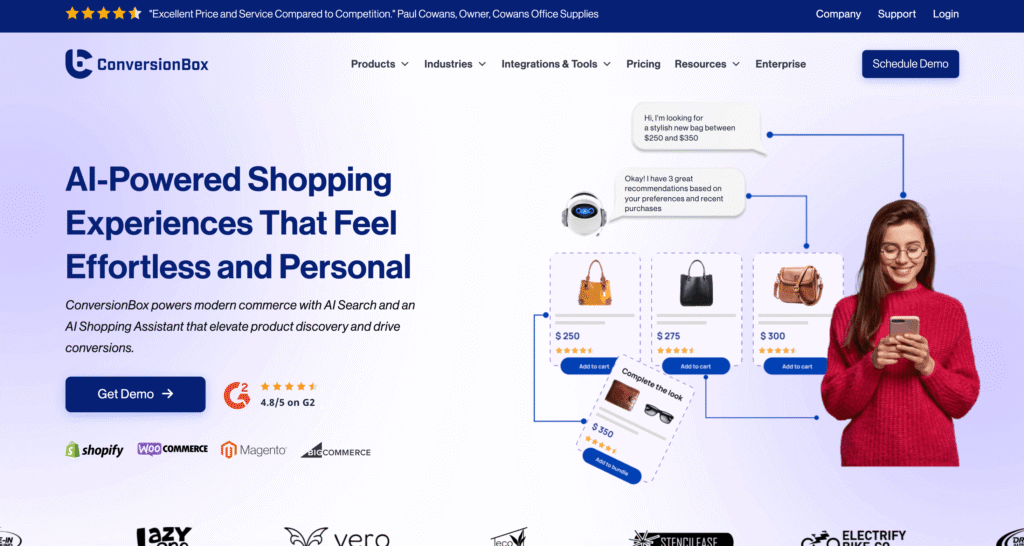
In 2026, e-commerce continues to evolve at lightning speed, and store owners are increasingly turning to advanced AI tools to improve customer experience, increase sales, and reduce operational costs. Among the top-performing solutions available globally, ConversionBox has emerged as a leading AI-driven platform specifically designed to bridge the gap between customer intent and product discovery. It is not just another search tool—it is an intent-based conversational AI engine that transforms how users find what they need on an e-commerce website.
The Innovation Behind ConversionBox
ConversionBox redefines the way search is handled in online stores. Traditional search systems often fail when shoppers use unclear or descriptive phrases, such as “a gift for a luxury traveler.” This results in zero or irrelevant results, leaving potential customers frustrated. ConversionBox solves this by applying advanced conversational AI that understands natural language, deciphers vague intent, and delivers personalized product recommendations with high accuracy.
What makes ConversionBox stand out is its ability to understand context, intent, and behavior patterns. This level of precision helps online shoppers quickly discover products aligned with their preferences, leading to better shopping experiences and higher conversion rates.
Why Personalization is Key in 2026
Today’s consumers expect brands to recognize and cater to their unique needs. Based on recent industry insights:
- 71% of online shoppers expect personalized interactions.
- 76% feel frustrated when personalization is missing.
With consumer expectations at an all-time high, e-commerce store owners are under pressure to deploy tools that deliver immediate and tailored results. ConversionBox is designed specifically to meet these expectations by helping merchants move away from rigid, keyword-based search methods.
Business Performance Impact with ConversionBox
Store owners adopting ConversionBox report exceptional improvements across various performance metrics. The AI tool doesn’t just enhance search—it improves the entire user experience and contributes directly to revenue growth.
The following table highlights key business performance improvements reported by merchants after switching to ConversionBox:
Table: Business Impact Metrics After Using ConversionBox
| Performance Indicator | Measured Improvement | Implication for Store Owners |
|---|---|---|
| Search Conversion Rate | +65% | Customers find relevant products more easily, leading to more purchases |
| Product Discoverability | +55% | Smart filters and AI-driven suggestions broaden exploration of product range |
| Revenue Per Visitor (RPV) | +35% | Higher intent-match accuracy increases order values |
| Bounce Rate Reduction | 120% improvement | Keeps visitors engaged and reduces lost traffic |
| Pricing (Flat Rate Model) | $199/month | Much more affordable than competitors charging $599–$1,000+ monthly |
Pricing Advantage and Accessibility
ConversionBox is purpose-built for mid-sized and fast-growing e-commerce brands. Instead of following the common usage-based pricing structure found in other platforms like Searchspring, it provides a predictable flat monthly fee. This helps business owners control their costs without compromising access to enterprise-level AI features.
Cost Comparison Table: ConversionBox vs. Competitors
| Platform | Pricing Model | Typical Monthly Cost | Additional Notes |
|---|---|---|---|
| ConversionBox | Flat Rate | $199 | All features included; ideal for scaling e-commerce teams |
| Searchspring | Usage-Based | $599 – $1,000+ | Charges vary with usage; may include hidden fees |
This pricing transparency eliminates budget surprises and allows merchants to focus on improving their user journey and product experience without worrying about rising platform costs.
Technical Simplicity and Speed of Deployment
Another reason why ConversionBox leads the AI tools market for online stores in 2026 is its fast and hassle-free implementation. It is compatible with major e-commerce platforms like Shopify, WooCommerce, and custom-built stores. Unlike many enterprise search systems that need weeks or months for configuration and training, ConversionBox comes with pre-trained commerce-specific datasets. This ensures immediate performance improvements right after integration.
Deployment Readiness Comparison Chart
| Feature | ConversionBox | Traditional Enterprise AI Search |
|---|---|---|
| Integration Time | 1–3 days | 4–12 weeks |
| Developer Resources Needed | Minimal | High |
| Pre-trained on Commerce Data | Yes | Rare |
| Shopify/WooCommerce Integration | Native support | Often requires custom development |
This plug-and-play functionality gives ConversionBox a competitive edge in a fast-paced market where time-to-market can make or break a business.
Final Thoughts
In 2026, e-commerce success increasingly depends on how well store owners understand and respond to customer intent. ConversionBox stands out as a transformative AI tool that not only interprets shopper behavior with great precision but also delivers tangible results in revenue, engagement, and cost efficiency. With its affordable pricing, advanced capabilities, and seamless integration, ConversionBox has become a must-have solution for online retailers aiming to thrive in a competitive global market.
For e-commerce brands seeking to enhance their search functionality, improve personalization, and drive better business outcomes, ConversionBox sets the gold standard for AI-powered product discovery tools in 2026.
2. Klaviyo AI (K:AI)
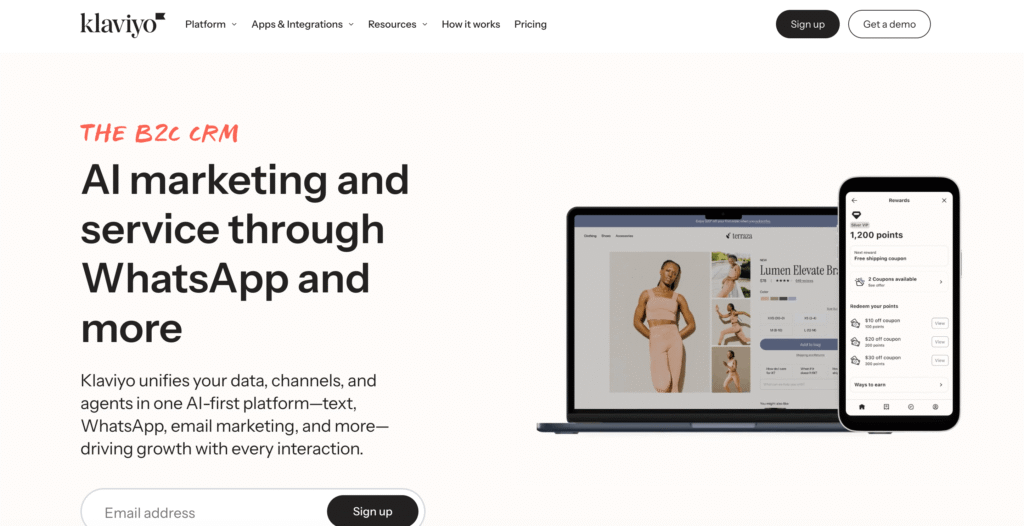
In the competitive world of e-commerce, store owners are turning to intelligent automation to better understand their customers, reduce marketing costs, and increase lifetime value. Klaviyo AI, also known as K:AI, has emerged as one of the top 10 global AI tools for online merchants in 2026. It goes beyond traditional email marketing by functioning as a powerful, predictive lifecycle marketing engine, built to automate and personalise communication across multiple touchpoints.
Predictive Intelligence for Customer Behaviour
Klaviyo AI uses advanced machine learning models to predict individual customer behaviors, such as the likely date of their next purchase, their risk of churning, and their projected lifetime value (CLV). These predictive insights enable businesses to take action before a sale is lost or a customer becomes inactive.
This kind of accuracy is especially important in 2026, where rising advertising costs have made paid acquisition more expensive. In contrast, owned marketing channels like email remain highly profitable. On average, email campaigns supported by Klaviyo AI deliver an impressive $36 return for every $1 invested—making it one of the most cost-effective channels available.
Comparing Manual and Automated Campaigns
Traditional manual email campaigns cannot compete with AI-driven flows in terms of results. Klaviyo’s 2026 benchmarks, based on its analysis of over 183,000 businesses, show that automated campaigns generate up to 30 times more revenue per recipient (RPR) than standard broadcasts. For example, while a manual email might generate $0.10 per recipient, automated flows such as abandoned cart sequences yield over $3.07 per recipient.
Table: Revenue Per Recipient Comparison – Manual vs. AI Flows
| Campaign Type | Revenue Per Recipient (RPR) | Conversion Impact |
|---|---|---|
| Standard Email Campaign | $0.10 | Baseline |
| Abandoned Cart Email Flow | $3.07 | 30x higher than baseline |
| SMS Campaigns (Across Verticals) | >$0.10 | Higher than average email RPR |
| Top 10% Campaign Performance | 5x Higher Order Rates | Uses AI to optimise content and timing |
These results clearly show the advantage of allowing AI to manage the timing, content, and targeting of campaigns based on customer data and predictive modelling.
Industry Case Studies and Real Results
In one notable example, Willow Tree, a fast-growing e-commerce brand, attributed 17.1% of its total revenue to Klaviyo AI’s predictive customer segmentation. The platform’s ability to test and optimize sign-up forms also led to a 65% increase in conversion rates for lead capture.
Performance Benchmarks: Klaviyo AI in Action
| Use Case | Result Achieved | Insight |
|---|---|---|
| AI Predictive Segments | 17.1% of Total Revenue | Improved targeting across lifecycle stages |
| Sign-up Form Optimization | +65% Conversion Rate | A/B testing via AI helped refine copy and design |
| Abandoned Cart Flow Implementation | +30x Revenue Per Recipient vs. Manual Campaign | Intelligent timing and targeting brought shoppers back |
These insights underline how AI-driven marketing is outperforming traditional campaign methods across different industries and customer segments.
Expanding Beyond Email to Omnichannel Automation
Klaviyo AI is no longer limited to email. In 2026, it also handles two-way communication via SMS and WhatsApp—channels expected to influence nearly 30% of all online sales by the end of the decade. The platform acts like a full-service marketing assistant, automating everything from content creation to A/B testing, audience segmentation, and lifecycle journey mapping.
Matrix: Klaviyo AI Capabilities Across Channels
| Marketing Channel | AI Capabilities | Impact on E-commerce Brands |
|---|---|---|
| Predictive flows, dynamic segmentation | Higher revenue and retention | |
| SMS | Automated conversations, promotional triggers | Improved engagement, especially during promotions |
| Two-way interactions, cart reminders | Strengthens customer relationships and repeat purchases | |
| Sign-up Forms | A/B testing, behavior-based display logic | Boosts lead capture and reduces bounce rates |
This multi-channel orchestration enables brands to deliver seamless experiences without increasing headcount or investing in multiple disjointed tools.
Built for Small Teams, Scaled for Growth
One of Klaviyo AI’s most impactful features in 2026 is its ability to act as a “content engineer” for lean marketing teams. For businesses with only one or two marketers, K:AI replicates the workload of an entire team—automating customer journeys, crafting messages, and optimising timing based on predictive data. This allows business owners to focus on long-term growth strategies while the platform manages the complex, repetitive tasks.
Conclusion
In a digital marketplace where attention is hard to earn and even harder to keep, Klaviyo AI delivers an intelligent and scalable solution for e-commerce store owners. It increases marketing effectiveness, improves revenue per visitor, and lowers operational strain through automation and AI-powered decision-making.
K:AI’s ability to anticipate customer needs, engage across multiple channels, and deliver impressive returns makes it one of the most valuable AI tools for e-commerce businesses in 2026. Its predictive lifecycle marketing model is reshaping how online brands attract, retain, and grow their customer base—making it a vital part of the modern e-commerce tech stack.
3. Jasper AI
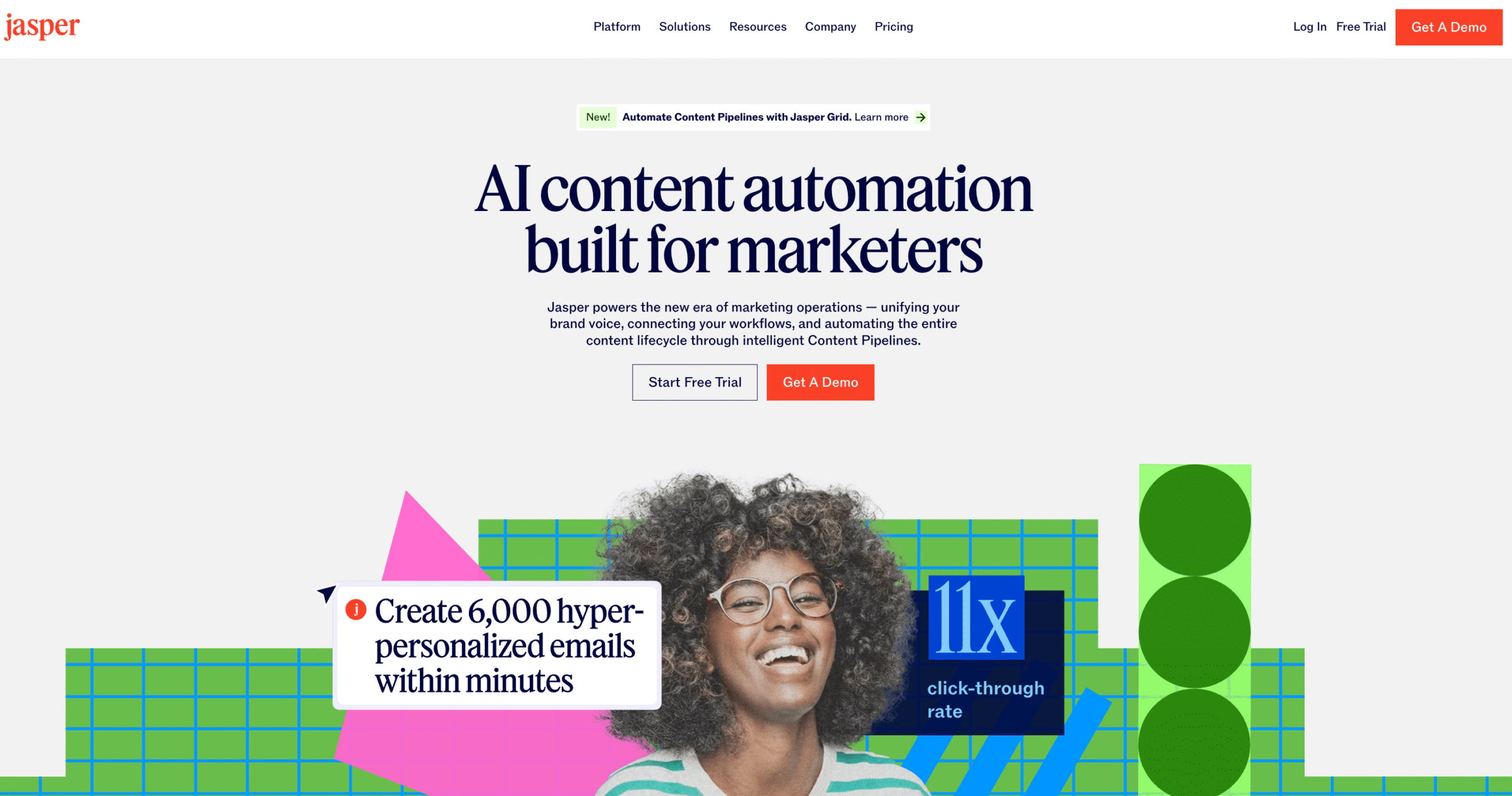
As the e-commerce landscape becomes increasingly digital and competitive in 2026, brands are moving away from sporadic content creation and shifting toward scalable, systematized content strategies. Among the top AI tools powering this shift, Jasper AI has positioned itself as a market leader for enterprise-level content production, helping e-commerce store owners manage their messaging across various channels, languages, and regions with precision and consistency.
From Copywriting Tool to Full-Scale Content Engine
Jasper AI has grown beyond being a simple text generation tool. It now serves as a full-fledged content operations platform built for scalability and speed. One of its standout features is the “Brand Voice” system, which ensures every piece of content—whether it’s a product description, email, social post, or landing page—matches the brand’s tone, style, and vocabulary. This consistency is crucial for customer trust and brand recognition, especially when content is published across multiple regions and platforms.
For e-commerce store owners managing multiple campaigns, Jasper AI removes the bottlenecks often caused by inconsistent tone or reliance on multiple freelance writers and agencies. It empowers marketing teams to operate more efficiently while maintaining high standards of brand alignment.
Content Efficiency and ROI Gains
Jasper AI significantly reduces the manual workload and cost involved in content creation. Reports from businesses using Jasper show an 88% reduction in writing expenses and a 93% improvement in campaign execution speed. These savings allow brands to reallocate budgets toward growth initiatives and speed up their go-to-market strategies.
Table: Jasper AI Performance and Efficiency Gains
| Performance Metric | Change Achieved | Strategic Impact for E-commerce Brands |
|---|---|---|
| Writing Costs | Reduced by 88% | Lower dependence on agencies and freelance content providers |
| Website Traffic | Increased by 800% | Strong top-of-funnel expansion through frequent and high-quality output |
| Campaign Turnaround Time | 93% Faster | Real-time responsiveness to seasonal trends and market changes |
| Weekly Labor Saved | 3–5 Hours per Team Member | Equivalent to adding 10–15% extra productivity to each team |
| Content ROI Improvement | +37% | Higher returns from structured and AI-optimized content investments |
The platform not only produces content faster but also makes it more strategic. By handling low-value tasks like keyword clustering, formatting, and visual asset placement, Jasper allows marketing professionals to focus on creative direction and brand strategy.
Empowering Lean Teams with Scalable Content
Jasper AI has been particularly valuable for small and medium-sized e-commerce teams that need to scale output without hiring large in-house content departments. It functions like an internal “Content Engineer”—not just creating assets, but coordinating an entire pipeline that includes ideation, editing, optimization, and distribution.
Matrix: Jasper AI Capabilities for E-commerce Workflows
| Content Workflow | AI Functionality Enabled by Jasper | Benefit to E-commerce Store Owners |
|---|---|---|
| Brand Guidelines | Enforced across all content using “Brand Voice” | Consistent brand messaging and tone everywhere |
| Content Planning & Ideation | Automated with AI-driven topic suggestions | Faster pipeline from idea to execution |
| Keyword and SEO Optimization | Built-in tools for targeting long-tail and product-specific queries | Better rankings in search and marketplace algorithms |
| Product Descriptions | Automated, multi-format, and localised if needed | Scalable for thousands of SKUs across regions |
| Performance Tracking Integration | Supports ROI analytics with content-specific metrics | Clear measurement of return on content investment |
This system-oriented approach transforms how store owners think about content. Instead of writing content piece-by-piece, they orchestrate entire content ecosystems designed to convert, educate, and retain customers at scale.
Strategic Pricing for Different Business Sizes
Jasper AI is priced to accommodate both individual store owners and enterprise-scale teams. With plans starting from $49 per month for individual users and extending beyond $125 per month for collaborative team environments, it offers flexible tiers that align with business growth and content output needs.
Comparison Table: Jasper AI Pricing Structure
| User Type | Monthly Starting Price | Key Features Included |
|---|---|---|
| Solo Entrepreneurs | $49 | Access to core content generation and brand voice settings |
| Small Teams | $125+ | Includes workflow automation, collaboration, and performance reporting |
| Enterprise Clients | Custom Pricing | Full system integration, API access, and cross-platform coordination |
By delivering such an extensive range of tools under a single platform, Jasper makes it possible for growing e-commerce brands to match the content output and quality of large enterprises without incurring huge overheads.
Conclusion
In 2026, content has become one of the most critical growth levers for e-commerce success. Jasper AI addresses this by offering a structured, AI-powered system that supports the full content lifecycle—from ideation and creation to optimization and measurement. Its ability to scale content production, enforce brand consistency, and improve ROI has made it a top AI solution for e-commerce store owners globally.
By transforming content from a series of individual tasks into a well-engineered system, Jasper AI helps businesses not only save time and money but also gain a stronger presence in competitive markets. This makes it an essential part of any high-performing e-commerce toolkit in 2026.
4. eDesk

In 2026, managing customer support has become a complex challenge for online retailers. Most e-commerce store owners now operate across 15 or more sales channels—including major marketplaces like Amazon and eBay, social platforms like TikTok Shop and Facebook, and their own direct-to-consumer (D2C) websites. Handling customer inquiries from all these sources can be overwhelming. This is where eDesk has emerged as one of the top AI tools for e-commerce globally, offering a complete solution that unifies support channels with intelligent automation.
Centralized AI Support Across Multiple Channels
eDesk’s AI-powered helpdesk brings together messages from all channels into one central dashboard. Its AI Agent is trained specifically for e-commerce, making it capable of understanding and responding to common issues such as order status, refunds, delivery delays, and product-related questions.
By automating up to 65% of incoming tickets, eDesk helps businesses save valuable time while ensuring that customers still receive timely and accurate assistance. This level of automation is especially critical for fast-growing brands that need to manage large volumes of inquiries without continuously expanding their customer service teams.
Performance Impact: Lower Costs, Higher Revenue
What sets eDesk apart is not only its ability to reduce support costs but also its contribution to sales growth. By automatically identifying and prioritizing high-intent pre-sale queries, the platform turns what was once just a support channel into a revenue-generating tool. In fact, businesses using eDesk have reported a 30% reduction in support-related expenses, alongside a 25% increase in lead conversions.
Table: Key Business Improvements with eDesk
| Functionality Area | Measured Impact | Business Outcome |
|---|---|---|
| Support Ticket Automation | 65% of total inquiries handled | Faster response time, fewer agents needed |
| Cost Reduction | 30% lower support costs | Improved efficiency without growing support teams |
| Conversion Rate Increase | 25% higher pre-sale conversions | More leads converted to sales via proactive AI engagement |
Seamless Integrations with E-commerce Platforms and Channels
eDesk has developed robust integrations to ensure complete omnichannel coverage. Whether a store operates through global marketplaces, social commerce apps, or standalone websites, eDesk connects all customer touchpoints and syncs data in real time.
Integration Matrix: eDesk Compatibility Overview
| Integration Category | Supported Platforms | Benefit for Store Owners |
|---|---|---|
| Marketplaces | Amazon, eBay, Walmart, Mirakl, Veepee | Consolidated ticket handling across all sales outlets |
| E-commerce Platforms | Shopify, BigCommerce, Magento, WooCommerce | Native integration enables quicker setup and fewer data silos |
| Communication Channels | TikTok Shop, WhatsApp, Facebook, Instagram | Unified support across customer-facing social and messaging apps |
These integrations ensure that no customer message is missed, regardless of where it comes from. eDesk makes it possible for support agents to maintain visibility and control, even in highly fragmented sales environments.
Human-AI Collaboration for 24/7 Support
Modern shoppers expect immediate assistance, and eDesk delivers on that expectation. The platform supports around-the-clock service with its AI-powered workflows and “interactive demo” features. These allow customers to resolve many of their issues in real time without waiting for a human agent.
Yet, when complex queries arise, eDesk seamlessly escalates the conversation to a human agent. This orchestration ensures the balance of AI speed and human empathy, which is important given that:
- 87% of customers in 2026 prefer a hybrid support experience.
- 68% of customer experience teams believe AI can now deliver a human-like touch.
Matrix: Consumer Preferences vs. eDesk Capabilities
| Consumer Expectations (2026) | How eDesk Delivers |
|---|---|
| 24/7 real-time support | AI agents handle routine queries day and night |
| Consistent experience across apps | Unified inbox connects all sales and messaging apps |
| Human-like conversation quality | AI is trained for empathy and escalation protocols |
| Rapid issue resolution | Intelligent routing and automation improve speed |
Conclusion
As e-commerce expands across multiple platforms, managing customer service without AI is no longer sustainable. eDesk provides a complete, AI-enhanced helpdesk that empowers store owners to scale their operations without losing the human touch. Its advanced automation, cost-saving capabilities, and sales-focused AI design make it one of the most valuable tools for e-commerce in 2026.
By consolidating communication channels and delivering fast, empathetic, and intelligent support, eDesk not only improves the customer experience—it also drives meaningful business growth. This makes it a vital component in the toolkit of any modern e-commerce brand aiming to compete and thrive in today’s global retail environment.
5. Prediko

In 2026, managing inventory efficiently has become one of the biggest challenges for e-commerce store owners. With rising customer expectations and global supply chain complexities, the cost of errors such as overstocking or stockouts can be extremely high. Prediko, a leading AI-powered inventory planning tool, is solving this issue with advanced forecasting and automation capabilities, making it one of the top AI tools for e-commerce businesses worldwide.
AI-Powered Demand Forecasting and Real-Time Inventory Control
Prediko uses artificial intelligence to manage inventory more accurately by predicting customer demand in real time. Trained on over 25 million Stock Keeping Units (SKUs) across 15 different industries, its forecasting model considers critical variables such as seasonal buying patterns, emerging sales trends, and supplier lead times. This gives e-commerce brands the power to go beyond guesswork and base their purchasing decisions on data-driven insights.
For Shopify store owners in particular, Prediko streamlines the entire process—from forecasting demand to generating automated purchase orders (POs). By syncing directly with supply chain operations, Prediko allows businesses to optimize stock levels, avoid costly stockouts, and make timely inventory decisions without manual intervention.
Operational and Financial Benefits of Using Prediko
Prediko offers measurable improvements in performance and cost savings. It turns inventory management into a strategic growth function rather than just a backend task. Businesses using Prediko have reported significantly higher return on investment (ROI), faster planning times, and fewer inventory shortages—all of which directly improve the customer experience and reduce financial waste.
Table: Business Performance Improvements with Prediko
| Impact Area | Reported Results | Strategic Implications |
|---|---|---|
| ROI from Predictive Planning | 75x ROI (Healf) | Maximizes return by aligning purchasing with real-time demand |
| Planning Time Reduction | 75% faster planning (Bright Body) | More efficient use of internal resources |
| Stockout Reduction | 60% fewer stockouts (We Are Jolies) | Maintains customer trust and avoids lost sales |
| Automated PO Generation | Real-time based on AI forecasts | Saves time and ensures optimal inventory replenishment |
| Bundle Forecasting Accuracy | SKU and product bundle segmentation | Improves inventory for multi-item and seasonal promotions |
Flexible Pricing for Different Store Sizes
Prediko offers pricing plans based on revenue scale, making it suitable for early-stage brands and larger operations alike. This flexibility ensures that store owners only pay for what they need while still accessing enterprise-grade features.
Pricing and Success Benchmark Matrix
| Plan Tier | Monthly Price | Revenue Scale | Notable Use Case | Key Outcome |
|---|---|---|---|---|
| Starter | $49 | Up to $100K | ROI Estimation via Impact Calculator | Entry-level forecast automation |
| Core | $119 | Up to $500K | Bright Body (75% faster planning) | Better time management for planning |
| Plus | $199 | Up to $1M | Cloudsharks (35% fewer stockouts) | More accurate SKU-level forecasting |
| Advanced | $349 | High-Volume Businesses | Healf (Achieved 75x ROI) | Deep optimization for large operations |
This tiered structure ensures that Prediko can scale with the business—from startups managing their first $100,000 in revenue to enterprise-level brands managing millions.
AI-Driven Inventory System Built for the Future
Unlike traditional systems that use basic reorder rules and static inventory levels, Prediko introduces “Digital Workers” to handle real-time changes in inventory. These AI agents constantly learn from new sales data and purchasing behaviors to update reorder quantities and product segmentation automatically.
Prediko also includes bundle-level forecasting, helping store owners manage complex product kits or promotional bundles more efficiently. This holistic view of inventory health gives brands the visibility and control they need to scale without risking lost sales or tying up cash in unsold inventory.
Matrix: Traditional Inventory vs. Prediko’s AI System
| Feature Area | Traditional Inventory Tools | Prediko AI System |
|---|---|---|
| Forecasting Accuracy | Static, Rule-Based | Real-time, AI-Powered Predictions |
| PO Generation | Manual Input | Automated via Digital Workers |
| SKU & Bundle-Level Forecasting | Limited or Non-existent | Detailed Forecasting for SKUs & Bundles |
| Planning Time | Long & Labor-Intensive | Reduced by 75% through Automation |
| Stockout Management | Reactive | Predictive with Up to 60% Reduction |
Conclusion
Prediko is reshaping how e-commerce businesses approach inventory management. With predictive AI, real-time decision-making, and automation built into every step, it helps store owners improve profitability, reduce waste, and ensure customer satisfaction by keeping the right products in stock at the right time.
For any e-commerce brand looking to scale smartly in 2026, Prediko stands out as an essential AI tool that transforms inventory from a problem area into a growth accelerator.
6. Algolia
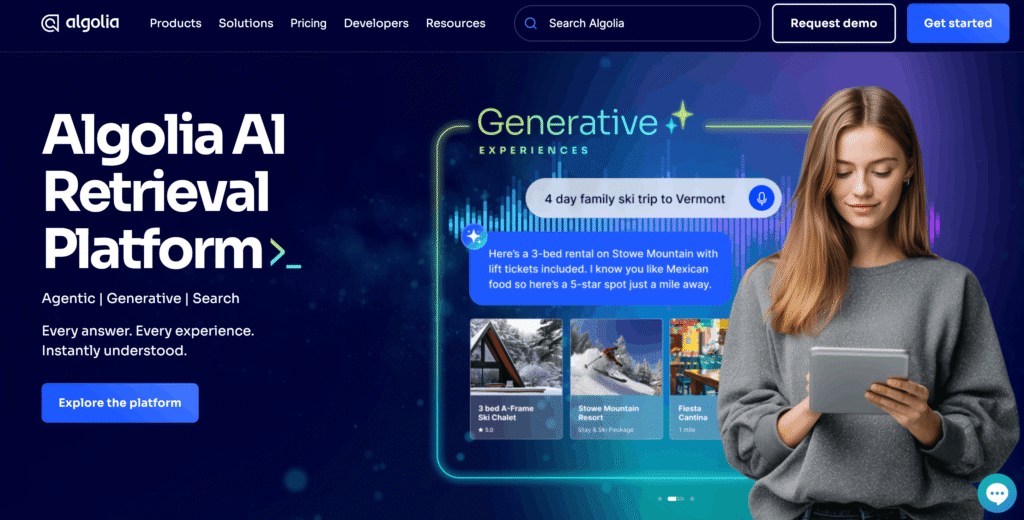
In 2026, Algolia continues to establish itself as one of the most powerful and advanced AI-based search platforms tailored for enterprise-level e-commerce operations. Known for its exceptional speed, flexibility, and relevance optimization, Algolia provides large-scale online retailers with an intelligent search experience that directly impacts both user satisfaction and business revenue.
Unlike many traditional search systems that rely solely on keyword matching, Algolia applies AI-driven semantic understanding through its proprietary NeuralSearch feature. This technology enables the platform to decode complex or even error-filled search queries, delivering results that reflect user intent rather than mere word similarity. For e-commerce brands, this translates into faster and more accurate product discovery, increasing the chances of conversion.
Core Capabilities Driving Performance
Algolia’s appeal lies in its robust developer-friendly environment. With a powerful API-first infrastructure, developers can build advanced features like “Frequently Bought Together” suggestions or “Related Items” carousels with minimal code—sometimes in as few as six lines. This design flexibility allows businesses to tailor customer experiences while integrating seamlessly into headless or composable commerce frameworks.
For enterprise users, the system’s ability to handle millions of search queries within milliseconds makes it an essential component of a frictionless digital shopping journey. Furthermore, its search logic can be adjusted to suit brand-specific priorities, helping businesses control how products appear based on popularity, availability, or profitability.
Measurable ROI and Operational Advantages
What sets Algolia apart from many search tools is its proven track record of delivering substantial returns. A third-party study by Forrester reported a remarkable 382% return on investment, with clients recovering their initial costs in less than six months. This rapid time-to-value has made Algolia a go-to choice for e-commerce leaders seeking measurable impact.
The following table highlights Algolia’s business impact across various operational metrics:
Algolia ROI and Performance Impact Table
| ROI / Efficiency Indicator | Quantified Result | Description |
|---|---|---|
| Total Return on Investment | 382% | Based on combined savings and revenue gains across enterprise clients |
| Search-Driven Revenue Increase | +34% | Attributed to improved relevance and discoverability of product listings |
| Conversion Rate Growth | Up to 360% | Up to fourfold improvement after integrating personalized search modules |
| Time to Financial Payback | Under 6 months | Reflects quick profitability and implementation efficiency |
| IT Labor Productivity Improvement | +90% | Achieved through automation of relevance tuning and search configuration |
| Licensing Cost Reduction | -25% | Reduced long-term costs through efficient scalability and fewer manual processes |
Scalability for Growth-Focused Brands
While Algolia’s enterprise-grade features are often seen as too premium for small businesses, the company offers an accessible “Build” plan for startups or mid-size brands. This free tier supports up to 10,000 monthly search requests, allowing growing stores to benefit from AI-enhanced search without immediate investment.
For brands anticipating growth, Algolia’s infrastructure is future-proof. It easily scales with increased user traffic and integrates well with modern tech stacks—especially those adopting headless commerce models. This makes it a long-term strategic asset, especially for stores that see search as a conversion channel rather than just a utility.
Positioning Within the 2026 E-commerce Tech Ecosystem
With increasing emphasis on user intent, speed, and personalization, Algolia aligns perfectly with the technological demands of modern e-commerce. In an era where milliseconds in loading time can impact revenue, and where customers expect hyper-relevant results instantly, Algolia empowers businesses to meet—and exceed—these expectations.
Its AI-led architecture ensures that search remains a growth engine rather than a bottleneck. From streamlining customer journeys to automating backend processes, Algolia stands as one of the most essential AI tools for any e-commerce store aiming for global success in 2026.
7. Shopify Magic

As AI continues to transform e-commerce operations in 2026, Shopify Magic has become one of the most impactful and widely accessible AI tools for online store owners. Built directly into the Shopify platform, Shopify Magic delivers a wide range of intelligent features designed to streamline daily workflows, support business growth, and make advanced AI capabilities available to every merchant—without the need for external tools or complex integrations.
Embedded AI for Effortless Store Management
Unlike third-party software that often requires separate onboarding and additional fees, Shopify Magic is embedded natively within the Shopify dashboard. This seamless integration allows the AI to access store-specific data such as product catalogs, customer profiles, historical trends, and sales performance. With this context, it powers a variety of intelligent automations and content generation features tailored specifically to each store.
Store owners can automatically generate compelling product descriptions, write search engine–friendly blog content, optimize FAQs, remove image backgrounds, and even draft marketing emails—all with a few clicks inside their existing Shopify environment.
Feature Table: What Shopify Magic Offers Across Business Functions
| Category | AI Capability | Included In |
|---|---|---|
| Content Creation | Product descriptions, blogs, FAQ writing | Included in all plans |
| Visual Enhancements | Background removal, image edits | Included |
| Email & Marketing Copy | Automated email and ad copy generation | Included |
| Conversational Assistant | Sidekick (AI advisor for business queries) | Rolling out in beta |
By embedding these features within the platform itself, Shopify ensures even the smallest merchants benefit from enterprise-grade AI tools without extra subscriptions or developer involvement.
Introduction of Shopify Sidekick: Conversational AI for Business Tasks
One of the most innovative additions to Shopify Magic in 2026 is Sidekick—a conversational AI assistant designed to act like a virtual co-founder. Rather than requiring the user to click through multiple reports, Sidekick allows store owners to issue natural language prompts such as:
- “What were my top-selling products last month?”
- “Set inventory alerts based on last quarter’s stock trends”
- “Draft an email campaign for our latest product launch”
This “agentic commerce” capability—where AI behaves more like a teammate—helps small business owners reduce time spent on analytics, planning, and repetitive admin work, allowing them to focus on strategic growth and customer engagement.
Matrix: Key Tasks Shopify Sidekick Can Automate
| Business Task | Sidekick AI Capability | Impact on Store Owner |
|---|---|---|
| Sales Analysis | Analyze past sales and product trends | Save hours on manual report pulling |
| Inventory Management | Adjust stock alerts and ordering thresholds | Prevent stockouts or overstocking |
| Marketing Support | Draft campaigns, segment audiences | Faster launch of targeted promotions |
| Operations Planning | Provide recommendations on pricing, bundling, or timing | Informed decisions based on historical patterns |
Pricing and Accessibility for All Store Sizes
Shopify Magic is included within Shopify’s pricing structure, ensuring broad accessibility. Whether a solo entrepreneur is just starting out or a mid-sized brand is scaling operations, AI tools are integrated as part of the standard subscription—no hidden costs, no additional platforms to manage.
Shopify Magic Pricing Comparison Table
| Shopify Plan | Monthly Cost | Access to AI Features | Ideal For |
|---|---|---|---|
| Basic | $17 | Content creation, image editing, marketing | New or small businesses |
| Business Elite | $159 | All features including Sidekick (rolling out) | Scaling brands and SMBs |
This pricing model reflects Shopify’s strategy of embedding intelligence into the core platform, rather than charging separately for AI modules.
Closing the AI Productivity Gap for SMBs
Many small and mid-sized e-commerce owners struggle with the learning curve and resource limitations that come with implementing AI tools. According to industry data, 43% of marketers still find AI adoption difficult due to knowledge or skill gaps. Shopify Magic helps close this gap by offering plug-and-play functionality that requires no coding, no training, and no additional software management.
Impact Matrix: How Shopify Magic Helps Store Owners Compete
| Challenge Faced by Merchants | AI-Powered Solution by Shopify Magic | Competitive Advantage Delivered |
|---|---|---|
| Time-consuming content creation | Auto-generate descriptions, blogs, emails | Speed to market with consistent brand messaging |
| Lack of design expertise | Background removal and image editing | Professional-looking product visuals |
| Decision-making fatigue | Conversational assistant (Sidekick) provides real-time answers | Data-driven decisions without analytics expertise |
| Marketing complexity | Draft ad copy and email flows instantly | Efficient campaign execution |
Conclusion
Shopify Magic stands out as one of the most transformative AI tools for e-commerce store owners in 2026. By building AI directly into the Shopify ecosystem, it empowers merchants of all sizes to access enterprise-level tools without additional costs or complexity. From content creation to inventory alerts and intelligent campaign planning, Shopify Magic simplifies and accelerates daily operations while boosting productivity and customer engagement.
In a market where larger brands often win by leveraging advanced tech stacks, Shopify Magic levels the playing field—giving every merchant the power to compete smarter, faster, and more effectively with AI.
8. Nosto
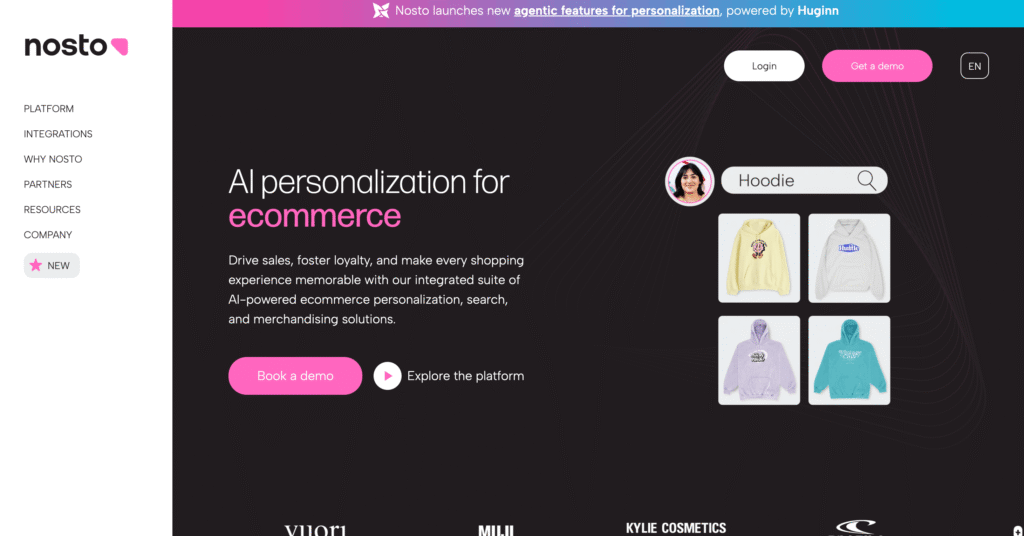
In 2026, personalization in e-commerce has evolved far beyond using a customer’s name in an email. Today’s shoppers expect online stores to understand their preferences, behaviors, and timing—delivering relevant experiences that feel tailored to them. Nosto, one of the world’s leading AI tools for e-commerce store owners, has become a powerful solution for creating these one-to-one personalized shopping experiences at scale.
Nosto is a Commerce Experience Platform (CXP) built to help brands convert visitors into loyal, repeat customers through intelligent personalization across every part of the digital storefront—from product recommendations to search results, category merchandising, content, and popups.
Real-Time Personalization with AI-Powered Recommendations
Nosto uses artificial intelligence to monitor customer behavior in real time and automatically adjust the online shopping experience based on individual preferences. This includes dynamically curated product recommendations, personalized content modules, adaptive site search, and targeted messaging—all informed by customer data such as browsing history, past purchases, and location.
By aligning shopper identity, intent, and timing, Nosto creates a personalized journey for each customer. This approach mirrors the same strategy that drives 35% of Amazon’s total customer purchases, giving even mid-sized retailers the tools to compete with global giants.
Table: Nosto’s AI-Powered Personalization Capabilities
| Feature Area | AI-Driven Capability | Benefit for E-commerce Brands |
|---|---|---|
| Product Recommendations | “Frequently Bought Together”, “Related Styles”, etc. | Increases AOV and drives cross-sell and upsell performance |
| Behavioral Targeting | Adjusts content based on real-time visitor actions | Enhances user experience and improves session retention |
| Dynamic Content Display | Personalized banners, CTAs, and images | Boosts engagement and conversion from returning visitors |
| Exit Intent Detection | Predicts abandonment to trigger recovery popups/emails | Reduces cart abandonment and recovers lost revenue |
Strong ROI for Mid-Market and Enterprise Brands
Nosto is particularly effective for fast-growing online stores and established retailers managing large or diverse catalogs. The platform has consistently shown high returns on investment through increases in both conversion rates and average order values (AOV). For example:
- Brands using Nosto often experience a 10% to 30% lift in conversion rates.
- Average order value grows by 15% to 25% as shoppers engage more deeply with tailored product suggestions.
- Personalized upsells and recommendation carousels can contribute to 31% of total e-commerce revenue.
Table: Nosto ROI and Revenue Impact Benchmarks
| Performance Metric | Typical Uplift Range | Strategic Benefit |
|---|---|---|
| Conversion Rate (CVR) | 10% – 30% increase | Converts more visitors into paying customers |
| Average Order Value (AOV) | 15% – 25% increase | Shoppers buy more due to better-targeted offers |
| Suggestive Selling Contribution | Up to 31% of total online revenue | Drives significant revenue through intelligent automation |
| Abandonment Recovery | Exit-intent triggers to capture sales | Reduces revenue loss due to cart drop-offs |
Pricing Model Aligned with Revenue Growth
One of the reasons why Nosto is ranked among the top AI tools for e-commerce in 2026 is its performance-based pricing model. This ensures that store owners only pay in proportion to their growth and success. The platform scales its cost structure based on monthly store turnover, making it accessible to growing businesses while still supporting the needs of high-volume enterprises.
Nosto Pricing and Revenue Tier Matrix
| Monthly Store Revenue | Estimated Monthly Cost | Expected Performance Return |
|---|---|---|
| $0 – $50,000 | $0.01 – $199 | Entry-level personalization tools |
| $50,000 – $250,000 | $500 – $1,500 | 10–30% CVR improvement |
| $250,000 – $1 Million | $1,500 – $4,000 | 15–25% AOV growth with multichannel use |
| $1 Million+ | Custom Pricing | Enterprise-grade personalization capabilities |
This revenue-aligned structure ensures that small merchants can start affordably, while larger stores unlock more robust features as they scale.
Quick Implementation and Fast Results
Unlike some AI platforms that require long development cycles or heavy coding, Nosto is known for its fast deployment. Merchants typically begin seeing measurable results within three to six months. Its plug-and-play setup integrates easily with platforms like Shopify, BigCommerce, and Magento, making it an ideal fit for businesses that want to move quickly without compromising performance.
Implementation and Adoption Performance Overview
| Deployment Factor | Typical Outcome | Business Advantage |
|---|---|---|
| Setup Time | Weeks, not months | Faster speed to market |
| Time to ROI | 3–6 months | Earlier profitability from AI investments |
| Technical Resources Required | Low to moderate | Minimal strain on internal teams |
| Platform Compatibility | Shopify, Magento, BigCommerce, etc. | Wide ecosystem support for flexible adoption |
Conclusion
In the competitive digital market of 2026, creating personalized experiences is not optional—it is essential. Nosto empowers e-commerce store owners to deliver real-time, tailored experiences that drive customer loyalty, improve purchase behavior, and increase revenue.
Its intelligent product recommendations, AI personalization engine, predictive intent tracking, and scalable pricing model make it a powerful tool for businesses of all sizes. With quick onboarding, proven ROI, and an architecture built for long-term growth, Nosto ranks among the top 10 AI tools for modern e-commerce brands seeking to elevate their customer experience and boost their sales performance.
9. Syte

In 2026, the way people shop online has shifted dramatically. As customer behavior becomes increasingly visual, traditional keyword-based search is no longer the only way consumers find products. Instead, many shoppers now rely on visual inspiration—using images to guide product discovery. Syte has emerged as one of the top AI tools for e-commerce store owners globally by making visual search not only possible but highly intuitive and conversion-friendly.
Syte is a visual intelligence platform that transforms how people shop for fashion, accessories, jewelry, and home decor. It allows customers to search for products using images—either by uploading their own photos, clicking on a product they like, or exploring visual galleries. This form of visual engagement aligns perfectly with the rising customer demand for fast, personalized, and inspiration-based shopping experiences.
Advanced Visual Search and “Shop Similar” Capabilities
One of Syte’s most impactful contributions to e-commerce in 2026 is its advanced visual search feature. Known as “Camera Search,” it allows users to upload an image or take a photo, then instantly browse visually similar items available in the store. This removes the need for typing keywords, which can be limiting—especially when customers don’t know how to describe what they’re looking for.
Another key feature is the “Shop Similar” function, which presents look-alike or complementary product options based on visual aesthetics, patterns, colors, and textures. This significantly boosts customer engagement and helps retailers increase product discoverability and conversions.
Table: Syte’s Core Visual AI Features and Benefits
| Functionality | Feature Description | E-commerce Benefit |
|---|---|---|
| Visual Search (Camera Search) | Shoppers upload or snap photos to find similar products | Increases product discovery and reduces friction in search |
| Shop Similar | Recommends visually related products | Boosts cross-sell and upsell conversions |
| Inspiration Gallery | Curated visual browsing experiences | Encourages deeper catalog exploration |
| Automated Product Tagging | AI-driven image analysis for accurate tagging | Improves catalog SEO and internal site search quality |
High Engagement and Performance Metrics
Visual AI is proving to be more effective than traditional text-based methods. In 2026, visual search features like those offered by Syte generate 30% higher engagement compared to standard text search. This indicates a strong preference among users for more intuitive, image-based interactions.
Syte’s visual recommendation carousels, which suggest items based on style similarity, also contribute to a measurable lift in average order value by showcasing products that align with the shopper’s taste, not just the metadata of the current item viewed.
Performance and Adoption Overview
| Key Metric | Documented Result | Strategic Value for Store Owners |
|---|---|---|
| User Satisfaction | 4.6 out of 5.0 (Based on 76 reviews) | Consistent positive user experience |
| Enterprise Adoption Rate | 31% of customers are enterprise-level | Proven track record with high-volume, large-scale stores |
| Visual Search Engagement | 30% more interaction than text-based search | Drives deeper engagement and faster discovery |
| ROI Realization Timeline | ~20 months on average | Long-term operational and revenue growth |
| Average Implementation Speed | 1 to 3 months | Quick deployment for faster time-to-market |
| Average Time-to-Purchase Reduction | 47% faster purchasing decisions | Accelerates sales cycles and improves shopping efficiency |
Smart Tagging and Catalog Optimization with AI
A standout capability of Syte is its automated product tagging feature. By scanning product images using deep learning, Syte generates a wide range of tags that describe style, color, texture, and patterns. This not only improves search accuracy but also creates a more search-friendly database, giving merchants an SEO advantage and improved internal catalog structure.
Matrix: Syte vs. Traditional Product Discovery
| Discovery Feature | Traditional Method | Syte Visual AI Method | Resulting Benefit |
|---|---|---|---|
| Search Query | Keyword-based | Image-based (Camera Search, Gallery) | Higher engagement, easier discovery |
| Recommendations | Metadata-linked | Style and visual similarity-based | Better personalization, higher AOV |
| Product Tagging | Manual entry | Automated via AI-driven image recognition | Saves time, improves accuracy |
| Catalog Browsing | Linear navigation | Visual exploration through carousels and galleries | Encourages longer sessions and higher conversions |
Ease of Adoption and Enterprise Compatibility
Syte is built for seamless integration into existing e-commerce platforms, including enterprise-level environments. With a typical implementation timeline of just 1 to 3 months, most merchants can start using Syte’s features without long development cycles. The platform is especially effective for retailers with visually rich inventories, where appearance matters more than specifications alone.
Conclusion
As customer behavior continues to shift toward image-driven decision-making in 2026, e-commerce brands that adopt visual AI tools like Syte stand to gain significant advantages. From improving engagement and increasing order value to reducing the time it takes a customer to find the right product, Syte delivers tangible results through its advanced visual search and product discovery features.
Its proven success across fashion, home decor, and accessories—combined with high satisfaction scores, enterprise trust, and automated catalog optimization—makes Syte one of the top 10 AI tools empowering e-commerce store owners around the world to provide smarter, faster, and more visually engaging shopping experiences.
10. RetentionX
In 2026, customer retention has become a top priority for e-commerce businesses aiming to improve profitability and reduce reliance on expensive acquisition strategies. RetentionX stands out as one of the most effective AI tools in the global e-commerce space, offering store owners powerful customer intelligence, retention automation, and performance analytics—all within a unified platform.
With advertising costs at an all-time high, e-commerce success now depends more on increasing lifetime value (LTV) and repeat purchases than on simply driving first-time transactions. RetentionX helps store owners shift toward sustainable growth by understanding customer behavior, predicting churn, and triggering personalized retention campaigns before customers drop off.
AI-Powered Customer Analytics and Retention Automation
RetentionX uses advanced AI models to segment customers based on behavior, loyalty, and purchasing patterns. It tracks key metrics like Recency, Frequency, and Monetary value (RFM), helping brands identify which customers are likely to churn and which are most valuable. The platform then automates timely, tailored offers to retain these customers.
Through seamless integration with tools like Klaviyo, Meta, and Google Ads, RetentionX enables brands to launch smart, data-informed campaigns targeted at specific audiences. This results in better performance from the same marketing budget, reduced churn, and higher returns on customer engagement.
Table: Core Capabilities of RetentionX and Their Business Impact
| Capability Area | Functionality Description | Business Benefit |
|---|---|---|
| Customer Segmentation | AI-driven RFM and cohort segmentation | Targeted messaging and smarter campaign strategy |
| Predictive Analytics | Churn forecasting and lifetime value modeling | Retention before loss and revenue predictability |
| Performance Automation | Product sorting, email syncing, campaign triggers | Reduces manual work and improves merchandising efficiency |
| Integration with Marketing Tools | Syncs with Klaviyo, Meta, Google | Enables hyper-personalized, cross-platform marketing |
| Audience Intelligence Dashboard | Real-time customer insights and cohort evolution tracking | Data-backed decision making across departments |
Revenue-Driven Results and Performance Benchmarks
E-commerce store owners using RetentionX consistently report measurable gains across their retention and revenue strategies. The platform doesn’t just track data—it helps turn that data into action.
Key performance improvements include:
- A 36% average increase in customer lifetime value (LTV)
- A 21% growth in repeat purchase rates
- 10%–15% higher conversion rates through personalized product merchandising
- A 300x average return on investment
Table: RetentionX Performance Metrics and ROI
| Success Metric | Measured Impact | Implication for Store Owners |
|---|---|---|
| Customer Lifetime Value (LTV) | +36% increase | Longer relationships and more value per customer |
| Repeat Purchase Rate | +21% growth | Stronger loyalty and sustainable revenue base |
| Conversion Rate Improvement | +10%–15% via automated product sorting | Better store experience and higher ROI from same traffic |
| Average ROI | 300x return | Significant gain compared to tool investment |
Performance-Based Pricing Tiers for All Growth Stages
RetentionX is priced to support businesses of all sizes, from early-stage stores to large enterprise brands. Its tiered subscription model ensures access to advanced features as a business grows, without locking smaller merchants out of high-impact insights.
RetentionX Pricing and Capability Matrix
| Plan Tier | Monthly Price | Sales Threshold | Included Features |
|---|---|---|---|
| Starter | $49 | Up to $250,000 per year | 30 customer segments, retention insights |
| Core | $149 | Upgraded access | 50 segments, deeper marketing analytics |
| Growth | $249 | Enterprise-level brands | 100 segments, AI predictive modeling, smart automation |
This flexible structure allows e-commerce store owners to scale their customer intelligence tools alongside their business growth.
Smart Product Merchandising Based on Real Conversion Data
One of the unique features of RetentionX is its ability to sort and prioritize products based on real-time performance. High-converting products (“winners”) are displayed more prominently across the site, while low-performing or overstocked products (“losers”) are automatically suppressed. This AI-driven merchandising directly supports better conversion rates, efficient stock turnover, and maximized margins.
Matrix: Manual vs. AI-Powered Product Merchandising
| Merchandising Task | Traditional Manual Method | RetentionX AI Method | Outcome |
|---|---|---|---|
| Product Ranking | Based on static rules or guesswork | Based on real conversion and performance data | Smarter shelf visibility and higher sales |
| Inventory Prioritization | Requires human review and adjustments | Automated based on demand, frequency, returns | Faster stock turnover and reduced dead stock |
| Campaign Targeting | Limited audience segmentation | Real-time syncing to ad platforms and email | Lower ad waste, more precise messaging |
| Conversion Optimization | A/B testing only | Dynamic product display personalization | 10–15% higher conversion across key pages |
Conclusion
In the highly competitive e-commerce landscape of 2026, acquiring customers is more expensive than ever. RetentionX addresses this by turning retention into a science—offering intelligent segmentation, predictive analytics, merchandising automation, and ROI-backed performance insights.
It’s not just about holding onto customers—it’s about understanding them deeply, serving them smarter, and growing profitably. With its strong AI infrastructure, measurable impact, and scalable pricing, RetentionX has earned its place as one of the top 10 AI tools for e-commerce store owners worldwide seeking long-term, sustainable growth.
The Global AI Advantage in E-commerce: ROI Trends and Economic Landscape in 2026
In 2026, the global e-commerce environment is more competitive and complex than ever. Online store owners are facing a dual challenge—rising operational costs and rapidly evolving consumer expectations. Amid this shift, artificial intelligence (AI) is proving to be a game-changing investment. From personalizing customer journeys to optimizing marketing spend, AI-driven platforms are now seen as essential tools for long-term profitability.
Rising Costs and the Need for Intelligent Automation
The cost of digital advertising continues to increase sharply. According to the latest data:
- Meta’s cost-per-thousand impressions (CPM) rose by 22.58% year-over-year.
- Google’s cost-per-acquisition (CPA) increased by 17.25% in the same period.
These rising costs are forcing e-commerce businesses to focus less on aggressive acquisition and more on optimizing retention, pricing, and personalization strategies. AI tools are playing a central role in this transition, helping brands get more value from every marketing dollar.
Matrix: Cost Trends vs. Strategic Shift in 2026
| Cost Indicator | 2025 Value | 2026 Value | Strategic Response with AI |
|---|---|---|---|
| Meta CPM Growth Rate | +18.4% | +22.58% | Improve targeting efficiency and ROI with AI |
| Google CPA Growth Rate | +13.7% | +17.25% | Focus on retention and personalized experiences |
| Customer Acquisition Cost (CAC) | Rising | Rising | Shift spend to AI-driven lifecycle campaigns |
| Ad-to-Sale Efficiency | Declining | Declining | Use AI to align spend with high-intent audiences |
AI as a Revenue Multiplier in E-commerce
AI adoption is no longer optional—it is a driver of superior financial performance. Research shows that companies using AI for hyper-personalization and customer experience improvements see significantly higher returns:
- Brands using AI for personalization generate 40% more revenue than their competitors.
- 82% of AI adopters report five to eight times higher returns on their marketing spend.
AI now plays a pivotal role in automating product recommendations, pricing adjustments, inventory visibility, and even retention campaigns—all of which directly impact both revenue and operational efficiency.
Table: Business Impact of AI in E-commerce
| Performance Metric | AI-Enabled Result | Implication for Store Owners |
|---|---|---|
| Revenue from AI Personalization | +40% Higher | Deeper customer loyalty and greater spend per visitor |
| ROI on Marketing Spend (AI-enhanced) | 5x to 8x Returns | Higher returns from existing marketing efforts |
| Campaign Performance | Enhanced segmentation and reach | Better results with less budget waste |
| Operational Efficiency | Streamlined repetitive workflows | More time for strategy, less time on manual tasks |
AI Adoption Rates by Business Size and Region
AI usage among small and mid-sized businesses (SMBs) has skyrocketed globally. As of 2026:
- 89% of small businesses globally use AI for at least one repetitive function.
- In the U.S., 68% of small businesses report using AI regularly, up from 48% in mid-2024.
- India leads in SMB AI adoption with a 59% usage rate—highlighting its growing technological infrastructure and innovation speed.
- North America remains the largest AI market by value, driven by large-scale government and private sector investments.
Global AI Adoption Matrix by Region (2026)
| Region | AI Adoption Rate (SMBs) | Market Driver | Growth Potential |
|---|---|---|---|
| United States | 68% (up from 48% in 2024) | Increased digital transformation budgets | Expanding access across verticals |
| India | 59% | High-speed SMB innovation and mobile-first users | Scaling AI use in micro-retail |
| Global Average | 89% | Workflow automation and customer engagement | Moving toward 95% adoption by 2028 |
| North America | Leading in valuation | Enterprise investment and policy support | Largest revenue-generating AI market |
AI Startups Surpassing Traditional Growth Models
The pace of AI adoption is also changing the business growth model. AI startups in the e-commerce SaaS space are reaching $30 million in annual revenue five times faster than traditional SaaS companies did a decade ago. This acceleration is due to demand for smarter software that interprets user intent and behavior rather than relying on static rule-based systems.
Table: AI Startup Growth vs. Traditional SaaS
| Growth Metric | Traditional SaaS (2016) | AI-Powered SaaS (2026) | Business Impact |
|---|---|---|---|
| Time to $30M Annual Revenue | 6–7 Years | 1–2 Years | Faster innovation, earlier returns on investment |
| Revenue Model | License/Subscription | Performance + Personalization | Scalable, aligned with customer outcomes |
| Product Intelligence | Rule-based | Intent-based AI | Better results with less human configuration |
Global AI Market Outlook and Forecasts
The AI market in e-commerce is expected to grow significantly through 2030. In 2025, the global valuation stood at $8.65 billion. By the end of 2026, the market is projected to reach $9.9 billion. Long-term forecasts indicate that this value will more than double by 2030, reaching an estimated $22.6 billion.
AI in Marketing is also seeing rapid growth:
- Current compound annual growth rate (CAGR) is 26.7%
- Forecasts show sustained growth through 2034 and beyond
Global Market Size and Forecast Table
| Market Segment | 2025 Value | 2026 Projection | 2030+ Target Value |
|---|---|---|---|
| Global AI in E-commerce | $8.65 Billion | $9.9 Billion | $22.6 Billion (2030–2032) |
| AI in Marketing (CAGR Growth Rate) | 26.7% CAGR | 26.7% CAGR | Growth sustained through 2034 |
| North American B2C E-commerce | $1.2 Trillion | $1.35 Trillion | $1.5 Trillion (Target by 2028) |
| AI Recommendation Contribution (Revenue) | 31%–35% of total | 35%–40% of total | 59% projected by 2030 |
Conclusion
In 2026, AI is no longer just an upgrade—it is the engine behind smarter e-commerce operations. From automating customer retention and driving more revenue through personalized experiences to reducing ad costs and improving merchandising decisions, AI tools have become central to business resilience and profitability.
For online store owners, adopting AI in 2026 means more than staying competitive—it means running a business that is leaner, faster, and built for long-term value. Whether through visual search, predictive analytics, dynamic pricing, or intelligent segmentation, AI is redefining what’s possible for e-commerce at every level.
The Rise of Agentic Commerce and AI-Driven Workforces in Global E-commerce (2026)
As the digital commerce landscape evolves, the top-performing e-commerce brands in 2026 are not merely using automation—they are operating within intelligent, self-improving ecosystems. A new paradigm has emerged across global retail: Agentic Commerce. This model redefines how businesses use artificial intelligence—not just to support human workflows, but to operate independently, make decisions, and execute actions in real time. The rise of this AI-first infrastructure is changing the makeup of modern e-commerce teams and driving transformative gains in both operational performance and marketing scalability.
Agentic Commerce: AI That Acts with Autonomy
Agentic Commerce refers to AI systems capable of interpreting shopper intent, making contextual decisions, and taking automated action without requiring human prompts. Instead of rigid, rule-based automation, AI agents now work alongside human teams to scale processes such as campaign optimization, inventory planning, customer support, and dynamic pricing.
A key outcome of this transformation is the development of a new hybrid workforce model. Marketing departments now consist not only of traditional marketers but also AI engineers and autonomous software agents. The emergence of the “Content Engineer” role signals a deeper structural change—these professionals focus on building intelligent workflows that continuously generate, test, and scale personalized content across all platforms.
Table: Key Features of Agentic Commerce in 2026
| Capability Area | Agentic AI Functionality | Impact on Store Operations |
|---|---|---|
| Intent Interpretation | Understands behavior and context to trigger real-time actions | Delivers hyper-relevant user experiences and responses |
| Autonomous Execution | Executes pricing, merchandising, and campaign adjustments | Reduces lag and removes need for manual oversight |
| Content Engineering | AI agents generate, test, and adapt content continuously | Enables brands to scale personalization faster and at lower cost |
| Multi-Agent Collaboration | Tools communicate with each other (e.g., Klaviyo + RetentionX) | Supports fully automated, integrated lifecycle journeys |
Marketing Evolution: From Manual Output to Scalable Systems
Gartner’s 2026 insights show that 65% of CMOs believe AI is fundamentally changing their roles. The focus is no longer on increasing output through more content, but on scaling outputs through AI systems that can adapt and self-improve. This means that brands winning in the AI era are the ones building modular, agent-driven strategies that automate large parts of the customer journey.
Businesses adopting AI-driven pricing strategies are already seeing tangible results. On average, these companies are reporting:
- 2% to 5% increase in total sales volume
- 5% to 10% improvement in overall profit margins
Performance Matrix: AI-Driven Pricing and Campaign Execution
| Performance Indicator | With Agentic AI | Without AI Integration | Strategic Advantage |
|---|---|---|---|
| Sales Volume Growth | +2% to +5% | Flat or inconsistent | AI-driven pricing adapts to market shifts |
| Gross Margin Improvement | +5% to +10% | Low single-digit gains | Optimized margin control with real-time pricing |
| Campaign Deployment Speed | Real-time | Hours to Days | Increases competitive response speed |
| Personalization at Scale | Fully automated | Manual or rule-based | Improves relevance and marketing ROI |
Operational Strategies That Define Success in 2026
Success in AI-powered e-commerce is not just about software adoption—it also depends on how businesses implement and operationalize these tools. Leading e-commerce brands in 2026 are embracing new principles in their operational strategies to maximize the value of AI and autonomous systems.
Matrix: Strategic Operational Priorities in AI Commerce
| Key Success Area | Best Practice in 2026 | Business Benefit |
|---|---|---|
| Data Velocity over Perfection | Launch fast with test cohorts, optimize over time | Accelerates time-to-value and lowers decision paralysis |
| Privacy-First Personalization | Use first- and zero-party data to drive trust and consent-based targeting | Meets demand for personalization without violating consumer trust |
| Mobile Experience Optimization | Achieve UI parity across desktop and mobile with conversational AI | Higher conversion on mobile, which now accounts for 60% of traffic |
| AI Infrastructure Planning | Shift to hybrid cloud + edge computing for cost-effective scalability | Supports rapid scaling as token usage increases across AI systems |
Chart: Mobile Traffic vs Conversion Parity in 2026
| Platform | Traffic Share (2026) | Conversion Rate |
|---|---|---|
| Mobile | 60% | 2.8% |
| Desktop | 40% | 2.8% |
The rise in mobile parity—with conversions now matching those on desktop—is largely due to the introduction of voice-activated shopping, AI-driven chat interfaces, and product discovery tools like visual search. Retailers investing in “hands-free commerce” have created seamless mobile experiences that translate into higher engagement and more frequent purchases.
Chart: AI Token Cost Decline vs Usage Surge (2024–2026)
| Metric | 2024 | 2026 | Change |
|---|---|---|---|
| Token Processing Cost | High | 280x cheaper | Major cost reduction |
| Average AI Usage (Enterprise) | Low to Medium | 3x increase | Surge in production use |
Although AI processing costs have dropped sharply, the volume of AI usage has grown even faster. This is pushing brands to adopt hybrid-cloud and edge AI architectures to manage scalability and ensure performance during high-traffic scenarios.
Conclusion
The most forward-thinking e-commerce brands in 2026 are no longer just using AI—they are building their entire operational architecture around it. The shift toward agentic commerce means AI tools are not just supporting human decision-making; they are acting on behalf of teams, making the right decisions, at the right time, across the buyer journey.
Store owners who embrace this model are unlocking higher revenue, better customer satisfaction, faster go-to-market execution, and significant cost savings. Whether through pricing, personalization, merchandising, or infrastructure optimization, AI is now the foundation of modern e-commerce excellence. Those who adopt early and scale intelligently will continue to lead the market well into the next decade.
Strategic Outlook on AI Adoption for E-commerce Success in 2026
The global e-commerce industry in 2026 has reached a transformative turning point. Artificial intelligence is no longer viewed as an optional enhancement—it has become an essential foundation for operational growth and long-term profitability. The businesses leading the market are not those waiting for conditions to stabilize, but those actively embracing an intelligent, agent-powered infrastructure that allows them to adapt, scale, and outperform in real time.
The rise of agentic commerce, as reflected through tools such as ConversionBox for intent-based discovery and RetentionX for lifecycle intelligence, signals a shift in how modern e-commerce businesses are structured. These tools are no longer isolated systems—they form an integrated, data-responsive ecosystem that drives business performance across customer acquisition, retention, product discovery, and personalization.
From Passive Systems to Intelligent Infrastructure
Store owners today must rethink their relationship with AI. It is not a replacement for creativity or strategy—it is a collaborative engine that enhances and scales both. The modern e-commerce entrepreneur must focus on designing and managing systems that can think, adapt, and act independently. This shift from content creation to system orchestration defines the most in-demand skill sets in the current market.
Success no longer depends on individual talent alone but on the merchant’s ability to deploy and align intelligent software to solve specific challenges. The ROI is clear:
- Netflix’s personalized AI systems generate over $1 billion in annual cost savings
- Prediko’s predictive inventory model delivered a 75x ROI for Healf
- Klaviyo AI enables small marketing teams to achieve performance outputs similar to a five-person department
These results prove that AI becomes most effective when applied to focused, outcome-oriented problems, rather than open-ended experimentation.
Table: Strategic AI Deployment – Real Business Outcomes
| AI Tool / Application | Use Case | Quantitative Result | Strategic Value |
|---|---|---|---|
| ConversionBox | Intent-based product discovery | +65% search conversion rate | Reduces friction in product search |
| RetentionX | Customer segmentation and retention | +21% repeat purchase rate | Strengthens loyalty and boosts lifetime value |
| Prediko | Inventory demand forecasting | 75x ROI achieved by Healf | Eliminates stockouts and over-ordering |
| Klaviyo AI | Predictive marketing and flow automation | +30x RPR in email flows | Elevates campaign output with minimal headcount |
| Netflix Personalization (Model) | Content recommendation engine | $1B+ annual savings | Industry benchmark for personalization ROI |
AI Adoption Outlook: From Niche to Norm by 2028
While fewer than 1% of online retailers operated with advanced AI agents in 2024, that figure is expected to reach 30% by 2028. The adoption curve is accelerating due to the increasing ROI, user-friendly software integrations, and reduced cost of AI deployment at scale.
For those e-commerce leaders adopting agentic AI systems now, the advantage compounds rapidly:
- Increased revenue through better personalization
- Lower churn through predictive retention efforts
- Real-time merchandising and pricing based on behavior
- Faster time-to-market through AI-driven campaign production
AI Maturity Projection Chart: E-commerce AI Agent Adoption
| Year | % of Online Retailers Using Advanced AI Agents | Growth Driver |
|---|---|---|
| 2024 | <1% | High complexity and early market hesitation |
| 2026 | 12%–15% (Estimated) | Strong ROI, SaaS integration, cost decline |
| 2028 (Target) | 30%+ | Scalable adoption and infrastructure maturity |
The Cost of Inaction vs. the Return of Intelligent Scaling
The opportunity in 2026 is massive, but the risk of delay is equally significant. With North American B2C e-commerce sales projected to hit $1.5 trillion by 2028, the brands that hesitate may miss their chance to build scalable systems that operate efficiently under pressure.
Matrix: Cost of Delay vs. Benefit of Early AI Adoption
| Decision Path | Short-Term Outcome | Long-Term Business Effect |
|---|---|---|
| Early AI Adoption | Streamlined operations, faster experimentation | Scalable growth, margin expansion, data-driven agility |
| Wait-and-See Approach | Slower adaptation, higher manual overhead | Risk of being outpaced by AI-powered competitors |
| General AI Experimentation | Unfocused efforts, limited ROI | Waste of time and budget on non-strategic tools |
| Targeted AI Integration | Efficient problem-solving with measurable KPIs | High ROI and sustainable competitive advantage |
Conclusion
The e-commerce store of 2026 is no longer a static digital storefront—it is a responsive, intelligent system built to adapt, learn, and grow with each interaction. Business owners who approach AI as a strategic co-pilot—not as a tool to be added later—will unlock the kind of scale, personalization, and retention that drives long-term success in a highly competitive digital environment.
From predictive intelligence to autonomous merchandising, the top 10 AI tools outlined in this report represent more than software—they represent the foundation of next-generation commerce. Store owners who act now will not only survive this AI-led transformation but will lead it.
Conclusion
As we move deeper into the digital commerce era, 2026 marks a pivotal year for e-commerce store owners across the globe. The competition is no longer just about having an online presence—it’s about building intelligent, responsive, and highly personalized shopping experiences that keep customers engaged, satisfied, and loyal. Artificial Intelligence has emerged as the most transformative force behind this shift, enabling businesses to automate operations, understand customer behavior in real time, and scale their growth with remarkable precision.
The top 10 AI tools featured in this comprehensive analysis—ConversionBox, Klaviyo AI, Jasper AI, eDesk, Prediko, Algolia, Shopify Magic, Nosto, Syte, and RetentionX—represent the leading edge of what is possible in the modern e-commerce ecosystem. These platforms are more than just software—they are digital partners capable of making strategic decisions, predicting outcomes, and executing actions that once required large teams and extensive resources.
Each tool brings something unique to the table. ConversionBox revolutionizes how shoppers discover products through intent-based search. Klaviyo AI empowers lean marketing teams with predictive email and SMS automation. Jasper AI industrializes content creation, allowing brands to scale messaging with consistency. eDesk consolidates customer service across channels with intelligent automation. Prediko uses predictive intelligence to solve inventory challenges before they happen. Algolia delivers lightning-fast, relevance-tuned product discovery. Shopify Magic democratizes AI access for millions of merchants through native integrations. Nosto personalizes the shopping journey across every touchpoint. Syte transforms product search into a visually intuitive experience. RetentionX turns customer data into actionable retention strategies that drive long-term value.
Together, these tools reflect a larger trend in global e-commerce—the rise of “Agentic Commerce.” This emerging model prioritizes AI systems that don’t just support decisions but make them. Store owners who embrace these technologies are building businesses that can respond to demand instantly, adapt their strategies in real time, and automate processes across marketing, operations, inventory, and customer service. It’s a future where every action is optimized, every interaction is personalized, and every decision is backed by data-driven intelligence.
Importantly, the shift toward AI is not just a technological upgrade—it is a strategic necessity. With rising advertising costs, changing consumer behavior, and global competition intensifying, the margin for error is smaller than ever. Store owners who fail to integrate AI into their core operations risk falling behind, while those who embrace these tools are gaining a critical edge in speed, scalability, and profitability.
Moreover, these tools are becoming more accessible to small and mid-sized businesses. With flexible pricing models, seamless integrations, and increasingly user-friendly interfaces, the barriers to entry have lowered significantly. In 2026, AI is no longer reserved for enterprise giants—it is a competitive equalizer that allows independent store owners to compete at scale.
As the industry evolves, the convergence of AI-driven personalization, automation, and predictive analytics is setting new standards for what consumers expect from their digital shopping experiences. The e-commerce businesses that will thrive are those that view AI not as a siloed feature, but as a foundational infrastructure for growth. Whether it’s reducing cart abandonment, optimizing pricing, forecasting demand, or delivering tailored content, AI is the engine powering the next generation of digital commerce.
In conclusion, the top 10 AI tools for e-commerce store owners in 2026 offer a blueprint for success in an increasingly complex and opportunity-rich landscape. They provide the frameworks to automate intelligently, personalize at scale, and optimize every corner of the online business. Store owners who invest now, build strategically, and treat AI as a collaborator rather than just a tool will not only meet the demands of today’s consumers—they will lead the e-commerce landscape of tomorrow. This is not just the future of retail—it is the intelligent transformation of commerce itself.
If you find this article useful, why not share it with your hiring manager and C-level suite friends and also leave a nice comment below?
We, at the 9cv9 Research Team, strive to bring the latest and most meaningful data, guides, and statistics to your doorstep.
To get access to top-quality guides, click over to 9cv9 Blog.
To hire top talents using our modern AI-powered recruitment agency, find out more at 9cv9 Modern AI-Powered Recruitment Agency.
People Also Ask
What are the best AI tools for e-commerce store owners in 2026?
The best AI tools in 2026 for e-commerce include Shopify Magic, Syte, RetentionX, Prediko, and several others that help with automation, personalization, and analytics.
How can AI tools improve an e-commerce business?
AI tools enhance product recommendations, automate marketing, improve customer retention, and optimize inventory, driving higher revenue and better user experiences.
Which AI tool is best for personalized product recommendations?
Syte is highly regarded for visual AI-based product recommendations that personalize the shopping experience using customer behavior and image recognition.
Is Shopify Magic a good AI tool for small businesses?
Yes, Shopify Magic is ideal for small businesses as it integrates natively into the Shopify platform, providing content creation, email automation, and business insights.
What is the average ROI from using AI in e-commerce?
Many e-commerce brands report a 5x to 8x return on marketing investment when AI tools are used effectively in customer engagement and personalization.
How does AI improve customer retention for online stores?
AI tools like RetentionX help analyze churn risk and automate personalized offers, which boost loyalty and improve repeat purchase rates.
What AI tool helps with inventory management?
Prediko is an AI-powered tool that assists with demand forecasting, restock planning, and inventory optimization for online retailers.
Can AI tools help with e-commerce pricing strategies?
Yes, AI tools analyze real-time data and suggest optimal pricing models to boost margins and increase competitiveness.
What features does Shopify Magic offer in 2026?
Shopify Magic includes AI content creation, image editing, email automation, and the Sidekick conversational advisor for business analytics.
Are AI tools affordable for small e-commerce startups?
Many AI tools like RetentionX and Shopify Magic offer entry-level pricing plans, making them accessible to startups and small online stores.
What are visual search tools in e-commerce?
Visual search tools like Syte allow customers to search using images instead of text, enabling a faster and more intuitive shopping experience.
Which AI tool is best for automating customer segmentation?
RetentionX provides deep customer intelligence and automatic segmentation using RFM models and cohort analysis.
How long does it take to see results from AI tools?
On average, e-commerce businesses start seeing measurable results from AI tools like Syte or RetentionX within 3 to 6 months of implementation.
Can AI tools automate product descriptions and SEO text?
Yes, tools like Shopify Magic generate product descriptions and SEO content automatically using generative AI.
What is agentic commerce in the context of AI?
Agentic commerce refers to AI systems that can understand intent and take autonomous actions, moving beyond simple automation to proactive decision-making.
Do AI tools help increase average order value?
Yes, AI-driven recommendation engines and cross-selling tools can significantly increase the average order value by offering complementary products.
How do AI tools impact marketing campaign performance?
AI tools improve marketing campaign results by creating personalized ads, optimizing audiences, and automating content delivery.
Are AI tools replacing human roles in e-commerce?
AI tools are not replacing humans but rather supporting teams by automating repetitive tasks and enabling faster, smarter decision-making.
What is the future of AI in e-commerce by 2028?
By 2028, it’s expected that one-third of online retailers will use advanced AI agents for real-time operations, content generation, and customer engagement.
Can AI tools be integrated with email platforms?
Yes, AI platforms like RetentionX integrate with email marketing tools such as Klaviyo to deliver targeted, behavior-based campaigns.
Which AI tool provides visual AI recommendations?
Syte specializes in visual AI, offering product discovery features like camera search and visually driven product suggestions.
Do AI tools help reduce operational costs?
AI tools streamline business operations, reduce manual workloads, and optimize resources, ultimately lowering operational expenses.
What are the key metrics AI tools can help improve?
AI tools boost conversion rates, customer lifetime value, repeat purchase rates, and reduce customer acquisition costs.
Is AI adoption in e-commerce growing globally?
Yes, AI adoption is accelerating worldwide, with 89% of small businesses using AI for daily operations and decision-making in 2026.
What role does AI play in mobile commerce growth?
AI enables frictionless mobile shopping by personalizing experiences and enabling hands-free, conversational commerce across mobile devices.
How does AI enhance e-commerce product sorting?
AI tools automatically rearrange product listings based on conversion data to prioritize high-performing products and improve sales.
Are there AI tools for demand forecasting in retail?
Yes, Prediko is designed specifically for AI-powered demand forecasting and inventory planning, helping businesses avoid overstocking or stockouts.
What type of AI helps with churn prediction?
Predictive AI, as used in tools like RetentionX, identifies customers likely to churn and triggers retention strategies to reduce loss.
How fast is the AI-powered e-commerce market growing?
The global AI e-commerce market is projected to grow from $8.65 billion in 2025 to over $22 billion by 2032, driven by rapid adoption and innovation.
Which AI tool provides business intelligence through conversation?
Shopify Magic’s Sidekick feature offers a conversational interface that provides data insights and helps execute tasks using natural language queries.
Sources
Digital Commerce 360
Kubix Media
SellersCommerce
Deloitte
Digital Marketing Institute
Demand Gen Report
Growth Suite
Netguru
Involve.me
ColorWhistle
eDesk
The Commerce Shop
GlobeNewswire
Shopify
Reply.io
ConversionBox
Luigi’s Box
Sensefuel
Klaviyo
Stellar Soft
Prediko
RedTrack
VWO
Jasper
Juma
Resilient Retail Club
Monday.com
Slashdot
Algolia
SourceForge
Tech.co
CartCoders
GetApp
G2
LoopReturns
ADA Asia
RetentionX
Red Stag Fulfillment