
Key Takeaways
- The corporate wellness software market is accelerating in 2026, driven by rising healthcare costs, AI-powered personalisation, and deeper integration into core HR technology ecosystems.
- Data shows strong ROI from corporate wellness programs, with measurable reductions in healthcare spending, absenteeism, and significant improvements in employee productivity.
- Employee wellness software and broader wellness technology segments are outpacing traditional HR tech growth, signalling a long-term structural shift toward preventive, digital-first workforce health strategies.
As we move deeper into 2026, the data surrounding corporate wellness software tells a compelling story: employee well-being is no longer a peripheral initiative—it is a strategic priority directly tied to business performance, workforce stability, and long-term organizational growth. The 135 corporate wellness software statistics, data points, and trends explored throughout this report collectively highlight a market that is expanding rapidly, innovating continuously, and reshaping how employers approach health, engagement, and productivity at scale.
Read our top list of the Top 11 Corporate Wellness Software.


One of the clearest takeaways from these statistics is the undeniable shift from reactive benefits to proactive, data-driven well-being strategies. Organizations are no longer waiting for burnout, absenteeism, or healthcare claims to spike before acting. Instead, they are leveraging advanced corporate wellness platforms to identify risks early, personalize interventions, and measure outcomes with precision. The rise of AI-powered insights, predictive analytics, real-time engagement dashboards, and integrated HR ecosystems demonstrates that wellness software in 2026 is deeply embedded within enterprise infrastructure.
The numbers also confirm that investment in corporate wellness technology is accelerating across industries and regions. Market growth projections, funding activity, and enterprise adoption rates reveal strong confidence in digital wellness solutions. Companies of all sizes—from startups to global enterprises—are allocating larger budgets toward holistic wellness platforms that encompass physical health, mental health, financial wellness, social connection, and preventative care. This trend reflects a broader understanding that employee well-being directly influences retention, productivity, and employer brand reputation.
Mental health continues to emerge as a defining focus within corporate wellness software. The data shows sustained growth in demand for virtual therapy, resilience training, stress management tools, and burnout detection capabilities. Employers are recognizing that psychological well-being is not separate from performance metrics—it is foundational to them. As a result, mental health analytics, confidential digital counseling services, and integrated support resources are becoming standard features rather than premium add-ons.
Equally significant is the evolution of personalization within wellness platforms. The statistics reveal higher engagement and stronger ROI when programs are tailored to individual employee needs, demographics, job roles, and health profiles. AI-driven personalization, behavioral nudges, wearable integrations, and adaptive content delivery are transforming generic wellness initiatives into dynamic, employee-centered experiences. In 2026, the most successful corporate wellness software solutions are those that treat employees as individuals rather than aggregate data points.
Another major insight from these corporate wellness software trends is the growing importance of measurable outcomes. Decision-makers are demanding clear ROI metrics tied to absenteeism reduction, healthcare cost containment, productivity improvements, and employee satisfaction scores. Advanced analytics tools are enabling HR leaders to connect wellness participation with retention rates, performance outcomes, and long-term workforce resilience. This shift toward quantifiable value is strengthening the business case for sustained investment in wellness technology.
The data also underscores the influence of hybrid and remote work environments on software adoption. As workforces become increasingly distributed, digital-first wellness platforms provide scalable, inclusive access to health resources regardless of geographic location. Multilingual support, culturally responsive programming, accessible design, and mobile-first experiences are no longer optional—they are essential to equitable engagement. Corporate wellness software in 2026 is built to support global teams operating across time zones, industries, and work models.
Financial wellness and social well-being are likewise gaining prominence in the corporate wellness ecosystem. Statistics show that employees experiencing financial stress are more likely to disengage, underperform, or leave their roles. In response, wellness software providers are expanding into budgeting tools, financial literacy programs, debt management resources, and retirement planning support. The integration of these offerings reflects a broader understanding that holistic wellness encompasses far more than physical health alone.
Data privacy and compliance remain central considerations as platforms collect sensitive health and behavioral information. The trends indicate increasing investment in security protocols, ethical AI frameworks, and transparent data governance practices. Employers are prioritizing solutions that balance personalization with privacy, ensuring that employee trust is maintained while leveraging actionable insights.
Taken together, these 135 corporate wellness software statistics paint a picture of an industry entering a more mature, results-oriented phase. The emphasis is shifting from participation rates to impact, from standalone apps to integrated ecosystems, and from generic programming to intelligent personalization. Organizations that embrace this evolution are better positioned to cultivate resilient teams, reduce long-term costs, and foster cultures of sustained well-being.
For HR leaders, founders, investors, and decision-makers, the insights presented in this comprehensive analysis offer more than just numbers—they provide direction. They highlight where the market is headed, which features are driving engagement, what benchmarks define success, and how technology-enabled wellness strategies are influencing broader workforce outcomes. Whether evaluating new corporate wellness software vendors, optimizing existing programs, or forecasting future investments, these data-driven insights serve as a strategic foundation.
In 2026, corporate wellness software stands at the intersection of technology, healthcare, and human capital management. The organizations that lead in this space are those that treat employee well-being not as a benefit expense, but as a growth lever. As the market continues to expand and innovation accelerates, one reality remains clear: investing in evidence-based, scalable, and measurable wellness technology is no longer optional—it is essential for building healthier, more productive, and future-ready workplaces.
Before we venture further into this article, we would like to share who we are and what we do.
About 9cv9
9cv9 is a business tech startup based in Singapore and Asia, with a strong presence all over the world.
With over nine years of startup and business experience, and being highly involved in connecting with thousands of companies and startups, the 9cv9 team has listed some important learning points in this overview of the Top 135 Corporate Wellness Software Statistics, Data & Trends in 2026.
If you like to get your company listed in our top B2B software reviews, check out our world-class 9cv9 Media and PR service and pricing plans here.
Top 135 Corporate Wellness Software Statistics, Data & Trends in 2026
📊 SECTION 1: MARKET SIZE & VALUATION

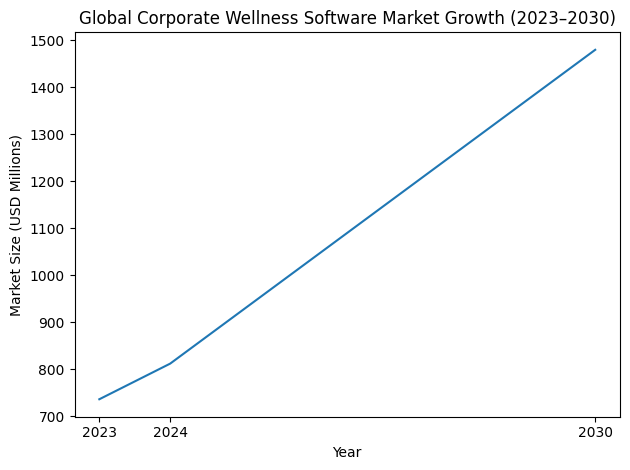
1. $736.06 million — Global Corporate Wellness Software Market size in 2023 The global corporate wellness software market reached $736.06 million in 2023, reflecting growing employer investment in digital tools designed to support workforce health and productivity.
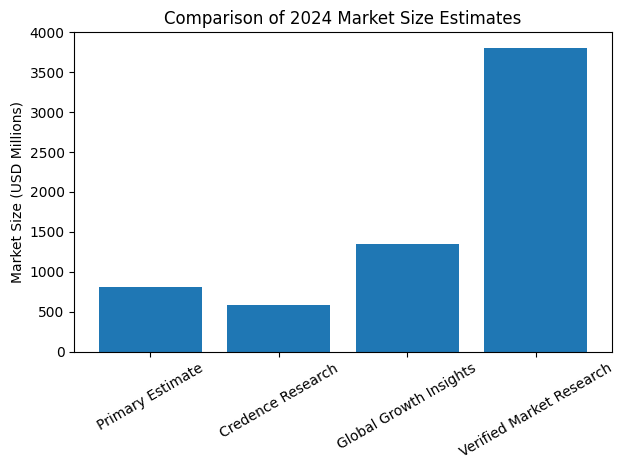
2. $811.91 million — Global Corporate Wellness Software Market size in 2024 By 2024, the corporate wellness software market had grown to $811.91 million, signalling sustained year-over-year demand as organisations increasingly prioritise employee wellbeing technology.
3. $1.48 billion — Projected Corporate Wellness Software Market size by 2030 The corporate wellness software market is projected to nearly double to $1.48 billion by 2030, suggesting that digital health and employee wellness platforms are becoming a mainstream component of HR strategy rather than a discretionary benefit.
4. 10.58% CAGR — Compound Annual Growth Rate of Corporate Wellness Software Market (2024–2030) A projected CAGR of 10.58% from 2024 to 2030 positions corporate wellness software as one of the faster-growing segments within the broader HR technology landscape, though buyers should note that growth projections vary considerably across research firms.
5. $0.6 billion — Estimated global corporate wellness software market value in 2025 (alternative estimate) An alternative estimate from Future Market Insights places the corporate wellness software market at $0.6 billion in 2025 — notably lower than some competing forecasts — underscoring how market definition and methodology significantly shape reported figures.
6. $1.1 billion — Projected corporate wellness software market value by 2035 Future Market Insights projects the corporate wellness software market will reach $1.1 billion by 2035, indicating long-term but measured growth, especially as organisations evaluate the real-world impact of wellness tools on employee health outcomes.
7. 6.2% CAGR — Expected growth rate of corporate wellness software market (2025–2035) A 6.2% compound annual growth rate over the next decade suggests steady, incremental adoption of corporate wellness software rather than explosive disruption, pointing to an industry maturing alongside broader HR and benefits technology.
8. $579 million — Corporate Wellness Software market value in 2024 (Credence Research) Credence Research values the corporate wellness software market at $579 million in 2024 — considerably lower than some other analysts — highlighting that market size estimates are highly dependent on how “wellness software” is scoped and which geographies are included.
9. $987.41 million — Projected market value of Corporate Wellness Software by 2032 With a projected value approaching $1 billion by 2032, corporate wellness software is on track to become a significant HR technology category, particularly as employers seek scalable platforms to manage increasingly complex employee health needs.
10. 6.9% CAGR — Projected CAGR of the Corporate Wellness Software market (2024–2032) A 6.9% CAGR for corporate wellness software from 2024 to 2032 reflects consistent market momentum, though organisations evaluating vendors should consider whether platform ROI is supported by independent outcome data rather than growth projections alone.
11. $1,346.49 million — Corporate Wellness Software Market value in 2024 (Global Growth Insights) Global Growth Insights estimates the corporate wellness software market at over $1.3 billion in 2024, a figure that reflects broader platform definitions encompassing mental health apps, engagement tools, and benefits administration within the wellness category.
12. $1,448.82 million — Expected market value in 2025 The anticipated rise to $1.45 billion in 2025 indicates that employer spending on employee wellness platforms is accelerating, driven by post-pandemic recognition of mental health’s role in workforce productivity and retention.
13. $2,603.24 million — Projected market value by 2033 A projected market value exceeding $2.6 billion by 2033 reflects the long-term institutionalisation of corporate wellness software within enterprise HR ecosystems, though actual growth will depend on demonstrable health outcomes and employee engagement rates.
14. 7.6% CAGR — Growth rate forecast for Corporate Wellness Software (2025–2033) A 7.6% CAGR forecast from 2025 to 2033 places corporate wellness software among the steadier growth markets within HR tech, suggesting incremental but reliable expansion rather than market saturation or boom-bust cycles.
15. $3.81 billion — Global Corporate Wellness Software Market size in 2024 (Verified Market Research) Verified Market Research’s estimate of $3.81 billion for 2024 is substantially higher than competing reports, likely because it incorporates adjacent categories such as telehealth, EAP platforms, and digital fitness — a reminder to scrutinise methodology when comparing corporate wellness market data.
16. $6.12 billion — Projected market size by 2031 (Verified Market Research) If the corporate wellness software market reaches $6.12 billion by 2031, as projected by Verified Market Research, it would represent a near doubling within seven years — a rate that reflects strong demand for integrated, data-driven employee wellness solutions.
17. 6.10% CAGR — Growth forecast from 2024 to 2031 (Verified Market Research) A 6.10% annual growth rate through 2031 indicates that corporate wellness software is a reliable, moderate-growth market rather than a speculative one, making it a strategically sound area for both technology vendors and enterprise HR buyers to invest in.
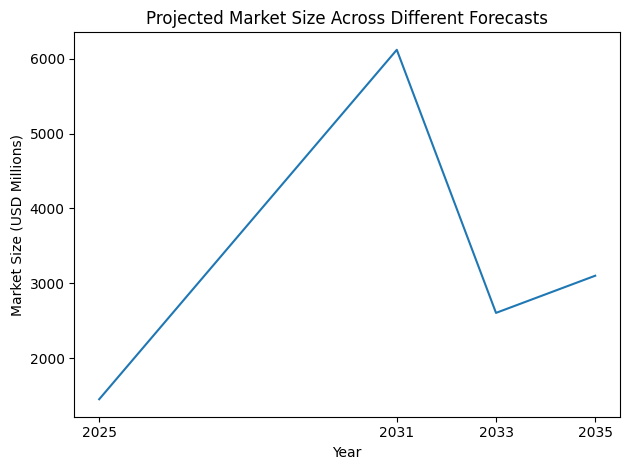
18. $1.7 billion — Corporate wellness software market value in 2025 (OMR Global) OMR Global’s $1.7 billion estimate for 2025 reflects a robust market underpinned by enterprises seeking to reduce healthcare costs and improve workforce mental health through purpose-built digital platforms.
19. $3.1 billion — Projected market size by 2035 (OMR Global) The projection of a $3.1 billion market by 2035 suggests that corporate wellness software will remain a growth area for the foreseeable future, particularly as hybrid work models create new challenges for employee wellbeing that traditional programmes cannot address alone.
20. 6.3% CAGR — Projected growth rate from 2026–2035 (OMR Global) A 6.3% CAGR between 2026 and 2035 offers a balanced perspective on the corporate wellness software opportunity — meaningful enough to attract continued investment, yet modest enough to suggest that vendors will need genuine differentiation to compete effectively.

🌍 SECTION 2: BROADER CORPORATE WELLNESS MARKET
21. $53.54 billion — Global corporate wellness market size in 2024 The broader corporate wellness market — encompassing physical programmes, coaching, nutrition, and digital tools — was valued at $53.54 billion in 2024, illustrating that wellness software is still just a fraction of total employer health spending, with significant room for platform consolidation.
22. $63.90 billion — Projected global corporate wellness market size by 2030 The global corporate wellness market is forecast to grow to $63.90 billion by 2030, indicating that employer investment in workforce health is becoming a structural rather than supplementary business expense.
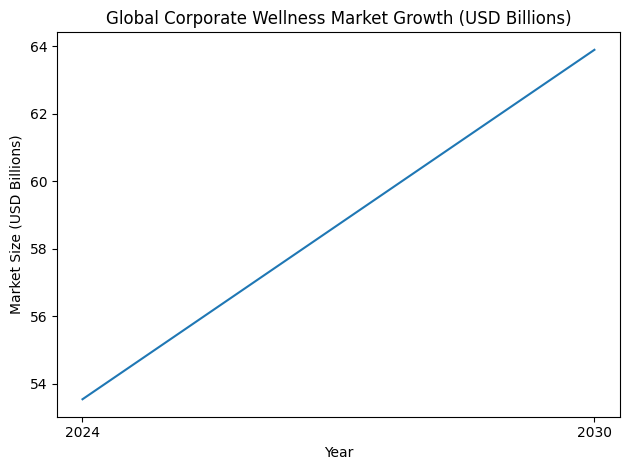
23. 3.01% CAGR — Global corporate wellness market growth rate (2025–2030) The broader corporate wellness market is growing at a modest 3.01% CAGR, suggesting that while demand is stable, the industry faces pressure to prove measurable health outcomes in order to unlock faster adoption.
24. 40.30% — North America’s revenue share of global corporate wellness market in 2024 North America holds over 40% of the global corporate wellness market, reflecting the region’s high employer healthcare costs and longstanding corporate culture of investing in employee benefits programmes — though this dominance may gradually shift as European and Asian markets mature.
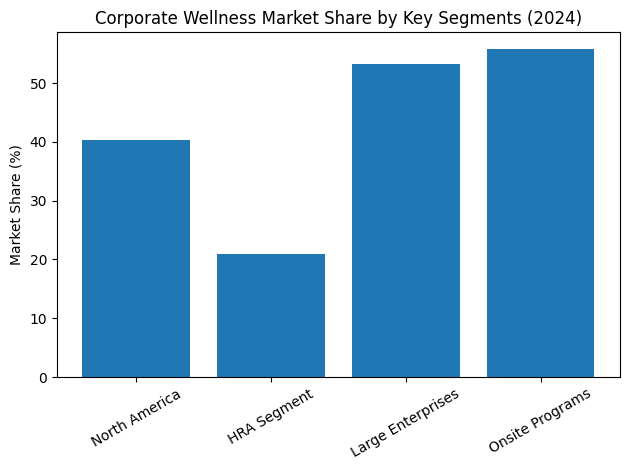
25. 20.94% — Market share of Health Risk Assessment (HRA) segment in 2024 Health Risk Assessments account for nearly 21% of corporate wellness market revenue, highlighting how data-driven health screening remains a foundational service that employers rely on to identify at-risk employees and tailor wellness interventions accordingly.
26. 53.27% — Large-scale enterprises’ share of the corporate wellness end-user market in 2024 Large enterprises account for over half of corporate wellness market spend, reflecting their greater budget capacity and regulatory incentives — though the remaining market share held by SMBs signals meaningful opportunity for scalable, cost-effective wellness platforms.
27. 55.84% — Revenue share held by onsite wellness programs in 2024 Onsite wellness programmes still generate the majority of corporate wellness revenue, but their dominance is gradually being challenged by digital and hybrid solutions that offer greater flexibility and measurability, especially for distributed workforces.
28. $100 billion — Projected global corporate wellness market size by 2026, growing ~9% annually Some projections forecast the global corporate wellness market reaching $100 billion by 2026 — a figure that, while ambitious, reflects the sweeping cultural shift in how businesses view employee health: not as a cost, but as a competitive advantage.
29. $2.3 billion — Global Employee Wellness Software market size in 2024 The global employee wellness software market was valued at $2.3 billion in 2024, representing strong standalone demand for technology platforms specifically focused on digital engagement, health tracking, and personalised wellbeing programmes.
30. $6.1 billion — Projected Employee Wellness Software market size by 2033 With projections of $6.1 billion by 2033, the employee wellness software market is expected to nearly triple in under a decade, driven by demand for AI personalisation, mental health integration, and real-time analytics within HR platforms.
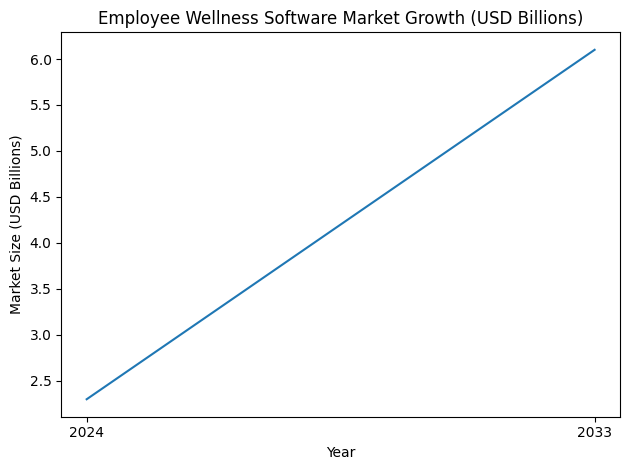
31. 11.2% CAGR — Employee Wellness Software market growth rate (2025–2033) An 11.2% annual growth rate for employee wellness software outpaces the broader HR tech market, signalling that organisations are increasingly treating wellness platforms as mission-critical infrastructure rather than supplementary employee perks.
32. ~$1.1 billion — North America’s share of the Employee Wellness Software market in 2024 North America’s $1.1 billion share of the employee wellness software market reflects both high corporate awareness and mature benefits infrastructure, though increasing healthcare costs are the primary driver pushing businesses toward preventive digital health tools.

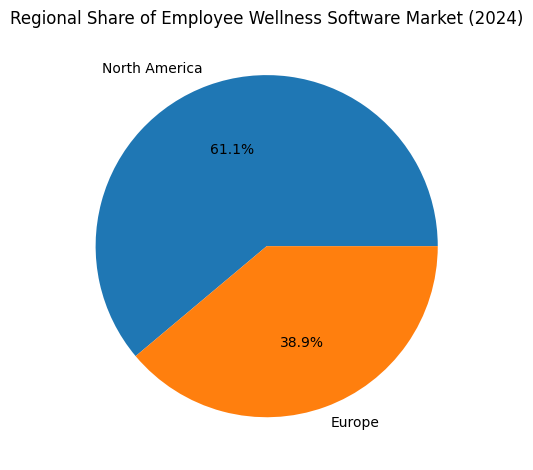
33. $700 million — Europe’s Employee Wellness Software market size in 2024 Europe’s $700 million wellness software market is growing alongside heightened regulatory and cultural emphasis on employee mental health, particularly following post-pandemic burnout discussions and evolving EU workplace wellbeing legislation.
34. 10.5% CAGR — Europe’s Employee Wellness Software market growth rate through 2033 Europe’s 10.5% CAGR for employee wellness software through 2033 suggests the region is closing the gap with North America, fuelled by increasing employer accountability for mental health and the rapid digitisation of HR functions across the continent.
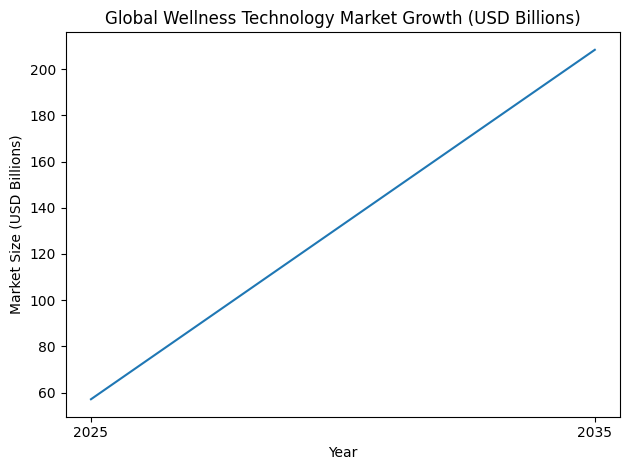
35. $57.1 billion — Global wellness technology market size in 2025 The global wellness technology market — encompassing consumer and corporate tools — stood at $57.1 billion in 2025, demonstrating that the convergence of health data, wearables, and software is creating a vast ecosystem with implications well beyond the traditional employee benefits space.
36. $208.36 billion — Projected wellness technology market size by 2035 A projected $208.36 billion wellness technology market by 2035 suggests we are at the early stage of a massive structural shift — though much of this growth depends on whether AI-driven platforms can demonstrate consistent, measurable improvements in population health.

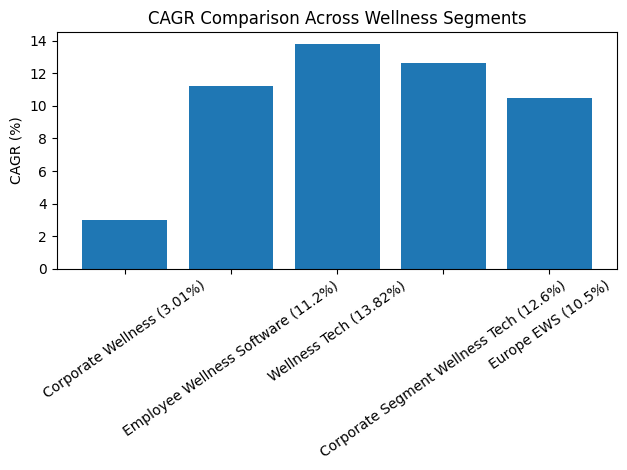
37. 13.82% CAGR — Wellness technology market growth rate (2026–2035) The 13.82% CAGR for wellness technology marks it as one of the fastest-growing segments across healthcare and HR, reflecting converging forces of aging workforces, rising chronic disease rates, and increasing employer investment in preventive health infrastructure.
38. 12.6% CAGR — Corporate/employer wellness segment of wellness technology is the fastest-growing (2026–2035) The corporate wellness segment is projected to grow at 12.6% annually — outpacing consumer wellness — indicating that employers, not individuals, are increasingly the primary buyers and drivers of wellness technology adoption.
39. 50.4% — North America’s share of the wellness technology market in 2025 North America’s commanding 50.4% share of the wellness technology market underlines the region’s leadership in both corporate wellness investment and health tech innovation, though Asia-Pacific is rapidly emerging as the next major growth frontier.
40. 8% — Corporate wellness software’s share of the global HR technology market in 2024 Accounting for 8% of the HR technology market in 2024, corporate wellness software has moved from a niche add-on to a recognised pillar of modern HR infrastructure — though it still has significant room to grow within total human capital management spending.
41. 14% — Projected corporate wellness software share of HR technology market by 2033 A projected 14% share of HR tech by 2033 would nearly double corporate wellness software’s current footprint within the sector, reflecting a future where employee health management is as integral to HR platforms as payroll or performance management.
42. 57.2% — Large companies’ share of the corporate wellness software market in 2025 Large enterprises dominate corporate wellness software adoption with a 57.2% market share, yet the remaining 43% attributed to SMBs indicates that smaller organisations are increasingly recognising the ROI of scalable, affordable wellness platforms.
43. 6%+ CAGR — Large companies’ segment growth rate from 2025 to 2035 Even among large enterprises — already the heaviest wellness software users — adoption is growing at over 6% annually, suggesting that organisations are continuously expanding and upgrading their wellness technology stacks rather than reaching saturation.
44. 21.1% — Revenue share of Health Risk Assessment (HRA) programs in U.S. corporate wellness market in 2024 Health Risk Assessments command over a fifth of the U.S. corporate wellness market, reflecting their established role as the first step in building personalised, data-informed employee health programmes — though their effectiveness depends heavily on follow-through and intervention quality.
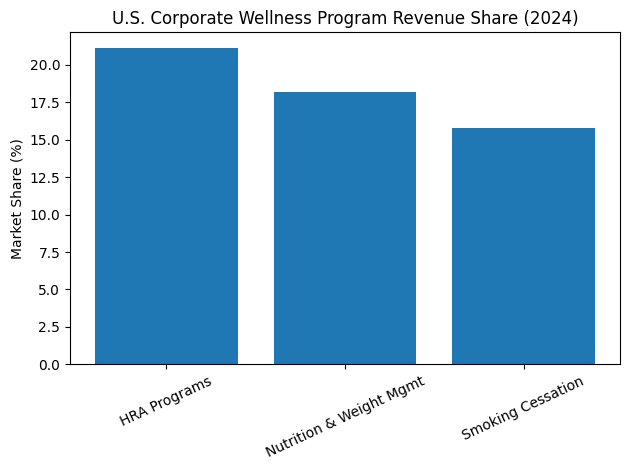
45. 18.2% — Market share of Nutrition & Weight Management segment in U.S. corporate wellness Nutrition and weight management programmes hold an 18.2% share of the U.S. corporate wellness market, recognising that metabolic and chronic disease prevention are among the highest-cost drivers in employer healthcare spending.
46. 15.76% — Market share of Smoking Cessation programs in U.S. corporate wellness Smoking cessation programmes account for nearly 16% of U.S. corporate wellness spend, a significant proportion that reflects both the high healthcare costs associated with tobacco use and the measurable, near-term ROI employers can achieve through structured cessation support.
💰 SECTION 3: ROI & FINANCIAL IMPACT

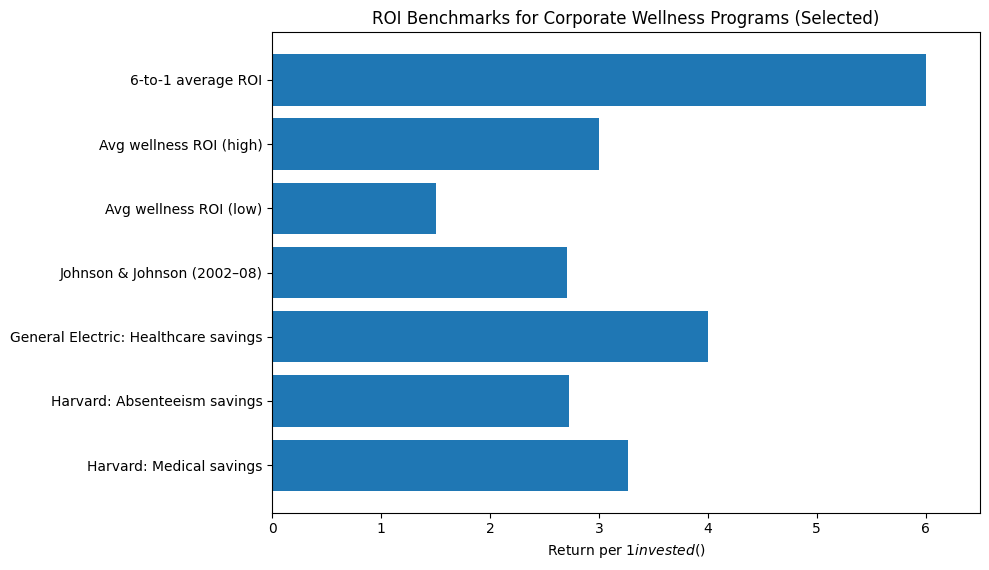
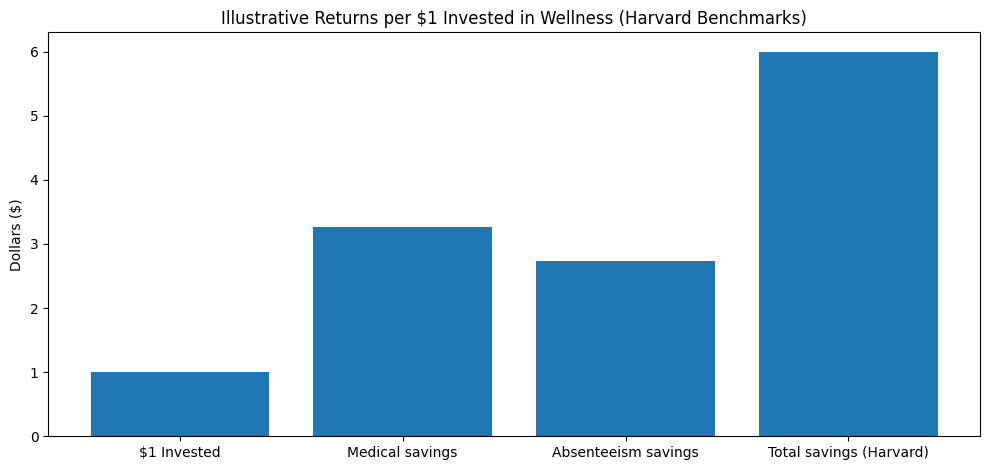
47. $3.27 — Medical cost savings for every $1 invested in wellness programs (Harvard) Harvard research suggests that employers can expect $3.27 in medical cost savings for every dollar invested in corporate wellness programmes — a compelling figure, though organisations should note that results vary based on programme design, employee participation rates, and health demographics.
48. $2.73 — Absenteeism cost reduction for every $1 spent on wellness programs (Harvard) Beyond medical savings, Harvard’s analysis found that wellness programmes reduce absenteeism costs by $2.73 for every dollar spent — a metric that is often easier to measure than healthcare cost reduction and therefore especially valuable for smaller employers building a business case.
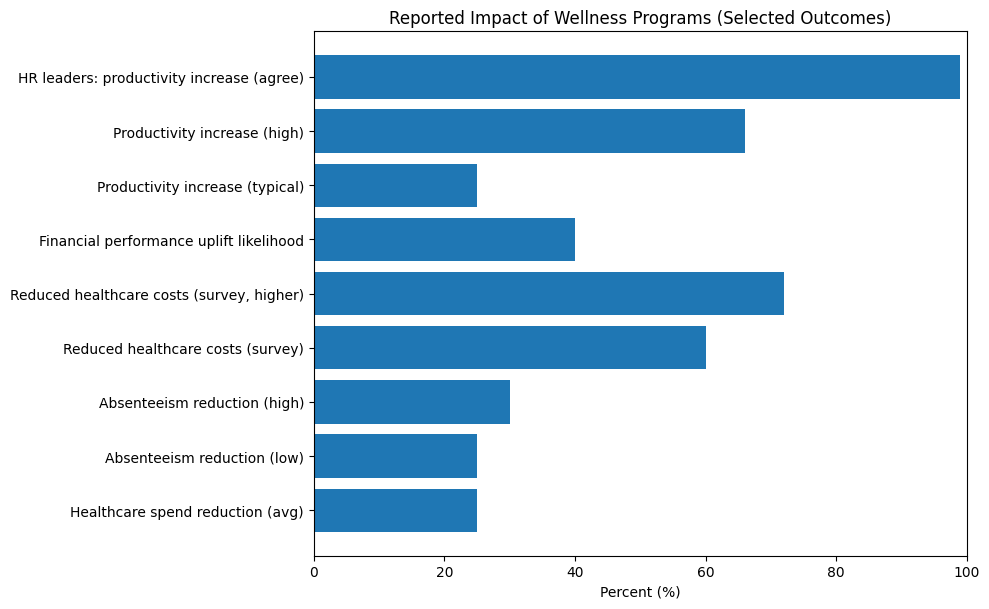
49. 25% — Average healthcare expenditure reduction for organisations with wellness programs Organisations with structured corporate wellness programmes report an average 25% reduction in healthcare expenditure compared to those without, suggesting that preventive health investment can meaningfully offset rising insurance and benefits costs over time.
50. 25–30% — Reduction in absenteeism rates after implementing wellness programs Employee absenteeism can fall by 25 to 30% following the introduction of corporate wellness programmes, which represents a direct productivity gain — though the magnitude of improvement varies based on how deeply wellness is embedded in company culture.
51. 95% — Companies measuring ROI of corporate wellness programs that see positive returns (2024) In 2024, 95% of companies that actively measured the ROI of their wellness programmes reported positive returns — a striking figure that reinforces the financial case for wellness investment, while also prompting questions about whether organisations without measurement frameworks are missing critical data.
52. 90% — Proportion of companies seeing positive wellness ROI in 2023 (rose to 95% in 2024) The jump from 90% to 95% positive wellness ROI between 2023 and 2024 suggests that as wellness programmes mature and measurement becomes more sophisticated, the financial case for employer investment is strengthening, not weakening.
53. 91% — HR leaders reporting healthcare benefit costs decreased due to wellness programs (2024) The fact that 91% of HR leaders in 2024 reported healthcare costs decreasing as a result of wellness programmes — up from 78% the previous year — indicates that corporate wellness is increasingly delivering measurable, bottom-line impact rather than serving as a feel-good benefit.
54. 99% — HR leaders who say wellness programs increase employee productivity Near-universal agreement among HR leaders — 99% — that wellness programmes boost employee productivity reflects a strong, consistent consensus across organisations of various sizes and industries, though the degree of productivity improvement will differ based on programme depth and engagement.

55. 77% — Companies with Wellhub reporting an overall ROI of more than 100% More than three-quarters of companies using Wellhub report achieving over 100% ROI — essentially recouping their wellness programme investment in full and generating additional savings — a figure that, while vendor-reported, aligns broadly with independent academic research on wellness programme returns.
56. $1.50–$3 — Average ROI per $1 spent on wellness programs over 2–9 years Wellness programme ROI typically falls between $1.50 and $3 per dollar invested over a 2–9 year horizon, suggesting that sustained commitment, rather than short-term pilots, is necessary for organisations to realise the full financial benefits of employee wellness technology.
57. $5.82 — Absenteeism cost savings for every $1 spent on wellness programs The $5.82 in absenteeism savings per wellness dollar spent is a remarkably strong return, particularly for industries where unplanned absences carry high operational costs — though employers should evaluate this figure against their specific workforce composition and absence rates.
58. 60% — Organisations reporting that wellness programs reduce healthcare costs Six in ten organisations report reduced healthcare costs after implementing wellness programmes, demonstrating that while results are not universal, the majority of employers do see meaningful healthcare savings — making a data-informed wellness strategy a financially prudent investment.
59. 40% — Companies with highly effective wellness programs more likely to report better financial performance Organisations with highly effective corporate wellness programmes are 40% more likely to report superior financial performance than peers with weak or no programmes, suggesting that employee health investment and business outcomes are more tightly linked than conventional accounting frameworks typically recognise.
60. $4 — Healthcare cost savings per $1 spent on wellness programs (General Electric) General Electric’s internal data showing $4 in healthcare savings per wellness dollar spent is among the most cited corporate case studies in this space, providing an empirical anchor for the ROI argument — though results at GE may reflect scale and programme maturity not easily replicated by smaller employers.
61. $500 — Reduction in healthcare claims per employee through wellness programs (Chevron) Chevron’s reported $500 reduction in annual healthcare claims per employee after implementing wellness programmes illustrates how large industrial employers can generate substantial cost savings through systematic, well-resourced health management initiatives.
62. $462 — Average savings in annual medical claims per employee engaged in wellbeing programs (2024) Engaged employees in wellbeing programmes generate $462 less in annual medical claims on average — a figure that provides a practical benchmark for HR and finance teams calculating the per-head value of wellness software investment.
63. $2.71 — ROI for every $1 spent on wellness programs (Johnson & Johnson, 2002–2008) Johnson & Johnson’s longitudinal $2.71 ROI per wellness dollar — measured over a six-year period — remains one of the most credible corporate wellness case studies available, demonstrating that patient, data-driven wellbeing strategies can generate sustained financial returns.

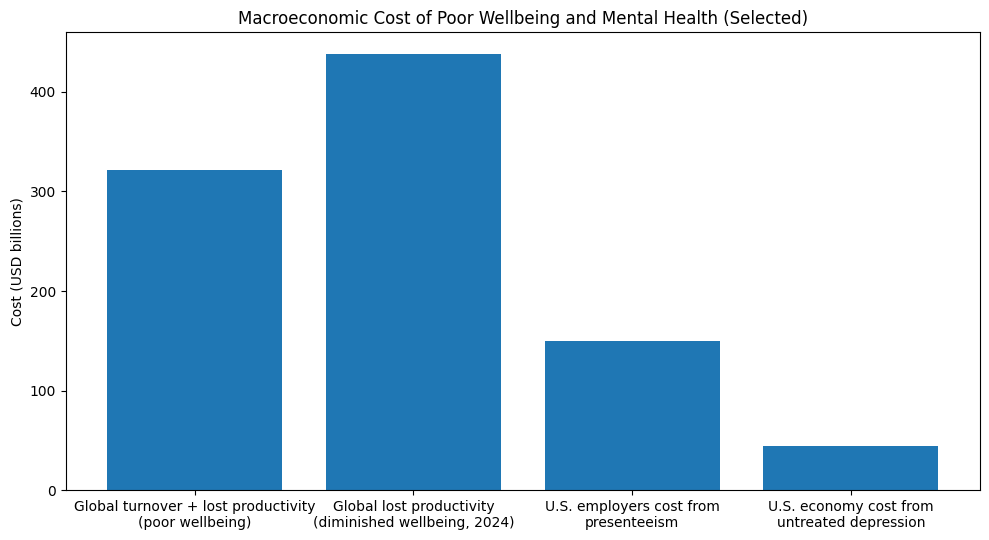
64. $322 billion — Global annual cost of poor employee well-being in turnover and lost productivity The staggering $322 billion global cost of poor employee wellbeing — through turnover and reduced productivity — underscores why corporate wellness investment is increasingly viewed as a strategic imperative rather than a discretionary benefit, particularly for talent-intensive industries.

65. 75% — Medical costs attributable to preventable conditions (Gallup) Gallup’s finding that 75% of medical costs stem from preventable conditions provides the strongest structural argument for employer-led wellness programmes: if the majority of healthcare spend is avoidable, then proactive digital health tools offer far greater value than reactive treatment.
66. $4 — ROI for every $1 invested in treatment for depression and anxiety The WHO-cited $4 return on every dollar invested in depression and anxiety treatment is particularly relevant to corporate wellness software vendors developing mental health modules, as it provides an evidence-based economic justification for prioritising psychological wellbeing within employee health platforms.
67. $44 billion — Annual collective cost to U.S. economy from untreated employee depression Untreated depression costs the U.S. economy $44 billion annually in lost workplace productivity — a figure that should prompt employers to treat mental health features in wellness platforms not as a nice-to-have but as a commercially significant investment in workforce sustainability.
68. 6-to-1 — Average return on investment from wellness programs A 6-to-1 average ROI from corporate wellness programmes — when factoring in both reduced healthcare costs and lower absenteeism — represents a compelling return on investment, though organisations should be cautious about applying industry averages without conducting their own cost-benefit analysis.
69. 25% — Increase in employee productivity at companies with wellness programs A 25% productivity increase associated with corporate wellness programmes highlights that the business case for employee health investment extends well beyond healthcare cost savings, encompassing measurable improvements in output, focus, and workforce engagement.
70. 66% — Increase in overall productivity observed at companies implementing wellness programs Some organisations report productivity gains as high as 66% after implementing wellness programmes — a figure at the optimistic end of the spectrum that likely reflects comprehensive programmes with high engagement, robust measurement, and strong leadership commitment.
71. $150 billion — Annual cost to U.S. employers from presenteeism Presenteeism — employees working while unwell and performing below capacity — costs U.S. employers an estimated $150 billion annually, a figure that often exceeds absenteeism costs and yet remains less frequently measured, making wellness software that tracks engagement and performance critical for identifying at-risk employees.
72. 72% — Companies experiencing reduced healthcare costs after implementing wellness programs Nearly three-quarters of companies report lower healthcare costs following wellness programme implementation — a majority large enough to suggest that, while results are not guaranteed, the risk of not investing in employee wellness may outweigh the upfront cost in most organisations.
73. £6.30 — ROI for every £1 invested in mental health screening and therapy (UK) UK data showing a £6.30 return for every £1 invested in workplace mental health programmes provides a powerful financial argument for UK employers, particularly as mental health-related absences continue to account for a growing share of total sickness absence.
74. £600 — Approximate savings per employee from an initial £80 wellbeing investment The prospect of generating £600 in savings per employee from an £80 initial investment makes the financial logic of digital wellbeing tools difficult to ignore, though employers should treat such headline figures as directional rather than guaranteed outcomes without independent validation.
75. $438 billion — Cost of lost employee productivity globally from diminished well-being in 2024 (Gallup) Gallup’s estimate that poor employee wellbeing cost the global economy $438 billion in lost productivity in 2024 contextualises corporate wellness software not as a departmental HR expense, but as a tool with macroeconomic significance — and a strong case for board-level prioritisation.
🧑💼 SECTION 4: EMPLOYEE BURNOUT & MENTAL HEALTH
76. 52% — U.S. employees who reported feeling burned out in 2024 (NAMI) More than half of U.S. employees reported burnout in 2024 according to NAMI’s workplace mental health poll, reinforcing that employee stress and exhaustion are now majority-level challenges that corporate wellness software must address as a core — not peripheral — feature.
77. 37% — Employees who felt overwhelmed by work to the point it affected their job (2024) With 37% of employees reporting that work overwhelm directly impaired their ability to perform, organisations face a real and measurable productivity risk from untreated stress — one that targeted digital wellness interventions, including mental health tracking and coaching tools, are designed to mitigate.
78. 59% — U.S. employees who reported burnout in 2024 (alternate survey) A separate survey found that 59% of U.S. employees experienced burnout in 2024, and while methodologies differ across studies, the convergence of multiple surveys above 50% establishes burnout as a systemic issue requiring structural employer responses rather than individual coping strategies.
79. 66% — Millennials who report significant burnout vs. 39% of baby boomers Millennials experience burnout at nearly twice the rate of baby boomers — 66% versus 39% — highlighting that the workforce’s largest cohort is also its most at-risk, which has direct implications for how corporate wellness platforms should design age-targeted wellbeing programmes.
80. 76% — U.S. workers experiencing some level of burnout, with 53% at moderate to severe levels (2025) Mind Share Partners’ 2025 data showing that 76% of U.S. workers experience burnout — with over half at moderate to severe levels — reveals that employee health risk is not a minority issue but a widespread workforce condition requiring scalable, technology-enabled intervention.
81. 34% — Employees whose productivity suffered due to mental health in 2024 One in three employees reported reduced productivity in 2024 as a direct result of mental health challenges, translating to a measurable performance drag that corporate wellness platforms offering mental health resources, coaching, and early intervention tools are specifically positioned to address.
82. 21% vs. 38% — Productivity loss rate with vs. without mental health resources Employees without access to mental health resources are nearly twice as likely to report productivity losses (38%) compared to those with access (21%), providing compelling evidence that investing in mental health features within corporate wellness software generates real and quantifiable performance improvements.
83. 48% — U.S. employees who have left a job for reasons tied to mental health The fact that nearly half of U.S. employees have left a role due to mental health concerns reframes corporate wellbeing investment as a retention strategy: organisations that fail to address mental health are not just risking employee wellbeing — they are actively driving talent attrition.
84. 91% — Employees who say mental health benefits are important, yet only 1 in 5 has used them (NAMI 2025) The striking gap between employees who value mental health benefits (91%) and those who have actually used them (20%) suggests that accessibility, stigma, and awareness — not just availability — are the critical barriers that modern wellness platforms must overcome through seamless, discreet digital delivery.
85. 77% — Employees who have experienced burnout at least once (Deloitte 2024) Deloitte’s finding that 77% of employees have experienced burnout at some point establishes it as a near-universal career experience, suggesting that corporate wellness programmes addressing recovery, resilience, and stress management are relevant to virtually the entire workforce — not just high-risk groups.
86. $5 million — Annual cost to a 1,000-person company from burnout-related losses Burnout costs a hypothetical 1,000-employee organisation approximately $5 million annually through absenteeism, turnover, and productivity loss — a figure that makes even a $200,000 annual investment in corporate wellness software a fiscally rational decision if it meaningfully reduces burnout incidence.
87. 67% — Performance boost and 21% productivity gain at companies prioritising well-being Organisations that prioritise employee wellbeing report 67% better performance and 21% higher productivity among their workers — figures that reflect not just the value of wellness programmes in isolation, but the compounding effect of integrating wellbeing into leadership culture and business strategy.
88. 15–20% — Share of involuntary payroll turnover caused by burnout Burnout accounts for 15 to 20% of all involuntary employee departures, meaning a meaningful fraction of every organisation’s recruitment and onboarding costs can be attributed to a preventable health condition — one that proactive corporate wellness tools are specifically designed to detect and address.
89. 54% — Mid-level employees experiencing burnout (highest rate by employment level) Mid-level managers and professionals experience the highest burnout rates at 54% — a finding with significant implications for corporate wellness software vendors, as this group often represents an organisation’s most critical and expensive-to-replace talent pipeline.
90. 79% — UK employees who feel close to burnout (rising to 82% in tech) With 79% of UK employees feeling close to burnout — and the figure rising to 82% in the tech sector — the urgency for effective digital wellness solutions has never been higher in the British labour market, particularly as remote and hybrid work continues to blur the boundaries between professional and personal life.
🏢 SECTION 5: ADOPTION, PROGRAMS & WORKFORCE ENGAGEMENT
91. 87% — Employees who choose employers based on health and wellness programs available The fact that 87% of employees factor wellness programmes into their employer selection reinforces that corporate wellness investment is no longer a soft benefit but a hard talent acquisition tool — one that directly influences which organisations attract the most competitive candidates.
92. 67% — Employees who like their jobs more when employers offer wellness programs Two-thirds of employees report higher job satisfaction when wellness programmes are available, suggesting a direct link between employer health investment and workforce morale — a link that has downstream benefits for retention, engagement, and discretionary effort.
93. 58% — Millennials who consider company wellness programs essential when job hunting More than half of millennials — the largest segment of today’s workforce — consider wellness programmes essential when evaluating job opportunities, making employer wellness offerings a strategically critical differentiator in highly competitive talent markets.
94. 54% — Gen Z employees who say wellness programs are an essential job consideration Over half of Gen Z workers view wellness programmes as essential when choosing a job, reflecting a generational shift in employment expectations that organisations will need to meet with credible, technology-enabled wellbeing offerings rather than superficial perks.
95. 45% — Employees in SMBs who say wellness programs would make them stay longer Even in small and medium-sized businesses, 45% of employees say wellness programmes would increase their likelihood of staying — a significant finding given that SMBs often struggle most with retention costs, and where affordable wellness software platforms can have a disproportionate impact.
96. 85% — Workers more likely to remain in their role if employer prioritises wellbeing With 85% of employees saying they are more likely to stay in a role when their employer visibly prioritises wellbeing, corporate wellness investment arguably generates more predictable retention returns than many traditional compensation-based retention strategies.
97. 85% — HR leaders who say wellness programs reduced talent management costs The fact that 85% of HR leaders have seen talent management cost reductions from wellness programmes directly links employee health investment to workforce economics, making a compelling case for treating wellness software as a cost-reduction tool as well as a health intervention.
98. 91% — CHROs who say wellness programs are important for talent acquisition Near-universal agreement among Chief Human Resource Officers (91%) that wellness programmes support talent acquisition reflects how thoroughly the narrative has shifted from “wellness as a benefit” to “wellness as a competitive recruiting asset.”
99. 92% — Workers who say it’s important to work for an organisation that values their wellbeing (APA 2023) The APA’s finding that 92% of workers value psychological and emotional wellbeing in their workplace provides a foundational employee expectation that corporate wellness platforms must meet — not just with features, but with genuine cultural integration and visible leadership commitment.
100. 75% — Businesses with wellness programs that see retention improvements Three-quarters of businesses with wellness programmes report measurable retention improvements, reinforcing the financial logic of employee health investment: retaining experienced staff consistently costs less than replacing them, and wellness software plays a demonstrable role in keeping employees engaged and committed.
101. 25% — Decrease in employee turnover at organisations with wellness initiatives Organisations with structured wellness initiatives experience 25% lower employee turnover on average — a reduction that, depending on an organisation’s size and average replacement cost, can generate savings that far exceed the annual cost of a wellness platform subscription.
102. 80% — U.S. businesses with 50+ employees offering corporate wellness benefits The fact that 80% of U.S. companies with 50 or more employees now offer corporate wellness benefits reflects a broad mainstream adoption — though the quality and utilisation of these programmes varies significantly, suggesting that investment in better tools and engagement strategies remains a key differentiator.
103. 70% — U.S. organisations investing in health assessment solutions (RAND study) RAND’s finding that 70% of U.S. organisations invest in health assessment solutions underscores how data-gathering has become a central pillar of corporate wellness strategy — providing the employee health intelligence needed to personalise programmes and measure ROI more effectively.
104. 75% — Large companies planning to increase wellness budgets by 10% in 2024 Three-quarters of large companies planned a 10% wellness budget increase in 2024, signalling that corporate wellness is entering a period of accelerated investment — one that benefits software vendors with scalable, data-driven platforms capable of absorbing and demonstrating the value of expanded budgets.
105. 10% — Average planned wellness budget increase among large companies (2024) A 10% average planned increase in wellness budgets among large enterprises represents meaningful incremental spend — and points to growing demand for more sophisticated platforms that go beyond basic health tracking to deliver personalised, analytics-driven wellbeing programmes.
106. 70% — Employees enrolled in wellness programs reporting higher job satisfaction Employees who participate in wellness programmes are 70% more likely to report high job satisfaction — a figure that links wellness engagement directly to one of the strongest predictors of retention, productivity, and employer brand strength.
107. 53% — Employees who reported better health due to wellness programs Over half of wellness programme participants report genuine health improvements — not just engagement or satisfaction — validating that well-designed corporate wellness tools can drive real health behaviour change when supported by meaningful employer investment and employee incentives.
108. 56% — Reduction in sick days from participation in wellness programs A 56% reduction in sick days among wellness programme participants is a compelling, easily measurable outcome for employers — and represents one of the most direct ways wellness software investment can be translated into bottom-line savings on absenteeism-related costs.
109. 63% — U.S. employees who prioritise work-life balance and wellbeing when job searching More than six in ten U.S. employees rank work-life balance and personal wellbeing as very important job criteria — a clear market signal that organisations offering credible, technology-supported wellness environments will hold a distinct advantage in attracting talent over those that do not.
110. 47% vs. 35% — Employees interested in digital mental health tools post- vs. pre-pandemic The post-pandemic rise in employee appetite for digital mental health tools — from 35% to 47% — reflects a lasting behavioural shift: workers are now more comfortable seeking digital support for mental wellbeing, creating a stronger market pull for app-based, on-demand corporate wellness solutions.
📱 SECTION 6: TECHNOLOGY, AI & DIGITAL TRENDS
111. 30% — U.S. employees using wearables in workplace wellness by 2024 Wearable device adoption in corporate wellness reached 30% of U.S. employees by 2024 — a significant penetration that enables real-time health data collection, though employers must ensure their wellness software platforms handle this data in compliance with privacy regulations and with meaningful employee consent.
112. 60% — Insurers investing in end-to-end digitisation of wellness platforms in 2025 The fact that 60% of insurers are actively digitising their wellness platforms in 2025 signals a structural convergence between insurance and employee health management — one that will increasingly blur the lines between benefits administration and wellness technology.
113. $229 billion — Projected size of the digital insurance platform market by 2029 The digital insurance platform market is projected to reach $229 billion by 2029 — a scale that contextualises wellness software as just one layer within a much larger ecosystem of employer health and financial risk management tools that are rapidly converging on integrated digital platforms.
114. 91% — HR professionals anticipating greater investment in mental health solutions (2024) Near-universal expectation among HR professionals that mental health investment will increase confirms that wellness platforms with comprehensive mental health modules — including therapy access, stress management tools, and mood tracking — are positioned to capture the majority of future wellness software spend.
115. 66% — HR professionals expecting increased investment in stress management tools (2024) Two-thirds of HR professionals anticipate higher spending on stress management and resilience tools, reflecting growing awareness that chronic workplace stress is one of the leading drivers of absenteeism, turnover, and healthcare costs — and that technology-enabled interventions can address it at scale.
116. 65% — HR professionals anticipating more investment in telemedicine (2024) Telemedicine is gaining significant traction within corporate wellness strategies — with 65% of HR professionals expecting increased investment — making it a critical integration point for wellness software platforms seeking to offer end-to-end employee health management beyond fitness and mental wellbeing tracking.
117. 55% — HR professionals expecting growth in mindfulness and meditation program investment More than half of HR professionals plan to increase investment in mindfulness and meditation programmes, signalling sustained demand for these features within corporate wellness platforms even as the market matures — and reflecting strong employee interest in accessible, science-backed stress-reduction tools.
118. 52% — Companies planning to increase investments in Lifestyle Spending Accounts (LSAs) Over half of companies plan to expand Lifestyle Spending Accounts — flexible allowances employees can use across wellness, fitness, and personal development — illustrating a broader shift toward personalised, employee-directed wellness benefits that digital platforms are uniquely positioned to facilitate and track.
119. 78% — Expected increase in fitness and wellbeing app usage by 2024 (WHO) The WHO’s projection of a 78% rise in fitness and wellbeing app usage by 2024 underscores how consumer mobile health behaviours are rapidly intersecting with employer wellness strategies, creating an expectation among employees for corporate wellness platforms that match the quality and usability of leading consumer apps.
120. 87% — Projected smartphone penetration by 2025 (up from 57% in 2020) With smartphone penetration projected at 87% globally by 2025, mobile-first corporate wellness platforms are no longer a premium option but a practical necessity — enabling employers to engage virtually their entire workforce through apps and digital tools rather than relying on onsite programmes.
121. 60% — HR leaders who say AI will play a significant role in workplace mental health by 2030 Six in ten HR leaders believe AI will fundamentally shape workplace mental health by 2030 — a near-term horizon that should push wellness software developers to invest in genuinely effective AI personalisation, predictive risk tools, and ethically designed chatbot-based mental health support.
122. 77% — Employees who said they would likely use an AI coach or chatbot for guidance Strong employee openness to AI coaching — with 77% expressing willingness to use such tools — presents a significant product opportunity for corporate wellness platforms, provided they can deliver contextually relevant, privacy-respecting, and clinically credible AI interactions rather than generic chatbot experiences.
123. 48.6% — Wearable devices’ share of wellness technology market in 2025 (largest segment) Wearables command nearly half of the wellness technology market in 2025, reflecting their role as the primary data-collection layer in the employee wellness ecosystem — though their true value depends on how effectively corporate platforms translate biometric data into actionable, personalised health insights.
124. 12.6% CAGR — Software Analytics & Platforms: fastest-growing wellness technology sub-segment The Software Analytics & Platforms sub-segment of wellness technology is growing at 12.6% annually — the fastest rate in the sector — as employers increasingly prioritise data-driven decision-making, personalised health journeys, and measurable programme outcomes over traditional one-size-fits-all wellness offerings.
125. $15 million — Investment by LifeDojo in August 2024 to improve its wellness platform LifeDojo’s $15 million platform investment in 2024 illustrates the scale of capital being deployed to build more sophisticated corporate wellness software, reinforcing that the market is in a competitive development phase where technology quality and outcomes data will increasingly determine vendor success.
📈 SECTION 7: ADDITIONAL PROGRAM & WORKFORCE DATA
126. 20% — Potential productivity increase from integrating well-being into leadership (Global Wellness Institute 2025) The Global Wellness Institute estimates that embedding wellbeing into leadership culture could unlock a 20% productivity increase — a figure that suggests the ceiling for corporate wellness ROI is significantly higher when health initiatives are driven top-down rather than positioned as optional employee benefits.
127. 39% — Employees staying at their job primarily because of strong benefits tied to wellness (Bank of America 2024) Bank of America’s 2024 data showing that 39% of employees stay in their role specifically because of strong wellness and flexibility benefits makes a clear case that wellness programme quality is a determinant of employee tenure — and that organisations scaling back these offerings risk losing a substantial share of their most tenured staff.
128. 3x — Higher likelihood of employees with high wellbeing to stay at their company Employees with high wellbeing are three times more likely to stay with their employer, a finding that transforms wellness software from a cost centre into a retention multiplier — and one that HR teams can use to make a data-backed case for sustained wellness technology investment to senior leadership.
129. 43% — Burned-out employees citing financial strain as a contributing factor (2024) The finding that 43% of burned-out employees trace part of their stress to financial strain highlights that effective corporate wellness platforms must address financial wellbeing alongside physical and mental health — a holistic approach increasingly supported by the best-in-class wellness tools in the market.
130. 3.5x higher stock performance and 8.5x higher revenue per employee at wellness-investing companies Fortune’s Best Companies to Work For — organisations that consistently invest in employee wellbeing — deliver 3.5 times greater stock market returns and 8.5 times higher revenue per employee, providing perhaps the most striking macro-level argument that wellbeing and financial performance are not competing priorities, but deeply aligned ones.
131. 7x — More likely employees in effective wellness programs agree they have meaningful work connections Employees in strong wellness programmes are seven times more likely to feel meaningfully connected to their work — a finding with significant implications for creativity, collaboration, and discretionary effort, all of which translate into the kinds of qualitative performance gains that are difficult to achieve through compensation alone.
132. 9 in 10 — Employees who consider the benefits package when evaluating an employer With nine out of ten employees factoring in the benefits package when choosing where to work, corporate wellness programmes have become a core component of employer value proposition — making wellness software investment a de facto requirement for any organisation serious about competing for talent in a tight labour market.
133. Over 50% — Gen Zers and millennials who consider wellness programs extremely important when job hunting More than half of Gen Z and millennial workers consider wellness programmes extremely important when evaluating employers, and given that these two generations will represent the overwhelming majority of the global workforce within a decade, organisations that underinvest in employee wellbeing technology today are building structural recruitment disadvantages for tomorrow.
134. 49.61% — Share of the corporate wellness market held by organisations/employers in 2024 Employers account for nearly half of all corporate wellness market spend in 2024, underscoring that corporate demand — rather than government, insurance, or individual purchasing — is the primary engine driving industry growth and shaping product development priorities for wellness software vendors.
135. 5x — How much more likely benefits-satisfied employees are to say they’ll stay with their employer Employees who are satisfied with their benefits package are five times more likely to express intent to remain with their employer — a retention multiplier that positions corporate wellness software, as a core component of a compelling benefits offering, as one of the highest-leverage investments an HR department can make.
Conclusion
As we move deeper into 2026, the data surrounding corporate wellness software tells a compelling story: employee well-being is no longer a peripheral initiative—it is a strategic priority directly tied to business performance, workforce stability, and long-term organizational growth. The 135 corporate wellness software statistics, data points, and trends explored throughout this report collectively highlight a market that is expanding rapidly, innovating continuously, and reshaping how employers approach health, engagement, and productivity at scale.
One of the clearest takeaways from these statistics is the undeniable shift from reactive benefits to proactive, data-driven well-being strategies. Organizations are no longer waiting for burnout, absenteeism, or healthcare claims to spike before acting. Instead, they are leveraging advanced corporate wellness platforms to identify risks early, personalize interventions, and measure outcomes with precision. The rise of AI-powered insights, predictive analytics, real-time engagement dashboards, and integrated HR ecosystems demonstrates that wellness software in 2026 is deeply embedded within enterprise infrastructure.
The numbers also confirm that investment in corporate wellness technology is accelerating across industries and regions. Market growth projections, funding activity, and enterprise adoption rates reveal strong confidence in digital wellness solutions. Companies of all sizes—from startups to global enterprises—are allocating larger budgets toward holistic wellness platforms that encompass physical health, mental health, financial wellness, social connection, and preventative care. This trend reflects a broader understanding that employee well-being directly influences retention, productivity, and employer brand reputation.
Mental health continues to emerge as a defining focus within corporate wellness software. The data shows sustained growth in demand for virtual therapy, resilience training, stress management tools, and burnout detection capabilities. Employers are recognizing that psychological well-being is not separate from performance metrics—it is foundational to them. As a result, mental health analytics, confidential digital counseling services, and integrated support resources are becoming standard features rather than premium add-ons.
Equally significant is the evolution of personalization within wellness platforms. The statistics reveal higher engagement and stronger ROI when programs are tailored to individual employee needs, demographics, job roles, and health profiles. AI-driven personalization, behavioral nudges, wearable integrations, and adaptive content delivery are transforming generic wellness initiatives into dynamic, employee-centered experiences. In 2026, the most successful corporate wellness software solutions are those that treat employees as individuals rather than aggregate data points.
Another major insight from these corporate wellness software trends is the growing importance of measurable outcomes. Decision-makers are demanding clear ROI metrics tied to absenteeism reduction, healthcare cost containment, productivity improvements, and employee satisfaction scores. Advanced analytics tools are enabling HR leaders to connect wellness participation with retention rates, performance outcomes, and long-term workforce resilience. This shift toward quantifiable value is strengthening the business case for sustained investment in wellness technology.
The data also underscores the influence of hybrid and remote work environments on software adoption. As workforces become increasingly distributed, digital-first wellness platforms provide scalable, inclusive access to health resources regardless of geographic location. Multilingual support, culturally responsive programming, accessible design, and mobile-first experiences are no longer optional—they are essential to equitable engagement. Corporate wellness software in 2026 is built to support global teams operating across time zones, industries, and work models.
Financial wellness and social well-being are likewise gaining prominence in the corporate wellness ecosystem. Statistics show that employees experiencing financial stress are more likely to disengage, underperform, or leave their roles. In response, wellness software providers are expanding into budgeting tools, financial literacy programs, debt management resources, and retirement planning support. The integration of these offerings reflects a broader understanding that holistic wellness encompasses far more than physical health alone.
Data privacy and compliance remain central considerations as platforms collect sensitive health and behavioral information. The trends indicate increasing investment in security protocols, ethical AI frameworks, and transparent data governance practices. Employers are prioritizing solutions that balance personalization with privacy, ensuring that employee trust is maintained while leveraging actionable insights.
Taken together, these 135 corporate wellness software statistics paint a picture of an industry entering a more mature, results-oriented phase. The emphasis is shifting from participation rates to impact, from standalone apps to integrated ecosystems, and from generic programming to intelligent personalization. Organizations that embrace this evolution are better positioned to cultivate resilient teams, reduce long-term costs, and foster cultures of sustained well-being.
For HR leaders, founders, investors, and decision-makers, the insights presented in this comprehensive analysis offer more than just numbers—they provide direction. They highlight where the market is headed, which features are driving engagement, what benchmarks define success, and how technology-enabled wellness strategies are influencing broader workforce outcomes. Whether evaluating new corporate wellness software vendors, optimizing existing programs, or forecasting future investments, these data-driven insights serve as a strategic foundation.
In 2026, corporate wellness software stands at the intersection of technology, healthcare, and human capital management. The organizations that lead in this space are those that treat employee well-being not as a benefit expense, but as a growth lever. As the market continues to expand and innovation accelerates, one reality remains clear: investing in evidence-based, scalable, and measurable wellness technology is no longer optional—it is essential for building healthier, more productive, and future-ready workplaces.
If you find this article useful, why not share it with your hiring manager and C-level suite friends and also leave a nice comment below?
We, at the 9cv9 Research Team, strive to bring the latest and most meaningful data, guides, and statistics to your doorstep.
To get access to top-quality guides, click over to 9cv9 Blog.
To hire top talents using our modern AI-powered recruitment agency, find out more at 9cv9 Modern AI-Powered Recruitment Agency.
People Also Ask
What is the corporate wellness software market size in 2026?
Estimates vary by analyst, but projections place the corporate wellness software market between $1 billion and over $3 billion by 2026, depending on how platforms are defined and whether adjacent services like telehealth are included.
How fast is the corporate wellness software market growing?
Growth forecasts range from 6% to over 10% CAGR through 2030, with employee wellness software segments expanding even faster due to rising demand for digital, AI-driven wellbeing solutions.
What is the ROI of corporate wellness programs?
Research shows returns between $1.50 and $6 for every $1 invested, including healthcare savings and reduced absenteeism, though actual ROI depends on engagement levels and program design.
Do wellness programs really reduce healthcare costs?
Yes, many studies report healthcare cost reductions of 20–25% for companies with structured wellness programs, especially when preventive care and chronic condition management are prioritised.
How much can companies save from reduced absenteeism?
Some analyses show $2.73 to $5.82 in absenteeism savings per $1 spent on wellness programs, particularly in industries where unplanned absence has high operational costs.
What percentage of companies see positive wellness ROI?
Recent data indicates that over 90% of companies measuring ROI report positive financial returns from corporate wellness programs.
Why is corporate wellness software becoming essential in HR tech?
Wellness software now integrates with HRIS, performance systems, and benefits platforms, making employee health management a core pillar of modern HR technology infrastructure.
How large is the global corporate wellness market overall?
The broader corporate wellness market exceeds $50 billion globally, covering physical programs, mental health support, nutrition, and digital platforms.
What is the size of the employee wellness software market?
The employee wellness software market is valued in the billions and projected to nearly triple by 2033 due to AI personalisation and remote workforce adoption.
Which region dominates the corporate wellness market?
North America holds the largest market share, driven by high healthcare costs and strong employer investment in employee benefits and wellbeing programs.
How important is mental health in corporate wellness trends?
Mental health is a leading growth driver, with strong ROI evidence showing returns of up to $4 for every $1 invested in depression and anxiety treatment.
What role does AI play in wellness software in 2026?
AI enables personalised wellness journeys, predictive health insights, behavioural nudges, and real-time analytics to improve engagement and measurable outcomes.
Are large enterprises the biggest buyers of wellness software?
Yes, large enterprises account for more than half of wellness software spending, although SMB adoption is growing rapidly due to scalable digital solutions.
What is the CAGR of the broader wellness technology market?
Wellness technology, including corporate and consumer solutions, is projected to grow at double-digit rates, making it one of the fastest-growing health tech segments.
How does wellness software improve employee productivity?
Companies report productivity increases ranging from 25% to over 60% when wellness programs are embedded in company culture and supported by leadership.
What percentage of medical costs are preventable?
Research suggests around 75% of medical costs are linked to preventable conditions, strengthening the business case for proactive corporate wellness programs.
How does wellness software reduce presenteeism?
By tracking engagement, stress indicators, and health risks, wellness platforms help employers identify struggling employees early, reducing productivity losses from presenteeism.
Is wellness software a long-term investment?
Yes, most ROI studies show stronger returns over multi-year periods, indicating that sustained implementation delivers greater financial impact than short-term pilots.
What are the biggest corporate wellness trends in 2026?
Key trends include AI personalisation, mental health integration, hybrid workforce support, real-time analytics, and deeper HR tech ecosystem integration.
How much does poor employee wellbeing cost globally?
Global losses from poor employee wellbeing reach hundreds of billions annually due to turnover, absenteeism, and reduced productivity.
What segments drive corporate wellness revenue?
Health Risk Assessments, onsite programs, mental health support, and digital engagement tools represent significant revenue drivers within the market.
Are onsite wellness programs still dominant?
Onsite programs still hold strong revenue share, but digital and hybrid models are growing faster due to flexibility and measurable outcomes.
How does wellness software impact employee retention?
Organisations with effective wellness programs are more likely to report improved financial performance and reduced turnover.
Is corporate wellness software part of HR tech spending?
Yes, corporate wellness software accounts for a growing share of the HR technology market and is projected to expand significantly by 2033.
How do SMBs benefit from wellness software?
SMBs gain measurable ROI through reduced absenteeism and healthcare costs, particularly with affordable, cloud-based wellness platforms.
What is the financial impact of untreated depression in the workplace?
Untreated depression costs billions annually in lost productivity, making mental health investment economically compelling for employers.
Why do companies measure wellness ROI more closely in 2026?
As budgets tighten, organisations demand measurable proof of cost reduction, productivity gains, and long-term health outcomes.
What industries benefit most from wellness software?
High-absence and high-healthcare-cost industries such as manufacturing, healthcare, and finance often see the strongest measurable ROI.
Can wellness software improve financial performance?
Companies with highly effective wellness programs are significantly more likely to report stronger overall financial performance.
What makes a corporate wellness program successful?
Successful programs combine leadership support, high engagement, personalised digital tools, clear ROI measurement, and integration with broader HR strategy.
Sources
Research and Markets
Future Market Insights
Credence Research
Global Growth Insights
Verified Market Research
OMR Global
Grand View Research
WellSteps
Growth Market Reports
Precedence Research
Coherent Market Insights
Sperity Health
Wellhub
Jake Jorgovan Blog
Selerix
Great Place to Work
Benepass
WellSource
Meditopia for Work
inFeedo
Spill
Grow Therapy
NAMI
High5Test
Cariloop
CoreHealth
Second Talent
Wellics
Zomohealth
Vantage Fit
TeamOut
Workhuman