
Key Takeaways
- Rapid EMS Market Growth: The global energy management software market is projected to grow from USD 12.60 billion in 2025 to USD 44.31 billion by 2035, at a CAGR of 13.40%, driven by rising energy efficiency demands and sustainability initiatives.
- AI, IoT, and Cloud Adoption Accelerate: Cloud-based energy management solutions captured approximately 60% of the market in 2025, while AI-powered EMS platforms can reduce energy expenses by up to 15% through predictive analytics, automation, and intelligent optimization.
- Energy Savings and Industry Expansion: Businesses implementing energy management software can achieve 5–30% energy cost savings, while growing adoption across manufacturing, commercial buildings, and utilities creates significant opportunities for EMS providers in 2026 and beyond.
Energy management software (EMS) helps businesses monitor energy consumption, reduce costs, and improve efficiency. In 2026, the global EMS market is experiencing rapid growth, with one forecast projecting USD 44.31 billion by 2035. Key trends include AI-powered optimization, cloud adoption, IoT integration, and energy savings of 5–30% for organizations implementing EMS solutions.
The global energy management software market is experiencing rapid growth in 2026 as businesses, manufacturers, commercial buildings, and governments increasingly prioritize energy efficiency, cost optimization, and sustainability. Rising electricity costs, stricter environmental regulations, and advancements in artificial intelligence (AI), Internet of Things (IoT) technologies, and cloud computing are accelerating the adoption of energy management software (EMS) worldwide. As organizations seek greater visibility into their energy consumption, modern EMS platforms are becoming essential tools for monitoring electricity usage, automating energy optimization, reducing carbon emissions, and improving operational efficiency.
Also, read our article on the Top 10 Energy Management Software.

According to industry estimates, the global energy management software market was valued at approximately USD 12.60 billion in 2025 and is projected to reach USD 44.31 billion by 2035, growing at a compound annual growth rate (CAGR) of 13.40%. Meanwhile, the broader energy management systems market, encompassing hardware, software, and services, is forecast to reach USD 131.67 billion by 2030. These projections highlight the growing importance of intelligent energy management solutions across industrial facilities, commercial properties, utilities, and residential environments.
Technological innovation is also transforming the energy management software industry. Cloud-based energy management solutions accounted for approximately 60% of the global market in 2025, while AI-powered energy optimization systems can potentially reduce energy expenses by up to 15%. Organizations implementing energy management software may achieve energy cost reductions ranging from 5% to 30%, depending on their infrastructure, implementation strategy, and operational requirements. Furthermore, the integration of smart meters, predictive analytics, digital twins, and automated demand response technologies is enabling businesses to make faster, more informed energy management decisions.

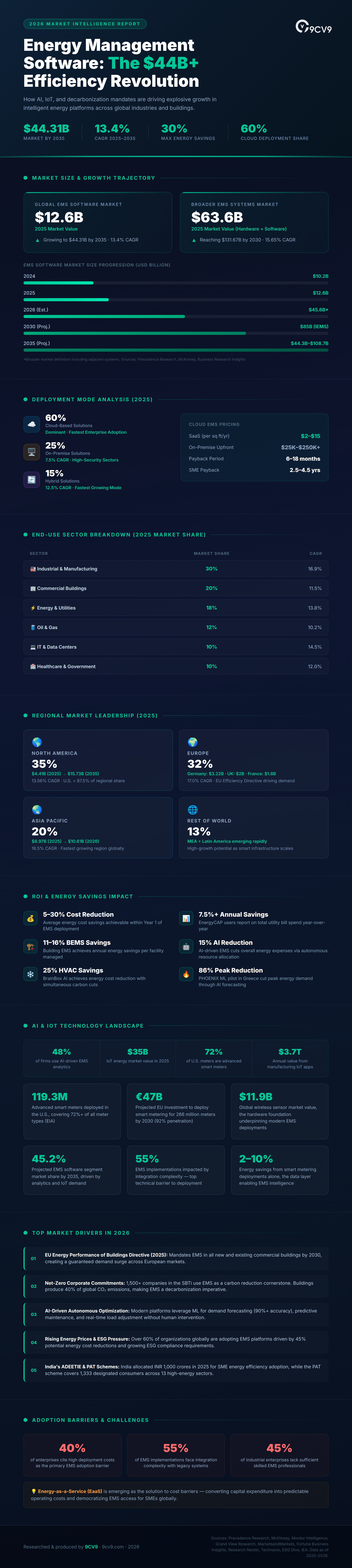
Regionally, North America remains a leading market for energy management software, while Asia Pacific is emerging as a major growth opportunity, supported by industrial expansion, smart city investments, and government-backed energy efficiency initiatives. Industries such as manufacturing, commercial real estate, healthcare, data centers, and oil and gas are increasingly investing in intelligent energy management platforms to improve resource utilization, strengthen regulatory compliance, and achieve long-term sustainability objectives.
This article explores the Top 103 Energy Management Software Statistics, Data & Trends in 2026, providing insights into global EMS market size, industry growth forecasts, cloud-based deployment, AI and IoT integration, energy savings, return on investment (ROI), regional adoption, competitive dynamics, and emerging technologies. Whether you are a business leader, energy manager, software provider, investor, or sustainability professional, these energy management software statistics offer valuable perspectives on the technologies, market developments, and opportunities shaping the future of energy management in 2026 and beyond.
Before we venture further into this article, we would like to share who we are and what we do.
About 9cv9
9cv9 is a business tech startup based in Singapore and Asia, with a strong presence all over the world.
With over ten years of startup and business experience, and being highly involved in connecting with thousands of companies and startups, the 9cv9 team has listed some of the top and best companies/tools in this review.
If you like to get your company listed in our top B2B software reviews, check out our world-class 9cv9 Media and PR service and pricing plans here.
Top 103 Energy Management Software Statistics, Data & Trends in 2026
Market Size & Growth
- The global energy management software market reached USD 12.60 billion in 2025 and is projected to hit USD 44.31 billion by 2035 at a CAGR of 13.40%, reflecting explosive demand for intelligent energy optimization platforms.
- A separate market estimate places EMS market size at USD 16.41 billion in 2025, growing to USD 50.16 billion by 2035 at an 11.9% CAGR, underscoring the sector’s strong growth consensus across research firms.
- The broader energy management systems (hardware + software + services) market reached USD 63.64 billion in 2025, forecasted to hit USD 131.67 billion by 2030 at a 15.65% CAGR, driven by decarbonization mandates and smart-grid rollouts.
- IMARC Group estimates the global energy management system market at USD 67.2 billion in 2025, with projections to reach USD 169.9 billion by 2034, pointing to one of the highest-value infrastructure software categories globally.
- The energy management software market is poised to reach USD 45.59 billion in 2026 and USD 108.7 billion by 2035 at a CAGR of 10.1%, establishing 2026 as a breakout year for enterprise energy platform adoption.
- By 2030, industrial energy management software (IEMS) could constitute approximately 70% of the total global EMS value pool, totaling $85 billion out of a projected $116 billion, per McKinsey research.
- The McKinsey Global Energy Perspective forecasts the total EMS value pool to exceed $116 billion by 2030, growing at more than 20% per annum from 2024 to 2030 as industries prioritize efficiency and compliance.
- Software’s share of the total EMS value pool is expected to rise from 27% in 2024 to 35% in 2030, as software reduces the need for physical hardware and on-site services, according to McKinsey.
- The energy management control software (EMCS) market was valued at USD 33.07 billion in 2024, growing rapidly as enterprises seek real-time compliance reporting and automated demand response tools.
- The industrial energy management software segment alone reached USD 29.14 billion in 2025, projected to grow to USD 30.43 billion in 2026 and reach USD 44.82 billion by 2035 at a 4.4% CAGR.
Deployment & Technology
- Cloud-based energy management solutions dominated the global market with a 60% share in 2025, driven by scalability, real-time data access, and seamless AI integration capabilities.
- On-premise EMS solutions held a 25% market share in 2025, mainly adopted by industries requiring high data control and stringent infrastructure security, with a projected 7.5% CAGR through 2035.
- Hybrid EMS deployments accounted for 15% of the market in 2025 and are expected to grow at the fastest pace of 12.5% CAGR as organizations bridge legacy and digital infrastructure.
- In North America specifically, on-premise solutions retained a 67.2% share of the EMS market in 2025, reflecting the region’s critical facility requirements and data sovereignty concerns.
- Cloud-based EMS models in North America are forecast to grow at 16.30% CAGR through 2031 as enterprises recognize the scalability and AI horsepower offered by centralized cloud servers.
- Cloud EMS adoption exceeded 55% globally in 2026 among surveyed organizations, with 48% of firms using AI-driven analytics and 30% deploying IoT-enabled monitoring tools.
- SaaS-based energy management platforms are priced at $2–$15 per square foot annually, offering faster implementation and lower upfront costs compared to on-premise systems priced at $25,000–$250,000+.
- The software segment of EMS is expected to attain a 45.2% market share by 2035, propelled by strong demand for real-time monitoring, analytics, predictive optimization, and IoT integration.
- Edge computing integration in EMS is accelerating, with facilities running latency-sensitive energy loops locally while pushing bulk analytics to the cloud to maintain system resilience.
- Digital twin technology is increasingly embedded in energy management platforms, enabling scenario simulation before real-world implementation and significantly improving optimization accuracy.
AI & IoT Integration
- AI-driven energy management systems can reduce overall energy expenses by up to 15% through smart resource allocation and autonomous demand-response execution.
- BrainBox AI’s HVAC optimization platform has demonstrated 25% reductions in energy costs while simultaneously cutting carbon emissions across commercial building portfolios.
- The global wireless sensor market reached USD 11.9 billion and is growing substantially, directly underpinning the IoT device density that powers modern EMS deployments.
- The IoT energy market was valued at USD 35 billion in 2025, with smart sensors, meters, and connected equipment generating continuous data streams for EMS platforms to process and optimize.
- Manufacturing IoT applications are estimated to generate $3.7 trillion in annual economic value, with energy management being one of the primary IoT-driven efficiency levers.
- Building Energy Management Systems (BEMS) in North America led with 61.4% revenue share in 2025, while Home Energy Management Systems (HEMS) are forecast to grow at the fastest rate of 16.72% CAGR through 2031.
- AI and machine learning integration allows EMS platforms to provide predictive analytics that forecast energy demand patterns, identify faults before failure, and optimize system efficiency 24/7 without human intervention.
- Schneider Electric launched the next generation of its EcoStruxure platform in 2025, equipped with AI that continuously analyzes energy data and prevents power-related problems proactively.
- Modern EMS platforms now integrate with smart meters, IoT sensors, BMS, HVAC controls, utility AMI systems, weather data services, and enterprise ERP systems in a unified data layer.
- The PHOENIX pilot project in Greece achieved an 86% reduction in peak energy usage through machine-learning forecasts embedded within its cloud-based EMS platform.
Energy Savings & ROI
- Organizations typically achieve 5–30% energy cost reduction within the first year of deploying energy management software, with payback periods of just 6–18 months.
- EnergyCAP users report an average of 7.5% or more year-over-year savings on total utility bill spend, with top performers achieving 2.5× the savings of average EMS users.
- Building Energy Management Systems (BEMS) specifically achieve 11–16% annual energy savings, while industrial and commercial EMS implementations can reach 10–19% savings depending on application.
- Renewable energy software delivers 15–30% annual ROI with 2–4 year payback periods, primarily through predictive maintenance delivering 20–30% cost reduction.
- Schneider Electric’s EcoStruxure platform delivers up to 30% energy savings across commercial building portfolios by integrating building management, power monitoring, and analytics.
- Some industrial EMS users report 25% reductions in peak demand charges through predictive optimization and edge computing–enabled demand response automation.
- SME EMS projects have realistic simple payback periods of 2.5–4.5 years when bundled with targeted operational improvements and basic retrofits, per Energy Solutions research.
- Energy savings from smart metering deployments are estimated at 2–10% across stakeholders, with smart meters enabling the granular data foundation needed for EMS optimization.
- Hardware, integration, and training extend EMS payback periods to 18–36 months for small enterprises, a challenge that Energy-as-a-Service (EaaS) subscriptions are beginning to solve by converting capex to opex.
- Hive’s smart home energy technology has helped customers save over 1.6 billion kilograms of carbon, equivalent to £490 million in energy cost savings across more than 2 million homes.
End-Use Sectors
- The industrial and manufacturing segment dominated the energy management software market with a 30% share in 2025, driven by high energy consumption and strong demand for efficiency and cost optimization.
- The commercial buildings segment held a 20% market share in 2025 and is growing at 11.5% CAGR, driven by smart building systems optimizing HVAC, lighting, and occupancy-based energy consumption.
- The IEA reports that industry accounted for approximately 40% of global final energy demand in 2025, making it the single largest end-use sector and the primary driver of EMS adoption.
- Commercial facilities commanded 40.6% of the North America EMS market in 2025, with the residential segment showing a robust 15.74% CAGR outlook through 2031.
- The oil and gas industry is anticipated to hold a 12.14% share of the EMS market in 2026, driven by high energy intensity and stringent regulatory efficiency and sustainability requirements.
- The manufacturing sector is expected to witness the highest EMS growth CAGR of 16.90% over 2025–2032, fueled by industrial automation and rising adoption of energy-efficient initiatives.
- The IT and data center segment is a fast-growing EMS end-user, as hyperscale data centers face mounting pressure to reduce power usage effectiveness (PUE) and demonstrate carbon neutrality.
- Healthcare and public sector organizations are increasingly adopting EMS platforms to meet energy compliance mandates while managing complex, multi-site facility portfolios.
- Building energy management systems (BEMS) are anticipated to achieve 40.2% market share by 2035, driven by commercial real estate, smart city initiatives, and corporate net-zero commitments.
- The EU’s new Energy Performance of Buildings Directive, passed in February 2025, mandates installation of energy management systems in all new and existing commercial buildings by 2030, creating a massive demand surge.
Regional Markets
- North America led the global energy management software market with a 35% share in 2025, underpinned by widespread deployment of advanced digital energy infrastructure across industrial and commercial sectors.
- The North America EMS software market was valued at USD 4.41 billion in 2025 and is projected to reach USD 15.73 billion by 2035 at a 13.56% CAGR, led by robust U.S. adoption.
- The U.S. contributed an 87.5% share of the North American EMS market in 2025, reflecting its highly mature smart grid ecosystem, IoT infrastructure, and regulatory energy frameworks.
- Europe accounted for approximately 32% of global EMS market growth in 2025–2029, driven by the EU’s strict energy efficiency directives and carbon emission reduction targets.
- The European EMS market is projected to grow at a 17.00% CAGR over 2026–2034, with Germany reaching USD 3.22 billion, France USD 1.80 billion, and the U.K. USD 2 billion by 2026.
- Asia Pacific held a 20% share of the global EMS software market in 2025 and is expected to grow at the highest CAGR of 16.5% between 2026 and 2035, led by China, India, and Southeast Asia.
- The Asia Pacific EMS market was valued at USD 8.97 billion in 2025, capturing 22.80% of global revenue, and is estimated to grow to USD 10.61 billion in 2026.
- Industrial energy management software adoption in Asia Pacific has risen by 55% over the past five years, with China and India leading on the back of government-supported energy efficiency mandates.
- Canada is forecast to deliver a 15.92% CAGR in the North American EMS market through 2031, making it one of the fastest-growing developed markets for energy management software.
- The Middle East & Africa and Latin America collectively account for approximately 5% of the global EMS market but are emerging as high-growth regions as smart infrastructure investment accelerates.
Competitive Landscape
- The top 10 EMS players globally capture approximately 50% of market share, with 42% of vendors focusing on SaaS solutions and 35% expanding AI-driven analytics offerings.
- Key global EMS vendors include Schneider Electric, Siemens, GE Digital, Honeywell, ABB, Johnson Controls, Rockwell Automation, IBM, Mitsubishi Electric, and Delta Electronics.
- Schneider Electric’s EcoStruxure platform is among the most widely deployed commercial energy management suites, integrating AI, IoT, and cloud analytics across thousands of buildings worldwide.
- Johnson Controls provides the OpenBlue Enterprise Manager with an Energy Manager module and the Metasys BAS, offering comprehensive facility energy control for large commercial and industrial clients.
- IBM’s Maximo platform targets renewable energy asset performance management, leveraging AI to enhance infrastructure reliability and reduce unplanned maintenance downtime.
- Honeywell offers the Carbon & Energy Management suite and Honeywell Forge platform, enabling KPI tracking and building energy performance optimization across complex enterprise portfolios.
- Over 1,500 companies globally have joined the Science Based Targets initiative (SBTi), with many leveraging energy management software as a cornerstone of their corporate carbon reduction strategies.
- Integration complexity impacts 55% of EMS implementations, while a shortage of skilled energy management professionals challenges approximately 45% of industrial enterprises adopting these systems.
- Nearly 40% of enterprises cite high deployment costs as the primary barrier to EMS adoption, while 32% struggle with integration challenges and 28% report a limited skilled workforce.
- Aurora Solar serves over 7,000 companies worldwide as of 2024–2025, demonstrating the rapid commercial scale-up of renewable energy software platforms embedded within broader EMS ecosystems.
Regulations & Policy
- The EU’s Energy Efficiency Directive sets a 32.5% energy efficiency improvement target by 2030, directly accelerating commercial and industrial adoption of software-based energy management systems.
- The EU’s Energy Efficiency Directive 2023 requires large corporations to reduce energy consumption by at least 11.7% by 2030, driving demand for cloud-based EMS platforms that simplify compliance reporting.
- California’s Title 24 building codes mandate real-time energy monitoring for commercial structures exceeding 50,000 sq ft, making EMS a legal requirement for a significant portion of U.S. commercial real estate.
- India’s government introduced the ADEETIE scheme in 2025, allocating INR 1,000 crores to assist micro, small, and medium-scale industries in adopting energy efficiency solutions including EMS.
- India’s Perform, Achieve, Trade (PAT) scheme assigns energy-saving goals to 1,333 designated consumers across 13 sectors, resulting in savings of 25.77 million tons of oil equivalent (MTOE) in 2022–2023.
- As of 2024, 11,127 individuals across India have earned certification as Energy Auditors, reflecting the growing human capital base required to implement and operate energy management systems.
- Commercial real estate owners face mandatory net-zero building codes starting in 2026, driving a sharp increase in demand for connected HVAC, lighting, and controls platforms across major global markets.
- Industrial facilities investing in ISO 50001–compliant EMS systems benefit from penalty avoidance and tax incentives, with the industrial segment expected to account for 38% of total EMCS revenue by 2026.
- The U.S. EPA’s Energy Star program provides evidence that buildings equipped with EMS consume significantly less energy per square foot than non-managed counterparts.
- The IEA reports that North America accounted for nearly one-third of global smart grid digitalization deployments in 2025, directly supporting the region’s leadership position in EMS adoption.
Smart Metering & Infrastructure
- According to the EIA, 119.3 million advanced meters in use in the U.S. account for over 72% of the 165 million meters across all customer types, providing the data backbone for EMS platforms.
- By 2030, investing in smart metering for 266 million meters in Europe is projected to cost approximately €47 billion, reaching nearly 92% penetration across EU member states.
- The average smart meter installation cost ranges from €180 to €200 per unit, while testing and integration costs add €230 for gas and €270 for electricity per metering point.
- Smart grid deployment globally is accelerating, with advanced metering infrastructure (AMI) rollouts giving EMS operators the granular, real-time consumption data needed for AI-driven self-healing grid functions.
- Wired communication protocols retained a 56.40% share of the North American EMS market in 2025, while wireless options are growing at 15.98% CAGR due to easier deployment and IoT compatibility.
- Services (integration, training, performance monitoring) held the largest component share of 42.6% in the North American EMS market in 2025, growing at 16.55% CAGR through 2031.
Carbon & Sustainability
- Buildings are responsible for approximately 40% of global CO2 emissions, making building energy management systems one of the highest-impact software categories for achieving global decarbonization targets.
- In 2024, electricity fulfilled roughly 22% of global energy demand across industry, buildings, and mobility; by 2050 this share is expected to rise to approximately 30%, expanding the EMS addressable market significantly.
- Global CO2 emissions could be reduced by almost 20% from 2024 to 2030 — from 58 billion to 47 billion metric tons — primarily driven by electrification and EMS-enabled efficiency, per McKinsey.
- Over 76% of small businesses have yet to implement comprehensive decarbonization strategies, representing a large addressable market for accessible, affordable EMS solutions targeting SMEs.
- The carbon and sustainability management software segment is the fastest-growing EMS application, driven by rising corporate demand to track harmful gas emissions and meet net-zero regulatory requirements.
- Iris Ohyama’s 2025 launch of the ENEverse cloud EMS platform signals a wave of new entrants offering Energy-as-a-Service (EaaS) models that lower adoption barriers for smaller organizations.
- ASEAN smart city initiatives are accelerating cloud-based energy optimization platform adoption across commercial and public infrastructure, contributing to Asia Pacific’s record 16.5% CAGR forecast.
- China’s expansion of EV charging networks is increasing demand for intelligent load balancing and distributed energy management systems, reinforcing its leadership in regional EMS adoption.
- The EU’s Fit for 55 package and net-zero commitments are reshaping procurement requirements across European member states, making EMS compliance capabilities a competitive necessity for suppliers.
- Corporate sustainability benchmarks tied to ESG reporting are pushing over 60% of organizations globally to adopt energy management platforms, primarily to meet compliance targets and reduce energy costs by up to 45%.
Future Outlook
- By 2037, Asia Pacific is predicted to surpass North America as the dominant EMS software market, driven by growing energy demand, accelerated digitalization, and large-scale smart grid investment.
- Demand response management software and distributed energy resource (DER) management software are among the fastest-growing EMS subcategories, as organizations integrate solar, storage, and microgrids into their operations.
- Virtual power plant (VPP) solutions are expanding rapidly within EMS ecosystems, aggregating distributed energy resources to provide grid stabilization services and new revenue streams for commercial energy users.
- Blockchain-based energy trading platforms are emerging within EMS architectures for decentralized microgrid management, enabling peer-to-peer electricity trading and new models of community energy management.
- Machine learning–powered demand forecasting models are being widely deployed within EMS to reduce peak energy costs, with some platforms demonstrating multi-week consumption prediction accuracy above 90%.
- The global EMS market’s top 10 players are aggressively investing in AI, SaaS, and Asia Pacific expansion through mergers, joint ventures, and strategic acquisitions to defend and grow their positions in a consolidating market.
- Mobile-first EMS applications for residential energy monitoring are growing rapidly, democratizing energy intelligence for households and enabling automated control of lighting, HVAC, and appliances from smartphones.
Conclusion
The Top 103 Energy Management Software Statistics, Data & Trends in 2026 highlight the growing importance of intelligent energy management solutions in helping businesses reduce operational costs, improve energy efficiency, and achieve sustainability objectives. As global energy consumption continues to evolve and organizations face increasing pressure to optimize resources, energy management software (EMS) is becoming an essential component of modern business infrastructure across manufacturing, commercial real estate, utilities, healthcare, and residential sectors.
The global energy management software market demonstrates substantial long-term growth potential, with one industry forecast projecting an increase from USD 12.60 billion in 2025 to USD 44.31 billion by 2035, representing a compound annual growth rate (CAGR) of 13.40%. Meanwhile, cloud-based energy management solutions accounted for approximately 60% of the global market in 2025, reflecting the growing preference for scalable, flexible, and data-driven energy optimization platforms. These developments indicate that digital transformation and energy efficiency are becoming increasingly interconnected.
One of the most significant energy management software trends in 2026 is the integration of artificial intelligence (AI), Internet of Things (IoT) technologies, machine learning, and predictive analytics. These innovations are transforming traditional energy monitoring systems into intelligent platforms capable of forecasting consumption patterns, detecting inefficiencies, automating demand response, and optimizing energy distribution. According to the statistics examined, AI-powered energy management systems can potentially reduce energy expenses by up to 15%, while organizations implementing comprehensive EMS solutions may achieve energy cost savings of 5% to 30%, depending on their operational environments and implementation strategies.
Regional market developments also reveal considerable opportunities for energy management software providers and investors. North America continues to lead in established energy management infrastructure, while Asia Pacific is positioned for rapid expansion as industrialization, smart grid investments, renewable energy integration, and government-backed efficiency initiatives accelerate adoption. At the same time, increasingly demanding sustainability requirements and energy performance regulations are encouraging organizations worldwide to invest in advanced energy monitoring, reporting, and optimization technologies.
Looking ahead, the future of energy management software beyond 2026 will increasingly be shaped by cloud-based platforms, AI-driven automation, smart metering infrastructure, digital twins, distributed energy resource management, and virtual power plants. As businesses integrate renewable energy sources, electric vehicle charging infrastructure, and intelligent building technologies, EMS platforms will play an increasingly important role in coordinating energy consumption, improving grid flexibility, and supporting long-term decarbonization strategies.
Ultimately, these 103 energy management software statistics and trends demonstrate that investing in modern energy management technology is no longer solely about monitoring electricity consumption. It is becoming a strategic business decision that can improve financial performance, strengthen operational resilience, support regulatory compliance, and advance environmental sustainability. For businesses, energy managers, technology providers, and investors, understanding the latest EMS market statistics, industry growth forecasts, and emerging innovations will be essential for identifying opportunities and making informed decisions in an increasingly energy-conscious global economy.
If you find this article useful, why not share it with your hiring manager and C-level suite friends and also leave a nice comment below?
We, at the 9cv9 Research Team, strive to bring the latest and most meaningful data, guides, and statistics to your doorstep.
To get access to top-quality guides, click over to 9cv9 Blog.
To hire top talents using our modern AI-powered recruitment agency, find out more at 9cv9 Modern AI-Powered Recruitment Agency.
People Also Ask
What is energy management software (EMS)?
Energy management software (EMS) is a digital platform that helps organizations monitor, analyze, and optimize energy consumption. It uses real-time data, automation, and analytics to reduce energy costs, improve efficiency, and support sustainability goals.
What is the global energy management software market size in 2026?
Industry estimates vary, with one forecast valuing the global energy management software market at USD 45.59 billion in 2026. Market valuations differ depending on whether they include software alone or broader energy management systems and services.
How fast is the energy management software market growing?
One industry forecast projects the global energy management software market to grow at a compound annual growth rate (CAGR) of 13.40% from 2025 to 2035, reaching approximately USD 44.31 billion by 2035.
What are the biggest energy management software trends in 2026?
Major EMS trends in 2026 include AI-powered energy optimization, cloud-based platforms, IoT integration, predictive analytics, smart metering, digital twins, automated demand response, and renewable energy management.
How much can businesses save using energy management software?
Businesses implementing energy management software may achieve energy cost savings of 5% to 30%, depending on their facilities, energy consumption patterns, technology infrastructure, and optimization strategies.
What percentage of energy management software is cloud-based?
Cloud-based energy management solutions accounted for approximately 60% of the global market in 2025. Their popularity reflects growing demand for scalable platforms, remote monitoring, real-time analytics, and AI integration.
How does AI improve energy management software?
Artificial intelligence improves energy management software through demand forecasting, predictive maintenance, automated optimization, and anomaly detection. AI-powered systems can potentially reduce energy expenses by up to 15%.
What is the difference between EMS and BEMS?
Energy management software (EMS) manages energy consumption across different facilities and industries. Building Energy Management Systems (BEMS) specifically optimize energy usage in buildings, including HVAC, lighting, and other connected systems.
Which industries use energy management software the most?
Manufacturing, commercial real estate, utilities, oil and gas, healthcare, and data centers are major EMS users. The industrial and manufacturing segment accounted for approximately 30% of the global energy management software market in 2025.
What is the expected energy management software market size by 2035?
One market forecast projects the global energy management software market to reach USD 44.31 billion by 2035, up from USD 12.60 billion in 2025. Other estimates differ because of varying market definitions and research methodologies.
Which region dominates the energy management software market?
North America led the global energy management software market with an estimated 35% share in 2025, supported by advanced smart grid infrastructure, industrial energy optimization, and widespread digital technology adoption.
Which region has the fastest-growing energy management software market?
Asia Pacific is projected to experience strong growth, with one forecast estimating a 16.5% CAGR between 2026 and 2035. China, India, and Southeast Asia are important growth markets.
What is the return on investment for energy management software?
EMS return on investment depends on implementation costs, energy consumption, and operational improvements. Some deployments report payback periods of 6–18 months, while smaller projects involving hardware upgrades may require longer.
How much does energy management software cost?
The supplied market data estimates SaaS-based EMS pricing at USD 2–15 per square foot annually, while on-premise implementations may cost USD 25,000–250,000 or more. Actual pricing varies by vendor, facility size, and functionality.
What is industrial energy management software?
Industrial energy management software helps manufacturers and industrial facilities monitor electricity consumption, optimize equipment performance, reduce peak demand charges, and improve operational efficiency through automation and analytics.
How does IoT technology support energy management systems?
IoT technology connects smart meters, sensors, HVAC systems, and industrial equipment to EMS platforms. These devices collect real-time energy data, enabling automated monitoring, predictive analytics, and more efficient resource allocation.
What are the benefits of cloud-based energy management software?
Cloud-based EMS platforms offer centralized energy monitoring, remote accessibility, scalable analytics, automated reporting, and easier integration with AI and IoT technologies. They can also reduce upfront infrastructure requirements.
How does energy management software reduce carbon emissions?
Energy management software reduces emissions by identifying energy waste, optimizing equipment operation, improving electricity efficiency, and supporting renewable energy integration. It also helps organizations monitor sustainability performance.
What is the role of smart meters in energy management software?
Smart meters provide detailed electricity consumption data that EMS platforms use to identify inefficiencies, monitor demand patterns, and automate energy optimization. They are essential components of modern intelligent energy infrastructure.
How many smart meters are installed in the United States?
According to the supplied energy management statistics, approximately 119.3 million advanced meters were in use in the United States, representing more than 72% of approximately 165 million meters across customer categories.
What is the future of AI-powered energy management systems?
AI-powered EMS platforms are expected to become increasingly autonomous, using machine learning to forecast electricity demand, detect equipment faults, optimize energy consumption, and coordinate distributed energy resources.
How does energy management software help commercial buildings?
Energy management software helps commercial buildings optimize HVAC systems, lighting, occupancy-based controls, and electricity consumption. Building energy management implementations can achieve approximately 11–16% annual energy savings.
What is the market share of industrial energy management software?
The industrial and manufacturing segment represented approximately 30% of the global energy management software market in 2025. Industrial demand is supported by energy-intensive operations, automation, and efficiency requirements.
What are the biggest challenges facing energy management software adoption?
Major EMS adoption challenges include high implementation costs, integration complexity, cybersecurity concerns, legacy infrastructure, and limited technical expertise. Some industry estimates identify integration difficulties in 55% of implementations.
How does energy management software support renewable energy?
Energy management software helps organizations monitor solar and other renewable energy sources, coordinate battery storage, forecast generation, balance electricity demand, and integrate distributed energy resources into existing infrastructure.
What is the difference between cloud-based and on-premise EMS?
Cloud-based EMS uses remote servers for centralized monitoring and analytics, while on-premise EMS operates within an organization’s infrastructure. Cloud platforms prioritize scalability, whereas on-premise systems offer greater direct infrastructure control.
How do energy management systems support ESG and sustainability reporting?
Energy management systems collect energy consumption data, monitor efficiency improvements, track emissions-related indicators, and generate performance reports that support environmental, social, and governance (ESG) disclosures.
What is a digital twin in energy management software?
A digital twin is a virtual representation of a physical building, facility, or energy system. EMS platforms use digital twins to simulate energy consumption, test optimization strategies, and evaluate potential improvements before implementation.
How will energy management software evolve beyond 2026?
Energy management software will increasingly incorporate AI automation, predictive analytics, digital twins, virtual power plants, distributed energy resource management, and advanced smart grid connectivity to improve energy efficiency.
Why should businesses invest in energy management software in 2026?
Businesses should consider energy management software to reduce energy expenses, improve operational efficiency, monitor electricity consumption, strengthen regulatory compliance, and support sustainability goals while preparing for future energy challenges.
Sources
Precedence Research
OpenPR
Mordor Intelligence
Grand View Research
Research Nester
Technavio
MarketsandMarkets
Fortune Business Insights
IMARC Group
Vocal Media
McKinsey & Company
Global Growth Insights
Business Research Insights
Intel Market Research
ESG Dive
SolarTech Online
Energies Media
Facilio
Energy Solutions
HTF Market Insights
Market Report Analytics
Schneider Electric
EIN Presswire