Key Takeaways
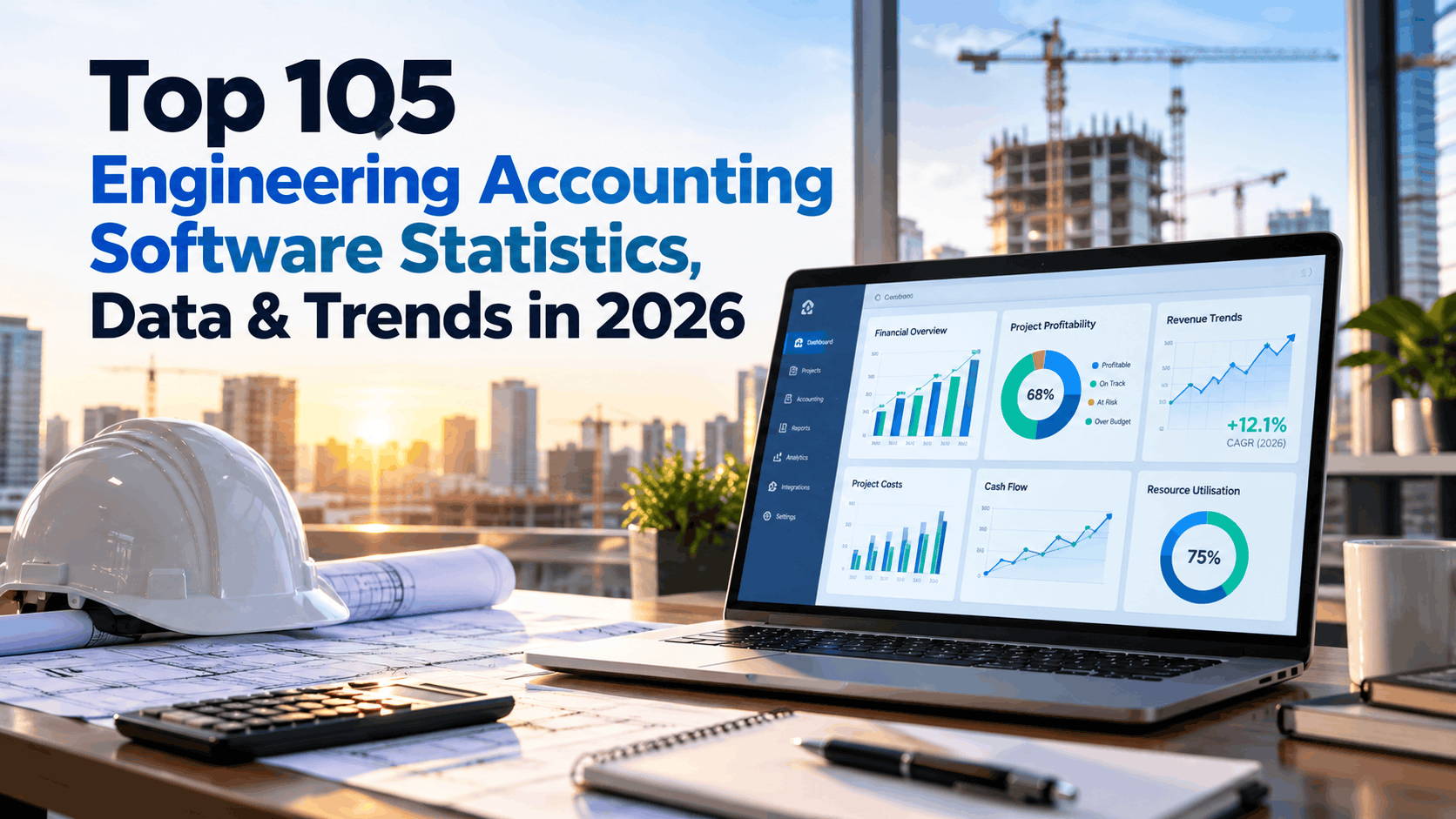
- Engineering Accounting Software Market Growth: The global engineering accounting software market is projected to reach USD 1.74 billion by 2032, growing at a 9.0% CAGR, driven by increasing demand for financial automation and project accounting solutions.
- Cloud Accounting and AI Adoption: Cloud-based solutions captured 68.08% of the broader accounting software market in 2025, while AI adoption among accounting firms surged from 9% in 2024 to 41% in 2025, accelerating digital transformation.
- Financial Automation and Project Profitability: With 75% of architecture and engineering firms still relying on manual accounting and finance processes to some degree, significant opportunities exist to improve efficiency, reduce project costs, and enhance profitability through integrated engineering accounting software.
Engineering accounting software is transforming financial management in 2026, with the global market projected to reach USD 1.74 billion by 2032 at a 9.0% CAGR. Explore 105 key statistics covering market growth, AI adoption, cloud accounting, financial automation, project cost management, and profitability trends shaping the engineering industry.
The engineering industry is undergoing a significant digital transformation, with accounting software playing an increasingly important role in financial management, project profitability, cost control, and operational efficiency. As engineering firms navigate rising project costs, complex financial reporting requirements, and growing pressure to improve productivity, the adoption of cloud-based engineering accounting software, artificial intelligence (AI), and automated financial management solutions is accelerating in 2026.
Also, read our article on the Top 10 Engineering Accounting Software.

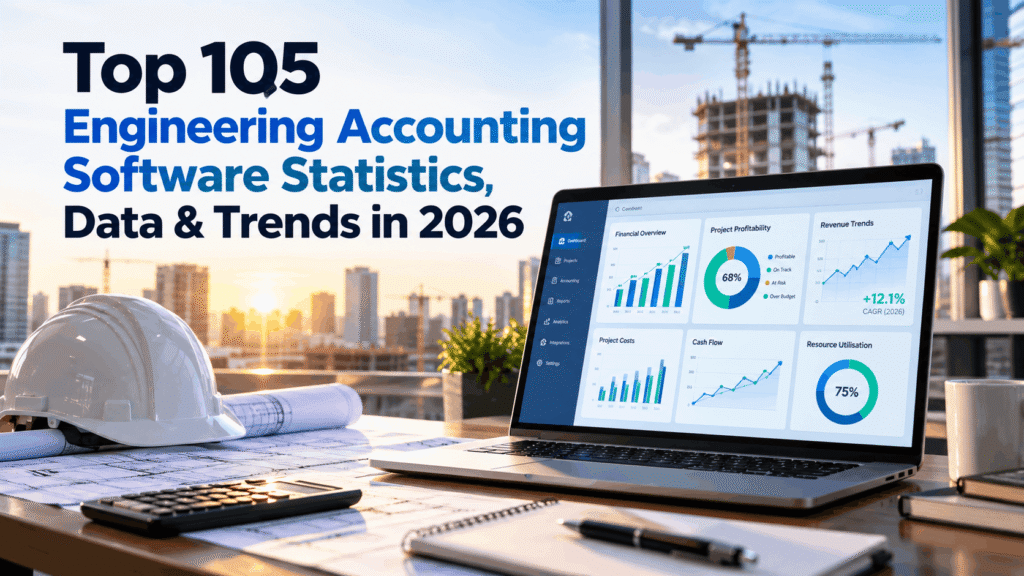
The global engineering accounting software market is experiencing substantial growth. According to market research estimates, the industry was valued at approximately USD 950.48 million in 2025 and is projected to reach USD 1.74 billion by 2032, representing a compound annual growth rate (CAGR) of 9.0%. Other market forecasts suggest even greater growth potential, reflecting differences in how engineering-specific accounting platforms, enterprise resource planning (ERP) solutions, and project financial management software are classified.
Cloud computing and AI-powered automation are among the most influential trends shaping the engineering accounting software market in 2026. Cloud-based solutions accounted for 68.08% of the broader accounting software market in 2025, while AI adoption among accounting firms increased dramatically from 9% in 2024 to 41% in 2025. These developments highlight the growing demand for real-time financial reporting, automated invoicing, predictive project budgeting, integrated payroll management, and intelligent cost forecasting.


Despite these technological advancements, significant operational challenges remain. The 2026 Deltek Clarity Architecture and Engineering Industry Study indicates that 75% of architecture and engineering firms report moderate to complete reliance on manual processes in accounting and finance functions. Meanwhile, median operating profit on net revenue declined to 16.7%, reinforcing the importance of accurate project accounting, resource utilisation tracking, and financial visibility in protecting engineering firms’ profitability.
Engineering accounting software is also becoming increasingly essential for managing large-scale infrastructure projects, where budget overruns, delayed payments, labour costs, and complex contractual requirements can significantly affect financial performance. Modern platforms such as Deltek Vantagepoint, BQE CORE, Sage Intacct, Oracle NetSuite, and Acumatica are helping engineering businesses integrate project management, financial accounting, billing, resource planning, and business intelligence into more connected workflows.
This comprehensive guide to the Top 105 Engineering Accounting Software Statistics, Data & Trends in 2026 examines the latest market size estimates, growth forecasts, cloud adoption rates, AI accounting trends, financial performance benchmarks, regional market developments, and emerging technologies transforming the engineering sector.
Whether you are an engineering firm owner, CFO, financial controller, project manager, software vendor, or technology investor, these engineering accounting software statistics provide valuable insights into the industry’s evolving financial technology landscape, helping businesses understand emerging opportunities, evaluate software investments, improve project profitability, and prepare for the future of engineering financial management.
Before we venture further into this article, we would like to share who we are and what we do.
About 9cv9
9cv9 is a business tech startup based in Singapore and Asia, with a strong presence all over the world.
With over ten years of startup and business experience, and being highly involved in connecting with thousands of companies and startups, the 9cv9 team has listed some of the top and best companies/tools in this review.
If you like to get your company listed in our top B2B software reviews, check out our world-class 9cv9 Media and PR service and pricing plans here.
Top 105 Engineering Accounting Software Statistics, Data & Trends in 2026
🌍 Market Size & Growth
- The global Engineering Accounting Software market was valued at USD 950.48 million in 2025 and is projected to reach USD 1,737.51 million by 2032, growing at a CAGR of 9.00%. As engineering firms double down on financial automation, this niche segment is entering a sustained growth cycle that outpaces general enterprise software.
- A separate analysis by HTF Market Intelligence values the Engineering Accounting Software market at USD 2.7 billion in 2025, forecasting growth to USD 6.8 billion by 2033 at a CAGR of 12.1%. This discrepancy in estimates reflects varying market definitions, with broader scopes capturing adjacent ERP and infrastructure finance tools.
- DataInsightsMarket estimates the engineering accounting software market at approximately USD 3,500 million by 2025, targeting a CAGR of 12% through 2033. This trajectory positions the market as one of the fastest-growing verticals within the professional services software ecosystem.
- Verified Market Reports values the broader Engineering Accounting Software market at USD 10.4 billion in 2023, projecting it to reach USD 21.4 billion by 2030 at a CAGR of 10.5%. These figures underscore the critical mass that engineering-specific financial tools are gaining within global enterprise software spending.
- The global engineering accounting software market was valued at USD 4.2 billion in 2023 and is projected to reach USD 8.9 billion by 2032, at a CAGR of 8.7% (DataIntelo). Sustained double-digit adoption rates in cloud and AI-driven features are driving this compound expansion across engineering verticals.
- The global accounting software market (inclusive of engineering-specific platforms) was valued at USD 21.56 billion in 2025, projected to grow to USD 23.47 billion in 2026 and reach USD 35.86 billion by 2031 at a CAGR of 8.85%. Engineering firms represent one of the fastest-adopting professional services categories within this ecosystem.
- Fortune Business Insights projects the global accounting software market to grow from USD 20.90 billion in 2025 to USD 42.17 billion by 2032, at a CAGR of 10.5%. Engineering-specific modules in ERP and project accounting are among the key growth engines fueling this expansion.
- According to Precedence Research, the global accounting software market was valued at USD 21.16 billion in 2025 and is expected to reach USD 50.79 billion by 2035, at a CAGR of 9.15%. The sustained double-digit outlook confirms that engineering firms are increasingly prioritising digital-first financial management infrastructure.
- The construction accounting software market — a subset closely related to engineering — is expected to rise from USD 1.64 billion in 2024 to USD 1.72 billion in 2025 at a 4.9% CAGR, reaching USD 2.26 billion by 2029 at a 7.0% CAGR. Asia Pacific leads this segment with a projected growth rate of 20% during 2024–2029, driven by rapid urbanisation.
- In the United States specifically, the construction/engineering accounting software market was valued at USD 239.56 million in 2022 and is forecasted to reach USD 331 million by 2028, growing at a CAGR of 5.5%. This underscores the dominant role the US plays in setting global benchmarks for engineering finance technology adoption.
☁️ Cloud Deployment & Adoption
- Cloud-based solutions captured 68.08% of the accounting software market share in 2025, advancing at a 10.15% CAGR through 2031 (Mordor Intelligence). For engineering firms, cloud deployment is no longer optional — it is the de facto standard for scalable project accounting.
- The cloud accounting software market was valued at USD 5.36 billion in 2025, up from USD 4.9 billion in 2024 (Atidiv). This 9.4% year-over-year jump signals a decisive shift away from legacy on-premise systems among engineering and professional services firms.
- Over 70% of mid-sized accounting firms now use cloud accounting software, while 94% of large enterprises use some form of cloud service (Atidiv, 2026). Engineering firms operating across multi-site infrastructure are disproportionately represented in these adoption figures.
- In North America, over 63% of companies have implemented cloud accounting systems, led by strong digital maturity and remote work trends (Global Growth Insights). Engineering firms headquartered in the US and Canada are leading the charge for cloud-native financial management.
- Cloud-based construction accounting solutions are projected to reach USD 1 billion in 2024, reflecting a strong shift from on-premises software (Research.com). The lure of real-time project cost visibility is the primary driver cited by engineering CFOs evaluating the move.
- 58% of A&E firms in 2026 report that 60% or more of their infrastructure and systems are cloud or SaaS-based (Deltek Clarity 47th Annual Study). This marks a significant milestone, as cloud readiness is now the majority position across North American engineering firms.
- 52% of accounting firms adopted or expanded cloud-based solutions in 2025, and 87% of professionals with highly integrated technology (75%+ integrated) experienced revenue growth (Wolters Kluwer, 2025). Firms that invest in cloud integration are not just more efficient — they are more profitable.
- High-growth A&E firms are 38% more likely to be fully cloud-based than their average-growth peers (Wolters Kluwer, 2025). For engineering firms, cloud deployment has emerged as a differentiating competitive advantage, not just a technology preference.
- Integrated solution software is expected to comprise 60% of the total construction/engineering accounting software market in 2024, emphasising the need for workflow efficiency and departmental collaboration (Research.com). Siloed tools are being rapidly phased out in favour of unified platforms.
- The cloud accounting software market is projected to grow from USD 5.62 billion in 2025 to USD 12.44 billion by 2033, at a CAGR of 10.46% (Global Growth Insights). For engineering software vendors, the cloud runway remains exceptionally long.
🤖 AI & Automation
- AI adoption in accounting firms surged from 9% in 2024 to 41% in 2025 — a radical shift from cautious experimentation to confident integration (Wolters Kluwer Future Ready Accountant Report, 2025). Engineering accounting platforms embedding AI for cost forecasting and anomaly detection are capturing disproportionate market share.
- In 2025, 64% of accounting firms plan to invest in AI, up from 57% in 2024 (Accounting Today, 2026). This accelerating investment cycle signals that AI-powered engineering accounting tools are quickly transitioning from differentiators to baseline expectations.
- A 2024 study found that 71% of organisations are using AI to some degree in their financial operations, with 41% using AI to a moderate or large degree (NetSuite, 2025). Engineering firms are leveraging AI for budget forecasting, resource allocation, and real-time cost tracking.
- Automated bookkeeping leads growth in AI-accounting at a 47.8% CAGR, the fastest-expanding accounting application globally (Mordor Intelligence, 2025). For engineering firms managing thousands of transactions across projects, automated reconciliation is the single highest-ROI AI use case.
- Firms that invested in technology in 2025 spent an average of USD 19,000, and plan to spend USD 20,000 in 2026 (Accounting Today, via Intuit data). Engineering-sector firms, with greater system complexity, tend to invest well above this benchmark.
- Top payroll solution providers are automating nearly 70% of payroll processes and reducing costs by up to 71% through generative AI and emerging technologies (Hackett Group, 2025). Engineering firms with large hourly workforces stand to benefit the most from payroll AI integration.
- 58% of organisations are exploring AI-driven payroll solutions, while 50% are focusing on automating manual payroll processes (ADP Global Payroll Survey, 2025). As payroll and accounting platforms converge, engineering firms gain holistic financial visibility.
- About 60% of cloud accounting users expect to adopt AI-powered features by 2025 (Market Reports World). For engineering project controllers, AI features like real-time budget alerts and resource overage detection are transforming how projects are financially governed.
- A quarter of accounting firms (25%) still have no current plans to use GenAI, but this is down sharply from 49% in 2024 (Thomson Reuters, 2025). The shrinking pool of non-adopters signals that engineering firms sitting on the sidelines risk falling behind industry peers.
- Advanced analytics dashboards are now standard in an estimated 83% of enterprise accounting deployments (Market Reports World). Engineering firms are leveraging these dashboards to track project burn rates, WIP balances, and profitability by contract type in real time.
📐 A&E Industry Benchmarks
- According to the 46th Annual Deltek Clarity A&E Study (2025), architecture and engineering firms are forecasting net revenue growth of 9.6% for 2025. Robust project pipelines, particularly in infrastructure and sustainability sectors, are driving this optimistic financial outlook.
- AI adoption surged to 53% of A&E firms leveraging AI tools in 2025, up from 38% the prior year (Deltek Clarity 46th, 2025). Use cases include proposal development, project planning, business development, and data analytics — all areas where engineering accounting software plays a central supporting role.
- 38% of A&E firms now rate themselves as digitally mature or advanced, while 74% expect to reach that stage within three years (Deltek Clarity 46th, 2025). This accelerating maturity curve is directly correlated with deeper adoption of purpose-built engineering accounting platforms.
- Business development strategies have shifted from volume to value: proposal volume dropped 38% but the value of awarded work grew by 52% year-over-year, with median win rates reaching 50% (Deltek Clarity 46th, 2025). Better project accounting tools help firms be more selective and financially disciplined in their bids.
- The 47th Annual Deltek Clarity Study (2026) surveyed nearly 900 A&E firms across the US and Canada — the largest sample in the study’s history. Its findings reflect an industry prioritising execution efficiency over pure growth, with accounting technology at the centre of that shift.
- The median operating profit on net revenue declined to 16.7% in 2026, retreating from a 10-year high in 2024 (Deltek Clarity 47th, 2026). This margin compression reinforces the financial case for engineering accounting software that surfaces cost inefficiencies before they become profit erosion.
- Employee turnover edged up slightly to 13.8% in 2026 among A&E firms (Deltek Clarity 47th). High turnover creates cost accounting complexity — one of the core pain points that engineering accounting software addresses through automated labour cost tracking.
- Nearly 60% of A&E firms say projects were delivered ahead of or on schedule in 2026 (Deltek Clarity 47th). Firms with integrated project accounting systems are significantly more likely to meet or beat schedule targets by enabling proactive cost and resource management.
- The average collection of payments for A&E firms reduced by 5.88 days to 73.47 days (Deltek Clarity 46th, 2025). Engineering accounting platforms with automated invoicing and AR tracking are the primary enablers of this DSO improvement trend.
- 80% of A&E firms still report complete to moderate reliance on manual processes in administrative and management functions; in accounting and finance specifically, that number is 75% (Deltek Clarity 47th, 2026). This persistent manual dependency represents the largest untapped opportunity for engineering accounting software vendors.
📊 KPIs & Financial Benchmarks
- The median utilisation rate for architecture firms was 61% in 2023, a notable increase of 0.8 percentage points year-over-year (Deltek Clarity A&E Study). Engineering accounting software helps firms track and improve utilisation in real time, directly impacting revenue per employee.
- The target overhead rate for engineering firms is 150–175% of direct labour costs, with high-performing firms achieving 130–150% (Deltek Clarity, Zweig Group, AEC Advisors, 2024–2025). Firms that fail to track overhead accurately are systematically underpricing their services.
- Architecture firms reported a 162% overhead rate as an industry benchmark (Deltek Clarity A&E Study). Precision overhead tracking through dedicated engineering accounting software is essential to maintaining profitability in this cost-sensitive environment.
- Engineering firms reported an average net revenue per employee of USD 167,444 in 2023 — an increase of more than USD 6,000 over the prior year (Deltek Clarity). Robust time-and-billing tracking within engineering accounting systems is the key driver of per-employee revenue improvements.
- The target net multiplier for a healthy A&E firm is 2.75 to 3.25, meaning every dollar of direct labour should generate USD 2.75 to USD 3.25 in net revenue (Northstar Financial Advisory). Engineering accounting platforms that automate billing and labour tracking are critical for monitoring and improving multiplier performance.
- Technical staff in engineering firms should target 60–70% utilisation, while project managers typically land at 55–65% because of non-billable management activities (Northstar Financial Advisory). Dashboards in engineering accounting tools make it possible to monitor utilisation rates weekly rather than monthly.
- 76% of UK A&E firms monitor client satisfaction (up from 63% in 2024), 74% track on-time delivery, and 72% monitor profitability (Deltek Clarity UK, 2025). These KPIs are all most effectively tracked through integrated engineering accounting and project management platforms.
- 71% of UK A&E firms track effective billing rate, up from 53% the prior year (Deltek Clarity UK, 2025). As billing rate tracking becomes mainstream, the demand for engineering accounting software with robust time-and-billing modules continues to rise.
- A break-even rate of 250–275% is necessary for a healthy engineering firm, given overhead rates of 150–175% (Northstar Financial Advisory). Engineering accounting software makes it possible to model and monitor break-even metrics continuously across all active contracts.
- Nearly a third of UK engineering firms expect profits to increase by more than 10% over the next year, despite ongoing economic uncertainty (Deltek Clarity UK, 2025). Financial confidence of this level depends heavily on the real-time visibility that engineering accounting software provides.
🏗️ Project Management & Cost Overrun
- 90% of large infrastructure projects go over budget, with an average cost overrun of 28% (Bent Flyvbjerg’s research). Engineering accounting software with real-time budget monitoring and variance alerts is the most effective tool for combating this industry-wide chronic problem.
- McKinsey estimated global construction inefficiencies cost USD 1.6 trillion annually, with cost overruns ranging from 20% to 45% across project types. Engineering accounting platforms that integrate with project management tools deliver measurable reductions in this staggering efficiency gap.
- 98% of megaprojects face cost overruns or delays, and the average cost increase is 80% of the original project value (McKinsey, Cycleconstruction). Real-time financial tracking through engineering accounting software is the first and most critical line of defence against megaproject budget collapse.
- Projects frequently exceed their budgets by 20% to 30% (CMiC, 2025). Engineering accounting software with earned value management (EVM) features enables project controllers to identify and course-correct cost deviations within days rather than weeks.
- Only 8.5% of projects are completed both on time and on budget, and a mere 0.5% are delivered on time, within budget, and to the owner’s satisfaction (analysis of 16,000+ projects). This systemic underperformance makes the ROI case for robust engineering project accounting tools essentially self-evident.
- 35% of construction and engineering professionals’ time is spent on non-productive activities (various industry sources). Engineering accounting software that automates data entry, reporting, and invoicing directly addresses this time leakage — freeing professionals for higher-value project work.
- 55% of the USD 3.55 billion invested in construction technology in Q1 2025 went toward next-generation robotics and AI-enabled technology, compared to less than 30% in all of 2024 (Nymbl Ventures). The surge in tech investment reflects engineering firms’ growing recognition that financial and operational software is a competitive necessity.
- Each additional technology implemented in engineering and construction generates a 1.14% increase in expected revenue — equivalent to a USD 1.14 million uplift for a USD 100 million revenue business (Construction Executive’s 2024 Technology Report). Engineering accounting software frequently ranks as the highest-ROI technology investment.
- Construction software market is forecast to grow from USD 10.76 billion in 2025 to USD 21.04 billion by 2032 (MarketsandMarkets). Engineering accounting modules are a core component of this expanding construction technology ecosystem.
- Hybrid Design-Build / EPCM firms carry overhead rates of 140–180%, and vertically integrated versions can reach 160–200% (Wiss, AEC Advisors, 2024–2025). Engineering accounting software that granularly tracks indirect costs is non-negotiable for these complex firm types to maintain financial discipline.
🌏 Regional Insights
- North America dominated the accounting software market with a 38.35% revenue share in 2025, backed by high cloud readiness, mature payment rails, and well-funded technology budgets (Mordor Intelligence). Engineering firms in the US and Canada are driving the majority of global platform upgrades.
- Asia Pacific is expected to expand with the highest CAGR of 9.5% from 2026 to 2035 in accounting software (Precedence Research), led by India, China, and Southeast Asia. Rapid infrastructure investment and government-mandated e-invoicing are creating fertile ground for engineering accounting software adoption.
- Asia Pacific’s cloud accounting adoption among SMEs has reached 56%, driven by government digitisation campaigns and financial literacy initiatives (Global Growth Insights). Engineering SMEs across the region are leapfrogging legacy systems, moving directly to cloud-native project accounting platforms.
- Europe holds approximately 27% of global accounting software deployment share (Global Growth Insights). In the UK, 40% of A&E leaders describe their firms as at the ‘mature’ stage of digital transformation (Deltek Clarity UK, 2026).
- The North America accounting software market was valued at USD 8.04 billion in 2025 and is projected to reach USD 19.55 billion by 2035, with a CAGR of 9.29% (Precedence Research). Engineering firms in this region are the anchor customer segment for global platform vendors like Deltek, Oracle, and SAP.
- AI accounting North America leads with 37.5% market share in 2024 in AI-driven financial tools (Grand View Research). KPMG announced a USD 100 million investment in its US Google Cloud practice specifically for AI-driven financial tools in November 2024.
- Asia Pacific is the fastest-growing region for AI accounting, projected at a 47.9% CAGR through 2030 (Mordor Intelligence, 2025). Engineering firms entering emerging markets in this region will increasingly require multi-currency, multi-entity accounting platforms.
- In the Middle East & Africa, cloud accounting adoption stands at 38%, driven by government digitisation and rising startup culture (Global Growth Insights). Infrastructure-heavy economies in the Gulf are rapidly adopting engineering-specific ERP and accounting solutions.
- In Europe, 48% of enterprises demand GDPR-compliant accounting solutions with enhanced data control and localisation features (Global Growth Insights). For engineering firms operating across EU jurisdictions, compliance-ready accounting software is a mandatory procurement requirement.
- 44% of European firms now use cloud accounting systems for multi-currency management and VAT tracking (Global Growth Insights). Engineering firms executing cross-border infrastructure contracts depend on this capability for accurate financial consolidation.
📈 SME vs Enterprise Dynamics
- Large enterprises captured 54.10% of 2025 accounting software revenue by deploying global-consolidation suites (Mordor Intelligence). However, the SME segment is outpacing them on growth velocity.
- SMEs registered the fastest growth at a 10.85% CAGR (2026–2031) in accounting software adoption (Mordor Intelligence). Cloud-native, subscription-based engineering accounting tools are finally making enterprise-grade project financial management accessible to small engineering firms.
- According to SNS Insider, large enterprises held 64.06% of accounting software market share in 2025, while SMEs are the fastest-growing segment at 11.24% CAGR. Smaller engineering firms are the key battleground for engineering accounting software vendors.
- ERP solutions led the accounting software market with a 42.50% share in 2025, while custom accounting software is the fastest-growing segment at a 10.14% CAGR (SNS Insider). Purpose-built engineering accounting solutions that blend ERP depth with industry-specific flexibility are uniquely positioned to capitalise.
- The mid-sized company adoption rate for cloud accounting is growing at 39%, supported by government initiatives to encourage digital transformation (Global Growth Insights). Mid-tier engineering firms represent the most rapidly expanding customer tier for platforms like Deltek Ajera and BQE CORE.
- About 62% of small enterprises adopt accounting software to reduce manual processing time, according to the US Department of Commerce (Business Research Insights). Small engineering firms cite time savings in invoicing and payroll as the top benefit of switching to dedicated accounting software.
- Subscription-based/cloud revenue models now represent nearly 80% of offerings among leading accounting software providers (Business Research Insights). This shift aligns perfectly with engineering firms’ preference for predictable OpEx software spending.
- In 2023, over 55% of SMEs in Latin America and Southeast Asia migrated to digital accounting platforms as governments promoted tax digitisation (Global Growth Insights). Engineering SMEs in these regions are rapidly adopting cloud accounting to meet mandatory electronic invoicing requirements.
- Over 45% of small engineering businesses cite complexity and learning curve of advanced software as a barrier to adoption (Business Research Insights). Vendors investing in user-friendly onboarding and industry-specific templates are gaining traction in the SME segment.
- The integrated enterprise accounting platform segment holds 42.3% of accounting software revenue in 2025 (Future Market Insights). For large engineering firms with complex multi-entity structures, integrated platforms remain the dominant procurement preference.
🔗 Integration, Compliance & Technology Trends
- 47% of companies now connect payroll with accounting and finance systems, up from 41% the prior year (ADP Global Payroll Survey, 2025). Engineering firms integrating payroll and project accounting gain a critical advantage in real-time project cost tracking.
- 39% of enterprises face difficulties linking cloud accounting software with legacy on-premises systems (Global Growth Insights). Engineering firms managing multi-decade infrastructure projects often carry legacy ERP environments that complicate cloud accounting migrations.
- Integration with mobile platforms has surged by 47%, while cloud adoption in large enterprises has expanded by 43% (Global Growth Insights). Mobile accessibility is now a baseline requirement for engineering project managers tracking costs from construction sites.
- 49% of businesses prefer mobile-friendly accounting platforms to support on-the-go accounting functions (Global Growth Insights). Field engineers and project managers who need real-time budget visibility on-site are the primary driver of this mobile-first shift.
- 36% of finance teams report reduced productivity during migration due to compatibility issues and poor technical support from vendors (Global Growth Insights). Engineering firms should budget for dedicated implementation support when transitioning to new accounting platforms.
- In 2025, 32% of US accounting firms received private equity funding in the past three years (Wolters Kluwer). PE consolidation is accelerating digital transformation, including engineering accounting software modernisation, across mid-market professional services firms.
- High-growth A&E firms are 53% more likely to have highly integrated systems than their peers (Wolters Kluwer). System integration — connecting accounting, project management, HR, and CRM — is the hallmark of financially outperforming engineering firms.
- On average, businesses use 7–25 different apps to manage operations, with costs averaging USD 10,000 per month, USD 3,000 of which is spent on apps they rarely or never use (Accounting Today). Engineering firms consolidating onto all-in-one accounting and project management platforms are eliminating significant software waste.
- AI-powered accounting tools have risen by 52% in implementation rates (Global Growth Insights). Engineering accounting software vendors are rapidly embedding AI for fraud detection, predictive cost modelling, and automated financial close.
- Blockchain ledger adoption is at 25% growth trend among forward-looking accounting platforms (Global Growth Insights). A subset of engineering firms — particularly those in government contracting — are evaluating blockchain for immutable project cost audit trails.
👩💼 Workforce & Talent
- 83% of organisations are expanding their payroll teams while 61% report that skills shortages have affected payroll service delivery (ADP, 2025). Engineering firms with automated payroll-accounting integration are better positioned to manage growing workforces without proportionate headcount increases in finance.
- A&E firm employee turnover reached 13.8% in 2026 (Deltek Clarity 47th), creating recurring project cost estimation challenges as labour rates and compositions shift. Engineering accounting software that updates labour cost models dynamically is essential for maintaining budget accuracy during periods of workforce churn.
- Engineering firms’ accounting and finance functions still rely 75% on manual processes according to the 47th Deltek Clarity Report (2026). This extraordinary persistence of manual work represents the single largest automation opportunity in the engineering sector.
- Payroll organisations faced a 7% increase in workload alongside a 2% decrease in budget in 2025 (Hackett Group). Engineering firms experiencing this squeeze are turning to integrated payroll-accounting automation platforms to do more with less.
- 81% of organisations are upskilling existing payroll staff and changing how they work to accommodate new technology (ADP Global Payroll Survey, 2025). Engineering firms leading this upskilling push are seeing faster adoption of accounting software and faster financial close cycles.
🎯 Software Selection & Vendor Landscape
- The leading vendors in the Engineering Accounting Software market include NetSuite, Deltek, SAP, Oracle, Sage Intacct, Acumatica, FinancialForce, Xledger, Deskera ERP, and EBizCharge (Verified Market Reports, ReportPrime). Each targets a different engineering firm profile, from boutique consultancies to global EPCM contractors.
- Deltek was recognised in G2’s 2026 Best Software Awards for Best ERP Software Products, reinforcing its dominant position among architecture and engineering firms. The recognition reflects the sustained investment Deltek has made in purpose-built A&E project accounting capabilities.
- BQE CORE is a cloud-based platform specifically designed for architecture and engineering firms, integrating accounting, invoicing, project management, and resource planning in a single unified environment (GetApp). Its A&E-native design eliminates the need for custom workarounds common in generic accounting platforms.
- Sage Intacct supports multi-entity accounting with the ability to handle various currencies, tax regulations, and reporting standards — making it a preferred choice for engineering firms with multiple international branches (SoftwareConnect). Global infrastructure engineering firms prize this capability for consolidated financial reporting.
- Engineering accounting platforms like Deltek Vantagepoint specifically address risk management, milestone tracking, document management, and budget control for large engineering projects with many stakeholders and phases (SoftwareConnect). This level of financial oversight is impractical to replicate in general-purpose accounting tools.
📉 Industry Challenges & Opportunities
- 53% of UK engineering firms plan to invest more in cloud solutions in 2026, representing a notable decline from 63% in the prior year (Deltek Clarity UK, 2026). This suggests a shift from initial cloud procurement to maximising value from existing cloud-based accounting investments.
- 40% of UK A&E leaders describe their firms as at the ‘mature’ stage of digital transformation — compared to only 43% of German firms still at the ‘applied’ stage (Deltek Clarity UK, 2026). This maturity gap creates significant cross-border opportunity for engineering accounting software vendors targeting European markets.
- The global construction software market is projected to grow from USD 10.76 billion in 2025 to USD 21.04 billion by 2032 (MarketsandMarkets). Engineering accounting software is a core sub-segment of this expanding market, with project finance tools commanding a growing share.
- AI-enabled tools now contribute over 30% of innovation focus in new accounting software offerings (Business Research Insights). Engineering accounting platforms that delay embedding AI risk losing competitive ground to cloud-native challengers investing heavily in intelligent automation.
- The UK’s National Audit Office reported that 70% of projects exceed budgets, averaging 18% overruns — a statistic that makes the business case for real-time engineering accounting software effectively irrefutable to engineering firm leadership.
Conclusion
The latest engineering accounting software statistics, data, and trends for 2026 reveal an industry undergoing significant transformation, driven by cloud computing, artificial intelligence, financial automation, and the growing demand for real-time project profitability insights. As engineering firms face increasing pressure to control costs, improve operational efficiency, and manage complex projects, investing in modern accounting software is becoming an essential component of long-term business competitiveness.
With the global engineering accounting software market projected to grow from USD 950.48 million in 2025 to approximately USD 1.74 billion by 2032, at a compound annual growth rate (CAGR) of 9.0%, demand for specialised financial management solutions is expected to remain strong. Broader market estimates suggest even greater growth potential, particularly as engineering businesses increasingly integrate accounting capabilities with enterprise resource planning (ERP), project management, and business intelligence platforms.
One of the most significant engineering accounting software trends in 2026 is the accelerating adoption of cloud-based financial management systems. Cloud solutions accounted for 68.08% of the broader accounting software market in 2025, demonstrating the shift towards scalable, accessible, and integrated financial technologies. Meanwhile, AI adoption among accounting firms increased from 9% in 2024 to 41% in 2025, highlighting the expanding role of intelligent automation in financial reporting, invoice processing, project cost forecasting, and resource allocation.
However, substantial opportunities for improvement remain. According to the 2026 Deltek Clarity Architecture and Engineering Industry Study, 75% of architecture and engineering firms still report moderate to complete reliance on manual accounting and finance processes. This continued dependence on manual workflows creates significant opportunities for software providers offering automated financial reporting, integrated payroll systems, real-time project accounting, and predictive analytics.
Financial performance is another critical consideration. With median operating profit on net revenue among architecture and engineering firms declining to 16.7%, businesses must prioritise accurate project budgeting, effective labour utilisation, overhead cost management, and timely invoicing. Engineering accounting software can support these objectives by providing greater visibility into project finances, identifying potential cost overruns, and enabling more informed financial decisions.
Looking ahead, the future of engineering accounting software will likely be shaped by several interconnected developments, including AI-powered financial forecasting, cloud-native ERP integration, automated compliance reporting, mobile accounting capabilities, and advanced project profitability analytics. Small and medium-sized engineering firms are also expected to become increasingly important customers as subscription-based software makes sophisticated financial management capabilities more accessible.
For engineering companies evaluating their technology strategies, the key takeaway from these 105 engineering accounting software statistics is clear: successful digital transformation requires more than replacing spreadsheets or automating bookkeeping. It involves building an integrated financial management environment that connects project delivery, workforce management, resource planning, accounting, and strategic decision-making.
Ultimately, engineering firms that strategically adopt modern accounting technologies, improve financial data visibility, and reduce inefficient manual processes will be better positioned to manage project risks, protect profit margins, and support sustainable business growth.
As the engineering accounting software market continues to evolve throughout 2026 and beyond, businesses that prioritise financial automation, cloud integration, and data-driven project management will be better equipped to compete in an increasingly complex and technology-driven engineering industry.
If you find this article useful, why not share it with your hiring manager and C-level suite friends and also leave a nice comment below?
We, at the 9cv9 Research Team, strive to bring the latest and most meaningful data, guides, and statistics to your doorstep.
To get access to top-quality guides, click over to 9cv9 Blog.
To hire top talents using our modern AI-powered recruitment agency, find out more at 9cv9 Modern AI-Powered Recruitment Agency.
People Also Ask
What is engineering accounting software?
Engineering accounting software is a specialised financial management solution designed for engineering firms. It integrates project accounting, budgeting, invoicing, payroll, resource planning, cost tracking, and financial reporting to improve operational efficiency and project profitability.
How big is the global engineering accounting software market in 2026?
The global engineering accounting software market was valued at approximately USD 950.48 million in 2025 and is projected to reach USD 1.74 billion by 2032. Market estimates vary depending on whether broader ERP and project financial management solutions are included.
What is the projected growth rate of the engineering accounting software market?
The engineering accounting software market is projected to grow at a compound annual growth rate (CAGR) of 9.0% through 2032. Other market research estimates suggest growth rates exceeding 12%, depending on market definitions and software categories.
What are the major engineering accounting software trends in 2026?
Major trends include cloud-based accounting, AI-powered financial automation, predictive project budgeting, real-time profitability tracking, integrated ERP platforms, mobile accounting, automated invoicing, and advanced financial analytics.
How is artificial intelligence transforming engineering accounting software?
AI helps engineering firms automate bookkeeping, detect financial anomalies, forecast project costs, optimise resource allocation, and improve financial reporting. AI adoption among accounting firms increased from 9% in 2024 to 41% in 2025.
What percentage of accounting software is cloud-based in 2026?
Cloud-based solutions accounted for 68.08% of the global accounting software market in 2025. Their adoption continues to grow as engineering firms seek scalable financial systems, remote accessibility, automated updates, and real-time project accounting capabilities.
Why is cloud accounting software important for engineering firms?
Cloud accounting software enables engineering firms to access financial data remotely, monitor project budgets, automate invoicing, and collaborate across locations. It also reduces dependence on on-premises infrastructure and supports integration with project management systems.
How many engineering firms still rely on manual accounting processes?
According to the 2026 Deltek Clarity Study, 75% of architecture and engineering firms report moderate to complete reliance on manual accounting and finance processes. This highlights substantial opportunities for financial automation and workflow improvement.
What are the benefits of engineering accounting software?
Engineering accounting software improves financial visibility, reduces manual data entry, automates billing, tracks project expenses, monitors profitability, and supports resource planning. These capabilities help engineering businesses manage complex projects more efficiently.
What is the best engineering accounting software in 2026?
Leading engineering accounting software options include Deltek Vantagepoint, Deltek Ajera, BQE CORE, Sage Intacct, Oracle NetSuite, and Acumatica. The best choice depends on company size, project complexity, accounting requirements, integrations, and budget.
How does engineering accounting software improve project profitability?
Engineering accounting software tracks labour expenses, overhead costs, project budgets, billing rates, and financial performance. Real-time dashboards help managers identify cost overruns, improve resource utilisation, and make better decisions to protect profit margins.
What is the average profit margin for architecture and engineering firms in 2026?
The 2026 Deltek Clarity Study reported a median operating profit on net revenue of 16.7% among architecture and engineering firms. This benchmark highlights the importance of accurate project accounting, cost management, and operational efficiency.
How much do engineering firms spend on accounting software?
Engineering accounting software costs vary by business size, user count, functionality, and deployment model. Broader accounting industry data indicates that technology-investing firms planned to spend approximately USD 20,000 on technology in 2026.
What percentage of engineering firms use AI technology?
The 2025 Deltek Clarity Study reported that 53% of architecture and engineering firms were using AI tools, compared with 38% the previous year. Applications include project planning, proposal development, business development, and data analytics.
How does engineering accounting software help prevent project cost overruns?
Engineering accounting software provides real-time budget monitoring, expense tracking, financial forecasting, and variance analysis. These features help project managers identify potential overruns early and adjust spending before financial problems escalate.
What percentage of large infrastructure projects exceed their budgets?
Research cited in the industry data indicates that approximately 90% of large infrastructure projects experience budget overruns, with average cost increases of 28%. Accurate financial tracking and proactive project controls can help engineering firms manage these risks.
What is the average overhead rate for engineering firms?
Engineering firms commonly target overhead rates of 150% to 175% of direct labour costs, while high-performing firms may achieve 130% to 150%. Monitoring overhead helps businesses establish accurate billing rates and maintain project profitability.
What is a good utilisation rate for engineering firms?
Technical employees in engineering firms generally target utilisation rates of 60% to 70%, while project managers often target 55% to 65%. Engineering accounting software helps monitor billable hours, workforce productivity, and resource allocation.
What is the net multiplier in engineering accounting?
The net multiplier measures net revenue relative to direct labour costs. A commonly cited target for healthy architecture and engineering firms is 2.75 to 3.25, meaning each dollar of direct labour generates approximately USD 2.75 to USD 3.25 in net revenue.
How does engineering accounting software support payroll management?
Engineering accounting software integrates payroll information with project costs, employee timesheets, labour rates, and financial reporting. This helps firms allocate workforce expenses accurately, reduce manual processing, and improve project-level cost visibility.
What is the fastest-growing region for accounting software in 2026?
Asia Pacific is projected to record the fastest regional growth in the broader accounting software market, with an estimated CAGR of 9.5% from 2026 to 2035. Infrastructure investment, cloud adoption, and digital tax compliance support regional demand.
Which region dominates the global accounting software market?
North America held approximately 38.35% of global accounting software revenue in 2025. Its leading position reflects mature technology infrastructure, widespread cloud adoption, established enterprise software providers, and strong digital transformation investment.
Are small engineering firms adopting accounting software faster?
Small and medium-sized enterprises are among the fastest-growing accounting software customer segments, with a projected CAGR of 10.85% from 2026 to 2031. Affordable cloud subscriptions are making advanced project accounting more accessible to smaller firms.
What is the difference between engineering accounting software and general accounting software?
Engineering accounting software includes specialised capabilities such as project-based billing, labour utilisation tracking, contract accounting, resource planning, and project profitability analysis. General accounting software primarily focuses on standard financial transactions and reporting.
How does engineering accounting software integrate with ERP systems?
Engineering accounting software connects with ERP platforms to consolidate project finances, procurement, payroll, resource management, and reporting. Integrated systems reduce duplicate data entry and provide a more complete view of organisational financial performance.
What are the biggest challenges facing engineering accounting software adoption?
Major challenges include implementation costs, legacy system integration, employee training, data migration, software complexity, and resistance to workflow changes. Research also highlights continued reliance on manual processes across engineering finance departments.
How does engineering accounting software improve financial reporting?
Engineering accounting software automates financial data collection, project expense allocation, invoicing, and reporting. Integrated dashboards provide visibility into cash flow, accounts receivable, project profitability, overhead costs, and budget performance.
What role does mobile accounting software play in engineering projects?
Mobile accounting software allows engineering managers to review project expenses, approve invoices, monitor budgets, and access financial reports from construction sites or remote locations. This improves collaboration between field operations and finance teams.
What is the future of AI-powered engineering accounting software?
AI-powered engineering accounting software is expected to expand into predictive financial forecasting, automated reconciliation, intelligent expense classification, fraud detection, and project risk analysis. These capabilities could reduce administrative workloads and improve financial decisions.
Why should engineering firms invest in accounting software in 2026?
Engineering firms should consider modern accounting software to reduce manual work, improve financial accuracy, strengthen project cost controls, and increase operational visibility. Cloud integration, AI automation, and real-time reporting can support sustainable business growth.
Sources
ReportPrime
HTF Market Intelligence
OpenPR
DataInsightsMarket
Verified Market Reports
DataIntelo
Mordor Intelligence
Fortune Business Insights
Precedence Research
Research.com
Atidiv
Global Growth Insights
Wolters Kluwer
Accounting Today
Thomson Reuters
The Hackett Group
ADP
Deltek
Full Sail Partners
Northstar Financial Advisory
Wiss
Contimod
Digital Construction Week
Elevate Constructionist
CIC Construction
SNS Insider
Yahoo Finance
Business Research Insights
Future Market Insights
Market Reports World
SkyQuest
Articsledge
NetSuite
SoftwareConnect
BigTime
GetApp