

Key Takeaways
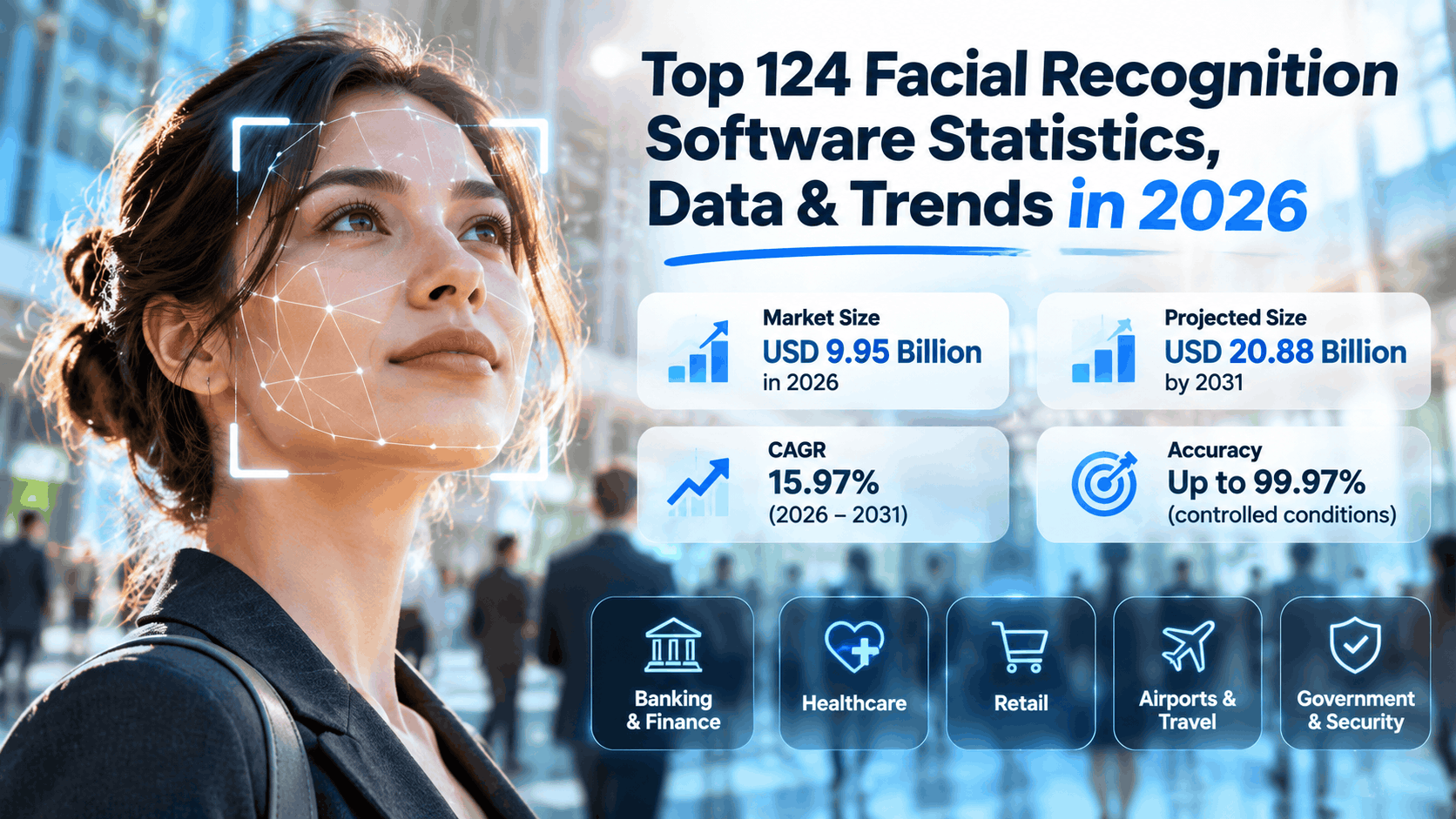
- Rapid Facial Recognition Market Growth: The global facial recognition market is valued at USD 9.95 billion in 2026 and is projected to reach USD 20.88 billion by 2031, growing at a 15.97% CAGR, driven by AI innovation, biometric security demand, and digital identity adoption.
- AI Accuracy and Industry Adoption: Advanced facial recognition algorithms achieve up to 99.97% accuracy under controlled conditions, accelerating biometric authentication adoption across banking, healthcare, retail, airports, and government security systems.
- Privacy Regulations and Emerging Trends: Facial recognition software trends in 2026 highlight growing investments in edge computing, 3D facial recognition, and AI-powered surveillance, alongside increasing concerns about biometric data privacy, algorithmic bias, cybersecurity, and regulatory compliance.
Facial recognition software is transforming digital identity verification, security, and biometric authentication in 2026. The global market is valued at USD 9.95 billion and is projected to reach USD 20.88 billion by 2031, growing at a 15.97% CAGR. Key trends include AI-powered accuracy improvements, expanding industry adoption, and stricter biometric privacy regulations.
Facial recognition software is transforming how businesses, governments, and consumers approach identity verification, security, access control, and digital authentication. As artificial intelligence (AI), machine learning, and biometric technologies continue to advance, facial recognition systems are becoming increasingly accurate, scalable, and accessible across industries. From airport security and banking authentication to retail surveillance and smartphone unlocking, facial recognition technology is reshaping the global digital identity landscape in 2026.
Also, read our article on the Top 10 Facial Recognition Software To Know.

The global facial recognition market is experiencing significant growth, driven by increasing cybersecurity threats, rising demand for contactless authentication, and expanding investments in AI-powered security solutions. According to Mordor Intelligence, the global facial recognition market is valued at approximately USD 9.95 billion in 2026 and is projected to reach USD 20.88 billion by 2031, representing a compound annual growth rate (CAGR) of 15.97%. Meanwhile, MarketsandMarkets estimates the market will grow from USD 10.02 billion in 2026 to USD 20.68 billion by 2031, highlighting strong industry momentum despite differences in market research methodologies.
Regional adoption patterns also reveal important developments in the facial recognition software industry. North America is estimated to account for approximately 43.1% of global market revenue in 2026, supported by enterprise adoption, government security initiatives, and technological innovation. Asia-Pacific is emerging as a major growth opportunity, with some forecasts projecting regional expansion exceeding 18% annually. Meanwhile, governments and businesses across Europe and the Middle East are investing in biometric identification systems while navigating increasingly complex privacy and regulatory requirements.

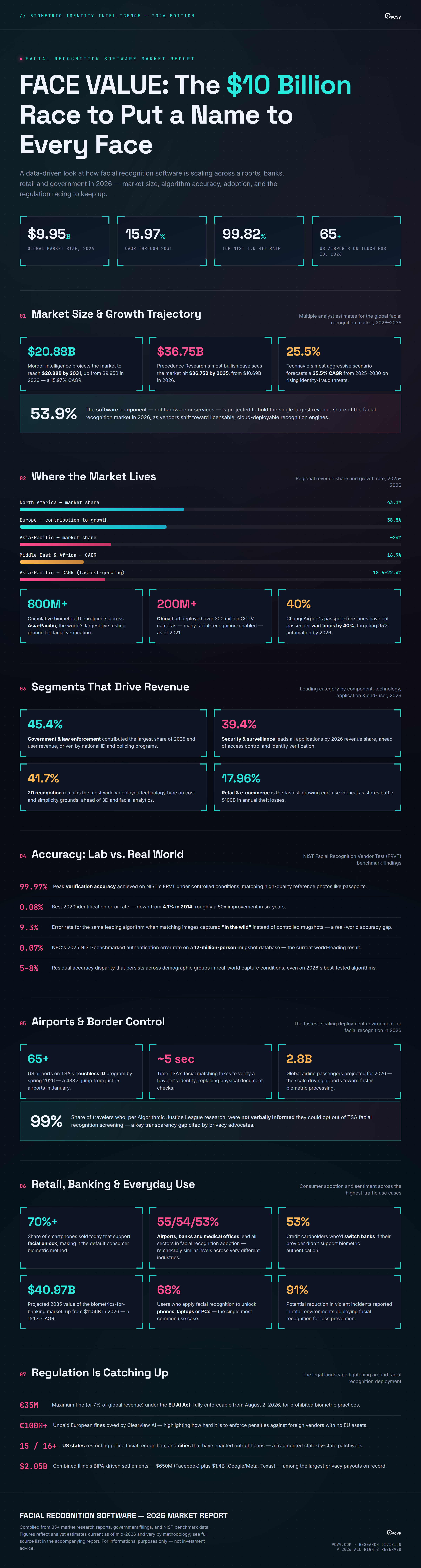
Technological improvements are another major driver of facial recognition software adoption. Advanced facial recognition algorithms have demonstrated accuracy levels reaching 99.97% under controlled testing conditions, while leading vendors continue improving identification speed, spoof resistance, and real-world performance. However, challenges involving demographic bias, inconsistent accuracy in uncontrolled environments, biometric data protection, and algorithmic transparency remain critical considerations for organizations deploying these technologies.
Industry applications are also expanding rapidly. Facial recognition software is increasingly integrated into banking and financial services, healthcare, retail, hospitality, transportation, and government operations. The banking biometrics market alone is projected to reach USD 11.56 billion in 2026, while the broader biometric payments market is expected to grow to USD 44.69 billion by 2034. These developments demonstrate how biometric authentication is evolving beyond traditional security applications into mainstream digital commerce and customer experiences.
Despite its commercial potential, facial recognition technology continues to generate debate surrounding privacy, surveillance, consent, and responsible AI governance. Regulatory frameworks such as the European Union’s AI Act and biometric privacy legislation in the United States are influencing how organizations collect, process, store, and use facial recognition data. Consequently, businesses must balance operational efficiency and security improvements with legal compliance, ethical considerations, and consumer trust.
This comprehensive guide to the Top 124 Facial Recognition Software Statistics, Data & Trends in 2026 explores the latest industry research, market forecasts, regional growth patterns, facial recognition accuracy benchmarks, consumer adoption statistics, emerging applications, and regulatory developments. By examining these statistics and trends, business leaders, technology providers, cybersecurity professionals, investors, and policymakers can gain valuable insights into the current state of the facial recognition software market and the opportunities and challenges shaping its future.
Before we venture further into this article, we would like to share who we are and what we do.
About 9cv9
9cv9 is a business tech startup based in Singapore and Asia, with a strong presence all over the world.
With over ten years of startup and business experience, and being highly involved in connecting with thousands of companies and startups, the 9cv9 team has listed some of the top and best companies/tools in this review.
If you like to get your company listed in our top B2B software reviews, check out our world-class 9cv9 Media and PR service and pricing plans here.
Top 124 Facial Recognition Software Statistics, Data & Trends in 2026
Market Size & Growth
1. Global Facial Recognition Market Reaches USD 9.95 Billion in 2026
The global facial recognition market is valued at approximately USD 9.95 billion in 2026 and is projected to reach USD 20.88 billion by 2031. This expansion reflects growing investment in biometric identity verification, AI-powered security, and facial recognition technology across government and commercial sectors.
2. Facial Recognition Market Expected to Grow at 15.97% CAGR
The global facial recognition industry is forecast to register a compound annual growth rate (CAGR) of 15.97% between 2026 and 2031. Rising cybersecurity threats, digital identity initiatives, and demand for contactless authentication are supporting this sustained growth.
3. Alternative Market Forecast Projects USD 20.68 Billion by 2031
MarketsandMarkets estimates the facial recognition market at USD 10.02 billion in 2026, with revenue projected to reach USD 20.68 billion by 2031. The forecast represents a 15.6% CAGR, reinforcing expectations of strong industry expansion.
4. Facial Recognition Market Could Add USD 20.37 Billion by 2030
Technavio forecasts approximately USD 20.37 billion in additional facial recognition market value between 2026 and 2030. Increasing concerns about identity theft, fraud prevention, and biometric security are among the major factors supporting market demand.
5. Some Facial Recognition Forecasts Predict 25.5% Annual Growth
Certain industry forecasts project facial recognition market growth of approximately 25.5% annually through 2030. This more aggressive outlook reflects expectations of accelerating enterprise adoption and growing demand for AI-based identity verification.
6. Facial Recognition Market Could Reach USD 25.03 Billion by 2033
Coherent Market Insights estimates the global facial recognition market at USD 8.20 billion in 2026 and projects growth to USD 25.03 billion by 2033, representing a 17.2% CAGR. Differences between forecasts reflect variations in market definitions and research methodologies.
7. Face Recognition Software Segment Expected to Reach USD 3.8 Billion by 2035
The global face recognition software market, excluding certain hardware and service components, is estimated at USD 1.28 billion in 2026. Revenue is projected to reach USD 3.8 billion by 2035, reflecting a forecast CAGR of approximately 12.9%.
8. Facial Recognition Market Forecast to Reach USD 36.75 Billion by 2035
Precedence Research projects that the global facial recognition market will expand from USD 10.69 billion in 2026 to approximately USD 36.75 billion by 2035. This forecast indicates substantial long-term opportunities for biometric technology providers.
9. Facial Recognition Software Market Could Reach USD 12.4 Billion by 2033
A separate facial recognition software market analysis values the industry at USD 5.4 billion in 2024 and forecasts growth to USD 12.4 billion by 2033. The projected 9.5% CAGR reflects continued demand for facial identification and authentication solutions.
10. Facial Recognition Surveillance Market Projected at USD 9.6 Billion
The global market for facial recognition technology used in surveillance systems was projected to reach USD 9.6 billion by 2025. This estimate highlights the commercial importance of public safety, monitoring infrastructure, and automated identity detection.
11. Statista Forecasts USD 8.44 Billion Facial Recognition Market by 2030
Statista estimates the worldwide facial recognition market at USD 5.51 billion in 2025, with revenue projected to reach USD 8.44 billion by 2030. Its forecast CAGR of 8.90% is more conservative than several other industry estimates.
12. United States Facial Recognition Market Estimated at USD 1.47 Billion
The United States was projected to generate approximately USD 1.469 billion in facial recognition market revenue in 2025. This positions the country as one of the largest national markets for biometric identification technology.
13. Global Facial Recognition Technology Revenue Estimated at USD 9 Billion in 2026
Industry estimates indicate that facial recognition technology revenue increased from approximately USD 5 billion in 2022 to a projected USD 9 billion in 2026. This represents an estimated annual growth trajectory of around 14%.
14. Facial Recognition Revenue Could Reach USD 19 Billion by 2032
Long-term industry projections suggest facial recognition technology revenue could reach USD 14 billion by 2030, USD 17 billion by 2031, and USD 19 billion by 2032. These estimates demonstrate expectations of continued biometric technology adoption.
15. Edge-Based Facial Recognition Hardware Forecast to Grow at 18.76% CAGR
Edge hardware used for facial recognition is projected to grow at a CAGR of 18.76%. Increasing demand for faster processing, reduced latency, and local biometric data handling is encouraging organizations to deploy facial recognition directly on devices.
Regional Market Breakdown
16. North America Accounts for 43.1% of Facial Recognition Market Revenue
North America is estimated to represent approximately 43.1% of the global facial recognition market in 2026. The region benefits from substantial cybersecurity investments, enterprise technology adoption, and government biometric identification initiatives.
17. North America Held 38% of Global Facial Recognition Revenue in 2025
A separate market analysis estimates that North America accounted for approximately 38% of worldwide facial recognition revenue in 2025. This confirms the region’s significant position in biometric security and digital identity technology.
18. Asia-Pacific Facial Recognition Market Forecast to Grow at 18.6% CAGR
Asia-Pacific is projected to experience facial recognition market growth of approximately 18.6% annually during the forecast period. Smart-city development, public safety investments, and expanding digital identity programs are supporting regional demand.
19. Europe Could Contribute 38.53% of Global Facial Recognition Market Growth
Technavio estimates that Europe will account for approximately 38.53% of worldwide facial recognition market growth during its forecast period. Regional demand is influenced by biometric security investments and evolving privacy regulations.
20. North America Expected to Contribute 35.26% of Market Growth Opportunities
North America is projected to contribute approximately 35.26% of global facial recognition market growth opportunities in Technavio’s analysis. National security, border management, and identity verification remain important regional applications.
21. Middle East Facial Recognition Market Forecast to Grow at 16.88% CAGR
The Middle East is projected to achieve a 16.88% CAGR in facial recognition technology adoption. Government-supported digital identity programs, smart infrastructure, and automated travel systems are among the principal growth drivers.
22. Asia-Pacific Biometric Identity Enrollment Exceeds 800 Million People
Regional biometric identity initiatives are estimated to have enrolled more than 800 million people across Asia-Pacific. Large-scale government identity programs and planned national deployments are creating substantial opportunities for facial verification technologies.
23. Singapore Changi Airport Reports 40% Reduction in Passenger Waiting Times
Biometric passport-free processing at Singapore Changi Airport has reportedly reduced passenger waiting times by approximately 40%. Airport authorities have also targeted 95% automated processing adoption by 2026.
24. United Kingdom Facial Recognition Market Estimated at USD 290 Million
The United Kingdom’s facial recognition market is estimated to reach approximately USD 290 million in 2026. Demand spans security, access control, government identification, and enterprise authentication applications.
25. Germany Facial Recognition Market Expected to Reach USD 330 Million
Germany’s facial recognition market is estimated at approximately USD 330 million in 2026. Growing enterprise security requirements and biometric identity applications are supporting market development.
26. France Facial Recognition Market Valued at USD 420 Million
France’s facial recognition market was estimated at approximately USD 420 million in 2025. This places France ahead of the cited United Kingdom and Germany estimates, although the figures refer to different reporting years.
27. Asia-Pacific Facial Recognition Market Valued at USD 2.32 Billion in 2026
The Asia-Pacific facial recognition market is estimated at USD 2.32 billion in 2026. One industry forecast projects a regional CAGR of 22.40%, reflecting significant investment in biometric identification and AI-powered security.
28. China’s Facial Recognition Market Estimated at USD 670 Million
China’s facial recognition market was estimated at approximately USD 670 million in 2025. Government security initiatives, surveillance infrastructure, and commercial biometric authentication contribute to domestic demand.
29. China Has Deployed More Than 200 Million Surveillance Cameras
A 2021 estimate indicated that China had installed more than 200 million CCTV cameras nationwide, including systems with facial recognition capabilities. This extensive infrastructure illustrates the scale of the country’s surveillance technology deployments.
30. India’s Facial Recognition Market Estimated at USD 260 Million
India’s facial recognition market was valued at approximately USD 260 million in 2025. Public-sector identification initiatives and growing demand for digital authentication are important contributors to market development.
31. Japan Facial Recognition Market Valued at USD 380 Million
Japan’s facial recognition market was estimated at approximately USD 380 million in 2025. Enterprise security, transportation, retail, and government identity verification are among the applications supporting adoption.
32. Middle East and Africa Facial Recognition Market Reaches USD 990 Million
The Middle East and Africa facial recognition market is estimated at USD 990 million in 2026. Saudi Arabia and the United Arab Emirates are among the major regional adopters of biometric identification and AI-powered security systems.
33. Russia Has Installed More Than 500,000 Facial Recognition Cameras
Russia has reportedly deployed more than 500,000 facial recognition-enabled cameras nationwide, including over 200,000 in Moscow. These installations reflect the country’s extensive use of biometric surveillance infrastructure.
34. Moscow Surveillance Cameras Covered 90% of Residential Areas in 2018
Historical estimates indicate that surveillance camera networks covered approximately 75% of Moscow’s public spaces and 90% of residential areas in 2018. These figures describe camera coverage rather than the proportion of cameras equipped with facial recognition.
35. Europe Expected to Generate Approximately 38.5% of Facial Recognition Market Growth
Some industry forecasts estimate that Europe will contribute around 38.5% of global facial recognition market growth. Regional expansion is occurring alongside increasingly stringent requirements for biometric data protection and responsible AI deployment.
Market Segments: Component, Technology, Application, and Deployment
36. Facial Recognition Software Accounts for 53.9% of Market Revenue
The software segment is projected to represent approximately 53.9% of global facial recognition market revenue in 2026. Demand for biometric algorithms, facial matching platforms, and AI-based identity management systems supports this market share.
37. 2D Facial Recognition Holds 41.7% Market Share
Two-dimensional facial recognition technology is expected to account for approximately 41.7% of the market in 2026. Its relatively low hardware requirements and compatibility with conventional cameras make it attractive for commercial applications.
38. Security and Surveillance Represents 39.4% of Facial Recognition Applications
Security and surveillance is projected to account for approximately 39.4% of facial recognition market revenue by application in 2026. Government monitoring, public safety, and enterprise security requirements contribute to this segment’s demand.
39. North America Leads Facial Recognition Technology with 43.1% Market Share
North America is estimated to hold approximately 43.1% of the global facial recognition market in 2026. Advanced technology infrastructure, cybersecurity investment, and established biometric technology providers support regional leadership.
40. 3D Facial Recognition Accounted for 37.8% of Market Revenue in 2022
Three-dimensional facial recognition represented approximately 37.8% of global market revenue in 2022. The technology is particularly relevant for security applications requiring facial depth analysis and additional protection against certain spoofing techniques.
41. 3D Facial Recognition Captured More Than 39% Market Share in 2025
A separate industry estimate indicates that 3D facial recognition accounted for more than 39% of market revenue in 2025. Demand is supported by high-security identification applications and advancements in depth-sensing technology.
42. Facial Recognition Access Control Holds Approximately 36%–37% Market Share
Access control accounted for approximately 36% of facial recognition market revenue in 2022, while another estimate places its share at 37% in 2025. Common applications include office entry, airport access, and secure facility authentication.
43. Facial Analytics Market Forecast to Grow at 20.5% CAGR
The facial analytics segment is projected to expand at a CAGR of approximately 20.5%. Facial analytics applications include facial attribute analysis and certain behavioral or demographic assessments, although their use raises accuracy and privacy concerns.
44. Retail and E-Commerce Accounted for 21.4% of Facial Recognition Revenue
Retail and e-commerce represented approximately 21.4% of facial recognition market revenue by end-use industry in 2022. Businesses have explored facial recognition for loss prevention, security monitoring, and customer identification.
45. Retail and E-Commerce Remained a Leading Facial Recognition Segment in 2025
A separate industry report identifies retail and e-commerce as the largest facial recognition end-use segment in 2025. Applications include store security, automated identity verification, and certain customer experience technologies.
46. Government and Law Enforcement Accounted for 45.40% of Revenue in 2025
Government and law enforcement contributed an estimated 45.40% of global facial recognition market revenue in 2025. National identity systems, border management, and policing technologies are major applications within this category.
47. Retail Facial Recognition Market Forecast to Grow at 17.96% CAGR
Retail and e-commerce facial recognition applications are projected to grow at a CAGR of approximately 17.96%. Loss prevention and security monitoring are important drivers, particularly as retailers seek to address substantial inventory losses.
48. Banking and Financial Services Hold 23.55% Facial Recognition Market Share
The banking, financial services, and insurance sector is estimated to account for 23.55% of the facial recognition market in 2026. Fraud prevention, customer identity verification, and regulatory compliance support adoption.
49. Healthcare Facial Recognition Market Forecast to Grow at 19.90% CAGR
Facial recognition applications in healthcare are projected to grow at approximately 19.90% annually. Potential applications include patient identification, contactless registration, facility access control, and administrative automation.
50. Facial Identification Segment Valued at USD 5.83 Billion in 2024
The facial identification segment was valued at approximately USD 5.83 billion in 2024. Identification systems compare facial images against databases of enrolled individuals, making them relevant for security and identity management applications.
51. Cloud-Based Facial Recognition Accounts for 47% of Deployments
Cloud-based facial recognition solutions are estimated to represent approximately 47% of deployments. Organizations adopt cloud infrastructure to support scalability, centralized management, and integration with existing digital services.
52. On-Premises Systems Hold 60% of Banking Biometrics Market
On-premises deployment accounted for approximately 60% of the banking biometrics market in 2025. Financial institutions frequently prioritize infrastructure control, data sovereignty, and security requirements when selecting biometric systems.
53. Cloud Banking Biometrics Market Forecast to Grow at 13.7% CAGR
Cloud-based deployment within the banking biometrics market is projected to grow at approximately 13.7% annually. Financial institutions are increasingly evaluating cloud authentication platforms as part of broader digital modernization initiatives.
Accuracy, Algorithm Performance, and Bias
54. Facial Recognition Algorithms Achieve Up to 99.97% Accuracy
Leading facial recognition verification algorithms have demonstrated accuracy approaching 99.97% in controlled benchmark environments. Actual performance depends on image quality, algorithm selection, matching thresholds, and deployment conditions.
55. Facial Recognition Error Rates Can Increase to 9.3% in Uncontrolled Conditions
One benchmark example found that an algorithm’s error rate increased from approximately 0.1% on high-quality mugshots to 9.3% when analyzing uncontrolled images. Lighting, facial angles, and obstructions can significantly affect recognition performance.
56. Facial Recognition Failure-to-Identify Rate Averaged 4.7% in One Evaluation
A cited facial recognition evaluation reported an average failure-to-identify rate of approximately 4.7% when processing images captured in uncontrolled environments without applying a confidence threshold.
57. NEC Facial Recognition Algorithm Achieved 0.07% Authentication Error Rate
NEC reported a 0.07% authentication error rate in an April 2025 NIST facial recognition identification benchmark involving a database of 12 million people. The result demonstrates the performance achieved by leading algorithms under defined testing conditions.
58. Leading Facial Recognition Algorithm Recorded 0.00012 False Non-Match Rate
A cited NIST verification benchmark reported a false non-match rate of 0.00012 for a leading algorithm at a false match rate of 0.000001. These results illustrate how biometric performance is measured at specific security thresholds.
59. Top Facial Recognition Algorithm Achieved 99.82% Identification Rate
In a cited NIST identification evaluation involving approximately 1.6 million enrolled faces, a leading algorithm achieved a rank-one identification rate of 99.82%. The result demonstrates high performance in a defined large-database matching scenario.
60. Yitu Facial Recognition Algorithm Reportedly Achieved 99.88% Accuracy
Yitu Technology reportedly achieved 99.88% accuracy in a cited 2022 facial recognition benchmark involving mugshot imagery. The result highlights the competitive performance of leading biometric recognition algorithms.
61. ROC Facial Recognition System Searched 12 Million Records in 1.45 Seconds
ROC reported that its facial recognition technology searched a database containing approximately 12 million records in 1.45 seconds. Search performance is an important consideration for large-scale identification systems.
62. Facial Recognition Error Rates Have Historically Halved Every Two Years
Research summarized from NIST evaluations indicates that facial recognition error rates have generally declined by approximately half every two years over an extended period. Improvements reflect advances in algorithms, training methods, and computing capabilities.
63. Facial Identification Error Rates Have Improved Fivefold
A cited analysis found that facial identification error rates declined by approximately a factor of five during a measured period. One leading system achieved a false-negative rate of 0.05% at a false-positive identification threshold of 0.3%.
64. Leading Facial Recognition Error Rate Fell from 4.1% to 0.08%
Historical NIST evaluations showed that the error rate of a leading facial recognition algorithm declined from approximately 4.1% in 2014 to 0.08% by April 2020. This illustrates the rapid improvement in biometric identification performance.
65. More Than 30 Facial Recognition Algorithms Surpassed Earlier Performance Benchmarks
By 2018, more than 30 facial recognition algorithms had reportedly exceeded the accuracy achieved by the best-performing system in 2014. The finding demonstrates that technological improvements were occurring across multiple developers.
66. Facebook DeepFace Achieved Approximately 97% Accuracy
Facebook’s DeepFace system demonstrated approximately 97% accuracy in determining whether two facial images represented the same individual. The historical benchmark remains an important reference in the development of deep-learning facial recognition.
67. Advanced Facial Recognition Systems Can Exceed 99% Accuracy in Controlled Tests
Some AI-powered facial recognition systems reportedly achieve accuracy above 99% under controlled conditions and above 95% in certain real-world evaluations. Results vary substantially depending on datasets, environmental conditions, and evaluation methods.
68. Facial Recognition Accuracy Disparities Estimated at 5%–8% Across Demographic Groups
One industry analysis suggests that facial recognition performance differences of approximately 5%–8% may remain between demographic groups under uncontrolled capture conditions. These estimates highlight the importance of independent fairness testing.
69. 42% of Surveyed Companies Report Demographic Accuracy Challenges
Approximately 42% of companies in a cited survey reported limitations in facial recognition accuracy across diverse demographic groups. Such challenges can affect deployment confidence and increase the importance of representative testing datasets.
70. 80% of Certain Metropolitan Police Wrongful Flags Reportedly Involved Black Individuals
A cited analysis claims that approximately 80% of wrongful facial recognition flags in a Metropolitan Police context involved Black individuals. The statistic requires careful interpretation because the original material does not specify the evaluation period or sample size.
71. 90% of Certain Facial Recognition-Related Arrests in Brazil Reportedly Involved Black Individuals
A cited Brazilian analysis reports that approximately 90% of facial recognition-related arrests for nonviolent offenses involved Black individuals. The figure raises concerns about unequal enforcement outcomes but does not independently establish an algorithmic error rate.
72. UK Police Reportedly Scanned More Than 7 Million Faces in 2025
A surveillance-focused report estimates that UK police scanned more than seven million faces using facial recognition technology in 2025. The figure highlights the scale of biometric policing and the importance of operational oversight.
73. Essex Police Reportedly Scanned 2.5 Million Faces Using Incorrect Settings
A reported incident involving Essex Police indicated that approximately 2.5 million faces were scanned using inappropriate facial recognition accuracy-threshold settings. The incident illustrates the importance of correct system configuration and independent monitoring.
Airports, Travel, and Border Control
74. 97% of US Airports Were Forecast to Adopt Facial Recognition by 2023
An earlier industry projection estimated that approximately 97% of US airports would integrate facial recognition into security operations by the end of 2023. This was a forecast rather than a verified measurement of actual adoption.
75. TSA Facial Recognition Expansion Targeted 65 Airports in 2026
The TSA PreCheck Touchless ID program was reported to be expanding from approximately 15 airports in January 2026 to 65 airports by spring 2026. The figures represent a substantial planned expansion in biometric passenger verification.
76. More Than 250 US Airport Security Lanes Reportedly Supported Digital Identity Scanning
As of April 2026, more than 250 airport security lanes across the United States were reported to support mobile identity credentials and facial scanning technologies. These systems are designed to simplify identity verification at checkpoints.
77. TSA Facial Recognition Could Expand to More Than 430 Airports
One industry report described a potential TSA facial recognition expansion to more than 430 airports between 2027 and 2029. This figure should be treated as a reported future target rather than a confirmed mandatory deployment schedule.
78. 99% of Travelers Were Reportedly Not Verbally Informed About Facial Recognition Opt-Out Options
Research attributed to the Algorithmic Justice League found that approximately 99% of observed travelers were not verbally informed about the option to decline facial recognition screening. The finding raises questions about transparency and informed participation.
79. 40% of Domestic PreCheck Travelers Were Forecast to Adopt Touchless ID
An industry projection suggested that approximately 40% of eligible domestic TSA PreCheck travelers could opt into Touchless ID during its first year of expanded availability. The figure represents a forecast rather than measured adoption.
80. TSA Facial Recognition Can Reduce Identity Verification to Five Seconds
The TSA has reportedly indicated that Touchless ID facial matching can complete identity verification in approximately five seconds per traveler. Faster authentication may help reduce document handling and checkpoint delays.
81. Biometric Data Breach Reportedly Exposed 190,000 Traveler Images
A reported 2024 subcontractor data breach associated with a biometric travel program exposed approximately 190,000 traveler images. The incident illustrates the cybersecurity risks associated with storing sensitive facial data.
82. Nearly Half of Airports Planned Biometric Identity Systems by 2026
SITA’s 2024 Air Transport IT Insights research indicated that nearly half of surveyed airports planned to implement biometric identity management systems by the end of 2026. These plans reflect increasing interest in automated passenger processing.
83. Global Airline Passenger Volume Was Projected at 2.8 Billion in 2026
One aviation technology report projected global airline passenger volumes of approximately 2.8 billion in 2026. Growing passenger traffic is an important factor behind investments in automated airport security and identity verification.
84. TSA Touchless ID Reportedly Available at More Than 60 Airports in 2026
By mid-2026, TSA PreCheck Touchless ID was reported to be available at more than 60 US airports. The expansion demonstrates growing implementation of biometric authentication within airport security operations.
85. 54.3% of Americans Support Facial Recognition for Airport Security
A cited consumer survey found that approximately 54.3% of Americans supported using facial recognition for airport safety screening. The result suggests majority support for this specific application, although attitudes may differ for other uses.
Retail, Banking, and Consumer Sentiment
86. More Than 70% of Smartphones Reportedly Support Facial Unlocking
Industry estimates suggest that over 70% of smartphones support facial unlocking capabilities. This reflects the widespread integration of biometric authentication into consumer devices and mobile security systems.
87. 68% of Users Report Using Facial Recognition to Unlock Devices
Approximately 68% of users in a cited survey reported using facial recognition to unlock smartphones, laptops, or computers. Device authentication is among the most familiar consumer applications of biometric technology.
88. 51% of Users Report Using Facial Recognition for Mobile Applications
Around 51% of surveyed users reported using facial recognition to access mobile applications, including healthcare platforms and booking services. Biometric login can improve convenience while reducing dependence on passwords.
89. 42% of Users Report Using Facial Recognition for Financial Accounts
Approximately 42% of users in a cited survey reported using facial recognition to access bank accounts or financial services. This reflects growing consumer familiarity with biometric authentication in digital banking.
90. 53% of US Adults Reportedly Support Facial Recognition in Retail Stores
A cited 2026 estimate suggests that approximately 53% of US adults support facial recognition technology in retail environments. Consumer acceptance may depend on whether the technology is used for security, payments, or customer tracking.
91. Consumer Support Falls to 40% for Facial Recognition Advertising
A cited survey reported support levels of approximately 49% for facial recognition-based retail purchases, 42% for emotion analysis, and 40% for personalized advertising. These figures suggest greater hesitation toward commercially intrusive applications.
92. 68% of Adults Oppose Police Facial Recognition Scanning on Public Streets
One survey cited in the source material found that approximately 68% of adults opposed police scanning people using facial recognition on public streets. Another figure indicated 46% support for broader police use, highlighting differences in how questions were framed.
93. 80% of Americans Are Aware of Police Facial Recognition Use
Approximately 80% of Americans in a cited survey reported at least some awareness that law enforcement agencies use facial recognition technology. Public familiarity with biometric surveillance does not necessarily indicate support for its deployment.
94. Facial Recognition Has Been Linked to a 91% Reduction in Certain Retail Violence Incidents
One industry claim suggests that facial recognition deployments may reduce violent incidents in certain retail settings by as much as 91%. The figure should not be interpreted as a universal outcome without details about the study population and implementation.
95. 49% of Consumers Believe Facial Recognition Can Help Prevent Shoplifting
Approximately 49% of surveyed consumers reportedly believe that facial recognition technology can help retailers combat shoplifting. This suggests cautious public confidence in facial recognition as a loss-prevention tool.
96. Nearly 30% of Retail Stores Reportedly Use Facial Recognition for Customer Tracking
Research attributed to CSC suggests that approximately 30% of retail stores use facial recognition to track customers. The cited material also reports a 74% figure related to customer tracking, although the precise survey denominator is unclear.
97. Approximately 25% of Consumers View Facial Recognition as a Positive Shopping Feature
A cited consumer study found that roughly one-quarter of respondents considered facial recognition beneficial to their shopping experience. The result suggests that enthusiasm for biometric retail personalization remains limited.
98. 70% of Spanish Banking Users Are Open to Facial Recognition ATM Withdrawals
Research attributed to CaixaBank indicates that approximately 70% of surveyed banking users in Spain were willing to use facial recognition instead of PIN codes for ATM withdrawals.
99. 42% of Latin American Banking Customers Want Facial Recognition Features
Approximately 42% of banking customers surveyed in Latin America expressed interest in facial recognition functionality within future banking applications. The result suggests meaningful demand for biometric financial services.
100. 53% of Credit Cardholders Would Consider Switching Banks for Biometric Authentication
A cited survey found that approximately 53% of credit cardholders would consider changing banks if their provider did not offer biometric authentication. The figure refers to biometrics broadly, rather than facial recognition alone.
101. Facial Recognition Adoption Estimates Reach 55% in Airports and 54% in Banking
One industry analysis cites facial recognition adoption figures of approximately 55% for airports, 54% for banks, and 53% for medical offices. These figures suggest substantial interest across several industries, although the underlying sample definitions are not specified.
102. 74% of Hotel Operators Expect Biometrics to Become Mainstream for Staff Identification
A hospitality industry survey reported that approximately 74% of hotel operators expected biometrics to become a mainstream staff identification method by 2025. Separately, 62% of surveyed customers believed facial recognition could improve guest experiences.
103. 41% of Hotel Guests Prefer Properties Offering Automated Facial Recognition
Approximately 41% of surveyed hotel guests indicated they would be more likely to select hotels offering automated facial recognition services. Potential benefits include faster check-in and more convenient identity verification.
104. Facial Recognition Payments Are Integrated into Major Chinese Digital Wallets
Facial recognition authentication is used within Chinese digital payment ecosystems, including services associated with Alipay and WeChat Pay. These applications demonstrate how biometric verification has expanded into everyday financial transactions.
Financial Services and Biometric Payments
105. Banking Biometrics Market Valued at USD 11.56 Billion in 2026
The global biometrics market for banking and financial services is estimated at USD 11.56 billion in 2026 and projected to reach USD 40.97 billion by 2035. The forecast represents a 15.10% CAGR and includes facial recognition alongside other biometric methods.
106. Banking Facial Recognition Segment Forecast to Grow at 13.2% CAGR
Facial recognition within the banking biometrics market is projected to grow at approximately 13.2% annually between 2026 and 2035. Demand for secure customer authentication and digital financial services supports this outlook.
107. Fingerprint Recognition Held 35% of Banking Biometrics Market in 2025
Fingerprint recognition accounted for approximately 35% of the banking biometrics market in 2025. Although facial recognition is growing, fingerprint authentication remains an established biometric technology within financial services.
108. North America Accounts for 40% of Banking Biometrics Market
North America represented approximately 40% of the global banking and financial services biometrics market in 2025. Cybersecurity investment, digital banking modernization, and identity verification requirements support regional demand.
109. Global Biometric Payments Market Forecast to Reach USD 44.69 Billion by 2034
The worldwide biometric payments market is estimated at USD 13.48 billion in 2026 and projected to reach USD 44.69 billion by 2034. The forecast CAGR is 16.20%, covering facial recognition, fingerprint, iris, and other biometric payment technologies.
110. European Biometric Payments Market Expected to Reach USD 3.88 Billion
Europe’s biometric payments market is projected to reach approximately USD 3.88 billion in 2026. The region accounted for around 28.70% of global biometric payment revenue in 2025.
111. Asia-Pacific Biometric Payments Market Forecast at USD 3.4 Billion
Asia-Pacific’s biometric payments market is projected to reach USD 3.4 billion in 2026. The region accounted for approximately 25.20% of global revenue in 2025, supported by expanding digital payment ecosystems.
112. North America Holds 36.20% of Global Biometric Payments Revenue
North America accounted for approximately 36.20% of worldwide biometric payment market revenue in 2025. The region’s position reflects widespread digital financial services adoption and investment in authentication technologies.
Regulation, Privacy, and Legal Landscape
113. EU AI Act Introduces Major Restrictions on Facial Recognition Technology
The European Union’s AI Act establishes restrictions and compliance requirements for certain biometric identification and facial recognition applications. The original source associates major high-risk system requirements with August 2, 2026, although implementation timelines vary by provision.
114. EU AI Act Prohibited-Practice Violations Can Trigger Fines of EUR 35 Million
The EU AI Act provides for significant financial penalties for violations involving prohibited AI practices. The maximum penalty can reach EUR 35 million or an applicable percentage of worldwide annual turnover, depending on the circumstances.
115. EU AI Act Penalties Can Reach 7% of Global Annual Turnover
Certain prohibited AI practice violations under the EU AI Act can result in penalties of up to 7% of worldwide annual turnover, subject to the Act’s applicable penalty rules. This creates substantial compliance exposure for organizations deploying restricted biometric systems.
116. Clearview AI Reportedly Faces More Than EUR 100 Million in European Fines
A surveillance-focused report claims that Clearview AI faces more than EUR 100 million in unpaid European regulatory penalties. The figure highlights enforcement challenges involving cross-border biometric data processing and facial recognition providers.
117. At Least 15 US States Have Restrictions on Police Facial Recognition
A cited regulatory overview reports that 15 US states have introduced restrictions affecting law enforcement facial recognition use, while at least 16 cities have adopted bans. The legal landscape remains fragmented across jurisdictions.
118. Biometric Privacy Disputes Have Produced Settlements Worth Hundreds of Millions
Biometric privacy litigation has resulted in substantial settlements, including Facebook’s USD 650 million Illinois BIPA settlement. The source material also cites approximately USD 1.4 billion in combined Google and Meta Texas settlements, which arose under a separate state legal framework.
119. Several US States Prohibit Arrests Based Solely on Facial Recognition Matches
Multiple US states have introduced rules restricting law enforcement from relying exclusively on facial recognition matches when making arrests. Such requirements emphasize corroborating evidence and safeguards against wrongful identification.
120. Australian Biometric Privacy Penalties Were Previously Cited at AUD 2.22 Million
One source cites AUD 2.22 million as a maximum Australian privacy penalty associated with facial recognition violations. This appears to reflect an older penalty framework and should not be treated as the current maximum without checking subsequent legislative changes.
121. Facial Recognition Misidentification Creates Growing Litigation Risks
Organizations deploying facial recognition technology face potential legal exposure when inaccurate matches contribute to wrongful arrests, discrimination, or privacy violations. These risks reinforce the importance of algorithmic testing, human oversight, and responsible data governance.
Vendors and Competitive Landscape
122. Ayonix Reportedly Holds 15% of Facial Recognition Vendor Market Share
One industry estimate identifies Ayonix Corporation as holding approximately 15% of the facial recognition technology vendor market, followed by IBM at 11% and Aware at 10%. These figures reflect the cited report’s market definitions and methodology.
123. Major Technology Companies Have Invested More Than USD 10 Billion in Biometric AI
An industry report estimates that Apple, Samsung, and Google collectively invested more than USD 10 billion in AI-driven biometric technologies over a five-year period. The figure reflects broader biometric AI investment rather than facial recognition software spending alone.
124. Global Facial Recognition Market Includes Major Established and Specialist Vendors
Leading companies identified across facial recognition industry reports include NEC, Thales, Cognitec Systems, IDEMIA, Fujitsu, Aware, FacePhi, Ayonix, Corsight AI, and TECH5. These vendors provide biometric identification, authentication, security, and identity management technologies across commercial and government markets.
Conclusion
The Top 124 Facial Recognition Software Statistics, Data & Trends in 2026 highlight an industry experiencing rapid technological advancement, expanding commercial adoption, and increasing regulatory scrutiny. As artificial intelligence, machine learning, and biometric authentication technologies continue to evolve, facial recognition software is becoming an increasingly important component of modern security infrastructure, digital identity management, and customer authentication systems.
The global facial recognition software market demonstrates substantial long-term growth potential. With Mordor Intelligence estimating a market value of USD 9.95 billion in 2026 and forecasting expansion to USD 20.88 billion by 2031, the industry is positioned for sustained double-digit growth. North America continues to lead in market share, while Asia-Pacific and the Middle East present significant growth opportunities driven by smart-city initiatives, digital transformation, and government-backed biometric identification programs.
One of the most important facial recognition technology trends in 2026 is the continuous improvement in algorithmic accuracy and processing efficiency. Leading facial recognition systems have achieved accuracy rates approaching 99.97% under controlled testing conditions, while advancements in 3D facial mapping, edge computing, and AI-powered facial analytics are expanding the technology’s capabilities. Nevertheless, differences between laboratory performance and real-world accuracy emphasize the importance of rigorous testing, demographic fairness, and responsible deployment.
Industry adoption is also becoming increasingly diversified. Banking and financial services are integrating facial recognition into fraud prevention, digital onboarding, and biometric payments, while airports are adopting automated identity verification to improve passenger processing. Healthcare providers, retailers, hospitality businesses, and government agencies are exploring facial recognition solutions to strengthen security, streamline operations, and enhance customer experiences. The projected expansion of the global biometric payments market to USD 44.69 billion by 2034 further illustrates the growing commercial significance of biometric technologies, although this broader market includes authentication methods beyond facial recognition.
However, privacy, cybersecurity, algorithmic bias, and regulatory compliance remain among the biggest challenges facing facial recognition software adoption. Increasing scrutiny of biometric surveillance, data collection practices, and automated identification systems is encouraging organizations to prioritize transparency, consent management, data protection, and ethical AI governance. Businesses adopting facial recognition technology must evaluate not only technical performance and operational benefits but also the legal and reputational risks associated with processing sensitive biometric information.
Looking ahead, the future of facial recognition software will likely be shaped by several interconnected developments: more sophisticated AI algorithms, privacy-preserving biometric authentication, increased edge-based processing, stronger anti-spoofing capabilities, and tighter integration with enterprise security and digital identity platforms. Organizations that successfully combine technological innovation with responsible data governance will be better positioned to capitalize on emerging market opportunities.
Ultimately, these 124 facial recognition software statistics, data points, and trends for 2026 demonstrate that facial recognition is evolving from a specialized security technology into a broader digital identity and authentication solution. For business leaders, technology vendors, investors, cybersecurity professionals, and policymakers, understanding these developments is essential for making informed investment decisions, evaluating biometric security solutions, and preparing for the next generation of AI-powered identity verification.
As the facial recognition industry continues to mature, the organizations most likely to succeed will be those that balance accuracy, security, operational efficiency, privacy protection, and public trust. These factors will play a defining role in determining how facial recognition technology develops and how widely it is adopted throughout 2026 and beyond.
If you find this article useful, why not share it with your hiring manager and C-level suite friends and also leave a nice comment below?
We, at the 9cv9 Research Team, strive to bring the latest and most meaningful data, guides, and statistics to your doorstep.
To get access to top-quality guides, click over to 9cv9 Blog.
To hire top talents using our modern AI-powered recruitment agency, find out more at 9cv9 Modern AI-Powered Recruitment Agency.
People Also Ask
What is the global facial recognition software market size in 2026?
The global facial recognition market is estimated at USD 9.95 billion in 2026, according to Mordor Intelligence. The market is projected to reach USD 20.88 billion by 2031, driven by AI advancements, biometric security demand, and digital identity verification.
What is the expected growth rate of the facial recognition market?
The global facial recognition market is forecast to grow at a compound annual growth rate (CAGR) of 15.97% between 2026 and 2031, supported by increasing adoption across banking, healthcare, retail, transportation, and government security.
How big will the facial recognition market be by 2031?
According to Mordor Intelligence, the global facial recognition market is projected to reach USD 20.88 billion by 2031. MarketsandMarkets offers a similar forecast of USD 20.68 billion, reflecting strong demand for AI-powered biometric authentication.
Which region dominates the facial recognition software market in 2026?
North America leads the global facial recognition market, accounting for an estimated 43.1% of revenue in 2026, according to Coherent Market Insights. Growth is supported by cybersecurity investments, enterprise adoption, and government identity verification programs.
Which region has the fastest-growing facial recognition market?
Growth estimates vary by research provider. Precedence Research forecasts an 18.6% CAGR for Asia-Pacific, while Mordor Intelligence identifies the Middle East as a fast-growing region with a projected 16.88% CAGR.
What are the biggest facial recognition software trends in 2026?
Major trends include AI-powered facial recognition, 3D facial mapping, edge computing, cloud-based biometric authentication, contactless identity verification, stronger anti-spoofing technologies, and increasing regulatory scrutiny of biometric data.
How accurate is facial recognition software in 2026?
Advanced facial recognition algorithms can achieve accuracy rates approaching 99.97% under controlled testing conditions. However, real-world performance varies depending on image quality, lighting, camera angles, demographic characteristics, and matching thresholds.
What factors affect facial recognition accuracy?
Facial recognition accuracy depends on lighting, image resolution, facial angles, obstructions, camera quality, algorithm performance, demographic diversity, and environmental conditions. Uncontrolled environments generally produce higher error rates than laboratory testing.
What is the difference between 2D and 3D facial recognition?
2D facial recognition analyzes facial features from standard images, while 3D facial recognition uses facial depth and geometry. 3D systems can provide stronger resistance to certain spoofing attacks but typically require more specialized hardware.
What percentage of the facial recognition market is software?
According to Coherent Market Insights, the software segment is expected to account for approximately 53.9% of the global facial recognition market in 2026, reflecting demand for AI algorithms, identity verification platforms, and biometric security applications.
Which industries use facial recognition software the most?
Major facial recognition applications include government security, banking, retail, airports, healthcare, and hospitality. Mordor Intelligence estimates that government and law enforcement accounted for 45.40% of market revenue in 2025.
How is facial recognition software used in banking?
Banks use facial recognition for digital onboarding, identity verification, account authentication, fraud prevention, and biometric payments. The technology helps reduce dependence on passwords and supports faster, more convenient customer authentication.
What is the biometric banking market size in 2026?
The global biometrics market for banking and financial services is valued at approximately USD 11.56 billion in 2026 and is projected to reach USD 40.97 billion by 2035, according to Precedence Research.
How is facial recognition technology used in airports?
Airports use facial recognition for passenger identity verification, security screening, boarding, and border control. Biometric systems can reduce document checks, streamline passenger processing, and improve operational efficiency.
How widespread is facial recognition at US airports?
The TSA PreCheck Touchless ID program was reported to be available at more than 60 US airports by mid-2026. Its expansion reflects increasing adoption of biometric identity verification in aviation security.
How does facial recognition improve airport security?
Facial recognition compares travelers’ facial images with verified identity records to support faster authentication. It can improve checkpoint efficiency and help detect identity mismatches, although human oversight and alternative verification methods remain important.
What percentage of smartphones support facial recognition?
Industry estimates cited in the source material suggest that more than 70% of smartphones support facial unlocking. Adoption is driven by demand for convenient device security, biometric authentication, and password-free access.
How many consumers use facial recognition to unlock devices?
Approximately 68% of surveyed users report using facial recognition to unlock smartphones, laptops, or computers. Device authentication remains one of the most common consumer applications of facial recognition technology.
How is facial recognition software used in retail?
Retailers use facial recognition for security monitoring, loss prevention, customer identification, and access control. Some businesses also explore personalized shopping experiences, although privacy and consent requirements can limit deployment.
What percentage of consumers support facial recognition in retail?
The source material cites an estimate that approximately 53% of US adults support facial recognition in retail stores. Acceptance varies by application, with lower support for emotion analysis and personalized advertising.
How is facial recognition technology transforming healthcare?
Healthcare organizations use facial recognition for patient identification, contactless check-ins, access control, and administrative efficiency. Fortune Business Insights projects a 19.90% CAGR for the healthcare facial recognition segment.
What are the benefits of facial recognition software for businesses?
Facial recognition software can improve identity verification, strengthen access security, reduce manual authentication, and streamline customer experiences. Benefits depend on system accuracy, deployment costs, regulatory compliance, and appropriate data protection.
What are the biggest challenges facing facial recognition software?
Major challenges include biometric data privacy, algorithmic bias, false matches, cybersecurity vulnerabilities, regulatory compliance, implementation costs, and public concerns about surveillance and consent.
Does facial recognition software have demographic bias?
Yes. Facial recognition algorithms can exhibit different error rates across demographic groups. Performance disparities depend on the algorithm, training data, image conditions, and application, making independent testing and fairness evaluations essential.
What is the difference between facial identification and facial verification?
Facial verification compares a person’s face against a claimed identity, typically using one-to-one matching. Facial identification searches a database of multiple identities to determine potential matches, making it more complex and sensitive to false positives.
What are the privacy risks of facial recognition technology?
Privacy risks include unauthorized biometric data collection, surveillance, identity tracking, data breaches, and misuse of facial information. Organizations must implement appropriate safeguards, transparency measures, retention policies, and legal compliance procedures.
How does the EU AI Act affect facial recognition software?
The EU AI Act restricts certain biometric identification practices and imposes requirements on high-risk AI systems. Organizations using facial recognition in regulated applications must assess applicable restrictions, transparency obligations, and compliance deadlines.
Who are the leading facial recognition software companies in 2026?
Major facial recognition technology providers identified in industry reports include NEC, Thales, IDEMIA, Fujitsu, Cognitec Systems, Aware, FacePhi, Ayonix, Corsight AI, and TECH5. Their solutions serve security, government, banking, and enterprise markets.
What is the future of AI-powered facial recognition software?
The future of facial recognition software includes improved AI accuracy, faster processing, edge-based authentication, advanced liveness detection, privacy-preserving biometrics, and wider integration with digital identity platforms and enterprise security systems.
Is facial recognition software a growing market in 2026?
Yes. Facial recognition is a growing technology market, with Mordor Intelligence forecasting 15.97% annual growth through 2031. Increasing demand for biometric authentication, fraud prevention, contactless security, and digital identity solutions supports its expansion.
Sources
Mordor Intelligence
MarketsandMarkets
Technavio
Coherent Market Insights
Global Growth Insights
Fortune Business Insights
Grand View Research
The Business Research Company
Precedence Research
Verified Market Reports
Market.us
Scoop Market
Gitnux
Federation of American Scientists
NEC Corporation
ROC
Center for Strategic and International Studies
Statista Market Insights
Binariks
Bayelsa Watch
TravelTourister
Nomad Lawyer
VisaHQ
Aviation Week
International Airport Review
WebProNews
AFAR
TheStreet
Artificial Intelligence Act
European Commission AI Act Service Desk
State of Surveillance
Privacy International
European Commission
Holistic AI
Future of Privacy Forum
Travel and Tour World


