

Key Takeaways
- Event Rental Software Market Growth: The global event management software market is projected to reach $11.31 billion in 2026 and $32.62 billion by 2034, driven by increasing demand for digital booking, inventory management, and rental automation solutions.
- Cloud-Based Event Rental Software Adoption: Cloud deployment accounted for over 63% of the event management software market in 2024, while leading platforms such as Booqable, Rentman, and Goodshuffle Pro continue to attract strong customer ratings.
- AI and Automation Transforming Event Rentals: With 90% of surveyed software buyers more likely to choose AI-enabled platforms, artificial intelligence, automated scheduling, inventory optimization, and data-driven decision-making are emerging as important event rental software trends in 2026.
Event rental software is transforming how businesses manage bookings, inventory, equipment, and event logistics in 2026. The global event management software market is projected to reach $11.31 billion in 2026 and $32.62 billion by 2034. Explore 108 key statistics covering market growth, cloud adoption, AI automation, software pricing, and customer satisfaction trends.
The event rental industry is undergoing a significant digital transformation as businesses increasingly adopt technology to streamline bookings, manage inventory, automate operations, and improve customer experiences. From wedding rental companies and party equipment suppliers to audiovisual production firms and large-scale event service providers, event rental software has become an essential tool for improving operational efficiency, reducing administrative costs, and supporting business growth.
Also, read our article on the Top 10 Event Rental Software To Know.

According to industry research, the global event management software market was valued at approximately $9.32 billion in 2025, with another market estimate projecting it to reach $11.31 billion in 2026 and expand to $32.62 billion by 2034. Meanwhile, the U.S. event rental industry is forecast to generate approximately $6.1 billion in revenue in 2026, representing an 8% increase from the previous year. These figures highlight the growing economic importance of event technology and the increasing demand for sophisticated rental management solutions.
One of the most important event rental software trends in 2026 is the accelerating adoption of cloud-based platforms. Cloud deployment accounted for more than 63% of the global event management software market in 2024, reflecting businesses’ growing preference for accessible, scalable, and subscription-based solutions. Modern event rental management software enables companies to manage equipment availability, track rental inventory, generate quotations, process reservations, coordinate deliveries, and monitor financial performance from centralized platforms.

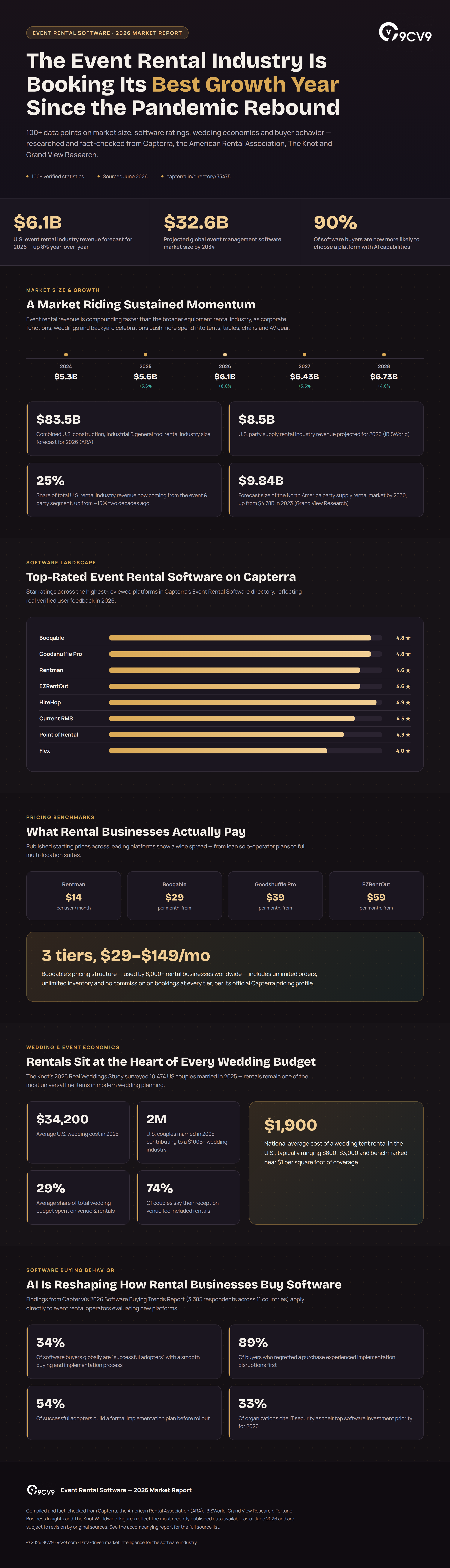
Competition among event rental software providers is also intensifying. Leading solutions such as Booqable, Rentman, Goodshuffle Pro, EZRentOut, and Point of Rental are competing on functionality, ease of use, customer support, pricing, and integrations. Customer satisfaction remains an important purchasing consideration, with several leading platforms achieving ratings between 4.6 and 4.9 out of 5 on Capterra. These ratings illustrate the importance of evaluating software based on operational requirements, customer feedback, and long-term business value.
Artificial intelligence is another emerging factor shaping the future of event rental technology. Research cited in the dataset indicates that 90% of software buyers are more likely to choose platforms offering AI capabilities, while 67% of organizations already use AI-enabled sales or marketing tools. For event rental businesses, AI-powered capabilities offer potential opportunities to improve demand forecasting, automate customer communications, optimize equipment utilization, and support more informed pricing decisions.
At the same time, growing wedding and event spending continues to create opportunities for rental businesses. The average U.S. wedding cost approximately $34,200 in 2025, while couples hired an average of 13 vendors per wedding. With venue and rental expenses representing a substantial portion of wedding budgets, efficient inventory management, scheduling, and vendor coordination are becoming increasingly important for rental operators seeking to remain competitive.
However, adopting event rental software is not without challenges. Software implementation costs, integration requirements, employee training, cybersecurity considerations, and subscription pricing can influence purchasing decisions. Research indicates that only 34% of global software buyers qualify as successful adopters, highlighting the importance of careful software selection, implementation planning, and ongoing operational support.
This comprehensive guide to the Top 108 Event Rental Software Statistics, Data & Trends in 2026 examines the latest industry market sizes, growth forecasts, software adoption patterns, vendor ratings, pricing benchmarks, customer satisfaction metrics, wedding rental economics, and emerging AI trends. Whether the reader is an event rental business owner, wedding industry professional, equipment rental operator, software provider, investor, or technology decision-maker, these statistics provide valuable insights into the evolving event rental software market and the opportunities shaping its future.
By understanding these event rental software statistics and industry trends, businesses can make more informed technology investments, identify opportunities for operational improvement, benchmark competing software solutions, and develop strategies for sustainable growth in an increasingly competitive event rental industry.
Before we venture further into this article, we would like to share who we are and what we do.
About 9cv9
9cv9 is a business tech startup based in Singapore and Asia, with a strong presence all over the world.
With over ten years of startup and business experience, and being highly involved in connecting with thousands of companies and startups, the 9cv9 team has listed some of the top and best companies/tools in this review.
If you like to get your company listed in our top B2B software reviews, check out our world-class 9cv9 Media and PR service and pricing plans here.
Top 108 Event Rental Software Statistics, Data & Trends in 2026
Market Size & Growth
- The global event management software market was valued at $8.40 billion in 2024. This baseline figure underscores how large and mature the event technology category has become heading into 2026.
- The event management software market reached $9.32 billion in 2025. Year-over-year growth of this scale signals accelerating enterprise and SMB investment in digital event tools, including rental-specific platforms.
- Fortune Business Insights values the global event management software market at $9.90 billion in 2025, forecast to hit $11.31 billion in 2026. This trajectory reflects rising demand for integrated booking, inventory, and logistics software among event and rental businesses.
- The event management software market is projected to grow at a 14.16% CAGR through 2034, reaching $32.62 billion. This double-digit compound growth rate makes event tech one of the faster-expanding verticals within business software.
- North America held over 45% of the global event management software market in 2024, per Grand View Research. This regional concentration reflects the density of event, wedding, and rental businesses across the US and Canada.
- A separate estimate puts North America’s 2025 share of the event management software market at 34.99%. Even with methodology differences across research firms, North America consistently leads global adoption.
- The software segment (versus services) captured more than 64% of the event management software market in 2024. This suggests most rental businesses are now buying off-the-shelf platforms rather than custom-built services.
- Cloud-based deployment accounted for more than 63% of the event management software market in 2024. The dominance of cloud-based delivery highlights why most modern rental software runs as SaaS rather than on-premise installs.
- Large enterprises represented over 53% of the event management software market in 2024. Despite this, a substantial 47% SMB share shows rental software vendors still serve a large base of small, independent operators.
- The U.S. event rental industry is forecast to reach $6.1 billion in revenue in 2026, an 8% increase over 2025. This is one of the strongest single-year growth rates the sector has posted in recent years.
- The U.S. event rental industry closed out 2025 at approximately $5.6 billion, up 5.6% from 2024. Steady year-over-year gains show the category recovering and expanding well beyond pre-pandemic norms.
- Growth in U.S. event rental revenue is projected to soften to 5.5% in 2027. This normalization suggests the sharpest post-pandemic rebound years are giving way to steadier, sustainable expansion.
- U.S. event rental revenue growth is forecast to further ease to 4.6% in 2028. A gradual deceleration is typical as a growing market matures past its initial recovery phase.
- Canada’s event rental industry generated roughly $270 million in 2025, up 3.8% from 2024. Canadian rental businesses are tracking a similar, if smaller-scale, growth pattern to their U.S. counterparts.
- Canada’s event rental sector is projected to grow 5.9%–6.3% in 2026, reaching about $280 million. This acceleration mirrors the broader North American event economy heading into 2026.
- The combined U.S. construction, industrial equipment, and general tool rental industry is projected to hit $83.5 billion in 2026, up 3.6%. Event rental remains a smaller but faster-growing slice of this much larger equipment rental economy.
- U.S. construction and industrial equipment rental penetration reached 59.5% in 2025 — its fifth consecutive year of increase. Rising penetration rates reflect a long-term structural shift toward renting over buying, a trend event rental software vendors are capitalizing on.
- Consumer spending on recreational services, which includes event and party rentals, is projected to grow 5.8% in 2026. This consumer-side momentum directly fuels demand for party and event rental bookings.
- The U.S. party supply rental industry is projected to reach $8.5 billion in revenue in 2026, per IBISWorld. This figure captures the tables, chairs, tents, and decor rental businesses that make up the software’s core customer base.
- IBISWorld estimates a 4.0% annual growth rate for the party supply rental industry between 2021 and 2026. Consistent mid-single-digit growth over a five-year span signals durable, structural demand rather than a short-term spike.
- Despite its five-year CAGR, the party supply rental industry is expected to see a slight 0.6% revenue dip in 2026 alone. This nuance is a reminder that even growing industries can see short-term softness within a longer upward trend.
- Party Rental Ltd. holds the largest share of the U.S. party supply rental market, according to IBISWorld. Market concentration among a few large players creates both competitive pressure and consolidation opportunities that software vendors must account for.
- The North America party supply rental market was valued at $4.78 billion in 2023 and is forecast to reach $9.84 billion by 2030. This implies a 10.9% CAGR, nearly double the pace of the broader U.S. party rental industry estimate.
- The event and party rental segment now accounts for roughly 25% of total U.S. rental industry revenue, up from about 15% two decades ago. This near-doubling of category share illustrates how central events have become to the broader equipment rental economy.
- U.S. event and party rental revenue reportedly rose from $5.9 billion in 2022 to $7.9 billion in 2023. Even accounting for methodology differences between sources, the direction is unambiguous: rapid post-pandemic expansion.
- The global party and event rental market was valued at approximately $20.46 billion in 2025. This broader global figure includes furniture, tents, decor, and audiovisual equipment rental spanning far beyond the U.S. market alone.
- The global party and event rental market is forecast to approach $25 billion by 2029. Sustained global growth reinforces why event rental software vendors are increasingly building for international, not just domestic, markets.
- There were an estimated 7,392 party supply rental businesses operating in the U.S. in 2025, up 0.7% year-over-year. Slow but positive business formation suggests a mature, fragmented market that software vendors can still penetrate.
- The U.S. party supply rental industry employed an estimated 45,000 people industry-wide. This workforce scale gives a sense of the operational complexity — staffing, scheduling, logistics — that rental software aims to simplify.
- The party supply rental industry is considered largely insulated from tariff-driven cost pressures due to its low import/export exposure. This relative trade insulation is a meaningful stability factor for U.S. rental operators budgeting for 2026.
Capterra & G2 Vendor Ratings (Event Rental Software Directory)
- Booqable holds a 4.8 out of 5 rating from 1,173 reviews on Capterra, the highest review count of any event rental platform. Its scale of user feedback makes it the most extensively vetted option in the category.
- Booqable markets itself as trusted by more than 8,000 rental businesses worldwide. This customer base size positions it as one of the most widely adopted dedicated rental management platforms globally.
- Rentman is rated 4.6 out of 5 based on 242 Capterra reviews. Its strong review volume reflects meaningful traction among AV, event, and equipment rental businesses.
- EZRentOut holds a 4.6 out of 5 rating from 210 Capterra reviews. Consistent scores across a large sample size suggest reliable satisfaction among its user base.
- Goodshuffle Pro is rated 4.8 out of 5 from 157 reviews on Capterra. Its high rating alongside a growing review count signals strong momentum in the event and party rental niche.
- Point of Rental Software scores 4.3 out of 5 from 149 Capterra reviews. As a long-standing enterprise rental platform, its slightly lower score may reflect the tradeoffs of serving larger, more complex operations.
- Flex is rated 4.0 out of 5 based on 137 Capterra reviews. This positions it at the lower end of top-reviewed platforms, worth weighing against its specific feature set for buyers.
- HireHop earns a 4.9 out of 5 rating from 84 Capterra reviews. Its near-perfect score across a meaningful sample size makes it one of the highest-rated platforms in the category.
- Current RMS holds a 4.5 out of 5 rating from 83 Capterra reviews. Its rating reflects steady satisfaction among AV and production equipment rental users specifically.
- InflatableOffice scores 4.9 out of 5 from 75 Capterra reviews. Its niche focus on inflatable and bounce house rental businesses hasn’t limited its overall satisfaction scores.
- TapGoods Event Rental Software is rated 4.8 out of 5 from 59 Capterra reviews. Purpose-built for event rental specifically, its strong score reflects positive fit for that use case.
- Alert holds a 4.6 out of 5 rating from 43 Capterra reviews. Its consistent mid-tier review volume makes it a credible option worth comparing against larger competitors.
- Quipli is rated 4.9 out of 5 from 39 Capterra reviews. As a newer entrant, its high early rating suggests strong product-market fit despite a smaller review base.
- Texada scores 4.4 out of 5 from 36 Capterra reviews. Its rating sits in the solid-but-not-top-tier range relative to category leaders.
- Reservety holds a 4.9 out of 5 rating from 36 Capterra reviews. This near-perfect score places it among the highest-rated platforms in the entire directory.
- RentMaster is rated 4.9 out of 5 from 35 Capterra reviews. Its consistently high satisfaction score has held steady across years of user feedback.
- ADVANTAGE 365 scores 4.5 out of 5 from 34 Capterra reviews. Its rating reflects solid performance among rental businesses using Microsoft-based ERP integrations.
- Orion Software (Sirius e) is rated 4.0 out of 5 from 28 Capterra reviews. This is on the lower end of the directory, useful context for buyers prioritizing user satisfaction scores.
- FocalPoint Software holds a 4.6 out of 5 rating from 23 Capterra reviews and says it serves 1,000+ rental stores. Its established customer base signals long-term staying power in the rental software space.
- RentKit is rated 4.8 out of 5 from 22 Capterra reviews. Despite a smaller review sample, its high score indicates strong satisfaction among early adopters.
- MCS Rental Software scores 4.5 out of 5 from 21 Capterra reviews. Its rating reflects steady performance in the broader equipment and plant rental segment.
- EventOffice holds a 4.7 out of 5 rating from 20 Capterra reviews. Its score places it comfortably in the upper tier of reviewed platforms.
- IntelliEvent Lightning is rated 4.3 out of 5 from 18 reviews and reports serving approximately 1,500 customers across 5 countries. Its international footprint distinguishes it from more domestically focused competitors.
- Rentopian holds a perfect 5.0 out of 5 rating from 16 Capterra reviews. While its review sample is smaller, a flawless score is a notable differentiator worth investigating further.
- anny is rated 4.9 out of 5 from 16 Capterra reviews. Its near-perfect score suggests strong early satisfaction among its user base.
- BoothBook scores 4.9 out of 5 from 14 Capterra reviews. As a niche photo booth and event add-on rental tool, its high rating reflects strong fit for that specific use case.
- Capterra’s Event Rental Software directory lists at least 25 distinct vendors on its first page alone. This breadth signals a genuinely competitive, fragmented market rather than one dominated by a single player.
- On G2, Booqable separately holds a 4.8-star rating from 51 reviews. Consistency between Booqable’s Capterra and G2 scores strengthens confidence in its overall reputation.
- On GetApp, equipment rental is cited as Booqable’s most common use case, referenced by 62% of reviewers. This confirms the platform’s core strength lies specifically in rental operations rather than adjacent use cases.
- 25% of Booqable’s GetApp reviewers work specifically in the Events Services industry. This is the largest single industry segment among its reviewer base, reinforcing its relevance to event rental businesses.
- In a Capterra head-to-head comparison, Booqable’s 1,088 tracked reviews break down to 1,069 positive, 10 neutral, and 9 negative. This overwhelmingly positive sentiment ratio, exceeding 98%, is a strong signal of consistent user satisfaction.
- In the same comparison, Goodshuffle Pro’s 154 tracked reviews break down to 149 positive, 3 neutral, and 2 negative. Like Booqable, its sentiment skews almost entirely positive, at roughly 97%.
- 96% of Rentman’s Capterra reviewers come from small businesses. This confirms Rentman’s core market fit is smaller, independent rental and AV operators rather than large enterprises.
- 54% of Rentman’s Capterra reviewers work in the Events Services industry specifically. This is the single largest reviewer segment, reinforcing Rentman’s relevance to event-focused rental businesses.
- In a Capterra comparison, Rentman’s 4.6 rating from 242 reviews outperforms Point of Rental’s 4.3 rating from 149 reviews. Head-to-head, Rentman edges out its larger enterprise-focused competitor on overall satisfaction.
- HireHop’s Value for Money sub-category is rated 4.9 out of 5 across 83 Capterra reviews. This suggests users see it as delivering strong returns relative to its cost.
Sub-Category Ratings (Ease of Use, Customer Service, Features, Value for Money)
- Goodshuffle Pro scores 4.8 for Ease of Use, 4.9 for Customer Service, 4.7 for Features, and 4.8 for Value for Money on Capterra. This balanced, top-tier performance across all four sub-categories makes it a strong all-around contender.
- Booqable scores 4.7 for Ease of Use, 4.8 for Customer Service, 4.6 for Functionality, and 4.7 for Value for Money. Its consistently high marks across categories reinforce why it leads the directory in total review volume.
- Rentman scores 4.4 for Ease of Use, 4.6 for Customer Service, 4.5 for Features, and 4.3 for Value for Money. Customer Service stands out as its relative strength compared to its other sub-scores.
- Point of Rental scores 4.2 for Ease of Use, 4.2 for Customer Service, 4.2 for Functionality, and 4.1 for Value for Money. Its remarkably even scores across categories suggest a platform with no major standout weaknesses, but also no standout strengths.
Pricing Benchmarks
- Rentman’s entry-level Crew Essential plan starts at $14 per user, per month. This makes it one of the more accessible per-seat pricing structures in the category.
- Booqable’s pricing starts at $29 per month across three tiers, up to $149 per month. Its tiered structure allows small operators to start lean and scale as their rental business grows.
- Booqable includes unlimited orders and unlimited inventory with no commission charged on bookings at every pricing tier. The absence of transaction-based fees is a meaningful differentiator for high-volume rental businesses.
- Goodshuffle Pro’s Lite plan starts at $39 per month, with its Standard plan priced at a flat $99 per month. This tiered approach targets both solo operators and growing rental businesses with dedicated pricing bands.
- Goodshuffle Pro offers a Website Integration add-on priced at approximately $79 per month. Optional add-ons like this let rental businesses customize their software spend to their specific operational needs.
- EZRentOut’s pricing starts at $59 per month for its Essential plan, scaling to $399 and $499 per month for Growth and Premium tiers. This wide pricing range reflects its ability to serve both small operators and larger, multi-location businesses.
- Current RMS reports serving more than 2,500 businesses worldwide. This customer base size signals meaningful traction, particularly within the AV and production equipment rental niche.
Wedding & Event Economics (The Knot 2026 Real Weddings Study)
- The average U.S. wedding cost $34,200 in 2025, based on a survey of 10,474 couples. This figure sets the financial backdrop against which rental spending decisions are made.
- Approximately 2 million U.S. couples married in 2025, contributing to a wedding industry worth more than $100 billion. This scale illustrates the enormous downstream demand for rental furniture, tents, and event equipment.
- Average wedding spend per guest reached $292 in 2025, up $8 from 2024. Rising per-guest costs directly support higher-value rental bookings for tables, seating, and tableware.
- 75% of couples say their wedding was financially worth the investment despite the cost. This sentiment suggests continued willingness to spend on rentals and event essentials rather than cutting corners.
- 85% of couples say the broader economy impacted how they planned their wedding. Even amid economic caution, most couples adapted rather than abandoned their plans, sustaining rental demand.
- Of those affected by economic conditions, 77% said they increased their spending anyway. This counterintuitive finding suggests couples are prioritizing wedding spend even during periods of economic uncertainty.
- AI adoption among couples planning their weddings nearly doubled year-over-year, reaching 36% in 2025. This mirrors the broader AI adoption trend also showing up in event rental software buying behavior.
- The average U.S. wedding guest count in 2025 was 117. This figure directly correlates with the volume of tables, chairs, and place settings rental businesses need to supply.
- Couples hire an average of 13 wedding vendors to execute their event. Rental companies are typically just one of over a dozen coordinated vendors, underscoring the value of software that streamlines communication and logistics.
- 89% of couples book a wedding venue, 88% hire a photographer, and 85% secure a caterer. These near-universal vendor categories define the core ecosystem that rental businesses operate within.
- Venue and rentals together account for approximately 29% of the total average wedding budget. This makes it one of the single largest line items in a typical wedding budget.
- 74% of couples say their reception venue fee included rental items like tables and chairs. This high bundling rate shows how deeply rentals are embedded into standard venue packages.
- 41% of couples report their venue fee included catering, and 37% included alcohol. These bundling patterns matter for rental businesses assessing where they fit into a venue’s all-in-one offering versus a standalone booking.
- Only 7% of couples say their venue fee included nothing beyond the space itself. This confirms that the vast majority of modern wedding venues now bundle at least some rental or catering elements.
- The average cost of a wedding venue reached $12,900 in 2025, up $700 from the prior year and up $3,900 since 2016. Rising venue costs have climbed nearly 30% in under a decade, a trend rental businesses must factor into their own pricing strategy.
- 76% of couples say price is the most important factor when choosing a venue. Cost sensitivity at the venue level often cascades down to rental vendor selection as well.
- The national average cost of a wedding tent rental in the U.S. is $1,900, typically ranging from $800 to $3,000. Tent rental remains one of the most visible and highest-value single rental line items at outdoor weddings.
- Large or elaborate wedding tent setups can run as high as $25,000 depending on size and features. This wide price range illustrates the significant upsell potential within tent and structure rentals alone.
- Weddings are estimated to account for roughly 34.84% of global party rental revenue. This makes weddings the single largest event category driving the party and event rental industry.
- Most U.S. couples allocate between $425 and $1,000 of their wedding budget specifically to rental items like tables, chairs, and dinnerware. This budget range gives rental businesses a useful benchmark for typical order values.
Software Buying Behavior & AI Adoption (Capterra 2026 Software Buying Trends Report)
- 90% of software buyers say they are more likely to choose a platform with AI capabilities. This makes AI functionality a near-universal purchasing criterion rather than a nice-to-have differentiator.
- 67% of organizations report already using AI-enabled sales or marketing tools. Widespread existing AI adoption sets a high bar for new software, including rental platforms, to match buyer expectations.
- Only 34% of software buyers globally qualify as “successful adopters” with a smooth buying and implementation experience. This leaves a majority of buyers navigating friction somewhere in their software purchase journey.
- 89% of buyers who regretted a software purchase experienced implementation disruptions. This strongly links post-purchase regret to poor onboarding rather than the software’s core features.
- Successful software adopters typically select and deploy new software within 3 months. Speed to value appears to be a defining trait separating successful implementations from problematic ones.
- 54% of successful adopters created a detailed implementation plan before rollout, compared to fewer disappointed buyers. Upfront planning correlates strongly with smoother software transitions.
- 62% of successful adopters defined their budget and must-have features early in the buying process, versus 48% of disappointed buyers. This 14-point gap highlights the value of disciplined requirements-gathering before purchasing rental software.
- Only 27% of UK software buyers reported being fully satisfied with their most recent software purchase. Regional variation in satisfaction suggests buying experience quality differs meaningfully across markets.
- 52% of UK software buyers experienced some form of regret after a recent purchase. This further reinforces that implementation quality, not just feature set, drives long-term buyer satisfaction.
- 82% of organizations expect revenue growth over the next 18 months. This broadly optimistic outlook supports continued software investment, including in rental and event management platforms.
- IT security was the most-cited software investment priority, named by 33% of organizations for 2026. Rental businesses evaluating new platforms should weigh vendor security posture alongside feature comparisons.
Conclusion
The latest event rental software statistics, data, and trends in 2026 highlight an industry experiencing steady growth, accelerating digital transformation, and increasing demand for efficient rental management solutions. As event rental businesses navigate rising customer expectations, complex inventory requirements, and growing operational challenges, adopting the right technology has become an important factor in maintaining competitiveness, improving profitability, and achieving sustainable business growth.
The broader event technology market presents significant opportunities. With the global event management software market projected to reach $11.31 billion in 2026 and $32.62 billion by 2034, businesses are increasingly recognizing the value of cloud-based platforms, automated booking systems, real-time inventory tracking, and integrated operational management. Meanwhile, the U.S. event rental industry is forecast to generate approximately $6.1 billion in revenue in 2026, demonstrating continued demand for rental equipment, event services, and supporting technologies.
One of the most significant findings from these 108 event rental software statistics is the growing importance of cloud-based rental management software. With cloud deployment accounting for more than 63% of the event management software market in 2024, rental operators are increasingly embracing flexible, scalable solutions that allow them to manage reservations, equipment availability, customer relationships, and business operations from centralized systems. This shift is particularly relevant for businesses managing multiple locations, large equipment inventories, or complex event schedules.
Customer satisfaction and software usability also remain essential considerations. Established event rental software providers such as Booqable, Rentman, Goodshuffle Pro, EZRentOut, and Point of Rental continue to compete through specialized functionality, customer support, and pricing flexibility. Strong customer ratings across leading platforms suggest that businesses have access to a competitive selection of rental management solutions, although the best software ultimately depends on organizational size, operational complexity, budget, and industry-specific requirements.
Another defining trend is the increasing influence of artificial intelligence and automation in event rental software. With 90% of surveyed software buyers indicating a greater likelihood of selecting platforms with AI capabilities, demand for intelligent business tools is expected to influence future software development. AI-powered demand forecasting, automated customer communication, inventory optimization, and data-driven pricing represent potential opportunities for rental businesses seeking to improve efficiency and maximize equipment utilization.
The wedding and party rental industries further reinforce the long-term importance of event rental technology. With the average U.S. wedding costing approximately $34,200 in 2025 and couples coordinating an average of 13 vendors, effective rental inventory management, booking coordination, and logistics planning remain critical to delivering successful events. Businesses that streamline these processes through technology may be better positioned to reduce operational errors, improve customer satisfaction, and capture additional revenue opportunities.
However, successful digital transformation requires more than purchasing software. The finding that only 34% of global software buyers qualify as successful adopters emphasizes the importance of evaluating implementation requirements, integration capabilities, employee training, customer support, and total ownership costs before investing in a new platform. Event rental businesses should prioritize solutions that address their operational challenges rather than selecting software based solely on popularity or advertised features.
Looking ahead, the future of event rental software beyond 2026 is likely to be shaped by continued cloud adoption, greater workflow automation, AI-assisted decision-making, mobile accessibility, and increasingly integrated business management platforms. As competition intensifies, rental companies that effectively combine technology with reliable service delivery and efficient resource management may gain meaningful advantages in customer retention, operational scalability, and profitability.
Ultimately, these Top 108 Event Rental Software Statistics, Data & Trends in 2026 demonstrate that rental management technology is becoming an increasingly valuable component of the modern event industry. Whether managing wedding decorations, party equipment, audiovisual systems, furniture rentals, or large-scale event infrastructure, businesses can benefit from understanding emerging market trends and making informed technology investments.
The key takeaway is clear: event rental businesses that prioritize operational efficiency, customer experience, and strategic technology adoption will be better positioned to navigate industry changes, capitalize on emerging opportunities, and build sustainable competitive advantages in 2026 and beyond.
If you find this article useful, why not share it with your hiring manager and C-level suite friends and also leave a nice comment below?
We, at the 9cv9 Research Team, strive to bring the latest and most meaningful data, guides, and statistics to your doorstep.
To get access to top-quality guides, click over to 9cv9 Blog.
To hire top talents using our modern AI-powered recruitment agency, find out more at 9cv9 Modern AI-Powered Recruitment Agency.
People Also Ask
What is event rental software?
Event rental software is a digital platform that helps businesses manage equipment rentals, inventory, reservations, quotations, payments, deliveries, and customer relationships. It is commonly used by party rental companies, wedding suppliers, and audiovisual equipment providers.
How big is the global event rental software market in 2026?
The broader global event management software market is projected to reach $11.31 billion in 2026, according to Fortune Business Insights. This figure includes event technology beyond rental-specific software.
What is the projected growth rate of the event management software market?
The global event management software market is projected to grow at a compound annual growth rate of 14.16% through 2034, reaching approximately $32.62 billion.
How large is the U.S. event rental industry in 2026?
The U.S. event rental industry is forecast to generate approximately $6.1 billion in revenue in 2026, representing an 8% increase from the estimated $5.6 billion recorded in 2025.
What are the best event rental software platforms in 2026?
Popular event rental software platforms include Booqable, Rentman, Goodshuffle Pro, EZRentOut, Point of Rental, HireHop, and TapGoods. The best choice depends on business size, inventory requirements, pricing, and operational complexity.
What are the major event rental software trends in 2026?
Major trends include cloud-based rental management, automated booking systems, real-time inventory tracking, AI-assisted operations, mobile accessibility, integrated payments, and centralized event logistics management.
How much does event rental software cost in 2026?
Event rental software pricing varies by provider and functionality. The dataset lists Booqable starting at $29 monthly, Goodshuffle Pro at $39 monthly, EZRentOut at $59 monthly, and Rentman’s Crew Essential plan at $14 per user monthly.
What percentage of event management software is cloud-based?
Cloud-based deployment accounted for more than 63% of the global event management software market in 2024. This reflects growing demand for accessible, scalable, and subscription-based event technology solutions.
Why is cloud-based event rental software becoming popular?
Cloud-based event rental software enables businesses to access booking records, inventory availability, customer information, and operational data remotely. It also supports collaboration across locations without requiring extensive on-premise infrastructure.
How does event rental software improve inventory management?
Event rental software helps businesses monitor equipment availability, track reservations, manage returns, identify scheduling conflicts, and coordinate inventory across multiple events. These capabilities can reduce double bookings and improve equipment utilization.
What is the highest-rated event rental software in 2026?
In the supplied Capterra data, Rentopian has a 5.0 out of 5 rating from 16 reviews. HireHop, InflatableOffice, Quipli, and Reservety each have ratings of 4.9 out of 5, although review counts differ.
How does Booqable compare with other event rental software?
Booqable holds a 4.8 out of 5 Capterra rating from 1,173 reviews in the dataset. It also reports serving more than 8,000 rental businesses worldwide, making it a widely reviewed rental management platform.
Is Rentman suitable for small event rental businesses?
Yes. Rentman serves audiovisual, event production, and equipment rental businesses. According to the supplied Capterra statistics, 96% of its reviewers represent small businesses, while 54% work in event services.
What are the benefits of Goodshuffle Pro for event rental companies?
Goodshuffle Pro provides tools for event rental inventory, quotations, order management, and customer coordination. Its reported Capterra ratings include 4.8 for ease of use, 4.9 for customer service, and 4.8 for value for money.
What is the market size of the U.S. party supply rental industry?
IBISWorld estimates that the U.S. party supply rental industry will generate approximately $8.5 billion in 2026. The industry includes businesses renting tents, tables, chairs, decorations, and other party equipment.
How many party rental businesses operate in the United States?
The supplied industry statistics estimate that approximately 7,392 party supply rental businesses operated in the United States in 2025, representing a 0.7% increase compared with the previous year.
How fast is the North American party supply rental market growing?
The North American party supply rental market was valued at approximately $4.78 billion in 2023 and is forecast to reach $9.84 billion by 2030, representing an estimated compound annual growth rate of 10.9%.
How is artificial intelligence changing event rental software?
AI can help event rental businesses forecast demand, automate customer inquiries, optimize inventory allocation, analyze booking patterns, and support pricing decisions. These applications may improve efficiency and reduce repetitive administrative tasks.
What percentage of software buyers prefer AI-powered platforms?
According to the supplied Capterra software buying statistics, 90% of surveyed software buyers are more likely to select platforms offering AI capabilities, highlighting growing interest in intelligent business software.
Can event rental software automate bookings and reservations?
Yes. Many event rental management platforms support online reservations, automated availability checks, booking confirmations, quotation generation, and payment workflows. Automation can reduce manual administration and improve booking accuracy.
How does event rental software help wedding rental businesses?
Wedding rental software helps businesses coordinate furniture, decorations, tents, tableware, delivery schedules, and customer reservations. It supports inventory planning and vendor coordination for weddings involving multiple suppliers.
What is the average wedding cost in the United States in 2025?
The supplied wedding industry statistics report an average U.S. wedding cost of $34,200 in 2025, based on a survey of 10,474 couples. Wedding spending supports demand for venues, rental equipment, decorations, and event services.
How many vendors are typically involved in a wedding?
Couples hired an average of 13 wedding vendors in 2025, according to the supplied wedding industry data. These vendors may include venues, caterers, photographers, decorators, rental suppliers, and entertainment providers.
How much does wedding tent rental cost in the United States?
The supplied statistics estimate that wedding tent rentals cost approximately $1,900 on average, typically ranging from $800 to $3,000. Large or elaborate tent installations can cost up to $25,000, depending on size and features.
What percentage of wedding budgets goes toward venues and rentals?
Venue and rental expenses together account for approximately 29% of the average wedding budget in the supplied statistics. This highlights the financial importance of rental equipment and venue services within the wedding industry.
What features should businesses look for in event rental software?
Important features include real-time inventory tracking, online booking, quotation management, customer records, payment processing, delivery scheduling, reporting, mobile access, integrations, and reliable customer support.
What challenges do businesses face when implementing event rental software?
Common challenges include data migration, employee training, integration difficulties, implementation costs, and workflow disruptions. The supplied research indicates that 89% of software buyers who regretted a purchase experienced implementation disruptions.
How long does it take to implement event rental management software?
Implementation time depends on business complexity, inventory size, integrations, and employee training. The supplied Capterra research indicates that successful software adopters typically select and deploy new software within three months.
Can event rental software improve business profitability?
Event rental software can support profitability by reducing booking errors, improving inventory utilization, automating administrative tasks, and streamlining logistics. Actual financial results depend on implementation quality, operating costs, and business demand.
What is the future of event rental software beyond 2026?
The future of event rental software is likely to involve greater AI integration, cloud adoption, automated workflows, mobile management, predictive analytics, and connected business systems. These technologies may help rental companies improve efficiency and scale operations.
Sources
Grand View Research
Fortune Business Insights
IBISWorld
American Rental Association
Rental Equipment Register
Capterra
G2
GetApp
The Knot Worldwide


