

Key Takeaways
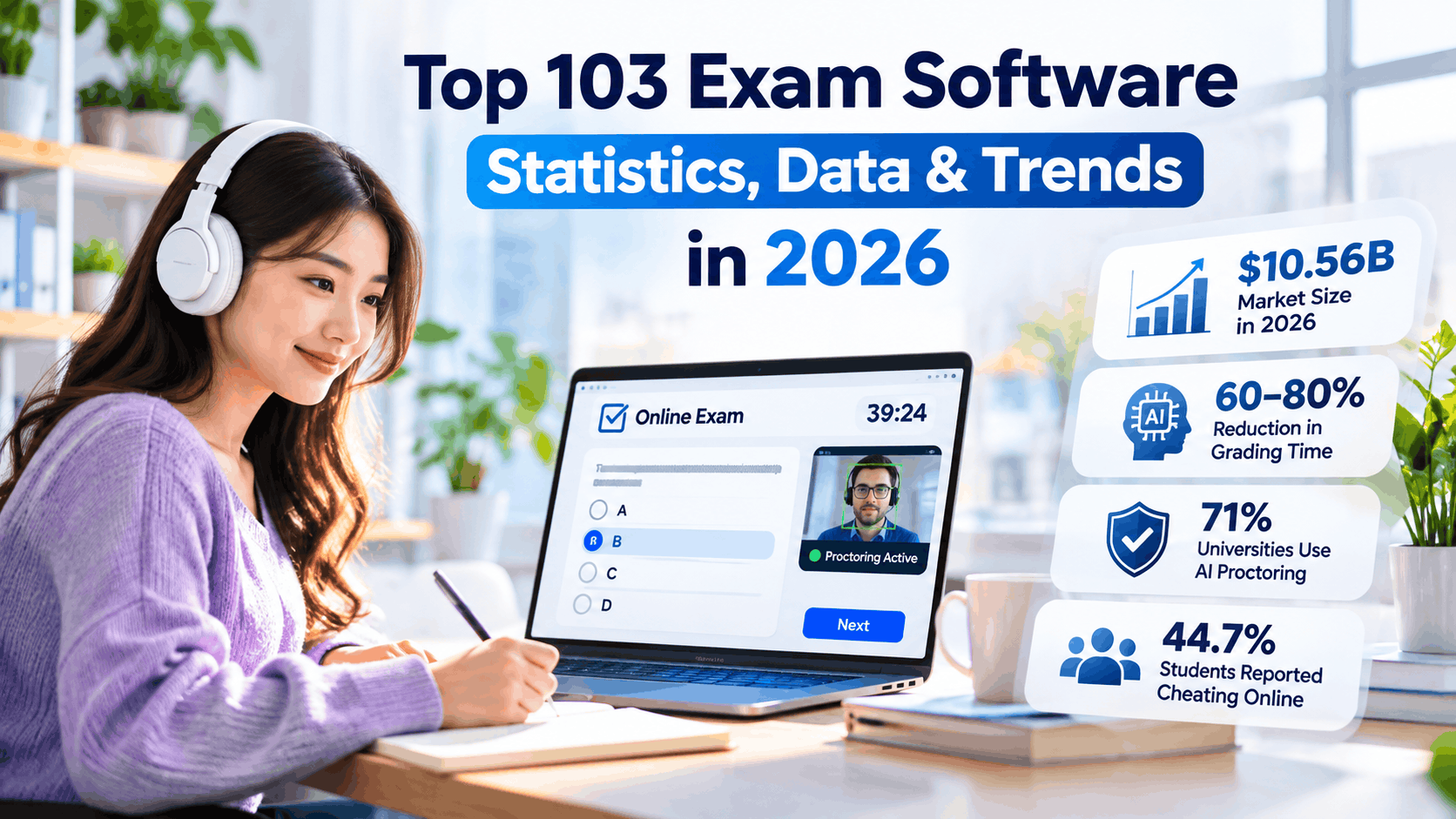
- Exam Software Market Growth: The global online exam software market is projected to reach $10.56 billion in 2026 and $15.86 billion by 2030, driven by increasing adoption of digital assessments, cloud-based examination platforms, and remote testing solutions.
- AI-Powered Exam Software and Online Proctoring: AI-based assessment tools can reduce grading time by 60–80%, while the global online exam proctoring software market is estimated to reach $1.12 billion in 2026, highlighting growing demand for automated grading and examination security.
- Digital Assessment Adoption and Academic Integrity: With 44.7% of students reporting online exam cheating and over 55% expressing proctoring privacy concerns, educational institutions and businesses are prioritizing secure, accessible, and user-friendly examination software.
Exam software is transforming digital assessments in 2026, with the global online exam software market projected to reach $10.56 billion and grow to $15.86 billion by 2030. Explore 103 key statistics covering market growth, AI-powered grading, online proctoring, academic integrity, cloud-based testing, and corporate assessments shaping the future of digital examinations.
The global exam software industry is undergoing a significant transformation in 2026, driven by the rapid adoption of artificial intelligence (AI), online assessments, remote proctoring, automated grading, and cloud-based examination platforms. As educational institutions, certification providers, and businesses increasingly embrace digital assessment solutions, exam software has become essential for improving testing efficiency, academic integrity, accessibility, and candidate experience.
Also, read our article on the Top 10 Exam Software To Try.

According to industry market projections, the global online exam software market is expected to reach $10.56 billion in 2026, up from $9.37 billion in 2025, representing annual growth of approximately 12.6%. The market is forecast to expand further to $15.86 billion by 2030, highlighting sustained demand for scalable digital examination systems. Meanwhile, the global online exam and assessment proctoring software market is estimated at $1.12 billion in 2026, with projections suggesting it could reach $2.76 billion by 2035.
Artificial intelligence is also reshaping how examinations are created, administered, monitored, and evaluated. AI-powered exam software enables automated question generation, intelligent grading, real-time cheating detection, predictive performance analytics, and personalized assessments. Industry estimates suggest that institutions implementing AI-based assessment solutions can reduce grading time by 60–80%, potentially allowing educators to dedicate more resources to teaching and student development.

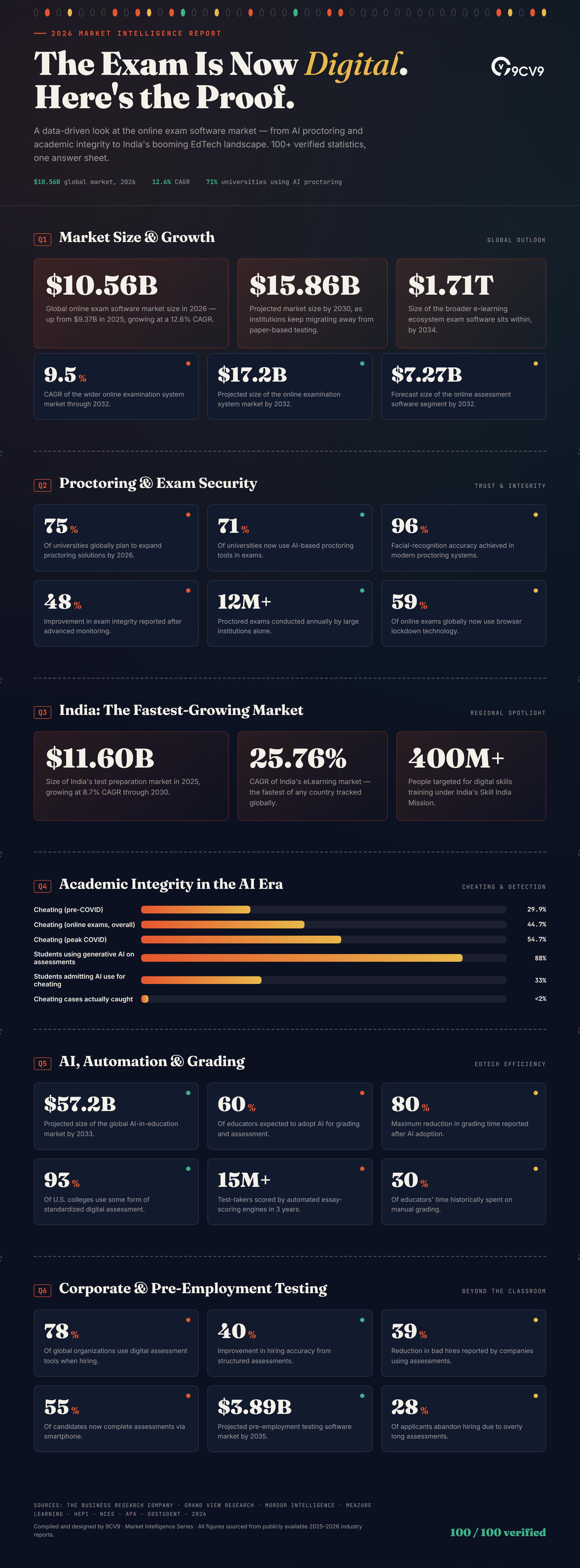
However, the growing adoption of online examination software also introduces challenges involving academic dishonesty, cybersecurity, student privacy, and technical reliability. Research cited in the compiled statistics indicates that 44.7% of students reported cheating in online examinations, while more than 55% of students using remote proctoring software expressed privacy concerns. These findings emphasize the importance of balancing examination security with fairness, transparency, accessibility, and user experience.
Beyond education, exam and assessment software is becoming increasingly important in corporate recruitment, employee training, professional certification, and workforce development. The global pre-employment testing software market is projected to reach $2.11 billion in 2026, reflecting growing organizational interest in skills-based hiring, structured candidate evaluations, and data-driven talent decisions.
The latest exam software statistics, data, and trends for 2026 reveal several important developments, including the expansion of cloud-based examination systems, increasing investment in AI-powered proctoring, growing demand for mobile-friendly assessments, and the integration of digital testing platforms with learning management systems (LMS) and human resource technologies.
This comprehensive collection of 103 exam software statistics for 2026 explores market size, revenue forecasts, adoption rates, online proctoring trends, academic integrity challenges, AI grading technologies, student experiences, and corporate assessment software developments. Whether you are an educator, HR professional, EdTech entrepreneur, software provider, or business decision-maker, these statistics offer valuable insights into the technologies, opportunities, and challenges shaping the future of digital examinations and assessments in 2026 and beyond.
Before we venture further into this article, we would like to share who we are and what we do.
About 9cv9
9cv9 is a business tech startup based in Singapore and Asia, with a strong presence all over the world.
With over ten years of startup and business experience, and being highly involved in connecting with thousands of companies and startups, the 9cv9 team has listed some of the top and best companies/tools in this review.
If you like to get your company listed in our top B2B software reviews, check out our world-class 9cv9 Media and PR service and pricing plans here.
Top 103 Exam Software Statistics, Data & Trends in 2026
Market Size & Growth
- The global online exam software market is projected to hit $10.56 billion in 2026, growing from $9.37 billion in 2025 at a CAGR of 12.6%, showing that institutions worldwide are rapidly shifting budgets toward digital assessment infrastructure.
- The same market is forecast to expand further to $15.86 billion by 2030, growing at a 10.7% CAGR, confirming that online exam software adoption is far from peaking and remains a long-term growth category.
- An alternative market model pegs the online exam software sector at $9.41 billion in 2025, rising to $15.14 billion by 2029 at a 12.6% CAGR, reinforcing double-digit growth as the consensus trajectory across multiple analyst firms.
- A more conservative valuation places the market at $4.8 billion in 2024, expanding to $9.2 billion by 2033 at an 8.2% CAGR, illustrating how estimates vary but the growth direction remains consistently upward.
- Another 2026 report frames online exam software at $6.71 billion in 2024, projected to reach $13.3 billion by 2031 at a 9.01% CAGR, nearly doubling within seven years.
- The online examination system market (a closely related category) was valued at $8.21 billion in 2024 and is expected to reach $17.2 billion by 2032 at a 9.5% CAGR, driven by demand for automated assessment tools.
- A separate online examination system forecast estimates the market at $4.247 billion in 2025, climbing to $12.82 billion by 2035 at an 11.68% CAGR, underlining sustained multi-year expansion.
- The online assessment software segment specifically was valued at $1.75 billion in 2024 and is projected to reach $7.27 billion by 2032 at a 9.1% CAGR, showing the assessment-tools niche growing over 4x within eight years.
- North America held the position of the largest regional market for online exam software in 2024, reflecting the region’s mature digital education infrastructure and early EdTech investment.
- Asia-Pacific is cited as the fastest-growing region for online exam software, with countries like India and China investing heavily in online education infrastructure and digital assessment adoption.
Online Proctoring Market
- The global online exam and assessment proctoring software market is estimated at $1.12 billion in 2026, projected to rise to $2.76 billion by 2035 at a CAGR of 11.9%, showing proctoring solutions becoming a defining subsegment of exam software.
- A separate online exam proctoring market analysis puts 2026 revenue at $1.07 billion, forecast to reach $8.09 billion by 2035 at an aggressive 25.27% CAGR, the fastest growth rate found across proctoring market reports.
- The Online Proctoring Services for Higher Education market reached $779.91 million in 2025 and is projected to hit $940.19 million in 2026, en route to $5,054.98 million by 2035 at a 20.55% CAGR.
- A competing estimate for the same higher-education proctoring niche sizes it at $911.64 million in 2026, rising to $4,650.96 million by 2035 at a 19.85% CAGR, corroborating strong double-digit growth.
- As of 2026, 75% of universities globally intend to expand their proctoring solutions, signaling that remote exam supervision is becoming a permanent fixture of higher education rather than a pandemic-era stopgap.
- More than 60% of universities worldwide have shifted toward hybrid assessment models that blend in-person and online proctored exams.
- Over 55% of students report preferring flexible online exam formats over traditional fixed-location testing.
- Institutions report up to a 48% improvement in exam integrity after implementing advanced monitoring features in their proctoring stack.
- In the U.S. specifically, nearly 72% of universities have integrated remote proctoring into degree programs, one of the highest national adoption rates recorded.
- Around 58% of U.S. students complete at least one online proctored assessment each semester.
- More than 45% of U.S. institutions now rely on automated (AI-driven) monitoring rather than live human proctors to increase consistency.
- Regionally, North America holds a 34% share of the global higher-education online proctoring market, followed by Europe at 28%, Asia-Pacific at 26%, and Middle East & Africa at 12%.
- Privacy concerns affect more than 55% of students using proctoring software, representing the leading friction point vendors must address.
- Technical issues impact over 47% of remote test-takers during proctored exams, highlighting a persistent reliability gap in exam software infrastructure.
- AI-based proctoring tools are now used in 71% of universities, cutting manual invigilation effort and reducing manual intervention by roughly 46%.
- Large-scale institutions collectively conduct over 12 million proctored exams annually, demonstrating the sheer operational scale modern exam software must support.
- Facial recognition accuracy in proctoring systems has reached approximately 96%, while anomaly-detection algorithms have cut cheating incidents by about 41%.
- Browser lockdown technology is now deployed in nearly 59% of online examinations globally, making it one of the most common built-in security features in exam software.
- Cloud-based deployment dominates the proctoring market with roughly 63% adoption, versus 37% for on-premise systems, reflecting the sector’s overall shift to SaaS delivery.
- Exam volumes on digital platforms have surged by 85% during the transition to remote and hybrid learning models.
- Modern proctoring platforms now support over 120 languages, expanding accessibility for global institutions and multinational certification bodies.
- Real-time monitoring tools in leading exam platforms can now track over 25 simultaneous behavioral indicators during a single exam session.
- In the U.S. specifically, around 82% of universities have implemented remote proctoring solutions, and roughly 74% of students engage in digitally monitored assessments annually.
- Compliance-driven adoption of proctoring software among U.S. institutions sits at approximately 69%, reflecting accreditation-body pressure around exam integrity.
- Integration between proctoring platforms and academic systems (LMS/SIS) is observed in 81% of institutions, streamlining scheduling and reporting workflows.
- Data protection frameworks are implemented in 77% of proctoring systems, aligning with national privacy regulations such as GDPR and India’s DPDP Act.
- Biometric authentication methods, such as keystroke and voice recognition, are used in 52% of exam platforms to strengthen candidate identity verification.
- Improved interface design in modern exam software has driven a 39% increase in student satisfaction scores across surveyed platforms.
- The U.S. online exam proctoring market alone was valued at around $160 million in 2024 and is projected to reach $370 million by 2030 at an 18% CAGR.
- Academic institutions account for more than 50% of the U.S. online exam proctoring market, ahead of corporate, government, and certification-body segments.
- Automated proctoring holds the dominant solution-type share in the U.S. market at more than 40%, driven by demand for scalable, 24/7 exam monitoring.
- AI-driven proctoring in the U.S. market flags malpractice with an accuracy exceeding 95%, a key selling point for exam software vendors targeting high-stakes testing.
- The global online proctoring market broadly was projected to reach $1.5 billion by 2025, growing at an 18.1% CAGR from 2020, according to earlier Verified Market Research estimates.
India-Specific Market Data
- India’s test preparation market — closely linked to exam software adoption — was valued at $11.60 billion in 2025 and is expected to grow at an 8.7% CAGR through 2030, reaching an additional $6.04 billion in incremental value.
- Coaching providers using AI-driven performance analytics constitute over 60% of India’s test-prep market’s operational focus, showing deep integration between exam software and India’s exam-prep ecosystem.
- Structured, technology-enabled coaching in India demonstrates a 15% higher success rate in competitive examinations compared to self-study methods.
- India’s eLearning market — the broader category exam software sits within — is projected to reach $7.57 billion, growing at a 25.76% CAGR, the fastest of any country tracked globally.
- India is explicitly named among the fastest-growing markets for online examination technology, driven by its enormous student population and government-backed digital education initiatives.
- Under India’s Skill India Mission, the government has targeted training over 400 million people, with digital assessment platforms increasingly used to certify and evaluate these learners.
- Leading India-based exam software and proctoring vendors — including Mercer | Mettl and Talview — are frequently cited among global market leaders, reflecting India’s growing role as both a consumer and exporter of exam-tech innovation.
- India-headquartered assessment vendor iMocha is recognized among key global players in the pre-employment assessment tools space, underscoring India’s expanding footprint in corporate testing software.
Academic Integrity & Cheating
- Self-reported online exam cheating was found in 44.7% of students overall in a systematic review, compared with 29.9% before COVID-19 and 54.7% during the pandemic peak.
- Students in fully online classes reported academic dishonesty at 42.3%, nearly 50% higher than the 28.3% reported by students in equivalent live/in-person classes.
- Verified cases of AI-assisted cheating rose from 1.6 per 1,000 students in 2022–2023 to 5.1 per 1,000 in 2023–2024, and are projected to reach 7.5 per 1,000 in 2025.
- According to GoStudent survey data, 33% of students admit to having used AI tools specifically to cheat on assessments.
- A 2025 Higher Education Policy Institute (HEPI) survey found 92% of students report using AI in some form for coursework, up sharply from 66% in 2024.
- In the same HEPI survey, 88% of students used generative AI tools to complete assessments, up from 53% the previous year — a rise researchers describe as staggering.
- Nearly 29% of students report an increase in their own cheating behavior since 2020, yet fewer than 2% say they were actually caught, revealing a significant detection gap that exam software vendors are racing to close.
- Across broader academic-integrity research, 60–70% of university students admit to some form of academic dishonesty during their studies.
- Specifically for exams, 43% of undergraduate students admit to cheating on tests, according to International Center for Academic Integrity (ICAI) data.
- Among high school students, 59% admit to cheating on tests during the past year, according to Josephson Institute research.
- In webcam-proctored randomized field experiments, proctored students scored statistically significantly lower than unproctored peers on identical exams, directly quantifying the “cost” of unmonitored academic dishonesty.
- Two out of three high school students report cheating on a test at least once, per Educational Testing Service data, while nine in ten admit to copying homework.
- Students are reported to be more than four times as likely to cheat in an online class compared to a face-to-face class, a key driver behind demand for exam-software proctoring features.
- In behavioral surveys, 42.4% of students in online classes admitted to hiding notes out of camera view during an exam more than once, versus 32.0% in equivalent live classes.
Test Anxiety & Student Experience
- A pooled meta-analysis of 67 studies covering 43,545 students found the overall prevalence of exam anxiety to be 48.43%, with moderate anxiety affecting 32.27% and high anxiety affecting 20.16% of students.
- Exam anxiety prevalence is higher among female students (54.96%) than male students (47.60%), a consistent pattern across the reviewed studies.
- Globally, an estimated 30–40% of students experience moderate-to-high levels of test anxiety during exams, according to aggregated survey data.
- Roughly one in four college students is affected by test anxiety severe enough to influence their grades and overall academic performance.
- Around one-third of medical students report clinically significant test anxiety, often tied to long-term, high-stakes evaluations — a segment increasingly served by specialized exam software.
- Students with high test anxiety typically score 12–15 percentile points lower than less-anxious peers on the same assessment, according to research published in the International Journal of Educational Research.
- A 2022 American Psychological Association survey found 45% of students say anxiety negatively impacts their academic performance.
AI, Automation & Grading
- The global AI-in-education market was valued at approximately $7.05–$8.3 billion in 2025 and is projected to reach $57.2 billion by 2033, growing at a striking 25.9% CAGR.
- 60% of educators are expected to adopt AI for grading and assessment tasks, reflecting rapid mainstreaming of AI-assisted evaluation inside exam software.
- Institutions implementing AI-based assessment tools report 60–80% reductions in grading time, a major efficiency driver behind exam software purchasing decisions.
- The same institutions report 30–50% improvements in assessment consistency and 25–40% gains in measurable student learning outcomes after adopting AI assessment tools.
- The global automated essay scoring (AES) software market was valued at $123 million in 2024 and is projected to reach $345 million by 2033 at a 12.3% CAGR.
- A separate automated essay scoring engine estimate places the market at $0.43 billion in 2026, growing to $1.19 billion by 2035 at roughly a 12% CAGR.
- Approximately 20% of educational institutions currently employ some form of automated scoring to streamline assessment, according to U.S. Department of Education-cited data.
- About 30% of K–12 schools in the U.S. have adopted AI-based grading systems, while over 40% of institutions overall have moved to cloud-based automated essay scoring platforms.
- Roughly 93% of U.S. colleges and universities use some form of standardized, technology-assisted assessment, reflecting near-universal adoption of digital evaluation infrastructure.
- Over 35% of academic institutions have implemented AI/NLP-powered essay scoring specifically to improve grading accuracy and reliability.
- Approximately 15 million test-takers were scored by automated essay-scoring engines in a recent three-year period, illustrating the scale AI grading already operates at.
- Educators spend over 30% of their working time on grading tasks, a burden that automated exam software directly targets for reduction.
Pre-Employment & Corporate Assessment Software
- The global pre-employment testing software market reached $1.97 billion in 2025 and is projected to climb to $2.11 billion in 2026 and $3.89 billion by 2035 at a 7.04% CAGR.
- Over 78% of global organizations now use at least one form of digital assessment tool during their hiring process.
- Companies using structured pre-employment assessments report a 35–40% improvement in hiring accuracy compared to resume-only screening.
- U.S. employers using early-stage assessments experience 25–30% lower employee turnover compared to those relying solely on interviews.
- Nearly 70% of firms globally prefer cloud-based pre-employment assessment platforms to accommodate global, distributed hiring needs.
- Over 55% of job candidates now complete pre-employment assessments via smartphone, confirming mobile-first design is now essential for corporate exam software.
- 60% of recruiters say they prefer interactive, gamified testing methods because they provide a more comprehensive read on candidates’ soft skills.
- More than 45% of companies now prioritize assessment software specifically engineered to reduce unconscious bias in hiring decisions.
- Organizations using predictive, structured assessments report up to a 39% reduction in bad hires, directly lowering replacement and retraining costs.
- Cognitive and behavioral testing is applied in over 60% of professional and technical hiring processes globally.
- Roughly 28% of job applicants abandon the hiring process altogether due to overly long or repetitive assessments, a key UX consideration for corporate exam software vendors.
E-Learning & Digital Education Context
- The global e-learning services market was estimated at $352.98–$426.39 billion in 2025–2026, underscoring the vast digital-education ecosystem that exam and assessment software is embedded within.
- The e-learning services market is projected to reach approximately $1.49–$1.71 trillion by 2033–2034, at CAGRs ranging from 19% to 20%, depending on the analyst source.
- North America holds roughly 35% of global e-learning services market share, the largest of any region.
- Mobile learning specifically is valued at $95.77 billion in 2026, projected to reach $200.24 billion by 2031 at a 15.89% CAGR — directly relevant to mobile-first exam software design.
- Mobile-based learning and assessment tools are found to boost overall training productivity by 43%, with learners completing modules 45% faster and retaining 45% more information than desktop-only users.
- 93% of businesses are projected to adopt some form of eLearning (including digital assessment) to boost engagement, performance, and ROI.
- Distance education enrollment among four-year U.S. undergraduates reached 3,737,980 students in the 2024–25 academic year, expanding the addressable base for online exam software providers.
- In the U.S. specifically, more than half of the 18.9 million enrolled students studied in a distance format during 2022–23, per National Center for Education Statistics data.
Conclusion
The latest 103 exam software statistics, data, and trends in 2026 highlight an industry experiencing significant growth, technological innovation, and widespread digital transformation. As educational institutions, corporations, certification providers, and training organizations increasingly adopt online examination platforms, the demand for secure, scalable, AI-powered, and user-friendly exam software continues to accelerate.
With the global online exam software market projected to reach $10.56 billion in 2026 and $15.86 billion by 2030, digital assessment technology is becoming an increasingly important component of modern education and workforce development. The expanding online proctoring market, growing adoption of automated grading systems, and rising demand for cloud-based examination solutions further demonstrate the industry’s long-term growth potential.
Artificial intelligence is emerging as one of the most influential trends shaping the future of exam software. From intelligent question generation and automated essay scoring to real-time monitoring, cheating detection, and personalized assessments, AI-powered examination systems are transforming traditional testing processes. Industry estimates suggesting 60–80% reductions in grading time illustrate the potential efficiency benefits of integrating AI into digital assessment workflows.
However, the growing reliance on online exam software also brings important challenges. Academic dishonesty, data privacy, cybersecurity risks, technical disruptions, and examination anxiety remain critical concerns. Research indicating that 44.7% of students reported cheating in online examinations and that more than 55% of students using proctoring software expressed privacy concerns underscores the need for assessment solutions that prioritize security, transparency, fairness, and accessibility.
Beyond academic institutions, corporate assessment and pre-employment testing software are becoming essential tools for skills-based recruitment, employee development, and professional certification. With the global pre-employment testing software market projected to reach $2.11 billion in 2026, organizations are increasingly recognizing the value of structured digital assessments in evaluating candidates, identifying skills gaps, and supporting data-driven hiring decisions.
Looking ahead, several developments are expected to influence the exam software industry, including greater adoption of AI-powered assessment technologies, expanded mobile examination capabilities, improved integration with learning management systems (LMS), advanced remote proctoring solutions, and growing emphasis on data protection and candidate experience.
For educational institutions and businesses, the key to successful exam software adoption lies in selecting platforms that balance automation, examination integrity, scalability, accessibility, and cost-effectiveness. Technology alone cannot guarantee better assessment outcomes; effective implementation, responsible AI usage, reliable infrastructure, and thoughtful examination design are equally important.
Ultimately, the top 103 exam software statistics for 2026 demonstrate that digital examination technology is evolving beyond simple online testing into a comprehensive ecosystem of intelligent assessment, performance analytics, remote monitoring, and workforce evaluation solutions. Organizations that understand these emerging trends and invest strategically in reliable, adaptable examination technologies will be better positioned to improve assessment efficiency, enhance user experiences, and meet the changing demands of education and employment.
The future of exam software will not be defined solely by how efficiently examinations are conducted, but by how effectively technology enables fairer, smarter, more secure, and more accessible assessments for learners and professionals worldwide.
If you find this article useful, why not share it with your hiring manager and C-level suite friends and also leave a nice comment below?
We, at the 9cv9 Research Team, strive to bring the latest and most meaningful data, guides, and statistics to your doorstep.
To get access to top-quality guides, click over to 9cv9 Blog.
To hire top talents using our modern AI-powered recruitment agency, find out more at 9cv9 Modern AI-Powered Recruitment Agency.
People Also Ask
What is the global exam software market size in 2026?
The global online exam software market is projected to reach $10.56 billion in 2026, up from $9.37 billion in 2025, reflecting increasing demand for digital assessments, remote examinations, and cloud-based testing platforms.
How fast is the exam software market growing in 2026?
The global online exam software market is projected to grow by approximately 12.6% from 2025 to 2026, with forecasts indicating a market value of $15.86 billion by 2030 and continued demand for digital examination solutions.
What are the biggest exam software trends in 2026?
Major exam software trends in 2026 include AI-powered grading, automated online proctoring, cloud-based examination platforms, mobile-friendly assessments, advanced cheating detection, and integration with learning management systems.
What is online exam software?
Online exam software is a digital platform that enables educational institutions, businesses, and certification providers to create, administer, monitor, grade, and analyze examinations remotely or in controlled testing environments.
How does AI improve exam software in 2026?
AI-powered exam software improves assessment efficiency through automated grading, intelligent question generation, cheating detection, performance analytics, and personalized testing. Some institutions report grading time reductions of 60–80%.
What is the online proctoring software market size in 2026?
The global online exam and assessment proctoring software market is estimated at $1.12 billion in 2026, with projections suggesting growth to $2.76 billion by 2035, driven by demand for secure remote examinations.
How many universities use online proctoring software?
Industry estimates suggest approximately 72% of U.S. universities have integrated remote proctoring into degree programs, while another estimate indicates 82% have implemented remote proctoring solutions.
What percentage of students prefer online exams?
According to industry statistics, more than 55% of students prefer flexible online examination formats over traditional fixed-location testing, reflecting demand for convenient and accessible digital assessments.
How common is cheating in online examinations?
A systematic review reported self-reported online exam cheating among 44.7% of students overall, compared with 29.9% before COVID-19 and 54.7% during the pandemic peak.
Can online exam software prevent cheating?
Online exam software can help deter and detect cheating through AI monitoring, browser lockdown, identity verification, and behavioral analysis. However, no technology can guarantee completely cheating-free examinations.
What percentage of universities use AI-powered proctoring?
Industry statistics indicate that AI-based proctoring tools are used in approximately 71% of universities, helping automate examination monitoring and reduce manual invigilation requirements.
How accurate is AI-powered exam proctoring software?
The compiled industry statistics report facial recognition accuracy of approximately 96% in proctoring systems, while some U.S. market estimates claim AI-driven malpractice detection accuracy exceeding 95%.
What are the main challenges of online exam software?
Major challenges include academic dishonesty, student privacy concerns, technical disruptions, cybersecurity risks, accessibility limitations, examination anxiety, and maintaining fairness across different testing environments.
How many students have privacy concerns about online proctoring?
More than 55% of students using online proctoring software report privacy concerns, highlighting the importance of transparent monitoring policies, responsible data collection, and secure examination platforms.
What percentage of online exam takers experience technical issues?
Industry estimates indicate that more than 47% of remote test-takers experience technical problems during proctored examinations, emphasizing the need for reliable software, stable connectivity, and technical support.
How much time can automated exam grading software save?
Institutions implementing AI-based assessment tools report grading time reductions of approximately 60–80%, potentially reducing administrative workloads and allowing educators to focus more on teaching and student support.
What is the automated essay scoring software market size?
The global automated essay scoring software market was valued at approximately $123 million in 2024 and is projected to reach $345 million by 2033, reflecting growing interest in AI-assisted written assessments.
How many educational institutions use automated grading software?
The compiled statistics estimate that approximately 20% of educational institutions use some form of automated scoring, while around 30% of U.S. K–12 schools have adopted AI-based grading systems.
What is the role of cloud computing in exam software?
Cloud computing enables scalable examination delivery, remote accessibility, centralized data management, and software integration. Industry estimates suggest cloud-based deployment accounts for approximately 63% of the online proctoring market.
Which region leads the global online exam software market?
North America held the largest regional share of the online exam software market in 2024, supported by established digital education infrastructure, technology adoption, and investment in educational technology.
Which region has the fastest-growing exam software market?
Asia-Pacific is identified as the fastest-growing region for online exam software, supported by expanding digital education infrastructure, growing student populations, and technology investment in countries such as India and China.
How is exam software used in corporate recruitment?
Businesses use exam software to evaluate candidate skills, cognitive abilities, technical knowledge, and behavioral competencies. Digital assessments support structured hiring decisions and help organizations identify qualified applicants.
What is the pre-employment testing software market size in 2026?
The global pre-employment testing software market is projected to reach $2.11 billion in 2026, increasing from $1.97 billion in 2025, with forecasts suggesting continued expansion to $3.89 billion by 2035.
How many companies use digital assessment software for hiring?
Industry estimates suggest that more than 78% of organizations worldwide use at least one digital assessment tool during recruitment, reflecting growing interest in structured candidate evaluations and skills-based hiring.
Does pre-employment assessment software improve hiring accuracy?
Companies using structured pre-employment assessments report approximately 35–40% improvements in hiring accuracy compared with resume-only screening, highlighting the potential value of standardized candidate evaluations.
How important is mobile compatibility for exam software?
Mobile compatibility is increasingly important, particularly in recruitment. Industry statistics suggest more than 55% of job candidates complete pre-employment assessments using smartphones.
What percentage of students experience exam anxiety?
A meta-analysis covering 67 studies and 43,545 students reported an overall exam anxiety prevalence of 48.43%, demonstrating the importance of accessible, intuitive, and supportive examination experiences.
How does exam software integrate with learning management systems?
Exam software integrates with learning management systems to streamline assessment scheduling, candidate enrollment, grading, performance reporting, and academic records. Industry estimates indicate LMS/SIS integration in 81% of institutions using proctoring platforms.
What features should businesses look for in exam software in 2026?
Important features include AI-assisted grading, secure online proctoring, customizable assessments, mobile compatibility, cloud deployment, analytics dashboards, LMS integration, data protection, and scalable examination management.
What is the future of exam software beyond 2026?
The future of exam software is expected to involve greater AI automation, adaptive assessments, advanced remote proctoring, mobile-first testing, stronger privacy protections, and closer integration with education and workforce management systems.
Sources
The Business Research Company
Business Research Insights
Research and Markets
Verified Market Research
Micro Market Insights
ReportPrime
Market Research Intellect
Strategic Revenue Insights
ThinkExam
Global Growth Insights
Market Reports World
MarkNtel Advisors
Proctor360
STATS N DATA
Technavio
BlinkExam
Market Research Future
The Insight Partners
HTF Market Intelligence
Zion Market Research
SMOWL
Springer Nature
Journal of Computing in Higher Education
Journal of Academic Ethics
PubMed Central (PMC)
National Center for Biotechnology Information (NCBI)
OctoProctor
Education Resources Information Center (ERIC)
Meazure Learning
APA PsycNet
Essay Service
Grand Canyon University (GCU)
Psico-Smart
Frontiers in Psychiatry
IOMC World
PatSnap
Verified Market Reports
SoluLab
Calmops
The Schoolhouse
AutoMark
Ohio State University
Intel Market Research
Grand View Research
Research.com
Mordor Intelligence
Custom Market Insights
Fortune Business Insights
Statista
eLearning Stats


