Key Takeaways
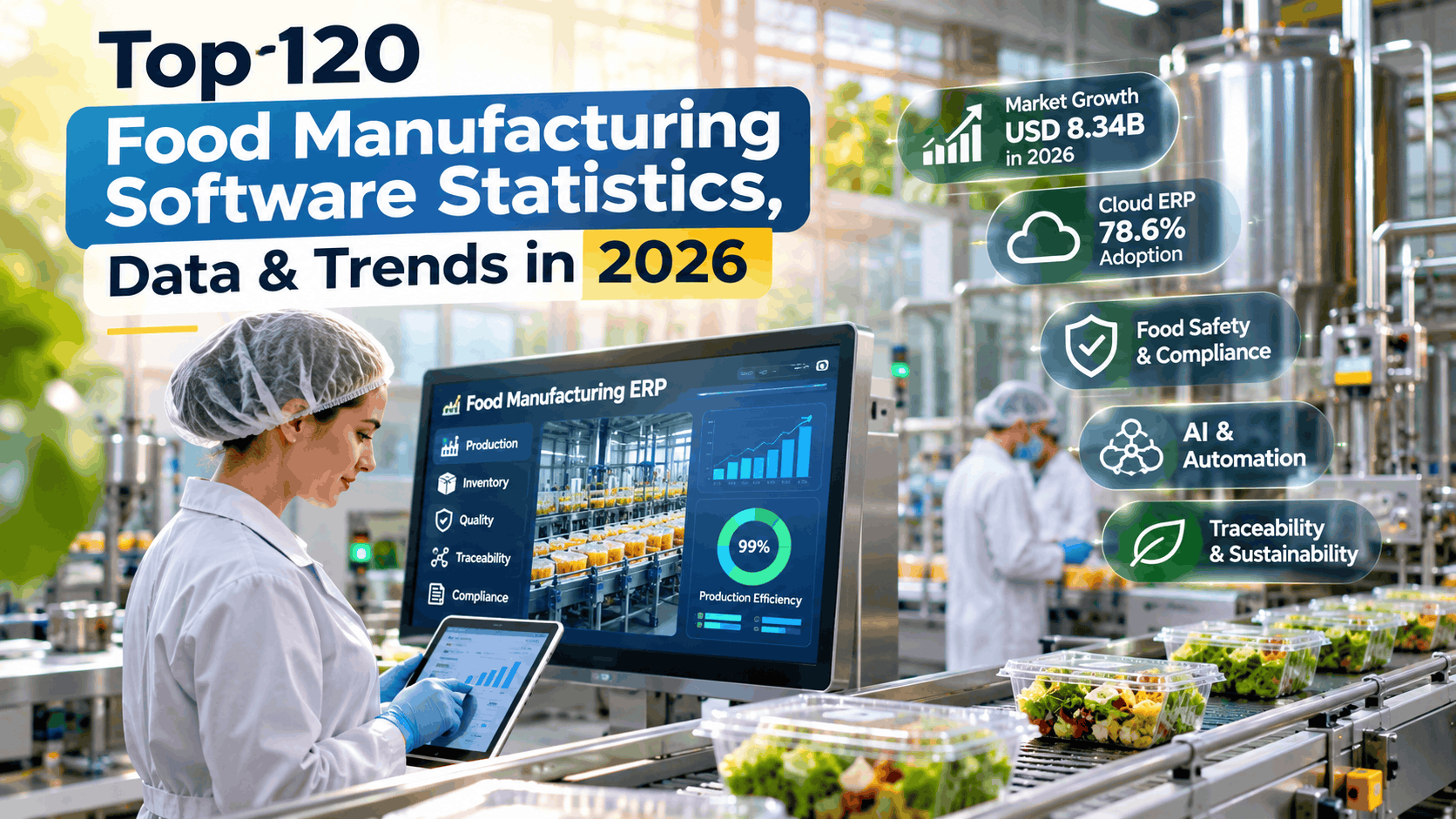
- Food Manufacturing Software Market Growth: The global food manufacturing software market is projected to reach USD 8.34 billion in 2026 and USD 18.42 billion by 2033, growing at an 11.94% CAGR, driven by increasing demand for ERP, automation, and digital production management solutions.
- Cloud ERP Adoption and Food Safety Compliance: Approximately 79% of major food manufacturers use ERP-based systems, while 78.6% of new ERP implementations favor cloud infrastructure, highlighting growing investments in food traceability, regulatory compliance, inventory management, and operational efficiency.
- AI, Automation, and Smart Manufacturing Trends: Around 45% of food and beverage manufacturers have adopted AI technologies in 2026, with AI-driven predictive maintenance potentially reducing equipment downtime by 30%–50%, accelerating the shift toward intelligent production, predictive analytics, and automated quality control.
Food manufacturing software in 2026 is a rapidly growing market, projected to reach USD 8.34 billion and expand at an 11.94% CAGR through 2033. Food manufacturers use ERP systems, artificial intelligence, cloud technology, and automation to improve production efficiency, strengthen food safety compliance, reduce operational costs, and enhance supply chain traceability.
The global food manufacturing industry is undergoing a significant digital transformation as businesses increasingly adopt advanced software solutions to improve production efficiency, strengthen food safety compliance, reduce operational costs, and optimize supply chain management. In 2026, food manufacturing software, food and beverage ERP systems, manufacturing execution systems (MES), artificial intelligence (AI), and digital traceability platforms are becoming essential technologies for food processors, manufacturers, and distributors seeking to remain competitive in an increasingly complex market.
Also, read our article on the Top 10 Best Food Manufacturing Software To Use.

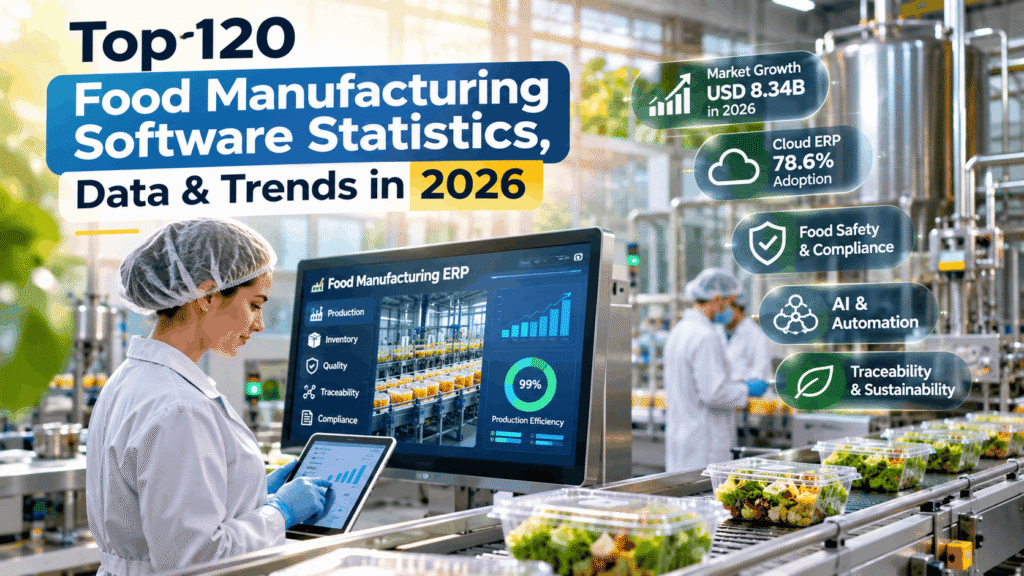
According to industry market projections, the global food manufacturing software market is expected to reach USD 8.34 billion in 2026 and expand to USD 18.42 billion by 2033, representing a compound annual growth rate (CAGR) of 11.94%. Alternative market estimates vary depending on software categories and research methodologies, but consistently indicate sustained demand for digital manufacturing solutions. North America continues to dominate the market, accounting for approximately 38% of global market share, while Asia-Pacific is emerging as an important growth region.
One of the most significant food manufacturing software trends in 2026 is the growing adoption of cloud-based enterprise resource planning (ERP) systems. Approximately 79% of major food manufacturers use ERP-based manufacturing management systems, while an estimated 78.6% of new ERP implementations favor cloud infrastructure over traditional on-premise deployments. These technologies enable manufacturers to integrate inventory management, production scheduling, procurement, recipe formulation, quality assurance, and financial operations into centralized platforms, improving operational visibility and decision-making.
Food safety, regulatory compliance, and supply chain transparency are also accelerating software investments. The global food traceability software market reached approximately USD 628.53 million in 2025 and is projected to grow at a CAGR of 15.90% between 2026 and 2035. With increasing emphasis on the Food Safety Modernization Act (FSMA), Hazard Analysis and Critical Control Points (HACCP), ISO 22000, and other international food safety standards, manufacturers are prioritizing digital batch tracking, automated compliance documentation, real-time monitoring, and recall management capabilities.
Meanwhile, artificial intelligence and smart manufacturing technologies are reshaping food production operations. Industry estimates suggest that approximately 45% of food and beverage manufacturers have adopted AI technologies in 2026, while AI-driven predictive maintenance can reduce equipment downtime by 30% to 50% in applicable manufacturing environments. AI-powered quality inspection, predictive analytics, automated production planning, and intelligent inventory optimization are creating new opportunities to improve productivity, minimize food waste, and strengthen operational resilience.
Despite these advancements, food manufacturers continue to face challenges involving rising labor costs, cybersecurity threats, implementation expenses, and complex regulatory requirements. Approximately 55% of ERP implementations exceed their original budgets, while 68% take longer than initially planned. These challenges highlight the importance of selecting suitable food manufacturing software, establishing realistic implementation strategies, and evaluating the long-term return on investment.
This comprehensive guide explores the Top 120 Food Manufacturing Software Statistics, Data & Trends in 2026, covering global market size, industry growth forecasts, ERP adoption rates, cloud deployment trends, food traceability software, food safety compliance, quality management systems, artificial intelligence, robotics, cybersecurity, and software implementation performance.
Whether evaluating the best food manufacturing ERP software, researching food processing technology trends, planning a digital transformation strategy, or assessing investment opportunities in the food technology sector, these statistics provide valuable insights into the technologies, market developments, and operational priorities shaping the future of food and beverage manufacturing in 2026 and beyond.
Before we venture further into this article, we would like to share who we are and what we do.
About 9cv9
9cv9 is a business tech startup based in Singapore and Asia, with a strong presence all over the world.
With over ten years of startup and business experience, and being highly involved in connecting with thousands of companies and startups, the 9cv9 team has listed some of the top and best companies/tools in this review.
If you like to get your company listed in our top B2B software reviews, check out our world-class 9cv9 Media and PR service and pricing plans here.
Top 120 Food Manufacturing Software Statistics, Data & Trends in 2026
Section 1: Market Size & Growth Outlook
- Food manufacturing software revenue is projected to hit USD 8.34 billion in 2026. This underscores how quickly food processors are shifting operational budgets toward digital production and compliance tools.
- The global food manufacturing software market is forecast to reach USD 18.42 billion by 2033, growing at an 11.94% CAGR from 2026. Such double-digit growth signals that software adoption is becoming a core strategic priority rather than an optional upgrade for food producers.
- An alternative market model places the food manufacturing software category at USD 6.36 billion in 2026, rising to USD 8.68 billion by 2035. The wide variance across analyst estimates reflects differing definitions of “software” scope, but all point toward sustained upward momentum.
- The broader food manufacturing software segment was valued at USD 7,920 million in 2025 and is projected to reach USD 13,385.8 million by 2033. This steady 6.78% CAGR trajectory highlights consistent, non-cyclical demand tied to regulatory and operational necessity.
- North America commands roughly 38% of global food manufacturing software market share in 2025. This regional dominance is largely attributed to stringent FDA/USDA compliance mandates that push manufacturers toward digital recordkeeping.
- North America operates more than 50,000 food and beverage manufacturing establishments that fuel software demand. This large installed base of facilities represents a durable, ongoing addressable market for ERP and compliance vendors.
- The United States alone hosts more than 42,000 food and beverage manufacturing facilities actively adopting production software. This concentration makes the U.S. the single largest national market for food-specific ERP solutions.
- Approximately 79% of major food manufacturers now use ERP-based manufacturing management systems. This high penetration rate shows ERP has become close to a baseline requirement for mid-size and large food producers.
- The MES (Manufacturing Execution System) segment for food and beverage is projected to grow from USD 7.3 billion to USD 10.7 billion, at a 7.9% CAGR. MES growth reflects rising demand for real-time production visibility on the plant floor.
- Large enterprises represent roughly 60% of ERP software market share within the food and beverage sector. Bigger manufacturers continue to lead adoption due to greater capital availability and more complex multi-site operations.
- SMEs in food manufacturing software adoption are projected to grow fastest, at a 9.5% CAGR. This signals that affordable, subscription-based ERP tools are finally closing the technology gap for smaller food producers.
- The broader food software market (covering ERP, inventory, and order management) was valued at USD 12.5 billion in 2024 and is estimated to reach USD 30 billion by 2033. A projected 10.2% CAGR reflects growing convergence between manufacturing, retail, and food-service software needs.
Section 2: Food Traceability Software & Solutions
- The global food traceability software market reached nearly USD 628.53 million in 2025. This figure captures dedicated tracking, batch, and lot-level software distinct from broader ERP suites.
- Food traceability software is forecast to grow at a 15.90% CAGR between 2026 and 2035, reaching USD 2.75 billion. This is among the fastest growth rates in the entire food-tech software landscape.
- The food traceability market overall (including hardware, software, services) is projected to expand from USD 36.88 billion in 2026 to USD 67.44 billion by 2034. This 7.84% CAGR reflects the convergence of consumer transparency demands with regulatory mandates.
- The software segment is expected to lead the food traceability market, contributing 26.33% of global share in 2026. Software’s leading position over hardware demonstrates that digital recordkeeping now outweighs physical tracking devices in market value.
- ERP systems account for approximately 27.6% of the food traceability software market share. This shows traceability functionality is increasingly embedded directly within core ERP platforms rather than sold as standalone tools.
- Around 72% of food companies in the U.S. report using traceability software to improve supply chain transparency. This high adoption rate reflects the practical necessity of digital tracking under modern food safety law.
- Nearly 68% of consumers say they prefer food products with clear origin tracking. Consumer-facing transparency demand is a direct commercial driver pushing manufacturers toward traceability software investment.
- Approximately 64% of food companies are adopting digital traceability systems specifically to improve supply chain visibility. This statistic illustrates that operational efficiency, not just compliance, is a key motivator for traceability software purchases.
- Roughly 69% of food businesses report a primary focus on compliance and safety tracking when selecting traceability software. Compliance readiness remains the dominant purchasing driver in this software category.
- North America holds approximately 34% share of the global food traceability software market, followed by Asia-Pacific at 29% and Europe at 27%. This regional split shows traceability software demand is genuinely global rather than concentrated in a single market.
- SAP SE leads the food traceability solutions market with over 8.5% share, and the top five vendors collectively hold 41.7% share. Market concentration among a handful of major vendors indicates significant consolidation in enterprise-grade traceability tools.
- The food traceability solutions market was valued at USD 26.2 billion in 2025 and is projected to reach USD 64.5 billion by 2035 at a 7.5% CAGR. This broader valuation, inclusive of full solution stacks, underlines how large the traceability technology opportunity has become.
Section 3: Food Safety, HACCP, FSMA & Compliance
- Food compliance software platforms in 2026 increasingly unify FSMA, HACCP, GFSI, FSSC 22000, SQF, and BRCGS requirements into a single system. This convergence reduces the administrative burden of juggling multiple separate compliance tools.
- The FDA’s FSMA Rule 204 traceability compliance deadline of January 20, 2026 has accelerated software adoption industry-wide. Regulatory deadlines like this one act as concrete forcing functions that push manufacturers to modernize recordkeeping systems.
- HACCP compliance software is increasingly required to support 21 CFR Part 11 electronic recordkeeping standards. This shows food safety software is now expected to meet the same data-integrity bar as regulated pharmaceutical systems.
- Digital checklist and paperless inspection tools are becoming standard features across food safety management software in 2026. This shift away from paper-based inspections materially reduces manual data entry errors and speeds up audits.
- Temperature monitoring with automated excursion alerts is now a core module in most modern food safety software suites. Automated sensor-based alerts help catch cold-chain failures before they escalate into safety incidents.
- Approximately 72% of major manufacturers implement digital traceability platforms specifically for regulatory compliance purposes. This reinforces that regulatory pressure, more than internal efficiency goals, drives most compliance software purchases.
- Nearly 65% of large food manufacturers operate integrated ERP and manufacturing execution platforms to strengthen traceability and compliance. Integration between ERP and MES layers is increasingly viewed as essential rather than optional for regulatory readiness.
- Corrective and preventive action (CAPA) tracking and supplier compliance management are now considered baseline features expected in food safety software. These capabilities let manufacturers close safety gaps faster and demonstrate audit-readiness to regulators.
- Food safety software adoption is being driven by evolving frameworks including FSMA 402 and GFSI, which expect accurate, real-time records at all times. This raises the bar for what “compliant” recordkeeping actually looks like in 2026.
- In the UK alone, there have already been almost 180 product recalls in 2026. Rising recall counts in a major food market illustrate why compliance software investment continues to accelerate globally.
Section 4: Quality Management Software (QMS)
- The global Quality Management Software market is estimated at USD 20,305.49 million in 2026 and projected to reach USD 61,037.88 million by 2035, at a 13% CAGR. This rapid expansion signals that quality assurance is shifting from manual spot-checks to fully digitized workflows.
- An alternate estimate values the QMS software market at USD 13.4 billion in 2026, growing to USD 28.8 billion by 2033 at an 11.5% CAGR. Even conservative estimates confirm QMS software is one of the fastest-growing compliance technology categories.
- Over 58% of major global food and beverage producers had deployed quality management solutions by 2024 to comply with standards such as HACCP and ISO 22000. Majority adoption among large producers suggests QMS software has crossed from early-adopter status into mainstream use.
- As of 2024, approximately 74% of enterprises across all industries had implemented at least one form of QMS. This broad cross-industry benchmark provides useful context for how food manufacturers compare to other regulated sectors.
- Cloud-based QMS deployments represent roughly 48% of all QMS installations, ahead of web-based (32%) and on-premise (20%) models. The clear cloud preference mirrors the wider shift away from on-premise infrastructure across manufacturing software generally.
- The QMS software market totaled USD 10.0 billion in 2024, with North America and Europe accounting for 72.3% of global spend. This concentration highlights how mature regulatory regimes in these regions directly translate into higher software spend.
- Globally, more than 75,000 organizations use QMS software to manage document control, audits, CAPA, and supplier quality. This figure demonstrates the scale of enterprise reliance on centralized quality platforms.
- The QMS software market is projected to grow from USD 11.73 billion in 2026 to USD 20.43 billion by 2031 at an 11.7% CAGR. Consistent double-digit growth projections across multiple analyst firms reinforce confidence in this category’s trajectory.
- Over 80% of companies using QMS software report faster regulatory submissions after deployment. This is one of the clearest, most measurable ROI indicators for quality management technology investment.
- Documentation control, data integrity, and CAPA remained among the most frequently cited compliance deficiencies during FDA enforcement activity in 2025. This directly explains why QMS software adoption continues accelerating — it targets the exact gaps regulators are penalizing.
Section 5: ERP & Cloud Deployment Trends
- Cloud-based ERP deployments account for approximately 70.4% of all ERP implementations as of 2024. This confirms cloud has decisively overtaken on-premise as the default deployment model for food manufacturers.
- Roughly 78.6% of new ERP implementations in 2026 are choosing cloud infrastructure over on-premise systems. New buyers are even more cloud-biased than the existing installed base, suggesting the shift will keep accelerating.
- Cloud ERP adoption climbed to 64% in 2024, up from 44% in 2020. This 20-percentage-point jump in just four years illustrates how rapidly manufacturers have modernized their infrastructure choices.
- Manufacturing represents approximately 47% of all ERP software purchases and 32% of total ERP market share. This makes manufacturing, including food processing, the single largest buyer category in the entire ERP industry.
- The manufacturing segment accounted for 53.71% of the cloud ERP market share in 2026. Manufacturing’s dominance within cloud ERP specifically shows the sector has embraced modern deployment models even faster than the broader economy.
- Cloud ERP is reported to deliver a 66% improvement in operational efficiency and 78% productivity gains among adopters. These figures give food manufacturers concrete, quantifiable benchmarks to justify ERP investment internally.
- Cloud ERP adoption is associated with 91% inventory optimization and a 62% cost reduction in purchasing and inventory management. For food manufacturers managing perishable inventory, these efficiency gains directly translate into reduced spoilage and waste.
- Average cloud ERP return on investment reaches 52%, meaning roughly $1.52 returned for every dollar invested. This ROI benchmark helps operations leaders build a defensible business case for ERP modernization.
- A mid-size ERP implementation averages USD 7.1 million in cost and 17.4 months in duration. These figures highlight that ERP rollouts remain a substantial capital and time commitment even in the cloud era.
- Approximately 55% of ERP implementations exceed their original budget, and 68% run longer than planned. These sobering statistics are a reminder that vendor selection and implementation partner experience matter as much as the software itself.
- Only 61% of organizations report their ERP implementation met original objectives. This gap between expectation and outcome underscores the importance of realistic scoping before an ERP project begins.
- Data migration is cited as the top ERP implementation challenge by 62% of organizations. For food manufacturers with years of historical batch and lot data, this is a particularly critical planning consideration.
- The most commonly used ERP modules are Finance/Accounting (95%), Inventory/Warehouse (69%), Sales/CRM (65%), Procurement (61%), and HR/Payroll (58%). This module ranking gives food manufacturers a useful benchmark for prioritizing phased ERP rollouts.
- Approximately 47% of organizations plan to replace or upgrade their ERP system within the next 24 months. This high refresh rate suggests the food manufacturing ERP market will remain active well beyond 2026.
Section 6: AI, Predictive Maintenance & Smart Manufacturing
- AI adoption within the food and beverage manufacturing sector stands at approximately 45% in 2026. This places food and beverage ahead of several other industrial sectors, driven by strict compliance and tight margin pressures.
- Globally, 56% of manufacturers now use some form of AI in maintenance or production operations, up from just 18% with fully deployed AI in 2023. This rapid maturation shows AI has moved from pilot projects to production-scale deployment within just a few years.
- Manufacturing facilities using AI-driven predictive maintenance report a 30% to 50% reduction in total machine downtime. For food processors running continuous production lines, this level of downtime reduction has a direct impact on throughput and revenue.
- AI-enabled predictive maintenance also extends the remaining useful life of production assets by 20% to 40% compared to calendar-based maintenance. This extends the value of existing capital equipment, delaying costly replacement cycles.
- The average cost of unplanned downtime in discrete manufacturing has risen to approximately USD 260,000 per hour in 2026. This steep figure explains why predictive maintenance software commands growing budget priority among plant operations teams.
- The AI in food and beverages market is valued at USD 18.34 billion in 2026 and projected to reach USD 88.37 billion by 2031, at a 36.96% CAGR. This is one of the fastest-growing AI application markets across any industry vertical.
- AI-driven predictive maintenance in food processing lifts overall equipment effectiveness (OEE) by 8-12%. OEE gains of this magnitude are considered highly significant in an industry where margins are typically thin.
- Unplanned downtime in food and beverage processing can exceed USD 50,000 per hour, making AI-driven predictive maintenance a fast-payback investment. This benchmark specifically calibrated to food and beverage plants helps operators size the potential ROI of AI tools.
- Early AI adopters in food and beverage report 8-12% overall-equipment-effectiveness gains and 10-15% cuts in inventory spoilage. Reduced spoilage is especially valuable in this industry given the perishable nature of raw materials and finished goods.
- Only about 14% of food and beverage companies currently run AI systems in full production across multiple workflows. This indicates the vast majority of the industry — 86% — still has significant AI adoption headroom, representing a major growth runway for software vendors.
- AI-powered automation adopters in food and beverage are achieving up to 30% reductions in food waste and 25% improvements in supply chain accuracy. These outcomes tie AI investment directly to both sustainability and operational performance goals.
- Gartner projects that 33% of enterprise software applications will include agentic AI by 2028, up from just 1% in 2024. This trajectory suggests food manufacturing ERP and MES platforms will increasingly embed autonomous, self-directing AI features.
- Asia Pacific holds a 33.70% share of the AI in food and beverages market and is expanding at a 40.25% CAGR. Government-backed smart-factory incentives in the region are accelerating AI-driven software adoption faster than in mature Western markets.
- Food sorting and grading applications account for a 29.75% share of the AI in food and beverages market. This reflects how computer-vision-based quality inspection has become the leading commercial AI use case in food processing.
Section 7: Automation, Robotics & Workforce
- The U.S. food industry faces a labor shortage of approximately 1 million workers. This persistent gap is one of the strongest structural drivers pushing manufacturers toward automation and workforce-management software.
- Around 750,000 manufacturing jobs in the U.S. remain unfilled despite historically low unemployment. This chronic vacancy rate reinforces why plant operators are turning to software-driven automation and scheduling tools.
- The Manufacturing Institute and Deloitte project that 2.1 million U.S. manufacturing jobs will go unfilled by 2030 due to skills shortages. This long-range forecast signals sustained, multi-year demand for labor-saving automation technology.
- Robot adoption is estimated to reduce labor costs in food manufacturing by approximately 20%. This is a key financial justification cited by plant operators when evaluating automation and robotics investments.
- 68% of food manufacturers reported that labor costs increased compared to the previous year, according to Food Engineering’s State of Food Manufacturing report. Rising labor costs are a direct financial pressure accelerating automation and software-driven efficiency initiatives.
- Workforce availability in food manufacturing has dropped by nearly 15% over the past three years. This decline illustrates the urgency behind current investment in cobots, scheduling software, and production automation.
- According to a 2024 industry survey, robot orders in the food and consumer goods sector surged by 85.6% year-over-year. This sharp increase indicates automation adoption is accelerating faster in food manufacturing than in many other industrial categories.
- Around 78% of food and beverage manufacturers say automation is essential to offset labor shortages, particularly in packaging, inspection, and material handling. This statistic captures automation’s shift from a “nice to have” to an operational necessity.
- Approximately 48% of total capital expenditure among surveyed food and beverage manufacturers is currently allocated toward automation initiatives. This level of capital commitment shows automation has become a top-tier budget priority, not a peripheral spend.
- The global food packaging robotics market is projected to grow at a robust double-digit CAGR between 2026 and 2035. Packaging automation remains one of the most mature and fastest-expanding automation categories within food manufacturing.
Section 8: Blockchain & Digital Ledger Traceability
- The blockchain food traceability market is projected to grow from USD 3,037.4 million in 2025 to USD 52,210.6 million by 2035, at a 32.9% CAGR. This explosive projected growth rate ranks blockchain traceability among the fastest-expanding technology niches in the entire food software landscape.
- The broader blockchain supply chain market is projected to grow from USD 1.77 billion in 2026 to USD 12.41 billion by 2031, at a 47.65% CAGR. This figure contextualizes food-specific blockchain adoption within the wider enterprise blockchain boom.
- Foodborne illness sickens roughly 600 million people annually worldwide and causes an estimated 420,000 deaths, according to FAO data. This global public health burden is a primary driver behind government and industry investment in blockchain-enabled traceability.
- The economic cost of unsafe food is estimated at USD 110 billion annually worldwide. This staggering figure provides critical context for why organizations are willing to invest in immutable, real-time tracking technologies like blockchain.
- In the U.S. specifically, foodborne illness affects about 48 million people annually, resulting in roughly 128,000 hospitalizations and 3,000 deaths, per CDC data. These domestic figures reinforce the urgency behind FSMA-driven traceability mandates.
- Foodborne illnesses are estimated to cost Americans USD 75 billion annually in medical care, lost productivity, and premature deaths. This is a frequently cited benchmark used to justify traceability technology investment at the enterprise level.
- Approximately 30-40% of food is estimated to be lost within the supply chain annually, a figure blockchain-enabled visibility aims to reduce. Waste reduction represents one of the most tangible, quantifiable value propositions for blockchain traceability adoption.
- A 2022 study found that 67% of surveyed supply chain stakeholders viewed blockchain positively as an influence on traceability adoption intent. This stakeholder sentiment data suggests blockchain traceability enjoys growing buy-in beyond just large enterprise adopters.
Section 9: Cybersecurity Risks in Food & Beverage Manufacturing
- Manufacturing, including food and beverage, accounted for more than a quarter of all investigated cyber incidents in 2025, making it the most targeted sector overall. This makes manufacturing broadly, and food processing specifically, a prime target that cybersecurity-integrated software must directly address.
- Manufacturing represented 27.7% of all cyberattacks in 2025, the highest share of any industry for the fifth consecutive year. This persistent targeting trend confirms that cybersecurity can no longer be treated as separate from core operational software strategy.
- Attacks against the food and agriculture sector specifically more than doubled between Q1 2024 and Q1 2025. This sharp escalation highlights food and beverage manufacturing’s growing exposure as production systems become more digitally connected.
- Ransomware attacks on manufacturing increased 58% year-over-year in 2025, with 1,060 manufacturing victims posted on leak sites. This scale of ransomware activity underscores why resilient, well-secured ERP and MES platforms are now a board-level concern.
- Verizon’s 2025 DBIR reported 1,607 confirmed data breaches in the manufacturing sector, up from 849 the prior year. This near-doubling of confirmed breaches demonstrates the accelerating cyber risk facing digitized food plants.
- More than 90% of breached manufacturing organizations had fewer than 1,000 employees — a size profile common among food manufacturers. This finding is particularly relevant for small and mid-size food producers who may assume they are too small to be targeted.
- The global average cost of a data breach reached USD 4.44 million in 2025, with U.S. breaches averaging USD 10.22 million. These figures make a strong financial case for investing in secure, modern software infrastructure over legacy, unpatched systems.
- Organizations using AI and automation extensively in security operations reported USD 1.9 million in average cost savings per breach. This demonstrates a direct link between smart security tooling and reduced financial exposure during incidents.
- Food and Ag-ISAC recorded 84 significant ransomware attacks against the food and agriculture sector between February and April 2025 alone. The concentration of attacks within just a few months illustrates how rapidly this threat has escalated for the industry.
- Remote access exploitation accounts for approximately 50% of attack vectors used against manufacturing targets. This statistic highlights why secure cloud ERP access controls are now a critical software selection criterion.
Section 10: Food Recalls, Safety Incidents & Financial Impact
- U.S. food recalls reached 57.4 million units in Q1 2026, nearly double the 28.76 million units recalled in Q4 2025. This sharp jump in recall scale illustrates the growing financial exposure food manufacturers face without robust traceability software.
- The average cost of a food recall for a mid-size manufacturer can exceed USD 10 million once destroyed product, legal fees, and lost shelf space are factored in. This figure is frequently cited as a core justification for investing in preventive quality and traceability technology.
- An event study of meat and poultry recalls found that Class I recalls erased approximately USD 109 million in shareholder wealth within five trading days. This shows recall risk extends well beyond direct operating costs into public market valuation.
- Severe food safety recalls can erase more than USD 100 million in shareholder value within days, excluding brand damage and litigation costs. This underlines why quality and compliance software increasingly gets evaluated as risk-mitigation infrastructure, not just an operational tool.
- Producer-side median recall costs following an overly broad FDA advisory range from USD 3.0 million to USD 72.7 million per firm. This wide cost range demonstrates how unpredictable and severe recall exposure can be without precise, software-driven traceability.
- The most common causes behind major 2026 recalls include undeclared allergens, foreign matter, and bacterial contamination. These recurring root causes are precisely the categories that modern allergen-management and quality-control software modules are designed to catch before products ship.
- The FDA’s average fully supported cost per direct work hour for reinspections is projected at USD 367,125 per FTE for fiscal year 2026. This regulatory cost structure indicates that non-compliance carries steep and rising government-assessed costs.
Section 11: Regional Market Share & Leading Vendors
- BatchMaster commands approximately 10% of the food manufacturing software market, driven by strength in recipe management and batch traceability. Its market position reflects strong demand for food-specific, rather than generic, ERP functionality.
- North America accounts for approximately 36-38% of the global food manufacturing software market, the largest of any region. This regional leadership is consistently confirmed across multiple independent market research firms.
- Europe holds approximately 27-29% share of the global food manufacturing and traceability software markets. Europe’s strong position is closely tied to stringent EU food safety and traceability regulation.
- Asia-Pacific is expected to register the fastest software adoption growth, at a 7.9% CAGR between 2026 and 2033. Rapid industrialization of food processing across the region is fueling this above-average growth rate.
- Approximately 69% of manufacturing companies prioritize software modernization as part of broader automation strategy. This confirms that ERP and MES upgrades are increasingly bundled into wider digital transformation initiatives rather than treated as standalone IT projects.
- Around 63% of food manufacturers allocate investment specifically toward cloud-enabled ERP implementation. This further validates cloud as the dominant deployment preference across the industry.
- Nearly 58% of software investment in food manufacturing is focused on AI-powered predictive maintenance and production optimization. This shows AI capability has become a leading purchasing criterion, not a secondary feature.
- Approximately 72% of new food manufacturing software launches now include AI capabilities. Vendors are rapidly embedding AI as a standard rather than premium feature across the category.
Section 12: SME Adoption, ROI & Implementation
- SMEs contribute approximately 33% of total food manufacturing software adoption. This meaningful minority share shows smaller food producers are no longer being left behind in the digital transformation wave.
- Nearly 64% of newly adopting SMEs in food manufacturing choose subscription-based (SaaS) deployment models. Lower upfront costs make cloud subscription pricing particularly attractive to smaller, cash-constrained food businesses.
- Automated inventory management is reported to lower stock discrepancies by approximately 23% among adopting food manufacturers. This directly reduces waste-related losses, a critical metric for perishable-goods businesses.
- Digital production planning tools improve operational efficiency by approximately 19% among food manufacturing software adopters. This efficiency gain helps justify software investment even for cost-sensitive small and mid-size producers.
- Around 51% of SMEs in food manufacturing now use mobile-enabled software applications for production monitoring and quality inspections. Mobile accessibility has become a key differentiator, allowing plant staff to conduct inspections directly from the production floor rather than returning to a desktop terminal.
Conclusion
The Top 120 Food Manufacturing Software Statistics, Data & Trends in 2026 highlight an industry undergoing rapid digital transformation, driven by increasing demand for operational efficiency, food safety compliance, supply chain transparency, and intelligent manufacturing technologies. As food and beverage manufacturers navigate rising production costs, workforce shortages, evolving regulatory requirements, and growing cybersecurity threats, adopting advanced software solutions has become an increasingly important strategy for maintaining competitiveness and achieving sustainable business growth.
With the global food manufacturing software market projected to reach USD 8.34 billion in 2026 and USD 18.42 billion by 2033, growing at a CAGR of 11.94%, the industry presents significant opportunities for software vendors, technology providers, manufacturers, and investors. The widespread adoption of enterprise resource planning (ERP) systems, manufacturing execution systems (MES), quality management software (QMS), and cloud-based production management platforms demonstrates how digital technologies are becoming integral to modern food manufacturing operations.
One of the most important findings from the 2026 food manufacturing software statistics is the accelerating transition toward cloud-based ERP solutions and integrated manufacturing platforms. With approximately 79% of major food manufacturers using ERP-based manufacturing management systems and an estimated 78.6% of new ERP implementations favoring cloud infrastructure, manufacturers are increasingly prioritizing scalability, real-time operational visibility, centralized data management, and seamless integration across production facilities.
Food safety and traceability remain equally important investment priorities. The global food traceability software market is projected to expand at a CAGR of 15.90% between 2026 and 2035, reflecting growing demand for digital batch tracking, automated compliance documentation, supplier monitoring, and efficient product recall management. As regulatory frameworks such as FSMA, HACCP, and ISO 22000 continue shaping industry requirements, manufacturers that invest in comprehensive food safety management software can strengthen compliance readiness, improve product accountability, and reduce operational risks.
Meanwhile, artificial intelligence, predictive maintenance, robotics, and smart manufacturing technologies are creating new opportunities for productivity improvements and cost optimization. With approximately 45% of food and beverage manufacturers adopting AI technologies in 2026 and predictive maintenance applications reporting potential equipment downtime reductions of 30% to 50%, intelligent automation is becoming an increasingly valuable component of food processing operations. AI-powered quality control, predictive inventory management, production forecasting, and automated inspection systems are also helping manufacturers address labor constraints, minimize food waste, and improve overall equipment effectiveness.
However, successful digital transformation requires more than simply purchasing new software. The statistics reveal that approximately 55% of ERP implementations exceed their original budgets, while 68% experience project delays. These findings emphasize the importance of careful software selection, realistic implementation planning, employee training, cybersecurity preparedness, and continuous performance evaluation. Food manufacturers must balance technological innovation with practical operational requirements to achieve measurable returns on their software investments.
Looking ahead, the future of food manufacturing software beyond 2026 will increasingly revolve around cloud ERP integration, AI-driven production optimization, real-time food traceability, automated quality assurance, predictive analytics, and cybersecurity resilience. Small and medium-sized food manufacturers are also expected to play a growing role in software adoption as affordable subscription-based platforms make advanced manufacturing capabilities more accessible.
Ultimately, the food manufacturing software statistics and trends for 2026 demonstrate that digital transformation is no longer limited to large multinational food producers. Manufacturers of all sizes can benefit from strategically implementing technologies that improve production visibility, strengthen food safety, optimize inventory, reduce waste, and support data-driven decision-making.
Businesses that prioritize scalable, secure, and industry-specific food manufacturing software will be better positioned to improve operational performance, adapt to changing regulatory requirements, and build long-term competitive advantages in the evolving global food and beverage manufacturing industry.
If you find this article useful, why not share it with your hiring manager and C-level suite friends and also leave a nice comment below?
We, at the 9cv9 Research Team, strive to bring the latest and most meaningful data, guides, and statistics to your doorstep.
To get access to top-quality guides, click over to 9cv9 Blog.
To hire top talents using our modern AI-powered recruitment agency, find out more at 9cv9 Modern AI-Powered Recruitment Agency.
People Also Ask
What is food manufacturing software?
Food manufacturing software is a digital solution that helps food and beverage manufacturers manage production planning, inventory, recipe formulation, quality control, regulatory compliance, supply chain operations, and financial processes through integrated systems.
What is the global food manufacturing software market size in 2026?
The global food manufacturing software market is projected to reach USD 8.34 billion in 2026, driven by increasing adoption of ERP systems, cloud-based manufacturing platforms, automation, and food safety management technologies.
How fast is the food manufacturing software market growing?
The global food manufacturing software market is forecast to grow at an 11.94% compound annual growth rate (CAGR) from 2026 to 2033, reaching approximately USD 18.42 billion by 2033.
What are the biggest food manufacturing software trends in 2026?
Major food manufacturing software trends in 2026 include cloud ERP adoption, artificial intelligence, predictive maintenance, automated quality inspections, real-time food traceability, smart manufacturing, robotics, and integrated food safety compliance systems.
What percentage of food manufacturers use ERP software?
Approximately 79% of major food manufacturers use ERP-based manufacturing management systems, demonstrating the growing importance of integrated software for production planning, inventory management, financial operations, and regulatory compliance.
What is food manufacturing ERP software?
Food manufacturing ERP software integrates essential business processes, including production scheduling, recipe management, inventory tracking, procurement, quality assurance, batch traceability, accounting, and supply chain management, into a centralized platform.
Why is cloud ERP becoming popular in food manufacturing?
Cloud ERP provides food manufacturers with scalable infrastructure, centralized data access, real-time production visibility, easier software updates, and reduced dependence on on-premise systems. Approximately 78.6% of new ERP implementations favor cloud infrastructure.
What percentage of ERP implementations use cloud technology in 2026?
Approximately 78.6% of new ERP implementations in 2026 are choosing cloud infrastructure over traditional on-premise systems, reflecting growing demand for flexible, scalable, and integrated enterprise resource planning solutions.
What is the food traceability software market size in 2026?
The global food traceability software market reached approximately USD 628.53 million in 2025 and is projected to grow at a 15.90% CAGR between 2026 and 2035, reaching approximately USD 2.75 billion by 2035.
Why is food traceability software important for manufacturers?
Food traceability software helps manufacturers track ingredients, production batches, suppliers, and finished products throughout the supply chain. It supports food safety compliance, faster product recalls, improved transparency, and better inventory control.
How does food manufacturing software improve food safety?
Food manufacturing software improves food safety through automated inspections, temperature monitoring, allergen management, batch tracking, corrective action management, and digital compliance records that help manufacturers identify and address potential safety risks.
What is HACCP compliance software?
HACCP compliance software helps food manufacturers identify food safety hazards, monitor critical control points, document corrective actions, maintain inspection records, and demonstrate compliance with Hazard Analysis and Critical Control Points requirements.
How does FSMA affect food manufacturing software adoption?
The Food Safety Modernization Act encourages food manufacturers to strengthen preventive controls, traceability, and recordkeeping. Software platforms support these requirements through digital tracking, compliance documentation, supplier monitoring, and recall management.
What is quality management software in food manufacturing?
Quality management software (QMS) helps food manufacturers manage quality inspections, audits, corrective and preventive actions, supplier quality, documentation, and regulatory compliance to maintain consistent product quality and food safety standards.
What is the global quality management software market size in 2026?
One industry estimate values the global quality management software market at approximately USD 20.31 billion in 2026, with projections reaching USD 61.04 billion by 2035 at a 13% CAGR across industries.
How is artificial intelligence used in food manufacturing?
Artificial intelligence supports predictive maintenance, automated quality inspections, demand forecasting, production scheduling, inventory optimization, food sorting, equipment monitoring, and supply chain analytics to improve manufacturing efficiency.
What percentage of food manufacturers use AI in 2026?
Approximately 45% of food and beverage manufacturers are estimated to have adopted AI technologies in 2026, while around 14% operate AI systems in full production across multiple workflows.
How much can AI predictive maintenance reduce manufacturing downtime?
AI-driven predictive maintenance can reduce equipment downtime by approximately 30% to 50% in applicable manufacturing environments by identifying potential equipment failures before they disrupt production operations.
How does food manufacturing software reduce food waste?
Food manufacturing software reduces food waste through inventory optimization, expiration-date tracking, demand forecasting, production planning, batch monitoring, and quality control. Some AI automation adopters report food waste reductions of up to 30%.
What is a manufacturing execution system (MES) for food production?
A manufacturing execution system monitors and manages production activities on the factory floor. Food manufacturers use MES software for real-time production tracking, equipment monitoring, quality inspections, batch management, and operational performance analysis.
What are the benefits of automation in food manufacturing?
Food manufacturing automation can improve production consistency, reduce manual labor requirements, increase operational efficiency, strengthen quality control, and minimize waste. Industry estimates suggest robotics can reduce certain manufacturing labor costs by approximately 20%.
How much does food manufacturing ERP implementation cost?
ERP implementation costs vary by company size, system complexity, integrations, and customization. One broader industry benchmark places average mid-size ERP implementation costs at USD 7.1 million, although smaller cloud-based solutions may cost substantially less.
What percentage of ERP implementations exceed their budgets?
Approximately 55% of ERP implementations exceed their original budgets, while 68% take longer than initially planned. These figures highlight the importance of realistic project planning, vendor evaluation, employee training, and data migration strategies.
What are the biggest challenges in implementing food manufacturing software?
Major challenges include high implementation costs, data migration, integration with legacy systems, employee training, cybersecurity risks, regulatory requirements, production disruptions, and difficulties achieving expected returns on investment.
How does food manufacturing software improve inventory management?
Food manufacturing software improves inventory management through real-time stock visibility, automated replenishment, lot tracking, expiration-date monitoring, and demand forecasting. Reported improvements include approximately 23% fewer stock discrepancies.
What are the cybersecurity risks facing food manufacturers in 2026?
Food manufacturers face cybersecurity threats involving ransomware, data breaches, unauthorized remote access, and operational disruptions. Manufacturing accounted for approximately 27.7% of cyberattacks in 2025, highlighting the importance of secure software systems.
How much does a food product recall cost manufacturers?
Food recalls can cost mid-size manufacturers more than USD 10 million when product disposal, legal expenses, operational disruption, and lost retail opportunities are considered. Actual costs vary significantly depending on recall severity and scale.
Which region dominates the food manufacturing software market?
North America leads the global food manufacturing software market, accounting for approximately 36% to 38% of market share. Europe follows, while Asia-Pacific represents an important growth region for digital manufacturing technologies.
Is food manufacturing software suitable for small businesses?
Yes. Small food manufacturers can use cloud-based ERP, inventory management, production planning, and compliance software. Approximately 64% of newly adopting SMEs favor subscription-based SaaS solutions because of their lower upfront infrastructure requirements.
What is the future of food manufacturing software beyond 2026?
The future of food manufacturing software centers on AI-powered automation, cloud ERP, predictive maintenance, digital traceability, intelligent quality control, robotics, cybersecurity, and integrated manufacturing platforms that improve efficiency, compliance, and sustainability.
Sources
- Business Research Insights
- Global Data Stats
- Congruence Market Insights
- Verified Market Reports
- Expert Market Research
- Global Growth Insights
- Fortune Business Insights
- SkyQuest Technology
- Global Market Insights
- Coherent Market Insights
- Mordor Intelligence
- GlobeNewswire
- Nulogy
- Guideflow
- My Field Audits
- FoodFlou
- Allera Tech
- Datahex
- Grand View Research
- Verdantix
- Market Growth Reports
- Polaris Market Research
- PR Newswire
- MarketsandMarkets
- Columbus News Online
- Research and Markets
- DocuClipper
- Anchor Group
- Companies History
- Quantumrun
- Parsli
- Bizowie
- Manufacturing Lead Generation
- F7i
- Food Engineering
- Barclays Corporate
- ESS Feed
- AlphaBOLD
- Exotica IT Solutions
- Victory Star
- IndexBox
- WiFiTalents
- Medium
- Partsimony
- GENEDGE
- Hefestus Technologies
- iFactory
- Future Market Insights
- DataM Intelligence
- Frontiers
- PatSnap
- TraceX Technologies
- CXTMS
- Manufacturing Business Technology
- Industrial Cyber
- FoodNavigator
- Food Industry Executive
- ScienceDirect
- TXOne Networks
- Total Assure
- Federal Register
- Yahoo
- MySA
- Spectacular Labs
- U.S. Food and Drug Administration
- Statista
- Emerald Publishing
- Stoneridge Software
- Folio3 FoodTech
- CRB Group