Key Takeaways
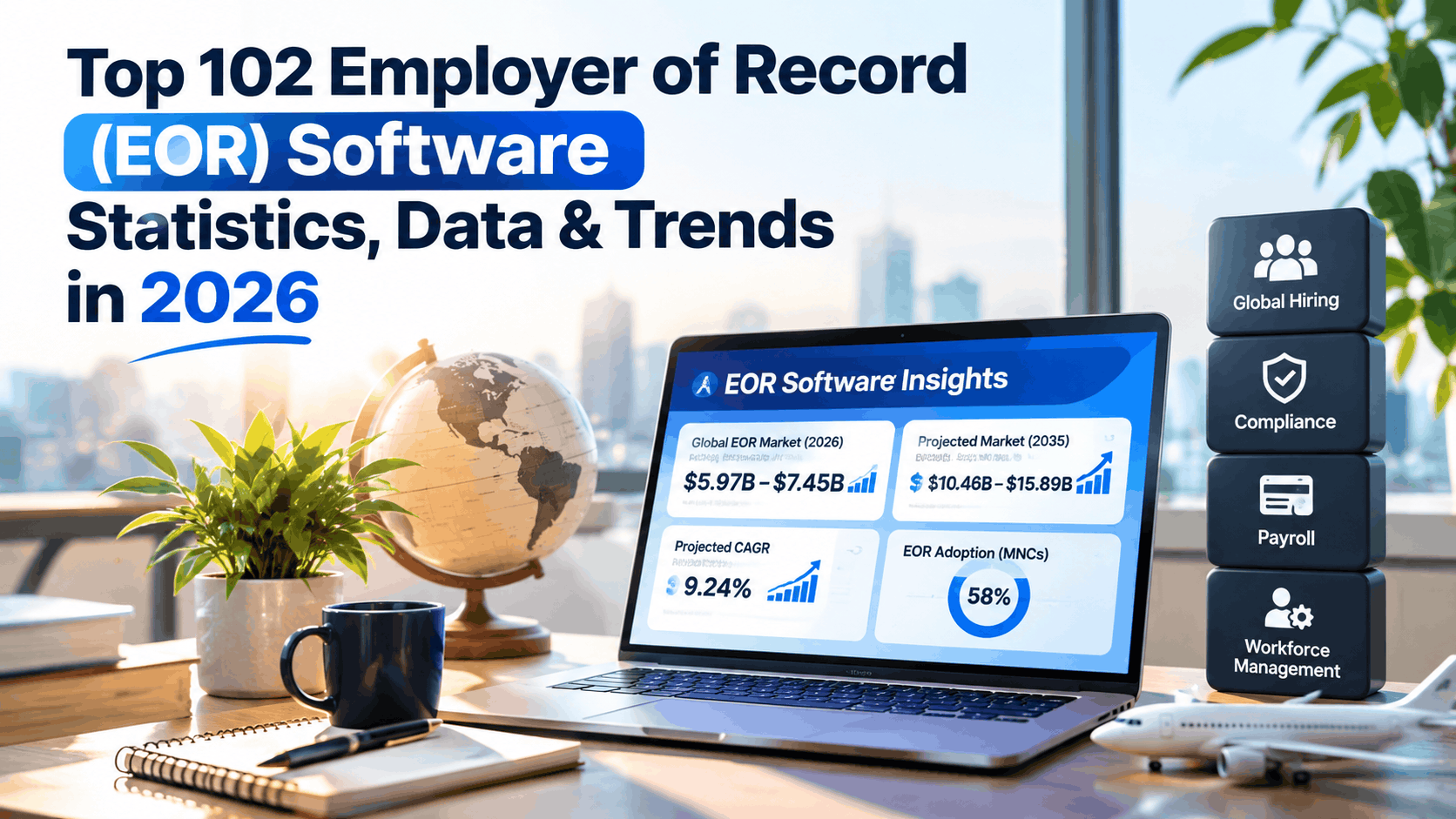
- Rapid EOR Market Growth: The global Employer of Record (EOR) software market is estimated at $5.97 billion to $7.45 billion in 2026, with forecasts projecting continued growth through 2035, driven by international hiring and workforce globalization.
- Rising Global Hiring and EOR Adoption: Approximately 58% of multinational companies reportedly use EOR services, while 86% of HR leaders identify international labor law compliance as a major challenge, accelerating demand for compliant cross-border employment solutions.
- AI Automation and Cost Efficiency: EOR software can potentially reduce first-year employment infrastructure costs by 60%–70%, while AI-powered payroll automation, cloud-based HR platforms, and real-time compliance monitoring are transforming global workforce management.
Employer of Record (EOR) software enables businesses to hire international employees without establishing local legal entities. In 2026, the global EOR market is estimated at $5.97 billion to $7.45 billion, driven by remote work, cross-border hiring, payroll automation, and employment compliance. Explore 102 key statistics covering market growth, adoption, pricing, and industry trends.
The global Employer of Record (EOR) software market is experiencing significant growth in 2026 as businesses increasingly embrace international hiring, remote workforce management, and cross-border employment solutions. With companies expanding into new markets and competing for global talent, Employer of Record (EOR) software has become an essential tool for simplifying international payroll, employee onboarding, benefits administration, and employment law compliance without establishing local legal entities.

According to industry estimates, the global Employer of Record market is valued between $5.97 billion and $7.45 billion in 2026, with projections suggesting it could reach $10.46 billion to $15.89 billion by 2035, depending on market definitions and growth assumptions. Some forecasts anticipate a compound annual growth rate (CAGR) of 9.24%, while broader workforce management segments could expand even faster. These figures highlight the increasing importance of EOR platforms within the global human resources technology ecosystem.
The rapid adoption of remote and hybrid working arrangements is a major driver of EOR software market growth. Industry estimates suggest that 52% of the global workforce participates in some form of remote or hybrid work in 2026, while 82% of companies offer flexible working arrangements. Additionally, approximately 58% of multinational companies reportedly use EOR services to support international employment operations. Small and medium-sized enterprises (SMEs) are also emerging as a major customer segment, accounting for an estimated 53% to 60% of the EOR market.


Regional trends further demonstrate the expanding opportunities within the Employer of Record industry. North America remains the largest EOR market, accounting for approximately 39% to 45% of global market share, followed by Europe at 28% to 30% and Asia-Pacific at 22% to 24%. Meanwhile, Asia-Pacific and Latin America are projected to experience particularly strong growth, driven by international recruitment, nearshoring, digital transformation, and increasing demand for skilled professionals in emerging economies.
Beyond workforce globalization, regulatory compliance and operational efficiency are accelerating the adoption of EOR software solutions. Industry data indicates that 86% of HR leaders identify international labor law compliance as a major workforce management challenge, while 87% of companies planning overseas expansion struggle with local tax and employment regulations. EOR platforms help businesses navigate these complexities while potentially reducing first-year employment infrastructure costs by 60% to 70% compared with establishing local legal entities, according to estimates included in the industry research.
Artificial intelligence, cloud-based infrastructure, and automated payroll processing are also transforming the competitive landscape. Approximately 38% of EOR providers reportedly use AI for payroll and compliance automation, while cloud-based EOR platforms account for an estimated 61% of deployments. Leading providers such as Deel, Remote, Multiplier, Remofirst, and Pebl continue to expand their international coverage and introduce technologies designed to improve employee onboarding, regulatory monitoring, and global workforce administration.
As the global employment landscape becomes increasingly interconnected, understanding the latest Employer of Record software statistics, EOR market size, adoption rates, pricing trends, and industry forecasts is essential for HR professionals, business owners, recruitment agencies, and international expansion teams.
This comprehensive guide to the Top 102 Employer of Record (EOR) Software Statistics, Data & Trends in 2026 explores the key figures shaping the industry, including global market growth, regional adoption, remote hiring trends, employment compliance challenges, EOR pricing, artificial intelligence integration, competitive developments, and future market opportunities. These insights provide a data-driven perspective on how Employer of Record software is transforming global hiring and helping organizations build compliant, scalable, and cost-efficient international workforces.
Before we venture further into this article, we would like to share who we are and what we do.
About 9cv9
9cv9 is a business tech startup based in Singapore and Asia, with a strong presence all over the world.
With over ten years of startup and business experience, and being highly involved in connecting with thousands of companies and startups, the 9cv9 team has listed some of the top and best companies/tools in this review.
If you like to get your company listed in our top B2B software reviews, check out our world-class 9cv9 Media and PR service and pricing plans here.
Top 102 Employer of Record (EOR) Software Statistics, Data & Trends in 2026
Market Size & Growth
- $4.4 billion — The global EOR market was valued at $4.4 billion in 2023, establishing a robust post-pandemic baseline that reflects the structural shift toward distributed workforce management.
- $5.2 billion — By 2024, the EOR market expanded to $5.2 billion as cross-border hiring became a permanent feature of multinational HR strategy rather than a pandemic-era workaround.
- $5.97–$7.45 billion — In 2026, the global EOR market is estimated at between $5.97 billion and $7.45 billion depending on market scope definition, underscoring the sector’s rapid institutionalization.
- 9.24% CAGR (2026–2035) — Custom Market Insights projects a 9.24% compound annual growth rate for the EOR market through 2035, driven by regulatory complexity and the globalization of talent acquisition.
- 14.8% expanded CAGR — When broader workforce platform services are included in the market definition, EOR-related services are forecast to grow at a 14.8% CAGR through 2036, reflecting platform convergence.
- $9.80 billion by 2033 — Data Bridge Market Research projects the EOR market to reach $9.80 billion by 2033, supported by demand from SMEs seeking compliant global expansion without entity setup costs.
- $10.46 billion by 2035 — Business Research Insights forecasts the market to reach $10.46 billion by 2035 at a 9.24% CAGR, making EOR one of the fastest-growing segments in the global HR tech ecosystem.
- $15.89 billion by 2035 — At the high-growth end, some analysts project the EOR market reaching $15.89 billion by 2035, driven by AI-powered platforms and fintech entrants commoditizing global payroll.
- $19.8 billion by 2036 — An expanded EOR market definition including integrated workforce platforms projects $19.8 billion in value by 2036, reflecting convergence with global HR infrastructure.
- $25 billion by 2034 — Exactitude Consultancy’s most aggressive projection places the full EOR addressable market at $25 billion by 2034, driven by SMB globalization and emerging market labor supply.
- 7% CAGR (Data Bridge) — Data Bridge Market Research projects a steady 7% CAGR for the core EOR market from 2026 to 2033, representing a more conservative estimate that excludes adjacent workforce services.
- $8.59 billion by 2030 — Verified Market Research forecasts the EOR market to reach $8.59 billion by 2030, placing it firmly in the upper tier of HR tech verticals by decade’s end.
Regional Dynamics
- 39–45% North America share — North America commands 39–45% of the global EOR market in 2026, driven by the US’s large cross-border hiring base and mature compliance infrastructure.
- 28–30% Europe share — Europe holds the second-largest EOR market share at 28–30%, supported by fragmented labor law frameworks across EU member states that make compliant hiring highly complex.
- 22–24% Asia-Pacific share — Asia-Pacific accounts for 22–24% of the global EOR market in 2026 and is growing faster than any other region as multinational hiring in India, Vietnam, and the Philippines accelerates.
- 17.1% APAC CAGR — Asia-Pacific EOR is projected to grow at a 17.1% CAGR through 2035, making it the single fastest-growing regional market and the top destination for EOR provider expansion.
- 18.5% Latin America CAGR — Latin America is projected to grow EOR demand at an 18.5% CAGR, fueled by US nearshoring to time-zone-aligned markets including Mexico, Colombia, Argentina, and Brazil.
- 156% LATAM remote hire growth — International companies increased remote hiring in Latin America by 156%, making the region a primary EOR destination for US and European businesses seeking cost-effective talent.
- 14.7% Europe CAGR — Europe’s EOR market is projected to grow at 14.7% CAGR through 2033, driven by GDPR complexity, posted worker regulations, and increasingly divergent post-Brexit employment frameworks.
- $1.93 billion Europe market (2024) — Europe’s EOR market was valued at approximately $1.93 billion in 2024, anchored by the UK, Germany, France, and the Netherlands as the largest country-level markets.
- 97% UAE expansion plans — 97% of UAE-based companies plan international expansion, with 41% intending to leverage external hiring partners like EOR providers to navigate unfamiliar legal environments.
- ~6% Middle East & Africa share — The Middle East and Africa region represents approximately 6% of the global EOR market in 2026, but carries one of the highest growth potentials as GCC economies diversify away from oil.
Remote Work & Workforce Trends
- 52% global remote workforce — By 2026, 52% of the global workforce engages in some form of remote or hybrid work, up from 28% in 2023, creating sustained structural demand for cross-border compliance solutions.
- 82% companies offer remote options — 82% of companies globally now offer remote or hybrid work arrangements, making multi-jurisdictional employment compliance an enterprise-wide operational priority.
- 27% fully remote in 2026 — 27% of full-time employees worldwide work fully remotely in 2026, while a further 52% hold hybrid roles that often span multiple jurisdictions.
- 71% companies with permanent remote work — 71% of companies allow some form of permanent remote work as of 2024, creating an enduring baseline of distributed workforce compliance demand.
- 88% no full RTO mandate — 88% of executives at remote or hybrid companies have no plans for a full return-to-office mandate, cementing long-term demand for EOR solutions through the decade.
- 47% mid-sized firms use EOR — Nearly 47% of mid-sized companies had used EOR for remote team management by 2024, a sharp increase from pre-pandemic adoption levels.
- 36.2 million US remote workers — Upwork forecasts 36.2 million Americans will work remotely by 2025, representing approximately 22% of the entire US workforce and the world’s largest national remote talent pool.
- 1 billion remote workers by 2030 — By 2030, an estimated 1 billion people globally will work remotely at least part-time, representing 30% of the worldwide workforce and an enormous addressable market for EOR.
- 50% emerging market hires — Emerging economies accounted for 50% of all international hires in 2025, with EOR platforms serving as the primary vehicle for compliant cross-border employment in these markets.
- 35% US cross-border hires via EOR — Approximately 35% of US cross-border hires in 2024 were facilitated via EOR arrangements, reflecting growing enterprise confidence in the EOR model as a primary hiring vehicle.
- 54% use global payroll services — 54% of companies globally use dedicated global payroll services for their remote employees in 2026, reflecting the structural embedding of EOR payroll infrastructure.
EOR Adoption & Enterprise Size
- 58% multinationals use EOR — 58% of multinationals already use EOR services, with the next wave of growth expected to come from SMBs accessing enterprise-grade global hiring capabilities via self-serve platforms.
- 53–60% SME market share — SMEs represent 53–60% of the global EOR client base in 2026, making small and mid-sized businesses the largest single segment driving EOR demand.
- ~14% SME CAGR — Small enterprises show the highest EOR adoption growth rate at approximately 14% CAGR, nearly double the growth rate of large corporations, as global hiring barriers fall.
- 48% full-service EOR market share — Full-service EOR captured 48% of the market in 2025, preferred for its comprehensive coverage of employment contracts, payroll, statutory benefits, and ongoing compliance monitoring.
- 61.73% international EOR dominance — International EOR arrangements are expected to dominate with a 61.73% share of the market in 2026, growing at 8% CAGR as global talent sourcing becomes mainstream.
- 31% IT/Tech sector share — The IT and technology sector accounts for 31% of all EOR usage globally — the largest sector by adoption — reflecting fierce cross-border competition for software engineers and AI talent.
- 15% IT sector CAGR — Technology sector EOR spending is projected to grow at a 15% CAGR, the highest of any vertical, as companies race to access globally distributed engineering and AI specialist talent.
- 10% manufacturing CAGR — Manufacturing EOR adoption is growing at approximately 10% CAGR as production companies expand quality assurance and engineering teams across Southeast Asia and Eastern Europe.
Compliance & Misclassification Risk
- 86% HR leaders cite compliance as top challenge — 86% of HR leaders identify compliance with international labor laws as their top global workforce challenge in 2026, making it the single most cited driver of EOR adoption.
- 87% cite local tax laws as hardest task — 87% of companies planning international expansion identify meeting local tax and employment regulations as their most difficult operational challenge going into 2026.
- 74% rely on external HR experts — 74% of organizations already rely on external specialists for international HR guidance, reflecting widespread recognition that in-house compliance expertise is insufficient for global operations.
- 30% gig workers misclassified — An ILO report found that approximately 30% of global gig economy workers are misclassified, leaving them without formal employment protections and exposing companies to significant legal liability.
- $26,253+ per-worker US misclassification risk — Per-worker US misclassification losses can exceed $26,253 in combined penalties, back-pay, and taxes, making EOR a financially compelling risk-mitigation tool.
- $3–4 billion annual US payroll tax loss — The US federal government loses an estimated $3–4 billion annually in payroll tax revenue due to contractor misclassification, intensifying DOL enforcement activity across sectors.
- $300,000+ Mexico fine per incident — Misclassification fines in Mexico can reach $300,000+ USD per incident in 2026, with additional retroactive liability for back benefits, taxes, and mandatory profit-sharing.
- €79 million Glovo fine — Glovo was fined €79 million for worker misclassification in Spain, a landmark enforcement case now widely cited in global EOR compliance risk discussions.
- $9.3 million US nursing agency penalty — Medical Staffing of America was ordered to pay $9.3 million in 2025 for misclassification of nurses, signaling intensified US Department of Labor enforcement across healthcare and staffing.
- 27% markets with classification ambiguity — Worker classification remains legally ambiguous in approximately 27% of global markets, creating persistent compliance uncertainty for companies hiring internationally without EOR.
- EU Platform Work Directive (December 2024) — The EU Platform Work Directive 2024/2831 entered into force in December 2024, establishing a presumption of employment for platform workers across all 27 EU member states with transposition required by December 2026.
- 51% companies seeking compliance support — 51% of companies cite accessing local compliance and market-entry expertise as one of their primary reasons for choosing an EOR over attempting direct foreign entity setup.
Pricing & Cost Analysis
- $199–$800+/month per employee — EOR pricing ranges from $199 to over $800 per employee per month depending on the provider, country, and service scope, with significant variation in what’s included at the base price.
- $400–$600 average EOR cost — The average EOR cost for international hiring sits at $400–$600 per employee per month in 2026, reflecting the market’s convergence toward a competitive mid-tier pricing band.
- 60–70% savings vs. local entity — Companies using EOR instead of setting up a local legal entity typically save 60–70% on first-year total cost of employment, making EOR the economically dominant choice for small headcounts.
- $25,000–$100,000+ entity setup cost — Setting up a foreign legal entity typically costs $25,000–$100,000+ per market and takes 3–6 months, costs entirely eliminated by EOR from day one.
- $50,000–$250,000 subsidiary cost — Foreign subsidiary establishment costs range from $50,000 to $250,000 per country, compared to EOR monthly fees that begin below $200 for some providers.
- 20–30% hidden cost inflation — Foreign exchange markups, onboarding fees, and benefit add-ons can inflate total EOR bills by 20–30% above headline pricing, making total-cost-of-ownership transparency a critical vendor evaluation factor.
- 15–25 employee break-even threshold — EOR becomes more expensive than a local entity once a company exceeds 15–25 employees in a single country, a key strategic threshold for global workforce planning.
- 5–10% back-pay exposure — Companies that forego EOR and misclassify workers often face retroactive back-payment obligations totaling 5–10% of annual payroll when identified by tax authorities.
- $199/month Remofirst — Remofirst offers EOR at $199/month per employee in 185+ countries, the lowest published price point in the market, targeting cost-sensitive SMBs and startups.
- $399/month Rise — Rise offers EOR services at $399/month per employee across 190+ countries, having processed over $1.3 billion in cumulative payroll volume through its platform.
- $599/month Remote.com — Remote.com prices its EOR service at $599/month in approximately 90 countries, focusing on a wholly-owned entity model that prioritizes compliance consistency over geographic breadth.
Technology & AI Integration
- 38% AI payroll automation — 38% of EOR providers now use AI for payroll and compliance automation in 2026, enabling real-time regulatory monitoring, anomaly detection, and multi-country tax calculation.
- 61% cloud-based EOR deployments — Cloud-based EOR platforms account for 61% of all deployments, providing the scalability, accessibility, and integration capabilities that distributed global teams require.
- 34% multilingual onboarding — 34% of EOR providers offer multilingual onboarding and real-time compliance tools, addressing the language and cultural needs of increasingly diverse international workforces.
- 59% upgraded APIs — More than 59% of EOR platforms upgraded their APIs in 2023–2024 to enable deeper integration with third-party ERP and HRIS systems, reducing data silos in global workforce management.
- 95% admin time reduction — AI-powered EOR tools can reduce administrative HR time by up to 95%, freeing HR teams to focus on strategic workforce planning and employee experience rather than compliance paperwork.
- 32% AI onboarding adoption growth — AI-enabled onboarding system adoption within EOR platforms rose approximately 32% year-over-year, significantly streamlining the multi-country employee integration process.
- 37% plan fully AI-run hiring by 2026 — 37% of companies plan to run fully AI-assisted hiring processes by 2026, with AI tools reducing recruiter time-to-hire by 40–60% in early deployments.
- 38% cloud HR surge — Cloud-based HR solutions surged 38% in the 2023–2025 period, with cloud-native HRIS now accounting for the majority of new EOR platform deployments globally.
- Deel AI compliance dashboards — Deel launched enhanced AI-powered compliance dashboards and predictive analytics in November 2025, enabling real-time regulatory risk monitoring across 130+ countries for its 40,000+ clients.
- Pebl “Alfie” AI assistant — Pebl (formerly Velocity Global) launched “Alfie,” an AI employment law assistant covering 185+ countries, transforming complex local labor law into actionable hiring guidance within minutes.
Competitive Landscape
- 150+ active EOR platforms — Over 150 active EOR platforms operate globally in 2026, ranging from large HR tech conglomerates like Deel and G-P to specialized boutique providers targeting niche geographies or industries.
- 40,000+ Deel clients — Deel, the market leader by client count, serves more than 40,000 companies with EOR coverage in 130+ countries, processing billions in global payroll annually.
- 130+ Deel owned entities — Deel owns legal entities directly in 130+ countries, providing greater compliance consistency and employer liability clarity compared to partner-based aggregator EOR models.
- $1.3B+ Rise payroll processed — Rise has processed over $1.3 billion in lifetime payroll volume across 190+ countries, establishing itself as one of the most geographically comprehensive EOR providers globally.
- 72-hour Multiplier onboarding — Multiplier onboards new employees in 72 hours or less in most countries, having been named EOR Industry Leader by the IEC Group in 2026 for operational speed and compliance quality.
- 185+ countries (Remofirst, Pebl) — Both Remofirst and Pebl offer EOR coverage in 185+ countries at competitive price points, making enterprise-grade global hiring accessible to companies of all sizes.
- Payoneer acquired Boundless (Jan 2026) — Payoneer acquired Boundless in January 2026, following its earlier acquisition of Skuad in 2024, signaling major fintech consolidation in the EOR and global payroll space.
- Revolut GlobalHire launch — Revolut launched its GlobalHire EOR product in H2 2025, bringing the resources of a $75B+ fintech into the EOR market and expected to intensify pricing competition and platform innovation.
- Safeguard Global sold to Deel — Safeguard Global sold its enterprise payroll division to Deel in 2025, reflecting ongoing sector consolidation as EOR market leaders acquire specialized regional payroll capabilities.
- 34.2% workforce solutions share — EOR and international employment services held a 34.2% share of the overall global workforce solutions market in 2024, making it the dominant and fastest-growing sub-segment.
Future Outlook & Labor Market Drivers
- 170 million new global jobs by 2030 — The World Economic Forum projects 170 million new jobs globally this decade, with AI, cybersecurity, and data analytics leading — all sectors with strong cross-border EOR demand.
- 95 million digital jobs by 2030 — Digital jobs are expected to reach 95 million globally by 2030, with tech roles like AI engineers representing approximately 20% of all new international hires via EOR platforms.
- 39% of skills outdated by 2030 — 39% of workers’ current skills will be obsolete by 2030 per the WEF, driving companies to continuously access global talent pools — sustaining long-term structural EOR demand.
- 85% employers prioritizing upskilling — 85% of employers worldwide plan to prioritize workforce upskilling, driving demand for EOR platforms that can manage global talent development programs across multiple jurisdictions.
- $26,000+ US per-worker liability — The per-worker financial liability for US misclassification can exceed $26,000 in combined penalties, back-taxes, and back-pay — a powerful compliance-driven financial argument for EOR in 2026.
- EOR break-even in days vs. months — While local entity setup takes 3–12 months, EOR onboarding typically completes in 1–5 business days, giving companies a decisive time-to-market advantage in competitive talent markets.
- 80% plan to maintain international remote hiring — 80% of companies with existing international remote teams plan to maintain or expand their global hiring footprint through 2027, sustaining EOR demand well into the next growth cycle.
- AI compliance monitoring now standard — By 2026, AI-based compliance monitoring is becoming a standard feature among enterprise-grade EOR providers, replacing annual manual audits with continuous real-time regulatory tracking.
- 190+ countries covered — Leading EOR providers now cover 190+ countries, meaning virtually any international hiring need can be fulfilled compliantly through EOR without requiring a company to establish a single foreign legal entity.
- EOR market doubles by 2035 — At projected CAGR rates, the global EOR market is expected to more than double in size between 2026 and 2035, from ~$7.45 billion to between $10.46 billion and $15.89 billion.
- Healthcare fastest-growing EOR sector — Healthcare is the fastest-growing EOR sector by CAGR as telemedicine, international medical staffing, and cross-border clinical trial recruitment drive unprecedented demand for compliant global employment solutions.
- EOR consolidation accelerating — At least 5 major EOR M&A transactions closed between 2024 and 2026, reflecting market maturation and the emergence of a tier of scaled, full-stack global employment platforms.
- On-demand EOR emerging — On-demand, single-worker EOR (with no minimum commitment) is emerging as a product category in 2026, lowering the barrier for startups and freelance-heavy companies to use compliant global employment.
- Benefits portability gap — A key 2026 product gap remains benefits portability — only 22% of EOR providers offer internationally portable benefits packages, representing a significant differentiation opportunity.
- EOR + PEO convergence — The boundary between EOR and Professional Employer Organization (PEO) services is blurring in 2026, with leading platforms offering both domestic co-employment and international EOR under unified platforms.
- Data privacy compliance driving EOR — Rising global data privacy regulations (GDPR, PDPA, LGPD) are driving EOR adoption as companies seek providers that can ensure compliant cross-border HR data handling as a bundled service.
- Statutory benefit costs vary 15–35% by country — Mandatory employer statutory benefit costs vary between 15% and 35% of gross salary depending on country, making EOR’s benefits management capability a major cost-planning tool for global HR teams.
- EOR vs. contractor: 3× compliance risk reduction — Companies using EOR instead of independent contractor arrangements reduce misclassification-related compliance risk by approximately 3× according to legal risk assessments, making EOR the structurally safer global hiring model.
Conclusion
The Top 102 Employer of Record (EOR) Software Statistics, Data & Trends in 2026 highlight the rapid transformation of the global employment landscape as businesses increasingly adopt international hiring, remote workforce management, and technology-driven employment solutions. With the global Employer of Record market estimated at $5.97 billion to $7.45 billion in 2026 and projected to reach between $10.46 billion and $15.89 billion by 2035 under different market forecasts, EOR software is becoming an increasingly important component of modern human resources management and global business expansion.
One of the most significant trends shaping the Employer of Record software market in 2026 is the growing demand for compliant cross-border hiring solutions. As organizations expand into international markets, managing local employment regulations, payroll taxes, statutory benefits, and employee contracts has become increasingly complex. Industry estimates indicate that 86% of HR leaders identify international labor law compliance as a major challenge, while 87% of companies planning global expansion struggle with local tax and employment requirements. These challenges reinforce the value of EOR platforms in helping businesses navigate regulatory complexities while reducing administrative burdens and potential employment risks.
The continued expansion of remote and hybrid work is another major factor accelerating EOR software adoption. With an estimated 52% of the global workforce participating in remote or hybrid working arrangements and approximately 58% of multinational companies reportedly using EOR services, international workforce management is becoming a mainstream business strategy. Small and medium-sized enterprises are also contributing significantly to market growth, as EOR solutions enable smaller organizations to access international talent without the substantial financial commitments associated with establishing foreign subsidiaries.
From a regional perspective, North America continues to dominate the global EOR market, accounting for an estimated 39% to 45% of market share, followed by Europe and Asia-Pacific. However, emerging markets across Asia-Pacific and Latin America present substantial opportunities for future expansion. Increasing demand for technology professionals, nearshoring strategies, digital transformation, and access to cost-effective international talent are expected to support continued growth in these regions.
Cost efficiency remains another important advantage of Employer of Record services. According to industry estimates, businesses can potentially reduce first-year employment infrastructure costs by 60% to 70% when using EOR solutions instead of establishing local legal entities. With typical EOR pricing ranging from $199 to more than $800 per employee per month, organizations have access to different service models depending on their hiring requirements, geographical coverage, and compliance needs. Nevertheless, businesses should carefully evaluate total employment costs, service transparency, and long-term workforce strategies when selecting an EOR provider.
Technological innovation is also reshaping the future of the industry. Artificial intelligence, automated payroll processing, cloud-based HR platforms, and real-time compliance monitoring are becoming increasingly important differentiators among EOR software providers. With approximately 38% of EOR providers reportedly integrating AI into payroll and compliance processes and cloud-based solutions representing an estimated 61% of deployments, the industry is moving toward more automated, scalable, and integrated global employment infrastructure.
Looking ahead, the Employer of Record industry is expected to benefit from continued globalization, international talent shortages, evolving labor regulations, and growing investment in digital HR technologies. The increasing convergence of EOR software, global payroll platforms, Professional Employer Organization (PEO) services, and workforce management systems could further transform how businesses recruit, employ, and manage international employees.
Ultimately, the 102 Employer of Record software statistics and trends for 2026 demonstrate that EOR solutions are evolving beyond traditional employment outsourcing into strategic platforms for international workforce expansion. For HR leaders, recruitment agencies, startups, multinational corporations, and business owners, understanding these market developments is essential for making informed decisions about global hiring, employment compliance, workforce costs, and technology investments.
As international recruitment becomes increasingly competitive and employment regulations continue to evolve, organizations that strategically leverage Employer of Record software, AI-powered HR automation, and compliant global employment solutions will be better positioned to access international talent, streamline workforce operations, minimize regulatory risks, and achieve sustainable business growth in 2026 and beyond.
If you find this article useful, why not share it with your hiring manager and C-level suite friends and also leave a nice comment below?
We, at the 9cv9 Research Team, strive to bring the latest and most meaningful data, guides, and statistics to your doorstep.
To get access to top-quality guides, click over to 9cv9 Blog.
To hire top talents using our modern AI-powered recruitment agency, find out more at 9cv9 Modern AI-Powered Recruitment Agency.
People Also Ask
What is Employer of Record (EOR) software?
Employer of Record (EOR) software enables businesses to hire, onboard, pay, and manage international employees without establishing local legal entities. EOR providers handle employment contracts, payroll, statutory benefits, and local labor law compliance.
What is the global Employer of Record market size in 2026?
The global Employer of Record market is estimated to be worth between $5.97 billion and $7.45 billion in 2026, depending on market definitions and research methodologies. Growth is driven by international hiring, remote work, and employment compliance requirements.
How fast is the Employer of Record software market growing?
The global EOR market is projected to grow at a compound annual growth rate (CAGR) of approximately 9.24% through 2035. Broader workforce management market forecasts suggest growth rates reaching 14.8%, reflecting increasing demand for global employment solutions.
What is the projected Employer of Record market size by 2035?
Industry forecasts estimate that the global EOR market could reach between $10.46 billion and $15.89 billion by 2035. Growth is expected to be supported by cross-border recruitment, remote workforce expansion, and increasing adoption of automated HR technologies.
What are the biggest Employer of Record software trends in 2026?
Major EOR software trends in 2026 include AI-powered payroll automation, real-time employment compliance monitoring, global hiring platforms, cloud-based HR solutions, international benefits management, and growing demand for integrated workforce management systems.
Why is Employer of Record software becoming more popular?
EOR software is gaining popularity because businesses need cost-effective ways to hire international employees, manage payroll, comply with local employment regulations, and expand into foreign markets without establishing expensive legal entities.
What percentage of multinational companies use EOR services?
Industry estimates suggest that approximately 58% of multinational companies use Employer of Record services. Adoption is driven by international workforce expansion, regulatory compliance requirements, and demand for simplified cross-border employment management.
Which region has the largest Employer of Record market share?
North America holds the largest share of the global EOR market in 2026, accounting for approximately 39% to 45%. Europe follows with an estimated 28% to 30%, while Asia-Pacific represents approximately 22% to 24% of the market.
Which region has the fastest-growing Employer of Record market?
Asia-Pacific is identified as one of the fastest-growing EOR markets, with projected annual growth of approximately 17.1%. Latin America also shows strong growth potential, with forecasts suggesting an 18.5% CAGR driven by nearshoring and international recruitment.
How much does Employer of Record software cost in 2026?
Employer of Record software typically costs between $199 and more than $800 per employee per month in 2026. Average pricing ranges from approximately $400 to $600, depending on the provider, hiring country, employee benefits, and compliance services included.
What factors affect Employer of Record software pricing?
EOR pricing depends on employee location, local labor regulations, payroll complexity, statutory benefits, provider coverage, onboarding requirements, and additional services. Foreign exchange markups and optional benefits can also increase total employment costs.
Can Employer of Record software reduce international hiring costs?
Yes. Industry estimates suggest that EOR services can reduce first-year employment infrastructure costs by approximately 60% to 70% compared with establishing foreign legal entities, particularly when companies hire small teams in multiple countries.
How much does it cost to establish a foreign legal entity compared with EOR?
Establishing a foreign legal entity can cost approximately $25,000 to $100,000 or more, depending on the country. EOR services offer an alternative through monthly per-employee fees, allowing businesses to hire internationally without creating local subsidiaries.
How long does it take to hire international employees through an EOR?
Employer of Record providers can typically onboard international employees within one to five business days, depending on local regulations and documentation. Establishing a foreign legal entity may take several months, making EOR attractive for faster market entry.
What is the difference between EOR and PEO software?
An Employer of Record generally acts as the legal employer for workers in countries where a business lacks an entity. A Professional Employer Organization (PEO) typically uses a co-employment model, sharing HR responsibilities with a business that already has a legal presence.
How does EOR software support remote workforce management?
EOR software supports remote workforce management by centralizing international payroll, employment contracts, employee onboarding, statutory benefits, and compliance monitoring. It enables businesses to manage distributed employees across multiple countries.
How does remote work influence Employer of Record market growth?
Remote and hybrid work increases demand for EOR solutions by allowing companies to recruit talent internationally. Industry estimates suggest that 52% of the global workforce participates in remote or hybrid work in 2026, creating demand for cross-border employment services.
What percentage of small businesses use Employer of Record services?
Small and medium-sized enterprises are estimated to represent approximately 53% to 60% of the global EOR client base in 2026. Their adoption is supported by affordable global hiring platforms and reduced barriers to international expansion.
Which industries use Employer of Record software the most?
The information technology sector is estimated to account for approximately 31% of global EOR usage. Other important industries include manufacturing, healthcare, financial services, and professional services, where international recruitment and compliance are priorities.
How does Employer of Record software help with employment compliance?
EOR software helps businesses manage local employment contracts, payroll taxes, statutory benefits, and labor law requirements. EOR providers offer country-specific expertise to reduce administrative complexity and support compliant international employment practices.
What are the biggest compliance challenges in global hiring?
Major challenges include employee misclassification, payroll tax obligations, local labor laws, statutory benefits, termination requirements, and employment documentation. Industry estimates indicate that 86% of HR leaders identify international labor law compliance as a major challenge.
What is employee misclassification, and how can EOR software help?
Employee misclassification occurs when workers are incorrectly categorized, often as independent contractors instead of employees. EOR providers help businesses establish appropriate employment arrangements and manage associated payroll, benefits, and compliance obligations.
How much can employee misclassification cost businesses?
Employee misclassification can result in substantial financial penalties, unpaid taxes, back wages, and legal expenses. Industry estimates indicate that US misclassification liabilities can exceed $26,000 per affected worker, depending on the circumstances.
How is artificial intelligence transforming EOR software in 2026?
Artificial intelligence is improving EOR software through automated payroll processing, compliance monitoring, document analysis, employee onboarding, and regulatory risk detection. Approximately 38% of EOR providers reportedly use AI for payroll and compliance automation.
What percentage of EOR software platforms are cloud-based?
Cloud-based EOR platforms are estimated to account for approximately 61% of deployments. Cloud infrastructure supports centralized workforce management, international accessibility, HR system integrations, and scalable payroll operations.
What are the benefits of AI-powered Employer of Record software?
AI-powered EOR software can reduce repetitive HR administration, identify payroll anomalies, accelerate onboarding, and improve regulatory monitoring. These capabilities help organizations manage international employees more efficiently while supporting compliance processes.
Who are the leading Employer of Record software providers in 2026?
Prominent EOR software providers in 2026 include Deel, Remote, Multiplier, Remofirst, Pebl, G-P, and Rise. These companies offer international employment solutions with varying geographic coverage, pricing models, payroll capabilities, and compliance services.
How many countries can Employer of Record providers support?
Leading EOR providers advertise employment coverage across more than 185 to 190 countries. Geographic availability varies by provider, and businesses should verify local legal employer arrangements, supported services, and country-specific employment requirements.
Is Employer of Record software suitable for startups and small businesses?
Yes. EOR software is particularly useful for startups and SMEs that want to hire international employees without establishing foreign subsidiaries. Flexible monthly pricing, simplified onboarding, and local compliance support make global recruitment more accessible.
What is the future outlook for Employer of Record software beyond 2026?
The EOR software market is expected to expand through 2035, supported by international hiring, AI-powered automation, remote work, and evolving labor regulations. Integrated global payroll, benefits management, and compliance platforms are likely to shape future competition.
Sources
Custom Market Insights
Business Research Insights
Data Bridge Market Research
Employsome
Select Software Reviews
Rise Works
FMC Group
Slasify
Gloroots
Atlas HXM
IEC Group
Exactitude Consultancy
Verified Market Research
International Labour Organization
World Economic Forum
Upwork
People Managing People
Pin
Hire Borderless
European Union
Stanford Institute for Economic Policy Research
Deloitte
PwC
Deel
Multiplier
Remofirst
Payoneer
Boundless