
Key Takeaways
- AI and GenAI are transforming eDiscovery: 69% of legal professionals use generative AI for work, while AI-assisted review is driving faster, more automated legal workflows.
- The eDiscovery market continues strong global growth: The market is projected to reach $20.74 billion in 2026 and could grow to $46.06 billion by 2034.
- Cloud adoption, automation, and regulation are reshaping eDiscovery software: Cloud solutions account for 76.65% of the 2026 market as organizations respond to rising data volumes and compliance demands.
eDiscovery software is transforming legal discovery in 2026 as AI, cloud technology, and automation reshape how organizations manage digital evidence. The global eDiscovery market is projected to reach $20.74 billion in 2026, while rising GenAI adoption, regulatory pressure, and growing data volumes accelerate demand for faster, more efficient eDiscovery solutions.
The eDiscovery software industry is entering a defining period of growth and technological transformation in 2026. As businesses, law firms, government agencies, and corporate legal departments manage rapidly expanding volumes of electronically stored information, eDiscovery technology is becoming an increasingly important part of litigation, regulatory compliance, investigations, data governance, and legal operations. Artificial intelligence, generative AI, cloud computing, technology-assisted review, and increasingly complex data protection regulations are accelerating this shift.

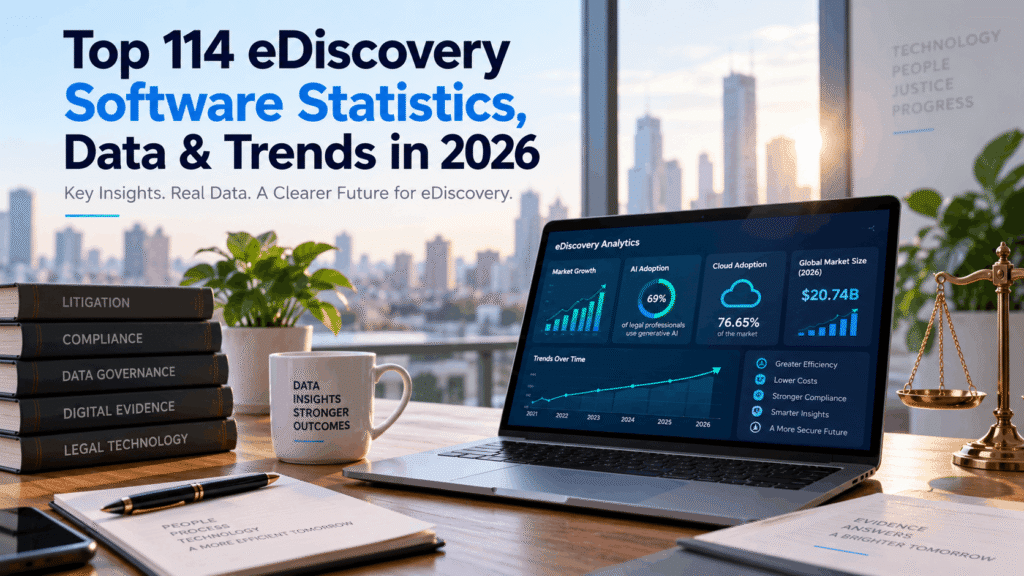
The scale of the market reflects this momentum. The global eDiscovery market was valued at approximately $18.73 billion in 2025 and is projected to reach $20.74 billion in 2026. By 2034, it could expand to $46.06 billion at a compound annual growth rate of 10.49%. Other industry estimates use different definitions and methodologies, but similarly point toward substantial long-term expansion. For example, worldwide eDiscovery spending across software and services is projected to reach approximately $19.14 billion in 2026, while the software-only segment is forecast to reach $7.27 billion and continue growing to $9.06 billion by 2028.
Artificial intelligence is emerging as one of the biggest forces reshaping eDiscovery software trends in 2026. Around 69% of legal professionals now use generative AI for work, while 87% of General Counsel report using GenAI within their legal teams. Among eDiscovery professionals specifically, 37% actively use AI in their work, compared with just 12% two years earlier. Meanwhile, 60.7% of eDiscovery practitioners expect large language models and generative AI to become transformative by the end of 2026. However, only 17.7% report using these technologies in all or most of their cases, demonstrating that a considerable gap remains between AI enthusiasm and widespread operational deployment.


The economics of electronic discovery are changing just as quickly. GenAI-assisted document review is now priced at approximately $0.11 to $0.50 per document, compared with traditional human review costs of roughly $1.50 to $3.00 per document. Forensic collection commonly costs $250 to $350 per hour, while data processing can range from approximately $50 to $250 per GB. These changing eDiscovery software pricing models are particularly significant because document review remains one of the largest and most expensive components of the discovery process.
Cloud adoption represents another major eDiscovery trend to watch. The cloud segment accounts for 76.65% of the eDiscovery market in 2026, while more than 70% of eDiscovery projects now involve information stored in cloud-based applications and systems. Off-premise eDiscovery software spending is estimated at approximately $5.16 billion in 2026, compared with $2.11 billion for on-premise deployments. This transition is making sophisticated discovery capabilities increasingly accessible beyond the largest enterprises and law firms.
Regulation and explosive data growth are adding further momentum. Global data volumes are expected to exceed 221,000 exabytes in 2026, while cumulative GDPR fines since May 2018 have surpassed €7.1 billion as of early 2026. The EU AI Act also becomes fully applicable from August 2026, adding another layer of AI governance and compliance considerations for organizations handling sensitive information. These developments are making the ability to locate, preserve, analyze, and produce digital evidence increasingly important across industries.
Geographically, North America remains the dominant eDiscovery market, accounting for 39.41% of the global market in 2025, followed by Europe at 23.77% and Asia Pacific at 19.03%. Asia Pacific, however, is emerging as one of the fastest-growing regions as digital infrastructure expands and regulatory frameworks develop across India, China, Southeast Asia, and other markets. International markets outside North America are consequently expected to increase their share of worldwide eDiscovery spending over time.
Beyond headline market growth, 2026 is also revealing major changes in how electronic discovery work is performed. Technology-Assisted Review, predictive coding, Continuous Active Learning, GenAI summarization, mobile data collection, cloud-native processing, and increasingly agentic AI workflows are transforming traditional discovery processes. Organizations using TAR 2.0 workflows can reduce the volume of documents requiring manual review by approximately 40% to 60%, while combining TAR with GenAI summarization can potentially reduce reviewer hours even further.
These developments make eDiscovery statistics particularly valuable for legal technology companies, law firms, corporate legal departments, compliance professionals, investors, researchers, and organizations evaluating eDiscovery software. Market size alone does not tell the entire story. Understanding AI adoption, cloud migration, regional growth, pricing changes, regulatory pressure, workflow automation, industry adoption, and practitioner sentiment provides a much clearer picture of where electronic discovery is heading.
In this guide to the Top 114 eDiscovery Software Statistics, Data & Trends in 2026, we examine the most important figures shaping the industry, covering eDiscovery market size and growth, regional market shares, AI and GenAI adoption, eDiscovery software pricing and costs, cloud deployment, compliance and regulation, Technology-Assisted Review, industry adoption, legal workforce trends, workflow spending, practitioner insights, and the future of agentic AI in electronic discovery. Together, these 114 eDiscovery statistics provide a data-driven view of an industry rapidly evolving from traditional document discovery into an increasingly cloud-native, AI-assisted, and automated legal technology ecosystem.
Top 114 eDiscovery Software Statistics, Data & Trends in 2026
🏦 A. Market Size & Growth
- The global eDiscovery market was valued at $18.73 billion in 2025 and is projected to reach $20.74 billion in 2026, reflecting robust and consistent annual expansion driven by data growth and legal digitisation. The market is currently in a high-growth phase with no sign of deceleration through the decade.
- By 2034, the global eDiscovery market is forecast to reach $46.06 billion, expanding at a CAGR of 10.49% from 2025 to 2034 — making it one of the fastest-growing legal technology segments worldwide. This long-term trajectory underscores investor and enterprise confidence in the sector.
- According to 360iResearch, the eDiscovery software market was estimated at $16.42 billion in 2024 and is expected to hit $17.86 billion in 2025, growing to $26.65 billion by 2030 at a CAGR of 8.40%. Multiple forecasters confirm the market is in a sustained double-digit growth cycle.
- GII Research / SkyQuest values the eDiscovery software market at $12.83 billion in 2024, forecasting growth to $28.57 billion by 2033 at a CAGR of 9.3%. Even more conservative estimates confirm the doubling of market size within a decade.
- Market.us projects the global eDiscovery market to reach $32.5 billion by 2033, growing from $14.8 billion in 2024 at a CAGR of 9.1% from 2025 to 2034. The compounding effect of data regulation, cloud adoption, and AI integration is the primary growth catalyst.
- According to ComplexDiscovery/EDRM, the worldwide eDiscovery software-only market will reach $7.27 billion in 2026, growing to an estimated $9.06 billion by 2028 — a CAGR of 11.40% over the 2023–2028 period, the fastest growth rate of any eDiscovery sub-segment.
- Total worldwide eDiscovery spending (software + services) is projected to reach $19.14 billion in 2026 when measuring across all delivery tasks (collection, processing, and review) — confirming the market’s scale beyond software alone.
- Global eDiscovery spending stood at $16.89 billion in 2024 and is forecast to reach $25.11 billion by 2029, a net increase of nearly $8.2 billion over five years driven by regulatory pressure and the proliferation of digital data.
- Verified Market Research pegs eDiscovery software at $13.52 billion in 2023, projecting $25.73 billion by 2030 at a CAGR of 8.79%. Consistent cross-firm estimates reaffirm the sector’s trajectory regardless of methodology.
- ComplexDiscovery’s annual market mashup estimates eDiscovery spending will reach $28.08 billion by 2030, growing from just $4.73 billion in 2012 — a near 6x expansion over 18 years driven by regulatory mandates and digital transformation.
- Gartner notes that eDiscovery software spending alone is projected to reach $7.2 billion by 2026, nearly doubling from mid-decade levels — pointing to software displacing services as the faster-growing component.
- The eDiscovery market grew at a CAGR of 7.6% from 2021 according to ComplexDiscovery’s earlier mashup estimates, with more recent projections upgrading this to 8.4–10.5% as AI-driven demand accelerates.
🌍 B. Regional Breakdown
- North America dominates the global eDiscovery market with a 39.41% share in 2025, valued at $7.38 billion, expected to reach $8.2 billion in 2026. The US legal system’s discovery obligations and data protection enforcement are the primary demand drivers.
- Europe holds the second-largest share at 23.77% of the global market in 2025, valued at $4.45 billion, projected to reach $4.81 billion in 2026. GDPR enforcement remains the dominant regulatory catalyst for European eDiscovery demand.
- Asia Pacific accounts for 19.03% of the global eDiscovery market in 2025 ($3.56 billion), forecast to grow to $4.02 billion in 2026. The region is the fastest-growing, driven by expanding regulatory frameworks in India, China, and Southeast Asia.
- Latin America holds an 8.29% market share in 2025 ($1.55 billion), growing to $1.71 billion by 2026. Brazil’s LGPD and expanding cross-border litigation are the primary growth engines.
- Middle East & Africa accounts for 9.51% of the global market in 2025 ($1.78 billion), expected to reach $2.0 billion by 2026, driven by evolving data protection laws in Saudi Arabia (PDPL) and South Africa (POPIA).
- The United States alone is projected to reach $5.68 billion in eDiscovery market value by 2026, cementing its position as the world’s single largest national market by a considerable margin.
- Even as the US market share dips slightly (from 70% to 65% over the forecast period), absolute US eDiscovery spending is expected to rise from $10.57 billion to $14.72 billion — a nearly 39% increase, demonstrating continued spending growth despite share dilution.
- International markets outside North America are increasing their combined share from 30% to 35% of total eDiscovery spending, fuelled by new privacy regulations, cross-border disputes, and rising digital infrastructure.
🤖 C. AI & GenAI Adoption
- 69% of legal professionals now use generative AI tools for work in 2026 — more than double the 31% recorded just one year ago in 2025. This is one of the most dramatic adoption surges documented in any professional services sector.
- 87% of General Counsel now report using generative AI within their legal teams, nearly doubling from 44% just one year earlier according to the FTI Consulting/Relativity General Counsel Report (March 2026, 224 GCs surveyed).
- 43% of all law firms and corporate legal departments now have an enterprise-wide GenAI tool deployed — up from just 14% at the start of 2024, according to the Thomson Reuters Institute 2026 AI in Professional Services Report.
- 37% of eDiscovery professionals actively use AI in their work — tripling the 12% figure from just two years ago — according to Everlaw’s 2025 eDiscovery Innovation Report (conducted with ACEDS and ILTA, 299 respondents).
- 42% of legal professionals now use legal-specific AI tools in 2026, up from roughly 20% in 2025, demonstrating rapid maturation from general-purpose tools toward purpose-built legal AI solutions.
- GenAI usage in US corporate law departments jumped to 52% active usage in 2025, more than doubling from 23% the year before, according to the Everlaw/ACC Generative AI Survey (657 in-house legal professionals across 30 countries).
- 60.7% of eDiscovery practitioners expect LLMs and GenAI to be transformative by the end of 2026, according to the eDiscovery Today 2026 State of the Industry Report (559 practitioners surveyed).
- However, only 17.7% of practitioners report actually using LLMs/GenAI in all or most of their cases — a meaningful hype-vs-reality gap that reveals the technology is widespread but inconsistently deployed.
- 46% of legal professionals believe AI will impact eDiscovery more than any other legal workflow within the next five years, according to the US Legal Support 2026 Legal Tech & AI Outlook (2,000+ respondents).
- The AI-in-eDiscovery segment was valued at $334 million, growing at a 16.1% CAGR from 2025 to 2030 — the fastest-growing sub-segment within the broader eDiscovery software market.
- The use of AI and machine learning in eDiscovery was projected to expand by approximately 30% annually from 2022 to 2024, a rate that has since accelerated sharply with the arrival of large language models.
- 42% of AI-using eDiscovery professionals save 1–5 hours per week through GenAI implementation — equivalent to 260 hours annually per individual, or 32.5 working days that can be redirected to higher-value legal strategy.
- More than 30% of practitioner survey respondents selected all seven listed AI use cases as active in their eDiscovery workflows in 2026, showing that adoption has moved well beyond early testing into everyday operations.
- 51% of legal industry respondents feel excited or hopeful about agentic AI, with only 19% expressing concern — pointing to a favourable outlook for the next wave of automation beyond current GenAI tools.
- Less than 20% of legal organisations have yet moved to widespread agentic AI adoption in H1 2026, but approximately half are either planning or actively considering it — a pipeline that will reshape eDiscovery in 2027–2028.
💰 D. Pricing & Costs
- Forensic collection rates have stabilised at $250–$350 per hour for standard onsite or remote work, with premium testimony and courtroom analysis commanding $400–$550/hr, according to the Winter 2026 ComplexDiscovery/EDRM Pricing Survey.
- GenAI-assisted review is now priced in the $0.11–$0.50 per-document range — directly challenging traditional human review economics and displacing a category that cost $1.50–$3.00/document just two years ago.
- Data hosting has commoditised at the infrastructure level, with standard rates now around $10–$100/GB per month; analytics-enabled hosting retains pricing differentiation above that band.
- Per-document AI review converging around $0.11–$0.50 represents a collapse from the $1.50–$3.00 human reviewer rates — making AI-driven review 3–15x cheaper per document in competitive 2026 pricing.
- A single litigation matter with 100GB of data could generate five- to six-figure bills under the traditional pricing model — a burden the 2026 all-inclusive and GenAI-bundled pricing models are actively dismantling.
- Document review accounts for over 80% of total litigation spend, equivalent to roughly $42 billion per year in the US alone, according to the American Bar Association. This is the single largest cost target for AI-driven efficiency gains.
- Fortune 1000 corporations spend between $5 million and $10 million annually on eDiscovery activities, according to the landmark RAND Corporation study — a figure that is now being challenged downward by AI-assisted review and cloud-native platforms.
- eDiscovery software pricing in 2026 ranges from approximately $3 to $30+ per GB for volume-based platforms, with all-inclusive subscription models offering an alternative to per-unit billing.
- In 2012, the RAND Corporation estimated eDiscovery production costs at $18,000 per GB — a figure that has collapsed to sub-$100/GB in 2026 all-inclusive models, representing a 180x cost reduction over 14 years.
- A complex commercial litigation matter could cost a plaintiff firm $50,000–$100,000 in eDiscovery costs before a single deposition, a barrier the 2026 pricing reset is fundamentally changing for smaller practices.
- Relativity announced its aiR for Review and aiR for Privilege GenAI solutions would be included in standard RelativityOne packages at no additional charge in early 2026 — triggering a major AI pricing reset across the industry.
- Data processing rates range from approximately $50–$250 per GB in 2026, with volume discounts and bundled packages making price comparison increasingly complex for buyers.
☁️ E. Cloud & Deployment
- The cloud segment holds 76.65% of the eDiscovery market in 2026 and is expected to grow rapidly through 2034, cementing cloud-native delivery as the industry’s default architecture.
- The global eDiscovery cloud software market will reach roughly $6.89 billion in 2026, broken down as SaaS ($3.41B), PaaS ($1.18B), and IaaS ($0.89B) — with SaaS the dominant and fastest-growing model.
- The eDiscovery cloud software segment is projected to grow at a CAGR of 12.98% from 2023 to 2028 — the fastest compound growth rate of any eDiscovery infrastructure category.
- Off-premise (cloud) deployment accounts for approximately $5.16 billion of the 2026 eDiscovery software market, versus $2.11 billion for on-premise — a 2.4x cloud premium that continues to widen.
- Cloud-based eDiscovery is now considered the norm by approximately 65% of legal and eDiscovery professionals as of 2025, completing the industry’s transition from on-premise as the default.
- More than 70% of eDiscovery projects now involve data stored in cloud-based applications and systems, requiring cloud-native discovery capabilities to collect and process without data egress complications.
- Global cloud infrastructure spending increased by nearly 22% in 2025, with legal services among the fastest-growing professional sectors transitioning to hosted platforms.
- Near-ubiquitous cloud adoption has crossed into mid-size and smaller legal firms in 2026, with cloud platforms enabling data processing that used to take days to complete in hours.
- Cloud-based eDiscovery offerings grew from 68% to 73% of market share (2023 to 2028), with spending increasing from $3.59 billion to $6.61 billion over the same period.
🛡️ F. Compliance, Regulation & Data Growth
- Global data volumes in 2026 are expected to exceed 221,000 exabytes — a staggering increase from just 0.1 zettabytes in 2005, creating an almost incomprehensibly large addressable problem for eDiscovery software.
- Cumulative GDPR fines since May 2018 now exceed €7.1 billion ($8.4 billion) as of early 2026, with approximately €1.2 billion issued in 2025 alone, according to the DLA Piper GDPR Fines and Data Breach Survey (January 2026).
- A total of 2,685 GDPR fines have been recorded globally through March 2026 — up 440 from the prior reporting period — according to the CMS GDPR Enforcement Tracker Report 2025/2026.
- EU data protection authorities received an average of 443 personal data breach notifications per day between January 2025 and early 2026 — a 22% year-on-year increase, marking the first time daily reports exceeded 400 since GDPR came into force.
- Over 90% of all records today are created electronically, according to the American Records Management Association, making eDiscovery software essential for virtually all legal proceedings.
- 65% of companies globally reported being the target of at least one cyberattack in the prior two years, galvanising demand for stronger compliance, data governance, and eDiscovery capabilities.
- The EU AI Act, which entered into force on 1 August 2024, will be fully applicable from August 2026, adding regulatory complexity and compliance requirements that will directly increase demand for eDiscovery and legal data governance tools.
- 76% of CISOs globally cite regulatory fragmentation as their top compliance challenge, according to the World Economic Forum 2025 — a pain point that eDiscovery platforms increasingly address through multi-jurisdiction workflow support.
- 32% of global organisations have been fined by regulators for data breach-related infractions in the past year, according to IBM — each incident creating potential eDiscovery obligations.
- The highest single GDPR fine on record — €1.2 billion — was imposed on Meta Platforms by Ireland’s Data Protection Commission, illustrating the regulatory severity that drives enterprise investment in compliant eDiscovery systems.
- The EU AI Act fines for prohibited AI practices can reach up to 7% of global annual turnover from August 2026 — a new compliance dimension that intersects directly with eDiscovery AI governance frameworks.
⚙️ G. Technology-Assisted Review (TAR) & Workflow
- More than 70% of eDiscovery projects used TAR (Technology-Assisted Review) tools by 2024 to improve document analysis speed and accuracy, according to Deloitte — reflecting near-mainstream adoption of automated review in enterprise litigation.
- Organisations using a TAR 2.0 workflow typically see a 40–60% reduction in the volume of documents requiring manual review, dramatically compressing timelines and reviewer costs on large matters.
- A 40% increase in TAR tool adoption was recorded between 2022 and 2024, demonstrating the technology’s mainstreaming across law firms of all sizes, not just the AmLaw 100.
- 55% of legal experts anticipated greater use of predictive coding and Continuous Active Learning (CAL) in eDiscovery by 2024 — a prediction that materialised fully as these tools became table stakes in 2025–2026.
- Mobile device data use in eDiscovery grew by approximately 35% between 2022 and 2024, driven by the proliferation of corporate messaging on platforms like Slack, Microsoft Teams, and WhatsApp.
- TAR combined with GenAI summarisation can trim reviewer hours by as much as 80% while simultaneously tightening privilege calls, according to Jatheon and Everlaw research — the most transformative efficiency gain in eDiscovery history.
- More than 75% of law firms implemented BYOD (Bring Your Own Device) policies for eDiscovery purposes by 2024, according to Exterro — increasing the scope of discoverable data and the need for mobile-capable eDiscovery platforms.
- Over 60% of law firms were expected to use cloud-based eDiscovery platforms by 2024, up from approximately 45% in 2022 — a trend that accelerated to near-ubiquity by 2026.
- Nearly 60% of legal professionals anticipated handling larger volumes of data for eDiscovery by 2024, a projection that proved accurate given 2025–2026 data explosion metrics.
- More than 50% of Fortune 500 legal departments were expected to establish dedicated eDiscovery teams by 2024 to manage growing data complexity and litigation volumes.
🏦 H. Industry & End-User Segments
- Large enterprises are projected to control 69.93% of the eDiscovery market in 2026 — driven by their extensive litigation portfolios, regulatory exposure, and higher data management complexity.
- The BFSI sector (Banking, Financial Services & Insurance) leads all verticals with a 24.68% expected global market share in 2026, reflecting its high regulatory scrutiny, frequent litigation, and mandatory data retention requirements.
- The services segment dominates the eDiscovery market at 68.80% in 2026, while the software segment accounts for the remaining 31.2% — though software is growing significantly faster at 11.4% CAGR vs. services at 6.73%.
- Government and regulatory bodies account for roughly $8.04 billion of eDiscovery spending in 2026; non-government organisations (corporations, law firms, and service providers) contribute approximately $11.10 billion.
- Law firms directly deliver approximately $2.48 billion of eDiscovery services in 2026; specialist service providers account for about $4.07 billion.
- In-house corporate teams and governments combined represent the largest direct delivery share at roughly $12.59 billion of the 2026 market — confirming the institutionalisation of eDiscovery within enterprise legal operations.
- The banking and financial services sector captured about 35% of the eDiscovery market in 2023 — more than any other single vertical — reflecting financial services’ outsized legal and regulatory discovery burden.
- Only 12% of corporate legal teams report using advanced analytics or TAR, while less than half say they are even exploring these technologies, according to CLOC — a gap that represents significant upside for solution providers.
- Firms with 51 or more attorneys demonstrate significantly higher AI adoption rates at 39%, compared to approximately 20% for smaller firms — reflecting resource and budget disparities in technology investment.
💼 I. Legal Workforce & Operational Trends
- 91% of in-house counsel cite efficiency as the primary benefit of GenAI adoption, with the most common applications being drafting (73%) and legal research (53%), according to the ACC/Everlaw survey.
- 64% of in-house counsel expect GenAI to reduce their reliance on outside counsel, and 50% expect measurably lower outside counsel costs as a direct result of AI-enabled internal capability, per the ACC/Everlaw survey.
- 78% of in-house counsel specifically encourage their outside law firms to adopt generative AI in order to reduce client costs — creating strong market pull for legal AI adoption at the law firm level.
- 62% of in-house legal professionals believe their outside law firms lack sufficient innovation, according to NexLaw.ai — a perception gap that is accelerating corporate investment in in-house eDiscovery technology.
- According to the Thomson Reuters Institute, law firms had 81 support staff FTEs per 1 lawyer in 2023, down from 95 in 2017 — fewer hands managing more data, which directly increases the need for automated eDiscovery solutions.
- The top three barriers to legal technology adoption for over 50% of firms are: time/resource constraints, budget limitations, and staff resistance to change — with staff resistance declining to 30% in 2026, the lowest on record.
- 54% of law firms offer no AI training despite 69% of their professionals using GenAI tools — a governance crisis that creates legal risk, including in eDiscovery workflows where defensibility depends on documented processes.
- 59% of law firms and 57% of corporate legal departments believe GenAI should be applied to their work, according to the Thomson Reuters Institute 2025 Generative AI in Professional Services Report.
- Civil litigation practices demonstrate the highest organisational AI adoption at 27% at firm level, followed by personal injury and family law firms at 20% each — reflecting the document-intensive nature of civil litigation.
- The legal technology market overall is projected to reach $32.54 billion by 2026, making eDiscovery software one of the largest components within a rapidly expanding legal tech ecosystem.
📊 J. Task-Level & Workflow Spending
- The document review task accounts for the largest eDiscovery sub-market at $4.61 billion in 2026, reflecting its labour-intensive nature and the massive industry effort to automate and AI-assist it.
- Data collection activities account for roughly $11.10 billion in 2026 across all delivery models (in-house + law firms + specialists) — making it the single largest task category by total spend.
- Data processing contributes approximately $3.43 billion to the 2026 eDiscovery task market, a stable segment that is being enhanced rather than disrupted by AI tooling.
- The overall eDiscovery market by task (collection, processing, review) will grow at a CAGR of approximately 8.46% from 2023 to 2028, reaching an estimated $22.65 billion by 2028.
- Between 2023 and 2028, eDiscovery review spending is forecast to increase from $9.81 billion to $13.59 billion — yet its percentage share of total eDiscovery spending will decline slightly from 65% to 60% as collection grows faster.
- Data capture/collection is the fastest-growing task segment — projected to increase from $2.26 billion in 2023 to $4.53 billion by 2028, more than doubling as organisations invest in preservation-first strategies.
- Non-government organisations’ eDiscovery spending is rising from $8.30 billion to $13.59 billion (2023–2028), increasing to 60% of the total market — signalling corporate and law firm adoption outpacing government.
📐 K. Survey & Practitioner Insights (Winter 2026)
- The Winter 2026 ComplexDiscovery/EDRM Pricing Survey drew 53 respondents: law firms (43.4%), software/services providers (24.5%), corporations (15.1%), consultancies (9.4%), and media/education (7.5%).
- 92.5% of Winter 2026 survey respondents identified North America – United States as their primary eDiscovery geography — confirming the US-centric nature of current eDiscovery pricing and practice benchmarks.
- 67.9% of survey respondents identified as legal/litigation support professionals, 26.4% as business/support functions, and 5.7% as IT/product development — reflecting the multi-disciplinary nature of modern eDiscovery teams.
- Hybrid pricing models and per-document billing each account for roughly 28% of reported primary pricing models for GenAI-assisted review in Winter 2026, showing the market has not yet converged on a standard commercial framework.
- The $250–$350/hour range for forensic collection was cited by 56.6% of respondents as the market anchor rate — a level that has stabilised despite the broader commoditisation visible in downstream eDiscovery services.
🔮 L. Future Outlook
- Agentic AI (AI agents that autonomously complete multi-step legal tasks) is following GenAI’s growth trajectory in legal — with about half of organisations planning or considering agentic AI in the near future, per Thomson Reuters Institute 2026.
- Gartner predicts over 40% of agentic AI projects will be cancelled by end of 2027 — a sobering forecast that will put pressure on eDiscovery vendors to demonstrate clear ROI from agentic workflow investments.
- The eDiscovery software market CAGR of 10.41% (2025–2030) is the fastest-compounding segment within the broader eDiscovery ecosystem, with AI as the central tailwind, according to ComplexDiscovery Market Intelligence.
- Gartner projects AI governance spending will reach $492 million in 2026, reflecting the urgency of building defensible governance frameworks — a direct enabler for compliant AI-assisted eDiscovery adoption.
- 2026 is the year of integration: firms are demanding platforms that unify deposition, discovery, and trial systems for end-to-end efficiency, according to the US Legal Support 2026 Legal Tech & AI Outlook.
- The worldwide eDiscovery market is projected to grow from $4.73 billion in 2012 to $28.08 billion by 2030 — representing nearly 6x market expansion driven by data, regulation, and AI over 18 years.
Conclusion
The 114 eDiscovery software statistics and trends for 2026 reveal an industry undergoing rapid expansion and fundamental technological change. Growing volumes of electronically stored information, increasingly complex regulatory requirements, cloud migration, and advances in artificial intelligence are collectively transforming eDiscovery from a specialized litigation function into a critical component of modern legal operations, compliance, investigations, and enterprise data governance.
Market growth provides one of the clearest indicators of this transformation. The global eDiscovery market is projected to reach approximately $20.74 billion in 2026 and potentially $46.06 billion by 2034. Meanwhile, worldwide eDiscovery software-only spending is forecast at $7.27 billion in 2026, with software growing faster than the services segment. Although different research organizations produce varying estimates based on their definitions and methodologies, the overall direction is consistent: organizations are allocating more resources to technologies capable of managing increasingly complicated digital evidence.
Artificial intelligence is likely to remain one of the most important eDiscovery trends beyond 2026. Generative AI usage among legal professionals has reached 69%, while 87% of General Counsel report GenAI use within their legal teams. Among eDiscovery practitioners, 60.7% expect LLMs and generative AI to become transformative by the end of 2026. Yet only 17.7% currently use these technologies in all or most cases. That gap suggests the next stage of competition will be less about whether eDiscovery vendors offer AI and more about whether they can integrate it reliably, defensibly, securely, and economically into everyday legal workflows.
Cost reduction could accelerate that transition. GenAI-assisted review is now priced at approximately $0.11 to $0.50 per document, substantially below the $1.50 to $3.00 per-document rates associated with traditional human review. Technology-Assisted Review can reduce the number of documents requiring manual review by approximately 40% to 60%, while TAR combined with GenAI summarization can potentially reduce reviewer hours by as much as 80%. With document review representing one of the largest eDiscovery spending categories, even incremental improvements in automation can translate into significant financial and operational benefits.
Cloud adoption is reinforcing these changes. Cloud solutions account for 76.65% of the eDiscovery market in 2026, and more than 70% of eDiscovery projects now involve information stored within cloud applications and systems. As evidence increasingly originates from collaboration platforms, mobile devices, messaging applications, SaaS products, and distributed corporate environments, cloud-native collection, processing, review, and governance capabilities are becoming essential rather than optional.
At the same time, regulatory pressure continues to increase the importance of defensible information management. Global data volumes are expected to exceed 221,000 exabytes in 2026, cumulative GDPR fines have surpassed €7.1 billion as of early 2026, and the EU AI Act becomes fully applicable from August 2026. These trends reinforce the need for organizations to understand where information resides, how it is preserved, how sensitive data is handled, and how AI-assisted decisions can be governed and documented.
The geographic and industry data also suggest that eDiscovery is becoming increasingly global. North America remains the largest regional market, but Europe, Asia Pacific, Latin America, and the Middle East and Africa collectively represent substantial opportunities for future expansion. Large enterprises are projected to account for 69.93% of the market in 2026, while BFSI is expected to lead industry demand with a 24.68% market share, demonstrating how litigation exposure, regulatory scrutiny, and data complexity continue to influence eDiscovery investment.
Looking ahead, the next evolution of eDiscovery software is likely to center on deeper automation and integration. Agentic AI is already attracting considerable interest, with approximately half of organizations planning or considering its adoption. However, expectations should remain measured: Gartner predicts that more than 40% of agentic AI projects could be cancelled by the end of 2027. Successful eDiscovery platforms will therefore need to demonstrate measurable improvements in cost, accuracy, productivity, governance, and defensibility rather than relying on AI capabilities alone.
Ultimately, these eDiscovery software statistics for 2026 point toward a market becoming larger, more automated, more cloud-centric, and increasingly influenced by AI. The transition from traditional manual discovery toward intelligent, technology-assisted workflows is already underway, but significant opportunities for further adoption remain.
For law firms, corporate legal departments, government agencies, legal technology providers, investors, and eDiscovery professionals, the central takeaway is clear: eDiscovery is evolving beyond document processing and review into a broader technology infrastructure for managing digital evidence and legal data. Organizations that can combine AI, cloud infrastructure, automation, regulatory compliance, and defensible workflows will be best positioned to navigate the enormous volumes of digital information shaping litigation and legal operations in 2026 and the years ahead.
If you find this article useful, why not share it with your hiring manager and C-level suite friends and also leave a nice comment below?
We, at the 9cv9 Research Team, strive to bring the latest and most meaningful data, guides, and statistics to your doorstep.
To get access to top-quality guides, click over to 9cv9 Blog.
To hire top talents using our modern AI-powered recruitment agency, find out more at 9cv9 Modern AI-Powered Recruitment Agency.
People Also Ask
What is eDiscovery software?
eDiscovery software helps organizations identify, collect, process, review, and manage electronically stored information for litigation, investigations, compliance, and other legal matters.
How big is the eDiscovery market in 2026?
The global eDiscovery market is projected to reach approximately $20.74 billion in 2026, up from an estimated $18.73 billion in 2025.
How fast is the eDiscovery market growing?
One forecast projects the global eDiscovery market to grow at a 10.49% CAGR from 2025 to 2034, reaching approximately $46.06 billion by 2034.
How big is the eDiscovery software market in 2026?
Worldwide eDiscovery software-only spending is projected to reach approximately $7.27 billion in 2026 and increase to about $9.06 billion by 2028.
What are the biggest eDiscovery trends in 2026?
Major eDiscovery trends in 2026 include generative AI, cloud adoption, Technology-Assisted Review, automation, growing digital data volumes, regulatory pressure, mobile data discovery, and agentic AI.
How is AI changing eDiscovery in 2026?
AI is helping legal professionals automate document review, summarize information, analyze large datasets, improve workflows, and reduce the time and cost associated with traditional eDiscovery processes.
How many legal professionals use generative AI in 2026?
Approximately 69% of legal professionals use generative AI tools for work in 2026, compared with 31% in 2025, according to the statistics compiled for this report.
How many General Counsel use generative AI?
Around 87% of General Counsel report using generative AI within their legal teams, highlighting the rapid adoption of AI across corporate legal departments.
How many eDiscovery professionals use AI?
Approximately 37% of eDiscovery professionals actively use AI in their work, compared with 12% two years earlier, indicating substantial growth in practical AI adoption.
Will generative AI transform eDiscovery?
About 60.7% of eDiscovery practitioners expect LLMs and generative AI to be transformative by the end of 2026, although only 17.7% use them in all or most cases.
How much time can GenAI save eDiscovery professionals?
Among AI-using eDiscovery professionals, 42% report saving between one and five hours per week through GenAI, potentially freeing substantial time for higher-value legal work.
How much does AI-assisted document review cost?
GenAI-assisted document review is priced at approximately $0.11 to $0.50 per document in 2026, compared with traditional human review costs of roughly $1.50 to $3.00 per document.
How much does eDiscovery data processing cost?
eDiscovery data processing rates generally range from approximately $50 to $250 per GB in 2026, although volume discounts and bundled pricing can affect actual costs.
How much does forensic data collection cost?
Standard forensic collection commonly costs approximately $250 to $350 per hour, while premium testimony and courtroom analysis can command rates of $400 to $550 per hour.
How much does eDiscovery data hosting cost?
Standard eDiscovery data hosting rates are approximately $10 to $100 per GB per month in 2026, with analytics-enabled hosting potentially priced above this range.
Is cloud eDiscovery growing in 2026?
Yes. The cloud segment accounts for 76.65% of the eDiscovery market in 2026, reinforcing cloud-based deployment as a dominant model for modern electronic discovery.
How many eDiscovery projects involve cloud data?
More than 70% of eDiscovery projects involve information stored in cloud-based applications and systems, increasing demand for cloud-native collection and processing capabilities.
What is Technology-Assisted Review in eDiscovery?
Technology-Assisted Review, or TAR, uses technology to help prioritize, classify, and review documents during eDiscovery, reducing dependence on fully manual document review.
How much can TAR reduce manual document review?
Organizations using TAR 2.0 workflows typically achieve a 40% to 60% reduction in the volume of documents requiring manual review, potentially reducing both costs and timelines.
How much can TAR and GenAI reduce review time?
TAR combined with GenAI summarization can reduce reviewer hours by as much as 80%, according to research included in the 2026 eDiscovery statistics dataset.
Which region has the largest eDiscovery market?
North America leads the global eDiscovery market, accounting for 39.41% of the market in 2025 and approximately $7.38 billion in value.
How large is the US eDiscovery market in 2026?
The United States eDiscovery market is projected to reach approximately $5.68 billion in 2026, making it the world’s largest individual national market.
Is Asia Pacific a growing eDiscovery market?
Yes. Asia Pacific represented 19.03% of the global eDiscovery market in 2025 and is forecast to grow from $3.56 billion in 2025 to approximately $4.02 billion in 2026.
Which industry uses eDiscovery the most?
BFSI is expected to lead industry demand with a 24.68% global eDiscovery market share in 2026, driven by regulatory scrutiny, litigation, and data retention requirements.
Do large enterprises dominate the eDiscovery market?
Yes. Large enterprises are projected to account for 69.93% of the eDiscovery market in 2026 due to their litigation exposure, regulatory obligations, and complex data environments.
Why is data growth increasing demand for eDiscovery software?
Global data volumes are expected to exceed 221,000 exabytes in 2026. More digital information creates larger datasets that organizations may need to preserve, search, analyze, review, and produce.
How does GDPR affect the eDiscovery market?
GDPR increases pressure on organizations to manage data carefully. Cumulative GDPR fines since May 2018 exceeded €7.1 billion by early 2026, strengthening the business case for compliance and data governance tools.
How will the EU AI Act affect eDiscovery in 2026?
The EU AI Act becomes fully applicable from August 2026, introducing additional AI governance and compliance considerations relevant to organizations deploying AI-assisted legal and eDiscovery workflows.
What is agentic AI in eDiscovery?
Agentic AI refers to AI systems capable of completing multi-step tasks with greater autonomy. Around half of organizations are planning or considering agentic AI, making it an emerging eDiscovery trend.
What is the future of eDiscovery software after 2026?
eDiscovery is expected to become increasingly AI-assisted, automated, cloud-native, and integrated. Market forecasts indicate continued growth as organizations face expanding data volumes, regulation, litigation, and digital evidence requirements.
Sources
Fortune Business Insights 360iResearch Market.us GII Research SkyQuest Verified Market Research ComplexDiscovery EDRM ElectroIQ BayelsaWatch 8am PlatinumIDS Everlaw ACC FTI Consulting Relativity Thomson Reuters Institute eDiscovery Today US Legal Support Jatheon DLA Piper Kiteworks CMS RAND Corporation NexLaw AI Secretariat ACEDS TransPerfect Legal DataMagicInc Nextpoint ad valorem StationX