
Key Takeaways
- Georgia’s Employment Market Continues to Improve: Georgia’s unemployment rate fell to 13.3% in Q4 2025, while economic growth, workforce participation, and job creation are shaping recruitment trends and employment opportunities in 2026.
- Rising Salaries and Technology Hiring Drive Talent Competition: Georgia’s average monthly salary reached GEL 2,271.6 in Q3 2025, with strong demand for IT professionals, software engineers, and skilled workers driving competitive recruitment and employee retention strategies.
- Labour Law Reforms Reshape Recruitment Strategies in 2026: Georgia’s new foreign worker permit requirements, introduced in March 2026, are transforming international hiring, making recruitment compliance, salary benchmarking, and strategic workforce planning essential for employers.
Georgia (Europe) shows improving recruitment trends in 2026, with unemployment falling to 13.3% in Q4 2025 and average monthly wages reaching GEL 2,271.6 in Q3 2025. These 100 recruitment statistics highlight employment growth, salary trends, technology hiring, labour shortages, and new work permit regulations shaping the country’s job market.
Georgia’s recruitment landscape is undergoing a significant transformation in 2026, driven by economic growth, rising wages, expanding technology industries, and major labour market reforms. As an emerging hiring destination at the crossroads of Europe and Asia, Georgia is attracting increasing attention from international employers, recruitment agencies, investors, and skilled professionals seeking new opportunities in a competitive and evolving job market.
Also, read some of our top articles here:
Top 10 Best Recruitment Agencies in Georgia, Europe


According to the National Statistics Office of Georgia, the country’s unemployment rate declined to 13.9% in 2024, reaching its lowest annual level in more than two decades. This positive momentum continued into 2025, with unemployment falling to 13.3% in the fourth quarter. Meanwhile, Georgia’s employment rate reached 47.1% in 2024, highlighting improvements in workforce participation and job creation.
Salary growth is another defining feature of Georgia’s recruitment market. The average monthly nominal wage reached GEL 2,271.6 in Q3 2025, representing a 10.4% year-on-year increase. High-demand industries such as information technology, telecommunications, construction, and financial services offer particularly competitive compensation. IT and communications professionals, for example, earned an average of GEL 4,212.9 per month, reflecting the growing importance of digital skills in Georgia’s economy.

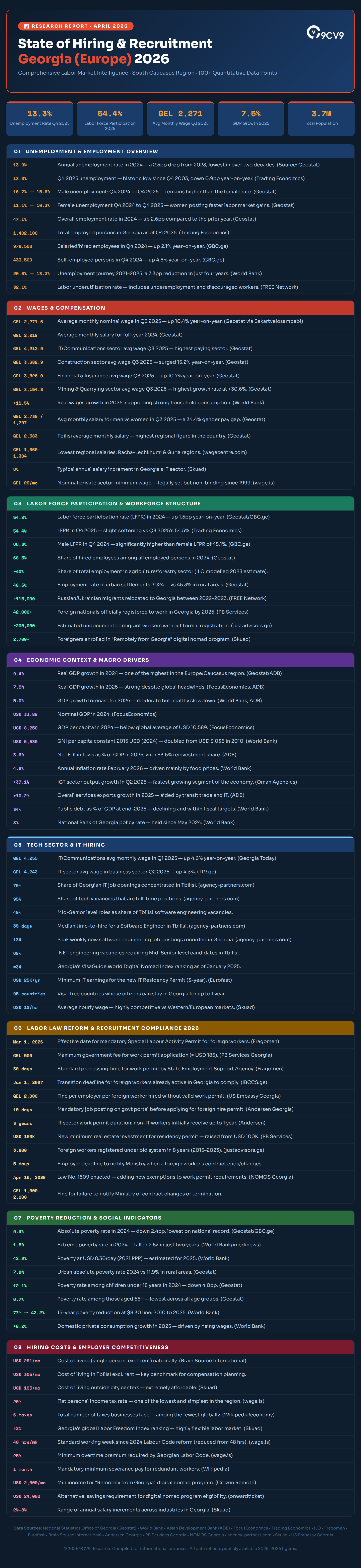
Georgia’s technology sector is becoming a major driver of recruitment activity. With the ICT industry expanding by 37.1% in Q2 2025 and Tbilisi accounting for approximately 70% of IT job openings, demand for software engineers, developers, and experienced technology professionals continues to shape hiring trends. Employers increasingly face competition for mid-to-senior-level talent, making effective recruitment strategies, competitive salaries, and employee retention essential business priorities.
At the same time, Georgia’s 2026 labour law reforms are reshaping international recruitment. The introduction of new work permit requirements on March 1, 2026, has established additional compliance obligations for businesses hiring foreign nationals. These changes make workforce planning, employment documentation, and immigration compliance increasingly important for local companies and international organisations expanding into Georgia.
Despite these positive developments, Georgia’s labour market continues to face structural challenges. Gender disparities in labour force participation, regional wage differences, skills mismatches, and relatively high labour underutilisation remain important considerations for employers. Understanding these challenges is essential for developing sustainable hiring strategies and identifying opportunities within the country’s evolving workforce.
For HR professionals, recruiters, business owners, and job seekers, staying informed about the latest Georgia recruitment statistics, employment trends, salary benchmarks, and hiring regulations in 2026 is crucial for making informed decisions.
This comprehensive guide explores the Top 100 Recruitment Statistics, Data & Trends in Georgia (Europe) in 2026, covering unemployment rates, employment growth, average salaries, labour force participation, technology recruitment, foreign worker regulations, economic indicators, and hiring costs.
Whether you are planning to hire employees in Georgia, expand your business into the Georgian market, benchmark compensation packages, or explore emerging employment opportunities, these recruitment statistics provide valuable insights into the trends shaping Georgia’s workforce and the future of recruitment in 2026 and beyond.
Before we venture further into this article, we would like to share who we are and what we do.
About 9cv9
9cv9 is a business tech startup based in Singapore and in Asia, with a strong presence all over the world.
With over ten years of startup and business experience, and being highly involved in connecting with thousands of companies and startups, the 9cv9 team has access to some of the best talents in the world.
If your company needs recruitment and headhunting services to hire top-quality employees, you can use 9cv9 headhunting and recruitment services to hire top talents and candidates. Email us at hello@9cv9.com.
Top 100 Recruitment Statistics, Data & Trends in Georgia (Europe) in 2026
📌 SECTION 1: UNEMPLOYMENT & EMPLOYMENT OVERVIEW
1. 13.9% — Georgia’s annual unemployment rate dropped to 13.9% in 2024, a decline of 2.5 percentage points from 2023, marking the lowest level recorded in over two decades according to the National Statistics Office.
2. 13.3% — In Q4 2025, Georgia’s unemployment rate hit 13.3%, the lowest reading since Q4 2003, continuing a multi-year downward trajectory that reflects the country’s rapid economic growth.
3. 14.2% — Q4 2024 saw unemployment at 14.2%, already 1.1 percentage points lower than the corresponding period in 2023, confirming a durable structural improvement in Georgia’s labor market.
4. 14.3% — In Q2 2025, unemployment briefly ticked up to 14.3% from 13.7% a year earlier, illustrating seasonal volatility that employers and recruiters should factor into their hiring timelines.
5. 20.6% — Georgia’s unemployment peaked at 20.6% in 2021 during the COVID-19 pandemic, making the subsequent recovery to 13.3% by 2025 one of the most dramatic labor market rebounds in the post-Soviet space.
6. 16.7% → 15.6% — Male unemployment fell from 16.7% in Q4 2024 to 15.6% in Q4 2025, though it remains meaningfully higher than the female unemployment rate, signaling persistent gender dynamics in job-seeking behavior.
7. 11.1% → 10.3% — Female unemployment declined from 11.1% to 10.3% between Q4 2024 and Q4 2025, with women posting faster labor market gains than men during this period.
8. 47.1% — Georgia’s overall employment rate stood at 47.1% in 2024, up 2.6 percentage points year-on-year, reflecting genuine job creation rather than just statistical reclassification.
9. 1,402,100 — Total employed persons in Georgia as of Q4 2025, providing a baseline for understanding the country’s hiring capacity and talent pool size.
10. 978,500 — The number of hired/salaried employees reached 978,500 in Q4 2024, up 2.1% year-on-year — a sign that formal employment is growing faster than self-employment.
11. 433,500 — Self-employed persons numbered 433,500 in Q4 2024, up 4.8% year-on-year, reflecting a vibrant entrepreneurial and gig-oriented segment of the workforce.
12. 32.1% — Georgia’s labor underutilization rate stands at 32.1%, including underemployment and discouraged workers, meaning headline unemployment significantly understates workforce challenges.
13. 68.5% — Of all employed persons in 2024, 68.5% were hired employees — slightly down 0.5pp from the year before, suggesting a marginal shift toward self-employment.
14. 233,900 — The number of unemployed persons in Q4 2024 was 233,900, down 14,700 (5.9%) from the prior year — one of the largest single-year drops in recent history.
📌 SECTION 2: WAGES & COMPENSATION
15. GEL 2,271.6 — The average monthly nominal wage in Georgia reached GEL 2,271.6 in Q3 2025, a 10.4% increase year-on-year, far outpacing inflation and boosting real purchasing power.
16. GEL 2,218 — Georgia’s average monthly salary for full-year 2024 was GEL 2,218 (~USD 800), making it one of the most cost-competitive talent markets in the Europe/Caucasus region.
17. GEL 4,212.9 — IT and Communications sector workers earned an average of GEL 4,212.9/month in Q3 2025 — nearly double the national average and the highest-paying sector in the country.
18. GEL 3,682.9 — Construction sector wages averaged GEL 3,682.9/month in Q3 2025, up 15.2% year-on-year, driven by major infrastructure projects like the Anaklia Deep Sea Port.
19. GEL 3,526.0 — The Financial & Insurance sector paid an average GEL 3,526.0/month in Q3 2025, up 10.7%, reflecting strong banking sector performance and demand for financial professionals.
20. GEL 3,154.3 — Mining & Quarrying recorded the highest wage growth rate at +30.6% in Q3 2025, though the absolute number of workers in the sector remains small.
21. GEL 3,402.5 — Professional, Scientific, and Technical Activities paid GEL 3,402.5/month in Q1 2025, up 12.1% — the second-fastest growing professional category by salary.
22. GEL 2,995.3 — Professional & Scientific activities averaged GEL 2,995.3/month in Q2 2025, confirming strong employer demand for skilled, knowledge-based professionals.
23. +11.5% — Real wages grew by 11.5% in 2025, supporting robust private consumption growth of 8.2% and demonstrating that salary increases are genuinely outpacing inflation.
24. GEL 2,738 vs GEL 1,797 — Men earned GEL 2,738/month versus women’s GEL 1,797 in Q3 2025, representing a 34.4% gender pay gap that is wider than most EU member states.
25. GEL 2,583 — Tbilisi workers earn an average of GEL 2,583/month — significantly above the national average and the benchmark for city-based compensation planning.
26. GEL 1,060–1,304 — Workers in Racha-Lechkhumi and Guria — Georgia’s lowest-wage regions — earn between GEL 1,060 and GEL 1,304/month, a major rural-urban income divide.
27. 6% — IT professionals in Georgia typically receive a 6% annual salary increment, making the sector not only the best-paid but also a stronger career investment over time.
28. 2%–8% — Annual salary increments across all industries range from 2% to 8%, giving employers useful benchmarks when structuring offers and retention packages.
29. GEL 20/month — The nominal private sector minimum wage of GEL 20/month has been unchanged since 1999, making it effectively non-binding; actual market wages are many times higher.
30. GEL 115/month — The public sector minimum wage is GEL 115/month — still extremely low and primarily a reference unit for government fees and calculations rather than a functional floor.
📌 SECTION 3: LABOR FORCE PARTICIPATION & WORKFORCE STRUCTURE
31. 54.8% — Georgia’s labor force participation rate (LFPR) rose to 54.8% in 2024, up 1.5 percentage points year-on-year, suggesting more workers are actively seeking and finding employment.
32. 54.4% — LFPR edged down to 54.4% in Q4 2025 from 54.9% a year earlier, a slight softening that mirrors global trends toward selective participation rather than broad disengagement.
33. 66.3% — Men’s LFPR in Q4 2024 was 66.3%, far exceeding women’s 45.1% — a 21.2 percentage point gap that represents one of the most significant gender labor market disparities in the region.
34. 45.1% — Women’s LFPR in Q4 2024, up 0.7pp year-on-year, shows gradual but insufficient progress toward gender parity in labor force engagement.
35. ~40% — Agriculture accounts for roughly 40% of total employment according to ILO modelled estimates, much of which is subsistence farming — a factor that inflates employment statistics in rural Georgia.
36. 48.5% — The urban employment rate of 48.5% in 2024 exceeds the rural rate of 45.3%, confirming that formal job creation remains concentrated in cities, especially Tbilisi.
37. ~115,000 — An estimated 115,000 Russian and Ukrainian migrants relocated to Georgia between 2022 and 2023, significantly stimulating labor market activity, startup formation, and housing demand.
38. 42,000+ — Over 42,000 foreign nationals were officially registered to work in Georgia by 2025, up from just 3,800 in the entire eight-year period between 2015 and 2023.
39. ~200,000 — An estimated 200,000 undocumented migrant workers are believed to operate in Georgia without formal registration — a key motivation behind the 2026 labor law reforms.
40. 239,000+ — Over 239,000 foreigners entered Georgia and stayed for more than six months during 2022–2023, highlighting the scale of migration that overwhelmed the old registration system.
📌 SECTION 4: ECONOMIC CONTEXT & MACRO DRIVERS
41. 9.4% — Georgia’s real GDP expanded by 9.4% in 2024, one of the highest growth rates in the Europe/Caucasus region, creating strong demand for skilled workers across sectors.
42. 7.5% — Real GDP growth moderated to 7.5% in 2025 — still exceptionally strong and well above the global average — reflecting broad-based economic expansion driven by services and ICT.
43. 5.0% — GDP growth is forecast to slow to 5.0% in 2026 as external conditions weaken and domestic demand normalizes, though the labor market is expected to remain supportive.
44. USD 33.8 billion — Georgia’s nominal GDP in 2024, establishing it as an upper-middle-income economy with a growing services-oriented base.
45. USD 8,250 — GDP per capita in 2024 remains below the global average of USD 10,589, signaling both workforce affordability and significant room for income convergence.
46. USD 6,535 — GNI per capita in constant 2015 USD in 2024 — more than double the USD 3,036 recorded in 2010, illustrating the decade of economic catch-up underpinning Georgia’s hiring boom.
47. 3.6% — Net FDI inflows stood at 3.6% of GDP in 2025 with an 83.6% reinvestment share, suggesting foreign companies already present in Georgia are doubling down on their operations.
48. 4.6% — Inflation accelerated to 4.6% in February 2026, primarily due to rising food prices, which employers should monitor when calibrating real wage offers and cost-of-living adjustments.
49. 8% — The National Bank of Georgia has held its policy rate at 8% since May 2024, reflecting a cautious monetary stance amid strong growth and rising inflation.
50. +37.1% — The ICT sector grew by 37.1% in Q2 2025, making it the fastest-growing segment of Georgia’s entire economy and the primary driver of high-skilled job creation.
51. +10.2% — Overall services exports grew 10.2% in 2025, aided by Georgia’s emergence as a trans-Caspian trade corridor, boosting logistics, transport, and tech hiring demand.
52. 34% — Public debt fell to 34% of GDP at end-2025, leaving Georgia fiscally resilient and capable of sustaining public sector hiring and infrastructure investment.
53. 5.5% — Georgia’s average real GDP growth rate over the past decade, underpinning consistent job creation and labor market improvements across the economic cycle.
📌 SECTION 5: TECH SECTOR & IT HIRING
54. GEL 4,255 — IT/Communications workers earned an average of GEL 4,255/month in Q1 2025, up 4.6% year-on-year, making the sector the best-compensated in Georgia.
55. GEL 4,243 — In the business sector specifically, IT workers averaged GEL 4,243/month in Q2 2025, up 4.3%, reflecting tight global demand for Georgian tech talent.
56. 70% — Tbilisi accounts for 70% of all IT job openings in Georgia, cementing its status as the undisputed tech capital of the country and the primary destination for tech hiring.
57. 95% — An overwhelming 95% of software engineering vacancies in Tbilisi are full-time positions, indicating that employers strongly prefer permanent hires over contractors in the tech space.
58. 49% — Nearly half (49%) of software engineering vacancies in Tbilisi are classified as Mid-Senior level, reflecting a skills shortage at the experienced end of the talent pipeline.
59. 35 days — The median time-to-hire for Software Engineer positions in Tbilisi stands at 35 days, indicating a competitive but not extreme hiring environment compared to Western Europe.
60. 134 — The peak weekly volume of new software engineering job postings in Georgia reached 134 in a single week, illustrating bursts of high hiring activity in the market.
61. 68% — 68% of .NET engineering roles in Tbilisi are at the Mid-Senior level, reflecting the maturation of Georgia’s enterprise software ecosystem and demand for experienced backend developers.
62. 20% — Entry-level candidates fill 20% of .NET engineering openings, suggesting some pipeline development exists but experienced talent remains the primary hiring priority.
63. #34 — Georgia ranked 34th on the VisaGuide.World Digital Nomad Index as of January 2025, reflecting its competitive position as a remote work destination.
64. 2,700+ — More than 2,700 foreign nationals are enrolled in Georgia’s “Remotely from Georgia” digital nomad program, contributing tax revenue and stimulating the local economy.
65. 95 countries — Citizens from 95 countries can enter Georgia visa-free and stay for up to one year, making Georgia one of the most accessible countries in the world for international talent.
66. USD 25,000/year — The minimum annual IT earnings threshold required to qualify for Georgia’s new 3-year IT Residency Permit, introduced in 2025 to attract high-value tech professionals.
📌 SECTION 6: LABOR LAW REFORM & RECRUITMENT COMPLIANCE 2026
67. March 1, 2026 — The landmark Special Labour Activity Permit requirement took effect on March 1, 2026, fundamentally changing how foreign nationals can work in Georgia for the first time.
68. GEL 500 (~USD 185) — The government-capped maximum fee for a work permit application is GEL 500, making Georgia’s work authorization process among the most affordable in the region.
69. 30 calendar days — Work permit applications are processed within a standard 30-day window, which employers should factor into onboarding timelines when hiring foreign nationals.
70. January 1, 2027 — All foreign nationals already working in Georgia as of March 1, 2026 must obtain a work permit by this transition deadline, giving businesses time to audit and regularize their workforce.
71. GEL 2,000 — Employers who hire foreign workers without a valid work permit face a GEL 2,000 fine per worker, with repeat offences attracting double or triple the standard penalty.
72. 10 business days — Before applying for a foreign worker’s permit, employers must advertise the role on Georgia’s official government jobs portal for at least 10 business days to test local labor supply first.
73. 3 years — The IT sector work permit is valid for up to 3 years — substantially longer than the 6–12 month permits for other sectors — a deliberate policy to attract and retain tech professionals.
74. USD 150,000 — The minimum real estate investment threshold for a residency permit was raised to USD 150,000 in 2026, up from USD 100,000, aiming to attract higher-quality long-term investors.
75. 3,800 — Only 3,800 foreign workers were formally registered under the old system during the entire 8-year period from 2015–2023, revealing how dramatically underregulated the labor market was.
76. 5 calendar days — Employers must notify the Ministry of Labour within 5 days when a foreign worker’s employment contract ends or is materially amended — a strict compliance deadline.
77. April 15, 2026 — Law No. 1509 was enacted on April 15, 2026, introducing new exemptions and expanding definitions in the work permit framework, adding a second major reform within weeks.
78. GEL 1,000–2,000 — Fines for failing to notify the Ministry about contract termination or amendment range from GEL 1,000 to GEL 2,000, depending on the scope and nature of the violation.
📌 SECTION 7: POVERTY REDUCTION & SOCIAL INDICATORS
79. 9.4% — Georgia’s absolute poverty rate fell to 9.4% in 2024, down 2.4 percentage points from the year before — the lowest figure ever recorded and a direct result of job creation and wage growth.
80. 1.8% — The extreme poverty rate fell to just 1.8% in 2024, having declined 2.5 times in only two years — a remarkable achievement that underscores the real-world impact of labor market improvements.
81. 1.4% — The World Bank projects extreme poverty will fall further to 1.4% in 2025 and 1.1% by 2027, indicating continued positive momentum driven by employment and wage gains.
82. 42.2% — An estimated 42.2% of Georgians live below the USD 8.30/day (2021 PPP) poverty line in 2025, indicating that while progress is real, significant workforce development needs remain.
83. 7.8% — Urban absolute poverty was 7.8% in 2024 versus 11.9% in rural areas, a rural-urban divide that shapes the geography of labor demand and where recruitment challenges are most acute.
84. 12.1% — Children under 18 face a poverty rate of 12.1% in 2024, down 4.0pp from the prior year — improvement driven in part by rising parental employment and wages.
85. 6.7% — Those aged 65+ have the lowest poverty rate at 6.7%, contrasting with higher rates among working-age adults and children, suggesting pension systems are providing some floor.
86. 77% → 42.2% — The poverty rate at the USD 8.30/day benchmark fell from 77% in 2010 to an estimated 42.2% in 2025 — a 34.8 percentage point improvement over 15 years.
87. +8.2% — Domestic private consumption grew 8.2% in 2025, directly fuelled by rising real wages and strong credit growth, reinforcing a virtuous cycle between employment and economic expansion.
88. +10.1% — Real credit growth of 10.1% in 2025 supported household purchasing power, enabling Georgian workers to improve living standards even as inflation remained above target.
📌 SECTION 8: HIRING COSTS, COST OF LIVING & EMPLOYER COMPETITIVENESS
89. USD 291/month — The average cost of living for a single person in Georgia (excluding rent) is just USD 291/month nationally, making it one of the cheapest places in Europe for employees to live comfortably.
90. USD 305/month — In Tbilisi, the cost of living rises slightly to USD 305/month (excl. rent), still extraordinarily affordable relative to other European capitals, benefiting both employers and employees.
91. USD 195/month — Outside city centers, cost of living drops to USD 195/month — highly relevant for employers operating shared service centers, BPOs, or remote-enabled teams in smaller cities.
92. USD 12/hour — The average hourly wage in Georgia is approximately USD 12, making it dramatically cheaper to hire locally than in Germany, the UK, or even Central/Eastern Europe.
93. USD 850/month — The average gross monthly salary of approximately USD 850 (GEL 2,270) positions Georgia competitively against countries like Ukraine, Serbia, and Bulgaria in the nearshore hiring market.
94. 20% — Georgia’s flat 20% personal income tax is one of the simplest and lowest income tax rates in the entire region, making take-home pay compelling for workers and compliance simple for employers.
95. 6 taxes — Businesses in Georgia face only 6 taxes in total, one of the smallest tax burdens globally and a major draw for international companies setting up regional operations.
96. #21 — Georgia ranks 21st globally on the Labor Freedom Index, reflecting its highly flexible labor market — termination, hiring, and wage-setting are all relatively unconstrained compared to EU norms.
97. 40 hours/week — The standard working week was reduced from 48 to 40 hours through 2024 Labour Code amendments, aligning Georgia with international norms and improving worker welfare.
98. 25% — Minimum overtime pay premium required under the Georgian Labour Code — employers must pay at least 1.25× the normal hourly rate for overtime worked beyond the standard week.
99. 1 month — Mandatory minimum severance pay of one month’s salary is required when making workers redundant — relatively light by European standards, adding to Georgia’s employer-friendly reputation.
100. USD 2,000/month — The minimum monthly income requirement for Georgia’s “Remotely from Georgia” digital nomad visa, positioning the program for mid-to-senior remote professionals rather than entry-level freelancers.
Conclusion
Georgia’s recruitment and employment landscape in 2026 reflects a rapidly evolving labour market shaped by strong economic growth, rising salaries, expanding technology industries, and significant employment law reforms. As businesses adapt to changing workforce demands, understanding the latest recruitment statistics, hiring trends, and labour market data in Georgia has become increasingly important for employers, HR professionals, recruitment agencies, and job seekers.
One of the most encouraging developments is the continued improvement in employment conditions. Georgia’s unemployment rate declined to 13.9% in 2024 and reached 13.3% in Q4 2025, highlighting the country’s progress in creating employment opportunities. At the same time, the average monthly nominal salary increased to GEL 2,271.6 in Q3 2025, demonstrating stronger wage growth and increasing competition for skilled professionals.
The technology sector remains a particularly important driver of Georgia’s hiring market. With ICT sector growth reaching 37.1% in Q2 2025 and Tbilisi accounting for approximately 70% of IT job openings, demand for software engineers, IT specialists, and experienced technology professionals continues to expand. Companies seeking to attract and retain top talent must increasingly prioritise competitive compensation, professional development, and effective employee retention strategies.
However, Georgia’s recruitment market also faces several challenges. Persistent skills shortages, gender differences in labour force participation, regional salary disparities, and labour underutilisation highlight the need for more inclusive and strategic workforce development. Furthermore, Georgia’s new foreign worker permit requirements introduced in March 2026 have made employment compliance and international recruitment planning more important for businesses hiring overseas professionals.
Looking ahead, Georgia’s projected 5.0% GDP growth in 2026 suggests continued opportunities for business expansion, workforce development, and recruitment activity, although economic growth alone does not guarantee stronger hiring across every industry. Employers that monitor salary benchmarks, emerging skills requirements, regulatory developments, and workforce availability will be better positioned to navigate the country’s changing employment environment.
For organisations planning to recruit employees in Georgia, several priorities stand out:
- Invest in high-demand skills: Focus recruitment efforts on technology, finance, construction, and other sectors experiencing growing demand for qualified professionals.
- Offer competitive salaries: Regularly benchmark compensation against industry averages and regional wage trends to attract and retain skilled employees.
- Strengthen recruitment compliance: Understand Georgia’s employment regulations, foreign worker permit requirements, and employer obligations before expanding hiring activities.
- Improve talent retention: Develop career progression opportunities, employee benefits, and workplace policies that support long-term workforce stability.
- Expand talent sourcing strategies: Explore opportunities beyond Tbilisi while considering regional differences in skills availability, salaries, and employment participation.
- Use data-driven recruitment strategies: Monitor labour market indicators, recruitment costs, economic forecasts, and workforce trends to make more informed hiring decisions.
Ultimately, the Top 100 Recruitment Statistics, Data & Trends in Georgia (Europe) in 2026 reveal a labour market with considerable growth potential alongside structural challenges that employers must carefully manage. Georgia’s combination of expanding industries, competitive labour costs, rising wages, and evolving recruitment regulations creates opportunities for both domestic businesses and international companies.
As Georgia continues to strengthen its position as an emerging destination for investment, technology development, and international business operations, organisations that embrace data-driven hiring, strategic workforce planning, and effective talent management will be better equipped to compete for skilled professionals.
Whether you are an employer looking to hire in Georgia, a recruitment agency exploring new talent markets, or a professional evaluating career opportunities, staying informed about Georgia’s latest employment statistics and recruitment trends will be essential for making confident, sustainable decisions in 2026 and beyond.
If you find this article useful, why not share it with your hiring manager and C-level suite friends and also leave a nice comment below?
We, at the 9cv9 Research Team, strive to bring the latest and most meaningful data, guides, and statistics to your doorstep.
To get access to top-quality guides, click over to 9cv9 Blog.
To hire top talents using our modern AI-powered recruitment agency, find out more at 9cv9 Modern AI-Powered Recruitment Agency.
People Also Ask
What is the unemployment rate in Georgia in 2026?
Georgia’s unemployment rate reached 13.3% in Q4 2025, down from 13.9% for the full year of 2024. This improvement reflects economic growth and job creation, although the figure is not a full-year 2026 unemployment rate.
What are the latest recruitment trends in Georgia in 2026?
Georgia’s key recruitment trends include rising salaries, growing demand for IT professionals, increased foreign worker regulation, and expanding employment opportunities in technology, construction, finance, and professional services.
What is the average salary in Georgia in 2026?
Georgia’s average monthly nominal salary reached GEL 2,271.6 in Q3 2025, increasing 10.4% year-on-year. Salaries vary significantly by industry, experience, and location, with technology and finance among the highest-paying sectors.
Is Georgia a good country for hiring employees in 2026?
Georgia offers competitive labour costs, a growing technology sector, and an expanding skilled workforce. Employers should consider local salary benchmarks, talent availability, employment regulations, and recruitment compliance before hiring.
Which industries are hiring the most in Georgia in 2026?
Technology, telecommunications, construction, financial services, and professional services are important recruitment sectors in Georgia. Strong economic activity and digital transformation continue to support demand for skilled professionals.
What is the employment rate in Georgia?
Georgia’s employment rate reached 47.1% in 2024, increasing by 2.6 percentage points from the previous year. This improvement indicates stronger workforce participation and employment opportunities across the economy.
What is the labour force participation rate in Georgia?
Georgia’s labour force participation rate reached 54.8% in 2024 and stood at 54.4% in Q4 2025. Participation varies by gender, age, and location, influencing workforce availability and recruitment strategies.
What is the average IT salary in Georgia?
IT and communications professionals earned an average monthly salary of GEL 4,212.9 in Q3 2025. Technology salaries are substantially higher than the national average, reflecting demand for specialised digital skills.
Is there a shortage of skilled workers in Georgia?
Georgia faces skills mismatches and competition for experienced professionals, particularly in technology and specialised occupations. Employers may need competitive salaries, training programmes, and broader recruitment strategies.
What are the recruitment challenges in Georgia in 2026?
Major recruitment challenges include skills shortages, regional wage disparities, gender participation gaps, labour underutilisation, and changing foreign worker regulations. These factors can affect recruitment costs and workforce planning.
What is the average salary in Tbilisi, Georgia?
The dataset reports an average monthly salary of approximately GEL 2,583 in Tbilisi. The capital generally offers higher wages than rural regions because of its concentration of businesses, technology companies, and professional employment.
How much do software engineers earn in Georgia?
Software engineering salaries vary by experience, specialisation, and employer. Georgia’s broader IT and communications sector averaged GEL 4,212.9 monthly in Q3 2025, providing a useful industry benchmark rather than a software-specific salary.
What is the average time to hire software engineers in Georgia?
The reported median time-to-hire for software engineers in Tbilisi is approximately 35 days. Recruitment timelines depend on technical requirements, candidate experience, salary competitiveness, and hiring procedures.
What percentage of IT jobs are located in Tbilisi?
Approximately 70% of Georgia’s IT job openings are concentrated in Tbilisi. The capital serves as the country’s primary technology employment hub, attracting software developers, engineers, and digital professionals.
Are technology jobs growing in Georgia in 2026?
Georgia’s ICT sector expanded by 37.1% in Q2 2025, indicating strong industry growth. Technology recruitment remains important, particularly for experienced software engineers, developers, and other skilled IT professionals.
What are the highest-paying industries in Georgia?
Information technology, construction, finance, and professional services are among Georgia’s highest-paying industries. In Q3 2025, average monthly wages reached GEL 4,212.9 in IT and communications and GEL 3,682.9 in construction.
What is the minimum wage in Georgia in 2026?
Georgia’s nominal private sector minimum wage remains GEL 20 per month, unchanged since 1999. The public sector minimum is reported at GEL 115 monthly. Actual market salaries are generally substantially higher.
What is the gender pay gap in Georgia?
In Q3 2025, men earned an average monthly salary of GEL 2,738 compared with GEL 1,797 for women. This represents an approximately 34.4% difference in average earnings, highlighting persistent gender inequality.
What are Georgia’s foreign worker permit requirements in 2026?
Georgia introduced new foreign worker permit requirements on March 1, 2026. Employers hiring foreign nationals must assess applicable work authorisation, registration, and compliance obligations, including relevant exemptions.
How much does a work permit cost in Georgia?
The dataset reports a maximum government work permit application fee of GEL 500, approximately USD 185. Employers should confirm the applicable fee, permit category, and administrative requirements before submitting applications.
How long does it take to obtain a work permit in Georgia?
Georgia’s standard foreign worker permit processing period is reported as 30 calendar days. Employers should account for documentation, eligibility checks, and any additional immigration procedures when planning recruitment.
Can foreign companies hire employees in Georgia?
Foreign companies can recruit employees in Georgia, subject to applicable employment, tax, and immigration requirements. Businesses should evaluate local hiring arrangements, employment contracts, payroll obligations, and work authorisation.
What is the standard working week in Georgia?
Georgia’s standard working week is generally 40 hours. Employers must also consider applicable exceptions, overtime arrangements, rest periods, and employment contract requirements when managing working hours.
What is the personal income tax rate in Georgia?
Georgia applies a flat personal income tax rate of 20% to employment income. Employers should consider income tax withholding and other applicable payroll obligations when calculating employee compensation.
What is the economic growth forecast for Georgia in 2026?
The dataset projects Georgia’s real GDP growth at 5.0% in 2026, following estimated growth of 7.5% in 2025. Continued economic expansion could support recruitment demand, although hiring conditions will differ across industries.
How many people are employed in Georgia?
Georgia recorded approximately 1,402,100 employed people in Q4 2025. This workforce includes salaried employees and self-employed individuals across services, agriculture, construction, technology, and other industries.
What are the most important HR trends in Georgia in 2026?
Key HR trends include salary benchmarking, technology talent acquisition, foreign worker compliance, employee retention, workforce development, and data-driven recruitment. Employers must also address regional and gender workforce disparities.
Is Georgia an affordable destination for international recruitment?
Georgia offers relatively competitive employment costs compared with many Western European markets. Average monthly wages of GEL 2,271.6 in Q3 2025 provide a useful benchmark, although specialised roles may command substantially higher salaries.
How can employers improve employee retention in Georgia?
Employers can strengthen retention through competitive compensation, career development, employee training, flexible work arrangements, and transparent promotion opportunities. Regular salary benchmarking is particularly valuable in competitive industries.
What is the future outlook for recruitment in Georgia beyond 2026?
Georgia’s recruitment outlook is influenced by economic growth, technology investment, workforce development, and labour law reforms. Employers that adapt to skills demand, rising wages, and compliance requirements will be better positioned for long-term hiring success.
Sources
National Statistics Office of Georgia (Geostat)
Georgia Broadcasting Company (GBC)
Trading Economics
World Bank
Asian Development Bank
FocusEconomics
Sakartvelosambebi
1TV Georgia
Georgia Today
Wage.is
BTU AI
FREE Network
Agency Partners
Brain Source International
Skuad
Oman Agencies
Fragomen
Eurofast
Andersen Georgia
PB Services Georgia
NOMOS Georgia
IBCCS
U.S. Embassy in Georgia
Just Advisors
Imedi News
Citizen Remote
VisaGuide.World
Wikipedia
DevsData