

Key Takeaways
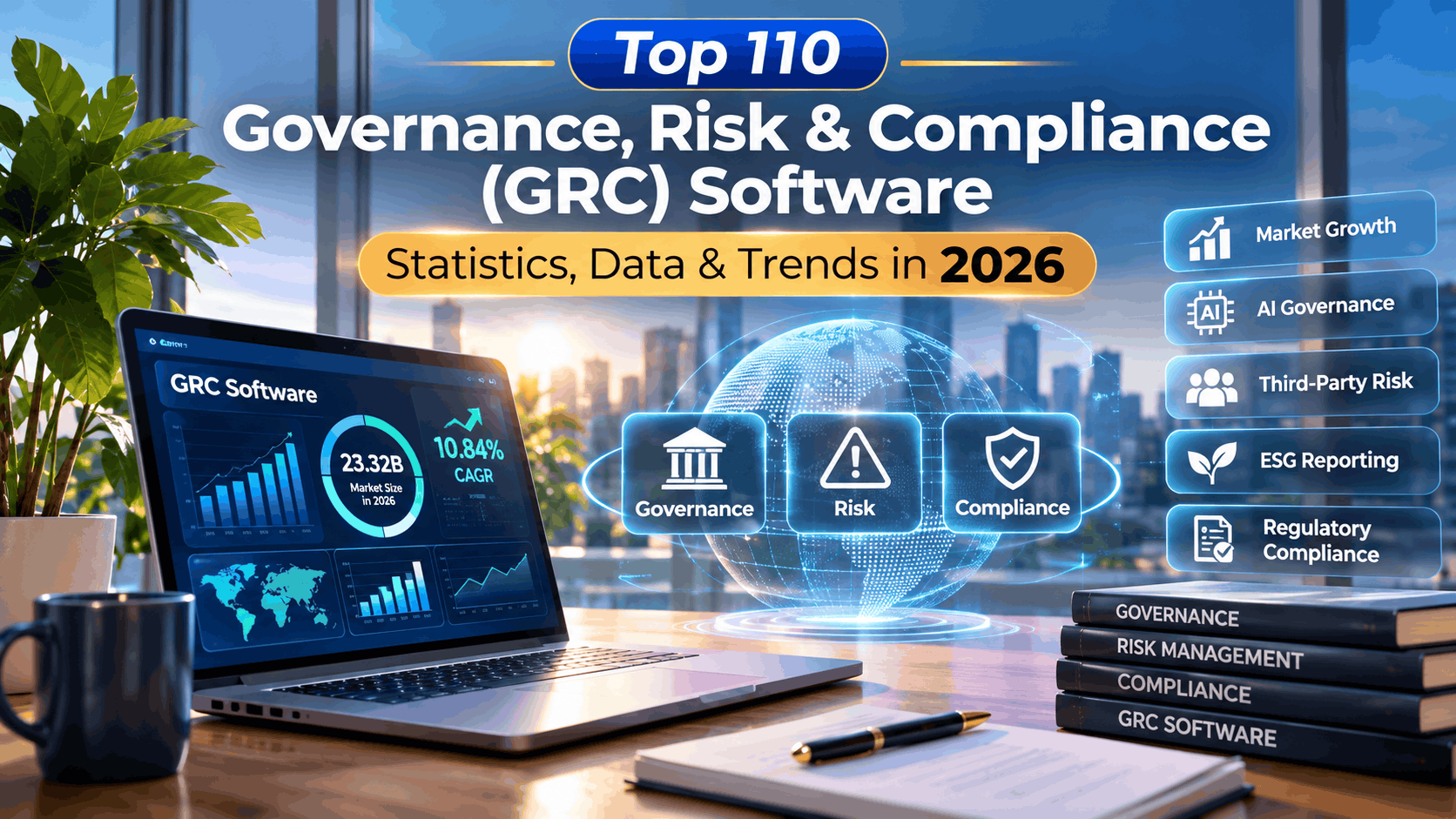
- Rapid GRC Software Market Growth: The global GRC software market is projected to reach $23.32 billion in 2026 and $39.01 billion by 2031, driven by regulatory complexity, cloud adoption, and enterprise risk management demand.
- AI-Powered Compliance Automation: Artificial intelligence, continuous compliance monitoring, and automated risk assessments are transforming GRC software, reducing audit preparation time by 30% to 50%.
- Increasing Importance of Integrated Risk Management: With non-compliance costing 2.71 times more than maintaining compliance, businesses are prioritizing integrated GRC platforms, cybersecurity governance, third-party risk management, and ESG reporting.
Governance, Risk & Compliance (GRC) software helps organizations manage regulatory obligations, enterprise risks, internal audits, and corporate governance through integrated digital platforms. The global GRC software market is projected to reach $23.32 billion in 2026 and $39.01 billion by 2031, driven by compliance automation, artificial intelligence, cybersecurity requirements, and increasing regulatory complexity.
Governance, Risk & Compliance (GRC) software has become an essential component of modern enterprise risk management, helping organizations navigate increasingly complex regulatory requirements, cybersecurity threats, financial risks, and corporate governance responsibilities. As businesses face growing pressure to strengthen accountability, protect sensitive information, and maintain regulatory compliance, demand for integrated GRC software solutions continues to accelerate worldwide.

In 2026, the global GRC software market is estimated to reach $23.32 billion, up from $21.04 billion in 2025. Industry projections suggest the market could expand to $39.01 billion by 2031, representing a compound annual growth rate (CAGR) of 10.84%. This growth reflects increasing enterprise investment in compliance automation, risk assessment tools, internal audit management, regulatory reporting, and centralized governance platforms.
The adoption of cloud-based GRC solutions is also reshaping the industry. Cloud deployment accounted for approximately 62.9% of the GRC software market in 2025, while large enterprises represented 69.6% of industry revenue. However, small and medium-sized enterprises (SMEs) are emerging as an important growth segment, with a projected CAGR of 13.02%. These developments highlight how governance, risk, and compliance technology is expanding beyond large corporations to businesses of different sizes and industries.

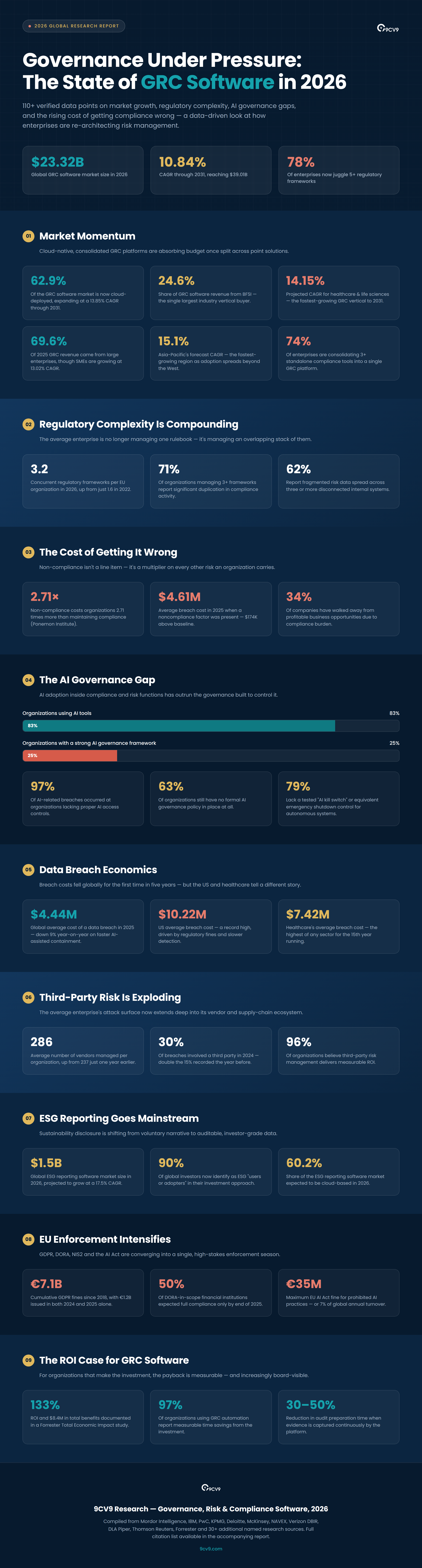
Regulatory complexity remains one of the strongest drivers of GRC software adoption. According to the statistics compiled for this report, 78% of global enterprises operate under five or more regulatory frameworks, while 62% report fragmented risk information across at least three internal systems. Organizations must increasingly manage overlapping requirements involving GDPR, the Digital Operational Resilience Act (DORA), NIS2, the EU AI Act, cybersecurity standards, financial regulations, and environmental, social, and governance (ESG) disclosures.
The financial consequences of inadequate compliance further reinforce the importance of effective governance and risk management. Research cited in the industry data indicates that non-compliance can cost organizations 2.71 times more than maintaining compliance. Meanwhile, IBM’s 2025 cybersecurity findings place the global average cost of a data breach at $4.44 million, demonstrating the substantial financial exposure associated with cybersecurity incidents and weaknesses in organizational controls.
Artificial intelligence is introducing another major transformation across the GRC software industry. AI-powered compliance monitoring, automated risk assessments, predictive analytics, continuous auditing, and intelligent regulatory tracking are helping organizations improve operational efficiency. However, AI adoption also creates new governance challenges. The compiled statistics indicate that more than 83% of compliance, ethics, and risk professionals use AI tools, while only approximately 25% have implemented robust AI governance frameworks.
Third-party risk management is becoming equally important as organizations rely on increasingly interconnected networks of vendors, technology providers, contractors, and external service partners. The growing frequency of third-party cybersecurity incidents has increased demand for vendor risk management software, automated due diligence, continuous supplier monitoring, and integrated third-party risk management (TPRM) platforms.
Beyond cybersecurity and regulatory compliance, organizations are investing in GRC technology to strengthen internal controls, streamline audit preparation, improve policy management, and enhance ESG reporting. Automated compliance workflows and centralized risk dashboards are increasingly replacing fragmented spreadsheets and manual reporting processes, enabling businesses to identify emerging risks earlier and make more informed decisions.
The following 110 Governance, Risk & Compliance (GRC) software statistics, data, and trends for 2026 provide a comprehensive overview of the industry’s market size, growth forecasts, software adoption rates, regulatory challenges, compliance costs, cybersecurity risks, AI governance developments, third-party risk management, ESG reporting, and return on investment.
Whether evaluating the best GRC software solutions, developing an enterprise compliance strategy, researching governance and risk management trends, or assessing opportunities in the growing GRC technology market, these statistics offer valuable insights into the forces shaping the future of governance, risk, and compliance software in 2026 and beyond.
Before we venture further into this article, we would like to share who we are and what we do.
About 9cv9
9cv9 is a business tech startup based in Singapore and Asia, with a strong presence all over the world.
With over ten years of startup and business experience, and being highly involved in connecting with thousands of companies and startups, the 9cv9 team has listed some of the top and best companies/tools in this review.
If you like to get your company listed in our top B2B software reviews, check out our world-class 9cv9 Media and PR service and pricing plans here.
Top 110 Governance, Risk & Compliance (GRC) Software Statistics, Data & Trends in 2026
Market Size & Growth
- The global GRC software market was valued at $21.04 billion in 2025 and is estimated to reach $23.32 billion in 2026, signalling continued double-digit momentum for enterprises shifting from siloed compliance tools to unified platforms.
- Mordor Intelligence projects the GRC software market will hit $39.01 billion by 2031, growing at a CAGR of 10.84%, underscoring the sustained, multi-year investment cycle organizations are entering.
- A separate industry estimate pegs 2024 GRC software revenue at $14.2 billion, forecasting expansion to $43.7 billion by 2033 at a 13.8% CAGR, reflecting how differing market scopes still point to the same long-term growth trajectory.
- Cloud deployment already commands 62.90% of the GRC software market in 2025 and is expanding at a 13.85% CAGR through 2031, confirming that cloud-native platforms are now the default procurement choice for compliance teams.
- Large enterprises controlled 69.60% of GRC software revenue in 2025, but SMEs are catching up fast with a forecast 13.02% CAGR, showing compliance automation is no longer an enterprise-only budget line.
- BFSI (banking, financial services and insurance) accounted for 24.60% of GRC software revenue in 2025, remaining the single largest vertical buyer of governance and compliance technology.
- Healthcare and life sciences are projected to post the fastest GRC software growth of any industry vertical at a 14.15% CAGR, driven by tightening patient-data and clinical-compliance mandates.
- North America held 39.55% of global GRC software revenue in 2025, while Asia-Pacific is projected to grow fastest at a 15.1% CAGR, signalling a geographic rebalancing of GRC software demand toward emerging markets.
- Technavio estimates the broader GRC platform market will reach $65.2 billion by 2026 at a 12.2% CAGR, one of several independent forecasts confirming double-digit sector growth.
- The vendor risk management software segment alone is projected to grow from $9.36 billion in 2025 to $10.62 billion in 2026, a 13.5% year-on-year increase that reflects the surging priority placed on third-party oversight tools.
Regulatory Complexity & Compliance Burden
- More than 78% of global enterprises now operate under five or more regulatory frameworks simultaneously, a load that is pushing organizations toward centralized GRC platforms rather than framework-by-framework spreadsheets.
- 62% of organizations report fragmented risk data spread across three or more internal systems, highlighting the operational case for a single source of compliance truth.
- Over 81% of enterprises now operate across multiple jurisdictions, and 69% must manage five or more compliance standards at once, compounding the complexity GRC software is built to solve.
- 71% of compliance-led enterprises rely on centralized control libraries to manage policy and audit workflows, evidence that consolidated GRC infrastructure has become a mainstream best practice rather than a nice-to-have.
- 74% of enterprises are now consolidating three or more standalone compliance tools into a single GRC solution, directly reflecting vendor consolidation as a 2026 procurement trend.
- The average EU organization now manages compliance with 3.2 concurrent regulatory frameworks, up from 2.1 in 2024 and 1.6 in 2022, illustrating just how quickly regulatory overlap has intensified in three years.
- Among organizations juggling three or more frameworks, 71% report significant duplication of compliance activity, showing the direct cost of not having an integrated GRC system.
- 60% of continuous compliance monitoring adopters have replaced annual audit cycles, up from just 29% still relying on the old once-a-year audit model, marking a structural shift toward always-on compliance assurance.
- 66% of firms use integrated risk dashboards, and doing so cuts manual reporting effort by 42%, a clear efficiency case for dashboard-driven GRC tools.
- 47% of organizations cite regulatory complexity as their top compliance challenge in PwC’s 2025 Global Compliance Survey, cementing regulatory sprawl as the industry’s number-one pain point heading into 2026.
Cost of Compliance & Non-Compliance
- Non-compliance costs organizations 2.71 times more than maintaining compliance, based on Ponemon Institute research comparing the financial burden of regulatory failure against proactive compliance investment.
- Breaches with a documented noncompliance factor cost an average of $174,000 more than breaches without one, reaching $4.61 million overall in 2025.
- Mid-market banks with $10 billion to $30 billion in assets now spend an estimated $15 million to $60 million annually on regulatory compliance overhead, excluding fraud losses or remediation costs.
- For a 100-person compliance team, cutting false positives by 60% can recover roughly $800,000 a year in analyst productivity alone, illustrating the tangible ROI automation delivers at scale.
- Personnel costs alone for a mid-market bank’s compliance function run $8 million to $20 million annually, based on a fully-loaded analyst cost of $95,000 to $135,000 per head.
- Non-compliance drives an average of $4.01 million in annual revenue loss per organization, the single largest component of the true cost of non-compliance.
- For every $1 lost to regulatory fines, companies incur roughly $10 in additional reputational losses, showing fines are only the visible tip of the non-compliance cost iceberg.
- 34% of companies report walking away from profitable business opportunities specifically because compliance requirements made the deal too burdensome to pursue.
- Financial institutions paid more than $4 billion in AML non-compliance penalties in 2025 alone, underscoring the scale of enforcement in the financial sector.
- PEP and sanctions non-compliance penalties surged 2,056% year-on-year to reach $244.5 million in 2025, one of the sharpest single-year jumps in any compliance penalty category.
- The U.S. SEC ordered $8.2 billion in financial remedies in FY2024, including $600 million in penalties for recordkeeping failures alone, reflecting how granular compliance failures are drawing regulatory attention.
- 60% of compliance professionals expect the cost of compliance to keep rising over the next 12 months, according to Cube’s Cost of Compliance Report 2025.
- 98% of organizations have applied some form of automation to their regulatory compliance processes, making manual, spreadsheet-based compliance the exception rather than the rule in 2026.
- 77% of compliance leaders say rising compliance complexity has already hurt business growth to some or a great extent, tying regulatory burden directly to commercial performance.
- PwC’s 2025 survey found organizations using compliance technology see 64% better risk visibility and 53% faster issue response, quantifying the operational upside of investing in GRC tooling.
Cybersecurity, Data Breaches & Risk
- The global average cost of a data breach fell 9% to $4.44 million in 2025, down from $4.88 million in 2024, marking the first decline in five years thanks to faster AI-assisted detection and containment.
- In the United States specifically, the average data breach cost rose to a record $10.22 million in 2025, driven by regulatory fines and slower detection timelines compared to the global average.
- Organizations using AI and automation extensively in their security operations saved an average of $1.9 million per breach compared to those using none, one of the clearest ROI signals for AI-enabled GRC and security tooling.
- The healthcare sector recorded the highest average breach cost of any industry for the 15th consecutive year, at $7.42 million per incident in 2025.
- The mean time to identify and contain a data breach fell to 241 days in 2025, the fastest response time in nine years, largely attributed to AI-powered detection tools.
- Data breaches spanning multiple environments (cloud, on-premises, hybrid) cost an average of $5.05 million, compared to $4.01 million for breaches confined to on-premises systems.
- Shadow AI — unsanctioned employee use of generative AI tools — was a contributing factor in 20% of breaches and added an average of $670,000 to breach costs.
- 97% of AI-related breaches occurred at organizations lacking proper AI access controls, revealing a stark governance gap between AI adoption and AI oversight.
- 63% of organizations still lack a formal AI governance policy altogether, leaving the majority of enterprises exposed as generative AI usage accelerates.
- Malicious insider incidents remain the costliest breach category, averaging $4.92 million per incident, higher than external attack vectors.
- Phishing remained the most common breach vector in 2025, involved in 16% of all reported incidents, reaffirming the need for continuous compliance and security-awareness monitoring.
- Breaches involving a third-party vendor now run approximately 11% above the global average cost, adding a direct financial argument for stronger third-party risk modules within GRC platforms.
AI in GRC, Compliance & Internal Audit
- Internal audit AI adoption is projected to double to 80% in 2026, with 39% of internal auditors already using AI tools and a further 41% planning adoption within 12 months.
- 84% of internal audit leaders now consider AI skills an important hiring criterion, signalling a structural shift in the internal audit talent profile.
- More than 83% of compliance, ethics and risk professionals report using AI tools in their function, yet only about 25% have implemented a robust AI governance framework to manage that usage.
- 85% of enterprises have now integrated AI into core operations or deployed it across multiple business functions, but only 25% report full visibility into how employees are actually using AI day to day.
- Global spending on AI governance and compliance platforms is projected to reach $2.54 billion in 2026, growing to $8.23 billion by 2034.
- Gartner projects spending on dedicated AI governance platforms will reach $492 million in 2026 alone, a distinct and fast-growing sub-segment within the broader GRC software category.
- 76% of surveyed organizations now report having a Chief AI Officer in place, a dramatic jump from just 26% in 2025.
- 78% of enterprises admit they are unprepared for their EU AI Act compliance obligations, exposing a significant readiness gap as enforcement phases continue through 2026.
- Close to three-quarters of companies plan to deploy agentic AI within two years, yet only 21% report having a mature governance model for overseeing autonomous AI agents.
- 55% of enterprises are actively deploying AI, but only 26% say their governance frameworks are fully aligned with the pace of that implementation.
- Financial services organizations tracked 157 AI-related regulatory updates in a single year, nearly double the volume of the prior year, illustrating how fast AI-specific rulemaking is accelerating.
- Almost 7 in 10 security and compliance leaders say AI adoption is outpacing their organization’s security and compliance controls, according to Thoropass’s 2026 State of Audit and Compliance Report.
- 63% of organizations reported at least one compliance consequence tied to an AI governance gap in the past year, ranging from audit findings to formal regulatory inquiries.
- 79% of organizations still lack a tested “AI kill switch” or equivalent emergency shutdown control, higher than the roughly 60% initially projected for 2026.
- Only 16.7% of organizations report seeing measurable ROI from AI specifically applied within their GRC programs, showing that AI adoption in compliance still lags meaningful, board-demonstrable returns for most.
- Firms investing more than 10% of their AI budget on ethics and governance report roughly 30% higher operating profit growth and 22% higher customer satisfaction, linking AI governance investment to tangible business performance.
- 66% of corporate boards still report limited-to-no working knowledge of AI, an improvement from 79% the prior year but still representing a majority-level governance blind spot at the top of the organization.
Third-Party & Vendor Risk Management
- 30% of data breaches involved a third party in 2024, doubling from 15% the year prior, according to Verizon’s Data Breach Investigations Report.
- 35.5% of breaches originated from third-party compromises in the latest annual period, up 6.5 percentage points year-over-year.
- The average company now manages 286 vendors, up from 237 in 2024, reflecting the accelerating vendor sprawl that GRC and TPRM software is designed to control.
- 96% of organizations believe third-party risk management delivers measurable ROI, yet only 83% consider their TPRM program fully “established,” revealing a maturity gap even among believers.
- Fourth-party breaches — incidents originating from a vendor’s own vendor — now account for 4.5% of all breaches, extending risk exposure well beyond an organization’s direct supplier list.
- 44% of organizations now assess more than 100 third parties every year, a due-diligence workload that is difficult to sustain without dedicated automation.
- Nearly half of financial institutions experienced a third-party cyber event in the past year, with AI now ranking alongside cybersecurity as a top third-party concern for the first time.
- 72% of financial institutions admit they have only partial awareness of which of their vendors are using AI, leaving a significant blind spot in fourth-party and AI-specific risk exposure.
- 63% of third-party risk management programs run on just one or two dedicated employees, even as more than half of those programs manage 300 or more vendor relationships.
- 85% of financial institutions relying on manual third-party risk processes are being pushed toward dedicated TPRM software, following a clear correlation between manual processes and adverse examination findings.
- Regulatory compliance (48%) and cyber risk (37%) are now the top two drivers shaping third-party risk management strategy globally, according to KPMG’s 2026 Global TPRM Survey.
- Business continuity and resilience concerns among executives monitoring third-party risk rose from 14% in 2023 to 23% in 2025, a 64% increase reflecting growing awareness of supply chain fragility.
- The vendor risk management software market alone is projected to reach $51.34 billion by 2030, confirming third-party risk as one of the fastest-growing sub-categories within the broader GRC space.
ESG & Sustainability Reporting
- The global ESG reporting software market is valued at roughly $1.5 billion in 2026 and is projected to reach $3.98 billion by 2032, growing at a 17.5% CAGR.
- A separate forecast puts the ESG reporting software market on track to reach $7.36 billion by 2034, expanding at an even faster 21.02% CAGR through the period.
- Cloud-based deployment is expected to represent 60.2% of the ESG reporting software market in 2026, cementing cloud as the default delivery model for sustainability compliance tools, mirroring the wider GRC market.
- North America is projected to hold roughly 38-40% share of the global ESG reporting software market through 2026, remaining the single largest regional buyer of ESG compliance technology.
- Asia-Pacific is emerging as the fastest-growing ESG reporting software region, with organizations in China, India and Japan adopting integrated platforms to meet global supply-chain sustainability demands.
- 90% of surveyed global investors now identify as ESG “users or adopters,” directly fueling corporate demand for auditable, investor-grade ESG disclosure software.
- Convergence of international ESG standards such as ISSB, CSRD and TCFD is a primary driver pushing organizations toward unified ESG reporting platforms capable of handling multiple frameworks simultaneously.
- Organizations using integrated ESG platforms in Asia-Pacific have achieved up to 25% faster sustainability reporting cycles compared to fragmented, spreadsheet-based ESG tracking.
EU Regulation: GDPR, DORA, NIS2 & AI Act
- Cumulative GDPR fines have reached €7.1 billion since 2018, with €1.2 billion issued in both 2024 and 2025 alone, showing enforcement intensity has not slowed nearly eight years after the regulation took effect.
- GDPR breach notifications reached 443 per day in 2025, a 22% year-on-year increase and the first time daily notifications have exceeded 400 since GDPR came into force.
- Only about a third of major European financial institutions were confident they could meet all DORA requirements by the January 2025 deadline, according to a McKinsey survey.
- Just 50% of DORA-in-scope institutions expected to reach full compliance by the end of 2025, with a further 38% pushing their target into 2026, per Deloitte research.
- 46% of financial institutions identified DORA’s Register of Information — the mandatory inventory of ICT third-party contracts — as the single most challenging requirement to fulfil.
- Large credit institutions with over €30 billion in assets report the highest DORA completion rate at 79%, reflecting the advantage of earlier investment in third-party risk infrastructure.
- 41% of organizations report significant uncertainty about their specific NIS2 obligations, driven largely by inconsistent national transposition of the directive across EU member states.
- NIS2 compliance obligations across critical sectors culminate in an October 2026 enforcement deadline, adding further urgency for in-scope organizations still building out compliance programs.
- The EU AI Act imposes fines of up to €35 million or 7% of global annual turnover for violations involving prohibited AI practices, among the steepest AI-specific compliance penalties in force anywhere in the world.
- Non-compliance with high-risk AI system obligations under the EU AI Act carries penalties of up to €15 million or 3% of worldwide turnover.
- Organizations with existing compliance platforms report significantly better AI governance readiness — 41% have frameworks in place — compared to just 18% among those still managing compliance manually.
Internal Audit & Controls
- Audit preparation time is reduced by 30% to 50% when evidence is captured continuously by a GRC platform rather than assembled manually ahead of each audit cycle.
- Ongoing compliance monitoring effort is cut by 60% to 80% when a platform automatically tracks legislative changes and surfaces relevant updates to obligation owners.
- SOC 2 remains the most widely adopted audit framework, used by 76% of organizations, with SOC 2 adoption itself increasing 40% in a single year.
- The average total cost of SOC 2 Type I certification is approximately $147,000, ranging from roughly $91,000 for companies under 50 employees to $186,000 for organizations with 50-250 employees.
- 60% of companies say they are more likely to do business with a startup that holds SOC 2 compliance, and 70% of venture capitalists say they prefer investing in SOC 2-compliant companies.
- Automated risk assessments are now used by 63% of organizations, cutting risk identification cycles by 41% compared to manual assessment processes.
GRC Software Adoption, Reviews & ROI
- 97% of organizations using GRC automation report measurable time savings, yet a majority still struggle to translate those savings into board-level ROI reporting.
- A Forrester Total Economic Impact study found a leading connected GRC platform delivered 133% ROI and $8.4 million in total quantified benefits for its customers.
- Organizations relying on fragmented GRC tools and manual processes face 30-40% higher compliance operating costs than those on a unified platform.
- GRC automation typically saves compliance teams five to ten hours of routine manual work per week per team member, freeing capacity for higher-value risk and governance analysis.
- Leading GRC platforms on Capterra and G2 consistently score in the 4.4-4.5 range on ease of use and customer support, reflecting a maturing product category where usability has become as important as feature depth.
- 68% of large enterprises now use dedicated policy management software as part of their broader GRC technology stack, rather than relying on shared drives or static documents.
- The policy management software market — a core GRC sub-segment — is projected to reach $4.58 billion by 2033, growing at a 9.87% CAGR.
- 61% of organizations say they prefer configurable GRC dashboards and 56% demand real-time alerting capabilities, defining the baseline feature expectations for 2026 buyers.
Conclusion
The Top 110 Governance, Risk & Compliance (GRC) Software Statistics, Data & Trends in 2026 highlight an industry undergoing significant transformation as organizations prioritize regulatory compliance, enterprise risk management, cybersecurity resilience, and corporate governance. With the global GRC software market estimated to reach $23.32 billion in 2026 and projected to grow to $39.01 billion by 2031 at a CAGR of 10.84%, demand for integrated governance, risk, and compliance solutions is expected to remain strong.
One of the most important GRC software trends in 2026 is the accelerating transition from fragmented compliance processes to centralized, cloud-based platforms. Cloud deployment already accounted for 62.9% of the market in 2025, reflecting growing demand for scalable, accessible, and automated compliance management systems. Although large enterprises continue to dominate GRC software spending, small and medium-sized businesses are increasingly adopting these solutions to manage regulatory obligations, streamline internal audits, and strengthen risk oversight.
Regulatory complexity and the rising cost of non-compliance remain major catalysts for GRC software adoption. With organizations navigating multiple regulatory frameworks, including GDPR, DORA, NIS2, and the EU AI Act, businesses are under increasing pressure to implement effective compliance monitoring, policy management, and regulatory reporting capabilities. The financial consequences are substantial, with research indicating that non-compliance can cost organizations 2.71 times more than maintaining compliance.
Artificial intelligence is also reshaping the future of governance, risk, and compliance technology. AI-powered risk assessments, predictive analytics, automated audit workflows, and continuous compliance monitoring offer opportunities to improve efficiency and reduce administrative workloads. However, the growing gap between enterprise AI adoption and formal AI governance frameworks demonstrates that organizations must balance technological innovation with accountability, transparency, and responsible AI management.
Meanwhile, third-party risk management, cybersecurity governance, and ESG reporting are emerging as critical areas of GRC software investment. As businesses become increasingly dependent on external vendors, cloud infrastructure, and interconnected digital ecosystems, comprehensive risk visibility and continuous monitoring are becoming essential. Organizations are also facing greater expectations for transparent sustainability disclosures, stronger internal controls, and demonstrable regulatory compliance.
The financial and operational benefits of GRC automation further reinforce its strategic importance. The compiled industry data indicates that continuous evidence collection can reduce audit preparation time by 30% to 50%, while automated compliance monitoring can reduce ongoing monitoring effort by 60% to 80%. These reported efficiency improvements illustrate how integrated GRC platforms can help compliance teams allocate more resources toward strategic risk management rather than repetitive administrative tasks.
Looking ahead, the most significant opportunities in the GRC software market beyond 2026 are likely to emerge from AI-driven compliance automation, cloud-native governance platforms, real-time risk intelligence, integrated third-party risk management, and increasingly sophisticated regulatory technology (RegTech). Organizations that successfully integrate these capabilities into their governance strategies will be better positioned to respond to regulatory changes, strengthen operational resilience, and support sustainable business growth.
Ultimately, the 110 GRC software statistics and trends examined in this report demonstrate that governance, risk, and compliance software is evolving from a regulatory necessity into a strategic business investment. For enterprises, compliance professionals, risk managers, technology providers, and business leaders, understanding these developments is essential for making informed software investment decisions, improving organizational accountability, and building resilient compliance frameworks.
As regulatory requirements evolve and digital risks become more complex, businesses that embrace integrated, automated, and data-driven GRC solutions will be better equipped to manage uncertainty, protect stakeholders, and maintain a competitive advantage in 2026 and the years ahead.
If you find this article useful, why not share it with your hiring manager and C-level suite friends and also leave a nice comment below?
We, at the 9cv9 Research Team, strive to bring the latest and most meaningful data, guides, and statistics to your doorstep.
To get access to top-quality guides, click over to 9cv9 Blog.
To hire top talents using our modern AI-powered recruitment agency, find out more at 9cv9 Modern AI-Powered Recruitment Agency.
People Also Ask
What is Governance, Risk & Compliance (GRC) software?
Governance, Risk & Compliance (GRC) software is a digital solution that helps organizations manage corporate governance, enterprise risks, regulatory compliance, internal audits, and policy management through a centralized platform.
How big is the global GRC software market in 2026?
The global GRC software market is estimated to reach $23.32 billion in 2026, increasing from $21.04 billion in 2025, driven by regulatory complexity, compliance automation, and enterprise risk management demand.
What is the projected growth rate of the GRC software market?
The global GRC software market is projected to grow at a compound annual growth rate (CAGR) of 10.84%, reaching approximately $39.01 billion by 2031.
What are the major GRC software trends in 2026?
Major GRC software trends include AI-powered compliance automation, cloud-based platforms, continuous risk monitoring, third-party risk management, ESG reporting, predictive analytics, and integrated regulatory management.
What factors are driving GRC software market growth in 2026?
Key growth drivers include increasing regulatory complexity, cybersecurity threats, digital transformation, AI governance requirements, rising compliance costs, and growing demand for automated enterprise risk management.
What percentage of the GRC software market is cloud-based?
Cloud-based deployment accounted for 62.9% of the global GRC software market in 2025 and is projected to grow at a CAGR of 13.85% through 2031.
Which industry uses GRC software the most?
The banking, financial services, and insurance (BFSI) industry is the largest GRC software market segment, accounting for approximately 24.6% of global GRC software revenue in 2025.
Which region dominates the global GRC software market?
North America dominates the global GRC software market, accounting for approximately 39.55% of worldwide revenue in 2025, supported by enterprise technology adoption and regulatory requirements.
Which region has the fastest-growing GRC software market?
Asia-Pacific is projected to be the fastest-growing GRC software market, with an estimated CAGR of 15.1%, driven by digital transformation, regulatory developments, and increasing enterprise compliance investment.
How is artificial intelligence transforming GRC software?
Artificial intelligence enhances GRC software through automated risk assessments, predictive analytics, intelligent regulatory monitoring, continuous auditing, anomaly detection, and automated compliance workflows.
What percentage of compliance professionals use AI tools?
More than 83% of compliance, ethics, and risk professionals reportedly use AI tools within their functions, although only approximately 25% have implemented robust AI governance frameworks.
How large is the AI governance software market in 2026?
Global spending on AI governance and compliance platforms is projected to reach $2.54 billion in 2026 and grow to approximately $8.23 billion by 2034.
How much does regulatory non-compliance cost businesses?
Research from the Ponemon Institute indicates that regulatory non-compliance costs organizations approximately 2.71 times more than maintaining compliance, including financial penalties, revenue losses, and operational disruption.
What is the average cost of a data breach in 2026?
The latest benchmark included in this report places the global average cost of a data breach at $4.44 million in 2025, down from $4.88 million in 2024. This provides a reference point for cybersecurity risk management in 2026.
How does GRC software improve cybersecurity risk management?
GRC software improves cybersecurity risk management by centralizing security controls, monitoring vulnerabilities, tracking compliance obligations, identifying emerging threats, and supporting incident response workflows.
What is the role of GRC software in third-party risk management?
GRC software supports third-party risk management through automated vendor assessments, supplier due diligence, continuous risk monitoring, compliance tracking, and centralized management of external business relationships.
How big is the vendor risk management software market in 2026?
The global vendor risk management software market is projected to reach $10.62 billion in 2026, increasing from $9.36 billion in 2025 and representing approximately 13.5% annual growth.
How common are third-party data breaches?
Verizon’s Data Breach Investigations Report indicates that third parties were involved in approximately 30% of breaches occurring in 2024, doubling from 15% in the previous year.
How does GRC software support ESG reporting?
GRC software supports ESG reporting by centralizing sustainability data, monitoring environmental and social risks, managing disclosure requirements, tracking performance indicators, and automating regulatory reporting workflows.
What is the ESG reporting software market size in 2026?
The global ESG reporting software market is estimated to reach approximately $1.5 billion in 2026 and is projected to grow to $3.98 billion by 2032 at a CAGR of 17.5%.
How does GRC software help organizations comply with GDPR?
GRC software supports GDPR compliance through data protection risk assessments, policy management, breach documentation, compliance monitoring, audit trails, and centralized tracking of regulatory obligations.
How much have GDPR fines reached by 2026?
Cumulative GDPR fines have reportedly reached approximately €7.1 billion since the regulation took effect in 2018, with around €1.2 billion in fines issued in each of 2024 and 2025.
How does GRC software support DORA and NIS2 compliance?
GRC software supports DORA and NIS2 compliance by helping organizations manage ICT risks, monitor third-party providers, document cybersecurity controls, track regulatory obligations, and strengthen operational resilience.
How does GRC software help businesses comply with the EU AI Act?
GRC software supports EU AI Act compliance through AI system inventories, risk classifications, governance policies, compliance documentation, control monitoring, and oversight of high-risk artificial intelligence systems.
How much time can GRC software save during audit preparation?
Continuous evidence collection through integrated GRC software can reportedly reduce audit preparation time by 30% to 50%, minimizing manual documentation and improving audit readiness.
How much can GRC software reduce compliance monitoring workloads?
Automated GRC platforms can reportedly reduce ongoing compliance monitoring effort by 60% to 80% through automated regulatory tracking, obligation management, control monitoring, and compliance alerts.
What is the return on investment of GRC software?
GRC software ROI varies by implementation. A Forrester Total Economic Impact study found that a leading connected GRC platform delivered 133% ROI and $8.4 million in quantified benefits.
Is GRC software suitable for small and medium-sized businesses?
Yes. GRC software helps SMEs automate compliance, manage enterprise risks, and reduce administrative workloads. The SME segment of the GRC software market is projected to grow at a CAGR of 13.02%.
What features should businesses look for in GRC software in 2026?
Essential GRC software features include automated risk assessments, real-time dashboards, compliance monitoring, policy management, audit management, vendor risk assessments, regulatory alerts, and AI governance capabilities.
What is the future of Governance, Risk & Compliance software beyond 2026?
The future of GRC software will likely focus on AI-driven automation, predictive risk intelligence, continuous compliance monitoring, cloud-native platforms, integrated ESG reporting, and increasingly sophisticated enterprise governance capabilities.
Sources
- Mordor Intelligence
- Verified Market Reports
- openPR
- Technavio
- GII Research
- The Business Research Company
- Market Growth Reports
- Xoralia
- FortisEU
- Sprinto
- Secureframe
- FluxForce
- SanctionsLookup
- Globalscape
- Ponemon Institute
- U.S. Securities and Exchange Commission (SEC)
- PwC
- IBM
- AllCovered
- Northdoor
- Bluefin
- DataFence
- Cynomi
- Verizon
- Wolters Kluwer
- Compliance Week
- konaAI
- Optro
- Gartner
- Deloitte
- Vision Compliance
- SQ Magazine
- Corporate Compliance Insights
- Smarsh
- FTI Consulting
- Thoropass
- Business Wire
- Kiteworks
- Onspring
- Evolvance Market Research
- DeepStrike
- SecurityScorecard
- Whistic
- Venminder
- 360factors
- Ncontracts
- KPMG
- MarketsandMarkets
- Fortune Business Insights
- Coherent Market Insights
- Persistence Market Research
- Capital Group
- DLA Piper
- CNIC Solutions
- The Next Web
- McKinsey & Company
- ComplianceHub
- European Union
- Lahebo
- A-LIGN
- UnderDefense
- StrongDM
- RegScale
- MetricStream
- Forrester
- Workstreet
- Capterra
- Pirani
- MasterControl
- Resolver
- IMARC Group


