Key Takeaways
- Discover the Top 110 Food Service Distribution Software Statistics, Data & Trends in 2026, exploring global market growth, AI adoption, cloud-based ERP systems, warehouse management, inventory optimization, and route planning.
- Learn how food distributors are leveraging automation, predictive analytics, food traceability, cold chain monitoring, and B2B digital ordering platforms to reduce operational costs, improve supply chain efficiency, minimize food waste, and increase profitability.
- Explore key industry insights, emerging technologies, and market forecasts shaping the future of food service distribution software in 2026 and beyond.
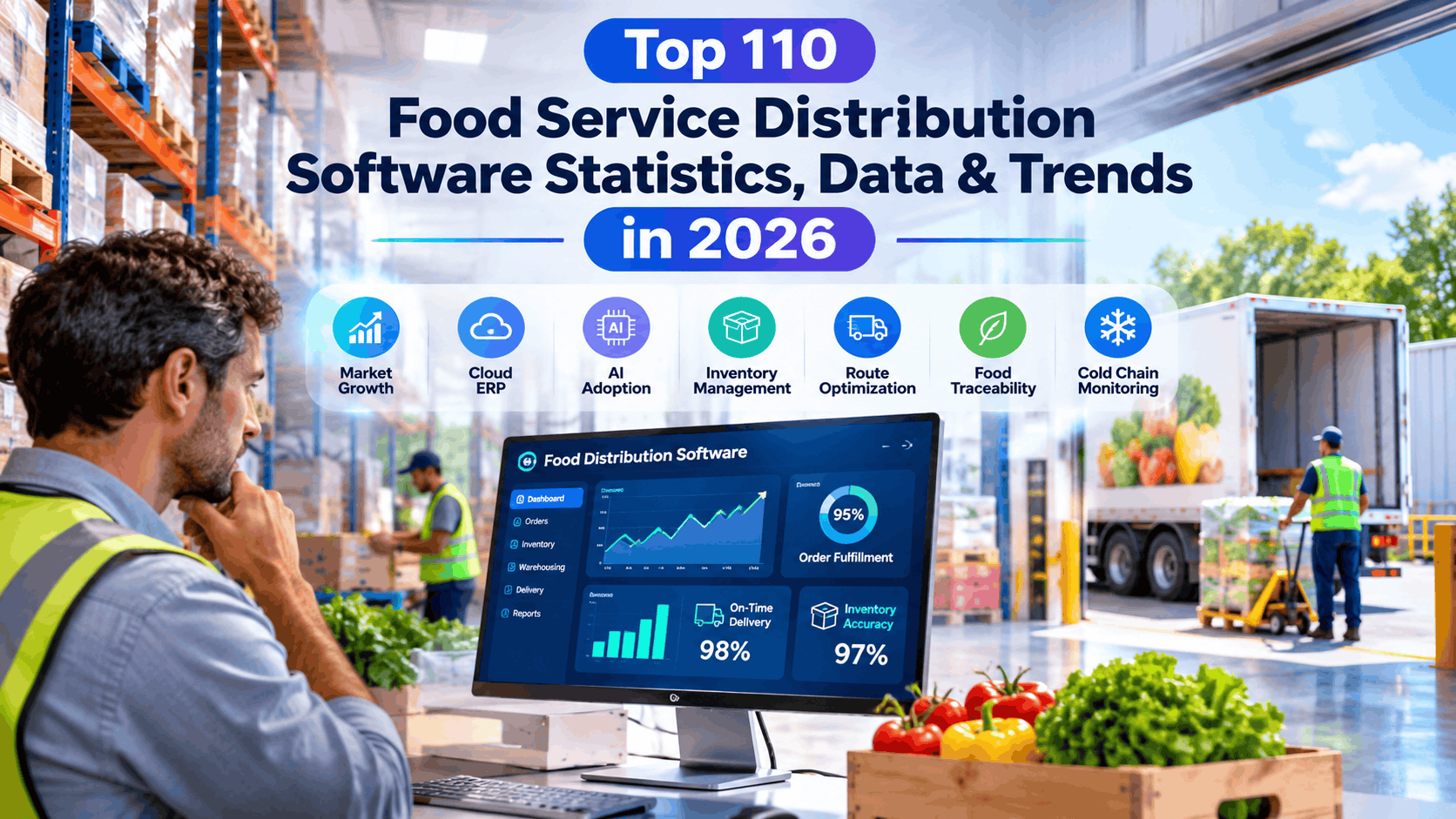
Food service distribution software helps distributors manage inventory, automate orders, optimize delivery routes, and improve supply chain efficiency. In 2026, the global market is estimated at $4.82 billion, with projections reaching $6.58 billion by 2034. Key trends include AI-powered forecasting, cloud ERP adoption, warehouse automation, food traceability, and cold chain monitoring.
The global food service distribution industry is undergoing a significant digital transformation as businesses increasingly adopt advanced software solutions to streamline operations, optimize supply chains, reduce food waste, and improve profitability. In 2026, food service distribution software has become an essential technology for wholesalers, food distributors, restaurant suppliers, and foodservice operators seeking greater efficiency, visibility, and control over their increasingly complex distribution networks.
Also, read our article on the Top 10 Food Service Distribution Software To Try.

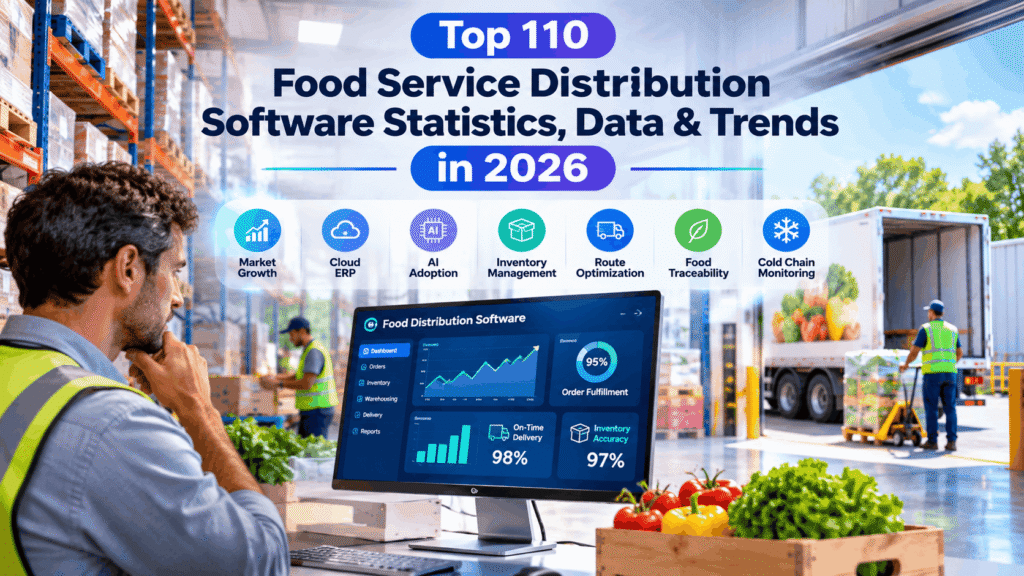
From inventory management and warehouse automation to artificial intelligence (AI), route optimization, cold chain monitoring, and food traceability, modern food distribution software is reshaping how businesses manage procurement, storage, order fulfillment, and last-mile deliveries.
According to industry market estimates, the global food service distribution software market is valued at approximately $4.82 billion in 2026 and is projected to reach $6.58 billion by 2034, representing a compound annual growth rate (CAGR) of 3.96%. Other market research estimates suggest considerably faster growth, reflecting differences in market definitions, software categories, and the inclusion of broader enterprise resource planning (ERP) and supply chain management solutions.

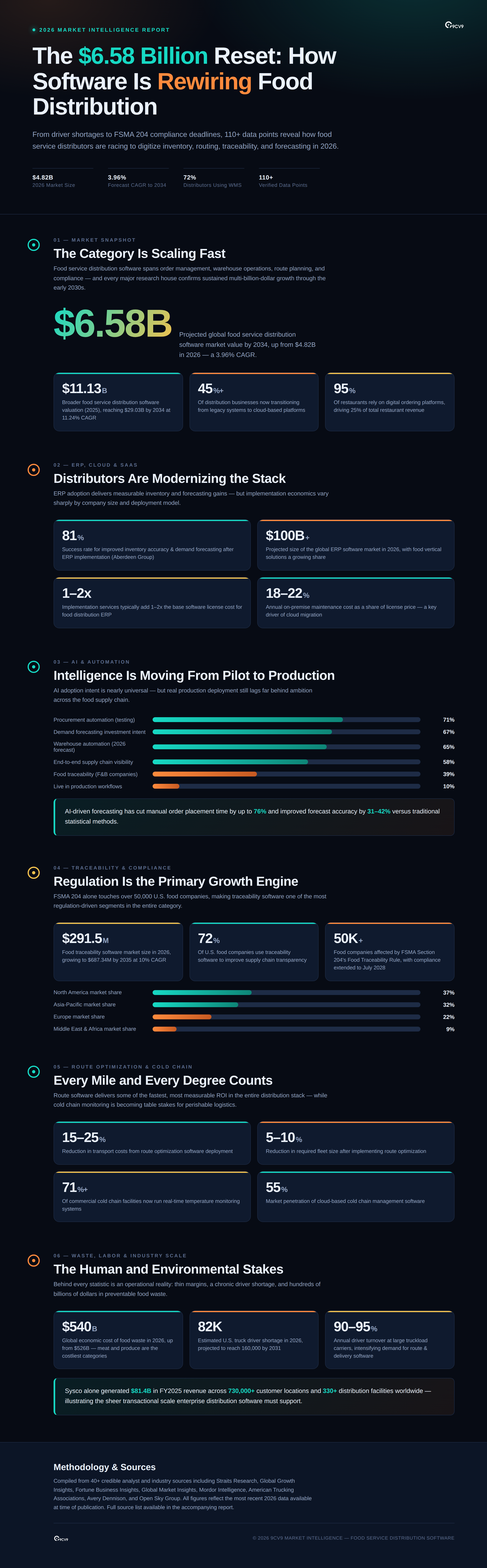
The growing adoption of cloud-based platforms is another major development influencing the food service distribution software market. Industry estimates indicate that more than 45% of food service distribution businesses are transitioning from legacy systems to cloud-based software, enabling real-time inventory tracking, automated order processing, improved warehouse coordination, and better communication across distribution networks.
Artificial intelligence and automation are also becoming increasingly important competitive differentiators. Research indicates that 58% of supply chain leaders use AI to improve end-to-end operational visibility, while 85% of supply chain executives plan to increase their AI spending in 2026. These technologies are helping businesses improve demand forecasting, optimize purchasing decisions, minimize stockouts, and identify opportunities to reduce operational costs.
Meanwhile, warehouse management systems (WMS), inventory optimization platforms, and intelligent delivery routing solutions are generating measurable operational improvements. Industry findings suggest that 72% of food distributors use warehouse management systems for inventory tracking, while route optimization software implementations can reduce transportation costs by approximately 15% to 25%, depending on operational conditions.
Food safety, regulatory compliance, and product traceability have become equally important considerations. With increasingly demanding requirements surrounding food handling, storage temperatures, product recalls, and supply chain transparency, distributors are investing in digital traceability platforms, automated compliance reporting, and Internet of Things (IoT) monitoring technologies.
Sustainability is another powerful driver of software adoption. The United Nations Environment Programme estimated that approximately 1.05 billion tonnes of food were wasted globally in 2022 across households, food services, and retail. As businesses seek to reduce waste and improve resource efficiency, advanced forecasting systems, automated inventory controls, and real-time temperature monitoring are becoming increasingly valuable components of modern food distribution operations.
At the same time, the expansion of B2B e-commerce and digital ordering platforms is transforming relationships between food distributors and their customers. Restaurants, hotels, catering companies, institutional kitchens, and other foodservice establishments increasingly expect seamless online ordering, accurate product availability, transparent pricing, and reliable delivery tracking.
For food distributors, technology providers, business owners, supply chain professionals, and investors, understanding these developments is essential for making informed decisions about software investments, operational improvements, and long-term business strategies.
This comprehensive guide to the Top 110 Food Service Distribution Software Statistics, Data & Trends in 2026 examines the latest industry figures, market growth projections, technology adoption patterns, and emerging innovations shaping the global food distribution software landscape.
Covering everything from food distribution ERP software, warehouse management systems, AI-powered demand forecasting, and route optimization to food traceability, cold chain logistics, B2B ordering, cybersecurity, and sustainability, these 110 statistics provide valuable insights into the opportunities, challenges, and technological developments influencing the industry in 2026 and beyond.
Whether a business is evaluating its first food distribution management software platform, upgrading an existing ERP system, or exploring AI-driven supply chain automation, these statistics offer a useful foundation for understanding how digital technologies are transforming the future of food service distribution.
Before we venture further into this article, we would like to share who we are and what we do.
About 9cv9
9cv9 is a business tech startup based in Singapore and Asia, with a strong presence all over the world.
With over ten years of startup and business experience, and being highly involved in connecting with thousands of companies and startups, the 9cv9 team has listed some of the top and best companies/tools in this review.
If you like to get your company listed in our top B2B software reviews, check out our world-class 9cv9 Media and PR service and pricing plans here.
Top 110 Food Service Distribution Software Statistics, Data & Trends in 2026
Market Size & Growth
- The global food service distribution software market is valued at $4.82 billion in 2026 and is projected to reach $6.58 billion by 2034. This steady 3.96% CAGR trajectory reflects the food service distribution software market’s maturation as distributors prioritize digital inventory and order-processing tools over legacy systems.
- The market is expected to grow at a CAGR of 3.96% between 2026 and 2034. This moderate but consistent growth rate signals a market driven by operational necessity rather than speculative hype, making food service distribution software a durable long-term technology investment.
- North America is the leading region in the food service distribution software market in 2026. North America’s dominance in food service distribution software adoption stems from a mature restaurant and foodservice ecosystem paired with early digital transformation among major distributors.
- Oracle Corporation, SAP SE, Blue Yonder, Infor, and Tyler Technologies are cited among the leading vendors in the food service distribution software market. The presence of established enterprise software giants alongside specialized vendors underscores how food service distribution software has become a strategic priority for both large-scale and niche providers.
- A separate market analysis pegs food service distribution software at $8.09 billion in 2025, rising to $10.75 billion by 2032 at a 4.2% CAGR. Divergent market-sizing estimates across research firms reflect differing methodologies for what counts as “distribution software,” but all point toward continued expansion through the early 2030s.
- One report values the broader food service distribution software category at $11.13 billion in 2025, forecast to reach $29.03 billion by 2034 at an 11.24% CAGR. This higher-growth estimate captures the accelerating shift toward cloud-based, AI-enhanced distribution platforms rather than narrowly defined legacy systems.
- The foodservice distribution software market is separately estimated at $1.5 billion in 2024, growing to $3.2 billion by 2033 at a 9.2% CAGR. This more conservative valuation likely isolates standalone distribution software from adjacent ERP and POS categories, illustrating how market scope significantly affects reported figures.
- Global food service management software is projected to reach $1,396.88 billion in 2026 and $3,914.30 billion by 2035, growing at a 12.13% CAGR. This dramatically larger figure reflects the inclusion of the entire food service management software ecosystem, not distribution-specific tools alone, highlighting how the distribution segment fits within a much larger digital food economy.
- The food service distribution software market is projected to expand from $5.72 billion in 2025 to $9.19 billion by 2032 at a 7.00% CAGR. This mid-range projection reinforces that regardless of methodology, every major research house agrees the category is on a sustained upward trend through the decade.
- The broader food software market, encompassing ERP, inventory, and POS tools, was valued at $12.5 billion in 2024 and is projected to reach $30 billion by 2033 at a 10.2% CAGR. Distribution-specific software represents one growth engine within this wider food software ecosystem that also includes recipe management and quality assurance platforms.
- The food distribution software market specifically (excluding general ERP) was valued at $3.5 billion in 2024 and is forecast to reach $7.2 billion by 2033 at an 8.5% CAGR. This narrower definition, which explicitly excludes non-food-specific ERP systems, better isolates demand for purpose-built food logistics software.
Cloud, SaaS & ERP Adoption
- Over 45% of food service distribution businesses are transitioning from legacy systems to cloud-based platforms. This accelerating cloud migration reflects distributors’ growing demand for scalability, remote access, and real-time data synchronization across warehouses and delivery routes.
- 95% of restaurants now rely on digital ordering platforms, which contribute 25% of their total revenue. This heavy reliance on digital ordering channels is a direct driver of demand for connected food service distribution software that can synchronize with restaurant-side systems.
- The global ERP software market is projected to exceed $100 billion in 2026, with food industry vertical solutions comprising a substantial share. The scale of the broader ERP market illustrates the significant addressable opportunity for food-industry-specific distribution modules within enterprise software budgets.
- Food and beverage companies achieve better inventory accuracy and demand forecasting after ERP implementation, with an 81% success rate reported. This high implementation success rate suggests that, unlike some enterprise software categories, food-specific ERP delivers measurable and reliable operational gains for distributors.
- Per-user ERP licensing for food distribution ranges from roughly $70 to $100 per user per month. Understanding this pricing band helps distributors budget realistically for platform rollout across sales, warehouse, and finance teams.
- Total cost of ownership for mid-market food distribution ERP systems ranges from $100,000 to $400,000, while enterprise deployments range from $25,000 to $120,000 depending on scope. These figures highlight how implementation costs vary enormously by company size, module complexity, and deployment model.
- Implementation services for food distribution ERP typically add 1–2x the base software license cost. This often-overlooked cost multiplier is critical for distributors budgeting total software investment, not just recurring subscription fees.
- Annual maintenance for on-premise food distribution ERP systems runs 18–22% of license cost per year. This ongoing maintenance burden is a key reason many food distributors are migrating toward cloud/SaaS models with bundled maintenance.
- The most critical ERP modules for food distribution are Manufacturing, Quality Management, Inventory Management, Supply Chain, and Warehouse Management, with all major vendors rating Manufacturing and Quality Management as “strong.” This vendor consensus underscores that food-specific compliance and quality features are now considered table stakes rather than optional add-ons.
AI, Automation & Digital Transformation
- Forrester forecasts 65% AI adoption in warehouse automation by 2026, though current adoption among mid-sized firms sits at just 22%. This gap between projected and actual adoption shows AI-powered warehouse automation is still in an early-majority phase for smaller food distributors.
- 39% of food and beverage companies use AI for traceability, up from roughly 24% in 2022 — a 15-point increase. This rapid rise in AI-driven traceability adoption is being pushed largely by regulatory pressure such as FSMA 204 compliance deadlines.
- 67% of supply chain executives planned AI investments exceeding $10 million for demand forecasting. Such large capital commitments signal that AI-driven forecasting has moved from pilot project to board-level strategic priority for major distributors.
- 58% of supply chain leaders use AI for end-to-end visibility across their operations. End-to-end visibility, once a competitive differentiator, is fast becoming a baseline expectation for distributors managing multi-location, multi-SKU operations.
- 71% of chief procurement officers are testing AI in procurement automation. This high testing rate indicates procurement is one of the leading use cases for AI experimentation within food distribution and broader supply chain organizations.
- 44% of European supply chain companies are adopting AI specifically for regulatory compliance. Europe’s comparatively stringent food safety and traceability regulations appear to be accelerating AI adoption for compliance-specific use cases.
- AI-driven food supply chain tools have helped major retailers cut food waste by up to 25%, per case studies such as Kroger’s AI deployment. This concrete waste-reduction outcome illustrates one of the clearest and most quantifiable ROI cases for AI investment in food distribution technology.
- AI-enabled quality control systems in food manufacturing report 15–30% better defect detection alongside 20–40% less unplanned downtime. These operational gains demonstrate that AI’s value in food distribution extends beyond forecasting into quality assurance and equipment reliability.
- 76% of food and beverage supply chain professionals identify Advanced Data Analytics as the dominant technology trend for 2026. This overwhelming preference for analytics over flashier technologies suggests distributors are prioritizing practical, data-driven decision-making tools.
- Only 12% of food and beverage companies have moved generative AI beyond the experimentation stage into active daily operations, while 44% remain in a “test phase” and 28% admit not knowing how to apply it. This gap between generative AI enthusiasm and real-world deployment highlights that most food distributors are still early in their GenAI journey compared to more established predictive AI tools.
- 85% of supply chain executives plan to increase AI spending in 2026, with one in five expecting a 20%+ budget increase. This strong spending intent confirms AI investment remains a top budget priority for supply chain and distribution leaders despite mixed real-world deployment rates.
- Companies with AI-mature supply chains report being 23% more profitable than peers and are six times more likely to use AI or generative AI widely. This profitability gap provides a compelling business case for food distributors weighing the ROI of deeper AI integration.
- 94% of supply chain companies plan to use AI or generative AI for decision support within the next two years. Near-universal planned adoption suggests AI-assisted decision-making will soon become a standard, rather than differentiating, feature of food distribution software.
- Only 23% of supply chain organizations currently have a formal AI strategy in place. This low formalization rate suggests many food distributors are adopting AI tactically rather than strategically, creating both risk and opportunity for software vendors offering structured AI roadmaps.
- 72% of logistics employees adopted AI tools in 2024 — the highest adoption rate of any industry measured. This unexpectedly high frontline adoption rate suggests AI tools embedded in food distribution and logistics software are proving genuinely useful to day-to-day operators, not just management.
- However, a 2026 industry survey found only 10% of retail and wholesale supply chain operators have AI actually live in production workflows. This sobering figure is a useful counterbalance to more optimistic adoption statistics, showing a persistent gap between AI ambition and operational reality in food distribution.
- The global AI-in-supply-chain market is valued at $9.94 billion in 2025 and is projected to reach $236.42 billion by 2035. This roughly 24-fold projected market expansion signals massive anticipated investment in AI-powered supply chain and distribution tools over the coming decade.
Warehouse Management & Inventory
- 72% of food distributors use Warehouse Management Systems (WMS) for inventory tracking. This high adoption rate confirms WMS software has become a near-universal operational requirement rather than a luxury upgrade for food distribution companies.
- Blockchain implementation in food traceability was expected to grow by roughly 25% through 2026. Growing blockchain adoption reflects distributors’ push for tamper-proof, verifiable supply chain records amid rising food safety scrutiny.
- Use of AI for demand forecasting increased by approximately 50% among top-tier food distributors. This sharp uptick among leading distributors suggests AI-powered forecasting is quickly becoming a key competitive differentiator in inventory planning.
- The average U.S. food distributor achieves an inventory turnover ratio of roughly 12 times per year. This turnover rate underscores the fast-moving, perishable nature of food distribution inventory compared to non-perishable goods sectors.
- Approximately 30% of food losses occur during the distribution stage globally. This substantial share of losses at the distribution stage represents one of the clearest opportunities where better inventory and route software can directly reduce waste.
- 51% of business leaders say inventory management and overstocking contribute significantly to food waste within their operations. This self-reported figure directly links inadequate inventory software to measurable financial and sustainability losses.
- A 15% improvement in forecast accuracy can deliver a 3% or higher pre-tax profitability improvement, according to the Institute of Business Forecasting. This ratio illustrates how relatively modest forecasting gains, enabled by better software, translate into outsized bottom-line impact for distributors.
- A one-percentage-point improvement in under-forecasting error at a $50 million turnover distributor can save as much as $1.52 million annually. This concrete dollar example demonstrates the significant financial leverage that even small forecasting software improvements can deliver at scale.
- Improved forecast accuracy can increase revenue by 0.5% to 3% through better inventory availability and demand shaping. This revenue impact, distinct from cost savings, shows forecasting software delivers value on both the top and bottom line.
- Forecasting software investments typically deliver payback in under 24 months, with many distributors seeing ROI in under 18 months. This relatively short payback window makes demand forecasting software one of the more financially justifiable technology investments for food distributors.
- AI-driven demand forecasting has decreased manual order placement time by up to 76% in enterprise retail and distribution deployments. This dramatic time savings frees staff to focus on higher-value tasks like customer relationship management and exception handling.
- AI-driven forecasting systems have improved forecast accuracy by 31–42% compared to traditional statistical methods. This substantial accuracy gain explains why AI-based forecasting modules are becoming standard features in modern food distribution software suites.
- Some AI demand forecasting deployments report inventory holding cost reductions of 19.4% alongside a 24.3% drop in stockout incidents. Simultaneously reducing both excess inventory and stockouts is a rare “win-win” outcome that highlights the operational value of AI-enhanced inventory software.
- Advanced AI forecasting platforms can push forecast accuracy into the 90–95% range, compared to the 70–80% typical of traditional methods. This leap in predictive precision is transforming inventory planning from a reactive to a proactive discipline within food distribution.
- Some inventory optimization platforms report average inventory reductions of up to 60% alongside a 50% improvement in product availability. While outcomes vary by implementation, this figure illustrates the upper bound of what best-in-class inventory software can achieve for distributors.
Route Optimization & Delivery Logistics
- Food and beverage companies implementing route optimization software typically achieve a 15–25% reduction in transport costs. This significant cost reduction range makes route optimization one of the highest-ROI software categories within the food distribution technology stack.
- Route optimization deployments also report a 5–10% reduction in required fleet size. Smaller fleet requirements translate directly into lower capital expenditure and maintenance costs for food distributors operating delivery fleets.
- Distributors operating more than one depot can achieve an additional 8–14% reduction in delivery kilometers through multi-depot route optimization. This additional efficiency layer shows how software sophistication scales with operational complexity for larger, multi-site distributors.
- Outsourcing last-mile delivery to specialized couriers typically becomes cost-effective from around 40 or more deliveries per city per day. This threshold offers distributors a data-backed benchmark for deciding when to shift from in-house fleets to outsourced last-mile logistics.
- Semi-dynamic routing models with weekly plans and daily adjustments typically lose 8–12% in efficiency compared to fully dynamic, nightly re-optimized routing. This efficiency gap makes a strong case for distributors to invest in dynamic routing software rather than static or semi-static planning tools.
- Industry guidance suggests that beyond four vehicles and 60-plus stops per day, static route planning is no longer operationally defensible. This practical threshold helps smaller distributors identify the tipping point at which dedicated route optimization software becomes essential rather than optional.
Food Traceability & Compliance Software
- The global food traceability software market is valued at $291.5 million in 2026 and is projected to reach $687.34 million by 2035, growing at a 10% CAGR. This steady growth reflects intensifying regulatory demands and consumer expectations around food origin transparency.
- 64% of companies are adopting digital traceability systems to improve supply chain visibility. This majority adoption rate confirms traceability software has moved well past early-adopter status into mainstream operational use.
- 69% of food businesses report focusing specifically on compliance and safety tracking as their primary traceability driver. This compliance-first motivation shows regulatory pressure, more than pure efficiency gains, is the leading force behind traceability software purchases.
- 72% of food companies in the United States use traceability software to improve transparency. The U.S.’s comparatively high adoption rate reflects the regulatory push from FSMA and related food safety legislation.
- 68% of consumers say they prefer products with clear origin tracking. This consumer preference creates a direct commercial incentive, beyond regulatory compliance, for distributors to invest in traceability capabilities.
- 66% of food retailers require traceability compliance from their suppliers. This retailer-driven requirement means traceability software adoption is increasingly non-negotiable for distributors seeking retail shelf placement.
- The broader food traceability solutions market, valued at $26.89 billion in 2026, is projected to reach $67.13 billion by 2035 at a 10.7% CAGR. This much larger figure includes hardware and services alongside software, illustrating the full scope of the traceability technology ecosystem.
- Software platforms account for nearly 44% of demand within the food traceability solutions market. This near-majority software share confirms that digital platforms, rather than hardware alone, are the primary value driver in modern traceability solutions.
- Blockchain-based traceability solutions contribute approximately 18% of the traceability solutions market. While still a minority share, blockchain’s growing footprint signals increasing distributor interest in immutable, tamper-evident record-keeping.
- North America holds roughly 37% of the global food traceability solutions market, supported by strong regulatory mandates. This regional leadership underscores how U.S. and Canadian food safety regulation has directly shaped global traceability software demand.
- FDA FSMA Section 204’s Food Traceability Rule affects an estimated 50,000-plus food companies in the United States. This wide regulatory net makes traceability software compliance a near-universal requirement across the American food distribution sector.
- A 30-month compliance extension pushed the FSMA 204 deadline from January 2026 to July 2028. This extension gives distributors additional runway to select and implement traceability software but does not eliminate the underlying compliance obligation.
- The U.S. accounts for approximately 42% of global food traceability software adoption. This concentration reflects the deeply embedded nature of compliance requirements within U.S. food distribution business operations.
- The food traceability software market was valued at $26.53 billion in 2024 and is growing at a CAGR of roughly 9.10% through 2034. Consistent double-digit-adjacent growth across nearly every research estimate confirms traceability software as one of the most durable growth categories in food technology.
- The on-premises deployment segment of the food traceability market was valued at $5.8 billion in 2024, growing at an 8.8% CAGR. Despite the broader industry shift to cloud, a meaningful share of larger distributors continue investing in on-premises traceability infrastructure for data control reasons.
Cold Chain & IoT Monitoring
- The cold chain temperature monitoring market is valued at $12.06 billion in 2026 and is projected to reach $20.78 billion by 2030, at a 14.6% CAGR. This rapid growth reflects intensifying regulatory and consumer demand for verifiable, real-time temperature integrity throughout food distribution.
- A separate estimate places the cold chain monitoring market at $8 billion in 2026, projected to reach $22.2 billion by 2035 at a 12.1% CAGR. Though figures vary across research firms, all confirm cold chain monitoring technology is among the fastest-growing segments adjacent to food distribution software.
- Over 71% of commercial cold chain facilities globally now operate real-time temperature monitoring systems. This high adoption rate shows real-time monitoring has become the industry norm rather than the exception for temperature-sensitive food distribution.
- Cloud-based cold chain management software has reached roughly 55% market penetration. This majority cloud penetration confirms that cold chain compliance, like broader distribution software, is rapidly migrating away from on-premises systems.
- Temperature excursions are responsible for approximately 14% of product losses in temperature-sensitive logistics categories globally. This measurable loss rate provides a clear, quantifiable justification for distributor investment in real-time cold chain monitoring integrated with distribution software.
- The two largest U.S. cold storage operators together control over 50% of national refrigerated warehousing capacity. This market concentration among cold storage providers has significant implications for how mid-sized distributors plan cold chain software integrations and partnerships.
- EU Good Distribution Practice guidelines mandate continuous temperature monitoring every 15–30 minutes throughout pharmaceutical and comparable cold chain distribution. This regulatory monitoring frequency sets a demanding technical benchmark that food distribution software with cold chain modules must be able to meet.
B2B & Online Ordering / E-Commerce
- 95% of restaurants rely on digital ordering platforms, which generate 25% of their total revenue. This heavy digital dependence among restaurant customers is a primary force compelling upstream food distributors to modernize their own ordering interfaces.
- Customers who place online orders visit restaurants 67% more frequently than those who don’t order online. This engagement uplift illustrates the broader commercial case for digital ordering infrastructure across the food service value chain, including distribution touchpoints.
- In a typical month, approximately 70% of U.S. consumers order food for delivery, while 70% pick up takeout. These near-identical adoption rates for delivery and pickup confirm digital ordering has become mainstream across nearly all fulfillment methods.
- 60% of U.S. consumers order delivery or takeout at least once weekly. This weekly ordering frequency underscores the recurring transaction volume that food service distribution software must support reliably at scale.
- The restaurant online ordering system market is projected to grow from $14.7 billion in 2026 to $38.84 billion by 2035, at an 11.40% CAGR. This robust growth in restaurant-facing ordering technology directly correlates with rising demand for compatible distributor-side order management systems.
- Website and desktop ordering still account for 74% of the online food ordering channel segment as of 2026. This finding challenges the assumption that mobile has fully overtaken desktop, particularly relevant for B2B food ordering platforms used by restaurant back-office staff.
- The global online food delivery services market is projected to grow at a 9.9% CAGR from 2026 to 2036. This sustained double-digit-adjacent growth rate signals continued long-term expansion of the digital ordering ecosystem that distribution software must integrate with.
- AI integration in food delivery is expected to cut operational costs by 20–30% through route optimization and automation over the next five years. This projected cost reduction reinforces AI-powered logistics as a central value proposition of modern food distribution and delivery software.
- The global food e-commerce market is expected to rise from $461.9 billion in 2025 to $954.6 billion by 2034. This near-doubling of the food e-commerce market represents a massive parallel growth driver for B2B ordering and fulfillment software used by distributors.
Food Waste & Sustainability
- The economic cost of food waste across the global supply chain is forecast to reach $540 billion in 2026, up from $526 billion the prior year. This rising cost trajectory strengthens the financial case for distribution software with built-in waste-reduction and inventory optimization features.
- Meat waste alone is projected to cost $94 billion globally in 2026, nearly one-fifth of total food waste losses. This concentration of waste cost in a single high-value category highlights the importance of category-specific inventory controls within distribution software.
- Fresh produce waste is projected to cost $88 billion globally in 2026, closely trailing meat as the second most costly waste category. Together, meat and produce account for the clear majority of quantifiable food waste losses that better inventory software aims to reduce.
- 72% of supply chain leaders cite meat as their biggest waste management challenge. This near-consensus view among supply chain professionals signals where distribution software vendors should prioritize category-specific waste-reduction features.
- AI-vision waste-tracking bins have helped hospitality groups cut plate waste by up to 50% in deployed pilots. While focused on the consumption end of the supply chain, this figure demonstrates the broader potential of AI-powered monitoring technology across the food value chain.
- The UN Environment Programme reported that 1.05 billion tonnes of food were wasted globally in 2022 across household, food service, and retail channels. This staggering global waste volume frames the scale of the opportunity that better distribution and inventory software addresses across the entire food ecosystem.
Cybersecurity & Data Risk
- 93% of companies now rely on third-party services to deliver their core value proposition, widening cybersecurity exposure across interconnected supply chains. This heavy interdependence means a security gap in one distribution software vendor can cascade risk across an entire network of food industry partners.
- AI-enabled adversary operations targeting cloud environments increased by 89% year-over-year, according to recent threat intelligence. This sharp rise in AI-powered attacks is a critical consideration for food distributors evaluating the security posture of cloud-based distribution platforms.
- Cloud-conscious intrusions by state-nexus threat actors rose 266% in 2025. This dramatic increase underscores why food distribution software vendors are prioritizing advanced threat detection and zero-trust architectures in their platforms.
- Organizations using AI and automation in their security operations save an average of $1.9 million per data breach. This substantial cost avoidance makes a strong case for food distributors selecting software vendors with mature, AI-assisted security operations.
Workforce, Labor & Industry Structure
- The U.S. foodservice distribution industry employs over 400,000 people directly. This substantial workforce underscores the scale of operations that distribution software must support across warehousing, sales, and delivery functions.
- The American Trucking Associations estimates a current U.S. driver shortage of approximately 60,000 to 82,000 drivers in 2026, with projections reaching 160,000 by 2031. This persistent driver shortage is a major structural driver pushing food distributors toward route optimization software that maximizes efficiency from a constrained labor pool.
- Large truckload carriers report annual driver turnover rates of 90–95%, with 35% of new hires quitting within their first 90 days. This extraordinarily high turnover rate makes driver-facing mobile route and delivery apps a critical retention and efficiency tool for food distributors.
- The trucking industry needs to recruit approximately 120,000 new drivers annually just to maintain current workforce levels. This ongoing recruitment gap reinforces why software-driven efficiency gains, rather than headcount growth alone, are central to distributor competitiveness.
- The average age of a U.S. truck driver is approximately 46 years old. This aging workforce trend adds urgency to distributor investments in automation and route software that reduce dependency on manual, experience-based routing decisions.
- Fewer than 50 driverless Class 8 trucks are currently running limited commercial pilots out of roughly 4 million operating trucks nationally. This tiny pilot fleet confirms that full vehicle autonomy remains a distant prospect, keeping software-driven human efficiency gains the primary near-term lever for distributors.
Industry Landscape & Key Players
- Sysco Corporation, the largest food distributor in the U.S., reported FY2025 revenue of $81.4 billion, up from $78.8 billion in FY2024 — roughly 3.2% year-over-year growth. Sysco’s continued double-digit-billion growth illustrates the massive transactional volume that enterprise-grade distribution software must reliably process for top-tier distributors.
- Sysco serves over 730,000 customer locations through a network exceeding 330 distribution facilities globally. This vast operational footprint demonstrates why large distributors require highly scalable, integrated software rather than point solutions.
- US Foods, the second-largest U.S. food distributor, operates roughly 168 distribution centers and a fleet of over 5,300 tractors serving approximately 300,000 restaurant customers. US Foods’ scale reinforces how mid-to-large distributors depend on route, warehouse, and CRM software working in close coordination.
- Sysco’s market capitalization stands at approximately $34.77 billion, with US Foods at $16.81 billion and Performance Food Group at $13.81 billion. These market valuations illustrate the substantial capital scale of the largest players shaping food distribution software purchasing decisions industry-wide.
- The U.S. food distribution industry contributes approximately $250 billion to U.S. GDP annually and employs around 1.2 million workers across the broader distribution ecosystem. This economic footprint underscores food distribution software’s role in supporting a critical, large-scale segment of the national economy.
Conclusion
The Top 110 Food Service Distribution Software Statistics, Data & Trends in 2026 highlight an industry undergoing rapid digital transformation, driven by the growing adoption of artificial intelligence, cloud-based enterprise resource planning (ERP), warehouse automation, inventory optimization, and advanced supply chain management technologies. As food distributors face increasing pressure to improve operational efficiency, reduce costs, maintain food safety standards, and meet evolving customer expectations, investing in modern food service distribution software has become an important strategic priority.
With the global food service distribution software market estimated at $4.82 billion in 2026 and projected to reach $6.58 billion by 2034, the industry presents substantial opportunities for software vendors, food wholesalers, restaurant suppliers, logistics providers, and technology investors. Although market forecasts vary depending on research methodologies and software classifications, the overall outlook points toward continued demand for integrated digital solutions that simplify complex food distribution operations.
One of the most significant findings is the increasing importance of AI-powered food distribution software and intelligent supply chain automation. With 85% of supply chain executives planning to increase AI spending in 2026 and 58% of supply chain leaders already using AI for end-to-end visibility, artificial intelligence is becoming an increasingly influential technology across procurement, demand forecasting, inventory planning, and logistics management.
However, the statistics also reveal a considerable gap between AI investment intentions and successful operational implementation. Many organizations remain in the experimentation phase, highlighting the importance of selecting practical, scalable software solutions that deliver measurable business outcomes rather than adopting emerging technologies solely because of industry trends.
Cloud-based food distribution ERP software and warehouse management systems are also reshaping the competitive landscape. As more than 45% of food service distribution businesses transition from legacy systems to cloud platforms, distributors are gaining access to improved data synchronization, real-time inventory visibility, automated order processing, and centralized operational management.
Similarly, the reported adoption of warehouse management systems by 72% of food distributors demonstrates the growing importance of accurate inventory tracking, efficient warehouse operations, and integrated distribution workflows.
Transportation efficiency represents another major opportunity for technology-driven improvements. Industry findings suggest that route optimization software can reduce transportation costs by approximately 15% to 25%, while advanced routing capabilities can help businesses improve delivery schedules, reduce unnecessary mileage, and make better use of existing vehicle fleets.
These capabilities are particularly valuable as food distributors navigate rising logistics expenses, labor shortages, fluctuating fuel costs, and increasingly demanding delivery requirements.
Meanwhile, food traceability software, cold chain monitoring systems, and digital compliance management platforms are becoming essential components of modern food distribution infrastructure. Greater emphasis on food safety, product transparency, temperature monitoring, and regulatory compliance is encouraging distributors to adopt technologies that improve accountability throughout the supply chain.
The growing importance of sustainability further reinforces the business case for digital transformation. With global food waste remaining a significant economic and environmental challenge, advanced demand forecasting, inventory optimization, and automated monitoring systems offer opportunities to minimize spoilage, reduce unnecessary stockholding, and improve resource utilization.
The expansion of B2B food distribution e-commerce and online ordering software is also changing how distributors interact with restaurants, hotels, catering businesses, and institutional foodservice customers. Digital ordering portals, automated purchasing workflows, real-time product availability, and integrated delivery tracking are increasingly important for delivering convenient, reliable, and transparent customer experiences.
Looking ahead, the most competitive food distribution businesses will likely be those that successfully integrate multiple technologies into a connected digital ecosystem rather than relying on isolated software applications.
For businesses evaluating food service distribution management software in 2026, several strategic priorities stand out:
- Prioritize integrated software solutions that connect inventory management, purchasing, warehouse operations, accounting, and delivery logistics.
- Invest in AI-powered forecasting and automation where measurable improvements in inventory accuracy, productivity, and profitability can be demonstrated.
- Adopt cloud-based ERP and distribution management platforms to improve scalability, operational visibility, and collaboration across multiple locations.
- Strengthen food safety and traceability capabilities through digital recordkeeping, batch tracking, temperature monitoring, and compliance management.
- Optimize transportation and last-mile delivery operations using intelligent route planning, fleet management, and real-time delivery tracking.
- Expand B2B digital ordering capabilities to improve customer convenience, order accuracy, and distributor–customer relationships.
- Evaluate total cost of ownership and return on investment before implementing new technologies, including integration, training, maintenance, and ongoing subscription expenses.
- Improve cybersecurity and data protection as food distribution networks become increasingly interconnected and dependent on cloud-based platforms.
Ultimately, the future of food service distribution software will be shaped by businesses’ ability to transform operational data into actionable insights, automate repetitive processes, strengthen supply chain resilience, and deliver consistently high service standards.
The 110 food service distribution software statistics and trends presented in this guide demonstrate that digital transformation is no longer limited to large multinational distributors. Small and medium-sized food wholesalers, regional suppliers, and specialized distribution businesses can also benefit from adopting modern technologies tailored to their operational requirements and financial capabilities.
As the industry moves beyond 2026, AI-driven decision-making, cloud ERP integration, intelligent warehouse management, real-time food traceability, predictive analytics, and automated delivery optimization are expected to play increasingly important roles in determining operational competitiveness.
For food distributors, software developers, technology providers, and industry stakeholders, the central takeaway is clear: the businesses that strategically invest in reliable, scalable, and integrated food service distribution software will be better positioned to reduce operational inefficiencies, improve customer satisfaction, protect profit margins, and achieve sustainable long-term growth in an increasingly digital global food supply chain.
If you find this article useful, why not share it with your hiring manager and C-level suite friends and also leave a nice comment below?
We, at the 9cv9 Research Team, strive to bring the latest and most meaningful data, guides, and statistics to your doorstep.
To get access to top-quality guides, click over to 9cv9 Blog.
To hire top talents using our modern AI-powered recruitment agency, find out more at 9cv9 Modern AI-Powered Recruitment Agency.
People Also Ask
What is food service distribution software?
Food service distribution software is a digital solution that helps food wholesalers and distributors manage inventory, purchasing, warehouse operations, order processing, delivery logistics, and food safety compliance through integrated platforms.
How big is the global food service distribution software market in 2026?
The global food service distribution software market is estimated at $4.82 billion in 2026, with projections reaching $6.58 billion by 2034. Market valuations vary depending on software categories and research methodologies.
What is the projected growth rate of the food service distribution software market?
The global food service distribution software market is projected to grow at a compound annual growth rate (CAGR) of 3.96% from 2026 to 2034, driven by digital transformation, cloud ERP adoption, and increasing demand for supply chain automation.
What are the major food service distribution software trends in 2026?
Major trends include AI-powered demand forecasting, cloud-based ERP systems, warehouse automation, real-time inventory tracking, route optimization, food traceability, cold chain monitoring, and B2B digital ordering platforms.
Why is food service distribution software important for businesses?
Food service distribution software improves operational efficiency, reduces manual errors, enhances inventory accuracy, optimizes delivery routes, strengthens food safety compliance, and helps distributors control costs while improving customer satisfaction.
How does AI improve food service distribution software?
Artificial intelligence improves food distribution by analyzing demand patterns, forecasting inventory requirements, optimizing delivery routes, automating procurement, identifying supply chain disruptions, and reducing operational inefficiencies.
What percentage of supply chain executives plan to increase AI spending in 2026?
Approximately 85% of supply chain executives plan to increase AI spending in 2026, with one in five expecting budget increases exceeding 20%. These investments support automation, predictive analytics, and supply chain optimization.
How many food distributors use warehouse management systems?
Industry estimates suggest that 72% of food distributors use warehouse management systems (WMS) for inventory tracking, highlighting the importance of automated stock control, warehouse visibility, and efficient order fulfillment.
What are the benefits of cloud-based food distribution ERP software?
Cloud-based food distribution ERP software provides real-time inventory visibility, centralized data management, automated workflows, remote accessibility, improved scalability, and better integration between purchasing, warehousing, accounting, and logistics.
What percentage of food distributors are adopting cloud-based software?
Industry estimates indicate that more than 45% of food service distribution businesses are transitioning from legacy systems to cloud-based platforms to improve operational efficiency, scalability, and real-time data synchronization.
How much does food distribution ERP software cost in 2026?
Food distribution ERP software licensing typically ranges from $70 to $100 per user monthly. Total implementation costs vary significantly depending on company size, software modules, customization requirements, and deployment complexity.
What is the difference between food distribution ERP and warehouse management software?
Food distribution ERP manages broader business processes, including purchasing, accounting, sales, and inventory. Warehouse management software focuses on storage operations, stock movements, picking, packing, and warehouse order fulfillment.
How does food distribution software reduce inventory costs?
Food distribution software reduces inventory costs through accurate demand forecasting, automated stock replenishment, real-time inventory visibility, expiration tracking, and improved purchasing decisions that minimize overstocking and product spoilage.
How accurate is AI-powered demand forecasting in food distribution?
Some advanced AI forecasting platforms report accuracy rates of 90% to 95%, compared with approximately 70% to 80% for traditional methods. Actual performance depends on data quality, forecasting methods, and operational conditions.
Can food distribution software help reduce food waste?
Yes. Food distribution software reduces food waste through demand forecasting, inventory rotation, expiration-date monitoring, automated replenishment, and cold chain temperature tracking that help prevent spoilage and unnecessary stock accumulation.
How much can route optimization software reduce food distribution costs?
Food and beverage businesses implementing route optimization software can achieve transportation cost reductions of approximately 15% to 25%, depending on delivery density, fleet utilization, routing complexity, and operational efficiency.
What is food distribution route optimization software?
Food distribution route optimization software helps businesses plan efficient delivery routes by analyzing delivery locations, vehicle capacity, traffic conditions, delivery schedules, and operational constraints to reduce mileage and transportation expenses.
What is food traceability software?
Food traceability software tracks food products throughout the supply chain, recording information such as product origins, batch numbers, processing activities, storage conditions, and distribution movements to improve transparency and recall management.
How big is the food traceability software market in 2026?
One market estimate values the global food traceability software market at $291.5 million in 2026, with projections reaching $687.34 million by 2035 at a 10% CAGR. Estimates differ depending on market scope and included technologies.
Why is food traceability important for food distributors?
Food traceability helps distributors identify product origins, manage recalls, maintain accurate records, meet regulatory requirements, improve supply chain transparency, and reduce food safety risks throughout distribution operations.
What is FSMA 204 and how does it affect food distribution software?
FSMA 204 is a U.S. food traceability regulation requiring additional recordkeeping for certain foods. Distribution software helps affected businesses capture, organize, and retrieve traceability data needed for regulatory compliance.
What is cold chain management software?
Cold chain management software monitors temperature-sensitive products during storage and transportation. It uses sensors, real-time alerts, temperature records, and analytics to help maintain product quality and reduce spoilage.
How big is the cold chain temperature monitoring market in 2026?
The global cold chain temperature monitoring market is estimated at $12.06 billion in 2026 and projected to reach $20.78 billion by 2030, representing a 14.6% CAGR, according to one industry market estimate.
How does IoT technology improve food distribution operations?
Internet of Things (IoT) technology enables real-time temperature monitoring, vehicle tracking, warehouse condition monitoring, equipment performance analysis, and automated alerts that improve food safety and operational visibility.
What is B2B food distribution ordering software?
B2B food distribution ordering software enables restaurants, hotels, caterers, and institutional buyers to purchase food products from wholesalers through digital catalogs, automated ordering systems, customer portals, and integrated payment workflows.
How does food distribution software support sustainability?
Food distribution software supports sustainability by reducing food waste, optimizing transportation routes, improving inventory turnover, minimizing unnecessary deliveries, monitoring energy-intensive cold storage, and improving resource utilization.
What are the biggest challenges facing food distributors in 2026?
Major challenges include rising transportation costs, driver shortages, food spoilage, inventory inaccuracies, regulatory compliance, cybersecurity risks, fragmented software systems, and increasing customer expectations for faster deliveries.
What cybersecurity risks affect food service distribution software?
Major cybersecurity risks include ransomware, unauthorized system access, data breaches, third-party vulnerabilities, cloud security threats, and supply chain attacks that can disrupt inventory systems, ordering platforms, and delivery operations.
Which companies are major players in the food service distribution software market?
Major software vendors identified in industry research include Oracle, SAP, Blue Yonder, Infor, and Tyler Technologies. These companies offer enterprise software capabilities relevant to distribution management, supply chains, and operational automation.
What is the future of food service distribution software beyond 2026?
The future of food service distribution software will increasingly involve AI-powered forecasting, predictive analytics, cloud ERP integration, automated warehouses, real-time food traceability, intelligent logistics, and connected B2B ordering systems.
Sources
- Straits Research
- Valuates Reports
- Verified Market Reports
- ReportPrime
- Business Research Insights
- IntelMarketResearch
- Market Research Intellect
- ERP Research
- Hustle Inspires Hustle
- SimplyDepo
- Software Advice
- Gitnux
- Global Sources
- Datup
- Open Sky Group
- Ongraph
- First Analysis
- bMobile Route
- The Marketing Agency
- Blue Ridge Solutions
- Supply & Demand Chain Executive
- SR Analytics
- International Journal of Science and Advanced Technology (IJSAT)
- Wair
- Flowlity
- Luniops
- Route4Me
- Bodha Route Planner
- Optiyol
- Global Growth Insights
- Expert Market Research
- Mordor Intelligence
- Fortune Business Insights
- Global Market Insights
- NextMSC
- Zion Market Research
- Digit Software
- Research and Markets
- Spherical Insights
- Future Market Insights
- EE Link Technology
- FleetRabbit
- Restolabs
- DoorDash Merchants
- MarkWide Research
- XtendedView
- Market.biz
- Market.us
- Avery Dennison
- Auxis
- StationX
- WifiTalents
- FindItParts
- PLS Logistics
- GoShip
- Peak Transport
- Truck Dispatch Experts
- Disfold
- POS USA
- Inecta
- GourmetPro