Key Takeaways
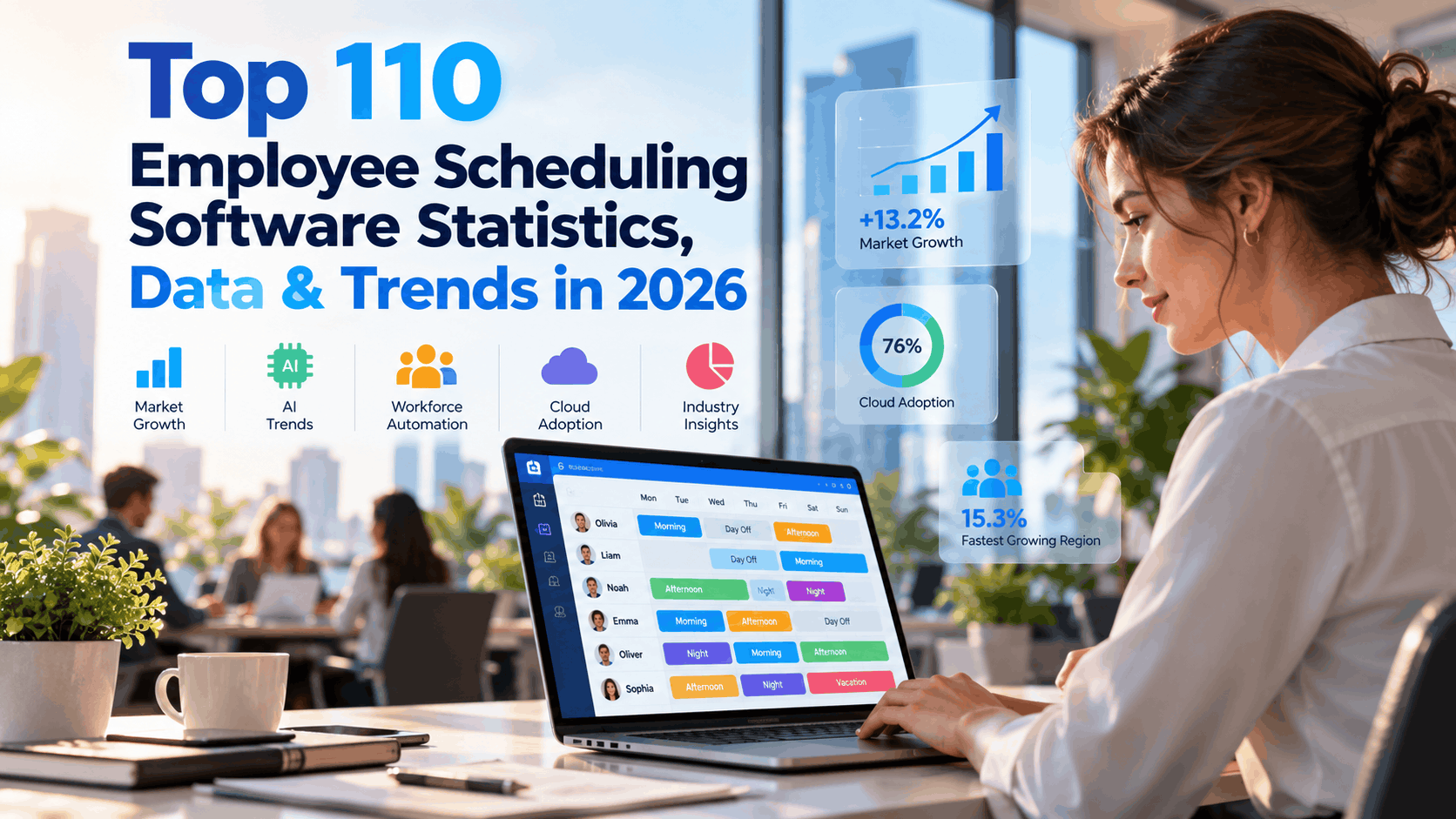
- Employee Scheduling Software Market Growth: The global employee scheduling software market is projected to reach USD 5.41 billion by 2033, growing at a 13.2% CAGR from 2025 to 2033, driven by cloud adoption, workforce digitalization, and rising demand for automated shift management.
- AI-Powered Scheduling and Cost Savings: AI-driven employee scheduling software can reduce annual labor costs by 8–15%, while workforce scheduling automation can save managers 5–10 hours per week and potentially reduce overtime expenses by 20–30%.
- Cloud Adoption and Workforce Management Trends: Cloud-based scheduling solutions are projected to capture 76% of the market in 2026, as businesses increasingly prioritize mobile employee scheduling, predictive workforce analytics, scheduling flexibility, and automated labor compliance.
Employee scheduling software is transforming workforce management in 2026 through AI-powered automation, cloud technology, and smarter shift planning. The global market is projected to reach USD 5.41 billion by 2033, growing at a 13.2% CAGR. Businesses can reduce labor costs by 8–15% while improving scheduling efficiency, employee satisfaction, and workforce productivity.
Employee scheduling software has become an essential component of modern workforce management, helping businesses streamline shift planning, optimize labor costs, improve employee productivity, and maintain compliance with increasingly complex labor regulations. As organizations embrace digital transformation, artificial intelligence (AI), and cloud-based HR technology, the demand for automated employee scheduling solutions continues to accelerate across industries worldwide.
Also, read our article on the Top 10 Employee Scheduling Software.

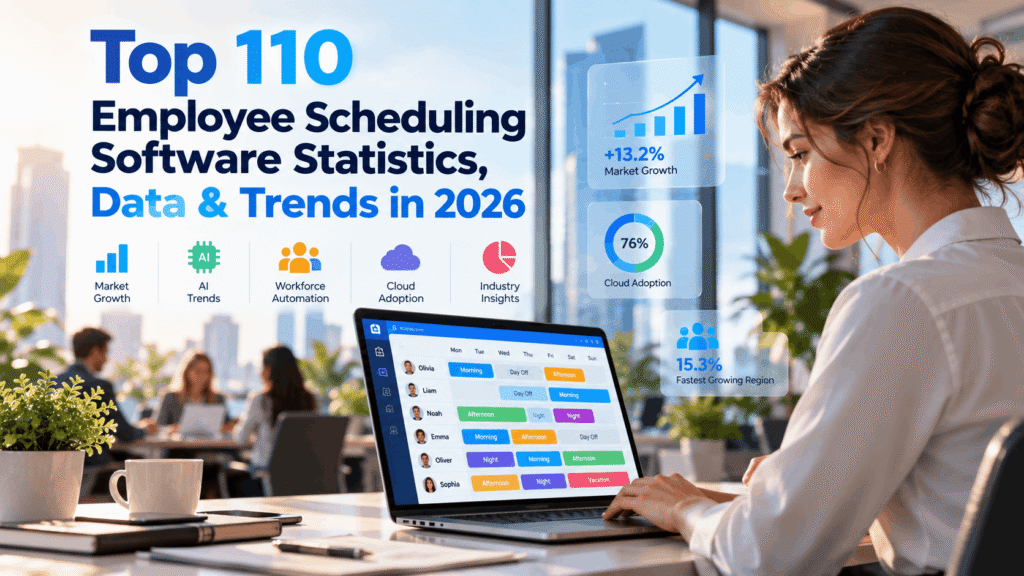
The global employee scheduling software market was valued at approximately USD 1.85 billion in 2024 and is projected to reach USD 5.41 billion by 2033, growing at a compound annual growth rate (CAGR) of 13.2% from 2025 to 2033. This expansion reflects the growing importance of workforce scheduling automation, particularly in labor-intensive industries such as healthcare, retail, hospitality, manufacturing, and transportation.
In 2026, employee scheduling software is evolving beyond traditional shift management tools into intelligent workforce optimization platforms. Modern solutions increasingly incorporate AI-powered scheduling, predictive labor demand forecasting, real-time employee availability tracking, automated shift swapping, mobile workforce management, and integrated payroll systems. These capabilities enable organizations to reduce administrative workloads, minimize scheduling conflicts, improve operational efficiency, and deliver greater scheduling flexibility to employees.
The financial benefits of adopting employee scheduling software are particularly significant. Industry data indicates that businesses implementing scheduling automation can save approximately 5–10 hours of managerial time per week, while organizations using demand-driven scheduling solutions may achieve 20–30% reductions in overtime expenses. Additionally, AI-powered workforce scheduling platforms have been associated with potential annual labor cost reductions of 8–15%, demonstrating the growing return on investment from intelligent workforce management technology.
Regional adoption patterns further highlight the industry’s global expansion. North America remains the largest employee scheduling software market, accounting for approximately 41.5% of global market share in 2026, while Asia Pacific is emerging as the fastest-growing region, with a projected CAGR of 15.3%. Meanwhile, cloud-based scheduling solutions are expected to represent 76% of the market in 2026, reflecting businesses’ increasing preference for scalable, accessible, and cost-effective software platforms.
Beyond operational efficiency, employee scheduling technology is also reshaping the employee experience. Greater demand for flexible working arrangements, mobile self-service capabilities, transparent shift allocation, and predictable work schedules is encouraging employers to adopt more employee-centric scheduling practices. As workforce expectations evolve, businesses must balance labor optimization with employee satisfaction, retention, and regulatory compliance.
This comprehensive guide to the Top 110 Employee Scheduling Software Statistics, Data & Trends in 2026 examines the latest market size estimates, industry growth forecasts, regional adoption patterns, AI scheduling trends, workforce management technology developments, cost savings, employee productivity metrics, and emerging opportunities shaping the global employee scheduling software industry.
Whether you are an HR professional, workforce manager, business owner, software developer, technology investor, or organizational decision-maker, these 110 employee scheduling software statistics provide valuable insights into how workforce scheduling technology is transforming business operations in 2026 and beyond.
Before we venture further into this article, we would like to share who we are and what we do.
About 9cv9
9cv9 is a business tech startup based in Singapore and Asia, with a strong presence all over the world.
With over ten years of startup and business experience, and being highly involved in connecting with thousands of companies and startups, the 9cv9 team has listed some of the top and best companies/tools in this review.
If you like to get your company listed in our top B2B software reviews, check out our world-class 9cv9 Media and PR service and pricing plans here.
Top 110 Employee Scheduling Software Statistics, Data & Trends in 2026
📈 Market Size & Growth
- The global employee scheduling software market reached USD 1.85 billion in 2024, reflecting strong adoption across healthcare, retail, hospitality, manufacturing, and technology sectors worldwide as businesses accelerate digital workforce management.
- The employee scheduling software market is forecast to grow at a CAGR of 13.2% from 2025 to 2033, one of the highest sustained growth rates in the broader HR technology sector, driven by AI integration, cloud adoption, and regulatory complexity.
- By 2033, the global employee scheduling software market is projected to reach USD 5.41 billion, more than tripling its 2024 value as enterprise adoption accelerates and SMBs in emerging markets digitalize their workforce operations.
- The broader workforce scheduling software market was valued at USD 11.25 billion in 2025 and is projected to reach USD 23.54 billion by 2033 at a 9.8% CAGR, encompassing enterprise WFM platforms alongside pure scheduling solutions.
- The employee shift scheduling software segment alone was valued at USD 2.56 billion in 2024, with a 7.3% CAGR projected through 2033, highlighting the critical commercial value of dedicated shift management tools in labour-intensive industries.
- Under an optimistic long-range scenario, the global employee scheduling software market could reach USD 8.22 billion by 2033 (Cognitive Market Research), driven by compounding AI automation effects, mobile-first adoption, and accelerating SMB digitalization in emerging economies.
- The workforce scheduling software market will grow by USD 3.67 billion from 2025 to 2029 at an 8.4% CAGR, propelled by escalating regulatory compliance requirements, digital HR transformation initiatives, and increasing labour cost pressures across all sectors.
- The global employee scheduling software market grew at a CAGR of 11.6% between 2021 and 2026, hitting the USD 1.1 billion milestone as cloud deployments became mainstream and mid-sized organizations moved away from spreadsheet-based scheduling.
- The employee scheduling and shift planning segment is projected to grow from USD 1.89 billion in 2024 to USD 3.94 billion by 2032 at a 9.6% CAGR, reflecting sustained enterprise demand for tools that optimize labour allocation and control costs.
- The top-10 workforce scheduling software vendors market is projected to reach USD 2.3 billion by 2029 at a 7.4% CAGR, per APPS RUN THE WORLD’s 2025 benchmark, as the competitive landscape consolidates around AI-capable, integration-rich platforms.
- A broader market definition places the employee scheduling software market at USD 3.2 billion in 2024, projected to reach USD 6.5 billion by 2033 at an 8.2% CAGR, when enterprise WFM suites with embedded scheduling modules are included.
- The staff scheduling software market was valued at approximately USD 2.12 billion in 2024 and is forecast to reach USD 5.95 billion by 2033 at a 10.8% CAGR, driven by rising demand for workforce optimization and hybrid work scheduling tools.
- The global scheduling software market overall (including appointment and business scheduling) was valued at USD 5.2 billion in 2024 and is expected to climb to USD 12.4 billion by 2033 at a 10.3% CAGR, reflecting broad digital scheduling adoption across industries.
- The enterprise employee scheduling software sub-market exceeded USD 400 million in 2024, growing at 10%+ annually as large corporations prioritize compliance automation, labour analytics, and workforce optimization at scale.
- The small business scheduling software segment reached USD 150 million in 2025 with a 12% CAGR, driven by affordable SaaS pricing models that bring enterprise-grade workforce management tools within reach of SMEs for the first time.
- The mobile app-based scheduling market segment is estimated at USD 142 million in 2025 with a 12% CAGR, as mobile-first workforce management becomes standard across field services, retail, and hospitality sectors globally.
- The online employee scheduling software market was valued at USD 1.5 billion in 2024 and is projected to reach USD 4.2 billion by 2033, growing at a 12.5% CAGR as cloud-native platforms replace legacy on-premises scheduling systems.
- The global restaurant scheduling software market alone was valued at USD 1.46 billion in 2025, forecast to reach USD 3.1 billion by 2030 — a 14.6% CAGR driven by AI-powered demand forecasting and labour cost optimization in food service.
- The restaurant management software market is set to expand from USD 6.54 billion in 2025 to USD 12.93 billion by 2030 at a 14.59% CAGR, with scheduling and labour optimization modules serving as the primary growth drivers.
- Remote work adoption surged 87% from pre-pandemic levels, with an estimated 32.6 million Americans working remotely by 2025 — a structural shift that drives urgent demand for digital scheduling and asynchronous workforce coordination platforms.
🌍 Regional Market Breakdown
- North America dominates with a 41.5% share of the global employee scheduling software market in 2026, fuelled by advanced technology infrastructure, stringent labour regulations, and the presence of market-leading vendors including UKG, ADP, Workday, and Oracle.
- North America’s scheduling software market reached USD 760 million in 2024, driven by widespread cloud adoption, complex multi-state labour regulations, and a dense ecosystem of HR technology vendors serving enterprise and mid-market clients.
- Europe holds approximately 28.5% of the global market, with a market size nearing USD 670 million in 2026, underpinned by strict labour-law compliance frameworks, GDPR-driven data governance requirements, and growing demand for scheduling analytics.
- Asia Pacific is the fastest-growing region with a CAGR of 15.3%, driven by rapid digitalization, expanding service-based industries, and mobile-first software adoption in India, China, Japan, and Australia as labour markets formalize.
- Asia Pacific accounts for 20–22% of new scheduling software installations in 2025, projected to grow at a CAGR above 15% through 2033, as rapid industrialization and cloud infrastructure investment in China and India accelerate adoption.
- The United States alone holds a 23.7% share of the global workforce scheduling software market, supported by massive R&D investments in AI workforce automation and a uniquely dense enterprise software ecosystem centred around major HCM vendors.
- North America is expected to capture 38.5% of the workforce scheduling software market, making it the world’s single largest regional revenue pool and the primary battleground for enterprise scheduling platform competition.
- The United Kingdom’s scheduling software market is estimated at USD 28 million with a 10% share in 2025, growing at a 12.5% CAGR as cloud software adoption accelerates across retail and healthcare — two of the UK’s largest employing sectors.
- Australia’s market is valued at USD 18 million with a 6.5% share in 2025, growing at 12.2% CAGR as small business and corporate cloud-based scheduling integration expands across healthcare, hospitality, and professional services sectors.
- Japan’s scheduling software market is projected to reach USD 33.6 million by 2026, growing as complex multi-shift manufacturing operations, an ageing workforce, and stringent labour standards drive demand for automated scheduling precision.
- China’s market is forecast to reach USD 22 million by 2026 as large-scale manufacturers, e-commerce logistics operators, and multinational firms adopt integrated scheduling systems to manage massive workforces efficiently and compliantly.
- India’s scheduling software market is on track for USD 17.8 million by 2026, fuelled by the rapid growth of the IT/BPO sector, expanding organized retail, and increasing cloud-based workforce management adoption among mid-sized enterprises.
- Latin America accounts for approximately 5.5% of global scheduling software revenues, with growth driven by increasing economic formalization, expanding service sectors, and digital transformation investment in Brazil, Mexico, and Colombia.
- The Middle East & Africa represents 3.5% of the global market, with healthcare, government, and hospitality sectors in Gulf Cooperation Council nations driving early-stage adoption of cloud-based workforce scheduling platforms.
- Canada’s SME scheduling software segment is valued at USD 20 million in 2025 with a 12% CAGR, as small retail and service businesses adopt automated scheduling platforms to manage tight labour markets and comply with provincial employment standards.
🏥 Industry Adoption & Verticals
- Nearly 80% of U.S. businesses have adopted some form of digital employee management solution, with scheduling software serving as the primary HR digitalization entry point — reflecting the central role of workforce automation in modern business operations.
- Over 60% of startups and SMBs with hourly or shift-based workforces were using scheduling or workforce management software as of 2024, reflecting how digital scheduling has shifted from an enterprise luxury to an SMB operational necessity.
- Healthcare leads all industries with an 82% scheduling software adoption rate, driven by 24/7 shift requirements, nurse-to-patient ratio mandates, complex compliance obligations, and the direct patient-safety implications of accurate staffing coverage.
- The retail sector shows 78% scheduling software adoption, with automated scheduling critical for managing variable demand patterns, seasonal staffing fluctuations, and high employee turnover in an industry where labour is both the largest cost and the primary service differentiator.
- The hospitality and food service sector has achieved 75% adoption, with restaurants, hotels, and event venues relying heavily on scheduling platforms to manage complex multi-shift environments, reduce labour cost overruns, and improve service consistency.
- Manufacturing accounts for approximately 68% scheduling software adoption, as production scheduling complexity, shift rotation requirements, fatigue management obligations, and safety compliance drive demand for integrated workforce management tools.
- As of 2024, 43% of U.S. workers are employed in jobs with flexible scheduling options (U.S. Bureau of Labor Statistics), creating foundational demand for dynamic scheduling platforms that support real-time availability changes and self-service shift management.
- Over 70% of U.S. service-sector workers are employed in industries where shift management is critical (BLS), making employee scheduling software a core operational tool rather than an optional productivity enhancement for the majority of U.S. employers.
- The IT and telecom sector shows approximately 55% scheduling software adoption, driven by global distributed teams, complex project-based staffing, 24/7 support operations, and the need to coordinate contractors across multiple time zones.
- Transportation and logistics has reached approximately 52% adoption, as route-based shift planning, driver hours-of-service compliance, seasonal demand fluctuations, and last-mile delivery coordination require sophisticated automated scheduling solutions.
- Healthcare-focused SafeSchedule achieved a 40% growth rate in 2025–2026, as hospitals and clinics prioritized health screening integrations, fatigue-aware shift assignments, and compliance audit trails amid intensifying patient safety regulations.
- AI-integrated platform ShiftSmart achieved ~30% market adoption in retail and hospitality sectors in 2025–2026, driven by AI-powered predictive analytics, automated shift reminders, and real-time demand-forecast-based staffing adjustments.
- Over 2.3 million employees accessed mobile scheduling platforms daily in 2024 — up from 1.1 million in 2021, representing a 109% increase — as smartphones became the primary workforce management interface for deskless workers.
- Mobile app-based scheduling accounted for 47% of all new scheduling software deployments in 2023, reflecting the shift towards mobile-first workforce management as field workers, retail staff, and healthcare workers demand on-the-go schedule access.
- Over 64% of shifts in retail and hospitality now begin or end outside fixed offices, making GPS-enabled mobile clock-in/out, instant shift notifications, and real-time schedule access non-negotiable features for modern scheduling platforms.
- User adoption rates exceed 85% when scheduling platforms are intuitive and mobile-friendly, but can fall below 60% when software is complex or lacks self-service options — highlighting UX as a critical factor in scheduling technology ROI.
- More than half of large employers (1,000+ employees) still relied on manual or no systematic processes to manage absenteeism in recent years, representing a massive unaddressed opportunity for scheduling and attendance automation vendors.
- Both small and large companies plan to digitize their HR efforts, with attendance tracking, scheduling automation, and compliance management among the top three HR digitalization priorities across all organizational sizes.
- The BFSI (Banking, Financial Services & Insurance) sector shows approximately 44% scheduling software adoption, growing as contact centres, branch operations, and compliance-driven scheduling requirements create demand for automated workforce management.
- The education sector has approximately 38% scheduling software adoption, with universities, school districts, and training organizations adopting scheduling tools to manage complex faculty, support staff, and adjunct instructor scheduling requirements.
🤖 AI & Technology Trends
- The AI-driven workforce scheduling market reached USD 2.24 billion in 2024 and is projected to surge to USD 17.5 billion by 2033 at an exceptional 22.9% CAGR — far outpacing the overall scheduling software market’s growth rate.
- AI-powered scheduling platforms deliver 8–15% annual labor cost reductions for enterprise customers, while simultaneously improving employee satisfaction scores and reducing voluntary turnover — creating virtuous cycles of operational and cultural improvement.
- Cloud-based deployment is projected to account for 76% of the scheduling software market in 2026, up from 52% in 2021, as businesses prioritize scalability, remote access, automatic updates, and lower upfront infrastructure investment.
- In automated scheduling environments, 28% of support tickets are resolved automatically by the scheduling platform itself, freeing IT and management bandwidth for higher-value tasks and reducing total cost of platform ownership.
- As of 2023, 73% of organizations had adopted SaaS applications for core HR functions — a structural shift that directly accelerates scheduling software adoption as cloud-native platforms replace legacy on-premises workforce management systems.
- AI scheduling copilots generate fully optimized shift schedules in under 5 minutes (McKinsey, 2025), considering employee preferences, labour law constraints, skill requirements, cost targets, and real-time demand forecasts — replacing hours of manual work.
- Automatic work schedule generators can reduce scheduling time by more than 50% for managers in complex multi-location environments, with AI evaluating availability, compliance, and labour demand to assign shifts instantly at scale.
- Retailers implementing AI scheduling report labor cost reductions between 8–15% annually while healthcare providers document improved patient care continuity through better staffing alignment — demonstrating cross-sector ROI from AI workforce optimization.
- The global SaaS market, valued at USD 266.23 billion in 2024, is projected to reach USD 1.13 trillion by 2032 at a 20% CAGR, providing a massive structural tailwind for cloud-based employee scheduling software adoption worldwide.
- ATOSS expanded its AI capabilities in 2024–2025 by introducing machine learning models for dynamic labour demand forecasting and fatigue-aware scheduling, improving both operational efficiency and employee well-being in manufacturing and healthcare deployments.
- ADP’s acquisition of WorkForce Software significantly strengthened AI-enhanced scheduling and labour optimization capabilities within ADP’s HCM suite, creating a unified platform that streamlines compliance, reduces labour costs, and improves workforce visibility for enterprise clients.
- The broader AI in HR market reached USD 3.25 billion in 2023, growing to USD 4.03 billion in 2024 and on pace for USD 15.24 billion by 2030 at a 24.8% CAGR — of which scheduling automation represents one of the highest-ROI AI applications.
- Natural language processing now enables employees to request time off, swap shifts, and check schedules through mobile apps and conversational interfaces, eliminating the need to navigate complex desktop portals and dramatically improving employee self-service adoption.
- The AI software sector overall hit USD 122 billion in 2024, projected to reach USD 467 billion by 2030 at a 25% CAGR (ABI Research) — a macro-level technology wave that is fundamentally reshaping the capabilities and competitive landscape of scheduling platforms.
- Enterprise adoption of AI scheduling accelerated significantly during 2024–2025 as cloud infrastructure matured, mobile-first interfaces improved, and seamless ERP integration capabilities removed the primary barriers to large-scale workforce scheduling automation deployment.
- The talent management software market, valued at USD 7.85 billion in 2024, is expected to reach USD 35.45 billion by 2034 at a 16.26% CAGR, with scheduling modules serving as a core productivity driver within integrated talent management ecosystems.
- Predictive scheduling tools that analyse historical demand patterns, weather forecasts, local events, and sales trends are now standard in leading scheduling platforms, enabling proactive staff adjustments that prevent costly understaffing and overstaffing situations.
💰 ROI & Cost Savings
- Organizations typically report 20–30% reductions in overtime expenses after implementing scheduling software with demand forecasting, directly addressing one of the largest variable labour cost items in shift-based industries.
- Businesses save an average of 5–10 hours per manager per week after adopting scheduling automation, reclaiming time previously consumed by manual schedule creation, conflict resolution, and last-minute shift coverage — equivalent to 260–520 hours of annual management productivity.
- Predictive scheduling tools reduce employee turnover by up to 15% (U.S. Department of Labor, 2024), by providing schedule transparency, advance notice, and shift preference options — factors consistently cited as primary drivers of shift worker loyalty and retention.
- Scheduling software reduces absenteeism by up to 10% (DOL 2024), by improving shift fairness, offering schedule predictability, and enabling easier digital availability and time-off management that reduces employee frustration and no-call-no-shows.
- Companies using attendance tracking software have achieved nearly a 20% reduction in absence rates, delivering measurable financial benefits by reducing costly last-minute shift replacements, emergency overtime, and the productivity disruption of unplanned absences.
- Companies with flexible scheduling arrangements save an average of $2,000 per employee in annual turnover costs (SHRM), as better schedule work-life balance alignment directly correlates with lower voluntary attrition rates and reduced recruitment and training expenses.
- Organizations report an 86% increase in employee satisfaction after adopting scheduling software, as fair shift allocation, schedule transparency, advance notice, and self-service options significantly improve the day-to-day employee experience for hourly and shift workers.
- Organizations conducting thorough ROI analysis before and after implementation are 67% more likely to achieve desired scheduling software outcomes — highlighting the importance of establishing measurement baselines and success metrics before deployment.
- A healthcare organization that implemented flexible shift scheduling — including self-scheduling and shift swapping — reduced turnover rates by 25% and increased employee satisfaction by 30% (Celayix case study), delivering both financial and cultural ROI.
- Most companies realize scheduling software ROI within 1–3 payroll cycles through reduced overtime, improved demand forecasting, lower absenteeism, and higher productivity — making scheduling automation one of HR technology’s fastest-payback investments.
- Businesses save an estimated 5–10 hours per week of manager time after switching to automated scheduling, with time savings concentrated in schedule creation, shift swap management, and last-minute coverage problem-solving.
- Absenteeism costs U.S. businesses USD 225.8 billion annually — equating to $1,685 per employee per year in lost productivity, overtime, and replacement hiring costs — a core problem that scheduling software directly addresses through better planning and coverage automation.
- The U.S. national absence rate was 3.2% in 2024 (Bureau of Labor Statistics), with injury, illness, and job dissatisfaction as leading causes — all of which scheduling software mitigates through better ergonomic shift design, proactive fatigue management, and improved employee engagement.
- Restaurant turnover rates exceed 70% annually, creating a perpetual scheduling crisis that AI-powered platforms directly mitigate through flexible shift allocation, preference-based assignment, and clear digital communication — reducing the recruitment and training cost cycle.
- A 2022 BLS survey identified flexible scheduling as a top driver of job satisfaction in restaurants, where turnover exceeds 70% — demonstrating that schedule quality is not just an operational issue but a primary talent retention and employee experience lever.
- The economic case for AI scheduling became “irrefutable” during 2024–2025 as customer reference sites published validated cost savings metrics and ROI data, removing enterprise procurement hesitation and accelerating large-scale deployment decisions.
⚖️ Workforce, Compliance & Employee Experience
- Over 70% of employees expect to manage their shifts through mobile apps (Research.com, 2025), making mobile-first scheduling a baseline requirement rather than a differentiating feature for any scheduling platform targeting modern workforces.
- Nearly 80% of startups consider mobile app access a “must-have” scheduling software feature, reflecting the reality that distributed, deskless, and hybrid workforces require on-the-go schedule visibility and real-time communication capabilities.
- Integration with payroll or project management systems is important for over 70% of scheduling software buyers, as organizations seek unified workforce management ecosystems that eliminate manual data re-entry and reduce payroll processing errors.
- Over 60% of enterprises require scheduling software with labour law compliance features, including overtime alerts, rest period enforcement, break scheduling, and audit logs — reflecting the legal and financial exposure of non-compliant workforce scheduling.
- 55% of scheduling software buyers rank detailed workforce analytics as a deciding purchase factor, as data-driven insights into labour costs, scheduling efficiency, absenteeism, and productivity become central to CFO and COO decision-making.
- Over 65% of SMBs request automated scheduling and intelligent shift planning as their primary feature requirement, reflecting the acute administrative burden that manual scheduling places on small management teams in hourly and shift-based businesses.
- Team messaging and real-time communication are important to more than 50% of scheduling software buyers, as fragmented communication across text messages, phone calls, and email creates costly scheduling coordination failures and employee frustration.
- 41% of workers have little or no say in when they work (XShift AI, 2025), representing a significant employee experience risk factor that modern self-service scheduling platforms directly address through availability-setting, shift bidding, and preference-based assignment tools.
- Only 49% of workers report high satisfaction with their flexibility to choose work hours (high5test.com, 2025), while 37% are satisfied with remote work flexibility — underscoring that schedule control, not just location flexibility, is a critical employee satisfaction driver.
- 60% of remote-capable employees prefer a hybrid work schedule, while only ~10% want fully on-site work — structural workforce preferences that scheduling software must accommodate through flexible, hybrid-aware scheduling logic and real-time capacity planning.
- 86% of workers across industries are open to changing jobs (PageGroup Talent Trends Report, 2023), underscoring why schedule fairness, flexibility, and predictability have become front-line employee retention strategies that directly impact business continuity and talent costs.
- Hourly wages in food service and retail surged 4.8% in 2024 (U.S. Bureau of Labor Statistics), outpacing broader inflation and making precise labour cost optimization through demand-driven scheduling more financially critical than ever for thin-margin operators.
🔮 Future Outlook & Trends
- Compliance automation is becoming a standard scheduling feature, with leading platforms automatically flagging “clopening” shifts (closing followed immediately by opening), enforcing mandatory rest periods, and generating audit-ready compliance logs for labour law adherence.
- The restaurant management software market is forecast to grow at a 14.59% CAGR from 2025 to 2030, the highest in any scheduling-adjacent vertical, as AI-driven labour forecasting and demand-based staffing optimization become table-stakes for competitive restaurant operations.
- The U.S. hospitality staffing market was valued at USD 166.49 billion in 2025 and is projected to reach USD 258.72 billion by 2032 — a massive market where scheduling optimization delivers direct competitive advantage through labour cost control and service consistency.
- Deskless workforce scheduling platforms now include offline access, instant notifications, and self-service portals, making real-time schedule adjustment accessible to field workers, delivery drivers, and remote service staff regardless of connectivity limitations.
- The warehouse labour demand forecasting software market reached USD 1.42 billion with a 13.6% CAGR through 2033, as AI-powered demand alignment becomes critical for e-commerce fulfilment centres managing extreme seasonal and promotional demand swings.
- Integration of total talent management — consolidating scheduling for full-time, part-time, temporary, and contract workers into a single system — is one of the fastest-growing scheduling software trends in 2026, particularly among enterprise employers managing complex blended workforces.
- 20% of employees feel uneasy about AI-generated schedules (National Restaurant Association), highlighting the importance of transparent AI decision-making, employee feedback mechanisms, and human-in-the-loop override options in scheduling platform design.
- Basic scheduling software packages are priced between $2.50 and $10 per user per month, while advanced platforms with geofencing, compliance, and analytics capabilities can reach $40 per user per month — reflecting a wide addressable market from micro-businesses to global enterprises.
- AI-driven scheduling platforms are increasingly using external data inputs including weather forecasts, local events, and historical sales trends to generate proactively optimized schedules that anticipate demand fluctuations before they impact service levels or labour costs.
- The global demand for scheduling solutions is expected to expand in emerging markets as businesses in Southeast Asia, the Middle East, and Latin America adopt digital transformation strategies that include cloud-based workforce management as a foundational capability.
Conclusion
The Top 110 Employee Scheduling Software Statistics, Data & Trends in 2026 highlight the growing importance of workforce scheduling technology in helping organizations improve operational efficiency, reduce labor costs, enhance employee satisfaction, and navigate increasingly complex workforce management requirements. As businesses accelerate digital transformation, employee scheduling software is evolving from a basic administrative tool into a strategic solution for workforce optimization, productivity improvement, and long-term organizational growth.
With the global employee scheduling software market projected to reach USD 5.41 billion by 2033, expanding at a compound annual growth rate (CAGR) of 13.2% from 2025 to 2033, the industry presents significant opportunities for software providers, HR technology companies, investors, and businesses seeking more efficient workforce management solutions. North America continues to dominate the market, while Asia Pacific is emerging as a major growth region, supported by increasing cloud adoption, expanding service industries, and rising demand for automated workforce scheduling.
One of the most significant employee scheduling software trends in 2026 is the rapid integration of artificial intelligence, predictive analytics, and intelligent automation. AI-powered employee scheduling tools are transforming how organizations forecast staffing requirements, allocate shifts, manage employee availability, and optimize labor expenses. With AI-driven scheduling solutions associated with potential labor cost reductions of 8–15% and automated scheduling systems capable of saving managers 5–10 hours per week, the business case for workforce scheduling automation continues to strengthen.
Cloud-based and mobile employee scheduling software is also reshaping the industry. As cloud deployment is projected to account for approximately 76% of the scheduling software market in 2026, organizations are increasingly prioritizing scalable, accessible, and integrated workforce management platforms. Features such as mobile shift management, employee self-service scheduling, automated shift swapping, real-time notifications, payroll integration, and labor compliance monitoring are becoming essential capabilities for businesses managing distributed, hybrid, and shift-based workforces.
Beyond technology adoption, the statistics emphasize the growing relationship between employee scheduling flexibility, workforce satisfaction, and employee retention. Organizations that provide greater schedule transparency, predictable working hours, and employee control over shift preferences are better positioned to improve workforce engagement and reduce scheduling-related dissatisfaction. In industries such as healthcare, hospitality, retail, manufacturing, and logistics, effective scheduling practices can directly influence service quality, operational continuity, and overall business performance.
Looking ahead, the future of employee scheduling software will increasingly revolve around AI-driven workforce forecasting, automated labor law compliance, advanced workforce analytics, integrated human capital management systems, and personalized employee scheduling experiences. Businesses that invest in these capabilities will be better equipped to respond to fluctuating labor demand, minimize unnecessary overtime, improve staffing accuracy, and maintain workforce flexibility in a rapidly changing employment landscape.
However, successful implementation requires more than simply adopting new technology. Organizations should carefully evaluate scheduling software based on industry-specific requirements, ease of use, integration capabilities, data security, regulatory compliance, employee accessibility, and measurable return on investment. Establishing clear performance indicators, including scheduling time savings, overtime reductions, absenteeism rates, employee satisfaction, and labor cost efficiency, will help businesses maximize the value of their workforce management investments.
Ultimately, the 110 employee scheduling software statistics, data, and trends for 2026 demonstrate that intelligent workforce scheduling is becoming a fundamental component of modern business operations. Organizations that embrace automation while maintaining a strong focus on employee well-being, scheduling fairness, and operational flexibility will be better positioned to achieve sustainable productivity improvements and long-term competitive advantages.
As the global workforce continues to evolve, employee scheduling software will play an increasingly important role in connecting workforce planning, HR technology, employee experience, and business performance. For employers, HR leaders, workforce managers, and technology decision-makers, understanding these employee scheduling software trends is essential for making informed investment decisions and building a more efficient, adaptable, and future-ready workforce.
If you find this article useful, why not share it with your hiring manager and C-level suite friends and also leave a nice comment below?
We, at the 9cv9 Research Team, strive to bring the latest and most meaningful data, guides, and statistics to your doorstep.
To get access to top-quality guides, click over to 9cv9 Blog.
To hire top talents using our modern AI-powered recruitment agency, find out more at 9cv9 Modern AI-Powered Recruitment Agency.
People Also Ask
What is employee scheduling software?
Employee scheduling software is a digital workforce management tool that helps businesses create employee schedules, assign shifts, track availability, manage time-off requests, and automate workforce planning to improve productivity and reduce labor costs.
How big is the global employee scheduling software market in 2026?
The global employee scheduling software market was valued at USD 1.85 billion in 2024 and is projected to reach USD 5.41 billion by 2033, reflecting strong growth driven by cloud adoption, AI automation, and digital workforce management.
What is the projected growth rate of the employee scheduling software market?
The global employee scheduling software market is forecast to grow at a compound annual growth rate (CAGR) of 13.2% from 2025 to 2033, supported by increasing demand for automated shift planning and workforce optimization.
What are the biggest employee scheduling software trends in 2026?
Major employee scheduling software trends in 2026 include AI-powered shift planning, predictive workforce analytics, cloud-based platforms, mobile scheduling apps, automated compliance monitoring, employee self-service, and payroll integration.
How does AI improve employee scheduling software?
AI-powered employee scheduling software analyzes employee availability, historical demand, labor costs, and scheduling preferences to automatically generate optimized work schedules, reduce scheduling conflicts, and improve workforce efficiency.
How much can businesses save by using employee scheduling software?
Businesses implementing scheduling automation can save approximately 5–10 managerial hours per week. AI-powered scheduling solutions may also reduce annual labor costs by 8–15% and overtime expenses by 20–30%, depending on implementation.
What percentage of businesses use employee scheduling software?
The compiled industry statistics indicate that nearly 80% of U.S. businesses use some form of digital employee management solution, while more than 60% of startups and SMBs with hourly or shift-based employees use scheduling or workforce management software.
Which industries use employee scheduling software the most?
Healthcare, retail, hospitality, manufacturing, and transportation are major adopters. The compiled statistics report scheduling software adoption rates of 82% in healthcare, 78% in retail, 75% in hospitality, and 68% in manufacturing.
What is the market share of cloud-based employee scheduling software in 2026?
Cloud-based employee scheduling software is projected to account for approximately 76% of the market in 2026, compared with 52% in 2021, as businesses increasingly adopt scalable, mobile-accessible, and subscription-based workforce management solutions.
Which region dominates the employee scheduling software market?
North America leads the global employee scheduling software market, with an estimated 41.5% market share in 2026. Strong technology infrastructure, enterprise software adoption, and complex labor regulations support regional demand.
Which region has the fastest-growing employee scheduling software market?
Asia Pacific is projected to be the fastest-growing employee scheduling software market, with a CAGR of approximately 15.3%, driven by workforce digitalization, expanding service industries, and increasing cloud adoption.
How much is the AI-powered workforce scheduling market worth?
The AI-driven workforce scheduling market was estimated at USD 2.24 billion in 2024 and is projected to reach USD 17.5 billion by 2033, growing at a CAGR of 22.9% as businesses adopt intelligent workforce optimization technologies.
Can employee scheduling software reduce overtime costs?
Yes. The compiled statistics suggest that organizations implementing automated scheduling and labor demand forecasting can reduce overtime expenses by approximately 20–30% through better shift allocation, improved staffing accuracy, and fewer scheduling conflicts.
How does employee scheduling software improve employee productivity?
Employee scheduling software improves productivity by automating shift assignments, reducing administrative tasks, preventing understaffing, improving workforce communication, and helping managers allocate employees according to operational requirements.
Can employee scheduling software reduce employee turnover?
Yes. Predictive scheduling tools may reduce employee turnover by up to 15% by improving schedule predictability, providing greater shift flexibility, and allowing employees more control over their working hours.
How does employee scheduling software reduce absenteeism?
Employee scheduling software can reduce absenteeism by improving schedule transparency, automating shift reminders, simplifying time-off requests, and enabling easier shift swaps. The compiled statistics suggest potential absenteeism reductions of up to 10%.
What features should businesses look for in employee scheduling software?
Essential features include automated shift scheduling, employee availability tracking, mobile access, shift swapping, time-off management, payroll integration, overtime alerts, labor compliance monitoring, workforce analytics, and real-time notifications.
How much does employee scheduling software cost in 2026?
Basic employee scheduling software typically costs between USD 2.50 and USD 10 per user monthly. Advanced platforms offering geofencing, compliance automation, predictive analytics, and enterprise integrations may cost up to USD 40 per user monthly.
What is the difference between employee scheduling software and workforce management software?
Employee scheduling software focuses on shift planning, availability, and schedule changes. Workforce management software provides broader capabilities, including attendance tracking, labor forecasting, payroll integration, compliance, and workforce analytics.
How does mobile employee scheduling software benefit businesses?
Mobile scheduling software allows employees to view shifts, request time off, swap schedules, receive notifications, and communicate with managers from smartphones, improving accessibility and coordination across distributed and deskless workforces.
What percentage of employees prefer mobile scheduling apps?
The compiled research indicates that more than 70% of employees expect to manage their shifts through mobile apps, highlighting growing demand for mobile-first scheduling platforms with real-time notifications and employee self-service features.
How long does it take to create employee schedules using AI?
Some AI-powered scheduling tools can generate optimized employee schedules in under five minutes, depending on workforce complexity, staffing requirements, employee availability, labor regulations, and scheduling constraints.
What are the benefits of employee scheduling software for small businesses?
Employee scheduling software helps small businesses reduce manual scheduling, manage shift changes, prevent staffing conflicts, track employee availability, control overtime expenses, and improve communication without requiring large HR departments.
Why is employee scheduling software important for healthcare organizations?
Healthcare organizations use employee scheduling software to manage 24/7 staffing, coordinate nursing shifts, monitor employee fatigue, maintain staffing coverage, support labor compliance, and improve continuity of patient care.
How does employee scheduling software help restaurants and hospitality businesses?
Employee scheduling software helps restaurants and hotels forecast staffing demand, manage peak service hours, reduce overtime, coordinate shift changes, and improve employee flexibility while controlling labor costs.
Can employee scheduling software integrate with payroll systems?
Yes. Many employee scheduling platforms integrate with payroll and time-tracking systems to synchronize scheduled hours, attendance records, overtime calculations, and employee information, reducing manual data entry and payroll errors.
How does employee scheduling software support labor law compliance?
Employee scheduling software supports compliance through automated overtime alerts, mandatory rest-period monitoring, break scheduling, shift conflict detection, working-hour limits, and audit-ready records. Employers must still verify applicable legal requirements.
What is predictive scheduling in workforce management?
Predictive scheduling uses historical staffing patterns, sales forecasts, employee availability, weather conditions, and operational demand to anticipate workforce requirements and create more accurate employee schedules.
How can businesses measure employee scheduling software ROI?
Businesses can measure scheduling software ROI by tracking managerial time savings, overtime expenses, absenteeism, employee turnover, scheduling errors, labor cost efficiency, employee satisfaction, and software implementation costs.
What is the future of employee scheduling software beyond 2026?
The future of employee scheduling software includes AI-driven workforce forecasting, automated compliance, personalized shift recommendations, predictive analytics, mobile-first employee experiences, and deeper integration with HR and payroll platforms.
Sources
Growth Market Reports
Business Research Insights
Verified Market Reports
DataHorizzon Research
Future Market Report
Cognitive Market Research
Allied Market Research
DataInsightsMarket
APPS RUN THE WORLD
DataIntelo
TimeForge
Research.com
Shiftboard
MyShyft
TeamSense
XShift AI
Everhour
Celayix
Agendrix
360 Research Reports
Live Industry Insights
Fortune Business Insights
Econ Market Research
HIGH5 Test
U.S. Bureau of Labor Statistics
PageGroup
WorkForce Software
Zapier
TCP Software
LiftHCM