Key Takeaways
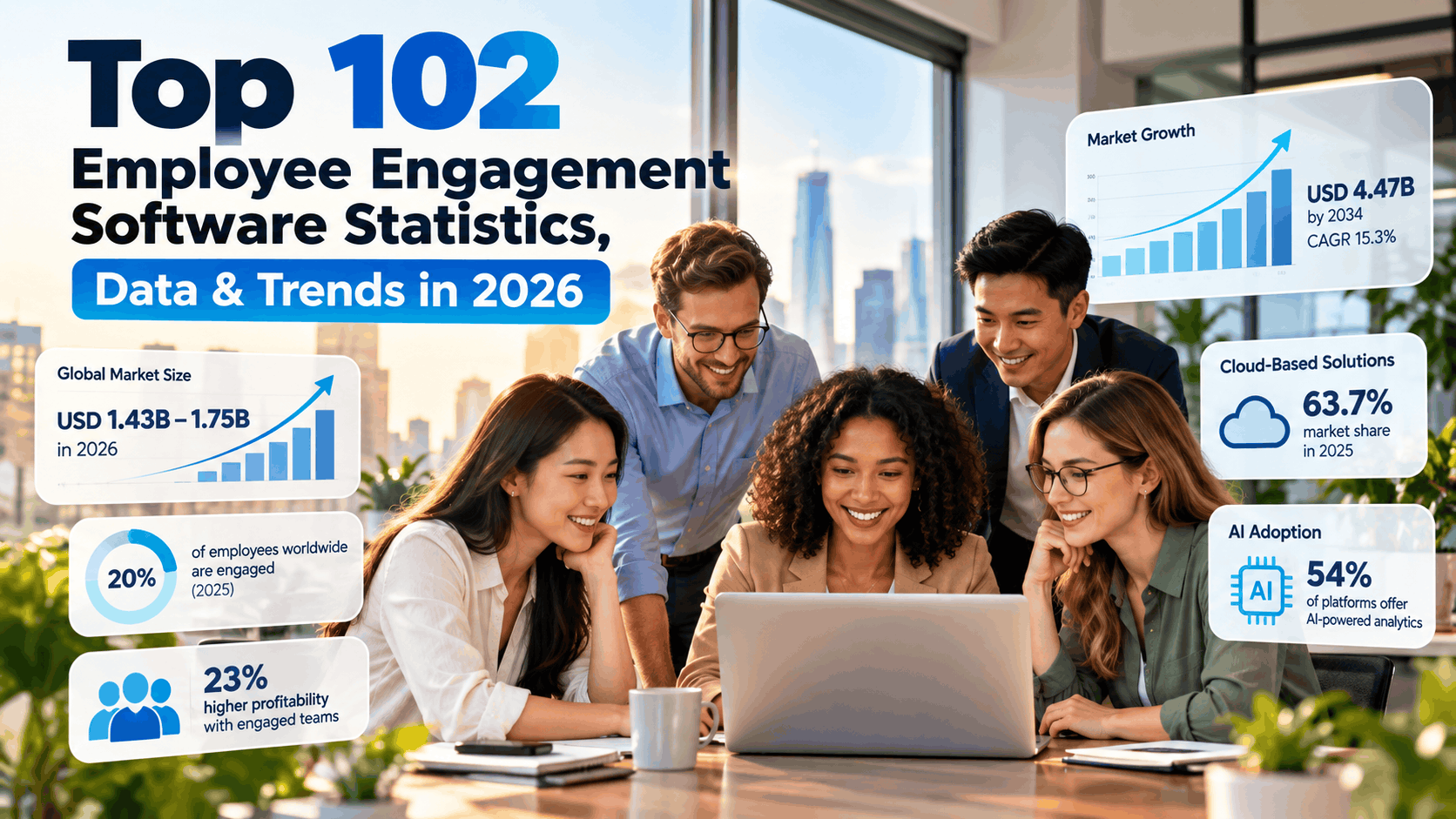
- Employee Engagement Software Market Growth: The global employee engagement software market is projected to reach USD 1.43–1.75 billion in 2026, driven by increasing adoption of cloud-based HR technology, workforce analytics, and employee experience platforms.
- Employee Engagement and Business Performance: Only 20% of employees worldwide were engaged in 2025, while highly engaged teams achieved 23% higher profitability and 81% lower absenteeism, highlighting the importance of effective employee engagement strategies.
- AI and Cloud-Based Employee Engagement Trends: Cloud-based solutions captured 63.7% of the employee engagement software market in 2025, while AI-powered analytics, automated employee feedback, and predictive retention tools are transforming workforce management in 2026.
Employee engagement software is a growing HR technology market, valued at approximately USD 1.43–1.75 billion in 2026. The top 102 employee engagement software statistics highlight market growth, AI adoption, employee retention, and workforce productivity. Businesses can use these insights to improve employee satisfaction, reduce turnover, and strengthen workplace performance.
Employee engagement software has become an essential component of modern human resource management as organisations worldwide seek to improve workforce productivity, employee satisfaction, retention, and overall business performance. In 2026, the growing adoption of artificial intelligence (AI), cloud-based HR technology, real-time employee feedback platforms, and predictive workforce analytics is transforming how businesses measure and improve employee engagement.

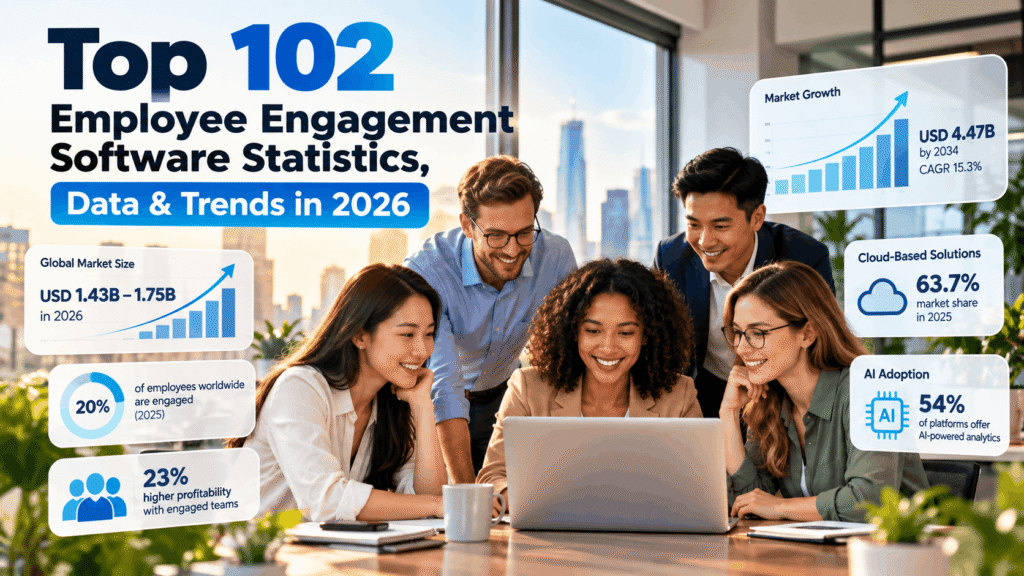
The global employee engagement software market is experiencing significant growth, with estimates placing its value between USD 1.43 billion and USD 1.75 billion in 2026. According to industry forecasts, the market could reach USD 4.47 billion by 2034, expanding at a compound annual growth rate (CAGR) of approximately 15.3%. This growth reflects increasing investments in employee experience platforms, employee recognition software, pulse survey tools, and digital workplace solutions designed to support increasingly distributed workforces.
However, the rising demand for employee engagement technology also reflects a growing workplace challenge. According to Gallup’s State of the Global Workplace 2026 report, only 20% of employees worldwide were engaged in 2025, highlighting the difficulties organisations face in maintaining workforce motivation and commitment. Employee disengagement has substantial financial consequences, with global productivity losses estimated in the trillions of dollars annually.

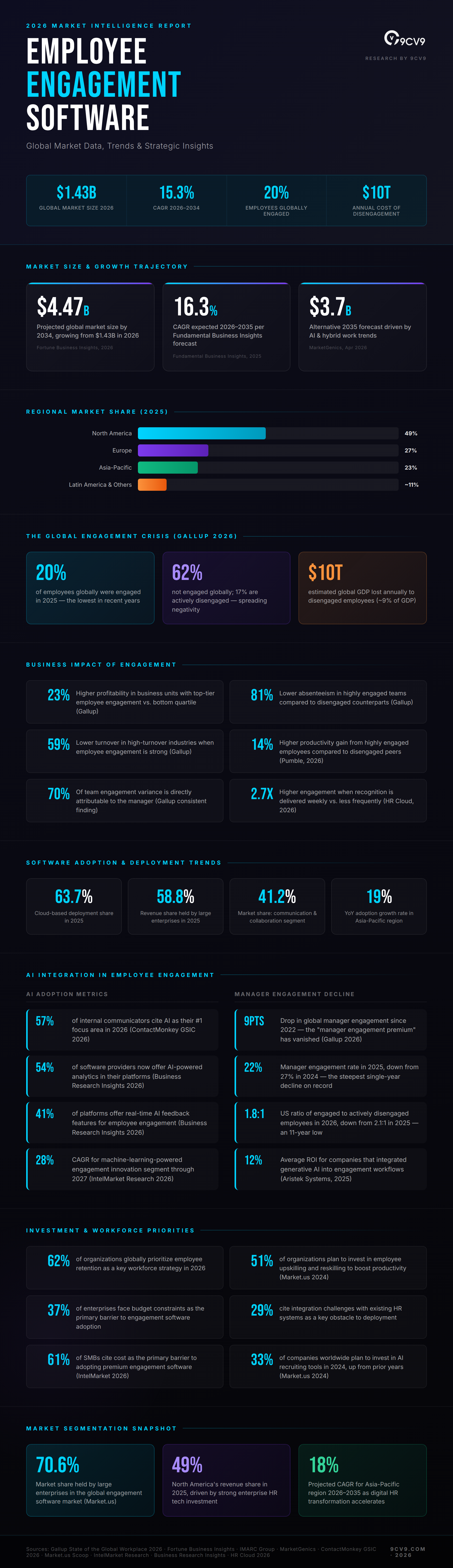
Research also demonstrates the measurable business benefits associated with higher employee engagement. Highly engaged teams achieve 23% greater profitability, 81% lower absenteeism, and significantly reduced employee turnover compared with less engaged teams. These findings reinforce the importance of implementing effective employee engagement strategies supported by reliable workforce analytics, continuous feedback systems, and employee recognition platforms.
Meanwhile, technological innovation is reshaping the employee engagement software industry. Cloud-based solutions accounted for approximately 63.7% of the market in 2025, while AI-powered analytics, automated sentiment analysis, personalised employee experiences, and mobile-accessible engagement surveys are becoming increasingly important capabilities. Businesses are also prioritising seamless integration with human resource information systems (HRIS), collaboration platforms, and performance management software.
As organisations navigate hybrid work arrangements, changing employee expectations, workforce wellbeing challenges, and increasing pressure to demonstrate HR technology return on investment (ROI), understanding the latest employee engagement software statistics is essential for making informed business decisions.
This comprehensive guide explores the Top 102 Employee Engagement Software Statistics, Data & Trends in 2026, covering global market size, industry growth forecasts, regional adoption patterns, employee engagement rates, AI adoption, software deployment trends, workforce productivity, employee retention, and emerging HR technology innovations.
Whether you are an HR professional, business leader, recruitment specialist, employee experience manager, or HR technology provider, these employee engagement software statistics for 2026 offer valuable insights into the evolving digital workplace and the technologies shaping the future of employee engagement.
Before we venture further into this article, we would like to share who we are and what we do.
About 9cv9
9cv9 is a business tech startup based in Singapore and Asia, with a strong presence all over the world.
With over ten years of startup and business experience, and being highly involved in connecting with thousands of companies and startups, the 9cv9 team has listed some of the top and best companies/tools in this review.
If you like to get your company listed in our top B2B software reviews, check out our world-class 9cv9 Media and PR service and pricing plans here.
Top 102 Employee Engagement Software Statistics, Data & Trends in 2026
🌐 Global Market Size & Growth
- The global employee engagement software market was valued at approximately USD 1.0 billion in 2023, marking the starting point of a decade-long growth cycle driven by workforce digitisation. (Market.us Scoop, 2026)
- By 2024, the global market had grown to USD 1.1 billion, reflecting steady year-on-year adoption as organisations integrated engagement tools into their HR tech stacks. (Market.us Scoop, 2026)
- The market expanded to USD 1.3 billion in 2025, with cloud-based platforms accounting for USD 0.87 billion of total revenue as remote-first organisations accelerated digital engagement. (Market.us Scoop, 2026)
- In 2026, the global employee engagement software market is projected to reach USD 1.43–1.75 billion, marking the sector’s firm entry into the multi-billion-dollar HR tech landscape. (Fortune Business Insights / Business Research Insights, 2026)
- The market is expected to climb to USD 1.7 billion by 2027, as employee experience becomes a board-level strategic priority across large enterprises globally. (Market.us Scoop, 2026)
- By 2028, the global market is forecast to generate USD 1.9 billion, fuelled by growing demand for predictive workforce analytics and AI-powered engagement tools. (Market.us Scoop, 2026)
- Market revenues are projected to hit USD 2.2 billion in 2029, as mobile-first engagement platforms gain traction among deskless and frontline workforce segments. (Market.us Scoop, 2026)
- The USD 2.5 billion milestone is expected to be reached by 2030, marking a near-doubling of the market in just five years and underlining sustained enterprise investment. (Market.us Scoop, 2026)
- By 2032, global revenues are forecast to reach USD 3.3 billion, with cloud-based solutions contributing USD 2.21 billion of that total. (Market.us Scoop, 2026)
- The market is projected to hit USD 3.8 billion by 2033, with on-premises deployments accounting for USD 1.25 billion and cloud solutions USD 2.55 billion. (Market.us Scoop / IMARC Group, 2026)
- Fortune Business Insights projects the market will reach USD 4.47 billion by 2034, growing from USD 1.43 billion in 2026 at a CAGR of 15.30%. (Fortune Business Insights, 2026)
- Fundamental Business Insights forecasts the market at USD 5.43 billion by 2035, implying a CAGR of 16.3% between 2026 and 2035. (Fundamental Business Insights, 2025)
- MarketGenics (April 2026) estimates the global market will reach USD 3.7 billion by 2035, driven primarily by AI integration and hybrid work normalisation, at a CAGR of 13.5%. (MarketGenics, Apr 2026)
- IntelMarket Research values the market at USD 1.10 billion in 2025, projecting growth to USD 3.15 billion by 2034 at a CAGR of 16.2%. (IntelMarket Research, Mar 2026)
- IMARC Group reports the global market at USD 1.195 billion in 2025, expected to reach USD 3.256 billion by 2034 at a CAGR of 11.43% through 2034. (IMARC Group, 2026)
🇺🇸 North America Market
- The U.S. employee engagement software market reached USD 272.4 million in 2025 and is projected to grow to USD 1.04 billion by 2034 at a CAGR of 15.57%. (IMARC Group, 2026)
- North America captured over 49% of global revenue in the employee engagement software market in 2025, underpinned by strong enterprise HR tech investment. (Fundamental Business Insights, 2025)
- North America’s absolute market value reached USD 0.44 billion in 2026, up from USD 0.38 billion in 2025, fuelled by digital HR transformation. (Fortune Business Insights, 2026)
- North America leads global adoption with a ~36% market share in 2025, supported by advanced digital infrastructure and high investment in employee experience technology. (MarketGenics, Apr 2026)
- According to Business Research Insights, North America leads with 45% market share, while Europe holds 27% and Asia-Pacific contributes 23% of total global adoption. (Business Research Insights, 2026)
🌏 Regional Breakdown
- Europe holds approximately 27% of the global market, driven by GDPR compliance requirements pushing demand for secure, data-driven engagement platforms. (Business Research Insights, 2026)
- Asia-Pacific demonstrates the fastest regional adoption rate at 19% YoY growth, as multinationals implement standardised engagement platforms across regional offices. (IntelMarket Research, 2026)
- Asia-Pacific is projected to achieve an ~18% CAGR from 2026 to 2035, fuelled by rapid digital HR transformation across India, China, and Japan. (Fundamental Business Insights, 2025)
- China holds a 23% share of the Asia-Pacific employee experience management market in 2025 and is expected to grow significantly between 2026 and 2035. (Global Market Insights, 2025)
- The Middle East and Africa region is increasingly driven by GCC countries investing in employee experience platforms, particularly for managing diverse expatriate workforces. (IntelMarket Research, 2026)
☁️ Deployment Mode & Technology
- Cloud-based solutions captured 63.7% of the employee engagement software market in 2025, expanding their dominance through scalability and remote accessibility. (Fundamental Business Insights, 2025)
- Cloud-based deployments are expected to reach USD 1.01 billion in revenue in 2026, compared to USD 0.50 billion for on-premises, confirming cloud’s structural market dominance. (Market.us Scoop, 2026)
- According to Business Research Insights, the market splits as: cloud-based 49%, web-based 31%, and on-premises 20% of total global deployments in 2026. (Business Research Insights, 2026)
- 61% of small and medium businesses cite cost as the primary barrier to adopting premium engagement software, limiting uptake in favour of free basic tools. (IntelMarket Research, 2026)
- Mobile accessibility features increase survey response rates by an average of 21.3% compared to desktop-only approaches, making mobile-first design a key platform differentiator. (ContactMonkey, 2026)
🏢 Enterprise Size Segmentation
- Large enterprises hold 70.6% of the global employee engagement software market share, reflecting the high capital investment capacity of organisations with 1,000+ employees. (Market.us Scoop, 2026)
- The large enterprise segment reached 58.8% revenue share in 2025, driven by high adoption in complex, distributed organisations with sophisticated HR tech requirements. (Fundamental Business Insights, 2025)
- The communication and collaboration segment held 41.2% market share in 2025, driven by the need for seamless team interaction tools in hybrid and remote work environments. (Fundamental Business Insights, 2025)
- Top 5 vendors account for 58% of market penetration, while mid-sized vendors collectively hold 32% of global deployments, highlighting a moderately concentrated competitive landscape. (Business Research Insights, 2026)
- The software component dominated the employee experience management market with ~63% share in 2025, growing at a CAGR of over 6% through 2035. (Global Market Insights, 2025)
😟 The Global Engagement Crisis
- Gallup’s State of the Global Workplace 2026 report found that only 20% of employees worldwide were engaged in 2025, down from 23% in 2022 — the first consecutive two-year decline. (Gallup, 2026)
- 62% of employees globally are not engaged, while 17% are actively disengaged, meaning they are miserable at work and actively spreading negativity to colleagues. (Gallup via HR Cloud, 2026)
- The ratio of engaged to actively disengaged U.S. employees fell to 1.8-to-1 in 2026, down from 2.1-to-1 in 2025 — the lowest ratio in 11 years. (HR Cloud, Mar 2026)
- No region of the world recorded an increase in employee engagement during the 2024–2025 period, marking the most widespread simultaneous global engagement decline on record. (Gallup State of the Global Workplace 2026)
- In the United States and Canada, the highest regional engagement rate stands at just 31%, with Latin America and the Caribbean at 30%. (ContactMonkey, Apr 2026)
- The global employee engagement score stood at 59% in 2011, rising to a peak of 69% in 2020 during the pandemic period before sliding back to 67% in 2022–2023. (Statista via Market.us Scoop)
- Asia-Pacific engagement peaked at 71% in 2021 before dropping to 68% in 2022, reflecting post-pandemic return-to-office disruption. (Statista via Market.us Scoop)
- Latin America led regional engagement at 77% in 2020, but experienced one of the sharpest declines, falling to 63% by 2022. (Statista via Market.us Scoop)
- Europe’s engagement score fell back to 52% in 2022, matching its 2012 baseline — a decade of engagement progress effectively erased in two years. (Statista via Market.us Scoop)
- Sub-Saharan Africa reached 71% engagement in 2020, maintaining a comparatively resilient 68% in 2022 — the most stable engagement trajectory of any global region. (Statista via Market.us Scoop)
💸 Financial Cost of Disengagement
- Disengaged employees cost the global economy an estimated USD 10 trillion in lost productivity in 2024, representing approximately 9% of global GDP. (Gallup State of the Global Workplace 2026)
- Gallup’s State of the Global Workplace 2025 report estimated disengagement drained USD 438 billion from the global economy in that year. (Gallup 2025 via Inclusion Geeks)
- The People Element Employee Engagement Report 2025 estimated annual losses from low engagement at USD 8.9 trillion — equivalent to nearly 10% of global GDP. (People Element via Pumble, 2026)
- Effectory’s Global Employee Engagement Index similarly highlighted that disengagement costs the world economy USD 8.8 trillion annually, confirming the scale of the productivity crisis. (Effectory via Pumble, 2026)
- Gallup also found that U.S. disengaged employees alone cost approximately USD 1.9 trillion in lost productivity in a single year, underscoring the domestic business case for engagement investment. (Gallup via Workhuman, 2026)
📈 Business Impact of Engagement
- Highly engaged teams deliver 23% higher profitability compared to those in the bottom quartile of engagement — a material performance gap that justifies platform investment. (Gallup via HR Cloud, 2026)
- Engaged teams experience 81% lower absenteeism, dramatically reducing operational disruption and the hidden costs associated with unplanned staff absences. (Gallup via HR Cloud, 2026)
- High employee engagement reduces turnover by 59% in high-turnover industries, directly lowering the significant recruitment, onboarding, and productivity loss costs of staff churn. (Gallup via HR Cloud, 2026)
- Engaged employees deliver 14% higher productivity than disengaged counterparts, creating measurable output advantages that compound at scale across large workforces. (Pumble, 2026)
- Business units with low engagement see significantly more quality defects and safety incidents than their engaged counterparts, making engagement a direct operational risk factor. (Gallup via Archie App, 2026)
- Turnover in low-engagement teams is 18%–43% higher depending on industry, confirming that disengagement is among the most financially damaging workforce conditions an organisation can face. (Gallup via Archie App, 2026)
- Recognition delivered weekly drives 2.7x higher engagement compared to less frequent recognition practices, making the cadence of appreciation as important as the act itself. (Gallup via HR Cloud, 2026)
- 54% of actively disengaged workers reported experiencing “a lot of stress” the previous day, highlighting the human cost — not just the business cost — of low engagement. (Gallup 2024 Report via Cerkl)
- 41% of all employees globally reported suffering a lot of stress the previous day, signalling a workforce wellbeing crisis that engagement software is increasingly designed to address. (Gallup 2024 via Cerkl)
👔 The Manager Engagement Crisis
- Managers account for 70% of the variance in team-level engagement — making manager engagement the single highest-leverage variable in any organisation’s engagement strategy. (Gallup consistent finding)
- Global manager engagement has dropped 9 percentage points since 2022, erasing the traditional “engagement premium” that managers historically enjoyed over individual contributors. (Gallup State of the Global Workplace 2026)
- The largest single-year manager engagement decline occurred between 2024 and 2025, when it fell 5 points from 27% to 22% — a structural warning sign for team-level performance. (Gallup 2026 via MangoApps)
- As of 2026, managers are only as engaged as the individual contributors they lead — a fundamental shift that removes one of the most powerful organic drivers of workforce engagement. (MangoApps, Apr 2026)
- Manager engagement has dropped from 30% to 27% between 2024 and 2025 per Gallup’s State of the Global Workplace 2025, reflecting the compounding stress of AI adoption mandates and RTO policies. (Gallup 2025 via Carey & Associates)
- Gallup’s Q1 2026 U.S. workforce survey identified that the top two drivers of frequent AI adoption within organisations are AI integration with existing systems and manager-led AI adoption. (Gallup, 2026)
🤖 AI in Employee Engagement Software
- 57% of internal communicators cite AI as their number-one focus area in 2026, up sharply from prior years, per ContactMonkey’s Global State of Internal Communications report. (ContactMonkey GSIC, 2026)
- 54% of employee engagement software providers now offer AI-powered analytics, reflecting a rapid shift from traditional survey tools to predictive intelligence platforms. (Business Research Insights, 2026)
- 41% of engagement platforms now provide real-time AI feedback features, enabling HR teams to intervene on disengagement signals before they manifest as turnover or absenteeism. (Business Research Insights, 2026)
- The machine learning-powered engagement innovation segment is projected to grow at 28% CAGR through 2027, making it the fastest-growing sub-segment within the broader HR tech market. (IntelMarket Research, 2026)
- Only 5% of organisations currently report measurable ROI from AI investments in HR, primarily because 95% lack clear implementation strategies, proper training, and realistic timelines. (MIT NANDA via Gallup 2025)
- Early adopters of generative AI in engagement workflows report an average 12% ROI, with the most significant gains coming from automating content creation and survey administration. (Aristek Systems, 2025)
- By 2025, 70% of employees demanded transparency in how AI influences HR decisions, while bias detection tools were expected to cut unfair practices by 40%. (Yomly, Oct 2025)
- The most significant AI ROI in employee engagement comes from automating repetitive work such as content creation and template development, freeing up HR teams for higher-value tasks. (ContactMonkey, May 2026)
- AI in employee engagement is projected to boost morale by 72% and cut turnover by 59% in organisations that implement it with clear strategy and manager support. (Articledge, Mar 2026)
- Manager support is the #1 driver of AI adoption in the workplace — employees are significantly more likely to adopt AI engagement tools when their direct manager actively champions them. (Gallup, Nov 2025)
💼 Investment Priorities & HR Spending
- 62% of organisations globally prioritise employee retention as a key workforce strategy in 2026, making it the most commonly cited driver of engagement software investment. (Business Research Insights, 2026)
- 48% of organisations focus on improving workplace productivity as a primary motivation for deploying employee engagement software. (Business Research Insights, 2026)
- 51% of organisations worldwide plan to invest in employee upskilling and reskilling to boost productivity, making L&D integration a critical differentiator for engagement platforms. (Market.us Scoop, 2024)
- 33.23% of companies plan to invest in AI recruiting tools in 2024, reflecting the blurring boundary between talent acquisition technology and employee engagement platforms. (Market.us Scoop, 2024)
- 37% of enterprises face budget constraints as the primary barrier to adopting dedicated employee engagement software, particularly among mid-market firms. (Business Research Insights, 2026)
- 29% of organisations cite integration challenges with existing HR systems as a key obstacle, highlighting the need for open API architectures and pre-built HRIS connectors. (Business Research Insights, 2026)
- In 2020, 49% of L&D professionals highlighted difficulty getting managers to prioritise employee learning as their top challenge — a gap that engagement platforms increasingly seek to close. (Market.us Scoop, 2026)
- Enterprise AI spending per employee averages USD 1,240 annually across companies with 500+ workers, with a meaningful share allocated to HR and engagement-adjacent tools. (IDC via Medha Cloud, Mar 2026)
🎯 Features & Usage Patterns
- In 2021, employee engagement in delivering CX varied globally, with Brazil leading at 62.5% highly engaged employees — the highest of any surveyed country. (Statista via Market.us Scoop)
- 72% of advanced digital workers rated both job satisfaction and job security highly in 2022, suggesting digital fluency correlates strongly with positive workplace experience. (Statista via Market.us Scoop)
- In 2020, 57% of employees identified collaboration devices that automatically pair with personal devices as a key technology for improving their work environment. (Market.us Scoop)
- The communication & collaboration platforms segment accounted for ~35% of the global employee engagement software market in 2025, driven by remote and hybrid work adoption. (MarketGenics, Apr 2026)
- 29% of workers are fully remote and 52% work in a hybrid setting as of 2026, making digital engagement tools structurally necessary rather than optional for most enterprises. (Workhuman, 2026)
- Hybrid workers report the highest engagement of any work arrangement, making hybrid-optimised engagement software a priority investment for employers seeking to maximise productivity. (HR Cloud, Mar 2026)
- Mobile-enabled survey platforms increase response rates by an average of 21.3% versus desktop-only methods, making mobile accessibility a must-have feature for meaningful employee data collection. (ContactMonkey, 2026)
- Employee recognition and rewards systems are the fastest-growing feature segment, driven by increasing adoption of cloud-based solutions offering peer-to-peer recognition and micro-bonus capabilities. (Verified Market Reports, Apr 2026)
🔒 Compliance & Regulation
- GDPR and CCPA data privacy regulations significantly shape vendor product development, requiring engagement software providers to embed data residency controls, consent management, and audit trails. (Market Report Analytics, Jan 2026)
- In the U.S., compliance with ADA and Section 508 is mandatory for employee engagement software deployed in federally connected organisations, requiring text alternatives and keyboard navigation. (Market.us Scoop, 2026)
- 78% of organisations that successfully deployed AI HR tools worked with external partners for at least part of the implementation, reflecting the compliance and integration complexity of modern engagement platforms. (Medha Cloud, Mar 2026)
🏆 Competitive Landscape
- The top 10 global employee engagement software vendors include Qualtrics, Glint, Culture Amp, Peakon, Lattice, Workday, 15Five, TINYpulse, Officevibe, and SurveyMonkey. (Fundamental Business Insights, 2025)
- Top 5 players account for 58% of market penetration, indicating a moderately concentrated market with significant white space for mid-market and vertical-specialist challengers. (Business Research Insights, 2026)
- 53% of small business owners report noticeable improvements in customer experience after implementing AI-powered engagement solutions — demonstrating ROI beyond internal HR metrics. (Aristek Systems, 2025)
- Microsoft unified Viva Glint and Viva Pulse into a single product in late 2025, reflecting consolidation pressure as enterprises demand fewer, more integrated HR technology platforms. (ContactMonkey, 2026)
📉 Disengagement & Wellbeing Signals
- The global employee engagement score has shown a fluctuating but upward long-term trend from 59% in 2011 to a peak of 69% in 2020, before declining to 67% in 2023 — a pattern that underscores the cyclical nature of workforce sentiment. (Statista via Market.us Scoop)
- Most employees score a 7 out of 10 on engagement, placing them in a “moderately engaged” band, but with a significant risk of falling below 6 into disengagement — a warning zone that pulse survey software is specifically designed to detect. (HR.com via Pumble, 2026)
- The Gallup 2026 State of the Global Workplace report found that engagement declines were concentrated in the manager layer, suggesting organisations must invest specifically in manager development tools — not just frontline pulse surveys — to reverse the trend. (Gallup, 2026)
- Global AI spending reached USD 301 billion in 2026, up from USD 223 billion in 2025, with employee engagement and HR analytics platforms benefiting from broader enterprise AI budget expansion. (IDC via Medha Cloud, Mar 2026)
Conclusion
The Top 102 Employee Engagement Software Statistics, Data & Trends in 2026 highlight the growing importance of employee engagement technology in shaping workforce productivity, employee satisfaction, talent retention, and organisational success. As businesses navigate evolving workplace expectations, hybrid work environments, and rapid technological advancements, investing in effective employee engagement software has become a strategic priority rather than an optional HR initiative.
The global employee engagement software market is experiencing substantial growth, with its value estimated between USD 1.43 billion and USD 1.75 billion in 2026. Industry projections suggest the market could reach USD 4.47 billion by 2034, supported by increasing demand for cloud-based employee engagement platforms, AI-powered workforce analytics, continuous employee feedback systems, and integrated HR technology solutions.
However, the statistics also reveal significant challenges facing employers worldwide. With only 20% of employees globally engaged in 2025, organisations must address declining workforce motivation, employee burnout, managerial disengagement, and rising retention concerns. These challenges create opportunities for businesses to adopt more proactive, data-driven employee engagement strategies that prioritise employee wellbeing, recognition, communication, and professional development.
The financial implications of employee engagement are equally compelling. Research indicates that highly engaged teams can achieve 23% higher profitability, 81% lower absenteeism, and substantially lower employee turnover. These findings demonstrate that employee engagement is closely associated with measurable business outcomes, making it an important consideration for organisations seeking to strengthen operational efficiency and long-term competitiveness.
Another defining trend in 2026 is the increasing integration of artificial intelligence into employee engagement software. AI-powered sentiment analysis, predictive employee turnover analytics, automated pulse surveys, personalised recognition programmes, and intelligent workforce insights are transforming how HR teams understand and respond to employee needs. Meanwhile, cloud-based solutions, which accounted for approximately 63.7% of the market in 2025, continue to support scalable, accessible, and integrated employee experience management.
Looking ahead, the future of employee engagement software will likely be shaped by several interconnected developments, including AI-driven personalisation, predictive workforce intelligence, mobile-first employee engagement platforms, stronger data privacy requirements, and closer integration with human resource information systems (HRIS) and performance management tools.
Nevertheless, technology alone cannot guarantee higher employee engagement. Organisations must combine digital engagement platforms with effective leadership, transparent communication, meaningful employee recognition, continuous feedback, and a supportive workplace culture. Employee engagement software delivers the greatest potential value when the insights it generates lead to practical improvements in employees’ everyday working experiences.
Ultimately, the employee engagement software statistics for 2026 demonstrate that businesses investing strategically in workforce engagement technology are better positioned to understand employee sentiment, identify retention risks, improve workplace satisfaction, and support sustainable organisational growth.
For HR professionals, business leaders, recruitment specialists, and technology decision-makers, staying informed about the latest employee engagement software market trends, adoption statistics, and emerging technologies will be essential for building resilient, productive, and highly engaged workforces in 2026 and beyond.
If you find this article useful, why not share it with your hiring manager and C-level suite friends and also leave a nice comment below?
We, at the 9cv9 Research Team, strive to bring the latest and most meaningful data, guides, and statistics to your doorstep.
To get access to top-quality guides, click over to 9cv9 Blog.
To hire top talents using our modern AI-powered recruitment agency, find out more at 9cv9 Modern AI-Powered Recruitment Agency.
People Also Ask
What is employee engagement software?
Employee engagement software is a digital platform that helps organisations measure employee satisfaction, collect feedback, recognise achievements, improve workplace communication, and strengthen employee retention through surveys, analytics, and performance insights.
What is the global employee engagement software market size in 2026?
The global employee engagement software market is estimated to reach USD 1.43–1.75 billion in 2026, driven by growing demand for cloud-based HR platforms, AI-powered workforce analytics, and employee experience management solutions.
How fast is the employee engagement software market growing?
The employee engagement software market is projected to grow at a compound annual growth rate (CAGR) of approximately 15.3% from 2026 to 2034, potentially reaching USD 4.47 billion by 2034.
What are the latest employee engagement statistics for 2026?
Gallup’s 2026 workplace report indicates that only 20% of employees worldwide were engaged in 2025. This highlights significant opportunities for organisations to improve employee motivation, workplace satisfaction, and retention.
Why is employee engagement software important in 2026?
Employee engagement software helps businesses identify disengagement, monitor workforce sentiment, improve communication, and reduce employee turnover. It supports data-driven HR strategies in increasingly digital, hybrid, and distributed workplaces.
What percentage of employees are engaged worldwide?
According to Gallup’s State of the Global Workplace 2026 report, approximately 20% of employees worldwide were engaged in 2025, demonstrating the challenges employers face in maintaining workforce motivation and commitment.
How does employee engagement affect business profitability?
Gallup research indicates that highly engaged teams achieve 23% higher profitability than teams with low engagement. Strong employee engagement is associated with improved productivity, customer satisfaction, operational efficiency, and business performance.
Can employee engagement software reduce employee turnover?
Employee engagement software can help organisations identify retention risks, improve recognition, and address workplace concerns. Research associates highly engaged teams with substantially lower turnover, although software alone does not guarantee retention improvements.
How does employee engagement impact employee productivity?
Research indicates that engaged employees can deliver approximately 14% higher productivity than disengaged employees. Higher engagement supports better collaboration, motivation, workplace efficiency, and organisational performance.
What are the biggest employee engagement software trends in 2026?
Major trends include AI-powered workforce analytics, predictive turnover insights, continuous pulse surveys, cloud-based HR platforms, mobile employee engagement tools, personalised recognition systems, and integrated employee experience management.
How is artificial intelligence transforming employee engagement software?
Artificial intelligence enables employee engagement platforms to analyse workforce sentiment, automate surveys, identify potential disengagement, personalise recognition, and generate predictive insights that help HR teams make informed decisions.
What percentage of employee engagement platforms use AI analytics?
Industry estimates suggest approximately 54% of employee engagement software providers offer AI-powered analytics, reflecting growing demand for predictive workforce intelligence, automated feedback analysis, and data-driven HR management.
What is cloud-based employee engagement software?
Cloud-based employee engagement software allows organisations to manage employee surveys, recognition, feedback, and workforce analytics through internet-accessible platforms without maintaining extensive on-premises infrastructure.
What percentage of employee engagement software is cloud-based?
Cloud-based solutions accounted for approximately 63.7% of the global employee engagement software market in 2025, reflecting increasing demand for scalable, accessible, and integrated HR technology.
Which region dominates the employee engagement software market?
North America leads the global employee engagement software market, supported by strong enterprise HR technology investment, advanced digital infrastructure, and widespread adoption of employee experience platforms.
Which region has the fastest-growing employee engagement software market?
Asia-Pacific is among the fastest-growing regions, with industry forecasts suggesting approximately 18% annual growth through 2035, driven by digital HR transformation across China, India, Japan, and other regional economies.
What are the benefits of employee engagement software for businesses?
Key benefits include improved employee satisfaction, stronger retention, better communication, continuous feedback, increased recognition, enhanced workforce analytics, and more informed HR decision-making.
How much does employee disengagement cost businesses globally?
Industry estimates place annual global productivity losses associated with employee disengagement in the trillions of dollars, with some research suggesting costs approaching USD 10 trillion.
How does employee engagement software improve employee retention?
Employee engagement platforms help HR teams monitor satisfaction, identify workplace concerns, recognise achievements, and analyse turnover risks. These insights support targeted retention strategies and improvements in employee experience.
What is employee pulse survey software?
Employee pulse survey software collects frequent, short employee feedback surveys to measure satisfaction, engagement, workplace concerns, and organisational sentiment. It helps HR teams monitor workforce trends and respond to emerging issues.
How does employee recognition software improve engagement?
Employee recognition software enables managers and colleagues to acknowledge achievements, celebrate contributions, and reinforce positive workplace behaviour. Research associates frequent recognition with stronger employee engagement.
What role do managers play in employee engagement?
Gallup research indicates that managers account for approximately 70% of the variance in team-level engagement. Effective leadership, regular feedback, employee recognition, and supportive management practices are essential for engaged teams.
How does employee engagement software support hybrid and remote teams?
Employee engagement software connects distributed employees through digital feedback, recognition, communication, and collaboration tools. It helps organisations monitor employee sentiment and maintain workplace connections across different locations.
What features should businesses look for in employee engagement software?
Important features include employee pulse surveys, real-time analytics, AI-powered insights, recognition programmes, anonymous feedback, mobile accessibility, HRIS integration, reporting dashboards, and data privacy controls.
What are the biggest challenges in adopting employee engagement software?
Common challenges include software costs, integration with existing HR systems, employee participation, data privacy requirements, limited HR resources, and difficulty translating engagement insights into measurable workplace improvements.
How can businesses measure employee engagement software ROI?
Businesses can evaluate ROI through employee retention rates, absenteeism, survey participation, productivity, employee satisfaction, and engagement scores. Comparing implementation costs with measurable workforce improvements helps assess value.
How does employee engagement software reduce absenteeism?
Employee engagement platforms help identify dissatisfaction, workplace stress, and emerging wellbeing concerns. Gallup research associates highly engaged teams with up to 81% lower absenteeism, although results vary across organisations.
What is the difference between employee engagement software and employee experience software?
Employee engagement software focuses on motivation, satisfaction, feedback, and recognition. Employee experience software covers the broader employee journey, including onboarding, development, workplace technology, engagement, and retention.
What is the future of AI-powered employee engagement software?
AI-powered employee engagement software is expected to increasingly support predictive workforce analytics, personalised feedback, automated sentiment analysis, turnover risk identification, and proactive employee experience management.
How can organisations improve employee engagement in 2026?
Organisations can improve engagement through regular feedback, employee recognition, manager development, career growth opportunities, transparent communication, wellbeing initiatives, and data-driven engagement strategies supported by HR technology.
Sources
Market.us Scoop
Fortune Business Insights
IMARC Group
Fundamental Business Insights
Business Research Insights
IntelMarket Research
MarketGenics
OpenPR
Gallup
HR Cloud
MangoApps
ShiftSwap
Pumble
Archie App
ContactMonkey
Workhuman
Verified Market Reports
Market Report Analytics
Global Market Insights
Articledge
Medha Cloud
Inclusion Geeks
Cerkl
Yomly