

Key Takeaways
- Rapid Hedge Fund Software Market Growth: The global hedge fund software market is valued at USD 2.51 billion in 2026 and is projected to reach USD 5.75 billion by 2032, driven by increasing demand for advanced investment management solutions.
- AI and Cloud Technology Are Transforming Hedge Fund Operations: AI adoption among hedge funds surged from 18% in 2024 to 46% in 2025, while cloud-based platforms are accelerating automation, portfolio analytics, and operational efficiency.
- Cybersecurity, Compliance, and Integrated Platforms Drive Software Adoption: Nearly 74% of institutional hedge fund software users utilize integrated platforms, reflecting growing demand for centralized risk management, regulatory compliance, secure data infrastructure, and automated investment workflows.
The global hedge fund software market is projected to grow from USD 2.51 billion in 2026 to USD 5.75 billion by 2032, with artificial intelligence, cloud computing, portfolio management, risk analytics, regulatory compliance, and operational automation as the primary growth drivers across the increasingly technology-dependent alternative investment industry.
The global hedge fund industry is undergoing a significant technological transformation in 2026, driven by the rapid adoption of artificial intelligence (AI), machine learning, cloud computing, advanced portfolio analytics, and automated risk management solutions. As hedge funds navigate increasingly complex financial markets, evolving regulatory requirements, cybersecurity threats, and growing investor expectations, hedge fund software has become an essential component of modern investment management infrastructure.

Hedge fund software enables investment managers, portfolio managers, fund administrators, quantitative analysts, and compliance professionals to streamline operations, improve investment decision-making, automate reporting, monitor portfolio performance, and manage financial risks more effectively. From sophisticated algorithmic trading systems and predictive analytics platforms to integrated investor reporting and regulatory compliance solutions, these technologies are reshaping how hedge funds operate, compete, and scale in an increasingly data-driven financial ecosystem.
The global hedge fund software market is experiencing substantial expansion. One market estimate values the industry at USD 2.51 billion in 2026, with projections indicating that it could reach USD 5.75 billion by 2032. Another forecast anticipates that the market will expand from USD 3.8 billion in 2026 to USD 8.53 billion by 2035. Although market valuations differ across research methodologies, these projections highlight the growing commercial importance of hedge fund management software and investment technology solutions.

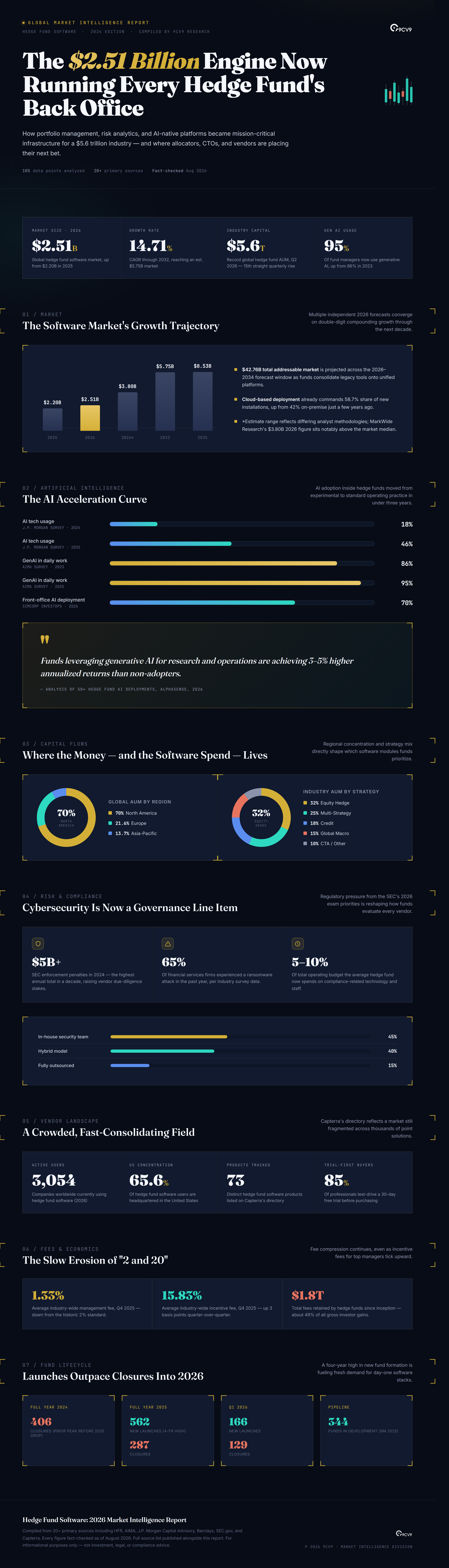
This technological expansion coincides with unprecedented growth across the broader hedge fund industry. Global hedge fund industry capital reached a record USD 5.6 trillion in the second quarter of 2026, while industry assets under management (AUM) are forecast to reach USD 8.83 trillion by 2031. As investment portfolios become larger and more diversified, fund managers increasingly require scalable software platforms capable of handling complex investment strategies, real-time market data, multi-asset portfolios, and sophisticated risk exposures.
Artificial intelligence is emerging as one of the most influential drivers of hedge fund software innovation. AI adoption among hedge funds increased from 18% in 2024 to 46% in 2025, representing approximately 156% relative year-over-year growth. Meanwhile, 95% of surveyed hedge fund managers report using generative AI in their work, demonstrating the increasing integration of intelligent technologies into financial research, investment analysis, software development, and operational workflows.
The adoption of cloud-based hedge fund software is also accelerating as investment firms seek greater scalability, accessibility, operational flexibility, and cost efficiency. Cloud-based deployments accounted for approximately 58% of hedge fund software installations in 2024, while nearly 74% of institutional hedge fund software users reportedly utilize integrated platforms. These developments reflect a broader transition away from fragmented legacy systems toward centralized investment management ecosystems.
Operational efficiency remains another major factor influencing software adoption. Automation embedded within hedge fund software has been reported to reduce manual operational errors by 38%, while real-time analytics tools can improve investment decision-making speed. Furthermore, more than 63% of hedge fund organizations identify automation and data integration as primary drivers behind their software adoption decisions.
Cybersecurity and regulatory compliance are equally important considerations shaping the hedge fund technology landscape in 2026. With 65% of financial services organizations reportedly experiencing ransomware attacks within a year and hedge funds typically allocating between 5% and 10% of their operating budgets to compliance-related expenses, secure and regulation-ready software platforms are becoming increasingly valuable. Fund managers must balance technological innovation with robust data protection, regulatory reporting, third-party vendor oversight, and AI governance frameworks.
Several key developments are defining the hedge fund software industry in 2026:
- Rapid market expansion: Increasing investment in digital infrastructure, portfolio management systems, and financial technology is supporting sustained market growth.
- Artificial intelligence and machine learning integration: Hedge funds are adopting AI-powered tools for investment research, predictive analytics, trading signals, and operational automation.
- Cloud-based software adoption: Scalable cloud infrastructure is increasingly replacing traditional on-premise investment management systems.
- Integrated investment management platforms: Fund managers are consolidating fragmented software tools into centralized platforms that support portfolio management, risk analysis, compliance, and investor reporting.
- Cybersecurity and regulatory compliance: Growing cyber threats and regulatory obligations are increasing demand for secure financial software and regulatory technology solutions.
- Alternative data and advanced analytics: Approximately 94% of surveyed fund managers and investment analysts plan to increase alternative data spending in 2026, highlighting the growing importance of data-driven investment strategies.
- Multi-asset investment management: Increasing portfolio diversification is driving demand for software capable of managing equities, derivatives, credit instruments, cryptocurrencies, and alternative investments.
- Operational cost optimization: Automation, managed technology services, and outsourced fund operations are helping investment firms improve productivity and manage rising infrastructure costs.
Understanding the latest hedge fund software statistics, market data, and industry trends is essential for hedge fund managers, institutional investors, financial technology providers, investment professionals, software developers, and financial services executives. These insights can support more informed technology procurement decisions, identify emerging investment opportunities, improve operational strategies, and provide a clearer understanding of the future of hedge fund management.
This comprehensive guide to the Top 105 Hedge Fund Software Statistics, Data & Trends in 2026 examines the latest market size estimates, growth forecasts, assets under management, AI adoption rates, cloud deployment trends, cybersecurity challenges, regulatory developments, fund launches, investment strategies, fee structures, operational costs, outsourcing practices, and software vendor trends.
By exploring these 105 statistics, financial services professionals and technology decision-makers can gain a deeper understanding of how digital transformation is reshaping the global hedge fund industry, which technologies are driving competitive advantages, and where future opportunities may emerge.
As hedge funds continue to embrace artificial intelligence, intelligent automation, advanced analytics, and integrated financial technology platforms, hedge fund software is evolving beyond its traditional role as an operational support tool. It is becoming a strategic foundation for investment intelligence, regulatory resilience, operational scalability, and long-term competitiveness in the global alternative investment industry.
Before we venture further into this article, we would like to share who we are and what we do.
About 9cv9
9cv9 is a business tech startup based in Singapore and Asia, with a strong presence all over the world.
With over ten years of startup and business experience, and being highly involved in connecting with thousands of companies and startups, the 9cv9 team has listed some of the top and best companies/tools in this review.
If you like to get your company listed in our top B2B software reviews, check out our world-class 9cv9 Media and PR service and pricing plans here.
Top 105 Hedge Fund Software Statistics, Data & Trends in 2026
Market Size & Growth Forecasts
1. The global hedge fund software market is valued at USD 2.51 billion in 2026, underscoring how central digital infrastructure has become to modern fund operations.
2. Industry analysts project the hedge fund software market will climb to USD 5.75 billion by 2032, reflecting a compound annual growth rate (CAGR) of 14.71%.
3. A separate 2026 forecast pegs global hedge fund software market value at USD 3.8 billion, expanding to USD 8.53 billion by 2035 at a 9.40% CAGR, showing strong analyst consensus on double-digit expansion.
4. The total addressable market (TAM) for hedge fund software between 2026 and 2034 is projected to reach approximately USD 42.76 billion, highlighting the scale of opportunity across the vendor ecosystem.
5. One market research report estimates the hedge fund software sector will grow from USD 1.97 billion in 2026 to USD 5.35 billion by 2035, at an 11.73% CAGR, reinforcing double-digit growth trajectories across multiple studies.
6. North America’s hedge fund software market alone was valued at USD 541.68 million in 2024 and continues to expand at an 11.5% CAGR, cementing the region’s dominance in software procurement.
7. Cloud-based deployment is projected to capture 58.7% market share of hedge fund software in 2025, confirming that SaaS delivery has become the default model for new fund technology purchases.
8. Portfolio and risk management modules represent 46% of core hedge fund software functionality adoption, making them the single largest feature category funds invest in.
9. Integrated hedge fund software platforms are used by nearly 74% of global institutional hedge fund users, reflecting the shift away from fragmented, siloed tools.
10. Automation embedded within hedge fund software has been shown to reduce manual operational errors by 38%, a critical efficiency gain for back-office teams.
11. Real-time analytics tools within hedge fund software platforms improve investment decision latency by 29%, giving portfolio managers a measurable speed advantage.
12. Multi-asset strategy support is now utilized by 61% of hedge funds, driving demand for software that can handle equities, derivatives, credit, and crypto within a single system.
Hedge Fund Industry Scale & AUM
13. Global hedge fund industry capital reached a record USD 5.6 trillion in Q2 2026, marking the fifteenth consecutive quarter of asset growth.
14. Quarterly industry capital increased by USD 409.3 billion in Q2 2026 alone — the largest single-quarter increase ever recorded by HFR.
15. The hedge fund industry’s assets under management (AUM) are forecast to reach USD 5.71 trillion in 2026, en route to an estimated USD 8.83 trillion by 2031.
16. North America accounts for approximately 70% of global hedge fund assets under management, making it the epicenter of hedge fund software demand.
17. Europe contributes roughly 21.6% of total global hedge fund assets, positioning it as the second-largest regional software market.
18. Asia-Pacific represents around 13.7% of the global hedge fund market, an emerging growth frontier for cloud-based fund technology vendors.
19. Hedge funds delivered an average return of 11.2% in 2025, the second consecutive year of double-digit performance — a trend that is fueling reinvestment into operational technology.
20. Total regulated hedge fund gross assets tracked in the 2026 AFI 500 ranking exceed USD 13.3 trillion, nearly three times the AUM estimated using unregulated methodologies.
21. The top three hedge fund managers alone account for almost USD 1.86 trillion in regulated hedge fund assets, illustrating extreme concentration at the top of the industry.
22. Multi-strategy platforms hold the largest market share of hedge fund AUM at 27.26% in 2025, driving outsized demand for integrated multi-asset software suites.
23. Quantitative and systematic hedge fund strategies are forecast to grow at an 11.63% CAGR through 2031, the fastest of any strategy category, intensifying demand for AI-powered analytics software.
AI & Machine Learning Adoption
24. AI adoption among hedge funds jumped from 18% in 2024 to 46% in 2025, representing a 156% year-over-year growth rate according to J.P. Morgan.
25. An additional 30% of hedge funds are actively investigating AI implementation, meaning only 24% of firms report no engagement with AI technology at all.
26. As of Q1 2026, over 47% of mid-to-large hedge funds globally have deployed at least one generative AI system in full production.
27. 95% of hedge fund managers surveyed by AIMA now report using generative AI in their work, up sharply from 86% in 2023.
28. 58% of fund managers expect generative AI to play a larger role in investment decision-making over the next year, up from just 20% in 2023.
29. 60% of institutional investors say they would be more likely to invest in a hedge fund that allocates meaningful budget to generative AI research and implementation.
30. Roughly 86% of hedge fund managers now provide staff with access to generative AI tools for research, coding, and internal analysis tasks.
31. Over 70% of global hedge funds now use machine-learning models somewhere in their trading pipeline, according to multiple 2026 industry surveys.
32. Around 18% of hedge funds rely on AI for more than half of their investment signal generation, reflecting deep AI integration among quant-focused managers.
33. More than 35% of new hedge fund launches in 2025 branded themselves as AI-driven or AI-enhanced funds.
34. Funds leveraging generative AI for research and operations are achieving 3–5% higher annualized returns than non-adopters, based on analysis of over 50 hedge fund deployments.
35. 75% of institutional investors now employ AI for non-investment workflows, while 55% have integrated it directly into their investment process.
36. Vendor consolidation is cited by 58% of buy-side firms as a top technology initiative, as funds seek to unify data and reduce platform sprawl.
37. Modernizing technology architecture and data infrastructure is a leading priority for 54% of investment managers surveyed in 2026.
38. Seven in ten investment managers are now actively deploying AI in their front offices, a dramatic jump from roughly one in ten just a year earlier.
39. 42% of emerging hedge fund managers now deploy AI across all business functions, reflecting AI’s spread beyond large, established platforms.
40. 94% of fund managers and investment analysts say they plan to increase alternative data spending in 2026, with 18% predicting a substantial increase.
41. More than half (54%) of investment firms report their alternative data budgets have grown by 50% or more over the past two years.
42. 84% of investment organizations spend between USD 500,000 and USD 2.5 million annually on alternative datasets, underscoring the scale of data-driven investment infrastructure spending.
Cybersecurity, Compliance & Regulation
43. The SEC imposed more than USD 5 billion in financial penalties in 2024 alone, its highest annual enforcement total in a decade, raising the stakes for compliance-grade hedge fund software.
44. 65% of financial services organizations experienced a ransomware attack in the past year, making cybersecurity-embedded software a non-negotiable requirement for fund operators.
45. Hedge funds typically spend between 5% and 10% of their total operating budgets on compliance-related expenses, much of which flows into regulatory technology.
46. 45% of hedge funds rely primarily on in-house teams for cybersecurity, while 40% use hybrid models and only 15% fully outsource security functions.
47. The SEC’s amended Regulation S-P now requires registered investment advisers to implement formal incident response programs with 30-day breach notification windows, effective June 3, 2026.
48. SEC fiscal year 2026 examination priorities explicitly include reviewing hedge fund AI governance controls and risks tied to polymorphic malware attacks.
49. Third-party vendor oversight — covering recordkeeping, cloud services, and data migration providers — is a heightened SEC examination focus for 2026.
50. In 2025, service organizations in regulated industries incurred an average cost of USD 5.56 million per data breach, reinforcing the ROI case for secure hedge fund platforms.
51. 74% of companies across the financial sector report concern about cyberattack threats, a key driver behind rising demand for security-hardened hedge fund software.
52. Drawbridge, a leading cybersecurity provider focused on private funds, now serves over 750 hedge fund clients, illustrating the scale of specialized compliance-tech demand.
Cloud, Deployment & Technology Infrastructure
53. Cloud-based hedge fund software installations represented 58% of total deployments in 2024, compared to 42% for on-premise systems.
54. Demand for AI and analytics tools within hedge fund software grew by 47% between 2021 and 2024.
55. Approximately 38% of hedge funds have integrated predictive analytics solutions into their software stack to support real-time, algorithm-assisted decision-making.
56. Machine-learning-based portfolio analytics adoption has increased by 41% among U.S. hedge funds since 2021.
57. Around 52% of fund administrators have implemented cloud-hosted trading and compliance systems as of the latest industry data.
58. Approximately 27% of U.S. hedge funds now use blockchain-based reconciliation tools to speed settlement and improve transparency.
59. 34% of hedge fund firms have invested in AI-enabled fraud detection systems in response to rising cybersecurity and regulatory pressure.
60. More than 63% of hedge fund organizations cite automation and data integration as the primary driver behind their hedge fund software adoption decisions.
61. System integration complexity affects 41% of hedge fund firms migrating away from legacy platforms, making implementation support a key vendor differentiator.
62. Data migration challenges influence 33% of hedge fund software implementation delays, particularly for funds with over a decade of historical data.
63. Cybersecurity concerns directly impact 29% of hedge fund software selection decisions, given the 24/7 nature of modern trading environments.
64. Customization costs affect 31% of hedge fund firms pursuing specialized investment strategies through their software platforms.
65. User training requirements influence 27% of hedge fund software adoption timelines, while vendor lock-in concerns affect 24% of procurement decisions.
66. The average buyer of financial and market data software works with approximately 37 vendors at small firms, rising to roughly 78 vendors at large institutions.
67. 76% of financial institutions surveyed in 2026 work with more than five distinct data vendors, highlighting the fragmented vendor landscape hedge fund software aims to unify.
68. Integrated hedge fund software platform spending is expected to grow at an average of 9.6% annually over the next three years, outpacing niche point-solution providers at 7.5%.
Fund Launches, Closures & Strategy Trends
69. New hedge fund launches rose to 562 in 2025, the highest annual total since 2021, according to HFR’s Market Microstructure Report.
70. Hedge fund liquidations fell to just 287 in 2025, the lowest annual total since 2004, signaling unusual industry stability.
71. New fund launches accelerated further in Q1 2026, reaching 166 — a jump of 30 over the prior quarter and 45 more than Q1 2025.
72. Hedge fund liquidations spiked to 129 in Q1 2026, the highest quarterly total in two years, showing renewed churn even amid a growth environment.
73. Equity Hedge strategies led new fund launches in Q4 2025 with 65 new funds, followed by Macro strategies with 35 launches.
74. 344 hedge funds were tracked in development during the first nine months of 2025 — the highest count since the Covid-19 era.
75. Equity hedge strategies represent 32% of total hedge fund industry AUM, making them the single largest strategy category by assets.
76. Multi-strategy funds account for approximately 25% of total hedge fund industry assets, driven by allocator demand for diversified, all-weather platforms.
77. Global macro strategies represent roughly 15% of hedge fund industry AUM, while credit strategies account for about 18%.
78. 45% of hedge funds report long/short equity as their primary investment strategy, the most common single approach in the industry.
79. Quantitative and systematic strategies have grown to represent approximately 20% of total hedge fund AUM, up sharply over the past several years.
Fees & Economics
80. The average industry-wide hedge fund management fee stood at an estimated 1.33% in Q4 2025, continuing a gradual multi-year decline from the historic “2 and 20” standard.
81. The average industry-wide incentive fee rose to an estimated 15.83% in Q4 2025, up three basis points quarter-over-quarter.
82. For hedge funds launched in 2025, the average management fee was an estimated 1.25%, while the average incentive fee reached 17.92%.
83. For new funds launched in Q1 2026, the average management fee eased to 1.22%, while the average incentive fee settled at 17.4%.
84. Hedge funds have collectively retained approximately USD 1.8 trillion in fees since inception — roughly 49% of the USD 3.7 trillion in gross gains generated for investors.
85. The use of pass-through fee arrangements has increased by roughly 40% over the past three years, driven largely by multi-strategy and quantitative platforms.
86. Breakeven AUM for emerging hedge fund managers rose to USD 82.9 million in 2026, up from USD 70.1 million in 2024, reflecting rising infrastructure and technology costs.
Talent, Operations & Outsourcing
87. Average headcount at emerging hedge fund managers has risen to 10 employees per firm, as smaller funds invest more heavily in operational infrastructure.
88. Top U.S. PhD programs produce only 2,000–3,000 machine learning, statistics, and physics graduates annually, fueling an intense hiring competition between hedge funds and Big Tech.
89. Managed services for hedge fund technology functions can save firms 50–75% compared to hiring equivalent roles in-house.
90. For sub-USD 500 million hedge funds, outsourced technology and operations services are often the only financially viable option to access institutional-grade infrastructure.
91. AI infrastructure spending at quantitative hedge funds runs 30–100% higher than at discretionary funds of the same AUM, reflecting AI’s role as a core production input rather than a support tool.
92. Talent costs represent 30–40% of total AI implementation budgets at hedge funds, typically the single largest line item.
93. Compute infrastructure — cloud GPU or on-premise — accounts for 20–30% of total first-year AI budgets at hedge funds adopting the technology.
94. A disciplined hedge fund AI rollout typically delivers a 20–30% productivity gain on the research function alone.
95. AI-disciplined hedge fund research functions report a 30–50% reduction in time required per investment idea generated.
Software Vendor Landscape & Capterra Data
96. Over 3,054 companies worldwide are currently using one or more dedicated hedge fund software platforms as of 2026.
97. Of all global hedge fund software users, 2,355 companies (65.6%) are headquartered in the United States, followed by the United Kingdom at 12.14%.
98. The majority of companies using hedge fund software fall into the 0–9 employee size bracket, showing strong small-fund and emerging-manager adoption.
99. Capterra’s Hedge Fund Software directory tracks 73 distinct products, giving fund managers a substantial field of vendors to evaluate.
100. AI Copilot and Generative AI capabilities now rank among the most-filtered “popular” features buyers search for on Capterra’s hedge fund software directory.
101. Compliance Management and Investor Reporting are consistently rated among the top features hedge fund software reviewers value most on Capterra.
102. 85% of professionals evaluating hedge fund software opt for a 30-day free trial before completing a purchase, according to Capterra buyer behavior data.
103. User reviews on Capterra’s Investment Management category cite Benchmarking, Portfolio Management, and Modeling & Simulation as the most valued functional capabilities.
104. Leading hedge fund software vendors named across Capterra and GetApp listings include Backstop by ION Analytics, FundCount, VestServe, Dynamo Software, HedgeGuard, Northstar Risk, and Pinnakl.
105. Capterra has verified over 2.5 million software reviews across its platform, giving hedge fund software buyers one of the largest independent review datasets available for vendor due diligence.
Conclusion
The global hedge fund software industry is entering a transformative period in 2026, characterized by rapid technological innovation, increasing institutional investment, artificial intelligence adoption, cloud-based infrastructure expansion, and evolving regulatory requirements. The 105 hedge fund software statistics, data points, and trends explored throughout this article demonstrate how financial technology is fundamentally reshaping the operational, analytical, and strategic capabilities of hedge funds worldwide.
As global financial markets become increasingly interconnected, volatile, and data-intensive, hedge fund managers can no longer rely exclusively on traditional investment management systems and manual operational processes. Modern hedge fund software has evolved into a comprehensive technological ecosystem that supports portfolio management, risk assessment, quantitative research, algorithmic trading, regulatory compliance, investor reporting, and operational automation.
Strong Market Growth Reflects Increasing Demand for Hedge Fund Software
The global hedge fund software market is positioned for substantial long-term expansion. Market estimates place its valuation at USD 2.51 billion in 2026, with projections suggesting that it could reach USD 5.75 billion by 2032. Other forecasts anticipate market valuations of up to USD 8.53 billion by 2035, demonstrating considerable growth potential despite differences in research methodologies.
This expansion is closely associated with the increasing scale and complexity of the global hedge fund industry. With worldwide hedge fund industry capital reaching USD 5.6 trillion in the second quarter of 2026 and assets under management projected to reach USD 8.83 trillion by 2031, investment firms require increasingly sophisticated technological infrastructure to manage growing portfolios and operational responsibilities.
Several factors are expected to sustain demand for hedge fund management software:
- Increasing institutional investment in alternative assets.
- Growing complexity of multi-asset investment portfolios.
- Rising demand for real-time financial analytics.
- Expansion of quantitative and systematic investment strategies.
- Increasing regulatory reporting obligations.
- Greater emphasis on operational efficiency and scalability.
- Accelerating adoption of artificial intelligence and automation.
- Growing demand for integrated portfolio and risk management platforms.
These developments highlight significant opportunities for financial technology companies, hedge fund software vendors, cloud infrastructure providers, and specialized investment management solution developers.
Artificial Intelligence Is Redefining Hedge Fund Management
Artificial intelligence represents one of the most consequential technological developments shaping the hedge fund software industry in 2026.
AI adoption among hedge funds increased from 18% in 2024 to 46% in 2025, while an additional 30% of hedge funds were actively investigating AI implementation. Furthermore, 95% of surveyed hedge fund managers reported using generative AI in their professional activities, illustrating the growing influence of intelligent technologies across the alternative investment industry.
The application of artificial intelligence extends beyond traditional quantitative trading strategies. Hedge funds are increasingly utilizing AI-powered software for financial research, market sentiment analysis, investment signal generation, portfolio optimization, predictive analytics, fraud detection, and internal operational processes.
Generative AI is also transforming how investment professionals access, interpret, and process financial information. AI-enabled research assistants, automated document analysis systems, intelligent coding tools, and natural language processing technologies can help investment teams manage increasingly large volumes of structured and unstructured financial data.
The supplied industry data indicates that disciplined AI implementation can deliver research productivity improvements of approximately 20% to 30%, while AI-enabled research functions have reported reductions of between 30% and 50% in the time required to generate investment ideas.
However, successful AI adoption requires more than technological investment. Hedge fund managers must establish appropriate governance frameworks, data quality standards, model validation procedures, cybersecurity safeguards, and human oversight mechanisms to ensure that AI-generated insights support responsible investment decision-making.
Cloud-Based Hedge Fund Software Is Becoming Increasingly Important
Cloud computing continues to transform the technological infrastructure of hedge funds worldwide. Cloud-based hedge fund software accounted for approximately 58% of total deployments in 2024, with its market share projected to reach 58.7% in 2025.
The growing adoption of cloud-based investment management software reflects the industry’s increasing demand for flexible, scalable, and cost-efficient technology solutions.
Unlike traditional on-premise systems, cloud-based hedge fund software can provide greater infrastructure flexibility, centralized data accessibility, remote collaboration capabilities, and more efficient software maintenance.
These advantages are particularly important for emerging hedge fund managers and smaller investment firms that may lack the financial resources required to build and maintain extensive proprietary technology infrastructure.
Nevertheless, cloud migration introduces important operational considerations. Approximately 41% of hedge fund firms migrating from legacy platforms encounter system integration complexity, while data migration challenges influence 33% of software implementation delays.
Consequently, hedge fund software vendors that provide reliable integration capabilities, comprehensive implementation support, secure data migration, and flexible deployment options are likely to remain attractive to investment firms seeking to modernize their technology infrastructure.
Integrated Platforms Are Replacing Fragmented Financial Technology Systems
The increasing adoption of integrated hedge fund software platforms represents another defining industry trend.
Nearly 74% of institutional hedge fund software users reportedly utilize integrated platforms, while portfolio and risk management modules account for 46% of core software functionality adoption.
Additionally, 58% of buy-side firms identify vendor consolidation as a leading technology initiative, reflecting growing concerns surrounding fragmented software ecosystems, disconnected data sources, and operational inefficiencies.
Modern hedge funds require technology platforms capable of connecting investment research, order management, portfolio accounting, risk analytics, compliance monitoring, and investor reporting within a coordinated digital environment.
Integrated hedge fund management software can help investment organizations reduce data inconsistencies, improve information accessibility, streamline operational workflows, and strengthen collaboration between front-office, middle-office, and back-office teams.
Automation is particularly valuable in this context. The industry data indicates that automation embedded within hedge fund software can reduce manual operational errors by approximately 38%, while more than 63% of hedge fund organizations identify automation and data integration as primary drivers of software adoption.
As investment strategies become increasingly sophisticated, the ability to manage multiple financial instruments, investment portfolios, and operational processes through integrated platforms will remain an important consideration in hedge fund software procurement.
Cybersecurity and Regulatory Compliance Remain Critical Priorities
Despite the considerable opportunities associated with digital transformation, cybersecurity threats and regulatory compliance requirements remain significant challenges for the hedge fund industry.
Approximately 65% of financial services organizations reportedly experienced ransomware attacks within a year, while 74% of financial sector companies expressed concerns about cyberattack threats.
Furthermore, service organizations operating in regulated industries incurred an average data breach cost of USD 5.56 million in 2025, highlighting the potentially substantial financial consequences of inadequate cybersecurity infrastructure.
Hedge funds typically allocate between 5% and 10% of their operating budgets to compliance-related expenses, demonstrating the importance of regulatory technology and secure investment management systems.
The evolving regulatory environment is also increasing scrutiny of AI governance, third-party technology providers, cloud infrastructure, incident response procedures, data protection, and recordkeeping practices.
As a result, hedge fund software selection increasingly requires a comprehensive assessment of security and compliance capabilities rather than an exclusive focus on investment performance and operational functionality.
Investment firms must prioritize software solutions that support robust access controls, secure data management, audit trails, regulatory reporting, cybersecurity monitoring, and effective incident response procedures.
Financial technology vendors capable of combining sophisticated investment management functionality with institutional-grade security and compliance capabilities are well-positioned to address these evolving requirements.
Alternative Data and Advanced Analytics Are Driving Investment Innovation
The growing importance of alternative data is creating new opportunities for hedge fund software providers and investment management technology companies.
Approximately 94% of surveyed fund managers and investment analysts plan to increase alternative data spending in 2026, while 54% of investment firms report that their alternative data budgets have increased by at least 50% over the previous two years.
Furthermore, 84% of surveyed investment organizations spend between USD 500,000 and USD 2.5 million annually on alternative datasets.
These figures demonstrate the increasing importance of sophisticated data acquisition, processing, integration, and analytical capabilities within the hedge fund industry.
Investment firms are increasingly seeking software platforms capable of transforming complex financial and alternative datasets into actionable investment intelligence. Predictive analytics, machine learning, automated data processing, and real-time market intelligence are becoming increasingly valuable components of modern hedge fund technology infrastructure.
However, the growing volume of available data also introduces challenges related to data quality, information governance, integration complexity, and infrastructure costs.
Hedge fund software platforms that effectively address these challenges can help investment professionals improve research efficiency, identify emerging market opportunities, and develop more informed investment strategies.
Rising Operational Costs Are Increasing Demand for Automation and Outsourcing
The economic environment surrounding hedge fund management is also influencing technology adoption decisions.
Average industry-wide hedge fund management fees stood at approximately 1.33% in the fourth quarter of 2025, while average incentive fees reached 15.83%. These figures reflect the industry’s continued evolution away from the traditional 2% management fee and 20% performance fee structure.
At the same time, the estimated breakeven assets under management for emerging hedge fund managers increased from USD 70.1 million in 2024 to USD 82.9 million in 2026.
Rising infrastructure expenses, technology investment requirements, cybersecurity obligations, and competition for specialized financial technology talent are placing additional pressure on hedge fund operating budgets.
Managed technology services and outsourced operational solutions are therefore becoming increasingly relevant. Industry estimates suggest that managed hedge fund technology services can generate cost savings of between 50% and 75% compared with hiring equivalent internal personnel.
For emerging hedge fund managers, cloud-based software, automated workflows, and outsourced technology services may provide more accessible pathways to institutional-grade investment management infrastructure.
For larger hedge funds, these technologies can support operational scalability, resource optimization, and more efficient allocation of internal expertise toward investment research and portfolio management.
Quantitative and Multi-Strategy Funds Are Creating New Software Opportunities
The increasing prominence of quantitative, systematic, and multi-strategy hedge funds is generating demand for more advanced financial technology solutions.
Multi-strategy platforms accounted for approximately 27.26% of hedge fund assets under management in 2025, while quantitative and systematic investment strategies are forecast to grow at an annual compound rate of 11.63% through 2031.
These investment approaches frequently require sophisticated computational infrastructure, real-time market data processing, algorithmic trading capabilities, portfolio optimization tools, and advanced risk management systems.
AI infrastructure spending at quantitative hedge funds is estimated to be between 30% and 100% higher than at discretionary hedge funds with comparable assets under management.
This difference illustrates the strategic importance of technology within systematic investment operations, where computational capabilities and data infrastructure can form essential components of the investment process itself.
As quantitative investing and multi-strategy fund structures continue to evolve, hedge fund software vendors will need to provide increasingly flexible, scalable, and customizable platforms capable of supporting diverse investment methodologies.
Selecting the Right Hedge Fund Software in 2026
With dozens of dedicated hedge fund software products available, selecting an appropriate platform has become an increasingly important strategic decision for investment organizations.
Leading hedge fund software solutions include platforms such as Backstop by ION Analytics, FundCount, VestServe, Dynamo Software, HedgeGuard, Northstar Risk, and Pinnakl.
However, the most suitable hedge fund management software will depend on the organization’s investment strategies, operational requirements, regulatory obligations, assets under management, technological maturity, and available budget.
When evaluating hedge fund software in 2026, investment managers should consider the following factors:
- Portfolio management and investment accounting capabilities.
- Real-time risk monitoring and exposure analysis.
- Artificial intelligence and machine learning functionality.
- Multi-asset and multi-strategy investment support.
- Regulatory compliance and automated reporting features.
- Cybersecurity and data protection capabilities.
- Integration with existing financial technology infrastructure.
- Cloud deployment flexibility and scalability.
- Alternative data processing and analytics capabilities.
- Investor reporting and performance measurement tools.
- Software implementation and data migration requirements.
- Vendor reliability, customer support, and industry expertise.
- Total cost of ownership and long-term return on investment.
- Customization capabilities and future technological adaptability.
A comprehensive software evaluation process can help hedge funds avoid unnecessary technology expenses, minimize implementation risks, and establish a more sustainable digital infrastructure.
The Future of Hedge Fund Software Beyond 2026
Looking beyond 2026, the hedge fund software industry is expected to become increasingly intelligent, interconnected, automated, and data-driven.
Artificial intelligence, machine learning, cloud computing, predictive analytics, blockchain-based reconciliation, and advanced cybersecurity technologies are likely to continue influencing how investment organizations develop and manage their technology infrastructure.
Future hedge fund management platforms may increasingly incorporate intelligent research assistants, automated investment workflows, real-time regulatory monitoring, advanced portfolio simulation, and more sophisticated data integration capabilities.
The growing emphasis on AI governance and regulatory oversight will also require software vendors to develop transparent, auditable, and secure technological solutions that support responsible innovation.
Furthermore, the expansion of global hedge fund assets under management and the increasing complexity of investment strategies are expected to create continued opportunities for specialized financial technology providers.
The most successful hedge fund software vendors will likely be those capable of balancing technological innovation with operational reliability, regulatory compliance, cybersecurity resilience, implementation flexibility, and measurable business value.
Final Thoughts
The Top 105 Hedge Fund Software Statistics, Data & Trends in 2026 reveal an industry undergoing significant digital transformation, supported by expanding global investment assets, accelerating artificial intelligence adoption, increasing cloud deployment, and growing demand for integrated investment management solutions.
The projected multibillion-dollar expansion of the hedge fund software market demonstrates the increasing importance of technology within the global alternative investment ecosystem. From portfolio management and quantitative research to cybersecurity, compliance, investor reporting, and operational automation, hedge fund software is becoming a foundational component of institutional investment infrastructure.
For hedge fund managers, investing in appropriate technology can support operational efficiency, research productivity, risk management, regulatory preparedness, and organizational scalability.
For financial technology providers, the industry’s ongoing transformation presents substantial opportunities to develop innovative software solutions that address the evolving requirements of investment organizations.
For institutional investors, understanding a hedge fund’s technological capabilities, cybersecurity practices, data governance frameworks, and operational infrastructure can provide additional insights into its organizational resilience and investment management processes.
Although individual market forecasts and adoption estimates vary according to research methodologies, the broader direction of the industry remains clear: hedge funds are becoming increasingly dependent on sophisticated digital infrastructure to manage complexity, improve efficiency, and remain competitive.
Ultimately, hedge fund software in 2026 is no longer simply a collection of operational tools. It is a strategic enabler of investment intelligence, financial innovation, operational excellence, regulatory resilience, and sustainable organizational growth.
As the global hedge fund industry continues to evolve, organizations that strategically embrace secure, scalable, integrated, and intelligent software solutions will be better positioned to navigate changing market conditions, capitalize on emerging technological opportunities, and build long-term competitive advantages in the increasingly sophisticated world of alternative investment management.
If you find this article useful, why not share it with your hiring manager and C-level suite friends and also leave a nice comment below?
We, at the 9cv9 Research Team, strive to bring the latest and most meaningful data, guides, and statistics to your doorstep.
To get access to top-quality guides, click over to 9cv9 Blog.
To hire top talents using our modern AI-powered recruitment agency, find out more at 9cv9 Modern AI-Powered Recruitment Agency.
People Also Ask
“Give a list of 30 Seo-optimised FAQ questions and answers that people will ask for the blog topic “”Top 105 Hedge Fund Software Statistics, Data & Trends in 2026″”. Please write each answer in under 320 characters. – Remove all the “”Q:”” and “”A:””. – Format the questions in H4 and remove all bullet points. – Bold the questions only – Remove all numberings, if any. – Do not bold the answers – Write 30 questions/answers – Do not write any HTML tag in the answer – Do not write the “”H4″” word in it”
What is hedge fund software?
Hedge fund software is a financial technology solution that helps investment firms manage portfolios, monitor risks, execute trades, automate operations, maintain regulatory compliance, and generate investor reports.
How big is the global hedge fund software market in 2026?
The global hedge fund software market is estimated to be worth USD 2.51 billion in 2026, with alternative market forecasts placing its valuation at USD 3.8 billion.
What is the projected growth rate of the hedge fund software market?
One market forecast projects the hedge fund software market to grow at a compound annual growth rate of 14.71%, reaching USD 5.75 billion by 2032.
How much will the hedge fund software market be worth by 2035?
One industry forecast projects that the global hedge fund software market could reach USD 8.53 billion by 2035, supported by increasing demand for investment technology and automation.
What are the biggest hedge fund software trends in 2026?
Major trends include artificial intelligence, machine learning, cloud computing, integrated portfolio management, predictive analytics, cybersecurity, regulatory technology, and automated investment workflows.
What percentage of hedge funds use artificial intelligence?
AI adoption among hedge funds increased from 18% in 2024 to 46% in 2025, while an additional 30% of hedge funds were actively investigating AI implementation.
How widely is generative AI used in hedge funds?
Approximately 95% of surveyed hedge fund managers report using generative AI in their work, compared with 86% in 2023, reflecting growing adoption across investment research and operations.
What percentage of hedge fund software is cloud-based?
Cloud-based hedge fund software accounted for approximately 58% of total deployments in 2024, with its market share projected to reach 58.7% in 2025.
What are the most important features of hedge fund software?
Key features include portfolio management, risk analytics, investment accounting, trade execution, regulatory compliance, investor reporting, performance measurement, and automated data integration.
How large is the global hedge fund industry in 2026?
Global hedge fund industry capital reached a record USD 5.6 trillion in the second quarter of 2026, marking the fifteenth consecutive quarter of asset growth.
What is the projected hedge fund industry AUM by 2031?
Global hedge fund assets under management are projected to reach USD 8.83 trillion by 2031, supporting growing demand for scalable investment management software.
Which region leads the global hedge fund software market?
North America is a leading hedge fund software market, supported by its concentration of institutional investment firms, hedge fund managers, and financial technology providers.
How does hedge fund software improve operational efficiency?
Hedge fund software automates repetitive tasks, integrates financial data, streamlines reporting, and reduces manual processing. Embedded automation has reportedly reduced operational errors by 38%.
What percentage of hedge funds use integrated software platforms?
Nearly 74% of institutional hedge fund software users reportedly utilize integrated platforms to consolidate investment management, risk analysis, compliance, and operational workflows.
How does artificial intelligence improve hedge fund performance?
AI supports hedge fund performance through predictive analytics, investment signal generation, automated research, portfolio optimization, and faster data processing. However, AI adoption does not guarantee higher investment returns.
How much do hedge funds spend on regulatory compliance?
Hedge funds typically allocate between 5% and 10% of their total operating budgets to compliance-related expenses, including regulatory technology, reporting systems, and monitoring tools.
Why is cybersecurity important in hedge fund software?
Cybersecurity protects sensitive financial data, investment strategies, investor information, and trading infrastructure. Approximately 65% of financial services organizations reportedly experienced ransomware attacks within a year.
What are the biggest challenges in hedge fund software implementation?
Major challenges include system integration complexity, data migration, cybersecurity risks, customization costs, employee training, legacy infrastructure, and vendor lock-in.
How common is predictive analytics adoption among hedge funds?
Approximately 38% of hedge funds have reportedly integrated predictive analytics solutions into their technology infrastructure to support algorithm-assisted investment decision-making.
How much do hedge funds spend on alternative data?
Approximately 84% of surveyed investment organizations spend between USD 500,000 and USD 2.5 million annually on alternative datasets for research and investment analysis.
Are hedge funds increasing their alternative data budgets in 2026?
Yes. Approximately 94% of surveyed fund managers and investment analysts plan to increase alternative data spending in 2026, with 18% anticipating substantial budget increases.
How many new hedge funds were launched in 2025?
A total of 562 new hedge funds were launched in 2025, representing the highest annual number of new hedge fund launches since 2021.
What are the average hedge fund management and performance fees?
In the fourth quarter of 2025, the average hedge fund management fee was approximately 1.33%, while the average incentive fee stood at 15.83%.
What is the breakeven AUM for emerging hedge fund managers in 2026?
The estimated breakeven assets under management for emerging hedge fund managers reached USD 82.9 million in 2026, up from USD 70.1 million in 2024.
How much can outsourced hedge fund technology services save?
Managed hedge fund technology services can reportedly generate cost savings of between 50% and 75% compared with hiring equivalent in-house technology professionals.
How does hedge fund software support quantitative trading?
Hedge fund software supports quantitative trading through algorithmic execution, statistical modeling, machine learning, historical data analysis, investment signal generation, and automated risk monitoring.
How much productivity improvement can AI deliver for hedge funds?
Disciplined AI implementation can reportedly improve hedge fund research productivity by 20% to 30% and reduce the time required to generate investment ideas by 30% to 50%.
What are the leading hedge fund software platforms in 2026?
Prominent hedge fund software platforms include Backstop by ION Analytics, FundCount, VestServe, Dynamo Software, HedgeGuard, Northstar Risk, and Pinnakl.
How should investment firms choose the best hedge fund software?
Investment firms should evaluate portfolio management capabilities, AI functionality, cybersecurity, regulatory compliance, integration options, scalability, vendor support, and total cost of ownership.
What is the future of hedge fund software beyond 2026?
The future of hedge fund software is expected to feature greater AI integration, intelligent automation, cloud-native infrastructure, advanced risk analytics, real-time compliance monitoring, and increasingly integrated investment management platforms.
Sources
- HFR (Hedge Fund Research)
- J.P. Morgan Capital Advisory Group
- AIMA (Alternative Investment Management Association)
- AlphaSense
- SimCorp
- U.S. Securities and Exchange Commission (SEC)
- Drawbridge Networks
- Business Research Insights
- Custom Market Insights
- MarkWide Research
- Capterra
- LCH Investments
- BarclayHedge
- BlackRock
- Preqin
- IBM
- Ponemon Institute


