

Key Takeaways
- Rapid Help Desk Software Market Growth: The global help desk software market is valued at USD 12.4 billion in 2026 and is projected to reach USD 33.3 billion by 2035, growing at an 11.6% CAGR.
- AI and Automation Are Transforming Customer Support: With 88% of contact centres adopting AI, intelligent help desk automation is accelerating ticket resolution, improving agent productivity, and reducing operational costs.
- Self-Service and ROI Are Driving Software Adoption: Approximately 81% of customers attempt self-service before contacting support, while businesses report an average return of USD 3.50 for every USD 1 invested in AI-powered customer service.
Help desk software improves customer support through intelligent ticket management, AI-powered automation, and self-service capabilities. In 2026, the global help desk software market stands at an estimated USD 12.4 billion, with a projected value of USD 33.3 billion by 2035, an 11.6% annual growth rate, and AI adoption among 88% of contact centres.
In 2026, help desk software has become an indispensable component of modern business operations, transforming how organisations manage customer inquiries, resolve technical issues, streamline IT service management, and deliver exceptional customer experiences. As businesses navigate increasing customer expectations, rising support volumes, digital transformation, and growing operational costs, advanced help desk solutions are emerging as strategic investments for improving service efficiency, workforce productivity, customer retention, and long-term business competitiveness.

The global help desk software market is experiencing substantial growth, reaching an estimated USD 12.4 billion in 2026 and projected to expand to USD 33.3 billion by 2035, representing a compound annual growth rate (CAGR) of 11.6%. Meanwhile, the help desk and ticketing software market is valued at approximately USD 14.4 billion in 2026 and is forecast to reach USD 30 billion by 2034. These figures highlight the growing importance of centralised ticket management, cloud-based customer support platforms, automated workflows, and intelligent service delivery solutions across industries.
One of the most significant help desk software trends in 2026 is the rapid adoption of artificial intelligence (AI), generative AI, machine learning, and agentic AI technologies. Approximately 88% of contact centres report using some form of AI, while 98% of IT organisations utilise AI in some capacity within their operations. Furthermore, agentic AI is projected to autonomously resolve 80% of common customer service requests by 2029, signalling a fundamental transformation in how businesses approach customer support and IT service delivery.

The growing demand for automation is also reshaping the help desk software industry. The help desk automation market is projected to increase from USD 10.7 billion in 2024 to USD 91.9 billion by 2033, registering an impressive CAGR of 27%. Intelligent ticket routing, automated responses, AI-powered chatbots, predictive analytics, and workflow automation are helping organisations reduce manual workloads, accelerate issue resolution, and optimise support resources.
Beyond technological innovation, customer expectations are becoming increasingly demanding. Approximately 88% of consumers expect faster support response times than they did one year earlier, while 74% expect round-the-clock customer support. Additionally, 83% of customers expect immediate engagement when contacting a business, and 74% express frustration when required to repeat their issues across multiple agents or communication channels. These statistics demonstrate why omnichannel help desk software, unified customer records, intelligent ticket management, and personalised support experiences are becoming essential business capabilities.
Help desk software is also delivering measurable improvements in operational efficiency and financial performance. Industry benchmarks indicate that median first response times can decrease from 4.1 hours with manual ticket handling to just 0.9 hours when AI-assisted ticket prequalification is implemented. Similarly, average resolution times can decline from three days with manual processes to approximately one day through workflow automation.
The financial benefits are equally significant. Businesses report an average return of USD 3.50 for every USD 1 invested in AI-powered customer service, with top-performing organisations achieving returns of up to USD 8 per dollar invested. Effective service desk automation implementations can also generate an estimated 320% return on investment within 18 months, highlighting the potential of help desk software to support sustainable cost optimisation and business growth.
Self-service capabilities and knowledge base management represent another major area of development. With 81% of customers attempting to resolve their issues independently before contacting a support agent and approximately 91% willing to use a relevant online knowledge base, businesses are increasingly investing in digital self-service portals, searchable documentation, AI-powered virtual assistants, and automated troubleshooting solutions. A well-maintained knowledge base can potentially deflect between 25% and 35% of inbound support tickets, allowing human agents to concentrate on more complex and high-value customer interactions.
Despite these advancements, organisations continue to face significant challenges in help desk management. Employee burnout, growing ticket backlogs, inconsistent knowledge base quality, fragmented communication channels, and difficulties scaling AI implementations remain persistent concerns. IT service desk agent turnover can reach as high as 40% annually, while employees lose an average of 3.22 hours of productivity per IT incident. These challenges reinforce the importance of selecting help desk software that balances automation, human expertise, service quality, and workforce management.
The evolving help desk software landscape also reflects a broader shift towards cloud-based Software-as-a-Service (SaaS) platforms. Businesses increasingly favour cloud help desk solutions for their scalability, accessibility, lower infrastructure requirements, and ability to support distributed teams. With entry-level help desk software pricing commonly ranging from USD 15 to USD 29 per agent per month, organisations of different sizes can access digital support management capabilities without substantial upfront infrastructure investments.
Understanding the latest help desk software statistics, market data, adoption trends, and performance benchmarks is therefore essential for business owners, IT managers, customer service leaders, technology executives, software developers, and investors seeking to make informed decisions in an increasingly competitive digital economy.
This comprehensive guide to the Top 102 Help Desk Software Statistics, Data & Trends in 2026 examines the most important developments shaping the global help desk software industry, including:
- Global help desk software market size, growth forecasts, and regional market share.
- Artificial intelligence, generative AI, agentic AI, and automation adoption statistics.
- Customer support response times, ticket resolution rates, and operational efficiency benchmarks.
- First contact resolution rates, customer satisfaction, and service quality metrics.
- Help desk software costs, cost-per-ticket benchmarks, and return on investment.
- Self-service adoption, knowledge base performance, and ticket deflection rates.
- Customer preferences, chatbot adoption, and sentiment towards AI-powered support.
- Support ticket volumes, workforce productivity, employee turnover, and backlog management.
- Help desk software pricing, buyer behaviour, deployment models, and purchasing trends.
Whether an organisation is evaluating the best help desk software, upgrading its existing IT service management infrastructure, implementing AI-powered customer support, or developing a long-term service automation strategy, these 102 statistics provide valuable insights into the opportunities, challenges, and emerging technologies defining the industry.
As businesses continue to prioritise customer-centric operations, intelligent automation, digital transformation, and cost-effective service delivery, help desk software is evolving beyond traditional ticket management into a comprehensive platform for operational excellence. Understanding these developments will be crucial for organisations seeking to improve customer experiences, maximise workforce productivity, strengthen customer loyalty, and maintain a competitive advantage in 2026 and beyond.
Before we venture further into this article, we would like to share who we are and what we do.
About 9cv9
9cv9 is a business tech startup based in Singapore and Asia, with a strong presence all over the world.
With over ten years of startup and business experience, and being highly involved in connecting with thousands of companies and startups, the 9cv9 team has listed some of the top and best companies/tools in this review.
If you like to get your company listed in our top B2B software reviews, check out our world-class 9cv9 Media and PR service and pricing plans here.
Top 102 Help Desk Software Statistics, Data & Trends in 2026
Market Size & Growth
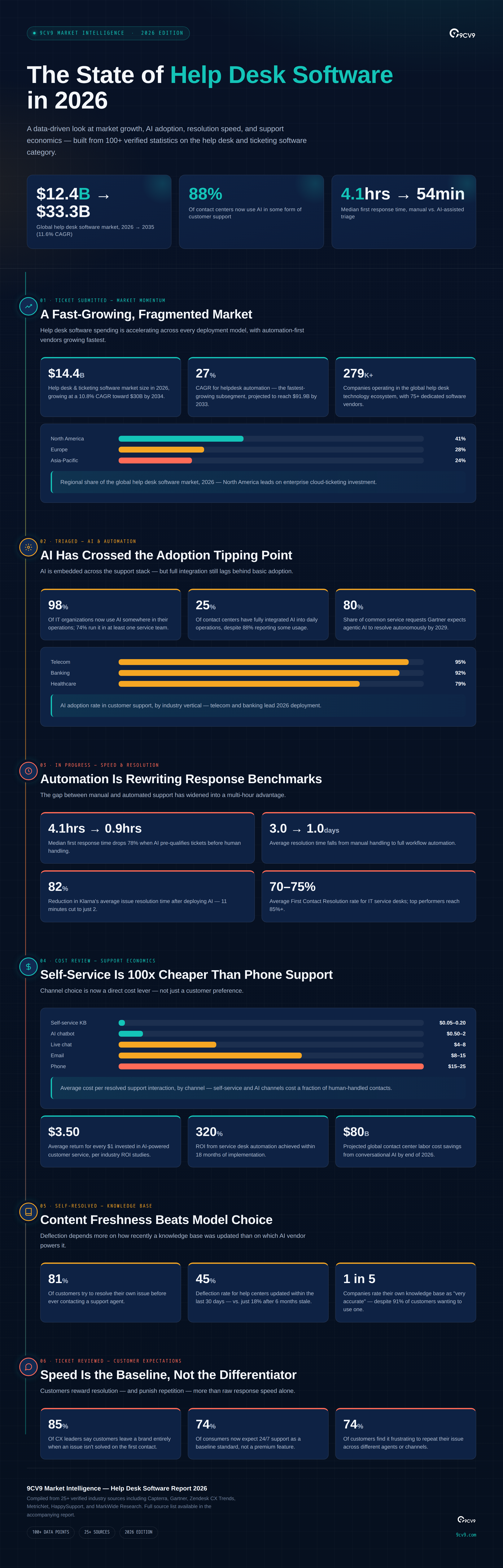
1. The global help desk software market reached an estimated USD 12.4 billion in 2026 and is projected to expand to USD 33.3 billion by 2035, reflecting an 11.6% CAGR — a clear signal that businesses are accelerating investment in centralized support platforms.
2. Help desk and ticketing software specifically is valued at USD 14.4 billion in 2026 and is forecast to reach USD 30 billion by 2034 at a 10.8% CAGR, underscoring how ticketing has become a foundational layer of modern customer operations.
3. The broader IT help desk software segment was valued at USD 11.4 billion in 2025 and is expected to hit USD 26.8 billion by 2034, growing at a 9.9% CAGR as enterprises modernize IT service management frameworks.
4. The open-source help desk software market is set to grow from USD 4.02 billion in 2025 to USD 4.57 billion in 2026, a 13.8% year-over-year increase, showing rising demand for cost-flexible, customizable ticketing alternatives.
5. Helpdesk automation specifically is projected to surge from USD 10.7 billion in 2024 to USD 91.9 billion by 2033, a striking 27% CAGR that highlights automation as the fastest-growing subsegment of the category.
6. The IT service desk market is forecast to expand from USD 4.32 billion in 2026 to USD 18.04 billion by 2035 at a 17.2% CAGR, one of the steepest growth curves in enterprise software.
7. North America commands more than 40% of the global help desk software market, driven by heavy enterprise investment in cloud-based ticketing infrastructure.
8. Europe follows with roughly 28% of global market share, while Asia-Pacific accounts for about 24%, reflecting a maturing but still-expanding regional footprint for support software.
9. The competitive landscape remains active, with vendors like Zendesk, Freshworks, ServiceNow, and Freshservice pursuing acquisitions and platform integrations to accelerate conversational AI and omnichannel capabilities.
10. More than 279,000 companies operate within the broader help desk technology ecosystem, with over 75 vendors actively producing dedicated help desk products.
AI Adoption & Automation
11. As of 2026, 88% of contact centers report using some form of AI, yet only 25% have fully integrated automation into daily operations — showing a persistent gap between adoption and true integration.
12. A striking 98% of IT organizations now use AI in some capacity within their operations, with 74% having already deployed AI in at least one service management team.
13. Telecom leads all industries in AI adoption for customer support at 95%, followed closely by banking at 92% and healthcare at 79%.
14. Gartner projects that agentic AI will be capable of autonomously resolving 80% of common customer service requests by 2029, marking a major shift from assisted to fully autonomous support.
15. By the end of 2026, Gartner estimates that just one in ten contact center interactions will be automated, a modest but meaningful rise from only 1.6% automated in earlier benchmarks.
16. Conversational AI is projected to cut global contact center labor costs by approximately USD 80 billion by the end of 2026, given that labor represents up to 95% of total contact center expenses.
17. Implementing conversational AI costs organizations roughly USD 1,000–1,500 per agent on average, with some deployments reaching USD 2,000, making ROI planning essential before rollout.
18. Gartner predicts that 20–30% of customer service agent roles could be affected by AI adoption in 2026, though 50% of companies that reduced headcount are expected to rehire similar roles by 2027.
19. Only 20% of customer service leaders report having actually reduced agent headcount due to AI — most say staffing stayed flat even as ticket volume increased.
20. Gartner’s own forecasting is direct: no Fortune 500 company is expected to have fully replaced human customer service with AI by 2028, reinforcing that hybrid human-AI models remain the dominant strategy.
21. 64% of enterprise CX teams ran an agentic AI pilot in 2026, but only 27% progressed to having at least one channel in full production — proof that piloting AI is easier than scaling it.
22. Basic rule-based chatbots historically resolved only 10–20% of customer issues autonomously, while modern LLM-powered AI agents now achieve autonomous resolution rates of 50–80%.
23. Support agents using AI copilots and assist tools handle 13.8% more customer inquiries per hour compared to agents without AI support.
24. 84% of customer service representatives using AI say it makes responding to tickets noticeably easier, pointing to strong agent-side satisfaction with AI tooling.
25. Field research across more than 5,000 customer support agents found that generative AI access increased issues resolved per hour by 14% on average.
Speed, Response Time & Resolution
26. The median first response time across support teams sits at 4.1 hours for manual handling, dropping to just 0.9 hours when AI pre-qualifies tickets before an agent responds.
27. Average resolution time is 3.0 days when handled manually, 1.9 days with AI assistance, and just 1.0 day when workflow automation is applied — illustrating a compounding speed advantage from layered automation.
28. During peak shopping seasons, total support automation rates can climb to 35.2%, with deterministic workflows — not chatbots — absorbing the bulk of demand surges like Black Friday.
29. Across a 2.9-million-ticket dataset, the overall automation rate for e-commerce support sits at 32.9%, with top-quartile merchants averaging 61.2% automation.
30. More than half of all classified support tickets in e-commerce fall into a single category: “Where is my order?” — showing how repetitive, automatable queries dominate real-world volume.
31. AI-powered first response times have fallen from over 6 hours to under 4 minutes in some enterprise benchmarks, representing an approximately 99% reduction in wait time.
32. Companies deploying AI in customer service have cut first response times by up to 74% within the first year of implementation.
33. Zendesk’s CX Trends research found customer expectations for initial response speed rose 63% between 2023 and 2024, raising the bar for what counts as “fast” support.
34. AI implementation has been linked to a 37% average reduction in first response times across multiple industry benchmarks.
35. AI-powered support tools can reduce overall resolution time by up to 50% through automation and predictive routing.
36. Klarna’s AI-assisted support cut average issue resolution time from 11 minutes to just 2 minutes — an 82% improvement — while maintaining customer satisfaction scores comparable to human agents.
37. Bank of America’s AI assistant Erica resolves 98% of customer queries within just 44 seconds, one of the fastest documented resolution benchmarks in the industry.
38. Across industries, AI has helped shift average resolution times from 32 hours down to roughly 32 minutes — an approximate 87% improvement in overall speed.
39. AI-powered real-time answer suggestions for agents can reduce individual issue resolution time by up to 30%.
40. Companies using AI-powered automation tools report a 75% reduction in ticket resolution times on average, directly lowering per-ticket operational costs.
First Contact Resolution & Service Quality
41. The average First Contact Resolution (FCR) rate for IT service desks sits between 70% and 75%, with high-performing desks consistently achieving 85% or higher.
42. A ticket reopen rate above 10% — especially after deploying new automation — is considered a red flag that tickets are being closed prematurely rather than genuinely resolved.
43. Most well-run service desks target a ticket reopen rate below 5%, treating it as a core quality signal alongside FCR.
44. Microsoft’s internal AI-assisted customer support achieved a 90% first-call resolution rate alongside a 70% reduction in required human intervention.
45. 85% of CX leaders report that customers leave a brand entirely when their issue isn’t resolved during the first interaction, making FCR a direct retention metric.
46. 88% of consumers say they expect faster support response times than they did just one year earlier, reflecting continuously rising service expectations.
47. 74% of consumers now expect 24/7 customer support as a baseline standard rather than a premium feature.
48. 83% of customers expect to be able to engage with a company “immediately” when they reach out — in digital terms, that means seconds, not minutes.
49. 74% of customers say it’s frustrating to repeat their issue across different agents or channels, highlighting the value of unified, context-aware ticketing systems.
50. 83% of CX leaders view memory-rich AI agents — ones that retain prior context — as essential for delivering genuinely personalized support.
Cost Per Ticket & ROI
51. Cost-per-ticket for support teams ranges widely from USD 2.93 to USD 49.69, with the average landing around USD 15.56 per resolved ticket.
52. A 2026 service desk benchmark places the average cost per resolved incident at USD 22.50, factoring in labor, tooling, and escalation overhead.
53. Self-service resolutions cost organizations an average of just USD 15 per ticket, compared to USD 45 for agent-handled interactions — a threefold cost difference.
54. AI-driven resolutions average just USD 0.62 per ticket compared to USD 7.40 for human-agent resolutions, according to enterprise benchmarking research.
55. Manually handling a single support ticket can cost an organization around USD 22, while automation can bring nearly 22% of ticket volume down to practically zero marginal cost.
56. Businesses report an average return of USD 3.50 for every USD 1 invested in AI-powered customer service, with top performers reporting returns as high as USD 8 per dollar spent.
57. ROI from service desk automation reaches an estimated 320% within 18 months for organizations that implement it effectively.
58. Outsourcing help desk operations can reduce overall service desk costs by up to 40% compared to maintaining an in-house-only model.
59. Live chat interactions cost businesses USD 4–8 each, email support runs USD 8–15, and phone support is the most expensive channel at USD 15–25 per interaction.
60. AI chatbot interactions cost as little as USD 0.50–2 each, while self-service knowledge base deflections cost just USD 0.05–0.20 — the cheapest support channel by a wide margin.
Self-Service & Knowledge Base Performance
61. 81% of customers actively try to resolve their own issues before reaching out to a support agent, reinforcing the importance of a well-maintained knowledge base.
62. Roughly 91% of customers say they would use an online knowledge base if one were available and genuinely relevant to their issue.
63. Despite strong demand for self-service, only about 1 in 5 companies rate their own knowledge base content as “very accurate,” revealing a significant content-quality gap.
64. A strong, well-maintained knowledge base can deflect between 25% and 35% of inbound support tickets before they ever reach a human agent.
65. The median AI-driven self-service deflection rate across industries sits at 22%, ranging from as low as 8% to as high as 45% depending on implementation maturity.
66. Traditional (non-AI) knowledge base deflection has a median rate of just 18%, plateauing well below what AI-enhanced self-service can achieve.
67. Help centers updated within the last 30 days achieve deflection rates as high as 45%, while help centers left unaudited for six months or more fall to just 18% — a 2.5x swing tied purely to content freshness.
68. 67% of AI self-service deployments fall short of their projected deflection targets within the first six months, with poor knowledge base quality cited as the leading cause.
69. Companies with mature, data-driven knowledge bases see an average 23% reduction in overall support ticket volume.
70. Poor search functionality within self-service portals is responsible for nearly 40% of failed self-service attempts in enterprise environments.
71. Access to a well-organized knowledge base can reduce average handle time (AHT) for agents by 20–40%, freeing up capacity for complex cases.
72. Up to 60% of support tickets could theoretically be resolved through self-service tools like how-to guides and FAQs, yet only around 36% are currently handled that way in practice.
73. Knowledge base–trained AI can deflect 30–40% of tier-1 support tickets before they ever require human involvement.
74. Companies offering AI-powered self-service resolve roughly four times more customer queries than those relying solely on static FAQ pages.
Customer Preferences & Sentiment on AI
75. 61% of new buyers say they’d rather receive a faster AI-generated response than wait for a human agent, a preference especially strong among first-time customers.
76. 74% of customers say they prefer chatbots specifically for handling simple, routine questions.
77. 62% of customers say they prefer chatbots over waiting for a human agent, though this preference drops sharply for complex or emotionally sensitive issues.
78. 79% of Americans still say they prefer interacting with a human over AI for customer service overall — showing sentiment is far more nuanced than “AI vs. human” headlines suggest.
79. Only 22% of customers now object to AI handling their query if it’s resolved correctly, a steep decline from 47% who objected back in 2021.
80. 56% of customers believe AI bots will be capable of fully natural, human-like conversations by 2026, reflecting rapidly rising trust in conversational AI.
81. 68% of consumers say they now expect chatbots to match the expertise and quality of a highly skilled human agent — a much higher bar than in previous years.
82. 64% of CX leaders report they plan to increase investment in evolving their chatbot capabilities within the next year.
Ticket Volume, Backlogs & Workforce
83. Analysis of more than 50,000 service desk tickets across 30+ organizations over a 14-month period found software and application requests dominate overall ticket workloads.
84. IT service desk agent turnover reaches as high as 40% annually, driven largely by workload-related burnout as unresolved ticket backlogs grow.
85. Employees lose an average of 3.22 hours of productivity per IT incident while waiting for resolution, a direct hit to organizational efficiency.
86. 13% of support tickets are responsible for driving 80% of total lost productivity — a small subset of complex, time-consuming cases disproportionately affects business operations.
87. The average annual cost per service desk agent, including salary and overhead, is approximately USD 65,000.
88. Service desk operational costs typically represent about 2.5% of a company’s total IT budget.
89. Absenteeism alone costs service desks an estimated USD 2,500 per agent annually in lost productivity and coverage gaps.
90. Peak-hour ticket volume spikes can run as much as 40% higher than average daily volume, requiring dynamic staffing strategies.
91. Efficiency gains from AI-driven automation can save mid-sized service desks an estimated USD 1.2 million per year.
92. Nearly 80% of organizations that outsource their help desk function report their service experience is either “better” or “the same” as when the work was handled fully in-house.
Capterra, Reviews & Buyer Behavior
93. Capterra’s 2026 Help Desk Shortlist evaluation considered 110 online search demand signals and more than 3,680 individual user reviews before ranking eligible products.
94. Capterra’s platform has verified more than 2.5 million user reviews across its software categories, using human moderation combined with AI-based authenticity detection.
95. Capterra data shows Ticket Management is the single most valued help desk feature among reviewers, with 54% rating it as a “critical” capability when selecting software.
96. Analysis of over 1,490 verified Capterra reviews found that help desk tools directly improve efficiency, cost control, and service quality for the IT teams that use them.
97. More than 550,000 Capterra user reviews and nearly 48,000 buyer-advisor interactions inform Capterra’s help desk software buying guidance for small-to-midsize businesses.
98. Preferred customer support channels remain telephone (97%), email (86%), self-service (79%), live chat (70%), and walk-up support (60%), showing multichannel coverage is still essential.
99. In 2026, SaaS/cloud deployment has become the dominant help desk software model, favored for its lower overhead, easier multi-location access, and reliable uptime versus on-premises alternatives.
100. Entry-level help desk software pricing on Capterra-listed platforms commonly starts around USD 15–29 per agent, per month, with enterprise-tier and AI-augmented plans scaling well beyond USD 50–99 per agent, per month.
101. Software and IT services buyers account for the largest single reviewer segment on Capterra’s help desk category, with small businesses making up the majority of active reviewers (often 65–83% depending on the vendor).
102. ITSM professionals report that only 24% believe their organization’s current ITSM best practices have kept pace with the fast-evolving IT and business landscape — a gap AI-driven help desk platforms are increasingly designed to close.
Conclusion
The Top 102 Help Desk Software Statistics, Data & Trends in 2026 reveal an industry undergoing a profound transformation driven by artificial intelligence, intelligent automation, cloud computing, evolving customer expectations, and the growing need for operational efficiency. Help desk software has evolved beyond conventional ticket management systems into comprehensive service management platforms that enable organisations to improve customer experiences, optimise workforce productivity, reduce operational expenditure, and strengthen long-term business competitiveness.
As businesses increasingly prioritise digital transformation and customer-centric strategies, help desk software is becoming a fundamental component of modern customer service, IT support, and enterprise service management infrastructure.
The Global Help Desk Software Market Is Positioned for Sustained Growth
The global help desk software industry continues to demonstrate considerable expansion potential. With the market reaching an estimated USD 12.4 billion in 2026 and projected to grow to USD 33.3 billion by 2035 at a compound annual growth rate of 11.6%, demand for advanced customer support and IT service management solutions is expected to remain strong over the coming decade.
Several related market segments are also experiencing substantial growth:
- The help desk and ticketing software market is projected to reach USD 30 billion by 2034.
- The IT help desk software market is expected to expand to USD 26.8 billion by 2034.
- The help desk automation market is forecast to reach USD 91.9 billion by 2033, growing at a CAGR of 27%.
- The IT service desk market is projected to reach USD 18.04 billion by 2035.
- The open-source help desk software market reached an estimated USD 4.57 billion in 2026.
These market projections cover different, potentially overlapping software categories and should not be combined into a single market valuation. Nevertheless, they collectively illustrate the increasing commercial importance of digital support infrastructure, intelligent ticketing systems, automated service delivery, and scalable customer experience management platforms.
North America remains the leading regional market, accounting for more than 40% of global help desk software market share, followed by Europe at approximately 28% and Asia-Pacific at around 24%. As digital adoption continues across established and emerging economies, software providers are likely to encounter additional opportunities for international expansion and industry-specific innovation.
Artificial Intelligence Is Redefining the Future of Help Desk Software
Artificial intelligence represents one of the most influential forces shaping the help desk software industry in 2026. From generative AI and conversational AI to autonomous AI agents and predictive analytics, intelligent technologies are fundamentally changing how organisations manage customer inquiries and technical support requests.
Approximately 88% of contact centres report using some form of AI, while 98% of IT organisations utilise AI in some capacity within their operations. Furthermore, 74% of IT organisations have already deployed AI within at least one service management team.
These adoption figures demonstrate that artificial intelligence is increasingly becoming an established component of modern service operations rather than an experimental technology.
The emergence of agentic AI is particularly significant. By 2029, agentic AI is projected to autonomously resolve 80% of common customer service requests, potentially transforming traditional support delivery models.
Modern large language model-powered AI agents can achieve autonomous resolution rates of between 50% and 80%, compared with historical resolution rates of approximately 10% to 20% for basic rule-based chatbots. This improvement highlights the potential of intelligent systems to manage increasingly sophisticated customer inquiries without continuous human intervention.
AI-powered help desk software can support organisations through automated ticket classification, intelligent issue prioritisation, predictive ticket routing, contextual response generation, sentiment analysis, multilingual customer support, automated troubleshooting, and continuous knowledge base optimisation.
However, successful AI implementation requires more than simply introducing automation tools. Although 64% of enterprise customer experience teams conducted agentic AI pilots in 2026, only 27% progressed to having at least one channel in full production. This disparity highlights the ongoing challenges associated with scaling artificial intelligence, integrating enterprise systems, maintaining data quality, and ensuring reliable service outcomes.
Organisations that establish strong AI governance, maintain accurate knowledge resources, and continuously monitor automation performance will be better positioned to realise the long-term benefits of intelligent help desk software.
Automation Is Improving Response Times and Ticket Resolution Efficiency
The latest help desk software statistics demonstrate the substantial impact of automation on customer support efficiency.
Median first response times decrease from approximately 4.1 hours under manual ticket handling to just 0.9 hours when AI-assisted ticket prequalification is introduced. Meanwhile, average ticket resolution times decline from three days with manual processes to 1.9 days with AI assistance and approximately one day when workflow automation is applied.
These improvements illustrate how combining artificial intelligence with structured workflow automation can significantly enhance service delivery performance.
Additional benchmarks indicate that AI implementation has been associated with an average 37% reduction in first response times, while AI-powered support tools can reduce overall resolution times by up to 50%.
Support agents using AI copilots and assistance tools also handle approximately 13.8% more customer inquiries per hour than agents operating without AI assistance. Separate field research involving more than 5,000 customer support agents found that access to generative AI increased issues resolved per hour by approximately 14%.
These productivity improvements can help organisations manage increasing support volumes without proportionally expanding their customer service workforce.
Nevertheless, businesses must ensure that faster ticket closure does not come at the expense of service quality. Ticket reopen rates exceeding 10% may indicate premature ticket closure or ineffective automated resolutions, while well-managed service desks generally target reopen rates below 5%.
The most effective help desk software implementations will therefore balance speed, accuracy, customer satisfaction, and sustainable operational performance.
Customer Expectations Are Driving Demand for Advanced Help Desk Solutions
Customer expectations continue to evolve rapidly, placing increasing pressure on organisations to provide immediate, personalised, convenient, and consistent support experiences.
Approximately 88% of consumers expect faster customer support response times than they did one year earlier, while 74% expect customer support to be available around the clock.
Furthermore, 83% of customers expect immediate engagement when contacting a company, and 74% express frustration when required to repeat their issues across different agents or communication channels.
These statistics reinforce the importance of omnichannel help desk software capable of consolidating customer interactions into a unified service environment.
Businesses increasingly require integrated support capabilities across email, telephone, live chat, self-service portals, messaging platforms, and AI-powered virtual assistants. Maintaining consistent customer context across these channels can reduce repetitive communication, improve service continuity, and enable more personalised customer experiences.
First contact resolution remains another critical performance indicator. Average first contact resolution rates for IT service desks range between 70% and 75%, while high-performing service desks consistently achieve rates of 85% or higher.
Organisations that prioritise first contact resolution, contextual customer support, and seamless escalation processes are better positioned to strengthen customer satisfaction, improve retention, and build lasting customer relationships.
Help Desk Software Is Delivering Significant Cost Savings and ROI
Financial efficiency remains one of the strongest drivers of help desk software adoption in 2026.
Traditional customer support operations can involve substantial expenditure associated with employee salaries, infrastructure, training, software licensing, ticket escalation, and administrative workloads. The average annual cost per service desk agent, including salary and overhead, is approximately USD 65,000, while service desk operational expenditure typically represents around 2.5% of an organisation’s total IT budget.
Intelligent automation and digital self-service technologies offer considerable opportunities to optimise these expenses.
Enterprise benchmarks indicate that AI-driven resolutions can cost approximately USD 0.62 per ticket, compared with USD 7.40 for human-agent resolutions. Other benchmarks place the average cost of self-service resolutions at USD 15 per ticket, compared with USD 45 for agent-handled interactions.
Although these figures reflect different operating environments and cost methodologies, they consistently demonstrate the potential financial advantages of automation and self-service.
Businesses report an average return of USD 3.50 for every USD 1 invested in AI-powered customer service, with top-performing organisations achieving returns of up to USD 8 per dollar invested. Effective service desk automation implementations can also generate an estimated 320% return on investment within 18 months.
For mid-sized service desks, efficiency gains associated with AI-driven automation can potentially generate annual savings of approximately USD 1.2 million.
These findings highlight why help desk software should increasingly be evaluated as a strategic business investment rather than solely as an operational expense. Organisations should assess software performance using measurable indicators such as cost per ticket, automation rates, agent productivity, customer satisfaction, resolution efficiency, and total cost of ownership.
Self-Service and Knowledge Base Management Are Becoming Essential
The increasing popularity of customer self-service represents another fundamental transformation within the help desk software industry.
Approximately 81% of customers attempt to resolve their issues independently before contacting a support agent, while 91% indicate that they would use an online knowledge base if relevant information were available.
A well-maintained knowledge base can deflect between 25% and 35% of inbound support tickets, while organisations with mature, data-driven knowledge bases experience an average 23% reduction in overall support ticket volume.
Knowledge base-trained AI systems can also deflect approximately 30% to 40% of tier-one support tickets before human intervention becomes necessary.
However, the effectiveness of self-service technologies depends heavily on content accuracy, accessibility, relevance, and freshness.
Help centres updated within the previous 30 days can achieve ticket deflection rates as high as 45%, whereas help centres left unaudited for six months or longer may experience deflection rates of approximately 18%.
Furthermore, 67% of AI self-service deployments fall short of their projected deflection targets within the first six months, with poor knowledge base quality identified as a leading contributing factor.
These statistics demonstrate that investing in sophisticated help desk software alone is insufficient. Organisations must also establish comprehensive knowledge management strategies that prioritise accurate documentation, regular content updates, intuitive search functionality, and continuous performance evaluation.
A strong knowledge management foundation can simultaneously improve customer experiences, enhance AI accuracy, reduce repetitive support requests, and increase workforce productivity.
Human Agents Will Remain Essential in an AI-Driven Help Desk Environment
Despite the rapid advancement of artificial intelligence and autonomous customer support technologies, human agents continue to play an essential role in service delivery.
Approximately 74% of customers prefer chatbots for simple and routine inquiries, while 62% prefer interacting with chatbots rather than waiting for a human agent. However, 79% of Americans still express an overall preference for human customer service interactions.
These findings demonstrate that customer preferences vary according to issue complexity, urgency, emotional sensitivity, and the quality of available automated support.
Artificial intelligence is particularly effective for repetitive inquiries, routine troubleshooting, information retrieval, ticket classification, and standardised service requests. Human agents remain important for complex problem-solving, sensitive customer interactions, exceptional circumstances, relationship management, and situations requiring nuanced judgement.
Furthermore, no Fortune 500 company is expected to have fully replaced human customer service with artificial intelligence by 2028.
The future of help desk software is therefore likely to be defined by hybrid human-AI service models that combine the scalability, speed, and consistency of automation with the empathy, adaptability, and problem-solving capabilities of human professionals.
Rather than focusing exclusively on workforce replacement, organisations should leverage artificial intelligence to empower support teams, reduce repetitive workloads, improve employee experiences, and enable agents to concentrate on higher-value customer interactions.
Workforce Productivity and Backlog Management Will Remain Strategic Priorities
The help desk software statistics for 2026 also reveal significant challenges associated with workforce management, employee productivity, and unresolved support requests.
IT service desk agent turnover can reach as high as 40% annually, with workload-related burnout representing a major concern. Employees also lose an average of 3.22 hours of productivity per IT incident while awaiting resolution.
Perhaps most significantly, approximately 13% of support tickets account for 80% of total lost productivity. This disproportionate impact demonstrates the importance of intelligent ticket prioritisation and effective escalation management.
Advanced help desk software can help organisations identify high-impact incidents, allocate resources more efficiently, anticipate support demand, monitor service-level agreements, and reduce operational bottlenecks.
By combining workforce analytics, automated ticket routing, predictive workload management, and AI-powered agent assistance, businesses can develop more resilient and productive service operations.
These capabilities are particularly valuable during periods of elevated support demand, when peak-hour ticket volumes can exceed average daily volumes by as much as 40%.
Organisations that proactively address workforce challenges through technology, process optimisation, employee training, and effective resource allocation will be better positioned to maintain consistent service quality as their operations expand.
Cloud-Based Help Desk Software Will Continue to Shape Purchasing Decisions
Cloud-based help desk software has emerged as the dominant deployment model in 2026, reflecting the increasing preference for flexible, scalable, and accessible enterprise technology solutions.
Software-as-a-Service help desk platforms offer organisations several advantages, including reduced infrastructure requirements, remote accessibility, centralised data management, simplified software maintenance, and greater scalability.
Entry-level help desk software pricing commonly starts at approximately USD 15 to USD 29 per agent per month, making digital support management solutions accessible to small and medium-sized businesses. More advanced enterprise and AI-powered plans can extend beyond USD 50 to USD 99 per agent per month.
However, selecting the best help desk software requires a comprehensive evaluation of organisational requirements rather than focusing exclusively on subscription pricing.
Businesses should consider ticket management capabilities, AI functionality, workflow automation, omnichannel integration, reporting and analytics, knowledge base management, scalability, implementation requirements, security controls, and overall total cost of ownership.
Ticket management remains a particularly important purchasing consideration, with 54% of surveyed software reviewers identifying it as a critical capability when selecting help desk software.
The most suitable help desk solution will ultimately depend on an organisation’s support volume, customer expectations, operational complexity, workforce structure, budget, and long-term digital transformation objectives.
The Future of Help Desk Software Beyond 2026
Looking beyond 2026, the global help desk software industry is expected to continue evolving towards increasingly intelligent, autonomous, interconnected, and customer-centric service management ecosystems.
Emerging technologies such as agentic AI, generative AI, predictive service analytics, contextual automation, and intelligent knowledge management are likely to expand the capabilities of traditional help desk platforms.
Future help desk software developments are expected to place greater emphasis on proactive issue detection, autonomous ticket resolution, personalised customer interactions, intelligent workload distribution, real-time performance monitoring, and seamless integration with broader enterprise systems.
The distinction between customer support software, IT service management platforms, customer relationship management systems, and enterprise workflow automation tools may also become increasingly blurred as organisations seek more unified technology environments.
Nevertheless, the long-term success of these innovations will depend on organisations’ ability to maintain reliable data, implement responsible AI governance, protect customer information, preserve service quality, and provide effective access to human assistance when necessary.
Businesses that adopt a balanced and data-driven approach to help desk digital transformation will be better positioned to navigate changing customer expectations, technological developments, and competitive pressures.
Final Thoughts
The Top 102 Help Desk Software Statistics, Data & Trends in 2026 collectively demonstrate that help desk software is no longer merely a tool for organising support tickets. It has become a strategic technology investment that influences customer satisfaction, employee productivity, operational efficiency, financial performance, and organisational resilience.
The projected expansion of the global help desk software market to USD 33.3 billion by 2035, combined with widespread AI adoption, substantial automation opportunities, growing self-service demand, and measurable productivity improvements, highlights the increasing importance of intelligent service management solutions.
For business owners, customer service leaders, IT managers, technology executives, software buyers, and investors, understanding these help desk software statistics provides a valuable foundation for evaluating market opportunities, benchmarking operational performance, and making informed technology investment decisions.
However, achieving sustainable results requires more than adopting the latest software or artificial intelligence capabilities. Organisations must establish clear performance objectives, maintain accurate knowledge bases, optimise support workflows, invest in employee development, monitor customer satisfaction, and continuously evaluate the effectiveness of automated service delivery.
The most successful organisations will be those that effectively combine advanced help desk software, intelligent automation, reliable data, human expertise, and customer-centric service strategies into a cohesive operational framework.
Ultimately, help desk software will continue to play an increasingly influential role in shaping the future of customer service, IT support, and enterprise service management. Organisations that proactively embrace these developments will be better equipped to reduce operational costs, accelerate issue resolution, enhance customer loyalty, improve workforce productivity, and establish sustainable competitive advantages in an increasingly digital and AI-driven global economy.
As the help desk software industry continues to mature, investing in scalable, intelligent, and adaptable service management solutions will become an increasingly important strategic priority for businesses seeking long-term growth and operational excellence in 2026 and beyond.
If you find this article useful, why not share it with your hiring manager and C-level suite friends and also leave a nice comment below?
We, at the 9cv9 Research Team, strive to bring the latest and most meaningful data, guides, and statistics to your doorstep.
To get access to top-quality guides, click over to 9cv9 Blog.
To hire top talents using our modern AI-powered recruitment agency, find out more at 9cv9 Modern AI-Powered Recruitment Agency.
People Also Ask
What is the global help desk software market size in 2026?
The global help desk software market is estimated at USD 12.4 billion in 2026 and is projected to reach USD 33.3 billion by 2035, driven by AI adoption, cloud computing, and increasing demand for automated customer support.
What is the projected growth rate of the help desk software market?
The global help desk software market is projected to grow at a compound annual growth rate (CAGR) of 11.6% through 2035, reflecting increasing investment in digital service management solutions.
How large is the help desk automation market?
The help desk automation market is projected to grow from USD 10.7 billion in 2024 to USD 91.9 billion by 2033, registering a CAGR of 27%.
Which region dominates the global help desk software market?
North America dominates the global help desk software market with more than 40% market share, followed by Europe at approximately 28% and Asia-Pacific at 24%.
What percentage of contact centres use AI in 2026?
Approximately 88% of contact centres use some form of artificial intelligence in 2026, although only 25% have fully integrated automation into their daily operations.
How many IT organisations use artificial intelligence?
Approximately 98% of IT organisations use AI in some capacity, while 74% have deployed artificial intelligence within at least one service management team.
How will agentic AI transform help desk software?
Agentic AI is projected to autonomously resolve 80% of common customer service requests by 2029, reducing manual workloads and improving support scalability.
What is the average first response time for help desk teams?
The median first response time is approximately 4.1 hours with manual ticket handling, compared with just 0.9 hours when AI-assisted ticket prequalification is implemented.
How does help desk automation improve ticket resolution times?
Average ticket resolution times decrease from three days with manual handling to 1.9 days with AI assistance and approximately one day with workflow automation.
What is the average first contact resolution rate for IT service desks?
The average first contact resolution rate ranges from 70% to 75%, while high-performing IT service desks consistently achieve rates of 85% or higher.
How much does help desk software cost in 2026?
Entry-level help desk software typically costs USD 15 to USD 29 per agent per month, while advanced enterprise and AI-powered solutions can exceed USD 50 to USD 99 per agent monthly.
What is the average cost per help desk support ticket?
The average cost per resolved support ticket is approximately USD 15.56, although costs range from USD 2.93 to USD 49.69 depending on operational complexity and service delivery methods.
How much does AI-powered ticket resolution cost?
AI-powered ticket resolution costs approximately USD 0.62 per ticket in certain enterprise benchmarks, compared with USD 7.40 for human-agent resolutions.
What is the average ROI of AI-powered customer support?
Businesses report an average return of USD 3.50 for every USD 1 invested in AI-powered customer service, with top-performing organisations achieving returns of up to USD 8 per dollar invested.
What is the ROI of help desk automation?
Effective service desk automation implementations can generate an estimated 320% return on investment within 18 months through reduced workloads, faster resolutions, and lower operational costs.
What percentage of customers prefer self-service support?
Approximately 81% of customers attempt to resolve their issues independently before contacting a support agent, while 91% would use a relevant online knowledge base if available.
How much can a knowledge base reduce support ticket volume?
A well-maintained knowledge base can deflect between 25% and 35% of inbound support tickets, while mature knowledge management systems are associated with an average 23% reduction in overall ticket volume.
What is the average AI-powered self-service ticket deflection rate?
The median AI-powered self-service ticket deflection rate is approximately 22%, with rates ranging from 8% to 45% depending on implementation maturity and knowledge base quality.
How important is knowledge base freshness for help desk performance?
Help centres updated within the previous 30 days can achieve ticket deflection rates of up to 45%, compared with approximately 18% for help centres left unaudited for six months or longer.
What percentage of customers expect 24/7 customer support?
Approximately 74% of consumers expect businesses to provide 24/7 customer support, making automated assistance, self-service portals, and AI-powered chatbots increasingly important.
What percentage of customers prefer AI chatbots?
Approximately 74% of customers prefer chatbots for simple, routine inquiries, while 62% prefer chatbot assistance over waiting for a human support agent.
Do customers still prefer human customer service agents?
Yes. Approximately 79% of Americans prefer human customer service interactions overall, highlighting the importance of combining AI automation with accessible human assistance.
How does generative AI improve help desk agent productivity?
Generative AI can increase the number of customer issues resolved per hour by approximately 14%, helping support agents respond faster and manage higher ticket volumes.
What is the average help desk agent turnover rate?
IT service desk agent turnover can reach as high as 40% annually, with excessive workloads, unresolved ticket backlogs, and employee burnout contributing to workforce challenges.
How much productivity is lost due to IT support incidents?
Employees lose an average of 3.22 hours of productivity per IT incident while awaiting resolution, demonstrating the importance of efficient help desk software and automated service management.
How much does it cost to employ a service desk agent?
The average annual cost of employing a service desk agent is approximately USD 65,000, including salary and operational overhead.
Can outsourcing help desk services reduce operational costs?
Yes. Outsourcing help desk operations can reduce service desk costs by up to 40% compared with maintaining an exclusively in-house support model.
What is the most important feature of help desk software?
Ticket management is the most valued help desk software feature, with 54% of surveyed software reviewers identifying it as a critical capability when selecting a support platform.
Why is cloud-based help desk software becoming more popular?
Cloud-based help desk software offers scalability, lower infrastructure costs, remote accessibility, simplified maintenance, and centralised ticket management, making it the dominant deployment model in 2026.
What are the biggest help desk software trends in 2026?
Major help desk software trends in 2026 include agentic AI, generative AI, autonomous ticket resolution, intelligent workflow automation, omnichannel support, cloud deployment, predictive analytics, and AI-powered self-service.
Sources
- MarkWide Research
- Verified Market Reports
- Dataintelo
- Research and Markets
- IMARC Group
- Business Research Insights
- Lorikeet
- Ringly
- Chatarmin
- Maven AGI
- Digital Applied
- Master of Code
- NextPhone
- Crisp
- Chatbase
- Kriseena
- Capterra
- eDesk
- Helply
- Desku
- QueryPal
- HappySupport
- Pipeback
- Clarity
- Unthread
- ProProfs Desk
- Auxis
- InvGate
- Gitnux
- Rezolve AI
- ScreenMeet
- Fixify
- KnowledgeHut
- Monday


