


Key Takeaways
- Higher Education Software Market Growth: The global higher education software market is projected to reach $194.87 billion by 2032, driven by increasing investment in learning management systems, student information systems, and cloud-based educational technologies.
- Artificial Intelligence Is Transforming Higher Education: With 88% of students and 77% of faculty using AI tools, artificial intelligence is reshaping personalized learning, enrollment management, predictive analytics, and administrative automation in 2026.
- Cloud Computing, Cybersecurity, and Student Retention Drive Investment: Universities are prioritizing secure cloud-based software, integrated digital platforms, and predictive retention technologies, with reported graduation-rate improvements ranging from 3 to 15 percentage points.
Higher education software supports digital learning, student management, enrollment automation, and institutional efficiency. In 2026, the industry’s growth reflects widespread artificial intelligence adoption, cloud migration, and demand for personalized education. The global market is projected to reach $194.87 billion by 2032, highlighting the increasing importance of technology across universities and colleges worldwide.
The global higher education software industry is undergoing a significant transformation in 2026 as universities, colleges, and academic institutions increasingly embrace digital technologies to enhance operational efficiency, improve student outcomes, streamline administrative processes, and deliver more accessible learning experiences. The rapid adoption of artificial intelligence (AI), cloud computing, learning management systems (LMS), student information systems (SIS), predictive analytics, and automated enrollment platforms is fundamentally reshaping how higher education institutions operate in an increasingly digital and competitive academic environment.


Higher education software has evolved far beyond traditional administrative and classroom management applications. Modern higher education technology encompasses a comprehensive ecosystem of interconnected digital solutions designed to support the entire student lifecycle, from recruitment, admissions, and enrollment to academic learning, student engagement, retention, graduation, and alumni relationship management. As institutions face mounting financial pressures, changing student expectations, intensifying competition, and growing cybersecurity threats, investing in scalable and intelligent software solutions has become an increasingly important strategic priority.
The financial growth of the global higher education software market reflects this accelerating digital transformation. The market was valued at approximately $100 billion in 2024 and is projected to reach $194.87 billion by 2032, growing at a reported compound annual growth rate (CAGR) of 7.01%. Meanwhile, the broader higher education technology market is estimated to reach $101.08 billion in 2026 and $205.89 billion by 2034. Although market valuations vary depending on the technologies and services included, these projections highlight substantial long-term commercial opportunities for education technology providers, software developers, investors, and academic institutions.

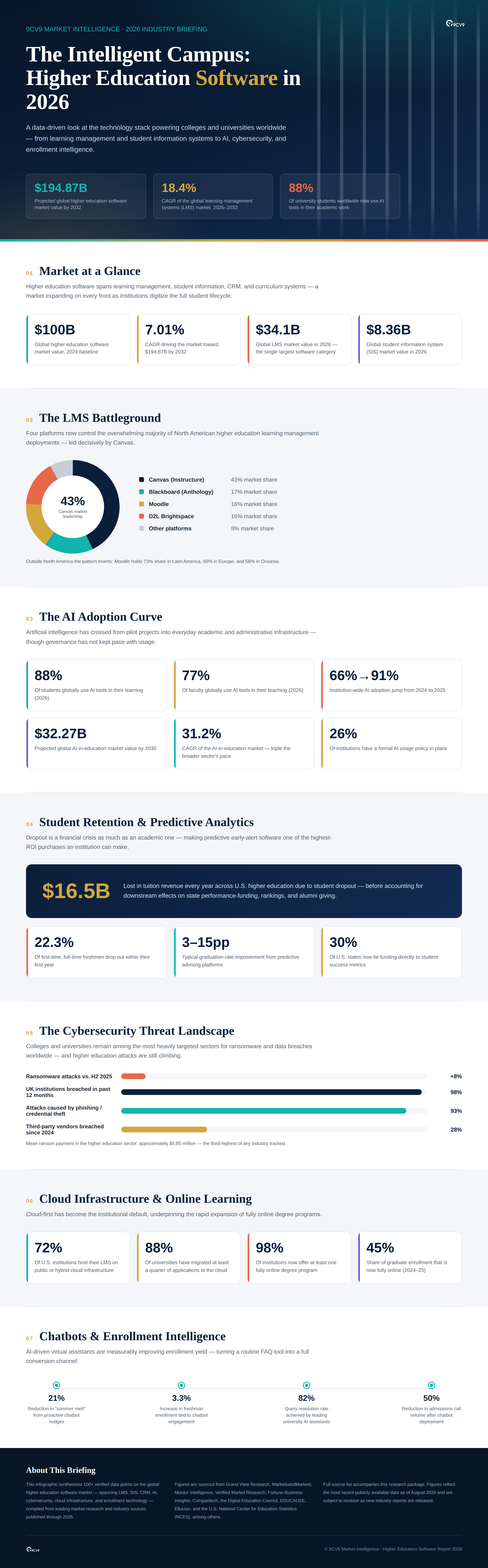
Several specialized higher education software segments are also experiencing considerable expansion. The global higher education CRM software market is estimated to reach $3.77 billion in 2026 and is projected to grow to $13.83 billion by 2035, registering a CAGR of 15.56%. Growing demand for digital student engagement and enrollment management solutions accounts for approximately 48% of market expansion within this segment, demonstrating the increasing importance of technology-driven student recruitment and enrollment strategies.
The Growing Importance of Learning Management Systems and Student Information Systems
Learning management systems remain among the most essential components of the higher education software ecosystem. Universities increasingly depend on LMS platforms to deliver digital coursework, facilitate communication between students and instructors, manage assessments, monitor academic performance, and support personalized learning experiences.
Global LMS revenue is projected to increase from $30.92 billion in 2025 to $100.70 billion by 2032, representing a CAGR of 18.4%. Learning management applications also accounted for approximately 46.35% of total education software spending in 2025, highlighting their significant role within institutional technology investment.
The higher education LMS market continues to demonstrate substantial vendor consolidation. Canvas, D2L Brightspace, Blackboard, and Moodle collectively account for more than 84% of higher education LMS implementations in North America. However, regional adoption patterns differ considerably, with Moodle holding approximately 73% of the market in Latin America, 69% in Europe, and 56% in Oceania.
Student information systems are experiencing similarly strong growth as institutions modernize their administrative infrastructure. The global SIS market is projected to reach $8.36 billion in 2026 before expanding to $15.36 billion by 2031, growing at a CAGR of 12.9%. Higher education institutions account for approximately 58.2% to 63.4% of SIS market revenue, reinforcing their position as the dominant customer segment for these platforms.
The growing demand for interoperability is also influencing institutional software purchasing decisions. Approximately 64% of new SIS implementation projects in 2024 required integration with learning management systems and financial platforms, demonstrating that connected software ecosystems are increasingly becoming a fundamental institutional requirement.
Artificial Intelligence Is Transforming Higher Education Software in 2026
Artificial intelligence represents one of the most influential technological developments shaping the higher education software industry in 2026. From generative AI-powered learning assistants and automated administrative workflows to predictive enrollment forecasting and intelligent student support systems, AI is creating new opportunities for institutions to improve productivity, personalization, and decision-making.
Recent higher education statistics indicate that approximately 88% of students and 77% of faculty globally use AI tools in their academic work. Furthermore, 91% of higher education administrators report personal AI usage, while institution-wide AI adoption increased from 49% in 2024 to 66% in 2025.
The global AI-in-education market was valued at $5.88 billion in 2024 and is projected to reach $32.27 billion by 2030, growing at a CAGR of 31.2%. This rapid expansion reflects increasing demand for intelligent educational technologies capable of automating repetitive tasks, improving institutional efficiency, and supporting more personalized academic experiences.
AI-powered predictive analytics is also gaining prominence in enrollment management. Approximately 56% of higher education institutions worldwide report using artificial intelligence for enrollment forecasting, with reported accuracy rates of around 85%. These capabilities enable institutions to anticipate enrollment fluctuations, optimize resource allocation, and develop more effective student recruitment strategies.
However, rapid AI adoption has introduced significant governance and ethical challenges. Only 26% of educators report that their universities have established formal AI usage policies, despite widespread adoption among students, faculty members, and administrators. This disparity highlights the growing need for responsible AI governance, transparent institutional policies, data protection frameworks, and appropriate human oversight.
Cloud-Based Higher Education Software Is Becoming the Industry Standard
Cloud computing continues to transform the technological infrastructure of colleges and universities worldwide. Institutions are increasingly replacing traditional on-premise systems with cloud-based higher education software to improve scalability, accessibility, system integration, operational flexibility, and infrastructure management.
The global cloud computing market in higher education was valued at approximately $15.5 billion in 2024 and is forecast to reach $45.6 billion by 2033, growing at a CAGR of 12.5%. Higher education institutions account for more than 65% of end-user share within the broader cloud computing in education market.
Approximately 72% of U.S. higher education institutions now host their learning management systems on public or hybrid cloud infrastructure. Additionally, 88% of surveyed universities have migrated at least one-quarter of their software applications to the cloud, while nearly 59% have transferred at least half of their institutional applications to cloud-based environments.
Cloud-based student information systems also account for approximately 70% to 72% of the SIS market in 2025–2026, further demonstrating the sector’s transition toward cloud-first software procurement.
These developments are particularly important as universities expand their online degree offerings, accommodate geographically dispersed student populations, and integrate increasingly sophisticated educational technologies into their existing infrastructure.
Cybersecurity and Data Protection Are Critical Institutional Priorities
As higher education institutions become increasingly dependent on digital platforms, cybersecurity and student data protection have emerged as major operational concerns. Universities manage extensive volumes of sensitive information, including student records, financial information, academic research, employee data, and institutional intellectual property.
Higher education providers experienced an 8% increase in ransomware attacks during the first half of 2026 compared with the second half of 2025. Furthermore, approximately 98% of UK higher education institutions reported experiencing at least one cyber breach or attack during the preceding 12 months.
The financial consequences of cybersecurity incidents can also be substantial. The average cost of a data breach in the global education sector stands at approximately $3.8 million, excluding additional reputational, regulatory, and long-term operational costs.
Third-party software vulnerabilities represent another significant challenge. Approximately 28% of the 100 leading third-party vendors commonly used by universities have experienced a confirmed data breach since 2024. Meanwhile, 95% of universities have at least one vendor with embedded AI exposure.
These statistics emphasize the importance of secure software procurement, regulatory compliance, vendor risk management, identity and access management, data encryption, and continuous cybersecurity monitoring. Higher education software providers must increasingly demonstrate robust security capabilities alongside functional performance and affordability.
Student Retention, Engagement, and Enrollment Technology Are Driving Software Investment
Improving student retention and academic success remains a fundamental objective for higher education institutions. As universities face increasing financial pressures and competition for prospective students, software solutions that identify at-risk learners, automate student engagement, and support personalized academic interventions are becoming increasingly valuable.
Higher education institutions collectively lose more than $16.5 billion in tuition revenue annually due to student dropout. Approximately 22.3% of first-time, full-time freshmen leave college within their first year, while an estimated 40% of undergraduates never complete their degrees.
Predictive analytics and student retention software offer institutions opportunities to identify academic, financial, and engagement-related risk factors before students discontinue their education. Institutions implementing established predictive retention platforms have reported graduation-rate improvements ranging from 3 to 15 percentage points through data-informed advising and early intervention strategies.
AI-powered chatbots and virtual assistants are also transforming student recruitment, admissions, and support services. Proactive chatbot-driven communication has been shown to increase freshman enrollment by up to 3.3% while reducing summer melt by as much as 21%.
Georgia State University recorded a 21.4% reduction in summer melt following the implementation of chatbot-guided enrollment communication. Similarly, the University of Houston’s AI-powered virtual assistant handled more than 33,000 conversations within eight months, achieving an 82% resolution rate while reducing financial aid and admissions-related call volumes.
These developments illustrate how higher education software can deliver measurable benefits across student engagement, institutional productivity, enrollment conversion, and administrative efficiency.
The Expansion of Online Education and Digital Learning
The continued growth of online and distance education is another major factor driving demand for higher education software in 2026. Universities are increasingly expanding their digital learning offerings to accommodate working professionals, international students, adult learners, and individuals seeking more flexible educational pathways.
The global online education market is projected to generate approximately $199 billion in revenue in 2026. Furthermore, approximately 98% of higher education institutions now offer at least one fully online degree program, compared with 77% in 2019.
Exclusively distance education enrollment among four-year U.S. undergraduates reached approximately 3.74 million students during the 2024–2025 academic year. Graduate-level exclusively distance enrollment also exceeded 2.66 million students in Fall 2024.
The expansion of digital education is generating sustained demand for virtual classrooms, learning management systems, online assessment software, curriculum management platforms, student collaboration tools, and digital academic support solutions.
As institutions continue to develop flexible learning environments, higher education software will play an increasingly central role in maintaining educational quality, accessibility, student engagement, and institutional competitiveness.
Understanding the Most Important Higher Education Software Statistics in 2026
The higher education software landscape in 2026 is characterized by accelerating technological innovation, growing institutional investment, expanding digital learning opportunities, and increasingly complex operational requirements.
While North America remains the largest regional market across several higher education software categories, Asia-Pacific is emerging as one of the fastest-growing regions, with projected compound annual growth rates ranging from 13% to more than 22% across various software segments. These regional developments highlight the expanding global opportunities for education technology providers and institutions pursuing digital transformation.
Understanding the latest higher education software statistics, market data, adoption patterns, and emerging technology trends is essential for university administrators, academic leaders, IT decision-makers, education technology companies, investors, and policymakers seeking to make informed strategic decisions.
This comprehensive guide to the Top 102 Higher Education Software Statistics, Data & Trends in 2026 examines the most significant developments shaping the industry, including:
- Global higher education software market size, revenue, and growth projections.
- Learning management system adoption and vendor market share.
- Student information system implementation and institutional purchasing trends.
- Artificial intelligence adoption, applications, and governance challenges.
- Cybersecurity threats, data breaches, and third-party software risks.
- Student retention software and predictive analytics performance.
- Cloud computing adoption and digital infrastructure modernization.
- Online education and distance learning enrollment statistics.
- AI-powered chatbots, virtual assistants, and enrollment management technology.
- Regional market growth, institutional investment, and emerging software opportunities.
By examining these 102 higher education software statistics, readers can gain a comprehensive understanding of the industry’s current trajectory, identify emerging opportunities, evaluate technological challenges, and better anticipate the future of digital transformation in higher education.
As universities and colleges navigate an increasingly technology-driven academic environment, the ability to select, implement, integrate, and govern effective higher education software will become a defining factor in institutional resilience, operational excellence, student success, and long-term competitiveness throughout 2026 and beyond.
Before we venture further into this article, we would like to share who we are and what we do.
About 9cv9
9cv9 is a business tech startup based in Singapore and Asia, with a strong presence all over the world.
With over ten years of startup and business experience, and being highly involved in connecting with thousands of companies and startups, the 9cv9 team has listed some of the top and best companies/tools in this review.
If you like to get your company listed in our top B2B software reviews, check out our world-class 9cv9 Media and PR service and pricing plans here.
Top 102 Higher Education Software Statistics, Data & Trends in 2026
📊 Market Size & Growth
1. The global Higher Education Software Market was valued at approximately $100 billion in 2024 and is projected to reach $194.87 billion by 2032, growing at a 7.01% CAGR. This scale confirms higher education software has become one of the fastest-institutionalizing categories within global EdTech investment.
2. The global Higher Education (technology-inclusive) market is valued at $101.08 billion in 2026, projected to reach $205.89 billion by 2034 at a 9.3% CAGR. Buyers researching Capterra’s higher education software directory should note this growth trajectory signals sustained vendor innovation and competition.
3. A separate higher education technology market analysis pegs 2026 valuation at $53.72 billion, projected to reach $272.42 billion by 2034 at a striking 22.50% CAGR. The wide variance across analyst firms underscores how differently “higher education software” is scoped — hardware-inclusive estimates run far higher than pure-software estimates.
4. The global Higher Education CRM Software Market is estimated at $3.77 billion in 2026, growing to $13.83 billion by 2035 at a 15.56% CAGR. Enrollment-focused CRM has become one of the fastest-growing sub-segments as institutions compete for a shrinking pool of traditional-age applicants.
5. Demand for digital student engagement and enrollment management tools accounts for 48% of overall higher education CRM market expansion. This confirms that recruitment and yield-management functionality, not just contact tracking, is now the primary CRM purchase driver.
6. Limited IT infrastructure in developing regions has constrained 31% of potential higher education CRM software implementations. Vendors targeting emerging markets must factor infrastructure readiness into go-to-market strategy.
7. LMS integration now features in 34% of new higher education CRM software deployments. Buyers are increasingly demanding unified, interoperable ecosystems rather than siloed point solutions.
8. The global Higher Education Catalog and Curriculum Management Software Market reached approximately $3.9 billion in 2026, projected to hit $5.1 billion by 2034 at a 7.1% CAGR. Curriculum-planning software remains a steady, if less headline-grabbing, growth pocket within the broader ecosystem.
9. The Higher Education Admissions Software Market in North America was valued at $1.2 billion in 2024, projected to grow to $2.0 billion by 2033 at a 6.8% CAGR. AI-driven decision-support is increasingly cited as the key differentiator among admissions platforms.
10. North America holds the largest revenue share of the global higher education market, contributing an estimated 37% of overall market growth, driven by heavy institutional investment in modern learning technologies.
🖥️ Learning Management Systems (LMS)
11. Global LMS revenue is projected to grow from $30.92 billion in 2025 to $100.70 billion by 2032, at an 18.4% CAGR — nearly double the broader education software market’s growth rate. This confirms LMS remains the single largest software category purchased by higher education institutions.
12. LMS applications account for 46.35% of total education software spending in 2025. Nearly half of every institutional EdTech dollar now flows toward learning management infrastructure.
13. Canvas held approximately 39%–43% of the North American higher education LMS market share in Fall 2024–2025, making it the clear market leader among four-year institutions. Its dominance is reinforced by adoption at all ten Ivy League universities.
14. Blackboard (Anthology) held roughly 17%–19% of the North American higher education LMS market in the same period, positioning it as the long-standing second-place incumbent despite continued share erosion.
15. Moodle and D2L Brightspace each hold approximately 16% of the North American higher education LMS market, forming a competitive “second tier” alongside Blackboard.
16. Canvas, Brightspace, Blackboard, and Moodle collectively account for over 84% of higher education LMS implementations in North America, reflecting significant market consolidation around four dominant vendors.
17. Outside North America, Moodle dominates decisively — holding 73% market share in Latin America, 69% in Europe, and 56% in Oceania. Institutions outside the U.S. and Canada overwhelmingly favor open-source, cost-flexible LMS platforms.
18. Moodle’s global network spans more than 150,000 installations and over 500 million registered users, making it the most widely deployed LMS platform worldwide by raw installation count.
19. 88% of organizations cite poor user experience as the primary reason for switching learning management systems, according to a 2026 industry survey — a critical insight for vendors competing on usability rather than feature count.
20. Among 560 LMS platforms benchmarked, only about 12% qualified as “AI-Leaders,” despite over 80% of LMS buyers reporting active demand for embedded AI features — revealing a substantial gap between buyer expectations and current vendor capability.
🎓 Student Information Systems (SIS)
21. The global Student Information System market is projected to reach $8.36 billion in 2026, up from $7.25 billion in 2025, en route to $15.36 billion by 2031 at a 12.9% CAGR, according to MarketsandMarkets.
22. Higher education institutions led the SIS market with a 58.20%–63.4% revenue share, confirming that colleges and universities — not K-12 schools — remain the dominant SIS buyer segment.
23. Cloud-based SIS deployments commanded roughly 70%–72% of the market in 2025–2026, growing at a 15.7% CAGR — a clear signal that on-premise SIS infrastructure is rapidly becoming legacy technology.
24. Medium-sized institutions (5,001–20,000 students) accounted for 43.20% of SIS implementations in 2025, making them the single largest institutional-size buying segment for these platforms.
25. North America retained the largest SIS regional revenue share at roughly 33%–43%, while Asia-Pacific is forecast to expand at the fastest CAGR of 16.4%–22.5% through the early 2030s.
26. In April 2026, Ellucian launched “Ellucian Student,” an AI-native SIS powered by a Higher Education Knowledge Graph containing nearly 10,000 institutional workflows — signaling the industry’s shift toward agentic, workflow-automating SIS platforms.
27. The next stage of SIS innovation is “Agentic AI,” where autonomous agents orchestrate admissions processing, transcript evaluation, onboarding, and compliance validation with minimal human intervention.
28. Bain Capital acquired PowerSchool for $5.6 billion, and KKR purchased Instructure (Canvas) for $4.8 billion — two of the largest private-equity transactions in EdTech history, confirming institutional investors see long-term durability in campus software infrastructure.
29. 64% of new SIS implementation projects in 2024 required seamless integration with learning management systems and finance platforms, underscoring that interoperability is now a baseline procurement requirement, not a differentiator.
30. 78% of SIS buyers cite GDPR or FERPA compliance as an essential purchasing criterion, making regulatory compliance one of the top three decision factors alongside cost and usability.
🤖 Artificial Intelligence in Higher Education
31. 88% of students and 77% of faculty globally now use AI tools in their academic work, up 16 percentage points from 2025, according to the Digital Education Council’s 2026 Global Survey of 45,398 respondents across 35 countries.
32. 91% of higher education administrators report personal AI usage, up from 84% the prior year — signaling that individual AI adoption among staff is approaching saturation.
33. Institution-wide AI adoption surged from 49% in 2024 to 66% in 2025, a 17-point jump marking the sector’s shift from experimentation to mainstream operational integration.
34. 88% of higher education leaders expect institutional AI use to continue rising over the next two years, indicating sustained investment momentum rather than a plateau.
35. Only 26% of educators say their university has a formal AI usage policy in place, despite near-universal adoption — a significant governance gap that software buyers and administrators should weigh heavily.
36. 56% of higher education institutions worldwide report using AI for enrollment forecasting, with reported accuracy rates around 85%, making predictive enrollment modeling one of AI’s most mature administrative use cases.
37. The global AI-in-education market was valued at $5.88 billion in 2024 and is projected to reach $32.27 billion by 2030, growing at a 31.2% CAGR — roughly triple the pace of the broader education software market.
38. 65% of U.S. universities had piloted AI-powered chatbots for student support services as of 2024, reflecting rapid early experimentation ahead of full-scale institutional rollout.
39. 78% of higher education institutions reported integrating AI tools into administrative processes, spanning admissions, advising, and institutional research functions.
40. Institutional Research and Analytics, Admissions, and Advising were identified as the three business functions expected to benefit most from AI integration across the higher education enterprise.
41. 45% of higher education faculty used AI tools in 2024, up sharply from 24% in 2023 — nearly doubling within a single academic year according to Cengage Group’s GenAI Report.
42. 94% of institutional employees report having used AI tools for work-related tasks within the past academic cycle, yet nearly half remain unaware of any formal AI usage policy or guideline at their institution.
43. 60% of administrators claim their institution uses AI functionality in some form, though fewer than one-third of higher education professionals report direct hands-on experience using AI in their own daily work.
44. Faculty intent to use AI in the U.S. and Canada declined nine percentage points, from 76% in 2025 to 67% in 2026 — the lowest future-adoption intent of any global region, suggesting cooling enthusiasm even as usage rises.
45. 45% of respondents in a 2026 Ellucian survey agreed AI does more good than harm for student learning, down 10 percentage points from the prior year — reflecting growing faculty apprehension about AI’s pedagogical impact.
46. Only 10% of surveyed schools and universities worldwide have formal AI governance guidelines in place, according to a UNESCO survey of more than 450 institutions, highlighting a global policy vacuum.
47. 70% of higher education institutions in Europe and North America have or are developing formal AI guidance, compared to only 45% in Latin America and the Caribbean — revealing significant regional disparity in AI governance maturity.
48. Student AI usage rose from 66% in 2024 to 92% in 2025 among university students — the steepest single-year adoption increase recorded in the sector to date.
🔐 Cybersecurity & Data Protection
49. Ransomware attacks against higher education providers rose 8% in the first half of 2026 compared to the second half of 2025, according to Comparitech’s Education Ransomware Roundup — even as K-12 attacks declined 26% over the same period.
50. A single ransomware operation known as “The Gentlemen” saw its attacks on education increase 275% from H2 2025 to H1 2026, with 80% of its claimed attacks targeting colleges and universities specifically.
51. Ransomware gangs claimed credit for 251 attacks on educational institutions worldwide in 2025, resulting in more than 3.96 million breached educational records — up from 3.11 million records breached in 2024.
52. Higher education paid a mean ransom amount of approximately $5.85 million per incident, the third-highest average payout of any industry sector tracked.
53. 98% of UK higher education institutions reported experiencing at least one cyber breach or attack in the previous 12 months, according to the Cyber Security Breaches Survey 2025/2026.
54. Phishing remains the entry point for approximately 93% of successful cyber incidents against UK universities, exploiting human error far more often than technical vulnerabilities.
55. Education institutions face an average of 4,388 weekly cyberattacks per institution, making education the single most-attacked sector globally in 2025, per DeepStrike research.
56. 28% of the top 100 third-party vendors commonly used by universities have experienced a confirmed data breach since 2024, illustrating how vendor-supply-chain risk compounds an institution’s own security exposure.
57. 95% of universities have at least one vendor with embedded AI exposure, and roughly 50% have detectable third-party AI embedded directly within their vendor services, according to UpGuard’s 2026 Higher Education Third-Party Cyber Risk Report.
58. Nearly 693,000 individuals were notified of a data breach stemming from a ransomware attack on an education provider in H1 2026 alone, driven largely by one large-scale Japanese education-sector breach.
59. The average cost of a data breach in the global education sector stands at approximately $3.8 million, excluding additional reputational, compliance, and long-term operational costs.
60. Over 35% of surveyed universities had unsecured or open database ports detected in security audits, and institutions face an average of roughly 10,000 brute-force login attacks per week.
📈 Student Retention & Predictive Analytics
61. Higher education institutions collectively lose more than $16.5 billion in tuition revenue annually to student dropout, making retention software one of the highest-ROI software categories an institution can deploy.
62. Roughly 22.3% of first-time, full-time freshmen drop out within their first year of college, and approximately 40% of all undergraduates never complete their degree, according to National Center for Education Statistics data.
63. For a mid-sized university enrolling 10,000 students, a 10% attrition rate translates into $1 million to $2 million in lost annual revenue, before accounting for downstream impacts on state performance-funding and rankings.
64. Approximately 30% of U.S. states now tie government funding directly to student success and persistence metrics, making retention-analytics software a matter of institutional financial sustainability, not just student welfare.
65. Institutions implementing established predictive-retention platforms typically report graduation-rate improvements of 3 to 15 percentage points through data-informed advising and early-intervention strategies.
66. 70% of students who leave college cite academic struggles as a primary contributing factor — struggles that predictive analytics systems can often flag weeks or months before they become visible to human advisors.
67. 30% of student dropouts cite financial difficulties as their primary reason for leaving, making financial-risk indicators a critical data input for modern early-alert and retention software.
68. The full-time student retention rate for four-year U.S. institutions stands at approximately 77%, meaning close to one in four students does not persist to their next year of enrollment.
☁️ Cloud Computing & Infrastructure
69. The global Cloud Computing in Higher Education market was valued at approximately $15.5 billion in 2024, forecast to reach $45.6 billion by 2033 at a 12.5% CAGR.
70. Higher education institutions represent more than 65% of end-user share within the broader cloud-computing-in-education market, confirming universities as the dominant institutional cloud adopter relative to K-12 schools.
71. Approximately 72% of U.S. higher education institutions now host their learning management systems on public or hybrid cloud infrastructure rather than on-premise servers.
72. 88% of surveyed universities have migrated at least a quarter of their software applications to the cloud, while nearly 59% have moved at least half of all institutional applications to cloud infrastructure.
73. Public cloud deployment accounted for over 52% share of the global cloud-computing-in-education market in 2024, edging out private and hybrid cloud models as the preferred deployment approach.
74. 46% of institutions identify enabling remote-learning accessibility and scalability as their primary reason for migrating campus systems to the cloud.
75. Cloud infrastructure allows institutions to deploy new online courses within roughly 48 hours, compared to three to four weeks under traditional on-premise IT provisioning models.
76. Data privacy concerns remain a meaningful barrier to cloud migration, with approximately 34% of schools and universities expressing concern over storing sensitive student information in third-party cloud environments.
💻 Online & Distance Learning
77. Exclusively distance-education enrollment among four-year U.S. undergraduates reached 3,737,980 students in the 2024–25 academic year, led overwhelmingly by public institutions, according to NCES IPEDS data.
78. Graduate exclusively-distance enrollment totaled 2,663,913 students in Fall 2024, with fully online study now representing approximately 45% of all graduate-level enrollment — surpassing traditional in-person formats.
79. 98% of higher education institutions now offer at least one fully online degree program, up sharply from just 77% in 2019, reflecting near-universal institutional commitment to online delivery.
80. Exclusively-distance undergraduate enrollment has remained stable at approximately 28%, while participation in at least some distance-education coursework reaches roughly 33% of all U.S. undergraduates.
81. The global online education market is projected to generate approximately $199 billion in revenue in 2026, reflecting continued monetization growth across degree programs, certificates, and micro-credentials.
82. 514,109 U.S. students were enrolled exclusively in distance-education institutions during the 2023–24 academic year, according to the Integrated Postsecondary Education Data System.
83. Two-thirds of U.S. higher education institutions report actively adding new online academic programs, according to a “Changing Landscape of Online Education” industry survey.
84. In fall 2022, more than 4.9 million U.S. college students were enrolled exclusively in distance-education courses, with a further 5.16 million enrolled in at least one distance-education course.
💬 Chatbots, Virtual Assistants & Enrollment Technology
85. 38% of undergraduate students and 48% of graduate students report using institutional website chat features during their admissions research process, with 90% rating the experience as “helpful.”
86. Proactive chatbot-driven nudges have been shown to boost freshman enrollment by up to 3.3% while reducing “summer melt” — admitted students who fail to enroll — by as much as 21%.
87. Georgia State University recorded a 21.4% reduction in summer melt after deploying chatbot-guided enrollment communication with admitted students.
88. When the University of Houston deployed its AI virtual assistant “Shasta,” it handled more than 33,000 conversations in eight months with an 82% resolution rate, cutting financial-aid call volume by 28% and admissions call volume by 10% year-over-year.
89. 46% of prospective students report using AI tools during their college search process, up from just 26% one year earlier — nearly doubling within a single admissions cycle.
90. After engaging with an admissions chatbot, 29% of students go on to email admissions directly, 28% browse deeper into the institution’s website, and 27% complete an inquiry form — confirming chatbots function as conversion launchpads rather than dead-end FAQ tools.
91. 42% of students report a positive overall experience with their institution’s chatbot technology, according to Ivy.ai’s Future of Higher Education Study.
92. Temple University reduced admissions-related call volume by 50% after implementing an AI-powered chatbot to handle routine prospective-student inquiries.
93. Many institutions report a 35%–50% increase in qualified lead capture when chatbots engage prospective-student website visitors in real time rather than relying solely on static contact forms.
94. Roughly 30%–40% of qualified admissions leads are captured outside standard business hours, underscoring the value of always-on AI-driven engagement for time-zone-dispersed and international prospects.
95. Georgia State’s predictive advising engine — built on integrated SIS, financial-aid, and advising data — generates tens of thousands of automated risk alerts each year, prompting proactive advisor outreach before students disengage.
🏫 Additional Institutional & Market Indicators
96. North America accounted for approximately 33.4%–43% of global market share across multiple higher education software categories, cementing the region’s position as the largest single addressable market for vendors.
97. Asia-Pacific is consistently identified as the fastest-growing regional market across LMS, SIS, and cloud-computing-in-education categories, with CAGRs ranging from 13% to over 22% depending on the sub-segment.
98. Academic institutions accounted for 55.10% of the overall education software market in 2025, with corporate training buyers representing the remainder and posting the highest projected sub-segment CAGR at 12.55%.
99. In January 2026, Instructure invested $45 million to add natural-language-processing capabilities to Canvas for automated grading and personalized learning pathways, targeting a 35% reduction in instructor workload.
100. More than 220 million students were enrolled in tertiary education globally in 2023, a figure projected to exceed 400 million by 2030 — a structural enrollment tailwind that underpins long-term demand for higher education software across every category.
101. The Higher Education Catalog and Curriculum Management Software segment lists Jenzabar, Oracle, Ellucian, Digarc, and Campus Management among its leading vendors — reflecting the fragmented, specialist-vendor structure still common in adjacent higher-ed software niches.
102. Cloud-based SIS solutions accounted for 61% of new higher-education software deployments industry-wide in 2024, reinforcing cloud-first procurement as the default institutional posture heading into 2026.
Conclusion
The higher education software industry in 2026 stands at a pivotal stage of technological evolution, driven by accelerating digital transformation, artificial intelligence adoption, cloud infrastructure modernization, and growing demand for personalized, accessible, and data-driven educational experiences. As universities, colleges, and academic institutions worldwide navigate increasingly complex operational challenges, higher education software has become an essential component of institutional growth, academic excellence, financial sustainability, and long-term competitiveness.
The 102 higher education software statistics, data, and trends examined throughout this comprehensive analysis demonstrate that digital technology is no longer merely a supplementary resource within academic environments. Instead, it has become a foundational element supporting nearly every aspect of higher education operations, from student recruitment, admissions, and enrollment management to curriculum delivery, academic assessment, student retention, institutional research, cybersecurity, and administrative decision-making.
With the global higher education software market projected to reach approximately $194.87 billion by 2032, the industry presents substantial opportunities for educational institutions, software developers, technology providers, investors, and other stakeholders. The continued expansion of specialized software categories further demonstrates that higher education digital transformation is a multidimensional development encompassing numerous interconnected technologies and institutional requirements.
Higher Education Software Market Growth Reflects Long-Term Digital Transformation
One of the most significant findings from the latest higher education software statistics is the sustained growth projected across multiple education technology segments.
The global higher education CRM software market is estimated to reach $3.77 billion in 2026 and expand to $13.83 billion by 2035, growing at a CAGR of 15.56%. Meanwhile, global learning management system revenue is projected to increase from $30.92 billion in 2025 to $100.70 billion by 2032.
The student information system market is experiencing similarly strong expansion, with projected revenue increasing from $8.36 billion in 2026 to $15.36 billion by 2031.
Collectively, these market projections highlight the growing importance of integrated digital infrastructure within higher education institutions. Universities are increasingly moving away from fragmented legacy applications and adopting interconnected software ecosystems capable of supporting academic, administrative, financial, and student engagement functions.
This transformation is creating considerable opportunities for software vendors capable of delivering scalable, interoperable, secure, and user-friendly solutions that address the evolving requirements of modern educational institutions.
For university administrators and institutional decision-makers, these developments emphasize the importance of establishing long-term digital transformation strategies rather than approaching software procurement as a series of isolated technology investments.
Artificial Intelligence Will Continue to Reshape Higher Education
Artificial intelligence remains one of the most influential forces transforming the higher education software landscape in 2026.
With approximately 88% of students, 77% of faculty members, and 91% of higher education administrators reporting AI usage in their respective academic or professional activities, artificial intelligence has rapidly transitioned from an emerging technology into a widely adopted institutional resource.
Institution-wide AI adoption increased from 49% in 2024 to 66% in 2025, while approximately 88% of higher education leaders expect institutional AI usage to continue expanding over the following two years.
The global AI-in-education market is also projected to reach $32.27 billion by 2030, registering a CAGR of 31.2%. This substantial growth reflects increasing demand for intelligent educational technologies that can automate administrative processes, personalize learning experiences, improve student engagement, and enhance institutional decision-making.
The most promising applications of artificial intelligence in higher education include:
- Automated admissions processing and enrollment forecasting.
- Personalized learning pathways and intelligent academic recommendations.
- AI-powered virtual assistants and student support chatbots.
- Predictive analytics for identifying students at risk of dropping out.
- Automated assessment, grading assistance, and academic feedback.
- Institutional research and data-driven resource allocation.
- Intelligent workflow automation across administrative departments.
- Curriculum development and academic content management.
However, the rapid expansion of AI adoption must be accompanied by appropriate governance, ethical frameworks, and institutional oversight.
Only 26% of educators report that their universities have formal AI usage policies, demonstrating a considerable gap between technological adoption and institutional preparedness.
Moving forward, higher education institutions must balance AI-driven innovation with academic integrity, data privacy, transparency, responsible automation, and human accountability. Institutions that establish effective AI governance frameworks will be better positioned to realize the benefits of artificial intelligence while mitigating its potential risks.
Cloud Computing and Software Integration Are Becoming Essential Institutional Capabilities
The transition toward cloud-based higher education software represents another defining industry trend in 2026.
The global cloud computing market in higher education is projected to grow from approximately $15.5 billion in 2024 to $45.6 billion by 2033, reflecting increasing institutional demand for scalable, accessible, and flexible digital infrastructure.
Approximately 72% of U.S. higher education institutions host their learning management systems on public or hybrid cloud infrastructure. Furthermore, 88% of surveyed universities have migrated at least one-quarter of their software applications to the cloud, while nearly 59% have transferred at least half of their institutional applications to cloud-based environments.
Cloud-based student information systems also account for approximately 70% to 72% of the SIS market in 2025–2026, demonstrating the growing preference for cloud-first software deployment models.
Cloud computing enables educational institutions to improve infrastructure scalability, facilitate remote learning, simplify software maintenance, accelerate technology deployment, and provide more consistent access to institutional resources.
Nevertheless, successful cloud migration requires more than transferring existing applications to remote servers. Universities must carefully evaluate system interoperability, data migration requirements, cybersecurity capabilities, vendor reliability, regulatory compliance, and long-term operational costs.
The finding that 64% of new student information system implementation projects in 2024 required integration with learning management systems and financial platforms further illustrates the growing importance of connected institutional technology ecosystems.
Higher education software vendors that prioritize open integrations, flexible application programming interfaces, centralized data management, and seamless interoperability are likely to be better positioned to meet evolving institutional requirements.
Student Retention and Predictive Analytics Are Increasingly Important Investment Priorities
The financial and academic consequences of student attrition remain among the most significant challenges facing higher education institutions worldwide.
Colleges and universities collectively lose more than $16.5 billion in tuition revenue annually due to student dropout. Approximately 22.3% of first-time, full-time freshmen leave college within their first year, while an estimated 40% of undergraduates never complete their degrees.
These statistics highlight the growing importance of student retention software, predictive analytics platforms, academic advising systems, and automated early-intervention technologies.
Institutions implementing established predictive retention platforms have reported graduation-rate improvements ranging from 3 to 15 percentage points through data-informed advising and early-intervention strategies.
By integrating academic performance data, attendance records, financial indicators, student engagement metrics, and advising information, higher education institutions can identify potential challenges before they develop into significant barriers to academic success.
Predictive analytics can also help institutions allocate student support resources more effectively, improve academic advising, identify enrollment risks, and develop personalized intervention strategies.
The long-term value of these technologies extends beyond tuition revenue protection. Improved student retention can contribute to stronger graduation outcomes, institutional reputation, student satisfaction, and academic performance.
Consequently, higher education institutions should increasingly evaluate software investments based on their measurable contributions to student success rather than focusing exclusively on administrative efficiency or short-term cost reduction.
Cybersecurity and Data Privacy Must Remain Central to Higher Education Software Strategies
Despite the considerable opportunities associated with higher education digital transformation, cybersecurity remains one of the industry’s most pressing challenges.
Higher education providers experienced an 8% increase in ransomware attacks during the first half of 2026 compared with the second half of 2025. Approximately 98% of UK higher education institutions reported experiencing at least one cyber breach or attack during the preceding 12 months.
Furthermore, the average cost of a data breach within the global education sector stands at approximately $3.8 million, illustrating the potentially severe financial consequences of inadequate cybersecurity protection.
The growing reliance on third-party software providers introduces additional institutional vulnerabilities. Approximately 28% of the 100 leading third-party vendors commonly used by universities have experienced a confirmed data breach since 2024.
As institutions expand their use of cloud computing, artificial intelligence, interconnected software applications, and digital learning environments, their cybersecurity responsibilities will become increasingly complex.
Higher education institutions must prioritize comprehensive security measures, including multi-factor authentication, data encryption, role-based access controls, continuous security monitoring, vulnerability management, secure software integrations, and disaster recovery planning.
Regulatory compliance must also remain a fundamental software procurement consideration. Approximately 78% of student information system buyers identify GDPR or FERPA compliance as an essential purchasing criterion.
Ultimately, cybersecurity should be treated as an integral component of higher education digital transformation rather than a separate technical responsibility. Software solutions that deliver advanced functionality without adequate security, privacy, and compliance capabilities may expose institutions to significant financial, legal, operational, and reputational risks.
Online Education and Flexible Learning Will Sustain Software Demand
The continued expansion of online and distance education is expected to remain a major driver of higher education software investment.
The global online education market is projected to generate approximately $199 billion in revenue in 2026. Additionally, approximately 98% of higher education institutions offer at least one fully online degree program, compared with 77% in 2019.
Exclusively distance education enrollment among four-year U.S. undergraduates reached approximately 3.74 million students during the 2024–2025 academic year, demonstrating the substantial scale of digital learning participation.
These developments reflect changing student expectations regarding educational accessibility, flexibility, affordability, and convenience.
Working professionals, international students, adult learners, and individuals with geographical or personal constraints increasingly benefit from educational models that extend beyond traditional campus-based instruction.
As a result, higher education institutions must continue investing in technologies that support flexible learning environments, including learning management systems, virtual classroom platforms, digital assessment software, online collaboration tools, curriculum management applications, and personalized academic support systems.
The future of higher education will likely involve an increasingly interconnected combination of traditional classroom instruction, hybrid learning, fully online programs, and technology-enhanced academic experiences.
Institutions capable of delivering consistent educational quality across these different formats will be better positioned to respond to changing student preferences and expanding global competition.
AI-Powered Enrollment Technology Is Transforming Student Recruitment
Student recruitment and enrollment management represent another area experiencing considerable technological innovation.
Approximately 46% of prospective students report using AI tools during their college search process, compared with 26% one year earlier. This substantial increase demonstrates how artificial intelligence is influencing the way prospective students discover, research, and evaluate higher education institutions.
AI-powered chatbots, virtual assistants, automated communication platforms, and enrollment management software are increasingly helping institutions respond to prospective students more efficiently.
Proactive chatbot-driven communication has been shown to increase freshman enrollment by up to 3.3% while reducing summer melt by as much as 21%.
Georgia State University recorded a 21.4% reduction in summer melt following the implementation of chatbot-guided enrollment communication. Meanwhile, the University of Houston’s AI virtual assistant handled more than 33,000 conversations within eight months, achieving an 82% resolution rate.
These findings illustrate the potential of intelligent enrollment technologies to improve communication responsiveness, reduce administrative workloads, support prospective students, and increase enrollment conversion rates.
The growing importance of after-hours engagement further reinforces the value of automated student support. Approximately 30% to 40% of qualified admissions leads are reportedly captured outside standard business hours.
For institutions competing for domestic and international students, the ability to provide timely, accurate, and personalized information throughout the admissions journey is becoming an increasingly valuable competitive advantage.
Regional Market Expansion Will Create New Opportunities for Higher Education Software Providers
Although North America remains the largest regional market across several higher education software categories, the global industry is experiencing substantial geographical diversification.
North America accounts for approximately 33.4% to 43% of global market share across multiple higher education software segments, supported by established digital infrastructure and considerable institutional technology investment.
However, Asia-Pacific is consistently identified as one of the fastest-growing regional markets across learning management systems, student information systems, and cloud computing in education, with projected compound annual growth rates ranging from 13% to more than 22%, depending on the software category.
This geographical expansion presents significant opportunities for higher education software providers capable of addressing regional requirements, infrastructure limitations, institutional budgets, language preferences, and regulatory environments.
Regional differences in learning management system adoption also demonstrate the importance of localized software strategies. While Canvas maintains a leading position in North America, Moodle accounts for approximately 73% of the LMS market in Latin America, 69% in Europe, and 56% in Oceania.
These adoption patterns indicate that software providers cannot necessarily rely on a uniform global strategy. Pricing flexibility, localization, deployment options, integration capabilities, and institutional support requirements may significantly influence purchasing decisions across different markets.
What Higher Education Institutions Should Prioritize Beyond 2026
As the higher education software market continues to evolve, institutional leaders must adopt a strategic and evidence-based approach to technology investment.
Selecting the right higher education software requires evaluating not only immediate functional requirements but also long-term scalability, integration capabilities, implementation costs, security standards, user experience, accessibility, and measurable institutional outcomes.
The most important priorities for higher education institutions moving forward include:
- Developing comprehensive digital transformation strategies aligned with institutional objectives.
- Investing in interoperable learning management systems, student information systems, and CRM platforms.
- Establishing responsible artificial intelligence governance and academic integrity policies.
- Strengthening cybersecurity infrastructure and third-party vendor risk management.
- Leveraging predictive analytics to improve student retention and graduation outcomes.
- Expanding accessible online, hybrid, and flexible learning opportunities.
- Modernizing legacy infrastructure through carefully planned cloud migration.
- Improving student recruitment and enrollment through intelligent automation.
- Providing continuous technology training for faculty members and administrative employees.
- Measuring software return on investment through academic, operational, and financial performance indicators.
Institutions that prioritize these areas will be better positioned to build resilient digital ecosystems capable of adapting to technological innovation, changing student expectations, and evolving regulatory requirements.
The Future of Higher Education Software Beyond 2026
Looking beyond 2026, the higher education software industry is expected to become increasingly intelligent, interconnected, automated, personalized, and outcome-oriented.
Emerging technologies such as agentic AI, advanced predictive analytics, intelligent workflow automation, and integrated institutional data platforms are likely to transform how universities manage academic and administrative operations.
The growing adoption of AI-native student information systems also signals a broader transition from traditional record-keeping applications toward intelligent platforms capable of coordinating complex institutional workflows.
At the same time, software usability will remain a critical factor influencing institutional purchasing decisions. Approximately 88% of surveyed organizations identify poor user experience as a primary reason for switching learning management systems, highlighting the importance of intuitive interfaces, accessibility, and effective user engagement.
Future higher education software platforms will therefore need to balance technological sophistication with practical usability. Advanced features will deliver limited institutional value if students, faculty members, and administrators struggle to incorporate them into their daily activities.
Software providers that combine artificial intelligence, cloud scalability, robust cybersecurity, seamless interoperability, accessible design, and measurable educational outcomes are likely to be well positioned within an increasingly competitive global market.
Final Thoughts
The Top 102 Higher Education Software Statistics, Data & Trends in 2026 collectively reveal an industry undergoing profound and sustained transformation. Rapid market expansion, widespread artificial intelligence adoption, increasing cloud migration, growing demand for online education, and the emergence of sophisticated student retention technologies are fundamentally reshaping the global higher education landscape.
However, the future of higher education software will not be determined solely by technological advancement or market growth. It will also depend on how effectively institutions integrate digital solutions into their academic strategies, administrative operations, student support services, and long-term institutional development plans.
Universities and colleges that approach digital transformation strategically, prioritize responsible innovation, strengthen cybersecurity, and invest in student-centered technologies will be better equipped to navigate the opportunities and challenges of an increasingly digital academic environment.
For education technology companies, the expanding higher education software market presents significant opportunities to develop solutions that address genuine institutional challenges, improve operational efficiency, enhance academic experiences, and deliver measurable educational outcomes.
For institutional leaders, administrators, investors, and policymakers, staying informed about the latest higher education software statistics and emerging industry trends will remain essential for making informed decisions, identifying growth opportunities, and anticipating future technological developments.
Ultimately, higher education software is no longer simply a collection of digital tools designed to support traditional academic operations. It has become a strategic foundation for institutional innovation, educational accessibility, student success, operational resilience, and sustainable growth.
As the global higher education sector continues to evolve throughout 2026 and beyond, institutions that successfully combine technological innovation with responsible governance, human-centered education, and data-driven decision-making will be best positioned to shape the future of higher education.
If you find this article useful, why not share it with your hiring manager and C-level suite friends and also leave a nice comment below?
We, at the 9cv9 Research Team, strive to bring the latest and most meaningful data, guides, and statistics to your doorstep.
To get access to top-quality guides, click over to 9cv9 Blog.
To hire top talents using our modern AI-powered recruitment agency, find out more at 9cv9 Modern AI-Powered Recruitment Agency.
People Also Ask
What is higher education software?
Higher education software refers to digital applications that help universities and colleges manage academic operations, student records, admissions, online learning, financial processes, institutional administration, and student engagement.
What is the global higher education software market size in 2026?
The global higher education software market was valued at approximately $100 billion in 2024. A broader higher education technology market estimate places its value at $101.08 billion in 2026.
How fast is the higher education software market growing?
The global higher education software market is projected to reach $194.87 billion by 2032. Individual software segments, including learning management systems, CRM platforms, and AI-powered educational technologies, demonstrate varying growth rates.
What are the biggest higher education software trends in 2026?
Major trends include artificial intelligence adoption, cloud-based software deployment, predictive analytics, automated admissions, personalized learning, cybersecurity modernization, integrated student information systems, and intelligent virtual assistants.
What are the main types of higher education software?
Major categories include learning management systems, student information systems, higher education CRM software, admissions software, curriculum management platforms, student retention software, financial management systems, and online learning applications.
What is the global learning management system market size?
The global learning management system market is projected to grow from $30.92 billion in 2025 to $100.70 billion by 2032, registering a compound annual growth rate of 18.4%.
What are the most popular learning management systems in higher education?
Canvas, Moodle, Blackboard, and D2L Brightspace are among the leading learning management systems. Together, these platforms account for more than 84% of higher education LMS implementations in North America.
What is the market share of Canvas in higher education?
Canvas held approximately 39% to 43% of the North American higher education LMS market during 2024–2025, making it one of the region’s leading digital learning platforms.
How widely is Moodle used in higher education?
Moodle holds approximately 73% of the LMS market in Latin America, 69% in Europe, and 56% in Oceania. Its global ecosystem includes more than 150,000 installations and over 500 million registered users.
What is the student information system market size in 2026?
The global student information system market is projected to reach $8.36 billion in 2026 and expand to $15.36 billion by 2031, growing at a compound annual growth rate of 12.9%.
What percentage of the SIS market comes from higher education institutions?
Higher education institutions account for approximately 58.2% to 63.4% of student information system market revenue, making universities and colleges the dominant customer segment.
How large is the higher education CRM software market in 2026?
The global higher education CRM software market is estimated at $3.77 billion in 2026 and is projected to reach $13.83 billion by 2035, growing at a CAGR of 15.56%.
What percentage of university students use artificial intelligence?
A 2026 global survey found that approximately 88% of students use artificial intelligence tools in their academic work, reflecting widespread adoption of AI-powered educational technologies.
What percentage of higher education faculty use AI tools?
Approximately 77% of faculty members globally report using artificial intelligence tools in their academic work, supporting activities such as content development, research, assessment, and teaching.
How many higher education institutions have adopted artificial intelligence?
Institution-wide artificial intelligence adoption increased from 49% in 2024 to 66% in 2025. Approximately 88% of higher education leaders expect institutional AI usage to continue increasing.
What is the market size of artificial intelligence in education?
The global AI-in-education market was valued at $5.88 billion in 2024 and is projected to reach $32.27 billion by 2030, growing at a compound annual growth rate of 31.2%.
How is artificial intelligence transforming higher education software?
Artificial intelligence supports personalized learning, automated grading, enrollment forecasting, predictive student retention, administrative automation, intelligent academic advising, and AI-powered student support services.
What percentage of universities have formal AI usage policies?
Approximately 26% of surveyed educators report that their universities have formal AI usage policies, highlighting a significant governance gap despite widespread artificial intelligence adoption.
How large is the cloud computing market in higher education?
The global cloud computing market in higher education was valued at approximately $15.5 billion in 2024 and is projected to reach $45.6 billion by 2033, growing at a CAGR of 12.5%.
What percentage of universities use cloud-based software?
Approximately 88% of surveyed universities have migrated at least one-quarter of their software applications to the cloud, while nearly 59% have transferred at least half of their institutional applications.
What percentage of universities use cloud-based learning management systems?
Approximately 72% of U.S. higher education institutions host their learning management systems on public or hybrid cloud infrastructure rather than traditional on-premise servers.
How common are cybersecurity attacks in higher education?
Approximately 98% of UK higher education institutions reported experiencing at least one cyber breach or attack within the preceding 12 months, highlighting the sector’s significant cybersecurity exposure.
What is the average cost of a data breach in the education sector?
The average cost of a data breach in the global education sector is approximately $3.8 million, excluding additional reputational damage, regulatory consequences, and long-term operational costs.
How much revenue do universities lose due to student dropout?
Higher education institutions collectively lose an estimated $16.5 billion in tuition revenue annually due to student dropout, highlighting the financial importance of student retention software and predictive analytics.
How does predictive analytics improve student retention in higher education?
Predictive analytics identifies students at risk of dropping out through academic, financial, and engagement data. Institutions using established retention platforms have reported graduation-rate improvements of 3 to 15 percentage points.
What is the global online education market size in 2026?
The global online education market is projected to generate approximately $199 billion in revenue in 2026, supported by demand for online degrees, professional certifications, micro-credentials, and flexible learning programs.
How many universities offer online degree programs?
Approximately 98% of higher education institutions reportedly offer at least one fully online degree program, compared with 77% in 2019, reflecting the continued expansion of digital education.
How effective are AI chatbots in higher education admissions?
Proactive chatbot-driven communication has been shown to increase freshman enrollment by up to 3.3% and reduce summer melt by as much as 21%, helping institutions improve enrollment conversion and student engagement.
Which region has the largest higher education software market?
North America remains the largest regional market across several higher education software categories, accounting for approximately 33.4% to 43% of global market share, depending on the software segment.
What is the future of higher education software beyond 2026?
Higher education software is expected to become increasingly AI-powered, cloud-based, interconnected, and personalized, with greater emphasis on agentic AI, predictive analytics, cybersecurity, automated workflows, and measurable student outcomes.
Sources
Available Upon Request


