

Key Takeaways
- Rapid Market Growth: The global farm management software market is projected to reach USD 10.58 billion by 2030, growing at a 17.3% CAGR, driven by increasing demand for digital farming solutions and precision agriculture technologies.
- AI, IoT, and Cloud Adoption: Cloud-based farm management software is estimated to hold 72.31% market share in 2026, while artificial intelligence, IoT sensors, agricultural drones, and SaaS platforms accelerate smart farming adoption.
- Higher Productivity and Cost Savings: Precision agriculture technologies can reduce farming input costs by 8–20% and improve crop yields by 2–10%, supporting greater profitability, resource efficiency, and sustainable agricultural operations.
Farm management software in 2026 is transforming agriculture through AI, precision farming, IoT, and cloud technology. The global market is projected to reach USD 10.58 billion by 2030, growing at a 17.3% CAGR. Explore 105 key statistics covering market growth, technology adoption, productivity improvements, cost savings, and emerging digital farming trends.
The global agricultural industry is undergoing a significant digital transformation as farmers, agribusinesses, and agricultural enterprises increasingly adopt advanced technologies to improve productivity, reduce operational costs, and enhance sustainability. In 2026, farm management software has emerged as a critical component of modern agriculture, enabling farmers to streamline daily operations, monitor crop performance, manage livestock, optimize resource allocation, and make data-driven decisions.
Also, read our article on the Top 10 Farm Management Software To Know.

From artificial intelligence (AI) and precision agriculture to cloud computing, Internet of Things (IoT) sensors, and agricultural drones, technological innovation is reshaping how farms operate worldwide. As agricultural businesses face mounting pressure from rising labor costs, climate variability, resource scarcity, and growing global food demand, digital farm management solutions are becoming increasingly important for maintaining profitability and competitiveness.
According to industry research, the global farm management software market was valued at approximately USD 4.18 billion in 2024 and is projected to reach USD 10.58 billion by 2030, representing a compound annual growth rate (CAGR) of 17.3%. Other market forecasts estimate that the industry could expand to USD 13.48 billion by 2034 or even USD 16.6 billion by 2035, highlighting substantial long-term growth opportunities across agricultural technology markets.

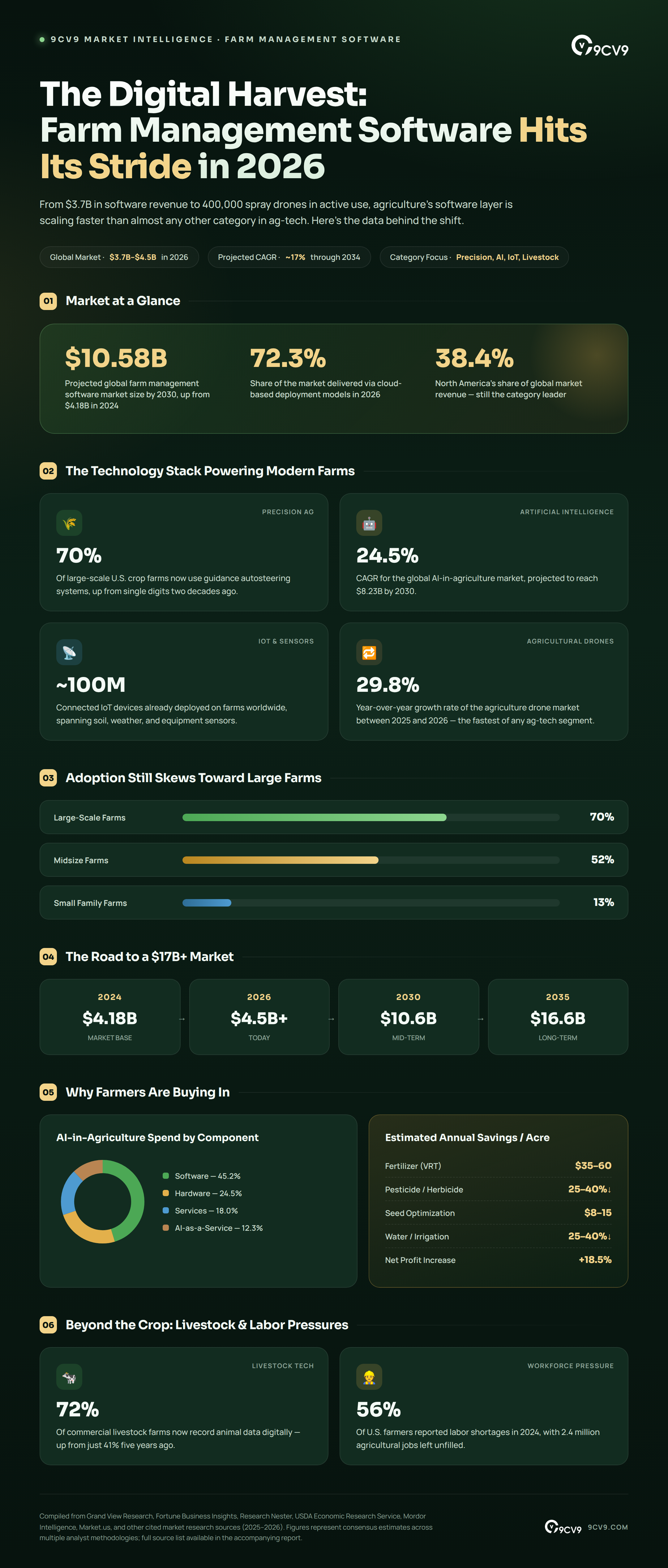
The adoption of cloud-based farm management software is another defining trend in 2026. Industry estimates suggest that cloud-based solutions account for approximately 72.31% of the farm management software market, reflecting increasing demand for scalable, subscription-based platforms that provide real-time access to agricultural data. These solutions enable farmers to integrate information from weather monitoring systems, soil sensors, satellite imagery, GPS-enabled machinery, and livestock tracking devices into centralized management dashboards.
Precision agriculture is also accelerating the adoption of digital farming technologies. Research indicates that guidance autosteering systems were already being used by 70% of large-scale crop-producing farms in the United States in 2023, while yield monitors, yield maps, and soil maps were utilized by 68% of large-scale operations. These technologies help agricultural businesses improve planting accuracy, optimize fertilizer applications, reduce unnecessary input consumption, and maximize crop yields.
Meanwhile, artificial intelligence is becoming one of the fastest-growing segments of agricultural technology. Market projections estimate that the global AI-in-agriculture industry could reach USD 8.23 billion by 2030, supported by growing investment in predictive analytics, automated crop monitoring, disease detection, intelligent irrigation, and machine learning-powered farm management systems.
Agricultural drones and IoT technologies are contributing to this transformation. The global agricultural drone market is projected to grow from USD 3.39 billion in 2025 to USD 11.79 billion by 2030, while connected sensors and smart irrigation systems are helping farmers monitor environmental conditions, automate equipment, and improve resource efficiency.
Beyond technological innovation, the economic benefits of farm management software are becoming increasingly important. Research reviewed for this article indicates that precision agriculture technologies can generate input savings of approximately 8% to 20% and crop yield improvements of 2% to 10%, although actual outcomes depend on farm size, crop type, implementation quality, and operating conditions. These potential improvements strengthen the business case for investing in digital agricultural management platforms.
However, the transition toward digital agriculture is not without challenges. High initial investment costs, limited rural internet connectivity, technical skills shortages, fragmented agricultural data, and differences in technology adoption between small and large farms continue to influence the industry’s development. Understanding these barriers is essential for software providers, agricultural businesses, investors, and policymakers seeking to accelerate digital transformation across the farming sector.
This comprehensive guide to the Top 105 Farm Management Software Statistics, Data & Trends in 2026 examines the latest industry estimates, market forecasts, adoption patterns, technological developments, and economic indicators shaping the future of agricultural software.
Covering nine major areas, including market size and growth, precision agriculture adoption, artificial intelligence, IoT connectivity, agricultural drones, livestock management software, cloud-based platforms, return on investment, and agricultural workforce challenges, the article provides a data-driven overview of the evolving farm management software landscape.
Whether evaluating the best farm management software solutions, researching agricultural technology investment opportunities, developing digital farming strategies, or studying the future of precision agriculture, these 105 statistics offer valuable insights into the technologies, market dynamics, and emerging trends expected to influence the global agricultural industry throughout 2026 and beyond.
Before we venture further into this article, we would like to share who we are and what we do.
About 9cv9
9cv9 is a business tech startup based in Singapore and Asia, with a strong presence all over the world.
With over ten years of startup and business experience, and being highly involved in connecting with thousands of companies and startups, the 9cv9 team has listed some of the top and best companies/tools in this review.
If you like to get your company listed in our top B2B software reviews, check out our world-class 9cv9 Media and PR service and pricing plans here.
Top 105 Farm Management Software Statistics, Data & Trends in 2026
📊 Section 1: Market Size & Growth
- The global farm management software market was valued at approximately USD 4.18 billion in 2024. This baseline figure underscores how quickly digital farm management has scaled into a multi-billion-dollar global software category.
- Grand View Research projects the farm management software market will reach USD 10.58 billion by 2030. This forecast reflects a compound annual growth rate of 17.3%, signaling sustained double-digit expansion through the decade.
- North America held roughly 38.0% of the global farm management software market share in 2024. This regional dominance is driven by large-scale commercial farms and mature precision-agriculture infrastructure.
- The software component (versus services) commanded over 64.0% of farm management software industry revenue in 2024. This highlights that farmers increasingly pay for platform capability rather than one-off consulting.
- Precision farming applications accounted for more than 43.0% of farm management software revenue in 2024. This confirms precision agriculture as the single largest use case driving software purchases.
- Web-based deployment models held over 51.0% of farm management software revenue share in 2024. This shows farmers are favoring browser-accessible platforms over locally installed systems.
- Fortune Business Insights values the farm management software market at USD 3.73 billion in 2026, rising toward USD 13.48 billion by 2034. This projected CAGR of 17.40% reinforces the sector’s long-term growth trajectory.
- Cloud-based farm management software commanded a 72.31% market share in 2026. This dominance illustrates farmers’ growing comfort with subscription-based, internet-hosted platforms over on-premise servers.
- Farmers represented the largest end-user segment of farm management software at 30.56% share in 2026. This suggests direct-to-farmer adoption is outpacing agribusiness and advisory-channel purchases.
- Research and Markets pegs the 2026 farm management software market at USD 3.94 billion, expanding at an 11.7% CAGR. This more conservative estimate still confirms robust year-over-year revenue growth.
- The farm management software market is forecast to reach USD 6.06 billion by 2030, per the same report. This indicates the industry could nearly double in size within just four years.
- Research Nester estimates the 2026 farm management software industry at USD 4.48 billion. This figure sits within the range of most analyst estimates, reinforcing the multi-billion-dollar consensus.
- The same report forecasts the market climbing to USD 16.6 billion by 2035 at a 15.5% CAGR. This long-horizon projection points to farm software becoming a mainstream agricultural investment category.
- Asia-Pacific is expected to capture 38.50% of the global farm management software market by 2035. This regional shift reflects the scale of smallholder-to-commercial farm modernization occurring across Asia.
- MarketsandMarkets values the sector at USD 3.4 billion in 2024, projecting USD 5.8 billion by 2029 at an 11.0% CAGR. This confirms multiple independent research houses agree on a steady growth curve.
- The Americas’ farm management software market alone is projected to hit USD 2.2 billion by 2029. This regional breakout shows how concentrated software spending remains in developed farming economies.
- Data Bridge Market Research estimates the market at USD 3.05 billion in 2024, growing to USD 8.85 billion by 2032. This 14.22% CAGR projection is among the more bullish long-term estimates in the sector.
- Mordor Intelligence values the market at USD 2.80 billion in 2025, forecasting USD 5.10 billion by 2030. This 12.70% CAGR estimate reflects continued but moderating growth as the market matures.
- Cloud-delivered SaaS farm platforms captured 52% of the farm management software market in 2024. This cloud-first trend is expected to continue at a 17.40% CAGR through 2030.
- The top five agri-tech players — Deere, Trimble, Climate LLC (Bayer), AGCO, and Raven — controlled roughly 43% of global farm management software sales in 2024. This concentration shows the market remains dominated by established agricultural equipment manufacturers.
- Deere & Company alone accounted for approximately 11.8% of global farm management software sales in 2024. This single-vendor share illustrates how equipment-tied software ecosystems retain strong customer lock-in.
- According to Statista-cited BIS Research data, the global farm management software and services market grew from USD 1 billion in 2020 to an expected USD 5+ billion by 2026. This five-fold growth over six years illustrates the category’s rapid commercial maturation.
🌾 Section 2: Precision Agriculture Adoption
- Guidance autosteering systems were used by 52% of midsize U.S. farms and 70% of large-scale crop-producing farms in 2023. This is a dramatic rise from single-digit adoption rates in the early 2000s.
- Yield monitors, yield maps, and soil maps were used on 68% of large-scale U.S. crop-producing farms. In contrast, only 13% of small family farms used the same information-support technologies, showing a persistent adoption gap.
- By 2026, over 65% of global farms are projected to adopt some form of precision agriculture technology. This milestone would mark precision farming’s transition from niche practice to industry standard.
- Variable rate technology (VRT) adoption in the U.S. varies sharply by farm size: 5% for small farms, 32% for midsized farms, and 45% for large-scale farms. This gradient demonstrates that capital intensity remains the primary adoption barrier for VRT.
- Wearable livestock technology adoption ranges from just 1% on small farms to 12% on large-scale farms with livestock sales. This gap suggests wearable sensor costs still favor economies of scale.
- Robotic milking systems were adopted on 19% of large-scale U.S. dairy farms. This adoption rate reflects the technology’s strong labor-saving value proposition despite high upfront costs.
- Data-based agronomic management recommendations were applied to between 16.7% (cotton) and 32.4% (corn) of total U.S. planted acreage between 2016 and 2019. This spread illustrates how crop type significantly influences digital-recommendation uptake.
- Farmers with over 100 acres show a 54% precision-agriculture-technology adoption rate, compared to only 28% for smaller non-adopting operations. This confirms farm size is one of the strongest statistical predictors of technology adoption.
- Each additional acre of farm size increases the statistical odds of precision agriculture technology adoption by roughly 3%. This finding from peer-reviewed regression analysis quantifies the scale effect precisely.
- Each additional year of farmer age decreases the odds of precision agriculture technology adoption by about 8%. This suggests generational transition will be a key driver of future software uptake.
- Farmers with more than 30 years of experience adopt precision agriculture technologies at a 50% rate, compared to 26% among less-experienced non-adopters. This indicates deep agronomic knowledge — not just youth — correlates strongly with technology uptake.
- Each additional year of farming experience increases the odds of precision agriculture adoption by approximately 4%. This reinforces that practical expertise helps farmers recognize where digital tools solve real inefficiencies.
- The global precision agriculture market is projected to reach USD 16.72 billion by 2030 at a 12.2% CAGR. This growth is closely tied to expanding farm management software integration.
- The precision crop farming IoT segment is projected to grow from USD 7,285.3 million in 2020 to USD 13,134 million by 2026. This near-doubling shows sustained capital flowing into crop-level sensor and data platforms.
🤖 Section 3: Artificial Intelligence in Agriculture
- The global AI-in-agriculture market is projected to reach USD 3.37 billion in 2026, growing toward USD 8.23 billion by 2030. This represents an approximate 24.5–25.0% compound annual growth rate.
- AI-in-agriculture market revenue is estimated to expand from USD 1.8 billion in 2024 to USD 3.0 billion in 2026. This near-doubling in just two years signals accelerating enterprise investment in agricultural AI.
- AI software commands the largest share of the AI-in-agriculture market at 45.2%. This confirms software-based intelligence layers — not hardware — capture the greatest share of agri-AI spending.
- AI hardware accounts for 24.5% of the AI-in-agriculture market, with services at 18.0% and AI-as-a-Service at 12.3%. This distribution shows a maturing ecosystem spanning infrastructure, support, and subscription models.
- Field farming represents 61.5% of the AI-in-agriculture market by farming type. This dominance reflects the sheer scale of row-crop operations relative to indoor and livestock farming.
- Farm management applications account for 35% of combined IoT-and-AI utilization within precision agriculture activities. This is the single largest application category, ahead of weather forecasting at 20%.
- Some forecasts place the AI-in-agriculture market at USD 4.7 billion in 2024, growing at a 26.3% CAGR through 2034. This higher estimate reflects differing methodologies but agrees directionally on strong growth.
- Future Market Insights projects the AI-in-agriculture market reaching USD 7.5 billion by the end of 2026, en route to USD 77.0 billion by 2036. This decade-long 26.3% CAGR forecast signals massive anticipated scale-up.
- The “solution” (software) component is expected to hold 69.0% share of the AI-in-agriculture component segment in 2026. This reinforces software’s central role over standalone AI hardware.
- Machine learning technology accounts for 47.0% of the AI-in-agriculture technology segment. This dominance stems from ML’s proven effectiveness in yield prediction and disease-risk forecasting.
- Precision farming represents 34.0% of the AI-in-agriculture application segment, the largest individual use case. This confirms AI adoption is heavily concentrated on variable-rate application and site-specific management.
- The UK is projected to be the fastest-growing country market for AI in agriculture, at a 25.0% CAGR. Government agricultural technology programs and strong research partnerships are cited as key drivers.
- The AI-in-precision-agriculture market alone was valued at USD 0.93 billion in 2025, projected to reach USD 5.68 billion by 2035. This 20.0% CAGR carve-out shows precision agriculture as AI’s leading beachhead in farming.
- Software platforms captured 46.73% share of AI-in-agriculture components in 2025. Subscription bundles from established players were cited as the primary driver of this software-led share.
- The USDA disbursed USD 3.1 billion under its Climate-Smart Commodities initiative in 2025, directing 40% of funds toward AI-enabled nutrient management. This public investment illustrates growing government support for AI-driven farm decision tools.
📡 Section 4: IoT, Sensors & Connectivity
- The global agriculture IoT market is valued at USD 8.86 billion in 2025, projected to reach USD 12.61 billion by 2030. This 7.3% CAGR reflects steady, if less explosive, growth compared to AI-specific segments.
- Precision farming applications hold approximately 52% share of the agriculture IoT market in 2024. This confirms IoT sensor networks are predominantly deployed to support precision crop management.
- Asia-Pacific’s agriculture IoT market is projected to grow at a 10.7% CAGR, the fastest of any region. This growth rate reflects large-scale government-backed digital agriculture programs across the region.
- The broader IoT-in-agriculture market is projected to reach USD 41.29 billion by 2035, up from USD 17.78 billion in 2025. This 8.79% CAGR spans hardware, connectivity, and analytics layers combined.
- Another estimate places the global IoT-in-agriculture market at USD 32.08 billion in 2026, forecast to reach USD 57.52 billion by 2033. This 8.7% CAGR estimate is broadly consistent with other IoT market sizing.
- Hardware is projected to hold 44.1% of the global IoT-in-agriculture market in 2026. Sensors, GPS units, drones, and livestock wearables form the core data-collection layer of smart farming.
- Global farmers were already using nearly 100 million connected IoT devices as of 2024. This figure has almost certainly increased further amid continued sensor and smart-machinery adoption.
- More than half of U.S. acreage growing cotton, corn, sorghum, rice, wheat, and soybeans leverages some form of automated technological assistance. This statistic underscores how mainstream automated guidance has become in major U.S. row crops.
- Smart irrigation systems integrated with IoT sensors can reduce water usage by up to 60% compared to traditional methods. This efficiency gain is among the most commonly cited environmental benefits of IoT-enabled farm management.
- The broader precision agriculture market, powered substantially by IoT, is growing at a CAGR exceeding 13%, alongside reported crop yield gains of 20–30%. This pairing of cost and yield improvement forms the core commercial case for IoT investment.
- The cost of core IoT hardware components — soil sensors, GPS receivers, and drone cameras — has declined by 52–60% over the past five years. This price collapse is rapidly expanding IoT accessibility to mid-sized and smallholder farms.
- Over 65 countries had committed to rural 5G rollout programs covering agricultural zones as of early 2026. Global 5G-connected farmland coverage is projected to reach 40% by 2030.
- IoT sensor costs specifically are reported to be down more than 55% over the past five years. This decline is cited as a key driver enabling broader precision agriculture IoT adoption among smaller operations.
🛰️ Section 5: Agricultural Drones
- The global agriculture drones market is projected to grow from USD 3.39 billion in 2025 to USD 4.41 billion in 2026. This represents an extremely high 29.8% year-over-year growth rate.
- The agriculture drones market is forecast to reach USD 11.79 billion by 2030 at a 27.9% CAGR. This makes drones one of the fastest-growing subcategories within the broader farm technology landscape.
- DJI’s agricultural spray drones are reportedly active in over 100 countries, treating more than 300 different crop types. This global footprint reflects the scale of commercial adoption achieved by a single manufacturer.
- Approximately 400,000 DJI agricultural spray drones were estimated to be in active use globally by the end of 2024, up 33% compared to 2023. This year-over-year growth rate highlights accelerating farmer confidence in drone spraying technology.
- Agricultural drones were deployed across more than 500 million hectares of farmland globally by mid-2024. This scale of coverage illustrates how mainstream aerial crop monitoring and spraying has become.
- Drone-based precision agriculture has helped save an estimated 210 million metric tons of water and reduce pesticide use by nearly 47,000 metric tons worldwide. These combined figures represent measurable environmental resource savings attributable to drone deployment.
- Entry-level agricultural drones now retail for USD 2,000–4,000, down sharply from USD 14,500 in 2016. This price collapse has been a major enabler of smallholder and cooperative drone ownership.
- North America holds the largest regional share of the agriculture drones market, estimated between 33% and 45% across various analyst reports. This regional leadership reflects strong precision-agriculture infrastructure and early UAV regulatory clarity.
- Drone-based precision spraying and monitoring can reduce water use for spraying operations by up to 90% compared to conventional methods. This dramatic efficiency gain is among the most cited drone-specific sustainability benefits.
- Field mapping and monitoring applications account for roughly 34.7% share of the agricultural drone market by application. This confirms mapping remains the leading commercial use case ahead of spraying and irrigation management.
🐄 Section 6: Livestock & Cattle Management Software
- The livestock management software market is estimated at USD 94.42 million in 2026, projected to reach USD 181.91 million by 2035. This reflects a 7.5% CAGR specifically within the livestock software niche.
- Over 72% of commercial livestock farms worldwide now record animal data digitally, compared to just 41% five years earlier. This near-doubling illustrates rapid digitization of animal-record keeping globally.
- More than 68% of livestock enterprises manage over 1,000 animals per operation, increasing reliance on centralized software platforms. This scale factor drives demand for automated, centralized herd-data systems.
- Approximately 59% of farms using livestock management software report improved breeding efficiency of over 25%. This is among the most commonly cited productivity benefits of digital herd management.
- Digital health-alert systems have been reported to improve disease detection accuracy by 31%. This improvement highlights software’s growing role in proactive animal health management.
- The global cattle management software market is valued at approximately USD 2.04 billion in 2026, projected to reach USD 4.59 billion by 2035 at a 9.45% CAGR. This confirms cattle-specific software as a substantial sub-segment of the broader farm software category.
- Cloud-based herd management platforms now represent an estimated 59% of deployed cattle software systems, compared to 41% still running on-premise. This shift mirrors the broader industry-wide move toward cloud-hosted farm platforms.
- RFID tagging is used in an estimated 72% of traceability-focused cattle operations. This adoption level reflects tightening food-traceability and export compliance requirements globally.
- An estimated 68% of livestock software interactions now occur through smartphones and tablets rather than desktop computers. This mobile-first usage pattern reflects farmers’ need for real-time, in-field data access.
- Asia-Pacific reportedly leads the cattle management software market with a 31.40% regional share in 2025. This leadership position is attributed to rapid modernization of livestock operations across the region.
☁️ Section 7: Cloud Computing & SaaS Adoption
- Global cloud services revenue was valued at USD 340.4 billion in 2021, projected to reach USD 768.5 billion by the end of 2026. This 17.7% CAGR context underpins the broader infrastructure enabling farm software delivery.
- By 2026, over 60% of farms worldwide are projected to adopt cloud platforms for data-driven farm management. This milestone reflects cloud computing’s transition from early-adopter tool to farming industry norm.
- Software-as-a-Service (SaaS) represents the majority of total cloud services revenue globally. This dominance explains why most modern farm management platforms are delivered under subscription-based SaaS pricing models.
- Cloud computing eliminates the need for farmers to invest in and maintain expensive on-site server infrastructure. This cost-avoidance benefit is repeatedly cited as a primary driver of farm-level cloud adoption.
- Farm data storage and analysis platforms increasingly integrate weather, soil, satellite, and IoT sensor data into unified cloud dashboards. This convergence of data sources is central to how modern farm management software adds decision-making value.
- Rural connectivity gaps remain one of the most cited barriers to cloud-based farm software adoption. This constraint disproportionately affects smallholder and remote farming operations in developing regions.
💰 Section 8: ROI, Yield & Economic Impact
- A systematic literature review finds precision agriculture technologies deliver average input savings of 8–20% alongside yield increases of 2–10%. Reported return on investment values in this body of research typically range between 5% and 15%.
- A global meta-analysis of 58 independent studies found precision agriculture technology adoption increases average return on investment by 22.3%. The same analysis found an associated 18.5% average increase in net profit.
- That same meta-analysis found nitrogen use efficiency improves by an average of 15.1% following precision agriculture adoption. Pesticide application was found to decrease by an average of 12.8% under the same conditions.
- The Association of Equipment Manufacturers reports current precision agriculture adoption has driven a 5% boost in annual U.S. crop production. An additional 6% potential gain is estimated if adoption increases further.
- Precision agriculture adoption has helped avoid cultivation of an estimated 11.4 million acres of additional cropland in the U.S. This land-sparing effect is roughly equivalent to five times the size of Yellowstone National Park.
- Variable rate seeding based on yield-potential zones is reported to reduce seed costs by an average of 11%, translating to estimated financial savings of USD 8–15 per acre. This is one of several input-specific savings categories tracked in precision agriculture ROI models.
- Variable rate fertilizer application is associated with an average 20% reduction in nitrogen use, translating to roughly USD 35–60 per acre in financial savings. These input-efficiency gains form a core part of the precision agriculture economic case.
- Targeted pesticide and herbicide application based on precision monitoring is associated with a 25–40% reduction in product use. This reduction contributes both cost savings and reduced environmental input load.
- AI-optimized irrigation scheduling has been associated with water usage reductions in the range of 25–40%. This is consistent with separately reported smart-irrigation savings figures elsewhere in precision agriculture research.
- Documented corn yield increases under precision agriculture technology adoption average approximately 15%, based on aggregated case data. Comparable wheat and rice operations have reported even higher average yield gains in select studies.
👥 Section 9: Labor, Workforce & Adoption Barriers
- Approximately 56% of U.S. farmers reported experiencing labor shortages in 2024. This figure illustrates how persistent workforce gaps remain a central operational challenge across American agriculture.
- There were an estimated 2.4 million open agricultural jobs in the United States in 2024. This scale of unfilled positions is a major driver behind farmers’ growing interest in automation and farm management software.
- U.S. agricultural labor costs surged approximately 17% in 2023, with a further roughly 7% increase forecast for 2024. This sustained wage inflation is accelerating the economic case for labor-saving digital and automated tools.
- The share of U.S. farms reporting a labor shortage rose from 14% in 2014 to 53% in 2021. This near four-fold increase over seven years underscores a structural, not cyclical, workforce challenge.
- The average U.S. farm is now staffed at only about 79% of its desired labor capacity. This persistent staffing gap is frequently cited as a key motivator for adopting labor-saving farm management and automation technologies.
Conclusion
The 105 farm management software statistics, data, and trends for 2026 highlight an agricultural industry undergoing rapid digital transformation. As farming operations become increasingly complex and global demand for food continues to grow, farm management software is emerging as an essential tool for improving operational efficiency, increasing agricultural productivity, reducing costs, and supporting sustainable farming practices.
The global farm management software market demonstrates significant growth potential. Industry estimates indicate that the market was valued at approximately USD 4.18 billion in 2024 and could reach USD 10.58 billion by 2030, reflecting a compound annual growth rate (CAGR) of 17.3%. Other forecasts project market valuations reaching USD 13.48 billion by 2034 and USD 16.6 billion by 2035. Although these projections vary according to research methodologies and market definitions, they collectively suggest sustained demand for agricultural software solutions over the coming decade.
One of the most important developments shaping the industry is the growing adoption of cloud-based farm management software and Software-as-a-Service (SaaS) platforms. With cloud-based solutions estimated to account for 72.31% of the market in 2026, agricultural businesses are increasingly prioritizing scalable, accessible, and integrated digital platforms. These systems enable farmers to monitor field conditions, manage agricultural resources, track livestock, analyze financial performance, and coordinate operations through centralized dashboards.
Artificial intelligence, machine learning, and predictive analytics are also transforming agricultural decision-making. The global AI-in-agriculture market is projected to reach USD 8.23 billion by 2030, reflecting increasing investment in intelligent crop monitoring, automated disease detection, precision irrigation, yield forecasting, and agricultural risk management. As these technologies mature, AI-powered farm management software is expected to play an increasingly important role in helping agricultural enterprises make faster, more accurate, and more informed operational decisions.
Similarly, the expansion of precision agriculture, IoT sensors, GPS-enabled machinery, and agricultural drones is creating new opportunities to optimize farming activities. The agricultural drone market alone is projected to reach USD 11.79 billion by 2030, while connected agricultural devices are enabling more sophisticated monitoring of soil conditions, crop health, irrigation requirements, and equipment performance.
The economic implications of these technologies are particularly significant. Research findings included in this report suggest that precision agriculture can deliver input savings of approximately 8% to 20% and crop yield improvements of 2% to 10%. Other studies report improvements in fertilizer efficiency, pesticide utilization, irrigation management, and overall farm profitability. These findings demonstrate how agricultural software and related technologies can create measurable financial and environmental benefits when implemented effectively.
Nevertheless, several challenges continue to influence the adoption of farm management software. High implementation costs, inadequate rural connectivity, limited technical expertise, data integration difficulties, and differences in technology accessibility between large commercial farms and smaller agricultural operations remain important barriers. Addressing these challenges will be essential for achieving broader digital agriculture adoption, particularly in developing economies and regions dominated by smallholder farming.
Looking ahead, the future of farm management software will likely be shaped by greater integration between AI-powered analytics, cloud computing, precision agriculture, agricultural automation, and real-time IoT monitoring. Software providers that prioritize affordability, interoperability, mobile accessibility, intuitive user experiences, and measurable returns on investment will be better positioned to serve the evolving needs of modern agricultural businesses.
For farmers and agribusinesses, the growing availability of digital management solutions presents opportunities to strengthen operational resilience, improve resource utilization, and maintain competitiveness. For agricultural technology companies, software developers, and investors, the expanding market offers opportunities to develop innovative products and services addressing persistent challenges across the global agricultural value chain.
Ultimately, the Top 105 Farm Management Software Statistics, Data & Trends in 2026 demonstrate that digital farming technologies are becoming increasingly central to the future of agriculture. While adoption rates and economic benefits will vary across regions, farm sizes, and agricultural sectors, the overall direction is clear: data-driven farm management is expected to become an increasingly important foundation for productive, profitable, and sustainable agricultural operations.
As the industry advances toward 2030 and beyond, agricultural businesses that strategically evaluate and adopt suitable farm management technologies will be better equipped to respond to changing market conditions, workforce pressures, environmental challenges, and the growing demands of global food production.
If you find this article useful, why not share it with your hiring manager and C-level suite friends and also leave a nice comment below?
We, at the 9cv9 Research Team, strive to bring the latest and most meaningful data, guides, and statistics to your doorstep.
To get access to top-quality guides, click over to 9cv9 Blog.
To hire top talents using our modern AI-powered recruitment agency, find out more at 9cv9 Modern AI-Powered Recruitment Agency.
People Also Ask
What is farm management software?
Farm management software is a digital platform that helps farmers manage crops, livestock, finances, equipment, and daily agricultural operations. It improves productivity through centralized data, automation, and real-time monitoring.
How big is the global farm management software market in 2026?
Industry estimates place the global farm management software market between USD 3.73 billion and USD 4.48 billion in 2026, depending on research methodology and market coverage.
What is the projected growth rate of the farm management software market?
The global farm management software market is projected to grow at compound annual growth rates ranging from approximately 11% to 17.4%, depending on the research provider and forecast period.
How much will the farm management software market be worth by 2030?
Grand View Research projects the global farm management software market will reach USD 10.58 billion by 2030, representing a 17.3% CAGR from its estimated 2024 valuation of USD 4.18 billion.
What are the biggest farm management software trends in 2026?
Major farm management software trends in 2026 include artificial intelligence, precision agriculture, cloud-based SaaS platforms, IoT sensors, agricultural drones, automated irrigation, and data-driven farm analytics.
Why is farm management software important for modern agriculture?
Farm management software helps agricultural businesses improve operational efficiency, reduce input costs, monitor crop health, optimize resources, and make informed decisions using real-time agricultural data.
What percentage of farm management software is cloud-based in 2026?
Cloud-based farm management software is estimated to account for 72.31% of the market in 2026, reflecting growing demand for scalable, subscription-based agricultural management platforms.
What is precision agriculture software?
Precision agriculture software uses GPS, sensors, satellite imagery, and data analytics to optimize planting, irrigation, fertilization, and harvesting. It helps farmers improve yields while reducing unnecessary resource consumption.
How widely adopted is precision agriculture technology?
Adoption varies by farm size. In 2023, guidance autosteering systems were used by 70% of large-scale U.S. crop-producing farms and 52% of midsize farms, demonstrating stronger adoption among larger agricultural operations.
How does farm management software improve crop yields?
Farm management software supports better crop decisions through soil monitoring, weather analysis, precision irrigation, and fertilizer optimization. Research suggests precision agriculture technologies can improve crop yields by approximately 2% to 10%.
How much money can farmers save using precision agriculture?
Research indicates precision agriculture technologies can reduce agricultural input costs by approximately 8% to 20%. Actual savings depend on farm size, crop type, technology selection, and implementation effectiveness.
What is the role of artificial intelligence in farm management software?
Artificial intelligence helps farmers predict crop yields, detect diseases, optimize irrigation, monitor soil conditions, and automate agricultural decisions through machine learning and predictive analytics.
How large is the AI in agriculture market in 2026?
One industry forecast estimates the global AI-in-agriculture market at USD 3.37 billion in 2026, with projected growth to USD 8.23 billion by 2030.
What is the future of AI-powered farm management software?
AI-powered farm management software is expected to increasingly support predictive crop analytics, automated disease detection, precision resource allocation, intelligent irrigation, and real-time agricultural decision-making.
How is IoT used in farm management software?
IoT technology connects soil sensors, weather stations, GPS devices, irrigation systems, and livestock trackers to farm management platforms, enabling real-time monitoring and automated agricultural operations.
What is the market size of agricultural IoT technology?
One market estimate values the global agricultural IoT market at USD 8.86 billion in 2025, with projected growth to USD 12.61 billion by 2030 at a 7.3% CAGR.
How do smart irrigation systems reduce water consumption?
Smart irrigation systems use soil moisture sensors, weather forecasts, and automated controls to deliver water when needed. Some reported implementations achieve water savings of up to 60% compared with traditional irrigation methods.
How big is the agricultural drone market in 2026?
The global agricultural drone market is projected to reach USD 4.41 billion in 2026, increasing from USD 3.39 billion in 2025. This represents approximately 29.8% year-over-year growth.
What are the benefits of agricultural drones for farmers?
Agricultural drones support crop monitoring, field mapping, precision spraying, and plant health assessments. They help farmers identify problems earlier, reduce unnecessary chemical applications, and improve field management.
How many agricultural drones are used worldwide?
Approximately 400,000 DJI agricultural spray drones were estimated to be operating globally by the end of 2024, representing a reported 33% increase compared with 2023.
What is livestock management software?
Livestock management software helps farmers monitor animal health, breeding, feeding, inventory, and herd performance. It centralizes livestock records and supports more efficient agricultural operations.
How large is the livestock management software market?
The global livestock management software market is estimated at USD 94.42 million in 2026 and projected to reach USD 181.91 million by 2035, reflecting a compound annual growth rate of approximately 7.5%.
How does cattle management software improve farm productivity?
Cattle management software helps farmers track breeding cycles, animal health, feeding schedules, and herd performance. Digital alerts and centralized records support better livestock management and operational efficiency.
What are the advantages of cloud-based farm management software?
Cloud-based farm management software provides remote accessibility, centralized data storage, automatic updates, and integration with agricultural sensors. It also reduces dependence on expensive on-site server infrastructure.
What is the return on investment for precision agriculture technology?
A systematic research review reports precision agriculture ROI values typically ranging from 5% to 15%. Another meta-analysis cited in the source material reports an average ROI improvement of 22.3% following adoption.
How does farm management software support sustainable agriculture?
Farm management software supports sustainable agriculture through optimized fertilizer use, precision pesticide applications, water conservation, improved soil monitoring, and more efficient agricultural resource management.
What are the biggest challenges facing farm management software adoption?
Major adoption barriers include high implementation costs, limited rural internet connectivity, insufficient technical expertise, data integration challenges, and affordability differences between small and large farms.
Which region leads the global farm management software market?
North America accounted for approximately 38% of global farm management software revenue in 2024. Asia-Pacific is projected to capture 38.5% of the market by 2035, according to another industry forecast.
How does farm management software help address agricultural labor shortages?
Farm management software helps farmers automate repetitive tasks, monitor equipment, optimize workforce scheduling, and reduce manual data entry. These capabilities can improve efficiency when agricultural labor is limited.
What is the future outlook for farm management software beyond 2026?
The farm management software industry is expected to expand through 2030 and beyond, driven by AI, IoT, cloud computing, precision agriculture, and automation. Long-term market forecasts project continued double-digit annual growth in several segments.
Sources
Grand View Research
Fortune Business Insights
Research and Markets
Research Nester
MarketsandMarkets
Data Bridge Market Research
Mordor Intelligence
SNS Insider
Statista
BIS Research
USDA Economic Research Service
Association of Equipment Manufacturers
Journal of Agricultural Economics
Market.us
Future Market Insights
USDA Climate-Smart Commodities
Precedence Research
DJI Agriculture
Market Growth Reports
360 Research Reports
APPIT Software Solutions
Koenig Equipment
Cropaia
FTI Consulting
Rutledge et al.
Scripps News
Grow It Here


