
Key Takeaways
- Endpoint Protection Software Market Growth: The global endpoint protection platform market is projected to reach USD 49.51 billion by 2034, growing at a 10.9% CAGR, driven by rising cybersecurity investments and demand for advanced threat protection.
- Ransomware Threats and AI-Powered Endpoint Security: Ransomware was involved in 44% of data breaches in 2025, accelerating enterprise adoption of AI-powered endpoint detection and response (EDR), extended detection and response (XDR), and automated cybersecurity solutions.
- Cloud Security, Zero Trust, and IoT Protection Trends: Cloud-delivered EDR solutions captured 66.48% of the EDR market in 2025, while expanding remote work, BYOD adoption, and IoT ecosystems are driving demand for integrated, zero trust endpoint security platforms.
Endpoint protection software in 2026 protects business devices against ransomware, malware, and advanced cyber threats. The global endpoint protection platform market is valued at USD 21.64 billion in 2026 and is projected to reach USD 49.51 billion by 2034. Key trends include AI-powered security, endpoint detection and response (EDR), zero trust, and cloud-based protection.
Endpoint protection software has become an essential component of modern cybersecurity strategies as businesses confront increasingly sophisticated ransomware attacks, AI-powered cyber threats, and expanding digital attack surfaces. In 2026, the rapid adoption of endpoint detection and response (EDR), extended detection and response (XDR), zero trust security, and artificial intelligence is transforming how organizations protect laptops, desktops, servers, mobile devices, and connected systems from cyberattacks.


The global endpoint protection software market continues to experience substantial growth, reflecting rising cybersecurity investments across industries. According to Fortune Business Insights, the global endpoint protection platform market is valued at approximately USD 21.64 billion in 2026 and is projected to reach USD 49.51 billion by 2034, representing a compound annual growth rate (CAGR) of 10.9%. Meanwhile, Mordor Intelligence estimates that the broader endpoint security market will reach USD 23.34 billion in 2026, highlighting sustained demand for advanced threat prevention, real-time monitoring, and automated incident response solutions.
Cybersecurity threats are also becoming more frequent, costly, and difficult to detect. Verizon’s 2025 Data Breach Investigations Report revealed that ransomware was involved in 44% of data breaches, while CrowdStrike reported that 79% of cyberattacks were malware-free, demonstrating how attackers increasingly exploit legitimate credentials, trusted applications, and existing system vulnerabilities. These developments are accelerating the transition from traditional antivirus software toward AI-powered endpoint security platforms capable of identifying suspicious behavior, detecting previously unknown threats, and responding to attacks in real time.

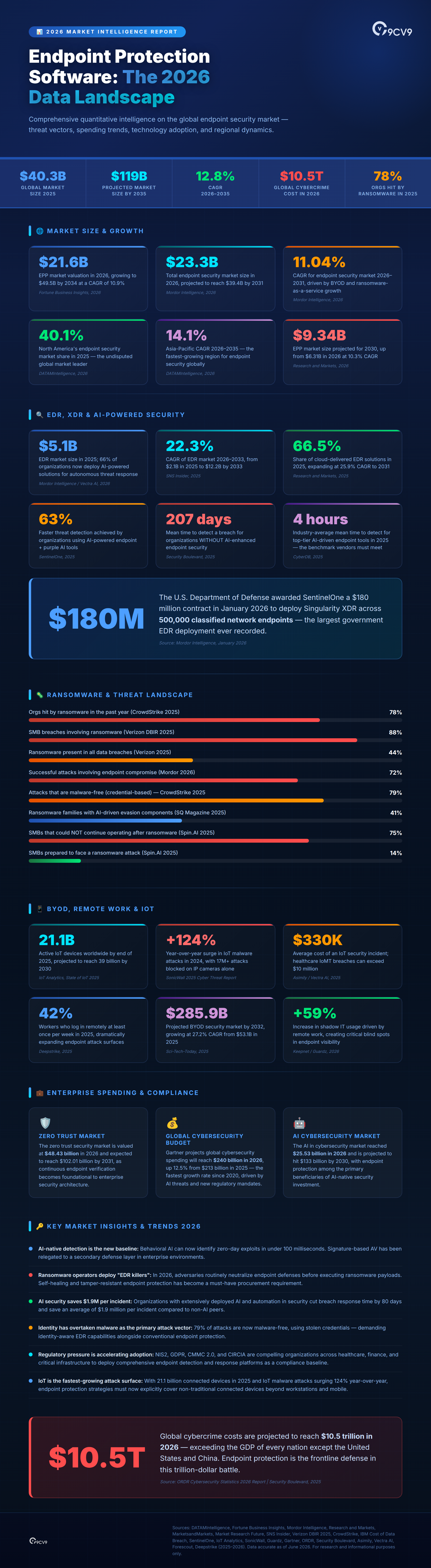
Artificial intelligence is emerging as a particularly influential force in endpoint security. Organizations deploying AI and automation in their cybersecurity operations have reported reducing breach response times by approximately 80 days and saving an average of USD 1.9 million per incident, according to IBM. At the same time, cloud-delivered EDR solutions accounted for 66.48% of the EDR market in 2025, illustrating the growing preference for scalable, centrally managed endpoint protection technologies that support distributed workforces and hybrid IT environments.
The proliferation of remote work, bring-your-own-device (BYOD) policies, and Internet of Things (IoT) devices is creating additional cybersecurity challenges. IoT Analytics estimates that 21.1 billion connected IoT devices were active worldwide by the end of 2025, with that number projected to reach 39 billion by 2030. As organizations increasingly rely on interconnected devices and cloud applications, securing every endpoint has become a critical requirement for maintaining business continuity, protecting sensitive information, and meeting regulatory obligations.
Regional developments further highlight the global importance of endpoint protection software. North America remains a leading market for endpoint security investments, while Asia-Pacific is projected to experience particularly rapid growth, with an estimated CAGR of 14.1% between 2026 and 2035. Increasing digital transformation, stricter cybersecurity regulations, and rising enterprise security budgets are creating significant opportunities for endpoint protection software providers across both developed and emerging markets.
Understanding these developments is essential for IT professionals, cybersecurity leaders, software vendors, business owners, and technology investors seeking to evaluate the evolving endpoint security landscape. From endpoint protection software market size and growth forecasts to ransomware statistics, EDR adoption rates, AI-powered cybersecurity trends, and enterprise security spending, quantitative insights provide valuable benchmarks for technology investment and cybersecurity planning.
This comprehensive guide to the Top 105 Endpoint Protection Software Statistics, Data & Trends in 2026 examines the latest available industry research, market projections, cybersecurity threat intelligence, and enterprise adoption patterns. It explores the forces shaping the global endpoint protection software industry, providing actionable insights into emerging security technologies, evolving cyber risks, and the future of endpoint security in 2026 and beyond.
Before we venture further into this article, we would like to share who we are and what we do.
About 9cv9
9cv9 is a business tech startup based in Singapore and Asia, with a strong presence all over the world.
With over ten years of startup and business experience, and being highly involved in connecting with thousands of companies and startups, the 9cv9 team has listed some of the top and best companies/tools in this review.
If you like to get your company listed in our top B2B software reviews, check out our world-class 9cv9 Media and PR service and pricing plans here.
Top 105 Endpoint Protection Software Statistics, Data & Trends in 2026
📊 Market Size & Growth
- The global endpoint security market reached USD 40.30 billion in 2025 and is projected to reach USD 119.04 billion by 2035, growing at a CAGR of 12.8% during 2026–2035. The endpoint protection sector has become one of the fastest-growing segments in cybersecurity, driven by escalating ransomware threats, remote work proliferation, and AI-powered attack sophistication. (Source: DATAMIntelligence, 2026)
- The global endpoint protection platform (EPP) market is valued at USD 21.64 billion in 2026, projected to reach USD 49.51 billion by 2034 at a CAGR of 10.9%. This sustained double-digit growth underscores the rising enterprise priority of comprehensive endpoint protection as cyber threats grow more complex and frequent. (Source: Fortune Business Insights, 2026)
- The endpoint security market size in 2026 is estimated at USD 23.34 billion, growing from USD 21.02 billion in 2025, with 2031 projections at USD 39.41 billion at 11.04% CAGR. Expanding BYOD policies, remote work trends, and increasingly sophisticated ransomware-as-a-service toolkits are the primary growth catalysts. (Source: Mordor Intelligence, 2026)
- The endpoint protection platform market will grow from USD 5.71 billion in 2025 to USD 6.31 billion in 2026 at a CAGR of 10.5%, reaching USD 9.34 billion by 2030. Key growth drivers include remote workforce expansion, ransomware threat escalation, and zero trust endpoint architecture adoption. (Source: Research and Markets, 2026)
- The global endpoint security market is projected to grow from USD 27.46 billion in 2025 to USD 38.28 billion by 2030, registering a CAGR of 6.9%. The market growth is underpinned by the critical role endpoint security plays in addressing threats against non-traditional endpoints such as ATMs, kiosks, industrial systems, and POS terminals. (Source: MarketsandMarkets, 2025)
- The global endpoint security market was valued at USD 16.25 billion in 2025 and is projected to grow from USD 17.79 billion in 2026 to USD 34.40 billion by 2034 at a CAGR of 8.60%. Rising BYOD adoption across enterprise environments is a primary propellant for the expanding market footprint of endpoint security vendors. (Source: Fortune Business Insights, 2026)
- The Endpoint Protection Platform industry is projected to grow from USD 19.13 billion in 2025 to USD 36.55 billion by 2035 at a CAGR of 6.69%. AI-driven security solutions and cloud integration are rapidly becoming essential features as organizations increasingly adopt cloud-based infrastructures. (Source: Market Research Future, 2026)
- North America leads the global endpoint security market with 40.1% market share in 2025. Advanced enterprise security budgets, cyber insurance pressure, ransomware exposure, and high adoption of EDR, XDR, and MDR platforms make North America the undisputed epicenter of endpoint protection spending. (Source: DATAMIntelligence, 2026)
- North America holds over 36% share in the endpoint security market in 2026, reaching approximately USD 9.0 billion. Strong regulatory enforcement, advanced infrastructure, and persistently high ransomware exposure combine to sustain North America’s market leadership position. (Source: Persistence Market Research, 2026)
- Asia-Pacific is the fastest-growing endpoint security region, expected to grow at a CAGR of 14.1% during 2026–2035. Digital banking modernization, government cybersecurity programs, cloud adoption, and manufacturing digitization are propelling Asia-Pacific to outpace all other regions in endpoint security investment. (Source: DATAMIntelligence, 2026)
- Asia Pacific held 24.20% of the global endpoint security market in 2025, reaching a valuation of USD 3.85 billion, and is projected to reach USD 4.31 billion in 2026. Increasing IT spending across industries and government-mandated cybersecurity frameworks are the primary catalysts for Asia-Pacific’s rapid endpoint security market expansion. (Source: Fortune Business Insights, 2026)
🔍 EDR & XDR Market
- The EDR market reached USD 5.10 billion in 2025, with 66% of organizations now deploying AI-powered solutions for autonomous threat response. The migration to AI-powered EDR reflects the growing recognition that signature-based detection is insufficient against modern polymorphic and fileless attack methods. (Source: Mordor Intelligence / Vectra AI, 2026)
- The Endpoint Detection and Response (EDR) market was valued at USD 2.10 billion in 2025 and is projected to reach USD 12.20 billion by 2033, growing at a CAGR of 22.3%. The extraordinary growth rate of the EDR market reflects enterprises’ urgent shift away from legacy antivirus tools toward behavior-based, real-time detection and response capabilities. (Source: SNS Insider, 2025)
- Cloud-delivered EDR solutions controlled 66.48% of the endpoint detection and response market size in 2025 and will continue expanding at a 25.90% CAGR to 2031. As remote work normalizes decentralized IT environments, cloud-delivered EDR has become the architecture of choice for organizations demanding scalable, real-time endpoint visibility. (Source: Research and Markets / Mordor Intelligence, 2025)
- Traditional endpoint prevention suites still held 44.23% of the EDR market share in 2025. Despite significant movement toward AI-driven behavioral detection, a substantial portion of the market continues to rely on prevention-first endpoint architectures, especially in mid-market and resource-constrained environments. (Source: Mordor Intelligence, 2025)
- Identity-threat detection and response posted a 24.83% CAGR through 2031, outgunning traditional endpoint prevention suites. As adversaries increasingly exploit stolen credentials rather than malware, identity-centric EDR tools have become essential for correlating Active Directory activity with endpoint behavior. (Source: Mordor Intelligence, 2026)
- North America held a 37.02% endpoint detection and response market share in 2025, driven by Executive Order 14028 compliance and private-sector threat intelligence sharing. Federal procurement mandates and CISA’s Continuous Diagnostics and Mitigation (CDM) program continue to drive substantial EDR investment across U.S. government and enterprise sectors. (Source: Research and Markets / Mordor Intelligence, 2025)
- The U.S. Department of Defense awarded SentinelOne a USD 180 million contract in January 2026 to deploy its Singularity XDR platform across 500,000 classified network endpoints. This landmark government contract validates the maturity of next-generation EDR/XDR platforms for the most demanding, security-critical endpoint environments on the planet. (Source: Mordor Intelligence, 2026)
- The software segment dominated the EDR market with approximately 65% market share in 2025. Continuous evolution of AI and machine learning in endpoint detection software, championed by vendors such as CrowdStrike and SentinelOne, is driving preference for software-centric over services-centric endpoint security. (Source: SNS Insider, 2025)
- XDR is expected to be the fastest-growing endpoint security solution type as buyers connect endpoint telemetry with identity, email, network, cloud, and SaaS signals. Organizations are finding that the cross-domain threat correlation capabilities of XDR far exceed the endpoint-only visibility offered by traditional EDR, prompting rapid platform migration. (Source: DATAMIntelligence, 2026)
- By 2026, behavioral AI can now identify zero-day exploits in under 100 milliseconds, making signature-based detection a secondary security layer. The shift to sub-second behavioral AI detection represents a quantum leap in endpoint protection efficacy, fundamentally altering the economics of cyber defense relative to offense. (Source: CyberDB, 2026)
🦠 Ransomware & Malware Threats
- Ransomware was present in 44% of all data breaches in 2025, a 37% increase from the prior year. The accelerating prevalence of ransomware across breach investigations confirms that endpoint protection with anti-ransomware capabilities is no longer optional — it is a fundamental business continuity requirement. (Source: Verizon DBIR 2025 / TechTarget)
- 78% of organizations were hit by ransomware in the past year. CrowdStrike’s State of Ransomware Survey reveals that ransomware has reached near-universal impact among enterprises, reinforcing the critical importance of proactive endpoint protection and incident response planning. (Source: CrowdStrike State of Ransomware Survey 2025)
- Ransomware accounted for 88% of SMB breaches in 2025. Small and medium-sized businesses bear a disproportionate share of ransomware’s impact, largely because they typically lack dedicated security teams and operate with weaker endpoint protection controls than enterprise organizations. (Source: Verizon DBIR 2025 / Huntress)
- 26% of ransomware incidents in 2025 involved compromised endpoints. Despite advances in endpoint detection, a quarter of all ransomware incidents still originated from inadequately protected endpoint devices, highlighting persistent gaps in deployment coverage and configuration management. (Source: Hornetsecurity Ransomware Impact Report 2025)
- Claimed ransomware victims jumped approximately 58% in 2025 year-over-year, with over 7,500 unique victim organizations listed on public leak sites. This dramatic surge in ransomware extortion activity demonstrates that attackers have industrialized their operations, using automation and affiliate networks to scale attack volumes. (Source: GuidePoint Security / Deepstrike, 2026)
- The median ransom payment jumped from approximately USD 12,700 in 2024 to USD 59,600 in 2025. While fewer victims are paying ransoms overall, those that do pay are transferring dramatically larger sums, reflecting attackers’ strategic pivot toward higher-value targets with sensitive data. (Source: Chainalysis / Deepstrike, 2026)
- Average ransomware-related breach costs can reach approximately USD 5.0 million when remediation, downtime, legal exposure, and business interruption are included. The true financial impact of ransomware extends far beyond the ransom itself, making endpoint protection investment a sound financial strategy compared to incident recovery costs. (Source: Deepstrike, 2026)
- The payment rate for ransomware fell to a record low of approximately 28% of victims in 2025. Improved backup strategies and incident response capabilities are enabling more organizations to recover without paying ransoms, though the declining payment rate is being offset by higher median ransom demands. (Source: Chainalysis / Deepstrike, 2026)
- Ransomware attacks against OT and IoT systems surged 46% in 2025. Operational technology environments, long considered isolated from IT network threats, are increasingly being targeted through compromised IoT devices that serve as lateral movement stepping stones into critical infrastructure. (Source: Honeywell / Deepstrike, 2025)
- Manufacturing was the #1 targeted industry for ransomware for four consecutive years through 2025, with extortion accounting for 29% of attacks. The manufacturing sector’s operational reliance on uptime and its legacy OT infrastructure make it particularly vulnerable to ransomware disruption, driving growing demand for OT-aware endpoint protection solutions. (Source: IBM X-Force Threat Intelligence Index 2025)
- Only 14% of SMBs are prepared to face a ransomware attack. With the vast majority of small businesses lacking even basic endpoint protection readiness, the gap between organizational vulnerability and actual preparedness represents one of the greatest cybersecurity risks in the current threat landscape. (Source: Spin.AI, 2025)
- 75% of SMBs could not continue operating if hit with ransomware. The existential threat ransomware poses to small businesses underscores the business imperative of deploying endpoint protection solutions that provide ransomware rollback and recovery capabilities. (Source: Spin.AI, 2025)
- Nearly one in five SMBs that experienced a cyberattack filed for bankruptcy or went out of business. Mastercard’s global SMB cybersecurity study reveals the lethal business consequences of inadequate endpoint protection, making cybersecurity investment a matter of organizational survival. (Source: Mastercard Global SMB Cybersecurity Study, 2025)
- In 2026, ransomware operators increasingly deploy “EDR killer” tools as a standard component of attack playbooks. The deliberate targeting of endpoint detection capabilities before executing ransomware payloads reflects an arms race dynamic that demands endpoint protection platforms with self-healing and tamper-resistant capabilities. (Source: Kaspersky / Securelist, 2026)
- Ransomware attacks caused over USD 18 billion in losses in the manufacturing sector alone in the first three quarters of 2025. The concentrated financial damage in manufacturing highlights the sector-specific risks of inadequate endpoint protection in environments where operational continuity is paramount. (Source: Kaspersky / VDC Research, 2025)
💻 Attack Vectors & Vulnerabilities
- 72% of successful ransomware attacks in 2025 involved endpoint compromise. With nearly three-quarters of all successful ransomware incidents starting at the endpoint, comprehensive endpoint detection and response capabilities are the single most critical defense investment organizations can make. (Source: Mordor Intelligence / Vectra AI, 2026)
- 79% of cyberattacks in 2025 were malware-free, relying on valid credentials and legitimate tools to move laterally through networks. This shift toward identity-based, “living-off-the-land” attack techniques makes behavioral analytics and identity-aware endpoint protection essential for modern threat detection. (Source: CrowdStrike, 2025)
- Phishing and ransomware campaigns orchestrated by generative AI accounted for 85% of successful initial access vectors in 2025. AI-powered phishing has dramatically lowered the skill threshold for attackers, making email-integrated endpoint protection that detects malicious payloads at the point of delivery increasingly critical. (Source: CyberDB, 2025)
- 41% of ransomware families examined in 2025 include AI-driven components to adapt payloads and evade defenses. Ransomware authors are actively incorporating machine learning capabilities to produce polymorphic variants that evade signature-based endpoint detection, raising the stakes for AI-native defensive platforms. (Source: SQ Magazine, 2025)
- Stolen or compromised credentials remain among the costliest attack vectors at USD 4.50 million per breach. Credential-based attacks that bypass traditional endpoint controls require organizations to deploy identity-aware EDR alongside conventional antivirus and behavioral detection capabilities. (Source: IBM Cost of a Data Breach Report, 2025)
- The average time to identify a breach involving stolen credentials exceeds the 181-day average for other breach vectors. Extended attacker dwell times in credential-based intrusions compound breach costs dramatically, making continuous behavioral monitoring at the endpoint a critical tool for shrinking detection gaps. (Source: IBM, 2025)
- Verizon’s 2025 DBIR recorded a 34% year-over-year rise in successful vulnerability exploits, with an eightfold jump in exploitation of edge devices and VPN concentrators. The escalating exploitation of edge infrastructure reinforces the need for comprehensive endpoint protection that extends beyond traditional workstations to network appliances and access devices. (Source: Verizon DBIR, 2025)
- The number of ransomware incidents reported globally has more than doubled over the past five years. This sustained acceleration in ransomware incident frequency confirms that endpoint protection has transitioned from a discretionary security investment to a board-level business continuity imperative. (Source: Verizon DBIR, 2025)
- 55% of security professionals consider smartphones to be the most vulnerable endpoint in enterprise environments. Mobile devices represent an increasingly critical attack surface that traditional endpoint protection platforms must extend to cover, particularly as BYOD adoption continues to grow. (Source: Sci-Tech-Today / Spyhunter, 2025)
- 81% of businesses have been hit by an attack involving malware. Malware remains the most prevalent endpoint threat vector, confirming that organizations must deploy multi-layered endpoint protection combining prevention, detection, and response capabilities. (Source: Sci-Tech-Today, 2025)
🤖 AI & Automation in Endpoint Security
- Organizations using AI and automation in security cut their breach response time by 80 days and saved an average of USD 1.9 million per incident. The measurable ROI of AI-enhanced endpoint security — in both time and financial savings — makes the business case for modernizing endpoint protection platforms overwhelmingly compelling. (Source: IBM, 2025)
- The AI in cybersecurity market was valued at USD 25.53 billion in 2026, projected to reach USD 50.83 billion by 2031 at a CAGR of 14.8%. AI-powered endpoint security tools are commanding growing market share as organizations demand automated threat detection and response capabilities that exceed human analyst throughput. (Source: MarketsandMarkets, 2026)
- The AI cybersecurity market is projected to exceed USD 133 billion by 2030. The extraordinary projected scale of AI-native security solutions underscores how fundamentally artificial intelligence is transforming every layer of the cybersecurity stack, with endpoint protection among the primary beneficiaries. (Source: ORDR, 2026)
- Organizations using Singularity Endpoint and AI-powered tools detect threats 63% faster and reduce mean time to respond (MTTR) by 55%. AI-accelerated threat detection and response metrics demonstrate quantifiably superior security outcomes compared to conventional endpoint protection tools relying on manual analyst workflows. (Source: SentinelOne / The Hacker News, 2025)
- In 2025, the industry average for mean time to detect (MTTD) dropped to 4 hours for top-tier endpoint protection tools. Benchmark MTTD figures set the performance bar for endpoint security vendor selection, as organizations increasingly prioritize detection speed as a key procurement criterion. (Source: CyberDB, 2025)
- Mean time to detect is 207 days for organizations without AI-enhanced security. The stark contrast between AI-enhanced and traditional endpoint security detection timelines illustrates why organizations that delay AI adoption face disproportionately high breach costs and dwell times. (Source: Security Boulevard, 2025)
- AI-powered attacks have increased by 427% year-over-year. The explosive growth of AI-generated cyber threats has created an urgent mandate for endpoint protection platforms to match offensive AI capabilities with equally sophisticated defensive AI capabilities. (Source: Security Boulevard, 2025)
- 77% of security professionals view AI-driven phishing as a serious and emerging threat. AI-generated spear phishing has become so convincing that traditional email-based security controls are insufficient without endpoint protection capable of detecting malicious payloads regardless of delivery sophistication. (Source: Guardz, 2026)
🌐 BYOD, Remote Work & IoT
- 42% of workers log in remotely at least once a week in 2025, widening organizational attack surfaces across home networks and personal devices. The normalization of hybrid work has permanently expanded the endpoint perimeter beyond corporate networks, creating irreversible demand for endpoint protection solutions with remote management capabilities. (Source: Deepstrike, 2025)
- The BYOD security market is projected to grow from USD 53.1 billion in 2025 to USD 285.9 billion by 2032 at a CAGR of 27.2%. The massive BYOD security market expansion reflects the scale of the security challenge organizations face in protecting enterprise data on employee-owned devices operating outside corporate security perimeters. (Source: Sci-Tech-Today, 2025)
- 39% of organizations list security concerns as the top obstacle to BYOD adoption. Despite the productivity benefits of BYOD policies, nearly four in ten organizations cite endpoint security challenges as the primary reason for limiting or restricting employee use of personal devices for work. (Source: Sci-Tech-Today, 2025)
- 36% of employees who use personal devices for work admit they often postpone important security updates. User-driven security negligence on personal endpoints creates exploitable vulnerability windows that endpoint protection platforms with automated patch enforcement capabilities can systematically close. (Source: Sci-Tech-Today, 2025)
- 38% of employees admit that their employer doesn’t have any BYOD policies, or the policy is sometimes or always ignored. The widespread absence or non-enforcement of BYOD security policies creates significant endpoint exposure that only automated, policy-enforcing endpoint protection platforms can effectively address. (Source: Guardz, 2026)
- 47% of companies allow employees to access corporate resources on unmanaged devices, authenticating via credentials alone. Reliance on credentials-only authentication for unmanaged endpoint access represents a critical security gap, given the prevalence of credential-theft attacks in the current threat landscape. (Source: Guardz, 2026)
- Shadow IT usage has increased by 59% with remote work adoption. The proliferation of unauthorized applications and unmanaged devices in remote work environments demands endpoint protection platforms with application control and shadow IT visibility capabilities. (Source: Keepnet / Guardz, 2026)
- 59% of organizations have experienced data loss through cloud-based shadow IT. Unsanctioned cloud application usage that bypasses endpoint protection monitoring creates significant data exfiltration risks that endpoint-integrated DLP capabilities are uniquely positioned to detect and prevent. (Source: Guardz / Infosecurity Magazine, 2026)
- 21.1 billion active IoT devices were connected worldwide by the end of 2025, projected to reach 39 billion by 2030. The exponential growth of IoT device deployments creates a massive and rapidly expanding attack surface that endpoint protection strategies must explicitly account for beyond traditional workstation and mobile device coverage. (Source: IoT Analytics, 2025)
- IoT malware attacks increased by 124% year-over-year in 2024, with over 17 million attacks blocked against IP cameras alone. The extraordinary acceleration of IoT-targeted malware activity highlights the critical need for endpoint protection architectures that can secure connected devices incapable of running traditional security agents. (Source: SonicWall 2025 Cyber Threat Report)
- The average IoT security incident costs USD 330,000, while healthcare IoMT breaches exceed USD 10 million. The steep financial consequences of IoT endpoint compromise are prompting organizations to integrate IoT device security into comprehensive endpoint protection strategies rather than treating them as separate security domains. (Source: Asimily / Vectra AI, 2025)
- 50% of IoT devices have critical vulnerabilities, as home networks remain the weakest link in enterprise endpoint security. The persistently high vulnerability rate of IoT devices deployed in remote work environments creates substantial endpoint security risks that are difficult to address without network-level visibility and control. (Source: Insider Risk Index, 2025)
- Routers and switches now average 32 vulnerabilities per device and account for 34% of the most critical vulnerabilities in enterprise networks. Network infrastructure endpoints represent a massively underprotected attack surface, with vulnerability densities that demand proactive scanning and patch management integration with endpoint protection platforms. (Source: Forescout, 2026)
- One in three data breaches now involves an IoT device. The mainstreaming of IoT as a breach vector confirms that endpoint protection strategies must extend well beyond traditional computing endpoints to address the full scope of the connected device risk surface. (Source: Insider Risk Index, 2025)
- Ransomware attacks against OT systems surged 30% in 2025, targeting Industrial Control Systems (ICS). Critical infrastructure operators face growing ransomware exposure through OT endpoints, driving demand for specialized endpoint protection platforms capable of securing air-gapped and legacy industrial environments. (Source: CyberDB, 2025)
🏢 Enterprise Adoption & Spending
- Global cybersecurity spending is projected to reach USD 240 billion in 2026, up 12.5% from USD 213 billion in 2025. The accelerating growth rate of cybersecurity investment — driven by AI-powered threats, ransomware escalation, and new regulatory mandates — positions endpoint protection as a core component of expanding security budgets. (Source: Gartner / Elisity, 2026)
- The zero trust security market is valued at USD 48.43 billion in 2026, expected to reach USD 102.01 billion by 2031. Zero trust architectures that mandate continuous endpoint verification are converging with endpoint protection platforms to create a unified security model that replaces perimeter-based defense. (Source: ORDR, 2026)
- 72% of enterprises now prioritize vendors that offer native integration across hybrid cloud environments. Enterprise endpoint security buyers are consolidating around platforms capable of delivering consistent protection across on-premises, cloud, and hybrid environments rather than point solutions with narrow deployment coverage. (Source: CyberDB, 2026)
- By 2025, Gartner predicted 50% of enterprises would adopt Managed Detection and Response (MDR) services for continuous security monitoring. The rapid adoption of MDR services as an overlay to endpoint protection reflects the growing recognition that security technology alone is insufficient without 24/7 human and AI-assisted threat monitoring. (Source: Gartner / ECCU, 2025)
- Asia-Pacific leads with 22% of organizations expecting cybersecurity budget increases above 10% in 2026. Asia-Pacific’s disproportionate share of organizations planning significant security budget growth reflects the region’s accelerating digital transformation and rapidly maturing regulatory environment. (Source: Elisity, 2026)
- The global average cost of a data breach fell to USD 4.44 million in 2026, a 9% decline from USD 4.88 million in 2024. Despite the modest decline in average breach costs, the aggregate financial impact of cybercrime continues to rise as breach frequency increases, making proactive endpoint protection investment increasingly economical. (Source: IBM Cost of a Data Breach Report 2026 / StationX)
- Organizations without zero trust implementation face breach costs 38% higher than zero trust-adopting peers. The financial premium of operating without zero trust endpoint controls provides a compelling, quantifiable justification for modernizing endpoint protection architectures aligned with NIST zero trust frameworks. (Source: Security Boulevard, 2025)
- 40% of organizations admit to delaying patch rollouts to avoid potential operational conflicts. Patch management delays create exploitable vulnerability windows that adversaries systematically target, making automated patch management integration a critical capability within comprehensive endpoint protection platforms. (Source: Sci-Tech-Today, 2025)
- Microsoft leads the endpoint protection platform market with its Defender suite, offering integrated protection across cloud, identity, and devices for large enterprises. Microsoft’s dominant market position reflects the enterprise preference for deeply integrated endpoint protection that extends across the full Microsoft security stack rather than requiring separate vendor relationships. (Source: MarketsandMarkets, 2025)
- Global cybercrime costs are projected to reach USD 10.5 trillion in 2026. The unprecedented scale of global cybercrime economic impact creates a powerful financial imperative for investment in endpoint protection platforms that can prevent, detect, and respond to the full spectrum of modern cyber threats. (Source: ORDR / Security Boulevard, 2026)
- 84% of organizations experienced identity-related breaches in 2025. The near-universal exposure to identity-centric attacks reinforces the need for endpoint protection platforms with integrated identity threat detection and response capabilities rather than device-only security controls. (Source: Security Boulevard, 2025)
🔒 Compliance & Regulatory Drivers
- Europe’s NIS2 Directive, which broadened mandatory cyber controls across 18 critical sectors in October 2024, is accelerating endpoint security adoption across Germany, France, and Eastern Europe. Regulatory-driven endpoint security investment is creating a sustained demand cycle for compliance-aware endpoint protection platforms with built-in audit logging and reporting capabilities. (Source: Research and Markets / Mordor Intelligence, 2025)
- GDPR breach-notification fines have elevated endpoint protection to a boardroom priority across European enterprises. The financial liability associated with reportable endpoint breaches under GDPR has transformed endpoint security from a technical IT concern into a board-level governance and risk management priority. (Source: Research and Markets, 2025)
- The U.S. federal procurement opportunity for EDR through CISA’s CDM and DoD CMMC requirements represents a USD 1.2 billion addressable market. Federal mandates for comprehensive endpoint detection and response capabilities are creating a substantial dedicated market segment that is accelerating the maturity and feature development of enterprise-grade endpoint protection platforms. (Source: Market Research Future, 2025)
- Canada’s updated Critical Infrastructure Protection standards, enacted in 2024, compel banking and energy operators to adopt AI-powered EDR for ransomware prevention. Cross-border regulatory alignment on endpoint security requirements is creating consistent demand for enterprise-grade AI-driven endpoint protection across North American regulated industries. (Source: Market Research Future, 2025)
- 90% of security incidents involving lost or stolen devices lead to unauthorized data breaches. The near-certain breach consequence of lost or stolen endpoints underscores the critical importance of remote wipe, full-disk encryption, and device tracking capabilities within comprehensive endpoint protection platforms. (Source: Spyhunter, 2025)
- 43% of UK businesses experienced a cybersecurity breach or attack in the past year, equivalent to approximately 612,000 businesses. Despite a modest decline from 50% the prior year, the scale of UK business endpoint exposure remains enormous, driving sustained demand for accessible, cost-effective endpoint protection solutions for mid-market organizations. (Source: UK Government Cyber Security Breaches Survey, 2025)
📈 Vendor Landscape & Technology
- Trend Micro acquired Snyk’s infrastructure-as-code security division for USD 320 million in December 2025 to enhance early EDR coverage. Large endpoint security vendor acquisitions signal market consolidation toward platform approaches that integrate developer-focused vulnerability scanning with runtime endpoint detection capabilities. (Source: Mordor Intelligence, 2026)
- The post-quantum cryptography industry is projected to grow from USD 0.42 billion in 2025 to USD 2.84 billion by 2030. Quantum-resistant encryption is emerging as a forward-looking requirement for endpoint protection platforms, particularly in government and defense sectors where long-term data confidentiality is paramount. (Source: MarketsandMarkets / ECCU, 2025)
- Microsoft introduced agentless scanning for Defender for Endpoint in January 2026, enabling security teams to inspect virtual machines and containers without kernel-mode driver installations. Agentless endpoint scanning capabilities significantly lower deployment friction for organizations seeking to extend endpoint visibility to cloud workloads and containerized environments. (Source: Mordor Intelligence, 2026)
- Acronis received an SE Labs AAA Award for XDR with 100% detection accuracy and 98% total accuracy in 2025. Third-party independent testing validation has become a critical procurement differentiator for endpoint protection platforms, with organizations increasingly demanding demonstrated detection accuracy rather than vendor-claimed efficacy. (Source: Acronis, 2025)
- Only 15% of companies provide employees with work-issued smartphones, while 61% expect employees to be remotely accessible without providing corporate devices. The disconnect between device provision responsibility and remote access expectations creates significant endpoint security gaps that mobile device management and BYOD-aware endpoint protection platforms must address. (Source: Sci-Tech-Today, 2025)
- Remote workers are 3× more likely to accidentally expose data than office employees, costing organizations an average of USD 17.4 million annually. The dramatically elevated data exposure risk of remote endpoints demands deployment of comprehensive endpoint protection platforms with data loss prevention capabilities across all employee-operated devices. (Source: Insider Risk Index / Ponemon, 2025)
- Insider threats increased 58% since remote work adoption, with 83% of organizations experiencing at least one insider threat incident in 2024. The surge in insider threat activity driven by distributed work environments is accelerating demand for endpoint protection platforms with user behavior analytics and anomaly detection capabilities. (Source: Insider Risk Index, 2025)
- Device risk scores increased 15% to 8.98 in 2025, indicating a consistent deterioration in the overall security posture of managed endpoints. Rising device risk scores across enterprise environments signal that patch management and configuration compliance programs are failing to keep pace with the expanding endpoint vulnerability surface. (Source: Insider Risk Index, 2025)
- 68% of security incidents originate from remote access points. The concentration of security incidents at remote endpoint access vectors confirms that VPN endpoints, remote desktop services, and work-from-home devices represent the most critical targets for endpoint protection investment. (Source: Security Boulevard, 2025)
- Only 42% of companies surveyed have a solution to proactively locate sensitive data on employee devices. The minority of organizations with endpoint data discovery capabilities highlights a significant gap in comprehensive endpoint protection strategies, particularly given the growing regulatory obligations around personal data protection. (Source: Guardz / Sensitive Data Report, 2026)
- 41% of IT and cybersecurity teams report increased anxiety and stress about future ransomware attacks. The mounting psychological toll of the ransomware threat landscape on security teams reinforces the need for endpoint protection platforms that automate detection and response, reducing cognitive load on human analysts. (Source: Sophos State of Ransomware, 2025)
- Only 47% of organizations monitor their networks 24/7, and only 50% encrypt sensitive data stored on devices. The persistent gaps in continuous monitoring and encryption coverage across enterprise endpoint environments reveal that significant portions of the market remain critically underprotected against modern endpoint threats. (Source: Expert Insights, 2025)
- Personal consumer devices are twice as likely to become infected with malware as corporate-issued devices. The markedly elevated malware infection rate on consumer-grade endpoints highlights the cybersecurity risks of BYOD policies that permit personal device access to corporate resources without equivalent endpoint protection standards. (Source: Expert Insights, 2025)
- 30% of IT leaders claim information security is the biggest obstacle to BYOD adoption within their organizations. Security concerns have become the defining constraint on BYOD program expansion, creating a sustainable market for endpoint protection solutions that can enforce security policy on heterogeneous personal device fleets. (Source: CloudSecureTech / Guardz, 2026)
- Encrypted threats against IoT devices increased by 93% in 2024. The surge in encrypted attack traffic targeting IoT endpoints exposes critical limitations in perimeter-based security controls, driving demand for endpoint protection platforms capable of decrypting and inspecting HTTPS traffic at the device level. (Source: SonicWall 2025 Cyber Threat Report)
- SonicWall detected 210,258 never-before-seen malware variants in 2024, approximately 630 new strains per day. The daily emergence of hundreds of novel malware strains confirms that signature-based endpoint detection approaches are fundamentally inadequate and must be augmented by AI-driven behavioral analysis. (Source: SonicWall 2025 Cyber Threat Report)
- Bitdefender and Netgear detected 13.6 billion IoT attacks between January and October 2025 alone. The extraordinary volume of IoT-targeted attacks in a single ten-month period illustrates the scale of the endpoint threat challenge that organizations face in securing their expanding connected device ecosystems. (Source: Vectra AI / Bitdefender, 2025)
- The number of connected IoT devices reached 18.5 billion in 2024, a 12% rise over 2023, growing at a 13.2% CAGR toward 39 billion by 2030. The relentless expansion of the IoT device estate is creating a perpetually expanding endpoint security challenge that will require increasingly scalable and automated endpoint protection approaches. (Source: IoT Analytics, State of IoT 2025)
- 40% of the riskiest device types identified in 2026 were not on risk radars a year ago. The rapid emergence of new high-risk endpoint categories underscores the need for dynamic, continuously updated endpoint protection strategies that can respond to threat landscape changes faster than annual risk assessments. (Source: Forescout, 2026)
Conclusion
The latest endpoint protection software statistics, data, and trends in 2026 reveal a cybersecurity industry undergoing significant transformation. As ransomware attacks become increasingly sophisticated, artificial intelligence reshapes cyber threats, and organizations expand their digital infrastructure, endpoint protection software has evolved from a traditional antivirus solution into a critical component of enterprise cybersecurity, risk management, and business continuity strategies.
The global endpoint protection software market is positioned for sustained expansion. According to Fortune Business Insights, the endpoint protection platform market is valued at approximately USD 21.64 billion in 2026 and is projected to reach USD 49.51 billion by 2034, growing at a CAGR of 10.9%. This growth reflects increasing enterprise investments in endpoint detection and response (EDR), extended detection and response (XDR), cloud-based security, and AI-powered threat prevention technologies.
One of the most significant findings is the growing complexity of modern cyberattacks. With ransomware involved in 44% of data breaches in 2025 and malware-free attacks accounting for 79% of cyberattacks reported by CrowdStrike, traditional signature-based antivirus solutions are increasingly insufficient as standalone defenses. Organizations must adopt comprehensive endpoint security strategies that combine behavioral analytics, continuous monitoring, identity protection, automated threat detection, and rapid incident response.
Artificial intelligence and automation are also redefining endpoint security effectiveness. IBM’s research indicates that organizations using AI-powered cybersecurity capabilities can reduce breach response times by approximately 80 days while saving an average of USD 1.9 million per incident. These findings highlight the potential financial and operational benefits of integrating intelligent automation into endpoint protection platforms, particularly as security teams face growing alert volumes and increasingly sophisticated attack techniques.
Meanwhile, the rapid expansion of remote work, bring-your-own-device (BYOD) environments, cloud computing, and Internet of Things (IoT) ecosystems is creating new security challenges. With the global number of connected IoT devices projected to reach 39 billion by 2030, businesses must extend endpoint security beyond traditional computers and servers to protect mobile devices, industrial systems, connected equipment, and other emerging attack surfaces.
Looking ahead, several developments are expected to shape the future of endpoint protection software:
- AI-powered endpoint security: Greater adoption of machine learning, behavioral threat detection, and automated incident response to identify sophisticated attacks more effectively.
- EDR and XDR adoption: Continued migration toward integrated security platforms that provide visibility across endpoints, networks, identities, cloud environments, and applications.
- Zero trust security integration: Increasing emphasis on continuous device verification, least-privilege access, and identity-aware endpoint protection.
- Cloud-native endpoint protection: Growing demand for scalable, centrally managed security solutions capable of protecting distributed and hybrid workforces.
- IoT and operational technology security: Expanded investment in securing connected devices, industrial infrastructure, and endpoints that cannot support conventional security agents.
- Cybersecurity compliance and governance: Stronger regulatory requirements encouraging organizations to implement endpoint monitoring, vulnerability management, encryption, and comprehensive security reporting.
For businesses, these endpoint protection software trends reinforce the importance of selecting cybersecurity solutions based on actual security capabilities rather than relying exclusively on vendor reputation or pricing. Effective endpoint protection requires a combination of advanced threat prevention, rapid detection, automated response, device visibility, regular vulnerability assessments, and well-defined incident recovery procedures.
For cybersecurity software providers and technology investors, the expanding endpoint security market presents opportunities in AI-native security platforms, managed detection and response services, cloud-delivered EDR, and specialized protection for increasingly complex enterprise environments. Asia-Pacific’s projected 14.1% CAGR between 2026 and 2035 also highlights the growing importance of emerging regional markets in shaping global cybersecurity demand.
Ultimately, the Top 105 Endpoint Protection Software Statistics, Data & Trends in 2026 demonstrate that endpoint security is no longer simply about preventing malware infections. It is about building resilient, intelligent, and adaptable cybersecurity infrastructures capable of protecting organizations against constantly evolving digital threats.
As cybercriminals increasingly exploit artificial intelligence, compromised identities, unmanaged devices, and vulnerabilities across interconnected systems, businesses that prioritize proactive endpoint protection, continuous monitoring, and automated threat response will be better positioned to reduce cybersecurity risks, minimize operational disruptions, and safeguard sensitive information.
The future of endpoint protection software will be defined by intelligent automation, integrated security architectures, and comprehensive endpoint visibility. Organizations that invest strategically in these capabilities in 2026 and beyond will be better equipped to navigate an increasingly complex cybersecurity landscape while supporting secure digital transformation and long-term business growth.
If you find this article useful, why not share it with your hiring manager and C-level suite friends and also leave a nice comment below?
We, at the 9cv9 Research Team, strive to bring the latest and most meaningful data, guides, and statistics to your doorstep.
To get access to top-quality guides, click over to 9cv9 Blog.
To hire top talents using our modern AI-powered recruitment agency, find out more at 9cv9 Modern AI-Powered Recruitment Agency.
People Also Ask
What is endpoint protection software?
Endpoint protection software is a cybersecurity solution that protects devices such as laptops, desktops, servers, and smartphones against malware, ransomware, phishing, and other cyber threats. It combines threat prevention, detection, monitoring, and automated response capabilities.
What is the global endpoint protection software market size in 2026?
According to Fortune Business Insights, the global endpoint protection platform market is valued at approximately USD 21.64 billion in 2026 and is projected to reach USD 49.51 billion by 2034, growing at a compound annual growth rate (CAGR) of 10.9%.
How fast is the endpoint security market growing in 2026?
The global endpoint security market is projected to grow at approximately 8.6% to 12.8% annually, depending on market definitions and research methodologies. Growth is driven by ransomware threats, cloud adoption, remote work, and AI-powered cybersecurity solutions.
What are the biggest endpoint protection software trends in 2026?
Major endpoint protection software trends in 2026 include AI-powered threat detection, cloud-native EDR, extended detection and response (XDR), zero trust security, automated incident response, identity threat protection, and expanded security coverage for IoT devices.
What is endpoint detection and response (EDR)?
Endpoint detection and response (EDR) is a cybersecurity technology that continuously monitors endpoint devices, identifies suspicious activities, investigates potential threats, and enables automated or manual responses to security incidents.
How large is the global EDR market in 2026?
The global endpoint detection and response market was valued at approximately USD 5.10 billion in 2025, according to Mordor Intelligence. Market forecasts indicate continued expansion as enterprises adopt behavioral threat detection and automated incident response technologies.
What is the difference between EDR and XDR security?
EDR focuses on detecting and responding to threats affecting endpoint devices. XDR extends security monitoring across endpoints, networks, email, cloud environments, and identities, enabling centralized threat correlation and coordinated incident response.
Why is endpoint protection software important for businesses in 2026?
Endpoint protection software helps businesses prevent malware infections, detect ransomware, protect sensitive information, and reduce operational disruptions. Growing cyber threats and distributed work environments make endpoint security essential for business continuity.
How common are ransomware attacks in 2026?
Ransomware remains a major cybersecurity threat. Verizon’s 2025 Data Breach Investigations Report found that ransomware was involved in 44% of investigated data breaches, highlighting the importance of endpoint protection and incident recovery capabilities.
What percentage of cyberattacks are malware-free?
CrowdStrike reported that 79% of cyberattacks in 2025 were malware-free. These attacks frequently exploit stolen credentials, legitimate administrative tools, and trusted applications, making behavioral detection and identity-aware endpoint security increasingly important.
How does artificial intelligence improve endpoint protection software?
Artificial intelligence improves endpoint protection by analyzing device behavior, identifying suspicious activities, detecting previously unknown threats, and automating incident response. Machine learning can help security teams detect complex attacks more efficiently.
How much can AI-powered cybersecurity reduce data breach costs?
IBM research cited in the industry data indicates that organizations using AI and security automation can save approximately USD 1.9 million per incident and reduce breach response times by around 80 days compared with organizations using less automation.
What percentage of EDR solutions are cloud-based?
Cloud-delivered EDR solutions accounted for approximately 66.48% of the endpoint detection and response market in 2025. Cloud-based deployment supports centralized security management, remote monitoring, scalability, and protection across distributed enterprise environments.
Which region has the largest endpoint security market?
North America leads the global endpoint security market, accounting for approximately 40.1% of market share in 2025, according to DATAMIntelligence. Strong cybersecurity spending, regulatory requirements, and advanced enterprise security adoption support its position.
Which region has the fastest-growing endpoint security market?
Asia-Pacific is projected to be the fastest-growing endpoint security market, with an estimated CAGR of 14.1% between 2026 and 2035. Growth is supported by digital transformation, cloud computing adoption, cybersecurity regulations, and increasing enterprise security investments.
What is the role of zero trust security in endpoint protection?
Zero trust security requires continuous verification of users, devices, and access requests. When integrated with endpoint protection software, it helps organizations enforce device compliance, restrict unauthorized access, and reduce the risks associated with compromised credentials.
How does endpoint protection software prevent ransomware attacks?
Endpoint protection software helps prevent ransomware through behavioral monitoring, malicious file detection, application controls, threat isolation, and automated response. Advanced platforms may also provide ransomware rollback and recovery capabilities.
What is the difference between antivirus and endpoint protection software?
Traditional antivirus software primarily detects and blocks known malware. Modern endpoint protection platforms offer broader capabilities, including behavioral analytics, ransomware prevention, endpoint monitoring, vulnerability management, and automated threat response.
What is the projected global cybersecurity spending in 2026?
Global cybersecurity spending is projected to reach approximately USD 240 billion in 2026, compared with USD 213 billion in 2025. Increasing ransomware threats, regulatory obligations, and demand for AI-powered security solutions are supporting higher cybersecurity investments.
How much does a data breach cost businesses in 2026?
IBM’s research cited in the industry data places the global average cost of a data breach at approximately USD 4.44 million. Actual costs vary depending on industry, attack severity, geographic location, recovery requirements, and the effectiveness of cybersecurity controls.
How does remote work affect endpoint security?
Remote work increases endpoint security risks because employees access corporate systems through home networks, personal devices, and remote connections. Endpoint protection software helps organizations monitor device activity, enforce security policies, and detect threats outside traditional offices.
What are the biggest BYOD security risks in 2026?
Major BYOD security risks include unmanaged devices, outdated software, weak authentication, malware infections, data leakage, and inconsistent security policies. Research cited in the industry data indicates that 39% of organizations identify security concerns as a leading obstacle to BYOD adoption.
How many IoT devices are connected worldwide in 2026?
IoT Analytics estimated approximately 21.1 billion active connected IoT devices worldwide by the end of 2025. The number is projected to reach 39 billion by 2030, increasing the need for scalable IoT security and comprehensive endpoint protection strategies.
Why is IoT endpoint security becoming more important?
IoT endpoint security is increasingly important because connected devices often have limited built-in protection, outdated firmware, and weak authentication. Compromised IoT devices can expose corporate networks to malware, unauthorized access, ransomware, and data breaches.
What industries need endpoint protection software the most?
Industries with significant endpoint security requirements include healthcare, financial services, manufacturing, government, retail, education, and technology. These sectors frequently manage sensitive information, distributed devices, critical infrastructure, and complex regulatory obligations.
What is managed detection and response (MDR)?
Managed detection and response (MDR) is a cybersecurity service combining security technology, threat intelligence, and expert monitoring. MDR providers help organizations detect, investigate, and respond to cyber threats, often delivering continuous monitoring and incident response support.
How does endpoint protection software support regulatory compliance?
Endpoint protection software supports cybersecurity compliance through threat monitoring, access controls, encryption, audit logs, vulnerability management, and incident reporting. These capabilities help organizations address requirements associated with GDPR, NIS2, and industry-specific security frameworks.
What features should businesses look for in endpoint protection software in 2026?
Businesses should prioritize real-time threat detection, ransomware protection, EDR capabilities, AI-powered analytics, automated response, cloud management, device visibility, vulnerability monitoring, identity integration, and compatibility with existing cybersecurity infrastructure.
What are the biggest challenges facing endpoint security in 2026?
Major endpoint security challenges include AI-powered cyberattacks, ransomware, stolen credentials, unmanaged devices, software vulnerabilities, IoT expansion, and security alert overload. Organizations must balance comprehensive protection with operational efficiency and cybersecurity budgets.
What is the future of endpoint protection software beyond 2026?
The future of endpoint protection software will emphasize AI-driven threat prevention, autonomous security operations, integrated EDR and XDR platforms, zero trust architectures, and cloud-native protection. Growing IoT adoption and sophisticated cyber threats will continue driving market demand.
Sources
DATAMIntelligence
Fortune Business Insights
Mordor Intelligence
Research and Markets
MarketsandMarkets
Market Research Future
SNS Insider
Persistence Market Research
Vectra AI
CyberDB
Guardz
Huntress
Deepstrike
Kaspersky
Securelist
Verizon
IBM
CrowdStrike
SentinelOne
The Hacker News
Acronis
SonicWall
Forescout
IoT Analytics
Asimily
Swif.ai
Stingrai
ORDR
Gartner
Elisity
Security Boulevard
Sci-Tech-Today
Insider Risk Index
Mimecast
Fortinet
Spyhunter
Expert Insights
Hornetsecurity
Sophos
Mastercard
UK Government
Spin.AI
GuidePoint Security
Chainalysis