Key Takeaways
- Employee Communication Tools Market Growth: The global employee communication tools market is projected to grow from $3.5 billion in 2024 to $12.2 billion by 2033, driven by increasing demand for digital workplace communication platforms and collaboration software.
- Workplace Productivity and Employee Engagement: Poor workplace communication costs businesses between $9,284 and $30,000 per employee annually, highlighting the importance of effective internal communication tools for improving productivity, employee engagement, and retention.
- AI and Digital Workplace Communication Trends: AI-powered employee communication software, mobile-first collaboration platforms, and integrated messaging solutions are transforming workplace communication in 2026, particularly for remote, hybrid, and frontline employees.
Employee communication tools improve workplace collaboration, productivity, and employee engagement through digital messaging, internal communication platforms, and AI-powered solutions. In 2026, the global market is experiencing rapid growth, with projections reaching $12.2 billion by 2033. Key trends include AI integration, mobile-first communication, hybrid work collaboration, and improved employee retention.
Effective employee communication has become a critical driver of organizational productivity, employee engagement, and business success in 2026. As businesses navigate hybrid work arrangements, distributed teams, digital transformation, and evolving workforce expectations, employee communication tools are playing an increasingly important role in connecting employees, streamlining collaboration, and improving workplace efficiency. From instant messaging platforms and internal communication software to AI-powered collaboration tools and mobile-first employee engagement solutions, organizations are investing heavily in technologies that enable faster, clearer, and more meaningful communication.
Also, read our article on the Top 10 Employee Communication Tools To Use.

The latest employee communication tools statistics for 2026 highlight the rapid expansion of this market. The global employee communication tools market, valued at approximately $3.5 billion in 2024, is projected to reach $12.2 billion by 2033, growing at a compound annual growth rate (CAGR) of 15.2%. Meanwhile, the broader internal communications software market is expected to surpass $28 billion by 2035, reflecting sustained demand for digital workplace solutions. These projections demonstrate how employee communication technology is evolving from a supporting business function into an essential component of modern organizational infrastructure.
However, ineffective workplace communication continues to create significant financial and operational challenges. Research estimates that poor communication costs businesses between $9,284 and $30,000 per employee annually in lost productivity, while employees waste approximately 13 hours per week dealing with communication inefficiencies. Furthermore, 68% of employees report losing valuable productivity because of poor communication, and 84% of business leaders identify decreased productivity as a major consequence of communication failures. These findings underscore the importance of adopting employee communication platforms that reduce information silos, improve collaboration, and ensure employees receive timely, relevant information.

Employee engagement and retention are equally important considerations. According to Gallup’s 2025 findings, only 21% of employees worldwide are engaged at work, contributing to an estimated $438 billion in annual productivity losses. Additionally, 63% of employees considering leaving their jobs identify poor internal communication as an influential factor in their decision. With approximately 2.7 billion deskless workers worldwide and hybrid work becoming increasingly common, businesses must also address communication gaps affecting frontline employees, remote teams, and workers without regular access to traditional office communication channels.
Emerging technologies are further transforming the employee communication software landscape. Artificial intelligence, automated meeting summaries, intelligent notifications, multilingual communication, real-time analytics, and personalized employee messaging are reshaping how organizations share information and collaborate. Research indicates that 72% of companies had adopted AI in at least one business function by 2024, while 92% of companies surveyed in 2025 planned to increase AI investments over the following three years. These developments suggest that AI-powered employee communication tools, unified communication platforms, and mobile-first collaboration solutions will remain important technology investment priorities throughout 2026 and beyond.
In this comprehensive guide, we explore the Top 105 Employee Communication Tools Statistics, Data & Trends in 2026, covering market size, industry growth forecasts, employee engagement, workplace productivity, communication challenges, software adoption, remote and hybrid work, frontline workforce communication, and artificial intelligence integration. Whether you are an HR professional, business leader, internal communications specialist, IT decision-maker, or software provider, these statistics offer valuable insights into the changing employee communication landscape and the technologies shaping the future of workplace collaboration.
Before we venture further into this article, we would like to share who we are and what we do.
About 9cv9
9cv9 is a business tech startup based in Singapore and Asia, with a strong presence all over the world.
With over ten years of startup and business experience, and being highly involved in connecting with thousands of companies and startups, the 9cv9 team has listed some of the top and best companies/tools in this review.
If you like to get your company listed in our top B2B software reviews, check out our world-class 9cv9 Media and PR service and pricing plans here.
Top 105 Employee Communication Tools Statistics, Data & Trends in 2026
Market Size & Growth
- The Employee Communication Tools market was valued at $3.5 billion in 2024 and is expected to reach $12.2 billion by 2033, at a CAGR of 15.2%.
With explosive compound growth projected over the next decade, the employee communication tools sector is one of the fastest-expanding segments in enterprise software — signaling massive unmet demand across organizations globally. - The broader Employee Communication Tool Software market was valued at $8.26 billion in 2024, projected to reach $15.4 billion by 2035 at a CAGR of 5.9%.
This broader valuation reflects the full ecosystem of platforms — from enterprise messaging to intranet solutions — underscoring how deeply communication infrastructure has embedded itself into daily business operations. - The global Internal Communications Software market, valued at approximately $12.65 billion in 2025, is projected to surpass $28 billion by 2035.
The doubling of the internal comms software market over a decade signals that organizations are moving from ad-hoc communication practices to strategic, technology-driven employee engagement programs. - A narrower Employee Communications Software segment stood at $800 million in 2024 and is forecast to reach $1.5 billion by 2033, registering a 7.5% CAGR.
Even more focused communication software solutions — targeting internal engagement and messaging — are sustaining healthy growth, pointing to the long-term, recurring nature of enterprise communication investments. - The employee communication tools market is projected to grow from $1.7 billion in 2023 to $3.8 billion by 2030 at a CAGR of 12.77%.
Double-digit CAGR over seven years confirms that the category is not a niche — it is a structural pillar of the modern digital workplace, with adoption accelerating across enterprise and SME segments alike. - The global frontline communication software market is projected to grow from $2 billion in 2025 to more than $6 billion by 2033 — nearly threefold growth.
Growth in frontline communication tools reflects belated recognition that deskless workers, who comprise the majority of the global workforce, are among the most underserved in terms of digital communication infrastructure. - The global workplace communication tools market is expected to reach approximately $27 billion by 2026, growing at a CAGR of around 15% from 2021.
This headline projection highlights a period of accelerated investment as remote and hybrid work models permanently reshapes corporate communication needs — marking a structural rather than cyclical shift in enterprise software spend. - The video conferencing market was valued at $11.65 billion in 2024 and is expected to reach $24.46 billion by 2033, growing at a CAGR of 8.2%.
Video conferencing remains the anchor product category within the employee communication tools landscape, with cloud-native platforms capturing a growing share as businesses phase out legacy hardware-based systems. - The Employee Communication Software market is expected to grow from $6.93 billion in 2025 to $12 billion by 2035 at a CAGR of 5.6%.
Sustained mid-single-digit growth over a decade underscores the predictability of this market — enterprises are not cutting communication software budgets, even in uncertain economic conditions. - U.S. employee engagement tools market reached $233 million in 2024 and is poised for a 16.9% CAGR.
The U.S. engagement tools segment is expanding nearly twice as fast as the broader enterprise software market — driven by intensifying competition for talent and the correlation between engagement and retention outcomes.
Productivity & Cost of Poor Communication
- Poor communication costs businesses between $9,284 and $30,000 per employee per year in lost productivity.
The wide range in cost-per-employee reflects variability by role and seniority — but even the lower bound represents a significant annual drag that modern communication tools are designed to address. - U.S. businesses collectively lose over $2 trillion annually due to ineffective workplace communication.
A $2 trillion productivity gap makes the business case for investing in communication infrastructure unarguable — this figure alone dwarfs the entire employee communication software market many times over. - Ineffective communication costs organizations $54,860 annually for every senior employee earning over $200,000 per year.
For organizations with large numbers of senior professionals, investing in structured communication tools pays back many times over within the first year — making executive buy-in for communication software essentially a no-brainer. - Senior employees lose an estimated 63 work days per year due to ineffective communication.
Losing the equivalent of roughly three months of a senior employee’s productivity annually to communication inefficiency represents one of the most quantifiable and addressable forms of organizational waste. - Knowledge workers spend 88% of their workweek on communication-related activities.
When nearly nine-tenths of the work week revolves around communication, the quality and efficiency of communication tools becomes one of the highest-leverage variables in overall workforce productivity. - Workers waste approximately 13 hours per week on ineffective communication, according to Grammarly’s Productivity Shift report.
Thirteen wasted hours per person per week — equivalent to roughly a third of the typical 40-hour workweek — means that communication inefficiency is not a marginal issue but a systemic performance risk. - Effective communication can save workers up to 25.2 hours per week, per Grammarly’s 2025 research.
The gap between what communication could save and what it currently wastes represents a massive opportunity for organizations that invest in the right tools, training, and communication culture. - 68% of employees say they waste too much time on productivity issues due to poor communication.
More than two-thirds of the workforce acknowledges that poor communication is directly hurting their day-to-day output — making employee communication tools a productivity multiplier, not just an HR nicety. - 72% of business leaders say effective communication has improved their team’s productivity.
The near-universal endorsement of communication’s impact on performance from business leaders suggests that improving communication infrastructure should rank among the top operational priorities for any growth-focused organization. - Companies that use technology for teamwork see a 20% boost in productivity.
A one-fifth improvement in productivity through communication technology adoption is an extraordinary ROI — particularly when set against the relatively low cost of modern SaaS communication platforms. - 84% of business leaders report communicating through more channels than ever before.
The proliferation of communication channels — email, chat, video, project management tools — is simultaneously increasing reach and creating complexity, driving demand for integrated platforms that consolidate the communication stack. - Employees who are included in detailed workplace communication are five times more likely to report higher productivity.
Being kept in the loop isn’t just a morale booster — it is a productivity multiplier, with inclusive communication practices directly linked to measurable output improvements across remote and hybrid teams.
Employee Engagement & Retention
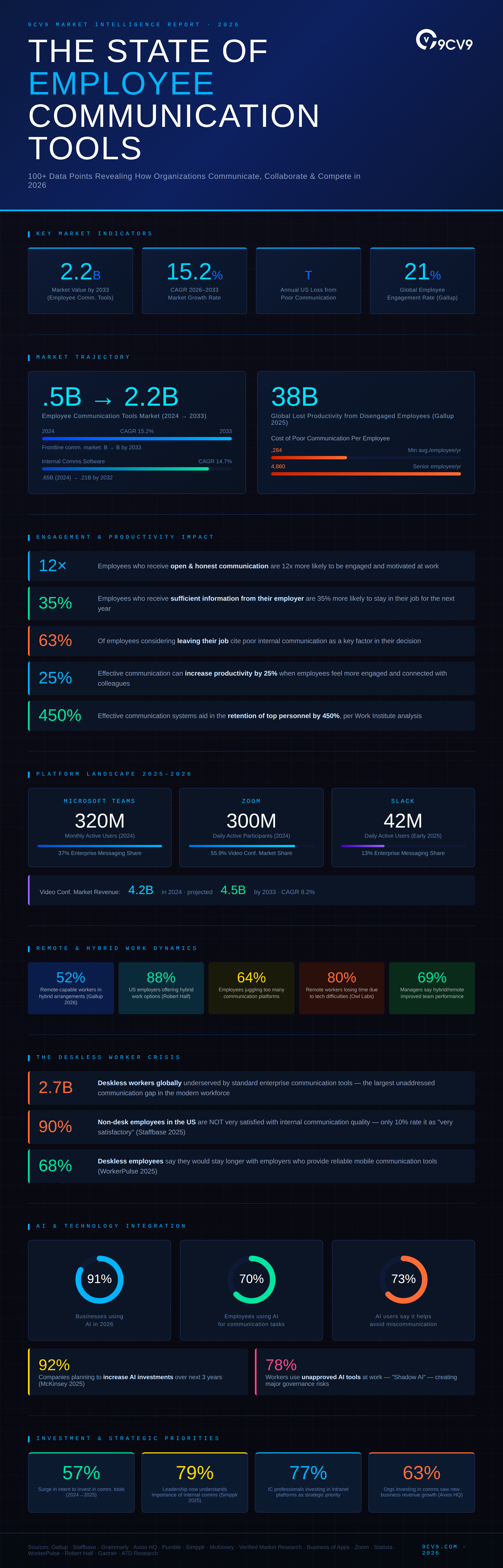
- Only 21% of employees worldwide are engaged at work, costing the global economy $438 billion in lost productivity annually (Gallup 2025).
With nearly four-fifths of the global workforce functionally disengaged, the relationship between communication quality and engagement takes on enormous strategic and economic significance for every organization. - If the workforce were fully engaged, the world economy would add $9.6 trillion in productivity annually, per Gallup.
The $9.6 trillion productivity potential of full engagement is a staggering number that reframes communication investment from a cost center to one of the highest-impact economic levers available to organizational leaders. - Only 26% of employees are engaged in their work, per the Achievers Workforce Institute’s 2026 Workforce Report.
With engagement stagnant at a quarter of the workforce, organizations that deploy targeted communication tools to connect employees to purpose and leadership stand to gain substantial competitive advantage. - 70% of team engagement depends on the manager, per Gallup 2025.
This statistic reframes the importance of manager-to-employee communication tools — equipping managers with effective channels to communicate recognition, direction, and feedback is essential to driving engagement at scale. - Employees are 12 times more likely to be engaged and motivated when they receive open and honest communication.
The magnitude of this engagement multiplier makes the case for radical transparency in internal communications — where candid, timely communication is not a cultural aspiration but a measurable business driver. - Employees who receive sufficient information from their employer are 35% more likely to stay in their jobs for the next year.
Retention is one of the most quantifiable ROI metrics for internal communication investment — preventing even one senior departure can justify the annual cost of an enterprise communication platform. - 63% of employees who are considering leaving their jobs cite poor internal communication as a key factor (Staffbase 2024).
The fact that the majority of potential leavers identify communication failure as a primary push factor should alarm HR and executive teams — and prompt urgent investment in communication infrastructure. - Effective communication systems aid in the retention of top personnel by 450%, according to a Work Institute analysis.
A 4.5x improvement in retention through better communication systems is among the most compelling ROI arguments in enterprise software — transforming communication investment from discretionary to strategic necessity. - 22% of employees have quit a job because they didn’t feel trusted or heard; good communication can cut turnover by 51%.
With more than one in five departures driven by feeling unheard, communication tools that enable two-way dialogue — not just top-down broadcasts — are critical for modern workforce retention strategies. - 37% of employees say consistent communication cadence from leadership is their top request.
Regularity matters as much as content — employees want to hear from leadership not just in times of crisis but on a predictable schedule, making cadence-focused communication tools a high-priority investment. - 63% of organizations that increased investment in communications saw new business revenue improve (Axios HQ 2025).
The correlation between internal communication investment and external revenue growth reveals that employee communication is not a purely internal concern — it is a customer experience and competitive differentiator. - 66% of organizations that increased investment in communications saw improved net-dollar retention.
Net-dollar retention, a core SaaS growth metric, improving in lock-step with communication investment proves that engaged, well-informed employees deliver better customer outcomes — closing the loop between internal comms and external performance.
Digital Communication Habits & Channels
- The average office worker receives approximately 117 emails per day and sends about 31.
The sheer volume of daily email traffic confirms that inbox overload remains a structural challenge — creating powerful market pull for alternative communication channels like messaging apps, intranets, and digital signage. - Knowledge workers spend approximately 19 hours per week on writing tasks like emails and reports.
Nearly half the working week consumed by written communication underscores why AI-assisted writing tools, smarter messaging platforms, and communication workflow automation are among the fastest-growing subcategories in the market. - 50% of employees use online chat or project management tools to communicate with colleagues (Pumble 2024).
The mainstream adoption of chat-based and task-linked communication tools signals a generational shift away from email as the default internal communication medium — reshaping what a “communication strategy” must include. - Employees spend 28% of the workweek managing emails, per McKinsey.
McKinsey’s finding that nearly a third of the workweek is consumed by email management makes a compelling case for investment in asynchronous communication tools that reduce inbox dependency without losing communication richness. - 76% of professionals say work communication has increased over the past year.
Rising communication volume is a double-edged sword — while it reflects greater organizational connectivity, it also increases the risk of cognitive overload, making intelligent filtering and channel management tools increasingly valuable. - 61% of knowledge workers prefer real-time communication, and 55% communicate synchronously most of the time.
The preference for synchronous communication among knowledge workers puts pressure on organizations to provide high-quality real-time channels — from messaging to video — that don’t degrade at scale. - 56% of professionals report occasionally missing key updates due to communication overload.
More than half the workforce is regularly losing sight of critical information — a statistic that quantifies the communication reach problem that modern employee communication platforms are specifically designed to solve. - 84% of business leaders say decreased productivity is a major consequence of ineffective communication.
When the vast majority of organizational leaders identify poor communication as a direct productivity inhibitor, the business case for communication tools investment goes beyond HR optics to operational imperative. - SMS communications have a 90% read rate within five minutes — critical for urgent updates.
No other communication channel matches SMS for immediacy and read rate — making text-based communication tools essential for time-sensitive operational updates, particularly in frontline and field worker environments.
Frontline & Deskless Worker Communication
- 2.7 billion deskless workers globally are underserved by standard enterprise communication tools.
The world’s largest workforce segment — comprising manufacturing, healthcare, logistics, and retail workers — remains largely disconnected from digital communication infrastructure, representing a massive greenfield opportunity for specialized platforms. - Only 10% of non-desk employees in the U.S. are very satisfied with internal communication at their workplaces (Staffbase 2025).
A 90% dissatisfaction rate among frontline workers is one of the most striking statistics in the communications industry — and a direct market catalyst for mobile-first, device-agnostic communication solutions. - 40% of deskless employees in the U.S. rate the quality of internal communication as “fair” or “poor” (Staffbase 2025).
Nearly half of frontline workers consider their employer’s communication quality substandard — a perception gap that directly correlates with higher absenteeism, turnover, and safety incident rates in high-risk industries. - 68% of deskless employees say they would stay longer with employers who provide reliable mobile communication tools (WorkerPulse 2025).
Retention among the hardest-to-reach segment of the workforce is directly tied to communication technology access — giving organizations that invest in mobile-first platforms a significant advantage in attracting and retaining frontline talent. - 60% of frontline employees miss critical updates when mobile communication tools are not available.
The majority of frontline workers are operating with incomplete information in the absence of dedicated mobile communication tools — creating operational risk, compliance failures, and safety vulnerabilities that have measurable business consequences. - Companies using mobile-first communication tools for deskless workers saw 30–40% improvement in compliance with safety updates (Frontline Insights 2024).
One of the most compelling ROI cases for frontline communication tools is their direct impact on safety compliance — where a 30–40% improvement can translate into avoided accidents, reduced liability, and lower insurance costs. - Organizations using mobile communication tools for deskless workers report up to 20% reduction in error correction time.
Beyond safety, communication quality improvements among frontline workers reduce operational rework — with a 20% reduction in error correction time delivering tangible cost savings across manufacturing, logistics, and field service. - 52% of desk-based employees feel their feedback is considered during change processes, versus only 39% of non-desk employees (Staffbase 2025).
The 13-percentage-point gap in perceived feedback inclusion between desk and non-desk workers highlights a systemic equity problem in internal communications that purpose-built frontline platforms are uniquely positioned to address.
Platform-Specific Statistics
- Microsoft Teams reached 320 million monthly active users globally by 2024.
Microsoft Teams’ scale is unmatched in the enterprise communication market — its dominance reflects the commercial power of bundling communication tools within existing enterprise software subscriptions rather than competing as standalone products. - Microsoft Teams holds approximately 37% of the enterprise messaging market share, per Statista.
Holding more than a third of the enterprise messaging market, Teams has established itself as the de facto communication standard for large organizations — presenting a significant integration challenge and opportunity for competing platforms. - Slack reported 42 million daily active users globally by early 2025, a 12% year-over-year growth.
Slack’s double-digit user growth trajectory, even after Salesforce’s 2021 acquisition, demonstrates that a dedicated communication-first platform still commands strong organic demand — particularly in tech-forward, agile organizational cultures. - Slack holds approximately 13% of the enterprise messaging market share.
While significantly smaller than Teams by market share, Slack’s 13% represents tens of millions of highly engaged enterprise users — and its deepening integration with Salesforce’s CRM ecosystem is a structural growth catalyst heading into 2026. - Zoom has over 300 million daily active participants and generated $4.66 billion in annual revenue in 2024.
Zoom’s revenue and daily user scale confirm that video conferencing has transitioned from a pandemic emergency tool to a permanent component of enterprise communication infrastructure — with pricing power and enterprise feature expansion sustaining growth. - Zoom holds a dominant 55.9% of the global video conferencing market share (Statista 2024).
More than half the world’s video conferencing activity runs on Zoom — a market concentration that gives the platform extraordinary leverage in pricing, feature development, and ecosystem partnerships. - The global video conferencing market reached $14.2 billion in revenue in 2024, with business platforms accounting for 61% of total revenue.
The strong business-to-consumer revenue split confirms that video conferencing growth is fundamentally enterprise-driven — and that organizations remain willing to pay premium rates for reliable, feature-rich video communication platforms. - Zoom users report an average of 6.7 meetings per week, versus 4.9 for Teams users and 4.2 for Google Meet users.
The differential in meeting frequency by platform offers insight into organizational communication cultures — Zoom users’ higher meeting cadence suggests that video-first work habits have taken deeper root in Zoom-centric organizations. - 87% of companies using Zoom also subscribe to at least one paid feature.
Zoom’s high paid feature attachment rate signals strong enterprise willingness to invest in premium communication capabilities — a positive indicator for upsell growth strategies across the video conferencing vendor landscape. - More than 62,380 companies worldwide are expected to use Slack in 2025, while Teams is expected to be used by 46,500 companies.
Slack’s broader organizational footprint in terms of distinct company accounts reflects its appeal to a wider range of business sizes, from early-stage startups to large enterprises, compared to Teams’ more concentrated enterprise penetration. - 77% of Fortune 100 companies use Slack (Salesforce/Slack).
Near-universal Fortune 100 adoption of Slack represents the platform’s position as the gold standard for elite enterprise communication — with brand cachet that continues to support premium pricing and sticky customer relationships.
AI & Technology Integration
- 80% of employees use or have experimented with AI, with 69% using it for communication and related tasks (Pumble 2026).
AI-assisted communication is no longer experimental — it is becoming standard practice for the majority of knowledge workers, with clear implications for communication tool vendors who need to embed AI features to remain competitive. - 91% of businesses use AI in 2026, per Azumo research.
With AI adoption crossing the 90% threshold, communication tools that lack AI-assisted features — auto-summarization, smart search, translation, or sentiment analysis — will increasingly be seen as outdated by enterprise buyers. - 72% of companies have adopted AI in at least one business function (McKinsey Global Survey 2024).
The majority of companies are already on their AI journey, with communication and collaboration workflows among the earliest and most tangible application areas — reinforcing the demand for AI-native communication platforms. - 73% of AI users say AI helps them avoid miscommunication at work (High5Test 2025).
Nearly three-quarters of AI-enabled workers report a direct reduction in miscommunication — one of the most persistent and costly workplace problems — making AI integration a decisive feature differentiator for next-generation communication tools. - 92% of companies are planning to increase AI investments over the next three years (McKinsey 2025).
Near-universal intent to increase AI spending means communication tool vendors that have embedded AI capabilities are positioned to capture a larger share of enterprise technology budgets in the medium term. - 78% of workers use unapproved AI tools at work without IT oversight, so-called “shadow AI.”
The majority of AI usage at work operates outside sanctioned IT frameworks — a risk management and governance challenge that is accelerating demand for officially approved, integrated AI communication platforms with compliance controls. - Germany leads intranet adoption at 61%, followed by Australia (50%), Switzerland (46%), and the UK (45%), while the US lags at 39% (Staffbase 2025).
The significant regional variation in intranet adoption rates reveals untapped market potential, particularly in North America and parts of Asia — where the case for centralized communication platforms has yet to reach maturity. - 79% of respondents say leadership now understands the importance of internal communications (Simpplr 2025).
Near-universal executive awareness of internal communication’s strategic importance marks a turning point — internal comms teams are finally earning a seat at the table, driving increased budgets and investment in communication technology.
Remote & Hybrid Work Impact
- 52% of remote-capable workers operate in hybrid arrangements as of 2026 (Gallup).
Hybrid work has become the statistical norm for knowledge workers — and with it, the demand for communication tools that bridge the digital-physical divide has become a non-negotiable element of the enterprise technology stack. - Approximately 20% of U.S. full-time employees work entirely remotely and 28% work in a hybrid model as of early 2026 (Gallup).
With nearly half of all U.S. knowledge workers having some remote component to their work, the addressable market for digital communication tools has permanently expanded beyond pre-pandemic levels. - 88% of U.S. employers provide some hybrid work options (Robert Half).
The near-universal adoption of hybrid work policies across U.S. employers has created a structural baseline demand for communication tools that support distributed collaboration — making communication software a table-stakes investment. - 83% of workers favor a mix of remote and in-office days globally.
The overwhelming preference for hybrid work among employees globally ensures that organizations cannot revert to pre-pandemic communication norms — locking in long-term demand for tools that support distributed team communication. - 69% of managers say hybrid or remote work has improved their teams’ performance (Owl Labs).
The majority of managers now report performance improvements under hybrid models — a vindication of flexible work that simultaneously validates the communication technology investments required to support it. - 64% of employees said they juggle too many communication platforms in hybrid settings (Owl Labs 2023).
Platform proliferation is creating cognitive overload for the majority of hybrid workers — driving demand for unified communication platforms that consolidate channels, reduce friction, and deliver a single pane of glass for workplace connectivity. - 8 in 10 remote workers reported losing time due to technical difficulties with communication tools in 2025 (Owl Labs).
The near-ubiquitous experience of technology-induced time loss among remote workers quantifies the hidden cost of poor communication tool UX — and the premium that enterprise buyers are increasingly willing to pay for reliability and ease of use. - Hybrid job postings jumped from 15% in Q2 2023 to 24% in Q2 2025, while fully on-site roles continue to decline.
The structural shift in labor market demand toward hybrid roles directly fuels growth in employee communication tools — companies advertising hybrid positions must equip their workforce with the digital infrastructure to support that model effectively.
Communication Culture & Leadership
- 93% of business leaders agree that communication is the backbone of business (Passive Secrets 2026).
Near-total consensus among business leaders on communication’s foundational importance to organizational success creates a powerful tailwind for communication software adoption — where cultural alignment accelerates technology investment. - 75% of employees identify effective communication as a top leadership attribute.
When three-quarters of employees rank communication as a defining leadership skill, organizations that equip their leaders with advanced communication tools gain a tangible advantage in leader credibility, employee trust, and workforce alignment. - Only 7% of U.S. workers strongly agree that communication in their workplace is very accurate, open, and timely.
The strikingly low single-digit percentage of workers who perceive their workplace communication as excellent highlights how vast the improvement opportunity is — and the competitive advantage awaiting organizations that close this gap. - 46% of workers believe they receive open and honest communication in their workplace.
A slight majority of employees feeling they are not receiving honest communication from their organizations creates fertile ground for disengagement, attrition, and reduced performance — all problems that structured communication tools can directly address. - 79% of employees say the quality of communication they get from leaders directly affects their productivity, motivation, and job satisfaction.
The triple impact of communication quality on productivity, motivation, and satisfaction — affecting three of the most critical workforce performance dimensions simultaneously — makes leader communication the highest-leverage communication investment an organization can make. - Only 14% of employees agree that their company communicates its values well, despite 44% of leaders believing their staff are fully on board.
The 30-percentage-point perception gap between leaders and employees on values communication is a structural alignment failure — one that purpose-built internal communication platforms, with measurable reach and engagement analytics, are specifically designed to close. - 67% of employees value communication from their direct supervisor more than from senior leaders.
The primacy of direct manager communication over C-suite messaging has important implications for communication tool design — platforms that empower team-level managers to communicate effectively are often more impactful than those focused solely on executive broadcast capabilities. - 86% of employees and executives cite lack of effective collaboration and communication as the main cause of workplace failures.
With overwhelming consensus across organizational hierarchies that communication failure is the root cause of most workplace problems, the investment case for communication tools becomes one of operational risk management, not just productivity optimization.
Meeting Statistics
- The average employee spends 11.3 hours per week in meetings, with large companies (1,000+ employees) averaging 12.8 hours.
The meeting time burden — exceeding a quarter of the standard workweek for many employees — is simultaneously one of the biggest productivity challenges and one of the clearest drivers of demand for asynchronous communication and meeting efficiency tools. - 92% of professionals admit to multitasking during video calls.
The near-universal prevalence of multitasking in video meetings signals a quality problem in virtual communication culture — creating demand for meeting tools with AI-powered summaries, shorter meeting formats, and structured async alternatives. - Reducing unnecessary meetings could save companies with 100 employees approximately $2.5 million per year.
A seven-figure annual savings opportunity from meeting rationalization alone makes meeting management and async communication tools among the highest-ROI investments in the employee communication stack. - 54% of employees want post-meeting summaries and action items, but only 39% report receiving them (Zoom).
The gap between demand for meeting accountability tools and actual delivery highlights an underserved workflow need — a gap that AI-powered meeting assistants and communication tools with summarization capabilities are rapidly closing. - Remote workers attend an average of 7.3 video calls per week in 2026.
More than one video call per working day has become the norm for remote employees — amplifying both the importance of high-quality video infrastructure and the urgency of video fatigue management within enterprise communication strategies.
Communication Challenges & Well-Being
- 53% of employees have experienced burnout, stress, and fatigue due to communication breakdowns in their business.
When more than half the workforce has experienced burnout attributable to communication dysfunction, investing in better communication tools is not just a productivity initiative — it is a workforce health and resilience imperative. - 40% of survey respondents have experienced burnout, stress, and fatigue due to workplace communication issues (Project.co 2026).
Even at the lower bound of research estimates, a 40% burnout attribution rate to communication issues represents a significant occupational health challenge — reinforcing the case for tools that streamline, simplify, and humanize workplace communication. - 66% of professionals agree that the expectation to always be connected contributes to their burnout and stress levels.
The “always on” communication culture enabled by digital tools is becoming a double-edged sword — driving demand for communication platforms with boundary-setting features, notification controls, and structured async workflows. - 53% of employees feel pressured to respond to messages quickly, even outside of work hours.
More than half the workforce experiences pressure-driven communication patterns that erode work-life boundaries — making communication tools with thoughtful availability features and async-first design increasingly valued in enterprise procurement decisions. - 69% of workers say they will work harder if they receive positive employee feedback (Passive Secrets 2026).
The productivity impact of feedback-rich communication cultures is quantified and significant — organizations that invest in tools enabling frequent, real-time recognition are creating a measurable performance multiplier across their workforce. - 63% of people considering quitting their jobs cited poor internal communication as influencing their decision (Pumble 2026).
With nearly two-thirds of flight-risk employees linking their intention to leave to poor communication, improving internal communication is not just a culture play — it is a direct intervention in one of the most expensive talent challenges facing modern organizations.
Investment & Future Trends
- 33% of internal communications teams plan to invest in new communication tools in 2025, with 30% actively considering it — a 57% increase in investment intent compared to 2024.
A 57% year-over-year surge in investment intent among internal communications teams signals that the market is entering an accelerated adoption phase — with organizations transitioning from reactive to proactive communication infrastructure investment. - Only 34% of internal communications teams have a dedicated budget (Workshop 2025).
With two-thirds of internal comms teams lacking ring-fenced budgets, the transition to strategic communication investment is still nascent — representing both a structural market challenge and an immense opportunity for vendors who can demonstrate clear ROI. - 77% of internal communications professionals are investing in intranet platforms as a strategic priority (Workshop 2025).
The broad consensus around intranet investment among communications professionals confirms that centralized, searchable, and personalized internal content platforms are becoming the communication hub of the modern digital workplace. - 85% of employees are most motivated when routinely informed about company news and information (Trade Press Services).
The motivational power of organizational transparency is significant and consistent across research — organizations that invest in tools enabling regular, reliable internal communications reap direct engagement and productivity dividends. - 73% of employees believe effective communication positively influences their job performance (U.S. Bureau of Labor Statistics).
The BLS endorsement of communication’s impact on job performance lends statistical credibility to the link between communication quality and individual productivity — framing communication tool investment as workforce development, not just IT infrastructure. - 33% of leaders were forced to set aside their primary tasks to address communication failures in 2025 (Axios HQ).
Leadership time wasted on firefighting communication failures is a quantifiable executive productivity cost — reinforcing the case for proactive communication infrastructure that prevents downstream issues rather than requiring reactive management. - Companies with formal communication training programs invest an average of $1,200 per employee annually (ATD Research 2024).
The per-employee investment benchmark for communication capability development provides a useful budget anchor for organizations building the business case for communication tools — where software costs are often a fraction of training expenditure. - 40% of HR leaders cite communication training as their top Learning & Development priority for 2025 (Gartner).
Communication’s ascent to the top of the HR learning agenda reflects the growing organizational recognition that technical skills alone are insufficient — and that communication competency is the connective tissue of all other workplace performance.
Conclusion
The Top 105 Employee Communication Tools Statistics, Data & Trends in 2026 highlight the growing importance of effective workplace communication in driving employee engagement, organizational productivity, and long-term business success. As businesses adapt to hybrid work environments, distributed teams, digital transformation, and changing employee expectations, investing in reliable employee communication tools and internal communication software has become a strategic priority rather than an optional operational expense.
The statistics reveal substantial growth opportunities within the employee communication technology market. With the global employee communication tools market projected to expand from $3.5 billion in 2024 to $12.2 billion by 2033, at a compound annual growth rate of 15.2%, demand for modern workplace communication solutions is expected to remain strong. Organizations are increasingly recognizing the value of centralized communication platforms, employee engagement software, instant messaging applications, and AI-powered collaboration tools in improving information accessibility, strengthening teamwork, and reducing operational inefficiencies.
However, the financial and human costs of ineffective workplace communication remain significant. Research estimates that poor communication can cost businesses between $9,284 and $30,000 per employee annually, while employees lose approximately 13 hours per week to communication-related inefficiencies. Furthermore, with only 21% of employees worldwide engaged at work according to Gallup’s 2025 findings, organizations face mounting pressure to improve internal communication strategies, strengthen leadership transparency, and create more inclusive workplace environments. These challenges demonstrate why effective employee communication is closely connected to workforce retention, job satisfaction, and overall business performance.
Another major trend shaping the employee communication tools industry in 2026 is the increasing adoption of artificial intelligence, mobile-first communication platforms, and integrated digital workplace solutions. AI-powered features such as automated message summaries, intelligent content recommendations, real-time translation, and communication analytics are helping businesses streamline information sharing and reduce administrative workloads. Meanwhile, the communication needs of approximately 2.7 billion deskless workers worldwide are creating additional opportunities for organizations to implement accessible, mobile-friendly solutions that connect frontline employees with managers and leadership teams.
Looking ahead, the future of employee communication software will likely be shaped by greater personalization, seamless platform integrations, data-driven communication strategies, and stronger support for asynchronous collaboration. Businesses that prioritize two-way communication, employee feedback, information transparency, and communication accessibility will be better positioned to build engaged, productive, and resilient workforces. However, technology alone is not enough; successful implementation also requires clear communication policies, leadership commitment, employee training, and continuous performance measurement.
Ultimately, these 105 employee communication tools statistics and trends for 2026 demonstrate that effective workplace communication is fundamental to sustainable organizational growth. For HR professionals, internal communications teams, business executives, and IT decision-makers, the key takeaway is clear: investing in the right employee communication tools, supported by a well-defined internal communication strategy, can help organizations reduce communication barriers, improve employee experiences, strengthen collaboration, and achieve better business outcomes in an increasingly connected and competitive digital workplace.
If you find this article useful, why not share it with your hiring manager and C-level suite friends and also leave a nice comment below?
We, at the 9cv9 Research Team, strive to bring the latest and most meaningful data, guides, and statistics to your doorstep.
To get access to top-quality guides, click over to 9cv9 Blog.
To hire top talents using our modern AI-powered recruitment agency, find out more at 9cv9 Modern AI-Powered Recruitment Agency.
People Also Ask
What are employee communication tools?
Employee communication tools are digital platforms that help organizations share information, collaborate, and connect employees. They include instant messaging applications, internal communication software, company intranets, video conferencing platforms, and employee engagement solutions.
What is the employee communication tools market size in 2026?
The global employee communication tools market was valued at approximately $3.5 billion in 2024 and is projected to reach $12.2 billion by 2033, growing at a compound annual growth rate (CAGR) of 15.2%.
How fast is the employee communication software market growing?
The employee communication tools market is projected to grow at a CAGR of 15.2% through 2033. Growth is supported by digital workplace transformation, hybrid work adoption, employee engagement initiatives, and demand for integrated communication platforms.
Why are employee communication tools important in 2026?
Employee communication tools improve collaboration, information sharing, productivity, and employee engagement. In 2026, they are increasingly important for connecting remote, hybrid, and frontline workers while reducing communication barriers and operational inefficiencies.
What are the latest employee communication tools statistics for 2026?
Key statistics include a projected $12.2 billion market by 2033, 68% of employees reporting productivity losses from poor communication, and 84% of business leaders identifying decreased productivity as a major consequence of ineffective communication.
How much does poor workplace communication cost businesses?
Research estimates that ineffective workplace communication costs businesses between $9,284 and $30,000 per employee annually. These losses result from misunderstandings, duplicated work, delayed decisions, reduced productivity, and inefficient collaboration.
How many hours do employees waste due to poor communication?
Employees waste approximately 13 hours per week on ineffective communication, according to Grammarly research. This represents nearly one-third of a standard 40-hour workweek and highlights the need for more efficient workplace communication systems.
How do employee communication tools improve productivity?
Employee communication tools improve productivity by centralizing information, reducing unnecessary meetings, accelerating decision-making, and supporting collaboration. Research indicates that 72% of business leaders believe effective communication improves team productivity.
What percentage of employees experience poor workplace communication?
Research indicates that 68% of employees waste too much time because of communication-related productivity problems. Additionally, 56% of professionals occasionally miss important workplace updates due to communication overload.
How does internal communication affect employee engagement?
Effective internal communication strengthens employee trust, motivation, and organizational alignment. Gallup reported that only 21% of employees worldwide were engaged in 2025, highlighting the importance of improving workplace communication and employee experiences.
How does employee communication software improve employee retention?
Employee communication software supports retention through transparent updates, employee feedback, recognition, and stronger manager relationships. Research indicates that employees receiving sufficient workplace information are 35% more likely to remain with their employer.
What percentage of employees leave jobs because of poor communication?
Research cited in the employee communication statistics indicates that 63% of employees considering leaving their jobs identify poor internal communication as an influential factor. This highlights the connection between communication quality and employee retention.
What are the most popular employee communication platforms in 2026?
Popular employee communication platforms include Microsoft Teams, Slack, Zoom, and Google Meet. These solutions provide workplace messaging, video conferencing, file sharing, collaboration features, and integrations with enterprise applications.
How many people use Microsoft Teams worldwide?
Microsoft Teams reached approximately 320 million monthly active users globally by 2024. Its widespread adoption reflects growing demand for integrated enterprise messaging, video conferencing, document collaboration, and digital workplace communication.
How many daily active users does Slack have?
The supplied research estimates that Slack reached approximately 42 million daily active users by early 2025, representing 12% year-over-year growth. Slack is widely used for team messaging, workplace collaboration, workflow automation, and application integrations.
What is the market share of Microsoft Teams and Slack?
The supplied statistics estimate that Microsoft Teams holds approximately 37% of the enterprise messaging market, compared with Slack’s 13%. Market share estimates can vary depending on geography, measurement methodology, and software category definitions.
How are AI-powered employee communication tools changing workplaces?
AI-powered communication tools automate meeting summaries, improve workplace search, translate messages, and support content creation. Research indicates that 73% of surveyed AI users believe artificial intelligence helps them avoid workplace miscommunication.
What percentage of companies use AI in workplace communication?
McKinsey reported that 72% of companies had adopted AI in at least one business function in 2024. AI adoption supports workplace communication through automated summaries, intelligent messaging, content recommendations, and collaboration assistance.
What are the biggest employee communication trends in 2026?
Major employee communication trends in 2026 include AI-powered collaboration, mobile-first messaging, unified communication platforms, asynchronous communication, employee engagement analytics, personalized notifications, and stronger support for hybrid and frontline workers.
How do employee communication tools support remote work?
Employee communication tools support remote work through instant messaging, video conferencing, shared documents, project updates, and asynchronous collaboration. These features help distributed employees stay connected, coordinate responsibilities, and access important information.
What percentage of employees work in hybrid arrangements?
Gallup statistics cited in the research indicate that approximately 52% of remote-capable employees work in hybrid arrangements in 2026. This creates continued demand for digital communication platforms supporting collaboration across office and remote locations.
What communication challenges do hybrid employees face?
Hybrid employees face challenges such as communication overload, fragmented information, excessive meetings, and platform switching. Research indicates that 64% of employees reported managing too many communication platforms in hybrid work environments.
How many deskless workers are there worldwide?
Approximately 2.7 billion deskless workers worldwide work in industries such as healthcare, retail, manufacturing, logistics, and hospitality. Many require mobile-first communication solutions because traditional office communication systems are less accessible.
Why are mobile-first employee communication tools important?
Mobile-first communication tools help frontline and deskless employees access company announcements, safety updates, schedules, and team messages. They improve information accessibility for workers without dedicated desks, corporate computers, or regular email access.
What percentage of frontline workers are satisfied with internal communication?
Staffbase research cited in the statistics indicates that only 10% of non-desk employees in the United States are very satisfied with workplace internal communication. This highlights opportunities to improve frontline communication accessibility and effectiveness.
How many emails does the average office worker receive daily?
The supplied research estimates that the average office worker receives approximately 117 emails and sends 31 emails daily. High email volumes contribute to information overload and increase demand for workplace messaging, intelligent filtering, and collaboration tools.
How much time do employees spend in meetings each week?
Employees spend approximately 11.3 hours per week in meetings, according to the supplied statistics. In organizations with more than 1,000 employees, the average increases to 12.8 hours, highlighting opportunities for asynchronous communication and meeting optimization.
How does workplace communication affect employee burnout?
Poor workplace communication can contribute to stress, fatigue, and burnout. Research indicates that 66% of professionals believe expectations to remain constantly connected increase stress, while 53% feel pressured to respond to messages outside working hours.
What features should businesses look for in employee communication software?
Businesses should prioritize instant messaging, mobile accessibility, video conferencing, employee feedback, analytics, security, integrations, AI assistance, and notification management. The best platform depends on workforce size, communication needs, and existing technology.
What is the future of employee communication tools beyond 2026?
The future of employee communication tools will likely feature greater AI integration, personalized messaging, mobile-first experiences, intelligent automation, and unified collaboration platforms. Market growth projections suggest sustained demand for digital workplace communication solutions through 2033.
Sources
Wise Guy Reports
Verified Market Research
Verified Market Reports
Report Prime
Passive Secrets
Pumble
Electroiq
Gallup
Achievers Workforce Institute
Grammarly
Axios HQ
Staffbase
SQ Magazine
Business of Apps
DemandSage
Zoom
Zebracat
SpeakWise
High5Test
Weavix
GlobeNewswire
Azumo
Simpplr
Axero Solutions
Workshop
Betterwitholi
Gable
McKinsey & Company
Grand View Research