Key Takeaways
- Rapid Market Growth: The global emissions management software market is projected to reach USD 61.53 billion by 2035, growing at an 18.3% CAGR, driven by carbon accounting, ESG reporting, and sustainability regulations.
- Cloud Adoption and AI Innovation: Cloud-first solutions captured 73.7% of the carbon management software market in 2025, while AI-powered emissions tracking, automation, and predictive analytics are transforming sustainability management.
- Scope 3 Emissions and Regulatory Compliance: Scope 3 emissions can account for 70%–90% of corporate carbon footprints, accelerating demand for supply chain emissions tracking, greenhouse gas reporting, and comprehensive carbon management software.
Emissions management software is a rapidly growing industry in 2026, driven by carbon accounting, ESG reporting, and climate regulations. The global market could reach USD 61.53 billion by 2035, growing at an 18.3% CAGR. Explore 105 key statistics covering market growth, cloud adoption, AI-powered emissions tracking, Scope 3 reporting, and sustainability trends.
Emissions management software has become an essential business technology in 2026 as organizations worldwide face increasing pressure to measure, monitor, report, and reduce their greenhouse gas (GHG) emissions. With stricter environmental regulations, growing investor expectations, and ambitious corporate net-zero commitments, businesses are increasingly adopting carbon accounting software, emissions tracking platforms, and AI-powered sustainability management solutions to improve environmental performance and maintain regulatory compliance.
Also, read our article on the Top 10 Emissions Management Software To Use.

The global emissions management software market is experiencing significant growth. According to Market Research Future, the market was valued at approximately USD 9.69 billion in 2024 and is projected to reach USD 61.53 billion by 2035, expanding at a compound annual growth rate (CAGR) of 18.3%. Meanwhile, Research Nester estimates the market could reach USD 22 billion in 2026, highlighting the substantial investment flowing into digital emissions monitoring and carbon management technologies. Although market estimates vary depending on research methodologies and software categories, industry forecasts consistently indicate strong long-term growth.
Cloud-based emissions management solutions are also transforming how organizations manage their environmental data. Mordor Intelligence reports that cloud-first deployments accounted for 73.7% of the carbon management software market in 2025, reflecting growing demand for scalable platforms that support automated data collection, real-time emissions monitoring, and centralized sustainability reporting. Large enterprises continue to dominate spending, representing approximately 71.4% of the market, while small and medium-sized enterprises are emerging as an important growth segment.

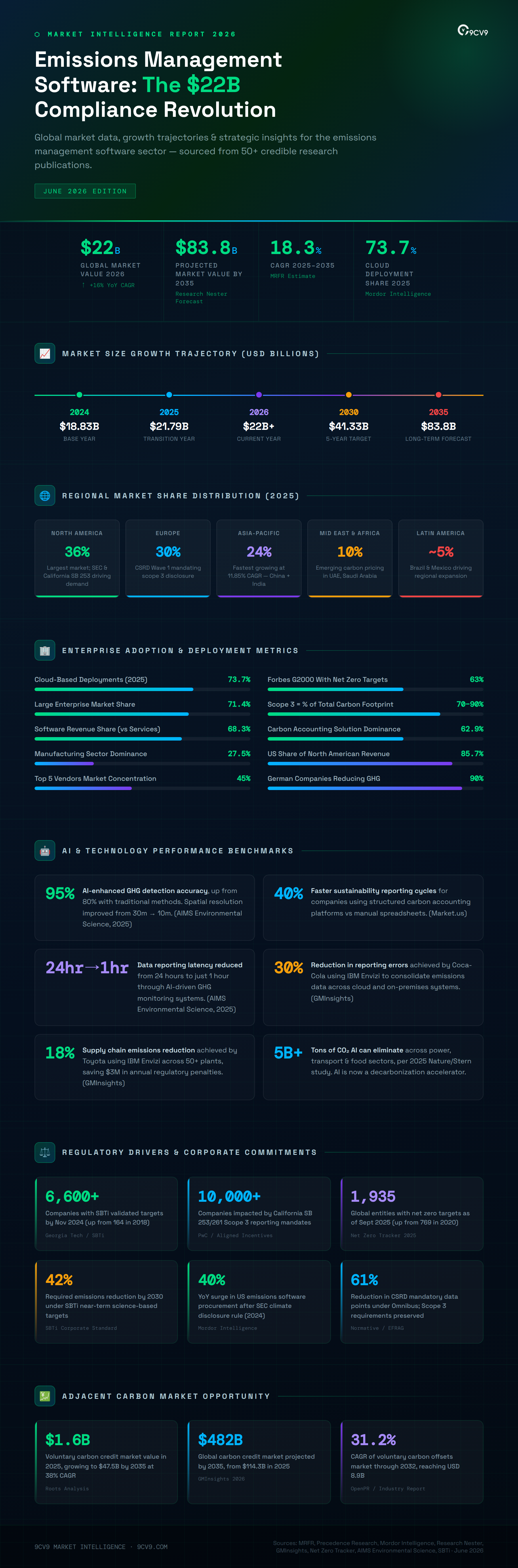
Geographically, North America remains a leading market, accounting for approximately 35.85% of global carbon management software revenue in 2025. Europe continues to drive demand through sustainability disclosure requirements, including the Corporate Sustainability Reporting Directive (CSRD), while Asia-Pacific is emerging as a significant growth region as businesses accelerate their decarbonization initiatives.
One of the most important emissions management software trends in 2026 is the growing emphasis on Scope 3 emissions tracking and supply chain carbon accounting. Scope 3 emissions can represent 70% to 90% of an organization’s total carbon footprint, making accurate supplier data collection and value-chain emissions reporting increasingly important. Businesses are therefore investing in advanced platforms that integrate Scope 1, Scope 2, and Scope 3 emissions measurement with ESG reporting, regulatory compliance, and sustainability performance analytics.
Artificial intelligence (AI), machine learning, Internet of Things (IoT) technologies, and predictive analytics are further reshaping the emissions management software industry. Research highlighted in the statistics indicates that AI-driven greenhouse gas monitoring systems have demonstrated improvements in detection accuracy from 80% to 95% in monitored environments, while certain AI-powered energy management applications have achieved energy cost reductions of up to 15%. These developments illustrate the potential for intelligent emissions management technologies to improve operational efficiency, strengthen reporting accuracy, and support measurable carbon reduction strategies.
Despite growing investment, significant challenges remain. Accenture’s research found that only 18% of companies disclosing emissions data were on track to achieve operational net-zero emissions by 2050, emphasizing the gap between corporate climate commitments and measurable environmental progress. This creates opportunities for emissions management software providers to deliver more sophisticated carbon tracking, emissions forecasting, automated reporting, and decarbonization planning capabilities.
In this comprehensive guide to the Top 105 Emissions Management Software Statistics, Data & Trends in 2026, we examine the latest market size estimates, industry growth forecasts, software adoption rates, regional market shares, cloud deployment trends, AI innovations, regulatory developments, and enterprise sustainability investments. Whether you are a business leader, sustainability professional, ESG consultant, software vendor, investor, or technology decision-maker, these statistics provide valuable insights into the evolving emissions management software market and the key trends shaping its future through 2030 and beyond.
Before we venture further into this article, we would like to share who we are and what we do.
About 9cv9
9cv9 is a business tech startup based in Singapore and Asia, with a strong presence all over the world.
With over ten years of startup and business experience, and being highly involved in connecting with thousands of companies and startups, the 9cv9 team has listed some of the top and best companies/tools in this review.
If you like to get your company listed in our top B2B software reviews, check out our world-class 9cv9 Media and PR service and pricing plans here.
Top 105 Emissions Management Software Statistics, Data & Trends in 2026
MARKET SIZE & GROWTH
1. The global Emissions Management Software market was valued at USD 9.689 billion in 2024, according to Market Research Future.
Emissions management software has crossed the multi-billion-dollar threshold, reflecting the growing urgency among enterprises worldwide to measure, manage, and mitigate their carbon output.
2. The Emissions Management Software market is projected to grow from USD 11.46 billion in 2025 to USD 61.53 billion by 2035, at a CAGR of 18.3% (Market Research Future).
This near-sixfold growth trajectory underscores how emissions tracking has evolved from a compliance checkbox into a core business investment for organizations across every industry.
3. The global emission management software market was valued at USD 18.83 billion in 2024 and is forecast to reach USD 78.72 billion by 2034, at a CAGR of 15.38% (Precedence Research).
With a CAGR exceeding 15%, emissions management software ranks among the fastest-growing enterprise software segments, outpacing many traditional SaaS categories.
4. The Emissions Management Software market size was valued at USD 18.91 billion in 2024 and is projected to exceed USD 124.49 billion by 2037, at a CAGR of over 15.6% (Research Nester).
These long-range projections confirm that emissions management software adoption is not cyclical — it is structurally anchored to permanently tightening global regulatory frameworks.
5. The emissions management software market is assessed at USD 22 billion in 2026, and is projected to reach USD 83.8 billion by 2035, at a CAGR of 16% (Research Nester, 2025).
The market’s 2026 valuation of $22 billion signals that adoption has moved well beyond the early-adopter phase, with mid-market enterprises now entering the fold en masse.
6. The Emissions Management Software Market will grow from USD 8.88 billion in 2024 to USD 22.13 billion by 2030, at a CAGR of 16.44% (TechSci Research).
A doubling of market size within six years highlights the compounding pressure of ESG mandates, investor scrutiny, and evolving climate disclosure regulations on software procurement decisions.
7. The Carbon Footprint Management Software market was valued at USD 16.67 billion in 2025 and is expected to grow to USD 20.05 billion in 2026 at a CAGR of 20.3% (The Business Research Company).
A 20%-plus CAGR reflects exceptional acceleration, driven by corporate sustainability deadlines, CSRD wave-one reporting, and investor pressure for verifiable emissions data.
8. The Carbon Footprint Management Software market is expected to reach USD 41.33 billion by 2030, at a CAGR of 19.8% (The Business Research Company).
By the end of the decade, carbon footprint management software will represent a market nearly four times its 2023 size, creating a massive window of opportunity for both established vendors and new entrants.
9. The Carbon Management Software market was valued at USD 2.87 billion in 2024 and is projected to touch USD 3.67 billion in 2025, rising to USD 33.41 billion by 2034, at a CAGR of 27.82% (Global Growth Insights).
At nearly 28% CAGR, carbon management software is growing at a pace that rivals AI infrastructure spending, as regulatory compliance transforms from optional to legally mandated.
10. The Carbon Management Software market grew from USD 13.08 billion in 2024 to USD 14.98 billion in 2025, and is expected to reach USD 28.63 billion by 2030, at a CAGR of 13.93% (Research and Markets).
This steady compound growth across multiple analyst estimates validates one consensus: emissions software spending is durable, non-discretionary, and accelerating globally.
11. The Carbon Accounting Software market is projected to grow from USD 11.25 billion in 2025 to USD 90.63 billion by 2035, at a CAGR of 23.2% (Market.us).
A CAGR of 23.2% places carbon accounting software among the top-tier growth categories in enterprise tech, fueled by mandatory GHG disclosure requirements and rising ESG investor demands.
12. The Carbon Accounting and Management Software market was estimated at USD 2.5 billion in 2025, projected to reach approximately USD 8 billion by 2033, at a CAGR of 15% (Market Report Analytics).
Even conservative market estimates show consistent double-digit growth, with no signs of slowdown given the wave of mandatory reporting frameworks taking effect through 2028.
13. The global Carbon Management Software market was valued at USD 18.3 billion in 2025 and is projected to reach USD 42.2 billion by 2034, at a CAGR of 9.77% (IMARC Group).
Even at the lower end of CAGR estimates, carbon management software is set to more than double in value within a decade, confirming its status as an essential enterprise infrastructure investment.
14. The Carbon Management Software Market size is estimated at USD 18.17 billion in 2026, expected to reach USD 31.5 billion by 2031, at a CAGR of 11.63% (Mordor Intelligence).
The 2026 milestone valuation of $18+ billion indicates that the emissions software market has definitively crossed from niche to mainstream enterprise software category.
15. The Carbon Management Software market grew from USD 14.98 billion in 2025 to USD 17.15 billion in 2026, expanding at a CAGR of 14.69% to reach USD 39.10 billion by 2032 (Research and Markets).
Year-on-year growth of over $2 billion in 2026 alone demonstrates that carbon management is receiving budgetary priority across industries, not just energy and manufacturing.
16. The Air Emissions Management Software market was estimated at USD 340.91 million in 2025 and is expected to reach USD 365.84 million in 2026, growing at a CAGR of 7.31% to reach USD 558.85 million by 2032 (360iResearch).
The air emissions sub-segment’s steady growth reflects industrial compliance demands in chemicals, automotive, and manufacturing — sectors facing strict particulate and NOx reporting rules.
DEPLOYMENT & CLOUD
17. Cloud-first deployments captured 73.7% of the carbon management software market share in 2025 (Mordor Intelligence).
Cloud dominance in emissions software reflects the SaaS-first buying preferences of sustainability teams, which require real-time data access, multi-site aggregation, and seamless framework updates.
18. Cloud-based deployment for carbon accounting software is anticipated to grow at the strongest rate, with a share of 55.84% in 2026 (Fortune Business Insights).
As reporting deadlines accelerate under CSRD and California’s SB 253/261, cloud-based platforms offer the speed-to-deployment advantage that on-premises solutions simply cannot match.
19. Cloud-based solutions now represent the majority of emissions management deployments, providing real-time data integration and automated analytics that significantly reduce manual reporting errors (Market.us).
The shift to cloud-native emissions platforms eliminates the versioning, maintenance, and audit-trail gaps that have long plagued spreadsheet-based carbon tracking.
20. The global Cloud Carbon Management System market is projected to reach a valuation of USD 12.5 billion by 2033, growing at a CAGR of 14.7% from 2025 to 2033 (Strategic Revenue Insights).
The dedicated cloud carbon management sub-market’s 14.7% CAGR reflects not just new enterprise adopters, but also platform migrations from legacy on-premises EHS software.
21. Software solutions account for 68.3% of 2025 carbon management software revenue, while service engagements are growing faster as companies outsource complex Scope 3 data harmonization (Mordor Intelligence).
The services growth trend signals that many organizations, particularly mid-market firms, lack in-house sustainability expertise and are turning to managed service models for emissions compliance.
22. The Carbon Footprint Management Software solutions segment is expected to dominate with 62.92% market share in 2026 (Fortune Business Insights).
With solutions outpacing services in market share, vendors are doubling down on self-serve platform capabilities and AI-driven automation to reduce dependency on implementation consulting.
REGIONAL BREAKDOWN
23. North America holds the largest carbon management software market share at 35.85% in 2025, retaining regional leadership (Mordor Intelligence).
North America’s regulatory environment — encompassing SEC climate disclosure rules, California’s SB 253/261, and voluntary carbon markets — continues to drive the highest per-enterprise spending on emissions platforms globally.
24. North America leads carbon management software adoption with approximately 36% share in 2025, driven by corporate net-zero mandates and investor disclosure pressure (Global Growth Insights).
The US alone contributes the lion’s share of this regional dominance, as institutional investors and proxy advisory firms make emissions data a key factor in capital allocation decisions.
25. North America dominates the carbon management software market with a market share of over 32.7% in 2025 (IMARC Group).
Across multiple analyst reports, North America consistently ranks first — validating that the combination of regulatory pressure, capital market demands, and technological readiness makes the region the global bellwether for emissions software adoption.
26. The US carbon accounting software market is valued at USD 4.19 billion in 2025 and is expected to grow to USD 29.69 billion by 2035, at a CAGR of 21.63% (Market.us).
The United States market’s 21%+ CAGR reflects the combined effect of SEC climate disclosure finalization, state-level regulations, and sustained investor pressure on public companies to report credible emissions data.
27. North America holds a 41.2% share of the carbon accounting software market in 2025, reaching USD 4.63 billion (Market.us).
North America’s near-majority share in carbon accounting specifically reflects the maturity of US corporations’ GHG Protocol adoption and the scale of public company disclosure obligations.
28. Asia-Pacific is the fastest-growing region for emissions management software, posting an 11.85% CAGR over the outlook period, driven by China’s dual-carbon policy and India’s decarbonization roadmap (Mordor Intelligence).
Asia-Pacific’s breakneck growth is a paradigm shift — industrial economies once seen as slow decarbonizers are now among the most aggressive adopters of digital emissions management tools.
29. Europe holds 30% of the carbon management software market share in 2025 (Global Growth Insights).
Europe’s strong market share reflects the CSRD mandate — the most comprehensive mandatory sustainability reporting regime globally — which requires thousands of large companies to produce audited Scope 1, 2, and 3 disclosures.
30. In Germany, over 90% of companies have taken steps to reduce greenhouse gas emissions, while about 80% have invested in energy efficiency (European Investment Bank, February 2025).
Germany’s near-universal corporate engagement with emissions reduction is driving one of Europe’s most active software procurement markets, supported by a USD 2.57 billion state aid program for industrial decarbonization.
31. The Middle East & Africa region accounts for approximately 10% of global carbon management software market share in 2025 (Global Growth Insights).
While MEA currently holds a smaller slice of the global market, rapidly expanding carbon pricing initiatives in Saudi Arabia, UAE, and South Africa are expected to drive adoption sharply upward through 2030.
32. The US alone accounts for 85.7% of North American carbon management software revenues in 2025 (IMARC Group).
The extraordinary US dominance within North America underscores how climate disclosure regulations, combined with shareholder activism, create a uniquely concentrated procurement environment for emissions software.
ORGANIZATIONAL ADOPTION
33. Large enterprises hold 71.4% of 2025 carbon management software spending, while SMEs will post a 12.1% CAGR through 2031 (Mordor Intelligence).
While large enterprises dominate current spending, the SME growth rate is nearly double the overall market average — signaling that democratized cloud-based solutions are finally making emissions management accessible to smaller organizations.
34. Large enterprises lead carbon accounting software adoption at 65%, leveraging emission tracking platforms and cloud-based technologies to optimize ESG reporting (Market.us).
Enterprise-grade emissions platforms provide the Scope 3 multi-tier supplier engagement, multi-framework reporting, and audit-grade data trails that large listed companies require for regulatory filings.
35. The Carbon Accounting and Management Software market for large enterprise solutions is projected to exceed USD 6 billion by 2028 (Market Report Analytics).
As enterprise sustainability teams grow from 2–3 staff to dedicated departments, software investment scales accordingly, with large enterprises increasingly viewing emissions platforms as core ERP-adjacent infrastructure.
36. SMEs represent a growing but less concentrated segment of emissions software end-users, with the shift to subscription models democratizing access (DataIntelo).
The subscription revolution has eliminated prohibitive upfront licensing costs, enabling SMEs to access enterprise-grade emissions tracking at price points previously reserved for large corporations.
37. The manufacturing sector leads carbon management software adoption with approximately 27.5% market share in 2025 (IMARC Group).
Manufacturing’s dominance in emissions software adoption reflects the sector’s high carbon intensity, complex supply chains, and exposure to both regulatory penalties and investor ESG scrutiny.
REGULATORY DRIVERS
38. Under the EU’s Corporate Sustainability Reporting Directive (CSRD), large public-interest entities must report for fiscal year 2025 with reports due in 2026 (iPoint Systems).
The CSRD’s phased rollout represents the most consequential regulatory catalyst in emissions software history — triggering a procurement wave among thousands of European and EU-exposed global companies.
39. Scope 3 emissions typically represent 70–90% of a company’s total carbon footprint, making supply chain data collection a mission-critical software function (Re-Flow.io).
The Scope 3 challenge is not just a reporting problem — it is a data architecture challenge that purpose-built emissions management platforms are uniquely positioned to solve through supplier engagement workflows.
40. The SEC’s March 2024 climate disclosure rule triggered a 40% year-over-year surge in US emissions software procurement (Mordor Intelligence).
Even amid subsequent legal challenges to the SEC rule, the compliance preparations it prompted have permanently elevated emissions software from optional to essential within US corporate IT budgets.
41. California’s SB 253 mandates Scope 3 reporting for any company operating in the state with more than USD 1 billion in annual revenue — potentially impacting over 10,000 public and private companies (PwC, Aligned Incentives).
California’s scope-3 mandate creates a de facto national US standard, as most large companies with California operations will need full value-chain emissions data regardless of federal-level delays.
42. CSRD’s phased mandatory data point requirements have been reduced by 61% (from ~1,100 to ~430) under the Omnibus simplification, though Scope 3 GHG disclosure requirements have been preserved (Normative).
The CSRD’s streamlining reduces compliance burden while protecting the core emissions transparency mandate — ensuring software demand remains robust even for companies previously deterred by reporting complexity.
43. ESRS E1 requires companies to disclose total gross Scope 3 GHG emissions, broken down by significant category including methodology and emission factor databases used (Normative).
The granularity of ESRS E1 disclosure requirements makes manual spreadsheet tracking practically untenable, creating a direct mandate for automated emissions management platforms with audit-grade traceability.
44. SBTi requires near-term targets to reduce emissions by at least 42% by 2030 from 2020 levels, and the number of validated companies grew from 164 in 2018 to over 6,600 by November 2024 (Georgia Tech).
SBTi’s exponential growth in corporate members creates a parallel demand driver for emissions software — companies cannot credibly commit to science-based targets without the tooling to measure and verify progress.
45. By end of 2023, 7,929 companies representing 39% of global market capitalization had committed to set SBTi targets (Georgia Tech).
When companies representing two-fifths of global market cap are bound by science-based emissions targets, the financial materiality of emissions management software is impossible to overstate.
46. As of September 2025, at least 1,935 entities have net zero targets — up from just 769 in December 2020 (Net Zero Tracker, Zerotracker.net).
A 150%+ increase in net zero commitments over five years has created a direct pipeline of organizations requiring sophisticated emissions management infrastructure to operationalize their pledges.
47. Almost two-thirds (63%) of Forbes Global 2000 companies have net zero targets, covering USD 36.6 trillion in revenue (Net Zero Stocktake 2025, Zerotracker.net).
With two-thirds of the world’s largest companies on record for net zero, emissions management software has graduated from a sustainability team tool to a board-level strategic asset.
48. Nearly one in three Forbes Global 2000 companies with net zero targets — 385 out of 1,245 — lack a clear roadmap to achieve them (Net Zero Stocktake 2025).
The 385-company gap between target-setting and credible planning represents a significant unmet software need — organizations that have committed publicly but lack the tools to actually track, model, or reduce emissions.
49. SBTi’s updated Corporate Net-Zero Standard V2.0 requires large companies to set net-zero targets within 1 year of commitment (down from 2 years) and introduces random compliance audits (Carbon Credits).
The tightening of SBTi’s governance timeline significantly compresses the window for software selection and implementation, intensifying demand for plug-and-play emissions platforms that reduce time-to-compliance.
50. Corporate climate target-setting increased 40% in 2025, with Asia emerging as a new center of gravity for net-zero commitments (SBTi, April 2026).
Asia’s 40% year-on-year surge in climate target-setting is reshaping the global emissions software market, with vendors now competing aggressively for market share in Japan, South Korea, India, and China.
TECHNOLOGY & AI
51. AI-driven GHG monitoring systems reduced data reporting latency from 24 hours to just 1 hour in research trials, increasing spatial resolution from 30 meters to 10 meters (AIMS Environmental Science, 2025).
Real-time emissions intelligence — previously only achievable with satellite infrastructure — is now accessible to industrial operators through AI-powered monitoring platforms integrated with IoT sensor networks.
52. AI systems enhanced GHG detection accuracy from 80% to 95% in monitored environments, enabling more precise identification of emission hotspots (AIMS Environmental Science, 2025).
A 15-percentage-point accuracy improvement in emissions detection is not merely technical progress — it translates to more defensible regulatory filings and lower risk of greenwashing liability.
53. For every 1% increase in the level of AI application within an enterprise, carbon emission intensity decreases by 0.0395% (Scientific Reports / Nature, 2025).
While incremental, the compounding effect of AI adoption on emissions intensity means that enterprises with mature AI deployments achieve measurably superior decarbonization outcomes over time.
54. AI-driven energy management systems can cut overall energy expenses by up to 15% through smart resource allocation (Energies Media, 2025).
A 15% reduction in energy costs through AI optimization represents a compelling ROI case for emissions management software, particularly for energy-intensive manufacturers still treating sustainability as a cost center.
55. AI can potentially cut over 5 billion tons of carbon emissions across three key sectors — power, road transport, and food/agriculture — according to a 2025 Nature study.
The scale of AI’s emissions reduction potential reinforces why emissions management software with embedded machine learning is increasingly seen not just as a compliance tool but as an active decarbonization accelerator.
56. Google reduced management costs by 40% using deep learning AI technology applied to energy and operations management (Scientific Reports / Nature, 2025).
Google’s real-world results validate the enterprise business case for AI-integrated emissions platforms — where the cost savings often outweigh the software investment within the first year of deployment.
57. Blockchain-based emissions tracking demonstrates up to 11% higher prediction accuracy and 4.47% higher overall accuracy compared to cloud-only solutions (Scientific Reports, 2025).
Blockchain’s immutable ledger architecture is becoming a critical differentiator in premium emissions management platforms, providing the audit-grade data integrity that institutional investors and regulators increasingly demand.
58. IoT applications in manufacturing are projected to generate between USD 1.2 and USD 3.7 trillion in annual value by 2025, with emissions monitoring forming a growing share of this value (Energies Media).
IoT-powered continuous emissions monitoring eliminates the manual meter-reading and spreadsheet-reconciliation workflows that historically made Scope 1 reporting the most error-prone segment of GHG disclosure.
59. Companies using IoT for energy management have seen costs drop by almost 40% through continuous machine monitoring (Energies Media, 2025).
The 40% cost reduction figure makes a powerful business case for IoT-integrated emissions platforms — transforming sustainability investments from cost centers into profit-protecting operational improvements.
60. BrainBox AI HVAC optimization has demonstrated 25% reductions in energy costs while simultaneously cutting carbon emissions in commercial buildings (Energies Media, 2025).
Single-purpose AI emissions tools in real estate are setting the benchmark for sector-specific emissions management, showing how targeted deployment can deliver faster ROI than broad-based platforms.
ENTERPRISE ADOPTION & ROI
61. Enterprises with structured sustainability strategies report up to 40% faster reporting cycles after adopting carbon accounting systems (Market.us).
Reporting cycle compression of 40% frees sustainability teams from manual data collection drudgery, allowing them to focus on strategic emissions reduction rather than backwards-looking compliance documentation.
62. Toyota partnered with IBM Envizi to monitor carbon emissions across more than 50 plants worldwide, reducing supply chain emissions by 18% and saving USD 3 million in annual regulatory penalties (GMInsights).
Toyota’s ROI case — measurable emissions cuts plus millions in avoided penalties — is precisely the kind of enterprise success story that accelerates peer adoption across the automotive and heavy manufacturing sectors.
63. Coca-Cola used IBM Envizi to consolidate emissions data from multiple sources, resulting in a 30% reduction in reporting errors and automated compliance with international climate standards (GMInsights).
Reporting error reduction is an underappreciated business case for emissions software — inaccurate GHG disclosures carry both reputational and legal risk in an era of mandatory third-party assurance.
64. Unilever used Salesforce Net Zero Cloud to automate emissions reporting for over 20,000 suppliers, meeting 2025 ESG objectives two years ahead of schedule (CSE-Net.org).
Unilever’s supplier engagement at scale demonstrates how cloud-native emissions platforms can tackle Scope 3 Category 1 complexity — the most data-intensive and previously intractable component of GHG inventory management.
65. A 83% of employees would consider changing jobs if their company didn’t practice strong CSR or sustainability, per a 2025 Zipdo survey (Coolset).
The talent retention dimension of sustainability is creating a secondary demand driver for emissions management software — companies increasingly need visible sustainability credentials to attract and retain top talent.
66. More than 70% of individual investors believe strong ESG practices can lead to higher returns (Coolset, citing survey data).
Investor conviction that ESG outperforms creates a financial market pull for emissions transparency tools — companies with credible, software-backed emissions disclosures enjoy lower cost of capital and broader investor appeal.
MARKET SEGMENTS & VERTICALS
67. The energy and utilities, manufacturing, transportation and logistics, oil and gas, and chemicals sectors are the five primary end-user verticals for emissions management software (DataIntelo).
The convergence of high emissions intensity and stringent regulatory exposure in these five sectors makes them the natural first movers in emissions software adoption, collectively representing the majority of current market demand.
68. The emission & carbon footprint tracking segment is expected to grow at the fastest rate from 2026 to 2035 within the energy management software space (Precedence Research).
The fastest growth in the tracking sub-segment reflects the regulatory imperative — companies must first accurately measure before they can credibly commit to reduction targets and avoid greenwashing liability.
69. North America led the energy management software market with a 35% share in 2025 (Precedence Research).
North America’s combined regulatory environment, corporate sustainability maturity, and digital infrastructure make it the global leader in energy-linked emissions management software adoption.
70. The Industrial Energy Management System (IEMS) market was valued at USD 28.78 billion in 2025 and is expected to grow to USD 47.45 billion by 2032, at a CAGR of 7.4% (Reanin).
Industrial IEMS platforms increasingly converge with emissions management software, as companies seek unified dashboards that track both energy efficiency and GHG output in real time.
71. The top 5 carbon management software players — IBM, Microsoft, SAP, Salesforce, and Schneider Electric — collectively held 45% market share in 2025 (GMInsights).
A moderately concentrated market with 45% share among five players signals healthy competition, leaving significant room for specialized vendors and regional players to capture niche segments.
72. IBM led the carbon management systems market with over 11% market share in 2025 (GMInsights).
IBM’s market leadership, anchored by its acquisition of Envizi and its enterprise client base, reflects the competitive advantage of combining established ERP relationships with purpose-built sustainability analytics.
73. The top 5 companies in carbon credit markets — Verra, South Pole, Climate Impact Partners, EcoAct, and 3Degrees — collectively held 35% market share in 2025 (GMInsights).
The carbon credit market’s fragmented structure creates integration opportunities for emissions management software vendors to embed offset procurement and verification workflows directly into their platforms.
CARBON MARKETS
74. The global voluntary carbon credit market was valued at USD 1.6 billion in 2025 and is projected to reach USD 47.5 billion by 2035, at a CAGR of 38% (Roots Analysis).
The voluntary carbon market’s explosive growth is creating a tightly coupled demand for emissions management software that can track offset purchases, verify additionality, and integrate credits into net GHG inventory reporting.
75. The global carbon credit market was estimated at USD 114.3 billion in 2025, expected to grow to USD 482 billion by 2035, at a CAGR of 15.9% (GMInsights).
As the compliance carbon market expands with new national ETS implementations, emissions management software capable of integrating carbon market transactions becomes increasingly mission-critical for regulated entities.
76. The global voluntary carbon offsets market was valued at USD 1.378 billion in 2025 and is projected to reach USD 8.977 billion by 2032, at a CAGR of 31.2% (OpenPR/Industry Report).
The 31% CAGR in voluntary carbon offsets reflects corporate urgency to compensate for hard-to-abate residual emissions — creating demand for software that can seamlessly integrate offset portfolios into GHG inventory management.
77. The voluntary carbon market is projected to reach approximately €3 billion in 2026 and €15 billion by 2035, at a CAGR of 20.59% (Regreener).
The voluntary carbon market’s 2026 milestone of €3 billion marks a pivotal inflection point, with emissions management platforms that incorporate carbon credit workflows positioned to capture significant value from this convergence.
78. Renewable energy projects hold the highest share (more than 30%) of the voluntary carbon credit market (Roots Analysis).
Renewable energy credits’ market dominance creates a direct software integration need — emissions platforms must now accurately account for contractual versus physical renewables, additionality, and temporal matching.
79. Forestry-based carbon offset projects account for nearly 55% of total voluntary carbon market revenue, with enterprises representing the dominant buyer segment at around 70% market share (OpenPR).
Nature-based offset dominance in the voluntary market reflects corporate preference for narrative-friendly, high-visibility climate projects — a dynamic that emissions software vendors are accommodating through integrated offset quality scoring.
SOFTWARE FEATURES & CAPABILITIES
80. Modern emissions management platforms support Scope 1, 2, and 3 emissions measurement in line with the GHG Protocol, including complex value chains and evolving Scope 3 requirements (KEY ESG).
Full three-scope coverage has become the baseline feature requirement for serious enterprise buyers — any platform that cannot handle Scope 3’s 15 categories is increasingly disqualified from shortlists.
81. IBM Envizi ESG Suite helps collect and consolidate over 500 common data types as part of carbon assessment processes (TechTarget).
The breadth of supported data types is a critical differentiator — organizations spanning multiple asset classes, geographies, and operational models require platforms that can ingest diverse source data without extensive custom integration.
82. Workiva Carbon supports trusted emissions factors across 240+ countries, territories, and regions (Workiva).
Geographic coverage depth is a decisive factor for multinational enterprises — emissions factors vary significantly by location, energy grid mix, and industry classification, making global database coverage a core software capability.
83. Carbon accounting software currently covers 78% software/solutions versus 22% services in market composition, with cloud deployment capturing 70% of deployments (Market.us).
The 70% cloud penetration rate signals that on-premises emissions management is rapidly becoming an exception — cloud’s advantages in real-time data sync, automatic regulatory updates, and remote collaboration now far outweigh data sovereignty concerns for most buyers.
84. The global IoT energy market hit USD 35 billion by 2025, with IoT sensor integration into emissions platforms enabling continuous automated data collection (Energies Media).
IoT-enabled automatic data capture eliminates the manual measurement and estimation bottlenecks that have historically inflated Scope 1 measurement uncertainty and undermined audit confidence.
85. Smart IoT-based predictive maintenance cuts equipment failures by 70% and slashes maintenance costs by 25%, with dual benefits for both operational efficiency and emissions reduction (Energies Media, 2025).
The dual operational-plus-environmental ROI of IoT-integrated emissions platforms makes the business case compelling even for organizations that have not yet internalized climate-related financial risk.
COMPETITIVE LANDSCAPE & M&A
86. The carbon management software market has seen approximately 15–20 significant M&A activities in the last 5 years, involving transactions cumulatively valued at USD 100 million to USD 500 million (Market Report Analytics).
Accelerating M&A activity in emissions software reflects strategic consolidation — larger enterprise software vendors are acquiring specialist firms to close product gaps rather than building native capabilities.
87. In January 2024, Sphera acquired SupplyShift to enhance supply chain transparency and Scope 3 Category 1 emissions tracking capabilities (The Business Research Company).
The Sphera-SupplyShift deal exemplifies the M&A thesis in emissions software: acquire supplier network access and engagement tooling to solve the hardest data problem in GHG reporting — indirect value chain emissions.
88. IBM’s acquisition of Envizi (2022) gave the platform close to 200 enterprise clients including CBRE, Canon, Microsoft, NatWest, and Telstra at time of acquisition (Verdantix).
IBM’s Envizi acquisition validates the blue-chip market for emissions software — enterprise buyers with complex, global operations are prepared to pay premium prices for platforms that deliver audit-grade data at scale.
89. The Salesforce Net Zero Cloud provides real-time carbon accounting for Scope 1, 2, and 3 emissions, and was used by Unilever to automate reporting across more than 20,000 suppliers (CSE-Net.org).
Salesforce’s integration of emissions management within its CRM ecosystem represents the convergence of sustainability data and commercial operations data — a convergence that simplifies Scope 3 procurement emissions tracking.
90. The top 5 carbon management software players hold roughly 40% of revenue, indicating moderate concentration with significant room for niche and regional players (Mordor Intelligence).
Moderate market concentration is typically optimal for innovation — enough scale to fund R&D among leaders, while leaving sufficient market share for specialized vendors to compete on workflow depth and regulatory specificity.
INDUSTRY-SPECIFIC & SUPPLY CHAIN
91. Scope 3 emissions can represent 70–90% of a company’s total carbon footprint across its value chain (Re-Flow.io).
The overwhelming dominance of Scope 3 in total GHG footprints makes supplier engagement modules — not just internal tracking dashboards — the decisive capability differentiator among enterprise emissions platforms.
92. The CSRD mandates Scope 3 reporting for all in-scope companies where value chain emissions are material, making it a legal obligation rather than voluntary best practice (Anthesis Group).
CSRD’s legal mandate for material Scope 3 disclosure removes the last justification for deferred implementation — organizations must now invest in supply chain emissions data infrastructure or face regulatory consequences.
93. ESRS simplified standards propose a 61% reduction in mandatory data points (from ~1,100 to ~430), with Scope 3 disclosure obligations preserved (Normative).
The Omnibus simplification reduces total compliance burden while protecting emissions transparency, striking a balance that maintains software demand while lowering the barrier for smaller organizations to achieve compliance.
94. Only 18% of companies disclosing emissions data are on track to reach net zero in operations by 2050, with half continuing to increase their emissions (Accenture, 2023).
This sobering statistic reveals the massive gap between stated commitments and actual progress — a gap that purpose-built emissions management software is uniquely positioned to close through real-time performance monitoring and reduction planning.
95. 37% of the Accenture G2000 companies were committed to net zero in 2023, yet among those disclosing data, one-third were cutting emissions too slowly (Accenture).
The pace gap — committed but too slow — is where emissions management software delivers its most critical value: enabling organizations to identify reduction levers, model decarbonization pathways, and accelerate execution.
FINANCIAL DIMENSIONS
96. Sustainability-linked finance is increasingly tied to verifiable emissions data, with audit-grade platforms reducing assurance costs (Mordor Intelligence).
As green bonds and sustainability-linked loans require third-party verified emissions data, the financial premium on software-backed GHG reporting is rising — incentivizing CFOs to prioritize emissions platform investment.
97. If the Fortune Global 500 invested just 0.5% of their combined USD 32 trillion revenue into sustainability goals, it could add USD 158 billion to global carbon reduction efforts (Natural Capital Partners / Environment+Energy Leader).
The scale of untapped corporate sustainability investment potential creates a massive addressable market for emissions management software, particularly as financial regulations make that investment increasingly mandatory.
98. In Q2 2025, clean energy and transportation investments in the US totaled USD 68 billion, holding 4.8% of total private investments (Research Nester, citing US data).
The surge of capital into clean energy is directly encouraging adoption of emissions management solutions, as companies need software tools to track, report, and optimize their clean energy transition progress.
99. Germany’s industrial decarbonization program is backed by a USD 2.57 billion state aid package for electrification and hydrogen processes, both of which depend heavily on software for monitoring and reporting (Research Nester).
State-backed decarbonization programs create a direct funding stream for emissions management software procurement, as grant recipients typically face mandatory monitoring, reporting, and verification (MRV) requirements.
100. Walmart’s Project Gigaton aims to eliminate 1 billion metric tons of greenhouse gas emissions by 2030, with suppliers having already helped avoid over 750 million metric tons (CSE-Net.org).
Walmart’s supplier engagement at Gigaton scale demonstrates that Scope 3 emissions management is no longer voluntary for their supply chain partners — creating a de facto demand mandate that is cascading through global value chains.
101. Carbon pricing mechanisms globally act as a primary driver of market growth, with environmental policies supporting about 43% of market expansion (Global Growth Insights).
Carbon price signals — now established in 70+ national and subnational jurisdictions — are transforming emissions management software from an ESG reporting tool into a risk management platform that directly protects enterprise profitability.
102. Investor pressure and scrutiny represent 55% of growth drivers in the carbon management software space, with finance-driven internal carbon pricing accounting for 40% (Global Growth Insights).
The capital market dimension of emissions management software demand is structurally durable — unlike regulatory drivers that can be delayed or repealed, investor pressure for credible climate disclosure shows no signs of abating.
103. The large enterprise carbon accounting software market is projected to post the strongest absolute revenue gains, while SMEs post the strongest 12.1% CAGR through 2031 (Mordor Intelligence).
The bifurcated growth story — enterprise scale vs. SME velocity — reflects how the emissions software market is maturing: enterprise volume sustains incumbents while SME growth fuels the next generation of lightweight, self-serve platforms.
104. Climate-focused companies that adopt emissions management software have demonstrated improved operational efficiency, enhanced brand reputation, and better access to green financing (Market Report Analytics).
The multidimensional ROI of emissions management software — spanning regulatory compliance, investor relations, brand equity, and green finance access — makes the business case compelling across CFO, CSO, and CEO stakeholder groups.
105. The global carbon credit market is expected to grow from USD 127.3 billion in 2026 to USD 482 billion by 2035, at a CAGR of 15.9% (GMInsights).
The expansion of carbon markets at this scale creates an urgent need for emissions management platforms capable of tracking compliance obligations, offset retirements, and avoided emissions credits in a unified, audit-ready environment.
Conclusion
The Top 105 Emissions Management Software Statistics, Data & Trends in 2026 highlight a rapidly evolving industry driven by environmental regulations, corporate sustainability commitments, technological innovation, and increasing demand for accurate carbon emissions reporting. As businesses worldwide prioritize decarbonization and environmental transparency, emissions management software is becoming an increasingly important component of enterprise sustainability strategies, helping organizations measure greenhouse gas emissions, improve operational efficiency, and demonstrate progress toward net-zero targets.
The market’s long-term growth potential remains substantial. According to Market Research Future, the global emissions management software market is projected to reach USD 61.53 billion by 2035, growing at a compound annual growth rate (CAGR) of 18.3%. Research Nester estimates that the market could reach USD 22 billion in 2026, reflecting growing investment in carbon accounting platforms, emissions monitoring systems, and ESG reporting solutions. Although market forecasts differ across research providers, they consistently point toward continued expansion as organizations strengthen their environmental data management capabilities.
Several important trends are shaping the future of the emissions management software industry. Cloud-based solutions accounted for 73.7% of the carbon management software market in 2025, demonstrating the growing preference for scalable, accessible, and automated sustainability management platforms. Large enterprises represented approximately 71.4% of market spending, while small and medium-sized enterprises are expected to become an increasingly important customer segment as subscription-based solutions become more accessible.
The integration of artificial intelligence, machine learning, IoT sensors, and predictive analytics is also transforming emissions management from a primarily compliance-focused activity into a more proactive approach to environmental performance optimization. Research cited in this report indicates that AI-powered greenhouse gas monitoring systems have improved detection accuracy from 80% to 95% in monitored environments, while certain AI-driven energy management technologies can reduce energy expenses by up to 15%. These advancements demonstrate how intelligent emissions management solutions can help organizations identify inefficiencies, improve data accuracy, and support more effective carbon reduction initiatives.
Meanwhile, Scope 3 emissions management is emerging as one of the industry’s most significant challenges and opportunities. With indirect value-chain emissions potentially accounting for 70% to 90% of a company’s total carbon footprint, organizations increasingly require sophisticated software capable of collecting supplier data, calculating emissions across complex supply chains, and supporting compliance with evolving sustainability reporting standards. Regulatory frameworks such as the European Union’s Corporate Sustainability Reporting Directive (CSRD) and California’s climate disclosure requirements are further reinforcing the importance of reliable, auditable emissions data.
Despite these technological advancements, a considerable gap remains between corporate climate commitments and measurable progress. Accenture’s research found that only 18% of companies disclosing emissions data were on track to achieve operational net-zero emissions by 2050. This finding reinforces the importance of moving beyond emissions measurement and reporting toward actionable decarbonization strategies supported by reliable data, performance monitoring, and continuous improvement.
Looking ahead to 2030 and beyond, the emissions management software market is expected to benefit from expanding carbon accounting requirements, greater adoption of automated ESG reporting, increased investment in supply chain transparency, and continued innovation in AI-powered sustainability technologies. Software providers that deliver accurate emissions calculations, seamless enterprise integrations, comprehensive Scope 1, 2, and 3 coverage, and adaptable regulatory reporting capabilities will be well-positioned to meet changing business needs.
Ultimately, the emissions management software statistics and trends for 2026 demonstrate that effective carbon management is becoming a strategic business priority rather than simply an environmental compliance obligation. Organizations that invest in reliable emissions tracking software, strengthen their sustainability data infrastructure, and integrate carbon reduction objectives into everyday business operations will be better equipped to manage regulatory risks, improve resource efficiency, enhance stakeholder confidence, and pursue long-term sustainability goals in an increasingly carbon-conscious global economy.
If you find this article useful, why not share it with your hiring manager and C-level suite friends and also leave a nice comment below?
We, at the 9cv9 Research Team, strive to bring the latest and most meaningful data, guides, and statistics to your doorstep.
To get access to top-quality guides, click over to 9cv9 Blog.
To hire top talents using our modern AI-powered recruitment agency, find out more at 9cv9 Modern AI-Powered Recruitment Agency.
People Also Ask
What is emissions management software?
Emissions management software helps businesses measure, track, analyze, and report greenhouse gas emissions. It supports carbon accounting, ESG reporting, regulatory compliance, and sustainability goals across Scope 1, 2, and 3 emissions.
How big is the global emissions management software market in 2026?
Research Nester estimates the global emissions management software market at USD 22 billion in 2026. Market valuations vary across research providers depending on software categories, methodologies, and geographic coverage.
What is the projected growth rate of the emissions management software market?
According to Market Research Future, the global emissions management software market is projected to grow at an 18.3% CAGR from 2025 to 2035, reaching approximately USD 61.53 billion by 2035.
What are the key emissions management software trends in 2026?
Major trends include AI-powered carbon tracking, cloud-based emissions monitoring, automated ESG reporting, Scope 3 supply chain management, IoT integration, predictive analytics, and growing demand for audit-ready sustainability data.
Why is emissions management software important for businesses?
Emissions management software helps organizations monitor their carbon footprint, improve environmental reporting accuracy, identify emission reduction opportunities, manage compliance risks, and track progress toward corporate sustainability targets.
What percentage of emissions management software is cloud-based?
According to Mordor Intelligence, cloud-first deployments accounted for 73.7% of the carbon management software market in 2025, reflecting growing demand for scalable, accessible, and automated carbon accounting solutions.
Which region dominates the emissions management software market?
North America held approximately 35.85% of the global carbon management software market in 2025, according to Mordor Intelligence. Corporate sustainability initiatives and environmental reporting requirements support regional demand.
Which region has the fastest-growing emissions management software market?
Asia-Pacific is identified as the fastest-growing region, with a projected CAGR of 11.85%, according to Mordor Intelligence. Growth is supported by industrial decarbonization initiatives in China, India, and other Asian economies.
What are Scope 1, Scope 2, and Scope 3 emissions?
Scope 1 covers direct emissions from company-owned sources. Scope 2 includes indirect emissions from purchased energy. Scope 3 covers other indirect emissions across the value chain, including suppliers, transportation, and product use.
Why is Scope 3 emissions tracking important in 2026?
Scope 3 emissions can represent 70%–90% of a company’s total carbon footprint. Accurate supply chain carbon accounting helps businesses identify emission hotspots, engage suppliers, and improve sustainability reporting.
How does AI improve emissions management software?
AI improves emissions monitoring through automated data processing, anomaly detection, predictive analytics, and emission forecasting. Research cited in the report shows AI-driven monitoring accuracy improving from 80% to 95% in studied environments.
Can emissions management software reduce operational costs?
Yes. Emissions management platforms can identify energy inefficiencies and support cost-saving decisions. Research cited in the report indicates that certain AI-driven energy management systems can reduce energy expenses by up to 15%.
What is carbon accounting software?
Carbon accounting software calculates, organizes, and reports greenhouse gas emissions from business activities. It uses emissions factors and operational data to support carbon footprint assessments, ESG disclosures, and decarbonization planning.
What is the difference between carbon accounting and emissions management software?
Carbon accounting software primarily measures and reports greenhouse gas emissions. Emissions management software typically offers broader capabilities, including emissions monitoring, reduction planning, forecasting, compliance tracking, and performance analysis.
Which industries use emissions management software the most?
Manufacturing, energy and utilities, transportation, logistics, oil and gas, and chemicals are major users. According to IMARC Group, manufacturing accounted for approximately 27.5% of the carbon management software market in 2025.
How does emissions management software support ESG reporting?
Emissions management software centralizes environmental data, calculates greenhouse gas emissions, maintains audit trails, and generates sustainability reports. It helps organizations prepare disclosures aligned with applicable ESG frameworks and reporting standards.
What role does the CSRD play in emissions management software adoption?
The EU Corporate Sustainability Reporting Directive increases demand for structured sustainability data and emissions reporting among covered companies. Its evolving requirements encourage investment in carbon accounting, data management, and compliance software.
How does California’s SB 253 affect emissions management software demand?
California’s SB 253 establishes greenhouse gas emissions disclosure requirements for qualifying large companies doing business in the state. This increases demand for software supporting Scope 1, 2, and 3 emissions measurement and reporting.
What percentage of carbon management software spending comes from large enterprises?
Large enterprises accounted for approximately 71.4% of carbon management software spending in 2025, according to Mordor Intelligence. Their complex operations and reporting requirements drive demand for enterprise-grade solutions.
Are small businesses adopting emissions management software?
Yes. Cloud subscriptions and accessible carbon accounting platforms are making emissions tracking more practical for smaller businesses. Mordor Intelligence projects a 12.1% CAGR for the SME segment through 2031.
How does IoT technology improve emissions monitoring?
IoT sensors enable continuous collection of energy consumption and operational data. When integrated with emissions management software, they support automated monitoring, faster reporting, equipment optimization, and improved data accuracy.
What are the benefits of cloud-based emissions management software?
Cloud-based platforms offer centralized emissions data, automated updates, remote accessibility, scalable reporting, and integration with enterprise systems. They help organizations manage sustainability information across multiple facilities and locations.
Who are the leading emissions management software providers in 2026?
Major providers identified in the report include IBM, Microsoft, SAP, Salesforce, and Schneider Electric. These companies offer enterprise sustainability, carbon accounting, environmental data management, and emissions reporting capabilities.
What is the market share of IBM in carbon management software?
According to Global Market Insights, IBM held more than 11% of the carbon management systems market in 2025. Its IBM Envizi ESG Suite supports enterprise emissions data collection, carbon accounting, and sustainability reporting.
How does emissions management software help companies achieve net-zero targets?
Emissions management software establishes carbon baselines, monitors progress, identifies reduction opportunities, and supports emissions forecasting. These capabilities help businesses develop measurable decarbonization strategies and evaluate net-zero performance.
What percentage of major companies have net-zero targets?
According to the Net Zero Stocktake 2025, approximately 63% of Forbes Global 2000 companies had established net-zero targets, representing USD 36.6 trillion in combined revenue.
How many companies are on track to achieve net-zero emissions by 2050?
Accenture’s 2023 research found that only 18% of companies disclosing emissions data were on track to achieve operational net-zero emissions by 2050, highlighting the gap between climate commitments and actual progress.
How does emissions management software support supply chain sustainability?
Emissions management software collects supplier activity data, calculates indirect emissions, monitors Scope 3 performance, and identifies carbon-intensive processes. It helps businesses improve supply chain transparency and support supplier decarbonization.
What is the relationship between carbon markets and emissions management software?
Carbon markets create demand for platforms that track emissions obligations, carbon credit purchases, offset retirements, and compliance records. Emissions management software can integrate these activities with broader sustainability reporting.
What is the future of emissions management software beyond 2026?
The industry is expected to expand through AI automation, cloud adoption, Scope 3 tracking, regulatory reporting, and advanced carbon analytics. Market Research Future projects the global emissions management software market could reach USD 61.53 billion by 2035.
Sources
Market Research Future
Precedence Research
360iResearch
Research Nester
TechSci Research
The Business Research Company
Global Growth Insights
Research and Markets
Global Market Insights
Market Report Analytics
Market.us
Fortune Business Insights
Mordor Intelligence
IMARC Group
DataIntelo
Verified Market Reports
Net Zero Tracker
Georgia Tech
Science Based Targets initiative
Accenture
AIMS Environmental Science
Scientific Reports
Nature
Carbon Credits
Energies Media
iPoint Systems
Normative
PwC
Aligned Incentives
Re-Flow
Strategic Revenue Insights
Reanin
Roots Analysis
Regreener
OpenPR
Verdantix
Centre for Sustainability and Excellence
Anthesis Group
KEY ESG
Workiva
Natural Capital Partners
Environment+Energy Leader
Coolset
Data Insights Market
TechTarget
Persefoni