

Key Takeaways
- GPS Tracking Market Growth: The global GPS tracking device market is projected to reach $4.14 billion in 2026, while the fleet management software market is expected to reach $42.9 billion, reflecting increasing demand for real-time location intelligence.
- AI, IoT and Cloud Adoption: Approximately 62% of asset tracking software platforms incorporate AI, while 66% of enterprises reportedly deploy IoT-enabled sensors, transforming predictive maintenance, asset monitoring, and fleet management.
- Operational Efficiency and Asset Security: Real-time GPS tracking can reportedly reduce operational inefficiencies by over 30%, helping businesses optimize fuel consumption, enhance driver safety, strengthen theft prevention, and improve fleet productivity.
GPS tracking software enables real-time location monitoring, fleet management, asset protection, driver safety, and operational optimization. In 2026, the global GPS tracking device market has an estimated value of $4.14 billion, with fleet management accounting for approximately 42% of device demand, alongside growing adoption of artificial intelligence, IoT, and cloud-based tracking solutions.
The global GPS tracking software industry is undergoing a significant transformation in 2026, driven by rapid advancements in artificial intelligence (AI), the Internet of Things (IoT), cloud computing, real-time location intelligence, and connected vehicle technologies. As businesses increasingly prioritize operational efficiency, asset security, fleet visibility, driver safety, and cost optimization, GPS tracking software has evolved from a basic location-monitoring solution into a comprehensive platform for intelligent business management and data-driven decision-making.

From transportation and logistics companies to construction businesses, manufacturing enterprises, delivery service providers, and government organizations, GPS tracking software is becoming an essential component of modern digital infrastructure. These solutions enable organizations to monitor vehicle movements, optimize delivery routes, reduce unnecessary fuel consumption, prevent unauthorized asset usage, improve workforce productivity, and strengthen regulatory compliance.
The growing economic significance of GPS tracking technology is reflected in its expanding global market. The global GPS tracking device market is estimated to reach $4.14 billion in 2026, increasing from $3.6 billion in 2025, with a reported near-term growth rate of approximately 15%. Meanwhile, a separate long-term market forecast projects the industry to reach $19.4 billion by 2036, highlighting sustained demand for location-based monitoring technologies across commercial and consumer applications.

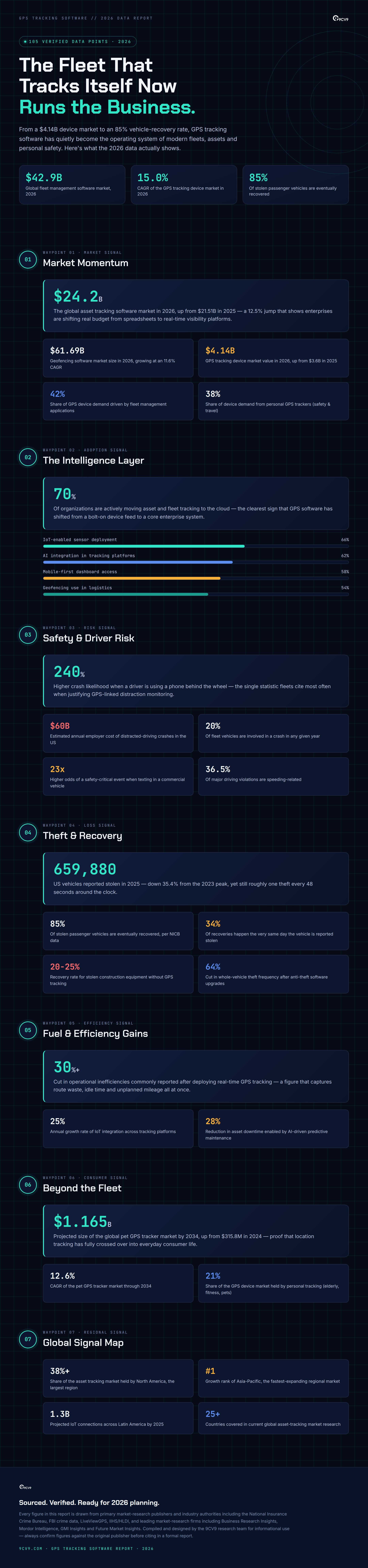
The broader software ecosystem is experiencing similarly strong growth. The global fleet management software market is projected to reach $42.9 billion in 2026, while the asset tracking software market is estimated to increase from $21.51 billion in 2025 to $24.2 billion in 2026. Furthermore, the asset tracking software market is forecast to reach $36.84 billion by 2030, demonstrating the increasing importance of real-time asset visibility, automated monitoring, and centralized operational management.
The Growing Importance of GPS Tracking Software in 2026
One of the most significant GPS tracking software trends in 2026 is the increasing integration of AI-powered analytics, IoT-enabled sensors, predictive maintenance, and cloud-based monitoring capabilities. Organizations are moving beyond traditional GPS tracking systems that simply display vehicle locations toward intelligent platforms capable of identifying operational inefficiencies, anticipating equipment failures, detecting unusual driver behavior, and generating actionable business insights.
Industry estimates indicate that approximately 66% of enterprises deploy IoT-enabled sensors for real-time asset performance tracking, with reported improvements in asset lifespan ranging between 20% and 35%. Additionally, approximately 62% of asset tracking software platforms incorporate AI capabilities, while predictive maintenance applications have been associated with reductions in asset downtime of around 28%.
Cloud adoption is another major factor reshaping the GPS tracking software landscape. Approximately 70% of organizations are reportedly transitioning toward cloud-based asset tracking solutions, reflecting growing demand for scalable infrastructure, remote accessibility, centralized data management, and reduced dependence on on-premises systems.
Mobile accessibility is also becoming increasingly important, with approximately 58% of users reportedly managing tracking dashboards through smartphones or tablets. This shift enables fleet managers, business owners, dispatchers, and field service professionals to access critical location information and respond to operational developments regardless of their physical location.
GPS Tracking Software, Fleet Management and Operational Efficiency
Fleet management remains one of the largest and most commercially significant applications of GPS tracking technology, accounting for approximately 42% of GPS tracking device demand in 2026.
Businesses operating commercial vehicles face increasing pressure to control operating expenses, improve delivery performance, maintain vehicle reliability, and ensure driver safety. GPS fleet tracking software addresses these challenges by providing real-time vehicle visibility, automated route optimization, idle-time monitoring, mileage tracking, geofencing alerts, and detailed operational reporting.
Real-time GPS tracking has been reported to reduce operational inefficiencies by more than 30%, illustrating its potential to deliver measurable business value. By identifying unnecessary vehicle movements, excessive engine idling, inefficient routes, and unauthorized vehicle usage, organizations can make more informed decisions regarding fleet utilization and resource allocation.
The integration of GPS tracking software with predictive analytics and telematics systems is further expanding these capabilities. Rather than relying exclusively on historical reports, businesses can increasingly use location intelligence to anticipate maintenance requirements, identify emerging safety risks, improve dispatching decisions, and minimize costly operational disruptions.
The Role of GPS Tracking Software in Driver Safety and Asset Protection
Driver safety, vehicle theft prevention, and asset recovery are also major factors influencing GPS tracking software adoption in 2026.
Approximately 20% of fleet vehicles are estimated to be involved in a crash annually, while employer-related vehicle crashes are estimated to cost businesses in the United States around $60 billion each year. These figures highlight the financial and operational importance of implementing effective fleet safety monitoring systems.
Modern GPS tracking platforms increasingly combine location monitoring with telematics, driver behavior analytics, dashcam integration, speeding alerts, harsh braking detection, and automated safety reporting. These capabilities help organizations identify potentially dangerous driving patterns, improve driver training, and establish more proactive fleet risk management strategies.
Vehicle theft remains another significant concern. Although reported vehicle thefts in the United States declined from 1,020,729 in 2023 to 659,880 in 2025, approximately 1,800 vehicles were still stolen daily during 2025.
Construction equipment theft presents additional challenges, with estimated annual losses ranging from $300 million to $1 billion in the United States. Recovery rates for stolen construction equipment are estimated at only 21% to 25%, emphasizing the importance of implementing effective asset monitoring and recovery solutions.
GPS tracking software, particularly when combined with geofencing, movement detection, and automated security alerts, can strengthen asset protection strategies and provide valuable location information to support authorized recovery efforts.
Emerging GPS Tracking Software Market Trends
The GPS tracking software industry is expanding beyond traditional commercial fleet management into personal safety, healthcare, pet monitoring, supply chain management, construction, agriculture, and connected infrastructure applications.
Personal GPS tracking devices are projected to account for approximately 38% of GPS tracking device market share in 2026, reflecting growing consumer demand for location-based safety and monitoring solutions.
The pet GPS tracker market is also experiencing substantial growth. Valued at approximately $315.8 million in 2024, the market is forecast to reach $1.165 billion by 2034, representing a compound annual growth rate of 12.6%.
Meanwhile, geofencing technology is becoming an increasingly important component of modern location intelligence platforms. The global geofencing software market is projected to grow from $55.3 billion in 2025 to $61.69 billion in 2026, before reaching $89.85 billion by 2030.
These developments demonstrate how GPS tracking technology is evolving into a broader ecosystem of connected devices, automated workflows, intelligent monitoring systems, and location-based digital services.
However, despite the considerable growth opportunities, businesses continue to encounter implementation challenges. Approximately 38% of organizations report data integration and interoperability difficulties when adopting new tracking software, while 29% identify deployment complexity as a barrier. Data privacy, cybersecurity, system compatibility, and responsible employee monitoring are also increasingly important considerations when evaluating GPS tracking solutions.
Understanding the Top 105 GPS Tracking Software Statistics, Data and Trends in 2026
Understanding the latest GPS tracking software statistics is essential for business leaders, fleet managers, logistics professionals, technology providers, investors, and organizations seeking to evaluate the effectiveness and commercial potential of location-based technologies.
This comprehensive guide to the Top 105 GPS Tracking Software Statistics, Data & Trends in 2026 explores the most significant developments shaping the industry, including:
- Global GPS tracking software and device market size, growth forecasts, and revenue opportunities.
- Artificial intelligence, IoT, cloud computing, and predictive analytics adoption.
- Fleet management software adoption and operational efficiency trends.
- Driver safety, distracted driving, and commercial vehicle risk statistics.
- Vehicle theft, asset recovery, and equipment loss prevention data.
- Fuel consumption, route optimization, and fleet productivity trends.
- Regulatory compliance, enterprise adoption, and implementation challenges.
- Personal GPS tracking, pet monitoring, and consumer location-based technologies.
- Regional market growth and emerging GPS tracking industry segments.
The statistics and industry trends presented in this article provide a comprehensive perspective on the current state and future direction of GPS tracking technology. Market estimates cover several related but distinct segments, including GPS tracking devices, fleet management software, asset tracking software, and geofencing platforms, and should therefore be interpreted according to their respective market definitions rather than combined into a single valuation.
As digital transformation accelerates and organizations increasingly depend on real-time operational intelligence, GPS tracking software is positioned to play an increasingly important role in improving business efficiency, strengthening asset security, enhancing driver safety, and supporting sustainable growth.
By examining these 105 GPS tracking software statistics, data points, and emerging industry trends, businesses and technology decision-makers can better understand market opportunities, identify adoption challenges, evaluate potential investments, and develop more effective location intelligence strategies in 2026 and beyond.
Before we venture further into this article, we would like to share who we are and what we do.
About 9cv9
9cv9 is a business tech startup based in Singapore and Asia, with a strong presence all over the world.
With over ten years of startup and business experience, and being highly involved in connecting with thousands of companies and startups, the 9cv9 team has listed some of the top and best companies/tools in this review.
If you like to get your company listed in our top B2B software reviews, check out our world-class 9cv9 Media and PR service and pricing plans here.
Top 105 GPS Tracking Software Statistics, Data & Trends in 2026
Market Size & Growth
1. The global GPS tracking device market is valued at $4.14 billion in 2026, up from $3.6 billion in 2025 — a reminder that hardware demand keeps climbing even as software becomes the real differentiator for fleet buyers.
2. The GPS tracking device market is forecast to grow at a 15.0% CAGR through 2026, signaling that adoption is accelerating rather than plateauing across commercial and consumer segments.
3. A separate 10-year outlook puts the GPS tracking device market at $8.5 billion in 2026, rising to $19.4 billion by 2036 at an 8.6% CAGR — underscoring long-run confidence in location-based technology spending.
4. Fleet management applications account for roughly 42% of GPS tracking device demand in 2026, confirming that commercial vehicle oversight remains the single biggest driver of industry growth.
5. Personal GPS trackers hold about 38% of device market share in 2026, showing that consumer safety use cases (child, elderly, travel tracking) now rival commercial fleet demand in volume.
6. The fleet management software market is projected to reach $42.9 billion by 2026, a figure that illustrates how quickly standalone tracking has evolved into full-scale software platforms.
7. The global asset tracking software market is estimated at $24.2 billion in 2026, up from $21.51 billion in 2025, reflecting a 12.5% year-over-year jump in enterprise appetite for real-time visibility tools.
8. Asset tracking software is projected to reach $36.84 billion by 2030 at an 11.1% CAGR, a trajectory that suggests demand for software-driven visibility will keep outpacing hardware-only solutions.
9. A broader asset tracking market (hardware plus software) is pegged at $32.45 billion in 2026, expanding to $54.29 billion by 2031 at a 10.84% CAGR, driven by e-commerce growth and falling sensor costs.
10. North America holds the largest share of the asset tracking market at over 38%, a concentration that reflects the region’s advanced logistics infrastructure and early adoption of telematics.
11. The geofencing software market is expected to grow from $55.3 billion in 2025 to $61.69 billion in 2026, an 11.6% CAGR that highlights how central virtual-boundary alerts have become to modern tracking platforms.
12. Geofencing software is projected to reach $89.85 billion by 2030 at a 9.9% CAGR, evidence that location-based automation is moving well beyond simple fleet alerts into retail, healthcare, and smart-city use cases.
13. The pet GPS tracker market was valued at $315.8 million in 2024 and is forecast to hit $1.165 billion by 2034 at a 12.6% CAGR, showing that consumer-grade location tracking is one of the fastest-growing niches in the space.
14. North America’s pet wearable market alone is estimated at $1.51 billion in 2026, a sign that GPS-enabled pet safety products have become a mainstream household purchase rather than a novelty item.
15. Real-time GPS tracking is reported to cut operational inefficiencies by more than 30%, a figure that helps explain why so many mid-size and large fleets treat tracking software as a cost-control tool rather than a luxury.
AI, IoT & Technology Adoption
16. Around 66% of enterprises now deploy IoT-enabled sensors for real-time asset performance tracking, improving asset lifespan by an estimated 20–35% — a direct efficiency case for pairing GPS data with condition monitoring.
17. AI integration is present in roughly 62% of asset tracking software platforms, enabling predictive maintenance that is credited with reducing asset downtime by about 28%.
18. Around 70% of organizations are actively transitioning to cloud-based asset tracking solutions, reflecting a broader shift away from on-premises fleet management infrastructure.
19. Mobile-first access is now standard, with 58% of users managing tracking dashboards from a smartphone or tablet rather than a desktop console.
20. Approximately 54% of logistics firms use geofencing to monitor asset movement across 15–20 transit points, showing that virtual boundaries have become a routine supply-chain control rather than an edge feature.
21. In broader asset tracking solution adoption, 64% of enterprises report using real-time tracking, and 47% say automation has directly reduced operational losses.
22. IoT and AI-based predictive tracking adoption is rising, with 52% of enterprises shifting toward predictive rather than reactive asset monitoring.
23. About 33% of enterprises using modern asset tracking platforms have enabled automated alerting, cutting the need for manual status checks.
24. Roughly 38% of firms report data integration and interoperability challenges when adopting new tracking software, a practical reminder that platform compatibility remains a real adoption barrier.
25. About 29% of organizations cite deployment complexity as a restraint on asset tracking software rollout, which is useful context for buyers evaluating implementation timelines.
26. Blockchain-based asset verification is emerging as a niche trend, with 41% of organizations exploring it for high-value or high-risk asset chains.
27. Machine learning-based driver risk models are increasingly used to flag at-risk drivers before a crash occurs, based on weeks of behavioral trend data rather than single incidents.
28. Fleet operators are increasingly layering multiple safety technologies — dashcams, telematics, and coaching — because no single system alone has been shown to dominate on safety outcomes.
29. Euro NCAP’s 2026 scoring criteria now assess both driver engagement monitoring and occupant monitoring, a regulatory signal that in-cabin and GPS-linked driver monitoring is moving from optional to expected.
30. Vehicle-to-everything (V2X) connectivity is emerging as a 2026 fleet safety trend, enabling cooperative alerts between trucks, infrastructure, and other vehicles.
Fleet Safety & Driver Behavior
31. Speeding contributes to 36.5% of all major driver violations and is a factor in 29% of all traffic fatalities, making speed monitoring one of the highest-value features in any GPS fleet platform.
32. Distracted driving-related violations have risen 31% over two years, reinforcing why fleets increasingly pair GPS location data with driver-behavior alerts.
33. Phone use while driving increases crash likelihood by 240%, a statistic that has become a central justification for telematics-based distraction monitoring.
34. Distracted driving violations surged 48% in early 2024 alone, a sharp enough spike that many fleets accelerated rollout of in-cab monitoring tied to their GPS systems.
35. Texting while driving a commercial vehicle increases the odds of a safety-critical event by 23 times, according to Federal Motor Carrier Safety Administration research.
36. Dialing a phone while driving a commercial vehicle raises safety-critical event odds sixfold, a smaller but still significant risk multiplier compared with texting.
37. Employer crash costs are estimated at $60 billion a year in the US, a figure that puts fleet safety technology spending into direct financial perspective.
38. About 20% of fleet vehicles are involved in a crash each year, underscoring why continuous GPS-based driver monitoring has shifted from a “nice to have” to a standard risk-management tool.
39. The average cost per fatality in a commercial fleet crash often exceeds $750,000, a number that makes even modest safety-technology ROI calculations compelling.
40. Police reported 781,958 distraction-affected crashes in 2023, representing 13% of all 6.1 million police-reported crashes that year.
41. The commercial auto insurance industry has logged 14+ consecutive years of underwriting losses, with nearly $5 billion in losses in 2024 alone — a trend pushing more fleets toward continuous GPS-based monitoring to manage premiums.
42. “Nuclear verdict” litigation awards over $100 million rose 81% in a single year, raising the stakes for fleets that lack documented, GPS-verified driver behavior records.
43. Out-of-service compliance violations exceeded 478,000 in 2025, up 6% year-over-year, adding pressure on fleets to keep GPS-linked compliance logs audit-ready.
44. Americans drove a record 3.324 trillion miles in 2025, a 0.9% increase over 2024 — more road exposure that directly raises the value proposition of real-time fleet visibility.
45. Inattentiveness as a contributing collision risk factor jumped 168% in recent fleet safety analysis, making driver-distraction alerts one of the fastest-growing use cases for telematics.
46. Studies on fleet driver monitoring consistently show that drivers who know their behavior is being recorded exhibit measurably lower rates of phone use, hard braking, and aggressive acceleration.
47. A disproportionate share of fleet crashes occur during low-speed backing maneuvers, a pattern that has pushed more fleets toward camera-plus-GPS combination systems rather than location tracking alone.
48. Handheld phone use while driving is now banned in 24 US states and Washington, D.C., a patchwork of regulation that makes automated, GPS-verified compliance reporting increasingly valuable for multi-state fleets.
49. In-vehicle touchscreen infotainment interactions have been measured at requiring up to 40 seconds of eyes-off-road time for some tasks, a distraction risk fleets are increasingly trying to offset with driver coaching data.
50. Distracted driving crashes peak between 3–6 PM, correlating with commute traffic volume — useful scheduling intelligence for fleets using GPS data to plan safer dispatch windows.
Vehicle Theft, Recovery & Loss Prevention
51. US vehicle thefts fell 35.4% from the 2023 peak of 1,020,729 to 659,880 in 2025, the lowest annual total the National Insurance Crime Bureau has recorded in decades.
52. Vehicle thefts dropped 23% from 2024 to 2025 alone, a rapid single-year decline that still left roughly 1,800 vehicles stolen every day nationwide.
53. The FBI independently recorded an 18.6% drop in motor vehicle theft from 2023 to 2024, the largest one-year decline ever logged in FBI crime data.
54. A vehicle was stolen roughly every 48 seconds in the US in 2025, down from about every 31 seconds at the 2023 peak — still a meaningful daily loss exposure for any fleet operating without tracking coverage.
55. The national vehicle theft rate stood at 250.2 per 100,000 residents in 2024, a benchmark fleets can use to gauge relative regional risk.
56. NHTSA has estimated the annual cost of vehicle theft to American owners at more than $8 billion, a figure from 2022 that predates the 2023 theft spike and is likely understated today.
57. The FBI’s most recent per-vehicle theft loss estimate averaged $8,886 across $6.4 billion in total losses, though that figure dates to 2019 and hasn’t kept pace with rising vehicle values.
58. Roughly 85% of stolen passenger vehicles are eventually recovered according to NICB data, with 34% recovered the same day and 45% within 48 hours — evidence that the first two days after a theft are the most decisive recovery window.
59. FBI NIBRS data shows a lower overall vehicle recovery rate of 52–57%, a discrepancy from NICB’s 85% figure that stems from differing methodologies and vehicle populations counted.
60. California led the nation with 136,988 vehicles stolen in 2025 — more than 20% of all US thefts occurring in a single state.
61. Washington, D.C. posted the nation’s highest theft rate at 842.4 per 100,000 residents in 2024, more than three times the national average.
62. More than a third of all 2025 US vehicle thefts occurred in just the top 10 metro areas, with Los Angeles-Long Beach-Anaheim leading at 53,911 thefts.
63. By theft rate, the hottest US metros in early 2026 data were San Francisco-Oakland-Fremont (477.51 per 100,000), Bakersfield-Delano (477.27), and Memphis (427.75).
64. The Chevrolet Silverado 1500 was the most stolen pickup truck in 2025 at 16,764 units, followed by the Ford F-150 at 10,102 — a pattern with direct relevance for commercial and contractor fleets.
65. Full-size pickup trucks had the highest theft rate of any vehicle class in a recent analysis, accounting for more than 25% of theft claims, down from 33% the prior year.
66. Hyundai and Kia’s combined share of US vehicle thefts fell from 21% in 2023 to just 14% in 2025 as manufacturer anti-theft software updates rolled out fleet-wide.
67. Hyundai and Kia’s anti-theft software upgrade cut theft claim frequency by 53% and whole-vehicle theft frequency by 64% versus non-upgraded vehicles — one of the clearest data-backed proofs that anti-theft technology works.
68. More than 100,000 vehicles — about 11% of all US thefts — were stolen with keys or fobs left inside, a preventable category that rose 20% between 2019 and 2021.
69. Construction equipment theft costs the US an estimated $300 million to $1 billion annually, a range that excludes stolen tools, materials, and indirect downtime costs.
70. Stolen construction equipment has only a 21–25% recovery rate, far lower than the passenger-vehicle recovery rate, largely because heavy equipment lacks titles, license plates, and VIN-style tracking infrastructure.
71. Equipment recovery without GPS tracking is reported at approximately 20%, meaning that in most untracked-equipment theft cases, the asset is never recovered at all.
72. NICB recommends a four-layer vehicle protection approach — common sense, visible deterrents, immobilizers, and GPS tracking as the final recovery layer — a framework increasingly cited by insurers and fleet risk managers alike.
73. The steepest 2025 state-level theft declines were seen in Washington (-39%), Colorado (-35%), and Puerto Rico (-34%), suggesting targeted enforcement is having a measurable regional impact.
Fuel Savings & Operational Efficiency
74. Businesses using GPS fleet tracking commonly report measurable reductions in fuel consumption through optimized routing and reduced idle time, a benefit repeatedly cited across fleet management case studies.
75. GPS-enabled route optimization is consistently linked to lower fuel costs and reduced travel time, making it one of the most commonly cited ROI drivers for fleet software adoption.
76. Precise GPS-based tracking of vehicle usage helps businesses minimize unnecessary mileage, directly lowering both fuel and maintenance spend over time.
77. IoT integration in tracking and asset platforms is growing at roughly 25% annually, a pace that reflects how quickly sensor-driven efficiency gains are being adopted industry-wide.
78. GPS-based idle-time monitoring gives fleet managers visibility into wasted engine-run time, one of the most direct and immediately actionable fuel-cost levers available in modern tracking software.
79. Real-time GPS visibility allows fleets to reroute technicians dynamically, shrinking “windshield time” and enabling more completed jobs per day without adding vehicles.
80. In manufacturing and just-in-time supply contexts, inbound GPS visibility is credited with reducing buffer stock requirements and helping prevent stockouts.
81. Satellite-enabled GPS trackers extend visibility to remote oil, gas, and mining operations beyond standard cellular coverage, closing a safety and control gap that terrestrial-only systems can’t address.
Regulatory, Compliance & Enterprise Trends
82. GPS tracking software increasingly doubles as a compliance tool, generating the detailed activity logs and reports fleets need to satisfy industry regulations.
83. Roughly 48% of asset tracking software market analysis focuses on investment trends and opportunities through 2035, reflecting sustained enterprise budget commitment to the category.
84. About 60% of current asset tracking market research covers regional analysis spanning North America, Europe, Asia-Pacific, and the Middle East & Africa across 25+ countries — evidence of how globally distributed adoption has become.
85. Roughly 55% of asset tracking market studies focus specifically on emerging technologies such as AI, IoT, and cloud computing, reflecting where vendor R&D investment is concentrated.
86. Tariff pressure on imported IoT sensors and RFID hardware is accelerating a shift toward software-centric, cloud-based tracking models that rely less on imported physical components.
87. Large enterprises generate the majority of asset tracking software revenue, though SME adoption is growing quickly as subscription pricing lowers the entry barrier.
88. Cloud-based deployment is increasingly the default choice for asset tracking software buyers, favored for eliminating on-premises IT overhead and enabling multitenant scalability.
89. Driver drowsiness and attention-monitoring systems are moving toward closed-loop, minimal-retention data models, reflecting rising privacy expectations layered onto GPS and in-cab monitoring tools.
90. On-device processing and transparent driver interfaces are becoming baseline expectations for any GPS-linked driver monitoring system evaluated in 2026.
Personal, Pet & Consumer GPS Tracking
91. Personal GPS trackers are projected to hold about 38% of total device market share in 2026, driven by child safety, elderly monitoring, and travel use cases.
92. The personal tracking segment — covering elderly and patient safety, fitness, and pet tracking — was estimated to account for roughly 21% of the broader GPS tracking device market.
93. The pet smart tracker market was valued at $938.9 million in 2021 and is projected to reach $2.6 billion by 2031 at a 10.3% CAGR, according to earlier market estimates that remain broadly consistent with newer forecasts.
94. Europe’s pet wearable market alone was valued at $1.2 billion in 2025 and is projected to reach $1.34 billion in 2026, showing steady regional growth in consumer GPS pet-safety spending.
95. GPS-enabled pet collars increasingly bundle geofencing, activity tracking, and health monitoring into a single device, moving the category well beyond simple location lookup.
96. Advances in mobile network coverage are cited as a direct enabler of more reliable personal and pet GPS tracking, particularly in previously weak-signal areas.
97. Consumer GPS tracking devices are increasingly marketed around “peace of mind” positioning rather than raw location accuracy, reflecting a shift in how the category is sold to non-commercial buyers.
Snapshot: Regional & Segment Breakdown
98. North America is consistently identified as the largest regional market for both fleet and asset GPS tracking software, driven by mature logistics, transportation, and manufacturing sectors.
99. Asia-Pacific is repeatedly flagged as the fastest-growing region for GPS and asset tracking software adoption, fueled by expanding manufacturing and logistics infrastructure.
100. IoT connections in Latin America alone were projected to reach 1.3 billion by 2025, a scale that illustrates how much of future GPS/IoT tracking growth will come from emerging markets rather than mature ones.
101. The software category, rather than services, consistently generates the largest share of revenue within the asset tracking software market, reflecting the shift from one-time hardware sales to recurring platform subscriptions.
102. Real-time location systems (RTLS) software is now tracked as a distinct, fast-growing sub-segment within the broader asset tracking software market rather than a niche add-on.
103. OBD-II plug-and-play GPS trackers remain one of the most commonly adopted device types for commercial vehicle fleets, prized for their no-installation simplicity.
104. Standalone personal, pet, and asset GPS trackers are increasingly segmented as distinct product lines by market researchers, reflecting how differentiated buyer needs have become within a single underlying technology.
105. GPS tracking device demand growth (15.0% CAGR in the near term) is currently outpacing the broader consumer electronics category average, underscoring how location-based safety and efficiency use cases continue to outgrow general tech spending.
Conclusion
The Top 105 GPS Tracking Software Statistics, Data & Trends in 2026 highlight the remarkable evolution of location-based technologies and their growing importance across the global digital economy. As organizations increasingly prioritize operational efficiency, asset visibility, fleet safety, cost reduction, and data-driven decision-making, GPS tracking software is becoming an indispensable component of modern business management.
The industry is transitioning beyond conventional location monitoring toward intelligent, interconnected platforms that combine artificial intelligence, Internet of Things (IoT) connectivity, predictive analytics, cloud computing, telematics, and automated workflows. These technological advancements are creating significant opportunities for businesses to improve operational performance, strengthen asset protection, and establish more resilient and competitive business models.
Strong Market Growth Reflects Increasing Demand for GPS Tracking Technology
The global GPS tracking industry continues to demonstrate substantial commercial potential in 2026. The GPS tracking device market is estimated to reach $4.14 billion in 2026, increasing from $3.6 billion in 2025, while a separate long-term forecast projects the market to reach $19.4 billion by 2036.
The broader location intelligence and fleet management ecosystem is also experiencing considerable expansion. The fleet management software market is projected to reach $42.9 billion in 2026, while the global asset tracking software market is estimated at $24.2 billion and is forecast to reach $36.84 billion by 2030.
Furthermore, the geofencing software market is projected to expand from $61.69 billion in 2026 to $89.85 billion by 2030, reflecting the growing importance of automated location-based monitoring across transportation, logistics, healthcare, retail, and connected infrastructure.
Although these market forecasts represent distinct industry segments and research methodologies, they collectively demonstrate the increasing commercial significance of location intelligence technologies.
The continued expansion of e-commerce, global supply chains, connected vehicles, and digital business operations is expected to create further opportunities for GPS tracking software providers and technology developers.
Artificial Intelligence, IoT and Cloud Computing Are Reshaping GPS Tracking Software
One of the most important findings from the latest GPS tracking software statistics is the accelerating integration of intelligent technologies into asset monitoring and fleet management platforms.
Approximately 66% of enterprises reportedly deploy IoT-enabled sensors for real-time asset performance tracking, while around 62% of asset tracking software platforms incorporate artificial intelligence capabilities. Predictive maintenance enabled by these technologies has been associated with reductions in asset downtime of approximately 28%.
Additionally, approximately 70% of organizations are reportedly transitioning toward cloud-based asset tracking solutions, demonstrating a growing preference for scalable, remotely accessible, and centrally managed software infrastructure.
These developments are transforming GPS tracking software from a reactive monitoring solution into a proactive operational intelligence platform.
Businesses can increasingly leverage connected sensors, historical location data, automated alerts, and predictive analytics to anticipate maintenance requirements, identify operational risks, improve resource allocation, and minimize unexpected disruptions.
Mobile accessibility is further supporting this transformation, with approximately 58% of users reportedly managing tracking dashboards through smartphones or tablets. As organizations adopt increasingly distributed operating models, mobile-first GPS tracking platforms are becoming valuable tools for fleet managers, dispatchers, field service teams, and business decision-makers.
Fleet Management and Operational Efficiency Remain Major Growth Drivers
Fleet management continues to represent one of the most important applications of GPS tracking technology, accounting for approximately 42% of GPS tracking device demand in 2026.
Transportation companies, logistics providers, construction businesses, delivery operators, and field service organizations increasingly rely on GPS fleet tracking software to improve vehicle utilization, optimize routes, monitor fuel consumption, reduce unnecessary mileage, and enhance workforce productivity.
Real-time GPS tracking has been reported to reduce operational inefficiencies by more than 30%, highlighting its potential to deliver measurable operational improvements when implemented effectively.
Some of the most significant business benefits associated with modern GPS fleet management software include:
- Improved real-time visibility into vehicle locations and asset movements.
- Reduced unnecessary fuel consumption through route optimization and idle-time monitoring.
- Enhanced vehicle utilization and operational resource allocation.
- Improved dispatching efficiency and delivery performance.
- Proactive vehicle maintenance and reduced equipment downtime.
- Automated reporting and improved regulatory compliance.
- Greater visibility into driver behavior and fleet safety risks.
- Improved operational decision-making through centralized analytics.
As businesses face increasing pressure to manage operating expenses and improve service quality, GPS tracking software is likely to remain an important investment for organizations managing commercial vehicles, mobile workforces, and geographically distributed assets.
Driver Safety and Asset Security Are Becoming Strategic Priorities
The statistics surrounding commercial vehicle accidents, distracted driving, vehicle theft, and equipment losses demonstrate why GPS tracking software is increasingly viewed as a strategic risk management solution.
Approximately 20% of fleet vehicles are estimated to be involved in a crash annually, while employer-related vehicle crashes reportedly cost businesses in the United States approximately $60 billion each year.
Modern GPS tracking platforms can support fleet safety initiatives by integrating location monitoring with driver behavior analytics, speeding alerts, harsh braking detection, telematics, dashcams, and automated safety reporting.
These capabilities provide organizations with greater visibility into potentially dangerous driving behaviors and enable more targeted driver coaching and risk management initiatives.
Vehicle theft prevention and asset recovery also remain significant considerations. Despite a substantial decline in reported US vehicle thefts from more than 1.02 million in 2023 to approximately 659,880 in 2025, businesses and consumers continue to face considerable financial exposure.
Construction equipment theft alone is estimated to cost the United States between $300 million and $1 billion annually, while recovery rates for stolen construction equipment remain relatively low at approximately 21% to 25%.
GPS-enabled asset monitoring, geofencing, unauthorized movement alerts, and real-time location reporting can strengthen existing security strategies and support authorized asset recovery efforts.
However, GPS tracking software should form part of a comprehensive security and safety framework rather than being treated as a standalone solution capable of eliminating theft or vehicle accidents.
Consumer GPS Tracking Is Creating New Market Opportunities
Although commercial fleet management remains a major contributor to industry growth, consumer GPS tracking applications are creating increasingly significant opportunities for software providers and device manufacturers.
Personal GPS trackers are projected to account for approximately 38% of GPS tracking device market share in 2026, supported by demand for child safety, elderly monitoring, travel security, and personal location-based services.
The pet GPS tracker market is also experiencing substantial expansion. Valued at approximately $315.8 million in 2024, the market is forecast to reach $1.165 billion by 2034, representing a compound annual growth rate of 12.6%.
Modern consumer GPS tracking solutions increasingly combine real-time location monitoring with virtual boundaries, activity tracking, mobile notifications, and health-related monitoring features.
These developments demonstrate that GPS tracking technology is evolving beyond traditional vehicle and equipment monitoring into a broader ecosystem of connected safety, security, and lifestyle applications.
As mobile connectivity improves and location-based technologies become more accessible, consumer GPS tracking software is positioned to become an increasingly important segment of the global tracking industry.
GPS Tracking Software Adoption Challenges Must Not Be Overlooked
Despite the positive market outlook, businesses must carefully evaluate the challenges associated with implementing GPS tracking software.
Approximately 38% of organizations reportedly experience data integration and interoperability challenges when adopting new tracking platforms, while around 29% identify deployment complexity as a significant implementation barrier.
These findings emphasize the importance of selecting GPS tracking software that aligns with existing business infrastructure, operational requirements, workforce policies, and long-term technology strategies.
Organizations evaluating GPS tracking software in 2026 should consider several critical factors, including system compatibility, location accuracy, network coverage, scalability, implementation costs, subscription pricing, data security, reporting capabilities, and vendor support.
Employee privacy and responsible location data management are also increasingly important considerations. As GPS tracking platforms collect more detailed information about vehicle movements, driver behavior, and workforce activities, businesses must establish transparent monitoring policies, appropriate access controls, and responsible data retention practices.
The most effective GPS tracking software implementations will therefore combine technological capabilities with clearly defined operational objectives, responsible governance, and measurable performance indicators.
The Future of GPS Tracking Software Beyond 2026
The future of GPS tracking software will increasingly be shaped by the convergence of artificial intelligence, predictive analytics, connected vehicles, IoT sensors, satellite connectivity, cloud infrastructure, and real-time location intelligence.
Emerging technologies such as vehicle-to-everything connectivity, automated asset monitoring, machine learning-based driver risk assessment, and satellite-enabled tracking are expanding the capabilities of traditional GPS platforms.
North America continues to represent a major market for GPS tracking and asset management technologies, supported by established transportation, logistics, and manufacturing infrastructure. Meanwhile, Asia-Pacific is frequently identified as a rapidly growing regional market, driven by expanding industrial activity, logistics networks, and digital transformation initiatives.
Future GPS tracking platforms are likely to become increasingly integrated with enterprise resource planning systems, supply chain management software, fleet management platforms, and other business intelligence solutions.
Rather than simply answering where a vehicle or asset is located, these platforms will increasingly help organizations understand how assets are being utilized, identify emerging operational risks, anticipate maintenance requirements, and determine how resources can be deployed more efficiently.
Final Thoughts
The Top 105 GPS Tracking Software Statistics, Data & Trends in 2026 demonstrate that GPS tracking technology is no longer limited to basic vehicle location monitoring. It has evolved into a sophisticated ecosystem supporting fleet management, operational intelligence, predictive maintenance, asset security, driver safety, regulatory compliance, and consumer protection.
For businesses, investing in the right GPS tracking software can create opportunities to reduce operational inefficiencies, improve resource utilization, strengthen security, enhance customer service, and support sustainable business growth.
For software developers, technology providers, and investors, the expanding GPS tracking market presents significant opportunities to develop innovative solutions that address increasingly complex commercial and consumer requirements.
However, achieving meaningful returns on GPS tracking software investments requires more than simply installing tracking devices. Organizations must establish clear business objectives, select compatible technologies, integrate tracking data into existing workflows, protect sensitive information, and continuously evaluate operational performance.
Ultimately, businesses that successfully combine real-time GPS tracking with artificial intelligence, IoT connectivity, predictive analytics, automation, and responsible data management will be better positioned to improve operational resilience and establish long-term competitive advantages.
As the global economy becomes increasingly connected, data-driven, and dependent on real-time visibility, GPS tracking software is set to remain a foundational technology for modern fleet management, asset protection, intelligent transportation, and enterprise digital transformation in 2026 and beyond.
If you find this article useful, why not share it with your hiring manager and C-level suite friends and also leave a nice comment below?
We, at the 9cv9 Research Team, strive to bring the latest and most meaningful data, guides, and statistics to your doorstep.
To get access to top-quality guides, click over to 9cv9 Blog.
To hire top talents using our modern AI-powered recruitment agency, find out more at 9cv9 Modern AI-Powered Recruitment Agency.
People Also Ask
What is GPS tracking software?
GPS tracking software is a digital solution that uses satellite-based positioning and location data to monitor vehicles, equipment, assets, and individuals, supporting real-time visibility, operational efficiency, and security.
How large is the GPS tracking market in 2026?
The global GPS tracking device market is estimated to reach $4.14 billion in 2026, up from $3.6 billion in 2025, driven by increasing demand for fleet management, asset monitoring, and personal tracking solutions.
What is the projected growth rate of the GPS tracking market?
The GPS tracking device market has a reported near-term growth rate of approximately 15%, supported by expanding commercial applications, IoT integration, connected vehicles, and consumer safety requirements.
What are the biggest GPS tracking software trends in 2026?
Major GPS tracking software trends include artificial intelligence, IoT integration, cloud-based deployment, predictive maintenance, geofencing, mobile accessibility, driver behavior analytics, and real-time asset monitoring.
How large is the fleet management software market in 2026?
The global fleet management software market is projected to reach $42.9 billion in 2026, reflecting growing demand for vehicle tracking, route optimization, fleet automation, and operational intelligence.
How large is the asset tracking software market in 2026?
The global asset tracking software market is estimated at $24.2 billion in 2026 and is projected to reach $36.84 billion by 2030, supported by enterprise digital transformation and real-time monitoring requirements.
What percentage of GPS tracking device demand comes from fleet management?
Fleet management accounts for approximately 42% of GPS tracking device demand in 2026, making commercial vehicle monitoring one of the largest applications of GPS tracking technology.
How does GPS tracking software improve operational efficiency?
GPS tracking software improves operational efficiency through route optimization, automated alerts, vehicle utilization monitoring, reduced idle time, and real-time dispatching. Reported efficiency improvements can exceed 30%.
How does GPS tracking software reduce fuel costs?
GPS tracking software helps reduce fuel costs by identifying inefficient routes, excessive engine idling, unnecessary mileage, speeding, and unauthorized vehicle usage, enabling businesses to optimize fuel consumption.
How is artificial intelligence transforming GPS tracking software?
AI enhances GPS tracking software through predictive maintenance, driver risk assessment, automated anomaly detection, and intelligent analytics. Approximately 62% of asset tracking software platforms reportedly incorporate AI capabilities.
What percentage of enterprises use IoT-enabled asset tracking?
Approximately 66% of enterprises reportedly deploy IoT-enabled sensors for real-time asset performance tracking, with estimated asset lifespan improvements ranging from 20% to 35%.
How does GPS tracking software support predictive maintenance?
GPS tracking software integrates vehicle usage data, IoT sensors, and AI analytics to identify potential maintenance requirements. Predictive maintenance applications have been associated with asset downtime reductions of approximately 28%.
How popular is cloud-based GPS tracking software?
Approximately 70% of organizations are reportedly transitioning toward cloud-based asset tracking solutions because of their scalability, remote accessibility, centralized data management, and reduced infrastructure requirements.
What percentage of GPS tracking users access mobile dashboards?
Approximately 58% of tracking software users reportedly manage dashboards through smartphones or tablets, highlighting the growing importance of mobile accessibility and remote fleet management.
What is geofencing in GPS tracking software?
Geofencing creates virtual geographic boundaries around designated locations. GPS tracking software generates automated alerts when vehicles, equipment, or other monitored assets enter or leave these predefined areas.
How large is the geofencing software market in 2026?
The global geofencing software market is projected to reach $61.69 billion in 2026 and $89.85 billion by 2030, reflecting increasing demand for automated location-based monitoring and business workflows.
How does GPS tracking software improve driver safety?
GPS tracking software supports driver safety by monitoring speeding, harsh braking, aggressive acceleration, and vehicle movements. Integrated telematics and driver behavior analytics enable more targeted safety interventions and coaching.
How common are commercial fleet vehicle accidents?
Industry estimates suggest that approximately 20% of fleet vehicles are involved in crashes annually. Employer-related vehicle crashes have also been estimated to cost US businesses approximately $60 billion per year.
How does GPS tracking software help prevent vehicle theft?
GPS tracking software supports theft prevention through geofencing, unauthorized movement alerts, real-time location monitoring, and vehicle activity notifications. It also provides location information to support authorized vehicle recovery efforts.
How many vehicles were stolen in the United States in 2025?
Approximately 659,880 vehicles were reported stolen in the United States in 2025, representing a 23% decline from 2024. Despite this improvement, roughly 1,800 vehicles were still stolen daily.
What is the recovery rate for stolen vehicles?
National Insurance Crime Bureau data indicates that approximately 85% of stolen passenger vehicles are eventually recovered. FBI data reports lower recovery rates of 52% to 57% because of different methodologies and vehicle populations.
How does GPS tracking software protect construction equipment?
GPS tracking software helps construction companies monitor equipment locations, detect unauthorized movements, and support recovery efforts. Construction equipment theft costs the United States an estimated $300 million to $1 billion annually.
What industries benefit most from GPS tracking software?
Transportation, logistics, construction, manufacturing, agriculture, delivery services, field services, healthcare, mining, and equipment rental businesses benefit from GPS tracking software through improved visibility, security, and operational efficiency.
What are the biggest GPS tracking software implementation challenges?
Major challenges include system integration, data interoperability, deployment complexity, network coverage, cybersecurity, and privacy. Approximately 38% of organizations report integration difficulties, while 29% identify deployment complexity as a barrier.
How does GPS tracking software support regulatory compliance?
GPS tracking software supports regulatory compliance through automated vehicle activity records, location histories, mileage reports, driver behavior monitoring, and audit-ready operational documentation, depending on applicable industry requirements.
How large is the personal GPS tracking market in 2026?
Personal GPS trackers are projected to account for approximately 38% of GPS tracking device market share in 2026, driven by demand for child safety, elderly monitoring, travel security, and personal location services.
How fast is the pet GPS tracking market growing?
The global pet GPS tracker market was valued at approximately $315.8 million in 2024 and is forecast to reach $1.165 billion by 2034, representing a compound annual growth rate of 12.6%.
Which region leads the GPS tracking software market?
North America is consistently identified as a leading market for fleet and asset tracking technologies, supported by advanced logistics infrastructure, established transportation networks, and widespread telematics adoption.
Which region has the fastest-growing GPS tracking software market?
Asia-Pacific is frequently identified as the fastest-growing region for GPS and asset tracking software adoption, supported by expanding manufacturing industries, logistics infrastructure, e-commerce, and enterprise digital transformation.
What is the future of GPS tracking software beyond 2026?
The future of GPS tracking software will increasingly involve AI-powered analytics, IoT connectivity, predictive maintenance, satellite-enabled tracking, automated geofencing, connected vehicles, cloud platforms, and responsible location data management.
Sources
- LiveViewGPS
- National Insurance Crime Bureau (NICB)
- PR Newswire
- Federal Bureau of Investigation (FBI)
- CBS News
- Insurance Information Institute (Triple-I)
- Highway Loss Data Institute (HLDI)
- Insurance Institute for Highway Safety (IIHS)
- National Highway Traffic Safety Administration (NHTSA)
- Carrier Management
- SambaSafety
- Lytx
- MoneyGeek
- Nexar
- The Zebra
- FleetRabbit
- DriveTeam
- Market Research Future
- Business Research Insights
- Research and Markets
- The Business Research Company
- GII Research
- Mordor Intelligence
- IMARC Group
- Future Market Insights
- Global Market Insights (GMI)
- Verified Market Reports
- Zion Market Research
- MetaTech Insights
- Fact.MR
- Allied Market Research
- Grand View Research
- Fortune Business Insights
- SelectHub


