Key Takeaways
- The top 10 disaster recovery software in 2026 prioritize AI-driven recovery, immutable backups, and automated orchestration to combat advanced ransomware threats.
- Cloud-based DRaaS and SaaS-first platforms are driving market growth, offering faster RTO, scalable infrastructure, and lower total cost of ownership.
- Leading disaster recovery solutions now focus on full infrastructure rebuild, cleanroom validation, and near-zero downtime to ensure business continuity and cyber resilience.
In 2026, disaster recovery software is no longer a secondary IT safeguard reserved for rare emergencies. It has become a mission-critical component of enterprise strategy, cybersecurity defense, and digital transformation. As organizations generate unprecedented volumes of data, expand into hybrid and multi-cloud environments, and face a relentless surge in ransomware attacks, the demand for advanced disaster recovery solutions has reached historic levels. The Top 10 Disaster Recovery Software in the world in 2026 represent the most resilient, intelligent, and scalable platforms designed to protect modern businesses from operational disruption.


The global shift toward cloud-first architectures, AI-driven automation, and Zero Trust security models has fundamentally changed how companies evaluate backup and recovery tools. In previous years, disaster recovery was often measured by simple metrics such as backup frequency and storage capacity. Today, enterprises assess recovery solutions based on their ability to deliver near-zero Recovery Time Objectives (RTO), seconds-level Recovery Point Objectives (RPO), immutable data protection, automated failover orchestration, and verified clean restores in ransomware scenarios.

The digital economy in 2026 operates at a pace where downtime is not just inconvenient; it is financially and reputationally catastrophic. Research consistently shows that a single hour of downtime can cost large enterprises hundreds of thousands of dollars, while prolonged outages can erode customer trust and trigger regulatory penalties. Against this backdrop, disaster recovery software has evolved from a technical utility into a core pillar of business continuity and risk management.

At the same time, the threat landscape has become more sophisticated. Cybercriminals now target backup infrastructure directly, attempting to encrypt or delete recovery points before launching large-scale attacks. This has forced leading disaster recovery vendors to embed security deep within their storage architectures. Immutable backups, air-gapped repositories, hardened operating systems, and AI-based entropy detection are no longer optional features; they are baseline requirements for modern resilience.
The Top 10 Disaster Recovery Software platforms in 2026 reflect this transformation. They combine continuous data protection, cloud-native Disaster Recovery as a Service (DRaaS), intelligent automation, and advanced threat detection to ensure that organizations can restore not just data, but full operational capability. Some platforms excel in hyper-converged appliance models that guarantee performance through tightly integrated hardware and software stacks. Others adopt software-defined architectures that offer flexibility, hardware independence, and seamless integration across heterogeneous environments.
Another defining trend shaping the disaster recovery market in 2026 is the integration of artificial intelligence. AI-driven recovery workflows now automate complex restoration sequences, identify ransomware encryption patterns in real time, and validate clean recovery points before production systems are reactivated. This shift toward autonomous recovery significantly reduces human error and accelerates incident response, addressing the persistent readiness gap that has historically undermined recovery efforts.
The growth of Disaster Recovery as a Service continues to accelerate as well. Organizations are increasingly replacing capital-intensive secondary data centers with scalable, subscription-based cloud recovery platforms. This transition reduces total cost of ownership, simplifies infrastructure management, and aligns with broader digital modernization initiatives. As a result, the global disaster recovery software market in 2026 is characterized by rapid innovation, strong competition, and sustained double-digit growth.
For enterprises evaluating the best disaster recovery software in 2026, the selection process requires careful consideration of several factors. These include architectural philosophy, deployment flexibility, performance benchmarks, security posture, compliance alignment, scalability, and long-term cost efficiency. The top platforms stand out not only for their technical capabilities, but also for their ability to integrate seamlessly into complex IT ecosystems while maintaining operational simplicity.
This comprehensive guide to the Top 10 Disaster Recovery Software in the world in 2026 provides a strategic overview of the leading solutions shaping the global resilience landscape. It examines their core strengths, architectural models, pricing dynamics, performance metrics, and AI-driven innovations. Whether an organization operates in healthcare, finance, manufacturing, technology, or government, understanding these platforms is essential for building a robust disaster recovery strategy that protects revenue, safeguards reputation, and ensures uninterrupted service delivery.
In the digital era, resilience is no longer a competitive advantage reserved for industry leaders. It is a prerequisite for survival. The top disaster recovery software platforms of 2026 demonstrate that business continuity is no longer about simply restoring data; it is about restoring confidence, restoring operations, and restoring growth in the face of escalating technological and cyber risks.
Before we venture further into this article, we would like to share who we are and what we do.
About 9cv9
9cv9 is a business tech startup based in Singapore and Asia, with a strong presence all over the world.
With over nine years of startup and business experience, and being highly involved in connecting with thousands of companies and startups, the 9cv9 team has listed some important learning points in this overview of the Top 10 Disaster Recovery Software To Use in 2026.
If you like to get your company listed in our top B2B software reviews, check out our world-class 9cv9 Media and PR service and pricing plans here.
Top 10 Disaster Recovery Software To Use in 2026
- Veeam Data Platform
- Cohesity Data Cloud
- Commvault Cloud
- Rubrik Security Cloud
- Druva Data Security Cloud
- HPE Zerto Software
- Microsoft Azure Site Recovery
- Acronis Cyber Protect
- Dell Technologies PowerProtect Suite
- NAKIVO Backup & Replication
1. Veeam Data Platform
In 2026, Veeam Data Platform stands as one of the most influential solutions in the global disaster recovery and enterprise backup software market. Recognized for its innovation in data resilience, Veeam commands approximately 20.53% of the enterprise backup and recovery sector, positioning it as a consistent market leader among disaster recovery software vendors worldwide.
With annual revenues surpassing $1.5 billion and a customer base exceeding 550,000 organizations across more than 150 countries, the platform demonstrates broad global adoption across industries such as finance, healthcare, manufacturing, technology, and government. Its continued evolution reflects the growing demand for cyber-resilient, cloud-ready, and ransomware-resistant disaster recovery infrastructure.
Core Architecture and Platform Design
The Veeam Data Platform is built around a modular and hardware-agnostic architecture, allowing enterprises to deploy backup and recovery systems without being constrained by specific hardware vendors. This design philosophy is particularly relevant in 2026, where hybrid and multi-cloud environments dominate enterprise IT strategies.
The platform’s architecture is structured around two central components:
Proxies – Responsible for data movement, processing, and transfer.
Repositories – Responsible for storing backup data in secure and scalable environments.
This separation of data transport and storage functions enables:
• Infrastructure flexibility
• Scalability across on-premises and cloud environments
• Reduced vendor lock-in
• Optimized performance tuning
Architectural Component Matrix
| Component | Primary Function | Strategic Benefit | Deployment Flexibility |
|---|---|---|---|
| Proxies | Data processing and transfer | Optimized performance and workload distribution | On-premises or cloud |
| Repositories | Backup data storage | Secure, scalable, ransomware-hardened storage | Physical, virtual, cloud |
| Management Layer | Centralized orchestration | Unified control across hybrid infrastructure | Enterprise-wide |
Linux-Hardened Repositories and Cyber Resilience
One of the most significant developments in the Veeam Data Platform in 2026 is its strategic shift toward Linux-hardened repositories. This transition reduces dependency on Windows-based systems and significantly minimizes exposure to ransomware attacks that commonly target Windows infrastructures.
Linux-hardened repositories incorporate immutability controls, which prevent backup data from being altered or deleted within a defined retention period. This feature strengthens enterprise cyber resilience and aligns with modern zero-trust security frameworks.
Security Enhancement Comparison
| Security Feature | Traditional Backup Systems | Veeam Data Platform 2026 |
|---|---|---|
| Windows Dependency | High | Reduced |
| Immutable Backups | Limited | Native Linux immutability |
| Ransomware Attack Surface | Moderate to High | Significantly Lower |
| Pre-Restore Malware Scanning | Optional | Built-in Secure Restore |
Continuous Data Protection and RPO Performance
Modern enterprises demand minimal downtime and near-zero data loss. The Veeam Data Platform addresses this requirement through its Continuous Data Protection (CDP) engine.
The CDP capability enables recovery point objectives (RPOs) measured in seconds for mission-critical workloads. This is particularly critical for industries where downtime directly impacts revenue, regulatory compliance, or customer trust.
Performance Benchmark Overview
| Metric | Enterprise Standard 2026 | Veeam Data Platform |
|---|---|---|
| Recovery Point Objective (RPO) | Minutes to Hours | Seconds |
| Recovery Time Objective (RTO) | Hours | Minutes to Low Hours |
| Global Customer Base | Variable | 550,000+ |
| Geographic Reach | Regional Focus | 150+ Countries |
| Annual Revenue | Varies | $1.5+ Billion |
Secure Restore and Ransomware Mitigation
Ransomware remains one of the most persistent threats in enterprise IT environments. Industry data indicates that approximately 55% of failed recovery attempts occur due to reinfection caused by unpatched vulnerabilities within the backup chain.
The Veeam Data Platform addresses this risk through its Secure Restore capability. This feature mounts backup images within an isolated sandbox environment before restoration. The system performs malware scanning and validation checks to ensure that infected data is not reintroduced into production systems.
Secure Restore Risk Mitigation Matrix
| Threat Scenario | Traditional Recovery Risk | Veeam Secure Restore Mitigation |
|---|---|---|
| Reintroduction of Malware | High | Isolated sandbox validation |
| Corrupted Backup Chain | Moderate | Pre-restore integrity scanning |
| Reinfection After Recovery | Common | Multi-layer scanning process |
| Unpatched Vulnerabilities in Backups | Frequent | Verification before production restore |
Strategic Positioning in the Top 10 Disaster Recovery Software Landscape
Within the broader context of the Top 10 Disaster Recovery Software Solutions in 2026, Veeam Data Platform distinguishes itself through:
• Hardware-agnostic architecture
• Advanced ransomware resilience
• Linux-hardened immutability
• Near-zero RPO capabilities
• Global enterprise adoption
Its combination of performance, security innovation, and deployment flexibility ensures continued relevance in a market increasingly defined by hybrid cloud complexity, cyber threats, and regulatory pressure.
As organizations prioritize operational continuity and cyber resilience in 2026, Veeam Data Platform remains a central benchmark in evaluating enterprise-grade disaster recovery and backup software solutions worldwide.
2. Cohesity Data Cloud
The finalization of the Cohesity and Veritas combination in late 2024, valued at approximately $7 billion, marked one of the most transformative consolidations in the global disaster recovery and enterprise data protection market. By integrating the Veritas NetBackup portfolio into the Cohesity Data Cloud ecosystem, the merged entity established itself as a dominant force in AI-powered data security and large-scale disaster recovery infrastructure.
As of 2026, the combined organization manages more than 40 exabytes of enterprise data and serves approximately 70% of the Global 500. This extensive reach positions Cohesity among the most influential vendors in the Top 10 Disaster Recovery Software platforms worldwide. The merger strategically combines Cohesity’s modern, cloud-native architecture with Veritas NetBackup’s deep enterprise footprint and legacy data protection expertise.
Enterprise Scale and Financial Overview
The financial and operational scale of Cohesity Data Cloud demonstrates its global footprint and rapid growth trajectory in the disaster recovery software market.
Enterprise Metrics Overview
| Metric | Details |
|---|---|
| Total Valuation | $7 Billion |
| Global Customers | 13,000+ |
| Projected Revenue (FY2025) | $2.0 Billion |
| Data Under Management | 40+ Exabytes |
| Global 500 Coverage | Approximately 70% |
Deployment Cost Structure
| Cost Category | Estimated Value |
|---|---|
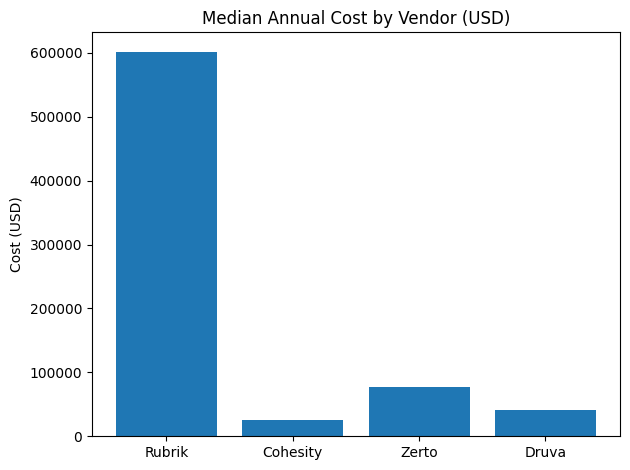
| Median Annual Buyer Cost | $24,937 |
| High-End Deployment Cost | $191,748 |
This pricing spectrum reflects the platform’s scalability, ranging from mid-sized enterprise deployments to large, multi-region, mission-critical environments.
Architectural Integration: NetBackup on SpanFS
A key technical achievement of the merger is the integration of Veritas NetBackup into Cohesity’s SpanFS distributed file system. SpanFS is engineered to provide global deduplication, scale-out storage, and distributed resiliency across hybrid and multi-cloud infrastructures.
The architectural consolidation enables a capability known as Instant Mass Restore. This functionality allows hundreds of virtual machines to be mounted and booted directly from the backup cluster simultaneously without requiring full data rehydration.
Instant Mass Restore Capability Matrix
| Feature | Traditional Recovery Model | Cohesity Data Cloud Model |
|---|---|---|
| VM Restore Method | Sequential restoration | Parallel boot from backup |
| Time to Recover Large VM Sets | Hours to Days | Minutes to Hours |
| Infrastructure Rehydration Required | Yes | No |
| Cluster-Level Scalability | Limited | Horizontal scale-out |
This innovation is particularly valuable in ransomware scenarios or data center-wide outages, where restoring hundreds of workloads simultaneously is essential for business continuity.
AI-Driven Data Intelligence with Gaia
Cohesity’s competitive differentiation in 2026 extends beyond traditional backup and disaster recovery. Its Gaia AI engine incorporates Retrieval Augmented Generation technology to transform archived and unstructured data into searchable, actionable intelligence.
Gaia enables enterprises to perform natural language queries across petabytes of stored information. This functionality effectively converts so-called dark data into a strategic business asset, unlocking insights that were previously inaccessible due to scale and complexity.
AI Functionality Overview
| Capability | Business Impact |
|---|---|
| Natural Language Search | Faster data discovery across massive archives |
| Retrieval Augmented Generation | Context-aware AI responses |
| Petabyte-Scale Query Processing | Enterprise-wide knowledge extraction |
| Dark Data Utilization | Monetization and compliance support |
By embedding AI directly into the data protection layer, Cohesity Data Cloud blurs the line between disaster recovery software and enterprise data intelligence platforms.
Cohesity FortKnox and Cyber Vaulting Strategy
In the evolving cyber threat landscape of 2026, immutable backups and isolated recovery environments have become essential components of disaster recovery planning. Cohesity FortKnox addresses this requirement through a SaaS-based cyber vaulting solution.
FortKnox creates a managed, immutable copy of critical data within a secure cloud environment. This design functions as a break glass recovery mechanism during catastrophic events such as:
• Ransomware attacks
• Insider threats
• Total site compromise
• Infrastructure-wide encryption
Cyber Vault Protection Matrix
| Threat Scenario | Standard Backup Risk Level | FortKnox Mitigation Strategy |
|---|---|---|
| Ransomware Encryption | High | Immutable cloud vault copy |
| Credential Compromise | Moderate | Isolated management plane |
| Primary Data Center Destruction | Severe | Offsite SaaS vault recovery |
| Backup Infrastructure Attack | Significant | Segmented, managed vault architecture |
The SaaS-based vault model reduces operational complexity while strengthening compliance posture and cyber insurance readiness.
Strategic Position in the 2026 Disaster Recovery Software Landscape
Within the broader Top 10 Disaster Recovery Software market in 2026, Cohesity Data Cloud integrating Veritas NetBackup represents a convergence of scale, AI innovation, and enterprise-grade resiliency.
Key competitive differentiators include:
• Management of over 40 exabytes of enterprise data
• Deep penetration within Global 500 organizations
• Distributed SpanFS architecture enabling Instant Mass Restore
• AI-powered search and analytics through Gaia
• SaaS-based cyber vaulting via FortKnox
As enterprises increasingly prioritize cyber resilience, hybrid cloud mobility, and AI-enabled data intelligence, Cohesity Data Cloud stands out as a next-generation disaster recovery platform that extends beyond traditional backup solutions. Its combination of scale, artificial intelligence, and immutable recovery architecture positions it as a defining solution in the global disaster recovery software market in 2026.
3. Commvault Cloud
By 2026, Commvault Cloud has successfully repositioned itself from a legacy enterprise backup vendor into a cloud-native disaster recovery leader. This transformation was accelerated through two major strategic acquisitions completed in 2024 and 2025, which reshaped its technological foundation and competitive standing in the global disaster recovery software market.
The acquisition of Appranix, valued at up to $2.1 billion, introduced advanced cloud rebuild orchestration capabilities into Commvault’s portfolio. Shortly afterward, the acquisition of Clumio strengthened its cloud-native data protection footprint, particularly in hyperscale environments. Together, these integrations enabled Commvault Cloud to address modern disaster recovery requirements that extend far beyond traditional backup restoration.
In the context of the Top 10 Disaster Recovery Software platforms in 2026, Commvault Cloud stands out for its ability to restore not only data, but entire cloud ecosystems.
Cloud Rewind: Full Application Stack Reconstruction
A defining innovation within Commvault Cloud is the integration of Appranix’s Cloud Rewind technology. Unlike traditional disaster recovery solutions that focus solely on restoring data volumes or virtual machines, Cloud Rewind is engineered to rebuild the complete cloud application stack.
This includes automated reconstruction of:
• Networking configurations
• Security groups
• Identity and Access Management policies
• Infrastructure dependencies
• Application-level integrations
Cloud Rebuild Capability Comparison
| Recovery Dimension | Traditional DR Tools | Commvault Cloud with Cloud Rewind |
|---|---|---|
| Data Restoration | Yes | Yes |
| Infrastructure Rebuild | Partial | Full Automation |
| Networking Configuration Recovery | Manual | Automated |
| IAM Policy Recreation | Manual | Automated |
| Application Dependency Mapping | Limited | Native Stack Awareness |
This capability is particularly critical during catastrophic region-wide cloud failures, misconfigurations, or ransomware events that corrupt infrastructure settings in addition to data.
Compatibility Leadership in Heterogeneous Environments
One of Commvault Cloud’s strongest differentiators in 2026 is its extensive compatibility matrix. Large enterprises often operate highly heterogeneous IT environments, blending legacy systems with modern cloud-native workloads.
Commvault supports:
• Over 800 data sources
• More than 1,400 storage targets
This unmatched interoperability allows Fortune 500 organizations to unify protection strategies across:
• Decades-old mainframes
• On-premises data centers
• Hybrid cloud environments
• Kubernetes clusters
• Multi-cloud deployments
Compatibility Matrix Overview
| Environment Type | Support Level in Commvault Cloud |
|---|---|
| Mainframes | Full |
| Virtual Machines | Full |
| Cloud-Native Workloads | Full |
| Kubernetes Containers | Native Integration |
| SaaS Applications | Broad Coverage |
| Object Storage Platforms | Extensive |
For enterprises managing complex digital transformation initiatives, this level of compatibility reduces operational silos and simplifies disaster recovery governance.
Recovery-as-Code: Infrastructure Rebuilt Through Automation
Another major innovation within Commvault Cloud in 2026 is its Recovery-as-Code capability. This feature automatically generates the infrastructure-as-code templates necessary to reconstruct cloud environments following catastrophic events.
When a region-wide outage or destructive cyberattack occurs, the platform can generate:
• Terraform configurations
• AWS CloudFormation templates
These templates are aligned with the last known good state of the environment, allowing organizations to rebuild infrastructure programmatically rather than manually reconfiguring components under pressure.
Recovery Automation Comparison
| Recovery Approach | Manual Rebuild Model | Recovery-as-Code Model |
|---|---|---|
| Infrastructure Documentation | Required | Auto-generated |
| Template Creation | Manual | Automated |
| Human Configuration Errors | High Risk | Reduced Risk |
| Recovery Time for Cloud Regions | Extended | Significantly Accelerated |
This approach dramatically reduces recovery time objectives for cloud-native enterprises and minimizes the operational risks associated with manual configuration during crisis scenarios.
Cloud-Native Pricing Model
Commvault Cloud’s pricing structure reflects its expansion into cloud-native disaster recovery services. For AWS environments, pricing begins at approximately $0.035 per instance per hour.
Cloud DR Pricing Snapshot
| Service Category | Starting Price Model |
|---|---|
| AWS Cloud-Native DR | $0.035 per instance per hour |
| Enterprise Hybrid DR | Custom enterprise pricing |
| Large-Scale Multi-Cloud Deployments | Tiered consumption-based models |
This consumption-based pricing aligns with modern DevOps and FinOps strategies, allowing organizations to scale protection in proportion to workload growth.
Strategic Position in the 2026 Disaster Recovery Software Market
In the competitive landscape of 2026, Commvault Cloud distinguishes itself through several defining characteristics:
• Full-stack cloud environment reconstruction
• Recovery-as-Code automation
• Industry-leading compatibility matrix
• Strong adoption among Fortune 500 enterprises
• Cloud-native, consumption-based pricing
As disaster recovery strategies increasingly shift toward automation, infrastructure-as-code, and hybrid cloud resiliency, Commvault Cloud represents a mature yet forward-looking platform. Its ability to bridge legacy systems with modern Kubernetes-driven architectures ensures continued relevance in enterprise environments undergoing digital transformation.
Within the global Top 10 Disaster Recovery Software ecosystem in 2026, Commvault Cloud is widely recognized for its comprehensive stack recovery, automation-first philosophy, and deep compatibility across heterogeneous IT landscapes.
4. Rubrik Security Cloud
In 2026, Rubrik Security Cloud is recognized as a high-assurance, security-first disaster recovery platform built around Zero Trust principles. Rather than competing primarily on traditional backup capacity or pricing efficiency, Rubrik has differentiated itself through hardened architecture, logical air-gapping, and intelligent recovery automation.
Although its estimated market share stands at approximately 1.08%, Rubrik maintains a strong presence within large enterprises that prioritize cyber resilience, regulatory compliance, and high-performance database recovery. Its positioning reflects a deliberate focus on quality, security depth, and mission-critical workload protection rather than broad mid-market expansion.
Zero Trust Architecture and the Atlas File System
At the core of Rubrik Security Cloud is its proprietary Atlas file system. Unlike traditional backup solutions that expose standard network protocols such as NFS or SMB for data access, Atlas is architected to avoid exposing writable protocols to the broader network.
This design creates what is commonly described as a logical air gap. Even if attackers obtain administrative credentials, backup data remains invisible and inaccessible because it cannot be mounted or modified using conventional network pathways.
Security Architecture Comparison
| Security Dimension | Traditional Backup Systems | Rubrik Security Cloud with Atlas |
|---|---|---|
| Writable Network Protocol Exposure | Yes | No |
| Logical Air Gap | Limited or Manual | Native and Automated |
| Credential-Based Attack Risk | Elevated | Significantly Reduced |
| Backup Data Visibility | Network Accessible | Hidden from Writable Access |
This architectural model aligns with Zero Trust security frameworks that assume breach conditions and minimize implicit trust within internal networks.
Hyper-Converged, Flash-First Infrastructure
Rubrik Security Cloud operates on a hyper-converged, flash-first architecture designed to deliver both high throughput and rapid recovery times. The integrated compute and storage model eliminates the need for separate backup servers and storage arrays, simplifying deployment while optimizing performance.
Flash-optimized infrastructure enables faster snapshot indexing, rapid live mounting of workloads, and improved resilience during peak recovery operations.
Infrastructure Characteristics Overview
| Architecture Element | Rubrik Implementation Strategy |
|---|---|
| Deployment Model | Hyper-converged appliance-based |
| Primary Storage Medium | Flash-first |
| Compute and Storage Integration | Unified |
| Scalability Model | Linear scale-out clusters |
This infrastructure design is particularly advantageous for enterprises running high-transaction databases and latency-sensitive applications.
Performance Metrics and Cost Profile
Rubrik Security Cloud operates at a premium price tier within the disaster recovery software market. However, its cost structure reflects its advanced security architecture and automation capabilities.
Performance and Financial Snapshot
| Metric | Details |
|---|---|
| Estimated Market Share | 1.08% |
| Median Reported Annual Cost | $601,917 |
| Recovery Point Objective (RPO) | 15 minutes to hours |
| Recovery Time Objective (RTO) | Instant via Live Mount |
| Primary Architecture Model | Hyper-converged, flash-first |
While the annual median cost is significantly higher than many competitors, large enterprises often justify this investment based on reduced ransomware recovery risk and minimized downtime for critical workloads.
Agentic Recovery and Intelligent Automation
One of Rubrik’s defining innovations in 2026 is its Agentic Recovery assistant, known as Ruby. This AI-driven capability automates complex recovery workflows during cyber incidents.
Ruby analyzes system telemetry and backup metadata to determine the blast radius of a ransomware attack. It identifies compromised systems, traces lateral movement patterns, and selects the last known clean snapshots for restoration.
Automated Recovery Workflow Comparison
| Recovery Phase | Manual Enterprise Model | Rubrik Agentic Recovery Model |
|---|---|---|
| Compromise Assessment | Security team analysis | Automated blast radius mapping |
| Snapshot Selection | Manual validation | AI-selected clean restore points |
| Workflow Orchestration | Script-driven or manual | Fully automated |
| Time to Initiate Recovery | Extended | Accelerated |
By automating forensic assessment and snapshot validation, Rubrik reduces both human error and recovery delays during high-pressure incident response scenarios.
Live Mount Capabilities for Large Databases
In 2026, Rubrik Security Cloud is particularly favored by enterprises operating large-scale SQL Server and Oracle database environments. Its Live Mount capability allows organizations to run production workloads directly from backup storage while primary infrastructure is being rebuilt.
This approach significantly reduces downtime for revenue-generating applications and compliance-sensitive databases.
Live Mount Use Case Matrix
| Workload Type | Traditional Restore Model | Rubrik Live Mount Model |
|---|---|---|
| SQL Databases | Full data rehydration required | Instant execution from backup |
| Oracle Databases | Sequential restoration | Direct run from backup cluster |
| Massive Data Warehouses | Extended downtime | Temporary operational continuity |
| Primary System Reconstruction | Blocking | Parallel with live operations |
Live Mount functionality effectively shifts disaster recovery from passive restoration to active operational continuity.
Strategic Position in the 2026 Top 10 Disaster Recovery Software Landscape
Within the global Top 10 Disaster Recovery Software ecosystem in 2026, Rubrik Security Cloud is widely regarded as a premium, security-centric platform. Its competitive strengths include:
• Zero Trust backup architecture
• Logical air-gapped Atlas file system
• AI-driven Agentic Recovery automation
• Flash-optimized hyper-converged infrastructure
• Instant Live Mount capabilities for enterprise databases
As ransomware threats grow more sophisticated and enterprises demand minimal downtime for critical systems, Rubrik’s architecture prioritizes resilience, isolation, and intelligent recovery orchestration. Its focus on hardened security and automated incident response ensures continued relevance among large enterprises seeking advanced disaster recovery solutions in 2026.
5. Druva Data Security Cloud
By 2026, Druva Data Security Cloud has established itself as one of the most distinctive platforms in the global disaster recovery and DRaaS landscape. It is widely recognized as the first 100% SaaS-based data protection solution to enter the Gartner Leaders quadrant, marking a structural shift in how enterprises approach backup and disaster recovery.
Unlike traditional vendors that rely on hybrid or appliance-based deployments, Druva operates without requiring any on-premises hardware. Its architecture is fully cloud-native, designed for organizations seeking to eliminate physical infrastructure, reduce operational overhead, and simplify disaster recovery management.
Druva’s market mindshare in the Disaster Recovery as a Service category has grown significantly, rising from 0.3% to 2.1% by 2026. This increase reflects growing enterprise confidence in SaaS-only resilience models.
Cloud-Native, Public-Cloud-Only Architecture
Druva operates exclusively on a public-cloud-only model, leveraging AWS as its backend infrastructure provider. Customers do not manage storage, compute, or replication hardware directly. Instead, they consume disaster recovery as a subscription service, with unified billing and centralized management.
This approach provides several structural advantages:
• No capital expenditure for hardware
• No data center maintenance requirements
• Automated infrastructure scaling
• Built-in geographic redundancy
• Simplified global compliance management
Deployment Model Comparison
| Architecture Model | Traditional DR Platforms | Druva Data Security Cloud |
|---|---|---|
| On-Premises Hardware Required | Yes | No |
| Hybrid Appliance Deployment | Common | Not Required |
| Public Cloud Backend | Optional | Native and Exclusive |
| Unified Billing Experience | Fragmented | Centralized SaaS Billing |
| Infrastructure Management | Customer Managed | Provider Managed |
This cloud-exclusive design makes Druva particularly attractive to enterprises accelerating digital transformation or pursuing data center exit strategies.
Cost Structure and Enterprise Affordability
Druva is often positioned as a cost-effective alternative to infrastructure-heavy disaster recovery platforms. Its subscription model aligns with operational expenditure frameworks and eliminates long-term hardware refresh cycles.
Financial Overview
| Metric | Details |
|---|---|
| Median Reported Annual Cost | $41,634 |
| Market Mindshare Growth (DRaaS) | 0.3% to 2.1% |
| Customer Satisfaction Score | 4.9 out of 5 |
| Infrastructure Model | 100% SaaS |
When compared to appliance-based or hyper-converged disaster recovery systems, Druva’s pricing structure lowers barriers for mid-sized enterprises and distributed organizations seeking enterprise-grade protection without high capital investment.
User Experience and Ease of Deployment
One of Druva’s strongest differentiators in 2026 is its ease of use. The platform maintains a 4.9 out of 5 satisfaction score among users, reflecting high ratings in deployment simplicity, interface clarity, and support responsiveness.
The SaaS-based design removes common operational burdens such as:
• Firmware updates
• Hardware lifecycle management
• Storage capacity forecasting
• Backup infrastructure patching
User Experience Comparison
| Operational Dimension | Traditional DR Systems | Druva SaaS Model |
|---|---|---|
| Initial Deployment Complexity | High | Low |
| Hardware Provisioning | Required | Not Required |
| Ongoing Maintenance | IT Team Intensive | Provider Managed |
| Scalability | Manual Expansion | Automatic Scaling |
For distributed enterprises with remote workforces and SaaS-heavy ecosystems, this simplicity accelerates onboarding and reduces administrative overhead.
DruAI: Intelligent Automation and SaaS Data Recovery
In 2026, Druva enhances its disaster recovery capabilities through DruAI, an AI-driven feature set focused on guided workflows and proactive threat detection.
DruAI assists administrators by:
• Identifying unusual data deletion patterns
• Recommending recovery actions
• Automating restore workflows
• Providing contextual threat alerts
The platform achieves a 95% recovery rate for deleted SaaS data within 24 hours, making it particularly effective for protecting collaboration platforms and business applications.
AI-Driven Recovery Capabilities
| Feature | Business Impact |
|---|---|
| Guided Recovery Workflows | Reduced human error |
| Proactive Threat Detection | Early identification of malicious activity |
| SaaS Data Recovery Success Rate | 95% within 24 hours |
| Workflow Automation | Faster recovery execution |
As SaaS adoption continues to dominate enterprise IT strategies, protection of cloud-native applications becomes as critical as infrastructure-level disaster recovery. Druva’s AI-assisted SaaS recovery focus positions it strongly within this evolving segment.
Strategic Role in the 2026 Disaster Recovery Software Landscape
Within the Top 10 Disaster Recovery Software platforms in 2026, Druva Data Security Cloud represents a fully SaaS-driven model designed for cloud-first enterprises. Its defining characteristics include:
• 100% SaaS architecture with no on-premises hardware
• Public-cloud-only backend powered by AWS
• Unified billing and subscription-based pricing
• High user satisfaction and ease of deployment
• AI-assisted SaaS data recovery capabilities
As enterprises increasingly prioritize agility, cost optimization, and infrastructure simplification, Druva’s model aligns with modern IT operating strategies. Its growth in DRaaS mindshare reflects broader industry momentum toward cloud-native, fully managed disaster recovery solutions that eliminate traditional hardware dependencies.
6. HPE Zerto Software
In 2026, HPE Zerto Software is widely regarded as the industry benchmark for Continuous Data Protection within the global disaster recovery software market. Now fully integrated into the HPE GreenLake platform, Zerto combines hypervisor-level replication with enterprise-grade orchestration, enabling organizations to achieve near-zero data loss and minimal downtime.
Although Zerto holds an estimated 1.08% market share, its reputation in mission-critical virtualized environments remains strong. It is frequently selected by enterprises that prioritize Recovery Point Objectives measured in seconds and Recovery Time Objectives measured in minutes rather than hours.
Hypervisor-Level Replication Architecture
Unlike traditional disaster recovery platforms that rely on scheduled snapshots, Zerto’s replication engine operates directly at the hypervisor level. This architecture continuously captures and replicates changes in real time, eliminating the data gaps that occur between scheduled backup intervals.
By intercepting writes at the virtualization layer, Zerto ensures granular journaling and near-continuous replication without impacting application performance.
Architecture Comparison Matrix
| Recovery Methodology | Snapshot-Based Systems | HPE Zerto CDP Model |
|---|---|---|
| Data Capture Interval | Scheduled (Hourly/Daily) | Continuous |
| Replication Layer | OS or Storage-Based | Hypervisor-Level |
| Typical RPO | Minutes to Hours | Seconds |
| Typical RTO | Hours | Minutes |
| Journal-Based Rollback | Limited | Granular and Continuous |
This approach enables organizations to rewind workloads to precise points in time, reducing exposure to ransomware encryption or accidental corruption.
Performance Profile and Operational Metrics
Zerto’s Continuous Data Protection capabilities make it particularly effective for virtualized applications that demand uninterrupted availability.
Performance Overview
| Metric | HPE Zerto Software |
|---|---|
| Estimated Market Share | 1.08% |
| Recovery Point Objective | Seconds |
| Recovery Time Objective | Minutes |
| Median Annual Cost | $76,750 |
| Pricing Model | Usage-Based |
While not positioned as the lowest-cost solution in the disaster recovery software market, Zerto’s value proposition centers on minimizing business disruption and protecting revenue-generating applications.
Integration with HPE GreenLake
Following its integration into the HPE GreenLake ecosystem, Zerto now benefits from a broader hybrid cloud consumption model. HPE GreenLake provides infrastructure-as-a-service capabilities, enabling customers to deploy disaster recovery resources across multi-site and cross-hypervisor environments with centralized orchestration.
Key orchestration capabilities include:
• Automated failover and failback
• Multi-site disaster recovery coordination
• Cross-hypervisor workload mobility
• Hybrid cloud resource scaling
Orchestration Capability Comparison
| Feature | Native Hyperscale Tools | HPE Zerto via GreenLake |
|---|---|---|
| Multi-Site Failover | Limited to Native Platform | Cross-Platform |
| Cross-Hypervisor Replication | Restricted | Supported |
| Granular Journal Recovery | Basic | Advanced |
| Hybrid Infrastructure Support | Cloud-Specific | Hybrid and Multi-Site |
This orchestration depth makes Zerto particularly valuable for enterprises operating complex virtualized data centers alongside hybrid cloud workloads.
Pricing and Customer Sentiment Comparison
When compared with hyperscale-native disaster recovery tools such as Microsoft Azure Site Recovery, Zerto demonstrates strong customer advocacy and emotional engagement metrics.
Pricing and Satisfaction Matrix
| Evaluation Metric | Microsoft Azure Site Recovery | HPE Zerto Software |
|---|---|---|
| Composite Score | 8.1 / 10 | 7.6 / 10 |
| Net Emotional Footprint | +94 | +86 |
| Likeliness to Recommend | 93% | 82% |
| Fair Price vs. Value | 86% | 79% |
| Median Annual Cost | Usage-Based | $76,750 |
While hyperscale-native tools may offer simpler procurement experiences, Zerto maintains strong loyalty among enterprises requiring granular control and cross-environment orchestration.
Operational Considerations
Despite its strong technical capabilities, Zerto’s enterprise licensing and contract negotiation processes are often considered more complex compared to cloud-native disaster recovery services bundled directly within hyperscale platforms.
However, organizations that require:
• Near-zero downtime
• Cross-hypervisor compatibility
• Granular rollback capability
• Journal-based continuous replication
continue to view Zerto as a strategic investment rather than a commodity backup solution.
Strategic Position in the 2026 Disaster Recovery Software Landscape
Within the Top 10 Disaster Recovery Software platforms in 2026, HPE Zerto Software maintains a focused reputation as a Continuous Data Protection specialist. Its defining characteristics include:
• Hypervisor-level continuous replication
• Seconds-level RPO performance
• Minutes-level RTO execution
• Integration with HPE GreenLake hybrid cloud services
• Advanced multi-site orchestration
As enterprise workloads demand uninterrupted availability and ransomware threats continue to evolve, Zerto’s continuous replication architecture ensures that organizations can recover virtualized applications with precision and speed. Its enduring strength lies in delivering consistent, journal-based resilience for mission-critical systems operating across hybrid and multi-site infrastructures.
7. Microsoft Azure Site Recovery
In 2026, Microsoft Azure Site Recovery (ASR) stands as the dominant native cloud disaster recovery solution within the global Disaster Recovery as a Service market. With an estimated 14.3% mindshare in the DRaaS category, ASR benefits from deep integration across the broader Microsoft ecosystem, including Azure infrastructure, Microsoft 365 services, and enterprise identity frameworks.
Its native positioning allows organizations already invested in Azure to extend business continuity capabilities without introducing additional third-party platforms. This ecosystem alignment has contributed significantly to its widespread enterprise adoption.
Integration Across Hybrid and Virtualized Environments
Azure Site Recovery is designed to support diverse enterprise infrastructure environments. It enables automated replication of:
• VMware virtual machines
• Hyper-V virtual machines
• Physical servers
• Azure virtual machines
Workloads can be replicated into Azure regions for failover and failback operations, creating a scalable cloud-based recovery site without requiring secondary data center investments.
Platform Integration Matrix
| Infrastructure Type | ASR Support Level | Recovery Target |
|---|---|---|
| VMware VMs | Full Support | Azure Cloud |
| Hyper-V VMs | Native Support | Azure Cloud |
| Physical Servers | Supported via Agents | Azure Cloud |
| Azure Virtual Machines | Native Integration | Cross-Region Azure |
This broad compatibility makes ASR particularly attractive to enterprises managing hybrid infrastructures that combine on-premises virtualization with cloud expansion strategies.
User Sentiment and Renewal Rates
Enterprise sentiment toward Azure Site Recovery is notably strong in 2026. Surveyed organizations report high confidence in platform reliability, integration depth, and long-term viability.
Customer Satisfaction Snapshot
| Metric | Microsoft Azure Site Recovery |
|---|---|
| DRaaS Mindshare | 14.3% |
| Net Emotional Footprint | +94 |
| Plan to Renew | 100% |
| Fair Price vs. Value Agreement | 86% |
The 100% plan-to-renew rate among surveyed enterprises indicates strong customer retention and perceived operational value. The high Net Emotional Footprint score further reflects positive engagement with product stability, vendor support, and ecosystem compatibility.
Cost Efficiency and Pricing Model
Azure Site Recovery follows a usage-based pricing structure. Costs vary depending on factors such as the number of protected instances, storage consumption, and replication frequency.
Compared to specialized third-party disaster recovery platforms, ASR is consistently viewed as more affordable, particularly for enterprises already consuming Azure services.
Cost Perception Overview
| Cost Dimension | ASR Market Perception |
|---|---|
| Pricing Structure | Usage-Based |
| Relative Cost vs. Third-Party DR | Generally Lower |
| Value for Money | 86% User Agreement |
| Capital Expenditure Requirement | None |
Because Azure infrastructure serves as the recovery target, organizations can consolidate billing and reduce vendor sprawl, improving financial predictability.
Operational Dependencies and Performance Considerations
Despite its strengths, Azure Site Recovery’s performance and reliability depend heavily on proper agent management. Replication agents installed on protected systems must remain aligned with supported versions.
During third-party patching cycles, mismatched agent versions can cause replication health to enter a critical state. When this occurs, failover operations may be temporarily blocked until compatibility issues are resolved.
Operational Risk Matrix
| Risk Factor | Potential Impact | Mitigation Strategy |
|---|---|---|
| Agent Version Mismatch | Failover Blocked | Strict Patch Governance |
| Third-Party Patching Conflicts | Replication Health Degradation | Coordinated Update Scheduling |
| Azure Region Outage | Regional Failover Required | Multi-Region Planning |
Organizations adopting ASR must implement disciplined patch management and monitoring processes to maintain optimal recovery readiness.
Strategic Role in the 2026 Disaster Recovery Software Landscape
Within the Top 10 Disaster Recovery Software ecosystem in 2026, Microsoft Azure Site Recovery represents the leading native cloud recovery platform. Its defining characteristics include:
• 14.3% DRaaS mindshare dominance
• Deep integration with Microsoft Azure and hybrid environments
• High customer renewal and satisfaction rates
• Usage-based, cost-effective pricing model
• Automated replication for VMware, Hyper-V, and physical servers
For enterprises standardized on Microsoft technologies, ASR provides a streamlined, scalable disaster recovery solution that aligns closely with cloud-first strategies. While specialized third-party platforms may offer deeper cross-cloud or advanced orchestration features, Azure Site Recovery remains the preferred choice for organizations seeking tightly integrated, cost-efficient recovery within the Microsoft ecosystem in 2026.
8. Acronis Cyber Protect
In 2026, Acronis Cyber Protect occupies a distinct position within the global disaster recovery software market by combining backup, disaster recovery, and next-generation anti-malware capabilities into a single unified platform. This integration model differentiates Acronis from traditional vendors that separate security and recovery functions across multiple tools.
With a 6.34% market share and 6,672 customers, Acronis holds the third-largest position by customer count in the disaster recovery category. Its growth has been fueled primarily by strong adoption among small to mid-market businesses seeking simplified protection models without enterprise-level complexity.
Unified Agent Architecture and Operational Advantage
Acronis Cyber Protect is built around a single-agent architecture that consolidates:
• Backup and recovery management
• Disaster recovery orchestration
• Endpoint protection and anti-malware
• Vulnerability assessment
This unified framework addresses what many organizations describe as the preparation gap. In traditional environments, security tools and backup systems often operate independently, leading to communication breakdowns during ransomware or cyberattack incidents. By integrating these capabilities into a single agent, Acronis reduces response delays and coordination errors.
Integration Comparison Matrix
| Capability Area | Disparate Tool Model | Acronis Unified Agent Model |
|---|---|---|
| Backup and Recovery | Separate Platform | Integrated |
| Anti-Malware Protection | Standalone Security Tool | Built-In |
| Threat Detection | Independent Alerts | Unified Dashboard |
| Incident Coordination | Manual Cross-Team Effort | Centralized Workflow |
| Agent Management | Multiple Agents Required | Single Agent |
This consolidation simplifies deployment, reduces endpoint resource consumption, and enhances real-time coordination during crisis response.
Market Metrics and Financial Overview
Acronis balances affordability with enterprise scalability through tiered pricing structures.
Business Metrics Snapshot
| Metric | Details |
|---|---|
| Market Share | 6.34% |
| Customer Count | 6,672 |
| ROI Sentiment Score | 5.7 / 10 |
| Entry-Level Pricing | $85 per year |
| Platform Focus | Integrated Backup & Security |
Entry-level pricing begins at $85 per year, making Acronis one of the most accessible disaster recovery solutions in the 2026 market. Enterprise-grade disaster recovery as a service orchestration and advanced automation features are custom-priced, reflecting broader infrastructure needs.
Pricing Structure Overview
| Plan Tier | Target Segment | Pricing Model |
|---|---|---|
| Entry-Level Protection | Small Businesses | Starting at $85 per year |
| Mid-Market DR and Security | Growing Organizations | Tiered Subscription |
| Enterprise DRaaS | Large Enterprises | Custom Pricing |
This tiered approach enables scalability from micro-business environments to larger distributed enterprises.
Adoption Among Small and Mid-Market Organizations
Acronis Cyber Protect is particularly popular within the small to mid-market segment. In 2026, approximately 88% of users in this category report valuing its ease of setup compared to more complex enterprise disaster recovery suites.
Ease-of-Use Comparison
| Evaluation Dimension | Complex Enterprise Suites | Acronis Cyber Protect |
|---|---|---|
| Initial Setup Complexity | High | Low |
| Agent Deployment Time | Extended | Rapid |
| Security and Backup Integration | Requires Multiple Systems | Unified |
| Administrative Overhead | Significant | Streamlined |
For organizations with limited IT staff, the reduction in operational complexity is a decisive factor in platform selection.
Integrated Security and Disaster Recovery Strategy
Acronis’ strategy in 2026 centers on merging cybersecurity and data resilience into a cohesive operational framework. By embedding anti-malware protection directly within the backup and recovery pipeline, the platform enhances proactive defense capabilities.
During ransomware incidents, the integrated system allows for:
• Immediate threat detection
• Isolation of infected endpoints
• Restoration from clean backups
• Coordinated remediation workflows
This unified approach reduces the risk of restoring compromised data and shortens overall incident response timelines.
Strategic Role in the 2026 Disaster Recovery Software Landscape
Within the Top 10 Disaster Recovery Software platforms in 2026, Acronis Cyber Protect stands out for its integrated protection model and strong penetration among small to mid-market organizations. Its defining characteristics include:
• Single-agent architecture combining backup and security
• Competitive entry-level pricing
• High adoption among SMBs
• Simplified deployment and management
• Scalable tiered subscription model
As cyber threats increasingly intersect with disaster recovery planning, Acronis’ unified platform model offers a streamlined alternative to multi-vendor environments. While larger enterprises may opt for specialized orchestration platforms, Acronis continues to expand its footprint by delivering accessible, integrated, and cost-efficient cyber protection solutions in 2026.
9. Dell Technologies PowerProtect Suite
In 2026, Dell Technologies continues to lead the hardware-integrated disaster recovery segment through its PowerProtect Suite and Data Domain appliance portfolio. While the broader industry has seen accelerated growth in SaaS-based and cloud-native disaster recovery platforms, Dell maintains a strong position among enterprises that require on-premises control, regulatory compliance alignment, and high-throughput performance.
With an estimated 1.94% share of the software-led disaster recovery market, Dell’s influence remains particularly strong in industries with rigid data sovereignty mandates, including financial services, healthcare, government, and critical infrastructure sectors.
PowerProtect Data Domain and the DD9910F All-Flash Innovation
A defining advancement in 2026 is the introduction of the DD9910F All-Flash appliance. This next-generation system significantly improves recovery performance by delivering ingest speeds of up to 94 TB per hour using DD Boost technology.
The shift toward all-flash architecture enhances:
• Backup ingest performance
• Data deduplication acceleration
• Faster restore operations
• Reduced recovery time for large datasets
This performance leap is particularly relevant for enterprises managing multi-petabyte environments that cannot tolerate extended recovery windows.
PowerProtect Data Domain Model Comparison
| Model | Usable Capacity Range | Max Throughput (DD Boost) | Ideal Segment |
|---|---|---|---|
| DD3300 | 4 TB – 32 TB | 7.0 TB/hr | SMB / Remote Offices |
| DD6400 | 8 TB – 172 TB | 27.7 TB/hr | Mid-Sized Enterprises |
| DD6900 | 24 TB – 288 TB | 33.0 TB/hr | Growing Enterprises |
| DD9400 | 48 TB – 1.5 PB | 57.0 TB/hr | Large Enterprises |
| DD9900 | 576 TB – 1.25 EB | 94.0 TB/hr | Multi-Petabyte Deployments |
The scalability of this lineup enables organizations to align capacity and performance with business growth, from remote office deployments to global data center consolidation strategies.
Data Invulnerability Architecture and End-to-End Validation
Dell’s Data Invulnerability Architecture (DIA) represents a cornerstone of its resilience strategy. DIA provides 100% end-to-end validation of data, ensuring that information is continuously verified throughout ingestion, storage, and retrieval processes.
This approach reduces the risk of silent data corruption, a threat that can compromise backup reliability without immediate detection.
Data Integrity Assurance Comparison
| Integrity Dimension | Traditional Backup Systems | Dell DIA Model |
|---|---|---|
| Inline Data Validation | Partial | Comprehensive |
| Ongoing Integrity Checks | Periodic | Continuous |
| Silent Data Corruption Detection | Limited | Advanced |
| End-to-End Verification Coverage | Not Guaranteed | 100% Validated |
For compliance-driven industries, the assurance of validated data integrity is often as critical as recovery speed.
Isolated Cyber Recovery Vaults
In response to the increasing sophistication of ransomware attacks, Dell has enhanced its isolated cyber recovery vault architecture. These vaults create segmented, secured environments that maintain immutable copies of critical data.
Compared to traditional air-gapped solutions, Dell’s cyber recovery vaults offer 2.8 times faster analytics performance. This enables security teams to rapidly scan and analyze protected datasets before initiating restoration processes.
Cyber Vault Capability Matrix
| Feature | Traditional Air Gap Model | Dell Cyber Recovery Vault |
|---|---|---|
| Physical Isolation | Yes | Yes |
| Automated Vault Orchestration | Limited | Advanced |
| Recovery Analytics Speed | Baseline | 2.8x Faster |
| Immutable Data Retention | Manual Controls | Integrated |
| Compliance Reporting | Separate Tools Required | Built-In Integration |
The combination of isolation, analytics acceleration, and orchestration strengthens incident response capabilities during enterprise-wide cyber events.
Performance Versus SaaS-Centric Alternatives
Despite the rapid rise of fully SaaS-based disaster recovery models in 2026, Dell maintains strong adoption among organizations that require:
• On-premises control of sensitive data
• High-performance ingest and restore speeds
• Compliance with strict regulatory frameworks
• Multi-petabyte storage scalability
Deployment Model Comparison
| Deployment Factor | Pure SaaS DR Platforms | Dell PowerProtect Suite |
|---|---|---|
| On-Premises Control | Limited | Full Control |
| Hardware Ownership | None | Integrated Appliances |
| Performance Predictability | Cloud-Dependent | Dedicated Infrastructure |
| Compliance Alignment | Shared Responsibility Model | Enterprise-Controlled |
This hardware-integrated model appeals to enterprises that prioritize deterministic performance and physical infrastructure governance.
Strategic Role in the 2026 Disaster Recovery Software Landscape
Within the Top 10 Disaster Recovery Software ecosystem in 2026, Dell Technologies PowerProtect Suite represents the leading hardware-integrated resilience platform. Its defining characteristics include:
• High-performance all-flash DD9910F architecture
• Ingest speeds up to 94 TB per hour
• Comprehensive Data Invulnerability Architecture
• Advanced cyber recovery vaults with accelerated analytics
• Broad scalability from SMB to multi-petabyte enterprises
As organizations balance cloud adoption with regulatory and performance demands, Dell continues to provide a robust, appliance-driven disaster recovery framework. Its emphasis on speed, validation, and isolation ensures continued relevance in sectors where control, throughput, and compliance remain paramount in 2026.
10. NAKIVO Backup & Replication
In 2026, NAKIVO Backup & Replication has established itself as a high-value alternative within the global disaster recovery software market. Serving over 26,000 businesses worldwide, the platform bridges the gap between small and mid-sized organizations and large enterprises by delivering advanced capabilities at a competitive price point.
NAKIVO’s appeal lies in offering features commonly associated with premium disaster recovery vendors—such as real-time replication and site recovery orchestration—while maintaining flexible and affordable licensing options. This balance has contributed to its growing presence among organizations seeking enterprise-grade resilience without excessive capital investment.
Global Adoption and Workload Coverage
NAKIVO supports protection across a wide range of infrastructure types, including:
• Physical servers
• VMware and Hyper-V virtual machines
• Cloud environments
• Microsoft 365 workloads
This multi-environment compatibility makes it suitable for hybrid IT infrastructures and distributed organizations that require unified disaster recovery governance.
Workload Coverage Overview
| Environment Type | Support Level |
|---|---|
| Physical Servers | Supported |
| VMware Virtual Machines | Native Support |
| Hyper-V Virtual Machines | Native Support |
| Cloud Workloads | Supported |
| Microsoft 365 | Per-User Protection Model |
Real-Time Replication and Site Recovery Orchestration
One of NAKIVO’s most competitive technical features in 2026 is its Site Recovery functionality. The platform enables real-time replication of critical workloads, supporting Recovery Time Objectives as low as one second in optimal configurations.
This capability allows organizations to:
• Maintain synchronized secondary environments
• Automate failover and failback operations
• Minimize downtime during outages
• Reduce data loss exposure
Replication and Recovery Comparison
| Capability Dimension | Snapshot-Based Systems | NAKIVO Real-Time Replication |
|---|---|---|
| Replication Frequency | Scheduled | Continuous |
| Minimum RTO | Minutes to Hours | As Low as One Second |
| Failover Orchestration | Manual or Script-Based | Automated |
| Rollback Flexibility | Limited Restore Points | Continuous Replication Logs |
This real-time replication model enhances operational continuity for organizations with revenue-sensitive applications.
Federated Repository and Scalable Storage
NAKIVO’s federated repository architecture allows multiple standalone repositories to be aggregated into a single logical storage pool. This design simplifies scaling and centralized management across distributed environments.
Key advantages include:
• Unified storage management
• Simplified capacity expansion
• Improved administrative efficiency
• Logical consolidation of backup storage
Storage Architecture Comparison
| Storage Model | Traditional Standalone Repos | NAKIVO Federated Repository |
|---|---|---|
| Centralized Management | Limited | Unified Logical Pool |
| Scalability | Manual Expansion | Aggregated Expansion |
| Cross-Site Visibility | Fragmented | Centralized |
| Administrative Complexity | Higher | Reduced |
For organizations managing multiple branch offices or geographically dispersed environments, this architecture enhances both scalability and oversight.
Flexible Licensing and Pricing Structure
NAKIVO offers both subscription-based and perpetual licensing models, providing flexibility for organizations with different financial planning strategies.
Licensing and Pricing Matrix
| License Type | Subscription (Annual) | Perpetual Pricing |
|---|---|---|
| Basic (VMware / Hyper-V) | $99 | Not Available |
| Pro Essentials | $199 | $229 per socket |
| Enterprise Essentials | $299 | $329 per socket |
| Enterprise (Full) | $599 | Contact Vendor |
| Microsoft 365 (Per User) | $1 per month | Not Available |
This tiered structure allows smaller organizations to adopt entry-level protection while enabling enterprises to scale toward full-featured orchestration and automation.
Cost-to-Feature Value Comparison
| Evaluation Area | Premium Enterprise Suites | NAKIVO Backup & Replication |
|---|---|---|
| Real-Time Replication | Included at High Cost | Included at Lower Cost |
| Site Recovery Orchestration | Enterprise Tier Only | Available in Higher Tiers |
| Licensing Flexibility | Often Subscription Only | Subscription or Perpetual |
| SMB Accessibility | Limited | High |
This pricing advantage has positioned NAKIVO as a strong alternative for organizations seeking enterprise-grade resilience without enterprise-level pricing complexity.
Strategic Role in the 2026 Disaster Recovery Software Landscape
Within the Top 10 Disaster Recovery Software platforms in 2026, NAKIVO Backup & Replication stands out for delivering high-end functionality at accessible price points. Its defining strengths include:
• Real-time replication with near-instant RTO
• Automated site recovery orchestration
• Federated repository for scalable storage
• Flexible subscription and perpetual licensing
• Broad workload protection across physical, virtual, and cloud environments
As businesses increasingly demand cost-efficient yet robust disaster recovery solutions, NAKIVO continues to gain traction among organizations seeking performance, scalability, and affordability in a single unified platform.
Strategic Analysis of the Global Disaster Recovery Software Ecosystem in 2026
Executive Overview: From Backup to Autonomous Cyber Resilience
The global disaster recovery software ecosystem in 2026 reflects a structural transformation in enterprise IT governance. What was once considered a secondary operational safeguard has evolved into a board-level strategic imperative. The convergence of escalating cyber threats, exponential data growth, and regulatory scrutiny has elevated disaster recovery from a reactive backup function to an integrated cyber resilience discipline.
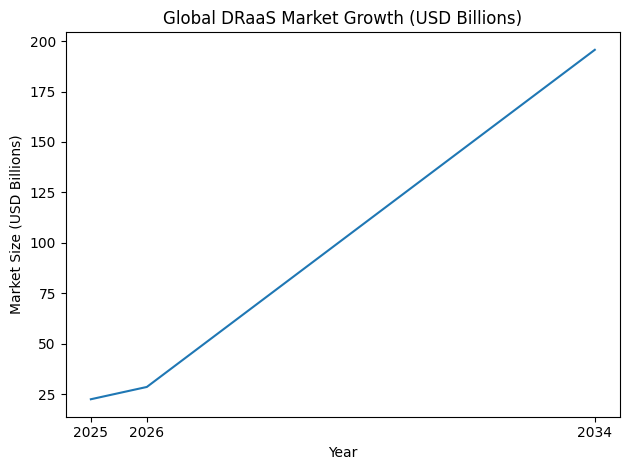
Cyberattacks are increasing at an estimated 30% week-over-week rate, while global data creation has surged toward 175 zettabytes by 2025. In parallel, the Disaster Recovery as a Service market has reached an estimated valuation of 28.50 billion USD in 2026, reflecting a compound annual growth rate of 27.23% from the previous year. This growth signals a decisive shift toward cloud-native recovery, automation, and AI-driven resilience frameworks.
Modern enterprises are no longer evaluating disaster recovery solely on traditional Recovery Point Objective and Recovery Time Objective benchmarks. Instead, leadership teams now prioritize full infrastructure rebuild capabilities, ransomware containment speed, data integrity verification, and automated orchestration across hybrid and multi-cloud ecosystems.
Market Valuation and Growth Trajectory
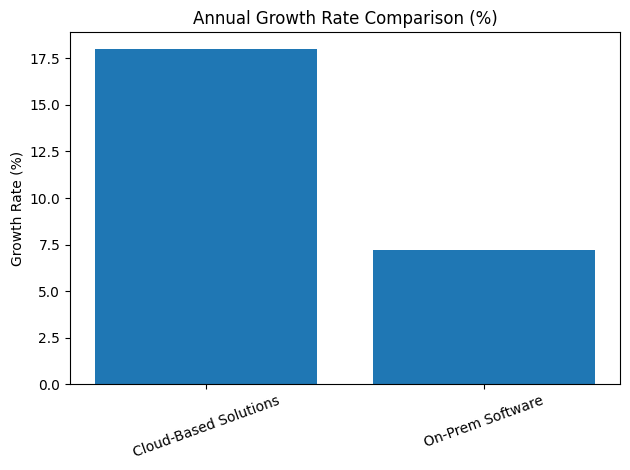
The disaster recovery ecosystem in 2026 spans multiple interconnected segments, including DRaaS, managed services, backup software, and orchestration platforms. Cloud deployment models now dominate, accounting for 65% of total market share.
Large enterprises remain the largest contributors to total spending, representing 57.76% of global revenue. However, small and medium-sized enterprises demonstrate the highest growth rates as they modernize legacy systems and transition away from capital-intensive on-premises hardware.
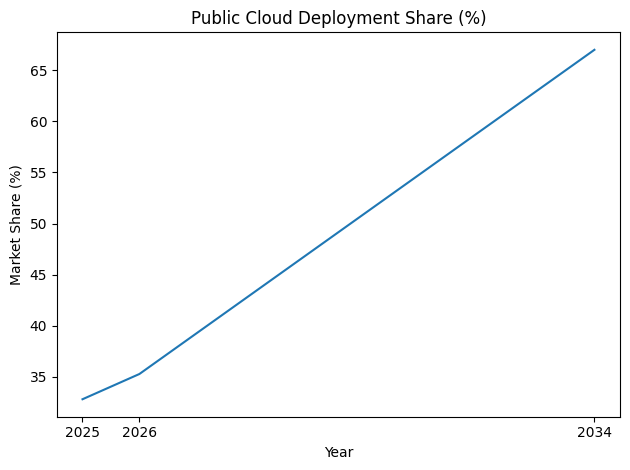
Disaster Recovery and DRaaS Market Projections 2025–2034
| Metric | 2025 Value (USD) | 2026 Value (USD) | 2034 Projected Value (USD) | CAGR (2025–2034) |
|---|---|---|---|---|
| Global DRaaS Market Size | 22.40 Billion | 28.50 Billion | 195.71 Billion | 27.23% |
| Data Backup & Recovery Software | 13.66 Billion | 14.99 Billion | 34.75 Billion | 9.79% |
| Managed DRaaS Segment Share | 38.5% | 40.83% | N/A | 22.1% |
| Public Cloud Deployment Share | 32.8% | 35.27% | 67.0% (by 2034) | 30.5% |
| Disaster Recovery Software Market | 12.83 Billion | 15.08 Billion | 26.2 Billion (2030) | 17.5% |
These projections underscore the acceleration of cloud-first disaster recovery strategies and the increasing role of managed and automated recovery services.
Geographic Market Dynamics
Regional distribution patterns highlight maturity in North America and high-growth potential in Asia-Pacific.
Regional Market Share and Growth Outlook
| Region | 2025 Market Share | Growth Outlook Through 2034 | Key Drivers |
|---|---|---|---|
| North America | 37.21% | Stable High Share | Regulatory compliance, vendor concentration |
| Asia-Pacific | N/A | 30.02% CAGR | BFSI expansion, telecom digitization |
| Europe | Significant | Moderate Growth | Data sovereignty and GDPR alignment |
| Latin America | Emerging | Accelerating | Cloud migration initiatives |
North America maintains leadership due to strict compliance requirements and advanced enterprise cloud adoption. Asia-Pacific, however, demonstrates the fastest expansion trajectory, fueled by aggressive digital transformation in banking, financial services, insurance, and telecommunications sectors.
The Readiness Gap: Backup vs. Recoverability
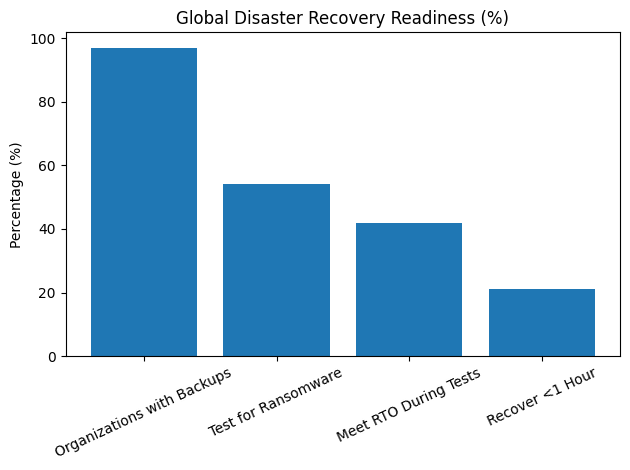
Despite near-universal adoption of backup tools, operational readiness remains inconsistent. The gap between possession of backup systems and actual recovery success has become a critical vulnerability.
Global Adoption and Readiness Statistics
| Statistic Description | Value / Percentage |
|---|---|
| Organizations maintaining backups | 97% |
| Organizations testing backups for ransomware recovery | 54% |
| DR plans failing to meet RTO during tests | 58% |
| Firms capable of recovery from wipe in under 1 hour | 21% |
| Manufacturers meeting recovery time targets | 18% |
| Average outage duration | 196 minutes |
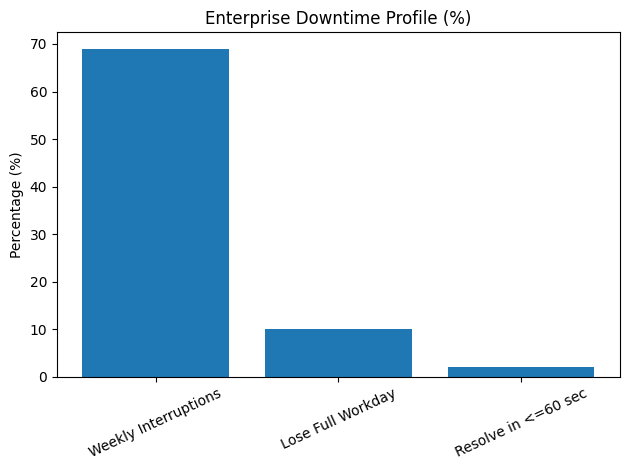
| Weekly or daily service interruptions | 69% |
| Average annual outages per organization | 86 |
This readiness gap has significant financial implications. While most organizations believe they are protected, testing results suggest otherwise. The inability to execute validated recovery plans exposes enterprises to extended downtime and reputational damage.
Economic Impact of Downtime and Recovery Failures
The financial consequences of inadequate disaster recovery capabilities are increasingly measurable and severe.
Economic Risk Indicators
| Indicator | Impact |
|---|---|
| Organizations reporting revenue loss from outages | 100% (Technology sector) |
| Companies reporting reduced customer trust | 90% |
| Average downtime cost per hour (North America) | Exceeds 100,000 USD for 50% of firms |
| Average annual incident responder spend | 1.9 Million USD |
| Time reduction using automated incident response | 78 minutes faster resolution |
| Cost reduction with automation | 45% lower outage costs |
Automated Disaster Recovery Orchestration solutions are increasingly deployed to reduce RTO from hours to minutes. Enterprises implementing automation report both faster resolution times and measurable cost savings.
Technological Shift: From Manual Restoration to Agentic Recovery
The defining technological transformation in 2026 is the integration of generative AI and agentic recovery workflows. Leading vendors now embed AI models capable of:
• Automated threat hunting
• Entropy-based anomaly detection
• Blast radius identification
• Autonomous failover orchestration
• Infrastructure-as-code regeneration
AI-Enabled Disaster Recovery Capabilities
| Capability Category | Traditional Model | 2026 Autonomous Model |
|---|---|---|
| Threat Detection | Manual Log Review | Real-Time AI Analysis |
| Recovery Workflow Initiation | Human Triggered | Automated |
| Infrastructure Rebuild | Script-Based | Code-Generated |
| Data Integrity Verification | Post-Restore Checks | Pre-Restore Validation |
| Ransomware Containment | Reactive | Predictive and Isolated |
This shift reflects a broader industry recognition that ransomware resilience depends not only on restoration speed but also on intelligent validation and automated containment.
Strategic Implications for Enterprises
In 2026, disaster recovery software has become a foundational component of enterprise risk management frameworks. Organizations increasingly align resilience investments with corporate governance mandates, cyber insurance requirements, and regulatory compliance obligations.
Key strategic trends shaping the ecosystem include:
• Migration toward public cloud-based DRaaS models
• Expansion of managed and automated recovery services
• Increased testing frequency for ransomware preparedness
• Integration of AI-driven validation and orchestration
• Convergence of security and backup platforms
As data volumes continue to scale and cyber threats intensify, disaster recovery strategies are evolving from isolated IT safeguards into integrated resilience ecosystems. The market trajectory suggests sustained high growth, with autonomous recovery, cloud-native orchestration, and AI-assisted threat mitigation defining the competitive landscape through 2034.
In summary, the global disaster recovery software ecosystem in 2026 is characterized by accelerated cloud adoption, rapid market expansion, persistent readiness gaps, and a decisive pivot toward automation and agentic recovery. Organizations that align technology investment with validated testing and intelligent orchestration are increasingly positioned to reduce downtime, control financial exposure, and maintain stakeholder trust in an era of continuous digital disruption.
Technical Performance and Operational Benchmarks in the Disaster Recovery Software Market (2026)
Executive Perspective on Technical Superiority
In 2026, technical leadership in the disaster recovery software ecosystem is no longer defined solely by backup reliability. Instead, performance differentiation is measured by the ability to execute Mass Restores at scale and deliver rapid Live Mount functionality under crisis conditions.
Enterprises now evaluate disaster recovery platforms based on their ability to simultaneously restore hundreds of workloads, maintain application uptime directly from backup storage, and automate failover orchestration without human bottlenecks. Research indicates that organizations implementing automated disaster recovery orchestration recover three times faster than those relying on manual restoration processes.
Core Technical Capabilities of Leading Disaster Recovery Platforms
The following matrix highlights comparative performance benchmarks across leading platforms in 2026.
Technical Capabilities of Top DR Solutions (2026)
| Feature | Veeam | Cohesity | Rubrik | Zerto | Druva |
|---|---|---|---|---|---|
| Primary File System | vPower NFS | SpanFS | Atlas | CDP Engine | Cloud-Native |
| Median RPO | 15 min – 1 hr | 15 min – 2 hr | 15 min – 4 hr | 1 – 30 sec | 15 min – 1 hr |
| Median RTO | < 15 min | Instant | Instant | < 5 min | < 30 min |
| Immutability Model | S3 Object Lock | SpanFS Native | Atlas Native | Journal-Based | Native SaaS |
| AI Integration | Inline Entropy | Gaia (RAG) | Ruby (Agentic) | Analytics | DruAI |
This comparison demonstrates a growing convergence of continuous replication, immutable architecture, and AI-assisted recovery orchestration as core performance differentiators.
Mass Restore and Live Mount as Competitive Differentiators
Mass Restore capability refers to the ability to mount and boot hundreds of virtual machines simultaneously during large-scale ransomware or site-wide failures. Platforms such as Cohesity and Rubrik enable instant execution from backup clusters, significantly reducing downtime exposure.
Live Mount functionality allows applications, including high-volume SQL and Oracle databases, to operate directly from backup storage while primary systems are rebuilt. This approach transforms disaster recovery from passive restoration into active business continuity.
Mass Restore Performance Comparison
| Capability Dimension | Traditional Backup Systems | Modern DR Platforms (2026) |
|---|---|---|
| Sequential VM Recovery | Yes | No |
| Parallel VM Boot | Limited | Yes |
| Live Execution from Backup | Rare | Common |
| Infrastructure Rehydration | Required | Often Eliminated |
The performance impact is substantial. Enterprises leveraging automated orchestration and Live Mount technologies report recovery speeds up to three times faster than manual restoration workflows.
Impact of Immutability and Air-Gapping on Ransomware Recovery
Statistical analysis in 2026 reveals that immutable backup architectures reduce ransomware recovery time by approximately 50%. By preventing modification or deletion of protected data, immutability eliminates the need for forensic validation of compromised backups.
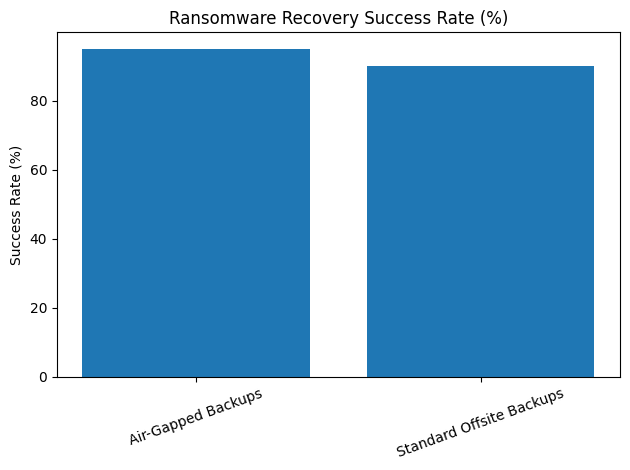
Recovery Success Rate Comparison
| Backup Strategy | Recovery Success Rate in Ransomware Scenarios |
|---|---|
| Air-Gapped Backups | 95% |
| Standard Offsite Backups | 90% |
| Immutable Backup Architectures | 50% Faster Recovery Times |
Air-gapped backups maintain a slight advantage in overall recovery success rates. However, modern logical air gaps combined with immutable storage provide comparable protection with greater operational flexibility.
Operational Cost of Manual Recovery
Despite technical advancements, many organizations still rely on manual recovery workflows. This reliance has measurable financial consequences.
Organizations without automated incident response workflows spend an average of 1.9 million USD annually on incident responders. Of that total, approximately 700,000 USD is directly attributed to manual data reconstruction and remediation processes.
Operational Cost Breakdown
| Cost Component | Annual Average (USD) |
|---|---|
| Incident Responder Engagement | 1.9 Million |
| Manual Data Reconstruction | 700,000 |
| Extended Downtime Operational Loss | Variable but High |
Automation reduces both direct labor expenses and downtime-related revenue losses, reinforcing the financial case for intelligent disaster recovery orchestration platforms.
Downtime Profile of Modern Enterprises
The operational environment in 2026 is characterized by persistent service disruption risk. Data indicates that 69% of organizations experience service interruptions at least weekly.
Downtime Statistics Snapshot
| Downtime Indicator | Percentage / Value |
|---|---|
| Organizations experiencing weekly interruptions | 69% |
| Companies losing a full workday after outage | 10% |
| Average outage duration | 196 minutes |
| Organizations resolving outage in ≤ 60 seconds | 2% |
Only 2% of surveyed enterprises can resolve an unplanned outage within 60 seconds or less. This statistic underscores the competitive importance of near-zero RTO capabilities delivered by continuous replication platforms such as Zerto and large-scale orchestration systems like Cohesity.
Performance Maturity Model for Disaster Recovery in 2026
Organizations can be broadly categorized across three operational maturity tiers.
Recovery Maturity Matrix
| Maturity Level | RPO Profile | RTO Profile | Automation Level | Risk Exposure |
|---|---|---|---|---|
| Legacy | Hours to Days | Hours to Days | Manual | High |
| Transitional | Minutes to Hours | Minutes to Hours | Partial Automation | Moderate |
| Autonomous | Seconds | Instant to Minutes | AI-Orchestrated | Low |
Enterprises operating within the autonomous tier demonstrate significantly lower downtime costs and improved ransomware resilience.
Strategic Implications for 2026 and Beyond
The technical benchmarks of 2026 confirm that disaster recovery performance is no longer measured by simple restore speed. Instead, competitive advantage is defined by:
• Continuous replication and seconds-level RPO
• Instant Live Mount capabilities
• Immutable and air-gapped backup architectures
• AI-driven blast radius analysis
• Automated recovery orchestration
As downtime tolerance approaches zero in digitally dependent industries, the need for near-instant RTO and validated data integrity becomes mission-critical. Vendors delivering autonomous recovery frameworks, scalable Mass Restore capabilities, and integrated AI analytics are setting the performance standard for the next generation of enterprise resilience platforms.
Economic Analysis and Total Cost of Ownership in the Disaster Recovery Software Market (2026)
Executive Overview: The Financial Reality of Resilience
In 2026, the total cost of ownership for disaster recovery software extends far beyond licensing fees. Organizations must account for infrastructure duplication, operational labor, compliance controls, testing cycles, cyber insurance alignment, and the cost of downtime itself.
A foundational principle influencing cost modeling remains the 3-2-1 rule:
• Three copies of data
• Two different storage media types
• One offsite copy
Approximately 70% of organizations continue to follow this framework, improving recovery success probabilities by an estimated 40%. However, while this strategy strengthens resilience, it significantly impacts storage, bandwidth, and operational expenditure.
Core Cost Drivers in Disaster Recovery TCO
Total cost of ownership is typically composed of five major financial pillars:
| Cost Component | Description |
|---|---|
| Software Licensing | Subscription or perpetual platform costs |
| Infrastructure | On-prem appliances, cloud storage, replication sites |
| Operational Labor | IT staffing, monitoring, testing, patching |
| Incident Response | Forensics, consultants, remediation teams |
| Downtime Impact | Revenue loss, productivity decline, reputational harm |
Organizations increasingly recognize that downtime cost often outweighs licensing cost. For many mid-to-large enterprises, downtime exceeds 100,000 USD per hour, reshaping investment priorities toward automation and prevention rather than reactive recovery.
Vendor Pricing and Segment Demographics
Disaster recovery vendors target distinct market segments, with pricing strategies aligned to enterprise size, deployment complexity, and service depth.
Vendor Pricing and Segment Comparison (2026)
| Vendor | Median Reported Cost | Entry Pricing | Primary Market Segment |
|---|---|---|---|
| Veeam | Custom | Free Trial | 59% Mid-Market |
| Rubrik | 601,917 USD per year | Contact Vendor | 85% Large Enterprise |
| Cohesity | 24,937 USD per year | Contact Vendor | 70% Global 500 |
| Zerto | 76,750 USD per year | 100 USD per year (Basic) | High-Availability Ops |
| Druva | 41,634 USD per year | Credit-Based Model | 100% SaaS / Cloud-First |
| IDrive | Not Disclosed | 2.95 USD per user per year | 88% Small Business |
| NAKIVO | Not Disclosed | 3 USD per workload per month | SMB & MSPs |
| Acronis | Not Disclosed | 49.99 USD per computer | Prosumer & SMB |
This pricing spectrum illustrates the segmentation of the market into:
• High-cost, security-intensive enterprise platforms
• Mid-tier cloud-native DRaaS providers
• Low-cost SMB-focused backup and replication solutions
Enterprise-focused vendors justify higher costs through automation, AI-driven orchestration, air-gapped architectures, and mass restore performance. SMB vendors compete on accessibility, simplified deployment, and predictable subscription pricing.
Cloud-Based DRaaS Versus On-Premises Infrastructure
A major shift influencing TCO in 2026 is the acceleration of Backup as a Service and Disaster Recovery as a Service adoption. Analysts project that 85% of large enterprises will adopt BaaS models by 2029.
This transition is supported by measurable growth trends:
Deployment Model Growth Comparison
| Deployment Model | Annual Growth Rate |
|---|---|
| Cloud-Based Solutions | 18% |
| Traditional On-Prem Software | 7.2% |
Cloud-based disaster recovery platforms reduce capital expenditure by eliminating secondary data center requirements. Enterprises no longer need to maintain duplicate hardware stacks or tape-based archives in geographically separate facilities.
Infrastructure Cost Comparison
| Cost Category | Traditional On-Prem DR | Cloud-Based DRaaS |
|---|---|---|
| Secondary Data Center Build | Required | Not Required |
| Hardware Refresh Cycles | Every 3–5 Years | Provider Managed |
| Tape Management | Required | Eliminated |
| Geographic Replication Costs | Physical Logistics | Cloud Replication |
| Long-Term Infrastructure Savings | Baseline | Up to 50% Savings |
Studies indicate that cloud-based DRaaS can reduce long-term infrastructure costs by up to 50% compared to hardware-intensive strategies.
The Economic Value of Automation
Automation significantly influences total cost of ownership. Organizations without automated response workflows spend an average of 1.9 million USD annually on incident responders. Approximately 700,000 USD of that amount is attributed specifically to manual data reconstruction.
Automation Impact on Operational Costs
| Operational Metric | Manual Model | Automated Model |
|---|---|---|
| Incident Resolution Time | Extended | 78 Minutes Faster |
| Annual Incident Response Cost | 1.9 Million USD | Reduced |
| Outage Cost Impact | Baseline | 45% Lower |
The financial case for automated disaster recovery orchestration becomes increasingly compelling when factoring in reduced downtime duration and labor dependency.
Segment-Specific TCO Considerations
Mid-Market Organizations
Mid-market enterprises prioritize balance between cost efficiency and enterprise-grade features. Vendors such as Veeam and NAKIVO appeal strongly in this segment by offering scalable licensing without extreme upfront capital investment.
Large Enterprises
Large enterprises face regulatory compliance obligations, multi-region infrastructure complexity, and higher downtime risk. For this segment, premium vendors such as Rubrik and Cohesity justify higher subscription costs through automation, immutable storage, AI-assisted recovery, and live mount capabilities.
SMBs and Prosumer Market
Small businesses and managed service providers focus heavily on entry pricing and simplicity. Solutions such as Acronis, IDrive, and NAKIVO dominate this segment due to predictable per-user or per-workload pricing structures.
Strategic Financial Implications for 2026 and Beyond
The economic narrative of disaster recovery in 2026 is shaped by four dominant forces:
• Cloud-based DRaaS expansion
• Declining tolerance for downtime
• Rising cyberattack frequency
• Increased regulatory accountability
As downtime becomes more expensive and ransomware more sophisticated, organizations are shifting from reactive recovery investments to proactive automation frameworks.
The total cost of ownership calculation increasingly includes not only licensing and infrastructure, but also resilience maturity, automation depth, and validated recovery readiness. Enterprises that align disaster recovery investments with cloud-native scalability and AI-driven orchestration are positioned to reduce both long-term capital expenditure and operational risk exposure.
In 2026, disaster recovery software is no longer evaluated as a cost center. It is assessed as a strategic financial hedge against revenue disruption, reputational damage, and regulatory penalties in an environment of continuous digital volatility.
AI Integration and the Future of Disaster Resilience in 2026
Executive Perspective: AI as a Core Recovery Requirement
By 2026, artificial intelligence is no longer positioned as an experimental enhancement within disaster recovery software. It has become a foundational architectural requirement. As ransomware variants grow more evasive and cloud infrastructures become increasingly complex, recovery systems must now detect, decide, and execute remediation steps autonomously.
AI is primarily embedded across three operational domains:
• Threat detection during backup and replication
• Recovery orchestration and dependency management
• Data intelligence and validation prior to restoration
The evolution toward AI-driven disaster resilience reflects a broader shift from passive data protection to active cyber defense and automated recovery execution.
AI-Driven Feature Adoption Landscape (2026)
| AI Capability | Primary Function | Leading Implementations |
|---|---|---|
| Inline Entropy Analysis | Early ransomware detection | Veeam, Rubrik |
| Agentic Recovery Workflows | Autonomous recovery orchestration | Druva, Rubrik |
| Cleanroom Recovery | Malware validation before restore | Cohesity, Veeam |
These capabilities collectively reduce downtime, prevent reinfection cycles, and minimize human error during high-pressure incident response events.
Inline Entropy Analysis: Early Ransomware Interception
Inline entropy analysis is now embedded into backup pipelines by vendors such as Veeam and Rubrik. This technology monitors the randomness level, or entropy, of data blocks during the backup process.
Ransomware encryption typically produces a sudden spike in entropy because encrypted files exhibit high randomness compared to normal structured data. When this spike is detected, the system automatically flags the activity as suspicious.
Operational Impact of Inline Entropy Detection
| Detection Phase | Traditional Backup Model | AI-Enhanced Inline Entropy Model |
|---|---|---|
| Encryption Detection Timing | Post-Backup Discovery | During Backup Process |
| Corrupted Data Storage Risk | Higher | Significantly Reduced |
| Administrator Alerting | Delayed | Real-Time |
| Immutable Repository Protection | Reactive | Preventative |
By alerting administrators before corrupted data is written into immutable storage, entropy-based detection prevents contaminated restore points from entering long-term archives. This capability significantly strengthens ransomware containment strategies.
Agentic Recovery Workflows: Autonomous Orchestration
Agentic recovery represents a major advancement in disaster recovery automation. Platforms such as Druva and Rubrik deploy autonomous AI agents capable of interpreting infrastructure dependencies and executing complex restoration sequences without direct human supervision.
For example, AI agents can:
• Ensure databases are fully operational before application servers initiate connections
• Validate authentication services before restoring user-facing workloads
• Sequence network and storage configuration steps dynamically
• Adjust recovery workflows based on live telemetry
Recovery Workflow Automation Comparison
| Recovery Step | Manual Execution Model | Agentic AI Model |
|---|---|---|
| Dependency Mapping | Human-Defined Scripts | AI-Analyzed |
| Service Startup Sequencing | Static Order | Dynamic Adjustment |
| Error Handling | Manual Intervention | Automated Correction |
| Time to Full Application Recovery | Extended | Accelerated |
Agentic orchestration reduces recovery complexity in hybrid and multi-cloud environments where dependencies may span containers, databases, identity systems, and network policies.
Cleanroom Recovery: Validated Restoration Environments
A growing concern in 2026 is the reinfection loop, where dormant malware or logic bombs are inadvertently restored into production environments. To mitigate this risk, vendors such as Cohesity and Veeam have introduced automated cleanroom recovery environments.
In a cleanroom model, backups are mounted in isolated sandbox infrastructures before production restoration. These environments perform:
• Multi-engine antivirus scanning
• YARA rule-based pattern detection
• Behavioral analysis
• Integrity verification
Cleanroom Recovery Risk Mitigation Matrix
| Risk Scenario | Standard Restore Model | Cleanroom Restore Model |
|---|---|---|
| Dormant Malware Reinfection | Possible | Mitigated |
| Logic Bomb Activation | Undetected | Pre-Restore Scanned |
| Data Integrity Verification | Post-Restore | Pre-Restore Validation |
| Production Network Exposure | Immediate | Isolated Sandbox |
This proactive validation step ensures that only verified clean snapshots re-enter live systems, significantly improving ransomware recovery success rates.
AI as a Target: Securing the Recovery Infrastructure
As AI capabilities expand within disaster recovery systems, the platforms themselves become high-value targets for advanced persistent threats. Attackers increasingly attempt to disable, encrypt, or manipulate recovery systems before launching broader campaigns.
Industry projections indicate that by 2028, more than 50% of enterprises will deploy dedicated AI security platforms specifically to protect disaster recovery infrastructure. These defensive AI layers will monitor anomalous activity within backup environments, validate integrity of AI decision-making models, and enforce zero-trust access controls.
Security Evolution Outlook
| Security Dimension | 2026 Status | 2028 Projection |
|---|---|---|
| AI in Recovery Platforms | Standard Among Leaders | Universal Expectation |
| AI-Specific Protection Layers | Emerging | Majority Adoption |
| Zero-Trust DR Infrastructure | Growing | Core Requirement |
Strategic Implications for Enterprise Resilience
The integration of artificial intelligence has fundamentally altered the performance expectations of disaster recovery software. Recovery systems must now:
• Detect ransomware during ingestion
• Orchestrate full-stack rebuilds autonomously
• Validate data integrity before restoration
• Protect themselves from targeted compromise
Enterprises evaluating disaster recovery platforms in 2026 increasingly consider AI integration depth as a primary selection criterion rather than a differentiator.
As cyber threats grow more sophisticated and recovery windows shrink toward near-zero tolerance, AI-enabled disaster resilience will define competitive advantage. Platforms that combine entropy-based detection, agentic recovery workflows, and cleanroom validation environments are shaping the next generation of autonomous cyber recovery ecosystems.Architectural Philosophy and Vendor Differentiation in the 2026 Disaster Recovery Software Market
Architectural Philosophy and Vendor Differentiation in the 2026 Disaster Recovery Software Market
Executive Overview: Two Competing Architectural Paradigms
The disaster recovery software ecosystem in 2026 is shaped by two dominant architectural philosophies: the Hyper-Converged Appliance model and the Software-Defined model.
These approaches differ fundamentally in how they distribute control, performance optimization, capital expenditure, and operational risk. Vendor differentiation increasingly centers not only on features such as AI integration or immutability, but also on architectural alignment with enterprise infrastructure strategies.
The Hyper-Converged Appliance Model
The hyper-converged appliance model is championed by vendors such as Rubrik and Cohesity. In this architecture, hardware and software are delivered as a tightly integrated stack. The vendor controls the operating system, storage layer, compute resources, and input/output pathways.
This design ensures predictable performance and simplified lifecycle management. Since the vendor owns the entire IO path, system tuning and compatibility risks are minimized.
For example, Rubrik’s Atlas file system is built on a distributed, append-only architecture designed for linear scalability. As nodes are added, capacity and performance increase proportionally without introducing architectural complexity.
Core Advantages of the Hyper-Converged Model
• Guaranteed performance consistency
• Reduced configuration variability
• Centralized vendor support
• Simplified deployment and upgrades
• Native integration of immutability and cyber vaulting
Operational Trade-Offs
Despite its strengths, the hyper-converged model introduces financial and architectural considerations:
• Significant upfront capital investment
• Dependency on proprietary hardware nodes
• Potential cloud egress bottlenecks during full-site recovery
• Less flexibility in hardware vendor selection
If a primary appliance is destroyed and data must be restored from a cloud tier, recovery speed may be constrained by bandwidth limitations and cloud egress policies.
The Software-Defined Model
In contrast, the software-defined model, represented by vendors such as Veeam and Commvault, decouples disaster recovery software from hardware infrastructure. Organizations are free to select their own compute and storage platforms.
Supported infrastructure options commonly include:
• Compute vendors such as Cisco, HPE, and Dell
• Storage types including block, object, and tape
• On-premises or cloud-based repositories
This model prioritizes flexibility and vendor independence. Enterprises can deploy commodity hardware, optimize cost structures, and avoid hardware lock-in.
Core Advantages of the Software-Defined Model
• Hardware agnosticism
• Lower capital expenditure flexibility
• Prevention of proprietary vendor lock-in
• Easier hybrid and heterogeneous integration
• Customizable scaling strategies
Integration Risk Considerations
The flexibility of the software-defined approach shifts integration responsibility to the customer.
If recovery time objectives are not met, the bottleneck is often linked to:
• Underpowered storage arrays
• Network bandwidth limitations
• Suboptimal compute provisioning
In this architecture, performance outcomes depend heavily on infrastructure decisions made by the organization rather than the software vendor.
Comparison of Core Architectural Drivers
| Feature | Hyper-Converged (Rubrik / Cohesity) | Software-Defined (Veeam / Commvault) |
|---|---|---|
| Security Responsibility | Vendor-Managed (Proprietary OS) | Customer-Managed (Windows / Linux) |
| Hardware Dependency | Mandatory Proprietary Nodes | Hardware Agnostic |
| Scaling Method | Linear (Add Nodes) | Modular (Scale Proxies / Repositories) |
| Best Use Case | Massive Data / Fast Local Recovery | Hybrid / Heterogeneous / Cost-Sensitive |
| Cyber Vaulting | Native (FortKnox / Vault) | Integration-Heavy |
Security and Control Implications
In hyper-converged environments, security responsibility is largely vendor-managed. The operating system is proprietary or hardened, reducing exposure to common vulnerabilities. This approach simplifies patching and compliance validation.
In software-defined environments, organizations manage operating systems such as Windows or Linux. While this provides flexibility, it requires disciplined patch governance and security oversight to prevent vulnerabilities in the backup chain.
Scaling and Performance Dynamics
Hyper-converged systems scale linearly by adding nodes. This simplifies expansion planning but requires purchasing additional proprietary hardware.
Software-defined platforms scale modularly by expanding proxies, repositories, or cloud storage. This approach can be more cost-efficient but requires architectural planning to avoid performance imbalance.
Scaling Comparison Matrix
| Scaling Dimension | Hyper-Converged Model | Software-Defined Model |
|---|---|---|
| Capacity Expansion | Add Appliance Nodes | Expand Storage Targets |
| Compute Expansion | Node-Based | Scale Proxies |
| Performance Predictability | High | Variable by Hardware |
| Cost Optimization Flexibility | Moderate | High |
Strategic Fit by Enterprise Profile
Large Enterprises with Massive Data Volumes
Organizations managing multi-petabyte datasets and requiring deterministic local recovery speeds often favor hyper-converged appliances. The simplified IO control and guaranteed throughput reduce performance unpredictability.
Hybrid and Cost-Sensitive Enterprises
Enterprises operating heterogeneous environments, particularly those combining legacy systems with cloud-native workloads, often prefer the software-defined approach. This model aligns with multi-vendor IT ecosystems and cost-optimization strategies.
Long-Term Market Outlook
In 2026, neither architectural philosophy dominates universally. Instead, selection increasingly depends on:
• Capital expenditure tolerance
• Infrastructure standardization level
• Cloud adoption maturity
• Regulatory and compliance requirements
• Internal IT operational capability
Hyper-converged platforms excel in performance assurance and simplified governance. Software-defined platforms excel in flexibility, customization, and hybrid adaptability.
As disaster recovery evolves toward AI-driven orchestration and autonomous resilience, architectural philosophy remains a central strategic decision. Enterprises must balance performance guarantees against infrastructure freedom, recognizing that architectural alignment directly influences cost, scalability, security posture, and recovery reliability in an era of escalating cyber risk.
Operational Readiness and the Human Element in Disaster Recovery (2026)
By 2026, disaster recovery software platforms have reached a high level of technical sophistication. AI-driven orchestration, immutable storage, cleanroom recovery, and continuous replication are widely available across leading vendors. However, operational readiness continues to lag behind technological capability.
Human factors remain one of the most significant contributors to recovery failure. While infrastructure resilience has improved, governance discipline, staffing expertise, and testing rigor frequently determine whether a recovery strategy succeeds under real-world conditions.
The Human Risk Factor in Business Continuity
Research in 2026 indicates that 40% of business continuity plan failures stem from poor vendor management and insufficient skilled IT staff. This statistic highlights a structural vulnerability: technology investments alone do not guarantee recoverability.
Organizational Readiness Gaps
| Operational Readiness Indicator | Percentage |
|---|---|
| BCP failures linked to vendor mismanagement or staffing gaps | 40% |
| Organizations with fully organized outage response approach | 33% |
| Organizations with centralized real-time recovery dashboard | 32% |
The absence of centralized dashboards further compounds the issue. Without real-time visibility into replication health, backup validation status, and failover readiness, organizations operate reactively rather than proactively.
Vendor Management and Integration Oversight
Modern disaster recovery ecosystems often involve multiple vendors, including cloud providers, backup platforms, security tools, and managed service providers. When vendor accountability is unclear, recovery coordination slows significantly.
Common vendor management failures include:
• Undefined escalation pathways
• Inconsistent SLA enforcement
• Fragmented tooling integration
• Poor documentation of failover dependencies
Operational risk frequently emerges not from software limitations, but from ambiguity in ownership and accountability during crisis response.
Testing Frequency: The Weakest Link
Testing remains the most critical weakness in operational readiness. Although 76% of enterprises conduct annual disaster recovery tests, 44% encounter major issues during those exercises.
Testing Outcomes Analysis
| Testing Metric | Percentage |
|---|---|
| Organizations testing DR annually | 76% |
| Organizations encountering major test failures | 44% |
These failures typically reveal:
• Misconfigured replication agents
• Outdated recovery documentation
• Unverified application dependencies
• Bandwidth bottlenecks
• Human process breakdowns
Annual testing cycles are increasingly viewed as insufficient in an environment characterized by weekly service interruptions and rapidly evolving ransomware tactics.
The Rise of Automated DR Drills
To address testing limitations, a growing number of organizations are adopting automated disaster recovery drills. Platforms such as ControlMonkey and Zerto have pioneered non-disruptive failover simulations that allow organizations to validate recovery workflows monthly or even weekly.
Automated testing frameworks deliver:
• Non-disruptive failover validation
• Dependency mapping verification
• Real-time RTO measurement
• Automated reporting for compliance
Manual Versus Automated Testing Comparison
| Testing Dimension | Annual Manual Testing | Automated DR Drills |
|---|---|---|
| Testing Frequency | Once Per Year | Monthly or Weekly |
| Operational Disruption | Possible | Minimal or None |
| Failure Detection Speed | Delayed | Immediate |
| Compliance Documentation | Manual | Auto-Generated |
The shift toward automated drills is a major contributor to improved recovery outcomes. Data indicates that 92% of DRaaS users now meet an RTO of under four hours, a significant improvement over organizations relying solely on manual testing frameworks.
Organizational Maturity and Response Coordination
Only one-third of organizations report having a fully organized outage response strategy. Mature response models typically include:
• Defined incident commander roles
• Pre-approved communication workflows
• Automated escalation procedures
• Centralized recovery dashboards
• AI-assisted recovery sequencing
Response Maturity Model
| Maturity Level | Testing Frequency | Dashboard Visibility | RTO Consistency |
|---|---|---|---|
| Low | Annual | Fragmented | Inconsistent |
| Moderate | Semi-Annual | Partial | Variable |
| High | Monthly/Automated | Centralized | Predictable |
Organizations operating at high maturity levels demonstrate significantly lower downtime variance and reduced reliance on external incident responders.
Economic Implications of Human Readiness Gaps
Operational disorganization directly increases recovery costs. Enterprises lacking structured workflows and automated validation often require external consultants and incident responders to coordinate recovery efforts.
In contrast, organizations employing automated drills and centralized dashboards experience:
• Faster incident resolution
• Reduced labor costs
• Higher SLA adherence
• Improved compliance audit outcomes
The cost of insufficient preparedness extends beyond downtime to include reputational damage and regulatory penalties.
Strategic Implications for 2026 and Beyond
The operational readiness gap underscores a central truth of disaster recovery in 2026: resilience is as much a governance discipline as a technological capability.
While platforms now offer near-instant RTO, continuous replication, and AI-driven orchestration, human readiness remains a critical determinant of recovery success.
Forward-looking enterprises are prioritizing:
• Continuous automated testing
• Centralized resilience dashboards
• Clear vendor accountability frameworks
• Structured incident command hierarchies
• Ongoing workforce training
As disaster recovery continues to evolve toward autonomous resilience models, the integration of disciplined operational governance with advanced automation will define the next phase of maturity. Technology can enable recovery, but organizational preparedness ultimately determines whether recovery objectives are achieved under real-world pressure.
Strategic Outlook and Market Forecast for the Disaster Recovery Software Ecosystem in 2026
The 2026 disaster recovery software market marks a decisive shift in enterprise thinking. Disaster recovery is no longer treated as a passive insurance mechanism designed solely to restore lost data. Instead, it has become an operational resilience strategy embedded into digital transformation roadmaps and corporate risk governance frameworks.
The top-tier vendors in the global ecosystem have responded to escalating ransomware threats by integrating security controls directly into storage architectures and embedding artificial intelligence across detection and orchestration layers. Recovery capability is now measured by speed, automation, and data integrity validation rather than simple backup frequency.
Competitive Positioning of Leading Vendors
The current competitive landscape reflects differentiated strategic strengths among leading providers.
Vendor Strategic Positioning Overview (2026)
| Vendor | Core Strategic Strength | Primary Architectural Focus |
|---|---|---|
| Veeam | Market leadership and infrastructure flexibility | Software-defined, hardened Linux repositories |
| Cohesity | Enterprise engineering depth and AI-driven scale | Hyper-converged, SpanFS architecture |
| Rubrik | Zero Trust security-first architecture | Proprietary Atlas file system |
| Druva | Fully SaaS-first resilience model | Cloud-native infrastructure |
| Zerto | Continuous replication and near-zero RPO | Hypervisor-level CDP engine |
Veeam continues to lead in market presence and deployment flexibility, appealing strongly to hybrid enterprises that require hardware-agnostic solutions.
The expanded Cohesity-Veritas organization brings substantial engineering resources and enterprise penetration, particularly among Global 500 organizations managing exabyte-scale environments.
Rubrik positions itself as a Zero Trust pioneer, embedding logical air gaps and proprietary file systems into its core architecture. Druva represents the SaaS-first model, eliminating on-premises infrastructure and aligning with cloud-native operating strategies.
For organizations where seconds of downtime translate directly into financial or safety risks, Zerto’s replication-based continuous data protection remains the benchmark for near-zero RPO and rapid recovery execution.
Strategic Priorities for 2026
Enterprises evaluating disaster recovery platforms in 2026 are prioritizing several critical capabilities.
Strategic Imperatives for Modern DR Adoption
| Strategic Priority | Operational Impact |
|---|---|
| Immutable Storage | Prevents ransomware tampering |
| Automated Orchestration | Reduces RTO from hours to minutes |
| Zero Trust Architecture | Protects backup systems from compromise |
| Cleanroom Validation | Prevents reinfection loops |
| AI-Driven Threat Detection | Identifies anomalies before corruption |
Immutable storage has become a baseline expectation rather than a premium feature. Platforms incorporating hardened Linux repositories or proprietary append-only file systems significantly reduce ransomware exposure.
Automated orchestration addresses the readiness gap by minimizing human dependency during high-pressure recovery scenarios. Organizations that implement automated workflows recover substantially faster and incur lower operational disruption costs.
Zero Trust as a Defensive Baseline
As threat actors increasingly target backup infrastructure directly, Zero Trust principles are becoming essential in disaster recovery design.
Security Evolution Matrix
| Security Approach | Traditional Model | 2026 Resilience Model |
|---|---|---|
| Backup Access Control | Network-Based | Zero Trust Enforcement |
| Data Validation | Post-Restore | Pre-Restore Cleanroom |
| Infrastructure Hardening | OS-Level Patching | Proprietary or Hardened OS |
| Threat Detection | Reactive Monitoring | AI-Driven Inline Analysis |
Architectures such as Rubrik’s logical air gap model and Veeam’s hardened Linux repositories exemplify this shift toward embedded security.
Long-Term Market Forecast
The disaster recovery market’s growth trajectory reinforces the permanence of this transformation. Projections indicate that the DRaaS market is expected to reach approximately 195 billion USD by 2034. This rapid expansion reflects increasing regulatory pressure, cyber insurance requirements, and enterprise cloud adoption.
Market Expansion Drivers
| Growth Driver | Strategic Impact |
|---|---|
| Ransomware Sophistication | Drives AI and immutability adoption |
| Cloud Migration | Accelerates DRaaS demand |
| Regulatory Compliance Requirements | Increases governance spending |
| Operational Downtime Intolerance | Elevates automation investment |
The growth of DRaaS and automated resilience platforms signals that disaster recovery is no longer discretionary. It is foundational to digital survival.
The Ultimate Benchmark of Resilience
In 2026, the ultimate measure of a disaster recovery solution is not simply whether data can be preserved. The defining benchmark is whether business operations can be restored with speed, certainty, and verified integrity.
Organizations are increasingly evaluating vendors based on their ability to:
• Restore entire cloud-native infrastructures
• Validate data cleanliness before production restore
• Automate complex dependency sequencing
• Minimize downtime exposure
• Protect recovery systems from direct attack
Strategic Conclusion
The 2026 disaster recovery software ecosystem reflects a structural evolution toward autonomous resilience. Vendors that integrate immutable storage, AI-driven detection, automated orchestration, and Zero Trust architecture are shaping the next decade of enterprise continuity strategy.
The projected expansion of the DRaaS market toward nearly 195 billion USD by 2034 underscores a central truth of the digital era: resilience is no longer optional. It is a prerequisite for competitive survival. Organizations that embed disaster recovery into operational strategy rather than treating it as a compliance checkbox will be best positioned to withstand the accelerating volatility of the modern cyber landscape.
Conclusion
The global conversation around disaster recovery software in 2026 is no longer centered on simple backup reliability. It is focused on cyber resilience, operational continuity, automated orchestration, and verified data integrity. The Top 10 Disaster Recovery Software solutions in the world have collectively redefined what business continuity means in an era dominated by ransomware, hybrid cloud complexity, and near-zero downtime expectations.
As organizations generate unprecedented volumes of data and operate across multi-cloud, edge, and on-premises environments, disaster recovery has evolved from an IT safeguard into a core enterprise risk management strategy. The leading platforms in 2026 distinguish themselves not only through speed of restoration, but through their ability to rebuild entire infrastructures, validate clean recovery points, automate dependency sequencing, and protect backup repositories from direct attack.
From Backup to Business Continuity Architecture
The Top 10 Disaster Recovery Software providers in 2026 represent different architectural philosophies, deployment models, and market segments. However, they share a common objective: enabling organizations to restore business operations with certainty and speed.
Modern enterprises no longer ask whether their data can be recovered. They ask:
• How quickly can mission-critical applications resume?
• Can cloud-native environments be rebuilt automatically?
• Is the recovery point free from dormant malware?
• Can failover occur without human bottlenecks?
This shift reflects the transformation of disaster recovery from reactive data restoration into proactive operational resilience.
Key Themes Defining Disaster Recovery Software in 2026
Several defining trends unify the Top 10 Disaster Recovery Software platforms worldwide:
Immutable Storage as a Baseline Requirement
Immutability is no longer a premium feature. It is an essential defense against ransomware encryption and malicious deletion. Leading vendors embed immutable storage directly into their architectures, ensuring that recovery data remains untouchable even if administrative credentials are compromised.
AI-Driven Recovery and Threat Detection
Artificial intelligence is now integrated into backup ingestion pipelines, recovery orchestration engines, and cleanroom validation environments. Inline entropy analysis detects encryption anomalies before corrupted data is stored. Agentic recovery workflows automate complex dependency sequencing. Cleanroom restores verify integrity before production re-entry.
Continuous Data Protection and Near-Zero RPO
For enterprises where downtime translates into financial loss or operational risk, replication-based Continuous Data Protection remains critical. Solutions capable of seconds-level Recovery Point Objectives and minutes-level Recovery Time Objectives set the performance benchmark for high-availability environments.
Mass Restore and Live Mount Capabilities
The ability to mount and run hundreds of workloads directly from backup storage during infrastructure rebuilds has become a decisive differentiator. Live Mount technology transforms disaster recovery from a passive restore process into active business continuity.
Cloud-Native and SaaS-First Deployment Models
Cloud-based Disaster Recovery as a Service continues to grow at double-digit rates. SaaS-first platforms eliminate hardware dependency and secondary data center costs, offering predictable subscription pricing and automated scaling.
Architectural Diversity and Vendor Differentiation
The Top 10 Disaster Recovery Software solutions in 2026 reflect two dominant architectural models: hyper-converged appliance-based systems and software-defined platforms.
Hyper-converged solutions offer tightly integrated hardware and software stacks that guarantee performance and simplify management. Software-defined platforms provide flexibility, hardware independence, and hybrid compatibility, allowing enterprises to design cost-optimized infrastructure environments.
Both approaches remain relevant. The optimal choice depends on organizational scale, regulatory requirements, capital expenditure tolerance, and cloud adoption maturity.
Economic Impact and Total Cost of Ownership
When evaluating the best disaster recovery software in 2026, cost cannot be viewed in isolation. Total cost of ownership includes infrastructure, testing, incident response labor, downtime exposure, and regulatory compliance risk.
Cloud-based DRaaS models reduce the need for maintaining secondary data centers and can lower long-term infrastructure costs significantly. Automated orchestration reduces incident response expenses and minimizes downtime losses.
In an environment where downtime costs can exceed six figures per hour for many enterprises, investment in automated, AI-enabled disaster recovery software becomes a strategic financial safeguard rather than an operational expense.
The Human Element and Operational Readiness
Even the most advanced disaster recovery solutions require disciplined governance, regular testing, and clear vendor management frameworks. Organizations that conduct automated disaster recovery drills and maintain centralized readiness dashboards consistently outperform those relying solely on annual manual testing.
The Top 10 Disaster Recovery Software platforms in 2026 increasingly support non-disruptive testing, automated failover simulations, and real-time health monitoring to close the preparedness gap.
Future Outlook: The Road to 2034
The projected growth of the Disaster Recovery as a Service market toward nearly 195 billion USD by 2034 signals sustained demand for resilience-first technology. Cyber threats will continue to evolve. Cloud ecosystems will grow more complex. Regulatory expectations will tighten.
In this landscape, disaster recovery software must deliver:
• Autonomous recovery orchestration
• Immutable and air-gapped data protection
• AI-powered anomaly detection
• Infrastructure-as-code regeneration
• Zero Trust backup architectures
The future of disaster recovery is not merely about storing data safely. It is about guaranteeing the restoration of full operational capability under the most adverse conditions.
Final Thoughts
The Top 10 Disaster Recovery Software solutions in the world in 2026 represent the culmination of a decade of transformation in backup, cybersecurity, and cloud infrastructure management. Organizations selecting a disaster recovery platform today are making a long-term strategic decision about how their business will survive and compete in a digitally volatile world.
In the digital economy, resilience is no longer optional. It is a competitive advantage, a regulatory necessity, and a financial imperative. The best disaster recovery software in 2026 is defined not just by its ability to save data, but by its ability to restore trust, restore productivity, and restore business continuity with precision, speed, and verified integrity.
If you find this article useful, why not share it with your hiring manager and C-level suite friends and also leave a nice comment below?
We, at the 9cv9 Research Team, strive to bring the latest and most meaningful data, guides, and statistics to your doorstep.
To get access to top-quality guides, click over to 9cv9 Blog.
To hire top talents using our modern AI-powered recruitment agency, find out more at 9cv9 Modern AI-Powered Recruitment Agency.
People Also Ask
What is the best disaster recovery software in 2026?
The best disaster recovery software in 2026 depends on business needs. Leading platforms offer AI-driven recovery, immutable backups, fast RTO, and cloud-native DRaaS to protect against ransomware and infrastructure failures.
What is DRaaS and why is it important in 2026?
Disaster Recovery as a Service (DRaaS) is a cloud-based solution that replicates and restores systems after outages. In 2026, it is essential for reducing downtime, lowering infrastructure costs, and improving cyber resilience.
How does AI improve disaster recovery software?
AI enhances disaster recovery by detecting ransomware via entropy analysis, automating recovery workflows, and validating clean restore points before production deployment.
What is the difference between backup and disaster recovery?
Backup stores copies of data, while disaster recovery restores full systems and business operations, including applications, networks, and cloud infrastructure.
What is Recovery Time Objective (RTO)?
RTO measures how quickly systems must be restored after disruption. Modern disaster recovery software in 2026 aims for minutes or near-zero downtime.
What is Recovery Point Objective (RPO)?
RPO defines the maximum acceptable data loss measured in time. Continuous data protection tools can achieve RPOs of seconds.
Why is immutable backup important in 2026?
Immutable backups prevent modification or deletion of stored data, protecting organizations from ransomware encryption and malicious insider attacks.
What is continuous data protection (CDP)?
CDP continuously replicates data in real time, enabling near-zero RPO and faster restoration compared to scheduled snapshot-based backups.
Which disaster recovery software supports hybrid cloud?
Top disaster recovery platforms support hybrid environments, allowing replication between on-premises data centers and public cloud providers.
Is cloud disaster recovery more cost-effective than on-premises?
Cloud DRaaS reduces hardware costs, eliminates secondary data centers, and can lower long-term infrastructure expenses by up to 50 percent.
How often should disaster recovery plans be tested?
Best practice in 2026 recommends automated monthly or quarterly testing rather than annual manual drills to ensure recovery readiness.
What is a cleanroom recovery environment?
A cleanroom is an isolated sandbox where backups are scanned for malware before restoration, preventing reinfection of production systems.
How does Zero Trust apply to disaster recovery?
Zero Trust backup architecture restricts access to recovery systems, ensuring that even compromised credentials cannot alter stored data.
What industries need advanced disaster recovery software?
Industries such as healthcare, finance, manufacturing, and telecommunications require advanced disaster recovery to meet compliance and uptime demands.
Can disaster recovery software protect against ransomware?
Yes, leading solutions use immutable storage, AI detection, and air-gapped backups to improve ransomware recovery success rates.
What is Live Mount in disaster recovery?
Live Mount allows virtual machines or databases to run directly from backup storage while primary systems are rebuilt.
How much does enterprise disaster recovery software cost?
Costs vary widely, ranging from entry-level SaaS subscriptions under $100 annually to enterprise platforms exceeding $500,000 per year.
What is the 3-2-1 backup rule?
The 3-2-1 rule recommends keeping three data copies, on two different media types, with one copy stored offsite for resilience.
What is disaster recovery orchestration?
Disaster recovery orchestration automates failover and restoration workflows, reducing human error and speeding up recovery processes.
Which disaster recovery solution is best for small businesses?
SMBs often choose cost-effective SaaS-based disaster recovery platforms with simple deployment and per-user or per-workload pricing.
How does AI-driven entropy analysis detect ransomware?
Entropy analysis monitors randomness in data during backup. Sudden spikes indicate possible encryption, triggering alerts before corrupted files are stored.
What is mass restore capability?
Mass restore enables simultaneous recovery of hundreds of virtual machines, minimizing downtime during large-scale outages.
Why is disaster recovery critical for compliance?
Regulations require data availability and protection. Advanced disaster recovery software ensures compliance with industry and regional mandates.
What is air-gapped backup?
Air-gapped backups are isolated from primary networks, reducing the risk of ransomware reaching stored recovery data.
How does disaster recovery support business continuity?
It restores critical systems quickly, reduces downtime costs, and maintains operational stability during cyberattacks or infrastructure failures.
What are the key features of top disaster recovery software in 2026?
Key features include immutable storage, AI-driven automation, cloud-native DRaaS, continuous replication, and cleanroom validation.
How long does it take to recover from a cyberattack?
Recovery time depends on RTO and platform capabilities. Automated DRaaS solutions can restore operations in minutes rather than hours.
What is Backup as a Service (BaaS)?
BaaS is a cloud subscription model where providers manage backup infrastructure, reducing operational overhead and capital expenditure.
Can disaster recovery software rebuild cloud environments?
Yes, modern platforms generate infrastructure-as-code templates to automatically rebuild entire cloud-native stacks after failure.
Why is disaster recovery software essential in 2026?
With rising cyberattacks and growing data volumes, disaster recovery software ensures operational resilience, revenue protection, and long-term business survival.
Sources
Business Research Insights
Veeam
Gitnux
Precedence Research
TechnologyMatch
Commvault
World Wide Technology
Druva
Fortune Business Insights
The Business Research Company
Macrium
ControlMonkey
Secureframe
6sense
Cohesity
Blocks and Files
Channel Futures
Sunset
Futurum Group
Jackim Woods & Co
Contabo
PeerSpot
Gartner
TrustRadius
Software Advice
NAKIVO
Info-Tech Research Group
SafetyCulture
G2
Server Parts
Dell
Dell Technologies
Virtue Market Research
SoftwareSuggest
Capterra
Ataccama
Disaster Recovery Journal