

























Key Takeaways
- The top 10 dental practice software platforms in 2026 combine AI-powered diagnostics, cloud-native infrastructure, and advanced revenue cycle management to improve efficiency and profitability.
- Leading dental software solutions help practices reduce overhead, automate scheduling and billing, strengthen data security, and increase case acceptance rates.
- Choosing the right dental practice management software depends on your clinic size, growth strategy, and need for scalability, integration, and compliance.
In 2026, the global dental industry is experiencing a digital transformation, driven by rapid advancements in artificial intelligence, cloud computing, cybersecurity, and interoperability with medical health records. As dental practices strive to provide higher standards of care while navigating increased competition, tighter margins, and growing administrative burdens, the role of dental practice management software has evolved from a support tool into an operational backbone. The right software is now essential for success—whether a clinic is a solo practice, a multi-location group, or a rapidly expanding dental service organization (DSO).

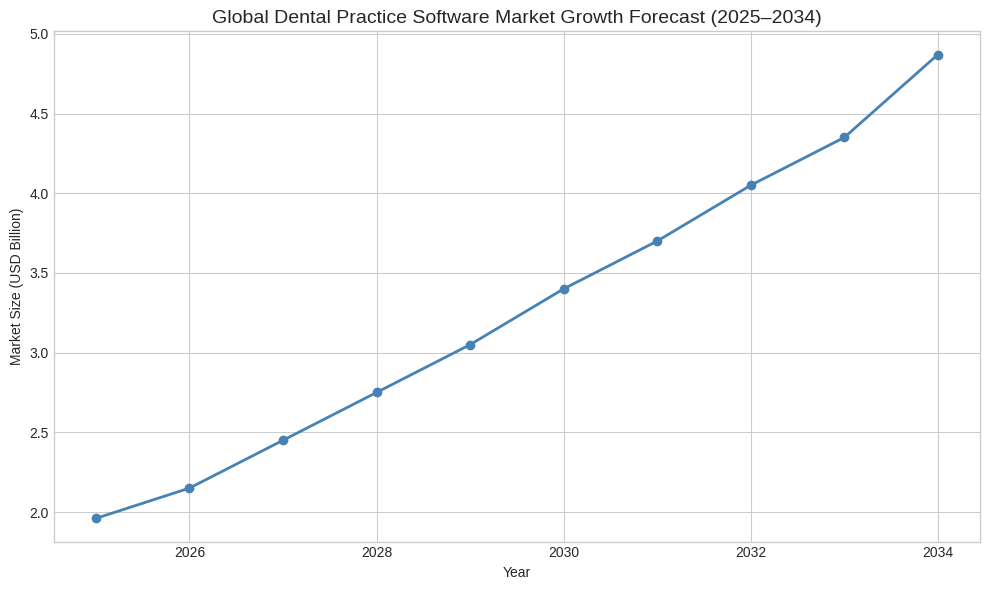
The dental software market has grown significantly in recent years. Valued at around USD 1.91 to 2.15 billion in 2026, with forecasts predicting it will reach nearly USD 5 billion by 2034, this expansion is driven by the growing demand for AI-powered tools, paperless operations, seamless patient experiences, and remote care capabilities. Clinics now seek solutions that not only manage appointments and billing but also enhance diagnostic accuracy, automate revenue cycle management (RCM), reduce staffing pressure, and deliver measurable return on investment (ROI).
This global shift is not just about keeping up with technology trends—it’s about building future-ready dental practices that can adapt to new patient behaviors, labor shortages, and complex regulatory environments. With an increasing focus on data privacy, HIPAA and SOC 2 compliance, and secure cloud hosting, dental software must now meet high expectations for both performance and protection. From AI-assisted treatment planning to cloud-native scheduling systems, the best dental platforms of 2026 are designed to deliver clinical precision, business efficiency, and patient satisfaction.
Selecting the right dental practice management software in this evolving landscape can be a strategic challenge. Each solution offers a unique set of features tailored for different practice types. Some prioritize flexibility and customization for tech-forward clinics, while others emphasize unified RCM and data consolidation for multi-location operations. Many platforms also cater to solo practitioners seeking ease of use, mobile access, and lower IT overhead.
This comprehensive blog breaks down the top 10 dental practice software platforms in the world for 2026. Each selection is based on extensive research, real-world performance, innovation in AI and automation, scalability, compliance capabilities, and overall user experience. Whether you’re looking to streamline operations, improve patient outcomes, expand your clinic, or reduce administrative costs, understanding the strengths of each software solution will help you make an informed decision.
In the sections that follow, we’ll explore each platform’s core features, pricing, performance metrics, clinical tools, and strategic advantages. From Dentrix Ascend’s cloud-native infrastructure and CareStack’s all-in-one scalability to Open Dental’s unmatched customization and tab32’s security-first design, this guide will help you identify the software that best fits your dental practice’s goals and growth strategy.
As we step deeper into the digital era of dentistry, the software you choose today could define the success of your clinic tomorrow. Let’s explore the top-performing dental software solutions that are leading the industry into the future.
Before we venture further into this article, we would like to share who we are and what we do.
About 9cv9
9cv9 is a business tech startup based in Singapore and Asia, with a strong presence all over the world.
With over nine years of startup and business experience, and being highly involved in connecting with thousands of companies and startups, the 9cv9 team has listed some important learning points in this overview of the Top 10 Dental Practice Software in 2026.
If you like to get your company listed in our top B2B software reviews, check out our world-class 9cv9 Media and PR service and pricing plans here.
Top 10 Dental Practice Software in 2026
1. Dentrix Ascend
Dentrix Ascend, developed by Henry Schein One, has emerged as one of the most widely adopted dental practice software platforms in the world in 2026. Built on a cloud-native framework, it offers advanced digital tools and streamlined workflows tailored for both small clinics and large Dental Service Organizations (DSOs). With a strong focus on usability, efficiency, and scalability, Dentrix Ascend continues to lead the way in transforming dental operations for the digital age.
Overview of Dentrix Ascend
Dentrix Ascend is designed to eliminate outdated interfaces and replace them with a clean, intuitive user experience. It supports real-time collaboration between multiple locations and seamlessly integrates key features that reduce manual work and increase productivity.
Key Features and Functional Highlights
The platform includes intelligent automation, real-time patient tracking, and comprehensive insurance verification—all aimed at making administrative and clinical workflows smoother and more accurate.
Table: Core Functional Capabilities of Dentrix Ascend
| Feature Category | Description |
|---|---|
| Cloud-Based Interface | Offers a modern, easy-to-use dashboard accessible from any location |
| AI Diagnostics | Built-in AI tools to assist with clinical analysis and decision-making |
| Insurance Automation | Real-time eligibility checks reduce labor and increase claim accuracy |
| Patient Routing Panel | Tracks patients from arrival to checkout, reducing no-shows and missed recare appointments |
| Health History Sync | Forms integrate directly into patient history for streamlined data entry |
| Multi-location Access | Ideal for large DSOs with multiple branches needing central control |
Usage Among Large Dental Service Organizations
Dentrix Ascend holds a dominant share in the DSO market. Its ability to unify data across locations while reducing overhead labor has made it a top choice for organizations seeking centralized operations.
Matrix: Adoption and Efficiency Insights
| Metric | Value |
|---|---|
| Market Adoption (Large DSOs) | 90% preference rate |
| Estimated Annual Labor Cost Savings | $75,000 per practice |
| Real-Time Eligibility Checks Enabled | Yes |
| Health Alert Automation | Fully integrated |
Pricing Structure (2026)
Dentrix Ascend uses a tiered monthly subscription model, making it accessible for both small and large teams. However, transitioning from older Dentrix systems may involve an upfront cost.
Table: Pricing and Deployment Costs
| User Scale | Monthly Subscription | Conversion/Setup Fee |
|---|---|---|
| Solo Practice | $399/month | $5,000 (one-time conversion) |
| 10 Users | $799/month | $5,000 (if migrating systems) |
| 100 Users | $1,599/month | $5,000 (estimated) |
User Experience: Professional Feedback
Dentrix Ascend has received generally positive feedback from dental professionals and practice managers who highlight its real-time capabilities, cloud efficiency, and consistent software updates. However, some users report challenges with specific features, especially when transitioning from legacy systems.
Insightful User Testimonial
Amanda B., a Business Manager at a multi-location dental office, shared her experience in January 2026:
“Switching to Dentrix Ascend revolutionized our workflow. The color-coded insurance verification helps our front desk instantly prioritize tasks. I especially appreciate how the forms automatically sync with health alerts. The system updates frequently, which keeps it feeling fresh and responsive. However, the reporting tools can be tricky—if the filters aren’t precise, the output might be off. The conversion from Dentrix Legacy had hiccups, with some features not translating to the cloud version, but the overall flexibility and remote access are absolutely worth it for our growing DSO.”
Conclusion
Dentrix Ascend stands out in 2026 as a robust, cloud-powered dental software solution. It is particularly well-suited for multi-location practices that require secure, real-time access to centralized data. With automation built into its core and a strong reputation for performance at scale, it remains a top contender in the global dental practice software market.
2. Eaglesoft
Eaglesoft continues to be one of the most widely recognized and dependable dental practice management systems in 2026. Designed and supported by Patterson Dental, this software is especially trusted by traditional clinics and established dental professionals who prioritize rich clinical functionalities and prefer operating within a locally hosted environment. Known for its depth and consistency, Eaglesoft has earned a reputation for being both powerful and user-friendly.
Comprehensive Software Overview
Eaglesoft is best suited for clinics that prefer on-premise solutions over cloud-based alternatives. It offers a strong blend of clinical precision, robust financial tracking, and seamless operational tools, making it a highly functional platform for daily dental office tasks.
Clean Table: Key Functional Features of Eaglesoft
| Feature Area | Description |
|---|---|
| Clinical Charting | Offers some of the most advanced and detailed charting capabilities available in on-premise systems |
| User Interface | Highly intuitive with multiple navigation options, ideal for training new staff |
| Treatment Planning | Fully integrated with scheduling and imaging systems for cohesive patient care |
| Financial Ledger Tools | Widely praised for its simplicity and accuracy in account management |
| Integration Support | 5.0-star integration rating with third-party tools like Adit and Rectangle Health |
Operational and Financial Efficiency
One of the defining strengths of Eaglesoft is its ability to deliver a measurable return on investment (ROI) within the first year of use. It provides well-structured modules that support billing, clinical documentation, and scheduling, minimizing the time staff spend switching between platforms.
ROI and Efficiency Matrix
| Performance Metric | Reported Value or Benefit |
|---|---|
| Average ROI Timeframe | 11 months post-implementation |
| Integration Score with Adit | 5.0/5.0 |
| Integration Score with Rectangle Health | 5.0/5.0 |
| Staff Training Time | Reduced due to intuitive UI |
| Charting Detail Level | Very High – Suitable for surgical and multi-specialty care |
Pricing Structure and Licensing Model
Unlike many modern SaaS solutions, Eaglesoft typically does not follow a standard monthly subscription pricing model. Instead, it is usually bundled with hardware or other services provided by Patterson Dental, and customized quotes are created based on each clinic’s requirements.
Clean Table: Eaglesoft Pricing and Licensing
| Element | Details |
|---|---|
| Cost Type | Custom quotation required |
| Bundling | Often packaged with Patterson Dental equipment |
| Technical Support and Maintenance | Higher fees if full support is included |
| Licensing Model | One-time license + optional ongoing service contracts |
User Feedback and Software Experience
Eaglesoft is highly rated for ease of use and operational reliability in moderate-volume clinics. However, feedback also reveals challenges with system stability and limited cloud compatibility—especially for high-volume offices aiming for remote flexibility.
Testimonial Snapshot from a Healthcare Specialist
Brittany B., a healthcare specialist in a high-volume hospital setting, shared her perspective in January 2026:
“Eaglesoft is an excellent operating system and plays a central role in our daily operations. The software is very user-friendly, and its flexibility in navigating between screens is great for onboarding new staff. The integration between images, scheduling, and treatment plans works seamlessly. However, in our busy office, the system tends to crash several times a day. Also, the lack of true cloud support makes it feel outdated, especially when we compare it to modern platforms. While it remains a solid solution, it seems to be lagging behind in adopting new-generation architecture.”
Conclusion
Eaglesoft remains one of the top dental practice software systems in 2026 for those who prioritize local data hosting, robust clinical tools, and dependable financial management features. Its extensive legacy, combined with highly rated third-party integrations, makes it a practical choice for long-standing clinics. However, for organizations looking for full cloud access and higher mobile compatibility, Eaglesoft may need to evolve further to meet future expectations. Nonetheless, its strong performance and trusted support keep it firmly placed among the top dental software platforms worldwide.
3. Open Dental
Open Dental stands out in 2026 as a powerful and flexible software platform widely appreciated for its open-source architecture. Designed for dental professionals who seek full control over their system, Open Dental gives clinics the ability to customize nearly every aspect of their software, offering unmatched transparency, data accessibility, and cost efficiency. It is especially popular among technology-oriented clinics looking for a reliable solution without being locked into rigid vendor contracts.
Overview of Open Dental’s Architecture and Usability
Open Dental is built on an open-source framework, which means users can view and modify the code base to tailor it to their specific operational needs. This freedom gives practices extensive room for optimization, from customized reports to third-party integrations and bespoke workflows.
Clean Table: Core Software Features of Open Dental
| Feature Area | Description |
|---|---|
| Open-Source Design | Allows full code visibility and user-level customization |
| Custom Templates | Access to 200+ data conversion templates for tailored reporting and migration |
| Lean Database Performance | Known for fast processing and efficient query handling |
| Staff Training Resources | Offers self-guided learning through free online tutorials and community forums |
| Third-Party Integrations | Compatible with platforms like Flex, XCharge, eServices, and more |
Performance and Technical Efficiency
One of the key reasons why tech-savvy clinics favor Open Dental is its superior speed and performance when handling large databases. Thanks to its lightweight system design, it performs complex queries faster than many other platforms in the market.
Performance Matrix: System Responsiveness and Technical Strength
| Performance Metric | Rating/Details |
|---|---|
| Database Query Speed | Rated as one of the fastest in the industry |
| Real-Time Data Sync | Yes |
| Template Flexibility | Over 200 conversion and report templates available |
| User Autonomy | High – full control over configurations and integrations |
Cost Structure and Hosting Options
Open Dental is among the most affordable dental software solutions for long-term use, especially considering its full feature access without added fees. It provides both local hosting options and an upgraded cloud-based model via Benco Cloud for those who prefer not to manage servers internally.
Clean Table: Pricing Tiers and Support Contracts
| Package Option | Monthly Cost (Per Location) | Description |
|---|---|---|
| Standard Support Plan | $199/month (Year 1) | Includes full customer support and software updates |
| Discounted Support Plan | $149/month (After Year 1) | Lower rate for continued support after 12 months |
| Benco Cloud Hosted Plan | $430/month | Ideal for practices seeking hosted cloud solutions without server management |
Community Insights and Real-World Use
The user community around Open Dental is known for being highly engaged, with a wealth of shared experiences, user-built templates, and open discussion on optimization strategies. Real-world feedback suggests that while some features may require technical learning, the long-term cost savings and customization power make it a favorite for many clinics.
Professional Testimonial from an Experienced User
A 2026 forum contributor known as “Starfleet-Dentist,” a dental professional, offered this insight:
“I’ve been using Open Dental for years, and I absolutely recommend it. We migrated all our records from a legacy 1996 system with no major issues. The best parts are the transparency and pricing—I’m not charged extra for every add-on. My team learned the software quickly using free video tutorials. However, the payment allocation system within the ledger can be confusing and poorly designed. For clinics willing to invest a little time setting up templates and using additional tools like Flex for patient forms, Open Dental delivers exceptional value.”
Conclusion
Open Dental has earned its place among the top dental practice software platforms in 2026 by offering clinics a powerful balance of flexibility, speed, and cost-effectiveness. Its open-source nature allows for high levels of customization, while its lean design ensures fast database handling and minimal lag. With competitive pricing, extensive support resources, and a strong user community, Open Dental is a practical choice for clinics looking to maintain full control over their technology infrastructure without sacrificing performance or support.
4. Curve Dental
Curve Dental has established itself as one of the top cloud-native dental software platforms in the world in 2026. Purposefully built as a Software-as-a-Service (SaaS) solution, it is especially appealing to dental practices seeking a modern, mobile-friendly, and efficient tool that requires minimal in-house IT infrastructure. With its sleek interface and advanced automation tools, Curve Dental is known for transforming how dental professionals manage their day-to-day operations.
Overview of Curve Dental’s Capabilities
Designed with mobility and user experience in mind, Curve Dental allows dental teams to manage everything—from scheduling to charting to imaging—within a secure cloud environment. This flexibility enables clinicians to access practice data from anywhere, which is particularly useful for multi-location offices or remote workflows.
Table: Key Functional Features of Curve Dental
| Feature Category | Description |
|---|---|
| Cloud-Native Infrastructure | Built entirely for the cloud; no server setup needed |
| Mobile Accessibility | Access patient records, schedules, and clinical data from any device |
| SmartFill Scheduling | Automatically fills canceled slots with waitlisted patients |
| Paperless Imaging | Cloud-based storage eliminates the need for expensive imaging hardware |
| User Interface Design | Fast, clean interface designed for efficiency and speed |
Performance Advantages and Operational Impact
One of the most compelling advantages of Curve Dental is its impact on operational efficiency and patient engagement. Clinics using Curve Dental report higher case acceptance rates and improved appointment retention, along with substantial cost savings.
Matrix: Performance Metrics and Efficiency Benefits
| Metric | Improvement Reported |
|---|---|
| Case Acceptance Rate | 30% increase on average |
| No-Show Reduction | 25% fewer missed appointments |
| Charting Speed | 3.5x faster than traditional paper or legacy systems |
| IT Expense Reduction | 90% decrease in IT-related costs |
| Startup Equipment Savings | Up to $20,000 saved in server infrastructure |
| Imaging Hardware Cost Avoidance | Estimated $30,000 saved due to cloud-based imaging |
Pricing Model and Financial Considerations
Curve Dental uses a monthly subscription model, making it a cost-effective option for clinics looking to reduce upfront hardware investments. Subscription fees vary based on selected features and add-ons.
Table: Curve Dental Pricing Overview
| Plan Type | Monthly Cost Estimate | Inclusions |
|---|---|---|
| Base Subscription | ~$350/month | Core clinical, scheduling, and billing features |
| Advanced Features Add-On | Up to $600/month | Includes SmartFill, enhanced reporting, cloud imaging, etc. |
| IT Infrastructure Savings | Up to $20,000 | Due to elimination of servers and related hardware |
Real-World Feedback and Professional Experience
Dental professionals who have adopted Curve Dental often emphasize its ease of use, automation tools, and the ability to work remotely. However, some acknowledge challenges tied to its reliance on third-party cloud providers.
User Insight: Testimonial from Dr. Carla Cohn (2026)
“Curve Dental has changed how we operate. It’s incredibly easy to use and perfect when I need to log in from home. The SmartFill feature has kept our daily schedule running smoothly by automatically slotting in waitlisted patients. We saved tens of thousands on imaging equipment since everything is managed through the cloud. The only real downside is the occasional downtime when AWS or Azure has outages, which temporarily locks us out. That said, we’ve seen a 1.5x boost in team productivity, and for a modern dental practice like ours, the benefits far outweigh the risks.”
Conclusion
In 2026, Curve Dental continues to stand out as one of the most innovative dental practice management solutions in the industry. Its 100% cloud-native design, combined with intelligent automation tools and a user-friendly interface, makes it ideal for forward-thinking dental practices. From boosting team productivity to dramatically lowering IT costs, Curve Dental delivers a modern, scalable platform that meets the evolving needs of dental professionals across the globe.
5. CareStack
In 2026, CareStack stands out as one of the top dental practice management solutions for group practices and Dental Service Organizations (DSOs) seeking a unified, all-in-one software platform. Unlike many systems that require separate add-ons or third-party tools, CareStack is designed to replace multiple software subscriptions by offering an extensive suite of features under one consolidated cloud-based system. It is particularly effective for practices focused on rapid growth, efficient revenue cycle management, and enterprise-level performance.
Overview of CareStack’s Capabilities and Value Proposition
CareStack is specifically tailored to streamline operations by integrating essential modules such as scheduling, billing, clinical charting, patient communication, reporting, and insurance management. Its ability to centralize operations makes it highly valuable for multi-location practices aiming to scale while reducing software complexity.
Table: Key Features and Functional Strengths of CareStack
| Feature Area | Description |
|---|---|
| All-in-One Cloud Platform | Combines scheduling, billing, clinical charting, RCM, and analytics into one system |
| Membership Plan Tools | Built-in feature for managing in-house membership and savings programs |
| Reputation Management | Includes tools for online review collection and brand monitoring |
| No-Show Prevention | Uses automated reminders and smart scheduling to reduce missed appointments |
| Enterprise Scalability | Supports rapid scaling for DSOs and group practices with centralized dashboards |
Quantifiable Business Benefits and Efficiency Metrics
CareStack delivers measurable growth and cost savings across multiple operational areas. Dental practices using the software report notable increases in insurance collections and patient retention, along with substantial production growth over time.
Matrix: CareStack Performance Outcomes
| Operational Metric | Value or Impact Reported |
|---|---|
| Production Growth | 40% increase per location over a 3-year period |
| Monthly Insurance Collections | 190% increase due to optimized RCM features |
| No-Show Reduction | 25% decrease through automated scheduling tools |
| Software Consolidation | Replaces 4–6 third-party tools with one platform |
Pricing Structure and Financial Flexibility
CareStack follows a fixed monthly pricing model based on the number of users or locations. While it may appear premium-priced compared to smaller-scale solutions, the return on investment is significant due to its ability to eliminate the need for multiple external tools.
Table: CareStack Pricing Breakdown
| Plan Tier | Monthly Cost (Per User/Location) | Key Inclusions |
|---|---|---|
| Standard Cloud Subscription | ~$698–$700 | Full access to all features and modules |
| Additional Savings | Included | Avoids third-party subscription costs |
| Implementation Support | Typically included | Guided onboarding and data migration for larger groups |
User Experience and Real-World Performance
CareStack receives high praise for its intuitive interface and operational consolidation, especially in multi-site organizations. However, its comprehensive nature can present a learning curve for first-time users unfamiliar with complex enterprise-grade platforms.
Testimonial: Lauren McDaniel, Owner of Ortho 99 Plus 1 (2026)
“CareStack has been a game-changer for our orthodontic group. We no longer juggle five different tools—the software does it all. Our onboarding process was smooth, and the interface is easy for staff to learn. In just one year, we saw over 20% growth in gross production. That said, the claims and ledger functions are a bit complicated for those new to large systems, but once you get the hang of it, the automation is powerful and effective.”
Conclusion
CareStack holds a strong position among the top dental practice software platforms in 2026 for practices looking for a powerful, scalable, and fully integrated solution. Its all-in-one cloud system reduces administrative burden, improves insurance collection, and enhances overall practice performance. For DSOs and growth-focused clinics aiming to modernize and centralize their operations, CareStack offers a future-ready solution that brings long-term efficiency and financial returns.
6. Denticon
Denticon, developed by Planet DDS, ranks among the top dental practice software platforms in 2026 due to its advanced cloud-based design and strong focus on multi-location scalability. Tailored especially for Dental Service Organizations (DSOs) and growing group practices, Denticon is engineered to eliminate the fragmentation often found in traditional systems. By centralizing operations, financial oversight, and clinical workflows, Denticon helps dental groups operate more efficiently and with greater visibility across all practice locations.
Core Functional Highlights of Denticon
Denticon is designed to unify administrative and clinical activities across multiple branches into a single, centralized platform. This model improves collaboration, minimizes redundancies, and gives practice managers the ability to make data-driven decisions across the network.
Table: Primary Capabilities of Denticon
| Functional Category | Feature Description |
|---|---|
| Revenue Cycle Management | Includes automated ERA (835) posting and real-time financial dashboards |
| Multi-Specialty Clinical Support | Provides specialized charting tools for orthodontics, periodontics, and pediatrics |
| Centralized Practice Oversight | Offers cloud-based dashboards for team huddles, productivity reviews, and KPIs |
| Integration Compatibility | Supports 25+ dental tools, including Apteryx XVWeb for imaging |
| Implementation Efficiency | Fast go-live timelines, typically completed within 2 months |
Operational and Financial Impact
Denticon’s centralized data management and automation tools lead to significant operational efficiencies, especially for DSOs managing multiple sites. From real-time financial tracking to integrated specialty support, the platform helps practices streamline their processes and scale without IT bottlenecks.
Matrix: Operational Benefits of Denticon
| Key Performance Area | Reported Outcome or Feature |
|---|---|
| Implementation Timeline | 2 months on average |
| Financial Posting Automation | Enabled through 835 auto-posting |
| System Transparency | Full network-wide visibility into all locations |
| Multi-Specialty Charting Availability | Yes – ortho, perio, and pediatric modules included |
| Imaging System Integration | Fully integrated with Apteryx XVWeb and other imaging tools |
Pricing Overview and Subscription Structure
Denticon is priced at a flat monthly rate, which includes access to all major features. Though considered premium in cost, its ability to replace multiple disconnected systems and deliver full visibility across locations provides strong value for larger organizations.
Table: Denticon Pricing Summary
| Pricing Component | Value Description |
|---|---|
| Monthly Subscription Rate | Approximately $750 per practice location |
| Cost Efficiency for DSOs | High – enables consolidation of software systems |
| Imaging Integration Included | Yes – with XVWeb and other popular dental imaging tools |
| Customization and Support | Available through onboarding and enterprise packages |
User Feedback and Real-World Experience
Dental professionals using Denticon consistently highlight the software’s strength in transparency and data centralization. While the visual design may not be as modern as some newer platforms, Denticon is widely praised for its reliability, deep functionality, and seamless growth support for expanding DSOs.
Testimonial: Dmitry Burshteyn, CEO of Progressive Dental Management (2026)
“Switching to Denticon removed the hardware limitations we had with traditional servers. The cloud-based environment allowed us to scale without IT friction. Centralized reporting has made team oversight incredibly simple—everyone stays aligned, no matter the location. Imaging integrations work flawlessly, especially with Apteryx. While the interface could use a design refresh, the real value lies in Denticon’s ability to centralize everything. It’s not cheap, but it’s worth every dollar for fast-growing dental groups.”
Conclusion
In 2026, Denticon remains one of the best dental software solutions for group practices and DSOs that prioritize growth, transparency, and centralization. With powerful revenue management tools, fast implementation, and support for specialty care, Denticon delivers a complete solution for multi-location practices. Though it comes at a premium cost, its robust functionality and scalability make it an essential platform for organizations aiming for seamless expansion and improved operational visibility.
7. tab32
tab32 has earned a strong reputation in 2026 as one of the most modern, mobile-first dental software solutions available. Built entirely on Google Cloud infrastructure, it is designed with enterprise-level security and real-time accessibility in mind. This platform is especially favored by dental professionals who want an all-in-one ecosystem that does not rely on disconnected add-ons or third-party plugins. Its integrated tools for imaging, scheduling, documentation, and analytics offer a seamless experience for growing dental practices and startups alike.
Core Features and Technology Advantages of tab32
tab32 offers a streamlined user interface and mobile-ready functionality, allowing users to access patient records, clinical data, and radiology tools from any device. Unlike legacy systems, tab32 is built for today’s cloud-based, remote-ready practice models.
Table: Key Functional Capabilities of tab32
| Feature Category | Description |
|---|---|
| Cloud Hosting Infrastructure | Deployed on Google Cloud for reliability, speed, and global scalability |
| Security Certifications | Compliant with ISO, NIST, SOC 2, and FedRAMP standards |
| AI Radiology Studio | Automates dental X-ray interpretation using built-in artificial intelligence |
| Unified Clinical Ecosystem | All modules (notes, imaging, billing, forms) integrated into one platform |
| Mobile Accessibility | Fully optimized for tablet and smartphone usage by dental teams |
Performance and Return on Investment
tab32 delivers strong operational value by eliminating the need for multiple software systems, reducing IT dependency, and enhancing clinical documentation efficiency. Newer practices especially benefit from its ease of setup and affordability.
Matrix: Operational Impact and Cost-Efficiency Metrics
| Performance Indicator | Value or Outcome Reported |
|---|---|
| Average ROI Period | 16 months |
| Downtime or Uptime Stability | Excellent – Powered by Google Cloud |
| Dependency on External IT Support | Minimal – Reduces reliance on local IT vendors |
| Imaging Automation Accuracy | High – Enabled by AI Radiology Studio |
| Platform Fragmentation | None – Unified system reduces software clutter |
Subscription Pricing and Feature Tiers
tab32 offers a flexible pricing model that caters to different types of dental practices, from small clinics to enterprise-level organizations. Each plan includes core functionalities, with advanced features and AI tools offered in higher tiers.
Table: tab32 Pricing and Plan Options
| Plan Tier | Monthly Cost | Key Features Included |
|---|---|---|
| Core Plan | $99/month | Patient records, forms, scheduling, and billing basics |
| Advanced Plan | $159/month | Includes AI imaging, analytics, and reporting tools |
| Enterprise Plan | $249/month | Full feature suite with advanced security and multi-location support |
User Experience and Practice-Level Feedback
Practices that have adopted tab32 frequently highlight the system’s intuitive interface and its flexibility for mobile and remote work. While the software offers significant benefits, some users mention that certain advanced tools require extra training for effective use.
Testimonial: Eugene P., Medical Practice Manager (2026)
“Using tab32 has been a great experience overall. The platform is simple to use, and tasks like writing progress notes, uploading forms, and viewing X-rays are just a click away. The system rarely goes down since it runs on Google Cloud. We didn’t need to hire an IT provider, which saved us money. One challenge was with the imaging tool—it sometimes didn’t save X-rays correctly. Also, we had to bring in an outside consultant to train our staff on the more advanced features. Still, for a startup practice like ours, tab32 made a big difference in how we manage daily operations.”
Conclusion
In 2026, tab32 continues to be one of the best dental practice software solutions for clinics that prioritize mobility, modern technology, and security. With a mobile-first design, enterprise-level hosting, and integrated AI tools, it offers unmatched flexibility for solo practitioners and growing groups alike. tab32’s transparent pricing and reduced dependency on IT infrastructure make it particularly attractive for new practices seeking a reliable and future-proof platform. Its fully unified ecosystem ensures that dental teams can work smarter without juggling multiple software tools.
8. DentiMax
DentiMax has established itself in 2026 as a dependable and affordable dental software platform designed to meet the needs of both solo practitioners and mid-sized clinics. It is one of the rare solutions on the market that gives dental offices the choice between cloud-based and on-premise deployment. By blending advanced clinical charting, strong imaging capabilities, and flexible pricing, DentiMax provides a value-focused alternative to high-cost enterprise systems.
Platform Features and Customization Options
DentiMax provides an efficient and functional environment for managing electronic medical records, imaging, treatment plans, and billing operations. The system is designed to maximize chairside productivity while offering customizable workflows and smart documentation tools.
Table: Functional Highlights of DentiMax
| Category | Description |
|---|---|
| Deployment Flexibility | Available as both a cloud-based and on-premise solution |
| Imaging Integration | Offers one of the strongest built-in imaging packages in the mid-tier market |
| Charting Tools | Includes speed buttons and voice-controlled periodontal charting |
| Financial Insights | Centralized reporting dashboard makes missed appointments and payments easy to track |
| User Control | Empowers practices with direct access to EMR configuration and customization |
Performance Metrics and Value Delivery
DentiMax appeals to dental practices looking for reliable performance at a fraction of the cost of premium solutions. Clinics using DentiMax often highlight the platform’s robust functionality, which delivers nearly 90% of the capabilities found in higher-end software suites.
Matrix: Operational Efficiency and Return on Investment
| Performance Indicator | Reported Outcome |
|---|---|
| Clinical Functionality Coverage | Covers 90% of premium-level dental software features |
| ROI Timeframe | Realized within 12–16 months depending on usage |
| Chairside Efficiency | Enhanced with quick-access charting and voice commands |
| Documentation Visibility | High – integrated dashboards make patient tracking easier |
| Imaging Software Inclusion | Included natively, eliminating the need for third-party tools |
Pricing Tiers and Cost Structure
DentiMax offers flexible pricing tiers to match varying operational needs, from local installations for budget-conscious clinics to unlimited cloud-based access for larger practices. Each plan includes core functionalities, with options to upgrade for additional flexibility.
Table: DentiMax Subscription Pricing
| Plan Option | Monthly Price | Features and Inclusions |
|---|---|---|
| In-Office Plan | $169/month | Local installation, imaging software, billing and charting tools |
| Cloud Core Plan | $299/month | Cloud-hosted version with secure access to all major functions |
| Cloud Unlimited Plan | $669/month | Enterprise-level usage, multi-user access, advanced configuration |
User Feedback and Field Experience
While DentiMax is highly regarded for its feature-rich functionality and low cost, some users point to areas where design and support services could be improved. However, the affordability and completeness of the package make it a practical option for clinics that want reliable results without a high overhead.
User Testimonial: Grace, Rise & Shine Dental Care (2026)
“DentiMax has given our clinic full control over how we manage patient data and billing. The reports are very detailed and help us quickly spot no-shows and delayed payments. The imaging and EOB tools are the best we’ve used so far. The interface is more basic than stylish, and it did take some time to train the team. We occasionally had difficulty reaching support, but for the price, it’s unbeatable. You get full imaging capabilities and management features without the complexity and cost of larger platforms.”
Conclusion
DentiMax remains one of the most practical dental software platforms for clinics that want affordability, versatility, and clinical power in one system. Its support for both cloud and in-office deployments, advanced imaging capabilities, and customizable charting tools make it an excellent choice for budget-conscious dental providers in 2026. With a straightforward pricing model and reliable ROI, DentiMax offers a comprehensive solution for growing practices that prefer simplicity without compromising core functionality.
9. Adit
Adit has emerged as one of the most impactful dental practice software platforms in 2026, particularly for clinics aiming to streamline patient communication, increase efficiency, and improve revenue outcomes. Built with artificial intelligence at its core, Adit offers a fully unified dashboard that merges multiple functions—ranging from VoIP calling and SMS to billing, appointment management, and marketing—into a single, easy-to-manage interface. Its focus on eliminating fragmented software tools makes it especially valuable for practices looking to simplify operations without sacrificing performance.
Comprehensive Features and Intelligent Integration
Adit provides an advanced all-in-one digital workspace designed to reduce administrative complexity. With over 15 core features built into a single platform, dental offices can eliminate the need for multiple third-party subscriptions.
Table: Key Functional Areas and AI-Powered Tools in Adit
| Feature Category | Description |
|---|---|
| Centralized Dashboard | Combines patient communication, scheduling, analytics, and billing in one place |
| AI Call Intelligence | Listens to phone calls, flags missed booking opportunities, detects patient dissatisfaction |
| Review & SEO Automation | Helps clinics improve online visibility and reputation through integrated review tools |
| VoIP & Text Communication | Built-in phone and SMS tools to communicate directly with patients |
| Analytics and Reporting | Offers advanced performance metrics at a lower cost compared to other platforms |
| Integration Compatibility | Seamlessly integrates with major practice management systems like Open Dental |
Performance Metrics and Reported Benefits
Practices using Adit have reported meaningful improvements in both patient acquisition and production efficiency within just a few months of implementation. Its AI-powered insights and automation contribute directly to stronger financial outcomes.
Matrix: Measurable Impact of Adit in Dental Clinics
| Key Metric | Performance Results |
|---|---|
| New Patient Growth | 25% increase in patient acquisition (e.g., AVA Dental) |
| Short-Term Production Boost | $6,000 increase within 3 months of adoption |
| Consolidation Efficiency | Replaces 15+ individual tools with one platform |
| Net Production Gain | 40% boost in overall production (e.g., OrthoGrace Dental) |
| Cost Advantage | Typically priced at half the cost of Dental Intel, with superior analytics |
Pricing Strategy and Value Delivery
Adit’s pricing model is designed to offer robust functionality at a cost significantly lower than many traditional dental analytics platforms. Although the specific monthly pricing may vary by practice size and configuration, the platform is consistently positioned as a cost-effective solution with enterprise-grade capabilities.
Table: Adit Pricing Highlights and Value Proposition
| Pricing Consideration | Value Description |
|---|---|
| Relative Cost Positioning | Generally 50% less expensive than competing platforms like Dental Intel |
| Platform Consolidation Savings | Reduces need for multiple third-party tools and subscriptions |
| Integration with Open Dental | Avoids costly data migration or software replacement |
| Support and Customer Service | Highly rated for responsiveness and issue resolution |
User Feedback and Real-Life Experience
Dental professionals often describe Adit as a versatile and powerful solution that brings financial and operational clarity. While some users have experienced occasional syncing issues with text reminders, most clinics report that the company’s support team is quick to resolve them.
Testimonial: Dr. Yolanda Mangrum, Owner and Dentist (2026)
“Adit has become our go-to software for everything. From texting and VoIP to SEO and patient reviews, it does it all. The fact that it’s half the cost of our previous software stack but offers even better reporting is a huge advantage. The seamless integration with Open Dental saved us from switching systems. We did have an issue with text reminders occasionally sending the wrong times, but the support team resolved it quickly. Overall, Adit has transformed our clinic’s financial performance and daily operations.”
Conclusion
In 2026, Adit continues to stand out as one of the top dental software platforms for practices that want to centralize operations, harness artificial intelligence, and improve patient engagement. With its unmatched blend of AI tools, integrated communication systems, and strong return on investment, Adit is a strategic choice for dental clinics seeking both innovation and simplicity. Its affordability, combined with powerful analytics and seamless third-party integration, makes it a leading solution in today’s dental technology landscape.
10. MOGO
MOGO continues to strengthen its position in 2026 as a dependable and secure dental software solution, especially for practices seeking cloud-ready functionality combined with enterprise-grade stability. Recognized as one of the early adopters of cloud integration within the dental software space, MOGO has evolved into a reliable tool for clinics that value essential features such as patient management, internal communication, and financial tracking—without overcomplicating the user experience.
Unlike some modern platforms focused solely on design or trend-based features, MOGO prioritizes operational integrity, high-level security, and clarity in pricing. These qualities make it a trusted option for multi-site dental offices and growing practices that need long-term software reliability.
Platform Capabilities and Practice Benefits
MOGO focuses on core functionalities that dental teams need most: accurate scheduling, reliable billing systems, and consistent performance. Its design emphasizes practicality over aesthetics, and it comes equipped with helpful training materials to ensure teams can get started without steep onboarding challenges.
Table: Core Functional Features of MOGO
| Category | Feature Description |
|---|---|
| Cloud Infrastructure | Supports secure cloud-based access with high uptime and system stability |
| Enterprise Stability | Rated 8.4 WH Score for operational reliability across large practices |
| Financial Reporting Tools | Includes automated aging reports for accounts receivable |
| Internal Messaging | Built-in communication system for staff coordination within the practice |
| Training and Education | Offers tutorials and educational resources for onboarding and continuous learning |
Security Framework and Performance Metrics
MOGO is particularly known for its focus on protecting sensitive patient information and minimizing system disruptions. It is a strong fit for clinics with strict compliance requirements or those operating in regulated environments.
Matrix: System Performance and Security Ratings
| Performance and Security Metric | Value or Description |
|---|---|
| Enterprise-Level Stability Rating | 8.4 WH Score |
| Freezing or Crashes | Rare – praised for system consistency |
| Security Emphasis | High – designed with protection-first principles |
| Multi-Location Accessibility | Fully supported with centralized data management |
| Training and Onboarding Support | Strong – suitable for training new staff efficiently |
Pricing Strategy and Affordability
MOGO follows a transparent, mid-range pricing approach that appeals to practices aiming to avoid hidden charges or per-feature upcharges. It provides all key features under one pricing plan, allowing dental offices to plan their software budget confidently.
Table: MOGO Pricing Overview
| Pricing Model Component | Details |
|---|---|
| Cost Tier | Mid-range pricing compared to industry averages |
| Add-on Fees | None – pricing includes full feature access |
| Ideal for | Multi-location practices, compliance-focused environments |
| Value Positioning | High reliability and support without inflated overhead |
User Feedback and Firsthand Insights
MOGO receives consistent praise from dental professionals for its simplicity, dependability, and minimal disruptions during daily operations. While the interface is not modern or sleek by 2026 standards, many users prefer its traditional layout for its ease of use in busy clinical settings.
Testimonial: Miranda C., Dental Professional (2026)
“MOGO is exactly what we needed—simple, stable, and focused on the essentials. Our scheduling and billing are smoother now, and the system doesn’t freeze like our old one used to. The built-in training resources really helped our new staff get up to speed fast. The interface could use an upgrade—it still feels like a classic desktop app—but for a multi-location setup, it’s perfect. The clear pricing and security standards give us peace of mind.”
Conclusion
In 2026, MOGO remains a strong choice for dental clinics that prioritize system stability, data security, and functional simplicity. It is especially beneficial for multi-site operations that require centralized data control and consistent performance without the need for flashy design or unnecessary tools. MOGO’s commitment to transparent pricing, educational support, and enterprise-level reliability makes it one of the top dental practice software platforms globally for clinics that want software that simply works.
Global Dental Practice Software Market Outlook in 2026: Macroeconomic Trends, Forecasts, and Regional Growth Patterns
The global dental practice management software (PMS) industry is undergoing rapid transformation in 2026, driven by the increasing demand for digital health solutions, an aging population, and a growing number of multi-location dental service organizations (DSOs). Innovations in cloud computing, AI-powered diagnostics, and interoperability with electronic health records (EHR) are reshaping how dental clinics operate and scale. From advanced economies like the U.S. to fast-emerging markets in Asia, the adoption of dental software is expanding across regions and segments.
Global Market Growth and Financial Forecasts
In 2025, the global dental PMS market was estimated to be valued between USD 1.77 billion and USD 1.96 billion. By 2026, the market is projected to rise to a value ranging between USD 1.91 billion and USD 2.15 billion. This strong growth trajectory is supported by a compound annual growth rate (CAGR) of 8.1% to 11.7%. Long-term projections anticipate the market reaching USD 4.87 billion by the year 2034, highlighting the sector’s resilience and expanding application.
Table: Global Dental Practice Software Market Forecast
| Year | Market Valuation (USD Billion) | CAGR Estimate (2026–2035) |
|---|---|---|
| 2025 | $1.77 – $1.96 | — |
| 2026 | $1.91 – $2.15 | 8.1% – 11.7% |
| 2034 (Projected) | $4.87 | — |
Regional Distribution and Growth Leadership
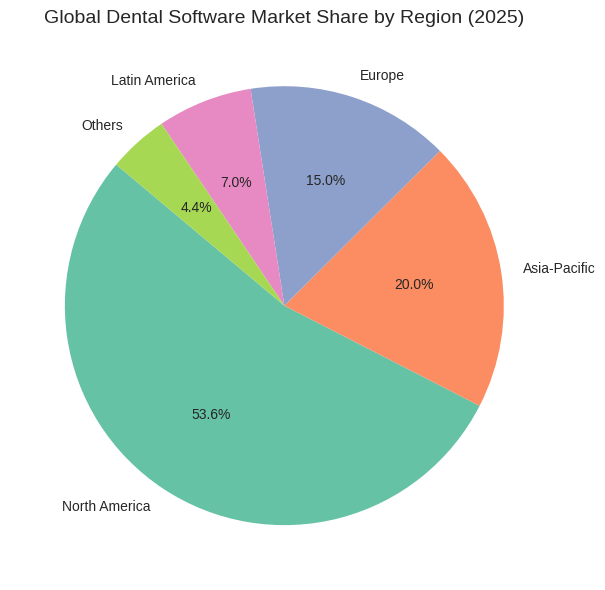
North America currently dominates the global dental software market, with a 2025 market share of 53.57%. This leadership is driven by its robust healthcare IT infrastructure, widespread internet penetration, and a large base of licensed dental professionals. The presence of established software providers such as Henry Schein and Patterson Dental further strengthens the region’s position.
However, Asia-Pacific is rapidly becoming the fastest-growing regional segment. Countries like China and India are witnessing accelerated digital adoption due to large-scale population health needs and growing demand for affordable, high-tech oral care. Additionally, the increase in chronic oral diseases and broader access to broadband internet are paving the way for next-generation cloud platforms in these markets.
Matrix: Regional Dental Software Market Insights (2025–2026)
| Region | 2025 Market Share | Key Drivers |
|---|---|---|
| North America | 53.57% | Strong IT infrastructure, large provider network |
| Asia-Pacific | Fastest growth | Digital health adoption in India and China, aging population |
| Europe | Moderate growth | Regulatory focus on EHR integration |
| Latin America | Emerging | Private sector investment in cloud dental tools |
Segment Analysis: Cloud vs. On-Premise Adoption
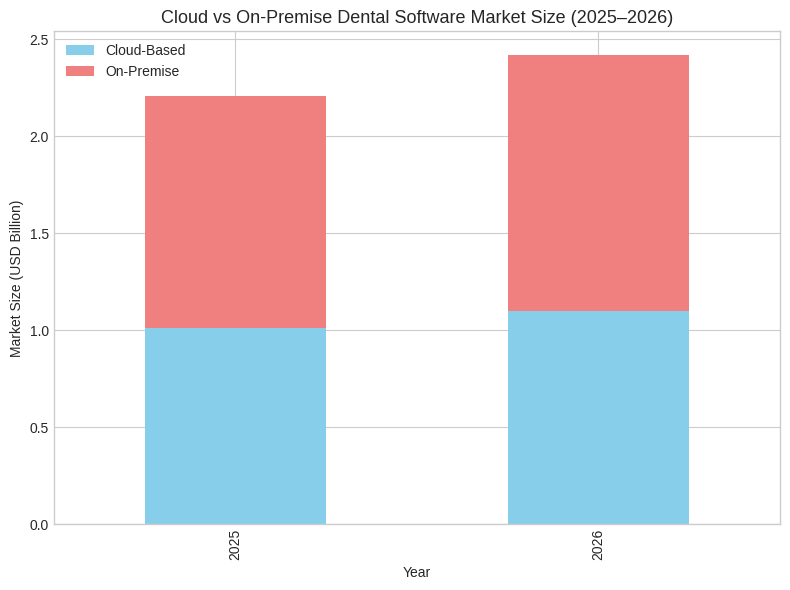
Cloud-based dental practice management systems continue to gain traction globally. In 2025, cloud-based solutions generated approximately USD 1.01 billion in value and are expected to reach USD 1.10 billion by 2026. These platforms are favored due to their ease of use, mobility, and scalability, especially for DSOs and multi-location clinics.
On-premise systems, although slightly larger in revenue in 2025 (USD 1.20 billion), are growing at a slower pace, with projections of USD 1.32 billion in 2026. The reduced growth rate of 6.5% reflects a gradual transition as many practices shift toward cloud-based infrastructure to enhance patient engagement and streamline updates.
Table: Cloud-Based vs. On-Premise Dental Software Segment Growth
| Segment | 2025 Market Size (USD Billion) | 2026 Forecast (USD Billion) | CAGR Estimate |
|---|---|---|---|
| Cloud-Based PMS | $1.01 | $1.10 | 10.06% |
| On-Premise PMS | $1.20 | $1.32 | 6.5% |
Aging Population and Clinical Complexity Driving Software Needs
A significant macroeconomic factor influencing software adoption is the global shift toward an aging population. Older adults often require complex dental care, including periodontal treatment, implant restorations, and long-term maintenance. These demands call for advanced clinical software capable of storing and managing high volumes of diagnostic data, including detailed periodontal charts, digital radiographs, 3D imaging, and treatment history.
The rise in demand for “whole-health integration”—linking oral health data with systemic medical records—is prompting software vendors to enhance interoperability. Platforms now support EHR compatibility, high-resolution imaging storage, and AI-based decision support to assist in treatment planning.
Matrix: Influence of Aging Demographics on Dental Software Design
| Clinical Demand Factor | Software Capabilities Required |
|---|---|
| Complex restorative procedures | Advanced charting, multi-specialty templates |
| Long-term health tracking | Longitudinal data management and reporting |
| Systemic disease connection | EHR interoperability and secure health data exchange |
| High imaging volume | Cloud storage with high-resolution image compression |
Conclusion
The dental practice management software market in 2026 is defined by strong financial growth, advancing technology, and changing demographics. With North America holding the dominant share and Asia-Pacific rapidly rising, the future landscape will depend on cloud-native innovation, patient-centric feature development, and scalable software ecosystems that support clinical precision and practice efficiency.
As dental organizations continue to adapt to digital transformation and expanding patient needs, the global PMS market is poised for sustained acceleration and evolving competitive dynamics.
The Economics of Dental Software in 2026: ROI, Margin Management, and the Business Case for Automation
In 2026, dental practices around the world are navigating increasingly tight profit margins, rising operational costs, and a complex patient care environment. With average revenues ranging from $700,000 to $1 million annually—and specialty dental clinics reaching over $1.5 million—profitability now hinges on the ability to control costs, improve efficiency, and increase patient throughput without sacrificing care quality. As overhead expenses typically account for 60% to 65% of collections, maintaining a sustainable EBITDA margin of 25% to 35% requires a strategic investment in dental practice management software that offers measurable financial and operational returns.
Technology as a Margin-Saving Investment
Modern dental software is no longer a convenience—it’s a financial necessity. Platforms powered by artificial intelligence and built on cloud-native architecture are enabling clinics to lower costs, enhance team performance, and boost revenue generation. These tools go beyond scheduling and billing to offer patient engagement automation, smart analytics, and integrated revenue cycle management (RCM).
Table: Economic Role of Dental Software in Practice Profitability
| Financial Metric | Standard Range | Targeted Outcome with Smart Software |
|---|---|---|
| Practice Revenue (General) | $700,000 – $1,000,000 | Stabilize or grow through patient conversion |
| Practice Revenue (Specialty) | $1.5 million+ | Boost profitability through complex case management |
| Overhead as % of Collections | 60% – 65% | Reduce through automation and cloud hosting |
| Target EBITDA Margin | 25% – 35% | Maintain by leveraging high-ROI technologies |
Quantifiable ROI from Cloud and AI Integration
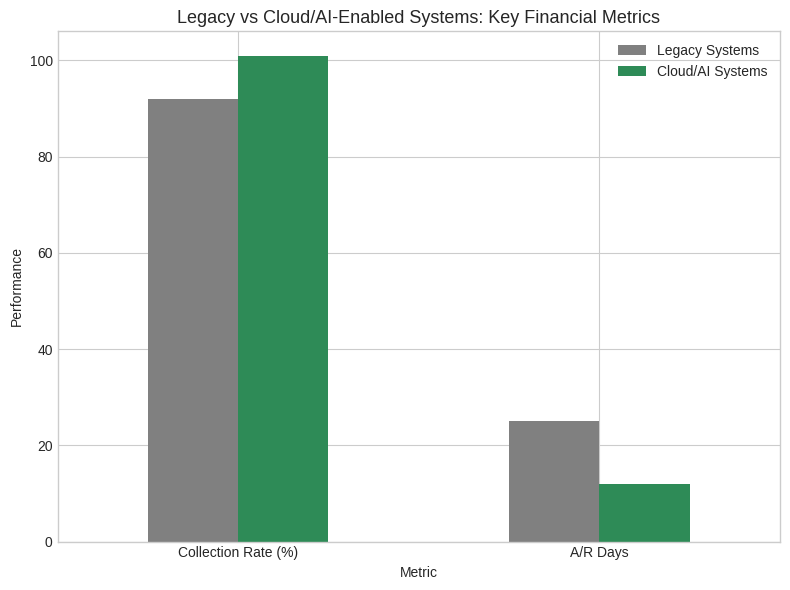
Dental practices that embrace automation through cloud-based and AI-powered platforms experience significantly improved business performance across nearly every key metric. Revenue collection improves, account receivables shrink, and patient volume increases due to more streamlined communication and case acceptance workflows.
Matrix: Performance Comparison – Legacy vs. AI/Cloud-Enabled Dental Platforms
| Operational Metric | Legacy Software Result | AI/Cloud Software Result |
|---|---|---|
| Collection Rate | 90% – 95% | Over 100% (with automated RCM tools) |
| Accounts Receivable Days | 20 – 30 days | Reduced to 12 days |
| Staff Retention Rate | Below 70% | Improved to 90% (due to intuitive workflows) |
| New Patient Growth Rate | 2% – 5% | Up to 25% increase |
| Case Acceptance Rate | Around 25% | 30% – 40% with AI-enhanced consultation tools |
Addressing Labor Shortages through Automation
In 2026, staffing shortages—especially among dental hygienists—remain one of the most pressing challenges across the industry. Approximately 90% of dental practices report extreme difficulty in hiring qualified clinical staff. In this environment, dental software must go beyond record-keeping to deliver automation at the front lines of patient interaction.
AI-powered agents now assist with booking appointments, managing intake forms, verifying insurance, and sending personalized reminders. These intelligent systems reduce administrative friction and recapture patient interest that would otherwise be lost during the intake process.
Table: Impact of AI-Driven Automation on Front Office Efficiency
| Workflow Stage | Traditional Handling | AI Automation Benefit |
|---|---|---|
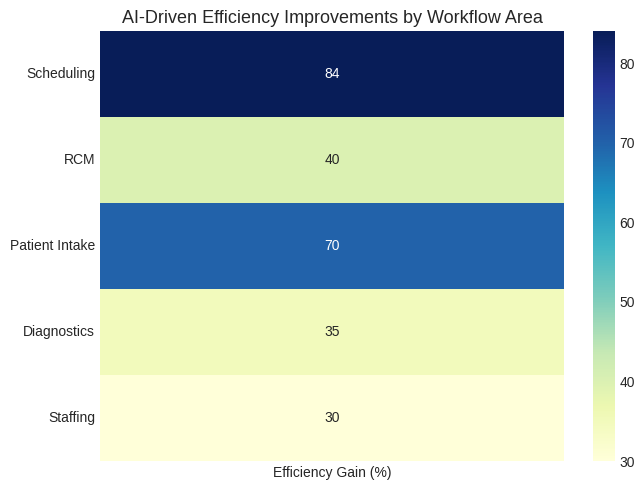
| Appointment Booking | Manual staff calls | AI agent improves booking volume by up to 84% |
| New Patient Intake | Paper-based forms and in-person check-in | Digital intake reduces wait times and errors |
| Reminder and Follow-up | Generic emails or missed communication | Personalized, automated messaging improves attendance |
| Insurance Verification | Staff-intensive and error-prone | Real-time validation reduces coverage issues |
Conclusion
As margin pressure intensifies and patient expectations evolve, dental practices in 2026 must treat software investment as a core part of their business strategy. The most successful clinics are those that shift from outdated legacy systems to cloud-native, AI-powered platforms that automate labor-intensive tasks, drive revenue growth, and safeguard profitability. Dental software is now a key differentiator—not just in operational efficiency, but in the overall sustainability and financial health of modern dental businesses.
Infrastructure and Deployment Models in 2026: Cloud vs. On-Premise Dental Software Systems
In 2026, dental practices face a pivotal decision when choosing between cloud-native and on-premise software platforms. This choice affects not only daily operations but also long-term financial sustainability, cybersecurity, and scalability. The global trend is rapidly shifting toward cloud-native solutions, largely driven by technological innovation, stronger data protection protocols, and evolving expectations around mobility and remote access.
Legacy on-premise systems, while still used by some smaller or traditional clinics, are entering a phase of functional decline. Most new development and cybersecurity investment are concentrated in cloud-based infrastructure, which now dominates the roadmap for dental software innovation.
Evaluating Total Cost of Ownership (TCO)
At first glance, on-premise systems may appear more cost-effective due to lower monthly licensing or support fees. However, when taking into account hardware replacement cycles, IT maintenance, local backup systems, and cybersecurity staffing, these apparent savings often diminish.
By contrast, cloud-native systems offer built-in services such as remote data backup, real-time updates, and remote access—all of which significantly reduce long-term overhead and risk. While cloud deployment may come with slightly higher monthly costs, it offers a stronger value proposition in terms of reliability, disaster recovery, and operational flexibility.
Table: Cost Structure Comparison – On-Premise vs. Cloud Software Models
| Cost Element | Legacy On-Premise (7 Workstations) | Cloud-Native Platform (2026 Standard) |
|---|---|---|
| Server Hardware Replacement | $2,800 – $8,500 every 5–8 years | None (cloud infrastructure included) |
| Monthly IT Support | $1,200/month for local server maintenance | Included in SaaS fee (approx. $1,600/month) |
| Data Backup | NAS Backup: $700 | Immutable cloud-based backups included |
| Cybersecurity Monitoring | Third-party or in-house | Built-in cloud security & compliance layers |
| Total Ownership Cost (Est.) | Comparable over 5 years | Higher up-front, but with greater coverage |
Hardware and Networking Infrastructure Requirements
The physical requirements for maintaining an on-premise solution differ significantly from a cloud-based deployment. Traditional on-premise systems require investment in server-grade hardware, complex networking setups, and reliable backup systems. These assets must also be refreshed periodically to keep up with system demands and security standards.
Cloud-native platforms, by contrast, rely on secure off-site servers and minimal local hardware, typically needing only fast internet and a browser-compatible workstation. This simplicity reduces internal IT burden while offering fast recovery in case of system failure or cyber incident.
Matrix: Technical Specification Comparison – On-Premise vs. Cloud Dental Workstations
| System Component | On-Premise Configuration | Cloud-Native Configuration (2026) |
|---|---|---|
| CPU | Xeon 2.4GHz – 3.4GHz | Intel Core i5 4.4GHz or higher |
| RAM | 16GB – 32GB | 16GB |
| Storage | 1TB (mirrored RAID for redundancy) | 256GB – 512GB local cache (cloud-hosted core) |
| Network | 24-Port Gigabit Switch (~$200 setup) | High-speed fiber internet + 5G backup |
| Backup System | On-site NAS unit (~$700 investment) | Automated encrypted cloud backup |
Strategic Considerations for 2026 Deployment
In addition to raw infrastructure costs, decision-makers must also consider business continuity, compliance with healthcare data laws, and the adaptability of their chosen system. Cloud-native platforms offer automatic software updates, centralized data management across multiple practice locations, and better support for hybrid or remote work models.
For growing dental practices, particularly those expanding into multi-location or DSO environments, cloud-based solutions present a clear advantage in scalability, uptime, and cost predictability.
Table: Strategic Benefits of Cloud Transition
| Evaluation Factor | Legacy On-Premise | Cloud-Native System |
|---|---|---|
| Disaster Recovery | Manual backups; slower recovery | Automated, instant failover |
| Scalability | Limited by physical hardware | Easily scaled to new locations/users |
| Compliance & Security | Practice-managed | Cloud vendor-managed with certifications |
| Remote Accessibility | VPN-dependent, less reliable | Browser-based, global access |
| Software Updates | Manual patches required | Automatic updates with no downtime |
Conclusion
The shift from on-premise to cloud-native dental software is no longer just a trend—it is now a strategic imperative. In 2026, practices that prioritize long-term efficiency, data protection, and flexible access are moving away from hardware-dependent systems and investing in cloud-based platforms that can support modern operational demands. While the initial investment in cloud may appear slightly higher, the overall return in terms of security, reliability, and scalability makes it a smarter and more future-proof choice for dental businesses aiming for sustained growth.
Artificial Intelligence in Dental Software: Enhancing Clinical Precision and Administrative Efficiency in 2026
In 2026, artificial intelligence (AI) has become an essential part of the dental software ecosystem. No longer a futuristic feature, AI now plays a critical role in both clinical diagnostics and administrative workflows. Top dental practice software platforms are integrating AI-driven features to help dentists improve accuracy, streamline communication, and increase case acceptance. AI is fundamentally changing how dental professionals diagnose, treat, and manage patient care while also automating many of the operational processes that once required human staff.
AI in Clinical Diagnostics and Patient Outcomes
AI has evolved to become a highly reliable tool in the dental diagnosis process. Using advanced neural network models such as convolutional neural networks (CNNs) and U-Net architectures, AI can now analyze digital imaging with precision—providing measurements, identifying pathologies, and even simulating future treatments.
Table: Clinical AI Capabilities in Dental Practice Software
| Clinical Function | AI Contribution Description |
|---|---|
| Caries Detection | AI identifies cavities with 80%–92% sensitivity and specificity |
| CBCT Segmentation | Automatically maps enamel, dentin, and bone structures for accurate measurement |
| Bone Height Analysis | Offers precise assessment for implant and periodontal planning |
| Periodontal Assessment | Detects apical foramen more accurately than traditional endodontic techniques |
| Treatment Visualization | Generative AI simulates post-treatment results through 3D visuals and videos |
Enhanced Patient Engagement Through AI Simulations
One of the most innovative applications of AI in 2026 is generative treatment simulation. Patients can now view realistic, AI-generated video renderings of their future smiles or orthodontic outcomes before committing to procedures. This visual communication significantly improves case acceptance by making dental outcomes more tangible and emotionally engaging for patients.
Matrix: Impact of AI Simulation on Patient Decisions
| Patient Interaction Feature | Resulting Patient Behavior Improvement |
|---|---|
| AI-Based Treatment Visualization | Increased understanding of proposed outcomes |
| Cosmetic Simulation Videos | Higher case acceptance for elective procedures |
| 3D Model Comparison Tools | Enhanced patient confidence in provider recommendations |
Administrative Automation with AI Receptionists
On the non-clinical side, administrative AI is streamlining front office operations in groundbreaking ways. Intelligent agents—often called “AI receptionists”—are capable of managing patient interactions with natural language understanding. These tools can handle appointment scheduling, verify insurance coverage, and update electronic records without staff involvement.
The ability of these AI agents to carry out multi-step administrative processes in real time is particularly valuable for understaffed practices or those looking to reduce operational costs without compromising patient experience.
Table: Administrative Workflow Automation Powered by AI
| Workflow Element | AI Functionality Description |
|---|---|
| Appointment Scheduling | AI manages new bookings, reschedules, and identifies cancellation gaps |
| Waitlist Coordination | Contacts waitlisted patients via SMS or email and updates scheduler |
| Insurance Verification | Pulls insurance data, confirms eligibility, and flags discrepancies |
| Intake Communication | AI conducts full conversations with patients, collecting medical history |
| Real-Time Scheduler Sync | Automates calendar updates across devices and users |
Conclusion
The integration of artificial intelligence in dental software platforms in 2026 is transforming both how dentists deliver care and how practices operate. From diagnostic imaging and clinical precision to streamlined administrative workflows, AI enhances every stage of the patient journey. Dental practices using AI-enabled platforms benefit from increased diagnostic accuracy, faster operations, reduced staffing pressure, and better patient communication. As AI continues to evolve, it is becoming a central feature of the top dental practice software tools shaping the future of modern dentistry.
Data Security and Regulatory Compliance in Dental Practice Software: 2026 Standards and Best Practices
In 2026, dental practice management software (PMS) must go far beyond traditional data protection methods. As dental records now include detailed medical histories, biometric identifiers, high-resolution imaging, and billing data, safeguarding this information has become one of the most critical requirements for software selection. For dental practices evaluating the top software platforms in the world, compliance with advanced cybersecurity and regulatory frameworks is no longer optional—it is essential.
Strengthening Security Standards in the Modern Digital Environment
Modern dental software platforms have moved well beyond basic HIPAA compliance. The industry is shifting toward adopting enterprise-level certifications such as SOC 2 Type II and ISO 27001. These certifications reflect a vendor’s commitment to ensuring security, data integrity, and service availability through regular third-party audits and continuous monitoring.
Table: Core Security Certifications Among Leading Dental Software in 2026
| Certification Name | Description | Software Examples |
|---|---|---|
| SOC 2 Type II | Third-party annual review of data security, confidentiality, and availability | Curve Dental, tab32 |
| ISO 27001 | International standard for information security management systems | Adopted by cloud-native vendors |
| HIPAA Compliance | U.S. federal standard for protecting patient health information (PHI) | Baseline requirement for all |
Modern Encryption and Hosting Practices
Encryption protocols now represent a core layer of security. All leading PMS platforms are expected to offer 256-bit AES encryption for stored data and TLS 1.2 or higher for any information transmitted across networks. These encryption standards safeguard data both at rest and during communication between systems or devices.
Additionally, most top dental software solutions are hosted on secure cloud infrastructure provided by major providers like AWS or Google Cloud. These data centers maintain extremely tight physical security policies, often involving three-tier multi-factor authentication and continuous surveillance.
Matrix: Data Hosting and Encryption Features in 2026 Dental Software
| Security Feature | Industry Standard Value (2026) |
|---|---|
| Data-at-Rest Encryption | 256-bit AES |
| Data-in-Transit Encryption | TLS 1.2 or higher |
| Hosting Provider | AWS, Google Cloud, or Azure |
| Physical Access Control | Three-layer two-factor authentication |
| Security Monitoring | Real-time, 24/7 threat detection and alert systems |
Immutable Backups and Ransomware Protection
One of the most valuable features in today’s data protection architecture is immutable cloud backup. These backups are designed to prevent data from being altered or deleted—even by ransomware or compromised internal access. They ensure that a full restoration of dental records is always possible, even in cases of cyberattacks or data corruption.
Table: Ransomware Readiness and Backup Reliability
| Backup Strategy | Functionality in Modern PMS Platforms |
|---|---|
| Immutable Cloud Backups | Prevents unauthorized alteration or deletion |
| Real-Time Backup Scheduling | Ensures continuous protection of patient data |
| Recovery Time Objective (RTO) | Typically under 15 minutes for cloud-native systems |
| Data Versioning | Multiple snapshots stored to track historical records |
Role-Based Access and Regulatory Oversight
Regulatory compliance in 2026 demands more than secure hosting—it requires precise control over who can access different types of patient information. The HIPAA “minimum necessary” rule is now enforced through granular Role-Based Access Controls (RBAC), which limit access based on user role and function. For instance, a billing coordinator may access insurance details, but not clinical notes, while a hygienist may see charting data without financial records.
In addition, the Department of Health and Human Services (HHS) now enforces annual penetration testing and active monitoring for compliance under Business Associate Agreements (BAAs). This ensures that dental software vendors and their clients maintain a continuously verified level of protection.
Matrix: Access Controls and Compliance Mechanisms in 2026
| Compliance Area | Implementation Requirement |
|---|---|
| Role-Based Access Control (RBAC) | Granular, with user group-level permissions |
| HIPAA “Minimum Necessary” Enforcement | Automated access limits tied to job function |
| Annual Penetration Testing | Mandatory for software vendors with active BAAs |
| Continuous Compliance Monitoring | Real-time alerts for anomalies and system misconfigurations |
Conclusion
In the dental technology landscape of 2026, top-tier practice management software platforms are defined not just by their features, but by how well they protect sensitive health data and adhere to evolving compliance standards. The combination of enterprise-grade certifications, military-level encryption, ransomware-resistant backups, and regulatory alignment with HIPAA and HHS mandates make data security a top-tier consideration for every dental practice. As patient expectations rise and digital threats become more sophisticated, investing in secure, regulation-compliant dental software is no longer optional—it is the foundation for sustainable and trustworthy clinical operations.
The Future of Dental Practice Software in 2026: Moving Toward the Autonomous Digital Clinic
In 2026, the global dental software industry is advancing toward a vision of near-autonomous practice management. The goal is clear: to significantly reduce the administrative workload placed on dental teams while enhancing diagnostic accuracy and operational efficiency. With technologies like generative AI, augmented reality (AR), predictive analytics, and tele-dentistry becoming core components of leading platforms, the next generation of dental software is poised to transform both the clinical and business side of dental care.
From Assistance to Autonomy: The Role of Generative AI and Augmented Reality
Generative AI is no longer limited to visual simulations. In 2026, it is evolving into an interactive assistant that supports live clinical decision-making. Augmented reality is also making a powerful entrance, especially when embedded into intraoral scanners and imaging software. These tools provide real-time, on-screen visual overlays during exams, helping dentists identify conditions like bone loss, enamel erosion, or alignment discrepancies with greater accuracy and speed.
Table: Advanced Technologies Embedded in Top Dental Software Platforms
| Technology Component | Functionality Description |
|---|---|
| Generative AI Assistance | Real-time generation of treatment suggestions based on live data |
| Augmented Reality Overlays | Visual cues layered onto live intraoral scans for guided diagnosis |
| AI-Enhanced Charting | Predictive entry and auto-completion of clinical documentation |
| Simulation Automation | Produces dynamic patient visuals for orthodontic and cosmetic planning |
Predictive Staffing and Workforce Optimization
One of the most practical uses of AI in 2026 is predictive staffing. By analyzing two or more years of historical scheduling data, leading dental practice software platforms can now recommend ideal staffing levels for upcoming weeks. This capability minimizes labor inefficiencies by forecasting when more hygienists or administrative support will be needed based on seasonal patterns, appointment types, and historical no-show rates.
Matrix: AI-Driven Workforce Forecasting in Dental Software
| Forecasting Feature | Operational Outcome |
|---|---|
| Schedule Pattern Analysis | Anticipates peak demand periods and appointment volume |
| Staff Allocation Suggestions | Recommends optimal shift distribution |
| Labor Cost Reduction | Minimizes overstaffing and underutilization |
| Patient Flow Prediction | Balances staff-to-patient ratios for improved care |
Tele-Dentistry and Integrated Whole-Health Solutions
The shift toward virtual care is accelerating, especially in remote and underserved areas. Dental software platforms now include built-in tele-dentistry features that allow clinics to offer video consultations, remote assessments, and follow-up care—all within the same interface used for in-office visits. These capabilities are critical for expanding access and improving continuity of care.
Furthermore, the rise of “whole-health integration” is connecting oral healthcare to broader systemic health tracking. PMS platforms are increasingly designed to share data with electronic health record (EHR) systems in primary care. This interoperability enables dental teams to contribute to the detection and management of conditions such as cardiovascular disease, diabetes, and autoimmune disorders, where oral inflammation may be an early indicator.
Table: Whole-Health and Tele-Dentistry Features in Leading Dental Software
| Feature Type | Description |
|---|---|
| Tele-Dentistry Module | Virtual consultations with appointment scheduling and e-prescriptions |
| Remote Diagnostics | Enables image and record sharing with specialists |
| EHR Integration | Syncs dental health data with medical EHR systems |
| Systemic Risk Flagging | Identifies oral symptoms that may signal broader health issues |
Conclusion
The top dental practice software platforms of 2026 are moving toward a model where human effort is augmented—and in some cases replaced—by smart, predictive, and responsive technologies. From real-time AR guidance during exams to automated staffing suggestions and virtual-first care models, these tools are redefining how clinics operate. Practices that adopt these advanced platforms gain not only operational efficiency but also clinical precision and deeper engagement with patients in both digital and physical environments. The future of dental informatics is intelligent, integrated, and increasingly autonomous.
Strategic Software Recommendations for Dental Practices in 2026: Choosing the Right Platform for Scalable Growth and Clinical Efficiency
In 2026, selecting the best dental practice management software is no longer just about comparing feature sets—it’s about aligning software infrastructure with the long-term vision and structure of the dental business. As the industry continues to consolidate and digitize, software has become the foundation of daily operations, financial performance, and patient engagement. The right platform can accelerate practice growth, automate key workflows, and provide strategic advantages in a competitive market.
Best Software Choices for Multi-Location and DSO Practices
For dental service organizations (DSOs) and multi-location groups, the most important requirement is system-wide unification. These organizations need centralized platforms that allow seamless coordination of revenue cycle management (RCM), clinical workflows, and performance analytics across multiple locations.
CareStack, Denticon, and Dentrix Ascend are ideal platforms for DSOs due to their cloud-native architecture and centralized data models. These systems are built to standardize clinical documentation, integrate enterprise billing, and deliver real-time dashboards—critical features for practices backed by private equity or those pursuing rapid expansion.
Table: Recommended Software for Multi-Location Practices
| Software Platform | Key Strengths for DSOs |
|---|---|
| CareStack | Unified RCM, all-in-one architecture, strong scalability |
| Denticon | Centralized dashboards, multi-specialty support, enterprise-grade security |
| Dentrix Ascend | Clean UI, DSO-wide scheduling and performance tracking |
Top Platforms for Independent and Single-Location Clinics
For smaller practices and solo practitioners, the focus should be on simplicity, speed, and affordability. These practices benefit most from cloud-native solutions that reduce IT costs, improve operational speed, and offer built-in automation.
Curve Dental and tab32 are leading options for independent practices in 2026. These platforms minimize setup complexity while offering essential features like real-time AI diagnostics, paperless workflows, and secure remote access.
Table: Recommended Software for Independent Clinics
| Software Platform | Advantages for Solo and Independent Practices |
|---|---|
| Curve Dental | Modern interface, cloud-native, minimal IT dependence |
| tab32 | AI-powered imaging, Google Cloud hosted, strong security framework |
Best Fit for Tech-Centric and Customization-Driven Practices
Practices with in-house IT teams or strong technical capabilities often look for maximum customization and control. Open Dental remains the preferred choice for these users. As one of the few open-source dental platforms, Open Dental allows for deep customization, advanced reporting, and integration with third-party tools—making it the go-to software for tech-savvy clinics willing to build a tailored digital ecosystem.
Table: Customization-Oriented Software for Tech-Forward Clinics
| Software Platform | Ideal Use Case |
|---|---|
| Open Dental | Clinics seeking full control, custom reporting, and modular integration |
How Software Drives the Performance Gap in 2026
The difference between high-performing and average dental practices in 2026 is increasingly shaped by how effectively they leverage technology. Clinics that implement AI-powered systems to streamline new patient communication and use automated RCM tools to accelerate billing cycles are seeing significant gains in efficiency, cash flow, and patient satisfaction.
Matrix: Strategic Software Capabilities That Influence Success
| Strategic Capability | Operational Impact |
|---|---|
| AI-Assisted Patient Intake | Faster first-mile engagement, reduced appointment drop-offs |
| RCM Automation | Accelerated payment cycles, reduced manual billing errors |
| Unified Data Infrastructure | Better visibility across teams, improved clinical standardization |
| Remote and Mobile Access | Enables flexible practice management and staff collaboration |
Conclusion
In 2026, dental software is no longer just a tool—it is the operational infrastructure that defines how practices grow, deliver care, and stay financially healthy. Choosing the right platform requires aligning with a clinic’s business model, scalability goals, and technical resources. Whether it’s an expanding DSO needing centralized reporting, an independent clinic seeking simplicity, or a power user aiming for customization, the top dental practice software solutions now offer strategic foundations for long-term success in an increasingly competitive landscape. Practices that embrace these technologies not only operate more efficiently but also position themselves at the forefront of the digital dental economy.
Conclusion
The landscape of dental practice management is undergoing a remarkable transformation in 2026. With advancements in cloud computing, artificial intelligence, cybersecurity, and interoperability, dental software is no longer a mere support tool—it has become the digital backbone of every successful practice. From solo clinics to large dental service organizations (DSOs), the ability to operate efficiently, deliver high-quality care, and maintain financial stability now heavily depends on selecting the right practice management software.
The top 10 dental practice software platforms in the world in 2026 each bring their own strengths to the table. Whether it’s Dentrix Ascend’s seamless cloud accessibility, Open Dental’s deep customization, Curve Dental’s mobile-first interface, or tab32’s enterprise-grade security and AI diagnostics—these platforms are shaping the future of dental operations. CareStack and Denticon continue to lead in scalability and centralized data control, making them ideal for multi-location and private equity-backed organizations. Meanwhile, tools like Adit and DentiMax provide outstanding value for practices that want robust functionality without the excessive cost of legacy systems.
Across all categories, the most successful practices are those that choose software aligned with their structure, patient volume, and growth strategy. A solo practitioner may benefit most from simplicity, low maintenance, and user-friendly automation, while a DSO will prioritize unified workflows, centralized billing, and scalable enterprise features. For clinics that demand total control, platforms that offer open architecture and integration flexibility continue to dominate the tech-forward segment.
Moreover, the impact of dental software now extends beyond practice operations. AI tools are improving diagnostic accuracy and case acceptance, predictive analytics are refining staffing and scheduling, and tele-dentistry is expanding access to care. The ability to connect oral health data with systemic health records is pushing the boundaries of what a dental platform can achieve in whole-health integration. Dental software is now a gateway to better patient outcomes, stronger financial performance, and long-term competitive advantage.
Security and compliance have also moved to the forefront, with 2026 marking a shift toward SOC 2-certified, HIPAA-compliant, and ISO-backed platforms that offer 256-bit encryption, immutable cloud backups, and role-based access controls. These standards are critical in protecting sensitive patient data and ensuring regulatory compliance in an increasingly complex digital health environment.
In a market projected to reach well over $2 billion by the end of 2026—and forecasted to grow to nearly $5 billion by 2034—the importance of making the right software choice has never been greater. Dental practice management software is no longer a back-office expense. It is a strategic investment that affects every aspect of the dental business, from patient communication and clinical accuracy to financial forecasting and team productivity.
As practices continue to face margin pressure, staffing shortages, and evolving patient expectations, the adoption of the right software is what will separate thriving, future-ready practices from those that fall behind. The top 10 dental practice software platforms in 2026 are more than just digital tools—they are the operating systems of modern dentistry. Choosing the right one means equipping your practice with the intelligence, flexibility, and resilience needed to lead in the decade ahead.
If you find this article useful, why not share it with your hiring manager and C-level suite friends and also leave a nice comment below?
We, at the 9cv9 Research Team, strive to bring the latest and most meaningful data, guides, and statistics to your doorstep.
To get access to top-quality guides, click over to 9cv9 Blog.
To hire top talents using our modern AI-powered recruitment agency, find out more at 9cv9 Modern AI-Powered Recruitment Agency.
People Also Ask
What is the best dental practice software in 2026?
The best dental practice software in 2026 depends on your clinic’s needs, but top-rated options include Dentrix Ascend, Open Dental, and Curve Dental.
Which dental software is best for multi-location practices?
CareStack, Denticon, and Dentrix Ascend offer centralized data management and scalability, making them ideal for multi-location dental groups and DSOs.
What is the most affordable dental software in 2026?
DentiMax and Open Dental offer affordable pricing plans with high functionality, making them popular among budget-conscious practices.
Which dental software offers the best cloud-based features?
tab32, Curve Dental, and Dentrix Ascend are leaders in cloud-native design, offering secure access, real-time updates, and mobile compatibility.
Is AI integrated into dental practice software in 2026?
Yes, most top dental software platforms include AI tools for diagnostics, patient communication, treatment planning, and revenue automation.
Can dental software help with patient scheduling?
Yes, top platforms use AI and automation to handle appointment scheduling, cancellations, reminders, and waitlist management efficiently.
Which dental software is best for imaging and X-ray integration?
DentiMax and tab32 offer powerful imaging modules that support high-resolution diagnostics and seamless X-ray integration.
Does dental software support teledentistry in 2026?
Yes, many platforms like Curve Dental and tab32 include built-in teledentistry features for virtual consultations and remote care.
How does AI improve dental case acceptance?
AI tools offer treatment simulations and visualizations, helping patients understand procedures better, which boosts case acceptance rates.
Is Open Dental still relevant in 2026?
Yes, Open Dental remains a top choice for tech-savvy clinics due to its customizability, open-source structure, and low-cost flexibility.
What are the key features of modern dental software?
Key features include AI diagnostics, cloud access, imaging tools, automated RCM, patient engagement, and integrated compliance controls.
Which dental software is best for solo practices?
Curve Dental and tab32 are preferred by solo clinics for their ease of use, low IT dependency, and AI-powered workflow support.
How secure is dental practice software in 2026?
Top platforms use 256-bit AES encryption, SOC 2 compliance, and immutable cloud backups to ensure data security and HIPAA compliance.
Does dental software offer EHR integration in 2026?
Yes, most advanced platforms offer interoperability with primary care EHR systems to support whole-health care integration.
How can software reduce dental practice overhead?
Automation in scheduling, billing, and patient intake helps reduce staff workload, improves efficiency, and cuts operational costs.
What is the ROI of investing in dental software in 2026?
Practices using AI-driven software report faster cash flow, better patient retention, and 25–40% gains in productivity and revenue.
What should I consider before choosing dental software?
Consider your clinic size, growth plans, integration needs, budget, cloud readiness, and whether the software supports AI automation.
Does dental software support role-based access controls?
Yes, modern platforms include role-based access to protect sensitive data and align with HIPAA’s minimum necessary standards.
Can dental software handle insurance and RCM automation?
Top platforms like CareStack and Adit automate insurance verification, billing, and collections, improving revenue cycle management.
Which dental software helps with patient reviews and SEO?
Adit and tab32 include reputation management and SEO tools to improve online visibility and attract more patients.
Is customization important in dental software?
Yes, platforms like Open Dental offer deep customization for clinics that want to tailor workflows, reports, and integrations.
How do cloud dental platforms compare to on-premise systems?
Cloud platforms offer better scalability, remote access, disaster recovery, and lower long-term maintenance costs than on-premise systems.
What compliance features should dental software have?
Look for SOC 2, ISO 27001, HIPAA compliance, end-to-end encryption, and support for annual penetration testing and audit logs.
Which software is best for growing DSOs in 2026?
CareStack and Denticon are purpose-built for DSOs, providing centralized RCM, enterprise analytics, and multi-site coordination.
Can dental software predict staffing needs?
Yes, AI in modern platforms analyzes past scheduling patterns to suggest optimal staffing levels and reduce labor inefficiencies.
Do modern dental platforms support remote work?
Yes, cloud-based dental software allows staff to access records, manage scheduling, and handle billing from any device securely.
How does dental software improve patient communication?
Software tools automate SMS, email, and VoIP communication, provide appointment reminders, and manage feedback loops effectively.
Are dental software platforms mobile-friendly in 2026?
Yes, leading platforms are optimized for tablets and smartphones, offering mobile charting, scheduling, and patient data access.
What trends are shaping dental software in 2026?
Key trends include AI automation, AR-guided diagnostics, EHR integration, cloud migration, and telehealth adoption in dental care.
How do I migrate to a new dental software platform?
Most vendors offer guided onboarding, data conversion tools, and cloud support to help practices migrate without major disruptions.
Sources
Dentistry Today
The Business Research Company
Fortune Business Insights
Towards Healthcare
InsightAce Analytic
Research and Markets
OpenLoop Health
Patientdesk
CareStack
Curve Dental
Group Dentistry Now
CyberlinkASP
Medix Dental
Gold Coast Dental
Institute of Digital Dentistry
RevUp Dental
G2
Dentrix
Henry Schein One
Software Advice
FindEMR
Capterra
GetApp
Medigy
Software Finder
ClinikEHR
Wisdom
Benco Dental
Open Dental
Cherry
Slashdot
Planet DDS
EMRFinder
tab32
FeaturedCustomers
DentiMax
Adit
Practice by Numbers
TopAdvisor
Prognocis
Comm100
Bright Smile Design