Key Takeaways
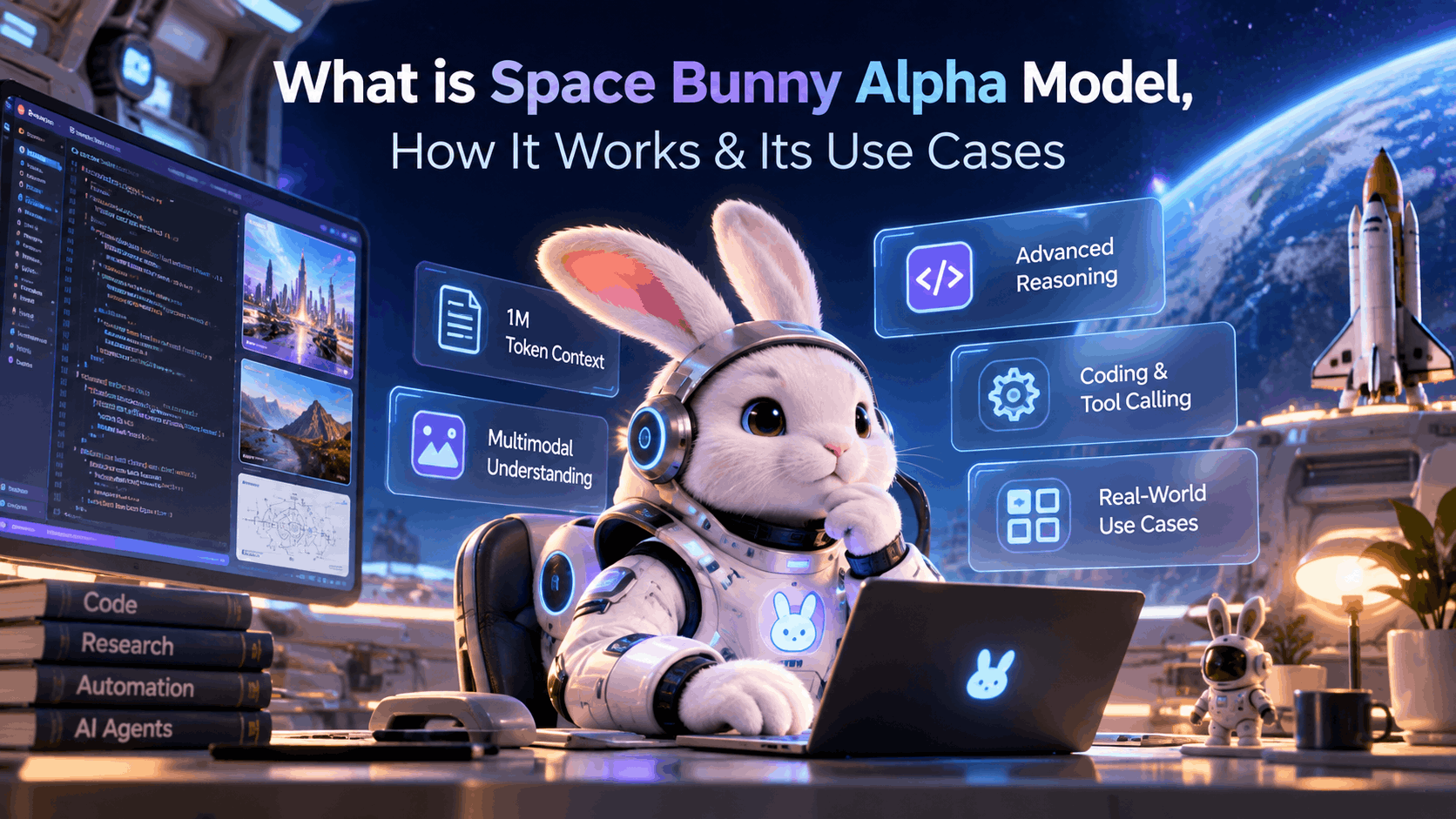
- Space Bunny Alpha is a powerful AI model featuring a 1M-token context window, multimodal understanding, advanced reasoning, coding, and tool-calling capabilities.
- Space Bunny Alpha supports AI coding agents, repository analysis, long-document processing, visual debugging, research, and enterprise automation workflows.
- Space Bunny Alpha offers strong speed and agentic capabilities, but its anonymous preview status means businesses should consider reliability, security, governance, and fallback models.
Space Bunny Alpha is an anonymous AI model that combines a 1-million-token context window, multimodal understanding, advanced reasoning, coding, and tool calling to handle complex tasks such as software development, long-document analysis, visual debugging, research, and AI agent workflows.
Space Bunny Alpha has quickly emerged as one of the most intriguing artificial intelligence models of 2026, attracting attention from developers, AI researchers, and coding-agent users because of its combination of a massive context window, multimodal understanding, configurable reasoning, and agentic software development capabilities. Unlike conventional AI models launched under an established technology brand, Space Bunny Alpha appeared as an anonymous or “stealth” preview model, adding considerable interest around both its capabilities and its underlying developer.

At the center of Space Bunny Alpha is a 1,000,000-token context window. This large working context allows the model to process substantial amounts of source code, technical documentation, research material, conversation history, and other information within a single workflow. Combined with support for text, images, and compatible multimodal inputs, Space Bunny Alpha can handle tasks ranging from repository-scale code analysis and visual debugging to long-document synthesis and research.
The model is particularly notable for AI coding and agentic workflows. Space Bunny Alpha supports function calling, structured outputs, and multiple reasoning effort levels, enabling developers to adjust how much computational reasoning is allocated to different tasks. A routine extraction or code explanation can use a lighter reasoning setting, while complex debugging, architecture analysis, software migrations, and multi-step engineering problems can receive substantially deeper reasoning.
These capabilities make Space Bunny Alpha useful for more than conversational AI. When integrated with compatible coding agents and development environments, it can participate in workflows that inspect repositories, modify multiple files, execute tools, analyze test results, interpret screenshots, diagnose problems, and iteratively improve an implementation. This ability to combine reasoning with external execution tools represents the broader transition from AI assistants that simply generate answers toward AI agents that can participate in complete workflows.
Space Bunny Alpha also has potential applications beyond software engineering. Businesses can use long-context AI models for document analysis, policy comparison, research synthesis, technical due diligence, incident investigation, structured data extraction, and controlled enterprise automation. Its multimodal capabilities can further connect visual evidence, such as screenshots or diagrams, with textual information including logs, specifications, and documentation.
However, Space Bunny Alpha also comes with important limitations. Its underlying developer has not been officially disclosed, and its preview status means availability, pricing, performance characteristics, and provider behavior may evolve. Large context capacity does not guarantee perfect recall or factual accuracy, while generated code, JSON responses, research conclusions, and tool calls still require validation before being trusted in production environments.
For organizations considering Space Bunny Alpha for enterprise AI, the safest approach is therefore to treat the model as a powerful but replaceable inference component. Model abstraction, automated testing, schema validation, restricted tool permissions, fallback models, monitoring, and human approval for consequential operations can help organizations benefit from its capabilities without becoming dependent on an experimental AI service.
This guide explains what the Space Bunny Alpha model is, how Space Bunny Alpha works, its key features and technical architecture, API and coding-agent integrations, performance characteristics, enterprise applications, limitations, and major use cases. It also examines why Space Bunny Alpha has gained so much attention in 2026 and what developers and businesses should consider before incorporating the model into real-world AI workflows.
Before we venture further into this article, we would like to share who we are and what we do.
About 9cv9
9cv9 is a business tech startup based in Singapore and Asia, with a strong presence all over the world.
With over ten years of startup and business experience, and being highly involved in connecting with thousands of companies and startups, the 9cv9 team has listed some of the top and best companies/tools in this review.
If you like to get your company listed in our top B2B software reviews, check out our world-class 9cv9 Media and PR service and pricing plans here.
What is Space Bunny Alpha Model, How It Works & Its Use Cases
- What Is the Space Bunny Alpha Model?
- API Request Mechanics and Parameter Integration
- Performance Telemetry and Benchmark Results
- Global Token Market Share and Adoption
- AI Coding Agent Integrations and Workflow Execution
- Enterprise Use Cases and System Implementations
- Technical Limitations and Failure Modes
- Architectural Strategy for Production Deployment
1. What Is the Space Bunny Alpha Model?
Space Bunny Alpha is an anonymous preview large language model released on September 23, 2026. It is positioned primarily as a high-speed reasoning, coding, multimodal understanding, and AI agent model, with an unusually large 1,000,000-token context window.
The model is publicly identified as stealth/space-bunny-alpha in major model-routing environments. Its developer remains undisclosed, meaning Space Bunny Alpha is best understood as a “stealth model”: users can access and evaluate the technology while the organization behind the underlying model remains anonymous.
This approach allows developers to test the model based on practical capabilities rather than brand recognition. Its combination of long-context processing, adjustable reasoning, multimodal input, structured output, and function calling makes Space Bunny Alpha particularly relevant for software development, AI agents, document analysis, research, and repository-scale workflows.
| Space Bunny Alpha Specification | Capability |
|---|---|
| Model Type | Anonymous preview large language model |
| Public Release | September 23, 2026 |
| Model Identifier | stealth/space-bunny-alpha |
| Context Window | 1,000,000 tokens |
| Maximum Completion | Up to 524,288 tokens |
| Input Modalities | Text, images and supported video inputs |
| Output | Text, code and structured data |
| Reasoning | Adjustable reasoning effort |
| Reasoning Levels | Low, medium, high, xhigh and max |
| Structured Output | JSON object responses |
| Tool Support | Function calling |
| API Design | OpenAI-compatible chat completion interface |
| Developer Identity | Undisclosed third-party provider |
Why Space Bunny Alpha Is Different
Space Bunny Alpha’s primary differentiator is the combination of a very large working context with reasoning and multimodal capabilities.
A one-million-token context window enables applications to supply substantially more information within a single model interaction than is practical with conventional smaller-context models. This can include source-code repositories, documentation, specifications, research materials, conversation histories, screenshots, diagrams and other contextual information.
The model is therefore particularly suitable for tasks where understanding relationships across a large amount of information is more important than answering an isolated question.
| Capability | Practical Benefit |
|---|---|
| 1M-token context | Processes very large bodies of information together |
| Multimodal understanding | Combines textual and visual information |
| Adjustable reasoning | Balances response speed against analytical depth |
| Large output capacity | Supports extensive code and structured responses |
| Function calling | Enables integration with software tools and agents |
| JSON output | Supports machine-readable application workflows |
| Coding capabilities | Assists with development and repository analysis |
How Space Bunny Alpha Works
Space Bunny Alpha operates through a prompt-to-reasoning-to-response pipeline. An application supplies instructions together with relevant context, which may contain text and supported visual or video material.
The model processes this information inside its large context window and applies a selected reasoning effort before generating the response.
A simplified operational flow looks like this:
| Processing Stage | What Happens |
|---|---|
| Input Collection | Application provides prompts, documents, code or media |
| Context Assembly | Information is assembled within the model context |
| Multimodal Interpretation | Text and supported visual information are interpreted |
| Reasoning | Model analyzes the information using the chosen effort level |
| Generation | A textual, coding or structured response is produced |
| Tool Request | Model may request an approved external function |
| Application Validation | Software validates output or requested actions |
| Execution | Approved downstream systems process the result |
This architecture makes Space Bunny Alpha useful as more than a conversational chatbot. It can operate as a reasoning component inside larger AI applications.
Space Bunny Alpha Reasoning Levels
One of the model’s notable capabilities is adjustable reasoning effort. Developers can select different levels depending on the complexity and latency requirements of a task.
| Reasoning Level | Suitable Applications | Relative Complexity |
|---|---|---|
| Low | Extraction, summaries, routine coding | Low |
| Medium | Comparisons, analysis, debugging | Moderate |
| High | Architecture, complex coding, planning | High |
| Xhigh | Difficult technical analysis and edge cases | Very High |
| Max | Highly complex reasoning and exploratory problems | Maximum |
Lower reasoning settings can be appropriate when applications prioritize responsiveness or handle relatively straightforward tasks. Higher settings are more appropriate when the model must examine complex dependencies, evaluate competing possibilities or perform deeper technical analysis.
This flexibility is especially useful for AI agents because not every step in an autonomous workflow requires the same amount of reasoning.
Long-Context Processing
The 1,000,000-token context window is central to the Space Bunny Alpha model.
Instead of repeatedly dividing a large information source into small fragments, developers can potentially provide much larger portions of the underlying material in the same model interaction.
For software engineering, this can mean supplying source files, configuration files, documentation and architectural information together. For research applications, it can mean analyzing numerous documents while preserving relationships between findings.
| Long-Context Task | Potential Application |
|---|---|
| Repository analysis | Understand relationships across many source files |
| Document research | Compare information across large document collections |
| Technical due diligence | Analyze specifications, reports and supporting material |
| Long conversations | Preserve more historical conversational context |
| Code migration | Evaluate dependencies across large applications |
| Compliance analysis | Review extensive policies and documentation |
| Knowledge synthesis | Consolidate findings from multiple information sources |
Multimodal Understanding
Space Bunny Alpha supports multimodal input, allowing supported deployments to combine text with images and video-related inputs.
This enables developers to construct workflows in which the model analyzes both written instructions and visual evidence.
For example, a developer could provide an interface screenshot and ask the model to identify usability problems. An engineering team could supply a system diagram alongside technical documentation and ask the model to evaluate architectural inconsistencies.
The model produces textual outputs rather than generating images or videos. Its multimodal functionality should therefore be understood primarily as multimodal understanding rather than multimedia generation.
Structured Output and JSON
Space Bunny Alpha can return structured JSON responses, making it useful for applications where model output must subsequently be processed by software.
Instead of generating unrestricted prose, an application can request information using a predefined structure containing fields such as classifications, findings, risks, recommended actions or extracted entities.
| Output Approach | Best Used For |
|---|---|
| Natural language | Research, explanations and conversational AI |
| Source code | Development and programming workflows |
| JSON | Application-to-application processing |
| Structured analysis | Auditing and evaluation systems |
| Function requests | AI agents and workflow automation |
Structured output reduces the amount of additional parsing required before AI-generated information can enter databases, dashboards, automation pipelines or downstream services.
Tool Calling and AI Agents
Function calling expands Space Bunny Alpha from a model that simply produces answers into a component capable of participating in agentic workflows.
An application can define approved tools or functions. When the model determines that one is required, it can generate a request describing the intended function and its arguments.
The surrounding application remains responsible for validating and executing that request.
This distinction is important. The model can recommend or request an action, but production systems should maintain control over permissions, authentication and potentially consequential operations.
| Agent Component | Responsibility |
|---|---|
| Space Bunny Alpha | Reasoning and determining appropriate actions |
| Application | Permission and policy enforcement |
| Function Schema | Defines available actions |
| External Tool | Performs approved operation |
| Validation Layer | Checks model-generated arguments |
| Feedback Loop | Returns results for subsequent reasoning |
Space Bunny Alpha for Software Development
Software engineering is one of the clearest potential applications for Space Bunny Alpha because coding frequently requires understanding information distributed across many files.
Rather than analyzing an isolated code snippet, the model can potentially reason across application code, database schemas, configuration files, tests, API definitions and documentation simultaneously.
Potential coding applications include repository analysis, debugging, code review, dependency mapping, migration planning, test generation, refactoring assistance and technical documentation.
Its large maximum completion capacity can also support workflows requiring substantial generated code, although production systems should generally constrain output lengths according to the actual task.
Space Bunny Alpha for Visual Debugging
Multimodal capabilities introduce additional software-development applications.
Developers can combine screenshots with code or written descriptions to investigate interface problems. The model may be used to interpret application screenshots, review layout hierarchy, compare an implementation against requirements or identify visible inconsistencies.
This can be particularly valuable for frontend engineering and automated quality-assurance workflows where visual evidence needs to be interpreted alongside technical context.
Space Bunny Alpha for Research and Document Analysis
Long-context capabilities also make the model suitable for research-intensive workloads.
Organizations can potentially supply collections of reports, internal documents, specifications or research notes and request consolidated findings.
| Research Use Case | Role of Space Bunny Alpha |
|---|---|
| Literature review | Synthesizes findings across documents |
| Competitive research | Compares products, companies or technologies |
| Policy analysis | Examines relationships across lengthy policies |
| Technical research | Consolidates specifications and engineering material |
| Due diligence | Identifies patterns, discrepancies and risks |
| Document comparison | Highlights similarities and contradictions |
The effectiveness of these workflows still depends on document quality, prompting, context organization and independent verification of important findings.
Space Bunny Alpha for Autonomous AI Agents
The combination of reasoning, large context capacity, structured responses and function calling makes Space Bunny Alpha particularly relevant for autonomous and semi-autonomous agents.
An agent could receive a goal, examine available context, determine the next action, request an approved tool, inspect the resulting information and continue until it reaches a defined stopping condition.
Potential examples include coding agents, research agents, document-processing agents, technical-support assistants and internal workflow automation.
However, high-impact actions should remain subject to deterministic validation, access controls and human approval where appropriate.
Is Space Bunny Alpha a MiniMax Model?
The actual developer of Space Bunny Alpha has not been officially disclosed.
Independent model fingerprinting has reported similarities between Space Bunny Alpha and models in the MiniMax family, including tokenizer behavior and technical characteristics. Other observers have also noted similarities between Space Bunny Alpha’s published capabilities and recent MiniMax model configurations.
These findings make a MiniMax connection plausible, but they do not constitute official confirmation of the model’s identity.
Consequently, describing Space Bunny Alpha definitively as a MiniMax model would be premature. Until either the provider or the distribution platform confirms its provenance, it should be described as an anonymous third-party model with technical evidence suggesting a possible relationship to the MiniMax model family.
Space Bunny Alpha Use Case Matrix
| Use Case | Suitability | Primary Advantage |
|---|---|---|
| Repository-Scale Coding | Very High | Large context and coding capability |
| AI Coding Agents | Very High | Reasoning, tools and long context |
| Document Analysis | Very High | Million-token context |
| Research Synthesis | Very High | Large-scale information processing |
| Visual Debugging | High | Image and text understanding |
| Software Architecture Review | High | Deep reasoning across dependencies |
| Data Extraction | High | Structured JSON responses |
| Workflow Automation | High | Function calling |
| Technical Support | High | Context-rich problem solving |
| Video Understanding | High | Supported multimodal input routes |
| Image Generation | Not Designed For | Text output rather than image generation |
| Video Generation | Not Designed For | Understanding rather than media creation |
Limitations and Considerations
Space Bunny Alpha remains a preview model, and its anonymous provenance creates additional considerations for organizations evaluating it for production workloads.
The identity of the underlying developer is not officially disclosed, and preview availability, pricing, routing behavior and model specifications can change. Multimodal compatibility can also depend on the provider route used to access the model.
Organizations handling sensitive information should additionally examine applicable data-retention policies before submitting proprietary source code, confidential documents, customer information or regulated data.
Large context windows should also not be interpreted as guaranteed perfect recall. Providing more information does not automatically improve accuracy. Effective context selection, prompt design, validation and evaluation remain important.
Space Bunny Alpha in the AI Model Landscape
Space Bunny Alpha represents an emerging class of models designed around large working contexts, multimodal understanding, configurable reasoning and agentic software integration.
Its 1,000,000-token context window and maximum output capacity of up to 524,288 tokens make it technically distinctive, while structured output and function calling extend its usefulness beyond conventional conversational AI.
For developers, its strongest potential lies in workloads that combine large amounts of information with coding, reasoning or automation. Repository-scale software engineering, AI agents, multimodal debugging, document intelligence and research synthesis are therefore among its most compelling use cases.
At the same time, Space Bunny Alpha should still be treated as an evolving preview model. Its underlying developer remains undisclosed, and speculation about its relationship to MiniMax should remain clearly separated from confirmed technical specifications.
2. API Request Mechanics and Parameter Integration
Space Bunny Alpha uses an OpenAI-compatible API structure designed to simplify integration with existing AI applications, coding agents, orchestration frameworks, and software development kits. Developers familiar with chat-completion APIs can therefore integrate the model without creating an entirely new request architecture.
A typical request combines authentication credentials, the Space Bunny Alpha model identifier, an ordered message history, reasoning configuration, generation limits, and optional controls for structured output or tool calling.
The precise parameters available can vary depending on whether Space Bunny Alpha is accessed directly or through an intermediary model-routing platform. For production integrations, developers should therefore validate parameters against the selected provider rather than assuming every gateway exposes identical controls.
Core Space Bunny Alpha API Parameters
| Parameter | Type | Requirement | Purpose |
|---|---|---|---|
| model | String | Required | Identifies Space Bunny Alpha as the target model |
| messages | Array | Required | Supplies the ordered conversation and instructions |
| reasoning | Object | Optional | Configures reasoning behavior and effort |
| max_completion_tokens | Integer | Optional | Limits completion size on compatible endpoints |
| max_tokens | Integer | Optional | Sets the maximum generation allocation where supported |
| temperature | Float | Optional | Controls randomness and response variation |
| top_p | Float | Optional | Controls nucleus sampling |
| tools | Array | Optional | Defines functions the model can request |
| tool_choice | String or Object | Optional | Determines how available tools may be selected |
| response_format | Object | Optional | Requests structured output such as JSON |
| stream | Boolean | Optional | Enables incremental response streaming |
| provider | Object | Provider-specific | Influences routing when supported by an aggregator |
Model Selection
The model parameter tells the API which model should process the request. The commonly documented identifier is:
stealth/space-bunny-alpha
Correct model identification is particularly important when requests pass through multi-model gateways because the same API endpoint may provide access to many different AI models.
Message Structure
The messages array contains the conversational context supplied to Space Bunny Alpha. Messages generally associate a role with corresponding content.
Typical roles include system-level instructions, user requests, assistant responses, and tool-related messages. Maintaining an ordered message history allows applications to construct multi-turn conversations and agent workflows.
Space Bunny Alpha also supports multimodal message structures. Depending on the active provider route, a message can combine textual instructions with images and compatible video inputs.
| Message Component | Typical Function |
|---|---|
| System | Defines application-level instructions |
| User | Contains the user’s request or task |
| Assistant | Represents previous model responses |
| Text Content | Supplies prompts, documents or contextual information |
| Image Content | Provides screenshots, diagrams or other visual material |
| Video Content | Supplies compatible video references where supported |
Reasoning Configuration
The reasoning parameter controls how much computational reasoning Space Bunny Alpha applies to a request.
Five documented reasoning levels are available: low, medium, high, xhigh, and max.
| Reasoning Effort | Typical Application | Expected Trade-Off |
|---|---|---|
| Low | Extraction, simple coding and summaries | Faster, lighter reasoning |
| Medium | Analysis and multi-step tasks | Balanced depth and responsiveness |
| High | Architecture and difficult debugging | Greater analytical depth |
| Xhigh | Complex technical investigations | Higher reasoning expenditure |
| Max | Highly demanding reasoning problems | Maximum available reasoning depth |
The current Space Bunny documentation indicates that requests without an explicitly supplied reasoning effort default to low. This is important because earlier descriptions of Space Bunny Alpha sometimes characterized maximum reasoning as the default.
Completion Token Controls
Generation limits prevent a request from producing unnecessarily large responses.
Space Bunny Alpha supports an unusually high maximum completion capacity of up to 524,288 tokens, but applications rarely need to allocate the full amount. Developers can normally specify a much smaller limit based on the task.
A short classification request might require only hundreds of tokens, while repository analysis, code generation, or detailed research could require substantially more.
Reasoning tokens may also contribute to completion usage even when the underlying reasoning is not displayed directly to the user.
Temperature and Top-P Sampling
Temperature and top_p influence how Space Bunny Alpha chooses tokens during generation.
Temperature controls the degree of variation in generated responses. Lower settings generally encourage more deterministic responses, while higher values can introduce greater variation.
Top_p applies nucleus sampling by limiting token selection to a probability-weighted subset of possible next tokens.
| Configuration Goal | Temperature Strategy | Top-P Strategy |
|---|---|---|
| Data extraction | Lower | More constrained |
| Code generation | Low to moderate | Moderately constrained |
| Technical analysis | Low to moderate | Broad enough for reasoning |
| Brainstorming | Moderate to higher | Broader sampling |
| Creative generation | Higher | Broader sampling |
In production applications, developers generally benefit from adjusting one sampling control deliberately rather than aggressively changing both simultaneously.
Structured JSON Output
The response_format parameter allows applications to request structured JSON output rather than ordinary prose.
This capability is useful when Space Bunny Alpha operates as part of a software pipeline. Instead of returning paragraphs that must subsequently be interpreted, the model can return information structured into fields that an application can parse.
Potential applications include data extraction, document classification, risk assessment, automated research, workflow routing, and agent planning.
However, JSON output should still be validated by application code before downstream processing. Structured generation does not replace schema validation, business-rule enforcement, or security controls.
Tool Calling and Function Integration
Space Bunny Alpha supports tool calling through tools and tool_choice parameters.
The tools array describes functions available to the model using structured definitions. These functions could represent database searches, internal APIs, file retrieval, business systems, calculators, or other application capabilities.
The model can then determine that a tool is necessary and generate a structured request for it.
| Tool Setting | Operational Purpose |
|---|---|
| none | Prevents the model from requesting tools |
| auto | Allows the model to determine whether a tool is needed |
| required | Requires a tool invocation |
| Explicit Tool | Directs the model toward a specific available function |
Importantly, Space Bunny Alpha does not independently execute arbitrary external operations simply because tool calling is enabled. The surrounding application remains responsible for validating arguments, checking permissions, executing approved functions, and returning results.
Streaming Responses
Streaming allows an application to receive generated content incrementally rather than waiting for the complete response.
When streaming is enabled on compatible endpoints, generated information is delivered progressively using a streaming response mechanism. This can significantly improve perceived responsiveness for lengthy generations.
| Response Mode | Best Application |
|---|---|
| Non-Streaming | Background jobs, JSON extraction and automation |
| Streaming | Chat interfaces and interactive coding assistants |
| Structured JSON | Machine-to-machine workflows |
| Tool Calling | Autonomous and semi-autonomous agents |
Streaming is particularly relevant to Space Bunny Alpha because complex reasoning and large output budgets can otherwise result in noticeable waiting periods before an entire response becomes available.
API Authentication and Security
API access requires authentication credentials supplied by the relevant provider. API keys should be stored exclusively in secure server-side environments or secret-management systems.
Keys should never be embedded directly into browser applications, public repositories, prompts, client-side storage, screenshots, or agent transcripts.
This becomes especially important when Space Bunny Alpha is incorporated into autonomous agents because agents may interact with logs, repositories, terminals, and other environments where accidentally exposed credentials could propagate.
Direct API vs Model Router Integration
Space Bunny Alpha can be accessed through its dedicated service as well as third-party model-routing infrastructure. The fundamental interaction pattern remains similar, but individual gateways may expose different endpoint formats, routing controls, parameter aliases, rate limits, or provider-specific functionality.
| Integration Method | Primary Advantage | Key Consideration |
|---|---|---|
| Direct Space Bunny API | Native model integration | Verify current direct API specifications |
| Model Router | Unified access across many models | Routing behavior may vary |
| OpenAI-Compatible SDK | Minimal integration changes | Confirm provider-specific parameters |
| Agent Framework | Rapid workflow orchestration | Validate tool permissions carefully |
| Custom Backend | Maximum application control | Requires additional engineering |
API Request Processing Flow
A Space Bunny Alpha API interaction can be understood as a sequence of controlled processing stages.
| Stage | Process |
|---|---|
| Authentication | Provider validates the supplied API credential |
| Model Routing | Request is directed to Space Bunny Alpha |
| Context Assembly | Messages and multimodal information are processed |
| Reasoning Allocation | Selected reasoning effort is applied |
| Model Inference | Space Bunny Alpha evaluates the supplied context |
| Tool Decision | Model determines whether an available function is required |
| Generation | Text, code, JSON or tool instructions are generated |
| Streaming | Tokens may be progressively returned when enabled |
| Application Validation | Client validates structured output or tool calls |
| Downstream Processing | Approved results enter the wider application workflow |
Why the Space Bunny Alpha API Matters for Developers
Space Bunny Alpha’s API architecture combines familiar chat-completion mechanics with capabilities designed for modern agentic applications.
Its one-million-token context window allows applications to supply unusually large working contexts, while configurable reasoning lets developers balance analytical depth against responsiveness. Structured output enables machine-readable workflows, and function calling allows the model to participate in controlled software automation.
These characteristics make the Space Bunny Alpha API particularly relevant for coding agents, repository analysis, long-document processing, multimodal applications, research systems, structured data extraction, technical assistants, and autonomous workflow orchestration.
For production deployment, however, developers should treat provider-specific parameters separately from core model capabilities. API behavior, routing options, retention policies, rate limits, and preview availability can change independently of the underlying Space Bunny Alpha model.
3. Performance Telemetry and Benchmark Results
Early evaluations of Space Bunny Alpha indicate competitive performance across scientific reasoning, multidisciplinary knowledge, difficult expert-level questions, structured data extraction, and tool calling. However, its benchmark record remains relatively new, and several widely cited results come from independent or model-focused evaluations rather than standardized vendor benchmarks.
The available results should therefore be interpreted as early performance indicators rather than definitive rankings against established frontier models.
Space Bunny Alpha Benchmark Performance
Space Bunny Alpha has been evaluated on GPQA Diamond, MMLU-Pro, Humanity’s Last Exam, and AI BENCHY. Results indicate that its strongest areas include difficult reasoning, structured extraction, and function calling.
| Evaluation Benchmark | Task Focus | Space Bunny Alpha Result | Evaluation Context |
|---|---|---|---|
| GPQA Diamond | Graduate-level scientific reasoning | 82.0% | 60-question subset |
| MMLU-Pro | Multidisciplinary knowledge and reasoning | 75.0% | Independent evaluation |
| Humanity’s Last Exam | Expert-level frontier reasoning | 46.1% | 300-question subset |
| AI BENCHY | Practical AI tasks and tool use | 7.0 / 10 | High reasoning |
| AI BENCHY Attempt Pass Rate | Successful attempted tasks | 62.1% | 12 of 22 tests fully passed |
| AI BENCHY Data Extraction | Structured information extraction | 10.0 / 10 | Category result |
| AI BENCHY Tool Calling | Function and tool execution | 10.0 / 10 | Category result |
The GPQA Diamond result is particularly relevant to evaluating complex scientific reasoning. Space Bunny Alpha achieved 82.0% on a standardized 60-question subset covering demanding questions across disciplines such as biology, chemistry, and physics.
Its 75% MMLU-Pro result provides another indication of broad reasoning ability across scientific, humanities, mathematical, and professional subjects.
Humanity’s Last Exam Performance
Space Bunny Alpha achieved 46.1% on a 300-question subset of the original Humanity’s Last Exam evaluation.
The reported standard error was approximately 2.9 percentage points, producing an approximate 95% confidence interval of 40.4% to 51.8%.
| HLE Measurement | Result |
|---|---|
| Evaluated Questions | 300 |
| Reported Accuracy | 46.1% |
| Approximate Standard Error | 2.9 percentage points |
| Approximate 95% Confidence Interval | 40.4% to 51.8% |
| Unscored Questions | 7 |
The result suggests that Space Bunny Alpha can address a meaningful proportion of extremely difficult expert-level questions. However, subset-based evaluations should not be directly compared with full-dataset results unless the competing models use the same questions, prompts, reasoning settings, tools, and scoring methodology.
AI BENCHY Performance
Space Bunny Alpha recorded an overall AI BENCHY score of 7.0 out of 10 at high reasoning.
Its category-level performance is arguably more informative than the headline score. The model reportedly received perfect 10.0 scores for both data extraction and tool calling, highlighting potential strengths for agentic applications.
| AI BENCHY Area | Reported Performance | Practical Interpretation |
|---|---|---|
| Overall | 7.0 / 10 | Competitive practical performance |
| Data Extraction | 10.0 / 10 | Strong structured information processing |
| Tool Calling | 10.0 / 10 | Strong potential for agent workflows |
| Attempt Pass Rate | 62.1% | Not every attempted task was completed |
| Fully Passed Tests | 12 of 22 | Indicates uneven performance across categories |
These characteristics are particularly relevant for developers considering Space Bunny Alpha for coding agents, research automation, structured extraction, API orchestration, and other tool-intensive workflows.
Long-Context Retrieval Performance
The model’s 1,000,000-token context capacity is one of its defining technical characteristics, but context-window size alone does not demonstrate retrieval accuracy.
A reported long-context experiment placed three separate codes inside a single input containing approximately 200,000 tokens. Space Bunny Alpha reportedly retrieved all three codes in the correct order during a single run.
| Long-Context Attribute | Observed or Published Characteristic |
|---|---|
| Maximum Context Window | 1,000,000 tokens |
| Tested Long Input | Approximately 200,000 tokens |
| Hidden Retrieval Targets | 3 |
| Retrieval Outcome | All three returned in correct order |
| Primary Relevance | Repository and large-document processing |
This is better interpreted as a long-context capability test rather than a comprehensive benchmark. More extensive needle-in-a-haystack, multi-needle, positional retrieval, and reasoning-over-context evaluations would be required to characterize performance across the full one-million-token window.
Token Efficiency
Early testing also suggests potentially favorable token efficiency for reasoning-intensive workloads.
One reported benchmark comparison recorded approximately 305,989 output tokens for Space Bunny Alpha versus approximately 913,989 for Qwen3.8 Flash across the same benchmark workload.
| Token-Efficiency Measurement | Space Bunny Alpha | Comparison Run |
|---|---|---|
| Reported Output Tokens | 305,989 | 913,989 |
| Relative Difference | Approximately 66% fewer | Baseline |
| Primary Implication | Lower generation volume | Higher generation volume |
Token efficiency can become commercially important when models transition from free previews to usage-based pricing. However, token count alone does not measure efficiency: output quality, reasoning accuracy, latency, retry rates, and eventual token pricing must also be considered.
Inference Speed and Latency
Operational telemetry for Space Bunny Alpha suggests that the model is designed for relatively fast generation despite its large context and reasoning capabilities.
Generation throughput and latency should be evaluated separately. Throughput describes how quickly output tokens are generated once generation begins, while time to first token measures how long the user waits before visible output starts.
| Performance Metric | Reported Measurement | What It Indicates |
|---|---|---|
| Median Generation Throughput | Around 88 tokens/second | Typical generation speed |
| Upper-Bound Throughput | Around 196 tokens/second | High-end observed generation rate |
| Median TTFT | Around 1.3-1.4 seconds | Typical initial response delay |
| P90 TTFT | Around 3.34 seconds | Slower 10% of measured requests |
| P99 TTFT | Around 9.22 seconds | Tail initial-response latency |
| Median End-to-End Latency | Around 7.68 seconds | Typical complete-request duration |
| P99 End-to-End Latency | Around 209.55 seconds | Extreme tail latency on demanding tasks |
These telemetry figures should be treated as observational rather than fixed model specifications. Actual performance can change according to provider capacity, prompt size, reasoning effort, output length, request concurrency, caching, geographic routing, and rate limiting.
Why End-to-End Latency Can Increase Sharply
A model can produce tokens quickly once generation starts while still taking considerably longer to complete a complex request.
Space Bunny Alpha’s configurable reasoning system means that higher reasoning levels can require additional processing before and during generation. Very large prompts can further increase processing requirements.
| Latency Factor | Potential Impact |
|---|---|
| Larger Context | More information requires processing |
| Higher Reasoning Effort | Additional inference computation |
| Long Output | Longer total generation time |
| Tool Calls | External execution adds latency |
| Multimodal Input | Images or video require additional processing |
| Provider Congestion | Can increase queueing time |
| Cache Availability | Reused context may improve efficiency |
For this reason, developers should not evaluate Space Bunny Alpha solely on tokens per second. Time to first token and complete workflow latency are often more meaningful measurements for production applications.
Prompt Caching and Repeated Workloads
Prompt caching can materially improve the economics and responsiveness of long-context applications because large portions of an existing prompt may remain unchanged between requests.
This is especially relevant for coding agents. A repository, system instructions, documentation, or application state may remain largely constant while the developer submits a sequence of new tasks.
High cache reuse can reduce the amount of repeated processing required for these recurring contexts.
| Workload | Potential Benefit of Prompt Caching |
|---|---|
| Coding Agent | Reuses repository and instruction context |
| Long Conversation | Reuses historical conversation |
| Research Agent | Reuses previously supplied documents |
| Document Analysis | Avoids repeatedly processing static material |
| Support Assistant | Reuses product and policy context |
| Autonomous Agent | Maintains recurring operational instructions |
Operational Reliability
Availability is another important consideration when evaluating Space Bunny Alpha for production systems.
Endpoint reachability and successful request completion should be treated as separate metrics. An endpoint can remain technically reachable while individual inference requests fail because of rate limits, provider capacity, malformed outputs, timeouts, or other upstream conditions.
| Reliability Concept | What It Measures |
|---|---|
| Endpoint Reachability | Whether infrastructure can be contacted |
| Request Availability | Whether requests successfully complete |
| Rate-Limit Reliability | Ability to handle repeated requests |
| Output Reliability | Whether usable responses are returned |
| Tool Reliability | Whether structured calls remain valid |
| Tail Latency | Performance during unusually slow requests |
This distinction is particularly important for autonomous agents because even a relatively small inference failure rate can accumulate across workflows involving dozens of sequential model calls.
Interpreting Space Bunny Alpha Benchmarks Carefully
The existing Space Bunny Alpha benchmark portfolio should not be interpreted as a standardized head-to-head leaderboard.
Its GPQA Diamond evaluation uses a 60-question subset, while its Humanity’s Last Exam result uses a 300-question subset. Published scores for competing models may have been produced using different question counts, prompts, reasoning budgets, tools, and evaluation frameworks.
There is also not yet the breadth of independently reproduced evaluation evidence available for more established frontier models.
| Benchmark Evidence | Confidence for Model Selection |
|---|---|
| Single Independent Test | Useful early signal |
| Subset Benchmark | Useful but requires comparison caution |
| Full Standardized Benchmark | Stronger comparative evidence |
| Repeated Independent Tests | Higher confidence |
| Production Workload Evaluation | Most relevant to deployment decisions |
Consequently, organizations evaluating Space Bunny Alpha should build application-specific tests rather than selecting it solely from headline benchmark scores.
What the Performance Data Means for Real-World Use
Space Bunny Alpha’s early results suggest that its most compelling positioning is not simply as another general-purpose chatbot.
Its combination of a one-million-token context window, strong structured extraction results, tool calling, multimodal understanding, adjustable reasoning, and relatively fast generation makes it particularly interesting for complex AI agents.
Repository-scale coding, research automation, large-document analysis, structured extraction, technical troubleshooting, tool-driven agents, and multimodal software-development workflows are therefore among the strongest candidates for practical deployment.
At the same time, Space Bunny Alpha remains a comparatively new anonymous preview model. Benchmark subsets, limited independent replication, changing provider infrastructure, and preview-stage operational characteristics mean that its current performance figures should be treated as promising early telemetry rather than permanent specifications or definitive proof of superiority over established frontier models.
4. Global Token Market Share and Adoption
Space Bunny Alpha experienced unusually rapid adoption after appearing publicly on September 23, 2026. Within its first partial week on OpenRouter, the anonymous model processed approximately 13.9 trillion tokens, placing it third among models ranked by weekly token usage.
During that period, DeepSeek V4.1 Flash ranked first with approximately 19.6 trillion tokens, while GLM 5.3 Flash ranked second with approximately 16.3 trillion. Space Bunny Alpha achieved its 13.9 trillion-token volume despite being available for less than a full week.
This rapid adoption provides an important signal about developer interest in free, long-context models optimized for coding, reasoning, multimodal processing, and AI agents.
OpenRouter Weekly Token Volume
| Model | Developer | Weekly Tokens Processed | Weekly Position |
|---|---|---|---|
| DeepSeek V4.1 Flash | DeepSeek | 19.6 trillion | #1 |
| GLM 5.3 Flash | Z.ai | 16.3 trillion | #2 |
| Space Bunny Alpha | Stealth | 13.9 trillion | #3 |
| Hy4 Preview | Tencent | 9.64 trillion | #4 |
| GPT-5.6 Luna | OpenAI | 8.53 trillion | #5 |
| DeepSeek V4 Flash 0731 | DeepSeek | 7.82 trillion | #6 |
| Nemotron 3 Ultra Free | NVIDIA | 5.67 trillion | #7 |
| MiMo-V2.6-Flash | Xiaomi | 5.51 trillion | #8 |
Space Bunny Alpha Reaches Number One in Daily Usage
Space Bunny Alpha subsequently climbed from third place in weekly usage to first place on OpenRouter’s daily model leaderboard.
The most recent complete-day ranking recorded approximately 4.32 trillion tokens processed by Space Bunny Alpha. DeepSeek V4.1 Flash followed with approximately 3.68 trillion, while MiMo-V2.6-Flash generated approximately 1.43 trillion.
| Daily Ranking | Model | Tokens Processed |
|---|---|---|
| #1 | Space Bunny Alpha | 4.32 trillion |
| #2 | DeepSeek V4.1 Flash | 3.68 trillion |
| #3 | MiMo-V2.6-Flash | 1.43 trillion |
| #4 | GLM 5.3 Flash | 1.32 trillion |
| #5 | GPT-5.6 Luna | 1.29 trillion |
| #6 | Hy4 Preview | 1.21 trillion |
| #7 | Nemotron 3 Ultra Free | 964 billion |
| #8 | DeepSeek V4 Flash 0731 | 948 billion |
This means Space Bunny Alpha was processing more tokens on OpenRouter during the measured day than any other individual model on the platform.
Rapid Growth in Cumulative Token Volume
The speed of Space Bunny Alpha’s growth is particularly notable because the model had only recently entered the market.
OpenRouter’s current trailing 30-day leaderboard records approximately 18.2 trillion Space Bunny Alpha tokens. Since the model did not exist for most of that 30-day measurement window, this figure represents only several days of actual availability.
| Adoption Indicator | Space Bunny Alpha Performance |
|---|---|
| Public Release | September 23, 2026 |
| Initial Partial-Week Volume | Approximately 13.9 trillion tokens |
| Current Tracked Volume | Approximately 18.2 trillion tokens |
| Initial Weekly Position | #3 |
| Recent Daily Position | #1 |
| Recent Daily Volume | Approximately 4.32 trillion tokens |
| Context Window | 1,000,000 tokens |
| Preview Token Price | Free |
The numbers illustrate how rapidly model rankings can change when developers gain access to a capable model with aggressive preview pricing.
Why Space Bunny Alpha Usage Grew So Quickly
Several factors likely contributed to the surge.
First, Space Bunny Alpha was offered free during its preview. For developers operating coding agents or autonomous systems that can consume millions of tokens during a single workflow, eliminating per-token inference charges creates a powerful incentive to experiment.
Second, the one-million-token context window makes the model suitable for unusually large workloads. Entire code repositories, lengthy documents, conversation histories, research collections, and multimodal information can potentially be supplied within a single context.
Third, Space Bunny Alpha supports adjustable reasoning, tool calling, images, video, and structured outputs. These capabilities make it relevant to agentic workloads that typically consume substantially more tokens than ordinary chatbot conversations.
| Adoption Driver | Potential Effect on Usage |
|---|---|
| Free Preview Pricing | Encourages experimentation and high-volume use |
| 1M-Token Context | Supports extremely large prompts |
| Coding Capability | Attracts developer and coding-agent workloads |
| Tool Calling | Supports autonomous agents |
| Adjustable Reasoning | Accommodates simple and difficult tasks |
| Multimodal Input | Expands potential application categories |
| OpenAI-Compatible Access | Reduces integration friction |
| Model-Router Distribution | Provides immediate access to developers |
Token Volume Is Not the Same as Market Share
OpenRouter token statistics should be interpreted carefully.
They represent activity occurring through OpenRouter rather than the entire worldwide artificial intelligence inference market. Models used heavily through proprietary applications, direct APIs, enterprise contracts, cloud platforms, and consumer products may process substantial volumes that do not appear in OpenRouter statistics.
Consequently, describing Space Bunny Alpha as having a specific percentage of the entire global LLM market would overstate what the available data establishes.
A more accurate description is that Space Bunny Alpha became one of the highest-volume models on OpenRouter and, on recent measured days, ranked first by tokens processed on that platform.
| Metric | What It Actually Measures |
|---|---|
| OpenRouter Token Share | Share of measured OpenRouter token traffic |
| OpenRouter Daily Rank | Relative usage among models routed by OpenRouter |
| OpenRouter Weekly Rank | Token volume over the measured weekly period |
| API Calls | Number of requests rather than computational volume |
| Tokens Processed | Amount of text or model context processed |
| Global LLM Market Share | Much broader metric not established by OpenRouter alone |
This distinction is particularly important when evaluating enterprise adoption. Extremely high token consumption demonstrates developer interest and workload volume, but it does not necessarily demonstrate equivalent revenue, paying customers, or enterprise deployments.
The MiniMax Connection
The developer behind Space Bunny Alpha remains officially anonymous.
OpenRouter explicitly describes it as a stealth model developed and operated by an undisclosed third-party provider. OpenRouter is the router rather than the model’s developer.
Independent technical analysis nevertheless provides substantial evidence connecting Space Bunny Alpha with the MiniMax model family.
Tokenizer fingerprinting found that Space Bunny Alpha produced exactly the same token counts as eight tested MiniMax models across all 50 test strings in one independent analysis.
| Identity Evidence | Finding |
|---|---|
| Official Developer | Undisclosed |
| OpenRouter Attribution | Stealth |
| Tokenizer Fingerprint | 50 of 50 matches with tested MiniMax models |
| Closest Identified Family | MiniMax |
| Context Similarity | Consistent with recent MiniMax architecture |
| Multimodal Similarity | Text, image and video inputs |
| Official MiniMax Confirmation | None |
| Official OpenRouter Confirmation | None |
The fingerprinting provides strong evidence that Space Bunny Alpha belongs to or shares technology with the MiniMax model family. It does not, however, prove the exact underlying model version.
Space Bunny Alpha and MiniMax M3.1 Flash
Speculation intensified after MiniMax introduced M3.1-Flash-Preview shortly after Space Bunny Alpha appeared.
The models exhibit several notable similarities, including a one-million-token context window and five reasoning effort settings spanning low, medium, high, xhigh, and max.
Community fingerprinting has consequently produced a plausible hypothesis that Space Bunny Alpha represents an early or unbranded version of MiniMax M3.1 Flash.
However, this relationship remains unconfirmed.
The distinction matters for accurate reporting. Space Bunny Alpha should therefore be described as an anonymous model strongly associated through independent technical evidence with the MiniMax family, rather than definitively identified as MiniMax M3.1 Flash.
Space Bunny Alpha Pricing
Another major contributor to adoption is straightforward: Space Bunny Alpha is currently free through its OpenRouter preview endpoint.
The listed prompt and completion prices are both zero.
| Space Bunny Alpha Pricing Component | Current Preview Cost |
|---|---|
| Input Tokens | $0 per million |
| Output Tokens | $0 per million |
| 1 Million Input Tokens | $0 |
| 1 Million Output Tokens | $0 |
| 100 Million Tokens | $0 |
| 1 Billion Tokens | $0 |
| Context Capacity | 1 million tokens |
The free endpoint is nevertheless subject to rate limits. Free access should therefore not be interpreted as unlimited guaranteed inference capacity.
More importantly, preview pricing should not be assumed to represent permanent commercial pricing. Organizations evaluating Space Bunny Alpha should model future costs independently rather than building long-term unit economics around a zero-cost preview.
Enterprise Economics of Free Inference
Free inference can dramatically alter the economics of AI-agent experimentation.
An autonomous coding agent may make dozens or hundreds of model calls while inspecting repositories, planning modifications, generating code, running tools, interpreting errors, and correcting its work.
The token consumption can therefore be substantially greater than that of a conventional chatbot interaction.
| Workload | Typical Token Consumption Pressure |
|---|---|
| Simple Chat | Low |
| Document Summarization | Moderate |
| Research Assistant | Moderate to High |
| Repository Analysis | High |
| Coding Agent | Very High |
| Long-Context Agent | Very High |
| Autonomous Tool Loop | Potentially Extremely High |
At a zero-dollar preview price, teams can conduct large-scale evaluations without direct token charges. This lowers the financial barrier to testing long-context architectures, multi-agent systems, repository-scale coding, and high-frequency tool loops.
Why Free Pricing Can Distort Usage Rankings
The same economic advantage that makes Space Bunny Alpha attractive also complicates interpretation of its extraordinary token volume.
A free model naturally encourages developers to submit workloads that might be economically impractical on expensive APIs. Users may also select extremely large context windows or allow autonomous agents to perform more inference iterations because marginal token expenditure is zero.
High token volume therefore demonstrates substantial usage, but not necessarily proportional commercial demand.
| Metric | What It Demonstrates | What It Does Not Prove |
|---|---|---|
| Trillions of Tokens | Very high platform usage | Equivalent revenue |
| #1 Daily Ranking | Strong current adoption | Permanent leadership |
| Free API Usage | Developer experimentation | Paid conversion |
| Large Context Usage | Demand for long-context inference | Superior model intelligence |
| Agent Traffic | Suitability for automation testing | Enterprise production readiness |
Enterprise Evaluation Considerations
For enterprises, the more important question is not whether Space Bunny Alpha can temporarily dominate a token leaderboard, but whether its technical and economic advantages remain sustainable after the preview period.
Organizations considering production adoption should evaluate model accuracy, inference latency, availability, data retention, rate limits, security requirements, provider transparency, future pricing, tool-call reliability, and migration options.
Space Bunny Alpha’s anonymous provenance is particularly relevant for organizations handling proprietary code, confidential documents, customer information, or regulated data. The model provider may retain prompts and completions under the applicable stealth-model terms, although OpenRouter states that this retained information is not used for model training.
Space Bunny Alpha’s Position in the 2026 AI Market
Space Bunny Alpha’s launch illustrates an important shift in the AI model market: distribution, inference economics, context capacity, and agent compatibility are increasingly important alongside benchmark intelligence.
Within days of release, the model moved from an unknown stealth listing to approximately 13.9 trillion tokens during its first partial week and subsequently reached first place on OpenRouter’s daily token leaderboard with approximately 4.32 trillion tokens processed in a single measured day.
Its free preview, one-million-token context window, multimodal support, adjustable reasoning, coding capabilities, and tool calling created favorable conditions for extremely rapid developer adoption.
Whether that momentum persists will depend on what happens after the preview. Future pricing, reliability, provider disclosure, enterprise governance, and the eventual confirmation or rejection of its suspected MiniMax lineage will determine whether Space Bunny Alpha evolves from a high-volume experimental model into a sustainable enterprise AI platform.
5. AI Coding Agent Integrations and Workflow Execution
Space Bunny Alpha has quickly gained attention as an AI coding model for agentic software development. Its combination of a 1,000,000-token context window, multimodal input, function calling, structured outputs, adjustable reasoning, and a maximum completion capacity of 524,288 tokens makes it particularly suitable for development environments that need to work across multiple files and tools.
Rather than functioning only as an autocomplete model, Space Bunny Alpha can provide the reasoning layer for coding agents that inspect repositories, edit files, execute commands, run tests, interpret screenshots, and revise implementations. Current coding-platform usage also indicates meaningful developer adoption, particularly within Kilo Code and other agent-based development environments.
| Space Bunny Alpha Capability | Coding Agent Benefit | Typical Application |
|---|---|---|
| 1M-Token Context | Maintains extensive repository context | Large codebase analysis |
| Multimodal Input | Understands screenshots and visual references | UI development and visual debugging |
| Function Calling | Requests external development tools | Terminal, browser and file operations |
| Structured Output | Produces machine-readable responses | Agent orchestration |
| Adjustable Reasoning | Matches reasoning depth to task complexity | Debugging and architecture analysis |
| Large Output Capacity | Supports extensive code generation | Multi-file implementation |
| Fast Inference | Accelerates repeated development cycles | Rapid prototyping |
Integration With AI Coding Agents
Space Bunny Alpha can operate within coding environments that expose compatible model endpoints and development tools. It has gained particular visibility in Kilo Code, where it is available as a coding model and has accumulated substantial real-world usage.
The model can also be connected to other coding-agent environments when those systems support compatible providers or OpenAI-style model interfaces.
| Coding Environment | Potential Space Bunny Alpha Role | Main Workflow |
|---|---|---|
| OpenCode | Reasoning and coding model | Repository editing and tool execution |
| Cline | Agentic coding model | Coding, terminal and browser workflows |
| Kilo Code | Integrated coding model | Code, planning and debugging |
| CLI Coding Agents | Backend reasoning model | Terminal-driven software development |
| Custom AI Agents | API-based reasoning engine | Specialized development automation |
Why Space Bunny Alpha Works Well for Agentic Coding
Agentic software engineering requires considerably more than generating source code from a prompt.
An AI coding agent may need to inspect an unfamiliar repository, identify dependencies, create an implementation plan, modify several files, run tests, investigate failures, and repeat the process until the requested change works.
Space Bunny Alpha’s large context window allows substantial amounts of repository information to remain available during these workflows. Function calling enables the surrounding agent to expose tools, while multimodal capabilities allow visual information to become part of the development process.
This combination makes Space Bunny Alpha especially relevant for long-running software engineering tasks where the model must maintain awareness of previous actions and results.
The Autonomous Coding Workflow
When Space Bunny Alpha operates inside a capable coding agent, software development can become an iterative feedback process rather than a single code-generation request.
| Workflow Stage | Space Bunny Alpha Role | Agent Environment Role |
|---|---|---|
| Understand | Interprets requirements | Supplies project context |
| Inspect | Determines relevant information | Reads repository files |
| Plan | Creates implementation strategy | Maintains task state |
| Generate | Produces code modifications | Writes files |
| Execute | Determines required commands | Runs terminal operations |
| Test | Interprets testing requirements | Executes test suite |
| Diagnose | Analyzes failures | Returns logs and errors |
| Inspect UI | Interprets visual results | Captures screenshots |
| Correct | Generates targeted fixes | Applies modifications |
| Verify | Evaluates final results | Re-runs tests and builds |
This distinction is important because Space Bunny Alpha itself does not inherently control a browser, terminal, or filesystem. Those capabilities are supplied by the coding agent. The model provides the reasoning that determines how those tools should be used.
Self-Verification and Iterative Debugging
One of the most valuable patterns for Space Bunny Alpha is an execution-and-verification loop.
After generating an implementation, a compatible coding agent can run the application, execute tests, inspect errors, or open the application in a browser. Results can then be returned to Space Bunny Alpha for another reasoning cycle.
For frontend development, browser-enabled agents can capture the rendered interface and provide screenshots back to the model. Space Bunny Alpha can compare the visible result with the original requirements and recommend further modifications.
| Verification Method | What Space Bunny Alpha Can Analyze |
|---|---|
| Unit Tests | Failed assertions and logic defects |
| Integration Tests | Cross-component failures |
| Build Output | Compilation and dependency problems |
| Runtime Logs | Application errors |
| Browser Screenshots | Visual inconsistencies |
| Console Errors | Frontend runtime failures |
| Test Reports | Regression results |
| Linter Output | Code-quality issues |
The resulting workflow can follow a repeated cycle of generate, execute, observe, diagnose, modify, and verify.
Visual-to-Code Development
Native image understanding makes Space Bunny Alpha particularly interesting for visual-to-code workflows.
Instead of describing an interface entirely through text, developers can provide screenshots, mockups, diagrams, or hand-drawn wireframes. The model can interpret visual hierarchy, labels, approximate positioning, components, and relationships before generating corresponding frontend code.
| Visual Input | Potential Coding Output |
|---|---|
| Hand-Drawn Wireframe | Functional page structure |
| UI Screenshot | Frontend component implementation |
| Dashboard Mockup | Dashboard layout and components |
| Mobile Design | Responsive interface |
| Architecture Diagram | Application structure |
| Error Screenshot | Targeted debugging recommendations |
| Game-Level Sketch | Interactive scene implementation |
This workflow can significantly accelerate early-stage prototyping because a visual concept becomes part of the development specification.
Wireframe-to-Application Prototyping
Early Space Bunny Alpha demonstrations have highlighted its ability to interpret rough interface sketches and translate them into functional web implementations.
The significance of these experiments is not simply that the model can write HTML, CSS, or JavaScript. The more important capability is multimodal interpretation: visual instructions can become actionable software requirements.
A coding agent can subsequently render the generated interface and return the visual result to Space Bunny Alpha. The model can then identify discrepancies and produce another revision.
This creates a visual development loop:
Wireframe or Screenshot
↓
Space Bunny Alpha Visual Analysis
↓
Code Generation
↓
Agent Writes Files
↓
Browser Rendering
↓
Screenshot Inspection
↓
Space Bunny Alpha Correction
↓
Updated Implementation
3D and Interactive Prototyping
Space Bunny Alpha can also generate code for browser-based 3D environments and interactive applications.
Experimental workflows have used visual references and textual instructions to create scenes, game mechanics, object interactions, movement systems, and other browser-based prototypes.
When paired with browser automation, the development agent can run the resulting application and provide observed behavior back to the model.
| Interactive Development Area | Potential Space Bunny Alpha Role |
|---|---|
| Scene Construction | Generate environment code |
| Player Movement | Implement control logic |
| Object Interaction | Create interaction systems |
| Collision Logic | Generate initial mechanics |
| UI Controls | Build menus and interface elements |
| Lighting | Configure visual environment |
| Debugging | Analyze runtime behavior |
| Iteration | Modify code after testing |
These capabilities make Space Bunny Alpha useful for rapid experimentation, although generated physics and complex interactive mechanics still require verification.
Repository-Scale Development
The 1M-token context window is particularly valuable for multi-file software engineering.
Instead of reasoning only about an isolated file, Space Bunny Alpha can potentially consider source code alongside tests, documentation, API specifications, database schemas, configuration files, and previous agent outputs.
| Repository Task | Benefit of Large Context |
|---|---|
| Multi-File Refactoring | Tracks dependencies between components |
| Framework Migration | Understands affected application layers |
| Repository Audit | Reviews broader architecture |
| API Migration | Connects callers and implementations |
| Test Generation | Relates tests to application behavior |
| Dependency Upgrade | Identifies affected modules |
| Documentation | Connects implementation with specifications |
| Debugging | Combines code, logs and previous attempts |
Large context capacity does not guarantee perfect repository understanding, so indexing, search, selective retrieval, and automated verification remain valuable for complex projects.
Real-World Coding Adoption
Current coding-platform data suggests Space Bunny Alpha is already receiving substantial usage from developers.
Kilo Code identifies the model as supporting function calling, structured outputs, reasoning tokens, text, image, and video inputs. It also currently lists Space Bunny Alpha among its recommended coding models.
Recent Kilo usage data places Space Bunny Alpha among the platform’s most heavily used models, including strong usage across planning and debugging workflows.
| Adoption Indicator | Current Position |
|---|---|
| Kilo Code Availability | Supported |
| Kilo Code Recommendation | Recommended |
| Context Window | 1,000,000 tokens |
| Maximum Output | 524,288 tokens |
| Function Calling | Supported |
| Structured Output | Supported |
| Multimodal Input | Text, image and video |
| Current Hosted Pricing | Free preview availability |
These figures can change rapidly because Space Bunny Alpha remains a new model and current free access may encourage unusually high experimentation.
Model Responsibilities Versus Agent Responsibilities
A common misconception is that Space Bunny Alpha independently opens browsers, modifies repositories, executes commands, or runs automated tests.
In practice, these capabilities come from the surrounding agent.
| Capability | Space Bunny Alpha | Coding Agent |
|---|---|---|
| Reasoning | Yes | Coordinates context |
| Code Generation | Yes | Applies code |
| Visual Understanding | Yes | Captures visual input |
| File Access | No | Yes |
| File Editing | Proposes changes | Executes changes |
| Terminal Access | Proposes commands | Executes commands |
| Browser Control | Determines actions | Controls browser |
| Screenshot Analysis | Yes | Captures screenshots |
| Test Execution | Interprets results | Runs tests |
| Deployment | Can recommend | Executes through tools |
This separation provides an important security boundary. Development teams can control exactly which tools an AI coding agent can access.
Best Space Bunny Alpha Coding Use Cases
Space Bunny Alpha appears particularly well suited to workflows where long context, visual understanding, reasoning, and repeated tool use are combined.
| Coding Use Case | Suitability | Main Advantage |
|---|---|---|
| Repository Analysis | Very High | 1M-token context |
| Multi-File Coding | Very High | Broad project awareness |
| AI Coding Agents | Very High | Tool calling and reasoning |
| Rapid Prototyping | Very High | Fast generation and iteration |
| Visual-to-Code | Very High | Native multimodal understanding |
| UI Development | High | Screenshot interpretation |
| Refactoring | High | Cross-file reasoning |
| Automated Debugging | High | Iterative execution workflow |
| Test Generation | High | Code and requirement analysis |
| 3D Prototyping | Moderate to High | Visual and coding combination |
| Precision Physics | Low | Requires specialized simulation tools |
Space Bunny Alpha and the Future of Agentic Software Engineering
Space Bunny Alpha demonstrates how AI coding is shifting from isolated code generation toward autonomous software engineering workflows.
Its one-million-token context window gives coding agents substantial working memory, while multimodal understanding allows screenshots and visual specifications to participate directly in development. Function calling connects reasoning with external tools, and adjustable reasoning enables agents to allocate more computational effort to difficult engineering problems.
The most valuable implementation is therefore not Space Bunny Alpha generating code in isolation. It is Space Bunny Alpha operating inside a controlled development environment where the agent can inspect, implement, execute, test, observe, correct, and verify its work.
This execution-and-verification cycle is what makes Space Bunny Alpha particularly relevant to the emerging generation of AI coding agents and autonomous software development workflows.
6. Enterprise Use Cases and System Implementations
Space Bunny Alpha is particularly relevant to enterprise AI workloads that combine large volumes of information, multimodal analysis, advanced reasoning, structured output, and controlled interaction with external systems. Its 1,000,000-token context window allows organizations to process substantial collections of source code, documents, screenshots, diagrams, logs, and other business information within a single working context.
Rather than serving only as a conversational AI assistant, Space Bunny Alpha can function as a reasoning layer inside enterprise applications. High-value use cases include repository-scale engineering analysis, software migrations, document intelligence, compliance auditing, incident investigation, interface review, structured research, and guarded AI agents.
| Enterprise Use Case | Space Bunny Alpha Capability | Typical Business Outcome |
|---|---|---|
| Repository Analysis | 1M-token context | Cross-system engineering insights |
| Software Migration | Coding and reasoning | Migration plans and dependency maps |
| Compliance Auditing | Long-context analysis | Policy gaps and contradiction matrices |
| Contract Analysis | Document synthesis | Obligation and risk summaries |
| Incident Investigation | Multimodal reasoning | Root-cause hypotheses |
| UI Auditing | Vision and coding | Interface improvement recommendations |
| Enterprise Research | Structured output | Decision-ready reports |
| Operational Agents | Function calling | Controlled workflow automation |
Repository-Scale Engineering Review
Large software environments frequently contain dependencies spread across application code, APIs, databases, configuration files, infrastructure definitions, documentation, and third-party integrations.
Space Bunny Alpha can analyze substantial portions of these materials together, helping engineering teams understand relationships that may be difficult to identify when files are examined independently.
| Engineering Input | Potential Analysis |
|---|---|
| Application Source Code | Implementation and dependency analysis |
| API Definitions | Interface compatibility review |
| Dependency Manifests | Legacy dependency identification |
| Database Schemas | Data architecture analysis |
| Configuration Files | Environment and deployment review |
| Runtime Logs | Failure and anomaly investigation |
| Test Suites | Coverage and behavior analysis |
| Architecture Documentation | Cross-service dependency mapping |
This capability can reduce excessive fragmentation during repository analysis. However, large-context processing does not eliminate the value of search, indexing, retrieval, and selective context management. Very large enterprise repositories may still exceed practical context limits or contain substantial amounts of irrelevant information.
Enterprise Software Migration
Software migrations represent another strong Space Bunny Alpha use case because they require reasoning across multiple layers of an application.
A framework migration may affect source code, libraries, APIs, database integrations, build processes, automated tests, deployment infrastructure, and monitoring systems simultaneously.
Space Bunny Alpha can help identify these relationships and organize them into a structured migration strategy.
| Migration Stage | Potential Space Bunny Alpha Role |
|---|---|
| System Discovery | Identify affected applications and components |
| Dependency Mapping | Trace legacy technologies and integrations |
| Compatibility Analysis | Identify breaking changes |
| Risk Assessment | Highlight migration failure boundaries |
| Migration Planning | Recommend implementation sequence |
| Code Transformation | Generate proposed modifications |
| Testing Strategy | Identify regression requirements |
| Verification | Analyze build and test results |
| Documentation | Produce migration records |
The model can also assist with generating verification scripts, migration checklists, test cases, and rollback considerations. Actual production changes should remain subject to automated testing and controlled deployment processes.
Long-Document Synthesis
Space Bunny Alpha’s large context window makes it useful for enterprise document intelligence.
Organizations can analyze collections of contracts, policies, technical specifications, operating procedures, research documents, procurement materials, and other lengthy records within broader analytical workflows.
| Document Workload | Potential Output |
|---|---|
| Multiple Contracts | Obligation and risk matrix |
| Corporate Policies | Compliance and contradiction analysis |
| Technical Specifications | Requirement comparison |
| Procurement Documents | Vendor comparison matrix |
| Operating Procedures | Process inconsistency analysis |
| Research Reports | Consolidated evidence summary |
| Historical Documents | Version-change analysis |
| Due-Diligence Materials | Structured findings |
Cross-Document Contradiction Analysis
One particularly useful application is comparing multiple versions of the same document or related policies.
Space Bunny Alpha can help identify requirements that were introduced, removed, modified, or contradicted between versions.
| Analysis Category | Typical Output |
|---|---|
| Added Requirement | Newly introduced obligation |
| Removed Requirement | Requirement no longer present |
| Modified Requirement | Change in wording or scope |
| Contradiction | Conflicting provisions |
| Responsible Party | Team or organization affected |
| Effective Period | Applicable version or timeframe |
| Supporting Location | Relevant document section |
This approach can help compliance, legal, procurement, and governance teams identify important changes without manually comparing every document line by line.
Citation-Grounded Enterprise Analysis
For high-stakes document analysis, Space Bunny Alpha can be instructed to associate findings with the relevant sections of the supplied source material.
This creates an evidence-grounded workflow where each generated conclusion can be checked against the original enterprise document.
| Validation Element | Purpose |
|---|---|
| Document Identifier | Identifies the originating record |
| Section Reference | Locates supporting information |
| Evidence Extract | Supports verification |
| Confidence Level | Highlights uncertain conclusions |
| Structured Finding | Enables automated processing |
| Human Review | Confirms consequential conclusions |
Model-generated references should still be verified programmatically or manually. Generative AI can produce plausible but inaccurate references, so citation requirements improve auditability without guaranteeing correctness.
Compliance and Policy Auditing
Space Bunny Alpha can assist organizations with comparing internal policies against corporate standards, contractual obligations, regulatory requirements, or other supplied frameworks.
The model can identify potentially missing requirements, contradictory provisions, outdated language, and areas that warrant specialist review.
| Compliance Task | Appropriate AI Function |
|---|---|
| Policy Comparison | Identify differences |
| Requirement Mapping | Match requirements with policies |
| Gap Analysis | Flag potentially missing coverage |
| Contradiction Detection | Identify conflicting provisions |
| Evidence Extraction | Locate supporting material |
| Report Generation | Structure findings |
| Final Compliance Decision | Reserved for authorized reviewers |
Space Bunny Alpha should therefore function as an analytical assistant rather than the final authority for legal or regulatory compliance.
Multimodal Incident Reconstruction
Enterprise incidents rarely produce only textual evidence.
A production outage might involve application logs, stack traces, monitoring dashboards, screenshots, network diagrams, architecture diagrams, configuration files, and recordings of reproduction steps.
Space Bunny Alpha’s multimodal capabilities allow several forms of evidence to participate in the same analytical workflow.
| Incident Evidence | Information Provided |
|---|---|
| Application Logs | Runtime behavior |
| Stack Traces | Failure locations |
| Screenshots | User-visible symptoms |
| Architecture Diagrams | Service relationships |
| Network Diagrams | Communication paths |
| Configuration Files | Environment state |
| Video Evidence | Reproduction sequence |
| Deployment Records | Recent application changes |
The model can compare visual symptoms with technical evidence and generate possible failure explanations.
Incident Investigation Workflow
A structured incident-analysis process should distinguish observed evidence from model-generated hypotheses.
| Investigation Stage | Space Bunny Alpha Function |
|---|---|
| Evidence Review | Analyze supplied incident information |
| Timeline Reconstruction | Organize events chronologically |
| Correlation | Connect visual and technical symptoms |
| Hypothesis Generation | Identify possible root causes |
| Evidence Assessment | Separate facts from assumptions |
| Recovery Planning | Suggest remediation approaches |
| Verification Planning | Recommend tests to confirm hypotheses |
| Reporting | Produce structured incident findings |
This separation is important because an AI-generated root-cause hypothesis should not automatically be treated as an established fact.
Multimodal Interface Auditing
Space Bunny Alpha’s image understanding and coding capabilities can support frontend development and interface quality assurance.
Development teams can combine application screenshots with frontend code, design-system requirements, interface specifications, and written acceptance criteria.
The model can then identify inconsistencies between the expected and rendered interface.
| UI Input | Potential Analysis |
|---|---|
| Application Screenshot | Layout and hierarchy review |
| Wireframe | Implementation guidance |
| Design Mockup | Visual comparison |
| Frontend Code | Code-to-interface analysis |
| Design Guidelines | Compliance assessment |
| Error Screenshot | Visual debugging |
| Multiple Viewports | Responsive design analysis |
Design-to-Code Workflows
Visual references can also function as development specifications.
Space Bunny Alpha can interpret screenshots, mockups, diagrams, and wireframes before generating corresponding frontend components. When connected to an AI coding agent, the resulting application can be rendered in a browser, captured, and returned to the model for further evaluation.
A typical workflow can follow:
Design Reference
↓
Visual Analysis
↓
Component Generation
↓
Application Rendering
↓
Visual Verification
↓
Code Correction
↓
Automated Re-Testing
This creates an iterative design-to-code process rather than relying on a single generation attempt.
Guarded Operational Agents
Function calling allows Space Bunny Alpha to participate in enterprise workflows that require external information or controlled actions.
The model can evaluate a request and propose an appropriate function call. The surrounding application remains responsible for determining whether that action is authorized.
| Architecture Layer | Responsibility |
|---|---|
| Space Bunny Alpha | Reasoning and tool selection |
| Tool Definition | Specifies permitted functions |
| Authentication Layer | Identifies the requesting user |
| Authorization Layer | Checks permissions |
| Validation Layer | Validates generated arguments |
| Execution Service | Performs approved operation |
| Audit System | Records actions and results |
| Feedback Loop | Returns results for further reasoning |
This architecture ensures that the generative model does not become the enterprise authorization system.
Read-Only Enterprise Agents
Read-only agents provide a comparatively low-risk starting point for enterprise adoption.
Space Bunny Alpha can be connected to approved search, repository, database, analytics, documentation, and monitoring functions without receiving permission to modify underlying resources.
| Read-Only Capability | Example Enterprise Task |
|---|---|
| Code Search | Locate dependencies |
| Database Query | Retrieve approved business records |
| Document Search | Find internal policies |
| Log Search | Investigate incidents |
| Analytics Query | Analyze operational metrics |
| Knowledge Retrieval | Search internal documentation |
| Repository Inspection | Review application architecture |
Organizations can use these workflows to evaluate agent reliability before introducing write permissions.
Human Approval for High-Impact Actions
The risk profile changes significantly when an AI agent can modify enterprise systems.
Space Bunny Alpha-generated tool calls should therefore be treated as proposals rather than authorization.
| Action Type | Recommended Control |
|---|---|
| Public Information Search | Automatic |
| Internal Read-Only Search | Automatic after authorization |
| Repository Inspection | Scoped access |
| Development File Creation | Sandboxed |
| Code Modification | Automated testing required |
| Database Modification | Approval required |
| Production Deployment | Controlled deployment gate |
| Permission Changes | Explicit authorization |
| Financial Operations | Human approval |
| Destructive Operations | Strong approval controls |
Where Space Bunny Alpha Fits Best in the Enterprise
Space Bunny Alpha’s strongest enterprise applications are those that benefit from combining large working contexts with reasoning, multimodal understanding, structured output, and controlled tool access.
| Enterprise Scenario | Suitability | Primary Advantage |
|---|---|---|
| Repository Review | Very High | Large-context code analysis |
| Software Migration | Very High | Cross-system reasoning |
| Long-Document Analysis | Very High | 1M-token context |
| Research Synthesis | Very High | Large-scale information analysis |
| Incident Investigation | Very High | Multimodal evidence processing |
| Compliance Assistance | High | Cross-document comparison |
| Interface Auditing | High | Vision and coding capabilities |
| Read-Only AI Agents | Very High | Controlled function calling |
| Autonomous Production Changes | Moderate | Requires strong safeguards |
| High-Stakes Decision Making | Conditional | Requires human verification |
The strongest enterprise implementation is therefore not one that gives Space Bunny Alpha unrestricted control. Instead, the model should operate as an analytical and reasoning layer while deterministic enterprise systems retain control over authentication, authorization, validation, execution, auditing, and consequential decisions.
This architecture allows organizations to benefit from Space Bunny Alpha’s long-context reasoning, multimodal analysis, and agent capabilities while maintaining the security and operational controls required for production enterprise AI.
7. Technical Limitations and Failure Modes
Space Bunny Alpha has attracted attention for fast inference, a 1,000,000-token context window, multimodal understanding, coding capabilities, and agentic workflows. However, early testing also reveals limitations that developers should understand before adopting the model for production systems.
The most important weaknesses involve complex physical simulations, inconsistent first-pass results, over-reasoning, multi-tool coordination, long-context reliability, and the uncertainty associated with an anonymous preview model.
| Assessment Dimension | Observed Strengths | Identified Limitations |
|---|---|---|
| Inference and Speed | Fast generation and responsive coding | Deep reasoning can substantially increase latency |
| Long Context | 1M-token context capacity | Large context does not guarantee perfect recall |
| Visual Understanding | Strong screenshots and wireframe analysis | Fine visual details can contain defects |
| Coding | Strong code generation and debugging | Some tasks require multiple corrective iterations |
| Agentic Workflows | Supports function calling and reasoning | Complex multi-tool orchestration can be inconsistent |
| Physical Simulation | Can generate simulation code | Weaknesses in realistic dynamic physics |
| Reasoning | Strong contextual analysis | Can overthink relatively simple tasks |
| Output Consistency | Capable results across many tasks | Results may vary between repeated generations |
| Enterprise Deployment | Flexible API integration | Anonymous provider and preview-stage uncertainty |
Physical Simulation Weaknesses
One of Space Bunny Alpha’s more visible weaknesses appears in dynamic physical simulations.
Early comparative testing found difficulties with simulations involving momentum transfer, fluid behavior, and complex atmospheric movement. Tasks such as Newton’s cradle, water-drop dynamics, and tornado simulations exposed the difference between generating visually convincing code and accurately reproducing physical behavior.
| Simulation Type | Main Technical Challenge | Space Bunny Alpha Suitability |
|---|---|---|
| Newton’s Cradle | Momentum and collision timing | Limited |
| Water Droplets | Fluid and surface behavior | Limited |
| Tornado Simulation | Complex atmospheric movement | Limited |
| Object Collisions | Continuous state calculations | Moderate |
| Particle Effects | Coordinating many moving objects | Moderate |
| UI Animation | Visual movement and transitions | High |
Space Bunny Alpha may therefore be useful for creating prototypes or visual demonstrations, but it should not replace dedicated numerical simulation software for engineering, robotics, computational fluid dynamics, or other applications requiring physical accuracy.
Visual Quality Versus Structural Accuracy
Space Bunny Alpha can rapidly generate sophisticated interfaces, visual applications, 3D environments, and interactive scenes. The quality of the overall composition can be impressive, but detailed inspection may reveal structural problems.
Generated environments can contain missing components, unusual boundaries, inconsistent object relationships, or interactive behavior that does not accurately match the original requirements.
| Visual Task | Expected Suitability |
|---|---|
| Website Layout | High |
| Wireframe-to-Code | High |
| Dashboard Prototyping | High |
| Screenshot Interpretation | High |
| Basic 3D Scene Generation | Moderate to High |
| Fine Structural Modeling | Moderate |
| Interactive Game Mechanics | Moderate |
| Dynamic Fluid Simulation | Low |
| Precision Physical Modeling | Low |
For this reason, Space Bunny Alpha is better positioned as a rapid prototyping and iterative development model than as a deterministic visual or simulation engine.
First-Pass Results Often Require Iteration
Another important limitation is that successful generation does not necessarily mean the first output is production-ready.
Space Bunny Alpha may correctly understand the overall objective while implementing individual details incorrectly or incompletely. Additional prompts, automated tests, screenshots, or execution feedback can be required before the final implementation satisfies the original requirements.
The most effective workflow therefore uses iterative verification.
| Development Stage | Recommended Process |
|---|---|
| Initial Generation | Generate the first implementation |
| Build Verification | Confirm that the application compiles |
| Automated Testing | Execute relevant tests |
| Visual Inspection | Review rendered output |
| Requirement Comparison | Compare implementation with specifications |
| Correction | Provide identified discrepancies |
| Re-Generation | Apply targeted modifications |
| Regression Testing | Confirm existing behavior remains intact |
| Final Verification | Validate acceptance criteria |
This iterative approach plays to Space Bunny Alpha’s strengths because the model can analyze execution feedback and revise its previous implementation.
Over-Reasoning and Verbosity
Developer feedback indicates that Space Bunny Alpha can sometimes devote considerably more reasoning and context to a task than necessary.
For difficult repository audits or architecture analysis, this behavior can be beneficial because the model considers broader contextual relationships. For simple configuration checks or small code modifications, however, the same behavior can increase token consumption and processing time without providing proportional value.
| Workload | Impact of Deep Reasoning |
|---|---|
| Simple Classification | Usually unnecessary |
| Configuration Review | Can become excessive |
| Small Code Modification | Low or medium reasoning is usually sufficient |
| Repository Audit | Deeper reasoning can be valuable |
| Complex Debugging | Higher reasoning may improve analysis |
| Architecture Review | Deep reasoning can be beneficial |
| Migration Planning | Higher reasoning can identify dependencies |
Production systems should therefore assign reasoning effort according to workload complexity rather than automatically using the highest setting.
Reasoning Depth Versus Latency
Higher reasoning can improve results, but the trade-off can be substantial.
Independent code-review testing found that higher reasoning identified considerably more known issues than low reasoning, while also increasing median execution time from roughly one minute to several minutes.
This illustrates an important Space Bunny Alpha deployment principle: maximum reasoning is not automatically the best reasoning level.
| Priority | Recommended Reasoning Strategy |
|---|---|
| Lowest Latency | Low |
| Routine Coding | Low to Medium |
| General Analysis | Medium |
| Difficult Debugging | High |
| Code Review | High |
| Architecture Analysis | High to Xhigh |
| Exceptional Complex Tasks | Max |
Long Context Does Not Guarantee Perfect Recall
The 1,000,000-token context window is one of Space Bunny Alpha’s defining advantages, but context capacity should not be confused with guaranteed comprehension.
A model may technically accept a large document or repository while still overlooking individual details, misunderstanding relationships, or giving disproportionate attention to certain parts of the context.
| Long-Context Risk | Recommended Mitigation |
|---|---|
| Important Detail Overlooked | Explicitly identify critical information |
| Excessive Irrelevant Context | Remove unnecessary material |
| Conflicting Information | Request contradiction analysis |
| Context Dilution | Organize inputs into logical sections |
| Unsupported Conclusion | Require evidence from supplied material |
| Retrieval Failure | Validate findings against original input |
Retrieval systems, repository search, indexing, and selective context management therefore remain useful even when a model supports one million tokens.
Multi-Tool Agent Limitations
Space Bunny Alpha supports function calling, making it suitable for AI agents that interact with external tools.
However, practical developer testing suggests that workflows involving several available tools can expose weaknesses. The model may occasionally choose an inefficient tool, require additional direction, or struggle to determine the optimal next action.
| Agent Failure Mode | Recommended Control |
|---|---|
| Wrong Tool Selection | Restrict available tools |
| Invalid Arguments | Enforce schema validation |
| Repeated Tool Calls | Apply iteration limits |
| Unauthorized Operation | Validate permissions |
| Incorrect Next Step | Use workflow constraints |
| Tool Failure | Implement deterministic error handling |
| Destructive Action | Require explicit approval |
| Agent Loop | Enforce execution and token limits |
For production agents, tool calling should therefore be treated as a proposal mechanism rather than an authorization mechanism.
Output Variability and Non-Determinism
Like other generative AI systems, Space Bunny Alpha can produce different outputs from identical or nearly identical prompts.
This can affect generated code structure, visual layouts, explanations, tool selection, and implementation strategies.
Such variability is acceptable for brainstorming and prototyping but becomes more significant when enterprises require reproducible behavior.
| Application | Tolerance for Variability |
|---|---|
| Brainstorming | High |
| Rapid Prototyping | High |
| UI Generation | Moderate |
| Code Generation | Moderate |
| Data Extraction | Low |
| Business Automation | Low |
| Financial Processing | Very Low |
| Safety-Critical Systems | Very Low |
Deterministic application logic should therefore handle validation, permissions, transactions, and other critical operations outside the model.
Preview-Stage Model Risk
Space Bunny Alpha remains an anonymous preview model. Its underlying developer, model architecture, parameter count, training dataset, and several other technical characteristics have not been publicly disclosed.
This creates additional uncertainty for enterprises evaluating the model.
| Enterprise Requirement | Current Position |
|---|---|
| Public Model Developer | Undisclosed |
| Model Architecture | Undisclosed |
| Parameter Count | Undisclosed |
| Training Dataset | Undisclosed |
| Knowledge Cutoff | Undisclosed |
| 1M Context Window | Available |
| Function Calling | Available |
| Multimodal Input | Available |
| Stable Long-Term Behavior | Not guaranteed during preview |
| Permanent Pricing | Not guaranteed |
Organizations should therefore avoid creating architecture that depends permanently on the current Space Bunny Alpha endpoint, pricing model, or behavioral characteristics.
Production Reliability Considerations
A production implementation should assume that inference requests can fail, become slower, hit rate limits, or return unusable results.
| Production Safeguard | Purpose |
|---|---|
| Model Fallback | Maintains availability |
| Request Timeout | Prevents stalled workflows |
| Retry Policy | Handles transient failures |
| Schema Validation | Rejects malformed output |
| Automated Testing | Detects incorrect generated code |
| Tool Authorization | Prevents unsafe operations |
| Token Limits | Controls excessive generation |
| Agent Iteration Limits | Prevents runaway loops |
| Monitoring | Detects behavioral changes |
| Human Approval | Protects consequential operations |
These controls are especially important for autonomous agents, where a single request can trigger several subsequent operations.
Developer Sentiment
Early developer sentiment toward Space Bunny Alpha is generally positive but mixed depending on workload.
Developers frequently praise its contextual awareness, coding ability, fast generation, multimodal capabilities, and usefulness within AI coding agents. The model’s current availability has also encouraged developers to experiment with large-context and tool-intensive workloads.
Criticism focuses primarily on verbosity, excessive reasoning, uneven tool orchestration, the need for corrective prompts, and uncertainty surrounding its anonymous origin.
| Developer Sentiment Area | General Assessment |
|---|---|
| Generation Speed | Strong |
| Coding Capability | Strong |
| Context Awareness | Strong |
| Repository Analysis | Promising |
| Visual Understanding | Strong |
| Debugging | Strong |
| Self-Correction | Promising |
| Conciseness | Weak to Moderate |
| Token Efficiency | Mixed |
| Multi-Tool Coordination | Mixed |
| Physics Simulation | Weak |
| Production Maturity | Unproven |
| Provider Transparency | Weak |
Where Space Bunny Alpha Performs Best
Space Bunny Alpha’s strengths and weaknesses make it considerably better suited to some workloads than others.
| Use Case | Suitability | Key Consideration |
|---|---|---|
| AI Coding Agents | Very High | Strong coding and tool support |
| Repository Analysis | Very High | Benefits from 1M context |
| Rapid Prototyping | Very High | Fast iterative generation |
| Long-Document Analysis | Very High | Large working context |
| Visual-to-Code | High | Strong multimodal understanding |
| UI Debugging | High | Screenshot analysis |
| Research Workflows | High | Long-context synthesis |
| Controlled Tool Agents | High | Requires application safeguards |
| 3D Prototyping | Moderate | Requires visual verification |
| Multi-Tool Autonomous Agents | Moderate | Orchestration can vary |
| Precision Physics | Low | Dedicated simulation tools are preferable |
| Safety-Critical Automation | Low | Requires deterministic systems |
Overall Assessment of Space Bunny Alpha’s Limitations
Space Bunny Alpha is a capable long-context and multimodal AI model, but its strongest characteristics should not obscure its current limitations.
The model appears particularly effective for AI coding agents, repository analysis, visual-to-code development, debugging, long-document processing, and rapid prototyping. Its large context window and configurable reasoning provide substantial flexibility for complex workloads.
Its weaknesses become more apparent when tasks demand deterministic physical behavior, exact reproducibility, efficient handling of simple requests, flawless multi-tool coordination, or production-grade predictability without external safeguards.
For developers, the most effective strategy is to use Space Bunny Alpha inside an iterative workflow where generated outputs can be executed, tested, observed, and corrected. For enterprises, the model should remain behind validation layers, restricted tool permissions, automated testing, fallback models, monitoring, and human approval for consequential actions.
This approach allows organizations to benefit from Space Bunny Alpha’s speed, coding capabilities, multimodal understanding, and large context window without treating an anonymous preview model as an inherently reliable production authority.
8. Architectural Strategy for Production Deployment
Space Bunny Alpha offers capabilities that can support sophisticated enterprise AI applications, including a 1,000,000-token context window, adjustable reasoning, multimodal input, structured output, and function calling. However, its status as an anonymous preview model means production deployments should be designed around replaceability, validation, access control, and operational resilience.
Organizations should avoid treating Space Bunny Alpha as a permanent infrastructure dependency. Instead, it should operate behind a model-independent application layer that allows routing, validation, monitoring, and fallback behavior to remain under enterprise control.
| Production Risk | Recommended Architectural Control | Primary Benefit |
|---|---|---|
| Model Deprecation | Model abstraction layer | Easy provider replacement |
| Provider Outage | Automatic fallback routing | Higher availability |
| Rate Limiting | Retry and fallback policies | Workflow continuity |
| Latency Variability | Explicit reasoning configuration | Predictable performance |
| Excessive Generation | Completion limits | Resource control |
| Invalid JSON | Runtime schema validation | Data integrity |
| Incorrect Tool Calls | Authorization gateway | Operational security |
| Duplicate Actions | Idempotency controls | Prevents repeated mutations |
| Model Behavior Changes | Regression evaluation | Detects quality degradation |
| Sensitive Operations | Human approval | Reduces consequential risk |
Decouple Space Bunny Alpha From Core Application Logic
Production applications should avoid hardcoding Space Bunny Alpha model identifiers throughout business logic.
Instead, requests should pass through an internal AI service or model abstraction layer.
A simplified architecture can follow:
Application
↓
AI Service Layer
↓
Model Router
↓
Provider Adapter
↓
Space Bunny Alpha or Fallback Model
↓
Validation Layer
↓
Business Application
This design allows organizations to change models without rewriting the wider application.
| Architecture Layer | Responsibility |
|---|---|
| Business Application | Defines the task |
| AI Service Layer | Creates model-independent requests |
| Model Router | Selects an appropriate model |
| Provider Adapter | Converts requests to provider format |
| AI Model | Performs inference |
| Validation Layer | Verifies generated output |
| Business Logic | Determines how results are used |
Implement Automatic Model Fallbacks
Space Bunny Alpha should not become a single point of failure.
Production systems can maintain alternative models capable of handling important workloads if Space Bunny Alpha becomes unavailable, reaches a rate limit, exceeds latency thresholds, changes pricing, or is withdrawn from preview access.
Fallback selection should be capability-aware rather than simply sending every failed request to the same secondary model.
| Failure Condition | Recommended Response |
|---|---|
| Temporary Network Failure | Controlled retry |
| Rate Limit | Backoff or alternate route |
| Provider Unavailable | Switch to fallback model |
| Excessive Latency | Trigger timeout and fallback |
| Invalid Structured Output | Retry or alternate model |
| Context Limit Mismatch | Reduce or retrieve context |
| Model Deprecation | Route to replacement model |
| Pricing Change | Apply cost-based routing policy |
Organizations should also account for differences in context windows, multimodal capabilities, tool support, and structured output when choosing fallback models.
Explicitly Configure Reasoning Effort
Space Bunny Alpha supports low, medium, high, xhigh, and max reasoning levels. Production applications should select reasoning according to workload complexity instead of allowing provider defaults to determine application behavior.
Routine tasks generally do not require maximum reasoning.
| Workload | Recommended Starting Reasoning | Primary Goal |
|---|---|---|
| Classification | Low | Minimize latency |
| Simple Extraction | Low | Efficient processing |
| Routine Summarization | Low | Fast response |
| Document Comparison | Medium | Balanced analysis |
| Standard Coding | Medium | Quality and speed |
| Complex Debugging | High | Deeper investigation |
| Incident Analysis | High | Multi-factor reasoning |
| Repository Migration | High | Cross-file analysis |
| Architecture Review | High to Xhigh | Deep system reasoning |
| Exceptional Complex Problems | Max | Maximum analytical depth |
Reasoning settings should ultimately be determined through workload-specific evaluations rather than assuming that higher reasoning always produces a better business outcome.
Control Output Length
Space Bunny Alpha supports an unusually large maximum completion capacity, but production applications should establish substantially smaller task-specific output limits.
A classification service might require only a few hundred tokens, while a technical analysis workflow could require several thousand.
Explicit limits help prevent unexpectedly long generations, excessive latency, runaway agent loops, and future cost increases if preview pricing changes.
Validate Every Structured Output
JSON mode improves machine readability but should not be treated as guaranteed compliance with an application’s internal data schema.
Every generated object should pass through deterministic validation before downstream consumption.
| Validation Stage | Required Check |
|---|---|
| Parsing | Is the response valid JSON? |
| Required Fields | Are mandatory properties present? |
| Type Validation | Do values use expected data types? |
| Enum Validation | Are values within permitted options? |
| Range Validation | Are numerical values acceptable? |
| Unknown Fields | Should unexpected properties be rejected? |
| Business Rules | Does the result satisfy application logic? |
| Security Rules | Could the output trigger unsafe behavior? |
Invalid outputs should be rejected, repaired through controlled retries, or routed to an alternative model.
Treat Tool Calls as Proposals
Function calling should never give Space Bunny Alpha unrestricted authority over enterprise systems.
The model should determine which tool may be useful and generate proposed arguments. Deterministic application code should decide whether execution is permitted.
The preferred sequence is:
Model Proposal
↓
Schema Validation
↓
Authentication
↓
Authorization
↓
Business Policy Check
↓
Idempotency Verification
↓
Human Approval When Required
↓
Tool Execution
↓
Audit Logging
↓
Result Returned to Model
This architecture ensures that Space Bunny Alpha remains the reasoning layer rather than the security authority.
Tool Permission Strategy
Different tools require different levels of protection.
| Tool Category | Recommended Permission Model |
|---|---|
| Public Information Retrieval | Automatic |
| Internal Knowledge Search | Authorized read-only |
| Repository Search | Scoped read-only |
| Log Analysis | Scoped read-only |
| Database SELECT | Restricted read-only |
| Development File Creation | Sandboxed |
| Source Code Modification | Sandboxed and tested |
| Database UPDATE | Strong authorization |
| Database DELETE | Explicit approval |
| Production Deployment | Controlled deployment gate |
| Permission Modification | Human approval |
| Financial Operations | Explicit human authorization |
Apply Least-Privilege Access
AI agents should receive only the minimum permissions necessary to complete a specific workflow.
A code-review agent does not require production database credentials. A document-analysis agent does not require deployment permissions. A research agent generally does not require write access.
| Agent Type | Appropriate Access |
|---|---|
| Research Agent | Read-only information retrieval |
| Documentation Agent | Document read access |
| Code Review Agent | Repository read access |
| Coding Agent | Sandboxed repository write access |
| Database Analyst | Scoped read-only queries |
| Operations Agent | Restricted operational tools |
| Deployment Agent | Controlled deployment permissions |
Separating capabilities limits the potential damage caused by incorrect reasoning, prompt injection, malformed tool calls, or compromised context.
Design State-Changing Operations for Idempotency
Autonomous workflows frequently retry operations after timeouts, provider failures, or uncertain responses.
State-changing tools should therefore support idempotency so that repeated requests do not accidentally perform the same operation multiple times.
| Operation | Idempotency Protection |
|---|---|
| Create Record | Unique request identifier |
| Send Notification | Message execution key |
| Database Mutation | Transaction identifier |
| Payment | Idempotency key |
| Deployment | Deployment operation ID |
| Job Submission | Unique job identifier |
This protection exists independently of the AI model and should be enforced by application infrastructure.
Human Approval for High-Impact Actions
Consequential operations should introduce explicit approval boundaries.
| Risk Level | Example Operation | Recommended Policy |
|---|---|---|
| Low | Search documentation | Automatic |
| Low | Read repository | Automatic |
| Medium | Create development file | Sandboxed |
| Medium | Modify source code | Automated verification |
| High | Update production database | Approval required |
| High | Deploy production release | Controlled approval |
| Critical | Delete production records | Explicit authorization |
| Critical | Financial transaction | Human authorization |
| Critical | Modify security permissions | Human authorization |
Human review should focus on actions where mistakes could create financial, security, legal, operational, or customer consequences.
Implement Retry and Circuit-Breaker Controls
Production applications should distinguish between transient failures and deterministic failures.
Rate limits, temporary provider outages, and some server errors may justify retries. Invalid authentication, malformed requests, schema violations, or unauthorized tool calls generally should not be retried automatically.
| Failure Type | Recommended Response |
|---|---|
| Temporary Network Error | Retry with backoff |
| Rate Limit | Backoff or fallback |
| Provider Server Error | Limited retry |
| Model Timeout | Fallback after threshold |
| Invalid Request | Do not automatically retry |
| Authentication Failure | Stop and investigate |
| Authorization Failure | Reject operation |
| Invalid Tool Arguments | Return for correction |
| Unsafe Action | Block execution |
Circuit breakers can temporarily stop requests to a degraded provider instead of allowing repeated failures to propagate throughout an application.
Monitor Space Bunny Alpha in Production
Space Bunny Alpha should be monitored as an external dependency whose behavior may evolve.
| Production Metric | Operational Purpose |
|---|---|
| Request Success Rate | Detect provider instability |
| Time to First Token | Monitor responsiveness |
| End-to-End Latency | Measure workflow performance |
| Token Consumption | Track resource usage |
| Reasoning Level | Explain performance differences |
| Invalid Output Rate | Monitor response quality |
| Tool-Call Failure Rate | Measure agent reliability |
| Retry Rate | Identify provider degradation |
| Fallback Rate | Detect primary-model instability |
| Task Success Rate | Measure actual business performance |
Organizations should also maintain regression evaluations containing representative production tasks. These evaluations can identify model behavior changes before they materially affect users.
Data Governance and Privacy
Space Bunny Alpha’s anonymous preview status warrants additional caution when handling sensitive enterprise information.
Organizations should classify data before deciding what information may enter model context.
| Data Category | Recommended Approach |
|---|---|
| Public Information | Generally appropriate |
| Public Source Code | Generally appropriate |
| Internal Documentation | Governance review |
| Proprietary Source Code | Security assessment |
| Customer Information | Privacy assessment |
| Personal Data | Strong controls |
| Trade Secrets | Provider-risk assessment |
| Authentication Credentials | Never include |
| API Keys | Never include |
| Regulated Information | Legal and compliance review |
Sensitive information should also be minimized before transmission whenever possible.
Production Readiness Matrix
| Production Requirement | Recommended Space Bunny Alpha Strategy |
|---|---|
| Model Availability | Maintain fallback models |
| Provider Lock-In | Use model abstraction |
| Latency Management | Explicit reasoning levels and timeouts |
| Output Reliability | Runtime schema validation |
| Agent Security | Restricted tool permissions |
| State Changes | Authorization and approval gates |
| Duplicate Operations | Idempotency protection |
| Credentials | Server-side secret management |
| Sensitive Data | Governance controls |
| Model Changes | Regression evaluation |
| Provider Failure | Retry and circuit breaker |
| Cost Changes | Model-independent usage controls |
| Preview Withdrawal | Replaceable provider adapter |
| Auditability | Centralized execution logs |
Recommended Production Architecture
A resilient Space Bunny Alpha implementation can follow a layered architecture:
User or Application
↓
Business Logic
↓
Internal AI Gateway
↓
Prompt and Context Management
↓
Policy and Data Controls
↓
Model Router
↓
Space Bunny Alpha or Approved Fallback
↓
Output and Schema Validation
↓
Authorization Engine
↓
Human Approval When Required
↓
Tool Execution
↓
Audit, Monitoring, and Observability
The central principle is that the AI model should never become the application’s trust boundary.
Production Deployment Strategy
Space Bunny Alpha’s one-million-token context window, multimodal capabilities, adjustable reasoning, structured output, and function calling make it potentially valuable for coding agents, repository analysis, research, document intelligence, incident investigation, and enterprise automation.
Its anonymous preview status, however, means organizations should avoid depending permanently on its current availability, pricing, behavior, or provider configuration.
A production-ready strategy should therefore keep Space Bunny Alpha replaceable. Model abstraction, capability-aware fallback routing, explicit reasoning budgets, completion limits, schema validation, least-privilege tool permissions, idempotency, automated testing, monitoring, and human approval for consequential operations provide the foundation for safer deployment.
With these safeguards, enterprises can benefit from Space Bunny Alpha’s long-context and agentic capabilities while maintaining control over security, reliability, costs, business logic, and operational risk.
Conclusion
Space Bunny Alpha represents an emerging generation of AI models built for more than conventional question answering. With a 1,000,000-token context window, multimodal understanding, configurable reasoning, structured output, coding capabilities, and function calling, the model is designed to handle complex workflows involving large amounts of information and multiple stages of reasoning.
Its strongest use cases are particularly relevant to software development and enterprise AI. Space Bunny Alpha can support AI coding agents, repository-scale analysis, multi-file refactoring, visual-to-code development, long-document synthesis, research automation, incident investigation, compliance assistance, and controlled tool-based workflows. When combined with capable agent environments, it can participate in iterative processes that inspect, generate, execute, test, diagnose, and refine work rather than simply producing a single response.
The model’s large context window is another important advantage. Developers and businesses can potentially analyze substantial codebases, technical documentation, policies, contracts, logs, screenshots, and other information within the same working context. However, a one-million-token capacity should not be confused with perfect recall or guaranteed accuracy. Retrieval, validation, testing, and carefully structured context remain important.
Space Bunny Alpha also comes with notable limitations. Complex physical simulations, deterministic output, fine-grained visual accuracy, and some multi-tool workflows may require additional iterations or specialized systems. More importantly, Space Bunny Alpha remains an anonymous preview model, creating additional considerations around long-term availability, pricing, provider transparency, data governance, and production reliability.
For businesses considering Space Bunny Alpha, the strongest deployment strategy is to treat it as a powerful but replaceable reasoning component. Model abstraction, fallback routing, explicit reasoning settings, schema validation, restricted tool permissions, automated testing, monitoring, idempotency controls, and human approval for consequential actions can substantially reduce production risk.
Ultimately, Space Bunny Alpha is notable because it demonstrates where generative AI is heading in 2026: toward long-context, multimodal, reasoning-driven models that can operate inside sophisticated AI agent workflows. Its combination of coding, visual understanding, large-scale context processing, and tool integration makes Space Bunny Alpha a compelling model for developers and enterprises to evaluate, particularly where complex information must be transformed into structured analysis, software, or controlled actions.
If you find this article useful, why not share it with your hiring manager and C-level suite friends and also leave a nice comment below?
We, at the 9cv9 Research Team, strive to bring the latest and most meaningful data, guides, and statistics to your doorstep.
To get access to top-quality guides, click over to 9cv9 Blog.
To hire top talents using our modern AI-powered recruitment agency, find out more at 9cv9 Modern AI-Powered Recruitment Agency.
People Also Ask
What is Space Bunny Alpha?
Space Bunny Alpha is an anonymous preview AI model designed for long-context reasoning, coding, multimodal understanding, structured output, and AI agent workflows.
How does Space Bunny Alpha work?
Space Bunny Alpha processes text and supported multimodal inputs within a large context window, applies configurable reasoning, and generates text, code, structured data, or tool calls.
Who created Space Bunny Alpha?
The developer behind Space Bunny Alpha has not been officially disclosed. It is distributed as a stealth or anonymous preview model, so claims about its underlying developer remain unconfirmed.
Is Space Bunny Alpha a MiniMax model?
Space Bunny Alpha has shown technical similarities to the MiniMax model family in independent analysis, but its developer has not officially confirmed that it is a MiniMax model.
Is Space Bunny Alpha the same as MiniMax M3.1 Flash?
There is speculation linking Space Bunny Alpha to MiniMax M3.1 Flash, but the relationship has not been officially confirmed. They should not be treated as definitively identical.
What is the Space Bunny Alpha context window?
Space Bunny Alpha supports a context window of up to 1 million tokens, enabling it to process large codebases, lengthy documents, conversation histories, and other extensive inputs.
What are the main Space Bunny Alpha features?
Key features include a 1M-token context window, multimodal understanding, configurable reasoning, coding, structured JSON output, function calling, streaming, and large completion limits.
Is Space Bunny Alpha a multimodal AI model?
Yes. Space Bunny Alpha supports multimodal understanding, allowing compatible deployments to process text alongside images and supported video inputs for analysis and reasoning.
Can Space Bunny Alpha understand images?
Yes. Space Bunny Alpha can analyze supported image inputs, making it useful for screenshot analysis, visual debugging, wireframe interpretation, interface auditing, and visual-to-code tasks.
Can Space Bunny Alpha analyze video?
Space Bunny Alpha supports video-related multimodal input through compatible provider routes, although exact video capabilities and input requirements can depend on the platform used.
Is Space Bunny Alpha good for coding?
Space Bunny Alpha is well suited to coding tasks because it combines long-context reasoning, code generation, multimodal understanding, and tool calling for agentic software development.
Can Space Bunny Alpha analyze an entire codebase?
Its 1M-token context window can accommodate substantial repository content. Very large codebases may still require indexing, retrieval, or selective context management for reliable analysis.
What coding agents support Space Bunny Alpha?
Space Bunny Alpha can work with compatible AI coding environments and agent frameworks, including platforms that support its provider or OpenAI-compatible API interfaces.
Can Space Bunny Alpha generate applications from wireframes?
Its vision and coding capabilities make it suitable for converting screenshots, mockups, and wireframes into frontend code, although generated applications should be tested and visually verified.
Can Space Bunny Alpha debug software?
Yes. Space Bunny Alpha can analyze source code, logs, errors, screenshots, and other technical context to identify possible defects and recommend or generate corrections.
Does Space Bunny Alpha support tool calling?
Yes. Space Bunny Alpha supports function and tool calling, allowing compatible applications to expose approved external functions that the model can request during agent workflows.
Can Space Bunny Alpha execute tools automatically?
The model can propose tool calls, but the surrounding application should validate permissions and arguments before execution, especially for state-changing or sensitive operations.
Does Space Bunny Alpha support structured JSON output?
Yes. Space Bunny Alpha can produce structured JSON output for applications such as data extraction, classification, workflow routing, research systems, and AI agents.
What reasoning levels does Space Bunny Alpha support?
Space Bunny Alpha supports five reasoning effort levels: low, medium, high, xhigh, and max. Developers can select a level according to task complexity and latency requirements.
Is Space Bunny Alpha fast?
Early telemetry indicates relatively fast generation throughput, although actual speed varies with provider capacity, prompt length, reasoning effort, context size, and output length.
What are the best Space Bunny Alpha use cases?
Strong use cases include AI coding agents, repository analysis, document synthesis, research, visual debugging, interface development, incident analysis, data extraction, and enterprise automation.
Can businesses use Space Bunny Alpha?
Businesses can evaluate Space Bunny Alpha for enterprise workflows, but its preview status and undisclosed developer make security, privacy, reliability, and governance reviews important.
Is Space Bunny Alpha suitable for enterprise AI agents?
It can support enterprise agents through long-context reasoning and tool calling. Production systems should add authorization, schema validation, monitoring, fallbacks, and human approval for sensitive actions.
Can Space Bunny Alpha analyze long documents?
Yes. Its 1M-token context window makes Space Bunny Alpha suitable for analyzing large reports, contracts, policies, specifications, research collections, and other lengthy documents.
Can Space Bunny Alpha be used for compliance analysis?
Space Bunny Alpha can assist with policy comparison, requirement mapping, contradiction detection, and evidence extraction, but consequential compliance conclusions should receive expert review.
What are the limitations of Space Bunny Alpha?
Limitations include anonymous provenance, preview-stage availability, possible output inconsistency, imperfect physical simulation, potential over-reasoning, and the need to validate generated results.
Is Space Bunny Alpha reliable for physics simulations?
It is not an ideal primary engine for precise physical simulations. Specialized numerical and engineering simulation software is more appropriate when deterministic physical accuracy is required.
Is Space Bunny Alpha free to use?
Space Bunny Alpha has been offered through free preview access on supported platforms. Preview pricing and rate limits can change, so zero-cost access should not be assumed to be permanent.
Is Space Bunny Alpha safe for production applications?
It can be integrated into production architectures with safeguards such as model abstraction, fallbacks, schema validation, restricted tool permissions, monitoring, and approval gates.
Why is Space Bunny Alpha gaining attention in 2026?
Space Bunny Alpha is attracting attention for its 1M-token context window, multimodal capabilities, coding performance, configurable reasoning, tool calling, fast inference, and suitability for AI agents.
Sources
Hugging FaceNeura MarketEnterprise DNAAI/ML API Documentationdaily.devOpenRouterYouTubeBigGo FinanceMultipleChatPiKiloReddit36Kr Europe