


Key Takeaways
- Modern database software in 2026 is increasingly multi-model, cloud-native, and AI-ready, supporting transactional, analytical, and vector-based workloads within a single platform.
- The best databases balance performance, scalability, security, and total cost of ownership, with serverless and managed options reducing operational complexity.
- Choosing the right database in 2026 depends on workload patterns, long-term growth plans, and the need for flexibility, compliance, and vendor independence.
In 2026, database software sits at the very core of digital transformation, powering everything from high-traffic consumer applications and enterprise platforms to real-time analytics, artificial intelligence, and global cloud infrastructure. As data volumes grow exponentially and application architectures become more distributed, choosing the right database is no longer a purely technical decision. It is a strategic business choice that directly affects performance, scalability, security, operational cost, and long-term innovation potential.


Modern organizations are no longer working with a single type of data or workload. Today’s systems must support transactional consistency, real-time processing, large-scale analytics, and increasingly, AI-driven workloads such as vector search, semantic querying, and machine learning pipelines. This shift has fundamentally changed what businesses expect from database software. In 2026, the best databases are not just fast or reliable; they are flexible, cloud-native, AI-ready, and designed to operate at global scale with minimal operational overhead.

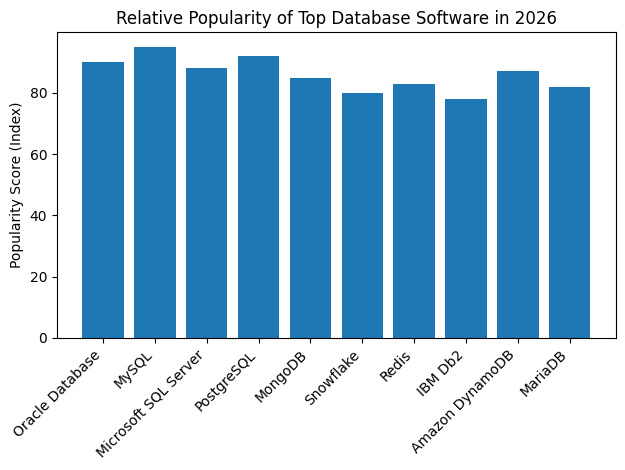
Another defining trend shaping database adoption in 2026 is architectural diversity. Traditional relational databases continue to play a critical role in structured data management, regulatory compliance, and mission-critical transactions. At the same time, NoSQL, distributed, in-memory, and serverless databases dominate use cases that demand extreme scalability, low latency, and high availability across regions. Cloud data warehouses and hybrid transactional-analytical platforms are also becoming mainstream, allowing organizations to consolidate systems and reduce data silos.


Operational efficiency has become just as important as raw performance. Engineering teams are under pressure to deliver faster with leaner resources, making fully managed and serverless database solutions increasingly attractive. Databases that automate scaling, backups, patching, failover, and security controls reduce operational risk and free teams to focus on product development rather than infrastructure management. In many cases, total cost of ownership in 2026 is driven more by operational simplicity and reduced downtime than by licensing fees alone.
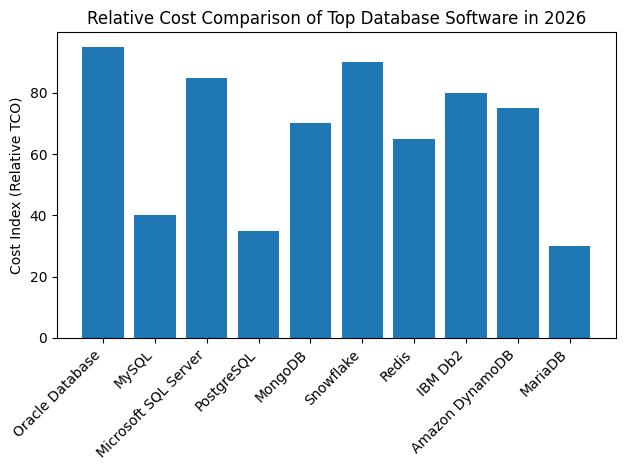
Cost transparency and vendor independence are also key considerations. Open-source and open-core databases continue to gain adoption as businesses seek flexibility, predictable spending, and freedom from restrictive licensing models. At the same time, enterprise and cloud-native platforms justify their pricing through advanced security, compliance readiness, global availability, and deep ecosystem integrations. Successful database strategies increasingly combine multiple technologies, selecting the right database for each workload rather than relying on a single solution.
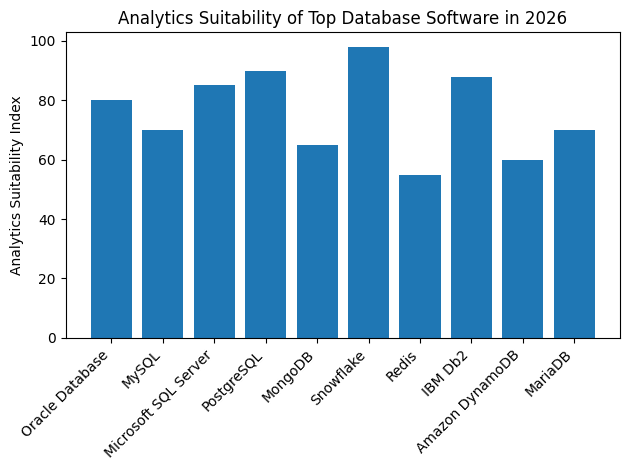
Security, resilience, and compliance expectations have reached a new baseline. With stricter regulations, rising cyber threats, and growing data sensitivity, databases in 2026 must provide strong encryption, fine-grained access control, auditing, and built-in disaster recovery. High availability and multi-region deployment are no longer optional features but essential requirements for business continuity and customer trust.
Artificial intelligence is now a major force shaping database evolution. Vector databases, AI-assisted query optimization, real-time data pipelines, and hybrid AI-transactional workloads are becoming standard capabilities. Databases that can support AI workloads natively, without forcing complex external integrations, are gaining a clear competitive advantage. This shift is redefining what it means to be a “modern” database in 2026.
This guide to the Top 10 Best Database Software To Try in 2026 is designed to help businesses, developers, architects, and decision-makers navigate this complex and rapidly evolving landscape. It examines leading database platforms across relational, NoSQL, cloud-native, and specialized categories, highlighting their strengths, trade-offs, and ideal use cases. Rather than promoting a one-size-fits-all solution, this list focuses on practical relevance, real-world adoption, and future readiness.
Whether you are modernizing legacy systems, building cloud-native applications, scaling globally, or preparing for AI-driven workloads, understanding the capabilities of today’s top database software is essential. The databases covered in this article represent the most influential and forward-looking technologies shaping data management in 2026, offering a strong foundation for performance, resilience, and long-term growth in an increasingly data-centric world.
Before we venture further into this article, we would like to share who we are and what we do.
About 9cv9
9cv9 is a business tech startup based in Singapore and Asia, with a strong presence all over the world.
With over nine years of startup and business experience, and being highly involved in connecting with thousands of companies and startups, the 9cv9 team has listed some important learning points in this overview of the Top 10 Best Database Software To Try in 2026.
If you like to get your company listed in our top B2B software reviews, check out our world-class 9cv9 Media and PR service and pricing plans here.
Top 10 Best Database Software To Try in 2026
- Oracle Database
- MySQL
- Microsoft SQL Server
- PostgreSQL
- MongoDB
- Snowflake
- Redis
- IBM Db2
- Amazon DynamoDB
- MariaDB
1. Oracle Database
Oracle Database follows a commercial licensing structure that is designed primarily for enterprises running large, mission-critical systems. This pricing approach reflects its position as a premium database platform rather than a cost-focused solution.
Oracle offers multiple editions to match different organisational sizes and workloads. The Enterprise Edition is built for complex, high-scale environments and includes advanced security, performance optimisation, and high-availability features. The Standard Edition 2 targets smaller deployments with fewer infrastructure demands, while the Express Edition is available at no cost for development, testing, or lightweight use cases with strict technical limits.
What differentiates Oracle is not just the upfront licence fee, but the long-term financial commitment required to operate it effectively. Annual support contracts, optional management packs, and enterprise hardware integrations significantly increase overall ownership costs. As server core counts rise, licensing costs also scale upward, making hardware choices a direct financial decision rather than a purely technical one.
Pricing and Cost Structure Overview
Edition Type | Intended Use Case | Licensing Basis | Typical Cost Level
Enterprise Edition | Large enterprises, mission-critical systems | Per processor core or named user | Very High
Standard Edition 2 | Small to mid-sized deployments | Per socket or named user | Medium
Express Edition | Development and testing | Free with limitations | Low
When total cost is evaluated over several years, Oracle clearly positions itself as a long-term investment rather than a budget solution. For large enterprises that require guaranteed uptime, regulatory compliance, and predictable performance at scale, this cost is often justified. However, for organisations prioritising flexibility and low operating expenses, the financial barrier can be substantial.
Cost Comparison Matrix Over Three Years
Database Platform | Licensing Cost | Support and Maintenance | Estimated Three-Year TCO
Oracle Database Enterprise Edition | Very High | Very High | Extremely High
Commercial Cloud-Managed Oracle | High | High | Very High
Open-Source Relational Databases | Low | Low to Medium | Low
This pricing reality explains why Oracle remains dominant in industries such as banking, telecommunications, and government, where reliability and compliance outweigh cost sensitivity.
User Reviews and Market Sentiment
Enterprise users consistently rate Oracle Database highly for its technical capabilities, stability, and security posture. Independent review platforms reflect strong overall satisfaction among experienced database teams.
Gartner users rate Oracle Database at approximately 4.5 out of 5, indicating strong confidence among enterprise decision-makers. TrustRadius as AWS RDS for Oracle allow enterprises to run Oracle workloads in cloud environments while maintaining familiar tooling and performance characteristics. This strategy strengthens Oracle’s presence even in organisations that prefer multi-cloud or hybrid architectures.
Future-Facing Capability Matrix
Focus Area | Strategic Direction
Artificial Intelligence | Native AI and vector search inside the database
Cloud Strategy | Multi-cloud and hybrid deployments
Customer Retention | Long-term support and backward compatibility
Enterprise Hardware | Selective innovation aligned with real-world workloads
Overall Positioning for 2026
Oracle Database stands out in 2026 as a premium, enterprise-grade database platform built for organisations that cannot compromise on performance, security, or reliability. Its pricing and operational complexity limit its appeal for smaller teams, but for enterprises managing critical data at scale, Oracle continues to justify its position among the top database solutions in the market.
2. MySQL
MySQL is widely recognised as one of the most trusted and commonly used relational database systems in the world. By 2026, it continues to dominate the web application and cloud-native database space, especially among startups, digital platforms, and fast-growing online businesses. Its open-source foundation, combined with decades of maturity, has made it a default database choice for millions of applications globally.
According to industry benchmarks from DB-Engines, MySQL consistently ranks at the very top among open-source databases and remains one of the most deployed relational databases overall. Its massive adoption base reflects long-term stability, predictable performance, and strong ecosystem support. MySQL is especially valued in environments where rapid development, low infrastructure cost, and reliable performance for web traffic are critical success factors.
While MySQL is sometimes described as less suitable for highly complex enterprise analytics, this perception does not weaken its strategic position. Instead, it highlights MySQL’s clear focus on speed, simplicity, and efficiency for real-world production workloads such as content platforms, SaaS products, e-commerce systems, and high-traffic websites. For these use cases, MySQL delivers an optimal balance between performance and operational simplicity.
Performance Characteristics and Scalability Strengths
MySQL is designed to deliver fast response times and consistent throughput, particularly for read-heavy workloads common in modern web services. It is capable of handling tens of thousands of transactions per second when properly tuned, even with thousands of concurrent user connections. For most production applications, database response times of under 10 milliseconds are easily achievable, ensuring smooth user experiences and fast page loads.
MySQL performs efficiently on modest hardware and scales well vertically up to several dozen CPU cores. Beyond that point, performance gains become more incremental, which is expected for a system optimised for transactional workloads rather than analytical processing. Horizontal scalability is supported through clustering, replication, and sharding strategies, making MySQL suitable for large-scale deployments when designed correctly.
Performance Comparison Snapshot
Workload Type | MySQL Performance Profile | Best Use Case Fit
Read-heavy transactions | Excellent | Web apps, CMS, SaaS platforms
Simple write operations | Strong | User activity, logging systems
Complex analytical queries | Moderate | Not primary focus
High concurrency | Strong with tuning | Large user-facing systems
This performance profile explains why MySQL remains a preferred choice for applications where speed, predictability, and low latency matter more than advanced analytical features.
Security Capabilities and Reliability Outlook
MySQL offers a mature and continuously evolving security framework. Core security features include encrypted data at rest, SSL and TLS encryption for data in transit, role-based access controls, and advanced authentication plugins. Enterprise editions further enhance auditing and compliance capabilities, making MySQL suitable for regulated industries when configured correctly.
Modern MySQL deployments increasingly adopt AI-driven anomaly detection, zero-trust access models, and automated security audits. These practices significantly reduce the risk of breaches and unauthorised access. The existence of hardened configurations and government-grade security guidelines further reinforces MySQL’s credibility for sensitive workloads.
At the same time, MySQL’s open-source nature means security maintenance is a shared responsibility. Periodic vulnerabilities have reinforced the importance of timely patching, regular updates, and proactive monitoring. Organisations that follow best practices consistently achieve high availability and long-term stability, especially when using managed cloud services.
Reliability and Availability Indicators
Deployment Model | Typical Availability Level | Operational Risk
Self-managed on-premises | High with skilled DBA | Medium
Managed cloud services | Very high | Low
High-availability clusters | Extremely high | Very low
Pricing Structure and Total Cost of Ownership Advantages
MySQL’s pricing model is one of its strongest competitive advantages. The Community Edition is completely free, allowing organisations to build, deploy, and scale applications without licensing fees. This makes MySQL especially attractive for startups, developers, and cost-sensitive projects.
For organisations requiring enterprise-grade support, advanced security features, or contractual guarantees, paid editions are available under a subscription model. These subscriptions are typically priced per server rather than per core or per user, keeping costs predictable as hardware scales.
Compared with proprietary databases, MySQL delivers a dramatically lower total cost of ownership. Lower infrastructure requirements, broad talent availability, and flexible deployment options significantly reduce both capital and operational expenses. Over multi-year periods, this cost efficiency becomes a decisive factor for many businesses.
Three-Year Cost Comparison Matrix
Database Type | Licensing Cost | Operational Cost | Overall TCO
MySQL Community | None | Low | Very Low
MySQL Enterprise | Moderate | Low to Medium | Low
Proprietary Enterprise Databases | Very High | Very High | Extremely High
Cloud deployment further strengthens MySQL’s cost advantage. Affordable managed offerings across AWS, Google Cloud, and Microsoft Azure allow businesses to scale globally without large upfront investments.
User Feedback and Community Confidence
MySQL consistently receives strong ratings across major software review platforms, reflecting high satisfaction among its core user base. Developers and engineering teams frequently highlight its ease of use, predictable behaviour, and long-term stability.
Positive feedback commonly focuses on fast performance for structured data, minimal learning curve, strong documentation, and a massive global community. These factors make MySQL easy to adopt, easy to hire for, and easy to maintain over time.
At the same time, user feedback remains balanced. Some teams note limitations when dealing with extremely large datasets, complex analytics, or advanced data types. These concerns reinforce the importance of matching MySQL to the right workload rather than viewing it as a universal solution.
User Sentiment Summary
Aspect | General User Opinion
Ease of use | Very strong
Stability and uptime | Excellent
Cost efficiency | Outstanding
Advanced analytics | Limited
Enterprise complexity handling | Moderate
Product Evolution and Roadmap Direction for 2025–2026
MySQL’s development roadmap shows a clear focus on closing historical gaps while strengthening its core strengths. Upcoming versions prioritise better parallel query execution, improved replication, enhanced recovery mechanisms, and deeper cloud-native integration.
Innovation releases introduce performance improvements and operational tooling, while long-term support releases ensure stability for production systems. This dual-track strategy allows organisations to choose between cutting-edge features and long-term reliability based on their risk tolerance.
Cloud providers are also heavily investing in MySQL as a managed service. Enhancements such as faster write performance, reduced maintenance downtime, improved migration tooling, and tighter integration with serverless and event-driven architectures are making managed MySQL deployments more powerful and enterprise-ready than ever before.
Future Capability Expansion Overview
Focus Area | Direction of Improvement
Performance | Parallelism and optimisation
Replication | Faster and more resilient
Cloud operations | Reduced downtime and automation
Enterprise readiness | Gradual but consistent improvement
Why MySQL Remains a Top Database Choice in 2026
MySQL earns its place among the top database software options in 2026 by delivering a rare combination of reliability, affordability, and real-world performance. It may not aim to solve every database problem, but for web-scale, cloud-first, and cost-conscious applications, it remains one of the smartest and safest technology choices available.
3. Microsoft SQL Server
Microsoft SQL Server is widely regarded as one of the most trusted relational database platforms for organisations that run on Microsoft technologies or operate in hybrid environments. By 2026, it remains a top-tier choice because it combines classic relational strengths with modern multi-model support, allowing teams to manage structured SQL data alongside semi-structured JSON and spatial data in one platform.
SQL Server’s continued popularity is strongly linked to how smoothly it fits into the broader Microsoft ecosystem. Many organisations choose it because it connects naturally with Microsoft’s developer tooling, identity stack, analytics products, and cloud services. This “connected platform” advantage reduces integration work, speeds up delivery, and simplifies governance. Even though licensing can be expensive and sometimes confusing, adoption remains strong because SQL Server often reduces overall complexity for Microsoft-first companies.
Where SQL Server fits best in 2026
Common environment fit | Why it remains a strong match
Microsoft-centric organisations | Tight integration, consistent admin experience, unified tooling
Hybrid cloud deployments | Flexible on-prem and cloud operation, modern management options
Data-heavy line-of-business systems | Mature transactional engine, governance controls
BI and analytics pipelines | Strong compatibility with Microsoft analytics workflows
Performance and Scalability Strengths
SQL Server continues to focus on enterprise performance, especially for high concurrency workloads where many users and services query the database at the same time. SQL Server 2025-era improvements place extra emphasis on smarter query planning and more efficient concurrency handling. In practical terms, this means fewer slowdowns during peak usage, better stability under heavy demand, and less tuning required for many common performance issues.
The platform also scales to very large data volumes and substantial compute footprints. Enterprise deployments can grow into extremely large database sizes, and the engine can use a high number of CPU cores effectively. For organisations that need more than a single-server design, SQL Server supports high-availability groups and patterns that enable scale-out strategies, including sharding and distributed designs.
Scalability snapshot
Scaling dimension | What SQL Server supports well | What it enables in real life
Vertical scaling (bigger servers) | High CPU core usage and large memory footprints | Consolidation of workloads, fewer servers to manage
Large database sizes | Enterprise-grade limits designed for extreme growth | Long-lived systems that keep expanding without platform changes
High concurrency | Improved locking and query processing features | More simultaneous users, fewer blocking issues
Horizontal patterns | HA groups and distributed architectures | Resilient systems and larger footprints when needed
Text chart: Where SQL Server typically shines (relative strength)
Area | Strength
High concurrency OLTP | ██████████
Governance and administration | ██████████
Hybrid operations | ██████████
Complex analytics inside engine | ████████░░
Simple low-cost deployments | ████░░░░░░
Security and Reliability for Enterprise Workloads
SQL Server’s security posture is one of the main reasons it stays in “top database” lists for 2026. It offers layered security controls that cover encryption, access restrictions, auditing, and identity integration. This makes it suitable for environments with strict compliance requirements, including finance, healthcare, and regulated enterprise IT.
Key security capabilities include database-level encryption, application-layer protection for sensitive fields, masking of confidential values for non-privileged users, and fine-grained access rules that can restrict which rows a user is allowed to see. Authentication options are also broad, with strong support for Microsoft identity management and modern security approaches that reduce credential sprawl.
Security capability matrix
Security need | SQL Server capability | Practical benefit
Encrypt the database at rest | Transparent encryption options | Protects files and backups if storage is exposed
Protect sensitive columns | Application-layer encryption options | Reduces risk of insider access and data leakage
Hide sensitive values from staff | Data masking | Limits exposure during support and reporting
Restrict access by role and data row | Row-level controls | Enables secure multi-tenant and departmental use
Track and prove compliance | Auditing and assessment tooling | Faster investigations and stronger governance
Reliability is also a core strength. High availability features help organisations maintain uptime and recover quickly during incidents. In hybrid designs, many teams also combine availability groups with cloud-based operational tooling to improve monitoring and operational resilience.
Pricing and Total Cost of Ownership Considerations
SQL Server is a commercial database with multiple editions and licensing paths, and this is where many buyers spend the most time evaluating fit. In 2026, the platform can be cost-effective in some scenarios, but expensive in others, depending on user count, server size, and whether the organisation needs Enterprise features.
Two common licensing approaches dominate:
Core-based licensing, typically chosen for larger or unpredictable user counts, especially in Enterprise deployments.
Server plus CAL licensing, often preferred for smaller organisations with a known and stable number of users.
SQL Server also offers free editions for development and lightweight workloads, which keeps the entry barrier low for prototyping and internal tools.
Licensing model comparison
Model | Best for | Cost predictability | Main trade-off
Core-based | Large systems, unknown user counts | Medium | Higher cost as cores increase
Server + CAL | Smaller teams with fixed users | High | Can become costly as user count grows
Free editions | Dev, test, small apps | Very high | Not suitable for full production at scale
TCO decisions usually come down to this question: does SQL Server reduce enough integration, admin overhead, and risk to justify the licence spend? For Microsoft-first organisations, the answer is often yes, because the ecosystem fit can reduce tooling sprawl, training time, and operational fragmentation.
User Reviews and Real-World Sentiment
User feedback consistently places SQL Server among the highest-rated databases in enterprise environments. Reviews commonly highlight three themes:
It is easy to work with for teams already familiar with Microsoft tools.
It stays stable under heavy workloads and long-running production use.
It integrates smoothly with Microsoft development and analytics workflows.
Users also appreciate the broad platform support, including Linux and container-based environments, which has expanded SQL Server’s relevance beyond traditional Windows-only deployments.
Common praise versus common concerns
Theme | What users like | What users dislike
Usability | Familiar tooling and strong admin experience | Some features add complexity in advanced setups
Performance | Strong throughput for enterprise workloads | High resource needs for large datasets
Integration | Excellent Microsoft ecosystem compatibility | Lock-in concerns for non-Microsoft stacks
Cost | Clear value for integrated environments | Licensing can be expensive and complex
This review pattern explains why SQL Server remains a top recommendation for 2026: it is often chosen not only for database features, but for the full operational and development experience that comes with it.
Latest Updates and Roadmap Direction for 2025–2026
SQL Server’s direction for 2026 strongly reflects two market shifts: AI-enabled applications and unified analytics workflows. Newer releases emphasise capabilities that help teams build AI-driven features closer to the database layer, including vector-related functionality and tooling that supports embedding and chunking patterns used in modern search and retrieval workflows.
At the same time, Microsoft’s platform strategy increasingly connects SQL Server to broader analytics experiences. The goal is to reduce heavy ETL workloads and enable more real-time analytics patterns by integrating SQL Server with Microsoft’s data and analytics stack. For organisations that already use Microsoft’s analytics products, this can shorten time-to-insight and reduce duplicated data pipelines.
Roadmap impact matrix
Roadmap theme | What it adds | Why it matters in 2026
AI readiness | Vector capabilities and AI-supporting functions | Enables modern semantic search and AI features
Developer productivity | JSON improvements, APIs, richer functions | Faster app development with fewer workarounds
Operational efficiency | Better backup compression and admin tooling | Lower storage cost, simpler operations
Unified analytics strategy | Tighter connection to Microsoft analytics stack | Less ETL, faster reporting, stronger governance
Why SQL Server is One of the Top Database Software Options to Try in 2026
Microsoft SQL Server earns its place among the top database platforms in 2026 because it delivers a complete enterprise-ready package: strong performance under concurrency, mature security controls, high availability options, and an ecosystem advantage that can materially reduce delivery and operating friction.
It is especially compelling for organisations that are already invested in Microsoft technologies, want a reliable database for mission-critical systems, and need a platform that is evolving toward AI-enabled workloads without abandoning enterprise stability. The licensing cost is real and must be planned carefully, but for many companies, the combined value of integration, governance, and predictable performance makes SQL Server a strategic long-term choice.
4. PostgreSQL
PostgreSQL is widely viewed as one of the strongest open-source relational databases available, and it continues to grow in adoption going into 2026. It is not only a relational database, but also an object-relational system, which means it supports advanced data types, rich indexing options, and extension-based customisation that many teams rely on for modern applications.
PostgreSQL is often selected when organisations want an open-source database that can handle demanding workloads without sacrificing standards, reliability, or flexibility. It is commonly adopted for data-heavy products, SaaS platforms, gaming services, and any environment where complex queries, analytics-style operations, and strict data integrity matter.
A key reason PostgreSQL ranks among the top database options for 2026 is extensibility. Instead of forcing teams into a one-size-fits-all feature set, PostgreSQL can be adapted using extensions for spatial data, time-series, vector search, and other specialised needs. This makes it highly relevant for modern requirements, including AI search, embeddings, and hybrid transactional-analytical usage patterns.
Where PostgreSQL fits best
Use case category | Why PostgreSQL is a strong choice
Modern web and SaaS backends | Strong correctness, strong concurrency, predictable performance
Data-heavy systems | Handles complex joins, aggregations, and advanced indexing well
Analytics inside operational systems | Performs well on complex queries compared with many alternatives
AI search and vector-ready apps | Growing ecosystem for vectors, similarity search, and related tooling
Industry-standard compliance needs | Strong adherence to SQL standards and integrity constraints
Performance and Scalability Strengths
PostgreSQL is widely recognised for strong performance under concurrent usage, especially when applications run many transactions and queries at once. It has a concurrency model designed to reduce blocking and maintain consistent user experience, which is critical for production systems with many active sessions.
In practical benchmarks reported in the provided material, PostgreSQL has been shown to exceed 20,000 transactions per second and maintain low latency even as concurrency increases. This matters because fast average speed is not enough in production; consistent performance at high load is what keeps applications stable during traffic spikes.
PostgreSQL is also known for being stronger on complex query workloads than many entry-level relational alternatives. This includes scenarios with advanced joins, heavy aggregation, and mixed transactional plus analytical patterns.
Performance profile snapshot
Workload type | Typical PostgreSQL strength | What that means for real applications
High-concurrency transactions | Very strong | Better stability when many users are active
Complex queries and joins | Strong | Faster dashboards, reporting, and data-heavy features
Mixed read/write workloads | Strong | Suitable for real-world app traffic patterns
Very large horizontal scale | Depends on architecture | Often uses proven patterns and tools for clustering
Text chart: Relative performance fit by workload
High-concurrency OLTP | ██████████
Complex SQL queries | ██████████
Operational analytics | █████████░
Simple read-heavy CRUD | ████████░░
Built-in native clustering | █████░░░░░
Security and Reliability Posture
PostgreSQL is considered a reliable choice for sensitive data because it offers granular access control, strong authentication options, and encryption support. It can restrict data access at a detailed level using policies that control what rows a user can read or modify, which is highly useful for multi-tenant SaaS platforms and regulated environments.
For data in transit, PostgreSQL supports encrypted connections. For data protection at rest, teams commonly use encryption at the storage layer and, when needed, additional encryption functions and extensions for field-level protection.
A major advantage is its transparent, community-driven security model. The codebase is widely reviewed, vulnerabilities are disclosed, and fixes are delivered regularly. Frequent maintenance releases help organisations stay current with patches without waiting for infrequent “big vendor” cycles.
Security and governance matrix
Security need | PostgreSQL capability | Practical benefit
Least-privilege access | Role-based permissions | Reduces accidental exposure and insider risk
Fine-grained data protection | Row-level rules | Strong multi-tenant and departmental controls
Encrypted traffic | SSL/TLS support | Protects data over networks
Field-level encryption options | Encryption extensions and patterns | Protects sensitive columns when required
Regular patch cadence | Frequent maintenance releases | Faster response to bugs and security issues
Reliability and uptime are also strong. PostgreSQL is widely deployed in production for long-running systems, and cloud providers commonly offer high-availability options with service commitments when standby configurations are enabled.
Pricing and Total Cost of Ownership Advantages
One of PostgreSQL’s biggest reasons for being a top database to try in 2026 is simple: there are no licensing fees. The PostgreSQL License allows free use in commercial and internal products without forcing organisations into per-core, per-user, or feature add-on pricing models.
This changes budgeting. Instead of spending heavily on database licences, teams can invest in better infrastructure, professional support, monitoring, or developer productivity. The financial model also scales cleanly: as usage grows, costs increase mainly due to infrastructure and operations, not because the software becomes more expensive.
Total cost drivers comparison
Cost category | PostgreSQL impact | Why it matters
Licensing fees | None | Eliminates a major enterprise cost line
Feature access | Included by default | No premium gates for “enterprise-only” basics
Scaling costs | Mainly infra + ops | More predictable long-term planning
Support options | Flexible | Community support or paid vendors, depending on needs
Hiring and skills | Usually accessible | Many engineers learn it and the ecosystem is mature
Cloud options further strengthen the cost advantage, because PostgreSQL is supported across major providers and many specialist platforms, with pricing tiers ranging from entry-level to high-performance production clusters.
User Reviews and Community Sentiment
PostgreSQL consistently scores highly in user satisfaction because it combines enterprise-grade capabilities with open-source freedom. Users commonly highlight that it is feature-rich, dependable, and capable of handling demanding workloads without forcing lock-in.
Another major advantage is the community. PostgreSQL has a deep ecosystem of documentation, extensions, tools, and forums. For teams that value long-term maintainability, this reduces the risk of being stuck with a platform that is hard to support or hard to hire for.
Commonly reported strengths and trade-offs
Area | What users typically like | What users typically find challenging
Core database features | Mature, powerful, standards-driven | Requires learning for best practices
Performance | Excellent for complex queries and concurrency | Needs tuning at high scale
Reliability | Strong stability in long-running production | Architecture choices matter for extreme growth
Ecosystem | Huge extension and tooling ecosystem | Quality varies across third-party tools
User experience | Strong with the right tools | GUI experiences can feel less polished than some vendors
Latest Updates and Roadmap Direction for 2025–2026
PostgreSQL’s roadmap is shaped by continuous improvement rather than occasional major shifts. Regular minor releases deliver security fixes and stability improvements, while major releases add performance upgrades and features that follow real-world demands.
For 2025–2026, one of the most important trends is how quickly PostgreSQL has moved into AI-adjacent database capabilities. Vector search has become a major focus across the database market, and PostgreSQL’s extension ecosystem has positioned it as a serious option for semantic search, embeddings, and AI-powered retrieval patterns, without forcing teams to abandon relational design.
Cloud-managed PostgreSQL offerings are also advancing quickly, with more automation, better performance tuning, stronger backup capabilities, and improved security integrations. This is important for 2026 because many teams want PostgreSQL’s flexibility without the operational burden of full self-management.
Roadmap impact matrix for modern teams
Focus area | What is improving | Why it matters in 2026
AI and vector readiness | Better vector indexing and extensions | Supports semantic search and AI-native features
Performance | Ongoing query and storage improvements | Faster apps and more stable peak-load behaviour
Cloud operations | More automation and resilience features | Less DBA overhead, better uptime
Security | Stronger key management patterns and integrations | Better governance for regulated industries
Ecosystem innovation | Rapid extension development | PostgreSQL adapts to new requirements quickly
Why PostgreSQL Is One of the Top 10 Database Software to Try in 2026
PostgreSQL earns its place among the top database options for 2026 because it delivers enterprise-grade capability without enterprise licensing constraints. It is powerful enough for demanding transactional systems, strong enough for complex SQL and analytics-style workloads, and flexible enough to evolve with modern requirements such as vector search and AI-driven features.
It is especially compelling for teams that want control, transparency, and predictable long-term cost. The main trade-off is that high-scale success often requires solid architecture and capable operational practices, but for many organisations, that investment still costs far less than proprietary licensing while delivering equal or better capability for key workloads.
5. MongoDB
MongoDB is widely recognised as the leading document-oriented NoSQL database and remains one of the most popular choices for modern application development going into 2026. It was built for flexible data storage, where applications evolve quickly and data structures change often. This design makes it highly attractive for product teams that ship new features frequently, integrate many APIs, and store semi-structured information such as user profiles, content objects, events, logs, and device data.
MongoDB’s market leadership in NoSQL is driven by a clear value proposition: it stores data as documents, which aligns closely with how many developers build applications using objects and JSON-like structures. This reduces friction between the application layer and the database layer, speeds up development cycles, and simplifies iteration when data requirements change.
Where MongoDB fits best
Use case type | Why MongoDB is a strong match | Typical examples
Rapidly changing product data | Flexible document model reduces schema constraints | Content platforms, marketplaces, SaaS apps
Large distributed workloads | Horizontal scaling built into common patterns | Global user apps, high-traffic services
High-volume event data | Efficient ingestion and time-series support | IoT telemetry, clickstream tracking
Multi-cloud cloud-native apps | Managed service options and portability patterns | Startups scaling across regions
Developer-driven systems | Strong documentation and developer tooling | Product-led engineering teams
Core Performance and Scalability Strengths
MongoDB is designed to scale horizontally and remain available even when workloads grow quickly. It supports sharding, which spreads data across multiple servers so applications can handle large datasets and high traffic without relying only on bigger hardware. This matters for 2026 because many systems are built for global usage, unpredictable traffic patterns, and continuous data growth.
MongoDB’s performance strengths typically appear when the application model benefits from document reads and writes that avoid heavy joins. When data is stored in a way that matches the document model, MongoDB can serve application requests efficiently and scale out with well-established operational patterns.
At the same time, MongoDB’s raw performance for strict ACID transactional workloads can require more careful design. Transaction-heavy systems with complex relational behaviour may find it harder to match the throughput and latency of top relational engines unless the application is modelled to reduce cross-document joins and locking pressure.
Performance fit snapshot
Workload type | MongoDB typical strength | What it means in practice
Document reads and writes | Very strong | Fast iteration and high throughput for app data
Horizontal scale-out | Excellent | Handles growth by adding nodes
Time-series data | Strong and improving | Better performance for telemetry and event logs
Relational-style joins | Limited compared to RDBMS | Encourages denormalisation and embedding
High TPS strict ACID workloads | Depends on design | Needs careful modelling to avoid bottlenecks
Text chart: Best-fit strength by workload
Document-centric app data | ██████████
Horizontal scaling | ██████████
Time-series ingestion | █████████░
Complex relational joins | ████░░░░░░
Strict high-volume ACID OLTP | █████░░░░░
Key Operational Metrics to Track for Performance
MongoDB performs best when it is monitored and tuned using workload-specific signals. Teams typically track query execution efficiency, index effectiveness, connection counts, lock behaviour, and resource usage.
Operational monitoring checklist
Metric category | What to watch | Why it matters
Operations per second | Read/write rate trends | Detects scaling pressure early
Query execution time | Median and tail latency | Shows user-facing performance stability
Index efficiency | Scanned vs returned documents | Identifies slow queries and missing indexes
Connections | Connection growth and saturation | Prevents overload during traffic spikes
Lock behaviour | Lock time and contention | Helps reduce transaction slowdowns
CPU and memory | Utilisation and spikes | MongoDB often benefits from memory for working sets
Disk I/O | Latency and IOPS | Storage bottlenecks often drive slowdown
Security and Reliability Posture
MongoDB provides a broad set of security controls that suit enterprise requirements, especially when deployed through its managed cloud environment. Core security capabilities typically include strong authentication options, fine-grained authorisation via role-based controls, auditing for sensitive actions, and encryption for data in transit and at rest.
Cloud deployments commonly strengthen security further through private networking options, controlled access lists, isolated environments, and multi-region placement. This supports data sovereignty requirements and helps organisations keep data close to users while maintaining governance.
A realistic security view also recognises that vulnerabilities can occur in supporting tools as well as the database itself. Keeping client utilities, drivers, and management interfaces updated is part of maintaining strong security hygiene.
Security capability matrix
Security requirement | MongoDB capability | Practical benefit
Identity and access control | Role-based controls and identity integration | Limits unauthorised actions
Auditing | Detailed event tracking | Supports compliance and investigations
Encryption | In transit and at rest options | Protects confidentiality across storage and networks
Network isolation | Private endpoints and controlled access | Reduces exposure to public internet risks
Multi-region support | Region selection and location-aware patterns | Helps meet sovereignty and latency needs
Reliability is a major selling point. Managed deployments commonly offer very high uptime commitments, and replication patterns support continued availability during infrastructure failures.
Pricing Structure and Total Cost of Ownership Considerations
MongoDB is commonly positioned as a flexible choice in pricing because it supports both self-managed deployment and managed tiers that scale from small development environments to large enterprise clusters. This tiering makes it easy for teams to start small and expand as production usage grows.
In managed environments, costs are typically driven by cluster sizing, storage, network transfer, backup needs, and support levels. MongoDB also offers serverless-style pricing for variable workloads, which can be attractive for applications that do not have steady traffic and want automatic scaling without fixed capacity planning.
TCO for MongoDB should be evaluated beyond licence cost alone. Real costs include operational effort, training time, performance tuning, index strategy, and architecture decisions. When used for the right use cases, MongoDB often reduces development time and simplifies iteration, which can lower overall cost by improving speed to market.
TCO evaluation matrix
Cost driver | MongoDB impact | How teams reduce cost
Cluster sizing | Can scale up quickly | Right-size based on monitoring, avoid overprovisioning
Indexes | Can become complex | Use workload-based index strategy, remove unused indexes
Storage format overhead | Can grow with large documents | Keep documents lean, avoid duplication where not needed
Network transfer | Can add cost in cloud | Use region-aware placement and efficient query patterns
Operational overhead | Lower in managed setups | Use managed services for backups, scaling, upgrades
User Reviews and Community Sentiment
MongoDB receives strong ratings in the market because it matches how many modern applications are built. Users commonly praise its flexible schema, developer-friendly query language, strong documentation, and proven scaling patterns.
Many teams also value the ecosystem of training and community resources, which reduces adoption friction. This helps organisations onboard engineers faster, develop with confidence, and solve production issues with widely available best practices.
Common praise and common concerns
Theme | What users like | What users need to plan for
Developer speed | Fast iteration with flexible documents | Requires good data modelling discipline
Scalability | Mature sharding patterns | Sharding adds operational complexity at large scale
Availability | Strong replication and managed uptime options | Needs thoughtful deployment design
Indexing | Powerful indexing options | Can be complex and memory-intensive
Relational behaviour | Works differently from SQL | Joins are limited, denormalisation is typical
Document size constraints | Encourages bounded entities | Large objects may require different storage patterns
Product Evolution and Roadmap Direction for 2025–2026
MongoDB’s roadmap direction for 2026 strongly targets three themes: deeper AI enablement, easier performance optimisation, and a broader platform approach that supports both transactional and analytical needs.
One key theme is automation around indexing and aggregation. MongoDB is positioning itself to reduce manual tuning by making the platform smarter about how workloads behave, which directly addresses real-world pain points around index design and performance troubleshooting.
Security strategy is also forward-looking, including work that anticipates future cryptographic threats. In parallel, MongoDB continues to invest in features that support unified analytics and real-time operational insights, reducing the need for separate systems in some architectures.
Roadmap impact matrix
Roadmap theme | What it aims to improve | Why it matters in 2026
AI-assisted optimisation | Smarter indexing and tuning | Reduces operational friction and performance surprises
AI-ready data patterns | Better support for vector-style workflows | Enables modern search and retrieval features
Unified workloads | Analytics and transactions closer together | Reduces latency and system sprawl
Security future-proofing | Stronger encryption direction | Protects long-lived sensitive data
Edge and sync patterns | Better support for distributed apps | Helps low-latency and offline-first experiences
Why MongoDB Is One of the Top 10 Database Software to Try in 2026
MongoDB earns a top spot in 2026 because it delivers what many modern applications need most: flexibility, fast development cycles, and reliable horizontal scaling. It is especially strong for document-centric products, high-growth platforms, event-driven systems, and global applications where data models change frequently.
The main trade-offs are also clear: MongoDB performs best when teams embrace document-first modelling, invest in good indexing discipline, and avoid forcing relational patterns such as heavy joins into a document database. When MongoDB is matched to the right workload and architecture, it can deliver excellent speed, high availability, and a development experience that is difficult for more rigid database systems to match.
6. Snowflake
Snowflake is widely recognised as a modern, cloud-first data warehouse built for large-scale analytics, reporting, and business intelligence. By 2026, it remains one of the most discussed and adopted platforms for organisations that want fast insights from growing data volumes without maintaining complex on-prem infrastructure.
Snowflake’s positioning is clear: it is designed for analytical workloads, not traditional transactional application databases. It excels when teams need to centralise data from many sources, run complex SQL queries at speed, support multiple departments at once, and share governed data across teams or even external partners. Its strong momentum in market rankings is closely tied to how well it fits cloud-native data strategies, especially in organisations that operate across more than one cloud provider.
Why Snowflake stands out in 2026 is its ability to combine enterprise-grade performance with operational simplicity. Many teams choose it because it removes common warehouse pain points such as capacity planning bottlenecks, concurrency slowdowns, and long platform maintenance cycles.
Where Snowflake fits best
Primary need | Why Snowflake is a strong match | Typical examples
Enterprise analytics at scale | Built for heavy SQL and BI workloads | Executive dashboards, KPI reporting
Multi-team data access | Handles many users and workloads concurrently | Finance, marketing, product analytics
Multi-cloud strategy | Runs across major cloud providers | Global enterprises, regulated industries
Data sharing and collaboration | Designed for controlled sharing | Partner data exchange, internal domains
AI-ready analytics foundations | Works well with open formats and modern pipelines | Feature stores, ML analytics datasets
Performance and Scalability for Analytics Workloads
Snowflake is engineered to perform well under large analytic workloads and high user concurrency. Its defining architectural advantage is the separation of compute from storage. This matters because organisations can scale query performance (compute) without having to copy or reorganise the underlying data (storage). It also means different teams can run workloads in parallel without constantly fighting for shared compute resources.
Snowflake uses “virtual warehouses” as isolated compute clusters. These can be resized up or down depending on query needs, and multiple warehouses can operate on the same underlying datasets at the same time. This reduces the common analytics problem where a single heavy workload slows everyone else down.
In addition, Snowflake supports serverless capabilities for specific tasks such as ingestion and optimisation services. These features improve performance and operational convenience, but they also introduce cost variables that must be managed with governance and monitoring.
Analytics performance and scaling model
Capability area | How Snowflake delivers | Practical outcome
Compute scaling | Virtual warehouses scale independently | Fast queries without data re-platforming
High concurrency | Separate warehouses per team/workload | Fewer performance conflicts
Elastic workload control | Resize or pause compute | Better cost-to-performance control
Memory-heavy workloads | Specialised warehouse options | Improved performance for complex workloads
Automation services | Serverless ingestion and optimisation | Less manual operations, faster pipelines
Text chart: Snowflake’s relative strength by data workload type
Large BI and reporting workloads | ██████████
Many analysts querying at once | ██████████
Cross-cloud analytics strategy | ██████████
Cost predictability without governance | ████░░░░░░
High-frequency OLTP transactions | ███░░░░░░░
Security, Governance, and Reliability
Snowflake is designed for enterprise environments where governance and compliance are not optional. It provides strong controls for authentication, authorisation, encryption, and auditing. Data is protected in transit with secure connections, and data at rest is encrypted automatically. Many organisations choose Snowflake specifically because it offers a structured security model that is easier to enforce consistently than do-it-yourself warehouse stacks.
Snowflake also supports advanced controls that help organisations manage sensitive data responsibly, including granular access control and policy-based protections that can restrict access at the row or column level. This is particularly useful when multiple departments share the same platform or when data contains regulated information.
For reliability and continuity, Snowflake provides mechanisms for recovering historical data and supports replication and failover patterns across regions and clouds. These capabilities make Snowflake suitable for mission-critical analytics where downtime or data loss can disrupt decision-making and operations.
Security and governance capability matrix
Governance requirement | Snowflake capability | Business value
Secure authentication | MFA and federated identity options | Reduced account takeover risk
Access control | Object-level permissions | Clear least-privilege enforcement
Sensitive data protection | Column and row policy controls | Better compliance for regulated data
Data classification | Tagging and metadata governance | Faster audits and better stewardship
Encryption by default | Automatic encryption at rest and secure transport | Strong baseline security
Recovery and continuity | Historical recovery and replication options | Better resilience against incidents
Pricing Model and Total Cost of Ownership Reality
Snowflake uses a consumption-based pricing model. Costs typically come from three main areas: compute usage, storage usage, and data transfer or specialised services usage. The advantage of this model is flexibility: organisations pay for what they use and can scale up or down as workload needs change. The challenge is predictability: without active governance, costs can rise quickly when large warehouses run continuously or when queries are inefficient.
In many real deployments, compute is the dominant cost driver, and virtual warehouses often represent the majority of the bill. This is why Snowflake cost management typically focuses on workload governance: warehouse sizing, scheduling, auto-suspend rules, query optimisation, and controlling high-cost serverless features.
Snowflake pricing components overview
Cost category | What drives spend | Typical optimisation focus
Compute (virtual warehouses) | Warehouse size and run time | Auto-suspend, right-sizing, workload isolation
Storage | TB stored per month | Data lifecycle policies, pruning, partition strategy
Cloud services usage | Metadata and service operations | Monitor fair-use thresholds and service patterns
Serverless features | Special multipliers and usage | Limit to high-value workloads, monitor consumption
Data transfer | Cross-region or external movement | Keep compute near data, reduce unnecessary egress
Cost control matrix: common behaviours and their impact
Behaviour pattern | Cost impact | Better practice
Warehouses left running 24/7 | High | Auto-suspend and scheduled usage
One shared warehouse for all teams | Medium to high | Separate warehouses by workload
Unoptimised heavy queries | High | Query profiling and optimisation standards
Over-sized warehouses “just in case” | High | Start small, scale based on measured need
Unmonitored serverless usage | Medium to high | Track usage by team and enforce budgets
User Sentiment and Real-World Adoption Signals
Snowflake is generally reviewed positively by teams that run large analytics programmes. Users commonly highlight that it scales smoothly, handles large datasets well, and enables fast SQL-based analysis without needing heavy engineering effort to keep the platform running. It is often described as accessible for analysts, since SQL remains the primary interface for most workflows.
The most consistent concern is cost management. Many users report that Snowflake delivers strong value, but only when organisations adopt strong usage governance. Without guardrails, consumption-based pricing can feel unpredictable, especially when many teams run large queries or operate multiple warehouses continuously.
User sentiment summary
What teams value most | What teams must plan for
Fast analytics at scale | Active cost governance and monitoring
Easy concurrency handling | Query standards and optimisation discipline
Strong security and governance | Clear ownership model for warehouses and budgets
Multi-cloud flexibility | Data movement planning to reduce transfer costs
Latest Updates and Roadmap Direction for 2025–2026
Snowflake’s product direction for 2025–2026 centres on three priorities: making analytics faster, making AI and ML workflows easier, and strengthening governance for trusted data sharing. A key strategic focus is supporting open table formats such as Apache Iceberg, which allows organisations to work with modern data lake architectures while reducing migration friction. This approach is especially relevant for AI development, where teams often want to use open formats and flexible pipelines while still benefiting from warehouse-level performance and governance.
Snowflake is also focusing on smarter optimisation features, including AI-assisted workload improvements, stronger security updates, and expanded governance tooling. These roadmap themes align with what enterprises want in 2026: a platform that supports analytics, AI-ready data practices, and cross-team collaboration without sacrificing compliance.
Roadmap impact matrix
Roadmap theme | What improves | Why it matters in 2026
Open data format support | Easier interoperability with lakehouse patterns | More flexibility for AI and modern pipelines
AI and ML enablement | Better support for AI-driven insights | Faster experimentation and deployment
Performance enhancements | Faster ingestion and query processing | Better user experience for BI at scale
Security upgrades | Stronger protection and compliance readiness | Reduces risk and audit burden
Governed data sharing | Easier collaboration internally and externally | Accelerates value from shared datasets
Why Snowflake Is One of the Top 10 Database Platforms to Try in 2026
Snowflake earns a place among the top database platforms to consider in 2026 because it solves a specific, high-value problem exceptionally well: large-scale analytics in the cloud with strong performance, multi-team concurrency, and enterprise governance. It is ideal for organisations that want to turn growing data into decisions quickly, operate across cloud environments, and support modern AI and advanced analytics initiatives.
The main trade-off is cost variability. Snowflake can become expensive if compute usage is not actively managed, especially when warehouses are oversized or left running. However, organisations that implement clear governance, good query discipline, and workload ownership often find that Snowflake delivers strong return through speed, scalability, and reduced operational burden compared with traditional data warehouse management.
7. Redis
Redis is widely seen as one of the fastest and most practical database platforms for real-time systems. In 2026, it remains a top choice because it is an in-memory, key-value data store that can respond in extremely small time windows. This makes it highly valuable for applications where milliseconds directly affect user experience, conversion rates, ad revenue, fraud detection accuracy, or operational stability.
Redis is often described as “simple by design” but powerful in production. It is commonly deployed as a caching layer, session store, real-time analytics engine, message broker, and coordination layer for distributed systems. Many high-performance architectures treat Redis as essential infrastructure rather than an optional add-on, because it reduces load on primary databases and keeps response times stable during traffic spikes.
Redis is not intended to replace every database type. Its strength is speed and low-latency access for predictable patterns, especially when data can be modelled around key-based lookups and fast in-memory operations.
Where Redis fits best
Workload type | Why Redis is a strong match | Typical examples
Caching | Extremely fast reads and writes | Page caching, API caching, query caching
Session and state management | In-memory access keeps apps responsive | Login sessions, shopping carts, user preferences
Real-time analytics | Fast counters and rolling windows | Live dashboards, rate limiting, clickstream counters
Queues and pub/sub | Lightweight messaging patterns | Background jobs, notifications, event distribution
Distributed coordination | Fast shared state | Locks, leaderboards, feature flags
Performance and Scalability in Real-World Architectures
Redis is widely adopted because its in-memory architecture delivers very high throughput with low latency. For many applications, the performance advantage is not marginal; it can be the difference between stable user experiences and systems that fail under load.
Recent Redis releases emphasise better performance on modern hardware through improvements such as multi-threaded processing, stronger memory management, and faster persistence operations. In parallel, related ecosystem developments demonstrate how in-memory stores can push very high requests-per-second under heavy concurrency, reinforcing Redis’s strategic value for systems that prioritise speed and scale-out patterns.
Redis also scales beyond single-node usage through replication and clustering. Replication supports high availability and read scaling, while Redis Cluster enables distributed storage across many nodes. These patterns allow Redis to support high-traffic production systems without requiring a single large machine.
Performance fit snapshot
Workload type | Redis strength | What it means in production
Key-value reads/writes | Exceptional | Ultra-fast response times for common app operations
High concurrency | Strong with modern improvements | Better throughput during spikes
Distributed caching | Excellent | Offloads primary databases and stabilises latency
Complex querying | Limited by design | Not a replacement for SQL analytics
Persistent transactional storage | Not a primary fit | Requires careful persistence configuration
Text chart: Redis relative strength by workload
Real-time caching and sessions | ██████████
Counters and rate limiting | ██████████
Message and event patterns | █████████░
Search and complex queries | █████░░░░░
Long-term data persistence | ████░░░░░░
Operational Risks and Design Trade-Offs
Redis’s strengths come with clear trade-offs. Because it is in-memory, storing large datasets can become expensive, since memory costs more than disk. Redis also has limited query flexibility compared to relational databases and analytical systems. It performs best when applications are designed around key lookups and well-defined access patterns.
Persistence is optional and must be configured carefully. Redis can persist data to disk using durability mechanisms, but misconfiguration can lead to higher risk during restarts or failures. For many teams, the best practice is to treat Redis as a performance layer and keep the system of record in a primary database, using Redis to accelerate access and absorb load.
Architecture decision matrix
Decision area | Best practice pattern | Why it reduces risk
Data ownership | Keep source of truth elsewhere | Prevents over-reliance on in-memory storage
Cache strategy | Use TTLs and eviction policies | Controls memory usage and cost
Persistence | Enable durability only when needed | Balances speed vs recovery safety
Scaling | Use replication and clustering | Improves uptime and throughput
Observability | Monitor memory, latency, evictions | Prevents surprise outages and cost spikes
Security and Reliability for Production Systems
Redis includes core security controls that support production use, especially when deployed with strong configuration practices. Common security capabilities include access control using user and permission rules, encryption for network traffic using TLS, and support for centralised identity integration patterns such as directory-based user management in enterprise contexts.
In managed Redis services, reliability is often strengthened through built-in high availability designs. These typically use replication across nodes and provide strong uptime commitments, making Redis suitable for mission-critical real-time workloads such as session storage, fraud checks, real-time recommendations, and rate limiting.
Security and governance matrix
Security requirement | Redis capability | Practical value
Access control | User permissions and ACL rules | Limits risky commands and unauthorised access
Encrypted traffic | TLS support | Protects data across internal and external networks
Credential management | Password and session policies | Reduces weak-access exposure
Auditing support | Connection and access visibility | Improves governance and investigations
High availability | Replication-first patterns | Keeps apps running during node failures
Pricing and Total Cost of Ownership Considerations
Redis can be free in its open-source form, but real production cost is usually driven by infrastructure, especially memory. Since Redis is primarily an in-memory database, large working sets can create significant cost pressure, particularly in cloud deployments where high-memory instances are expensive.
Managed Redis offerings provide tiered pricing based on memory capacity, CPU needs, and whether high availability is enabled. High availability typically doubles node count, which increases cost, but it is strongly recommended for production due to the stability benefits.
Redis cost drivers overview
Cost driver | What increases spend | How teams control it
Memory footprint | Large keys, large values, no TTL | Use TTLs, compress payloads, keep keys lean
High availability | Multiple nodes and replicas | Enable only where uptime matters, but most prod needs it
Throughput needs | High CPU and network | Right-size instances and monitor peak usage
Persistence overhead | Durability features enabled | Use persistence selectively and tune settings
Operational tooling | Monitoring and admin features | Prefer managed services for lower ops cost
Value versus cost matrix
Scenario | Redis value level | Typical cost profile
API caching and sessions | Very high | Low to medium
Real-time rate limiting | Very high | Low
Large-scale in-memory analytics | High | Medium to high
Storing massive datasets in RAM | Mixed | High
Replacing a primary database | Low fit | High risk and high cost
User Sentiment and Community Confidence
Redis consistently receives strong user sentiment because it delivers clear, measurable performance gains. Users often report that Redis improves page load speed, stabilises backend services, reduces database strain, and enables real-time features that would be difficult to implement with slower storage systems.
Common user praise includes ease of integration, straightforward data structures, and reliable performance at scale. Typical concerns include limited query flexibility, increasing memory cost at scale, and a desire for more user-friendly administration tools in free deployments.
User sentiment summary
What teams value most | What teams must plan for
Extremely fast access | Memory cost can rise quickly
Simple data structures | Limited support for complex queries
Strong reliability with replication | Persistence requires careful configuration
Powerful real-time patterns | Monitoring and governance must be intentional
Product Evolution and Roadmap Direction for 2025–2026
Redis’s roadmap direction for 2025–2026 focuses on improving throughput on modern multi-core hardware, expanding data structures, and strengthening enterprise-grade operational features. There is also increased focus on search and query improvements through an evolving query engine approach.
A major strategic theme is Redis expanding beyond classic caching use cases into newer areas such as time-series data, JSON-like structures, and vector-style capabilities that can support AI-related workloads. This is important for 2026 because many real-time systems are being combined with semantic search, recommendation engines, and AI-driven experiences.
Roadmap impact matrix
Roadmap theme | What is improving | Why it matters in 2026
Multi-thread performance | Better utilisation of modern CPUs | Higher throughput and improved concurrency
New data structures | JSON, time-series, probabilistic structures | More use cases without changing platforms
Query and search features | Broader retrieval options | Better developer experience and flexibility
Enterprise monitoring | More detailed metrics and safety features | Stronger operations at scale
AI-adjacent capabilities | Vector-style patterns | Supports modern search and recommendation workloads
Why Redis Is One of the Top 10 Database Platforms to Try in 2026
Redis earns a spot among the top database platforms for 2026 because it solves a critical problem better than almost any alternative: ultra-fast, low-latency data access for real-time applications. It is especially valuable as a caching and performance layer that protects primary databases, reduces infrastructure strain, and improves user experience.
Redis is most successful when it is used as a specialised component in a broader architecture. Teams that design around key-based access patterns, apply strong TTL and eviction strategies, and use replication for high availability can achieve major performance improvements with predictable operations. For organisations building modern, high-speed digital products, Redis remains one of the most practical and high-impact database technologies to adopt in 2026.
8. IBM Db2
IBM Db2 is a long-established enterprise database family that combines a proven relational engine with multi-model capabilities. In 2026, it remains a strong choice for organisations that need one platform to manage structured SQL data while also supporting formats such as JSON and XML. This “hybrid” design is especially valuable for enterprises modernising older systems while introducing new digital services that generate semi-structured data.
Db2 is commonly chosen when reliability, predictable performance, and governance are non-negotiable. It is designed to run across on-premises environments, private clouds, and public clouds, making it suitable for hybrid operating models. Db2’s strategic advantage is that it can support both transactional and analytical workloads while keeping a consistent SQL foundation, which reduces fragmentation in data platforms.
Where Db2 fits best in 2026
Enterprise need | Why Db2 aligns well | Typical examples
High-volume transactions | Built for consistent OLTP performance | Banking, billing, order processing
Hybrid data workloads | Relational plus JSON/XML support | Customer platforms, integration hubs
Hybrid cloud operations | Runs across on-prem and cloud | Regulated enterprises, multi-environment IT
Performance efficiency | Strong optimiser and compression options | Large databases with cost control goals
Governance and audit | Strong controls plus add-on data security tools | Compliance-heavy industries
Performance and Scalability Strengths
Db2 is widely recognised for strong performance at enterprise scale, especially for transactional workloads. In comparative testing described in the provided material, Db2 delivered substantially higher throughput than PostgreSQL in a TPC-E style workload, and the gap increased as the database scale grew. This matters in 2026 because many production databases do not stay “small”; they accumulate data, indexes, and concurrent users over years. Db2 is built to stay stable and efficient as complexity rises.
Db2’s performance profile is reinforced by an advanced cost-based optimiser, indexing strategies, efficient storage management, and built-in compression. These capabilities help reduce I/O pressure and keep CPU utilisation more controlled at scale, which is often the difference between a database that “works” and one that performs predictably under stress.
Db2 scaling and performance snapshot
Scaling area | Db2 capability | Practical outcome
Transactional throughput | Strong OLTP optimisation | Faster, steadier user-facing systems
Large-scale growth | Efficient resource usage at scale | Better performance as data grows
High availability scaling | pureScale and HADR patterns | Uptime and scale without major redesign
Storage efficiency | Compression and storage management | Lower storage cost, faster scans
Cloud performance tuning | Low-latency network support in clustered setups | Better stability in cloud-scale designs
Text chart: Relative strength by workload type
High-volume OLTP transactions | ██████████
Hybrid transactional + reporting | █████████░
Very large database scale | █████████░
Simple low-cost small apps | █████░░░░░
Developer-first rapid prototyping | ██████░░░░
Security, Governance, and Reliability Posture
Db2 is built with enterprise security expectations in mind. Core capabilities typically include role-based access control, encryption, and detailed logging that supports audit trails. For many organisations, Db2 becomes even stronger when combined with specialised data protection tooling that focuses on privileged access monitoring, compliance reporting, and vulnerability assessment.
The material provided highlights common enterprise risks such as insider threats and credential misuse, and positions Guardium-style monitoring as a practical way to strengthen controls across hybrid environments. This approach is relevant in 2026 because many incidents are not only technical failures; they are also access, policy, and governance failures.
Security and governance matrix
Security requirement | Db2 capability | Why it matters for 2026 operations
Access control | Role-based permissions | Reduces over-privileged access
Encryption | Data protection options | Supports confidentiality and compliance
Auditing and logging | Detailed activity records | Faster investigations and audit readiness
Privileged monitoring add-ons | Real-time behaviour visibility | Detects misuse earlier
Vulnerability assessment | Configuration and patch risk detection | Reduces preventable incidents
Reliability is a major Db2 strength. High availability designs such as HADR support failover with short disruption windows, and clustered approaches such as pureScale are built for continuous operation. For organisations that run mission-critical systems, these patterns can be decisive, because downtime is often more expensive than licensing.
Reliability and continuity comparison
Deployment approach | What it provides | Best-fit scenario
Single node with backups | Basic recovery | Non-critical internal systems
HADR multi-node | Strong uptime and disaster recovery | Critical production workloads
pureScale clustering | Continuous operation and scale | Always-on enterprise platforms
Pricing and Total Cost of Ownership Considerations
Db2 offers tiered pricing options that can start small and scale up to enterprise needs. A free tier is typically used for evaluation, learning, and development. Production tiers are designed for predictable scaling with clearer operational support levels, including premium support and higher limits in enterprise plans.
Db2 total cost of ownership is often shaped by three factors:
Compute sizing and utilisation management
Storage efficiency (especially compression and archival strategies)
Operational consolidation and platform standardisation
The provided material also points to historical examples where Db2 consolidation and compression reduced operational and storage costs. While those examples are older, the underlying principle still applies in 2026: Db2 can reduce TCO when it is deployed in environments that benefit from consolidation, governance, and compression-driven efficiency.
TCO driver matrix
Cost driver | What increases spend | Cost control approach
Compute sizing | Over-provisioned vCPU | Right-size by utilisation and growth forecasts
Storage growth | Large datasets retained forever | Archival policies and compression
High availability | More nodes and replicas | Use HA where downtime cost is high
Support level | Premium response commitments | Match support tier to business criticality
Operations overhead | Complex administration workflows | Standardised automation and monitoring
User Feedback and Community Sentiment
Db2 generally receives positive feedback for reliability, stability, and performance in enterprise settings. Users commonly highlight that it handles high-transaction environments well, stays stable under heavy load, and supports large data volumes with consistent response times. Security capabilities and cross-platform flexibility are also frequently valued, particularly in organisations that operate across mixed infrastructure.
The most common criticisms are usually about user experience and tooling. Some users perceive the administration experience as more cumbersome than newer competitors, and routine tasks can feel more manual without strong automation. There are also calls for faster delivery of new features and easier skills onboarding for teams that are not already experienced with IBM platforms.
User sentiment summary
What organisations value | What organisations must plan for
Strong performance at scale | DBA skills and operational discipline
High reliability and uptime options | Modern tooling and automation investment
Enterprise security and governance | User experience can feel less streamlined
Hybrid environment support | Training and onboarding for new teams
Latest Updates and Roadmap Direction for 2025–2026
Db2’s direction for 2025–2026 is clearly focused on AI readiness, cloud integration, and stronger security controls. A major roadmap highlight in the provided material is built-in support for vector data types and similarity search. This is important for 2026 because more organisations want to build AI features that rely on embeddings, semantic retrieval, and Retrieval Augmented Generation workflows. Vector support inside the database reduces the need to bolt on separate systems for some AI retrieval patterns, especially when structured business data must be combined with unstructured signals.
The roadmap also highlights:
Enhancements to clustered availability and performance (including low-latency networking support in cloud environments)
More granular security controls and masking approaches that reduce data inference risk
Expanded cloud object storage integration and broader support for lakehouse-style data management, including Apache Iceberg CRUD
Roadmap impact matrix
Roadmap theme | What improves | Why it matters in 2026
Vector data support | Similarity search within SQL workflows | Enables AI retrieval and semantic features
Cloud integration | External storage and archival options | Lower cost and better resilience
Security controls | Stronger masking and TLS visibility | Reduced leakage risk, better compliance
Lakehouse alignment | Apache Iceberg operations | Easier hybrid warehouse + lake patterns
Availability upgrades | Better clustered performance | Higher uptime with modern infrastructure
Why IBM Db2 Is One of the Top 10 Database Software to Try in 2026
IBM Db2 earns its place among the top database platforms for 2026 because it combines enterprise-grade reliability with modern capabilities that match today’s needs. It is particularly compelling for organisations that run mission-critical transactional systems, need strong governance, and want a platform that can evolve toward AI-enabled workloads without abandoning a mature SQL foundation.
Db2 is not always the simplest option for small teams that want quick setup and lightweight administration. However, for enterprises that value stability, performance at scale, hybrid deployment flexibility, and a forward roadmap that includes vectors and data lake alignment, Db2 remains a strong strategic database choice for 2026.
9. Amazon DynamoDB
Amazon DynamoDB is widely regarded as one of the most powerful serverless NoSQL databases available for modern cloud-native applications. By 2026, it continues to stand out because it removes almost all traditional database management tasks, such as server provisioning, patching, scaling, and infrastructure maintenance. This allows engineering teams to focus entirely on application logic and product delivery.
DynamoDB is strategically positioned for extreme scale and predictable performance. It is designed to deliver consistent, single-digit millisecond response times regardless of table size or traffic volume. This makes it a preferred choice for large-scale digital platforms, high-traffic consumer applications, and microservice architectures where reliability and speed are critical.
Its ability to handle trillions of requests daily and massive traffic spikes without manual intervention has made DynamoDB a foundational database for globally distributed systems. The tight integration with the broader AWS ecosystem further strengthens its appeal, especially for serverless and event-driven architectures.
Where DynamoDB fits best
Application need | Why DynamoDB excels | Typical use cases
Massive scale | Automatically scales to extreme request volumes | E-commerce events, gaming backends
Low latency | Consistent single-digit millisecond responses | User profiles, session storage
Serverless architecture | No servers or capacity planning required | Microservices, Lambda-based apps
Event-driven systems | Native stream integration | Real-time analytics, change processing
Global availability | Multi-region active-active support | Worldwide consumer applications
Performance and Scalability Capabilities
DynamoDB is engineered for scale first. Its architecture allows it to expand storage and throughput automatically as demand grows, without performance degradation. This makes it fundamentally different from traditional databases that require manual sharding or capacity planning.
The platform supports both simple key-value access patterns and document-style data, enabling flexible modeling while maintaining predictable performance. For applications requiring transactional guarantees, DynamoDB supports multi-item ACID transactions, allowing developers to perform coordinated reads and writes without sacrificing scalability.
For read-heavy workloads, DynamoDB Accelerator (DAX) adds an in-memory caching layer that can reduce latency even further, pushing response times into the microsecond range. This makes DynamoDB suitable not only for operational data but also for high-speed personalization and recommendation use cases.
Performance feature overview
Capability | What DynamoDB delivers | Business impact
Request throughput | Millions of requests per second | Handles viral traffic without outages
Latency | Single-digit milliseconds | Smooth user experience at scale
Automatic scaling | No manual tuning | Reduced operational risk
In-memory acceleration | Optional microsecond reads | Faster personalization and feeds
Global replication | Multi-region active tables | Low latency for global users
Text chart: DynamoDB workload suitability
High-scale key-value access | ██████████
Event-driven microservices | ██████████
Global user applications | ██████████
Complex relational joins | ███░░░░░░░
Ad-hoc analytics | ████░░░░░░
Security, Data Protection, and Reliability
DynamoDB is built on AWS’s shared responsibility model, where AWS secures the infrastructure and customers control access, data usage, and policies. It includes strong security features that meet enterprise and regulated-industry requirements.
Access to tables is controlled through fine-grained permissions, allowing restrictions down to specific items or attributes when required. All data is encrypted by default at rest and protected in transit using secure connections. For organizations with stricter governance needs, customer-managed encryption keys can be used to maintain full control over key lifecycle and auditing.
Reliability is one of DynamoDB’s strongest advantages. Built-in replication across availability zones ensures resilience within a region, while global tables extend this protection across regions. This allows applications to remain available even during infrastructure failures or regional disruptions.
Security and reliability matrix
Requirement | DynamoDB capability | Operational benefit
Access control | Fine-grained IAM policies | Least-privilege enforcement
Encryption at rest | Enabled by default | No performance trade-offs
Encryption in transit | TLS-secured endpoints | Secure data movement
Auditing | API-level logging and metrics | Compliance and traceability
Disaster recovery | Point-in-time restore and backups | Protection against accidental loss
High availability | Multi-region active tables | Near-zero downtime
Pricing Model and Total Cost of Ownership Reality
DynamoDB uses a consumption-based pricing model that aligns cost with actual usage. Instead of paying for idle servers, customers pay for the capacity and storage they consume. This model works particularly well for workloads with unpredictable or spiky traffic.
Two capacity modes are available. On-demand mode is ideal for variable workloads, as it automatically adjusts to traffic and charges only for requests served. Provisioned mode is better for steady workloads and can be optimized further with reserved capacity commitments for long-term savings.
The true cost of DynamoDB should be evaluated in terms of total ownership, not just request pricing. When engineering time, operational overhead, and failure risk are factored in, DynamoDB often proves more economical than self-managed databases, especially for systems that need to scale rapidly or globally.
Cost driver comparison
Cost area | What affects spend | Optimization approach
Read/write requests | Traffic volume and access patterns | Batch operations, efficient keys
Capacity mode choice | Predictable vs spiky usage | Match mode to workload
Storage size | Data growth over time | Archive cold data, optimize items
Backups and recovery | Retention and PITR usage | Enable only where required
Engineering overhead | Manual scaling and ops work | Serverless model eliminates most ops
Text chart: Cost efficiency by workload type
Unpredictable traffic | ██████████
Global applications | █████████░
Steady predictable workloads | ████████░░
Small static datasets | ██████░░░░
User Feedback and Market Sentiment
DynamoDB is consistently praised by developers and architects for doing exactly what it promises: scaling effortlessly while remaining fast and reliable. Users frequently highlight that it removes operational stress during traffic spikes and large-scale events.
Common strengths mentioned by users include its seamless scalability, strong integration with serverless services, and predictable performance under load. Teams also value the peace of mind that comes from not having to manage infrastructure or emergency scaling operations.
The most common challenges reported relate to data modeling and cost visibility. Because DynamoDB requires careful design of access patterns, teams new to NoSQL sometimes face a learning curve. Cost optimization also requires monitoring, especially in high-traffic systems.
User sentiment summary
What users value | What teams must plan for
Zero server management | Learning NoSQL access patterns
Extreme scalability | Monitoring request-based costs
High availability by default | Designing efficient data models
Product Evolution and Roadmap Direction for 2025–2026
DynamoDB’s evolution continues to focus on scale, resilience, and deeper integration with modern application architectures. Recent and ongoing enhancements strengthen transactional support, global replication, and developer tooling.
A major strategic theme is enabling DynamoDB to serve as the backbone for event-driven and real-time systems at planetary scale. Improvements in streams, integrations, and operational visibility make it easier to build reactive applications without adding external infrastructure.
The roadmap direction reinforces DynamoDB’s role as a long-term foundation for serverless systems rather than a niche NoSQL option.
Roadmap impact matrix
Focus area | Direction of improvement | Why it matters in 2026
Scalability | Higher sustained throughput | Supports global digital platforms
Developer experience | Better tooling and integrations | Faster time to market
Reliability | Stronger multi-region patterns | Business continuity at scale
Cost controls | More visibility and optimization options | Predictable cloud spending
Why Amazon DynamoDB Is One of the Top 10 Database Software to Try in 2026
Amazon DynamoDB earns its place among the top database platforms for 2026 because it solves one of the hardest problems in modern software engineering: delivering massive scale with consistent performance and minimal operational effort. It is especially compelling for teams building global, high-traffic, serverless, and event-driven applications where downtime or latency directly impacts business outcomes.
While DynamoDB requires thoughtful data modeling and cost awareness, organizations that embrace its design principles often gain a level of scalability and reliability that would be extremely difficult to achieve with self-managed databases. For cloud-native systems that must grow without limits, DynamoDB remains one of the most strategic database choices available in 2026.
10. MariaDB
MariaDB is a widely adopted relational database system that emerged as a community-driven fork of MySQL. By 2026, it continues to be a strong choice for organizations that want enterprise-grade database capabilities without vendor lock-in. MariaDB is used across a wide range of industries, including finance, aviation, telecommunications, healthcare, and the public sector, where reliability, transparency, and cost control are critical.
MariaDB’s strategic positioning is built on three core pillars: open-source freedom, deep MySQL compatibility, and continuous innovation beyond traditional relational workloads. While it maintains high compatibility with MySQL for easy migration, it has evolved into a broader data platform that supports transactional, analytical, and semi-structured workloads, including emerging AI-driven use cases.
The database is often selected by teams that want predictable performance, simpler operations, and the ability to scale without expensive licensing. Its low hardware requirements and flexible architecture make it attractive for both cloud-native applications and on-premise deployments.
Where MariaDB fits best
Business requirement | Why MariaDB is a strong fit | Typical use cases
Cost-sensitive environments | No licensing fees, open-source core | Startups, public sector, SMEs
MySQL migration paths | High compatibility with minimal rewrites | Legacy MySQL applications
Transactional systems | Strong ACID compliance | Banking, billing, reservations
Hybrid workloads | Supports SQL, JSON, analytics, vectors | Modern data-driven platforms
Vendor independence | No single-vendor lock-in | Long-term infrastructure planning
Performance and Scalability Capabilities
MariaDB is well regarded for its strong transactional performance and steady improvements in scalability. It performs efficiently on modest hardware while still supporting high concurrency in production systems. In managed cloud environments, MariaDB has demonstrated notable gains in both read and write throughput, showing clear improvements across newer releases.
One of the most important developments for MariaDB going into 2026 is its progress in vector search and AI-related workloads. Native vector capabilities allow similarity search directly inside the database, enabling AI features such as semantic search and Retrieval Augmented Generation without requiring a separate vector database. Benchmarks show MariaDB competing strongly in this space, highlighting its relevance for modern AI-enabled applications.
MariaDB Enterprise editions further improve performance through a more advanced query optimizer that is designed to take advantage of modern SSD storage, automatically selecting faster execution paths for complex queries. Tools such as workload capture and replay help organizations test performance changes safely before upgrading production systems.
Performance and scalability snapshot
Capability area | MariaDB strength | Practical impact
Transactional throughput | Strong and consistent | Reliable business-critical systems
Cloud performance | Optimized managed offerings | Higher TPS with lower latency
Vector search | Native and competitive | AI search without extra databases
Storage efficiency | Compression and tuning | Lower infrastructure costs
Upgrade testing | Workload replay tooling | Reduced production risk
Text chart: MariaDB workload suitability
Transactional OLTP workloads | ██████████
MySQL-compatible web apps | ██████████
AI and vector search | █████████░
Large enterprise analytics | ███████░░░
Extremely large corporate systems | ██████░░░░
Security and Reliability Posture
MariaDB provides a comprehensive security model that continues to mature for enterprise use. It supports encryption for data at rest and in transit, strong authentication mechanisms, auditing, and role-based access control. Enterprise and cloud offerings enable secure defaults, including hardened server configurations and restricted access at the network level.
Modern releases introduce additional safeguards such as TLS enabled by default, finer-grained privilege control, password reuse prevention, and external key management integration. These features help organizations meet modern security expectations without excessive manual configuration.
High availability is another area where MariaDB performs well. Clustered deployments using synchronous replication provide resilience against node failures, while managed cloud services offer built-in high availability with strong uptime guarantees. These capabilities make MariaDB suitable for production systems that require continuous availability.
Security and reliability matrix
Security or reliability need | MariaDB capability | Business benefit
Encrypted data | At rest and in transit | Strong baseline data protection
Access control | Roles, privileges, auditing | Compliance and accountability
Password hygiene | Reuse prevention and policies | Reduced credential risk
High availability | Clustering and managed HA | Minimal downtime
Regular security updates | Active patch cycle | Faster vulnerability response
Pricing Model and Total Cost of Ownership Advantages
MariaDB is widely recognised for its cost efficiency. The community edition is completely free, making it an accessible entry point for development and production use. For organizations that need enterprise-grade support, advanced features, or managed services, MariaDB offers paid enterprise platforms and cloud-hosted options with predictable pricing.
Managed MariaDB hosting is available across many providers with flexible plans that scale from small deployments to enterprise-grade clusters. This variety allows organizations to choose infrastructure that matches their performance and budget requirements.
A key differentiator is total cost of ownership. MariaDB positions itself as a dramatically lower-cost alternative to proprietary databases, especially over multi-year periods. Savings come not only from the absence of licensing fees but also from lower hardware requirements, simpler scaling, and reduced operational complexity.
TCO comparison drivers
Cost factor | MariaDB impact | Why it matters
Licensing | None for community edition | Immediate cost reduction
Hardware needs | Lower resource footprint | Cheaper infrastructure
Scaling model | Flexible replication options | Cost-efficient growth
Support choice | Optional enterprise support | Pay only when needed
Vendor lock-in | None | Long-term cost control
Text chart: Cost efficiency by database type
Open-source MariaDB | ██████████
Commercial open-source support | █████████░
Proprietary enterprise databases | ███░░░░░░░
User Reviews and Community Sentiment
MariaDB receives consistently positive feedback from users, particularly for its reliability, ease of use, and open-source philosophy. Users frequently highlight its stability in production, smooth MySQL compatibility, and strong performance for web-scale and transactional workloads.
Many teams appreciate how quickly MariaDB evolves, with frequent releases and visible community involvement. Its simplicity and lower learning curve compared to some enterprise databases make it easier to adopt and operate. High availability through clustering and performance improvements through tools like MaxScale are also commonly praised.
Criticism typically focuses on upgrade complexity, documentation discoverability, and limitations in certain advanced SQL features. Some users also note that MariaDB may not match the absolute peak performance of high-cost proprietary systems for extremely large corporate workloads. Even so, the consensus remains that MariaDB offers an excellent balance of cost, performance, and openness.
User sentiment summary
What users value | What users must plan for
Low cost and open-source freedom | Careful upgrade planning
MySQL compatibility | Documentation navigation
Good performance on modest hardware | Advanced feature gaps vs proprietary systems
Strong availability options | Scaling strategy decisions
Product Evolution and Roadmap Direction for 2025–2026
MariaDB’s roadmap for 2025–2026 shows a clear commitment to innovation while preserving open-source values. A major focus area is AI application enablement. Native vector search capabilities allow MariaDB to support modern AI workflows directly inside the database, reducing architectural complexity for teams building LLM-powered applications.
Additional roadmap priorities include improved JSON handling, safer and faster schema changes, stronger security defaults, and better tooling for performance testing and upgrade validation. These improvements aim to reduce operational downtime and make MariaDB more attractive for enterprise workloads.
The MariaDB Foundation is also investing in community growth and education, ensuring long-term sustainability and a strong contributor ecosystem. This focus helps MariaDB remain competitive while staying independent of restrictive commercial licensing models.
Roadmap impact matrix
Roadmap focus | Improvement area | Why it matters in 2026
AI and vector search | Native similarity queries | Enables AI features without extra systems
Operational safety | Online schema changes | Less downtime during upgrades
Security defaults | TLS and password controls | Stronger out-of-the-box protection
Performance tooling | Workload replay and testing | Safer production upgrades
Community growth | Training and education | Long-term platform stability
Why MariaDB Is One of the Top 10 Database Software to Try in 2026
MariaDB earns its place among the top database platforms for 2026 by offering a rare combination of open-source freedom, strong performance, and modern innovation. It is especially well suited for organizations that want MySQL compatibility, lower costs, and the ability to evolve toward AI-enabled and cloud-native workloads without locking themselves into a single vendor.
While it may not replace high-cost proprietary databases in every extreme enterprise scenario, MariaDB delivers exceptional value for most real-world applications. For teams seeking a reliable, flexible, and future-ready open-source database, MariaDB stands out as one of the smartest database choices to explore in 2026.
Conclusion
As organizations move deeper into data-driven decision-making, AI-powered applications, and globally distributed digital platforms, the role of the database has never been more strategic than it is in 2026. The databases highlighted in this guide represent the most capable, future-ready, and widely trusted technologies available today, each excelling in different areas of performance, scalability, cost efficiency, and architectural flexibility. Choosing the right database software in 2026 is no longer about selecting a single “best” option, but about aligning database capabilities with business goals, workload patterns, and long-term growth plans.
One of the clearest trends shaping database selection in 2026 is specialization. Traditional relational databases remain essential for transactional integrity, compliance, and structured data workloads, while modern NoSQL and cloud-native databases dominate in scenarios that demand massive scalability, low latency, and global availability. At the same time, the lines between transactional, analytical, and AI workloads are rapidly blurring. Many of the top database platforms now support multi-model data, real-time analytics, and vector search capabilities, enabling organizations to consolidate systems and simplify their data architecture.
Another defining factor is operational simplicity. Fully managed and serverless databases have become increasingly attractive because they reduce infrastructure overhead, eliminate capacity planning, and minimize downtime risks. For engineering teams under pressure to deliver faster with fewer resources, databases that automate scaling, backups, patching, and high availability provide a significant competitive advantage. In many cases, total cost of ownership is now driven more by operational efficiency and engineering time than by raw licensing or infrastructure costs.
Cost control and vendor independence are also critical considerations. Open-source and open-core databases continue to gain momentum as organizations seek to avoid long-term lock-in and unpredictable licensing models. At the same time, enterprise-grade commercial platforms justify their cost through advanced security, compliance, performance guarantees, and integrated ecosystems. In 2026, successful database strategies often combine both approaches, using open-source solutions where flexibility and cost efficiency matter most, and commercial or managed platforms where reliability and scale are mission-critical.
Security, resilience, and compliance have become non-negotiable. With increasing regulatory requirements and the rising cost of data breaches, modern database software must provide strong encryption, fine-grained access controls, auditing, and built-in disaster recovery. The leading databases in this list demonstrate that high performance no longer needs to come at the expense of security or reliability. Many now offer multi-region replication, near-zero downtime architectures, and advanced monitoring as standard features rather than optional add-ons.
Looking ahead, artificial intelligence and machine learning will continue to reshape database design. Vector search, semantic querying, real-time data pipelines, and AI-assisted optimization are becoming core database capabilities rather than external integrations. Databases that can support AI workloads natively, while still handling traditional transactional and analytical demands, are particularly well positioned for the next generation of applications.
Ultimately, the best database software to try in 2026 depends on how well it supports your specific use cases, technical expertise, and growth ambitions. Some platforms excel at high-volume transactions, others at real-time personalization, global scale, advanced analytics, or AI-driven workloads. The most successful organizations are those that evaluate databases not only on features, but on ecosystem maturity, operational impact, and long-term adaptability.
By understanding the strengths, trade-offs, and future direction of today’s top database platforms, businesses can make informed decisions that support innovation, performance, and resilience well beyond 2026. Whether you are modernizing legacy systems, building cloud-native applications, or preparing for AI-first architectures, the database technologies covered in this guide provide a strong foundation for sustainable growth in an increasingly data-centric world.
If you find this article useful, why not share it with your hiring manager and C-level suite friends and also leave a nice comment below?
We, at the 9cv9 Research Team, strive to bring the latest and most meaningful data, guides, and statistics to your doorstep.
To get access to top-quality guides, click over to 9cv9 Blog.
To hire top talents using our modern AI-powered recruitment agency, find out more at 9cv9 Modern AI-Powered Recruitment Agency.
People Also Ask
What is the best database software to use in 2026
The best database software in 2026 depends on workload needs, but leading options combine scalability, security, cloud support, and AI readiness for modern applications.
Which database software is most popular in 2026
Popular databases in 2026 include cloud-native, open-source, and enterprise platforms that support transactional, analytical, and real-time workloads at scale.
Are relational databases still relevant in 2026
Yes, relational databases remain essential for structured data, compliance, and transactional systems, especially in finance, healthcare, and enterprise operations.
What is the difference between SQL and NoSQL databases in 2026
SQL databases focus on structured data and ACID transactions, while NoSQL databases prioritize scalability, flexibility, and high-speed access for modern applications.
Which database is best for cloud-native applications
Cloud-native databases are best for applications that need auto-scaling, high availability, and minimal infrastructure management in distributed environments.
What database software is best for startups in 2026
Startups often choose open-source or serverless databases that offer low cost, fast deployment, and easy scalability without heavy operational overhead.
Are serverless databases worth using in 2026
Serverless databases are valuable because they eliminate server management, scale automatically, and reduce operational complexity for growing teams.
Which database software is best for large enterprises
Large enterprises prefer databases with strong security, compliance features, high availability, and support for complex transactional workloads.
What database software supports AI and vector search
Many modern databases now include native vector search to support AI, semantic search, and machine learning workloads directly within the database.
How important is scalability when choosing a database
Scalability is critical in 2026, as applications must handle unpredictable traffic, global users, and rapid data growth without performance loss.
Which database is best for high-traffic applications
Databases designed for low-latency and horizontal scaling are ideal for high-traffic applications such as e-commerce and digital platforms.
What is the most cost-effective database software
Cost-effective databases typically include open-source or usage-based platforms that reduce licensing fees and operational overhead.
Are open-source databases safe for production use
Open-source databases are widely used in production and offer strong security, reliability, and transparency when properly configured and maintained.
Which database software is easiest to manage
Managed and serverless databases are easiest to manage because they automate backups, scaling, patching, and high availability.
What database is best for analytics and reporting
Analytical databases and cloud data warehouses are optimized for large queries, business intelligence, and reporting workloads.
How does database choice affect application performance
The right database improves response times, reduces downtime, and ensures consistent performance under load, directly impacting user experience.
What database software is best for global applications
Databases with multi-region replication and global availability are best for applications serving users across multiple countries.
Is database security more important in 2026
Yes, database security is critical due to stricter regulations, rising data breaches, and the need for encryption, access control, and auditing.
What database supports real-time data processing
Databases optimized for in-memory access and event-driven architectures are best for real-time processing and instant data updates.
Which database software has the lowest total cost of ownership
Databases with minimal licensing, low hardware needs, and reduced operational effort usually offer the lowest long-term costs.
How do AI features impact modern databases
AI features improve query optimization, enable semantic search, and allow databases to support machine learning workflows natively.
What database is best for microservices architecture
Databases that scale independently, integrate with cloud services, and support event-driven patterns work best with microservices.
Can one database handle both OLTP and analytics
Many modern databases support hybrid workloads, allowing transactional and analytical queries on the same data platform.
What should businesses consider before choosing a database
Key factors include performance, scalability, cost, security, ecosystem support, and long-term flexibility.
Are traditional on-premise databases still used
On-premise databases are still used in regulated industries, but many organizations are moving toward hybrid or cloud deployments.
Which database is best for developer productivity
Databases with simple data models, strong tooling, and good documentation help developers build and iterate faster.
How often should businesses review their database stack
Organizations should review their database strategy regularly to adapt to growth, new workloads, and emerging technologies.
What role does cloud integration play in database choice
Cloud integration enables automation, global scalability, and faster deployment, making it a key factor in 2026.
Is it better to use one database or multiple databases
Many modern architectures use multiple databases, selecting the best tool for each workload rather than a single solution.
Why is 2026 a key year for database innovation
In 2026, databases are rapidly evolving to support AI, real-time analytics, and cloud-native applications, reshaping how data is managed.
Sources
LLCBuddy
Acceldata
TimeXtender
Navisite
DB-Engines
6sense
Gartner
Baremon
Intelegain
Bytebase
Oracle
Waratek
The Register
TrustRadius
NetSuite
ERP Peers
Oracle Blogs
Rimini Street
Nucamp
MySQL Developer Documentation
Releem
MoldStud
Rapid7
Chris Shennan
Amazon Web Services
Skyvia
NimbusWeb
Oracle Help Center
Microsoft Tech Community
Microsoft Learn
Netwrix
Petri IT Knowledgebase
Airbyte
Microsoft
DigitalOcean
EnterpriseDB
Middleware
DEV Community
PostgreSQL
eUKhost
Stormatics
G2
Bacula Systems
UpGrad
Sematext
MongoDB Investors
MongoDB
Wiz
Vendr
Vantage
SiliconANGLE
SELECT.dev
Snowflake Documentation
Snowflake Masters
Better Stack
Redis
Azure
Coralogix
IBM
IBM Cloud Docs
Domsignal
TFiR
Adventures in Open Source
Ubuntu Security Notices
HostAdvice
Stackhero
MariaDB Foundation
DEV
InfoQ