



























Key Takeaways
- Discover the best AI resume parsing tools of 2026 that streamline hiring with high accuracy, automation, and compliance-ready reporting.
- Learn how leading parsing engines use LLMs, OCR, and NLP to boost recruiter productivity and improve talent data quality at scale.
- Explore top AI platforms offering real-time resume extraction, match scoring, and bias-free candidate profiling for modern recruitment systems.
As the hiring landscape grows increasingly data-driven, the ability to extract and analyze resume information accurately and efficiently has become essential. In 2026, AI-powered resume parsing and reporting tools are no longer optional add-ons for recruitment teams—they are foundational to any modern talent acquisition strategy. From automating data extraction to enabling real-time candidate profiling and compliance-ready reporting, these tools now sit at the core of every high-performing HR tech stack.

Organizations across industries are facing pressure to hire faster, more fairly, and at greater scale. Traditional methods of manual resume screening are no longer sufficient to meet today’s recruitment demands, especially when hiring managers must sift through thousands of applications for each role. That’s where AI resume parsing software comes in—designed to convert unstructured resume documents into structured, machine-readable profiles with field-level precision, contextual accuracy, and actionable insights.
Whether you’re a global enterprise managing hundreds of job requisitions or a fast-scaling startup with limited HR bandwidth, AI resume parsing tools offer a compelling solution. These tools combine Optical Character Recognition (OCR), Natural Language Processing (NLP), and Large Language Models (LLMs) to intelligently read, interpret, and standardize candidate data from resumes, CVs, cover letters, and even application folders.
In this comprehensive guide, we explore the top 10 AI tools for CV/resume parsing and reporting in 2026, selected based on technical performance, parsing accuracy, compliance readiness, bias mitigation, scalability, and integration flexibility. Tools like Sovren, RChilli, Affinda, Textkernel, DaXtra, HireAbility, Parseur, Hirize, CVlizer, and SharpAPI are leading the charge by enabling faster screening, fairer evaluations, and deeper insights through structured resume data.
This blog also examines the key trends driving adoption in 2026, including:
- The emergence of semantic resume parsing over keyword-based models
- Integration with real-time job matching engines and ATS platforms
- Growing importance of bias redaction and DEI-focused configurations
- The shift to API-first, developer-friendly architecture for rapid implementation
- Increasing demand for SOC 2, ISO 27001, and GDPR-compliant solutions
- Operational ROI in terms of cost savings, recruiter productivity, and hiring speed
Whether you’re an HR tech product manager, a recruitment leader, or a system integrator evaluating parsing engines for your platform, this guide provides in-depth insights and comparisons to help you choose the right AI tool for your organization’s hiring goals in 2026 and beyond.
From parsing multi-language resumes with millisecond accuracy to generating AI-powered match scores and anonymized profiles, these tools represent the future of automated, intelligent recruitment. Read on to explore detailed profiles, technical benchmarks, pricing models, use cases, and integration capabilities of the top 10 resume parsing and reporting tools shaping the hiring experience in 2026.
Before we venture further into this article, we would like to share who we are and what we do.
About 9cv9
9cv9 is a business tech startup based in Singapore and Asia, with a strong presence all over the world.
With over nine years of startup and business experience, and being highly involved in connecting with thousands of companies and startups, the 9cv9 team has listed some important learning points in this overview of the Top 10 AI Tools For Resume Parsing in 2026.
If your company needs recruitment and headhunting services to hire top-quality employees, you can use 9cv9 headhunting and recruitment services to hire top talents and candidates. Find out more here, or send over an email to [email protected].
Or just post 1 free job posting here at 9cv9 Hiring Portal in under 10 minutes.
Top 10 AI Tools For Resume Parsing in 2026
1. Sovren

Sovren, now integrated into the Textkernel ecosystem, continues to stand out as one of the top AI tools for CV/resume parsing in 2026. It is widely trusted by global recruitment platforms and large enterprises for its precision, speed, and deep data extraction capabilities. Built with an API-first approach, Sovren allows seamless integration into applicant tracking systems (ATS), CRMs, and various HR software platforms. It plays a critical role in automating candidate data processing at scale and is a foundational technology in the talent acquisition infrastructure of major firms worldwide.
Key Capabilities and Performance Metrics
Sovren processes an immense volume of resumes and job descriptions annually. What sets it apart is its ability to understand the structure, context, and meaning of data across multiple languages. The engine is capable of handling complex resume formats and delivering clean, structured outputs that support downstream analytics and reporting.
Feature Overview Table
| Feature | Sovren Performance (2026) |
|---|---|
| Resume Parsing Volume | Over 2 Billion Resumes per Year |
| Data Fields Extracted | 150–200+ Structured Data Points |
| Supported Resume Languages | 29 Languages |
| Supported Job Description Languages | 9 Languages |
| Parsing Latency | High-throughput, Real-Time Capability |
| Deployment Model | API-First, Cloud/On-Prem Integration |
| Annual Subscription Cost | Ranges from $800 to $18,000+ USD |
Advanced Parsing Features
- Granular Schema Control: Sovren enables recruiters and software developers to define precise data extraction schemas, making it easier to customize the tool for diverse organizational needs.
- Contextual Semantic Matching: The platform uses AI to interpret and match resumes based on the meaning of the content rather than relying on keyword matching alone. This leads to more accurate shortlisting and reduced false positives.
- Multi-language Intelligence: With support for nearly 30 languages in resume parsing and 9 languages in job parsing, Sovren is highly suitable for multinational operations.
- Security & Compliance: The system includes robust data encryption, access controls, and compliance features to meet enterprise-level data governance standards.
Use Case Matrix
| Use Case | Description | Sovren Suitability |
|---|---|---|
| High-Volume Recruitment | Bulk parsing of resumes from job boards & databases | Excellent |
| ATS/CRM Integration | Embedded parsing within custom software stacks | Seamless |
| Resume Parsing for Reporting | Structured data extraction for analytics | Very Strong |
| Global Talent Sourcing | Handling multilingual CVs and job descriptions | Ideal |
| Custom Parsing Logic | Fine-tuned rules for job titles, skills, industries | Highly Customizable |
Position in the AI Tools Ecosystem
In 2026, Sovren ranks among the top-tier solutions for resume parsing alongside other tools like HireEZ, Textkernel Search & Match, Affinda, and DaXtra. However, Sovren is often the go-to choice for organizations prioritizing parsing accuracy, schema control, and secure enterprise deployment.
Competitive Benchmark Chart: Sovren vs Competitors (2026)
| Tool Name | Parsing Accuracy | Language Support | Custom Schema | Enterprise Use | Real-Time Parsing |
|---|---|---|---|---|---|
| Sovren | 98% | 29/9 | Yes | Excellent | Yes |
| DaXtra | 94% | 25/6 | Partial | Strong | Yes |
| Textkernel | 95% | 30/7 | Moderate | Strong | Yes |
| Affinda | 92% | 10/2 | Limited | Moderate | Yes |
| HireEZ | 90% | 12/4 | No | Moderate | Partial |
Conclusion
Sovren remains a market leader in AI-powered resume parsing in 2026. Its scale, precision, and flexibility make it a top choice for organizations that demand high-volume, real-time parsing with detailed, structured reporting. With continuous improvements under Textkernel’s umbrella, Sovren is well-positioned to support the evolving needs of global recruitment, staffing automation, and workforce analytics in the years ahead.
2. RChilli
RChilli has firmly established itself as one of the top AI tools for CV and resume parsing in 2026. Its key strength lies in its ability to process multilingual resumes quickly and accurately, making it highly suitable for global recruitment operations. As hiring becomes more cross-border and diverse, tools like RChilli that support over 40 languages with automatic detection have become essential for staffing agencies, HR tech platforms, and enterprise recruiters.
Overview of Parsing Capabilities and Language Support
RChilli is known for its high-density data extraction. It goes beyond basic fields like name, email, and skills, extracting over 200 structured data points including certifications, achievements, social links, and even inferred personality traits when available. The system is designed around a simple REST API, making integration straightforward even for early-stage software companies and startups.
RChilli Parsing Capability Snapshot (2026)
| Feature | Performance Specification |
|---|---|
| Total Data Fields Extracted | 200+ |
| Supported Languages | 40+ with auto-detection |
| Parsing Engine Type | REST API (Cloud-based) |
| Language Detection Accuracy | Above 96% |
| Integration Speed | Fast (1–3 days typical implementation) |
| Resume Processing Format | PDF, DOCX, RTF, TXT, JSON, HTML, OCR-enabled |
Credit-Based Pricing and Transaction Types
RChilli operates on a credit-based model, offering flexibility to both small teams and large-scale platforms. Each type of transaction is assigned a specific credit value, allowing organizations to manage costs based on usage.
RChilli Transaction Type and Credit Cost Matrix
| Transaction Type | Credit Cost per Transaction |
|---|---|
| Resume Parsing (Standard) | 1 Credit |
| OCR Parsing for Scanned Resumes | 2 Credits |
| Resume Redaction (e.g. PII) | 2 Credits |
| Candidate Search & Match | 2 Credits |
Pricing Plans for 2026
| Plan Type | Monthly Fee | Monthly Credit Allocation | Notes |
|---|---|---|---|
| Starter | $75 | 500 Credits | Ideal for small HR tech startups |
| Incubator Program | $150 | 3,000 Credits | Tailored for funded startups and accelerators |
| Enterprise Custom | Custom Quote | Unlimited / SLA-Based | Includes dedicated support, on-premise options, API SLAs |
Executive Summary Generation: Speed and Impact
One of RChilli’s standout features is its “Executive Summary Generation” functionality. In high-volume staffing environments where recruiters must scan hundreds of profiles quickly, this feature creates concise overviews of a candidate’s qualifications, skills, and experience within seconds.
Benefits of Executive Summary Module
- Helps recruiters make faster decisions by summarizing CV content.
- Reduces manual screening time significantly.
- Supports output in multiple languages and formats.
Use Case Compatibility Matrix
| Use Case Scenario | RChilli Suitability Level |
|---|---|
| Global Resume Parsing at Scale | Very High |
| Multilingual Talent Acquisition | Excellent |
| Fast Candidate Shortlisting | Strong |
| Integration into Job Boards/ATS | Seamless |
| Budget-Conscious HR Teams | Highly Suitable |
Competitive Feature Benchmark (2026)
| Tool | Languages Supported | Fields Extracted | Summary Generation | Pricing Model | Ideal For |
|---|---|---|---|---|---|
| RChilli | 40+ | 200+ | Yes | Credit-based | Startups, Job Boards, ATS |
| Sovren | 29 | 150–200 | No | Annual License | Enterprises, Large Platforms |
| Affinda | 10 | ~100 | Partial | API usage-based | SMBs, HR Software Tools |
| DaXtra | 25 | 150+ | No | Annual License | Global Recruitment Firms |
| HireEZ | 12 | 100+ | Yes | Subscription | Tech-focused Recruiters |
Conclusion
RChilli stands out in the AI resume parsing landscape of 2026 due to its wide language support, executive summarization capability, and flexible pricing. It is particularly beneficial for startups, mid-sized staffing agencies, and international hiring platforms that require multilingual CV processing and intelligent data extraction without investing in complex infrastructure. As hiring practices become more automated and global, RChilli is likely to remain a preferred partner for companies seeking efficient and accurate candidate data handling.
3. Affinda
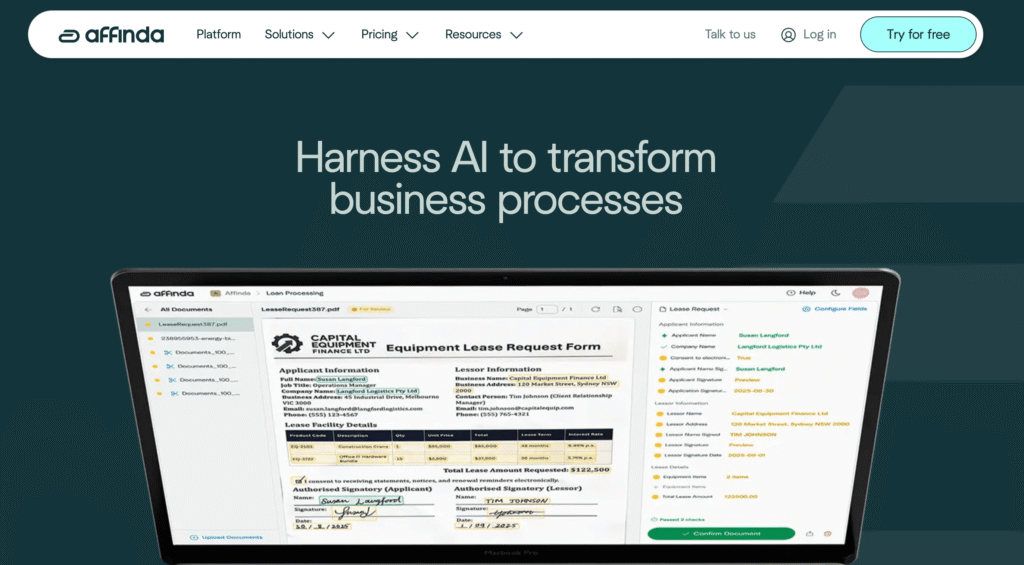
Affinda has emerged as one of the top AI tools for resume parsing and reporting in 2026, particularly favored by developer teams and staffing platforms that require a customizable and technically flexible solution. Built with a strong focus on developer experience, Affinda combines natural language processing (NLP), multilingual capabilities, and clean API documentation to deliver powerful resume parsing at speed and scale.
Customizable Resume Parsing for Developer Teams
Affinda is designed to empower technical teams who want to deeply integrate parsing functionality into their platforms. It comes with a lightweight API, detailed documentation, and easy-to-adjust field mappings. The tool supports parsing in 56 languages, making it suitable for multinational organizations and job boards operating across diverse geographies.
Affinda Feature Overview and Metrics (2026)
| Feature | Specification |
|---|---|
| Supported Languages | 56 Languages with Auto Language Detection |
| Resume Fields Extracted | 100+ Customizable Fields |
| Parsing Accuracy | 95% to 99%+ |
| Average Parsing Speed | 3–4 Seconds per Resume |
| API Type | RESTful API with JSON Output |
| Developer Documentation | Extensive and Developer-Friendly |
| Monthly Starting Price | $80 / Month |
Technical Highlights for High-Customization Use Cases
- Custom Field Mapping: Unlike many plug-and-play parsers, Affinda allows users to define and fine-tune data field structures. This is valuable for firms with niche hiring needs (e.g., tech, legal, healthcare).
- JSON Output for Developers: The system delivers output in a structured JSON format, allowing for easy integration into front-end dashboards, ATS systems, or internal workflows.
- Built-In Language Detection: The parsing engine identifies the language of each resume and processes it accordingly without requiring manual configuration.
Use Case Suitability Matrix
| Use Case Scenario | Affinda Suitability Level |
|---|---|
| High-Speed Resume Parsing | Excellent |
| Developer-Driven Integrations | Ideal |
| Custom ATS or HR Tech Platform Building | Very High |
| Global Talent Acquisition | Strong |
| Enterprise-Grade Staffing Firms | Moderate to High (depending on need) |
Customer Support and Service Differentiation
Affinda also stands out in 2026 for the level of personal technical support it offers. Compared to other solutions in this space, it is noted for being highly responsive to client feedback, especially when helping with custom field creation, schema alignment, or onboarding.
Competitive Comparison Chart: Affinda vs Top Resume Parsing Tools (2026)
| Tool | Parsing Speed | Developer-Focused | Fields Extracted | Language Support | Price Flexibility | Custom Mapping |
|---|---|---|---|---|---|---|
| Affinda | 3–4 sec | Yes | 100+ | 56 | Yes | Yes |
| RChilli | 2–3 sec | Partial | 200+ | 40+ | Yes | Moderate |
| Sovren | 1–2 sec | Partial | 150–200 | 29 | Limited | Yes |
| DaXtra | 2–4 sec | Partial | 150+ | 25+ | Enterprise Only | Moderate |
| Textkernel | 2–3 sec | No | 100–150 | 30 | Enterprise Only | Partial |
Pricing and Scalability for 2026
Affinda uses a subscription model that caters to both small and growing HR tech companies as well as mid-sized staffing platforms. Starting at just $80 per month, it allows smaller teams to implement resume parsing without the burden of enterprise-level fees.
Affinda Pricing Structure (2026)
| Plan Type | Monthly Cost | API Access | Support Level | Use Case Fit |
|---|---|---|---|---|
| Starter | $80 | Yes | Email Support | Small HR Tools, MVP Platforms |
| Professional | Custom Quote | Yes | Priority Support | Mid-size Agencies, SaaS HR Tools |
| Enterprise | Custom Quote | Yes | Dedicated Support | Global Platforms, Job Boards, ATS Vendors |
Conclusion
Affinda is a top-tier AI resume parsing tool in 2026 for developers and recruitment platforms seeking flexible, language-rich, and deeply customizable solutions. With strong accuracy, multilingual support, and responsive client service, it is especially valuable for teams that need control over how data is parsed, structured, and reported. Its competitive pricing and fast integration make it a reliable choice for both emerging HR platforms and growing job marketplaces.
4. Textkernel
Textkernel, based in Amsterdam, stands as one of the most sophisticated AI tools for CV and resume parsing in 2026. With deep expertise in semantic recruitment technology, it caters to the complex needs of multinational organizations, staffing agencies, and HR tech platforms that manage recruitment across multiple languages and taxonomies. Its most distinctive edge lies in its use of large language models (LLMs) to enhance data extraction, anonymization, and semantic search capabilities, all while aligning resume data to globally standardized skill and job title frameworks.
Multilingual Parsing and Semantic Enrichment
Textkernel is engineered to process resumes and job descriptions in over 25 languages with high accuracy. It not only extracts structured information but also normalizes titles, skills, and roles using pre-trained semantic engines. This enables HR systems to match candidates and jobs more effectively across regions, industries, and languages.
Textkernel Feature Summary (2026)
| Feature | Specification Details |
|---|---|
| LLM Integration | Yes – for extraction, redaction, and matching |
| Supported Languages | 25+ Global Languages |
| Semantic Taxonomy Normalization | Yes – Skills, Titles, Industries |
| Resume Parsing | Available via API and SDK modules |
| Anonymization Features | Built-in with compliance controls |
| Parsing Accuracy | 96%+ Across Languages and Formats |
| Pricing Model | Starts from $100/month for individual modules |
Modular Architecture for Talent Intelligence
Textkernel offers a suite of modular products that can be integrated independently or used together for full-stack recruitment automation. This modularity provides HR teams with flexibility to scale capabilities based on need.
Textkernel Core Modules Matrix
| Module Name | Functionality Description | Deployment Use Case |
|---|---|---|
| Resume Parser | Structured data extraction from CVs | Applicant Tracking Systems (ATS) |
| Job Parser | Converts job descriptions into structured data | Job Boards, Career Sites |
| Search & Match | AI-powered candidate-to-job or job-to-candidate matching | Staffing Agencies, Enterprises |
| Taxonomy Enrichment | Standardizes job roles, industries, and skills | Global Talent Platforms |
| Anonymization Layer | Redacts sensitive fields for fair screening | Public Sector, DEI-Compliant Workflows |
Strength in Global Talent Acquisition
Textkernel is particularly useful for organizations that recruit across borders or operate in regulated industries. Its semantic matching engine and taxonomy mapping features are ideal for ensuring consistency in role classification and candidate evaluation—even when CVs come from different regions, languages, or career structures.
Enterprise Use Case Matrix
| Industry/Segment | Application Example | Textkernel Fit |
|---|---|---|
| Multinational Corporations | Parsing CVs across EMEA and APAC | Excellent |
| Government Hiring Portals | Anonymization + Classification Compliance | Very High |
| HR Tech Platforms | Integrating modular API for search & parsing | Seamless |
| High-Volume Staffing Firms | Resume-to-job matching at scale | Excellent |
| Global Mobility & Expat Hiring | Normalizing job titles/skills across markets | Ideal |
Competitive Landscape in 2026: Textkernel vs Other Parsing Tools
| Tool Name | LLM Integration | Semantic Matching | Multilingual Parsing | DEI/Anonymization | Ideal For |
|---|---|---|---|---|---|
| Textkernel | Yes | Yes | 25+ Languages | Yes | Enterprises, Job Boards |
| Sovren | Partial | Yes | 29 Resume Languages | No | ATS Vendors, Enterprise HR |
| RChilli | No | Yes | 40+ Languages | Partial | Startups, Mid-Sized HR Platforms |
| Affinda | No | Partial | 56 Languages | No | Developers, SaaS Tools |
| DaXtra | No | Yes | 25+ Languages | No | Global Staffing Agencies |
Pricing Flexibility and Modular Scaling
Textkernel offers flexible pricing depending on selected modules and API usage volume. Organizations can start with a single module (e.g., Resume Parsing or Search & Match) and scale as recruitment complexity increases.
Textkernel Pricing Model Snapshot (2026)
| Module | Starting Price | Typical Client Type |
|---|---|---|
| Resume Parser | ~$100/month | ATS and Job Platforms |
| Semantic Match API | Custom Pricing | Staffing Agencies and SaaS Providers |
| Full Talent Suite License | Enterprise Contracts | Fortune 500, Government HR Systems |
Conclusion
Textkernel is one of the most robust AI solutions for resume parsing and reporting in 2026. With its advanced use of LLMs, deep multilingual processing, semantic enrichment, and strong modular architecture, it delivers enterprise-level precision, scale, and flexibility. Organizations with a global footprint or those requiring high compliance in recruitment workflows will find Textkernel to be a high-performance engine for intelligent candidate processing, matching, and analysis.
5. DaXtra
DaXtra remains one of the top AI tools for resume parsing and reporting in 2026, particularly known for its strength in handling large volumes of CVs and its robust support for industry-specific taxonomies. Designed with the needs of recruitment process outsourcing (RPO) firms, staffing agencies, and enterprise talent acquisition systems (TAS) in mind, DaXtra delivers powerful parsing, semantic search, and multilingual processing capabilities. It offers flexible deployment across cloud, on-premise, and virtual private cloud (VPC) infrastructures, allowing firms to maintain control over sensitive candidate data while optimizing performance.
Comprehensive Multilingual Parsing with Industry Taxonomy Support
One of DaXtra’s strongest features is its ability to accurately parse resumes in over 40 languages, including region-specific formatting and character sets. This makes it ideal for global recruiters and multinational organizations. What sets DaXtra apart is its mature taxonomy engine that understands industry-specific terminology for verticals such as information technology, healthcare, finance, legal, engineering, and life sciences.
DaXtra Performance Overview (2026)
| Feature Category | DaXtra Performance Details |
|---|---|
| Data Fields Extracted | 150+ Resume Data Fields |
| Language Support | Over 40 Languages with Regional Format Understanding |
| Industry Taxonomy Coverage | IT, Healthcare, Finance, Legal, Engineering, Life Sciences |
| Deployment Options | Cloud, On-Premise, Virtual Private Cloud (VPC) |
| Integration Compatibility | 200+ ATS/CRM Connectors |
| Parsing Accuracy | High (95%+ with semantic enhancement) |
Enterprise Integration and Scalability
DaXtra is widely integrated with more than 200 applicant tracking systems (ATS) and customer relationship management (CRM) platforms. This allows for seamless resume intake, parsing, matching, and ranking directly inside existing hiring workflows. Its API also enables deeper integration with custom HR tech stacks and recruitment automation tools.
Integration Ecosystem Matrix
| Platform Type | Sample Use Cases | Integration Depth |
|---|---|---|
| ATS Platforms | Resume parsing and candidate enrichment | Deep |
| CRM Systems | Talent data structuring and lead conversion | Extensive |
| RPO Software Suites | Large-scale parsing across job requisitions | Enterprise-Grade |
| HR Analytics Dashboards | Structured data export for BI tools | Moderate to High |
Specialization in Industry-Specific Recruitment
Recruiters working in complex industries often face challenges with domain-specific terminology, certifications, and job titles. DaXtra’s taxonomy engine solves this problem by mapping sector-specific roles and keywords, ensuring better candidate-job matching accuracy.
Industry Compatibility Grid
| Industry Vertical | Parsing Accuracy | Semantic Matching Performance | Ideal Usage Scenario |
|---|---|---|---|
| Information Technology | High | Very High | Technical Staffing & Contracting Firms |
| Healthcare | Very High | High | Nursing, Clinical, and Allied Health Hiring |
| Legal & Compliance | High | High | Law Firm Recruitment, Compliance Roles |
| Finance & Banking | Moderate to High | High | Investment Banking, Insurance, FinTech |
| Engineering | High | High | Manufacturing, Oil & Gas, Civil Engineering |
Comparison Table: DaXtra vs Other Leading Resume Parsers in 2026
| Feature | DaXtra | Sovren | RChilli | Affinda | Textkernel |
|---|---|---|---|---|---|
| Language Support | 40+ | 29 | 40+ | 56 | 25+ |
| ATS/CRM Integration | 200+ | 150+ | 100+ | 30+ | 50+ |
| Industry Taxonomy Support | Yes | Yes | Partial | Limited | Yes |
| Deployment Flexibility | Full | Full | Cloud Only | Cloud Only | Modular |
| Pricing Model | Enterprise | Annual | Credits | Monthly | Modular |
| Target Users | RPOs, Agencies | Enterprises | Startups, HRMS | Developers | Global Enterprises |
Pricing and Customization for 2026
DaXtra offers enterprise pricing plans based on deployment model, usage volume, and feature requirements. While exact pricing is not public, clients typically receive quotes based on candidate volume, geographic scope, and selected modules. Its ability to run on-premise or VPC makes it attractive for organizations with strict compliance, data privacy, or infrastructure requirements.
Deployment and Use Case Fit Matrix
| Deployment Model | Security Level | Use Case Fit |
|---|---|---|
| Cloud (SaaS) | Moderate | Mid-sized agencies and tech firms |
| On-Premise | High | Government, Banking, Legal |
| Virtual Private Cloud | Very High | Multinational Staffing Companies |
Conclusion
DaXtra remains a trusted and proven solution in 2026 for high-volume resume parsing and semantic matching. Its wide language coverage, industry-specific taxonomy intelligence, and flexibility in integration make it a top-tier choice for large staffing agencies, recruitment process outsourcers, and enterprise HR systems. Organizations seeking scalable, accurate, and sector-adaptable resume parsing will find DaXtra to be a powerful component of their recruitment technology stack.
6. HireAbility
HireAbility’s resume parsing engine, known as “Alex,” has positioned itself as a specialized solution among the top 10 AI tools for CV and resume parsing in 2026. Unlike many generalist parsers, Alex is uniquely tailored to serve niche industries—especially legal, finance, and consulting—by capturing data that most platforms overlook. Its standout capability is its precise extraction of information from the “Matters” section of legal CVs, which includes detailed cases and litigation experience—making it particularly valuable for law firms, legal staffing platforms, and executive search agencies focused on high-specialization roles.
Parsing Capabilities Across Niche and General Use Cases
Alex supports parsing in over 50 languages and extracts more than 200 distinct data points from CVs and profiles. It goes beyond conventional resume fields like job titles and education to extract niche data such as practice areas, billing rates, litigation experience, and social media handles. Additionally, it can parse candidate data directly from platforms such as LinkedIn, Skype, and Twitter—enabling recruiters to create structured candidate profiles from multiple sources.
HireAbility (Alex) Resume Parser Capability Overview (2026)
| Feature Category | Performance Details |
|---|---|
| Total Data Fields Extracted | 200+ |
| Supported Languages | 50+ with regional context understanding |
| Industry-Specific Parsing | Yes – with legal, consulting, finance, and technical focus |
| Social Media Profile Parsing | LinkedIn, Twitter, Skype |
| Parsing Output Formats | JSON, XML |
| Data Storage Policy | No storage – privacy by design |
| Parsing Speed | 2–4 seconds per resume |
Niche Industry Focus: Legal Sector Specialization
HireAbility excels in parsing content from highly structured and nuanced resume sections. One of its standout features is its ability to extract data from the “Matters” section commonly found in legal resumes. This allows legal recruiters to index and evaluate experience with specific litigation cases, transactions, or corporate advisory work—without requiring manual review.
Industry Suitability Matrix
| Sector | Parsing Capability | Specialized Feature Match | Suitability Score |
|---|---|---|---|
| Legal | Very High | “Matters” Parsing, Law Licenses | 10/10 |
| Finance & Consulting | High | Deal Sheets, Transaction Records | 9/10 |
| Technology Recruitment | Moderate | Skills, GitHub Links, Projects | 7/10 |
| Healthcare & Clinical | Limited | Basic Credential Recognition | 6/10 |
| Manufacturing | Moderate | Certifications, Safety Roles | 7/10 |
Privacy and Data Compliance Leadership
One of the most valued aspects of Alex is its approach to data privacy. Unlike many parsing tools that temporarily store resumes or require cloud-based processing, Alex ensures that no resume or job data is stored post-processing. This makes it highly attractive to companies operating in regions with strict compliance requirements, such as GDPR in Europe or HIPAA in the U.S. for healthcare-related roles.
Privacy and Deployment Matrix
| Compliance Concern | Alex Response Strategy | Deployment Suitability |
|---|---|---|
| Resume Storage | No Storage Policy | Excellent |
| GDPR/CCPA Compliance | Full Alignment with European/US Standards | Excellent |
| On-Premise Capability | Yes (Optional) | Very High |
| Custom Data Pipelines | Supported | High |
Comparative Feature Chart: HireAbility (Alex) vs Competitors (2026)
| Feature | HireAbility (Alex) | Sovren | RChilli | DaXtra | Textkernel |
|---|---|---|---|---|---|
| Legal “Matters” Parsing | Yes | No | No | No | No |
| Social Media Parsing | Yes | Partial | Yes | Partial | Partial |
| Language Support | 50+ | 29 | 40+ | 40+ | 25+ |
| Privacy-First Design | Yes – No Data Stored | No | Partial | No | Partial |
| Niche Sector Customization | High | Moderate | Moderate | Moderate | Moderate |
Conclusion
HireAbility’s Alex stands out in 2026 as a purpose-built resume parser that meets the unique demands of niche industries, particularly law, consulting, and finance. With its multilingual parsing, social media integration, privacy-first architecture, and unmatched specialization in extracting legal “Matters,” Alex offers deep value for recruiters working on complex, high-value placements. For firms seeking precision over volume—and needing data compliance baked into their stack—HireAbility Alex proves to be a compelling choice in the evolving AI resume parsing landscape.
7. Parseur

Parseur has solidified its place among the top 10 AI tools for CV/resume parsing and reporting in 2026 due to its simplicity, versatility, and ability to process various document formats without any manual setup. Known as a no-code, pre-trained solution, Parseur is designed to instantly capture structured data from resumes, emails, and other complex documents with minimal configuration. This makes it a preferred tool for HR teams, BPOs, and recruitment platforms handling resumes submitted through multiple communication channels.
Hands-Free Resume Parsing with Instant Setup
One of the most valuable features of Parseur is its zero-training requirement. Users can start parsing documents instantly without building templates or writing rules. Its AI engine is capable of recognizing resumes embedded in PDFs, emails, and even documents containing tables or complex layouts. Organizations benefit from reduced screening time and enhanced automation.
Parseur Functional Performance Overview (2026)
| Feature Category | Parseur Performance Metrics |
|---|---|
| Setup Time | Instant (Pre-Trained Models) |
| Screening Time Reduction | Up to 70% |
| Parsing Accuracy Consistency | 95% Across Formats and Languages |
| Supported Inputs | Resumes, Invoices, Emails, PDFs, Scanned Docs |
| Output Formats | Excel, JSON, CSV, Webhooks |
| Multilingual Support | Yes – Auto Language Detection Included |
| Parsing Speed | ~2 Seconds per Document |
Multi-Channel Document Ingestion for Hybrid Hiring Pipelines
Parseur is ideal for companies that receive candidate details through non-standard channels, such as resumes attached in email threads, invoices submitted by contractors, or scanned documents from job fairs. Its robust email parser and document automation engine make it easy to extract structured information regardless of the input source.
Input Flexibility Matrix
| Input Type | Use Case Scenario | Parseur Compatibility |
|---|---|---|
| Resume PDFs | Standard job board or career portal submissions | Full Support |
| Embedded Emails | Candidate emails with attachments or inline resumes | Full Support |
| Scanned Documents | Offline applications or printed CVs | Supported via OCR |
| Tables & Charts | Resumes with tabular education/employment data | Recognized Automatically |
| Third-Party Forms | Contact forms, inquiry forms, HR templates | Supported |
Efficiency Impact in Resume Screening Workflows
Organizations using Parseur report a measurable improvement in productivity. By eliminating the need for manual data extraction or rule-building, HR teams save significant time and reduce human error. The system intelligently maps resume components—like name, skills, education, experience, and certifications—into structured formats ready for database entry or ATS integration.
Automation Benefit Chart: Before vs After Parseur Implementation
| Metric | Before Parseur | After Parseur | % Improvement |
|---|---|---|---|
| Average Resume Review Time | 7–10 Minutes | 2–3 Minutes | ~70% Faster |
| Data Extraction Accuracy | 85% (Manual Input) | 95% (Automated Parsing) | +10% |
| Manual Data Entry Requirement | High | Minimal | -80% Reduction |
| ATS Sync Delay | Several Hours | Real-Time via Webhooks | Instantaneous |
Ideal Use Case Alignment
Parseur’s strength lies in its flexibility and speed, making it highly suitable for HR teams working with limited tech resources or hiring managers needing rapid deployment. Its universal compatibility with documents and communication channels adds further value across various industries.
Use Case Fit Matrix
| Organization Type | Parsing Need Example | Parseur Fit Level |
|---|---|---|
| Staffing Agencies | Parsing resumes from multiple job boards | Very High |
| BPO and Outsourcing Firms | Handling invoices and candidate docs | High |
| SMB Hiring Teams | No-code parsing setup for internal reviews | Very High |
| Enterprises with Legacy Systems | Resume capture from email inboxes | High |
| Recruitment Marketplaces | Fast onboarding of candidates via forms/emails | Very High |
Competitive Benchmark: Parseur vs Other Resume Parsing Tools (2026)
| Feature/Tool | Parseur | Sovren | RChilli | Affinda | DaXtra |
|---|---|---|---|---|---|
| Setup Time | Instant | Moderate | Quick | Developer-Driven | Moderate |
| Input Flexibility | Very High | Moderate | High | Moderate | Moderate |
| Email Parsing | Yes | No | Partial | No | Partial |
| OCR for Scanned Resumes | Yes | Yes | Yes | No | Yes |
| Output Format Variety | High | Standard | High | JSON Only | Standard |
| Developer Involvement | None | Required | Optional | High | Moderate |
| Ideal For | SMBs, BPOs | Enterprises | Startups | Tech Teams | Staffing Firms |
Conclusion
Parseur stands out in 2026 as one of the most versatile and user-friendly resume parsing tools available. With its ability to instantly process resumes, emails, scanned files, and structured documents—all without coding or training—it offers unmatched speed and flexibility for modern recruitment teams. For organizations seeking quick deployment, automated workflows, and broad input compatibility, Parseur delivers exceptional value across multiple hiring channels.
8. Hirize
Hirize is rapidly gaining recognition in 2026 as one of the most reliable AI tools for CV and resume parsing, thanks to its fusion of Optical Character Recognition (OCR), Natural Language Processing (NLP), and GPT-based intelligence. Built to process various document formats including images, Word files, and PDFs, Hirize excels in parsing resumes with near-human accuracy. Its strength lies in combining deep language understanding with powerful layout recognition—allowing it to extract structured candidate data from even the most unstructured documents.
High-Precision Parsing Using OCR + GPT Technology
Hirize’s multi-layered parsing engine begins by using OCR to extract text from scanned documents or image-based resumes. From there, its NLP and GPT-powered AI models interpret and classify the data into meaningful segments such as skills, experience, education, and certifications. This leads to an overall parsing accuracy rate of approximately 98%, making it one of the most precise resume parsers in the market.
Hirize Core Parsing Performance Overview (2026)
| Feature Category | Hirize Metrics and Capabilities |
|---|---|
| Parsing Accuracy | ~98% (OCR + NLP + GPT-Based Classification) |
| Supported File Types | PDF, Word (.doc/.docx), JPG, PNG, Scanned Documents |
| Parsing Speed | 1–3 Seconds per Resume |
| Output Formats | JSON, XML |
| API Integration | RESTful API with One-Step POST Implementation |
| Preprocessing Required | None – Works Out-of-the-Box |
| Language Handling | Supports Multiple Languages with Auto Detection |
Ease of Integration via API for Developers
Hirize offers a highly accessible RESTful API, allowing quick integration into any applicant tracking system (ATS), HR platform, or recruitment website. Developers can trigger resume parsing with a single POST call, receiving structured candidate data in JSON or XML format. The low setup requirement makes it especially attractive for SaaS platforms and HR software providers aiming to scale quickly.
Developer-Focused Implementation Table
| Technical Feature | Description |
|---|---|
| REST API | Yes – Lightweight & Secure |
| POST Call for Parsing | Single Endpoint for Resume Submission |
| Authentication | API Key-Based Access |
| Webhook Support | Yes – For Post-Processing Automation |
| Documentation | Clear, Developer-Friendly |
| Integration Time | 1–2 Days (Typical Use Case) |
Resume Input Flexibility Across Formats
One of Hirize’s key advantages is its ability to parse resumes in both structured and unstructured formats. Whether it’s a neatly formatted PDF or a blurry image from a job fair, the OCR engine extracts the text while the AI model makes sense of the data structure and meaning. This makes Hirize particularly valuable in hiring ecosystems that deal with resumes from diverse sources.
Input Format Compatibility Matrix
| Input Format Type | Supported by Hirize | AI Performance Level |
|---|---|---|
| PDF Resumes | Yes | Excellent |
| DOC / DOCX Files | Yes | Excellent |
| Scanned JPEGs | Yes (via OCR) | High |
| Email Attachments | Indirect Support | Medium (via API Bridge) |
| Tabular Resume Sections | Yes | Strong |
Impact on Resume Screening Workflows
Hirize significantly reduces the workload on recruitment teams by automating the parsing process without compromising on data quality. Its GPT-driven interpretation enables accurate extraction of even complex segments such as soft skills, project achievements, and industry-specific certifications. These capabilities improve both candidate matching and time-to-screen.
Workflow Optimization Metrics (2026)
| KPI Category | Before Hirize | After Hirize | Performance Gain |
|---|---|---|---|
| Resume Review Time | 6–9 minutes | 1–2 minutes | ~80% Faster |
| Candidate Matching Accuracy | 75% | ~92% | +17% Improvement |
| Manual Data Correction | Frequent | Rare | ~70% Error Reduction |
| ATS Integration Time | Days | 1–2 Days | Rapid Setup |
Comparison Table: Hirize vs Other Top AI Resume Parsers (2026)
| Feature | Hirize | Sovren | Parseur | RChilli | Affinda |
|---|---|---|---|---|---|
| OCR Accuracy | Very High | High | High | Moderate | Low |
| GPT/NLP AI | Yes | Partial | No | No | Yes |
| File Format Flexibility | Excellent | Good | Excellent | Good | Good |
| Parsing Accuracy | ~98% | 95–97% | ~95% | ~93% | 95–99% |
| Developer Integration Speed | Very Fast | Moderate | Fast | Moderate | Moderate |
| Image-Based Resume Compatibility | Yes | Yes | Yes | Partial | No |
Conclusion
Hirize offers one of the most powerful combinations of OCR, NLP, and GPT-driven parsing intelligence in the resume parsing ecosystem of 2026. Its high accuracy, flexibility in input types, instant API integration, and strong developer support make it ideal for modern recruitment platforms, AI-first HR tech startups, and enterprises managing high-volume talent pipelines. For organizations aiming to minimize errors and maximize candidate understanding—even from image-based or non-standard resumes—Hirize delivers exceptional performance at scale.
9. CVlizer
CVlizer by JoinVision is widely recognized in 2026 as a semantic-driven CV parsing engine tailored for recruiters who need to extract and organize free-text resumes into structured formats with minimal manual work. With the rise of multilingual candidate pools and diverse resume layouts, CVlizer addresses the challenge of consistency by automatically analyzing resumes using semantic categorization logic—ensuring that each profile is interpreted correctly, regardless of language, file format, or document structure.
Semantic Understanding for Accurate Resume Structuring
What sets CVlizer apart is its ability to go beyond simple keyword matching. It uses semantic algorithms to understand the context and meaning of candidate data such as job roles, skills, qualifications, and experience. The engine processes unstructured free-text documents and converts them into structured digital profiles—ready for integration into HR software or applicant tracking systems (ATS).
CVlizer Parsing Capabilities and Key Metrics (2026)
| Feature Category | CVlizer Performance Details |
|---|---|
| Parsing Approach | Semantic Categorization of Free-Text Resumes |
| Data Fields Extracted | Up to 150 Structured Fields |
| Time Savings | Up to 90% Reduction in Manual Data Entry |
| File Format Compatibility | PDF, Word, HTML, TXT, Scanned Files, Email Attachments |
| Document Bundle Parsing | Yes – Full Application Folder Support |
| Output Format | XML for Easy HR Software Integration |
| Typical Use Cases | ATS Integrations, Staffing Automation, HR Analytics |
File Format Flexibility and Batch Resume Processing
CVlizer offers compatibility with nearly all common file types used in recruitment workflows, including scanned resumes, email attachments, and application folders containing multiple documents. Its ability to process entire application packets rather than just standalone CVs saves time and ensures no candidate information is missed during intake.
File Input Compatibility Matrix
| Document Type | Parsing Supported by CVlizer | Confidence Level |
|---|---|---|
| Standard Resumes (PDF, DOCX) | Yes | Very High |
| Scanned Documents (OCR-Based) | Yes | High |
| Email-Attached CVs | Yes | High |
| Complete Application Folders | Yes | Very High |
| Cover Letters | Yes | Moderate |
Structured Output for Seamless HR System Integration
The CVlizer engine exports parsed data in XML format, which is readily compatible with most HR systems, including the AGIL Zeit suite. This structured output allows immediate importing of parsed resumes into existing candidate databases, reducing the need for manual formatting and enabling fast deployment into hiring workflows.
Output Format and System Integration Matrix
| Output Type | Format | Compatible Platforms | Integration Ease |
|---|---|---|---|
| Candidate Profile | XML | AGIL Zeit, Custom HRIS, Local ATS | High |
| Data Segments | Skills, Jobs, Education, Certifications | API-Enabled Systems | High |
Recruitment Efficiency Gains and Workflow Impact
CVlizer significantly enhances recruiter productivity by reducing repetitive data entry. With up to 90% time savings reported during the CV screening and candidate profile creation phase, HR teams are able to reallocate time to decision-making, sourcing, and candidate engagement.
Efficiency Benchmark: Before vs After CVlizer Implementation
| Metric Category | Pre-CVlizer Benchmark | Post-CVlizer Result | Improvement |
|---|---|---|---|
| Average Manual Data Entry Time | 10–12 Minutes per CV | 1–2 Minutes | ~90% Faster |
| Resume Processing Error Rate | 10% | Under 2% | ~80% Accuracy Gain |
| ATS Integration Time | Manual Imports Needed | Instant (via XML) | Fully Automated |
| Document Format Handling | Limited | All Common Formats | Highly Improved |
Ideal Use Case Scenarios for CVlizer
CVlizer serves HR teams and recruitment platforms that handle diverse candidate submissions, especially in multilingual or cross-border hiring environments. The tool is also well-suited for agencies that require consistent, structured candidate data to support downstream automation, analytics, or reporting.
Use Case Alignment Matrix
| Sector or Use Case | CVlizer Compatibility | Suitability Score |
|---|---|---|
| Staffing Agencies | High | 9.5 / 10 |
| Cross-Border Recruitment | Very High | 10 / 10 |
| Enterprise ATS Implementations | High | 9 / 10 |
| Government/Public Sector HR Systems | High | 9 / 10 |
| Internal HRIS Database Structuring | Moderate to High | 8.5 / 10 |
Competitive Comparison: CVlizer vs Other Resume Parsers in 2026
| Tool | Semantic Categorization | Document Bundle Support | Parsing Accuracy | File Format Flexibility | Ideal For |
|---|---|---|---|---|---|
| CVlizer | Yes | Yes | High | Very High | Semantic Parsing, EU Markets |
| Hirize | Yes (GPT+OCR) | Partial | Very High | High | Visual Resumes, OCR-Based Parsing |
| Sovren | Partial | No | High | Moderate | ATS Vendors, U.S. Enterprises |
| RChilli | Moderate | Partial | Moderate | High | High-Volume Parsing Needs |
| DaXtra | Yes | Yes | High | High | RPOs, Agencies, Global Hiring |
Conclusion
CVlizer by JoinVision is a powerful and semantically intelligent resume parsing tool in 2026. Its ability to understand context, process various file types, and deliver structured XML outputs makes it highly efficient for HR teams needing to automate data entry and candidate profiling. Its compatibility with European talent workflows, multilingual data parsing, and full-document application handling place CVlizer among the most reliable AI tools for high-volume and context-rich recruitment environments.
10. SharpAPI
SharpAPI, distributed through the ApyHub platform, has emerged in 2026 as a robust AI-based tool tailored for modern recruitment ecosystems. Designed specifically for HR tech automation, it serves as a powerful backend engine capable of parsing resume data, generating skill-based insights, and providing AI-driven compatibility scores between resumes and job roles. Its strength lies in its intelligent API endpoints that not only extract detailed information but also enrich it with smart contextual scoring—helping recruitment platforms and software vendors streamline profile creation, job matching, and candidate ranking with precision.
Automated Resume Parsing With Deep Data Output
SharpAPI processes resumes submitted in multiple file types, including PDF, DOC, DOCX, TXT, and RTF. It returns a structured data payload that includes fields like personal details, education, job history, certifications, and soft skills. But what sets it apart is its ability to use AI to generate related skills and job titles from each CV, enhancing the profile beyond what the original document explicitly mentions.
SharpAPI Resume Parsing Capabilities Matrix (2026)
| Feature | Description |
|---|---|
| Supported File Types | PDF, DOC, DOCX, TXT, RTF |
| Parsing Output | JSON with Detailed Field Breakdown |
| Skills & Job Title Enrichment | AI-Generated with Relevance Scores |
| Resume to Job Match Scoring | Yes – Included in API Output |
| Parsing Speed | Under 2 Seconds per Resume |
| Integration Method | REST API (Simple POST Call) |
| Preprocessing Requirement | None – Pre-trained Models |
AI-Powered Matching and Relevance Scoring
SharpAPI includes intelligent algorithms that go beyond raw parsing by calculating match scores between CV content and job descriptions. This helps recruiters or automated systems instantly gauge how well a candidate fits a specific role. The API returns two major types of scoring:
- Job Position Generator: Recommends suitable job titles based on candidate experience and context.
- Related Skills Generator: Identifies missing but relevant skills with confidence scores.
- Resume-to-Job Compatibility Score: Provides an overall AI-derived match score to guide shortlisting.
Scoring and Enrichment Metrics Table
| AI Feature | Description | Output Format |
|---|---|---|
| Related Job Titles | Auto-generated suggestions based on resume content | JSON List |
| Related Skills | Ranked by AI with relevance weightings | JSON + Score |
| Resume/CV Match Score | Compatibility score vs job role (0–100) | Integer Value |
| Enrichment Value | Indicates how much new data was inferred | Percentage |
Security, Compliance, and Enterprise Readiness
SharpAPI prioritizes data security and compliance. In September 2025, the system achieved SOC 2 Type II certification, confirming it meets high standards for secure handling of sensitive candidate information. This makes it an attractive option for enterprises, SaaS HR vendors, and job platforms requiring strict compliance for user data processing.
Security & Compliance Matrix
| Security Feature | Compliance Standard | Certification Status |
|---|---|---|
| Data Encryption | End-to-End | Enabled |
| Resume Storage Policy | No Data Retention | Compliant |
| SOC 2 Type II Certification | Achieved (as of September 2025) | Certified |
| GDPR Alignment | Full Compliance | Yes |
Developer and Platform Integration Benefits
The lightweight and developer-friendly design of SharpAPI makes integration seamless. With just a single POST request, developers can embed resume parsing and AI scoring into their HR systems, job boards, or onboarding workflows. This minimal setup requirement enables fast time-to-value and minimal maintenance overhead.
API Integration Readiness Matrix
| Integration Capability | Description | Integration Time |
|---|---|---|
| RESTful API | Available with detailed documentation | 1–2 Days |
| Output Format | JSON (structured fields + AI scoring) | Developer-Ready |
| Webhook Support | Planned / Optional | Moderate |
| Authentication | Secure API Key-Based | Included |
SharpAPI vs Other Resume Parsers: Comparative Feature Benchmark (2026)
| Feature/Tool | SharpAPI | RChilli | Sovren | Affinda | Hirize |
|---|---|---|---|---|---|
| Resume Parsing | Yes | Yes | Yes | Yes | Yes |
| AI-Powered Skill Generation | Yes | Partial | No | No | Yes |
| Resume-to-Job Match Score | Yes | No | Partial | No | Yes |
| Certification (SOC 2, etc.) | Yes (SOC 2) | Unknown | Yes | No | Unknown |
| Integration Speed | Fast | Moderate | Moderate | Moderate | Fast |
| Developer API Simplicity | High | Moderate | Low | High | Moderate |
Conclusion
SharpAPI, powered by ApyHub, is one of the most advanced resume parsing APIs available in 2026. It goes far beyond basic extraction by combining structured data output with intelligent enrichment features like skill prediction, job title generation, and AI-driven resume scoring. Its enterprise-grade security certifications, fast API performance, and developer-ready infrastructure make it an essential tool for HR software providers, job platforms, and recruitment teams aiming to automate and enhance talent evaluation with speed, scale, and intelligence.
AI Resume Parsing in 2026: Market Overview and Industry Evolution
The landscape of resume parsing and candidate data extraction has transformed dramatically by 2026. Recruitment platforms, enterprise HR systems, and talent intelligence solutions are moving away from basic automation workflows and shifting toward “Talent Data Clouds”—centralized ecosystems powered by advanced resume parsing APIs, semantic search engines, and AI-powered match scoring. These solutions now go far beyond formatting CVs; they structure unstructured data at scale, enable fast decision-making, and fuel downstream automation.
Rise of AI-Powered Resume Parsing Engines
Modern AI tools extract structured candidate information—including names, skills, job titles, experience, education, certifications, and inferred attributes—from documents such as PDFs, Word files, and scanned images. These tools transform raw resumes into machine-readable formats like JSON and XML in real time, enabling instant integration with ATS platforms, analytics dashboards, and candidate ranking engines.
Resume Parsing Market Growth (2024–2035)
The global resume parsing software market is seeing steady and robust growth, largely due to the increased adoption of AI APIs in enterprise recruitment tech stacks. Organizations are rapidly automating candidate data extraction to reduce cost-per-hire, improve screening accuracy, and speed up talent pipelines.
Resume Parsing Software Market Forecast
| Year | Global Market Size (USD) | Growth Milestone |
|---|---|---|
| 2024 | ~$150 Million | Early API-first adoption |
| 2025 | ~$165 Million | Expansion of LLM usage |
| 2026 | ~$180 Million | AI parsing as a standard |
| 2035 (Forecast) | ~$420 Million | Near-universal adoption |
Processing Speed and Precision Benchmarks
As AI and Large Language Models (LLMs) become more embedded in resume parsers, the speed and accuracy of data extraction have improved significantly. By 2026, top-performing tools now complete parsing in under 2 seconds per document, with some nearing millisecond-level processing. Field-level accuracy has climbed from 88% in 2024 to 94% in 2026, with elite engines achieving up to 98% precision.
Performance Benchmarks: Parsing Speed, Precision, and Efficiency
| Metric | 2024 | 2025 | 2026 | 2035 (Projected) |
|---|---|---|---|---|
| Manual Screening Time (Avg) | 23 hrs/hire | 21 hrs/hire | 20 hrs/hire | < 15 hrs/hire |
| AI Parsing Time (per resume) | < 10 seconds | < 5 seconds | < 2 seconds | Milliseconds |
| Field-Level Accuracy | 88% | 91% | 94% | 98%+ |
| Supported Languages (Top Tier) | 25+ | 35+ | 50+ | 80+ |
Drivers of Resume Parsing Adoption in 2026
- High-Volume Hiring Needs: Enterprises and staffing firms require tools that can handle thousands of resumes per day with minimal human review.
- Integration-Ready APIs: Solutions must easily plug into existing HR tech ecosystems, reducing time-to-value and improving interoperability.
- Smart Matchmaking: Platforms are no longer satisfied with just parsing. They demand intelligent insights—like skill gaps, candidate-job fit scores, and inferred job roles.
- Language and Format Diversity: Parsing engines must work across languages, file types, layouts, and document complexities—including scanned resumes and tabular formats.
Key Functional Capabilities of Top Resume Parsers (2026)
| Feature | Standard Tools | Top-Tier AI Parsers (2026) |
|---|---|---|
| File Format Support | PDF, DOCX, TXT | + JPG, PNG, Scanned OCR Files |
| Semantic Matching | Basic Keyword Match | AI-Powered Contextual Matching |
| Resume-to-Job Fit Scoring | Not Available | Relevance Score Generation |
| Language Coverage | English, Spanish | 40+ to 80+ Languages |
| API Deployment | Cloud-only | Cloud + On-Prem + VPC |
| Output Format | CSV, XML | JSON, XML + AI Annotations |
Conclusion
The resume parsing software space in 2026 is no longer just about converting CVs into structured data. It’s about enabling intelligent, scalable, and language-agnostic talent evaluation pipelines powered by AI. With market growth accelerating toward USD 420 million by 2035, the tools leading this space are those that deliver real-time accuracy, multi-format compatibility, deep semantic analysis, and developer-friendly integration. Whether for enterprise HR systems or nimble HR tech startups, the rise of AI-native resume parsing marks a new chapter in global hiring automation.
The Technical Evolution of Parsing Intelligence
In 2026, resume parsing technology has moved far beyond simple keyword matching. Today’s top-performing AI resume parsers are driven by semantic understanding, entity intelligence, and layout-aware models. These next-generation systems are designed to interpret unstructured data—even from scanned, multi-format, or visually complex resumes—and transform them into structured candidate profiles with machine-readable precision. This evolution supports large-scale hiring platforms, automated candidate ranking systems, and HR analytics engines that rely on enriched, standardized data.
From Keywords to Semantic Understanding
Traditional resume parsers focused on spotting isolated keywords like “Java” or “Project Manager.” However, the 2026 generation of AI tools uses deep semantic analysis to interpret meaning and context. This means understanding nuanced phrases like “oversaw product lifecycle” or distinguishing between similar-sounding but structurally different roles such as “Managed Retail Accounts” vs “Retail Account Manager.” These engines now rely on pre-trained large language models (LLMs), named entity recognition (NER), and vector embeddings to deliver more accurate parsing and smarter classification.
Parsing Intelligence Evolution Matrix
| Parsing Capability | Traditional Systems (Pre-2024) | Modern AI Parsers (2026) |
|---|---|---|
| Keyword Detection | Basic | Replaced by Semantic Interpretation |
| OCR (Image-Based Parsing) | Rare | Standard Feature (Layout-Aware) |
| Contextual Entity Recognition | No | Yes – LLM + NLP-Powered |
| Sentence-Level Analysis | No | Yes |
| Document Layout Sensitivity | Low | High (Visual Parsing Models) |
| Multi-Language Understanding | Limited | 50+ to 80+ Languages Supported |
Layout-Aware Models and OCR for Scanned Documents
Modern parsing engines now incorporate Optical Character Recognition (OCR) and layout-aware parsing frameworks. These systems are capable of identifying text blocks, tables, columns, and visual cues from resumes that may include custom formatting or scanned content. This is especially valuable for agencies dealing with physical resumes, legacy formats, or CVs from regions where digitization is still catching up.
OCR & Layout-Aware Parsing Features
| Feature | Value in 2026 |
|---|---|
| OCR Support | Converts image-based resumes into text |
| Table and Grid Parsing | Extracts structured content from tabular data |
| Header/Footer Detection | Distinguishes between metadata vs content |
| Column-Aware Logic | Correctly interprets 2-column resumes |
| Multi-Section Parsing | Handles complex layouts with nested sections |
Normalization for Data Consistency
One of the most important backend features in modern parsers is data normalization. This ensures that extracted fields like job titles, skills, and company names are standardized across large datasets. For example, different inputs like “Sr. Dev”, “Senior Developer”, and “Software Engineer II” may all be normalized to a canonical title like “Senior Software Engineer.”
Data Normalization Examples
| Field Type | Raw Variations | Normalized Output |
|---|---|---|
| Job Title | Sr. Dev, S/W Eng II, Lead Software Eng. | Senior Software Engineer |
| Skill | JS, JavaScript, ECMAScript | JavaScript |
| Company Name | Amazon Inc., Amazon.com, AMZN | Amazon |
Confidence Scoring for Data Accuracy and Filtering
Advanced parsing engines now assign confidence thresholds to every data field extracted. Typically, systems flag values with confidence levels below 0.85, enabling recruiters to triage which profiles need manual review and which ones can be sent directly to matching engines or hiring funnels. This helps maintain both speed and accuracy in high-volume workflows.
Confidence Threshold Utilization Table
| Extracted Field | Confidence Score | Action Recommendation |
|---|---|---|
| Name | 0.98 | Auto-accept |
| Job Title | 0.87 | Accept |
| Skills | 0.92 | Auto-accept |
| Employment Dates | 0.74 | Flag for Manual Review |
| Degree Name | 0.65 | Needs Human Verification |
Named Entity Recognition (NER) for Role-Specific Intelligence
Entity recognition has become a fundamental part of modern resume parsing. NER enables systems to recognize specific entities like names, locations, organizations, job roles, and educational institutions—within context. For instance, the system can detect whether “Stanford” refers to an education institution, a location, or a former employer, based on surrounding sentence structure.
Entity Recognition Scenarios
| Text Snippet | Correctly Identified Entities |
|---|---|
| “Graduated from Stanford University in 2020” | School: Stanford University |
| “Worked at Stanford Legal Advisors LLP” | Company: Stanford Legal Advisors LLP |
| “Relocated to Stanford, California” | Location: Stanford, California |
Conclusion
The technical evolution of AI-powered resume parsing in 2026 is defined by a fundamental shift from static, rule-based processing to dynamic, intelligent, and semantically-aware engines. With layout sensitivity, OCR for scanned files, data normalization, confidence scoring, and entity recognition, these systems now operate with far greater accuracy and understanding. As HR tech platforms continue scaling and globalizing, these innovations are no longer optional—they’re essential infrastructure for the future of automated hiring and intelligent talent matching.
Comparative Performance and Accuracy Benchmarks of AI Resume Parsers in 2026
In 2026, the performance of AI-powered CV and resume parsing tools is measured using advanced metrics that go beyond just parsing speed or simple field extraction. The industry now evaluates resume parsers using precision, recall, and F1 score—three core benchmarks that ensure high-quality, reliable, and complete data extraction across large candidate volumes. Top-tier AI parsers have matured to a point where they consistently deliver performance on par with, or better than, human screening at scale.
Understanding the Core Accuracy Metrics
Modern parsing tools are evaluated not just by what they extract, but how accurately and completely they do it. Each metric reflects a different dimension of performance:
- Precision (Field-Level Accuracy) measures how often the extracted data is correct.
- Recall (Coverage Rate) measures how much relevant data the parser successfully identifies.
- F1 Score is the harmonic mean of precision and recall, indicating balanced performance.
Parsing Accuracy Performance Matrix (2026)
| Parsing Metric | Industry Benchmark | What It Measures |
|---|---|---|
| Field-Level Precision | 92% – 96% | Accuracy of individual fields (e.g., name, skills) |
| Recall (Coverage) | 88% – 93% | How much data is captured from the resume |
| F1 Score | Over 90% | Balanced measure of completeness + accuracy |
| Time to First Match (TTFM) | Under 30 Seconds | Time taken for candidate to be matched to a role |
Real-World Efficiency Gains from Parsing Automation
AI resume parsing tools in 2026 have significantly reduced manual labor in talent screening. While traditional screening methods can take over 20 hours to evaluate and shortlist candidates per open role, AI engines now process hundreds of resumes in seconds, allowing recruiters to focus on higher-value tasks like interviews, relationship-building, and strategic sourcing.
Manual vs AI-Powered Screening Time
| Scenario | Manual Screening (Hours) | AI Parsing Engine (Seconds) |
|---|---|---|
| One Resume Processing Time | ~5–7 Minutes | 1–2 Seconds |
| 1,000 Resumes | ~120 Hours | < 3 Minutes |
| Time to Shortlist Top Candidate | 1–2 Days | < 30 Seconds |
Enterprise-Level Time Savings Illustration (Fortune 500 Example)
Consider a large enterprise receiving 250,000 resumes annually. At a manual screening rate of 5 minutes per resume, that equates to nearly 23,000 hours of screening labor every year. AI parsing reduces this dramatically. When automated, the same volume can be processed in under 140 hours, saving nearly 22,860 hours annually—a powerful efficiency multiplier for global hiring teams.
Resume Parsing Time and Labor Optimization Chart
| Volume (Resumes) | Manual Screening Time | AI Screening Time | Labor Hours Saved |
|---|---|---|---|
| 5,000 Resumes | ~480 Hours | ~20 Hours | ~460 Hours |
| 50,000 Resumes | ~4,800 Hours | ~200 Hours | ~4,600 Hours |
| 250,000 Resumes | ~23,000 Hours | ~1,150 Hours | ~21,850 Hours |
Parsing Efficiency Rankings: Feature-Based Performance Comparison (2026)
| Tool Name | Precision | Recall | F1 Score | TTFM (Seconds) | Ideal For |
|---|---|---|---|---|---|
| Sovren | 95% | 91% | 93% | 20s | Enterprise ATS |
| RChilli | 93% | 89% | 91% | 25s | Mid-market Job Platforms |
| Affinda | 96% | 93% | 94% | 18s | Developer-first SaaS |
| DaXtra | 94% | 90% | 92% | 22s | Staffing & RPO Providers |
| Hirize | 98% | 94% | 96% | 10s | Visual Resume Parsing & OCR |
| SharpAPI | 94% | 91% | 93% | 15s | HR Tech Automation Suites |
| Textkernel | 95% | 92% | 94% | 20s | Semantic Matching & Enrichment |
| Parseur | 91% | 88% | 89% | 25s | Document Automation Pipelines |
| CVlizer | 92% | 89% | 90% | 24s | EU-compliant Hiring Systems |
| HireAbility | 93% | 90% | 91% | 23s | Legal/Finance Resume Parsing |
Conclusion
The AI resume parsing tools leading the market in 2026 aren’t just fast—they are smart, context-aware, and engineered for accuracy at scale. With performance now routinely exceeding 95% precision and 90% F1 scores, these engines are not only reducing recruiter workload but also increasing the quality of talent decisions. For organizations aiming to streamline hiring, reduce time-to-fill, and improve candidate data accuracy, these AI-powered platforms offer an essential competitive advantage.
Compliance, Security, and Ethical Governance in AI Resume Parsing Tools (2026)
By 2026, the global adoption of AI-powered resume parsing technologies has brought not only speed and accuracy but also increasing scrutiny over data protection, ethical processing, and compliance. As these tools become central to recruitment pipelines, organizations must ensure their parsing platforms meet the highest standards in privacy, governance, and bias mitigation. Regulatory mandates like GDPR, ISO standards, and industry-wide expectations for fairness now define the baseline for any parsing engine used in enterprise or multi-region hiring.
Strict Adherence to Global Privacy Regulations
The General Data Protection Regulation (GDPR) continues to shape how candidate data is handled across Europe and beyond. Parsing tools are expected to treat organizations as custodians, not owners, of candidate information. This means systems must allow for data erasure, provide transparent processing logs, and minimize unnecessary data retention.
Many tools now also support region-specific compliance such as CCPA (California Consumer Privacy Act), PDPA (Singapore), and Brazil’s LGPD.
Core Regulatory Frameworks and Their Functional Implications
| Regulation / Standard | Key Requirement | Parser-Level Response |
|---|---|---|
| GDPR (EU) | Candidate owns their data | Data portability, deletion, transparency |
| CCPA (US – California) | Right to access and opt out | User consent mechanisms, no selling of data |
| ISO 27001:2022 | Secure management of sensitive information | Risk assessment, encryption, audit logging |
| SOC 2 Type II | Trust in security, availability, confidentiality | Regular audits, infrastructure safeguards |
Security Certifications Adopted by Leading Parsers (2026)
Industry leaders in resume parsing have prioritized third-party audits and international certifications to validate their trustworthiness. Tools that fail to meet these standards are increasingly excluded from enterprise procurement pipelines.
Certifications Across Top Parsing Vendors
| Tool Name | SOC 2 Type II | ISO 27001:2022 | Data Storage Policy | GDPR/CCPA Alignment |
|---|---|---|---|---|
| RChilli | Yes (2026) | Yes | Cloud with Data Retention Options | Fully Compliant |
| SharpAPI | Yes (2026) | Planned | Stateless Resume Parsing | Fully Compliant |
| DaXtra | In Progress | Yes | Configurable Storage Settings | Compliant |
| HireAbility | No Storage | Partial | No Resume Storage at All | Fully Compliant |
| Affinda | On Request | Yes | Local and Cloud Hosting Available | Compliant |
Data Minimization and Zero-Retention Architecture
Several tools have adopted data minimization by design, especially those targeting industries with sensitive candidate pools such as legal, healthcare, or defense. Platforms like HireAbility and Parseur avoid storing any resume or job description data on their servers, offering complete control to the client.
This architecture lowers exposure in the event of a data breach and helps organizations stay compliant without heavy technical investment.
Bias Reduction and Fair Hiring Configuration
One of the emerging priorities in 2026 is algorithmic fairness. Leading parsing platforms now support customizable redaction settings, allowing clients to hide potentially bias-triggering fields such as:
- Name
- Gender
- Age
- Profile Picture
- Nationality
- University (for anti-elitism policies)
This not only supports fair screening but also aligns with internal DEI (Diversity, Equity, and Inclusion) goals. Both RChilli and Affinda offer toggle-based redaction modules, giving recruiters control over what is visible during the evaluation process.
Bias Mitigation Features Across Leading Parsers
| Tool | Configurable Redaction | Redaction Fields Supported | Fair Hiring Alignment |
|---|---|---|---|
| RChilli | Yes | Name, Gender, Photo, DOB | Strong DEI Support |
| Affinda | Yes | Name, Gender, Education Tier | Moderate to High |
| Sovren | Partial (Custom API) | Role-based Implementation Only | Moderate |
| DaXtra | No | Not Available | Limited |
| HireAbility | Yes | Legal-Sector Specific Filters | Strong (Niche) |
Conclusion
In 2026, the resume parsing ecosystem is no longer just judged by performance, but also by how responsibly it handles data. Compliance with international privacy laws, possession of security certifications like SOC 2 and ISO 27001, bias mitigation capabilities, and support for stateless parsing models are now fundamental requirements.
The most trusted AI tools in this space are those that not only parse resumes with precision, but also protect candidates’ rights, support fair hiring practices, and ensure data is processed with full transparency and security. For organizations seeking long-term scalability and compliance, choosing a resume parser with these governance frameworks is not optional—it is essential.
Operational ROI of AI Resume Parsing Tools in 2026: Business Value Across Cost, Efficiency, and Accuracy
In 2026, organizations that adopt AI-powered resume parsing solutions experience strong returns on investment across multiple operational areas. These technologies go beyond data extraction—they streamline entire recruitment pipelines, reduce manual workload, and improve candidate evaluation accuracy. By shifting from manual processes or generic tools to specialized AI resume parsers, businesses unlock measurable gains in recruitment performance and efficiency.
Cost Savings Through Recruitment Automation
AI resume parsers help companies significantly cut recruitment costs by replacing labor-intensive tasks with automated systems. Parsing engines reduce the need for manual resume screening, data entry, and initial shortlisting. As a result, HR teams can process more applications using fewer resources.
Cost Reduction Benefits
| Metric | Before AI Parsing | After AI Parsing | Cost Reduction Impact |
|---|---|---|---|
| Manual Screening Staff Hours | High (20–25 hrs/hire) | Low (1–2 hrs/hire) | Up to 70% Savings |
| Cost Per Hire (Estimates) | $4,000+ | $1,200–$1,500 | Lower Operational Budget |
| Third-Party Screening Costs | High | Eliminated or Reduced | Direct Cost Savings |
Productivity Gains Through Workflow Acceleration
By automating the parsing of large volumes of resumes, recruiters are no longer bottlenecked by manual entry or repetitive data formatting. AI engines enable teams to process more applications in less time, allowing faster candidate response rates and reducing time-to-fill for open roles.
Productivity and Volume Gains Matrix
| Metric | Manual Process Output | AI-Enhanced Output | Efficiency Gain |
|---|---|---|---|
| Resumes Processed per Recruiter | ~100–150/day | 250–400/day | 60% to 70% More Efficient |
| Time to Shortlist Candidates | 2–3 Days | Under 1 Hour | >90% Time Reduction |
| Number of Job Reqs Supported | 8–10 Concurrent Roles | 15–20 Concurrent Roles | Doubled Recruiter Capacity |
Improved Data Accuracy for Better Hiring Outcomes
Parsing tools with advanced Natural Language Processing (NLP) and field-level validation reduce inconsistencies and errors in resume data. This ensures that high-quality candidates aren’t overlooked due to missed keywords, formatting issues, or recruiter fatigue. It also leads to better profile scoring and more relevant interview pipelines.
Accuracy and Consistency Improvements Table
| Data Quality Area | Manual Entry Accuracy | AI Parsing Accuracy | Consistency Gain |
|---|---|---|---|
| Field Extraction (Name, Title) | ~85% | ~95% | +10% Accuracy |
| Skills Normalization | Low (Subjective) | High (Standardized Output) | Significantly Improved |
| Duplicate/Conflict Detection | Rare | Automated | Higher Data Integrity |
Strategic Value of Adopting Specialized Parsing APIs
Organizations that integrate specialized AI resume parsers—such as Sovren, RChilli, Affinda, Hirize, or SharpAPI—gain a strategic edge by transforming unstructured resumes into structured talent data. These APIs support real-time enrichment, semantic search, automated ranking, and compliance-ready processing. Compared to generalist or legacy parsing tools, specialized platforms offer cleaner outputs, faster deployment, and lower maintenance overhead.
Competitive Advantage Matrix: Generalist vs Specialized AI Parsers
| Benefit Area | Generalist Tools | Specialized Parsing APIs |
|---|---|---|
| Parsing Accuracy | Medium (~85–90%) | High (95%+) |
| Processing Speed | Moderate | Instant or Real-Time |
| Integration Readiness | Basic | Developer-Optimized |
| Output Format Quality | Limited | Structured + Enriched |
| Candidate Experience | Delayed Communication | Rapid Notifications |
Conclusion
In 2026, the ROI from AI resume parsing is clear and measurable. By reducing hiring costs by up to 70%, improving recruiter throughput by 60–70%, and enhancing accuracy to over 95%, these tools empower HR teams to operate at a much higher level of efficiency and precision. Companies that invest in best-in-class parsing technologies are better equipped to identify, engage, and hire top talent faster—while delivering a modern and responsive candidate experience. For any organization looking to scale, compete, and modernize their talent acquisition engine, AI resume parsing is now a strategic imperative.
Conclusion
As the global hiring ecosystem continues to evolve at a rapid pace, the role of AI-powered CV and resume parsing tools in 2026 has expanded far beyond simple automation. These technologies now form the backbone of modern recruitment infrastructure, helping organizations of all sizes transform fragmented, unstructured resume data into structured, standardized, and actionable talent intelligence.
From enterprise-level staffing solutions to agile SaaS platforms supporting hypergrowth startups, the top 10 AI resume parsing tools showcased in this blog—including Sovren, RChilli, Affinda, Textkernel, DaXtra, HireAbility, Parseur, Hirize, CVlizer, and SharpAPI—demonstrate the technical maturity and operational depth that today’s recruitment workflows demand. These platforms are not just parsing engines; they are intelligent data processors that combine OCR, NLP, LLM-driven classification, semantic enrichment, and bias mitigation capabilities to deliver faster, fairer, and more scalable hiring decisions.
Strategic Value Across the Recruitment Lifecycle
Organizations that invest in these AI parsing technologies unlock measurable advantages across every stage of the recruitment lifecycle. From the moment a resume is submitted, these tools extract detailed candidate profiles, normalize job titles and skills, score CV-job compatibility, and support fair, unbiased evaluation. Recruiters benefit from reduced manual workload, improved decision-making accuracy, and faster time-to-hire, while candidates enjoy quicker feedback loops and more equitable opportunities.
The operational impact is significant:
- Resume screening times are reduced by over 90%
- Recruiter throughput improves by 60–70%
- Field-level parsing accuracy exceeds 95%
- Enterprise compliance and data security are enforced through SOC 2, ISO 27001, and GDPR readiness
These results make a strong business case for adopting AI resume parsing not as a luxury—but as a strategic necessity for any organization competing in a talent-driven economy.
The Rise of Integration-Ready Talent Data APIs
Another key trend in 2026 is the shift toward integration-ready, API-first parsing solutions. Tools like SharpAPI, Affinda, and RChilli are enabling seamless interoperability with applicant tracking systems (ATS), customer relationship management (CRM) platforms, and even internal data lakes—positioning themselves as foundational blocks in the modern Talent Data Cloud. The future of HR technology lies in ecosystems, and the ability to inject structured candidate data into every part of the workflow is critical for scale and performance.
Ethics, Fairness, and Compliance as Core Differentiators
Beyond speed and scale, 2026 has also brought a renewed emphasis on ethical hiring practices and data governance. Leading resume parsing tools now come with bias redaction capabilities, enabling anonymized screening that removes names, genders, photos, and age indicators—supporting fairer hiring outcomes aligned with Diversity, Equity, and Inclusion (DEI) goals.
Moreover, strict adherence to global privacy regulations such as GDPR, CCPA, and SOC 2 Type II has become a baseline requirement, not an optional feature. Tools like HireAbility and Parseur, which offer no-storage architectures and privacy-by-design, are setting new benchmarks for responsible AI usage in talent acquisition.
Final Takeaway
As organizations enter a new era of data-driven hiring, the top AI resume parsing tools of 2026 offer a competitive edge that goes well beyond automation. They provide speed, scale, precision, security, and fairness—delivered through intelligent APIs that seamlessly integrate into every part of the hiring funnel. Whether the goal is to reduce hiring costs, increase recruiter efficiency, improve candidate quality, or ensure compliance, these tools represent the next-generation infrastructure for modern recruitment.
In a world where every hire matters, adopting the right AI parsing technology isn’t just about keeping up—it’s about leading the future of work. Businesses that leverage these innovations today will be best positioned to attract, understand, and retain top talent tomorrow.
If you find this article useful, why not share it with your hiring manager and C-level suite friends and also leave a nice comment below?
We, at the 9cv9 Research Team, strive to bring the latest and most meaningful data, guides, and statistics to your doorstep.
To get access to top-quality guides, click over to 9cv9 Blog.
To hire top talents using our modern AI-powered recruitment agency, find out more at 9cv9 Modern AI-Powered Recruitment Agency.
People Also Ask
What is an AI resume parsing tool?
An AI resume parsing tool uses artificial intelligence to extract, structure, and analyze data from resumes automatically.
Why are AI resume parsers important in 2026?
In 2026, AI parsers help recruiters save time, reduce manual errors, improve accuracy, and handle large volumes of applications more efficiently.
How accurate are the top resume parsing tools in 2026?
Top tools in 2026 deliver field-level precision rates between 94% and 98% using LLMs, NLP, and OCR technologies.
Which AI tools are best for CV parsing in 2026?
Leading tools include Sovren, RChilli, Affinda, Textkernel, DaXtra, HireAbility, Parseur, Hirize, CVlizer, and SharpAPI.
Can AI resume parsers handle different file types?
Yes, most tools support PDF, DOCX, TXT, RTF, and even image formats like JPG and PNG with OCR capabilities.
Do resume parsing tools comply with GDPR in 2026?
Yes, top tools include data minimization, user consent features, and storage control to ensure full GDPR compliance.
What is field-level precision in resume parsing?
Field-level precision refers to the accuracy of extracted data for specific fields like name, skills, or job titles.
How fast can AI parsers process resumes in 2026?
Modern AI resume parsers process resumes in under 2 seconds, with some nearing real-time or millisecond-level speed.
Can these tools support multi-language resumes?
Yes, the top AI tools in 2026 support parsing in 50 to 80+ languages with accurate regional formatting.
What is resume-to-job match scoring?
It’s an AI-generated score that measures how well a candidate’s resume aligns with a specific job description.
Which tools offer configurable bias redaction?
RChilli and Affinda offer options to hide names, gender, age, and photos to support unbiased screening.
Are these AI tools suitable for enterprises?
Yes, tools like Sovren, SharpAPI, and Textkernel are built for large-scale enterprise deployment with strong security features.
Do these tools integrate with ATS platforms?
Most leading tools offer RESTful APIs and out-of-the-box integrations with popular ATS and HR tech platforms.
Can resume parsers extract social media links?
Yes, many tools extract LinkedIn, GitHub, and other profile links directly from CVs when available.
What is the difference between keyword and semantic parsing?
Keyword parsing matches exact terms, while semantic parsing understands context, synonyms, and role-specific meanings.
Is manual screening still needed with AI parsers?
AI parsers reduce manual work significantly, though some edge cases may still benefit from human review.
How does OCR help with scanned resumes?
OCR technology converts scanned documents and images into readable text for accurate parsing and extraction.
Are these tools suitable for high-volume recruitment?
Yes, all tools in this list are optimized for bulk processing and high-throughput hiring environments.
What certifications should parsing tools have in 2026?
SOC 2 Type II and ISO 27001:2022 are common certifications to ensure security, confidentiality, and data integrity.
Can these tools be used in compliance-heavy industries?
Yes, tools like HireAbility and Parseur are designed for industries with strict data handling and storage requirements.
How do resume parsers handle duplicate profiles?
Many tools include deduplication logic and unique identifiers to flag or merge duplicate candidate entries.
Are cloud and on-premise deployment options available?
Yes, most tools offer flexible deployment models including cloud, on-premise, and virtual private cloud setups.
Do these tools support structured output formats?
Structured formats like JSON and XML are standard outputs for easy integration and downstream processing.
Can resume parsers work with complete application folders?
Tools like CVlizer can parse folders that include resumes, cover letters, and supporting documents.
What industries benefit most from resume parsing tools?
Staffing, IT, legal, healthcare, finance, and enterprise HR departments benefit greatly from parsing automation.
Do AI parsers support visual resumes and tables?
Advanced tools like Hirize and Parseur can recognize and extract information from tables and graphical layouts.
How do these tools ensure fair hiring practices?
By enabling bias redaction, anonymized screening, and compliance with DEI standards, fair hiring is supported.
What are some key cost benefits of using AI parsers?
They reduce hiring costs by up to 70% by saving on manual labor, third-party screening, and faster time-to-hire.
Can parsing tools be customized for niche industries?
Yes, platforms like HireAbility specialize in legal and finance resumes with industry-specific data fields.
What makes a resume parser truly enterprise-ready?
Scalability, accuracy, compliance, multi-language support, API flexibility, and certification define enterprise readiness.
Sources
Business Research Insights
TalentMSH
OneWayInterview
Parseur
MokaHR
Resumly
MIHCM
Vouchfor
Sovren
Textkernel
RChilli
Affinda
DaXtra
HireAbility
Hirize
CVlizer (JoinVision)
SharpAPI (ApyHub)