

























Key Takeaways
- Discover the most advanced AI tools in 2026 that streamline market research, competitive tracking, and data-driven decision-making.
- Learn how platforms like AlphaSense, 6sense, and Similarweb deliver faster insights, improve ROI, and support strategic execution.
- Explore industry-specific AI solutions designed to boost forecasting accuracy, enhance customer intelligence, and uncover growth opportunities.
Artificial intelligence has fundamentally transformed the way organizations approach market research and competitive analysis. In 2026, businesses no longer rely solely on surveys, spreadsheets, or static reports to understand customers and competitors. Instead, they depend on intelligent systems that continuously collect signals, analyze massive volumes of structured and unstructured data, and convert those signals into real-time strategic decisions. As markets grow more complex and digital channels multiply, the speed at which companies access reliable insights has become the defining factor between market leaders and laggards.

Today’s business environment moves faster than ever. New competitors emerge overnight. Pricing strategies shift weekly. Consumer sentiment can change within hours.
Search behavior, social conversations, website updates, earnings calls, and product launches all generate valuable intelligence.
However, manually tracking these signals is no longer practical. The sheer scale of information makes traditional research approaches too slow, too expensive, and often outdated by the time insights are delivered. This is precisely where AI-powered market research tools step in.
Modern AI tools for market research and competitive intelligence use machine learning, natural language processing, predictive analytics, and generative models to automate discovery and analysis. They do more than gather data. They interpret context, identify patterns, detect risks, and surface opportunities before teams even ask the right questions. Instead of spending weeks building reports, organizations can now receive actionable insights in minutes. Instead of reacting to competitor moves after the fact, they can anticipate shifts and respond proactively.
The result is a new category of intelligent platforms that function less like dashboards and more like digital teammates. These systems monitor millions of sources continuously, summarize complex documents, track competitor messaging changes, analyze traffic flows, predict buyer intent, and recommend next steps. Sales teams close deals faster. Marketing teams target the right audiences more precisely. Strategy leaders make decisions backed by evidence rather than guesswork. In short, AI has turned market research from a slow support function into a real-time growth engine.
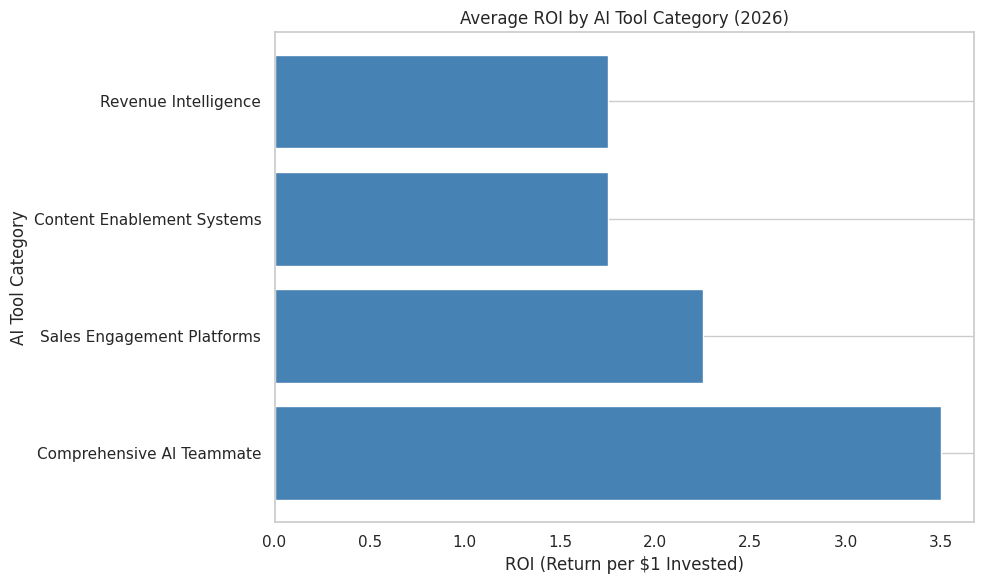
In 2026, AI adoption across research and intelligence functions has also become more measurable. Many companies now report clear returns on investment within the first year, often achieving two to five times ROI through time savings, higher win rates, and improved deal quality. For startups, AI tools enable affordable and instant market validation. For enterprises, they unlock deep competitive monitoring and enterprise-wide knowledge activation. This broad spectrum of use cases means AI research platforms are no longer optional enhancements; they are critical infrastructure for modern businesses.
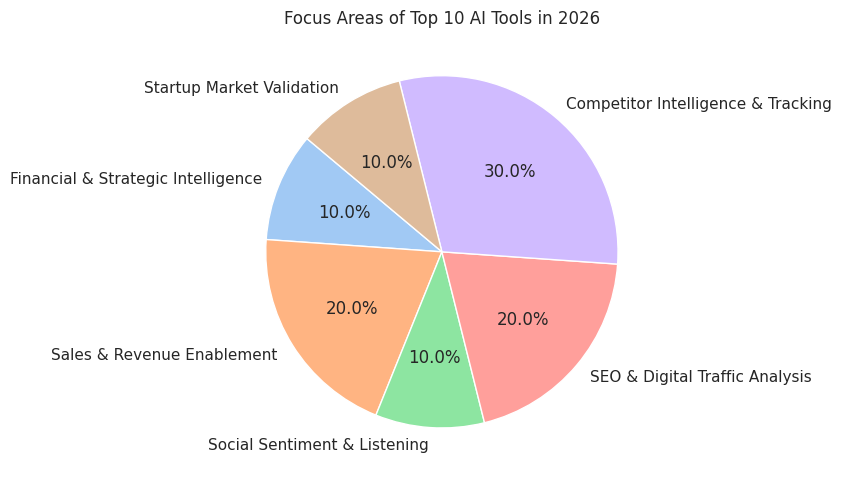
At the same time, the competitive landscape of AI tools has matured significantly. The market now includes highly specialized platforms designed for different needs. Some tools focus on financial and strategic intelligence, helping executives analyze filings and earnings calls. Others specialize in social listening and consumer sentiment. Some monitor competitor websites and digital footprints in real time. Others optimize SEO, track search demand, or integrate directly into sales workflows with battlecards and win/loss insights. There are also lightweight solutions that give startups instant market sizing and validation without the cost of traditional research firms.
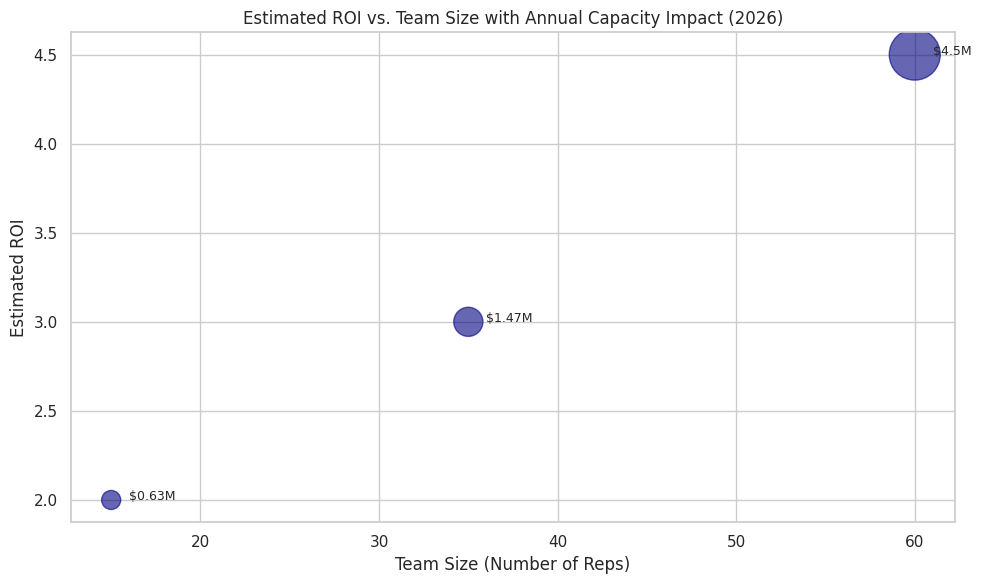
This specialization reflects a broader industry shift. Success no longer comes from collecting the most data. Data is now abundant and easily accessible. Instead, success depends on how quickly teams can synthesize information and turn it into action. The best AI tools are those that seamlessly fit into daily workflows, connect with existing systems, and deliver clear recommendations rather than overwhelming users with raw numbers.
This guide explores the top 10 AI tools for market research and competitive analysis in the world in 2026. Each platform featured has been selected based on its innovation, real-world performance, scalability, and measurable business impact. Together, they represent the most advanced technologies available for organizations seeking faster insights, smarter strategies, and stronger competitive positioning.
Whether the goal is tracking competitors, understanding customer sentiment, forecasting demand, improving SEO visibility, enabling sales teams, or validating new ideas, these AI-powered tools provide the foundation for data-driven growth. By adopting the right mix of solutions, businesses can move beyond reactive research and embrace proactive intelligence—where every decision is supported by timely, accurate, and actionable insights.
For professionals in strategy, marketing, product, and revenue operations, this list serves as a roadmap to the future of market research. The tools outlined here do not simply inform decisions; they empower organizations to act decisively and stay ahead in an increasingly competitive global marketplace.
Before we venture further into this article, we would like to share who we are and what we do.
About 9cv9
9cv9 is a business tech startup based in Singapore and Asia, with a strong presence all over the world.
With over nine years of startup and business experience, and being highly involved in connecting with thousands of companies and startups, the 9cv9 team has listed some important learning points in this overview of the Top 10 AI Tools For Market Research and Competitive Analysis in 2026.
If you like to get your company listed in our top B2B software reviews, check out our world-class 9cv9 Media and PR service and pricing plans here.
Top 10 AI Tools For Market Research and Competitive Analysis in 2026
1. AlphaSense
AlphaSense is widely recognized in 2026 as a premium AI-powered platform for strategic and financial research. With exceptional client adoption across top global corporations and financial institutions, it serves as a core digital research assistant for thousands of enterprises around the world.
Business Milestones and Client Reach
AlphaSense has seen extraordinary financial and operational growth, marking its reputation as a preferred platform for market research. Its high penetration into elite business circles is highlighted by the following data:
Table: AlphaSense Market Adoption and Growth Metrics
| Business Metric | Value | Interpretation |
|---|---|---|
| Annual Recurring Revenue (ARR) | Over $500 million (Oct 2025) | Signifies 73% year-over-year growth |
| Customer Base | More than 6,500 enterprise clients | Includes Microsoft, Pfizer, Google, and Nvidia |
| Adoption by S&P 100 | 88% | Standard tool for major corporate strategy teams |
| Penetration into Asset Management Firms | 90% | Widely used by top global investment firms |
| Adoption by Investment Banks | 80% | Essential for financial diligence and research |
| Enterprise Contract Size | $10K–$20K per user; $50K–$100K deals | Larger clients spend up to $1M+ annually |
| Average ARR per Customer | Grew from $28K to $66K in 3 years | Reflects increasing client value and usage depth |
Technology Capabilities Driving AlphaSense’s Value
The platform’s impact goes beyond scale. Its technological sophistication enables users to process vast volumes of unstructured data quickly and insightfully:
- Smart Synonyms: This AI mechanism interprets user intent and maps queries to semantically similar industry terms, e.g., interpreting “market size” to include “TAM” or “industry volume.” This ensures a broader, more relevant dataset without requiring manual input refinement.
- Content Integration: AlphaSense aggregates insights from over 10,000 premium data sources, including:
- SEC filings
- Earnings calls
- Broker research
- Expert interview transcripts (enhanced post-acquisition of Tegus in 2024)
- Agentic Workflows and Digital Analysts:
- Deep Research: Automatically compiles key insights from millions of documents.
- AI Agent Interviewer: Mimics analyst behavior to produce SWOT analyses, summarize diligence notes, and benchmark competitive signals.
- These agents save between 50% to 75% of time traditionally spent on manual research and maintain a document processing accuracy of 50% to 95%.
Table: AlphaSense Core Technology Overview
| Feature Name | Function Description |
|---|---|
| Smart Synonyms | Understands user intent; expands keyword coverage intelligently |
| Deep Research | Summarizes long-form financial documents and expert transcripts |
| AI Agent Interviewer | Performs autonomous competitive benchmarking and strategic analysis |
| NLP-Driven Sentiment | Quantifies tone and subjectivity in financial disclosures and earnings transcripts |
| Document Universe Size | Over 10,000 licensed and proprietary content sources |
Sentiment Analysis for Market Perception Tracking
A standout feature of AlphaSense is its sentiment analysis module, which uses advanced NLP to quantify tone, emotional inflection, and sentiment shifts in company statements and analyst coverage. These numerical sentiment scores reveal early signals of:
- Market optimism or pessimism
- Investor reactions to executive statements
- Shifting analyst tone before stock performance changes
Table: Sentiment Intelligence Use Cases
| Use Case | Strategic Outcome |
|---|---|
| Earnings Call Sentiment Change | Predicts market direction based on executive communication trends |
| Analyst Report Tone Shifts | Gauges confidence in sector trends or leadership commentary |
| Sentiment Scoring Trends | Identifies early warning signs of volatility or sentiment mismatches |
Strategic Benefits for Enterprises
AlphaSense positions itself as more than a research platform—it’s a competitive edge enabler. By automating manual data-gathering steps and converting raw content into actionable intelligence, businesses gain:
- Quicker time to insight
- Sharper competitive benchmarking
- Data-backed strategic decisions
These advantages make AlphaSense indispensable for roles in:
- Corporate Strategy
- Investment Analysis
- Competitive Intelligence
- Private Equity and Venture Capital
- Strategic Consultancy
Conclusion: AlphaSense as a Leading AI Tool for 2026
With a strong combination of technology, speed, and depth, AlphaSense in 2026 continues to redefine what AI-enabled research can achieve. From its rich database of financial intelligence to its intelligent agents and sentiment tracking features, it equips business leaders, analysts, and strategists with the tools they need to stay ahead in rapidly evolving markets.
As enterprises increasingly depend on data-driven decisions, AlphaSense’s blend of automation, insight, and comprehensiveness establishes it as one of the top 10 AI tools for market research and competitive analysis globally in 2026.
2. 6sense

In 2026, 6sense has solidified its reputation as one of the most innovative and transformative AI tools used for market research and competitive analysis. Originally known for its marketing capabilities, 6sense now plays a critical role in the broader revenue operations ecosystem. Its advanced AI-driven systems not only help identify sales opportunities early but also enable organizations to take timely, data-backed actions in highly competitive B2B markets.
Transforming Market Intelligence Through Signalverse and Buyer Prediction
6sense’s strength lies in its ability to process vast quantities of behavioral and intent data from the market. Its proprietary “Signalverse” engine collects trillions of buyer signals across digital channels to identify high-potential accounts, even before those prospects interact with sales teams. This predictive insight enables businesses to approach the right buyers at the right time.
This capability has significantly changed how B2B organizations conduct market research, identify sales opportunities, and understand competitive positioning.
Key Functionalities Powered by AI and Agentic Design
In 2025, 6sense launched one of its most transformative features—RevvyAI, an AI-driven conversational interface that acts as a command center for revenue teams. This feature allows users to:
- Use natural language to set up custom signals
- Create targeted audience segments
- Launch campaigns across multiple marketing and sales channels
- Eliminate traditional research bottlenecks and operational delays
The automation of these tasks addresses what 6sense identifies as “routing failures”—scenarios where leads fall through due to a lack of timely intelligence. With RevvyAI, companies reduce manual research and improve campaign execution speed dramatically.
Table: RevvyAI Capabilities and Use Cases
| Feature | Description | Strategic Benefit |
|---|---|---|
| Conversational Commands | Configure actions through natural language | Faster campaign setup, minimal training needed |
| Audience Segmentation | AI-driven identification of in-market personas | High campaign relevance and precision targeting |
| Multi-channel Activation | Launch campaigns across email, social, and display simultaneously | Unified marketing execution with broader reach |
| Signal-based Prioritization | Ranks accounts based on real-time intent and behavior | Ensures focus on high-potential opportunities |
Statistical Impact on Revenue Outcomes
Data from the 2025 “Buyer Experience Report” and enterprise use cases show that the implementation of 6sense leads to significant performance improvements across key sales and marketing metrics.
Table: Measurable Performance Outcomes Using 6sense
| Metric | Performance Gain | Strategic Interpretation |
|---|---|---|
| Sales Cycle Duration | 52% reduction (69 days to 33 days) | Speeds up pipeline movement and deal closures |
| Conversion Rate (MQL to Meeting) | 10–15% lift | Improved targeting through AI-generated insights |
| Win Rate | 4x increase compared to non-AI leads | Higher likelihood of closing sales with data-qualified leads |
| Average Deal Size (ADS) | 46%–63% larger than average | Higher revenue from AI-informed account targeting |
| Pipeline ROI (Conversational AI) | 22x return from email automation | Substantial return from intelligent automation workflows |
Case Studies Illustrating Real-World Success
Companies using 6sense have experienced transformative growth in their market approach. Two notable examples include:
- Rithum: Within 90 days of activating 6sense, the company shifted from inactive to a high-performing pipeline generator. Over 58% of its sales pipeline was composed of 6sense Qualified Accounts (6QAs), with deal sizes 22% higher than those from other sources.
- Socure: Generated $52 million in pipeline within the first year. The company achieved a 60% faster engagement time on accounts flagged as high-potential by 6sense signals.
Table: Enterprise Case Study Impact with 6sense
| Company | Revenue Outcome | Strategic Takeaway |
|---|---|---|
| Rithum | 58% of pipeline via 6QAs | AI qualification drives higher conversion and deal size |
| Socure | $52M pipeline generated | Faster identification and response to surging demand |
Financial Performance and Market Recognition
Despite broader corrections in private tech company valuations during early 2026, 6sense has maintained financial strength due to consistent innovation and strong enterprise adoption.
Table: Financial and Market Metrics for 6sense (2026)
| Metric | Value | Strategic Interpretation |
|---|---|---|
| Company Valuation | $5.2 Billion | Resilience amid shifting investor sentiment |
| Revenue in 2023 | $210 Million | High earnings powered by enterprise adoption |
| Annual Growth Rate | 40% | Sustained expansion in competitive enterprise tech market |
| Gartner Magic Quadrant Status | 5 Years as a Leader | Continued recognition as a category-defining solution |
Why 6sense is Among the Top 10 AI Tools for Market Research in 2026
6sense’s AI-first approach reshapes how modern organizations approach revenue generation, competitive tracking, and customer acquisition. By combining predictive analytics, real-time signal processing, and agentic automation, 6sense empowers teams to convert insights into revenue with remarkable speed and accuracy.
Its multi-layered value across marketing, sales, and operations makes it a top-tier tool for any enterprise looking to sharpen its competitive analysis and drive growth through actionable market intelligence.
3. Brandwatch

In 2026, Brandwatch stands out as one of the most advanced AI tools for market research and competitive analysis. As the digital ecosystem becomes increasingly saturated with generic and low-value content, often referred to as “AI slop,” businesses require more reliable and insightful platforms to understand genuine consumer behavior. Brandwatch has emerged as a trusted solution by offering deep consumer intelligence capabilities across a broad range of modern digital touchpoints.
Real-Time Sentiment Analysis and Market Trend Detection
Brandwatch’s core strength lies in its ability to analyze millions of online conversations in real time using natural language processing (NLP). The platform tracks over 100 million content sources, including blogs, forums, mainstream social media platforms, video content, live streams, and even podcasts. Its sentiment analysis engine maintains an accuracy rate of approximately 85%, making it one of the most dependable platforms for brands seeking clarity amid digital noise.
One of the most significant contributions of Brandwatch in 2026 is helping brands spot emerging themes and reputational risks before they escalate. For example, in its annual “State of Social” report, Brandwatch found that mentions of “hidden fees” across industries rose by 40% in 2025. This early identification of customer dissatisfaction allowed brands to proactively revise pricing and communication strategies, avoiding reputational damage and aligning closer to customer expectations.
Table: Key Capabilities of Brandwatch and Strategic Benefits
| Feature | Brandwatch Capability | Strategic Benefit |
|---|---|---|
| Sentiment Accuracy | 85% | Enables precise emotional and opinion tracking across audiences |
| Source Monitoring | 100M+ online sources including TikTok and podcasts | Captures a holistic and current digital footprint of consumers |
| Trend Detection | Real-time tracking of consumer issues (e.g., “hidden fees”) | Allows companies to adapt products and messaging based on live insights |
| Market Alert System | Instant notifications of trending topics or crises | Helps manage reputation by enabling faster response to public sentiment |
Revenue Impact and Case-Based Results
Brandwatch’s influence extends beyond monitoring. It actively contributes to business growth by improving public relations, preventing churn, and increasing brand loyalty. Companies that have integrated Brandwatch into their operations have reported significant improvements in brand health and revenue generation.
For instance, Bimbo, a global food manufacturing company, attributed over $580,000 in direct sales to its Brandwatch-enabled real-time engagement campaigns. Similarly, Metia, a digital agency, reported a 25% increase in positive brand mentions and a 15% reduction in negative mentions after using Brandwatch for crisis detection and response.
Table: Business Value Metrics Generated by Brandwatch
| Performance Indicator | Outcome Achieved | Use Case Application |
|---|---|---|
| Direct Sales Uplift | $580,000 increase | Bimbo’s live response campaign based on real-time insights |
| Positive Brand Sentiment Growth | 25% improvement | Metia’s engagement strategy during a brand reputation event |
| Negative Sentiment Decline | 15% decrease | Crisis intervention guided by Brandwatch monitoring |
| Customer Churn Reduction | Over 30% reduction | Addressing dissatisfaction signals proactively |
| Typical Revenue Range | Between $100M to $250M | Reflects mature adoption across enterprise markets |
Crisis Management and Brand Responsiveness
In the current digital landscape, speed of response has become a key differentiator. Approximately 60% of consumers expect brands to respond to complaints or concerns within one hour. Brandwatch equips companies with the ability to meet these expectations by providing alert-driven dashboards, actionable insights, and customizable workflows that prioritize urgent customer signals.
Its effectiveness in handling reputation-sensitive environments has positioned it as an essential part of the communications stack for companies that operate in high-stakes industries such as consumer goods, travel, telecommunications, and financial services.
Organizational Scale and Ownership
Brandwatch operates with a workforce of around 1,000 employees and maintains its headquarters in Brighton, United Kingdom. The company’s global presence and consistent innovation have been supported under the ownership of Cision, a global leader in public relations and media monitoring software.
Table: Brandwatch Company Profile Overview
| Attribute | Detail |
|---|---|
| Headquarters | Brighton, United Kingdom |
| Ownership | Part of Cision Group |
| Global Employee Count | Approximately 1,000 |
| Key Markets Served | Consumer Brands, Agencies, Enterprises |
| Competitive Differentiator | Strong sentiment AI across modern digital formats |
Conclusion: Why Brandwatch Is a Top AI Tool for Market Intelligence in 2026
Brandwatch has successfully positioned itself as a critical intelligence tool for any brand serious about understanding market sentiment, identifying competitive shifts, and responding in real time. Its combination of high-accuracy sentiment detection, expansive media coverage, and measurable ROI makes it one of the top 10 AI tools for market research and competitive analysis in 2026.
4. Visualping

Visualping has established itself as one of the most vital AI-powered tools in the competitive analysis landscape by focusing on a key intelligence source often overlooked—live website content. In 2026, it plays a major role in how organizations across industries monitor and respond to real-time updates made by competitors on their websites. From pricing strategy shifts to regulatory compliance changes, Visualping enables businesses to stay ahead by tracking what truly matters on digital properties.
Strategic Value of Website Monitoring in Market Research
Unlike traditional SEO platforms that focus on keywords and backlinks, Visualping specializes in detecting and analyzing actual content modifications. These updates often carry strategic business signals such as product launches, service feature enhancements, or pricing structure changes. Visualping empowers companies to capture these signals at scale, enabling faster responses and more informed strategic decisions.
A striking 85% of Fortune 500 companies are reported to use Visualping in 2026 to track key competitor website updates. These include changes to promotional language, pricing updates, campaign launches, legal disclaimers, and product availability. The tool is particularly valued for its AI-powered summaries that differentiate between significant updates and routine layout or design adjustments.
Table: Strategic Features of Visualping and Competitive Use Cases
| Feature Type | Capability Description | Business Application |
|---|---|---|
| AI Content Change Detection | Filters meaningful text changes from irrelevant layout shifts | Prevents false alerts; prioritizes business-critical updates |
| Automated Summarization | Plain-language summaries of detected changes | Saves analyst time and improves team communication |
| Real-Time Monitoring | Immediate alerts on web changes | Enables fast action in pricing or messaging adjustments |
| Cross-Device and Page Support | Tracks changes on mobile and desktop versions | Comprehensive visibility across device-specific user experiences |
| Battlecard Integration | Feeds competitive intelligence into sales enablement tools | Allows teams to adjust messaging prior to client or prospect interactions |
Adoption Across Industries and Business Functions
Visualping is used globally by over 2 million users. While e-commerce platforms leverage it to monitor competitive pricing and inventory availability, B2B enterprises integrate it into their revenue operations and sales intelligence workflows. For example, if a competitor modifies their value proposition or feature set on their landing page, Visualping flags this change, allowing internal teams to adjust sales pitches, proposal narratives, and digital ad messaging within hours.
This form of rapid reaction and message agility is essential in industries where market positioning can be impacted by even subtle shifts in competitor strategies.
Pricing Tiers and Operational Scalability
Visualping offers a flexible pricing structure that supports a range of use cases—from individual marketers to large-scale enterprise surveillance teams. The platform is designed for both low-frequency usage and extremely high-volume monitoring, ensuring it meets the needs of various organizational sizes.
Table: Visualping Pricing Structure and Tier Capabilities (2026)
| Plan Tier | Monthly Pricing (2026) | Monitoring Limits | Suitable For |
|---|---|---|---|
| Free | $0 | 150 checks/month, up to 5 pages | Individual users with light monitoring |
| Starter | From $14 | Higher page limits and scan frequency | Small marketing teams |
| Business | From $100 | 2,000+ checks/month, unlimited pages | Medium-sized businesses |
| Enterprise | Custom Pricing | 50,000+ checks/month, priority support | Large corporations with aggressive tracking |
These pricing tiers offer organizations a clear and scalable path as their monitoring needs grow. The Enterprise tier, in particular, supports automated integrations into CI/CD pipelines and sales enablement tools, providing seamless competitive awareness at every stage of the funnel.
Recognitions and Industry Validation
TechRadar and other analysts have consistently recognized Visualping for its excellence in content monitoring. In 2026, it is praised for being one of the most reliable and precise tools for tracking digital footprint changes. Whether it’s used for SEO regression alerts, legal compliance tracking, or pricing surveillance, the platform delivers consistently high utility.
Visualping’s value is further amplified by its application across different business functions:
- Marketing teams use it to ensure SEO and brand messaging consistency.
- Sales teams rely on it for battlecard updates and competitive talk-track alignment.
- Product and Legal departments apply it for monitoring compliance statements and regulatory changes posted on government or competitor sites.
Table: Visualping Functional Matrix by Business Use Case
| Business Unit | Use Case Application | Strategic Value Provided |
|---|---|---|
| Sales Enablement | Competitor talk-track intelligence | Real-time sales playbook adaptation |
| Marketing | SEO and brand language monitoring | Ensures consistency and messaging superiority |
| Product Management | Feature comparison and innovation benchmarking | Tracks industry updates and positioning shifts |
| Legal and Compliance | Regulatory text updates | Mitigates compliance risks and improves audit trails |
| E-commerce Teams | Competitor price tracking | Supports dynamic pricing strategies |
Conclusion: Why Visualping Is a Top AI Tool for Competitive Intelligence in 2026
Visualping continues to dominate the market research and intelligence space by addressing a critical yet often neglected aspect—live content and message tracking. In a world where even small website changes can reflect larger shifts in business direction, Visualping’s ability to catch and summarize these changes in real time offers a substantial strategic advantage.
Its wide adoption across industry sectors, combined with AI precision, makes it a key component of the modern digital intelligence stack. For organizations committed to staying informed, agile, and responsive in fast-changing markets, Visualping stands as one of the top 10 AI tools for market research and competitive analysis in 2026.
5. Similarweb

In 2026, Similarweb has emerged as one of the most trusted AI tools for market research and competitive analysis by adapting to the rapidly evolving landscape of AI-driven search and generative discovery. As traditional search engines begin to share the digital spotlight with conversational AI platforms, Similarweb offers unparalleled visibility into how businesses are discovered, how users behave across multiple channels, and how competitors are performing in these dynamic environments.
Navigating the Rise of Generative Discovery Ecosystems
One of the most impactful shifts in digital behavior in recent years has been the rise of AI-powered discovery tools such as ChatGPT and Google Gemini. Similarweb recognized this trend early and launched its Gen AI Intelligence Toolkit, a strategic product designed to help marketers and analysts understand how traffic flows from generative AI platforms to websites.
In June 2025, Similarweb reported a significant 357% year-over-year increase in referral visits from AI platforms, exceeding 1.1 billion visits. This highlights the platform’s value in providing insights not only into traditional search performance but also into the new patterns of user discovery emerging from generative engines.
Table: Similarweb’s Generative Engine Optimization (GEO) Insights and Metrics
| Key Metric | Value Achieved | Strategic Context |
|---|---|---|
| AI Referral Traffic (June 2025) | Over 1.1 billion visits | Reflects 357% YoY growth due to rise of ChatGPT and Gemini referrals |
| Gen AI App Download Surge | 319% growth | Indicates mainstream user behavior shifting to generative discovery |
| ChatGPT-Google Usage Overlap | 95% | Shows multi-channel consumer research combining AI and search |
| Referral Conversion Rate (AI→Site) | Approximately 7% | Strong performance for transactional websites via Gen AI traffic |
Analyzing Market Behavior and Competitive Digital Footprint
Similarweb is especially useful for businesses aiming to understand how users move through digital spaces. Its behavioral analytics engine helps uncover referral sources, time on site, bounce rates, and competitive benchmarks across different sectors. For market researchers and digital strategists, this level of visibility is essential for adjusting campaigns, content strategies, and platform distribution.
Marketers rely on Similarweb to answer strategic questions such as:
- Where is our traffic really coming from?
- How does our competitor’s web performance compare?
- Which AI assistants are driving real user engagement?
Table: Core Functionalities of Similarweb in 2026
| Function Category | Platform Capability | Business Value Delivered |
|---|---|---|
| AI Referral Intelligence | Tracks website traffic from Gen AI engines | Guides GEO strategy and AI assistant integration |
| Competitive Benchmarking | Compares traffic, engagement, and keyword data against rivals | Reveals gaps and opportunities in digital market presence |
| Channel Behavior Mapping | Maps how users move across AI tools, search engines, and sites | Helps optimize multi-channel marketing strategies |
| Web Performance Analytics | Provides in-depth website metrics (time, bounce rate, referrals) | Informs content, UI, and campaign design decisions |
Market Penetration, Global Reach, and Pricing Model
Similarweb is one of the most widely used platforms in the digital intelligence space, particularly in the United States, where it holds a dominant 53% market share among professional research tools. It has been adopted extensively by enterprise-grade organizations for its robust data accuracy and strategic depth, though the tool’s learning curve and pricing remain a consideration for small business users.
Table: Commercial and Market Overview of Similarweb
| Commercial Attribute | Value Range | Interpretation |
|---|---|---|
| Monthly Pricing (Professional Tier) | $199 – $799 | Designed for professionals and mid-large enterprises |
| Revenue Multiple (Secondary) | 1.52x | Valuation benchmark for comparable digital intelligence platforms |
| U.S. Market Share | 53% | Indicates leadership in market research and digital analytics sector |
Despite its premium price point, Similarweb is regarded as offering top-tier data integrity, which justifies its adoption by large-scale businesses, financial institutions, and global market research teams.
Why Similarweb Is Ranked Among the Top AI Tools for Market Intelligence in 2026
Similarweb delivers unmatched visibility into how consumers discover content, navigate across platforms, and engage with brands online. Its pivot to Generative Engine Optimization (GEO) has allowed businesses to understand and adapt to the new age of AI-led discovery, giving them a competitive advantage in both search and conversational ecosystems.
By bridging the gap between traditional digital intelligence and modern AI-powered discovery patterns, Similarweb stands as one of the top 10 AI tools for market research and competitive analysis in 2026—offering strategic clarity at a time when digital behavior is more fragmented and complex than ever before.
6. Klue

In the global landscape of market research and competitive analysis in 2026, Klue has positioned itself as one of the top AI tools trusted by product marketers, revenue teams, and sales leaders. Designed specifically for competitive enablement, Klue enables businesses to centralize, distribute, and activate insights about their competitors in a way that directly impacts deal outcomes and strategic decision-making.
Unlike traditional research platforms, Klue focuses not only on collecting data but also on making it useful and accessible—particularly during high-stakes sales cycles. By connecting CRM, communication tools, and AI-powered analytics, the platform gives companies a deeper understanding of why they win or lose deals and how to respond competitively.
Win/Loss Analysis as a Strategic Advantage
A core feature of Klue in 2026 is its integrated win/loss analysis engine. By pulling in data from platforms like Salesforce, the system identifies clear patterns in competitive deal performance. Teams can uncover which competitors are most likely to beat them, why certain messaging works, and how product gaps influence conversion rates. This automated feedback loop helps shape marketing strategy, sales training, and even product development priorities.
Table: Klue’s AI Capabilities in Competitive Win/Loss Analysis
| Feature Category | Description of Functionality | Strategic Business Value |
|---|---|---|
| AI Win/Loss Attribution | Analyzes CRM outcomes to find competitor-specific insights | Reveals deal drivers and blockers |
| Integration with Salesforce | Real-time sync with opportunity data | Automatically links battlecards with active deals |
| Competitive Trend Detection | Aggregates competitor mentions, pricing changes, product releases | Enables proactive sales and roadmap adjustments |
| Deduplication Intelligence | Filters repeated syndicated news articles | Reduces noise and improves focus on unique competitive events |
| Feedback Loop to Product Teams | Win/loss findings influence product features and roadmap decisions | Aligns R&D efforts with market opportunities |
Sales Enablement Through Real-Time Battlecards
Klue is particularly powerful when used to equip sales teams with competitive intelligence at the moment they need it most. Its dynamic battlecards—digital one-pagers filled with tactical insights—can be embedded directly into sales workflows via integrations with Slack, Salesforce, and Microsoft Teams.
Sales reps use these battlecards during live deal cycles to counter objections, compare product features, and sharpen messaging based on current rival strategies. According to customer case studies, such as Alteryx, Klue helped increase battlecard adoption by 40%, resulting in better-prepared sales teams and higher conversion rates.
Table: Klue’s Sales Enablement and Deal Impact Metrics
| Performance Indicator | Value Achieved | Business Impact Description |
|---|---|---|
| Win Rate Lift | Up to 50% | Enhanced through rigorous battlecard and win/loss programs |
| Battlecard Adoption Increase | 40% (Alteryx case study) | Higher internal usage driven by usability and accessibility |
| G2 Satisfaction Rating | 4.7 out of 5 | Reflects user appreciation across enterprise clients |
| Typical Discount on Deals | 11% | Useful benchmark for enterprise-level contract negotiations |
| Entry-Level Contract Cost | Starts at $10,000/year | Affordable entry for mid-sized competitive teams |
User Experience and Platform Evolution
Klue has received widespread praise for its intuitive interface, fast onboarding, and responsive customer support. At the same time, power users note that mastering its more advanced features may require a bit of a learning curve. To address this, Klue introduced new information deduplication logic in 2026, significantly reducing content overload for analysts by filtering redundant competitor stories or syndicated press releases.
This refinement streamlines content delivery and helps intelligence professionals focus only on what’s relevant, further boosting the platform’s usability and operational efficiency.
Table: Klue Platform Experience Matrix (2026)
| Evaluation Dimension | User Feedback Summary |
|---|---|
| Interface Design | Clean, simple, easy to navigate |
| Learning Curve (Advanced Use) | Moderate complexity, requires onboarding |
| Content Quality | High, with deduplication reducing noise |
| Integration Flexibility | Strong compatibility with CRM, Slack, Teams |
| Support & Onboarding | Reliable, guided setup and customer success team |
Conclusion: Why Klue Is One of the Top 10 AI Tools for Market Research in 2026
Klue stands out in the competitive intelligence landscape not just for collecting insights, but for activating them. Its focus on win/loss analysis, battlecard automation, and seamless sales enablement makes it a go-to platform for organizations that need to turn research into revenue.
By delivering real-time intelligence to sales teams, informing product decisions, and refining marketing strategies based on competitive patterns, Klue enables companies to stay ahead in crowded markets. As such, it ranks among the top 10 AI tools for market research and competitive analysis in 2026.
7. Crayon

Crayon stands among the most powerful AI tools for market research and competitive analysis in 2026, particularly favored by enterprise organizations that demand both depth and accuracy. Unlike broader tools that cover hundreds of competitors at a surface level, Crayon focuses on analyzing a select few with unmatched granularity. It monitors digital activity across an extensive range of data sources, turning complex competitor behavior into structured intelligence that directly supports strategic planning, product development, and sales enablement.
With its strong emphasis on revenue enablement, Crayon enables companies to align their competitive research efforts with measurable business outcomes. Its platform is designed not only to gather data but also to generate actionable insights that influence decision-making at both operational and executive levels.
Comprehensive Data Collection Across Digital Channels
Crayon differentiates itself by aggregating data from more than 300 million sources, including official websites, SEC filings, social platforms, product review forums, news outlets, and intellectual property databases. This breadth ensures that no strategic update, product change, or public reaction is missed.
The platform is built to deliver insights into a company’s full digital footprint, uncovering key moves like messaging shifts, pricing updates, patent filings, legal disclosures, and campaign launches—providing a real-time lens into competitor evolution.
Table: Crayon’s Intelligence Capabilities and Use Case Applications
| Intelligence Feature | Platform Capability | Strategic Business Application |
|---|---|---|
| Multi-Source Monitoring | Tracks 300M+ sources including patents, reviews, filings | Comprehensive view of competitor actions across multiple domains |
| Digital Footprint Aggregation | Maps content updates, design changes, campaigns, and disclosures | Identifies strategic shifts early |
| Revenue Enablement Reporting | Links intel insights to pipeline and deal success | Demonstrates ROI from competitive initiatives |
| Competitive Alerts & Tagging | AI-based tagging of high-priority competitive events | Ensures timely internal stakeholder awareness |
High-Touch Enterprise Onboarding and Accuracy Focus
Crayon is particularly popular among enterprise-level companies that require a more hands-on approach. Its onboarding process spans 7 to 8 weeks and includes dedicated customer success managers, custom playbook design, and precision tuning of monitored competitors. This structured setup ensures higher data relevance and reduces noise—making the platform especially effective in industries where intelligence accuracy directly impacts revenue outcomes.
Crayon’s customer portfolio includes major names such as Gong, Mailchimp, and Dropbox, which depend on detailed competitive coverage and strategic clarity.
Table: Crayon Enterprise Implementation and Support Features
| Enterprise Feature | Description | Strategic Benefit |
|---|---|---|
| Dedicated Success Managers | Personalized onboarding and monitoring support | Tailored implementation for each business unit |
| 7–8 Week Onboarding Timeline | Structured rollout with integrated enablement tools | Guarantees consistent competitive insight delivery |
| Precision Tuning per Competitor | Focused data coverage on top rivals | Reduces irrelevant insights and increases signal strength |
Quantifiable Business Impact and Win Rate Improvements
Organizations using Crayon have reported significant improvements in their win/loss ratios. According to enterprise CI programs, Crayon users have seen a 22% increase in win rates, particularly in contested deals where real-time insights made the difference.
Additionally, the platform’s Executive Summary dashboard transforms passive data points into actionable revenue intelligence. Leaders can view metrics like influenced revenue, deal outcomes, and content engagement to evaluate the direct impact of their competitive intelligence initiatives.
Table: Crayon Performance Metrics and Strategic Results
| Performance Indicator | Reported Outcome | Business Interpretation |
|---|---|---|
| Win Rate Uplift | 22% increase | Improved competitiveness in live deal environments |
| Starting Price Point | $15,000+/year | Premium solution designed for mid-to-large enterprises |
| Data Types Monitored | 100+ | Includes legal, product, social, and technical sources |
| G2 Ease of Use Rating | High marks | Praised for dashboard usability despite robust feature set |
Why Crayon Is a Top AI Tool for Competitive Intelligence in 2026
Crayon excels in transforming fragmented digital data into structured intelligence that supports revenue outcomes. Its rigorous onboarding, unmatched monitoring breadth, and sharp focus on revenue enablement make it a strategic choice for companies competing in high-stakes markets.
With advanced capabilities like real-time competitor tracking, CRM-linked win/loss analysis, and stakeholder-ready dashboards, Crayon empowers organizations to not just react—but lead—with intelligence. It remains one of the top 10 AI tools globally for market research and competitive analysis in 2026.
8. Stravito
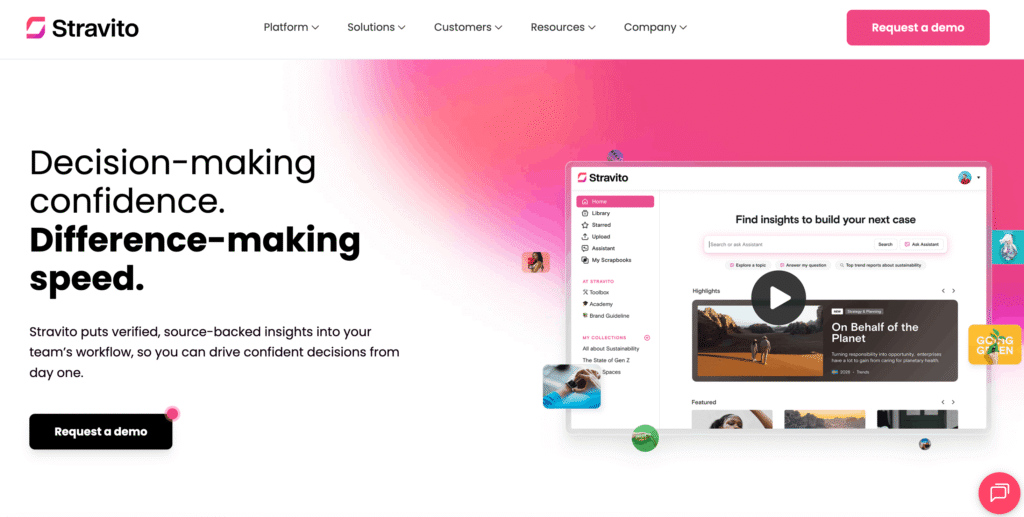
Stravito has become a standout AI platform in 2026 for enterprises that generate vast amounts of internal research and need a reliable system to organize, discover, and activate insights. Unlike generic data storage systems, Stravito is built specifically to serve as a central intelligence hub for multinational companies, transforming scattered knowledge into structured, actionable insights. Leading brands such as Nestlé, Roche, and Heineken rely on Stravito to unlock the value hidden within their internal research archives, syndicated data, and market intelligence.
This AI-powered tool supports strategic business functions by combining advanced generative search, AI personas, and intuitive knowledge curation—all aimed at turning insights into faster, smarter decisions.
AI Personas and Generative Intelligence for Knowledge Discovery
A major innovation introduced by Stravito in late 2025 was the AI Personas feature. This functionality allows users to interact with their internal research as if they were engaging in a natural conversation. For instance, a marketing executive targeting Gen Z can engage with an AI persona designed to reflect that demographic’s behaviors and preferences—drawing only from the company’s verified and trusted internal studies.
By narrowing the response base to validated corporate knowledge rather than third-party internet data, Stravito ensures a high degree of relevance, security, and accuracy. This makes strategic planning more aligned with internal findings and less prone to misinterpretation from external noise.
Table: Stravito’s Core Functionalities and Strategic Applications
| Functional Capability | Description | Strategic Benefit |
|---|---|---|
| AI Persona Interaction | Chat with AI personas that simulate target demographics or market views | Personalized, data-backed scenario modeling |
| Generative Search Engine | Retrieves insights from across internal datasets using natural language | Simplifies knowledge retrieval for non-technical users |
| Insight Brief Creation | Transforms research into narrative strategic briefs | Helps business teams quickly act on insights |
| Smart Categorization | Organizes diverse data types into searchable, tagged libraries | Makes company-wide research easily accessible |
| Data-to-Action Connectivity | Links data points to next-step recommendations | Bridges the gap between analytics and execution |
Enterprise Impact and Use Case Highlights
Stravito’s most notable strength lies in how it improves time to decision. In a compelling case study from Nestlé USA, the company reported that research usage levels previously seen over a 10-year period were achieved within just one month of adopting Stravito. This highlights the platform’s impact on unlocking hidden insights and democratizing access to institutional knowledge across departments.
Furthermore, the platform isn’t merely a repository. It is designed for activation, meaning it doesn’t stop at organizing data—it helps teams convert those insights into briefings, presentations, and strategic action plans. Its integrated storytelling approach combines visuals with summaries to guide decision-makers clearly.
Table: Measurable Outcomes and Market Presence of Stravito
| Business Metric | Performance Indicator | Interpretation and Business Relevance |
|---|---|---|
| Time to Insight Acceleration | “10 years’ usage in 1 month” (Nestlé USA case) | Demonstrates exponential efficiency gains in data utilization |
| Total Funding Secured | $23.8 million | Reflects investor confidence in enterprise-scale knowledge tech |
| Primary Competitors | Faraday, dscout | Operates in the AI knowledge management and consumer insight space |
| G2 Customer Satisfaction Rating | 4.7 out of 5 | Indicates strong user adoption and platform effectiveness |
Focused on Enterprise Insight Activation, Not Just Storage
Stravito’s value proposition is rooted in its understanding that dashboards don’t make decisions—people do. That principle shapes its product direction: the platform bridges the gap between information storage and real-time business value by enabling organizations to actively engage with insights in ways that influence daily operations and long-term strategy.
Its ability to generate “Insight-to-Action” briefs and strategic summaries transforms it from a passive archive into a decision-making assistant. Teams can download structured reports, visualize market trends, and develop consumer profiles directly from their private research database, all without needing to manually sift through documents.
Table: Stravito Functional Value Matrix by Business Role
| Business Role | Use Case Application | Strategic Benefit Delivered |
|---|---|---|
| Marketing Teams | Segment-specific insights and persona briefings | Faster campaign alignment and message targeting |
| Strategy Executives | Synthesized trends from years of reports | Accelerated decision-making on long-term business priorities |
| Research Departments | Internal knowledge categorization and retrieval | Prevents data duplication and resource waste |
| Product Development | Feature planning based on verified consumer feedback | Develops user-centric innovation initiatives |
Why Stravito Ranks Among the Top 10 AI Tools for Market Research in 2026
Stravito excels in helping large organizations reclaim control over their most valuable strategic asset—internal knowledge. With cutting-edge features like conversational AI personas, generative search, and actionable insight briefings, the platform empowers employees at every level to make smarter, faster decisions based on verified internal intelligence.
Its unique position as both a knowledge manager and an activation engine secures its place among the top 10 AI tools globally for market research and competitive analysis in 2026.
9. Semrush

Semrush has firmly established itself in 2026 as one of the most relied-upon AI tools for market research and competitive analysis. Initially recognized for its dominance in the SEO space, Semrush has evolved into a comprehensive platform that empowers businesses to understand online demand, track competitors’ content strategies, and uncover growth opportunities in real time.
Its blend of search data intelligence, competitive benchmarking, and AI-driven automation makes it essential for organizations that want to stay ahead in digital visibility, organic traffic acquisition, and consumer behavior insights.
AI Toolkit and the Power of Copilot for Market Research
A major innovation in Semrush’s platform is the integration of artificial intelligence into its workflows. The Copilot feature acts as a smart assistant that suggests what research to prioritize, automates content analysis, and even creates performance reports. This removes the manual burden on marketing teams and speeds up research cycles.
The AI Toolkit enhances the platform’s usability by offering capabilities such as:
- Automated competitor content summaries
- Generation of optimized SEO metadata
- Real-time identification of keyword trends and volume gaps
These features allow marketers, content strategists, and analysts to identify where competitors are outperforming and adjust strategies before losing share.
Table: Semrush AI Feature Set and Strategic Applications
| Feature Area | AI Capability Description | Business Application |
|---|---|---|
| Copilot Assistant | Recommends tasks and automates research reports | Saves analyst time, speeds up marketing cycles |
| Content Summary AI | Extracts insights from long competitor articles | Reduces effort in evaluating rival messaging and content strategy |
| SEO Metadata Generator | AI-driven tag and description creation | Improves ranking speed and keyword alignment |
| Demand Gap Detection | Identifies keyword areas competitors rank for but you don’t | Helps uncover lost visibility opportunities |
| Trend-Based Forecasting | Tracks keyword spikes and seasonal interest | Enables campaign timing optimization |
Real-Time Demand Analysis for Predictive Market Insights
Semrush is widely recognized among research teams for its Demand Analysis capabilities. By monitoring live keyword search volumes across different geographies and segments, the platform helps predict consumer interest levels and future purchasing intent.
This is especially useful for organizations planning product launches, pricing strategy adjustments, or market entry initiatives. With the ability to view what potential customers are searching for, businesses can create high-impact content and advertisements that align with market demand.
Table: Semrush Use Cases in Market Research and Competitive Intelligence
| Research Function | Semrush Application | Strategic Benefit Delivered |
|---|---|---|
| Competitor Gap Analysis | Identifies keywords rivals rank for but your site doesn’t | Informs content creation for traffic recovery |
| Keyword Intent Mapping | Segments keywords by purchase funnel stage | Improves alignment of content to customer journey |
| PPC Strategy Benchmarking | Analyzes where competitors spend on paid ads | Reveals advertising priorities and high-converting keywords |
| SERP Feature Monitoring | Tracks rich result formats (e.g., snippets, FAQs) | Helps tailor content for featured placements |
Pricing Plans and Adoption Across Enterprise Segments
Semrush offers a scalable pricing structure that caters to various business sizes—from solo marketers to enterprise digital teams. Each plan is designed to unlock deeper analytics as organizational needs grow.
Table: Semrush Pricing Plans and Target User Segments (2026)
| Plan Name | Monthly Pricing (2026) | Target Users | Core Functional Focus |
|---|---|---|---|
| Pro | $139.95 | Freelancers and small digital teams | SEO basics, keyword research, and traffic tracking |
| Guru | $249.95 | Agencies and mid-market businesses | Extended data, branded reports, and historical trends |
| Business | $499.95 | Large-scale enterprises | Custom APIs, high-volume reporting, and integrations |
Semrush is currently used by organizations with employee counts ranging from 1,000 to 5,000 and is embedded in technology stacks across more than 20 industries. Its versatility and AI-enhanced intelligence have made it a mainstay in the marketing strategies of both B2B and B2C brands.
Enterprise Credibility and Technology Integration
Aside from content marketers, Semrush is also trusted by technical SEO teams, performance advertisers, and business intelligence departments. Its ability to blend real-time keyword data with competitor monitoring has enabled it to become a foundational tool for organizations aiming to maximize ROI from digital channels.
Moreover, with integrations across CRM systems, CMS platforms, and web analytics tools, Semrush allows insights to flow easily across departments—ensuring that every team operates with unified, data-driven visibility.
Table: Cross-Functional Benefits of Semrush in Enterprise Environments
| Business Department | Use Case Application | Outcome Achieved |
|---|---|---|
| Marketing Strategy | Campaign forecasting and opportunity analysis | Launches aligned with demand spikes and competitor shifts |
| Sales Enablement | Organic search insights for sales materials | Better buyer targeting based on content engagement signals |
| Product Development | Feature demand tracking via keyword intent | Prioritized roadmap based on real user queries |
| Executive Leadership | Market intelligence and benchmarking reports | Strategic planning aligned with digital opportunity zones |
Why Semrush Is Among the Top 10 AI Tools for Market Research in 2026
Semrush continues to dominate the landscape of SEO and content intelligence by empowering businesses to not just compete—but lead—through data-backed strategies. Its AI-enhanced automation, coupled with powerful competitive benchmarking and keyword analysis, enables companies to tap into real-time digital behavior and adjust fast.
As digital competition intensifies across all sectors, Semrush stands out as one of the most robust and intelligent solutions in 2026 for organizations seeking to stay ahead in search rankings, content strategy, and consumer discovery.
10. IdeaProof
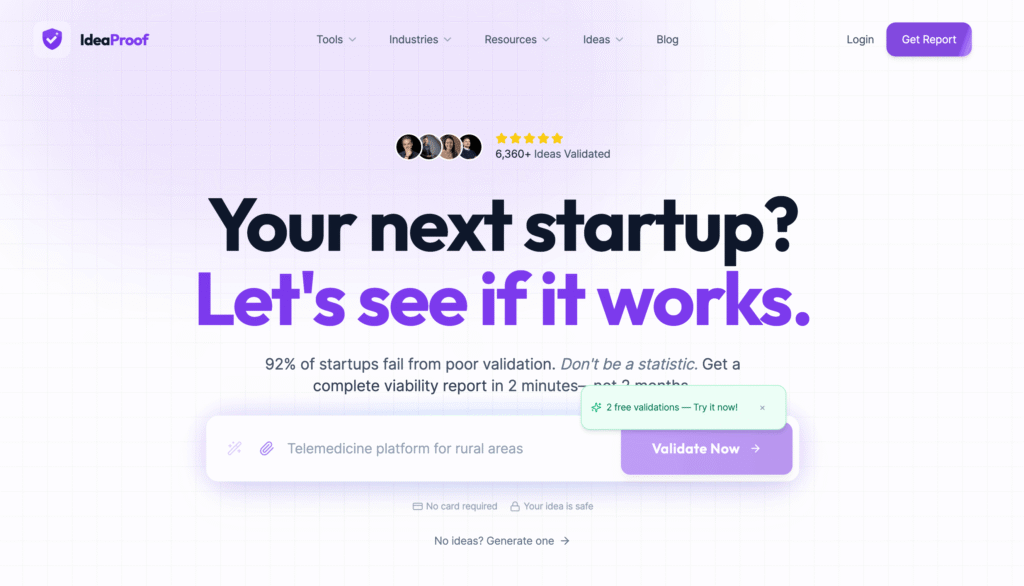
In the evolving landscape of market research and competitive analysis tools in 2026, IdeaProof has carved out a unique position as a rapid-response, AI-powered research platform purpose-built for startups and early-stage ventures. It is designed for speed, affordability, and simplicity—traits highly valued by founders in the initial phases of business ideation, market entry, and pitch preparation.
Unlike traditional market research services that require significant financial investment and long turnaround times, IdeaProof offers near-instant reports with a high degree of accuracy, powered by advanced Multi-AI model architecture. It democratizes access to market intelligence by delivering detailed insights within seconds and at a cost accessible to entrepreneurs.
Ultra-Fast AI Research with Instant Market Sizing and Validation
IdeaProof’s core strength lies in its speed and precision. The platform delivers detailed market analysis—including TAM (Total Addressable Market), SAM (Serviceable Available Market), SOM (Serviceable Obtainable Market), demand trends, and competitor mapping—within just 120 seconds.
This rapid delivery model is especially beneficial during the Lean Canvas or ideation stage, where time and resources are limited but strategic direction is crucial. Founders can test multiple ideas quickly without committing to expensive, time-consuming reports.
Table: Key Performance Metrics of IdeaProof (2026)
| Performance Indicator | Reported Value | Strategic Significance |
|---|---|---|
| Time to Insight Delivery | 120 Seconds | Enables near-instant market validation for agile startup planning |
| AI Report Accuracy | 89% | High accuracy relative to automation-based research tools |
| Report Pricing Range | $50 – $200 | Extremely cost-effective compared to traditional $10K+ industry norms |
| Monthly Subscription Tiers | Free to €59.99 | Scalable pricing model for varying startup needs |
Practical Utility in Early-Stage Business Planning
One of IdeaProof’s greatest advantages is how effectively it supports early-stage entrepreneurs during their most critical decision-making windows. Whether for refining a pitch deck, preparing for an investor meeting, or validating product-market fit, the platform provides 80% of the insight that traditional firms offer—at just 5% of the cost.
Its real-time intelligence helps founders avoid unnecessary risk by testing assumptions about demand, market size, and competitive viability long before committing to full-scale product development or investor fundraising.
Table: IdeaProof Use Cases Across Startup Planning Stages
| Startup Activity | IdeaProof Application | Business Value Delivered |
|---|---|---|
| Lean Canvas & Validation | Instant TAM/SAM/SOM estimation and competitor analysis | Quick go/no-go decisions based on market evidence |
| Fundraising Decks | Generates proof points for investor conversations | Enhances credibility and data-backed storytelling |
| Product-Market Fit Testing | Provides demand analysis and growth forecasting | Informs product strategy before market launch |
| Early-Stage Competitor Benchmarking | AI-generated comparison of similar business models | Helps identify gaps, risks, and potential differentiators |
Scalable Pricing Model for Bootstrapped Founders
IdeaProof is one of the few AI-powered research tools designed with pricing transparency and startup budgets in mind. Users can start with a free tier, then scale up to a subscription that fits their frequency of use. Its pay-per-report model also enables one-off analysis needs, making it highly flexible.
Table: IdeaProof Pricing Matrix for Startups (2026)
| Plan Type | Cost (2026) | Features Included | Ideal For |
|---|---|---|---|
| Free Tier | $0 | Limited market scans and AI recommendations | Hobbyists, early-stage concept validation |
| Pay-Per-Report | $50 – $200/report | Complete market reports with full analysis | Founders prepping for investor meetings |
| Monthly Subscription | €19.99 – €59.99 | Unlimited scans, faster generation time, additional insights | Growing startups needing frequent intel |
Ranked Best AI Research Tool for Startups in 2026
IdeaProof has earned recognition as the top-ranked AI market research platform for startups due to its ability to deliver high-value insight in seconds, with accuracy levels nearing 90%. Its utility lies in empowering early-stage teams with data-driven clarity—before they invest large amounts of time, capital, or development resources.
Rather than replacing deep-dive enterprise tools like Similarweb or Crayon, IdeaProof positions itself as a precursor to high-investment research. It gives founders the confidence to proceed—or pivot—based on quantifiable, AI-validated intelligence.
Why IdeaProof Deserves a Place Among the Top 10 AI Tools for Market Research in 2026
For a growing segment of entrepreneurs and small business builders, speed and cost are non-negotiable. IdeaProof stands out by meeting both requirements without compromising on quality. By enabling near-instant decision support, empowering smarter business modeling, and making professional-grade research affordable, it continues to reshape how early-stage market analysis is performed in 2026.
Economic Analysis of AI Adoption in Market Research and Competitive Intelligence (2026)
As businesses continue to embrace digital transformation, the adoption of AI-powered market research and competitive intelligence tools in 2026 is showing clearer financial returns. Whether used in sales enablement, strategic planning, or content development, these AI solutions are driving measurable performance improvements across high-velocity teams and enterprise organizations. From faster time-to-insight to increased revenue per rep, the economic case for these platforms has become increasingly strong and predictable.
AI ROI Modeling for Sales and Marketing Intelligence Tools
Organizations now calculate AI return on investment (ROI) using a structured framework. This ROI is derived from three major value drivers:
- Productivity Gains: Hours saved by automation, multiplied by average hourly rep cost.
- Revenue Contribution: Number of incremental deals closed due to enhanced insights.
- Deal Quality Improvement: Increased contract values from better targeting and messaging.
Finance teams apply a standardized formula to evaluate these outcomes and justify their investments in platforms such as AlphaSense, 6sense, and Gong.
Table: ROI Calculation Model for AI-Driven Research and Enablement Tools
| Component | Description | Financial Impact |
|---|---|---|
| Saved Hours × Hourly Cost | Time savings via AI research, outreach, or summarization | Direct productivity ROI, reduced manual effort |
| Incremental Deals × Average Contract Value (ACV) | New wins attributed to AI insights and enablement | Boost in revenue from previously lost or delayed opportunities |
| Total Software Investment | Annual or monthly subscription cost | Denominator used to measure return against cost |
| ROI Formula | ROI = ((Saved Hours × Cost) + (Deals × ACV)) ÷ Software Investment | Returns typically observed within the first 30–90 days |
For example, a 100-rep B2B sales team saving just 7 hours per week per rep could unlock over $4.5 million in annual productivity capacity, assuming an average hourly cost of $60–$70. In parallel, AI tools that assist with pitch accuracy, competitive response, or market segmentation can lift win rates and average deal values by 10%–30%.
Benchmark ROI by Tool Category in 2026
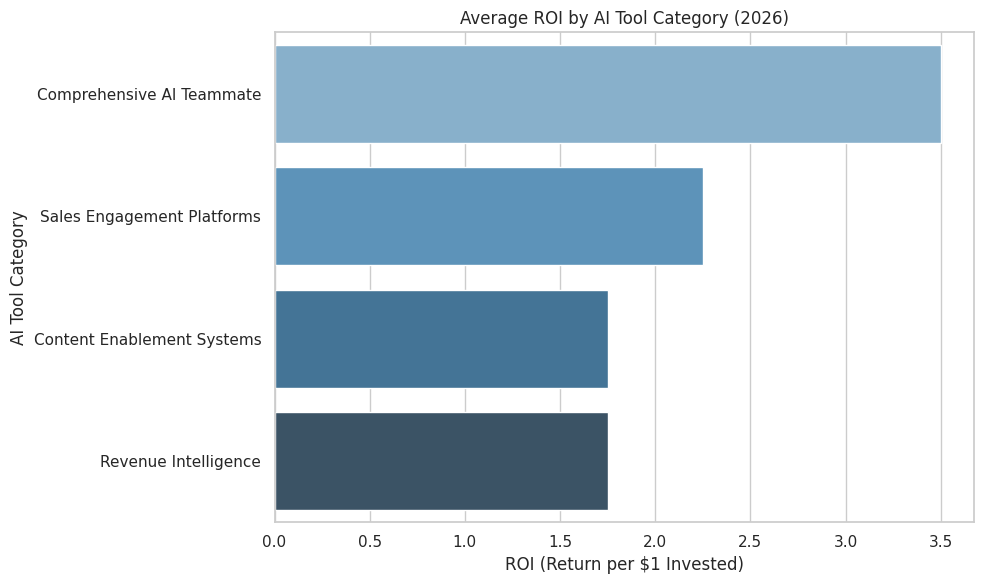
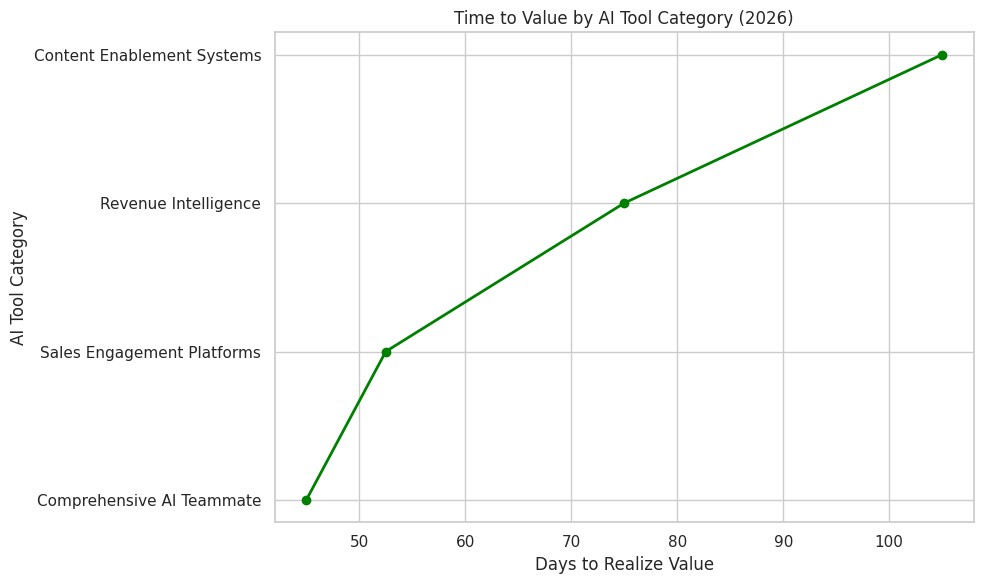
AI platforms vary in the time they take to generate measurable returns, depending on their core function and level of integration. Below is a summary table showing expected ROI, time to value, and operational focus for key tool categories.
Table: ROI Benchmarks by AI Tool Category (2026)
| AI Tool Category | Typical ROI Range | Time to Value | Core Coverage Area | Sample Tool Examples |
|---|---|---|---|---|
| Comprehensive AI Teammates | 2x–3x (3x–5x at scale) | 30–60 days | Full-cycle research and intelligence | AlphaSense, 6sense |
| Sales Engagement Platforms | 2x–2.5x | 45–60 days | Pre-call prep, outreach automation | Outreach, Salesloft |
| Content Enablement Systems | 1.5x–2x | 90–120 days | Pre-sales enablement, battlecards, deal prep | Highspot, Seismic |
| Revenue Intelligence (Post-Call) | 1.5x–2x | 60–90 days | Call analysis, rep coaching, deal review | Gong, Chorus |
This structured breakdown helps teams decide where to prioritize AI investments based on their maturity level, deal complexity, and volume of activity.
Scalability of ROI for Enterprise-Level Teams
Large organizations benefit more significantly due to economies of scale. When AI platforms are deployed across high-rep-volume teams (50+ users), even modest improvements in individual productivity or win rates compound to deliver enterprise-wide value.
For example:
- Mid-market teams typically see 2x–3x ROI in the first year.
- Enterprise teams with 50+ sellers or strategists may achieve 3x–5x ROI, especially when insights are linked directly to sales conversations, marketing execution, and competitive defense.
Table: ROI Scalability by Team Size
| Team Size | Expected ROI Range | Example Efficiency Outcome |
|---|---|---|
| <25 Reps | 1.5x–2.5x | Improved research access, basic reporting automation |
| 25–50 Reps | 2x–3x | Full-funnel enablement with measurable conversion gains |
| 50+ Reps (Enterprise) | 3x–5x | Organization-wide productivity boost + strategic insights |
Why ROI Visibility Accelerates AI Investment in 2026
With predictable benchmarks now in place, business leaders are approaching AI investments not as experiments but as measurable revenue drivers. AI research platforms no longer serve just as repositories of data—they act as full-cycle intelligence assistants, streamlining decisions, shortening deal cycles, and enhancing competitive positioning.
For companies deploying tools like AlphaSense, Similarweb, Crayon, or 6sense, the ability to tie insights directly to business outcomes has shifted AI from a “nice-to-have” to a core operational enabler in high-growth environments.
Strategic Outlook for AI-Powered Market Research and Competitive Intelligence in 2026 and Beyond
As 2026 advances and organizations begin shaping their strategies for 2027, a profound transformation is underway in the field of AI-driven market research and competitive analysis. The top-performing tools highlighted in this report are not just leading because of their features—they represent a larger shift in how intelligence is used to drive strategic outcomes. Emerging patterns in user behavior, product innovation, and operational strategy are redefining the expectations for what AI research platforms must deliver.
From Reactive Automation to Proactive Intelligence
The most significant change in 2026 is the evolution of AI systems from passive assistants to proactive collaborators. Today’s leading tools, such as AlphaSense and other agent-powered platforms, are beginning to anticipate business needs before users issue commands. Instead of waiting for teams to ask questions, these systems are continuously scanning internal and external data sources to prepare insights, draft recommendations, and alert decision-makers about trends, threats, or opportunities in real time.
This move toward proactive intelligence introduces a new class of “always-on” research agents that act more like strategic teammates than tools—capable of tracking competitor moves, synthesizing documents, and providing context-rich summaries before meetings or deadlines.
Table: Evolution of AI Functionality in Research Platforms (2024–2026)
| AI Capability Evolution | 2024 Standard | 2026 Advancement |
|---|---|---|
| Task Execution | User-initiated commands | System-initiated insight delivery |
| Output Format | Data exports and dashboards | Strategic briefings with narrative recommendations |
| Data Scope | Public web + structured inputs | Proprietary, real-time, and contextual enterprise data |
| Response Timing | On-demand | Preemptive and continuous |
| AI Role | Assistant | Embedded research partner |
The Disappearance of Visible AI
Another important development is the seamless embedding of AI into everyday enterprise tools. What was once a visible interaction—prompting a chatbot or generating a chart—has now become background infrastructure. From Microsoft Office environments auto-optimizing content, to platforms like Salesforce suggesting churn mitigation steps before risk emerges, AI is becoming more invisible yet indispensable.
This shift is particularly relevant to market research professionals. Modern tools now deliver insights within the applications teams already use, reducing the friction between research and execution. The competitive edge is no longer defined by flashy AI features but by how well the intelligence integrates with the user’s workflow and existing business logic.
Specialization Over Scale: The Rise of Vertical AI
As generalized AI models such as GPT-5 and Gemini mature, their limitations in domain-specific applications have become clearer. In response, top research and intelligence tools are pivoting toward specialization, introducing purpose-built models tailored for specific industries.
Examples include platforms like Claude for Financial Services or AlphaSense’s financial intelligence agents—solutions that outperform general AI by offering higher accuracy, domain relevance, and faster return on investment. These tools are trained not only on industry-specific vocabulary but also on regulatory frameworks, document structures, and competitive nuances that vary by vertical.
Table: General AI vs. Vertical AI in Market Research (2026)
| Capability Dimension | General AI Model (e.g., GPT-5) | Vertical AI Model (e.g., Claude FS) |
|---|---|---|
| Domain Accuracy | Moderate to good | High to expert-level |
| Business Context Awareness | Generic understanding | Deep contextual relevance |
| Trust and Verifiability | Limited | Strong—supports sourcing and compliance needs |
| ROI Speed | 3–6 months | 30–60 days |
| Strategic Alignment | Broad use cases | Tailored for finance, healthcare, marketing, etc. |
This move from “Scale to Specialization” is a defining trait of the top 10 tools profiled in this report. Each solution succeeds not through general utility, but through its ability to generate citable, actionable, and context-aware insights—a necessity for professionals in high-stakes environments like competitive strategy, go-to-market planning, and investor relations.
From Data Collection to Actionable Synthesis
AI has commoditized the act of collecting data, making web scraping, keyword monitoring, and traffic tracking available in seconds. However, the new competitive advantage lies in how quickly and precisely teams can synthesize that data into strategic action.
Today’s leading platforms are optimized for speed-to-insight. They not only help teams interpret the market but also guide them on what to do next—whether it’s preparing for a competitor’s move, identifying white space, or launching at the optimal moment.
Table: Shift in Research Tool Value Propositions (Past vs. Present)
| Value Driver | Traditional Tools | 2026 AI Platforms |
|---|---|---|
| Data Collection | Manual and time-intensive | Instant and automated from 100M+ sources |
| Insight Generation | Analyst-dependent | AI-generated and decision-ready |
| Time to Strategy | Weeks to months | Minutes to days |
| Output Format | Static reports | Dynamic, real-time briefings |
| Role in Decision-Making | Informational | Action-enabling |
Strategic Implications for Decision-Makers in 2026
As we move further into a data-saturated digital economy, information gathering alone no longer creates value. Success now depends on turning weak signals into bold moves—faster than the competition. The top tools in this report were selected because they empower teams to move from knowledge to execution seamlessly.
For professionals in marketing, product, finance, and corporate strategy, the implication is clear: the best-performing organizations in 2026 are not just more informed—they’re more agile, more predictive, and more capable of aligning intelligence with real-world action.
Conclusion
In 2026, the landscape of market research and competitive analysis has entered a new era—one defined by speed, precision, and automation. The rise of artificial intelligence has transformed how organizations discover, interpret, and act upon data. No longer limited to traditional surveys, manual benchmarking, or fragmented datasets, today’s leading AI tools empower businesses to operate with real-time insight, competitive foresight, and data-backed confidence.
The ten AI-powered platforms profiled in this guide—AlphaSense, 6sense, Brandwatch, Visualping, Similarweb, Klue, Crayon, Stravito, Semrush, and IdeaProof—represent the most innovative and results-driven technologies in the field. These tools are not just market research platforms; they are full-cycle intelligence engines designed to help teams navigate complexity, uncover strategic opportunities, and outperform competitors in every market condition.
Each of these tools brings a unique value proposition:
- AlphaSense redefines financial and strategic research with agentic workflows and expert-backed analysis.
- 6sense empowers revenue teams with AI-driven buyer intent data and dynamic campaign orchestration.
- Brandwatch offers unmatched capabilities in consumer sentiment monitoring and social intelligence.
- Visualping provides precision tracking of competitor website updates, turning small changes into actionable insights.
- Similarweb delivers market share analysis and AI-powered discovery trend tracking across channels.
- Klue integrates competitive intelligence directly into sales cycles through real-time battlecards and win/loss analysis.
- Crayon monitors over 300 million sources to provide high-resolution digital footprint insights for strategic teams.
- Stravito turns internal research assets into searchable, AI-summarized knowledge libraries for enterprise activation.
- Semrush remains a go-to platform for SEO-driven content intelligence and digital demand forecasting.
- IdeaProof stands out as a game-changer for startups needing instant, affordable market validation.
Together, these platforms reveal a larger industry transformation. Market research is no longer about collecting information for archival purposes—it is about using AI to turn that information into high-velocity, strategic decision-making. Teams are moving from reactive analysis to proactive market moves, powered by intelligence that is continuous, predictive, and context-aware.
In this new model, the value of a research tool is not defined by how much data it gathers, but by how effectively it synthesizes that data into clarity and action. Whether identifying whitespace opportunities, countering competitor messaging, optimizing digital presence, or forecasting demand trends, AI platforms in 2026 are delivering value faster and more precisely than ever before.
The return on investment is now clearer, with many companies reporting 2x to 5x ROI within the first year of deployment—especially when these tools are deeply integrated into sales, marketing, and product workflows. Beyond productivity, the strategic advantage lies in better decisions made sooner.
As we look ahead, the most competitive organizations will be those that treat AI not as a support function, but as an embedded layer in how they operate—researching continuously, adapting dynamically, and executing decisively. The top 10 AI tools listed in this report are helping global businesses move from data overload to strategic clarity, one insight at a time.
For professionals in strategy, marketing, product, and revenue operations, selecting the right combination of these platforms is not just a tactical decision—it is a strategic investment in long-term market leadership. In 2026, competitive success will favor those who are not just informed, but intelligently enabled.
If you find this article useful, why not share it with your hiring manager and C-level suite friends and also leave a nice comment below?
We, at the 9cv9 Research Team, strive to bring the latest and most meaningful data, guides, and statistics to your doorstep.
To get access to top-quality guides, click over to 9cv9 Blog.
To hire top talents using our modern AI-powered recruitment agency, find out more at 9cv9 Modern AI-Powered Recruitment Agency.
People Also Ask
What are the best AI tools for market research in 2026?
The best AI tools for market research in 2026 include AlphaSense, 6sense, Brandwatch, Semrush, Similarweb, Klue, Crayon, Visualping, Stravito, and IdeaProof.
Which AI tool offers real-time competitive intelligence?
AlphaSense and Crayon provide real-time competitive insights by continuously scanning documents, filings, and websites for changes and updates.
How does AI improve market research accuracy in 2026?
AI improves accuracy by using machine learning to analyze large data sets quickly, detect patterns, and deliver actionable, verified insights.
Which AI tool is best for startup market validation?
IdeaProof is ideal for startups, providing fast, affordable market analysis, competitor benchmarking, and demand forecasting within seconds.
Is 6sense good for sales and market research teams?
Yes, 6sense combines predictive AI, intent signals, and multi-channel orchestration to help sales and marketing teams identify high-converting leads.
Can AI tools replace traditional market research firms?
AI tools offer faster and more cost-effective insights but are often used alongside traditional research for deeper strategic validation.
Which tool is best for analyzing website traffic trends?
Similarweb provides powerful tools for benchmarking digital traffic, analyzing discovery trends, and measuring share of voice across platforms.
How do AI tools help with competitor benchmarking?
AI tools like Klue and Crayon track changes in competitor websites, pricing, messaging, and content to deliver real-time strategic comparisons.
What is the ROI of using AI tools for research in 2026?
Businesses report 2x to 5x ROI in the first year from AI tools through productivity gains, faster decisions, and improved deal performance.
Which AI platform helps monitor social media trends?
Brandwatch excels in social listening, capturing and analyzing conversations from over 100 million sources to identify brand sentiment and trends.
What is AlphaSense used for in competitive research?
AlphaSense is used for financial intelligence, corporate research, and synthesizing high-value documents like earnings calls and filings.
Do AI tools help improve B2B marketing results?
Yes, tools like 6sense and Semrush use predictive analytics and keyword insights to drive better targeting, engagement, and conversion.
Can AI tools generate market sizing data like TAM or SAM?
Yes, platforms like IdeaProof provide instant TAM, SAM, and SOM data to support lean planning and investor pitches for startups.
Which tool is best for SEO-focused market research?
Semrush offers powerful AI-enhanced SEO, content gap analysis, and keyword tools tailored for marketers and agencies.
How fast can AI tools deliver market insights?
Some tools like IdeaProof deliver insights in under 2 minutes, while others like AlphaSense offer continuous monitoring and updates.
Is Brandwatch suitable for enterprise-level research?
Yes, Brandwatch is trusted by global enterprises for tracking sentiment, consumer behavior, and crisis signals in real-time.
What makes Klue unique among AI research tools?
Klue integrates competitive insights directly into sales workflows with live battlecards and win/loss analysis synced with CRM systems.
Which AI platform helps manage internal research libraries?
Stravito is built for large enterprises to organize, summarize, and activate internal research using AI personas and generative search.
Can AI tools assist with product development insights?
Yes, many AI tools reveal trends, demand signals, and competitor product changes that inform roadmap and innovation decisions.
Are AI tools for market research affordable for startups?
Yes, platforms like IdeaProof offer freemium or low-cost plans starting under $100, making AI insights accessible for early-stage founders.
How does Crayon differ from other competitor tracking tools?
Crayon monitors over 300 million sources with high precision, ideal for large enterprises needing deep competitive digital footprint analysis.
What features does Semrush Copilot provide in 2026?
Semrush Copilot suggests research tasks, summarizes content, generates SEO reports, and helps users optimize their digital strategy faster.
How do companies measure success with AI research tools?
Companies measure success through ROI metrics like time saved, increased win rates, faster insights, and revenue influenced by intelligence.
Are there any AI tools that integrate with Slack or Salesforce?
Yes, platforms like Klue and Crayon integrate with Slack, Salesforce, and other systems to ensure insights reach teams in real-time.
What is the difference between AlphaSense and Crayon?
AlphaSense focuses on financial intelligence from high-value documents, while Crayon emphasizes competitor tracking and market moves.
Do AI research tools support multiple industries?
Yes, platforms like Similarweb, Semrush, and Brandwatch support a wide range of industries from tech and retail to healthcare and finance.
Which AI tool helps with internal decision-making speed?
Stravito speeds up internal decision-making by turning complex research libraries into searchable, personalized intelligence layers.
What kind of insights can Brandwatch deliver?
Brandwatch delivers sentiment trends, customer concerns, influencer mentions, and brand perception insights from digital and social sources.
How scalable are AI research tools for large teams?
Most tools offer enterprise plans with integrations, user roles, and automated workflows designed to support large teams and departments.
Why are vertical AI models gaining popularity in 2026?
Vertical AI models offer industry-specific accuracy, faster insights, and higher trust, making them more effective than general-purpose AI.
Sources
AlphaSense
Grand View Research
Brandwatch
Similarweb
GenesysGrowth
Sacra
IntuitionLabs
Nucamp
6sense
Morningstar
Business Wire
PM Insights
Tracxn
Meltwater
SuperAGI
LeadIQ
PitchBook
Visualping
Gartner
IdeaProof
The CMO
Improvado
Storylane
G2
Federico Presicci
Crayon
Stravito
SiliconANGLE
Vivun