



























Key Takeaways
- Discover how AI tools like ElevenLabs, ChatGPT, and Descript are revolutionizing podcast scripting, editing, and voice synthesis in 2026.
- Learn which platforms offer the best solutions for video-first podcasting, multilingual dubbing, and automated publishing workflows.
- Find out how ethical AI, real-time processing, and global distribution tools help creators scale podcast production and audience growth.
The podcasting industry in 2026 has undergone a profound transformation, driven largely by the integration of cutting-edge artificial intelligence tools that are reshaping how content is planned, produced, and distributed across the globe. What was once a niche hobby for independent creators has evolved into a powerful, multi-billion-dollar media category. From audio-only productions to video-first formats, podcasting now commands a significant share of the creator economy, brand marketing budgets, and audience attention. This shift is largely powered by the new generation of AI tools designed specifically for podcasters, offering unprecedented levels of automation, quality enhancement, multilingual output, and creative scalability.

In today’s competitive landscape, content creators, media professionals, and marketing teams are no longer bound by traditional studio limitations or expensive production setups. Instead, AI-driven platforms offer the ability to script full episodes, generate realistic human-like voiceovers, perform real-time audio editing, transcribe with near-perfect accuracy, and even produce video versions of episodes using AI avatars. These tools do more than just save time—they democratize access to high-quality production capabilities for creators at every level, from solo entrepreneurs to global media brands.
With the global podcasting market forecast to exceed USD 40 billion by the end of 2026, and ad revenues projected to surpass USD 5 billion, competition is rising fast. Creators and agencies that fail to adopt AI-driven production workflows risk falling behind. According to industry data, over 80 percent of top-performing podcasters now integrate at least three or more AI tools across their production lifecycle—typically blending text-to-speech platforms like ElevenLabs, content generators such as ChatGPT, and video avatar creators like HeyGen or AI Studios. These tools not only speed up production but also improve discoverability, audio fidelity, audience engagement, and cross-platform distribution.
Moreover, the rise of multilingual AI voice models and automated dubbing technology is allowing podcasters to scale their shows across global markets with minimal localization costs. Regions like Asia-Pacific, Latin America, and the Middle East are seeing explosive growth in podcast listenership, and AI is enabling seamless entry into these fast-growing markets by translating and adapting content into multiple languages—often in the creator’s own voice. This has transformed the concept of “global-from-day-one” podcasting from theory into operational reality.
However, as AI becomes deeply embedded into the content stack, ethical questions around consent, voice cloning, deepfakes, and authenticity are also gaining prominence. Industry leaders like Resemble AI, ElevenLabs, and DupDub are addressing these concerns with features such as watermarking, ethical voice marketplaces, and consent protocols. At the same time, regulatory bodies are beginning to crack down on low-quality AI-generated audio feeds—commonly referred to as “AI slop”—flooding podcast directories. This makes it even more critical for professional creators to select reliable, context-aware AI tools that prioritize production quality, traceability, and compliance.
This blog dives deep into the top 10 AI tools that are redefining podcast generation in 2026. From real-time audio enhancement and ultra-fast transcription to voice synthesis, avatar-led video podcasting, and multilingual dubbing, this list will cover the most advanced platforms currently shaping the future of content creation. Whether you are a solo creator, marketing team, or enterprise studio, understanding and mastering these tools is now essential for success in the podcasting ecosystem.
Let’s explore the leaders of this AI-powered audio revolution and uncover the features, benefits, and best use cases for each.
Before we venture further into this article, we would like to share who we are and what we do.
About 9cv9
9cv9 is a business tech startup based in Singapore and Asia, with a strong presence all over the world.
With over nine years of startup and business experience, and being highly involved in connecting with thousands of companies and startups, the 9cv9 team has listed some important learning points in this overview of the Top 10 AI Tools For Generating Podcasts in 2026.
If you like to get your company listed in our top B2B software reviews, check out our world-class 9cv9 Media and PR service and pricing plans here.
Top 10 AI Tools For Generating Podcasts in 2026
- ElevenLabs
- ChatGPT
- Descript
- Riverside.fm
- HeyGen
- Podcastle
- Wondercraft
- Auphonic
- NotebookLM
- Adobe Podcast
1. ElevenLabs

ElevenLabs has rapidly positioned itself as the world’s go-to platform for AI-generated audio and podcasting content in 2026. From its roots as a niche voice synthesis startup, the company has grown into a core infrastructure powering content workflows across major industries. With an explosive rise in both valuation and user base, ElevenLabs is not just a tool—it is now a foundational layer for modern voice-driven media.
Unmatched Growth and Market Impact
The trajectory of ElevenLabs between 2023 and 2025 represents one of the fastest growth stories in the AI content industry. In late 2025, the company’s valuation hit USD 6.6 billion after a USD 100 million staff equity event. This surge mirrors the 2,000% leap in its Annual Recurring Revenue (ARR), which grew from USD 25 million in 2023 to an astonishing USD 200 million by Q3 2025. These numbers reflect not just interest but deep integration into the workflows of enterprises and creators alike.
Over 60% of Fortune 500 companies are reported to be using ElevenLabs technology for everything from internal training materials to multilingual branded podcasts, corporate voiceovers, and audio-driven customer engagement.
Advanced Voice Cloning and Realism
What separates ElevenLabs from other tools is its unmatched voice fidelity. It offers two key voice synthesis features tailored for different needs:
- Professional Voice Cloning: Requires at least 30 minutes of quality input audio. Outputs synthetic speech that mirrors human nuances, emotions, and intonation patterns to a near-perfect degree.
- Instant Voice Cloning: Ideal for speed. It needs only 10 seconds of input audio to generate a reliable voice model, making it highly useful for rapid podcast iteration.
Global Language Reach and Localized Expression
ElevenLabs supports voice generation in over 70 languages and regional accents, allowing creators to reach global audiences while maintaining the original speaker’s personality. This language scalability is a vital feature for companies seeking to localize educational podcasts, product explainers, or branded audio series.
Technical Highlights and Performance
| Feature | Specification or Capacity |
|---|---|
| Language Support | 70+ languages and regional accents |
| Voice Library | 4,000+ pre-trained synthetic voices |
| Model Latency | Time-to-First-Audio as low as 75ms (Flash model) |
| Audio Output Quality | Up to 192kbps, 44.1kHz PCM |
| Request Size Limit | Up to 40,000 characters per request |
| Voice Clone Training Speed | Instant (10s input) or Professional (30 mins input) |
Flexible Pricing Models for All Types of Podcasters
ElevenLabs offers a tiered pricing structure that caters to beginners, indie podcasters, media teams, and enterprise users.
| Plan | Monthly Price | Credits/Month | Key Features |
|---|---|---|---|
| Free | $0 | 10,000 | Personal use, 128 kbps audio, basic TTS & dubbing |
| Starter | $5 | 30,000 | Commercial use, instant voice cloning |
| Creator | $22 | 100,000 | Professional voice cloning, 192 kbps quality |
| Pro | $99 | 500,000 | PCM output, API access, high-volume production |
| Scale | $330 | 2,000,000 | 3 seats, low-latency API, ideal for growing studios |
| Business | $1,320 | 11,000,000 | 5 seats, 5¢/min TTS cost, full enterprise deployment |
Use Case Matrix: ElevenLabs Podcast Applications by Sector
| Industry | Use Case | Key Benefit |
|---|---|---|
| Media & Publishing | Multilingual podcast localization | Retains host identity across languages |
| Corporate Training | Internal communications and onboarding audio | Cost-effective voice content at scale |
| Education | Audio textbooks and accessibility content | Supports multiple accents and dialects |
| Marketing | Branded podcast campaigns and voice ads | Custom brand voice cloning |
| Government | Public service announcements in native languages | Improves reach across regional populations |
Conclusion
ElevenLabs stands at the forefront of AI-powered podcast generation in 2026. Its ability to combine realistic voice synthesis, multilingual capabilities, fast API performance, and flexible pricing makes it a universal platform for everyone—from solo podcasters to global media companies. In an age where voice is becoming a dominant medium for content, ElevenLabs delivers not just sound, but scalable storytelling.
2. ChatGPT

In the world of AI-powered podcast production, ChatGPT has become an essential part of nearly every content creator’s toolkit. Developed by OpenAI, this platform has grown into a powerhouse of productivity and creative planning, offering not just writing support but complete content orchestration for podcasters worldwide.
Massive Global Reach and Financial Strength
As of mid-2025, ChatGPT’s growth has been extraordinary. With a global valuation of USD 500 billion and an annual recurring revenue (ARR) of USD 10 billion, it dominates the AI subscription economy. Its reach spans across all sectors of content creation, including podcasting.
The platform engages 900 million weekly active users, including 10 million paid ChatGPT Plus subscribers, as of December 2025. Its consistent user growth, paired with daily visits exceeding 193 million, signals deep trust from both individual creators and professional studios.
ChatGPT Usage & Revenue Growth Overview
| Metric | Value (2025–2026) |
|---|---|
| Weekly Active Users | 900 Million |
| Daily Visits | 193.33 Million |
| Monthly Revenue | USD 1 Billion |
| Annual Sales Forecast (2025) | USD 12 Billion |
| Market Share in AI Tools | 62.5% |
Podcasting Functions and Workflow Integration
ChatGPT has evolved from a language model into a full-service planning assistant for podcast creators. It handles the entire pre-production and post-production content cycle, becoming the content strategist behind many of 2026’s most successful shows.
Key applications in podcast creation include:
- Episode Brainstorming: Helps creators plan series themes, map seasonal arcs, and align content with trending topics or audience interests.
- Script Generation: Produces detailed episode outlines, guest introductions, ad scripts, and compelling intros or outros.
- Guest Research & Interview Questions: Customizes in-depth interview questions tailored to each guest’s background or industry.
- Post-Production Repurposing: Converts raw transcripts into SEO-optimized blog articles, LinkedIn posts, YouTube descriptions, and newsletter blurbs.
Podcasting Workflow Matrix Using ChatGPT
| Workflow Stage | ChatGPT Contribution | Benefits for Creators |
|---|---|---|
| Planning | Topic ideation, audience targeting, seasonal mapping | Strategic alignment with content goals |
| Scripting | Full episode scripts, question sets, ad copy | Saves time, ensures consistency |
| Research | Real-time web research, citations via Comet or Pro Search | Up-to-date and accurate script support |
| Repurposing | Blog posts, email content, captions | Boosts discoverability and SEO rankings |
| Marketing | Social media content and call-to-actions | Supports multi-channel promotion |
Real-Time Web Integration and Smart Search Tools
One of ChatGPT’s strongest advantages is its integration with Pro Search and the Comet browser. This enables creators to fetch real-time, credible web content and summarize it into script-ready insights—ideal for current affairs podcasts or niche subject matter. Users no longer need to manually dig through articles; ChatGPT compresses research into actionable narratives, citations included.
This intelligent aggregation ability enhances podcast quality and accuracy. It also significantly reduces prep time while raising audience trust by grounding content in verified sources.
Measured Impact on Podcast Engagement
According to creator performance data compiled through 2025, podcasters using ChatGPT across the full content lifecycle—from research and scriptwriting to promotion—achieve a 10% higher engagement rate compared to those using siloed tools. This uplift is attributed to coherent narrative flow, timely research, and optimized distribution copy powered by the model.
Performance Comparison: Full AI-Driven Podcast Strategy vs Traditional
| Approach Type | Research Quality | Script Depth | Time Saved | Audience Engagement |
|---|---|---|---|---|
| Traditional Manual | Medium | Medium | Low | Average |
| ChatGPT Full-Funnel Use | High | High | Very High | +10% Above Average |
Conclusion
In 2026, ChatGPT continues to redefine how podcasts are researched, written, and distributed. It serves as the strategic core behind many top-performing podcasts—enhancing not just writing, but entire content workflows. As more creators turn to AI for scalability and performance, ChatGPT’s ability to combine intelligence, speed, and creativity secures its place among the top 10 AI tools for podcast generation worldwide.
3. Descript

Descript has become a top-tier solution for podcasters seeking a smooth and smart way to edit audio and video content using AI. Known for its intuitive, text-based editing interface, Descript allows creators to work on audio just like editing a document—cutting out mistakes or unwanted segments by simply deleting the related text. In 2026, this method has revolutionized podcast workflows across industries, making Descript one of the top 10 AI tools for podcast production globally.
Strong Market Performance and Revenue Growth
By the end of 2024, Descript reached an Annual Recurring Revenue (ARR) of USD 55 million. This marked a 75% year-over-year growth, driven by increased adoption among creators, educators, marketing teams, and corporate content producers. The brand’s unique editing model and continuous feature upgrades have kept it ahead of many traditional audio editing tools.
Descript Revenue & Growth Overview
| Metric | Value (2024–2026) |
|---|---|
| Annual Recurring Revenue (ARR) | USD 55 Million |
| Year-over-Year Growth | 75% |
| User Base | Expanding among prosumers, startups, and agencies |
| Revenue Drivers | AI editing tools, remote recording, Studio Sound, premium exports |
Innovative AI Features that Power Modern Podcasting
What makes Descript stand out in the crowded podcast tech space is its full stack of AI-powered features. These tools dramatically simplify the editing process and increase the overall production quality without requiring technical expertise.
- Text-Based Editing: Creators can trim, restructure, or enhance audio/video by editing an auto-generated transcript.
- AI “Underlord” Suite: Automatically removes filler words, suggests social-media-friendly clips, and ensures smooth delivery in spoken content.
- Studio Sound: Upgrades low-quality recordings to crisp, studio-like audio—useful for field recordings or remote interviews.
- Remote Recording via SquadCast: Built-in functionality after acquiring SquadCast enables high-quality local audio capture, even during unstable internet connections.
Descript Podcast Workflow Applications
| Podcast Production Stage | Descript Functionality | Value for Users |
|---|---|---|
| Recording | Remote interviews with local file backup | Prevents data loss, ensures clean audio |
| Editing | Edit via transcript, remove filler words, auto-cut silences | Fast, intuitive, no prior editing experience needed |
| Enhancement | Studio Sound for audio clarity, AI-generated voice smoothing | High production value from low-input content |
| Publishing | Create audiograms, reels, short clips | Extends podcast content reach via social media |
| Collaboration | Multi-user workspace, script commenting | Enables team-based podcast production |
Pricing Tiers and Usage Matrix (2026)
Descript offers multiple plans that cater to different levels of podcasting—from casual creators to enterprise media teams.
| Plan | Monthly Price (Billed Annually) | Features & Usage Limits |
|---|---|---|
| Free | USD 0 | 1 hour of processing/month, basic features, watermark on exports |
| Hobbyist | USD 16 | 10 hours, filler word removal, speech cloning, 1080p watermark-free export |
| Creator | USD 24 | 30 hours, 4K exports, access to royalty-free stock media |
| Business | USD 50 | 40 hours, video translation in 30+ languages, support for custom AI avatars |
Performance Comparison: Descript vs Traditional Editors
| Capability | Descript (2026) | Traditional Editors (Pre-AI Era) |
|---|---|---|
| Editing Method | Text-Based Editing via Transcript | Manual waveform cutting |
| AI Enhancement | Yes – Studio Sound, Filler Removal, Avatars | Minimal to none |
| Social Clip Generation | Auto-identifies shareable clips | Requires manual review |
| Video Translation & Dubbing | 30+ Languages Supported | Rarely integrated |
| Remote Recording Reliability | Progressive Upload + Local Backup | Dependent on internet stability |
Conclusion
In 2026, Descript has positioned itself as one of the most intelligent and accessible podcast production tools available. From editing and enhancement to publishing and remote collaboration, it brings together all the key features creators need—powered by fast, user-friendly AI. With continuous innovation like Studio Sound, Underlord editing suite, and SquadCast integration, Descript remains at the forefront of podcast technology worldwide.
4. Riverside.fm

Riverside.fm has emerged as a top-tier solution for creators who prioritize studio-grade podcast recording—even when working remotely. Built for professional podcasters, media companies, and interview-based formats, this Tel Aviv-based platform ensures unmatched audio and video fidelity regardless of internet conditions. With strong funding rounds and rapid AI integration, Riverside has firmly secured its position among the top 10 AI tools for podcast generation in 2026.
Global Expansion and Financial Milestones
Riverside’s financial growth has been steady and impactful. In late 2024, the company raised USD 30 million in its Series C funding round, boosting total investment to USD 80 million. This funding fueled the development of new AI features and supported a significant expansion of platform capabilities. As of 2026, Riverside is used by major podcasting networks, independent creators, education platforms, and corporate training teams looking to produce broadcast-quality episodes from anywhere in the world.
Funding & Adoption Snapshot
| Category | Key Details |
|---|---|
| Total Funding (as of 2026) | USD 80 Million |
| Series C Raised | USD 30 Million (2024) |
| Primary User Base | Podcasters, educators, enterprises |
| Global Reach | 140+ countries |
| Core Strength | 4K local recording, AI-powered editing |
Recording Technology and Audio Precision
Riverside’s edge lies in its unique approach to remote recording. Instead of relying on a cloud stream that’s vulnerable to connection drops, it captures each participant’s audio and video locally in full resolution. Files are then uploaded progressively during the session. This means that even if someone’s internet lags or disconnects, the final recording remains flawless.
Key technical strengths include:
- 4K Video Recording: Ensures crisp visual quality for video podcasts.
- Uncompressed Audio: Captured at 48kHz WAV format, matching studio-grade fidelity.
- Progressive Upload: Audio and video are uploaded in real-time locally, reducing data loss risk.
- Multi-Track Recording: Each speaker is recorded separately for cleaner post-production edits.
AI-Powered Features Enhancing Podcast Creation
By 2026, Riverside has integrated multiple AI features that simplify podcast production and distribution. These tools remove many of the time-consuming tasks creators typically face.
- Magic Clips: AI automatically identifies and trims the most engaging or viral moments from a full episode, making them ready for TikTok, Instagram Reels, or YouTube Shorts.
- AI Co-Creator: Instantly generates show notes, episode summaries, titles, timestamps, and even suggested chapters—without requiring any user commands.
- Smart Mute: Automatically silences speakers who aren’t talking, reducing crosstalk and background noise.
- Producer Mode: Offers live remote direction, letting producers manage guest audio and camera settings discreetly during a recording session.
Riverside’s Podcast AI Workflow Capabilities
| Workflow Stage | Features & Tools | Benefits for Podcasters |
|---|---|---|
| Pre-Recording | Guest invitations, equipment checks, local test capture | Ensures readiness before session starts |
| Recording | 4K local video, uncompressed audio, Producer Mode | High-fidelity capture and real-time management |
| Post-Production | Magic Clips, Smart Mute, AI Co-Creator summaries | Speeds up editing and publishing |
| Publishing | Multistreaming, direct social clip export | Expands reach across platforms instantly |
| Enterprise Integration | Custom API, SSO, HubSpot sync | Seamless workflow for teams and agencies |
Riverside.fm Pricing & Features Matrix (2026)
| Plan | Monthly Cost (Billed Annually) | Key Features |
|---|---|---|
| Free | USD 0 | 2 hours of multi-track recording, 720p video |
| Pro | USD 24 | 15 hours/month, 4K video, AI summaries, unlimited transcription |
| Live | USD 34 | 1080p live streaming, multistreaming, audience call-ins |
| Webinar | USD 79 | Host up to 100 attendees, HubSpot integration, enhanced interactivity |
| Business | Custom | SSO security, custom API, white-labeling, dedicated support |
Performance Matrix: Riverside.fm vs Traditional Remote Recording Tools
| Feature | Riverside.fm (2026) | Traditional Tools (Pre-AI Era) |
|---|---|---|
| Recording Method | Local 4K + 48kHz WAV | Compressed cloud stream |
| AI Editing & Summarization | Yes – Magic Clips, Co-Creator | No AI assistance |
| Video Quality | Up to 4K | Up to 1080p |
| Noise Reduction & Smart Mute | Automated | Manual post-processing |
| Transcript Speed & Accuracy | Instant, high accuracy | Often outsourced |
| Enterprise-Grade Features | Custom API, SSO, Integrations | Limited or unavailable |
Conclusion
In 2026, Riverside.fm continues to lead the charge in delivering premium-quality remote podcasting experiences. With a combination of powerful recording infrastructure, AI-enhanced automation, and enterprise-ready features, it provides podcasters and production teams with everything they need to create professional content without needing a physical studio. Its impact on long-form content, interview formats, and live video podcasting makes it one of the most reliable and advanced AI tools for podcast generation worldwide.
5. HeyGen
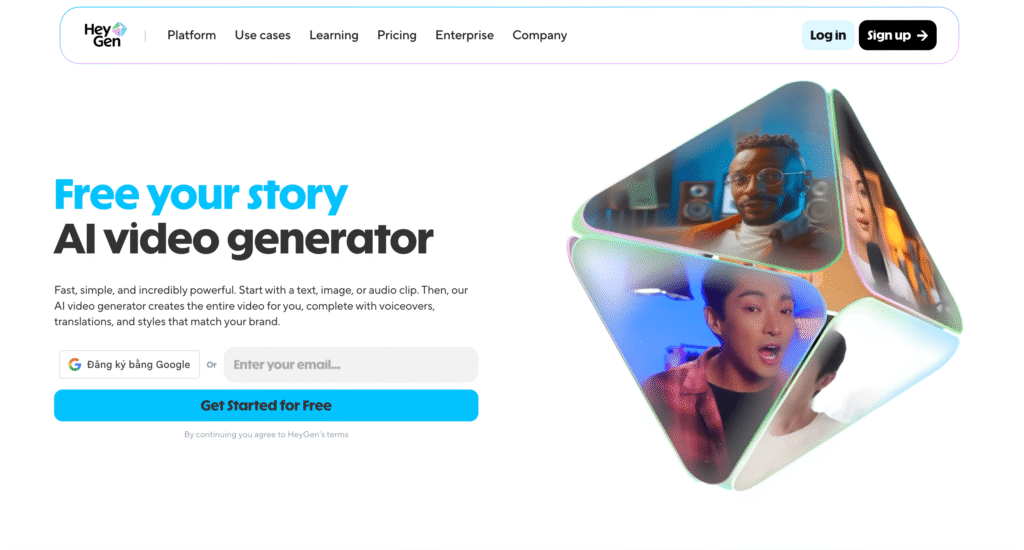
In 2026, as video podcasts—commonly known as vodcasts—become a dominant format in the content world, HeyGen has quickly established itself as one of the top AI tools enabling creators to scale their reach globally. This advanced AI platform allows podcasters to convert audio into professional video content using realistic avatars, automated dubbing, and synchronized multilingual voiceovers. For creators who want to appear on video without needing expensive studio setups, HeyGen delivers a revolutionary solution.
Rapid Market Growth and Platform Valuation
By early 2025, HeyGen reached a valuation of USD 3.3 billion, driven by the increasing demand for AI-generated video content across podcasting, education, and social media. Its tools are now used by both solo podcasters and global media teams looking to expand their reach with minimal resources. Whether for YouTube podcasts, social media teasers, or branded educational episodes, HeyGen has become indispensable in AI-powered video production.
HeyGen Market & Growth Overview
| Key Metric | Value/Status (2025–2026) |
|---|---|
| Company Valuation | USD 3.3 Billion |
| Primary Users | Podcasters, educators, social creators |
| Global Language Support | 175+ languages with auto lip-sync |
| Avatar Library | 700+ stock avatars and custom upload |
| Core Use Cases | Vodcasts, localized dubbing, avatar videos |
Avatar Technology and Multilingual Reach
HeyGen’s most impactful feature is its Avatar IV engine. This tool allows users to create lifelike virtual presenters using either stock avatars or their own likeness. These avatars can deliver podcast scripts, summaries, or promotional content in a professional studio-like presentation.
The platform’s AI dubbing engine supports real-time lip-sync and voice translation in over 175 languages. Unlike basic dubbing tools, HeyGen matches the speaker’s intonation and facial expressions, making the localized content look natural and culturally adaptive. This enables podcasters to repurpose a single recording into dozens of localized versions, without re-recording or hiring voice actors.
Podcasting Workflow with HeyGen AI
| Stage | HeyGen Contribution | Outcome for Podcasters |
|---|---|---|
| Pre-Production | Script upload, avatar selection | No need for camera or physical presence |
| Production | Avatar-based video creation | Studio-like delivery with consistent branding |
| Localization | Auto-dubbing in 175+ languages with synced lip movement | Global audience reach from one recording |
| Post-Production | 4K export, visual enhancements, team collaboration tools | High-quality vodcasts ready for distribution |
| Distribution | Multi-platform exports (YouTube, TikTok, Spotify video) | Broad content repurposing |
HeyGen Pricing Plans and Features (2026)
HeyGen offers scalable pricing for individuals and teams, making it suitable for creators of all levels.
| Plan | Monthly Price | Key Features |
|---|---|---|
| Free Trial | USD 0 | 1 voice clone, 3 videos/month, 3-minute limit |
| Creator | USD 29 | Unlimited voice cloning, 1080p export, 700+ avatars |
| Team | USD 39 per seat | 4K export, team collaboration, faster rendering speeds |
Integration with Global Platforms and Use Cases
HeyGen’s technology is increasingly integrated with platforms like Spotify, which now offers real-time podcast translation supported by AI tools such as HeyGen. This makes it easier for podcasters to serve a worldwide audience. For creators aiming to grow across Asia, Europe, Latin America, or Africa, HeyGen eliminates language barriers while preserving voice tone, making localized episodes more authentic and accessible.
Performance Matrix: HeyGen vs Traditional Video Dubbing & Avatars
| Feature | HeyGen (2026) | Traditional Workflow |
|---|---|---|
| Voice-to-Avatar Automation | Yes | Manual animation or filming |
| Language Localization | 175+ languages with real-time sync | Requires voice actors and editing |
| Avatar Personalization | Stock + Custom Avatars | Green screen filming or animation tools |
| Video Quality | Up to 4K export | Variable depending on equipment |
| Time to Publish | Minutes | Days or weeks |
| Team Collaboration | Built-in tools | Managed across separate platforms |
Conclusion
HeyGen empowers podcasters in 2026 to turn simple audio into globally engaging vodcasts—without needing expensive cameras, studios, or voice actors. Its advanced avatar system, multi-language dubbing, and seamless production tools make it one of the most effective AI platforms for scaling podcast content across video channels and regions. As more creators embrace video-first podcasting, HeyGen’s capabilities place it firmly among the top 10 AI tools shaping the future of podcast creation.
6. Podcastle
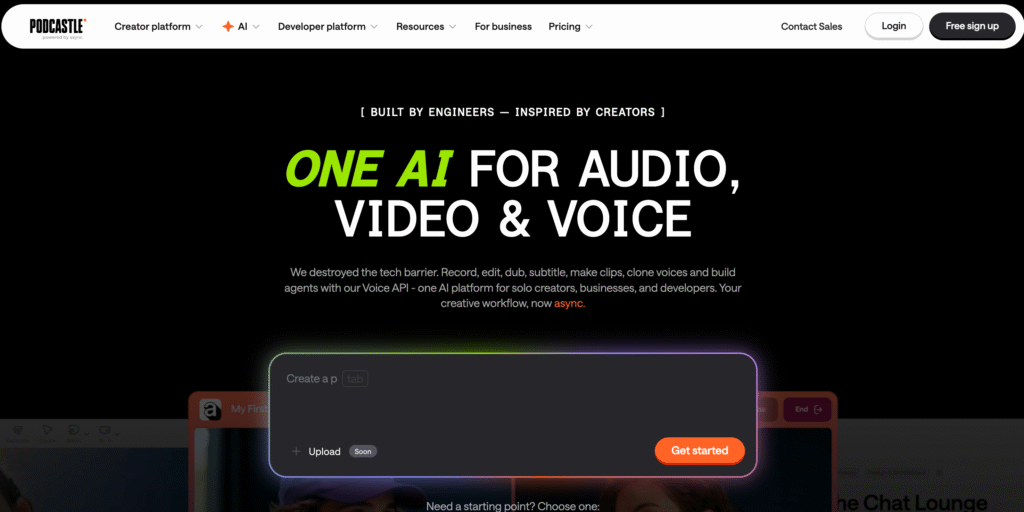
Podcastle has established itself as one of the top 10 AI tools for generating podcasts in 2026 by offering a complete podcast creation suite that is both powerful and easy to use. Designed for solo podcasters, educators, marketers, and small teams, Podcastle enables users to record, edit, enhance, and publish professional-quality audio content—all from within a web browser. With cloud-based flexibility, intuitive design, and a range of intelligent AI tools, it is now widely regarded as a game-changing platform for creators who want to deliver high-impact audio content without a steep learning curve or expensive production gear.
Funding and Market Position
By 2026, Podcastle has raised over USD 22.2 million in Series A funding. This financial backing has helped accelerate its development and push innovative updates to a growing global user base. The platform has gained popularity in the AI audio editing market, consistently ranking among the top competitors thanks to its accessible yet professional-grade capabilities.
Podcastle Growth Highlights
| Key Metrics | Value (2025–2026) |
|---|---|
| Series A Funding | USD 22.2 Million |
| Core User Base | Indie podcasters, educators, SMEs |
| Platform Access | Browser-based, no installation needed |
| Competitive Position | Top-tier AI audio suite |
| Key Strengths | Ease of use, AI-powered enhancement |
Advanced AI Editing and Voice Tools
Podcastle’s signature AI feature is Magic Dust, a powerful tool that turns raw, unpolished recordings into professional-grade audio with a single click. It removes background noise, evens out voice levels, and optimizes clarity—especially useful for creators recording in less-than-ideal environments.
The platform also offers AI voice cloning and text-to-speech (TTS), making it possible to generate consistent narrator voices or produce ad reads and content segments without manual voice input. These tools enable faster production cycles and greater flexibility in script generation.
Podcastle AI Workflow and Toolset
| Function Area | Capabilities and Features | Benefits for Users |
|---|---|---|
| Recording | Remote multitrack audio/video capture via browser | Easy remote interviews and co-hosted shows |
| Editing | Text-based editing, Magic Dust AI noise removal | Clean, fast editing without audio skills |
| Voice Tools | AI voice cloning, Revoice (TTS), automated ad generation | Scalable content creation with consistent voice |
| Publishing | Direct export, hosting integration, audio file optimization | Simplifies publishing to all major platforms |
Podcastle Pricing Tiers and Feature Matrix (2026)
Podcastle’s pricing model is designed to accommodate a wide range of users, from hobbyists to small production teams. Each tier unlocks progressively more features tailored to more intensive workflows.
| Plan | Monthly Price (USD) | Core Features Included |
|---|---|---|
| Basic | Free | Limited multitrack recording, Magic Dust preview |
| Storyteller | USD 11.99 | Full AI audio enhancement, basic AI voice cloning |
| Pro | USD 23.99 | Unlimited recording/editing, advanced TTS, 4K video, collaboration tools |
| Business | Custom Pricing | Team workspaces, priority support, custom integration and publishing options |
Performance Comparison: Podcastle vs Traditional Editing Suites
| Feature/Functionality | Podcastle (2026) | Traditional Editing Tools |
|---|---|---|
| Platform Type | Browser-based, cloud-powered | Desktop installation required |
| Learning Curve | Beginner-friendly | Steep, often requires training |
| AI Enhancement Tools | Magic Dust, Voice Cloning, TTS | Rare or manual processing |
| Recording Features | Remote multitrack (audio + video) | Local or limited cloud capability |
| Integration & Publishing | Built-in hosting/export options | Requires external apps or manual exports |
User Experience and Hybrid Utility
What truly sets Podcastle apart in 2026 is how it balances high-performance features with simplicity. It is often described as the “bridge” between Riverside.fm (known for its premium-quality recording capabilities) and Descript(famous for its editing-first workflows). Podcastle combines both worlds into one seamless studio—accessible even for creators with no formal background in audio editing.
Its drag-and-drop interface, instant previews, and step-by-step tutorials allow new users to produce studio-level podcasts in hours rather than days. This hybrid strength has made Podcastle one of the most adopted tools among new podcasters entering the creator economy.
Conclusion
In 2026, Podcastle continues to empower independent creators and small teams with everything they need to plan, record, edit, and publish podcasts using AI. Its clean design, powerful automation features, and scalable pricing model make it one of the most practical and complete platforms available today. Whether users are launching a storytelling series, expert interviews, educational content, or branded campaigns, Podcastle stands out as a top-tier AI podcast tool trusted around the world.
7. Wondercraft
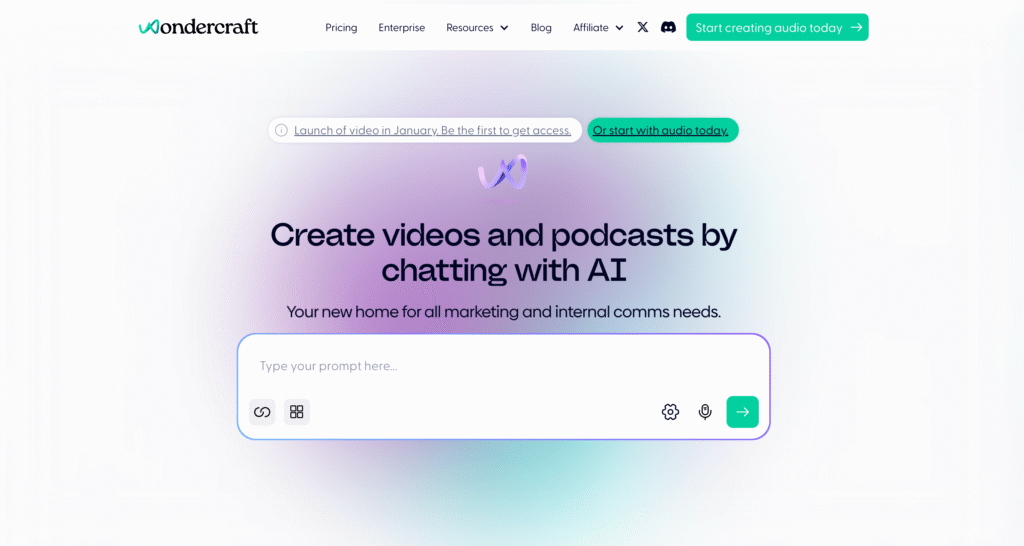
Wondercraft has quickly become one of the most influential AI tools in the podcasting space, especially for creators and businesses that value branding, storytelling, and production quality. Founded in 2023, Wondercraft focuses on audio-first content development, offering a lightweight studio experience that enables users to produce polished, business-ready podcasts without heavy technical setups. By 2026, it has secured its place among the top 10 AI tools for generating podcasts worldwide.
Strategic Positioning and Market Investment
Backed by a USD 3.5 million seed funding round—including contributions from ElevenLabs and angel investor Steven Bartlett—Wondercraft has built its platform around the needs of brand-focused podcasters. It is particularly well-suited for entrepreneurs, agencies, and thought leaders seeking to differentiate their audio content through voice identity, sonic branding, and storytelling precision.
Wondercraft Market and Funding Overview
| Category | Key Information (2023–2026) |
|---|---|
| Company Launch | 2023 |
| Seed Funding Raised | USD 3.5 Million |
| Strategic Investors | ElevenLabs, Steven Bartlett |
| Target Audience | Business podcasters, branded creators |
| Primary Strength | AI-driven audio branding & scripting |
Shift in AI Adoption: A Generational Insight
Wondercraft’s own 2025 report titled AI in Content Creation highlighted a significant trend in AI adoption across age groups. While over 80% of content creators have started integrating AI into their production processes, a surprising finding showed that creators aged 35–54 are leading in full adoption—from ideation to delivery. Only 42% of Gen Z (under 25) report using AI tools throughout their workflow.
This generational divide is not rooted in resistance to technology but in differing priorities. Older professionals are often managing brands, businesses, or high-stakes content timelines. They rely more on AI tools to accelerate production, maintain consistency, and streamline team-based content delivery.
AI Usage by Age Group Matrix
| Age Group | Full AI Workflow Adoption (2025) | Primary Motivations |
|---|---|---|
| 35–54 | 65–70% | Efficiency, scale, content consistency |
| 25–34 | 52% | Time savings, experimentation |
| Under 25 (Gen Z) | 42% | Creative control, manual personalization |
Core Features That Empower Modern Podcasters
Wondercraft’s tools are specifically designed to enhance the auditory experience of branded content. Rather than simply generating voice outputs, it enables strategic audio production that aligns with brand identity, audience retention, and global reach.
- Audio Branding Suite: Users can craft custom intros, outros, transitions, and branded jingles using AI-generated voices and royalty-free music. This ensures every episode feels consistent and professional.
- Script-Optimized Editing: The platform includes intelligent editing tools that tailor scripts for spoken delivery, ensuring rhythm, emphasis, and pacing match the intended emotional tone of the content.
- Clip Extraction Engine: Wondercraft uses AI to automatically identify the most engaging 30-second to 2-minute clips, ideal for promotion on platforms like LinkedIn, Instagram, or TikTok.
- Multilingual Voice Dubbing: It supports high-quality dubbing into multiple languages, expanding podcast accessibility and engagement across global markets.
Wondercraft Podcast Workflow Overview
| Workflow Step | Feature/Tool Used | Benefits Delivered |
|---|---|---|
| Content Planning | Script Editing with spoken language tools | Tailored scripts for voice-first delivery |
| Voice Creation | AI Voice Library, Custom Branding Tools | Branded audio identity without voice actors |
| Editing | Prosody-based refinements, filler removal | Enhanced listening flow and tone clarity |
| Promotion | Clip Extraction & Social Templates | Accelerated multi-platform marketing |
| Localization | High-quality voice dubbing in multiple languages | Broader reach with cultural sensitivity |
Voice Branding vs General Voice AI Matrix
| Feature Category | Wondercraft | Standard Voice AI Tools |
|---|---|---|
| Audio Branding Support | Custom intros/outros, transitions | Limited or not available |
| Script Editing for Voice | Designed for prosody and pacing | General text-to-speech optimization |
| Clip Extraction AI | Built-in, optimized for social | Requires separate tools |
| Language Dubbing | Human-like quality with tone retention | Often robotic and generic |
| Target Users | Brand storytellers, thought leaders | General-purpose creators |
Conclusion
Wondercraft is not just an AI audio editor—it’s a full-scale creative studio for brands and business-focused podcasters. In 2026, it is helping creators build memorable audio identities, generate high-quality branded content quickly, and amplify their voice across global markets with AI-powered dubbing and production features. As the podcasting landscape becomes more competitive and professionalized, Wondercraft stands out as an essential platform for those who want to lead with sound and strategy.
8. Auphonic
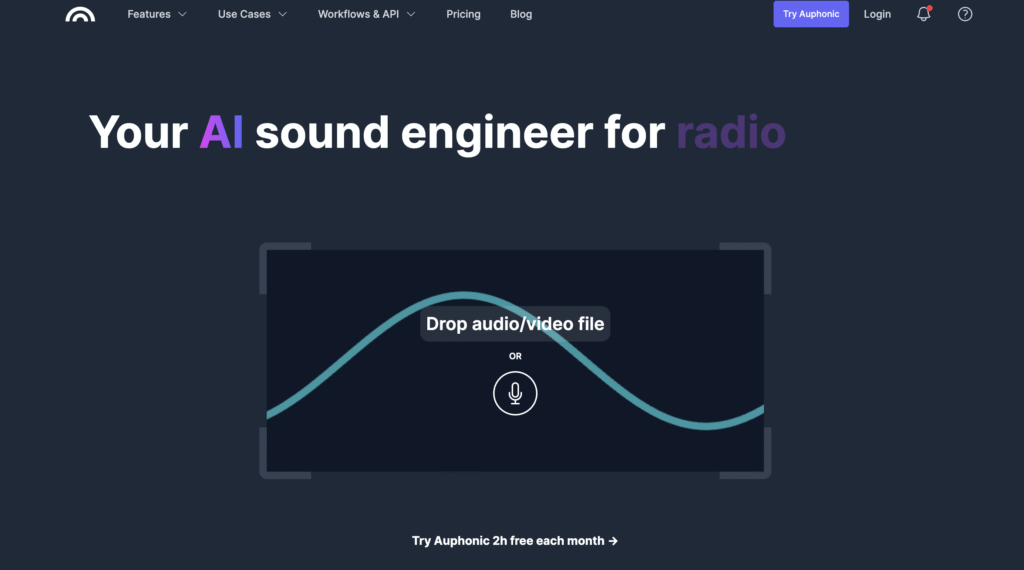
Among the top 10 AI tools transforming podcast production in 2026, Auphonic stands out as a precision post-production platform dedicated to delivering professional audio quality with minimal effort. Based in Graz, Austria, Auphonic is widely recognized for its “one-click” processing approach, which helps podcasters achieve studio-grade results—even without technical expertise or advanced editing software.
Trusted for Audio Reliability and Consistency
Despite having a lean team of just four employees, Auphonic plays a major role in global podcast output. Its AI algorithms automatically handle tasks that would otherwise require hours of manual post-production, making it ideal for independent creators, educational institutions, nonprofits, and large podcast networks.
Auphonic’s reputation has been built around its ability to solve the most common listener complaint in 2026: inconsistent or poor audio quality. As listener expectations rise, the demand for seamless, well-balanced audio is no longer optional—it’s essential for engagement and retention.
Platform Overview and Technical Summary
| Feature Category | Specification / Capability |
|---|---|
| Headquarters | Graz, Austria |
| Team Size | 4 Employees |
| Core Algorithms | Adaptive Leveling, Intelligent Noise Reduction |
| File Output Formats | MP3, WAV, OGG, FLAC, multi-format export |
| Supplementary Tools | Chapter marker generator, speech-to-text transcription |
Core AI Functions That Make Auphonic Indispensable
Auphonic’s standout functionality is its Adaptive Leveling System, which ensures that all speakers in a podcast episode are equally audible—regardless of differences in microphone quality, recording distance, or speaking volume. This is particularly valuable for panel discussions or interviews recorded in varied acoustic environments.
Its Noise Reduction AI automatically removes background disturbances such as electrical hums, static interference, or room echo, without compromising the clarity of speech. Combined, these features dramatically reduce the need for expensive microphones or controlled studio setups.
The platform also generates automated transcriptions and chapter markers, which help with search engine indexing, content repurposing, and episode navigation across platforms like Spotify, Apple Podcasts, and YouTube.
Auphonic’s AI Audio Workflow
| Workflow Stage | Auphonic Feature Used | Creator Benefits |
|---|---|---|
| Audio Upload | Supports multiple input formats | Flexible for various recording sources |
| Noise Cleaning | Automatic hum/static removal | Saves time on manual filtering |
| Voice Balancing | Adaptive Leveling across tracks | Ensures clear dialogue and listener comfort |
| Final Output | Export in multiple formats (MP3, WAV, OGG) | Ready for distribution across platforms |
| Content Enhancement | Chapter marker + transcript generation | Improves SEO, discoverability, and UX |
Audio Engineering Tool Comparison Matrix
| Feature/Tool | Auphonic (2026) | Traditional Editors (Manual) | Basic AI Podcast Tools |
|---|---|---|---|
| Adaptive Leveling | Yes | Manual EQ and mixing | Partially supported |
| Noise Reduction | Intelligent and automated | Manual filters, time-intensive | Often preset-based |
| Chapter Marker Generator | Automatic | Not included | Rare |
| Multi-Format Export | Yes | Often requires third-party tools | Limited formats |
| Speech Transcription | Built-in | Separate service required | Not always available |
| Setup Time Required | None | High | Low to medium |
Why Auphonic Is Critical for Indie and Enterprise Podcasters in 2026
Whether it’s a solo host recording from a home office or a corporate production team working with multiple guests, audio clarity is the foundation of a successful podcast. Auphonic bridges the gap between technical excellence and accessibility, making it possible for even non-technical users to deliver clean, professional audio.
Creators no longer have to learn complex audio workstations or hire audio engineers. Auphonic handles the heavy lifting—especially during the polishing phase—freeing up more time for script writing, interviews, promotion, and audience engagement.
Conclusion
Auphonic continues to define what modern podcast sound should be in 2026: clear, consistent, and polished. Its minimal learning curve, powerful backend AI, and automated production outputs make it one of the most efficient and reliable post-production tools on the market. For podcasters looking to elevate their sound quality without increasing costs or complexity, Auphonic remains an industry favorite—one click at a time.
9. NotebookLM

In the rapidly evolving world of AI podcast creation, NotebookLM—powered by Google’s Gemini model—has become a vital tool for transforming research into structured audio content. Recognized in 2026 as one of the top 10 AI tools for generating podcasts, it stands out not for flashy voiceovers or visual effects, but for its deep analytical power and ability to convert dense documents into intelligent, human-like podcast conversations.
Positioning and Purpose in the Podcasting Ecosystem
NotebookLM is not built for entertainment or casual podcasting. Instead, it serves academics, researchers, educators, students, and thought leaders who want to convert complex materials—like policy papers, academic journals, or long-form reports—into educational podcast dialogues. The platform’s innovative “Audio Overviews” feature allows two AI-generated hosts to discuss the content conversationally, helping listeners understand key insights in a natural format.
Google NotebookLM Platform Overview
| Feature Area | Functionality |
|---|---|
| Model Backbone | Gemini (2026 edition) with 2M-token context window |
| Input Types Supported | PDFs, URLs, Docs, research notes, spreadsheets |
| Output Format | Dialogues between two AI-generated hosts |
| Specialization | Long-form content summarization and research synthesis |
| Ideal Users | Researchers, students, educators, analysts |
How NotebookLM Powers Learning-Focused Podcasts
At its core, NotebookLM excels at contextual synthesis. Using Gemini’s extended context capacity of 2 million tokens, it can process full-length book series, whitepapers, or technical documentation and turn them into flowing, dialogue-based podcast scripts. This is especially powerful for those creating “learning podcasts”—episodes that educate rather than entertain.
The platform can extract key ideas, debate arguments, explain complex theories, and pose questions—all within a natural conversational format. This allows podcast creators to offer content that’s both educational and engaging.
Primary Use Cases for Podcast Creation
| Use Case | Application Description | Audience Impact |
|---|---|---|
| Research Summarization | Converts full research papers into listener-friendly discussions | Supports scholarly and scientific outreach |
| Custom Study Podcasts | Creates personalized learning audio from class materials | Enhances student revision and comprehension |
| Policy Briefing Episodes | Synthesizes lengthy government or legal documents into summaries | Makes public discourse more accessible |
| Corporate Knowledge Sharing | Turns internal docs into narrated knowledge-sharing podcasts | Boosts onboarding and team education |
| Podcast Outline Generation | Helps users ideate structured podcast themes from uploaded content | Speeds up pre-production and editorial planning |
Contextual Awareness vs Traditional AI Summarization
| Capability | NotebookLM (2026) | Traditional AI Podcast Tools |
|---|---|---|
| Context Window | 2 million tokens | 100k–200k tokens |
| Custom File Upload | Yes (multiple formats) | Often limited to text input |
| Dynamic Dialogue Creation | Yes – Dual AI-hosted formats | Typically monologue-style |
| Targeted Learning Applications | Strong – academic, research, policy | Weak – usually entertainment-driven |
| Episode Personalization | Yes – Based on user-uploaded content | Limited to generic topic generation |
Performance Benefits for Research-Driven Creators
NotebookLM gives creators the ability to quickly generate intelligent, context-rich audio content without needing to manually summarize complex documents. The ability to simulate intelligent dialogue allows creators to showcase multiple viewpoints or explain both sides of an argument—an especially valuable trait for educators, academic publishers, and media companies working in knowledge-focused verticals.
Podcast Creation Efficiency Matrix
| Workflow Phase | NotebookLM Feature Used | Benefit for Creators |
|---|---|---|
| Input & Planning | Uploads multiple sources | Saves hours of manual reading |
| Script Structuring | Audio Overview generator | Generates episode-ready structure automatically |
| Educational Tone | Dual AI-host dialogue | Creates engagement through Q&A-style content |
| Personalization | Deep context parsing | Tailors episodes to exact content goals |
Conclusion
In 2026, NotebookLM is redefining what educational podcasting can look like. With its ability to convert dense documents into engaging discussions between AI hosts, it has unlocked a new genre of personalized learning podcasts. Its high-context memory, paired with the strength of Gemini’s natural language processing, makes it one of the most advanced tools available for anyone creating audio from information-heavy materials. For researchers, institutions, and anyone aiming to turn deep knowledge into spoken insight, NotebookLM stands as a powerful, intelligent solution.
10. Adobe Podcast
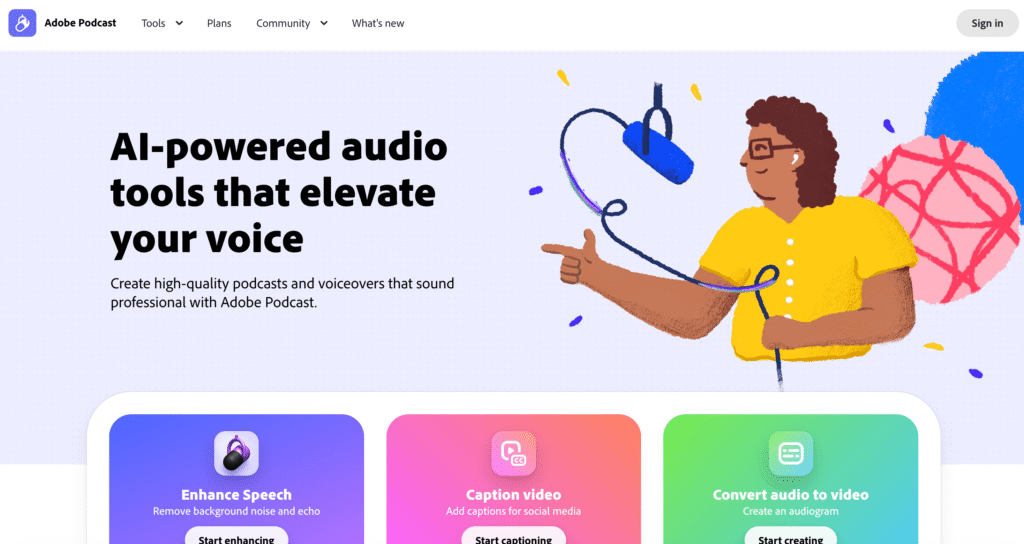
Adobe Podcast, formerly known as Project Shasta, has evolved into one of the most trusted and widely used AI tools for professional podcast creation in 2026. Designed for enterprises, media studios, and high-end content teams, Adobe Podcast combines advanced voice enhancement with seamless browser-based recording and editing. Its streamlined interface and AI-powered audio processing tools help podcasters deliver consistently clear and polished episodes—regardless of their recording environment.
Strategic Positioning in the AI Podcasting Ecosystem
As part of Adobe’s Creative Cloud suite, Adobe Podcast integrates smoothly with existing Adobe tools such as Premiere Pro, Audition, and Express. This ecosystem connectivity has made it a preferred choice for businesses and creative professionals seeking an all-in-one podcast workflow—from recording and enhancement to branding and distribution.
A standout feature is the Enhance Speech engine, which has become a defining tool in the audio industry. This AI function dramatically improves poor or noisy audio, transforming raw recordings into studio-quality sound—ideal for remote interviews, on-the-go content capture, or legacy audio restoration.
Adobe Podcast Platform Overview
| Feature Area | Capability Description |
|---|---|
| Audio Enhancement | Enhance Speech: Real-time AI clarity and noise cleanup |
| Recording System | Web-based multitrack capture with browser-only setup |
| Pre-Recording QA | Mic Check: Ensures audio settings are optimal before recording |
| Visual Integration | Adobe Express support for custom episode covers and visuals |
| AI Video Compatibility | Integrated with Runway AI tools for video-native podcasting |
| Ideal Users | Creative teams, agencies, enterprise podcast departments |
Enhance Speech and High-Fidelity Audio Processing
The Enhance Speech tool remains the platform’s flagship feature. Using deep AI audio modeling, it removes background noise, echo, and harshness from voice recordings while enriching vocal tones. The output mimics the acoustics of a high-end studio, regardless of where the speaker is physically located.
This technology is especially valuable for remote teams, virtual events, or creators recording in challenging environments. It also reduces the need for expensive mics, acoustic treatment, or post-production engineering.
Adobe Podcast Workflow Matrix
| Podcasting Phase | Feature Used | Outcome for Creators |
|---|---|---|
| Pre-Recording | Mic Check AI Tool | Detects hardware/setup issues before recording |
| Recording | Web-Based Capture | Enables remote, high-quality multitrack recording |
| Audio Processing | Enhance Speech | Studio-grade sound, even from poor audio sources |
| Visual Branding | Adobe Express | On-brand visuals for episodes, thumbnails, social posts |
| Video Integration | Runway AI Partnership | Easy conversion to vodcasts or video podcast shorts |
Audio Engineering Comparison Matrix
| Feature/Tool | Adobe Podcast (2026) | Standard Audio Editors | Entry-Level AI Tools |
|---|---|---|---|
| AI Voice Enhancement | Enhance Speech, real-time | Manual EQ/noise filters | Basic preset noise reduction |
| Recording Platform | Browser-based multitrack | Desktop software, hardware-dependent | Limited recording, usually mono |
| Video & Visual Integration | Native Adobe ecosystem | Requires third-party tools | Minimal to no video support |
| Brand Visual Customization | Adobe Express integration | Manual artwork creation | Not included |
| Enterprise-Ready Infrastructure | Creative Cloud and SSO enabled | Not designed for team workflows | Not suitable for large teams |
Use Cases Across Industries
Adobe Podcast has become the default audio tool for a variety of enterprise and creative applications. Its scalable AI-driven workflow is adaptable for both solo creators and large production teams.
| Industry/Use Case | How Adobe Podcast Is Used | Key Benefits |
|---|---|---|
| Corporate Communications | Branded internal podcast updates and training modules | Enhances clarity, accelerates content turnaround |
| Media & Entertainment | Serialized narrative podcasts with high-quality dialogue | Fast cleanup of raw voiceover and scene audio |
| Education & Training | Lecture-to-podcast conversion with improved student engagement | Improved voice clarity for online learning |
| Marketing & Branding | Audio series paired with Adobe visuals for promotional storytelling | Consistent branding across visual and audio assets |
Conclusion
In 2026, Adobe Podcast continues to define the gold standard for enterprise-grade podcast production. Its AI tools like Enhance Speech and Mic Check make it easy to capture professional-quality sound from anywhere, while its tight integration with Adobe’s creative ecosystem provides unmatched branding and visual storytelling capabilities. For teams that prioritize quality, speed, and brand alignment, Adobe Podcast remains a top-tier choice among the world’s most advanced AI podcast generation platforms.
Macro-Economic Trends and Regional Dynamics
The global podcasting landscape in 2026 reflects a pivotal shift from amateur experimentation to professionalized, monetizable content production—driven heavily by AI-powered tools, video-first formats, and regional market expansions. With watchable podcasts, multilingual content, and corporate investment fueling growth, the industry has become a central pillar of the broader creator economy.
Advertising Boom and Revenue Acceleration
One of the most notable indicators of podcasting’s maturity is the surge in global advertising spend. As of 2026, podcast and vodcast ad revenues are expected to reach USD 5.0 billion, marking a 20% year-on-year increase. This growth is largely driven by the effectiveness of audio and video podcast ads, which continue to outperform traditional media formats. According to recent user behavior studies, 86% of frequent podcast listeners demonstrate high ad recall, significantly exceeding engagement benchmarks on TV or social media platforms.
Global Market Growth: Podcasting and Ad Spend Forecast
| Market Indicator | 2024 Actual | 2025 Projection | 2026 Forecast |
|---|---|---|---|
| Global Podcasting Market Size | USD 37.07 Billion | USD 32.48 Billion | USD 40.46 Billion |
| Global Podcast Ad Spending | USD 3.0–3.4 Billion | USD 4.46 Billion | USD 5.0 Billion |
| U.S. Podcast Ad Revenue | USD 2.16 Billion | USD 2.30 Billion | USD 2.56 Billion |
| Total Global Podcast Listeners | 546.7 Million | 584.1 Million | 619.2 Million |
| U.S. Monthly Listener Percentage | 47% | 55% | 55%+ |
Regional Distribution and Market Expansion
North America continues to dominate the global podcasting economy, accounting for 38.5% of the global market share in 2026. The U.S. still leads in both advertising spend and content volume. However, regional diversification is accelerating rapidly.
The Asia-Pacific region is now the fastest-growing market for podcasts, thanks to its high mobile internet penetration and widespread adoption of AI technologies—particularly AI-powered voice dubbing and translation. These technologies enable podcasts to be instantly localized into regional languages, significantly widening their reach.
Regional Content Production Leaders in 2026
| Country | Number of Podcasts Produced |
|---|---|
| United States | 2,267,422 |
| Brazil | 206,439 |
| Indonesia | 145,127 |
| Germany | 101,518 |
This rise in regional production reflects a broader democratization of podcasting. Local creators are using affordable AI tools to launch branded shows, educational content, and multilingual episodes tailored to national and regional audiences.
Language Trends and Global Reach
While English remains the dominant language in the global podcasting space—accounting for 61% of total content—the growth of Spanish (11%) and Portuguese (6%) is reshaping content strategy in Latin America and parts of Europe. With AI tools like voice cloning, automatic dubbing, and real-time translation becoming mainstream in 2026, more creators are reaching cross-border audiences than ever before.
Podcast Language Share in 2026
| Language | Global Share (%) |
|---|---|
| English | 61% |
| Spanish | 11% |
| Portuguese | 6% |
| Other Languages | 22% (combined) |
Conclusion: A New Era of AI-Driven Podcasting Economics
By 2026, podcasting has evolved into a globally recognized media economy, deeply integrated with AI workflows, multilingual capabilities, and video-first strategies. As macroeconomic trends continue to favor creator-led content and advertising returns remain high, podcasting is no longer a niche format—it’s a fully-fledged global industry. Tools that automate voice enhancement, multilingual delivery, editing, and research synthesis are now central to growth, enabling even small teams to operate with the sophistication of full-scale production studios. The future of podcasting is not just audible—it’s global, watchable, and powered by AI.
Technological Infrastructure: The Rise of Agentic AI
The podcasting industry in 2026 is not only shaped by creativity and storytelling—it is powered by a new generation of AI infrastructure known as agentic AI. This breakthrough marks a fundamental shift in how podcast content is researched, produced, and distributed. Unlike traditional AI that responds passively to prompts, agentic AI operates as an autonomous assistant—capable of executing full workflows, making decisions, and coordinating complex tasks across platforms.
For podcasters, this means transitioning from disconnected software tools to integrated AI ecosystems—or “AI stacks”—where each step of the content lifecycle is handled by intelligent agents.
Understanding Agentic AI and Its Impact on Podcasting
Agentic AI refers to systems that go beyond language generation. These systems initiate actions, process multimodal inputs (text, image, audio, and video), and trigger events across apps. In 2026, platforms like n8n and Microsoft Copilot Studio have made it possible to automate production pipelines that include CRM updates, script deployment, visual creation, audio enhancements, and cross-platform publishing—all without manual input after setup.
Podcasters no longer rely on a single tool for each task. Instead, AI agents combine and execute complex sequences involving multiple tools, enhancing efficiency and scaling output.
Common AI Stack Configuration for Professional Podcasters in 2026
| Function | AI Tool Commonly Used | Role in the Stack |
|---|---|---|
| Scriptwriting & Planning | ChatGPT (OpenAI) | Generates full scripts, outlines, and interview prep |
| Voice Synthesis | ElevenLabs | Delivers human-like AI voiceovers in multiple tones |
| Video & Image Branding | Canva, Midjourney | Produces episode thumbnails, intros, and visuals |
| Research Processing | NotebookLM (Google Gemini) | Summarizes documents, converts files to dialogue |
| Editing & Enhancement | Descript, Auphonic | Cleans audio, removes noise, levels speech tracks |
| Distribution Automation | n8n, Make, Copilot Studio | Schedules and publishes across podcast platforms |
Multimodal Processing and Extended Context Capacity
The newest generation of AI models like Google Gemini 2.5 and 3.0 Pro have unlocked unprecedented levels of contextual understanding. These models support context windows of up to 2 million tokens, allowing creators to upload:
- Entire book collections
- Multi-hour webinars
- Long-form research papers
- Full YouTube podcast archives
The system can then analyze, summarize, and generate structured outputs such as interview scripts, topic timelines, or auto-generated Q&A segments. This has completely transformed the research and planning stages of podcasting, eliminating the traditional bottlenecks faced by solo creators or small teams.
Comparison: Traditional AI Tools vs Agentic AI Workflows
| Criteria | Traditional AI Tools (2023) | Agentic AI Infrastructure (2026) |
|---|---|---|
| Task Automation | Prompt-response interaction | Full execution of multi-step workflows |
| Input Types | Text-based only | Text, image, video, audio (multimodal) |
| Context Window Capacity | 100k–200k tokens | Up to 2 million tokens |
| Workflow Integration | Manual transitions between tools | Seamless across entire toolchains |
| Personalization and Recall | Session-limited memory | Persistent project-level memory |
| Output Complexity | Single-use text blocks | Dynamic media, documents, actions |
Agentic AI Use Cases for Podcasters
| Use Case Category | Application Example | Benefit for Podcasters |
|---|---|---|
| Research & Development | Analyze entire eBook or course material for theme extraction | Speeds up script creation and topic ideation |
| Audio-Visual Content Sync | Generate matching visuals based on voice tone and content | Ensures consistent branding and episode identity |
| Workflow Automation | Auto-publish edited files to Spotify, YouTube, and RSS feeds | Reduces manual publishing workload |
| Multi-language Publishing | Auto-dub and translate podcasts using AI agents | Enables global audience expansion |
| Marketing and Distribution | Schedule social media snippets from podcast highlights | Increases listener reach and engagement |
Conclusion: From Fragmented Tools to Intelligent Ecosystems
The rise of agentic AI in 2026 signals a major evolution in podcasting workflows. Creators are no longer limited by technical tools or time-consuming manual work. Instead, they operate intelligent, modular systems that learn, adapt, and act autonomously. With tools like ChatGPT, ElevenLabs, NotebookLM, Canva, and n8n forming the core of modern AI stacks, podcasting has moved into a new era of scalability, precision, and creative freedom—empowered by AI that doesn’t just assist, but fully executes.
Technical Benchmarks: Latency, Realism, and Speed
As AI becomes central to modern podcast workflows in 2026, performance benchmarks are now critical in choosing the right tools. The most advanced podcast generation platforms are evaluated based on their speed, realism, and ability to operate across multiple languages. These capabilities are quantified using key metrics such as Time-to-First-Byte (TTFB), Real-Time Factor (RTF), and multilingual audio fidelity.
For podcasters, these performance indicators are no longer just technical details—they directly affect production efficiency, responsiveness, and the listener’s perception of audio quality. Whether the goal is real-time interaction or high-fidelity storytelling, choosing a platform with the right balance of latency and emotional expression is essential.
Latency Benchmarks and Streaming Responsiveness
Latency determines how quickly an AI voice system can begin generating speech after receiving input. This is especially important in live interactions, AI co-hosting, call-in shows, and real-time dubbing. In 2026, ultra-low latency has become a competitive differentiator in AI audio.
The Cartesia Sonic Turbo model leads the field with a TTFB as low as 40ms, optimized for instant response in interactive settings. In contrast, ElevenLabs’ expressive model, designed for deep emotional realism, trades off speed for authenticity, averaging 300ms+ in latency.
AI Voice Model Latency Comparison Table
| AI Model / Provider | Median TTFB (ms) | Primary Strength |
|---|---|---|
| Cartesia Sonic Turbo | 40ms – 90ms | Instant responsiveness for live AI voice interaction |
| ElevenLabs Flash | 75ms | Balanced speed and sound quality |
| AsyncFlow (L4 Optimized) | ~20ms (inference time) | Highly efficient processing on NVIDIA L4 GPU infrastructure |
| ElevenLabs Expressive | 300ms+ | Maximum emotional fidelity, ideal for storytelling |
Podcasters focused on performance-first use cases—such as multi-language live streaming or rapid AI dialogue—tend to favor Cartesia or AsyncFlow. Those building narrative content prioritize expressive latency models like ElevenLabs for immersive listening.
Processing Speed and Real-Time Factor (RTF)
While latency measures live responsiveness, Real-Time Factor (RTF) quantifies how fast an AI model can process audio for post-production tasks such as transcription, voice cloning, and segmentation. An RTF below 1.0 means that audio is being processed faster than real time. By 2026, elite tools have achieved sub-0.4 RTF, allowing for a full hour-long podcast to be transcribed or analyzed in less than 20 minutes.
RTF Benchmark Comparison for Post-Production Transcription
| Tool / Model | Real-Time Factor (RTF) | Key Application |
|---|---|---|
| WhisperX Ultra (A100 GPU) | 0.12 | Industry gold standard for high-speed transcription |
| Deepgram Turbo | 0.30 | Enterprise-grade speech-to-text at API scale |
| AssemblyAI FastTrack | 0.32 | Balanced RTF for bulk podcast processing |
| RevAI AutoSplit | 0.35 | Optimized for segmenting long podcast episodes |
These advancements allow podcast creators to automate entire editing pipelines, generating transcripts, highlight clips, and metadata in record time—especially valuable when producing multilingual content or publishing on tight schedules.
Matrix: Latency vs Speed vs Emotional Quality
| Model / Platform | Latency (TTFB) | RTF (Speed) | Voice Realism | Best Use Case |
|---|---|---|---|---|
| Cartesia Sonic Turbo | 40–90ms | Not disclosed | Moderate | Real-time co-hosting and live dialogue |
| ElevenLabs Flash | 75ms | ~0.4 | High | Dynamic podcast narration |
| ElevenLabs Expressive | 300ms+ | ~0.5 | Very High | Emotional interviews and storytelling episodes |
| WhisperX Ultra | N/A | 0.12 | N/A | Fast transcription and multilingual segmentation |
| RevAI AutoSplit | N/A | 0.35 | N/A | Podcast clip extraction and auto-segmentation |
Conclusion: Performance Optimization Is Now a Strategic Choice
In 2026, podcast creators have access to an ecosystem of AI tools that offer precision control over latency, realism, and speed. Those building interactive, real-time podcast formats require ultra-low TTFB systems like Cartesia. Meanwhile, narrative-focused creators continue to favor expressive AI models that deliver richer voice textures, even if slightly slower.
Ultimately, the top 10 AI podcast generation tools are not only judged by what they create—but by how fast, how natural, and how scalable they make the process. Understanding the technical benchmarks behind each tool enables creators to optimize their AI stack for performance, reach, and listener experience.
The Economics of AI-Driven Content Creation
As AI tools reshape the podcasting landscape in 2026, the economic dynamics of content creation have shifted. While it’s now easier than ever to launch a podcast using AI-powered platforms, monetization has increasingly concentrated at the professional tier of the market. AI technology has lowered entry barriers, but sustainable revenue remains largely accessible to top-tier creators who blend strategic automation with authentic human storytelling.
Revenue Trends and Earnings Across the Creator Economy
In 2026, the broader creator economy continues its rapid growth. Forecasts estimate it will reach USD 528.39 billion by 2030, driven by platforms that reward creators for publishing, partnering with sponsors, and generating niche content. Yet earnings distribution remains heavily skewed.
The average full-time creator earns around USD 44,000 annually. However, only 4% of global creators qualify as “professionals,” earning over USD 100,000 per year. This elite segment benefits the most from the integration of AI tools, branded partnerships, and premium monetization channels.
Creator Earnings and Revenue Distribution Matrix
| Category | Data Point (2026) |
|---|---|
| Global Creator Economy Size | USD 528.39 Billion (Projected by 2030) |
| Average Annual Earnings | USD 44,000 |
| Professional Creator Segment | 4% earn over USD 100,000 per year |
| Indie Podcasters Monetizing | Only 15% generate consistent revenue |
Revenue Sources for Podcasters and AI-Enabled Creators
Creators are now generating income from diverse channels, ranging from ad shares to sponsorships, premium subscriptions, and AI-fueled content repurposing. YouTube remains a central platform for monetization, especially with the rise of video-first podcasts.
Monetization Benchmarks for AI-Integrated Podcasting in 2026
| Revenue Stream | Key Figures |
|---|---|
| YouTube Long-Form Ad Share | 55% to creators |
| YouTube Shorts Ad Share | 45% to creators |
| Sponsored Content Spend (US) | USD 9.29 Billion forecast |
| YouTube RPM (Revenue per 1,000 views) | USD 5 – USD 15 (general), higher in premium niches |
| Podcast CPM (Cost per 1,000 Impressions) | USD 10 – USD 50 (based on topic and audience size) |
Niches such as finance, SaaS, luxury, and B2B often command CPMs well above USD 50, offering lucrative opportunities for creators who target these verticals with AI-enhanced, high-production-value content.
The Industry Profitability Paradox
Despite rapid revenue growth, the podcast industry remains highly competitive and top-heavy. A majority of independent creators struggle to generate consistent income. According to recent surveys, only 15% of indie podcasters earn significant revenue, with the rest relying on part-time income, passion projects, or subsidized platforms.
This has created an economic paradox: while monetization opportunities are expanding, only creators who embrace strategic systems—especially those involving AI automation—can scale efficiently and compete.
Strategic Shifts: Human Creativity + AI Automation
To thrive in this environment, top creators have adopted agentic AI strategies. Instead of managing every task manually, podcasters now delegate repetitive or technical tasks to AI agents. These tasks include:
- Auto-identifying the most viral audio clips
- Generating social media posts and audiograms
- Transcribing, tagging, and scheduling content across platforms
- Creating automated highlight reels and language dubbing
This leaves creators with more time to focus on what audiences truly value—human-first storytelling, emotional connection, and editorial insight. As AI becomes more prevalent, this human layer becomes the key differentiator in a saturated content market.
Agentic AI Integration Matrix for Revenue Scaling
| Task | AI Tool Used (Example) | Benefit to Creator |
|---|---|---|
| Clip Extraction & Editing | Descript, Riverside, Adobe AI | Saves editing hours, produces shareable content |
| Scriptwriting & Summaries | ChatGPT, NotebookLM | Streamlines planning, enhances episode structure |
| Multilingual Dubbing | ElevenLabs, HeyGen | Expands audience across geographies |
| Social Media Scheduling | Make, n8n, Copilot Studio | Automates marketing and release cycles |
Conclusion: AI as a Revenue Multiplier, Not a Replacement
In 2026, the most successful podcasters are those who treat AI not as a content replacement—but as a productivity engine. While AI tools reduce production time and widen distribution, true monetization lies in how creators use their human perspective, unique voice, and editorial judgment to stand out.
For those aiming to join the top tier of podcasting success, building a smart AI stack is only the first step. The real value is unlocked when this infrastructure supports original, impactful storytelling that resonates deeply with the audience—and delivers measurable ROI in an increasingly competitive digital content economy.
Ethical Considerations, Security, and Ethical AI
As podcasting tools powered by artificial intelligence reach new levels of speed, scale, and realism in 2026, ethical concerns and security standards have become more important than ever. With the global rise in synthetic voice generation and automated podcast production, questions around consent, authenticity, and content quality are no longer optional—they are central to sustainable success in the AI-powered creator economy.
The top AI tools for generating podcasts in 2026 are not only judged by technical performance or audio fidelity, but also by their ability to protect digital rights, support responsible voice usage, and ensure creators, listeners, and voice models are ethically safeguarded.
Authentication and Deepfake Detection in AI Audio
Advanced generative tools such as Resemble.ai have built industry-leading safeguards into their platforms. Their “Resemble Detect” system can identify whether an audio file is AI-generated or human-recorded. This feature is now widely used in media verification workflows, especially for corporate podcasts and journalistic outlets that require full transparency in voice origin.
In addition, Resemble.ai has introduced “PerTH” AI watermarking, which cryptographically tags synthetic audio files. This makes it easier to prove ownership and authenticity—critical in legal disputes and licensing frameworks.
Security and Authentication Feature Matrix (2026)
| Platform | Key Security Feature | Purpose and Impact |
|---|---|---|
| Resemble.ai | Resemble Detect | Flags deepfake audio, supports media forensics |
| Resemble.ai | PerTH Watermarking | Authenticates AI-generated content using embedded signals |
| ElevenLabs | Iconic Voice Licensing | Provides licensed access to celebrity voice models |
| DupDub | Consent Upload System | Requires legal proof before cloning third-party voices |
Consent Management and Ethical Voice Licensing
One of the most sensitive areas of AI podcasting is voice cloning. To maintain ethical standards, platforms like DupDub have embedded consent capture workflows. Before users can train or use cloned voices, they must upload signed documentation from the original voice donor. This process has positioned DupDub as a leader in voice security and ethics compliance.
Similarly, ElevenLabs has launched its Iconic Voice Marketplace, where professional narrators and public figures—including celebrities such as Matthew McConaughey and Michael Caine—officially license their voices for audiobook and podcast use. This eliminates legal ambiguity and allows creators to confidently use recognizable voices without facing copyright risks.
Consent and Licensing Standards Matrix
| Platform | Voice Usage Policy | Impact on Creators and Talent Rights |
|---|---|---|
| DupDub | Mandatory Signed Consent for Voice Cloning | Prevents unauthorized replication of real voices |
| ElevenLabs | Licensed Voice Marketplace | Enables ethical use of public figure voices |
| Play.ht | Internal Audit Logs | Tracks voice generation history to aid transparency |
| Wondercraft | Model Attribution Tags | Automatically tags AI voices with origin metadata |
Combatting AI-Generated Content Overload
With the explosion of automated audio feeds, a new problem has emerged: AI slop—a term used to describe low-quality, mass-produced podcasts flooding RSS directories. In 2026, over 10,000 such feeds have been flagged by platforms like the Podcast Index, which warn that these AI-generated feeds dilute search rankings, reduce listener trust, and crowd out human creators.
To solve this, podcast platforms are moving toward AI-native stacks that enforce strict content labeling, speaker attribution, and context-aware filtering. These systems help platforms distinguish between meaningful human-led content and AI-generated filler, improving discovery for high-quality shows.
AI Content Moderation and Discovery Matrix
| Challenge | AI-Driven Solution | Outcome for the Podcasting Ecosystem |
|---|---|---|
| Content Flooding (AI Slop) | Directory-level filtering algorithms | Protects discoverability for high-value, human-first shows |
| Attribution Confusion | Speaker ID tagging and verification | Increases listener trust and platform transparency |
| Spam Show Proliferation | Automated auditing and scoring | Reduces low-quality show indexing in podcast search |
Conclusion: Ethical Infrastructure Is the Foundation of Sustainable AI Podcasting
In 2026, the most respected AI podcast tools are those that blend powerful voice capabilities with robust safeguards around consent, attribution, and content quality. As synthetic media continues to scale, ethical integrity becomes not just a legal issue—but a competitive advantage.
Platforms like Resemble.ai, ElevenLabs, and DupDub are setting the standard by embedding traceability and rights protection directly into their systems. Meanwhile, podcast platforms and directories are working to protect the ecosystem from low-effort, AI-generated spam by enforcing transparency and regulating discoverability.
Creators aiming to lead in this new landscape must adopt tools that don’t just produce fast content—but do so responsibly, with clear documentation, audience trust, and respect for the voices—human or synthetic—behind the microphone.
Strategic Projections and Industry Conclusions
Podcasting in 2026 has matured into a sophisticated, AI-integrated media format that rivals traditional entertainment in reach, scale, and monetization potential. No longer confined to audio-only formats, the modern podcast has become a dynamic, multimodal experience—blending voice, video, and AI automation into a unified storytelling engine. Professional creators are now operating within intelligent production systems that extend far beyond microphone and editing software.
The strategic landscape reveals clear imperatives for content creators and media professionals looking to lead in this space. The successful podcaster of 2026 is not only a storyteller, but also a systems builder—integrating AI tools, visual branding, and community-first strategies into a scalable content infrastructure.
Shift from Audio-Only to Visual-First Formats
One of the most significant shifts in podcasting is the mainstream adoption of video. In 2026, 41% of U.S. listenersprefer watchable podcasts, and YouTube has become the dominant discovery engine for new audio content. This evolution means that simply offering audio is no longer enough. Creators are expected to integrate video elements—whether through traditional camera recordings or AI-generated avatars.
Platforms such as HeyGen, Synthesia, and AI Studios are being widely adopted to help creators produce video-native podcasts without needing a full studio setup. These tools allow for rapid production of engaging, branded, and localized video podcasts at scale.
Video Integration Strategy Matrix for Podcasters
| Strategy | Tool or Platform Used | Core Benefit |
|---|---|---|
| AI Avatar Video Production | HeyGen, AI Studios | Visual podcasting without camera or studio |
| Livestreaming & Shorts | YouTube, Riverside.fm | Discoverability through platform algorithms |
| Multilingual Video Dubbing | ElevenLabs, Descript Overdub | Expanded reach via native-language delivery |
AI as a Core Efficiency Engine
In 2026, AI is not just an add-on—it is core infrastructure. Podcast creators using advanced AI tools now report an average 30% reduction in production costs, enabling them to scale output without expanding human teams. Time previously spent on editing, scripting, transcription, or scheduling is now automated through platforms like ChatGPT, Descript, Riverside, Make, and NotebookLM.
The strategic recommendation for professional creators is to reinvest AI-driven time savings into building deeper audience relationships, expanding into new markets, or producing more nuanced, evergreen content.
AI Efficiency Gains and Strategic Reinvestment Table
| AI Tool Function | Time/Cost Saved | Suggested Reinvestment Area |
|---|---|---|
| Script & Planning | ChatGPT, NotebookLM | Research quality and show structure |
| Editing & Voice Cleanup | Descript, Auphonic | Publishing speed and visual enhancement |
| Clip Generation & Marketing | Adobe Podcast, Wondercraft | Social channel engagement |
| Scheduling & Publishing | Make, n8n, Copilot Studio | International content pipeline expansion |
Podcasting Goes Global from Day One
One of the most transformative outcomes of AI integration is the ability to launch shows globally without translation bottlenecks. AI-powered dubbing and voice cloning from platforms like Spotify’s Voice Translation, ElevenLabs, and HeyGen now allow creators to publish in multiple languages simultaneously. This removes geographic constraints and opens up new revenue streams across markets.
Content can now be localized—maintaining the original host’s voice and tone—into Spanish, Portuguese, Hindi, Japanese, or Korean with no additional recording effort.
Multilingual AI Tools Impact Matrix
| Tool | Language Support (2026) | Use Case |
|---|---|---|
| ElevenLabs | 175+ Languages | Human-like voice dubbing |
| Spotify Voice Translation | 15+ Languages (and growing) | Seamless distribution through Spotify |
| HeyGen | Multilingual Avatar Support | Localized visual podcasts with lip-sync |
Human Trust and Intimacy Remain the Competitive Advantage
As AI-generated content floods the digital landscape, human presence and personality become the last remaining moat. Audiences in 2026 are drawn to shows that feel authentic, personal, and emotionally resonant. The relationship between host and listener—built through voice tone, vulnerability, and consistency—is still the strongest driver of long-term success.
Podcast creators who maintain a “human-first storytelling” approach while using AI to scale their output are more likely to command audience loyalty, drive subscriptions, and attract brand partnerships. This balance of automation and authenticity is now the most valuable currency in the podcast economy.
AI vs Human Differentiation Matrix
| Strength | AI Contribution | Human Creator Contribution |
|---|---|---|
| Speed and Scalability | Automated workflows, fast production | Personal nuance and emotional context |
| Multilingual Reach | Instant voice translation | Local cultural understanding |
| Content Structuring | Scripting and format planning | Original opinions, interviews, and insight |
| Brand Trust and Engagement | Limited | Built through host presence and consistency |
Conclusion: AI Tools Are Now the Backbone of Podcasting Success in 2026
The top AI tools for podcasting in 2026—ChatGPT, ElevenLabs, Descript, Riverside, HeyGen, NotebookLM, and Adobe Podcast—are no longer optional for professional creators. These platforms do more than generate content; they support full-stack operations across planning, voice creation, editing, distribution, translation, and analytics.
For those aiming to compete and grow in a global creator economy, mastering these tools is essential. But equally important is remembering that the ultimate competitive edge is the human voice—not just in sound, but in substance. The fusion of intelligent AI infrastructure with genuine storytelling is what defines podcasting’s future and keeps audiences coming back for more.
Conclusion
The podcasting industry in 2026 has reached a remarkable inflection point. What was once a grassroots medium driven by individual passion projects has now evolved into a global, AI-powered content economy backed by intelligent systems, voice automation, and multimodal storytelling. The rise of advanced podcast generation tools has empowered creators—from solo hosts and educators to media companies and global brands—to produce, scale, and monetize audio and video-first content at unprecedented levels.
At the center of this transformation are the Top 10 AI tools for generating podcasts, each contributing a specialized role in the modern production stack. Platforms like ElevenLabs and Resemble.ai are setting the benchmark for lifelike voice synthesis, while Descript and Adobe Podcast deliver cutting-edge editing, audio clean-up, and seamless browser-based workflows. ChatGPT and NotebookLM by Google are redefining research and scriptwriting, transforming dense documents into smart, conversational dialogues. Meanwhile, tools like HeyGen and Podcastlemake it easy to create video-native content with AI avatars, multilingual support, and scalable visual branding.
From ideation and script development to recording, editing, publishing, localization, and even monetization, AI tools now touch every stage of the podcast production cycle. These platforms do more than just assist—they serve as end-to-end automation engines capable of reasoning, generating, translating, and executing content workflows in real time. This not only reduces production time and cost but also allows creators to focus on higher-value storytelling and audience engagement.
For professional podcasters and aspiring creators alike, understanding and integrating these AI solutions is no longer a luxury—it is a necessity. In 2026, competitive success in podcasting increasingly depends on one’s ability to:
- Leverage AI efficiency to scale production without scaling headcount
- Expand reach globally through real-time voice translation and localization
- Enhance audio fidelity using AI-powered clean-up and expressive voice cloning
- Deliver video-first experiences that align with audience consumption trends
- Build ethical, transparent practices around voice usage, attribution, and licensing
- Maintain human trust in a content landscape increasingly shaped by automation
As AI continues to evolve, podcasting will only become more immersive, accessible, and intelligent. Creators who invest in mastering these technologies will be able to produce content faster, reach wider audiences, and monetize smarter—all while preserving the unique human connection that makes podcasting such an intimate and enduring medium.
In closing, the tools highlighted in this blog—ChatGPT, ElevenLabs, Descript, Adobe Podcast, HeyGen, Riverside.fm, Auphonic, Podcastle, Wondercraft, and NotebookLM—represent the most advanced solutions available today. Each is purpose-built to solve specific challenges within the modern podcasting workflow, and together, they form the backbone of the next generation of global audio content.
For those ready to embrace the future of podcast creation, now is the time to build your AI stack, streamline your operations, and elevate your creative vision. The tools are here. The infrastructure is ready. And the global audience is listening.
If you find this article useful, why not share it with your hiring manager and C-level suite friends and also leave a nice comment below?
We, at the 9cv9 Research Team, strive to bring the latest and most meaningful data, guides, and statistics to your doorstep.
To get access to top-quality guides, click over to 9cv9 Blog.
To hire top talents using our modern AI-powered recruitment agency, find out more at 9cv9 Modern AI-Powered Recruitment Agency.
People Also Ask
What are the best AI tools for generating podcasts in 2026?
The best AI tools for podcast creation in 2026 include Descript, ElevenLabs, Adobe Podcast, Podcastle, and Riverside, offering features like AI editing, voice cloning, and video integration.
Which AI podcast tool has the most realistic voice synthesis?
ElevenLabs leads in realistic voice cloning, providing emotionally rich and lifelike voiceovers suitable for storytelling, interviews, and multilingual narration.
Can AI tools fully automate podcast production in 2026?
Yes, many tools now offer end-to-end automation, including scripting, voice generation, editing, and distribution, reducing production time by over 70%.
What is the easiest AI tool for beginners to start podcasting?
Podcastle is widely praised for its user-friendly interface, allowing beginners to record, edit, and publish with minimal technical knowledge.
Is Adobe Podcast good for professionals?
Yes, Adobe Podcast is ideal for professionals, offering studio-quality audio enhancement, AI-powered mic checks, and seamless integration with Adobe Creative Cloud.
How do AI podcast tools improve audio quality?
Most platforms use machine learning to remove noise, enhance speech clarity, balance volume, and simulate studio-like sound automatically.
Do these tools support video podcasting as well?
Yes, tools like Riverside, Descript, and HeyGen allow podcasters to create high-quality video content with AI avatars or real-time video feeds.
Which AI tools offer the fastest processing speeds?
Cartesia Sonic Turbo and WhisperX Ultra offer low latency and fast real-time factors, enabling near-instantaneous editing and transcription.
Can I create multilingual podcasts using AI?
Yes, ElevenLabs and Spotify Voice Translation offer AI dubbing and translation, allowing podcasters to reach global audiences across languages.
Is Descript good for editing long podcast episodes?
Descript excels at long-form content, with powerful text-based editing, transcription, and filler word removal to streamline post-production.
Are AI tools suitable for interview-style podcasts?
Absolutely, tools like Riverside and SquadCast are tailored for remote interviews, offering multi-track recording and AI audio cleanup.
Do these tools offer transcription features?
Yes, most platforms include automated transcription powered by ASR models like Whisper, enabling searchable, editable podcast scripts.
Can I monetize podcasts made with AI tools?
Yes, AI-produced podcasts are eligible for monetization through ads, sponsorships, and platforms like Spotify, YouTube, and Substack.
Are there any free AI tools for podcasting in 2026?
Some tools offer free tiers with limited features, such as Podcastle, Descript Free, and CapCut’s AI voice-over generator.
Which AI tools are best for podcast marketing?
Descript, Canva, and Headliner allow podcasters to generate promotional clips, audiograms, and social media visuals to attract more listeners.
Do AI podcast tools allow custom branding?
Yes, platforms like Adobe Podcast and Canva provide customizable templates for podcast covers, social media, and episode branding.
How secure are AI podcasting platforms?
Leading tools like Resemble.ai and ElevenLabs offer watermarking and deepfake detection features to ensure content authenticity and voice protection.
Can AI tools help with podcast SEO?
Yes, AI can generate show notes, keywords, meta descriptions, and titles optimized for search engines, boosting podcast visibility.
What is the cost of using top AI podcast tools in 2026?
Pricing ranges from free to $30–$99/month for pro plans, with enterprise features like multilingual support and API access costing more.
Are there tools for podcast collaboration in teams?
Yes, platforms like Descript and Riverside support multi-user workflows, cloud editing, and collaborative timelines for teams and agencies.
Do creators still need microphones when using AI tools?
High-quality mics are recommended, but tools like Adobe Podcast’s “Enhance Speech” can improve even basic mic recordings to studio level.
How do AI avatars help in podcasting?
AI avatars from tools like HeyGen allow creators to produce video podcasts without appearing on camera, ideal for scaling content visually.
Are there any AI tools made specifically for mobile podcasting?
Yes, tools like Podcastle and Riverside offer mobile apps with AI-powered features for creators on the go.
How accurate are AI-generated transcriptions in 2026?
Transcription accuracy is over 90% on most platforms, with WhisperX Ultra achieving industry-best speeds and precision on long episodes.
Can these AI tools detect and fix audio errors automatically?
Yes, features like noise gating, echo reduction, and speech enhancement run in real time or during export to clean up errors automatically.
Which AI podcast tools support voice cloning?
ElevenLabs, Resemble.ai, and Play.ht offer advanced voice cloning, letting users replicate their voice or licensed celebrity voices.
Are AI podcasting tools compliant with copyright laws?
Major platforms require user consent and licensing for cloned voices or imported music, ensuring legal and ethical compliance.
What are the biggest benefits of using AI for podcasting?
AI saves time, reduces costs, improves quality, enables multilingual content, and allows solo creators to produce at professional scale.
Can AI tools help find podcast topics or write scripts?
Yes, ChatGPT and Jasper AI are commonly used for brainstorming ideas, generating outlines, and writing podcast scripts in seconds.
What future trends are expected in AI podcasting tools?
Expect more real-time capabilities, emotion-aware voice synthesis, seamless video integration, and full-stack automation for end-to-end podcast production.
Sources
Research Nester
Riverside
Backlinko
Loopex Digital
Skyquestt
Learning Revolution
Thursday Labs
Podnews
ElectroIQ
Podcastle
DataNorth AI
Wondercraft
AI Studios
Sacra
PM Insights
Unkoa Marketing
Manhattan Venture Partners
AutoPPT
AIR Media-Tech
Murf AI
Eesel AI
DemandSage
Podigee
Matchmaker
Analytics Insight
Toolfolio
Descript
Goldcast
Tracxn
Podcast Videos
Riverside
The Podcast Setup
Impact
PitchBook
BeFreed
SO Development
Alitu
Resemble AI