
Key Takeaways
- Specialized roles in AI, machine learning, and data architecture command significantly higher salaries globally in 2026, especially in finance and healthcare sectors.
- Remote work preferences are reshaping salary expectations, with professionals often accepting lower pay for flexibility and work-life balance.
- Certifications in generative AI, cloud platforms, and data science tools can boost compensation by up to 47%, making them essential for career growth.
The global data and analytics industry has entered a pivotal phase in 2026, driven by rapid technological advancements, the widespread adoption of AI, and an ever-growing demand for data-driven decision-making across every major industry. As organizations continue to embrace digital transformation at scale, the need for skilled data professionals has reached unprecedented levels—reshaping not just business strategies but also the entire landscape of compensation, benefits, and career growth within this sector.


This complete guide offers a comprehensive view into how salaries in the data and analytics space are evolving worldwide in 2026. From data analysts and data scientists to AI engineers, business intelligence professionals, and chief data officers, salary benchmarks are shifting based on a range of factors—experience level, region, industry demand, certification credentials, and even the work model (remote, hybrid, or in-office). Understanding these variables has become essential for both employers seeking to attract top-tier talent and professionals aiming to benchmark their worth in an increasingly competitive market.
One of the most notable trends in 2026 is the continued stratification of pay based on specialization. Entry-level roles now require more targeted skills, often supported by relevant graduate degrees or certifications in areas like generative AI, cloud analytics, and machine learning operations. Mid-career professionals who can combine technical proficiency with cross-functional leadership are in high demand, commanding significantly higher compensation than in previous years. Meanwhile, executive roles in data governance, AI ethics, and strategic analytics are seeing substantial pay spikes—especially in sectors such as finance, healthcare, and sustainability.
Geographically, the salary landscape presents stark contrasts. Developed markets like the United States, Singapore, the United Kingdom, and Germany continue to offer some of the highest base salaries for data roles. However, emerging economies such as India, Vietnam, and the Philippines are attracting foreign investment due to their growing talent pool and cost efficiency, leading to upward salary pressures in local job markets. Regional hubs are also developing unique patterns—for example, Singapore is evolving into Asia’s premier data innovation center, while India is seeing strong growth in AI and data engineering, especially in Tier 1 cities.
In parallel, 2026 has introduced a new layer of compensation complexity with the rise of hybrid and remote work preferences. Many professionals are willing to accept reduced base salaries in exchange for work-from-anywhere flexibility, while others expect a premium for full-time in-office roles. This evolving dynamic has added a strategic dimension to salary negotiations and workforce planning.
Moreover, total compensation packages now go far beyond just base salary. Bonuses, stock options, flexible work arrangements, learning and development budgets, and well-being perks play a crucial role in determining overall employee satisfaction and retention. Data from leading salary guides indicate that companies offering structured performance bonuses and generous learning incentives are significantly more successful in retaining their analytics talent.
This guide compiles the most recent data from industry reports, salary surveys, and employer insights to present a data-rich, easy-to-understand, and globally focused overview of salary trends in the data and analytics profession. Whether you’re a hiring manager planning compensation structures or a professional mapping your next career move, this guide will provide you with the clarity, benchmarks, and strategic insights needed to make informed decisions in 2026 and beyond.
Before we venture further into this article, we would like to share who we are and what we do.
About 9cv9
9cv9 is a business tech startup based in Singapore and Asia, with a strong presence all over the world.
With over nine years of startup and business experience, and being highly involved in connecting with thousands of companies and startups, the 9cv9 team has listed some important learning points in this overview of Salaries in the Data & Analytics Industry for 2026: An In-Depth Guide.
If your company needs recruitment and headhunting services to hire top-quality employees, you can use 9cv9 headhunting and recruitment services to hire top talents and candidates. Find out more here, or send over an email to hello@9cv9.com.
Or just post 1 free job posting here at 9cv9 Hiring Portal in under 10 minutes.
Salaries in the Data & Analytics Industry for 2026: An In-Depth Guide
- The Global Macroeconomic Context and Technology Market Stabilization
- `Role-Based Compensation Analysis: The AI and Machine Learning Surge
- Data Science and Advanced Analytics: The Transition to Decision Enablement
- Data Engineering and Architecture: The Infrastructure Core
- Regional Analysis: North American Market Variance
- Regional Analysis: Europe and the United Kingdom
- Regional Analysis: Asia-Pacific and the “Quality Era”
- Role of Experience and Seniority in Compensation
- The Industry Influence: Sectors Paying a Premium
- The Education and Certification Impact: “The Great Grad Reset”
- The Remote Work Paradox and Compensation Trade-offs
- Total Compensation: Benefits, Perks, and Bonuses
- Imperatives for the 2026 Data Industry
1. The Global Macroeconomic Context and Technology Market Stabilization
The year 2026 marks a significant shift in how companies across the globe approach hiring and salary planning within the data and analytics industry. Unlike the early 2020s, which were defined by aggressive hiring and rapid pay hikes in response to a booming digital economy, the current trend reflects a more calculated and measured growth path. Organizations have matured in their approach to workforce expansion, now focusing on strategic hiring and ROI-driven planning, especially in fields like data science, artificial intelligence (AI), and machine learning (ML).
Global Macroeconomic Influence and Market Realignment
The worldwide economic environment has played a critical role in shaping compensation trends in the tech and data sectors. The aftermath of global inflation, changing interest rates, trade tariffs, and digital transformation fatigue has contributed to a more stabilized salary growth rate. Companies are becoming more cautious in their investments, directing budgets toward areas that yield measurable results. This shift from volume-based hiring to value-based hiring has created a talent landscape where only the most skilled professionals—particularly in data and analytics—continue to command premium salaries.
Hiring Filter: Precision Over Volume
Across global enterprises, a notable transformation in hiring strategy is underway. Organizations are implementing tighter hiring filters, designed to identify candidates who bring immediate business value. Rather than expanding teams for the sake of growth, companies now pursue leaner, more technically proficient units—especially in roles that are essential to driving advanced analytics, predictive modeling, and AI-enabled operations.
Global Salary Growth Trends in Technology and Data Roles
While the broader technology market has cooled, the data and analytics segment remains highly competitive. This is especially true for candidates with specialized capabilities in AI/ML, data science, and cybersecurity analytics. As firms work to operationalize AI beyond pilot phases, they continue to offer competitive salaries to attract rare talent.
Below is a detailed table illustrating the average annual salary growth rates for key tech roles over a four-year period:
Table: Global Average Annual Salary Growth (%) in Key Tech Roles
| Role | 2023 | 2024 | 2025 | 2026 (Projected) |
|---|---|---|---|---|
| Overall Tech Sector | 3.5% | 2.9% | 1.6% | 1.6% |
| AI/ML Specialists | N/A | N/A | 4.4% | 4.1% |
| Data Scientists | N/A | N/A | 4.1% | 4.1% |
| Cybersecurity Specialists | N/A | N/A | 4.0% | 3.8% |
The Specialization Premium
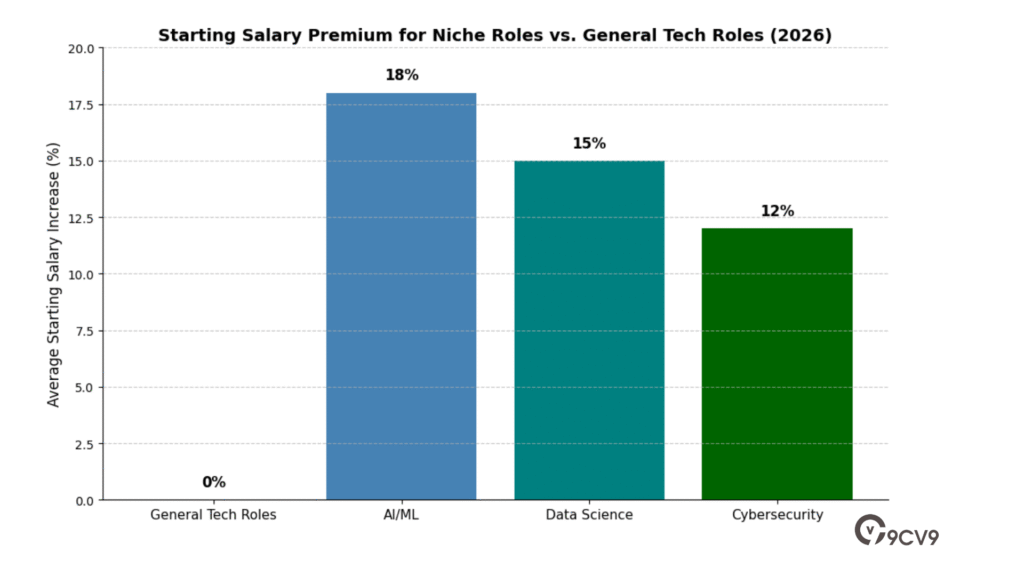
One of the defining compensation trends of 2026 is the emergence of the “specialization premium.” Companies are willing to pay more for professionals who possess rare, in-demand skills. According to industry data, nearly 87% of technology and IT executives confirm that they offer higher initial salaries to candidates with niche expertise in fields like:
- Artificial Intelligence and Machine Learning Engineering
- Predictive Data Modeling
- Cloud-Based Data Analytics
- Cybersecurity Intelligence
- Generative AI and NLP
This premium is essential for businesses looking to scale their AI applications from sandbox testing into production-ready solutions. The demand for professionals who can deliver AI-driven results at scale continues to surpass supply, further intensifying the competition for top-tier talent.

Shift from Experimental to Scalable AI Initiatives
Organizations are no longer satisfied with AI limited to small test environments. In 2026, there is a decisive move toward integrating AI into core business workflows. This evolution requires not only advanced tools but also highly skilled data professionals capable of designing, deploying, and maintaining these systems at scale. As a result, salary structures are now more closely aligned with technical depth, business impact, and implementation experience.
Conclusion
The global data and analytics job market in 2026 is maturing into a more structured, ROI-focused, and skill-centric environment. While general tech salary growth has normalized, the competition for highly skilled analytics professionals—especially in AI/ML and data science—remains intense. Companies that aim to lead in the digital economy are prioritizing quality over quantity in their hiring practices and are offering significant salary premiums to secure the best talent available. For professionals in this space, deep expertise, specialization, and the ability to drive business outcomes are more valuable than ever.
2. Role-Based Compensation Analysis: The AI and Machine Learning Surge
a. Benchmarks for AI and Machine Learning Roles
As organizations around the world increase their investments in artificial intelligence and automation, the global demand for AI and machine learning professionals has reached unprecedented levels in 2026. Salaries in this sub-sector of data and analytics are now among the highest across the entire tech industry. One of the key drivers behind this growth is the rising need for highly skilled professionals capable of building, deploying, and managing complex AI systems—especially those leveraging Large Language Models (LLMs) and real-world workflow integration.
Unlike traditional data science roles that focus primarily on analyzing data and creating statistical models, today’s AI professionals are expected to develop intelligent systems with direct operational impact. These professionals must deliver scalable and intelligent automation using cutting-edge tools and architectures, contributing to a measurable boost in productivity and efficiency. As a result, salary benchmarks for these specialized roles have grown significantly across all experience levels.
AI and Machine Learning Salary Benchmarks in 2026
The average base salary for AI professionals in 2026 has grown substantially due to talent scarcity and the increasing complexity of systems being developed. Particularly in tech hubs such as the United States, Singapore, Germany, and Canada, compensation for experienced AI engineers and machine learning architects continues to climb. Year-over-year salary growth has been strongest at the mid-level, where a 9.2% increase has been observed.
The following table presents updated compensation data for core AI and machine learning roles in 2026:
Global AI and Machine Learning Salary Range by Role (USD Annual Base Pay)
| Job Title | 25th Percentile | Median (50th Percentile) | 75th Percentile |
|---|---|---|---|
| AI Architect | $142,750 | $175,000 | $196,750 |
| AI/ML Engineer | $134,000 | $170,750 | $193,250 |
| AI Research Scientist | $124,000 | $160,000 | $210,000 |
| Machine Learning Engineer | $118,000 | $154,000 | $198,000 |
| AI/ML Analyst | $119,250 | $145,750 | $174,000 |
| LLM Developer | $165,000 | $188,000 | $209,000 |
| RPA Engineer | $105,250 | $123,500 | $152,500 |
Source: 2026 Global Compensation Reports – Technology Sector
Emerging Role of LLM Developers in 2026
Among all AI roles, LLM Developers—those who specialize in the development and orchestration of large language models and Retrieval-Augmented Generation (RAG)—have seen the most rapid rise in compensation. These professionals often command base salaries above $200,000, reflecting their critical importance in enterprise AI transformation. Their ability to scale AI-driven applications across business functions positions them as valuable assets in both corporate innovation teams and product-focused tech startups.
The productivity benefits these experts deliver—often estimated to be 10 times greater than traditional software development in specific tasks—justify the premium employers are willing to offer. As businesses race to embed generative AI capabilities in customer service, internal operations, and product delivery, LLM engineers have become central to execution.
Salary Growth Outlook and Strategic Recommendations
For professionals in the data and analytics field, transitioning into AI-focused roles offers one of the most financially rewarding career moves in 2026. Upskilling in areas such as LLM fine-tuning, RAG pipelines, prompt engineering, and AI system deployment is now a top priority for both job seekers and current employees aiming to boost their earning potential.
Employers, on the other hand, must prepare for intensified competition in recruiting top AI talent. Companies are advised to not only benchmark salaries against global standards but also offer additional compensation elements such as equity, flexible work models, and career development incentives to retain critical hires.
In summary, the AI and machine learning compensation landscape in 2026 showcases how technical specialization and real-world implementation capabilities directly translate into higher salaries and job market leverage. As this sector continues to evolve, both talent and employers will need to adapt quickly to remain competitive in a data-driven economy.
b. The Impact of Generative AI on Generalist Roles
In the global data and analytics job market of 2026, generative AI has not only driven salary growth for specialized roles—it has also triggered notable stagnation, and in some cases decline, in pay for generalist and entry-level positions. While high-end AI system builders are in high demand, roles centered around repetitive tasks or low-complexity functions are being phased out or restructured due to automation.
Automation Disrupts Routine-Based Data Jobs
As AI becomes more deeply integrated into business workflows, companies are rethinking their approach to task allocation. Repetitive and low-complexity tasks such as data entry, standard SQL querying, and basic reporting are now commonly handled by AI-powered platforms. This has significantly reduced the need for human intervention in these functions, leading to:
- Reduced hiring in generalist data roles
- Role restructuring to focus more on automation oversight
- Greater demand for professionals with AI-integration literacy
These shifts have had a direct impact on compensation, especially among roles that haven’t evolved to include automation-adjacent skills.
Case in Focus: SQL Developers and Reporting Analysts
One of the clearest examples of salary disruption due to AI can be seen in mid-level SQL developer roles. These professionals, once essential to managing queries and report generation, are now facing shrinking demand as tools like no-code data platforms and AI query builders automate much of their traditional work.
As a result:
- Many SQL-focused roles have become redundant
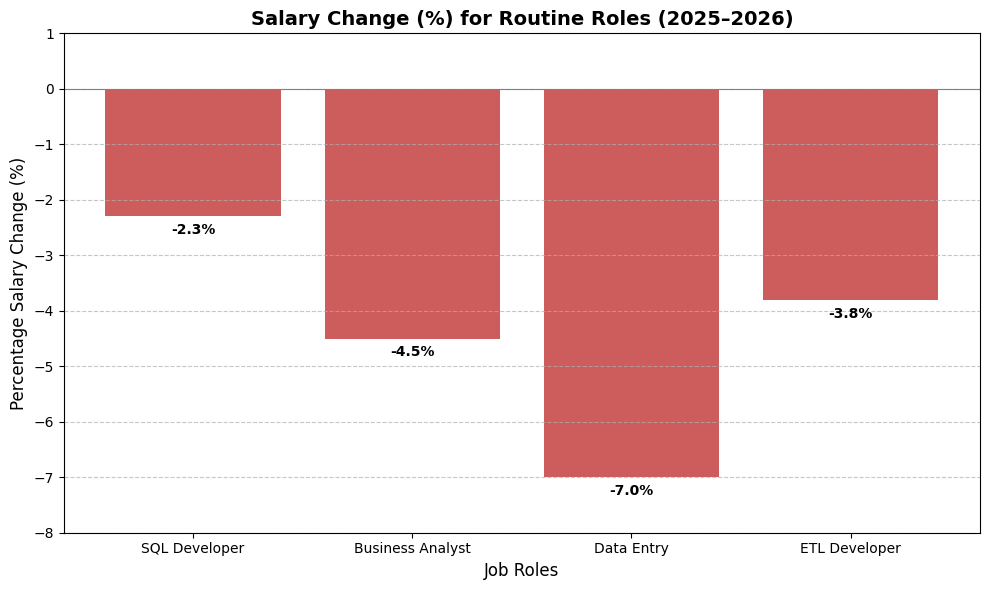
- Mid-level SQL developer salaries dropped by 7% globally in 2026
- Candidates without value-adding specializations (e.g., cloud orchestration, AI tooling) face stagnant or declining compensation
Table: Compensation Trends for Generalist Data Roles (2025 vs. 2026)
| Role Title | 2025 Avg Base Salary (USD) | 2026 Avg Base Salary (USD) | Year-over-Year Change (%) |
|---|---|---|---|
| Mid-Level SQL Developer | $91,000 | $84,630 | -7.0% |
| Junior Business Analyst | $66,500 | $65,000 | -2.3% |
| Reporting/Data Entry Clerk | $54,000 | $50,750 | -6.0% |
| ETL Developer | $84,500 | $82,000 | -3.0% |

Why Generalist Roles Are Being Replaced or Repositioned
The decline in compensation for these roles can be attributed to multiple evolving factors:
- Widespread AI Tool Adoption: Organizations now rely on AI for real-time query handling, eliminating the need for manually constructed reports.
- Cloud-Native Data Tools: Platforms with embedded AI simplify dashboarding, reporting, and data analysis, reducing reliance on basic SQL skills.
- Shift Toward Orchestration and Integration: Instead of executing tasks manually, companies now want professionals who can automate and connect tools across systems.
Matrix: Job Security and Pay Outlook by Role Complexity
| Role Category | Task Complexity | Automation Risk | 2026 Pay Outlook |
|---|---|---|---|
| LLM Developer | High | Low | Very Positive |
| AI/ML Engineer | High | Low | Positive |
| SQL Developer | Medium | High | Negative |
| Reporting Analyst | Low | High | Declining |
| Data Entry Clerk | Low | Very High | Strong Decline |
| Cloud Data Engineer | High | Low | Stable-Growth |
What This Means for Job Seekers and Employers
For professionals in the data field, the message is clear: foundational skills are no longer enough. To stay competitive in the market, individuals must shift toward roles that incorporate:
- AI integration and automation workflows
- System orchestration and process optimization
- Cloud-native and data pipeline engineering
Meanwhile, employers are strategically investing in automation to reduce costs—but they are also re-evaluating their workforce models. Those in generalist positions are expected to either upskill or transition into adjacent specialties that AI cannot yet replicate.
Conclusion
The global salary landscape for data and analytics roles in 2026 reflects two clear realities: highly skilled, AI-aligned professionals are in growing demand, while generalist and routine-based roles are experiencing flattening or declining pay. As automation continues to transform data workflows, both individuals and organizations must adapt to remain competitive in this evolving environment.
3. Data Science and Advanced Analytics: The Transition to Decision Enablement
In 2026, data science continues to be one of the most influential fields in the data and analytics industry. However, the role has evolved significantly. Today’s data scientists are no longer seen merely as data modelers—they are increasingly viewed as strategic decision enablers who embed their work into broader business intelligence systems and operational workflows. This shift has contributed to more structured salary bands, with strong earning potential—especially for those in leadership or specialized AI domains.
The New Role of the Data Scientist: From Insight Generation to Decision Enablement
Data scientists in today’s market are expected to contribute more than just insights. They are becoming deeply integrated into decision-making processes. The modern data scientist works with causal inference, predictive modeling, and real-time analysis tools that feed directly into dashboards, automation pipelines, and executive reports. In 2026, businesses want data professionals who can drive measurable outcomes—whether it’s increasing customer retention, improving operational efficiency, or automating strategic forecasting.
These capabilities have made the role more standardized across regions, but demand for experienced and niche-skilled professionals still fuels high compensation benchmarks.
Salary Growth in Data Science Compared to the Broader Tech Industry
Data scientists continue to enjoy salary growth well above the overall tech sector average. In 2026, the projected base salary growth for data scientists is around 4.1%, compared to just 1.6% for general tech roles.
Table: Annual Salary Growth Comparison – Data Science vs Tech Sector (2026)
| Sector/Role | Projected Salary Growth (%) |
|---|---|
| Data Scientists | 4.1% |
| Overall Tech Industry | 1.6% |
| Senior Data Scientists (AI) | 4.3% |
| Analytics Leaders (Director+) | 4.5% |
National and Global Salary Benchmarks for Data Science Roles in 2026
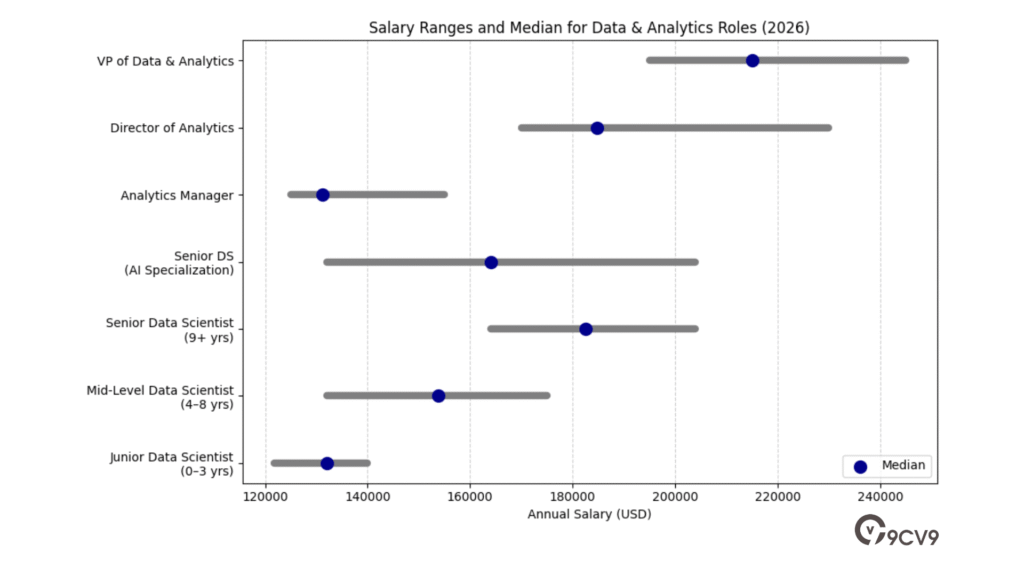
The table below highlights the average salary ranges for various data science and analytics positions, showcasing junior, mid, senior, and leadership levels. These figures reflect compensation trends in top hiring markets globally.
Salary Table: Data Science & Analytics Roles (2026)
| Job Title | Annual Salary Range (USD) | Median/Benchmark Salary (USD) |
|---|---|---|
| Junior Data Scientist (0–3 years) | $121,750 – $140,000 | $132,000 |
| Mid-Level Data Scientist (4–8 yrs) | $132,000 – $175,000 | $153,750 |
| Senior Data Scientist (9+ yrs) | $164,000 – $204,000 | $182,500 |
| Senior DS (AI Specialization) | $132,000 – $204,000 | $164,000 |
| Analytics Manager | $125,000 – $155,000 | $131,202 |
| Director of Analytics | $170,000 – $230,000 | $184,828 |
| VP of Data & Analytics | $195,000 – $245,000 | $215,000 |
The Rise of Analytics Leadership and Strategic Oversight Roles
In 2026, there’s increasing demand for analytics professionals who can lead both people and systems. Senior managers, directors, and vice presidents in data and analytics are no longer limited to overseeing reports—they are now expected to:
- Design and maintain reference architectures for analytics infrastructure
- Supervise cross-functional “sprint pods” focused on delivering data products
- Translate proof-of-concepts into production models with tracked business impact
- Define ROI-linked KPIs for analytics teams
This evolution has created significant salary opportunities at the top tier, especially for professionals with both technical and strategic business skills.
Matrix: Role Complexity vs. Salary Growth Potential (2026)
| Role Category | Role Complexity | Decision-Making Impact | Salary Growth Potential |
|---|---|---|---|
| Junior Data Scientist | Medium | Moderate | Medium |
| Mid-Level Data Scientist | High | High | High |
| Senior DS (AI Specialist) | Very High | High | Very High |
| Analytics Manager | High | Very High | High |
| Director of Analytics | Very High | Strategic | Very High |
| VP, Data & Analytics | Extremely High | Executive-Level | Very High |
Conclusion
In 2026, the global data and analytics salary landscape reflects a strong demand for value-driven, decision-enabling professionals. Data scientists who can embed their insights into business tools and lead data-driven strategies are rewarded with competitive pay. As organizations shift toward outcome-oriented analytics, roles that bridge technical depth and strategic thinking—particularly in leadership—offer the most promising salary growth paths across the industry.
4. Data Engineering and Architecture: The Infrastructure Core
In 2026, the importance of data engineering and architecture has reached new heights in the global data and analytics industry. As companies worldwide embrace AI-driven decision-making, the backbone of success lies in the strength and reliability of their data infrastructure. The ability to extract insights or deploy AI systems heavily depends on the quality, structure, and availability of data—making infrastructure professionals central to long-term digital strategy.
The Strategic Shift Toward Data Infrastructure
Organizations have come to recognize a core principle: data is only as valuable as the systems that support it. This realization has shifted focus toward data engineers and architects—experts responsible for designing the pipelines, platforms, and storage solutions that power modern analytics and AI environments.
In particular, roles linked to cloud-based data systems, distributed architectures, and real-time processing frameworks have become indispensable. These professionals are building the foundation that allows AI applications to run at scale with high performance, security, and accessibility.
Consistent Salary Growth Across Engineering and Architecture Roles
Unlike some roles in the data space that have seen uneven compensation changes, data engineering and architecture roles have enjoyed consistent and measurable salary growth in 2026. The demand is driven by the complexity of maintaining hybrid cloud platforms, securing data pipelines, and preparing infrastructure for AI readiness.
Professionals with deep expertise in AWS, Azure, and Google Cloud Platform (GCP) certifications are especially valued, with nearly half of hiring managers confirming they offer premium pay for candidates with these credentials.
Table: Annual Salary Growth in Infrastructure Roles (2026)
| Role Category | 2025 Avg Base Salary (USD) | 2026 Avg Base Salary (USD) | Year-over-Year Growth (%) |
|---|---|---|---|
| Data Architect | $158,700 | $166,750 | +5.1% |
| Senior Data Warehouse Developer | $143,800 | $152,150 | +5.8% |
| AI Platform Engineer | $180,600 | $190,000 | +5.2% |
| Database Manager | $145,400 | $153,000 | +5.2% |
Global Salary Benchmarks for Key Engineering and Architecture Roles
The following table outlines low, median, and high salary benchmarks for critical infrastructure-related positions. These figures reflect trends across North America, Europe, and APAC, where competition for these roles remains particularly strong.
Salary Table: Data Engineering & Architecture Roles (2026)
| Job Title | 25th Percentile (USD) | Median Salary (USD) | 75th Percentile (USD) |
|---|---|---|---|
| Data Architect | $136,750 | $166,750 | $189,750 |
| Data Engineer | $127,000 | $156,250 | $180,750 |
| AI Platform Engineer | $160,000 | $190,000 | $220,000 |
| Senior Platform Engineer | $155,000 | $175,000 | $198,000 |
| Database Manager | $128,000 | $153,000 | $176,500 |
| BI Developer | $109,250 | $130,500 | $156,500 |
| IT BI Analyst | $103,250 | $126,250 | $149,500 |
| Database Administrator | $95,500 | $119,750 | $137,500 |
Growing Value of Cloud and Security Certifications
A key salary driver in 2026 is certification. Professionals with cloud credentials from leading platforms—such as AWS Certified Data Analytics, Azure Solutions Architect, or GCP Professional Data Engineer—are seeing substantial salary premiums.
Many organizations are building cloud-native data stacks and prefer candidates who can:
- Optimize storage and compute costs
- Secure data environments against cyber threats
- Build scalable, distributed processing pipelines
- Enable real-time AI application data feeds
Matrix: Cloud Certification Impact on Salary Growth
| Certification Type | Value Recognition by Employers | Impact on Salary Range | Demand Level (2026) |
|---|---|---|---|
| AWS Data Analytics | High | +8% to +12% above average | Very High |
| Azure Architect Expert | High | +7% to +11% above average | High |
| GCP Data Engineer | Medium-High | +6% to +10% above average | High |
| Snowflake Certification | Medium | +5% to +8% above average | Growing |
Conclusion
In the global salary landscape of 2026, data engineering and architecture have become the essential pillars of every data-driven enterprise. These professionals are responsible for building and securing the systems that allow modern analytics and AI initiatives to operate efficiently. With growing emphasis on real-time data, hybrid-cloud models, and AI readiness, the demand for infrastructure experts continues to rise steadily.
Employers are willing to invest in top-tier talent, especially those certified in leading cloud platforms and capable of modernizing legacy systems. For professionals seeking long-term relevance and high earning potential in the data and analytics field, specializing in data infrastructure presents a clear and compelling path forward.
5. Regional Analysis: North American Market Variance
a. Metropolitan Pay Premiums in the U.S.
In 2026, North America—particularly the United States—continues to lead the world in setting salary benchmarks across the data and analytics industry. While national trends show consistent growth in compensation for skilled professionals, regional differences play a major role in shaping exact salary figures. These differences are largely influenced by factors such as cost of living, tech sector maturity, and the concentration of enterprise AI adoption in key metropolitan areas.
How U.S. Geography Influences Data Salary Levels
Not all cities offer the same compensation. Urban centers with a high density of tech firms and advanced AI development pipelines—such as New York, San Francisco, and Seattle—tend to pay significantly more than the national average. These metro hubs attract top-tier talent by offering not only higher base pay but also performance bonuses, equity options, and faster career acceleration paths.
In contrast, mid-tier and emerging cities still offer competitive salaries but typically trail behind the compensation packages found in coastal innovation centers.
Table: Salary Variance Across Major U.S. Cities (2026)
| City/Region | % Above National Average | Median Data Analyst Salary (USD) |
|---|---|---|
| New York, NY | +36.5% | $117,250 |
| San Francisco, CA | +35.0% | $116,500 |
| Seattle, WA | +29.0% | $111,000 |
| Denver, CO | +20.0% | $103,500 |
| Philadelphia, PA | +16.5% | $100,200 |
| Boston, MA | +13.5% | $84,186 |
| Chicago, IL | +12.0% | $82,850 |
Intense Competition for Senior and Executive-Level Talent
In leading markets such as San Francisco and New York, demand for senior engineers and executive roles is so high that companies are offering premium compensation far beyond industry averages.
Some of the most notable 2026 salary benchmarks include:
- Lead Data Engineer in San Francisco: $180,000 to $200,000 base salary
- VP of Engineering in New York: Base salary up to $350,000, with bonus potential of up to 40%
This trend reflects a “winner-takes-all” dynamic where companies in top-tier regions are willing to stretch compensation budgets to acquire professionals who can lead mission-critical AI and data transformation efforts.
Table: Senior & Executive Compensation in Top U.S. Cities (2026)
| Role Title | Location | Base Salary Range (USD) | Bonus Potential (%) |
|---|---|---|---|
| Lead Data Engineer | San Francisco, CA | $180,000 – $200,000 | Up to 20% |
| VP of Engineering | New York, NY | $300,000 – $350,000 | Up to 40% |
| Director of Analytics | Seattle, WA | $190,000 – $220,000 | Up to 25% |
| Chief Data Officer | Boston, MA | $250,000 – $300,000 | Up to 30% |
Matrix: Regional Talent Demand vs Salary Premium (2026)
| City/Region | Talent Competition Level | Salary Premium Category | Growth Outlook (2026) |
|---|---|---|---|
| New York, NY | Very High | Very High | Strong |
| San Francisco, CA | Very High | Very High | Strong |
| Seattle, WA | High | High | Stable |
| Denver, CO | Medium-High | Moderate | Growing |
| Philadelphia, PA | Medium | Moderate | Steady |
| Boston, MA | Medium-High | High | Strong |
| Chicago, IL | Medium | Moderate | Moderate |
What This Means for Employers and Job Seekers
For employers, salary strategy in 2026 needs to align with regional expectations. Companies operating in top-paying cities must offer competitive packages to attract and retain top analytics and AI talent. Meanwhile, firms in lower-cost regions are leveraging remote work models to access talent without paying coastal premiums.
For job seekers, understanding geographic pay variances allows for better salary negotiations and smarter decisions when evaluating job offers. Professionals with highly transferable AI, cloud, or data leadership experience are positioned to earn significantly more by targeting metro markets with talent shortages and budget flexibility.
Conclusion
In the global salary landscape for data and analytics professionals, the U.S. remains a leader—but pay is not uniform across the country. High-demand metro areas continue to command substantial premiums due to intense competition for specialized talent and enterprise AI expansion. As remote work normalizes and AI adoption spreads, understanding regional dynamics is more important than ever for both employers and professionals navigating the 2026 data job market.
b. The Canadian Landscape
The Canadian data and analytics industry in 2026 is experiencing dynamic growth, closely aligned with broader North American trends. As digital transformation continues to reshape the business landscape, Canadian organizations are accelerating their investments in data-driven technologies. Nearly all IT departments across the country—around 98%—have committed to significant modernization efforts in the next two years. This rapid shift is driving demand for data professionals with infrastructure, engineering, and analytical skills.
The Rise of Digital Transformation in Canada
Canada’s focus on enterprise-wide digital change is creating substantial job opportunities in data and analytics. Employers are actively seeking talent that can modernize legacy systems, design scalable data architectures, and deliver real-time business intelligence insights. This nationwide push has positioned data roles as critical components of business success, resulting in steady increases in compensation across all levels of experience.
In particular, roles such as data architects, engineers, and business intelligence developers are receiving notable salary attention due to their importance in executing cloud migration, AI infrastructure, and real-time data strategy initiatives.
Compensation Benchmarks for Canadian Data & Analytics Roles (2026)
The table below presents the latest salary ranges for major data and analytics job titles in Canada, reflecting low (25th percentile), median (50th percentile), and high (75th percentile) values across the national job market. These figures highlight the growing value of technical and analytical skills within digitally progressive organizations.
Table: 2026 Salary Ranges for Data & Analytics Roles in Canada (CAD)
| Job Title | 25th Percentile (Low) | Median (Mid) | 75th Percentile (High) |
|---|---|---|---|
| Data Architect | $111,750 | $145,500 | $176,500 |
| Data Engineer | $120,250 | $143,000 | $169,000 |
| Database Manager | $104,500 | $134,250 | $158,750 |
| Database Administrator | $76,750 | $95,250 | $121,500 |
| Business Intelligence Developer | $83,250 | $104,500 | $125,250 |
| Data Analyst | $74,250 | $89,500 | $111,750 |
Key Salary Insights in the Canadian Market
- Data Architects hold the highest earning potential, driven by their ability to design modern data systems for enterprise AI and analytics.
- Data Engineers are close behind, valued for their ability to build and maintain data pipelines that support real-time analytics.
- Database roles remain essential, but compensation tends to be lower unless tied to cloud-native or advanced security responsibilities.
- Business Intelligence Developers see healthy mid-range pay, especially those skilled in dashboarding tools and analytics platforms like Power BI, Tableau, and Looker.
- Data Analysts, while typically earning less than engineering counterparts, are increasingly rewarded for their ability to interpret data into actionable insights for business stakeholders.
Matrix: Role Impact vs. Salary Potential in Canada (2026)
| Role Category | Business Impact Level | Salary Growth Potential | Demand Intensity |
|---|---|---|---|
| Data Architect | Very High | Strong | High |
| Data Engineer | High | Strong | High |
| Business Intelligence Developer | High | Moderate-High | Moderate-High |
| Database Manager | Moderate | Moderate | Moderate |
| Database Administrator | Moderate | Low-Moderate | Steady |
| Data Analyst | Medium | Moderate | High |
What This Means for Employers and Job Seekers in Canada
For Canadian employers, staying competitive in talent acquisition means aligning compensation with evolving job requirements. Candidates who bring cloud engineering skills, automation expertise, or real-time analytics capabilities are commanding higher salaries.
For job seekers, there is strong upward mobility for professionals who continuously upskill in AI integration, distributed data platforms, and modern analytics frameworks. Credentials in platforms like Azure, AWS, GCP, or experience with Spark, Snowflake, and Kubernetes can significantly improve compensation prospects.
Conclusion
Canada’s data and analytics job market in 2026 is thriving, driven by aggressive digital transformation strategies and increased enterprise dependency on real-time data. As companies modernize their operations, they are offering competitive salaries to secure top-tier professionals in architecture, engineering, and analytics. This trend is expected to continue as organizations across the country push forward with their digital agendas, making data-centric roles both high in demand and lucrative in terms of career growth.
6. Regional Analysis: Europe and the United Kingdom
a. United Kingdom Salary Benchmarks
Across the United Kingdom and wider Europe, the data and analytics job market in 2026 is shaped by a unique mix of stabilizing salary trends and rising skills shortages. While pay levels in these regions are showing more predictability than in past years, employers are struggling to find professionals with the necessary expertise—particularly in high-demand sectors such as finance, technology, and industrial analytics.
In markets like Ireland and the UK, the shortage of qualified talent is especially evident. Reports show that 96% of employers in Ireland and 93% in the UK have encountered major skills gaps over the past year. As companies continue to modernize their data strategies, the demand for highly skilled professionals has not only remained high but is also pushing companies to exceed traditional pay benchmarks when recruiting top-tier talent.
UK Salary Benchmarks in 2026: Strong Demand for Finance and Tech Expertise
In the UK, organizations are increasingly competing for talent with niche capabilities in financial services analytics, shared service operations, and the broader tech sector. While many companies follow industry benchmarks to guide their salary offers, roughly 72% indicate that they are willing to offer above-average compensation to secure specialists in strategic roles.
Table: United Kingdom Salary Benchmarks for Key Roles in 2026 (GBP)
| Role Title | Low (25th Percentile) | Median (50th Percentile) | High (75th Percentile) |
|---|---|---|---|
| Shared Service Centre Director | £84,250 | £112,500 | £133,000 |
| Group Financial Controller | £76,250 | £85,000 | £106,500 |
| Financial Controller | £63,000 | £76,750 | £92,500 |
| Senior Finance Business Partner | £61,500 | £72,750 | £82,000 |
| Financial Analyst (FinTech) | £49,500 | £55,500 | £61,750 |
| Data Analyst (Tech Sector) | £55,000 | £70,000 | £85,000 |
Germany: A Stronghold for Data Science Salaries in Industrial Regions
Germany continues to be a central hub for data professionals in Europe, especially within the manufacturing, automotive, and industrial technology sectors. The average salary for data scientists across the country stands at €58,100 gross per year. However, senior professionals with more than six years of experience and advanced technical capabilities—such as in machine learning, production optimization, and AI-based quality control—can command significantly higher pay.
- In high-demand regions such as Bavaria, where many global tech and industrial firms are headquartered, senior data scientists can earn up to €130,000 annually.
- These figures underscore a regional pay disparity where geography and industry sector heavily influence compensation.
Table: Data Science Compensation Trends in Germany (2026)
| Experience Level | Average Gross Salary (EUR) | Salary Range (EUR) |
|---|---|---|
| Entry-Level Data Scientist | €45,000 | €42,000 – €50,000 |
| Mid-Level (3–6 years) | €58,100 | €55,000 – €70,000 |
| Senior (6+ years) | €85,000 | €75,000 – €130,000 |
| Senior (Bavaria – Top Tier) | €100,000 | €95,000 – €130,000 |
Matrix: Talent Shortage vs Salary Growth Pressure in Europe (2026)
| Country | Skills Shortage Level | Industry Focus | Salary Growth Trend |
|---|---|---|---|
| Ireland | Very High | Tech, Financial Services | Strong |
| United Kingdom | Very High | Shared Services, FinTech | Strong |
| Germany | High | Industrial Tech, AI | Moderate-High |
| France | Moderate | Retail Analytics, Banking | Moderate |
| Netherlands | Moderate-High | Logistics, Digital Health | High |
What Employers and Talent Should Expect in the European Market
Employers across Europe are adapting to this talent-constrained market by offering more flexible compensation packages, which may include higher bonuses, remote work options, and training support to retain valuable staff. Regions with sector-specific concentration—like Bavaria’s industrial base or London’s financial district—are showing the highest upward pressure on salaries due to dense competition for advanced data talent.
For professionals in data and analytics, now is an ideal time to specialize. Those who invest in high-demand skills such as cloud data architecture, financial modeling, AI engineering, or real-time analytics are likely to see greater salary increases, particularly when willing to relocate to high-growth European hubs or work on cross-border projects.
Conclusion
The United Kingdom and European data and analytics salary landscape in 2026 reveals a complex but opportunity-rich market. While salary levels are stabilizing overall, skill shortages continue to drive aggressive compensation strategies in finance, tech, and industrial sectors. Professionals with domain-specific expertise and leadership capabilities remain in high demand, making this a favorable environment for both job seekers and companies ready to invest in specialized talent.
7. Regional Analysis: Asia-Pacific and the “Quality Era”
a. Singapore: The Regional Tech Hub
The Asia-Pacific (APAC) region is undergoing a significant transformation in hiring practices, particularly in key markets such as Singapore and India. As the region matures in its digital evolution, companies are shifting away from rapid recruitment models toward a more deliberate and long-term approach. This transition, often described as the beginning of the “Quality Era,” is defined by a preference for highly skilled, adaptable professionals who can contribute to sustained innovation and strategic business impact.
Rather than simply filling roles quickly, organizations in the APAC region are now focused on identifying talent with a solid foundation in analytics, domain expertise, and the ability to evolve with emerging technologies such as artificial intelligence (AI), sustainability data systems, and cloud-native analytics platforms.
Singapore: A High-Performance Tech and Analytics Hub
Singapore continues to hold its position as one of the most stable and competitive job markets in the global data and analytics landscape. As of 2026, the country’s unemployment rate remains low at 2.0%, while salary growth across the tech and data sector is forecasted between 4.0% and 4.3%.
The strongest salary trends are found in sectors like financial services and healthcare, where demand for real-time decision intelligence, regulatory analytics, and AI-driven reporting tools continues to expand. Roles related to Environmental, Social, and Governance (ESG) data and AI infrastructure are also drawing significant compensation premiums due to limited talent availability.
Table: Data & Analytics Salary Benchmarks in Singapore (2026)
| Job Title | Experience Level | Annual Salary Range (SGD) |
|---|---|---|
| Entry-Level Data Analyst | 0–2 Years | S$50,352 – S$63,600 |
| Mid-Level Data Analyst | 5–10 Years | S$60,000 – S$90,000 |
| Senior Data Analyst | 10–15 Years | S$90,000 – S$170,000 |
| Analytics Manager | 15+ Years | S$140,000 – S$240,000+ |
Monthly Compensation Insights from Major Tech Employers in Singapore
Some of the region’s largest employers—such as TikTok and Grab—have reported competitive monthly compensation packages for data professionals. These include both base salary and additional benefits such as bonuses, equity, and allowances.
Table: Monthly Compensation for Mid-Level Analysts at Major Tech Firms (Singapore, 2026)
| Employer | Monthly Total Compensation (SGD) |
|---|---|
| TikTok | S$7,314 – S$15,404 |
| Grab | S$7,314 – S$15,404 |
These figures reflect the increasing value placed on experienced analytics professionals who can support large-scale AI models, customer segmentation platforms, and mobile performance analytics.
Matrix: Singapore Data Role Maturity vs. Compensation Potential (2026)
| Experience Level | Job Complexity | Market Demand Level | Salary Growth Outlook |
|---|---|---|---|
| Entry-Level | Low | High | Moderate |
| Mid-Level | Medium | Very High | High |
| Senior-Level | High | High | Very High |
| Analytics Leadership | Very High | Medium-High | Very High |
What This Means for the APAC Data Talent Landscape
Singapore exemplifies the broader regional move toward precision hiring. Employers are becoming more strategic in sourcing professionals with deep analytical backgrounds, especially those with experience in regulated environments like financial services and healthcare. Candidates with proficiencies in tools such as Python, R, Tableau, Power BI, Snowflake, and cloud platforms (AWS, Azure, GCP) continue to have a strong edge in the hiring market.
In the “Quality Era,” professionals who focus on mastering their craft, expanding their knowledge of cross-functional data ecosystems, and building strong business acumen will find the best opportunities for career progression and salary growth.
Conclusion
The Asia-Pacific region is entering a more mature, skills-oriented hiring phase in 2026. In Singapore, one of the region’s key tech hubs, data and analytics professionals are benefiting from robust demand, rising salaries, and premium compensation packages—particularly for those with specialized expertise. As hiring becomes more focused on long-term value and adaptability, professionals who align with this shift will be best positioned to succeed in the evolving APAC data economy.
b. India: The Hiring Filter
In 2026, India’s data and analytics job market is undergoing a noticeable transformation. After several years of rapid salary growth driven by aggressive hiring, the market has entered a more measured and selective phase. This shift is often referred to as the “hiring filter” era, where employers—especially in sectors like healthcare, consumer goods, and retail—are becoming more cautious and focused on hiring only the most relevant and capable candidates.
Rather than expanding teams broadly, Indian employers are concentrating their efforts on acquiring high-impact talent, particularly in emerging and specialized domains such as artificial intelligence (AI), machine learning (ML), and data engineering. These roles remain in strong demand, especially as international companies continue to invest in India due to its deep talent pool, scalable workforce, and cost-effective innovation ecosystem.
India’s New Hiring Priorities: From Speed to Specialization
Employers are now placing more emphasis on skill quality, long-term potential, and specialization instead of merely scaling up their workforce. With this recalibration, average salary growth across general roles is slowing, while high-performing specialists—especially in AI-driven areas—are still commanding strong compensation.
Table: Average and Top-Tier Salary Ranges for Data & Analytics Roles in India (2026)
| Role Title | Average Annual Salary (INR) | Top 10% Salary Range (INR) |
|---|---|---|
| General Tech Professional | ₹16.8 Lakhs | ₹22.1 Lakhs+ |
| Data Engineer | ₹22.7 Lakhs | ₹30 Lakhs+ |
| Business Consultant (Data-Focused) | ₹18.0 Lakhs | ₹25 Lakhs+ |
| Analytics Consultant | ₹22.0 Lakhs | ₹30 Lakhs+ |
Growth Opportunities in India’s Data-Centric Economy
Despite moderation in broader tech compensation, India continues to be a global center of excellence for data-driven innovation. The most successful professionals in 2026 are those with:
- Advanced knowledge of AI/ML model building
- Hands-on experience with big data technologies (Spark, Hadoop, Snowflake)
- Exposure to global enterprise environments
- Strong communication and cross-functional consulting capabilities
Professionals who bring this hybrid blend of technical depth and business orientation remain in the top income brackets and are often courted by global firms for key delivery and leadership positions.
Matrix: Hiring Demand vs. Compensation Strength by Role (India 2026)
| Role Type | Market Demand Level | Compensation Growth Potential | Strategic Priority Level |
|---|---|---|---|
| Data Engineer | Very High | High | High |
| Analytics Consultant | High | High | High |
| Business Consultant (Data Focus) | Medium-High | Moderate-High | Medium-High |
| General Tech Professional | Moderate | Low-Moderate | Medium |
What Employers and Professionals Should Expect in India
For employers, the hiring strategy in India has matured to prioritize depth over breadth. Investment is flowing into AI infrastructure, advanced analytics capabilities, and cloud-native data systems. This means that while entry-level and generalist salaries may cool, senior-level compensation for specialists will continue to increase in competitive clusters like Bangalore, Hyderabad, Pune, and Gurugram.
For professionals, the current hiring filter presents both a challenge and an opportunity. The bar is rising for technical qualifications, but those who can meet it are seeing long-term career acceleration, project ownership, and strong salary growth. Certifications in cloud platforms (AWS, GCP, Azure), AI/ML, and data architecture are proving to be valuable differentiators.
Conclusion
India’s data and analytics landscape in 2026 reflects a more focused and quality-oriented hiring environment. Salaries are stabilizing in generalist roles, but advanced positions in AI, analytics consulting, and data engineering remain lucrative. For skilled professionals ready to adapt and specialize, India continues to offer global career visibility and competitive compensation—making it one of the most strategic markets in the global data economy.
8. Role of Experience and Seniority in Compensation
a. Individual Contributor (IC) Levels in Data Science and AI
In 2026, professional experience and seniority remain the most influential drivers of salary growth in the data and analytics industry. However, traditional definitions of seniority based purely on the number of years in a role are rapidly evolving. Employers are placing more value on real-world application of skills, strategic thinking, and the ability to lead innovation than simply on tenure.
The global job market is becoming more segmented, with a clear divide emerging between junior individual contributors and senior professionals who drive organizational data strategy. While junior roles are still critical to operations, significant salary increases are typically reserved for those who can scale solutions, manage platforms, and influence business outcomes.
Reframing Seniority: From Tenure to Applied Expertise
Rather than relying solely on how long someone has worked in the field, companies are redefining seniority based on how effectively a professional can apply technical skills to complex, high-impact problems. Professionals who demonstrate practical experience—such as deploying machine learning models, architecting MLOps systems, or mentoring teams—tend to command higher salaries regardless of formal title or years of service.
Table: Role of Seniority in Salary Determination (2026 Overview)
| Factor | Traditional Approach | Evolving Market View |
|---|---|---|
| Years of Experience | Key salary benchmark | One of several considerations |
| Real-World Skill Application | Optional advantage | Mandatory for mid/high levels |
| Business Strategy Contribution | Limited to leadership | Expected at all senior levels |
| Mentoring/Team Enablement | Non-essential | Valued for salary progression |
Individual Contributor (IC) Framework for Data and AI Roles
According to the Burtch Works 2026 study, the data science and AI industry now categorizes Individual Contributors (ICs) into three main levels. Each tier reflects increased responsibility, technical complexity, and influence within the organization. These levels help employers better assess talent and define salary bands based on actual capabilities, not just job titles.
Table: IC Levels in Data Science & AI Roles (2026)
| Level | Experience Range | Role Scope and Responsibilities |
|---|---|---|
| IC-1 | 0–3 Years | Entry-level; focused on learning, basic modeling tasks |
| IC-2 | 4–8 Years | Solves advanced problems, supports junior team members |
| IC-3 | 9+ Years | Subject Matter Expert (SME); leads projects, mentors, trains |
Key Compensation Insights for AI Professionals by IC Level
- IC-1 professionals are typically early-career practitioners who are hands-on with exploratory modeling and learning core tools like Python, SQL, and basic ML frameworks.
- IC-2 professionals often work on production-grade AI systems, manage data pipelines, and start taking ownership of components within larger ML platforms.
- IC-3 professionals operate at an enterprise level. They guide architecture decisions, handle governance in AI and MLOps systems, and often serve as technical mentors or team leads.
The most notable salary jumps occur when transitioning from IC-1 to IC-2. This phase marks a shift from being a contributor to becoming a solution owner who ensures scalability, security, and performance of AI deployments.
Matrix: Skills vs. Seniority Impact on Salary Trajectory (2026)
| Role Level | Technical Skill Depth | Leadership/Strategy Contribution | Salary Influence Level |
|---|---|---|---|
| IC-1 | Low–Medium | Low | Entry-Level |
| IC-2 | High | Medium | High |
| IC-3 | Very High | High | Very High |
| Manager+ | Varies (Tech + Biz) | Very High | Executive |
What This Means for Job Seekers and Employers
For professionals aiming to advance their careers and increase earnings in the data and analytics field, moving beyond routine technical work is essential. The pathway to higher compensation increasingly relies on the ability to:
- Deliver scalable, enterprise-ready analytics or AI solutions
- Train and mentor junior colleagues
- Contribute to business-aligned strategy and value delivery
- Adapt to new tools and lead platform-wide deployments
For employers, clearly mapping IC levels and aligning them with compensation strategies ensures competitive hiring, better role clarity, and more predictable career growth pathways for data teams.
Conclusion
In the evolving global data and analytics industry of 2026, experience and seniority still matter—but what matters more is how that experience translates into real business impact. Structured IC levels, applied skills, and strategic thinking now define the salary curve. Professionals who grow from technical executors to business enablers are best positioned for long-term compensation success in a competitive market.
b. Management and Executive Tiers
As companies expand their data operations globally, there is a growing need for structured leadership across all levels of analytics functions. In 2026, salary structures for management and executive roles reflect both tactical and strategic responsibilities within data teams. Leaders who can drive both technical execution and business transformation through data are commanding some of the highest salaries across the industry.
From entry-level managers who oversee small teams, to senior executives who define departmental strategy, compensation packages are increasingly aligned with the scale of influence, team complexity, and strategic contribution that these professionals bring to the organization.
Evolving Leadership Needs in a Data-Driven Economy
With data becoming a central pillar of enterprise decision-making, organizations now require leaders who can bridge technical depth with business insight. Whether managing AI delivery, scaling data infrastructure, or translating insights into ROI-positive outcomes, data managers and executives are vital to successful digital transformation.
The 2026 hiring landscape shows that employers are willing to pay top dollar for leaders who can integrate data into product, finance, and customer experience strategies.
Table: Compensation Benchmarks for Data & Analytics Managers and Executives (United States, 2026)
| Management Level | Key Responsibilities | Median Base Salary (USD) |
|---|---|---|
| MG-1 | Tactical Team Lead (1–3 reports) | $165,000 – $185,000 |
| MG-2 | Functional Manager (leads a sub-division) | $190,000 – $215,000 |
| MG-3 | Senior Executive (VP/Department Head) | $235,000 – $310,000 |
Management Level Breakdown and Organizational Role
Understanding the responsibilities of each management level provides insight into why salary levels differ so significantly. As leaders move from day-to-day delivery oversight to full strategic ownership, the compensation increases reflect the broader business impact of their decisions.
Matrix: Managerial Level vs. Team Scope and Strategic Responsibility (2026)
| Level | Team Size Managed | Scope of Influence | Decision-Making Impact | Salary Tier |
|---|---|---|---|---|
| MG-1 | 1–3 Direct Reports | Project/Initiative Level | Tactical | Mid-Level |
| MG-2 | 4–10+ Reports | Functional/Sub-Division | Operational & Strategic | Upper-Mid |
| MG-3 | 20+ Reports | Department/Enterprise-Wide | Executive | Executive/Top-Tier |
Skills That Elevate Data Managers Into Executive Compensation Bands
Professionals in data management roles who move into executive salary brackets typically display a mix of leadership capabilities and technical fluency. These high-impact leaders often have:
- Experience scaling data and AI systems across multiple business units
- Strong stakeholder management and communication skills
- Deep understanding of budgeting, team capacity planning, and KPI measurement
- Ability to define and lead enterprise-wide data transformation strategy
Conclusion
In 2026, management and executive roles within the global data and analytics industry have become more structured, strategic, and rewarding. Professionals who evolve from leading small tactical teams to influencing organization-wide data strategy are seeing sharp increases in their base salaries. As companies invest in data governance, AI infrastructure, and cross-functional analytics, the demand for skilled and visionary leaders will continue to grow—making these roles not only central to success but also highly compensated.
9. The Industry Influence: Sectors Paying a Premium
In 2026, one of the key factors influencing compensation in the global data and analytics field is the specific industry a professional works in. While experience, role, and geography certainly matter, the vertical sector can create salary variances of up to 25%. This disparity is driven by the urgency with which different industries are adopting advanced analytics, automation, AI, and digital transformation strategies.
Sectors like financial services, healthcare, biotechnology, and sustainability are offering substantial compensation premiums as they aggressively compete for top-tier analytics talent. These industries are under pressure to modernize systems, manage data risk, and extract more value from real-time insights—making them hotspots for skilled professionals.
Table: Salary Premium Trends by Industry Sector (2026)
| Industry Sector | In-Demand Skill Areas | Average Salary Growth (%) | Compensation Outlook |
|---|---|---|---|
| Financial Services & FinTech | Tokenization, Risk Analytics, AI Ops | 3–5% | High |
| Healthcare & Biotech | AI Diagnostics, Biostatistics | 6%+ | Very High |
| Professional Services | ERP Analytics, Workflow Automation | 3.2% | Moderate |
| Sustainability & Climate | ESG Metrics, Carbon Accounting | 5–6% | High |
| Telecommunications | 5G Infrastructure, Cloud Engineering | 4% | Moderate |
Why Certain Industries Offer Higher Salaries in 2026
Each high-paying industry is dealing with rapid changes that demand advanced data expertise. The more critical and urgent these transformations are, the more willing companies are to offer premium salaries to attract professionals who can deliver results.
Financial Services and FinTech: Risk, Compliance, and AI
The financial services sector, including both traditional banking and emerging fintech platforms, is investing heavily in data systems that support regulatory compliance, fraud detection, customer segmentation, and tokenized asset management.
- Compliance experts and AI auditors are especially valuable.
- Professionals familiar with frameworks like MAS (Monetary Authority of Singapore) digital-asset guidelines or international AML protocols are in demand.
- Firms are targeting professionals who can blend technical knowledge with governance risk frameworks.
Healthcare and Biotech: Data in Life-Saving Applications
Healthcare is one of the fastest-growing industries for data professionals in 2026. With global populations aging and medical tourism increasing, demand is rising for real-time health monitoring, predictive diagnostics, and AI-supported clinical decision-making.
- Roles in biostatistics, health informatics, and population data analytics are especially well-compensated.
- Average salary increases in healthcare analytics exceed 6%, outpacing the baseline for general tech roles.
Professional and Scientific Services: The Broadest Market for Data Jobs
This sector includes consulting firms, research organizations, and enterprise services. It currently accounts for more than 75% of global openings for data-related roles, driven by its cross-functional nature.
- Scientific data analysts earn around $98,859 on average, reflecting their highly technical responsibilities.
- Technical analysts focused on operational performance or system automation earn around $90,827.
Table: Salary Benchmarks in Professional & Scientific Services (2026)
| Role Title | Average Annual Salary (USD) |
|---|---|
| Scientific Data Analyst | $98,859 |
| Technical Data Analyst | $90,827 |
| ERP/Data Systems Consultant | $95,200 |
| R&D Data Architect | $105,500 |
Sustainability and Environmental Intelligence
With increased global focus on ESG compliance and carbon neutrality, data roles supporting sustainability initiatives are in demand. Employers seek professionals with backgrounds in carbon accounting, climate modeling, and sustainability scoring systems.
- Strong salary growth is observed in roles that connect sustainability reporting with cloud data warehousing and AI forecasting.
- Many of these professionals are now being placed within Chief Sustainability Offices in major corporations.
Telecommunications: Scaling 5G and Cloud Ecosystems
Telecom companies are expanding their infrastructure through 5G networks and modernizing backend systems through cloud and edge computing. This creates demand for data engineers and analysts who can:
- Analyze network traffic in real time
- Optimize bandwidth allocations
- Build predictive maintenance systems for network reliability
Matrix: Industry Disruption vs. Data Role Opportunity (2026)
| Industry Sector | Rate of Technological Disruption | Role Availability Level | Compensation Premium |
|---|---|---|---|
| Financial Services | Very High | High | High |
| Healthcare | Very High | Moderate-High | Very High |
| Professional Services | Moderate | Very High | Moderate |
| Sustainability | High | Moderate | High |
| Telecommunications | High | Moderate-High | Moderate |
Conclusion
In 2026, compensation in the global data and analytics industry is closely tied to the strategic priorities of specific sectors. Industries undergoing urgent transformation or facing critical challenges—such as regulation, risk, population health, and sustainability—are offering the most competitive salary packages. For professionals aiming to maximize their earnings, aligning their skills with high-growth industries and specializing in domain-specific analytics presents the most effective path to career and compensation advancement.
10. The Education and Certification Impact: “The Great Grad Reset”
In 2026, the global data and analytics job market is undergoing a fundamental shift in how entry-level and mid-career talent is evaluated. A significant reset—widely referred to as the “Great Grad Reset”—is reshaping hiring expectations. Employers are no longer content with general academic qualifications. Instead, they are prioritizing candidates who can demonstrate real-world readiness, supported by specialized graduate education and industry-recognized certifications.
This evolution reflects the growing demand for professionals who can contribute immediately to production environments, manage complex data pipelines, and work with next-generation AI tools. As a result, advanced degrees and targeted certifications have become crucial for unlocking higher compensation and career growth.
Table: Market Shifts in Entry-Level Hiring Expectations (2024 vs. 2026)
| Evaluation Criteria | 2024 Hiring Focus | 2026 Hiring Focus |
|---|---|---|
| Undergraduate Degree | Sufficient in most roles | No longer competitive on its own |
| Graduate Degree (Master’s/PhD) | Valuable but optional | Expected for AI/data-intensive roles |
| Portfolio / Real Projects | Bonus | Mandatory for technical assessments |
| Certifications | Supplementary | Key factor in salary negotiations |
Graduate Degree Trends in AI and Data Roles
Graduate education is rapidly becoming the standard for data and AI professionals. In 2026, 91% of professionals in artificial intelligence roles hold a postgraduate degree—up from 86% in 2024. Among these, master’s degrees have overtaken PhDs in terms of prevalence, accounting for 64% of credentialed professionals.
This trend highlights a preference for hands-on, application-driven education that balances depth of knowledge with practical relevance. As a result, the talent pool for “production-ready” AI engineers and data scientists is tightening, pushing starting salaries upward for those with advanced academic qualifications.
Table: Graduate Degree Penetration Among AI Professionals (2024 vs. 2026)
| Education Level | 2024 Share (%) | 2026 Share (%) |
|---|---|---|
| PhD | 34% | 27% |
| Master’s Degree | 52% | 64% |
| Bachelor’s Only | 14% | 9% |
Certifications and Salary Premiums in 2026
Alongside graduate education, industry certifications are playing a pivotal role in determining salary tiers across the data and analytics workforce. Whether for entry-level professionals aiming to stand out or mid-career specialists targeting high-value roles, certifications now offer quantifiable salary boosts.
Employers in 2026 are actively rewarding skills verified by recognized certification programs. In fact, professionals holding certifications in business intelligence tools, cloud platforms, or AI systems are earning an average of 16.6% to 47% more than their non-certified peers.
Table: Salary Increases Associated with Key Certifications (Global Averages, 2026)
| Certification Category | Average Salary Increase (%) |
|---|---|
| Analytics & BI Tools | 16.6% |
| Data Science & Big Data Platforms | 17.9% |
| Cloud Platforms (AWS, Azure, GCP) | 17.9% |
| General AI Skills | 28.0% |
| Applied Generative AI | 47.0% |
Generative AI Certifications: The Highest Salary Booster in 2026
The most valuable credential in the data job market today is applied generative AI expertise. Professionals who are certified in technologies that power large language models (LLMs), prompt engineering, or retrieval-augmented generation (RAG) pipelines are seeing up to a 47% salary premium—making it the single most lucrative upskilling path.
These certifications not only validate technical know-how but also demonstrate readiness to integrate generative AI into real-world applications, from customer service automation to research workflows and data summarization engines.
Matrix: Career Stage vs. Recommended Certifications for Salary Growth
| Career Stage | Priority Certification Types | Estimated Salary Impact |
|---|---|---|
| Entry-Level | BI Tools, SQL, Cloud Fundamentals | +10–18% |
| Mid-Career | Data Science, Cloud Platforms, MLOps | +15–25% |
| Senior-Level | AI Governance, Generative AI, Strategy | +25–47% |
What This Means for Talent and Employers Globally
For job seekers, especially in competitive markets like AI engineering, data science, and analytics consulting, graduate degrees and certifications are no longer optional. They are essential tools for standing out in a crowded field and securing premium compensation.
For employers, this shift underscores the need to align hiring practices with competency-based evaluation. Organizations that prioritize candidates with certified, job-ready skills benefit from faster onboarding, fewer training cycles, and greater returns on talent investments.
Conclusion
In 2026, education and certification have become powerful levers for salary advancement in the global data and analytics industry. The “Great Grad Reset” is redefining how professionals are hired, trained, and paid. Those who invest in formal learning and targeted credentials—especially in high-demand areas like generative AI, cloud platforms, and data science—will enjoy accelerated salary growth and long-term career resilience in one of the world’s most dynamic job markets.
11. The Remote Work Paradox and Compensation Trade-offs
In 2026, one of the most significant changes reshaping the global data and analytics workforce is the evolving relationship between job location and compensation. Remote work has become more than just a preference—it’s now a key variable in salary negotiation strategies for both employers and employees.
As hybrid and remote-first models mature, professionals across all levels—from junior analysts to senior data scientists—are factoring workplace flexibility into their financial decisions. While some are willing to accept lower salaries in exchange for remote freedom, others expect compensation premiums to return to physical office spaces.
Remote Work Trade-Offs: A New Standard in Salary Negotiation
The concept of a “remote discount” has gained traction across global markets. A major study by the American Economic Association highlights that U.S.-based technology professionals, including software engineers and data scientists, are willing to accept average pay cuts of up to 25.6% for fully or partially remote roles.
This willingness to earn less is especially prevalent among high-income professionals. For individuals earning $200,000 or more annually, choosing remote work can translate into a self-imposed salary reduction of $50,000–$60,000—primarily in exchange for the freedom to avoid daily commutes and maintain location flexibility.
Table: Remote Work Salary Discount (2026)
| Work Arrangement | Average Salary Reduction (%) | Estimated Annual Reduction (USD) |
|---|---|---|
| Fully Remote | 25.6% | ~$60,000 (for $230K roles) |
| Hybrid (3 Days/Week) | 15–20% | ~$30,000–$40,000 |
| Remote Optional | 5–10% | ~$10,000–$20,000 |
The Office Return Premium: Paying More for In-Person Work
While remote work often leads to salary concessions, the opposite is true for employers seeking full-time, on-site commitment. Organizations requiring in-office attendance five days a week must offer higher compensation to attract and retain top-tier analytics professionals.
Survey data shows that 75% of tech professionals would consider working entirely in-office—but only if offered a salary premium of at least 10% above their market value. This trend has made location-based roles costlier for businesses, particularly in competitive urban markets.
Table: Work Model Preferences and Their Salary Impact (2026)
| Work Preference | Sentiment Percentage | Salary Implication |
|---|---|---|
| Willing to work in-office | 75% | Requires ≥10% salary increase |
| Prefer hybrid model | 60% | Considered the baseline expectation |
| Would quit without remote | 76% | Retention risk without flexibility |
| Accept pay cut for remote | 55% | Will accept 11–25% lower pay |
Matrix: Work Model vs. Talent Market Leverage (2026)
| Work Model | Talent Preference Strength | Employer Cost Impact | Recruitment Strategy |
|---|---|---|---|
| Fully Remote | Very High | Lower salary required | Broader global reach |
| Hybrid (2–3 days) | High | Neutral | Best balance for most |
| Fully In-Office | Low | High premium required | Use for leadership roles |
Remote Work as a “Lifestyle Premium” for High Earners
Interestingly, remote work functions as a lifestyle choice most accessible to already well-paid professionals. High earners with financial stability are more inclined to trade marginal salary gains for quality of life, suggesting that flexibility is becoming a “luxury good” in the workforce. This has created a dual market:
- Entry- and mid-level professionals remain more sensitive to salary fluctuations
- Senior professionals may prioritize autonomy, travel, or family time over incremental earnings
Implications for Employers and Professionals in Data & Analytics
For companies, remote flexibility has become a strategic lever for managing payroll costs and widening the talent pool. Organizations that embrace remote-first models can tap into geographically diverse expertise without inflating salary offers. However, for roles that demand on-site presence—such as those involving secure data, high-collaboration teams, or physical infrastructure—competitive salary premiums are unavoidable.
For professionals, understanding the economic trade-offs of remote work is essential for making informed career decisions. Flexibility now holds real monetary value, and the ability to weigh it against personal priorities is a key part of negotiating compensation packages in 2026.
Conclusion
In 2026, the global data and analytics industry is defined not only by what professionals earn—but also where and how they choose to work. The shift toward valuing flexibility has introduced a new layer of complexity in compensation planning. Employers must balance cost, productivity, and culture, while professionals must weigh salary against autonomy and lifestyle. Remote work is no longer just a benefit—it is a powerful currency in the evolving world of work.
12. Total Compensation: Benefits, Perks, and Bonuses
In 2026, base salary alone no longer defines competitiveness in the data and analytics job market. As companies compete to attract and retain top talent in AI, machine learning, data science, and engineering, total compensation packages have become more strategic and comprehensive. Today’s professionals are evaluating job offers based on the full value of pay, benefits, bonuses, perks, equity, and long-term career development opportunities.
Organizations that fail to invest in complete compensation strategies risk losing high-value candidates to competitors offering more holistic rewards.
The Shift Toward Value-Based Compensation
Employers across global markets are responding to a competitive hiring environment by rethinking how compensation is structured. While base pay remains essential, benefits such as flexible work arrangements, performance-linked bonuses, wellness coverage, and professional development budgets are emerging as critical differentiators.
Approximately 50% of hiring managers worldwide anticipate that offering stronger perks and non-cash benefits will be a decisive tactic for attracting skilled professionals in 2026.
Table: Most Valued Employee Benefits in 2026
| Compensation Element | Percentage of Talent Valuing It (%) |
|---|---|
| Performance-Based Bonus | 68% |
| Flexible Work Hours | 60% |
| Learning & Development Budget | 63% |
| Comprehensive Health Coverage | 47% |
| Remote Work / Location Choice | 44% |
Retention Bonuses and Market-Responsive Salary Adjustments
As salary inflation slows in some regions and intensifies in others, employers are increasingly using proactive retention strategies to maintain workforce stability. These include periodic salary adjustments for high performers and retention bonuses for mission-critical talent.
For professionals in AI, ML, and cloud-based analytics roles—where poaching is frequent—organizations are recommending:
- Standard Retention Increases: 4–5% annually to keep pace with competitors
- Critical Retention Adjustments: 8–10% in scenarios where attrition risk is high
These salary refreshes are applied even when employees are not actively seeking new roles, ensuring continued loyalty and motivation.
Table: Recommended Retention Salary Adjustment Benchmarks (2026)
| Risk Category | Suggested Annual Pay Increase (%) |
|---|---|
| Standard Retention | 4–5% |
| High-Risk / Critical Talent | 8–10% |
Matrix: Total Compensation Strategy vs. Talent Attraction Effectiveness
| Compensation Category | Short-Term Attractiveness | Long-Term Retention Value | Salary Dependency Level |
|---|---|---|---|
| Base Salary | High | Moderate | Essential |
| Bonuses | High | High | High |
| Work Flexibility | Very High | High | Moderate |
| Learning Budgets | Moderate | Very High | Low |
| Health/Wellness Benefits | Moderate | High | Low |
| Equity/Stock Options | Low (initial) | Very High | High for senior roles |
The Emerging Role of Development and Upskilling
Professionals in 2026 expect more than compensation—they want to grow. Learning and development budgets are now seen as a non-negotiable part of job offers. Whether through certifications in cloud platforms, AI systems, or data visualization tools, continuous upskilling is being integrated into compensation packages.
Employers offering structured upskilling paths—supported by reimbursed certifications, internal academies, or budget allocations—are more likely to attract and retain high-potential candidates seeking long-term growth.
Conclusion
In 2026, total compensation is a multi-layered strategy that includes far more than salary alone. Performance bonuses, flexible work structures, learning investments, and health benefits all play pivotal roles in how data and analytics professionals evaluate opportunities. Organizations that understand and respond to these expectations are more likely to attract, engage, and retain world-class talent in a globally competitive digital economy. Total compensation is no longer optional—it is the foundation of modern workforce strategy.
13. Imperatives for the 2026 Data Industry
In 2026, the global salary environment for data and analytics professionals is undergoing a profound shift. The days of fast salary inflation and mass hiring driven by digital urgency have passed. What has emerged in its place is a market focused on deep expertise, continuous learning, and strategic impact. Both professionals and employers must now rethink their approaches to compensation, talent development, and long-term workforce planning.
This “flight to quality” means that the highest salaries are being reserved for individuals who bring applied, measurable value to their organizations. It also means companies must design compensation strategies that go beyond just salary—integrating purpose, learning, flexibility, and career growth into the core of their talent models.
Data Talent is Now a Strategic Investment
In today’s competitive landscape, organizations that treat their data professionals as strategic assets—not just technical employees—are the ones gaining the edge. Salaries are being tied closely to business value creation, and roles that contribute directly to revenue growth, operational efficiency, or regulatory compliance are commanding top-tier compensation.
To stay competitive, companies must:
- Offer flexible work environments that empower autonomy and creativity
- Maintain salary structures aligned with global market trends and role specialization
- Provide structured upskilling programs, particularly in AI, cloud, and compliance-driven analytics
- Build cultures that emphasize long-term purpose and cross-functional collaboration
Key Areas Driving Salary Premiums in 2026
The most sought-after roles are no longer generalist titles. Employers are looking for applied expertise in specific technical domains that power modern digital infrastructure and decision systems.
Table: Technical Focus Areas Linked to Salary Premiums (2026)
| High-Value Skill Domain | Impact on Salary Potential | Market Demand Level | Strategic Business Role |
|---|---|---|---|
| AI Orchestration & MLOps | Very High | Very High | Automating decision intelligence |
| Cloud Architecture (AWS/GCP) | High | High | Scaling real-time data platforms |
| Data Governance & Compliance | High | Growing | Ensuring trust and auditability |
| Real-Time Data Engineering | Moderate-High | High | Enabling operational visibility |
| ESG & Sustainability Analytics | High | Emerging | Supporting reporting and strategy |
Matrix: Employer Imperatives vs. Workforce Expectations (2026)
| Employer Priority | Workforce Expectation | Recommended Strategy |
|---|---|---|
| Competitive Base Pay | Financial Recognition | Benchmark against top 10% salary bands |
| Purpose-Driven Work | Meaningful Contribution | Align roles with organizational mission |
| Remote and Hybrid Flexibility | Autonomy and Life Balance | Offer location-agnostic opportunities |
| Career Advancement Opportunities | Structured Skill Development | Provide certification and L&D pathways |
| Equity and Total Compensation | Long-Term Financial Growth | Blend salary, bonuses, and stock incentives |
Recommendations for Data Professionals in 2026
Professionals who want to remain at the top of the salary curve must continuously evolve. The most successful data and analytics experts are not only technically sound but also business-aware. They understand how their work contributes to revenue, strategy, and compliance—and they can communicate that value effectively.
Key actions for professionals include:
- Earning certifications in cloud platforms, AI, and data security
- Gaining hands-on experience in orchestrating production-grade analytics systems
- Developing leadership and cross-functional collaboration skills
- Specializing in high-demand sectors such as healthcare, finance, and sustainability
Conclusion
In 2026, the global data and analytics salary market is no longer about easy access to high pay. It rewards professionals who demonstrate real-world value and align with strategic business goals. Organizations that prioritize purposeful work, skill development, and flexible compensation models will attract and retain top talent. For professionals, ongoing education and specialization are no longer optional—they are essential for sustained career success in this fast-evolving, data-driven economy.
Conclusion
As the data and analytics industry enters a new phase of maturity in 2026, understanding the complex layers of global compensation has become essential for professionals, employers, and hiring decision-makers alike. This complete guide has explored the most up-to-date salary trends, regional differences, role-based benchmarks, and the growing influence of education, certifications, and remote work on earnings potential in this fast-evolving field.
At the core of this transformation is a clear trend: the global data and analytics job market is no longer just about technical skills. It now prioritizes value creation, real-world application, and cross-functional collaboration. High compensation is being reserved for professionals who are not only technically competent but also capable of driving measurable business outcomes through their expertise in AI, machine learning, data engineering, cloud architecture, governance, and decision intelligence.
From senior executives leading enterprise-wide AI strategy to entry-level analysts launching careers in hybrid or remote settings, compensation in 2026 reflects the value professionals deliver—not just the roles they hold or the years of experience they possess. The move from traditional salary models to more strategic and purpose-driven compensation frameworks underscores the need for adaptability, lifelong learning, and specialization.
For professionals, the insights provided in this guide reveal that earning potential is no longer tied solely to geography or job title. Instead, salary progression depends heavily on applied expertise, industry focus, certification status, and willingness to embrace continuous development. Professionals who pursue graduate-level education, stay current with emerging technologies like generative AI, and invest in recognized certifications are far more likely to remain competitive and reach higher earning brackets.
For employers, the data-driven workforce of 2026 requires new thinking around compensation strategy. Attracting and retaining top talent means offering more than a competitive base salary. Organizations must design total compensation packages that include flexibility, purpose, performance-based bonuses, career development budgets, and hybrid or remote work options. These elements are no longer perks—they are expectations in a competitive hiring environment.
Across regions, salary patterns reflect both economic conditions and local industry maturity. North America remains the highest-paying market, particularly in major tech hubs. Europe, while stabilizing, offers high compensation in finance and healthcare. Asia-Pacific, especially in Singapore and India, is moving toward quality-driven hiring, where deep specialization results in strong salary growth. In all geographies, niche skills and domain-specific expertise continue to command premium compensation.
Industry sectors are also critical drivers of salary differentiation. Financial services, healthcare, professional services, and sustainability-focused organizations are leading the charge, offering substantial pay increases to attract data professionals who can navigate compliance, model risk, enhance operational efficiency, and deliver predictive insights.
Key takeaways from the 2026 salary landscape include:
- Continuous upskilling is no longer optional—it is a core requirement for salary growth.
- Certifications in areas such as cloud platforms, data science, and applied generative AI yield the highest compensation boosts.
- Professionals are increasingly willing to trade salary for remote or hybrid work flexibility, while employers are using flexibility as a bargaining tool in compensation packages.
- Seniority is defined more by business impact and technical leadership than by years of service, with IC-level frameworks and management tiers influencing salary benchmarks.
- Total compensation—combining salary, bonuses, benefits, and learning opportunities—has become a central component of recruitment and retention strategies.
In summary, the global data and analytics salary ecosystem in 2026 is highly dynamic, skill-sensitive, and strategy-driven. Professionals must take an active role in managing their career paths, while employers must align compensation models with evolving workforce expectations. As the industry continues to grow and diversify, those who adapt quickly and invest in specialized capabilities will be best positioned to thrive in this highly competitive and opportunity-rich environment.
Whether you’re a hiring manager planning your compensation budget, a professional seeking to maximize your earning potential, or an organization building world-class data teams, understanding the new compensation realities outlined in this guide will be essential to making informed decisions in the global data and analytics economy of 2026 and beyond.
If you find this article useful, why not share it with your hiring manager and C-level suite friends and also leave a nice comment below?
We, at the 9cv9 Research Team, strive to bring the latest and most meaningful data, guides, and statistics to your doorstep.
To get access to top-quality guides, click over to 9cv9 Blog.
To hire top talents using our modern AI-powered recruitment agency, find out more at 9cv9 Modern AI-Powered Recruitment Agency.
People Also Ask
What is the average salary for a Data Analyst in 2026?
The global average salary for a Data Analyst in 2026 ranges between $65,000 to $90,000, depending on location, experience, and industry.
Which country offers the highest salary for data professionals in 2026?
The United States continues to offer the highest salaries, with senior-level data roles reaching over $150,000 annually.
How much does a Data Scientist earn in 2026?
In 2026, Data Scientists earn between $85,000 and $140,000 globally, with top earners in AI-focused roles exceeding this range.
Are AI and ML roles more highly paid in 2026?
Yes, AI and machine learning roles offer some of the highest salaries, often 20–40% more than general data roles.
What is the salary range for Data Engineers in 2026?
Data Engineers typically earn between $80,000 and $135,000 globally, with higher rates in North America and Western Europe.
Does experience level impact salary in data and analytics?
Yes, professionals with 5+ years of hands-on experience often see a 30–50% increase in pay compared to entry-level roles.
How much do senior data executives make in 2026?
Senior data leaders such as Chief Data Officers or VPs can earn between $200,000 and $350,000 annually.
What industries pay the most for data professionals in 2026?
Finance, healthcare, and tech sectors offer the most competitive compensation packages for data roles.
Are salaries rising or falling in the data industry in 2026?
Salaries are generally rising, especially for roles with specialized skills in AI, governance, and cloud-based analytics.
What certifications help boost data salaries in 2026?
Certifications in generative AI, cloud platforms, data science, and business intelligence tools significantly increase earning potential.
How does remote work affect data salaries in 2026?
Many professionals are accepting up to 25% lower salaries for remote roles, while on-site jobs may require salary premiums to attract talent.
What is the salary for a Data Architect in 2026?
Data Architects earn between $100,000 and $160,000 globally, depending on region and experience.
What skills are most in demand for high-paying data jobs in 2026?
Skills in machine learning, AI orchestration, data governance, and cloud infrastructure are highly valued.
Do master’s degrees impact salary in data analytics?
Yes, in 2026, over 90% of AI professionals have graduate degrees, leading to better pay and senior opportunities.
How do entry-level salaries compare across regions in 2026?
Entry-level salaries vary widely, with North America and Western Europe offering the highest starting ranges.
Is it worth pursuing a career in data analytics in 2026?
Yes, with rising global demand and evolving technologies, data analytics remains a lucrative and future-proof career.
What is the salary trend for data professionals in India in 2026?
In India, data professionals earn between ₹16.8L to ₹30L+, with top-tier roles in AI and engineering leading the charts.
How much does a Business Intelligence Analyst earn in 2026?
BI Analysts globally earn between $70,000 and $110,000, depending on region, tools used, and years of experience.
Are salaries different for government vs private sector data jobs?
Yes, private sector data roles generally offer higher salaries, but government jobs may include better job security and benefits.
What’s the role of gender in data salary gaps in 2026?
Despite improvements, salary gaps still exist; however, leading firms are pushing for greater equity through transparent pay practices.
How important is industry specialization for salary growth?
Highly important. Niche knowledge in finance, biotech, or AI compliance can lead to 20–30% higher pay.
What benefits are included in total compensation in 2026?
In addition to salary, packages often include performance bonuses, stock options, healthcare, and flexible work benefits.
How much can certifications boost a data professional’s salary in 2026?
Certifications can raise salaries by 16%–47%, especially in areas like AI, cloud platforms, and big data tools.
Is hybrid work still a standard in 2026 for data teams?
Yes, hybrid remains the norm, though salary expectations adjust depending on remote or in-office requirements.
What is the salary range for analytics managers in 2026?
Analytics managers earn between $120,000 and $180,000, with those in high-growth sectors exceeding this range.
What roles are seeing the fastest salary growth in 2026?
AI engineers, data governance leads, and ML ops professionals are among the fastest-growing in salary terms.
Does location within a country impact salary?
Yes, major tech hubs and capital cities typically offer higher pay compared to smaller or rural areas.
How often are data professionals getting raises in 2026?
Most companies review compensation annually, with proactive increases of 4–5% and critical raises reaching 8–10%.
How is the demand for data professionals in Europe in 2026?
Europe faces a significant talent shortage, pushing companies to offer higher pay and international hiring incentives.
What is the global outlook for data jobs in 2026?
The global outlook is strong, with continued expansion in demand, driven by AI adoption, cloud transformation, and real-time analytics needs.
Sources
Robert Half
Kelly Services
Hays
India Today
Burtch Works
Lorien Global
Blue Signal Search
USAII
Robert Walters
Coursera
Harnham
Nucamp
Reeracoen
Vertical Institute
Morgan McKinley
6figr
UCLA Anderson Review
Baker Library
Entrepreneur
Vena Solutions
Michael Page