Key Takeaways
- Indonesia’s 2026 salary landscape is driven by revised minimum wage regulations (UMP, UMK, and UMS), regional wage gaps, and stricter compliance requirements that directly impact total employment cost.
- High-demand sectors such as technology, fintech, manufacturing, mining, and renewable energy command strong salary premiums, with certified and specialized talent seeing the fastest wage growth.
- Employers must balance competitive salary benchmarking with EVP strategies, digital upskilling, and structured career pathways to retain top talent in Indonesia’s evolving labor market.
Indonesia’s salary landscape in 2026 stands at the intersection of regulatory reform, digital transformation, regional economic diversification, and shifting workforce expectations.
As Southeast Asia’s largest economy continues to evolve, compensation structures across provinces and industries are being reshaped by new minimum wage formulas, sectoral wage policies, green economy investments, and rising demand for specialized talent.
Check out the snapshot of salary information in our infographic here.
For employers, HR leaders, investors, and professionals alike, understanding salaries in Indonesia for 2026 is no longer optional—it is a strategic necessity.


With projected GDP growth hovering around 5 percent, Indonesia maintains macroeconomic stability. However, beneath this steady growth lies a more complex labor market reality. Formal employment is expanding in high-value sectors such as technology, mining, renewable energy, fintech, advanced manufacturing, and healthcare, while informal employment and underemployment remain structural challenges. Wage growth is moderate overall, yet premium roles in cybersecurity, artificial intelligence, ESG governance, downstream mineral processing, and executive leadership continue to command significantly higher compensation.
One of the most important developments influencing salaries in Indonesia for 2026 is the implementation of a revised minimum wage formula. The updated regulatory framework introduces a more localized and productivity-driven approach, integrating regional inflation and economic growth through an adjusted Alpha coefficient. In parallel, the reintroduction of Sectoral Minimum Wages (UMS) adds another layer of complexity for employers operating in specific industries such as automotive manufacturing, electronics, hospitality, and heavy industry. These reforms signal a stronger policy emphasis on protecting purchasing power while aligning wages with regional productivity performance.

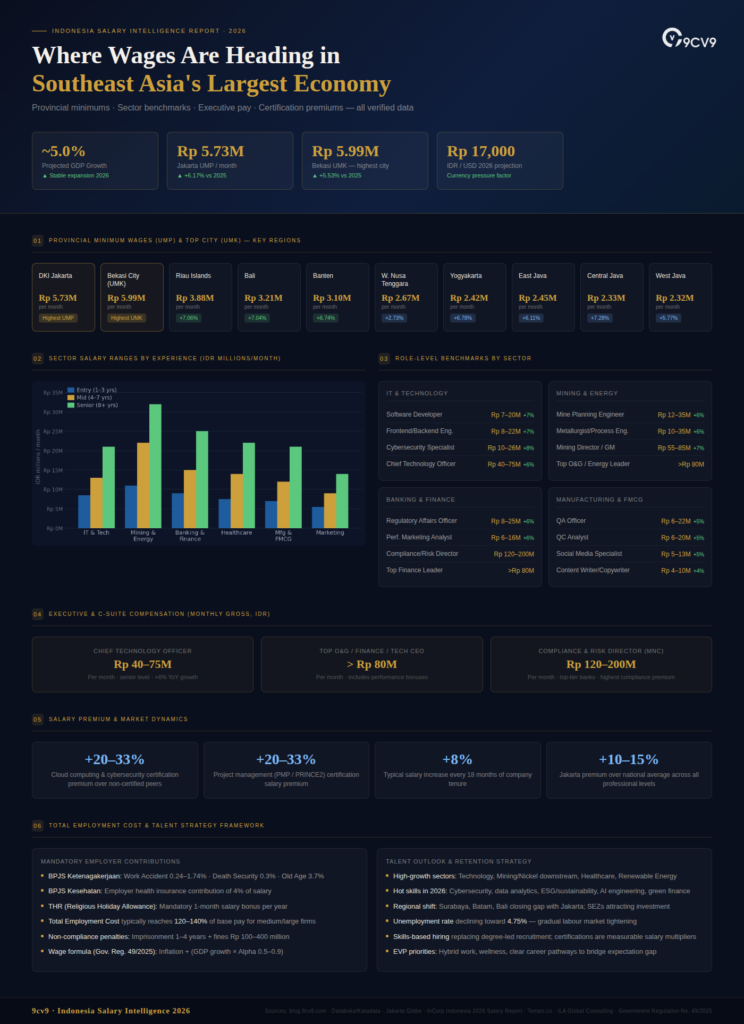
Regional salary disparities also remain a defining feature of Indonesia’s labor market. Jakarta continues to lead as the highest-paying region, but industrial hubs such as Bekasi, Karawang, Surabaya, and Batam are narrowing the gap. Special Economic Zones and export-driven corridors are attracting investment and skilled workers, reshaping the traditional concentration of opportunity within the capital. At the same time, creative and university-driven cities like Bandung and strategic gateways like Medan are emerging as competitive talent centers with improving wage benchmarks.
Beyond statutory wages, total employment cost is a critical factor shaping employer decisions in 2026. Base salary represents only part of the financial commitment. Mandatory Religious Holiday Allowance (THR), social security contributions through BPJS, work accident insurance, pension obligations, income tax withholding, and structured wage scale compliance significantly increase overall payroll costs. For many organizations, total employment cost reaches between 120 percent and 140 percent of base pay. As compliance enforcement strengthens, companies must adopt more data-driven payroll planning and internal salary benchmarking systems.
The demand for specialized and certified talent further defines the salary narrative for 2026. Employers are increasingly shifting from degree-based hiring to skills-based recruitment. Certifications in cloud computing, cybersecurity, project management, financial analysis, sustainability reporting, and operational excellence are functioning as measurable salary multipliers. Professionals with validated expertise often earn premiums ranging from 20 percent to 33 percent above their non-certified peers. This shift underscores the importance of continuous upskilling in a competitive labor market.
Talent sentiment in 2026 also plays a decisive role in shaping compensation strategies. Professionals are increasingly cautious, prioritizing job stability, leadership quality, flexible work arrangements, and clear career progression. However, a noticeable gap exists between candidate salary expectations and employer budget planning. While many professionals expect double-digit salary increases when switching roles, companies are maintaining more conservative pay structures aligned with moderate economic expansion. This tension places greater emphasis on Employer Value Proposition strategies, including hybrid work policies, wellness investment, and structured career development pathways.
Meanwhile, Indonesia’s transition toward a green and digital economy is redefining future talent requirements. The government’s investment ambitions—targeting trillions of rupiah in renewable energy, electric vehicle ecosystems, and decarbonization projects—are generating demand for renewable energy engineers, sustainability officers, ESG managers, and green finance specialists. As the nation advances toward its long-term Golden Indonesia 2045 vision, workforce quality and formal employment expansion will determine whether wage growth becomes more inclusive and productivity-driven.
This complete guide to salaries in Indonesia for 2026 brings together the latest insights on minimum wage benchmarks, regional salary comparisons, sector-specific pay trends, executive compensation, total employment cost, certification premiums, green economy opportunities, and talent retention strategies. It is designed to serve as a comprehensive resource for:
Employers planning payroll budgets and compliance frameworks
HR professionals benchmarking compensation across regions and sectors
Investors evaluating labor cost competitiveness
Professionals assessing career mobility and salary expectations
Recruitment and workforce strategy leaders navigating a skills-led market
In an environment defined by regulatory refinement, sectoral specialization, and evolving workforce priorities, salary decisions must be informed by both data and strategic foresight. Indonesia’s labor market in 2026 is stable but dynamic, competitive yet regulated, and increasingly focused on quality over quantity. Understanding its compensation structures is essential for building sustainable organizations, competitive careers, and a resilient national workforce.
As the country continues to modernize its industrial base and strengthen its human capital, salary frameworks will remain a central indicator of economic transformation. This guide provides the clarity and depth required to navigate Indonesia’s evolving compensation landscape with confidence and precision.
Before we venture further into this article, we would like to share who we are and what we do.
About 9cv9
9cv9 is a business tech startup based in Singapore and Asia, with a strong presence all over the world.
With over nine years of startup and business experience, and being highly involved in connecting with thousands of companies and startups, the 9cv9 team has listed some important learning points in this overview of Salaries in Indonesia for 2026: A Complete Guide.
If your company needs recruitment and headhunting services to hire top-quality employees, you can use 9cv9 headhunting and recruitment services to hire top talents and candidates. Find out more here, or send over an email to hello@9cv9.com.
Or just post 1 free job posting here at 9cv9 Hiring Portal in under 10 minutes.
Salaries in Indonesia for 2026: A Complete Guide
- Macroeconomic Determinants of 2026 Compensation Structures
- The 2026 Regulatory Framework for Minimum Wages
- Regional Minimum Wage Benchmarks (UMP and UMK)
- Salary Trends and Benchmarks by Professional Field
- Executive Compensation and the C-Suite
- Professional Certification Premiums and High-Demand Skills
- Talent Sentiment and Retention Strategies
- Growth Patterns Beyond Jakarta
- The Green Economy and Future Talent Requirements
- Strategic Foresight
1. Macroeconomic Determinants of 2026 Compensation Structures
a. Inflation and Purchasing Power Dynamics
Compensation planning in Indonesia for 2026 is shaped by a macroeconomic environment characterized by relative stability rather than aggressive expansion. Economic growth remains consistent, inflation is contained within the central bank’s target corridor, and labor market conditions show gradual improvement. However, salary adjustments are influenced by a complex mix of domestic demand resilience, global economic uncertainty, currency pressures, and rising living costs in urban areas.
Organizations operating in Indonesia in 2026 are required to balance financial prudence with competitive remuneration strategies. Employers must navigate regulatory wage floors, sector-specific talent shortages, and union-driven wage expectations while maintaining profitability in an environment of moderate economic growth.
Macroeconomic Environment Shaping 2026 Compensation
Indonesia’s gross domestic product growth in 2026 is projected to range between 4.9 percent and 5.4 percent. This steady performance is supported primarily by strong household consumption and continued recovery in manufacturing and downstream processing industries.
Nevertheless, the external environment introduces constraints. Global trade fragmentation, slower global demand, and evolving supply chain structures continue to influence Indonesia’s export performance. In addition, trade dynamics involving major economies such as China and the United States impact regional investment flows and commodity pricing.
The table below summarizes key macroeconomic indicators relevant to compensation planning.
Macroeconomic Indicators and Their Salary Implications
| Economic Indicator | 2024 (Actual) | 2025 (Actual/Est.) | 2026 (Projected) | Salary Impact Interpretation |
|---|---|---|---|---|
| Real GDP Growth | 5.0% – 5.04% | 4.95% – 5.11% | 4.9% – 5.4% | Moderate room for structured wage increments |
| Headline Inflation (YoY) | 1.87% – 2.0% | 1.6% – 2.65% | 2.5% – 3.0% | Necessitates inflation-aligned salary adjustments |
| IDR/USD Exchange Rate | ~15,500 | 15,800 – 16,300 | ~17,000 | Potential cost pressure for import-reliant sectors |
| Open Unemployment Rate | 4.91% | 4.85% | 4.75% | Gradual tightening of labor market |
| Bank Indonesia Policy Rate | 5.75% | 4.75% | 4.25% – 4.75% | Eases financing costs, supports corporate expansion |
Inflation Trends and Purchasing Power Considerations
Inflation in 2026 is expected to remain within Bank Indonesia’s official target range of 1.5 percent to 3.5 percent, with most forecasts centering between 2.65 percent and 3.0 percent. At a headline level, inflation appears manageable and does not signal macroeconomic overheating.
However, beneath the surface, structural pressures remain. Essential goods such as food and energy continue to exhibit price volatility. Urban households, particularly in major metropolitan areas like Jakarta, Surabaya, and Bandung, face elevated living costs compared to national averages.
This divergence between moderate headline inflation and persistent increases in essential goods has intensified discussions around wage adequacy. Labor organizations, including the Confederation of Indonesian Trade Unions and the Labor Party, have advocated for wage adjustments reaching up to 10.5 percent to better align earnings with the Decent Living Needs benchmark.
Inflation and Real Wage Dynamics Matrix
| Component | 2026 Trend Outlook | Impact on Workers | Employer Consideration |
|---|---|---|---|
| Headline CPI | Stable (2.5% – 3.0%) | Moderate erosion of purchasing power | Annual salary increment alignment |
| Food Prices | Elevated and volatile | Higher household expenditure burden | Possible hardship allowances in urban areas |
| Energy Costs | Sensitive to global oil | Transportation and utility cost impact | Transport or energy-related benefits |
| Housing Costs in Urban Centers | Structurally high | Increased wage expectations | Location-based pay differentials |
Labor Market Conditions and Wage Pressures
The open unemployment rate is projected to decline to approximately 4.75 percent in 2026, reflecting gradual labor market tightening. While this does not indicate a severe talent shortage across all sectors, specialized roles in technology, manufacturing engineering, renewable energy, and digital services continue to experience upward salary pressure.
As companies compete for high-skilled professionals, compensation packages increasingly incorporate performance-based bonuses, retention incentives, and non-monetary benefits such as flexible work arrangements and enhanced health coverage.
Labor Market Tightness and Sectoral Salary Pressure
| Sector | Talent Availability | Salary Growth Pressure | Typical Compensation Strategy |
|---|---|---|---|
| Technology and Digital | Limited specialized talent | High | Above-market base + performance bonuses |
| Manufacturing and Industry | Improving but selective | Moderate | Structured annual increments |
| Financial Services | Competitive market | Moderate to High | Incentive-heavy compensation models |
| Retail and Consumer | Broad labor pool | Moderate | Cost-controlled increment adjustments |
| Energy and Mining | Skill-dependent | High in niche roles | Premium pay for technical expertise |
Currency Movements and Compensation Planning
The rupiah is projected to hover around 17,000 per US dollar in 2026. Depreciation pressures affect organizations dependent on imported raw materials, technology infrastructure, or foreign-denominated liabilities. This may limit salary growth in sectors exposed to international cost pressures.
However, export-oriented industries may benefit from currency weakness, potentially creating room for targeted wage increases, particularly in manufacturing and commodity-based sectors.
Interest Rates and Corporate Compensation Budgets
Bank Indonesia’s policy rate is expected to ease to between 4.25 percent and 4.75 percent in 2026. Lower borrowing costs can support capital investment, expansion, and hiring. While this does not automatically translate into aggressive wage growth, it provides employers with greater financial flexibility when designing salary review cycles.
Strategic Compensation Framework for 2026
Employers in Indonesia in 2026 are increasingly adopting a structured approach to compensation planning. Rather than implementing across-the-board increases, organizations differentiate salary adjustments based on performance, skill scarcity, geographic cost differentials, and strategic business priorities.
Recommended Compensation Strategy Matrix
| Strategic Focus Area | Recommended Approach | Expected Outcome |
|---|---|---|
| Inflation Protection | Align base increment with projected CPI | Maintains real income stability |
| Talent Retention | Introduce retention bonuses for critical roles | Reduces attrition in competitive sectors |
| Urban Cost Adjustment | Implement city-based allowance differentiation | Enhances fairness across locations |
| Performance Differentiation | Tiered increment model based on performance ratings | Rewards productivity and high contribution |
| Long-Term Cost Management | Variable pay over fixed pay expansion | Preserves organizational flexibility |
Conclusion: Salary Outlook in Indonesia for 2026
The salary environment in Indonesia for 2026 reflects measured economic growth, contained inflation, and moderate labor market tightening. While macroeconomic indicators suggest stability, structural cost pressures and sectoral talent shortages introduce complexity into compensation decisions.
Organizations must design compensation strategies that are data-driven, inflation-aware, and responsive to evolving workforce expectations. Employees, on the other hand, can expect moderate nominal wage growth, with stronger increases concentrated in high-demand sectors and metropolitan areas.
In summary, Indonesia’s 2026 salary landscape is defined by disciplined growth, strategic differentiation, and a continued focus on maintaining purchasing power within a stable but globally interconnected economic environment.
b. Currency Volatility and Its Impact on Labor Costs
In 2026, the Indonesian Rupiah is projected to weaken toward the IDR 17,000 per US dollar level. This currency movement introduces an important layer of complexity into compensation planning across industries. While exchange rate fluctuations are not uncommon in emerging markets, the scale and persistence of depreciation influence wage competitiveness, cost structures, and investment flows.
Currency volatility does not affect all stakeholders equally. Multinational corporations, export-driven businesses, domestic enterprises, and employees experience the impact in different ways. As a result, compensation strategies in 2026 must account not only for domestic inflation but also for exchange rate dynamics and global capital movements.
Exchange Rate Outlook and Macroeconomic Context
The expected depreciation of the Rupiah occurs within a broader global environment marked by shifting capital flows, monetary policy adjustments in advanced economies, and ongoing trade realignment. For Indonesia, the weakening currency has both stimulative and inflationary implications.
Key Currency and Monetary Indicators
| Indicator | 2025 Estimate | 2026 Projection | Compensation Planning Relevance |
|---|---|---|---|
| IDR/USD Exchange Rate | 15,800 – 16,300 | Around 17,000 | Alters dollar-denominated labor cost competitiveness |
| Bank Indonesia Policy Rate | 4.75% | 4.25% – 4.75% | Supports credit growth and business expansion |
| Imported Inflation Sensitivity | Moderate | Increasing | Influences cost-push wage pressure |
| Capital Flow Volatility | Episodic | Elevated risk | Affects investment and hiring sentiment |
Advantages for Multinational Corporations
For multinational companies operating in Indonesia, a weaker Rupiah effectively reduces labor costs when measured in US dollars or other hard currencies. This improves Indonesia’s attractiveness as a regional production and service hub.
Two sectors stand to benefit significantly:
Business Process Outsourcing
A weaker currency enhances Indonesia’s competitiveness in back-office services, shared service centers, and IT-enabled operations. Wage costs expressed in US dollars decline relative to regional peers, improving margins for global firms.
Manufacturing and China+1 Strategies
Companies pursuing diversification strategies beyond China increasingly evaluate Southeast Asia as a manufacturing base. A depreciated Rupiah lowers operational expenses for foreign investors, particularly in labor-intensive industries such as electronics assembly, textiles, and consumer goods production.
Foreign Investor Cost Advantage Matrix
| Factor | Impact of Weaker Rupiah | Strategic Outcome |
|---|---|---|
| Labor Costs in USD Terms | Decrease | Enhanced cost competitiveness |
| Export Pricing Flexibility | Improved | Greater global pricing advantage |
| Investment ROI in Foreign Currency | Potentially Higher | Increased attractiveness for relocation strategies |
| BPO Operational Margins | Expanded | Incentive for service center expansion |
Pressure on Domestic Firms and Employees
While foreign investors may benefit, domestic firms face a different reality. Currency depreciation increases the cost of imported raw materials, capital goods, and energy inputs. This creates cost-push inflation that gradually filters into operating expenses.
For employees, currency weakness indirectly affects purchasing power through higher prices of imported goods, transportation costs, and energy-related expenses. Even if headline inflation remains within official targets, specific cost categories may rise faster than average.
Cost-Push Transmission to Labor Market
| Channel of Impact | Immediate Effect | Medium-Term Wage Implication |
|---|---|---|
| Imported Raw Materials | Higher production costs | Reduced profit margins, cautious salary increments |
| Energy and Fuel Imports | Increased logistics and utility expenses | Upward wage pressure from living cost concerns |
| Consumer Imported Goods | Higher retail prices | Purchasing power erosion |
| Capital Equipment Imports | Increased investment costs | Slower expansion, selective hiring |
Monetary Policy Response and Its Limits
Bank Indonesia has entered an easing cycle, reducing its policy rate to approximately 4.75 percent to stimulate domestic credit growth and support economic activity. Lower interest rates aim to ease financing conditions for businesses and households.
However, the transmission of monetary easing to the labor market is not immediate or uniform. Several structural factors limit its impact:
Corporate Caution
Companies facing exchange rate uncertainty may delay hiring or moderate salary increments despite lower borrowing costs.
Sectoral Divergence
Export-oriented industries may benefit from currency weakness, while import-dependent sectors experience margin compression.
Household Behavior
Consumers facing higher living costs may prioritize savings over spending, dampening demand-driven wage expansion.
Monetary Policy Transmission Matrix
| Policy Lever | Intended Effect | Labor Market Reality in 2026 |
|---|---|---|
| Lower Policy Rate | Stimulate borrowing and investment | Gradual and uneven hiring impact |
| Credit Expansion | Support business growth | Selective sectoral expansion |
| Liquidity Support | Stabilize financial markets | Indirect and delayed wage effects |
Net Impact on Salary Structures in 2026
The combined effect of currency depreciation and monetary easing produces a nuanced salary environment:
For Multinational Employers
Indonesia becomes more cost-competitive in global terms, potentially increasing demand for skilled labor in export-oriented and outsourced service roles.
For Domestic Enterprises
Higher input costs may constrain broad-based salary increases, leading to targeted adjustments rather than across-the-board raises.
For Employees
Real wage growth may depend heavily on sector and location. Workers in globally integrated industries could benefit from expanded hiring, while others may experience slower income progression relative to living costs.
Strategic Compensation Considerations Under Currency Volatility
In response to exchange rate uncertainty, organizations in Indonesia are increasingly adopting adaptive compensation frameworks.
Recommended Employer Response Framework
| Risk Factor | Strategic Compensation Response |
|---|---|
| Currency Depreciation | Increase variable pay components to maintain flexibility |
| Imported Cost Inflation | Conduct mid-year salary reviews in high-impact sectors |
| Talent Competition from MNCs | Benchmark salaries against regional dollar equivalents |
| Profit Margin Volatility | Link bonuses to operational performance metrics |
Conclusion: Currency Risk as a Structural Salary Variable
In 2026, exchange rate volatility emerges as a structural factor in Indonesia’s compensation landscape. While a weaker Rupiah strengthens the country’s appeal to foreign investors and multinational firms, it simultaneously introduces inflationary pressures that affect domestic businesses and household purchasing power.
Salary planning therefore requires a dual perspective: global competitiveness in foreign currency terms and local sustainability in real purchasing power terms. Organizations that incorporate exchange rate scenarios into their compensation strategies will be better positioned to maintain both talent retention and financial resilience in a dynamic economic environment.
c. The Informal Economy and the Quality of Employment
A defining structural characteristic of Indonesia’s labor market entering 2026 is the continued dominance of informal employment. As of late 2025, approximately 57.8 percent of total employment remains informal. While headline unemployment indicators suggest gradual improvement, the deeper reality reveals a more complex and uneven labor landscape.
The persistence of informality has significant implications for wage growth, income security, productivity levels, and long-term economic competitiveness. Although formalization initiatives remain a stated government priority, the pace of transition from informal to formal work remains gradual and sectorally uneven.
Employment Composition Snapshot
| Employment Indicator | 2018 | 2023 | Late 2025 | 2026 Outlook |
|---|---|---|---|---|
| Informal Employment Share | ~56% | ~57% | 57.8% | Gradual decline, limited pace |
| Open Unemployment Rate | 5.3% | 5.0% | 4.85% | 4.75% |
| Underemployment (Part-time/Reduced Hours) | ~30% | ~32% | 33.8% | Elevated |
| Formal Sector Job Growth | Moderate | Selective | Concentrated in urban centers | Skill-dependent |
Dominance of Informal Employment
Informal employment in Indonesia spans agriculture, small-scale retail, micro-enterprises, gig work, and household services. Workers in this segment often lack employment contracts, social security coverage, standardized wage structures, and career mobility pathways.
The concentration of informal jobs in lower value-added sectors limits productivity gains and constrains average wage growth across the economy. Despite moderate GDP expansion, wage improvements have not consistently translated into proportional real income gains for large segments of the workforce.
Informal vs Formal Employment Characteristics
| Dimension | Informal Employment | Formal Employment |
|---|---|---|
| Contractual Protection | Limited or none | Structured contracts and labor rights |
| Social Security Coverage | Often absent | Mandatory coverage |
| Wage Stability | Income variability | Fixed salary structures |
| Productivity Levels | Lower on average | Higher output per worker |
| Career Mobility | Restricted | Structured progression pathways |
Sectoral Distribution and Job Creation Trends
Net job additions in recent years have largely occurred in agriculture and low-value service sectors. These sectors, while labor-absorbing, typically generate lower wages and limited productivity growth. Meanwhile, higher value-added industries such as advanced manufacturing, digital technology, and financial services expand at a slower pace relative to labor supply growth.
This imbalance contributes to a structural misalignment between workforce skills and job quality, reinforcing wage stagnation.
Sectoral Job Addition Matrix
| Sector | Job Growth Trend | Value-Added Level | Wage Growth Potential |
|---|---|---|---|
| Agriculture | High absorption | Low | Limited |
| Informal Retail and Services | Moderate | Low to Medium | Constrained |
| Manufacturing (Basic) | Gradual recovery | Medium | Moderate |
| Advanced Manufacturing | Selective expansion | High | Strong in niche roles |
| Technology and Digital | Strong but concentrated | High | High |
Real Wage Trends and Output Divergence
Since 2018, real wages in several sectors have either stagnated or declined relative to output growth. While productivity has increased in specific industries, wage transmission has been uneven. This divergence reflects structural factors such as informality, weak bargaining power in certain sectors, and surplus labor in low-skilled segments.
The outcome is a polarized labor market in which wage growth is concentrated among high-skilled workers, while middle-skilled roles experience relative contraction.
Real Wage and Productivity Dynamics
| Indicator | 2018–2020 Trend | 2021–2023 Trend | 2024–2026 Outlook |
|---|---|---|---|
| Real Wage Growth | Slowing | Uneven recovery | Moderate, sector-specific |
| Labor Productivity Growth | Gradual increase | Moderate | Supported by formal sectors |
| Wage-to-Output Ratio | Declining | Stabilizing | Limited structural change |
Employment Polarization and Skill Distribution
The Indonesian labor market exhibits increasing polarization. Middle-skilled occupations, particularly in clerical, routine administrative, and basic manufacturing roles, have experienced relative decline due to automation, digitalization, and structural shifts in economic activity.
At the same time:
Low-skilled roles continue to expand, particularly in agriculture and informal services.
High-skilled roles grow in technology, engineering, finance, and specialized services.
This dual expansion at opposite ends of the skill spectrum compresses the middle tier and intensifies income inequality.
Employment Polarization Framework
| Skill Level | Employment Trend | Wage Trend | Structural Drivers |
|---|---|---|---|
| Low-Skilled | Expanding | Stagnant to modest | Informal sector growth, labor absorption |
| Middle-Skilled | Contracting share | Slower growth | Automation, digitization |
| High-Skilled | Expanding selectively | Strong growth | Digital economy, global integration |
Underemployment and Labor Utilization
Although the open unemployment rate is projected to improve to 4.75 percent in 2026, this headline figure masks a high underemployment rate. Approximately 33.8 percent of the workforce is classified as part-time or underemployed, meaning individuals are working fewer hours than desired or in roles below their skill capacity.
Underemployment reduces aggregate income potential and suppresses household consumption growth. It also indicates latent labor market slack that may moderate wage pressures, particularly in lower- and middle-skilled segments.
Unemployment vs Underemployment Comparison
| Indicator | Definition | 2025 Level | 2026 Implication |
|---|---|---|---|
| Open Unemployment Rate | Actively seeking work but not employed | 4.85% | Declining to 4.75% |
| Underemployment Rate | Working fewer hours or below skill level | 33.8% | Persistent structural issue |
| Effective Labor Slack | Combined measure of idle capacity | Elevated | Limits broad wage acceleration |
Implications for Salary Growth and Workforce Strategy in 2026
The dominance of informal employment and persistent underemployment significantly shape Indonesia’s salary environment in 2026.
For Employers
Abundant labor supply in lower-skilled segments helps contain wage escalation in entry-level roles. However, competition for high-skilled talent intensifies, particularly in formal and globally integrated industries.
For Policymakers
Formalization, productivity enhancement, and skill upgrading remain critical to strengthening real wage growth and reducing structural vulnerability.
For Workers
Income mobility increasingly depends on access to formal employment pathways and upskilling opportunities, especially in digital and technical domains.
Strategic Employment Quality Improvement Matrix
| Structural Challenge | Policy or Corporate Response | Expected Long-Term Impact |
|---|---|---|
| High Informality | Incentivize SME formal registration | Broader social protection coverage |
| Underemployment | Expand vocational and technical training | Improved skill-job alignment |
| Shrinking Middle-Skill Jobs | Promote advanced manufacturing and digital roles | Balanced employment structure |
| Wage Stagnation | Link productivity gains to compensation systems | Sustainable real wage growth |
Conclusion: Beyond Headline Unemployment
While Indonesia’s projected unemployment rate of 4.75 percent in 2026 suggests stability, deeper labor market indicators reveal structural challenges related to informality, underemployment, and job polarization.
The quality of employment, rather than merely the quantity of jobs, emerges as the central issue shaping wage dynamics. Without accelerated formalization and productivity-driven job creation, real wage growth is likely to remain uneven and concentrated in high-skilled sectors. Consequently, the broader salary landscape in 2026 reflects a dual reality: improving macro indicators alongside persistent structural labor market constraints.
2. The 2026 Regulatory Framework for Minimum Wages
a. The Revised Minimum Wage Formula and the Alpha Coefficient
Indonesia’s minimum wage determination process for 2026 operates under a newly enacted regulatory structure introduced through Government Regulation Number 49 of 2025. This regulation replaces the previous framework governing Provincial Minimum Wages (Upah Minimum Provinsi or UMP) and Regency/City Minimum Wages (Upah Minimum Kabupaten/Kota or UMK).
The reform represents a structural shift in wage governance. Rather than applying a broadly uniform national formula, the updated framework emphasizes regional economic performance, productivity differentials, and labor absorption capacity. The objective is to create a wage-setting mechanism that better reflects local economic realities while maintaining national consistency in methodology.
This regulatory recalibration aligns with broader labor policy reforms following Constitutional Court ruling No. 168/2023, which called for a revised and more worker-oriented manpower legal framework.
Key Differences Between the Previous and 2026 Minimum Wage Framework
| Dimension | Pre-2025 Framework | 2026 Framework Under PP 49/2025 |
|---|---|---|
| Core Approach | Semi-uniform national logic | Regionally differentiated calculation |
| Economic Inputs | Inflation + limited growth adjustment | Inflation + growth multiplied by Alpha |
| Productivity Consideration | Limited weighting | Explicitly incorporated through Alpha |
| Regional Differentiation | Moderate | Stronger localization emphasis |
| Policy Orientation | Stability-focused | Worker-share and productivity-linked |
Localized Wage Determination Logic
The 2026 framework introduces a more granular economic calculus. Each province and regency/city calculates its wage adjustment based on its own inflation rate and regional economic growth figures. This approach acknowledges that economic expansion in industrial provinces differs significantly from that in agrarian or service-based regions.
By embedding productivity and labor absorption into the formula, policymakers aim to ensure that wage increases reflect real economic gains rather than arbitrary percentage adjustments.
This regional differentiation affects employers in diverse ways:
Industrialized provinces may record stronger wage growth due to higher regional output expansion.
Less developed regions may experience more moderate increases aligned with slower economic growth.
The Revised Minimum Wage Formula for 2026
Under Government Regulation Number 49 of 2025, the wage adjustment formula is expressed as follows:
Wage Increase = Inflation + (Economic Growth × Alpha)
Each component plays a distinct role:
Inflation represents the annual regional consumer price index change.
Economic Growth refers to the regional GDP growth rate.
Alpha is an adjustment coefficient representing labor’s share in regional economic expansion.
The introduction of a significantly revised Alpha coefficient is the most critical change in the 2026 framework.
Understanding the Alpha Coefficient
For 2026, the Alpha coefficient range has been increased to between 0.5 and 0.9. This marks a substantial revision from the 0.1 to 0.3 range applied in the 2023 wage-setting framework.
Alpha functions as a multiplier that determines how much of regional economic growth translates into wage increases. A higher Alpha effectively channels a larger portion of growth to workers.
Comparison of Alpha Coefficient Ranges
| Framework Year | Alpha Range | Wage Transmission Effect |
|---|---|---|
| 2023 Framework | 0.1 – 0.3 | Limited growth pass-through to wages |
| 2026 Framework | 0.5 – 0.9 | Stronger linkage between growth and worker income |
Illustrative Scenarios Using the 2026 Formula
To understand the practical implications, consider hypothetical regional data:
Example Scenario 1
Regional Inflation: 2.8%
Regional Economic Growth: 5.2%
Alpha: 0.6
Wage Increase = 2.8% + (5.2% × 0.6)
Wage Increase = 2.8% + 3.12%
Total Wage Increase = 5.92%
Example Scenario 2
Regional Inflation: 3.0%
Regional Economic Growth: 5.0%
Alpha: 0.9
Wage Increase = 3.0% + (5.0% × 0.9)
Wage Increase = 3.0% + 4.5%
Total Wage Increase = 7.5%
Wage Adjustment Sensitivity Matrix
| Inflation | Economic Growth | Alpha | Calculated Wage Increase |
|---|---|---|---|
| 2.5% | 5.0% | 0.5 | 5.0% |
| 2.5% | 5.0% | 0.7 | 6.0% |
| 3.0% | 5.2% | 0.8 | 7.16% |
| 3.0% | 5.4% | 0.9 | 7.86% |
The matrix illustrates how changes in the Alpha coefficient significantly influence final wage outcomes, even when inflation and growth remain constant.
Policy Rationale Behind the Alpha Expansion
The expansion of the Alpha range reflects a policy decision to strengthen labor’s participation in economic gains. By increasing the multiplier, the government ensures that wage growth does not lag excessively behind regional output expansion.
This change serves several policy objectives:
Enhancing real income growth for workers
Improving domestic consumption resilience
Addressing concerns over wage stagnation relative to productivity
Responding to judicial directives requiring stronger labor protections
Implications for Employers and Investors in 2026
The revised minimum wage framework introduces greater variability across regions. Employers operating in multiple provinces must prepare for differentiated wage increases rather than uniform national adjustments.
Employer Impact Assessment Matrix
| Employer Type | Impact Level | Key Consideration |
|---|---|---|
| Labor-Intensive Manufacturing | High | Budget planning for higher Alpha-driven increases |
| Multinational Corporations | Moderate | Region-based cost recalibration |
| SMEs in Low-Growth Regions | Moderate | More manageable increases if growth is slower |
| Service Sector Employers | Variable | Depends on regional economic performance |
Strategic responses may include:
Regional payroll forecasting based on projected Alpha assignments
Productivity-linked bonus structures to complement statutory increases
Automation and operational efficiency adjustments in high-growth regions
Balancing Growth, Fairness, and Competitiveness
The 2026 minimum wage framework represents a shift toward a more economically responsive and worker-aligned wage determination system. By embedding productivity into the calculation through an expanded Alpha coefficient, the regulation aims to balance three objectives:
Ensuring workers benefit from economic expansion
Maintaining regional competitiveness
Supporting sustainable business operations
In summary, the 2026 regulatory architecture moves Indonesia’s wage-setting mechanism toward a hybrid model that integrates inflation protection with growth participation. The magnitude of wage adjustments will increasingly depend on regional economic performance, making localized economic monitoring essential for employers and policymakers alike.
b. Legal Compliance and Enforcement
Indonesia’s 2026 minimum wage regime is accompanied by strict enforcement mechanisms designed to ensure employer compliance. The government has reaffirmed that wage levels established through Governor’s Decrees are legally binding and non-negotiable. These figures represent absolute statutory floors that cannot be reduced or adjusted downward by employers, regardless of internal business conditions.
The only limited exception applies to micro and small enterprises, which are subject to separate regulatory considerations. For medium and large enterprises, full compliance with Provincial Minimum Wages (UMP), Regency/City Minimum Wages (UMK), and where applicable Sectoral Minimum Wages (UMS), is mandatory.
Binding Nature of Governor’s Decrees
Minimum wage figures issued annually through Governor’s Decrees function as enforceable legal instruments. Once enacted, these wage levels:
Establish the lowest permissible monthly wage
Apply uniformly within the designated jurisdiction
Cannot be waived through private agreement
Override company-level compensation policies
Minimum Wage Applicability Framework
| Wage Type | Issuing Authority | Mandatory Nature | Scope of Application |
|---|---|---|---|
| Provincial Minimum Wage (UMP) | Governor | Absolute | Province-wide baseline |
| Regency/City Minimum Wage (UMK) | Governor (regional basis) | Absolute | Specific regency or municipality |
| Sectoral Minimum Wage (UMS) | Governor (sector-based) | Absolute | Designated industries within region |
Criminal Sanctions and Financial Penalties
Under the Job Creation Law, non-compliance with statutory minimum wage provisions exposes employers to serious criminal and financial consequences. Payment of wages below the established UMP or UMK is categorized as a labor violation subject to penal sanctions.
The legal risks include:
Imprisonment ranging from one to four years
Fines ranging from IDR 100 million to IDR 400 million
Potential reputational damage and operational disruption
Increased scrutiny from labor inspectors
Sanction Structure for Minimum Wage Violations
| Violation Type | Legal Consequence | Financial Penalty Range |
|---|---|---|
| Payment below UMP or UMK | 1–4 years imprisonment | IDR 100 million – IDR 400 million |
| Repeated or systematic underpayment | Heightened enforcement scrutiny | Risk of cumulative penalties |
| Non-implementation of mandated wage scale | Administrative sanctions | Subject to labor authority review |
These enforcement measures significantly elevate compliance risk exposure for employers, particularly labor-intensive businesses.
Service Tenure Distinction in Wage Application
A critical aspect of Indonesia’s minimum wage framework is the distinction based on employee tenure.
Workers with Less Than One Year of Service
Statutory minimum wages (UMP, UMK, or UMS) apply strictly to employees with less than one year of service. These figures function as entry-level wage floors.
Workers with One Year or More of Service
For employees who have completed at least one year of employment, compensation must follow the company’s internal Wage Structure and Scale, commonly referred to as SUSU (Struktur dan Skala Upah).
This requirement prevents companies from indefinitely applying minimum wage rates to long-serving employees.
Tenure-Based Wage Compliance Matrix
| Employee Tenure | Applicable Wage Standard | Employer Obligation |
|---|---|---|
| Less than 1 year | UMP / UMK / UMS | Must meet or exceed statutory minimum |
| 1 year or more | Internal Wage Structure and Scale (SUSU) | Must reflect qualifications and responsibilities |
Internal Wage Structure and Scale (SUSU) Requirements
The SUSU framework requires employers to develop a transparent compensation structure that differentiates wages based on:
Job classification
Educational background
Professional qualifications
Skill levels
Responsibility scope
Years of service
Failure to implement a structured wage scale can expose companies to compliance risks during labor inspections.
Core Components of a Compliant Wage Structure
| Component | Description | Compliance Objective |
|---|---|---|
| Job Evaluation | Formal classification of positions | Ensure pay equity and consistency |
| Grade Differentiation | Salary bands by role complexity | Reflect responsibility and expertise |
| Tenure Adjustment | Progressive increments over time | Prevent wage stagnation |
| Documentation | Written wage policy records | Audit and inspection readiness |
Reintroduction of Sectoral Minimum Wages (UMS)
In 2026, the reintroduction of Sectoral Minimum Wages (Upah Minimum Sektoral or UMS) adds another layer of complexity to compliance. Under this system, specific strategic industries are required to apply wage levels above the standard UMK.
Industries typically affected may include:
Energy and extractive sectors
Advanced manufacturing
Strategic logistics and transportation
Certain high-value industrial clusters
Sectoral Wage Hierarchy Illustration
| Wage Category | Relative Level | Typical Coverage |
|---|---|---|
| UMP | Baseline | Provincial minimum |
| UMK | Above UMP (in many areas) | Specific cities/regencies |
| UMS | Above UMK | Strategic or designated industries |
Employers operating in affected sectors must verify whether UMS rates apply to their business classification, as failure to do so constitutes underpayment.
Compliance Risk Assessment for 2026
The 2026 regulatory environment introduces multi-layered compliance obligations:
Absolute statutory minimums
Tenure-based wage differentiation
Mandatory internal wage structures
Sector-specific wage premiums
Employer Compliance Risk Matrix
| Compliance Area | Risk Level | Recommended Mitigation Strategy |
|---|---|---|
| Minimum Wage Payment Accuracy | High | Regular payroll audits |
| SUSU Implementation | Moderate | Formal documentation and HR policy review |
| Sectoral Wage Identification | High | Legal verification of industry classification |
| Recordkeeping and Documentation | Moderate | Maintain inspection-ready compliance files |
Strategic Implications for Employers
The strengthened enforcement posture in 2026 signals a clear regulatory intent: minimum wage compliance is not merely administrative but criminally enforceable.
For employers, this necessitates:
Proactive payroll compliance audits
Legal consultation regarding sectoral classification
Clear documentation of wage structures
Continuous monitoring of Governor’s Decrees
Conclusion: A High-Stakes Compliance Environment
Indonesia’s 2026 minimum wage regime is characterized by firm legal enforceability, tenure-sensitive wage rules, and the revival of sector-based wage differentiation. Governor-issued minimum wage figures function as binding legal floors, and violations carry significant criminal and financial consequences.
Organizations operating in Indonesia must therefore treat wage compliance as a core governance priority. In a regulatory environment defined by strict enforcement and layered wage structures, robust internal controls and transparent compensation systems are essential to mitigate legal exposure and maintain operational continuity.
3. Regional Minimum Wage Benchmarks (UMP and UMK)
a. Provincial Minimum Wage (UMP) Benchmarks for 2026
Indonesia’s minimum wage landscape in 2026 reflects significant regional variation driven by industrial concentration, living cost differentials, infrastructure development, and the Alpha coefficients applied under the updated wage formula. Provincial economies with strong manufacturing bases, financial services concentration, or strategic industrial zones typically record higher wage floors than predominantly agrarian or less industrialized provinces.
Jakarta continues to serve as the country’s highest-paying provincial labor market due to its status as the national economic center. Meanwhile, satellite regions in West Java and industrial clusters in the Riau Islands maintain relatively elevated wage levels to remain competitive in attracting skilled technical, logistics, and manufacturing workers.
The variation between statutory minimum wages and the calculated Decent Living Need (KHL) benchmark remains a central issue in wage debates, particularly in high-cost urban and tourism-driven regions.
Provincial Minimum Wage (UMP) Benchmarks for 2026
The Provincial Minimum Wage (UMP) represents the legally binding baseline for formal employment within each province. These figures are established through Governor’s Decrees and apply to workers with less than one year of service.
For 2026, most provinces finalized their UMP determinations in late December 2025. The national average increase ranged between approximately 5 percent and 7.9 percent, depending on regional inflation, economic growth, and Alpha coefficient application.
2026 Provincial Minimum Wage (UMP) Table
| Province | 2026 UMP (IDR) | Regulatory Increase % | Decent Living Need (KHL) (IDR) |
|---|---|---|---|
| DKI Jakarta | 5,729,876 | 6.17% | 5,898,511 |
| Highland Papua | 4,508,714 | 5.20% | 5,314,291 |
| South Papua | 4,508,100 | 5.19% | 5,314,281 |
| Papua | 4,436,283 | 3.51% | 5,314,281 |
| Bangka Belitung | 4,035,000 | 4.09% | 4,714,805 |
| North Sulawesi | 4,002,630 | 6.02% | 3,864,224 |
| South Sumatra | 3,942,963 | 7.10% | 3,299,907 |
| Aceh | 3,932,552 | Pending Calculation | 3,654,466 |
| South Sulawesi | 3,921,088 | 7.20% | 3,670,085 |
| Riau Islands | 3,879,520 | 7.06% | 5,717,082 |
| East Kalimantan | 3,762,431 | 5.12% | 5,735,353 |
| Bali | 3,207,459 | 7.04% | 5,253,107 |
| North Sumatra | 3,228,949 | 7.90% | 3,599,803 |
| Banten | 3,100,881 | 6.74% | 4,295,985 |
| West Java | 2,317,601 | 5.77% | 4,122,871 |
| Central Java | 2,327,386 | 7.28% | 3,512,997 |
| East Java | 2,446,880 | 6.11% | 3,575,938 |
| Yogyakarta | 2,417,495 | 6.78% | 4,604,982 |
Statutory Wage vs Decent Living Need Gap
A critical observation from the 2026 data is the recurring gap between statutory minimum wages and the Decent Living Need (KHL) benchmarks calculated by regional authorities.
In several provinces, the KHL significantly exceeds the official UMP. This discrepancy highlights structural cost-of-living pressures that are not fully absorbed by the statutory wage formula.
Wage Gap Analysis Matrix
| Province | 2026 UMP (IDR) | KHL (IDR) | Absolute Gap (IDR) | Gap Percentage Relative to UMP |
|---|---|---|---|---|
| Yogyakarta | 2,417,495 | 4,604,982 | 2,187,487 | ~90% |
| Bali | 3,207,459 | 5,253,107 | 2,045,648 | ~64% |
| Riau Islands | 3,879,520 | 5,717,082 | 1,837,562 | ~47% |
| East Kalimantan | 3,762,431 | 5,735,353 | 1,972,922 | ~52% |
| DKI Jakarta | 5,729,876 | 5,898,511 | 168,635 | ~3% |
The Special Region of Yogyakarta presents one of the widest disparities. The 2026 UMP of approximately IDR 2.41 million is substantially below the calculated decent living need of roughly IDR 4.6 million. A similar pattern is visible in Bali, where tourism-driven price dynamics elevate living costs beyond statutory wage levels.
Regional Wage Clusters by Economic Profile
To better understand regional diversity, provinces can be grouped into economic clusters.
High-Wage Industrial and Administrative Hubs
| Cluster Type | Example Provinces | Key Drivers |
|---|---|---|
| National Economic Center | DKI Jakarta | Finance, services, corporate HQ |
| Industrial and Special Zones | Riau Islands, East Kalimantan | Manufacturing, energy, logistics |
Mid-Tier Industrial and Resource Regions
| Cluster Type | Example Provinces | Key Drivers |
|---|---|---|
| Resource-Based Economies | South Sumatra, Papua | Mining, commodities |
| Diversified Regional Economies | North Sulawesi, South Sulawesi | Mixed manufacturing and services |
Lower-Wage Labor-Intensive Regions
| Cluster Type | Example Provinces | Key Drivers |
|---|---|---|
| Labor-Intensive Manufacturing | West Java, Central Java | Textiles, assembly manufacturing |
| Education and Cultural Hub | Yogyakarta | Education services, tourism |
Implications for Employers and Workforce Planning
The wide dispersion of UMP figures across provinces significantly influences investment decisions, payroll budgeting, and workforce mobility.
For employers operating nationally, payroll cost projections must account for:
Regional wage differentials
Sectoral minimum wage requirements (UMS where applicable)
Potential wage adjustments arising from collective bargaining
For employees, geographic mobility increasingly becomes a determinant of earning potential, particularly for technical and skilled roles.
Strategic Considerations for 2026
The continued gap between UMP and KHL in multiple regions suggests that minimum wage negotiations will remain contentious. Labor unions frequently challenge wage determinations in high-cost provinces where statutory floors do not fully align with living standards.
From a macroeconomic perspective, the differentiated regional wage framework reflects Indonesia’s economic diversity. However, it also underscores the importance of localized economic monitoring, as wage competitiveness and household purchasing power vary substantially across provinces.
In conclusion, the 2026 Provincial Minimum Wage benchmarks illustrate both regulatory progress and persistent structural imbalances. While statutory increases remain within the 5 to 7.9 percent range, the divergence between legal wage floors and actual living cost benchmarks continues to shape policy debates, employer compliance strategies, and workforce expectations throughout Indonesia.
b. Regency/City Minimum Wage (UMK) in Industrial and Tourism Hubs
In Indonesia’s wage architecture, the Regency and City Minimum Wage (UMK) functions as a localized adjustment mechanism that supersedes the Provincial Minimum Wage (UMP) in areas with stronger economic output, higher productivity, and elevated living costs. Industrial clusters, export-oriented manufacturing zones, and tourism-driven urban centers typically record higher UMK levels compared to provincial baselines.
For 2026, Indonesia’s industrial corridor in West Java continues to dominate the upper tier of minimum wage benchmarks. Cities such as Bekasi and Karawang, which form part of Southeast Asia’s largest manufacturing ecosystem, maintain the highest statutory wage floors nationwide. Meanwhile, strategic export and logistics hubs such as Batam and Tangerang also report substantial wage levels driven by investment intensity and labor demand.
2026 UMK Benchmarks in Major Industrial and Tourism Centers
| Regency / City | 2026 UMK (IDR) | Primary Economic Driver |
|---|---|---|
| Kota Bekasi | 5,999,443 | Services and General Manufacturing |
| Kabupaten Bekasi | 5,938,885 | Southeast Asia’s Largest Industrial Zone |
| Kabupaten Karawang | 5,886,853 | Automotive and Technical Manufacturing |
| Kota Depok | 5,522,662 | Emerging Digital and Satellite Services |
| Kota Cilegon | 5,469,923 | Steel, Chemical and Heavy Industry |
| Kota Tangerang | 5,399,406 | Logistics and International Airport Hub |
| Kota Batam | 5,357,982 | Special Economic Zone (KEK) and Electronics |
| Kota Surabaya | 5,288,796 | Maritime Trade and Heavy Industry |
| Kabupaten Gresik | 5,195,401 | Petrochemicals and Smelters |
| Kabupaten Sidoarjo | 5,191,541 | Light Manufacturing and Food Processing |
| Kota Bandung | 4,737,678 | Creative Economy and High-Tech Industries |
| Kota Malang | 3,736,101 | Education and Tourism |
| Badung (Bali) | 3,791,003 | Luxury Hospitality and Foreign-Owned Enterprises |
| Kota Denpasar | 3,499,879 | Administrative and Trade Center |
| Kota Medan | 4,295,057 | Agribusiness and Agromanufacturing |
West Java Industrial Corridor: National Wage Leaders
The Bekasi–Karawang industrial belt remains Indonesia’s highest-paying labor market in 2026. These regions host multinational automotive manufacturers, electronics assemblers, logistics hubs, and industrial estates that collectively employ hundreds of thousands of workers.
High industrial productivity, strong export orientation, and sustained foreign direct investment drive elevated labor demand. As a result, UMK levels in Kota Bekasi and Kabupaten Bekasi approach the IDR 6 million threshold, setting the national benchmark for statutory wage floors.
Industrial Cluster Wage Leadership Matrix
| Region Cluster | Average UMK Level (IDR) | Key Industry Concentration | Wage Pressure Intensity |
|---|---|---|---|
| Bekasi–Karawang Corridor | ~5.9 – 6.0 million | Automotive, electronics, heavy manufacturing | Very High |
| Greater Jakarta Satellite | ~5.3 – 5.5 million | Logistics, digital services, trade | High |
| East Java Industrial Belt | ~5.1 – 5.3 million | Maritime, petrochemicals, manufacturing | Moderate to High |
| Bali Tourism Zone | ~3.5 – 3.8 million | Hospitality and tourism | Moderate |
Batam and the Riau Islands: Strategic Export Hub
The municipality of Batam in the Riau Islands demonstrates one of the most dynamic wage adjustments in 2026. As a designated Special Economic Zone (Kawasan Ekonomi Khusus or KEK), Batam plays a pivotal role in electronics manufacturing and export-oriented industries.
In 2026, Batam recorded a 7.38 percent increase in its minimum wage, the highest percentage increase among the top ten wage-leading cities. This adjustment reflects its strategic importance in attracting foreign direct investment and supporting global supply chain diversification.
Batam’s Competitive Positioning Factors
| Factor | Strategic Implication |
|---|---|
| Proximity to Singapore | Cross-border industrial integration |
| Electronics Manufacturing Base | High export intensity |
| Special Economic Zone Status | Regulatory and tax incentives |
| Aggressive Wage Adjustment | Enhances talent retention and investment appeal |
Tourism and Service-Oriented Cities
In tourism-heavy regions such as Bali, particularly Badung Regency, wage structures reflect hospitality-driven economic activity. However, despite relatively strong tourism revenues, UMK levels remain below those of industrial hubs in West Java.
The difference reflects variations in industrial capital intensity, export productivity, and formal sector wage bargaining power. Service-based economies, while vibrant, typically exhibit lower statutory wage floors compared to capital-intensive manufacturing clusters.
Comparative Industrial vs Tourism Wage Profile
| Economic Base | Typical UMK Range (IDR) | Labor Skill Composition | Wage Growth Potential |
|---|---|---|---|
| Heavy Manufacturing | 5.4 – 6.0 million | Technical and skilled labor | High |
| Logistics and Trade | 5.2 – 5.5 million | Mixed skilled workforce | Moderate to High |
| Tourism and Hospitality | 3.5 – 3.8 million | Service-oriented workforce | Moderate |
| Education and Creative | 3.7 – 4.7 million | Knowledge-based roles | Moderate |
Implications for Employers in 2026
The elevated UMK levels in industrial corridors significantly influence operational cost structures. Companies operating in Bekasi, Karawang, and similar hubs must allocate substantially higher payroll budgets compared to firms in Central Java or certain eastern provinces.
For labor-intensive manufacturers, minimum wage obligations directly affect competitiveness. However, these regions also benefit from established industrial ecosystems, infrastructure access, and skilled labor pools.
Key Employer Considerations
| Consideration Area | Strategic Response |
|---|---|
| Payroll Budget Forecasting | Incorporate city-specific UMK differentials |
| Investment Site Selection | Balance wage costs against infrastructure advantages |
| Talent Retention | Align compensation with sectoral wage premiums |
| Compliance Monitoring | Ensure adherence to updated Governor’s Decrees |
Conclusion: UMK as a Reflection of Regional Economic Power
The 2026 Regency and City Minimum Wage structure illustrates Indonesia’s economic stratification. Industrial powerhouses in West Java maintain the highest wage floors due to export intensity and manufacturing productivity. Strategic export hubs like Batam show aggressive wage growth aligned with foreign investment objectives. Tourism centers, while economically vibrant, maintain comparatively lower statutory wage levels.
Overall, the UMK framework reinforces the localized logic introduced in Indonesia’s revised wage regulations. Regional economic strength, industrial specialization, and labor demand now play an increasingly decisive role in shaping statutory wage benchmarks across the country.
c. Sectoral Minimum Wages (UMS) and Specialized Indicators
Beyond Provincial (UMP) and Regency/City (UMK) minimum wages, Indonesia’s 2026 wage framework incorporates an additional regulatory layer known as Sectoral Minimum Wages. These are divided into Provincial Sectoral Minimum Wages (UMSP) and Regency/City Sectoral Minimum Wages (UMSK).
Sectoral wages apply specifically to designated industries that are considered high-value, strategically important, or characterized by elevated productivity and profitability. By regulation, sectoral minimum wages must not be lower than the applicable UMK. In practice, they are often set above the general minimum to reflect industry-specific earning capacity and labor market dynamics.
This additional tier adds complexity to employer compliance, particularly in industrial and tourism hubs where multiple wage standards may apply simultaneously.
Structural Position of Sectoral Wages Within the Wage Hierarchy
The wage framework in 2026 can be understood as a tiered system.
Minimum Wage Hierarchy Matrix
| Wage Category | Geographic Scope | Applicability | Relative Level |
|---|---|---|---|
| UMP (Provincial Minimum Wage) | Province-wide | Baseline for formal workers < 1 year | Foundational |
| UMK (Regency/City Minimum Wage) | Specific city/regency | Overrides UMP in industrialized regions | Higher than UMP |
| UMSP (Provincial Sectoral Wage) | Province-specific sector | Applies to designated sectors across province | ≥ UMK |
| UMSK (District Sectoral Wage) | District-specific sector | Applies to designated sectors within district | ≥ UMK and often higher |
Sectoral wage policies are designed to preserve income premiums in industries that historically offer higher compensation due to technical skill requirements or higher productivity margins.
Sectoral Wage Example: Badung District, Bali
In 2026, the Badung district in Bali introduced a district-level sectoral minimum wage (UMSK) specifically for the “Accommodation and Food and Beverage Provision” sector covering 4-star and 5-star hotels.
The sectoral wage has been set at:
IDR 3,828,912.60
This figure exceeds the general UMK level for the region, reflecting the high-revenue profile of luxury hospitality and the strong contribution of international tourism to local economic output.
Bali Sectoral Wage Illustration
| Region | General UMK (IDR) | Sector Covered | UMSK (IDR) | Sector Rationale |
|---|---|---|---|---|
| Badung (Bali) | 3,791,003 | 4–5 Star Hotels (Accommodation & F&B) | 3,828,912.60 | High-value tourism and foreign business |
The sector-specific premium aims to align wages with service standards, international visitor expectations, and the profitability of luxury hospitality operators.
Industrial Sectoral Wages in West Java
West Java remains the epicenter of Indonesia’s manufacturing activity, particularly in automotive assembly, electronics, textiles, and technical production. In 2026, UMSK indicators have been formalized in 12 regencies, including Bekasi and Karawang.
The primary objective is to maintain historical wage premiums for technical and skilled workers in high-productivity sectors such as:
Automotive manufacturing
Advanced electronics assembly
Textile and garment production
Industrial machinery operations
Industrial UMSK Rationale Matrix
| Region | Sector Focus | Strategic Objective |
|---|---|---|
| Bekasi | Automotive & Electronics | Preserve technical wage competitiveness |
| Karawang | Automotive Manufacturing | Maintain skilled labor retention |
| Selected Regencies (12 total) | Textile & Industrial Production | Protect industry income benchmarks |
By formalizing UMSK levels, regional wage councils ensure that highly specialized workers do not revert to general minimum wage levels, especially during periods of economic moderation.
Economic and Compliance Implications
The reintroduction and expansion of sectoral minimum wages in 2026 introduce several implications:
Greater Payroll Complexity
Employers must identify whether their business classification falls under designated sectoral categories at the provincial or district level.
Higher Labor Costs in Strategic Industries
Industries benefiting from higher productivity are expected to share economic gains with workers through elevated wage floors.
Increased Inspection Sensitivity
Misclassification of business sector can result in underpayment relative to mandated UMS levels, exposing companies to compliance risks.
Sectoral Wage Compliance Risk Matrix
| Compliance Area | Risk Level | Mitigation Strategy |
|---|---|---|
| Incorrect Sector Classification | High | Legal review of KBLI business classification codes |
| Payroll System Alignment | Moderate | Separate wage mapping by sector |
| Multi-Location Operations | High | Region-specific wage audits |
| Luxury Hospitality & Export Sectors | Elevated | Annual review of UMS decrees |
Impact on Wage Differentiation and Labor Markets
Sectoral minimum wages reinforce labor market segmentation. Workers in strategic industries receive statutory income premiums, while employees in general service or informal sectors remain subject to standard UMK or UMP levels.
This dynamic contributes to widening wage dispersion across sectors, particularly between:
High-productivity manufacturing clusters
Luxury hospitality zones
General retail and low-margin service industries
Sectoral Wage Premium Effect
| Sector Type | Typical Wage Floor Position | Income Premium Effect |
|---|---|---|
| Automotive Manufacturing | UMSK above UMK | Strong |
| Electronics & Export Industry | UMSK above UMK | Strong |
| Luxury Hospitality | UMSK above UMK | Moderate to High |
| General Retail & Services | UMK only | Limited |
Strategic Importance in 2026 Wage Policy
The implementation of UMSP and UMSK in 2026 reflects a broader policy direction toward productivity-linked wage differentiation. Rather than relying solely on geographic wage adjustments, the framework now integrates sectoral performance as a formal determinant of wage floors.
For policymakers, this approach aims to:
Encourage skill specialization
Protect historical wage structures in industrial clusters
Strengthen domestic purchasing power in high-output sectors
For employers, it necessitates careful regulatory monitoring and classification accuracy.
Conclusion: Sectoral Wages as a Structural Feature of 2026 Compensation
Sectoral Minimum Wages represent one of the most significant structural complexities in Indonesia’s 2026 wage environment. With UMSK levels applied in tourism hubs such as Badung and industrial corridors like Bekasi and Karawang, wage compliance now requires a multidimensional assessment of geography, industry classification, and worker tenure.
The expansion of sectoral indicators signals Indonesia’s transition toward a more differentiated wage system, where productivity, specialization, and strategic industry status increasingly shape statutory compensation benchmarks.
4. Salary Trends and Benchmarks by Professional Field
a. Information Technology and the AI Differentiator
In 2026, professional and technical salary growth across Indonesia reflects a disciplined “quality over quantity” hiring approach. Rather than broad workforce expansion, organizations are prioritizing high-impact roles that support digital transformation, operational efficiency, automation, and long-term competitiveness.
Across most industries, year-on-year salary growth ranges between 4 percent and 6 percent. However, high-demand and strategically critical sectors such as Technology, Mining, Energy, and Life Sciences report stronger upward adjustments, particularly for specialized or scarce skill sets, where annual growth may reach 6.5 percent to 8 percent.
Professional Salary Growth by Sector
| Sector | 2026 YoY Salary Growth Range | Talent Market Condition |
|---|---|---|
| Information Technology | 7% – 8% | High competition, skill shortages |
| Mining and Natural Resources | 6.5% – 8% | Technical expertise demand |
| Life Sciences and Healthcare | 6% – 7.5% | Growing specialization |
| Financial Services | 5% – 6% | Stable, performance-driven |
| Manufacturing | 4% – 6% | Selective growth in technical roles |
| Consumer and Retail | 4% – 5% | Cost-controlled increments |
Information Technology and the AI Differentiator
The technology sector remains the most dynamic segment of Indonesia’s labor market in 2026. Organizations across industries are accelerating investments in digital infrastructure, cybersecurity, automation, artificial intelligence, and cloud computing. As a result, demand for experienced and strategic-level technology professionals has intensified.
The most significant salary premiums are observed in roles that extend beyond operational execution. Positions focused on system architecture, planning, procurement strategy, automation management, cybersecurity governance, and AI implementation are particularly sought after.
The push toward digital maturity and long-term national development goals has created a structural shortage of advanced technical skills. Industry forecasts indicate that Indonesia will require approximately 100,000 cybersecurity professionals by 2026 to safeguard both public and private digital infrastructure.
IT Salary Benchmarks for 2026 (Monthly Gross, IDR)
| IT Role | Entry (1–3 yrs) | Mid (4–7 yrs) | Senior (8+ yrs) | National YoY Growth |
|---|---|---|---|---|
| Software Developer | 7M – 10M | 10M – 14M | 14M – 20M+ | ~7% |
| Full Stack Engineer | 9M – 12M | 13M – 17M | 18M – 25M+ | ~8% |
| Data Scientist | 10M – 13M | 14M – 18M | 18M – 25M+ | ~8% |
| Cybersecurity Specialist | 10M – 13M | 14M – 18M | 18M – 26M+ | ~8% |
| DevOps Engineer | 9M – 12M | 12M – 16M | 16M – 22M | ~7% |
| Mobile App Developer | 8M – 10M | 11M – 15M | 15M – 21M | ~7% |
| Data Engineer | 9M – 11M | 12M – 16M | 16M – 22M | ~7% |
| IT Project Manager | 15M – 18M | 20M – 25M | 25M – 35M | ~6% |
| Chief Technology Officer | 40M – 45M | 50M – 60M | 60M – 75M+ | ~6% |
AI, Cloud, and Cybersecurity Premium Analysis
Specialized roles related to artificial intelligence deployment, cloud security architecture, penetration testing, and digital risk management command substantial premiums over general IT support functions.
Salary Premium Comparison Matrix
| Role Category | Typical Monthly Range (IDR) | Market Positioning |
|---|---|---|
| General IT Support | 5M – 12M | Broad supply, lower specialization |
| Cloud Infrastructure Engineer | 12M – 20M+ | Scarce skill, high certification |
| Cybersecurity Analyst | 10M – 26M+ | High demand, national priority |
| AI / Machine Learning Engineer | 15M – 30M+ | Advanced technical specialization |
| Enterprise Systems Architect | 20M – 35M+ | Strategic oversight role |
The premium reflects both technical complexity and risk exposure. Organizations managing sensitive infrastructure or regulated industries are particularly aggressive in securing cybersecurity and data governance talent.
Mid-Level Compression and Senior-Level Premium
One notable trend in 2026 is mid-level compression. Entry-level salaries have risen moderately due to digital hiring expansion, while senior roles command disproportionately higher compensation because of limited supply and strategic importance.
Compensation Tier Dynamics
| Experience Tier | Market Competition Level | Salary Growth Intensity |
|---|---|---|
| Entry (1–3 years) | Moderate | Steady |
| Mid-Level (4–7 years) | Competitive | Moderate to strong |
| Senior (8+ years) | Scarce talent pool | Strong |
| Executive (C-Level) | Limited candidates | Premium-driven |
Broader Professional Field Trends
While technology leads in compensation acceleration, other professional domains show differentiated patterns:
Engineering and Technical Manufacturing
Demand remains strong in automotive, energy, and industrial automation. Skilled engineers with automation and robotics capabilities see faster increments than traditional mechanical roles.
Mining and Energy
Remote project-based roles and regulatory compliance specialists command higher pay due to geographic hardship and environmental governance requirements.
Life Sciences
Pharmaceutical research, regulatory affairs, and biotech development professionals experience sustained demand as healthcare modernization progresses.
Cross-Industry Skill Premium Matrix
| Skill Category | Industry Coverage | Premium Level |
|---|---|---|
| Automation and Robotics | Manufacturing, Mining | High |
| ESG and Compliance | Energy, Finance | Moderate |
| Data Analytics | Multi-sector | High |
| AI Systems Integration | Technology, Finance, Industry | Very High |
| Regulatory Affairs | Healthcare, Pharma | Moderate |
Conclusion: Skill Scarcity as the Primary Wage Driver
Indonesia’s professional salary landscape in 2026 is increasingly defined by specialization, strategic responsibility, and digital capability. While overall salary growth remains moderate at 4 to 6 percent across most industries, technical and AI-driven roles continue to outperform the broader labor market.
The structural shortage of advanced cybersecurity, cloud, and AI professionals reinforces upward wage pressure in high-skill segments. At the same time, generalist and administrative roles experience slower income progression.
As Indonesia advances toward long-term national development goals, salary differentiation will increasingly reflect skill depth, digital readiness, and strategic contribution rather than simple years of experience alone.
b. Banking, Financial Services, and Fintech
Indonesia’s banking and financial services industry is undergoing a significant transformation driven by digital banking penetration, embedded finance ecosystems, and rapid fintech platform expansion. The acceleration of QRIS-based transactions, which expanded by more than 226 percent in transaction value by 2024, illustrates the country’s fast-growing digital payment infrastructure and consumer adoption.
By 2026, digital finance is no longer a supplementary channel but a core operating model. As a result, demand has intensified for professionals who can operate within highly regulated, technology-enabled environments. Financial institutions are prioritizing expertise in risk management, compliance, anti-money laundering (AML), environmental, social, and governance (ESG) integration, and digital financial infrastructure governance.
Sectoral Talent Demand Drivers in 2026
| Structural Driver | Labor Market Impact | Key Skill Focus |
|---|---|---|
| Digital Banking Expansion | Increased compliance complexity | Regulatory risk oversight |
| QRIS and Cashless Growth | Higher transaction monitoring requirements | AML and fraud analytics |
| Fintech Scale-Up Competition | Aggressive talent acquisition | Growth strategy and governance |
| ESG Regulatory Emphasis | Sustainability-linked financing growth | ESG reporting and green finance |
| Cross-Border Investment Activity | Sophisticated financial modeling demand | Quantitative finance and analytics |
Salary Benchmarks in Banking and Financial Services
Compensation in 2026 reflects a clear bifurcation between operational retail roles and high-level governance or strategic finance positions. Governance, regulatory, and quantitative roles command significant premiums due to increased regulatory scrutiny and digital risk exposure.
Financial Services Salary Table (Monthly Gross, IDR unless stated otherwise)
| Role | Monthly Salary Range (IDR) | Key Qualification Profile |
|---|---|---|
| Internal Audit Department Head | 40M – 50M | Bachelor’s degree; 10–15 years experience |
| Merchant Acquisition Head | 40M – 50M | Bachelor’s degree; 10–15 years experience |
| Investment Analyst | 28M – 35M | Bachelor’s degree; 3–5 years experience |
| Bank Relationship Manager | 18M – 50M (Annualized variable) | Target-driven; strong client portfolio focus |
| Risk Analyst | 15M – 40M (Annualized variable) | Quantitative finance background |
| Compliance Officer | 20M – 55M (Annualized variable) | Regulatory and AML specialization |
| Japanese-Speaking Associate | 10M – 12M | Language proficiency + business degree |
| Personal Banker | 5M – 7.5M | Bachelor’s degree; 2–3 years experience |
Governance-Level Compensation
At the executive level, compensation escalates sharply. Compliance Directors and Risk Directors in top-tier multinational banks may earn between IDR 120 million and IDR 200 million per month, depending on institution size, regulatory complexity, and portfolio exposure.
Executive Compensation Snapshot
| Executive Role | Estimated Monthly Range (IDR) | Strategic Responsibility |
|---|---|---|
| Compliance Director | 120M – 200M | Regulatory governance and AML oversight |
| Risk Director | 120M – 200M | Enterprise risk management and capital adequacy |
| Chief Financial Officer | 150M – 250M+ | Financial strategy and shareholder accountability |
Risk, Compliance, and ESG as Core Salary Drivers
The regulatory environment in 2026 has grown increasingly complex, particularly for institutions operating across digital channels. The expansion of fintech lending, digital wallets, cross-border payments, and open banking ecosystems has heightened systemic risk considerations.
Consequently, professionals with expertise in:
Anti-money laundering systems
Quantitative risk modeling
Capital adequacy frameworks
Sustainability-linked financial instruments
Data-driven fraud detection
are commanding stronger salary premiums.
Role-Based Salary Differentiation Matrix
| Role Category | Talent Supply Level | Salary Growth Intensity | Competitive Pressure |
|---|---|---|---|
| Retail Banking Roles | Moderate | Stable | Medium |
| Corporate Banking Specialists | Limited | Strong | High |
| Quantitative Risk Analysts | Scarce | Very Strong | Very High |
| ESG and Sustainable Finance | Emerging Scarcity | Strong | High |
| Fintech Product Strategists | Highly Competitive | Very Strong | Very High |
Fintech vs Traditional Banking Competition
A defining characteristic of 2026 is aggressive competition between established banks and fintech scale-ups. Traditional institutions are investing heavily in digital capabilities while attempting to retain governance discipline. Fintech firms, on the other hand, offer rapid growth trajectories, equity incentives, and innovation-driven cultures.
This dynamic has intensified competition for “tenacious” professionals capable of balancing aggressive expansion strategies with strong ethical and compliance standards.
Competitive Compensation Levers
| Institution Type | Compensation Strategy |
|---|---|
| Traditional Banks | Stability, structured bonuses, governance premiums |
| Fintech Scale-Ups | Higher growth incentives, stock options, flexibility |
| Multinational Banks | Premium executive compensation, global mobility |
| Digital-Only Banks | Technology-driven incentives and rapid promotion |
Future Outlook for Financial Talent in 2026
Indonesia’s transition toward a digitally integrated financial ecosystem suggests sustained demand for high-caliber professionals in risk, governance, and digital strategy roles. As transaction volumes increase and regulatory oversight tightens, governance capacity becomes a central determinant of institutional credibility.
Salary growth in the sector will remain strongest in areas that combine:
Advanced financial analytics
Digital infrastructure knowledge
Regulatory compliance expertise
Cross-border transaction management
Conclusion: Governance and Digital Risk Define 2026 Compensation
In 2026, Indonesia’s banking, financial services, and fintech sectors reflect a maturing yet highly competitive compensation landscape. While retail and operational roles experience steady salary progression, governance-intensive and digitally specialized positions command significant premiums.
The rapid expansion of digital payment infrastructure, fintech platforms, and ESG-aligned finance has elevated the strategic importance of compliance and risk leadership. As institutions navigate growth alongside regulatory complexity, salary differentiation increasingly reflects an individual’s capacity to manage both innovation and institutional integrity.
c. Manufacturing and FMCG Supply Chains
By the third quarter of 2025, Indonesia’s manufacturing sector emerged as the largest contributor to national GDP, reinforcing its position as one of the country’s most important employment generators. Entering 2026, manufacturing remains central to industrial policy, export competitiveness, and workforce absorption.
The expansion of downstream processing, automotive production, electronics assembly, and consumer goods manufacturing has strengthened the sector’s structural role. At the same time, supply chain diversification strategies under the broader “China+1” shift continue to position Indonesia as a strategic regional alternative for global production networks.
Manufacturing’s Strategic Position in 2026
| Indicator | Structural Impact in 2026 |
|---|---|
| Largest GDP Contributor | Increased investment and capital intensity |
| Second-Largest Employment Sector | Sustained workforce demand |
| Export Diversification Driver | Integration into global supply chains |
| China+1 Relocation Strategy | Expanded foreign manufacturing footprint |
FMCG Sector: Cost Optimization and Omnichannel Pressure
Within fast-moving consumer goods (FMCG), shifting consumer behavior has introduced new cost pressures. Heightened price sensitivity, omnichannel retail growth, and e-commerce penetration are forcing companies to refine inventory strategies, streamline sourcing, and integrate digital reporting tools.
Brands are increasingly investing in data-driven supply chain management, real-time inventory analytics, and regional sourcing flexibility. This transformation has elevated demand for professionals capable of managing complexity across procurement, logistics, planning, and automation.
FMCG Supply Chain Strategic Drivers
| Market Pressure | Talent Demand Outcome |
|---|---|
| Consumer Cost Sensitivity | Lean inventory and cost control expertise |
| Omnichannel Retail Growth | Integrated logistics and digital reporting skills |
| China+1 Diversification | Regional sourcing and vendor risk management |
| Sustainability Mandates | ESG-aligned procurement and carbon tracking |
Manufacturing and FMCG Salary Benchmarks for 2026
Compensation levels in manufacturing and FMCG reflect a mix of operational responsibility, capital oversight, and strategic transformation mandates. Leadership roles tied to global compliance, resilience planning, and digital implementation command the highest premiums.
Manufacturing and FMCG Salary Table (Average Monthly Gross, IDR)
| Role | Average Monthly Gross (IDR) | Strategic Priority Focus |
|---|---|---|
| Quality Director | 77M | Global standard compliance and audit readiness |
| R&D Director | 80M | Product localization and innovation |
| Plant Manager | 30M – 100M | Operational resilience and S&OP integration |
| Supply Chain Manager | 40M | Inventory control and cost optimization |
| Brand Manager | 135M (Median) | Public engagement and e-commerce integration |
| Production Engineer | 16M | Automation and ERP integration |
| Quality Auditor | 21M | Risk management and compliance verification |
| Innovation Manager | 35M | Market-ready R&D commercialization |
Plant Leadership and Operational Complexity
Plant Managers demonstrate one of the widest salary ranges in 2026, from IDR 30 million to IDR 100 million per month. Compensation depends heavily on:
Facility size and capital intensity
Export exposure
Automation sophistication
Integration of digital production systems
Leaders with experience in automated production reporting, enterprise resource planning (ERP) systems, and predictive maintenance technologies are commanding compensation at the upper end of the range.
Plant Leadership Compensation Drivers
| Capability Area | Salary Impact Level |
|---|---|
| Digital Implementation Experience | Very High |
| Multi-Site Operational Oversight | High |
| Export-Focused Production | High |
| Basic Operational Management | Moderate |
Advanced Manufacturing and Automation Premium
Advanced manufacturing roles are experiencing accelerated salary growth, particularly in areas such as robotics engineering, smart factory integration, and sustainability operations.
As firms invest in decarbonization and environmental reporting to meet international trade standards, sustainability officers and environmental compliance specialists have become strategic hires rather than support functions.
Advanced Role Premium Matrix
| Specialized Role | Demand Intensity | Salary Growth Trend |
|---|---|---|
| Robotics Engineer | High | Strong |
| Automation Systems Engineer | High | Strong |
| Sustainability Officer | Growing | Accelerating |
| ESG Supply Chain Analyst | Growing | Strong |
| Traditional Production Supervisor | Stable | Moderate |
Supply Chain Management as a Competitive Advantage
Supply Chain Managers remain critical to FMCG resilience in 2026. Companies increasingly expect these professionals to combine data analytics capabilities with vendor negotiation skills and geopolitical risk awareness.
Core Competency Expectations
| Skill Category | Strategic Value in 2026 |
|---|---|
| Data Interpretation and Analytics | Real-time demand forecasting |
| Regional Sourcing Strategy | Risk diversification under China+1 |
| Cost Optimization Frameworks | Margin protection in price-sensitive markets |
| Digital Logistics Platforms | Omnichannel fulfillment efficiency |
Brand Management and Market Integration
In FMCG, Brand Managers hold strategic influence as digital engagement becomes central to growth. With a median monthly compensation of approximately IDR 135 million in leading firms, these roles bridge product positioning, digital commerce, and consumer analytics.
Brand leaders are increasingly evaluated on:
E-commerce performance metrics
Integrated marketing ROI
Consumer data utilization
Sustainable product positioning
Conclusion: Industrial Transformation Drives Compensation Differentiation
In 2026, Indonesia’s manufacturing and FMCG sectors reflect a decisive shift toward digital integration, operational resilience, and sustainability alignment. As manufacturing solidifies its position as the country’s largest GDP contributor, salary differentiation increasingly mirrors capital intensity, automation sophistication, and global compliance requirements.
High-value leadership roles in quality, R&D, and plant management command substantial compensation premiums. Meanwhile, advanced technical specialists in robotics, sustainability, and digital supply chain management experience faster salary growth than traditional production roles.
The manufacturing and FMCG salary landscape in 2026 ultimately demonstrates that competitive advantage now hinges on technological adoption, supply chain intelligence, and the ability to align operational efficiency with evolving consumer and regulatory expectations.
d. Mining, Oil, and Gas Benchmarks
Indonesia’s mining, oil, and gas industries continue to rank among the highest-paying sectors for specialized technical professionals in 2026. The government’s downstreaming agenda in nickel, bauxite, and copper has accelerated capital investment in smelters, refineries, and mineral processing facilities. This structural shift has expanded demand for metallurgical engineers, process optimization specialists, environmental scientists, and safety experts.
The construction of dozens of smelting facilities has transformed the energy and mining value chain from raw material export toward higher value-added processing. As a result, compensation levels reflect both technical scarcity and the operational complexity of large-scale industrial projects.
Key Structural Drivers of Salary Premiums
| Strategic Driver | Impact on Talent Demand |
|---|---|
| Mineral Downstreaming Policy | Increased demand for metallurgical expertise |
| Smelter Construction Expansion | Growth in engineering and project oversight roles |
| Remote Operational Locations | Hardship-based compensation premiums |
| Environmental Compliance Mandates | Rising demand for sustainability specialists |
| Global Commodity Volatility | Performance-linked compensation variability |
Energy Sector Salary Benchmarks for 2026
Compensation in the energy sector is typically quoted on an annual basis due to project-based contracts and international reporting standards. Monthly equivalents are provided for benchmarking comparison.
Energy Sector Salary Table (Annual and Monthly Equivalent, IDR)
| Role | Annual Salary Range (IDR) | Monthly Equivalent (Approx.) |
|---|---|---|
| Petroleum Engineer | 600M – 840M+ | 50M – 70M+ |
| Mining Engineer (Senior) | 480M – 840M | 40M – 70M |
| Completion Engineer | 485.9M | 40.5M |
| Mine Safety Engineer | 446.5M | 37.2M |
| Mine Inspector | 373.6M | 31.1M |
| Production Engineer (Oil & Gas) | 468.2M (Mean) | 39.0M |
Senior-Level Compensation and Scarcity Premium
Senior mining engineers with extensive field experience and operational oversight capabilities frequently command monthly salaries between IDR 40 million and IDR 70 million. Compensation depends on:
Project scale and capital intensity
Commodity specialization (nickel, copper, oil, gas)
Remote deployment conditions
International technical certifications
Specialists involved in high-risk extraction, drilling operations, or offshore projects often receive additional allowances beyond base pay.
Remote Deployment and Benefits Structure
Many energy sector roles involve assignments in remote regions, offshore platforms, or isolated mining zones. Companies typically offer hardship benefits to offset environmental and logistical challenges.
Remote Compensation Add-On Matrix
| Benefit Type | Typical Purpose |
|---|---|
| Remote Location Allowance | Compensation for geographic isolation |
| Rotation-Based Leave | Work-life balance for remote assignments |
| Housing and Camp Facilities | On-site accommodation and services |
| Hazard Pay | Elevated risk exposure |
| Transportation and Travel Coverage | Periodic return travel to home base |
Downstreaming and Metallurgical Expertise
Indonesia’s downstreaming strategy has intensified demand for metallurgical engineers capable of overseeing mineral refinement and smelting operations. As processing capacity expands, companies require professionals who can optimize yield, manage environmental compliance, and ensure international quality standards.
Emerging Technical Specialization Demand
| Specialized Role | Demand Trend | Strategic Importance |
|---|---|---|
| Metallurgical Engineer | Strong | Smelter optimization and yield control |
| Environmental Scientist | Accelerating | ESG compliance and emissions reduction |
| Process Control Engineer | High | Automation in refining operations |
| Industrial Safety Specialist | Strong | Regulatory and operational risk control |
| Energy Efficiency Analyst | Growing | Cost control and sustainability targets |
Commodity Cycles and Variable Compensation
Compensation in mining and oil and gas is often influenced by global commodity price cycles. During periods of elevated commodity prices, bonuses and performance incentives can significantly increase total earnings beyond base salary.
Compensation Structure Breakdown
| Compensation Component | Typical Weight in Total Package |
|---|---|
| Base Salary | 60% – 75% |
| Performance Bonus | 10% – 20% |
| Remote/Hardship Allowance | 5% – 15% |
| Long-Term Incentives | Variable |
Comparative Positioning Among Industries
The energy sector consistently ranks above technology, financial services, and manufacturing in base salary terms for technical specialists. However, career progression often requires field exposure, extended remote rotations, and specialized certifications.
Industry Salary Comparison Snapshot
| Industry Sector | Senior Technical Monthly Range (IDR) |
|---|---|
| Mining and Oil & Gas | 40M – 70M+ |
| Technology | 18M – 35M+ |
| Financial Services | 28M – 55M+ |
| Manufacturing | 30M – 100M (Plant Leadership) |
Conclusion: Technical Depth and Operational Risk Drive Premiums
In 2026, Indonesia’s mining, oil, and gas industries remain the highest-paying sectors for specialized engineering talent. Downstream mineral processing expansion, remote operational environments, and stringent environmental standards collectively sustain strong compensation benchmarks.
Senior engineers and petroleum specialists command significant salary premiums due to technical scarcity and operational risk exposure. With continued investment in smelters and resource refinement infrastructure, the sector’s demand for high-caliber technical professionals is expected to remain robust, reinforcing its position at the top of Indonesia’s salary hierarchy.
e. Healthcare and Life Sciences
Indonesia’s healthcare and life sciences sector is undergoing sustained expansion in 2026, supported by demographic shifts, rising life expectancy, urbanization, and expanded public health infrastructure investment. An aging population, combined with broader health insurance coverage and increased private hospital development, has elevated the complexity of healthcare delivery across the archipelago.
The sector’s transformation is not limited to clinical care. Hospital management, health informatics, digital medical records, pharmaceutical regulation, and clinical governance have emerged as high-priority domains. As hospitals modernize and integrate advanced diagnostic technologies, demand for both specialized medical professionals and high-level administrative leadership continues to rise.
Key Growth Drivers in 2026
| Structural Driver | Talent Demand Impact |
|---|---|
| Aging Demographic Profile | Increased demand for specialized medical services |
| Hospital Infrastructure Expansion | Growth in clinical and administrative leadership |
| Digital Health Integration | Need for health informatics expertise |
| Universal Healthcare Coverage | Greater service utilization and workforce demand |
| Pharmaceutical Market Development | Rising need for regulatory and clinical specialists |
Healthcare Salary Benchmarks for 2026
Compensation in healthcare varies significantly between clinical practitioners and executive-level administrators. Leadership roles overseeing large hospital systems command substantial premiums due to operational responsibility, regulatory compliance, and strategic oversight obligations.
Healthcare Salary Table (Annual and Monthly Averages, IDR)
| Healthcare Role | Annual Average Salary (IDR) | Monthly Average (Approx.) |
|---|---|---|
| Hospital Administrator | 1.17 Billion | 97.8M |
| Regional Medical Director | 926.5M | 77.2M |
| Pharmacist | 400.9M | 33.4M |
| Registered Nurse | 288.5M | 24.0M |
| Healthcare Consultant | 319.3M | 26.6M |
| Dentist | 351.6M | 29.3M |
Hospital Administration and Executive Leadership Premium
Hospital administrators represent one of the highest-paid categories in the healthcare ecosystem. Typically holding master’s degrees in healthcare management, public health, or hospital administration, these professionals oversee complex operational systems that integrate:
Health informatics platforms
Medical coding and billing systems
Clinical governance protocols
Regulatory compliance frameworks
Strategic financial management
The increasing digitization of medical records and reimbursement systems has amplified the importance of administrators capable of bridging medical knowledge with financial and technological oversight.
Executive-Level Compensation Drivers
| Leadership Capability | Salary Impact Level |
|---|---|
| Multi-Hospital Network Oversight | Very High |
| Digital Health System Implementation | High |
| Regulatory and Accreditation Expertise | High |
| Strategic Expansion Planning | High |
Clinical Role Compensation Dynamics
While executive positions command the highest compensation, clinical roles also reflect growing specialization premiums.
Pharmacists benefit from the expansion of pharmaceutical distribution networks and regulatory compliance requirements. Registered nurses remain in steady demand due to hospital expansion and patient volume growth, though salary growth in nursing remains more moderate compared to administrative leadership.
Clinical Compensation Profile
| Clinical Role | Demand Intensity | Salary Growth Trend |
|---|---|---|
| Specialist Physicians | High | Strong |
| Pharmacists | Moderate to High | Steady |
| Registered Nurses | High Volume | Moderate |
| Dentists | Stable | Moderate |
Healthcare Consulting and Advisory Services
Healthcare consultants play a growing role in supporting hospital modernization, operational efficiency, and regulatory readiness. As facilities adopt electronic health records, improve procurement systems, and pursue international accreditation standards, advisory professionals with multidisciplinary expertise are increasingly valued.
Consulting and Advisory Skill Requirements
| Skill Area | Strategic Importance in 2026 |
|---|---|
| Hospital Financial Modeling | Revenue sustainability |
| Health Informatics Integration | Digital transformation |
| Accreditation Compliance | Quality assurance |
| Public Health Policy Advisory | Government alignment |
Regional Variation and Private Sector Influence
Compensation in healthcare varies significantly between metropolitan areas such as Jakarta, Surabaya, and Medan, and more remote provinces. Private hospital groups in urban centers typically offer higher salary packages, particularly for executive and specialist roles.
Regional Compensation Influence Matrix
| Region Type | Compensation Level | Growth Outlook |
|---|---|---|
| Major Metropolitan | High | Strong |
| Secondary Cities | Moderate | Expanding |
| Remote Regions | Variable | Incentive-based |
Long-Term Outlook for 2026 and Beyond
Indonesia’s healthcare expansion aligns with broader socioeconomic development goals. Continued investment in medical infrastructure, telemedicine platforms, pharmaceutical production, and health technology is expected to sustain upward salary pressure for both administrative leaders and specialized clinicians.
As hospital systems grow in complexity, the premium placed on interdisciplinary expertise—combining clinical knowledge, data analytics, financial management, and regulatory oversight—will likely increase.
Conclusion: Administrative Complexity Drives Compensation Growth
In 2026, Indonesia’s healthcare and life sciences sector demonstrates a clear divergence between routine clinical roles and high-level administrative leadership. Hospital administrators and regional medical directors command substantial compensation premiums due to their oversight of increasingly sophisticated healthcare ecosystems.
The intersection of demographic demand, infrastructure expansion, and digital integration positions healthcare as one of the structurally expanding professional fields in Indonesia’s salary landscape. Compensation growth in the sector reflects not only medical specialization but also the growing complexity of managing modern healthcare institutions across a geographically diverse nation.
5. Executive Compensation and the C-Suite
Executive and C-suite compensation in Indonesia during 2026 reflects a disciplined growth orientation. Boards and shareholders are prioritizing measurable performance, digital transformation outcomes, operational resilience, and environmental, social, and governance (ESG) alignment. Rather than aggressively inflating base salaries, organizations are structuring total compensation packages around performance incentives, long-term value creation, and international exposure.
Leadership selection has become more selective. Companies increasingly seek executives capable of integrating automation, data-driven decision-making, sustainability frameworks, and cross-border expansion strategies into core business models. As a result, negotiation for senior roles often emphasizes equity participation, performance bonuses, and regional mobility opportunities over simple base salary escalation.
Executive Compensation Benchmarks for 2026
C-suite packages vary significantly depending on geographic location, company size, ownership structure, and industry. Jakarta continues to command the highest executive compensation levels due to its status as Indonesia’s primary corporate and financial hub.
Executive Compensation Table (Annual Figures, IDR)
| Executive Title | Annual Average Base Salary | Average Bonus | Estimated Total Package |
|---|---|---|---|
| CEO (Jakarta) | 1.49 Billion | 1.08 Billion | 2.57 Billion |
| CEO (Batam) | 1.06 Billion | 974.5 Million | 2.03 Billion |
| COO (Jakarta) | 1.14 Billion | 452.4 Million | 1.59 Billion |
| CFO (National) | 913.5 Million | 201.5 Million | 1.11 Billion |
| Top Sales Officer | 1.09 Billion | Variable | 1.2 Billion+ |
| VP of Safety | 714.6 Million | Variable | 800 Million+ |
Geographic Differentiation in Executive Pay
Executive compensation demonstrates clear geographic variance. In Jakarta, monthly base salaries for senior management typically range from IDR 85 million to IDR 200 million. This range reflects industry exposure, corporate scale, and multinational affiliation.
In secondary cities such as Surabaya or Medan, total executive packages are generally 15 percent to 25 percent lower than Jakarta benchmarks. The difference reflects lower operational costs, regional market size, and cost-of-living adjustments.
Regional Executive Compensation Comparison
| Location Category | Relative Compensation Level | Key Influencing Factors |
|---|---|---|
| Jakarta | Highest | Corporate HQ presence, capital markets |
| Industrial Hubs (Batam) | High | Export focus, multinational operations |
| Secondary Cities | Moderate | Regional market scale |
| Emerging Regional Cities | Lower | Limited capital concentration |
Base Salary vs Total Package Structure
Executive remuneration in 2026 places substantial emphasis on variable compensation components. Bonuses, profit-sharing arrangements, and long-term incentives often represent a significant portion of total earnings.
Compensation Structure Breakdown
| Compensation Component | Typical Weight in Total Package |
|---|---|
| Base Salary | 45% – 65% |
| Annual Performance Bonus | 20% – 40% |
| Long-Term Incentives | 10% – 25% |
| Other Benefits | Variable |
This structure aligns executive interests with corporate performance metrics such as revenue growth, EBITDA targets, ESG compliance, and digital transformation milestones.
Disciplined Growth and Leadership Criteria
In 2026, executive recruitment emphasizes strategic execution capabilities rather than symbolic leadership. Boards prioritize candidates who can:
Implement enterprise-wide digital transformation
Integrate ESG reporting and sustainability governance
Strengthen risk management frameworks
Expand regional or international operations
Improve operational resilience amid global uncertainty
Leadership Competency Priorities
| Strategic Competency | Executive Relevance Level |
|---|---|
| Digital Transformation Leadership | Very High |
| ESG Governance Expertise | High |
| Financial Risk Management | High |
| Cross-Border Expansion Experience | High |
| Crisis and Operational Resilience | Very High |
Sales and Revenue Leadership Premium
Top Sales Officers demonstrate a distinct compensation profile, with a larger variable component tied to performance. High-performing commercial executives in sectors such as technology, FMCG, and industrial manufacturing may exceed IDR 1.2 billion annually, depending on revenue outcomes.
Similarly, roles such as Vice President of Safety in energy and heavy industry sectors reflect the increasing importance of regulatory compliance and risk mitigation.
Long-Term Stability and International Exposure
Negotiation dynamics at the executive level increasingly emphasize long-term strategic positioning. Candidates often prioritize:
Equity or stock-linked incentives
Multi-year contract stability
Regional leadership exposure
Participation in global boards or committees
These factors contribute to the evolving definition of executive value beyond base salary escalation.
Comparative Industry Positioning
Executive compensation varies by sector, with energy, financial services, and technology typically offering higher total packages due to capital intensity and regulatory complexity.
Industry-Level Executive Pay Snapshot
| Industry Sector | Executive Pay Intensity |
|---|---|
| Mining and Energy | Very High |
| Financial Services | High |
| Technology | High |
| Manufacturing | Moderate to High |
| Healthcare | Moderate |
Conclusion: Performance-Linked Leadership Compensation
In 2026, executive compensation in Indonesia reflects a balanced and performance-oriented approach. While base salaries remain competitive, the total remuneration framework increasingly ties leadership rewards to measurable impact in digital transformation, ESG governance, and operational efficiency.
Geographic differentials persist, with Jakarta maintaining the highest benchmarks, while secondary cities operate at moderately lower compensation levels. Across industries, the defining feature of C-suite pay in 2026 is alignment with long-term value creation rather than short-term salary escalation.
6. Professional Certification Premiums and High-Demand Skills
a. Technical and Management Certifications
Indonesia’s 2026 labor market reflects a decisive shift from traditional degree-based recruitment toward a competency-driven hiring framework. Employers increasingly prioritize validated technical capabilities, structured methodologies, and internationally recognized certifications over academic credentials alone.
As digital transformation accelerates and regulatory scrutiny intensifies, professionals who demonstrate certified expertise in cybersecurity, cloud infrastructure, financial analysis, and structured project management consistently command higher compensation. Certification premiums are particularly visible in industries where operational risk, compliance, and system reliability are mission-critical.
Certification as a Salary Multiplier
Professional certifications now function as compensation multipliers rather than simple resume enhancers. In high-growth sectors such as fintech, energy, telecommunications, and advanced manufacturing, leadership eligibility often depends on credential validation.
Certification Premium Overview
| Certification | Estimated Salary Premium | Primary Sector Demand |
|---|---|---|
| AWS Solutions Architect | 20% – 30% | Fintech, E-commerce, Banking |
| CISSP / CISM | 25%+ | SOC Managers, Security Architects, Regulated Sectors |
| PMP (Project Management) | 33% (Median) | Construction, Energy, Telecommunications |
| CFA (Chartered Financial Analyst) | High-Value Premium | Portfolio Management, Investment Banking |
| Six Sigma Master Black Belt | High-Value Premium | Supply Chain, Manufacturing, Process Optimization |
Technical Certifications: Cloud and Cybersecurity Leadership
Cloud computing and cybersecurity certifications represent the strongest technical premium drivers in 2026. As digital banking, e-commerce ecosystems, and government data infrastructure expand, leadership roles increasingly require advanced credentials.
Certifications from major vendors such as AWS and Microsoft Azure have become near-mandatory for technical leadership positions in regulated industries. Similarly, governance-focused certifications from ISACA, including CISM, are often prerequisites for senior risk management roles.
Technical Certification Impact Matrix
| Certification Level | Career Impact Level | Typical Salary Growth Outcome |
|---|---|---|
| Associate-Level Cloud Certification | Entry to Mid | Moderate |
| Professional-Level Cloud Certification | Mid to Senior | 20% – 30% increase potential |
| CISSP (Security Governance) | Senior | 25%+ premium |
| CISM (Information Security Management) | Executive Track | Strong upward mobility |
In fintech environments, professionals upgrading from Associate to Professional-level AWS certifications may experience salary increases between 20 percent and 30 percent within a year, particularly when moving into architecture or system leadership roles.
Project Management and Structured Methodology Premium
Structured project management certifications are equally influential in capital-intensive sectors. The Project Management Professional (PMP) credential continues to command a median salary premium of approximately 33 percent in Indonesia, particularly in industries that rely heavily on formal governance structures and risk control frameworks.
This premium mirrors broader regional trends, where structured methodology-driven sectors reward certified project leaders with higher compensation due to their measurable impact on cost control and timeline adherence.
Project Certification Demand Drivers
| Sector | Why PMP Certification Matters |
|---|---|
| Construction | Infrastructure delivery and risk mitigation |
| Energy and Mining | Large-scale capital project governance |
| Telecommunications | Network rollout and regulatory compliance |
| Manufacturing | ERP implementation and automation projects |
Finance and Investment Certification Value
In the financial sector, advanced credentials such as the Chartered Financial Analyst (CFA) designation continue to represent a strong compensation differentiator. Professionals managing institutional portfolios, investment analysis, and cross-border capital allocation benefit from structured financial training and international credibility.
Finance Certification Impact
| Role Category | Certification Influence on Salary |
|---|---|
| Investment Analyst | Strong upward adjustment |
| Portfolio Manager | High-value premium |
| Corporate Finance Director | Enhanced leadership positioning |
Operational Excellence and Six Sigma
Manufacturing and supply chain environments increasingly reward Six Sigma Master Black Belt holders due to their capacity to drive measurable process efficiency improvements. As companies focus on lean production, waste reduction, and decarbonization targets, structured optimization expertise becomes financially valuable.
Operational Excellence Certification Impact
| Certification Level | Salary Influence Level |
|---|---|
| Six Sigma Green Belt | Moderate |
| Six Sigma Black Belt | Strong |
| Six Sigma Master Black Belt | High-Value Premium |
Degree vs Certification Compensation Comparison
The 2026 market illustrates a clear compensation distinction between academic qualifications and performance-validated credentials.
Qualification-Based Salary Influence
| Qualification Type | Salary Influence in 2026 |
|---|---|
| Bachelor’s Degree | Baseline Requirement |
| Master’s Degree | Moderate Enhancement |
| Industry Certification | High Premium |
| Multi-Certification Profile | Very High Premium |
Professionals combining advanced degrees with globally recognized certifications often experience the strongest compensation acceleration.
Long-Term Implications for Workforce Strategy
The movement toward a skills-led economy suggests that:
Continuous certification renewal will remain essential
Cross-functional expertise will increase salary leverage
Hybrid technical-management profiles will command premiums
Credential stacking will become a competitive necessity
Employers are increasingly integrating certification benchmarks into job grading frameworks and promotion criteria.
Conclusion: Certification as a Strategic Career Lever
In 2026, professional certification functions as a decisive salary differentiator across Indonesia’s technology, finance, manufacturing, and energy sectors. As industries grow more regulated and technologically complex, validated expertise carries measurable financial value.
The labor market’s transition toward competency-based hiring reflects a broader transformation in workforce expectations. Professionals who invest in globally recognized certifications and continuously upgrade their skills are positioned to capture substantial compensation premiums in an increasingly competitive and specialized employment landscape.
b. Critical Soft Skills for 2026
As Indonesia’s labor market evolves in 2026, technical certifications and digital competencies remain important, but they are no longer sufficient on their own. Employers increasingly emphasize adaptive, human-centric capabilities that enable professionals to operate effectively in complex, technology-driven environments.
Automation, artificial intelligence, and digital platforms have reshaped workflows across industries. Consequently, organizations are seeking professionals who can complement technical systems with strategic thinking, emotional awareness, and cross-functional collaboration. The most competitive candidates combine hard skills with advanced interpersonal and cognitive abilities.
Core Soft Skills Defining Employability in 2026
| Core Skill | Strategic Importance Level | Workplace Application |
|---|---|---|
| Analytical Thinking | Very High | Complex decision-making and problem resolution |
| Emotional Intelligence | High | Leadership and team cohesion in hybrid settings |
| Cross-Cultural Communication | High | Regional and international business expansion |
| Digital Literacy | Very High | AI integration and data-informed strategy |
Analytical Thinking: The Primary Differentiator
Analytical thinking ranks as the top core competency for 2026 hiring managers. In an environment characterized by data abundance and operational uncertainty, employers prioritize individuals capable of evaluating problems from multiple perspectives and deriving structured, logical solutions.
This skill extends beyond technical analysis. It includes strategic prioritization, risk assessment, and the ability to synthesize quantitative data with qualitative insights.
Analytical Skill Application Matrix
| Workplace Scenario | Analytical Skill Requirement |
|---|---|
| Supply chain disruption | Root cause analysis and contingency modeling |
| Financial performance review | Data interpretation and scenario planning |
| Digital transformation initiatives | Process mapping and efficiency optimization |
| Regulatory compliance challenges | Risk evaluation and policy alignment |
Emotional Intelligence in High-Pressure Environments
Emotional intelligence has become increasingly important as organizations operate in hybrid or fully remote structures. Leaders must manage distributed teams, navigate performance pressures, and maintain morale under evolving business conditions.
Professionals with strong emotional regulation, empathy, and interpersonal awareness are better equipped to:
Resolve conflicts constructively
Maintain productivity during uncertainty
Build trust in digital work environments
Lead multicultural teams
Emotional Intelligence Competency Framework
| Component | Workplace Impact |
|---|---|
| Self-Regulation | Stability in high-stress decision-making |
| Empathy | Improved collaboration and retention |
| Social Awareness | Effective stakeholder engagement |
| Relationship Management | Stronger leadership influence |
Cross-Cultural Communication and Regional Expansion
As Indonesian firms expand into Southeast Asia and global markets, cross-cultural competence is becoming a critical career asset. Professionals capable of navigating linguistic, social, and business norm differences provide a competitive advantage in cross-border negotiations and regional partnerships.
This capability is particularly relevant in sectors such as manufacturing, fintech, energy, and e-commerce, where multinational collaboration is common.
Cross-Cultural Skill Value Matrix
| Business Activity | Cross-Cultural Skill Importance |
|---|---|
| International Vendor Negotiation | High |
| Overseas Market Entry | Very High |
| Joint Ventures and Partnerships | High |
| Regional Talent Management | High |
Digital Literacy Beyond Basic Proficiency
Digital literacy in 2026 extends far beyond basic software familiarity. Employers expect professionals to understand and leverage AI-powered tools, data analytics platforms, and cloud-based collaboration systems.
Key digital capabilities include:
Interacting effectively with AI agents and automation tools
Data storytelling using platforms such as Tableau and Python
Cloud collaboration across distributed teams
Cyber hygiene awareness in regulated industries
Advanced Digital Competency Framework
| Digital Skill Area | Strategic Workplace Value |
|---|---|
| AI Tool Integration | Productivity enhancement and workflow automation |
| Data Visualization and Storytelling | Executive decision support |
| Cloud Collaboration Platforms | Seamless remote teamwork |
| Basic Coding and Automation Logic | Operational efficiency |
Soft Skills and Compensation Correlation
Employers increasingly link soft skill mastery to promotion velocity and compensation growth. Leaders who demonstrate analytical rigor and emotional intelligence are more likely to advance into managerial and executive roles.
Soft Skill Influence on Career Trajectory
| Skill Category | Impact on Promotion | Influence on Salary Growth |
|---|---|---|
| Analytical Thinking | Very High | Strong |
| Emotional Intelligence | High | Moderate to Strong |
| Cross-Cultural Competence | High | Strong in multinational firms |
| Advanced Digital Literacy | Very High | Strong |
Hybrid Skill Profiles as Competitive Advantage
The most sought-after professionals in 2026 combine:
Technical certification
Strategic problem-solving capability
Cross-cultural adaptability
Digital fluency
Strong emotional intelligence
This hybrid profile enables individuals to bridge operational execution with strategic leadership.
Conclusion: Human Capabilities as Strategic Capital
In Indonesia’s 2026 employment landscape, soft skills are no longer secondary attributes. They are strategic differentiators that determine leadership readiness, compensation growth, and long-term career sustainability.
While technical credentials open doors, analytical thinking, emotional intelligence, cross-cultural communication, and advanced digital literacy define who progresses. As organizations confront rapid technological change and global integration, the human advantage remains central to competitive performance.
7. Talent Sentiment and Retention Strategies
a. The Gap in Salary Expectations
The professional workforce in Indonesia in 2026 demonstrates a cautious yet pragmatic outlook. After years of volatility driven by digital disruption, regulatory reform, and global economic uncertainty, employees are placing greater emphasis on long-term career value rather than short-term compensation spikes.
Stability, ethical leadership, meaningful development pathways, and work-life balance now rank alongside salary as primary decision factors. The labor market reflects a recalibration in professional priorities, with many candidates evaluating employers through the lens of organizational resilience and long-term opportunity.
Key Drivers of Talent Sentiment in 2026
| Workforce Priority | Relative Importance Level | Underlying Motivation |
|---|---|---|
| Job Stability | Very High | Economic caution and risk aversion |
| Leadership Quality | High | Desire for transparent governance |
| Career Development Opportunities | Very High | Skills-led career progression |
| Competitive Compensation | High | Inflation and purchasing power protection |
| Work Flexibility | Moderate to High | Hybrid and digital work expectations |
The Gap in Salary Expectations
A structural disconnect has emerged between employer compensation planning and candidate expectations in 2026. While professionals anticipate substantial wage progression when changing roles, corporate salary budgets remain conservative.
Approximately 57 percent of professionals expect salary increases of 20 percent or more when switching jobs. In contrast, 69 percent of employers report planning pay increases of only 1 percent to 5 percent above standard indexation for new hires.
Salary Expectation vs Employer Budget Matrix
| Indicator | Percentage (%) | Market Implication |
|---|---|---|
| Professionals expecting ≥20% increase | 57% | High mobility incentive |
| Employers planning 1%–5% increase above index | 69% | Conservative compensation framework |
| Professionals open to job change without raise | >60% | Elevated turnover risk |
Turnover Risk and Mobility Trends
More than six in ten professionals indicate openness to changing jobs if meaningful salary adjustments are not offered within the next year. This mobility sentiment is particularly strong among mid-career professionals and high-demand technical specialists.
Turnover Risk Assessment by Segment
| Employee Segment | Turnover Risk Level | Primary Trigger |
|---|---|---|
| Mid-Level Professionals | High | Career plateau and compensation gap |
| High-Demand Technical Roles | Very High | Competitive external offers |
| Entry-Level Employees | Moderate | Learning and exposure opportunities |
| Senior Executives | Selective | Strategic alignment and long-term equity |
Strategic Retention Challenges
The widening gap between salary expectations and employer budgets creates several strategic risks:
Increased poaching among high-demand roles
Internal dissatisfaction from perceived inequity
Higher recruitment and onboarding costs
Loss of institutional knowledge
However, not all retention solutions depend solely on base salary increases. Many professionals in 2026 evaluate total employment value rather than headline compensation alone.
Total Value Proposition Components
| Value Dimension | Retention Impact Strength |
|---|---|
| Structured Career Pathways | Very Strong |
| Skill Development Investment | Very Strong |
| Performance-Based Incentives | Strong |
| Leadership Transparency | Strong |
| Flexible Work Policies | Moderate to Strong |
Retention Strategies for 2026
To address expectation gaps without destabilizing cost structures, organizations are adopting more nuanced retention strategies.
Compensation and Incentive Alignment
Employers increasingly emphasize variable pay, retention bonuses, and milestone-based rewards rather than permanent base salary escalation.
Targeted Retention Framework
| Strategy Type | Objective |
|---|---|
| Performance-Linked Bonuses | Reward measurable business impact |
| Skill Certification Sponsorship | Strengthen long-term employability |
| Mid-Year Adjustment Reviews | Address inflation-related dissatisfaction |
| Long-Term Incentive Plans | Encourage multi-year commitment |
Leadership and Development Focus
Leadership quality plays a decisive role in retention. Professionals are more likely to remain with organizations that offer mentorship, transparent communication, and opportunities for strategic involvement.
Leadership Impact Matrix
| Leadership Practice | Employee Retention Influence |
|---|---|
| Regular Feedback Mechanisms | High |
| Transparent Performance Metrics | High |
| Cross-Functional Exposure | Moderate to High |
| Recognition and Reward Programs | Strong |
Balancing Stability with Opportunity
Although professionals express caution, they also seek upward mobility. Employers that combine moderate financial growth with credible long-term development opportunities are better positioned to retain critical talent.
Retention Leverage Comparison
| Approach | Short-Term Effect | Long-Term Sustainability |
|---|---|---|
| Aggressive Salary Increases | High | Limited (budget strain) |
| Structured Career Growth | Moderate | High |
| Skill Investment Programs | Strong | Very High |
| Workplace Flexibility | Moderate | High |
Conclusion: Managing the Expectation Gap
In 2026, Indonesia’s talent sentiment reflects a measured and value-driven mindset. While professionals continue to seek significant salary growth when switching roles, employers maintain disciplined compensation budgets aligned with moderate economic expansion.
The widening expectation gap creates measurable turnover risk, particularly among mid-career and high-demand specialists. However, organizations that strengthen their total employee value proposition—through leadership quality, career development, certification support, and structured incentives—can mitigate mobility pressure without compromising financial sustainability.
Ultimately, retention in 2026 depends not only on competitive pay but on an employer’s ability to deliver credible long-term growth and organizational stability.
b. Total Employment Cost (TEC) and Compliance
In Indonesia’s 2026 regulatory environment, the monthly base salary represents only a portion of the actual cost incurred by employers. Once mandatory bonuses, social security contributions, insurance premiums, and statutory leave entitlements are included, the Total Employment Cost (TEC) typically ranges between 120 percent and 140 percent of the base salary.
For financial planning purposes, employers must factor in not only fixed compensation but also annual religious bonuses, insurance contributions, income tax withholding mechanisms, and wage structure compliance obligations.
Core Components of Total Employment Cost
The following table summarizes the primary statutory cost elements that increase overall employment expenditure.
Statutory Cost Components for 2026
| Cost Component | Mandate / Rate | Contributed By |
|---|---|---|
| THR (Religious Holiday Allowance) | 1 Month Salary (Annual) | Employer |
| BPJS Ketenagakerjaan (Old Age Security) | 5.7% (3.7% Employer / 2.0% Employee) | Employer + Employee |
| BPJS Ketenagakerjaan (Pension) | 3.0% (2.0% Employer / 1.0% Employee) | Employer + Employee |
| Work Accident Insurance | 0.24% – 1.74% (Risk-Based) | Employer |
| Death Security (JKM) | 0.30% | Employer |
| BPJS Kesehatan (Health Insurance) | 5.0% (4.0% Employer / 1.0% Employee) | Employer + Employee |
| Overtime (First Hour) | 1.5 × Hourly Wage | Employer |
| Annual Leave | 12 Working Days (Statutory Minimum) | Employer |
Religious Holiday Allowance (THR)
The Religious Holiday Allowance, commonly referred to as THR, is a mandatory annual payment equivalent to one month’s salary for employees with at least one year of continuous service. Employees with shorter tenure receive proportional payments.
THR significantly impacts annual payroll budgets because it effectively increases annual fixed compensation by approximately 8.33 percent (one additional month over twelve).
THR Cost Impact Illustration
| Base Monthly Salary (IDR) | Annual Base (12 Months) | THR (1 Month) | Total Annual Direct Salary |
|---|---|---|---|
| 10,000,000 | 120,000,000 | 10,000,000 | 130,000,000 |
Social Security Contributions (BPJS)
Employers must contribute to Indonesia’s social security system through BPJS Ketenagakerjaan and BPJS Kesehatan programs. These contributions are calculated as percentages of wages and include both employer and employee portions.
Employer Contribution Summary
| Program | Employer Share |
|---|---|
| Old Age Security | 3.7% |
| Pension | 2.0% |
| Health Insurance | 4.0% |
| Work Accident Insurance | 0.24% – 1.74% |
| Death Security | 0.30% |
Depending on the industry risk classification, total employer-side contributions can exceed 10 percent of gross salary, excluding THR.
Estimated TEC Calculation Example
For a monthly base salary of IDR 15,000,000:
Illustrative TEC Breakdown
| Component | Approximate Monthly Equivalent (IDR) |
|---|---|
| Base Salary | 15,000,000 |
| Employer Social Security (~10%) | 1,500,000 |
| THR Allocation (1/12 monthly) | 1,250,000 |
| Estimated Total Monthly TEC | 17,750,000 |
In this example, the Total Employment Cost reaches approximately 118 percent of base salary before accounting for overtime or performance bonuses. In higher-risk sectors or with additional benefits, TEC can approach 130 to 140 percent.
Overtime and Leave Obligations
Overtime payments are regulated and begin at 1.5 times the hourly wage for the first hour. Employers in manufacturing, logistics, and energy sectors must carefully monitor overtime exposure to prevent cost escalation.
Additionally, statutory annual leave of 12 working days represents a paid liability that affects workforce planning and productivity modeling.
Income Tax (PPh 21) Withholding
Employers are responsible for withholding employee income tax under Article 21 (PPh 21). In 2026, most companies apply the Effective Tax Rate (ETR) method for monthly withholding calculations.
Tax compliance introduces administrative complexity, particularly for companies with:
Variable compensation structures
Expatriate employees
Multiple income components
Accurate payroll systems and regular reconciliation are essential to prevent tax penalties.
Wage Structure and Scale (SUSU) Compliance
The implementation of a formal Wage Structure and Scale (SUSU) is now a core compliance requirement. Employers must ensure internal pay differentiation based on job classification, tenure, qualifications, and responsibility level.
SUSU plays a critical role in preventing wage compression—where long-serving or higher-skilled employees earn only marginally more than newly hired workers due to annual minimum wage adjustments.
Wage Compression Risk Matrix
| Risk Scenario | Business Impact |
|---|---|
| Minimum wage increases exceed internal adjustments | Employee dissatisfaction |
| Lack of structured salary bands | Compliance exposure |
| Senior staff earning near UMK levels | Retention and morale risk |
A properly documented SUSU framework ensures alignment between statutory wage increases and internal pay progression systems.
Strategic Implications for Employers in 2026
Total Employment Cost management requires coordinated oversight between HR, finance, and legal teams. Businesses must:
Incorporate THR into annual forecasting models
Monitor BPJS contribution caps and thresholds
Align overtime planning with operational efficiency
Ensure tax withholding compliance
Maintain documented wage structure policies
TEC Planning Framework
| Planning Dimension | Strategic Objective |
|---|---|
| Payroll Forecasting | Avoid underestimation of annual costs |
| Compliance Monitoring | Prevent regulatory penalties |
| Compensation Structuring | Balance fixed vs variable pay |
| Workforce Productivity Planning | Optimize cost per output ratio |
Conclusion: TEC as a Strategic Budget Variable
In Indonesia’s 2026 regulatory landscape, Total Employment Cost extends well beyond base salary. Employers typically incur 120 to 140 percent of monthly base pay once statutory obligations are incorporated.
Accurate TEC forecasting, compliance with BPJS and tax regulations, and structured wage scale implementation are essential for sustainable workforce management. Organizations that proactively manage these cost components can maintain regulatory compliance while optimizing payroll efficiency and protecting long-term financial stability.
c. Employer Value Proposition (EVP) Trends
In 2026, Indonesia’s employment landscape reflects a growing recognition that compensation alone is insufficient to secure and retain high-performing talent. As salary budgets remain disciplined and expectation gaps persist, organizations are recalibrating their Employer Value Proposition (EVP) to deliver broader, non-monetary value.
Successful employers are focusing on building workplaces where professionals choose long-term engagement rather than simply accepting job offers. EVP strategies now integrate flexibility, health investment, structured career mobility, and global exposure as key retention pillars.
Core EVP Pillars in 2026
| EVP Dimension | Strategic Purpose | Retention Impact Level |
|---|---|---|
| Flexible and Hybrid Work | Work-life integration and productivity balance | Very High |
| Wellness and Mental Health | Sustainable performance and employee resilience | High |
| Clear Career Pathways | Long-term engagement and skill progression | Very High |
| Returning Indonesians Program | Access to global exposure and advanced skillsets | High |
Flexible and Hybrid Work Models
Workplace flexibility remains one of the strongest non-financial differentiators in 2026. Although approximately 66 percent of professionals indicate they would consider full-time on-site work in exchange for higher salaries, remote or hybrid options remain a powerful draw—especially when pay increases are modest.
Hybrid arrangements offer professionals autonomy while reducing commuting costs and time burdens. For employers, structured flexibility policies can enhance talent attraction without significantly increasing payroll expenditure.
Flexible Work Value Matrix
| Work Arrangement | Talent Attraction Strength | Cost Impact on Employer |
|---|---|---|
| Fully On-Site | Moderate | Neutral |
| Hybrid (2–3 Days Remote) | Very High | Low to Moderate |
| Fully Remote (Selective Roles) | High | Variable |
Wellness and Mental Health Investment
Employee wellness programs are transitioning from optional benefits to strategic workforce investments. Organizations increasingly recognize that sustained productivity depends on physical and mental resilience.
Enhanced health insurance coverage, preventive medical programs, counseling access, and mental health support are becoming central components of EVP design. In regulated and high-pressure industries such as finance, technology, and energy, structured wellness initiatives are linked directly to risk management and performance sustainability.
Wellness Strategy Components
| Wellness Initiative | Organizational Benefit |
|---|---|
| Expanded Health Insurance Coverage | Reduced absenteeism |
| Mental Health Counseling Access | Improved morale and emotional resilience |
| Preventive Health Screening | Long-term cost reduction |
| Flexible Leave Policies | Burnout prevention |
Clear Career Pathways and Structured Development
Younger professionals entering the workforce increasingly demand visibility into career progression. Job titles alone no longer guarantee engagement; individuals seek transparent development frameworks, measurable promotion criteria, and structured mentorship.
Organizations that provide documented career ladders, certification sponsorship programs, and cross-functional exposure opportunities demonstrate stronger retention outcomes.
Career Pathway Value Framework
| Development Initiative | Retention Influence |
|---|---|
| Defined Promotion Milestones | Very High |
| Certification Sponsorship | High |
| Internal Mobility Programs | High |
| Leadership Mentorship Tracks | Very High |
Returning Indonesians Program (Diaspora Talent Strategy)
A notable trend in 2026 is the structured recruitment of Indonesian nationals currently studying or working abroad. Companies are actively targeting diaspora professionals with international exposure, offering compensation packages 15 percent or more above local market benchmarks to attract their return.
This strategy aims to:
Inject global best practices into domestic operations
Strengthen cross-border business capabilities
Accelerate digital and governance transformation
Enhance multinational competitiveness
Diaspora Talent Incentive Framework
| Incentive Component | Strategic Objective |
|---|---|
| Salary Premium (15%+) | Offset relocation opportunity cost |
| Leadership Track Positioning | Fast integration into senior roles |
| International Project Exposure | Leverage global expertise |
| Relocation Support | Reduce transition friction |
Balancing Cost Discipline with EVP Strength
As employer salary budgets remain measured, EVP innovation becomes a cost-effective strategy to bridge the expectation gap. Organizations that integrate flexibility, wellness, and structured growth into their talent strategies can strengthen retention without unsustainable payroll inflation.
EVP vs Salary Increase Comparison
| Approach | Short-Term Attraction | Long-Term Retention Impact |
|---|---|---|
| Large Salary Increase | High | Moderate |
| Flexible Work Policy | High | High |
| Structured Career Growth | Moderate | Very High |
| Wellness Investment | Moderate | High |
| Diaspora Recruitment Premium | Targeted High | Strategic |
Conclusion: EVP as a Strategic Differentiator in 2026
In Indonesia’s 2026 employment market, the most competitive organizations are those that design holistic employee experiences rather than relying solely on salary increments. Flexible work arrangements, proactive wellness programs, transparent career pathways, and strategic diaspora recruitment initiatives define the modern Employer Value Proposition.
As professionals prioritize stability, development, and meaningful engagement, companies that successfully align their EVP with these evolving expectations will strengthen retention, protect institutional knowledge, and maintain competitive positioning in a disciplined growth environment.
8. Growth Patterns Beyond Jakarta
Although Jakarta continues to function as Indonesia’s primary financial and corporate center, 2026 marks a clearer redistribution of growth momentum toward secondary cities. The traditional salary premium of 10 percent to 40 percent associated with Jakarta-based roles is no longer the sole indicator of opportunity.
Improved logistics infrastructure, industrial zoning, port modernization, and regional digitalization initiatives have strengthened alternative urban centers. Companies are expanding into Surabaya, Batam, Bali, Bandung, and Medan to reduce operational costs, diversify risk, and access new labor markets without sacrificing competitiveness.
Regional Growth Drivers in 2026
| City / Region | Strategic Economic Role | Competitive Advantage in 2026 |
|---|---|---|
| Surabaya | Maritime trade and heavy engineering | Industrial depth and competitive UMK |
| Batam | Export electronics and special economic zone | KEK incentives and aggressive wage growth |
| Bandung | Creative and technology talent pipeline | University-driven STEM supply |
| Medan | Agribusiness and northern manufacturing hub | Regional economic gateway |
Surabaya: Maritime and Industrial Leadership
Surabaya, the capital of East Java, continues to strengthen its position as a national logistics and maritime trade hub. With direct port access and heavy industry presence, it serves as a major anchor for shipbuilding, petrochemicals, and engineering activities.
The 2026 Regency/City Minimum Wage (UMK) in Surabaya stands at approximately IDR 5.28 million. This level is increasingly competitive with satellite cities around Jakarta such as Depok and Tangerang, narrowing the compensation gap between the capital region and East Java.
Surabaya Competitive Position Matrix
| Indicator | 2026 Position |
|---|---|
| UMK Level | ~IDR 5.28M |
| Industrial Concentration | Maritime, heavy engineering |
| Infrastructure Readiness | Strong port and logistics integration |
| Cost Efficiency vs Jakarta | Moderate cost advantage |
Batam: Export Electronics and KEK Advantage
Batam has emerged as one of Indonesia’s most strategically positioned industrial zones. Its designation as a Kawasan Ekonomi Khusus (Special Economic Zone) enhances its appeal to export-oriented electronics manufacturers and multinational investors.
Aggressive wage adjustments in 2026 reflect Batam’s ambition to attract and retain skilled technical workers. The region benefits from proximity to Singapore, established industrial parks, and streamlined regulatory processes tailored to foreign direct investment.
Batam Economic Strength Factors
| Factor | Strategic Impact |
|---|---|
| KEK Status | Tax and regulatory incentives |
| Electronics Manufacturing Base | High export intensity |
| Wage Competitiveness | Strong technical talent retention |
| Regional Connectivity | Cross-border trade integration |
Bandung: Creative and Technical Talent Hub
Bandung continues to distinguish itself through its strong academic ecosystem and creative economy orientation. With numerous leading universities, the city generates a steady stream of entry-level STEM graduates, supporting technology startups, digital design firms, and research-driven industries.
Although wage levels remain below those of Jakarta’s industrial satellites, Bandung compensates with talent depth and innovation culture.
Bandung Workforce Value Matrix
| Strength Area | Competitive Advantage |
|---|---|
| University Pipeline | Reliable supply of entry-level engineers |
| Creative Economy Growth | Digital and design-driven industries |
| Lower Operational Costs | Attractive for startups and SMEs |
| Tech and R&D Orientation | Innovation ecosystem support |
Medan: Northern Economic Engine
Medan, located in North Sumatra, serves as the economic gateway for the northern region of Indonesia. With a Provincial Minimum Wage (UMP) of approximately IDR 3.22 million, the city supports manufacturing, agribusiness, and commodity processing activities.
While wage levels remain below major industrial corridors, Medan’s strategic geographic positioning and expanding infrastructure enhance its regional importance.
Medan Economic Role Overview
| Indicator | 2026 Status |
|---|---|
| UMP Level | ~IDR 3.22M |
| Core Industries | Manufacturing and agribusiness |
| Regional Connectivity | Gateway to northern Sumatra |
| Cost Structure | Lower than western industrial hubs |
Comparative Regional Salary Competitiveness
As secondary cities strengthen their economic foundations, salary disparities between Jakarta and leading regional hubs are narrowing.
Regional Salary Comparison Snapshot
| City | Approximate Minimum Wage Benchmark | Relative to Jakarta |
|---|---|---|
| Jakarta | Highest national benchmark | Baseline |
| Surabaya | Highly competitive (UMK ~5.28M) | Slightly lower |
| Batam | Competitive with export premium | Moderate gap |
| Bandung | Mid-range | Moderate gap |
| Medan | Lower but regionally strong | Wider gap |
Strategic Implications for Employers and Professionals
For Employers
Expanding beyond Jakarta enables cost optimization, geographic diversification, and access to specialized talent pools. Industrial clusters in Surabaya and Batam offer productivity advantages without the full cost burden of Jakarta-based operations.
For Professionals
Career mobility opportunities are increasingly available outside the capital. Skilled workers in technical, logistics, and creative fields can achieve competitive compensation while benefiting from lower living costs in secondary cities.
Cost and Opportunity Trade-Off Matrix
| Location Type | Salary Level | Cost of Living | Career Opportunity Growth |
|---|---|---|---|
| Jakarta | Highest | Highest | Very High |
| Industrial Hubs | High | Moderate | High |
| University Cities | Moderate | Lower | Growing |
| Regional Gateways | Moderate | Lower | Expanding |
Conclusion: A Multi-Center Growth Model
In 2026, Indonesia’s economic growth is no longer concentrated solely in Jakarta. Surabaya’s industrial competitiveness, Batam’s export-driven ecosystem, Bandung’s innovation pipeline, and Medan’s regional manufacturing strength collectively illustrate a more distributed development model.
While Jakarta remains a premium salary market, secondary cities increasingly offer competitive compensation, infrastructure readiness, and strategic growth opportunities. The evolving geographic distribution of opportunity reflects Indonesia’s broader transition toward a more balanced and diversified national economy.
9. The Green Economy and Future Talent Requirements
Indonesia’s economic strategy in 2026 increasingly integrates sustainability, renewable energy development, and decarbonization initiatives. The government has set ambitious investment targets amounting to approximately IDR 7,500 trillion in new capital inflows, with a significant share directed toward renewable power generation, electric vehicle (EV) battery ecosystems, and integrated downstream processing of critical minerals.
This transformation represents not only an industrial policy shift but also a workforce restructuring agenda. Reskilling and upskilling programs are positioned as foundational pillars to ensure that Indonesia’s labor market can support green sector expansion.
Green Investment Focus Areas
| Investment Domain | Strategic Objective |
|---|---|
| Renewable Energy Generation | Solar, wind, hydro, and geothermal expansion |
| EV Battery Ecosystem | Integrated nickel-to-battery value chain |
| Decarbonization Infrastructure | Emissions reduction in heavy industry |
| Grid Modernization | Renewable integration and energy stability |
| Sustainable Finance | ESG-linked capital mobilization |
Projected Green Talent Demand
Indonesia is projected to require approximately 1.5 million green sector professionals over the coming years. This demand spans engineering, environmental science, finance, project management, and regulatory compliance.
The expansion of renewable capacity and downstream battery production has intensified competition for professionals with interdisciplinary expertise that combines technical proficiency with sustainability governance.
Green Workforce Demand Matrix
| Talent Category | Demand Intensity | Core Skill Requirements |
|---|---|---|
| Renewable Energy Engineers | High | Resource assessment and system design |
| Sustainability Officers | Growing | ESG compliance and reporting frameworks |
| ESG Managers | High | Risk disclosure and governance integration |
| Grid Integration Specialists | High | Energy systems modeling and stability analysis |
| Green Project Finance Analysts | Strong | Infrastructure financing and capital structuring |
Salary Benchmarks in the Green Sector
Specialist roles in renewable energy and sustainability governance typically command monthly salaries ranging from IDR 10 million to IDR 25 million, depending on experience level and technical complexity. Senior leadership roles in large renewable projects may exceed these ranges, particularly in multinational-backed ventures.
Green Sector Salary Range (Monthly Gross, IDR)
| Role | Monthly Salary Range (IDR) | Strategic Focus Area |
|---|---|---|
| Renewable Energy Project Manager | 15M – 25M | Utility-scale solar and wind projects |
| Sustainability Officer | 10M – 20M | ESG compliance and carbon reporting |
| ESG Manager | 15M – 25M | Corporate sustainability governance |
| Resource Assessment Engineer | 12M – 22M | Feasibility and geological evaluation |
| EV Battery Operations Specialist | 15M – 25M | Integrated battery value chain |
National Energy Policy and Talent Competition
The National Energy Policy target of achieving 23 percent renewable energy contribution has intensified demand for professionals in grid integration, storage technology, and renewable project finance.
As renewable penetration increases, grid operators require specialists capable of managing intermittency risks, power stability modeling, and digital monitoring systems.
Renewable Integration Competency Framework
| Competency Area | Strategic Importance in 2026 |
|---|---|
| Energy Storage Technology | Very High |
| Smart Grid Integration | Very High |
| Power Purchase Agreement Structuring | High |
| Carbon Accounting and Reporting | High |
EV Ecosystem and Downstreaming Synergy
Indonesia’s leadership in nickel reserves underpins its ambition to build a vertically integrated EV battery ecosystem. The convergence of mining, refining, battery production, and export manufacturing has generated new interdisciplinary roles bridging industrial engineering and sustainability compliance.
EV Ecosystem Talent Demand
| Segment | Talent Profile Required |
|---|---|
| Nickel Processing Facilities | Metallurgical and environmental engineers |
| Battery Manufacturing Plants | Process engineers and automation specialists |
| ESG Compliance Units | Environmental risk and sustainability experts |
| Export and Trade Compliance | Regulatory and international trade analysts |
Reskilling and Upskilling Imperative
Meeting green sector workforce requirements requires large-scale skill development initiatives. Government and private sector collaboration is increasingly focused on vocational training, digital certification programs, and university-industry partnerships.
Reskilling Priority Areas
| Skill Domain | Workforce Transition Objective |
|---|---|
| Renewable Engineering Basics | Transition from fossil-based sectors |
| ESG Reporting Standards | Corporate governance modernization |
| Carbon Market Literacy | Participation in global climate finance |
| Digital Monitoring Systems | Automation and efficiency in energy systems |
Long-Term Labor Market Impact
The green transition is likely to:
Increase demand for interdisciplinary professionals
Elevate technical and governance standards
Strengthen international investor confidence
Shift employment from carbon-intensive sectors to sustainable industries
While salary levels in the green sector remain below those in oil and gas at the senior-most levels, long-term growth prospects and international exposure enhance the sector’s attractiveness.
Comparative Sector Salary Snapshot
| Sector | Specialist Monthly Range (IDR) |
|---|---|
| Oil and Gas | 40M – 70M+ |
| Technology | 18M – 35M+ |
| Green Energy | 10M – 25M |
| Manufacturing | 16M – 30M |
Conclusion: Sustainability as a Structural Growth Driver
Indonesia’s green economy transition in 2026 represents both an environmental commitment and an economic modernization strategy. With investment targets reaching IDR 7,500 trillion and an estimated need for 1.5 million green sector talents, the competition for renewable energy, ESG, and EV ecosystem professionals is accelerating.
As the renewable energy share approaches national policy targets, talent requirements in project management, grid integration, sustainability governance, and green finance will intensify. The evolution of this sector signals a long-term structural transformation in Indonesia’s labor market, where sustainability expertise becomes an increasingly valuable component of professional competitiveness.
10. Strategic Foresight
Indonesia’s salary environment in 2026 reflects a decisive shift toward quality over quantity in both recruitment and compensation strategy. Employers are no longer expanding headcount indiscriminately. Instead, hiring is targeted, skill-specific, and aligned with measurable business impact.
The introduction of the revised minimum wage formula and the reintroduction of Sectoral Minimum Wages (UMS) demonstrate a regulatory intent to link wage growth more closely to productivity and purchasing power. The expansion of the Alpha coefficient range and the enforcement of Wage Structure and Scale (SUSU) frameworks further reinforce this direction.
Policy and Market Direction Overview
| Structural Feature | Strategic Implication for 2026 |
|---|---|
| Revised Minimum Wage Formula | Growth-linked wage adjustments |
| Expanded Alpha Coefficient | Greater labor share in regional output |
| Reintroduction of Sectoral Wages (UMS) | Industry-specific wage premiums |
| Mandatory SUSU Implementation | Prevention of wage compression |
Employer Payroll Strategy: A More Sophisticated Model
For employers, maintaining competitiveness in 2026 requires more advanced payroll modeling than in previous years. Total Employment Cost (TEC) calculations must account for:
Statutory minimum wage increases
Sectoral wage adjustments
BPJS contributions and social security expansion
THR obligations
PPh 21 tax compliance
Premiums for specialized and certified talent
As specialized technical and governance roles command higher compensation, payroll planning must integrate both statutory compliance and market-driven wage premiums.
Employer Budgeting Framework for 2026
| Cost Factor | Budgeting Sensitivity Level |
|---|---|
| Minimum Wage Adjustments | High |
| Sectoral Wage Compliance | High |
| Social Security Contributions | Moderate to High |
| High-Demand Technical Roles | Very High |
| Executive Compensation Alignment | Moderate |
Macroeconomic Stability vs Labor Market Transformation
Indonesia’s projected GDP growth of approximately 5 percent has preserved macroeconomic stability. Inflation remains controlled, unemployment has modestly declined, and investment flows continue in strategic sectors.
However, this growth rate alone has not been sufficient to fully transform the labor market. Structural challenges persist, including:
High levels of informal employment
Underemployment and skill mismatches
Wage stagnation in low-productivity sectors
Limited upward mobility for low-income workers
Macroeconomic Stability vs Labor Market Outcomes
| Indicator | 2026 Status | Structural Challenge Remaining |
|---|---|---|
| GDP Growth (~5%) | Stable | Moderate growth ceiling |
| Unemployment Rate (~4.75%) | Improving | Underemployment remains high |
| Informal Employment Share | Elevated | Limited formalization pace |
| Real Wage Growth | Uneven | Productivity gap persists |
The evidence suggests that moderate growth alone cannot close the income gap between formal and informal sectors. Structural transformation requires stronger productivity gains, formalization incentives, and targeted skill development.
Data-Led Benchmarking as a Competitive Advantage
In a market defined by selective hiring and cautious salary budgeting, organizations that leverage real-time benchmarking data gain a strategic edge. Compensation decisions increasingly rely on:
Regional wage comparisons
Sector-specific salary premiums
Certification-based salary multipliers
Total compensation structuring (base vs variable mix)
Benchmarking-Driven Compensation Strategy
| Strategic Action | Competitive Outcome |
|---|---|
| Regular Market Salary Surveys | Improved offer acceptance rates |
| Role-Based Pay Differentiation | Targeted talent acquisition |
| Certification-Based Pay Bands | Alignment with skills-led hiring |
| Location-Based Salary Adjustments | Cost optimization without talent loss |
Beyond Salary: Investing in Long-Term Value
The most resilient organizations in 2026 recognize that compensation alone does not determine retention or performance. Investments in digital upskilling, structured career pathways, and employee wellness programs strengthen long-term workforce stability.
Strategic Investment Areas
| Investment Area | Long-Term Organizational Benefit |
|---|---|
| Digital Upskilling | Productivity and innovation |
| Certification Sponsorship | Skill competitiveness |
| Wellness and Mental Health | Sustainable performance |
| Transparent Career Pathways | Reduced turnover |
| Leadership Development | Organizational resilience |
Aligning with the Golden Indonesia 2045 Vision
Indonesia’s long-term national development ambition, often referred to as the Golden Indonesia 2045 vision, emphasizes productivity growth, industrial modernization, and human capital advancement.
Achieving this vision requires a structural shift toward:
High-quality formal employment
Productivity-driven wage growth
Green and digital economy integration
Inclusive labor market participation
Future-Focused Workforce Transformation Matrix
| Long-Term Objective | Required Labor Market Shift |
|---|---|
| Industrial Modernization | Advanced technical skill development |
| Green Economy Transition | Sustainability-focused workforce expansion |
| Digital Transformation | AI and data literacy integration |
| Inclusive Economic Growth | Formalization and social protection coverage |
Conclusion: Building a Resilient and Inclusive Workforce
Indonesia’s 2026 salary landscape reflects a balancing act between stability and transformation. While macroeconomic conditions remain steady, structural labor challenges demand more deliberate workforce strategies.
Organizations that succeed will be those that:
Adopt disciplined yet competitive compensation structures
Integrate statutory compliance with strategic talent premiums
Leverage benchmarking data for informed salary positioning
Invest in digital, sustainable, and leadership capabilities
As Indonesia advances toward 2045, the central challenge will not merely be sustaining growth, but ensuring that growth translates into high-quality, formal employment capable of supporting a resilient and inclusive national workforce.
Conclusion
The salary landscape in Indonesia for 2026 reflects a decisive transition toward a more structured, productivity-driven, and compliance-oriented labor market. Across provinces, industries, and professional tiers, compensation is no longer shaped solely by market competition, but by a complex interplay of macroeconomic stability, regulatory reform, sectoral specialization, digital transformation, and workforce modernization.
This complete guide to salaries in Indonesia for 2026 demonstrates that while headline economic indicators such as approximately 5 percent GDP growth and moderate inflation provide stability, deeper structural shifts are redefining how wages are determined, negotiated, and benchmarked.
A Regulatory Environment Anchored in Productivity and Protection
The introduction of the revised minimum wage formula under Government Regulation Number 49 of 2025 marks one of the most significant policy evolutions in recent years. By integrating inflation and economic growth through an expanded Alpha coefficient, the 2026 wage-setting mechanism strengthens the link between regional productivity and worker compensation.
The reintroduction of Sectoral Minimum Wages (UMS), alongside stricter enforcement of Provincial and Regency/City Minimum Wages (UMP and UMK), further reinforces compliance expectations. Employers must now account for multiple wage tiers depending on geography, industry classification, and tenure. The mandatory implementation of a Wage Structure and Scale (SUSU) also ensures that salary progression reflects responsibility and experience, reducing the risk of wage compression.
For businesses operating in Indonesia, this signals a clear shift toward disciplined payroll governance. Compliance is no longer a secondary administrative function; it is a strategic risk management priority.
Regional Diversification and the Decline of Jakarta-Centric Opportunity
Although Jakarta remains the highest-paying labor market in Indonesia, growth patterns beyond the capital have accelerated. Industrial corridors in West Java, export hubs such as Batam, maritime centers like Surabaya, and innovation-driven cities such as Bandung are narrowing the historical compensation gap.
Regional minimum wage benchmarks demonstrate that secondary cities now offer competitive wage structures supported by improving infrastructure and targeted investment. This decentralization of opportunity reshapes workforce mobility and site selection strategies for employers. Companies expanding beyond Jakarta can balance operational cost efficiency with access to skilled talent pools.
For professionals, this trend broadens career pathways and reduces reliance on the capital as the sole engine of upward mobility.
Sectoral Differentiation and the Rise of Specialized Talent
Salary benchmarks across industries in 2026 confirm that compensation growth is uneven and skill-driven. Technology, cybersecurity, cloud infrastructure, mining, renewable energy, fintech, advanced manufacturing, and healthcare leadership roles continue to command strong premiums.
The transition to a skills-led labor market is evident. Professional certifications in cloud computing, cybersecurity, project management, finance, and operational excellence are increasingly functioning as salary multipliers. Employers are placing measurable value on validated expertise, while professionals who continuously upskill position themselves for accelerated compensation growth.
At the same time, sectors such as manufacturing and FMCG are reshaping supply chains through automation, omnichannel integration, and sustainability alignment. Energy and downstream mineral processing projects are driving demand for engineers, environmental scientists, and technical specialists. The green economy transition further amplifies demand for ESG managers, renewable energy project leaders, and sustainability professionals.
The Indonesian labor market in 2026 rewards specialization, adaptability, and interdisciplinary expertise.
Executive Compensation and Strategic Leadership
At the executive level, compensation frameworks reflect a disciplined growth philosophy. Rather than aggressive base salary escalation, organizations are structuring packages around performance-based bonuses, long-term incentives, and governance accountability.
Leaders are evaluated not only on revenue growth but on digital transformation execution, ESG compliance, operational resilience, and international expansion capability. The emphasis on stability and long-term value creation aligns with broader corporate governance reforms and investor expectations.
The strategic message is clear: compensation must correlate with measurable impact and institutional sustainability.
Talent Sentiment, Expectation Gaps, and EVP Innovation
A critical theme emerging in 2026 is the gap between employee salary expectations and employer budget realities. While professionals anticipate significant increases when changing roles, organizations are planning more conservative adjustments. This divergence creates turnover risk, particularly among mid-career and high-demand specialists.
To address this imbalance, forward-thinking companies are strengthening their Employer Value Proposition (EVP). Flexible work arrangements, wellness programs, certification sponsorship, structured career pathways, and diaspora recruitment initiatives are becoming central retention tools.
In an environment where salary growth alone may not satisfy expectations, holistic workforce strategies determine competitive advantage.
Total Employment Cost and Financial Discipline
Another defining feature of the 2026 compensation environment is the recognition that base salary represents only part of the true employment expense. When Religious Holiday Allowance (THR), social security contributions, insurance premiums, overtime obligations, and tax withholding are incorporated, Total Employment Cost (TEC) can reach 120 percent to 140 percent of base pay.
Employers must therefore adopt data-driven payroll forecasting and compliance systems to manage cost exposure effectively. Sustainable workforce planning now requires integration between HR, finance, and legal functions.
The Path Toward Golden Indonesia 2045
The broader narrative underpinning Indonesia’s 2026 salary landscape is long-term transformation. The nation’s ambition to achieve advanced economy status by 2045 hinges on building a high-quality, formal, and resilient workforce.
While macroeconomic stability has been preserved, structural challenges remain. Informal employment levels are still significant, underemployment persists, and wage disparities between sectors continue. Bridging these gaps requires sustained investment in education, vocational training, green sector development, and digital capability enhancement.
The shift toward higher-value employment, green energy ecosystems, and digital infrastructure expansion signals a gradual but meaningful evolution in labor market quality.
Final Strategic Takeaway
A complete guide to salaries in Indonesia for 2026 reveals a labor market defined by complexity, opportunity, and strategic recalibration. Compensation decisions are shaped by regulatory reform, regional diversification, sectoral specialization, certification-driven premiums, and evolving talent expectations.
For employers, success depends on aligning competitive salary benchmarking with disciplined cost management and long-term workforce development. For professionals, advancement increasingly depends on certified expertise, adaptive skills, and cross-sectoral capability.
Indonesia’s salary landscape in 2026 is not characterized by explosive wage growth, but by structured, productivity-aligned progression. As the economy continues its journey toward a more advanced and inclusive model, compensation strategies must evolve in tandem with national development priorities, technological change, and global competitiveness.
The future of salaries in Indonesia will belong to organizations and professionals who combine regulatory awareness, strategic foresight, and continuous skill development in a market that values quality, resilience, and measurable impact.
If you find this article useful, why not share it with your hiring manager and C-level suite friends and also leave a nice comment below?
We, at the 9cv9 Research Team, strive to bring the latest and most meaningful data, guides, and statistics to your doorstep.
To get access to top-quality guides, click over to 9cv9 Blog.
To hire top talents using our modern AI-powered recruitment agency, find out more at 9cv9 Modern AI-Powered Recruitment Agency.
People Also Ask
What is the average salary in Indonesia in 2026?
The average salary in Indonesia in 2026 varies by industry and region, but most professional roles range between IDR 7 million and IDR 25 million per month, with higher figures in technology, finance, and energy sectors.
What is the minimum wage in Indonesia for 2026?
Minimum wages in 2026 depend on province and city. UMP and UMK rates vary significantly, with Jakarta exceeding IDR 5.7 million and industrial cities like Bekasi nearing IDR 6 million per month.
How is the 2026 minimum wage calculated in Indonesia?
The 2026 wage formula uses inflation plus economic growth multiplied by an Alpha coefficient, linking wage increases to regional productivity and purchasing power.
What is the difference between UMP and UMK in Indonesia?
UMP is the provincial minimum wage, while UMK applies at the regency or city level and is usually higher in industrial or high-cost areas.
What is Sectoral Minimum Wage (UMS) in 2026?
UMS applies to specific industries and must not be lower than UMK. It is commonly used in high-value sectors such as automotive, electronics, and hospitality.
Which city has the highest minimum wage in Indonesia in 2026?
Kota Bekasi and Kabupaten Bekasi have some of the highest UMK levels, reaching close to IDR 6 million per month.
How much is the average IT salary in Indonesia in 2026?
IT salaries range from IDR 7 million for entry-level developers to over IDR 25 million for senior engineers, with cybersecurity and AI roles earning even more.
What are the highest-paying jobs in Indonesia in 2026?
Mining engineers, petroleum engineers, C-suite executives, and senior technology leaders rank among the highest-paid roles in Indonesia.
How much do CEOs earn in Indonesia in 2026?
CEOs in Jakarta earn total annual packages averaging over IDR 2.5 billion, including base salary and performance bonuses.
What is the average salary in Jakarta in 2026?
Jakarta remains the highest-paying region, with professional salaries often 10% to 40% higher than secondary cities.
How much do manufacturing managers earn in Indonesia?
Plant managers can earn between IDR 30 million and IDR 100 million per month depending on plant size and industry complexity.
What is the average fintech salary in Indonesia in 2026?
Fintech professionals in risk, compliance, and digital banking roles typically earn between IDR 15 million and IDR 55 million per month.
How much do mining engineers earn in Indonesia?
Senior mining engineers earn between IDR 40 million and IDR 70 million per month, often with additional remote allowances.
What is the total employment cost in Indonesia?
Total employment cost usually ranges from 120% to 140% of base salary due to THR, BPJS contributions, and statutory obligations.
Is THR mandatory in Indonesia in 2026?
Yes, employers must pay a Religious Holiday Allowance equal to one month’s salary for eligible employees.
What are BPJS contributions for employers?
Employers contribute to BPJS for health, pension, and work accident insurance, typically exceeding 10% of salary depending on risk classification.
How much salary increase can professionals expect in 2026?
Most industries report annual salary growth of 4% to 6%, while high-demand sectors like technology see increases up to 8%.
Are salaries in Indonesia rising in 2026?
Yes, salaries are increasing moderately, particularly in specialized technical and green economy roles.
What is the salary premium for certifications in Indonesia?
Certifications such as PMP, CISSP, and AWS can increase salaries by 20% to 33% depending on sector demand.
Which industries are growing fastest in salary terms?
Technology, renewable energy, mining, and fintech are leading salary growth in 2026.
What is the average healthcare salary in Indonesia?
Healthcare administrators can earn nearly IDR 100 million per month, while nurses average around IDR 24 million per month.
How competitive is Surabaya’s salary compared to Jakarta?
Surabaya’s UMK is highly competitive, narrowing the gap with Jakarta’s satellite cities.
What is the salary range for renewable energy professionals?
Green economy specialists typically earn between IDR 10 million and IDR 25 million per month.
Are informal workers affected by minimum wage rules?
Minimum wage regulations apply only to formal sector workers; informal employment remains outside statutory coverage.
How do sectoral wages impact employers?
Sectoral wages increase payroll obligations in designated industries, requiring precise compliance and budgeting.
What soft skills are most in demand in 2026?
Analytical thinking, emotional intelligence, cross-cultural communication, and digital literacy are top soft skills.
How much do financial analysts earn in Indonesia?
Investment analysts typically earn between IDR 28 million and IDR 35 million per month.
What is the salary outlook for executive roles in 2026?
Executive compensation emphasizes performance bonuses and long-term incentives rather than aggressive base salary hikes.
Is Indonesia attractive for foreign investors in 2026?
Yes, moderate labor costs and currency positioning make Indonesia attractive for manufacturing and outsourcing investments.
What factors influence salary levels in Indonesia?
Regional cost of living, industry demand, certification, experience level, and regulatory wage structures all influence salary benchmarks.
Sources
Business Indonesia
ResearchGate
Jakarta Globe
World Bank
Robert Walters
Scribd
Monroe Consulting Group
Cekindo
Universitas Muhammadiyah Yogyakarta
BCA
Medium
Bank Permata
BFI Finance
DPR RI
9cv9 Recruitment
RSM Global
Eos Global Expansion
ILA Global Consulting
VietnamPlus
Universitas Negeri Surabaya
ASEAN Briefing
Bali Store Luggage
Legal Indonesia
Pemerintah Provinsi Jawa Barat
Dealls
Pusat Studi Jatim
Tempo
Mercer
VOI
Edstellar
AYP Group
Empleyo
PayScale
EWS
Perpusnas
ERI Economic Research Institute
ERI SalaryExpert
Horizons
Sprintzeal
Time Doctor
Remote People
Certwizard
HR Asia
KnowledgeHut
NovelVista
Global Skills Development Council
City University of Seattle
Robert Half
Incorp Asia
Michael Page Indonesia