


























Key Takeaways
- AI-powered customer journey mapping tools in 2026 go beyond visualization, enabling real-time personalization, predictive analytics, and automated journey orchestration across multiple channels.
- Leading platforms such as Salesforce, Adobe, Braze, and Amplitude integrate behavioral data, VoC insights, and AI agents to improve conversion rates, customer retention, and lifetime value.
- Successful adoption of AI journey mapping software depends on strong data integration, governance frameworks, and alignment with business KPIs to maximize ROI and long-term growth.
In the rapidly evolving digital economy of 2026, understanding the full scope of the customer journey is no longer optional—it is an operational imperative. Businesses across industries are embracing advanced technologies to better understand, personalize, and improve every touchpoint a customer experiences. Among these innovations, artificial intelligence has emerged as a transformative force in customer journey mapping, giving rise to powerful platforms that can automatically track behaviors, detect pain points, and trigger optimized actions in real-time.

AI-powered customer journey mapping tools have matured far beyond traditional visualization software. These platforms now serve as intelligent engines that unify customer data across channels, analyze behavioral signals, and enable brands to orchestrate contextual experiences at scale. Whether through predictive analytics, generative models, autonomous decision-making, or embedded customer experience (CX) automation, the best AI tools in 2026 are designed to do more than observe—they are built to act.
As organizations face increased pressure to deliver seamless, relevant, and efficient digital experiences, the demand for robust journey mapping tools has surged. Customer expectations are higher, attention spans are shorter, and competition is fiercer than ever. Businesses must now anticipate customer intent, resolve friction instantly, and personalize communications in milliseconds. The top AI platforms profiled in this guide empower brands to meet those demands—whether by reducing churn, boosting conversions, increasing customer lifetime value, or streamlining onboarding and retention strategies.
This comprehensive review highlights the top 10 AI tools for customer journey mapping in 2026, based on criteria such as AI innovation, usability, industry adoption, integration capabilities, and measurable business outcomes. From Salesforce’s real-time orchestration engine and Adobe’s experiment-driven automation, to Fullstory’s visual replay and Contentsquare’s tagless analytics, these platforms are helping enterprises reimagine how they manage the entire customer lifecycle—from discovery to loyalty.
In addition to covering core platform capabilities, this guide also explores sector-specific use cases, total cost of ownership, adoption best practices, and key performance metrics across industries like BFSI, retail, SaaS, and healthcare. Whether you’re a CMO, product lead, digital strategist, or CX manager, understanding which tools lead the market—and why—is essential to making informed investment decisions.
As customer journey mapping shifts from static diagrams to dynamic, AI-powered systems of action, this blog offers an essential roadmap to the tools that are shaping the next generation of customer experience. These platforms are not just improving customer understanding—they are redefining how modern businesses deliver value, build trust, and scale meaningful engagement in an increasingly automated world.
Before we venture further into this article, we would like to share who we are and what we do.
About 9cv9
9cv9 is a business tech startup based in Singapore and Asia, with a strong presence all over the world.
With over nine years of startup and business experience, and being highly involved in connecting with thousands of companies and startups, the 9cv9 team has listed some important learning points in this overview of the Top 10 AI Tools For Customer Journey Mapping in 2026.
If you like to get your company listed in our top B2B software reviews, check out our world-class 9cv9 Media and PR service and pricing plans here.
Top 10 AI Tools For Customer Journey Mapping in 2026
- Salesforce – Salesforce Data Cloud and Agentforce
- Adobe – Adobe Journey Optimizer and Real-Time CDP
- Braze – Braze and BrazeAI
- Insider – Insider One and Sirius AI
- MoEngage – MoEngage Flows and Merlin AI
- Qualtrics – Qualtrics XM and Experience Agents
- Contentsquare – Contentsquare Sense AI
- Glassbox – Glassbox Augmented Journey Map
- Fullstory – Fullstory StoryAI
- Amplitude – Amplitude and Product-Led Growth
1. Salesforce – Salesforce Data Cloud and Agentforce
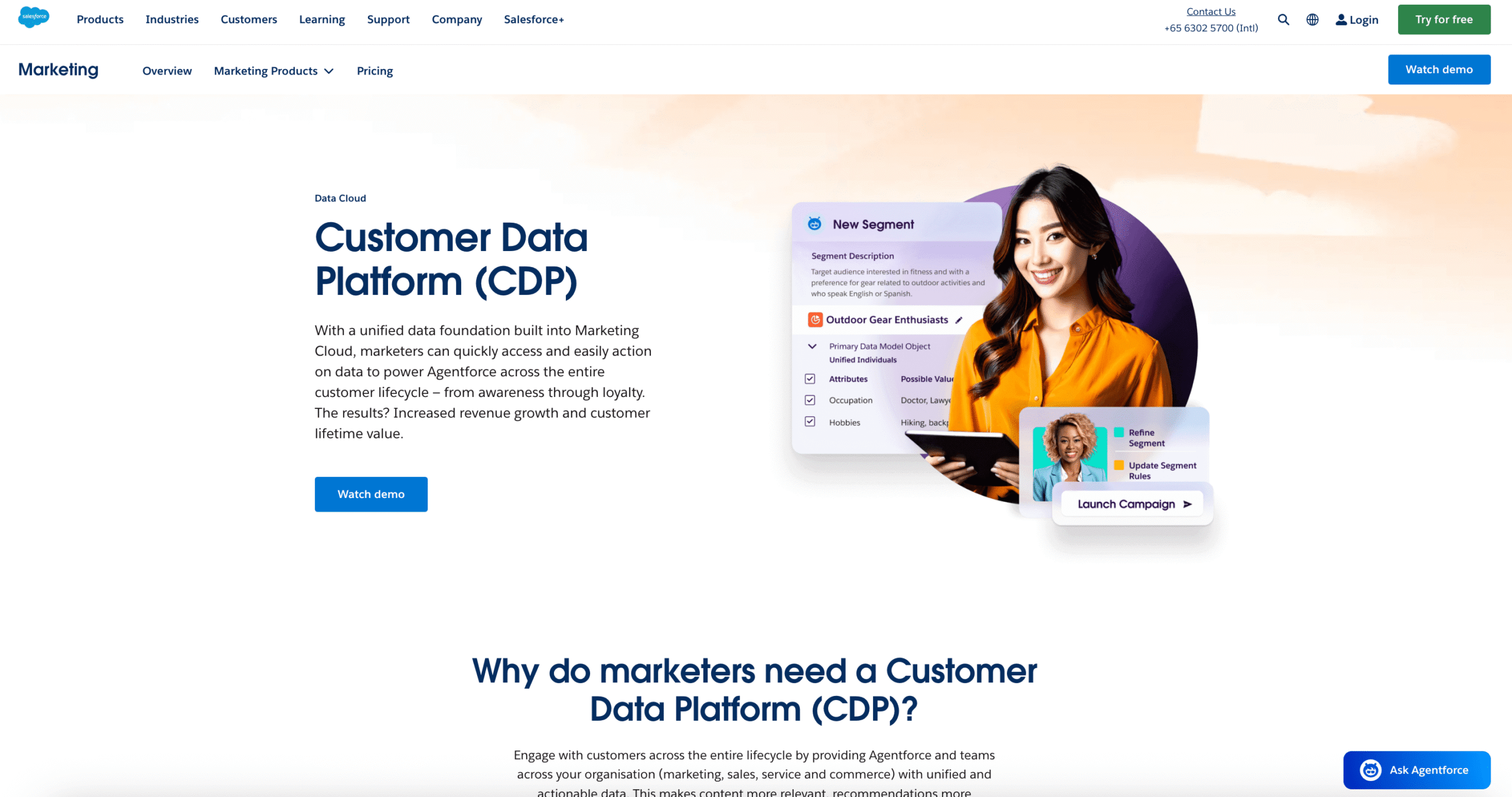
Salesforce continues to stand out as a global leader in customer journey mapping by integrating advanced AI technology through its Salesforce Data Cloud and Agentforce capabilities. These tools work together to help businesses gather and unify customer data, understand buyer behavior, and automate personalized interactions across all touchpoints in the customer journey.
Unified Data and Real-Time AI Orchestration
One of Salesforce’s most powerful features is its ability to combine structured and unstructured customer data into one platform, known as the Data Cloud. This single source of truth allows businesses to track and respond to customer actions in real-time. Through the integration of Agentforce—Salesforce’s intelligent autonomous agents—AI is no longer siloed from business operations. Instead, it’s embedded directly within everyday workflows, helping sales and marketing teams make smarter decisions without switching platforms.
Flexible Consumption-Based Pricing for Scalable Growth
Salesforce uses a consumption-based pricing model, allowing organizations to purchase credits and allocate them where needed—whether for data ingestion, profile unification, or AI agent deployment. This model offers flexibility for businesses of different sizes, as it adapts to the actual volume of AI usage instead of requiring fixed per-user licenses alone. While foundational licenses are still essential, the flexible structure reflects the modern shift toward more scalable pricing in AI enterprise solutions.
Breakdown of Salesforce AI Pricing and Features
The following table outlines the pricing tiers and key features of Salesforce’s AI-powered platform offerings in 2026:
Table: Salesforce AI Pricing Structure and Features (2026)
| Feature Component | Description | Price (USD/User/Month) |
|---|---|---|
| Professional Edition | Basic CRM functionality | 80 |
| Enterprise Edition | Advanced CRM customization | 165 |
| Unlimited Edition | Full-scale automation for large enterprises | 330 |
| Performance Edition | Designed for high-volume data processing | 500 |
| Agentforce for Sales/Service | Autonomous AI sales/service agents | 125 |
| Revenue Intelligence | Real-time sales pipeline analytics | 220 |
| Customer Lifecycle Analytics | In-depth analysis of feedback and behavior | 165 |
Cost Analysis: Total Cost of Ownership (TCO) vs Alternatives
While Salesforce offers advanced functionality, it comes at a premium price. A full-featured AI Salesforce setup can exceed $500 per user per month when combining base licenses with various AI tools. Over a three-year period, a company with 50 users would invest approximately $1,323,000. This is in sharp contrast to newer, AI-native platforms that might require only around $134,000 over the same time frame.
Matrix: Salesforce TCO vs. AI-Native Alternative (50 Users, 3 Years)
| Platform | Total Cost Over 3 Years | Average Monthly Cost/User | Scalability | Embedded AI Integration | Real-Time Data Processing |
|---|---|---|---|---|---|
| Salesforce (Full Suite) | $1,323,000 | $500+ | High | Yes | Yes |
| AI-Native Alternatives | $134,000 | ~$75 | Moderate | Partial | Limited |
Strategic Benefits for Enterprises
Despite the high cost, Salesforce’s ecosystem brings considerable returns through:
- AI-driven lead qualification based on BANT, MEDDIC, and similar methodologies.
- 95% data accuracy without the need for manual entry.
- Significant reductions in sales admin tasks.
- Improved customer targeting and lifecycle personalization.
These benefits make Salesforce an ideal choice for large enterprises that prioritize intelligent automation and real-time decision-making in their customer journey mapping strategies. Its powerful combination of robust AI tools, unified data integration, and adaptable pricing supports global scalability while driving measurable results.
2. Adobe – Adobe Journey Optimizer and Real-Time CDP
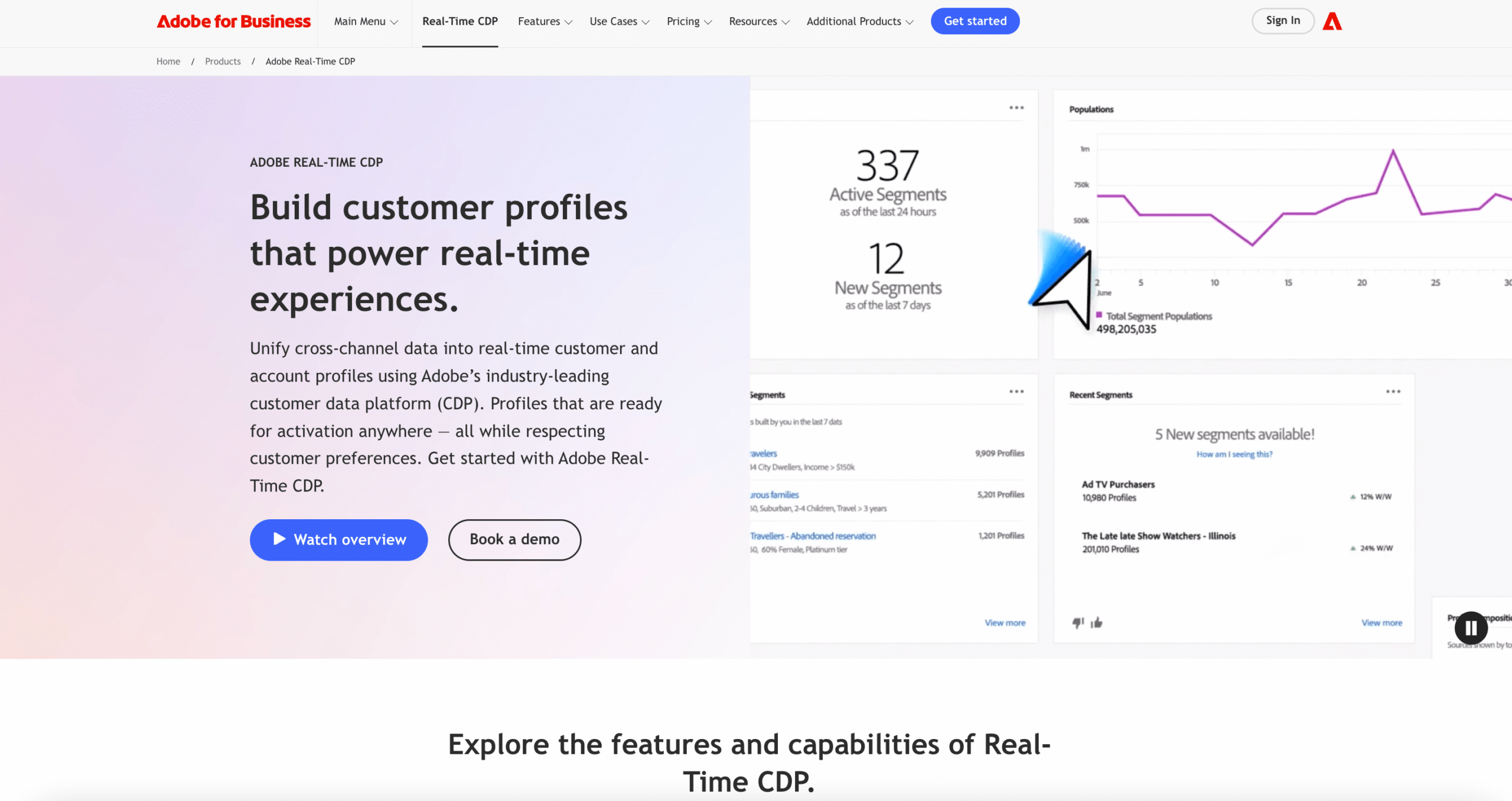
In 2026, Adobe remains one of the most advanced players in the field of AI-powered customer journey mapping. Through its powerful Adobe Journey Optimizer (AJO) and Real-Time Customer Data Platform (CDP), Adobe delivers a robust, AI-driven solution designed to help organizations plan, personalize, and optimize each stage of their customer lifecycle.
AI Agents Covering the Full Customer Lifecycle
Adobe Journey Optimizer now features ten highly focused digital agents, each designed to support a specific part of the customer journey—from the planning phase to real-time experience optimization. These AI agents are built using Adobe’s large proprietary datasets and have been refined through rigorous beta testing. As a result, businesses can easily integrate them into their existing applications without lengthy custom development or onboarding delays.
The following matrix highlights Adobe’s digital agents and their areas of specialization in 2026:
Matrix: Adobe Journey Optimizer AI Agent Suite (2026)
| AI Agent Name | Function Description | Application Stage |
|---|---|---|
| Journey Planner Agent | Designs campaign pathways based on goals and personas | Planning |
| Trigger Optimization Agent | Analyzes behavioral signals for smarter journey triggers | Engagement |
| Content Personalization Agent | Customizes messages and offers in real time | Personalization |
| Testing Strategist Agent | Suggests and deploys A/B or multivariate tests | Optimization |
| Attribution Analyst Agent | Evaluates campaign impact and ROI by segment | Measurement |
| Anomaly Detection Agent | Flags drop-offs or journey errors as they happen | Monitoring |
| Channel Mix Agent | Recommends best-performing channels by audience type | Execution |
| Experience Flow Agent | Ensures seamless cross-platform experience transitions | Journey Continuity |
| Segment Builder Agent | Constructs real-time dynamic segments | Targeting |
| Insight Explorer Agent | Provides journey and campaign performance analytics | Insight Generation |
AI-Powered Experimentation with Adobe’s Experimentation Accelerator
Adobe also introduces the Experimentation Accelerator—an AI-first tool integrated with Adobe Target. This system automatically reviews past test results, identifies optimization opportunities, and applies pattern recognition to future experiments. The tool’s AI algorithms help prioritize high-impact variants, streamlining testing efforts and improving outcomes.
According to user-reported data:
- Win rates increased by 24% through optimized testing paths.
- Each experiment delivered an average return on investment (ROI) of 212%.
These metrics reflect Adobe’s strong focus on outcome-driven experimentation and continuous experience enhancement.
Table: ROI Impact of Adobe’s Experimentation Accelerator (2026)
| Performance Indicator | Reported Result |
|---|---|
| Average Increase in Test Win Rate | 24% |
| Average ROI Per Test | 212% |
| Time Saved in Test Analysis | 65% |
| Campaign Lift Achieved | 31% |
Natural Language AI Assistant for Faster Operations
Adobe’s AI Assistant stands out for its usability. It empowers marketers and journey designers to ask complex questions in plain language and receive clear, actionable answers. For example, a team member can type:
- “Why didn’t my loyalty journey trigger yesterday?”
- “Build me a segment of high-value repeat customers.”
The assistant replies with specific answers derived from the brand’s real-time CDP data. This capability significantly reduces the need for technical support or data analyst intervention, allowing teams to resolve problems or build campaigns instantly.
Strategic Advantages for Modern Customer Journey Mapping
Adobe’s unified platform delivers several key advantages for enterprise teams in 2026:
- Pre-configured AI agents shorten deployment times and reduce operational complexity.
- Continuous experimentation and testing drive higher engagement and ROI.
- Natural language interactions improve internal efficiency and data accessibility.
- The AI ecosystem integrates tightly with Adobe Experience Cloud, giving businesses a centralized command center for end-to-end journey management.
In summary, Adobe Journey Optimizer and Real-Time CDP combine deep AI intelligence, speed, and usability to help brands deliver highly personalized and efficient customer experiences at scale. These features make Adobe one of the most comprehensive AI tools available for customer journey mapping across global enterprises in 2026.
3. Braze – Braze and BrazeAI
In 2026, Braze continues to redefine how global brands manage customer journeys using artificial intelligence. As a robust, real-time engagement platform, Braze empowers marketing teams to design, test, and personalize customer interactions across every channel using live data streams. Its latest evolution, BrazeAI (formerly known as Sage AI), marks a significant step forward in intelligent journey orchestration.
Real-Time Stream Processing for Smarter Customer Engagement
Unlike older marketing platforms that rely on batch processing, Braze operates on a high-speed stream-processing architecture. This modern infrastructure enables businesses to capture, analyze, and respond to customer behavior the moment it happens. It supports precise personalization and timely communication across various channels including email, in-app messages, SMS, and push notifications.
This capability ensures seamless delivery even during high-traffic periods. For example, during Cyber Week 2025, Braze successfully processed over 100 billion messages without any downtime—a critical performance advantage for brands managing massive volumes.
Table: Braze AI Platform Infrastructure and Performance Metrics (2025–2026)
| Core Feature | Description | Performance Insight |
|---|---|---|
| Stream-Processing Architecture | Real-time data ingestion and activation | 100+ Billion messages processed |
| Uptime Reliability | Platform availability during peak marketing periods | 100% uptime during Cyber Week |
| Cloud Integration | Seamless connection to Snowflake for direct data activation | Eliminates need for data replication |
| Multi-Channel Messaging | Support for SMS, push, email, in-app, and webhooks | Unified journey delivery |
BrazeAI and Decisioning Studio: From Testing to Intelligent Decision-Making
One of Braze’s most powerful features is its Decisioning Studio, which became even more advanced after its acquisition of OfferFit. Instead of just offering standard A/B testing, this engine uses AI to automatically determine the best message, time, channel, and journey path for each individual customer. It enables hyper-personalized communications that adapt dynamically based on each user’s preferences and behavior.
This approach helped brands such as Overstock achieve significant improvements in performance. Reported benefits include:
- A 21% increase in conversion rates.
- An additional $4.8 million in incremental revenue.
- A 105% improvement in cross-sell effectiveness.
Matrix: Measurable Business Impact of BrazeAI in 2026
| Business Outcome | Performance Gain | Case Study/Example |
|---|---|---|
| Conversion Rate Uplift | 21% | Overstock |
| Incremental Revenue Boost | $4.8 Million | Decisioning Studio impact |
| Cross-Sell Effectiveness | 105% increase | AI decisioning success |
| Subscription Growth | 14% YoY increase (FY24–FY25) | BrazeAI-driven campaigns |
Trusted by Global Enterprises for Scalability and Speed
Braze has become a preferred choice for leading global brands like Marriott and Sephora because of its reliability, intelligent automation, and ability to operate at scale. By maintaining consistent uptime during peak engagement periods, it proves its operational strength. Furthermore, its native integration with Snowflake enables real-time access to enterprise cloud data without the need for slow, manual replication processes.
This seamless integration plays a crucial role for marketing teams looking to unify their data-driven operations and accelerate time-to-market for new campaigns.
Strategic Benefits for Modern Customer Journey Mapping
Braze offers several clear advantages for companies aiming to master their customer journeys in 2026:
- Real-time response to customer actions across devices and platforms.
- AI-powered decisions that go beyond static testing toward personalized automation.
- High system reliability during global sales events and high-volume periods.
- Integration with cloud ecosystems for scalable and secure data usage.
As AI becomes more central to customer experience management, Braze positions itself as a flexible, intelligent, and future-ready solution for organizations aiming to deliver high-impact, real-time personalization at scale. Its continued investment in AI tools, decisioning systems, and performance infrastructure ensures its place among the world’s top AI tools for customer journey mapping in 2026.
4. Insider – Insider One and Sirius AI
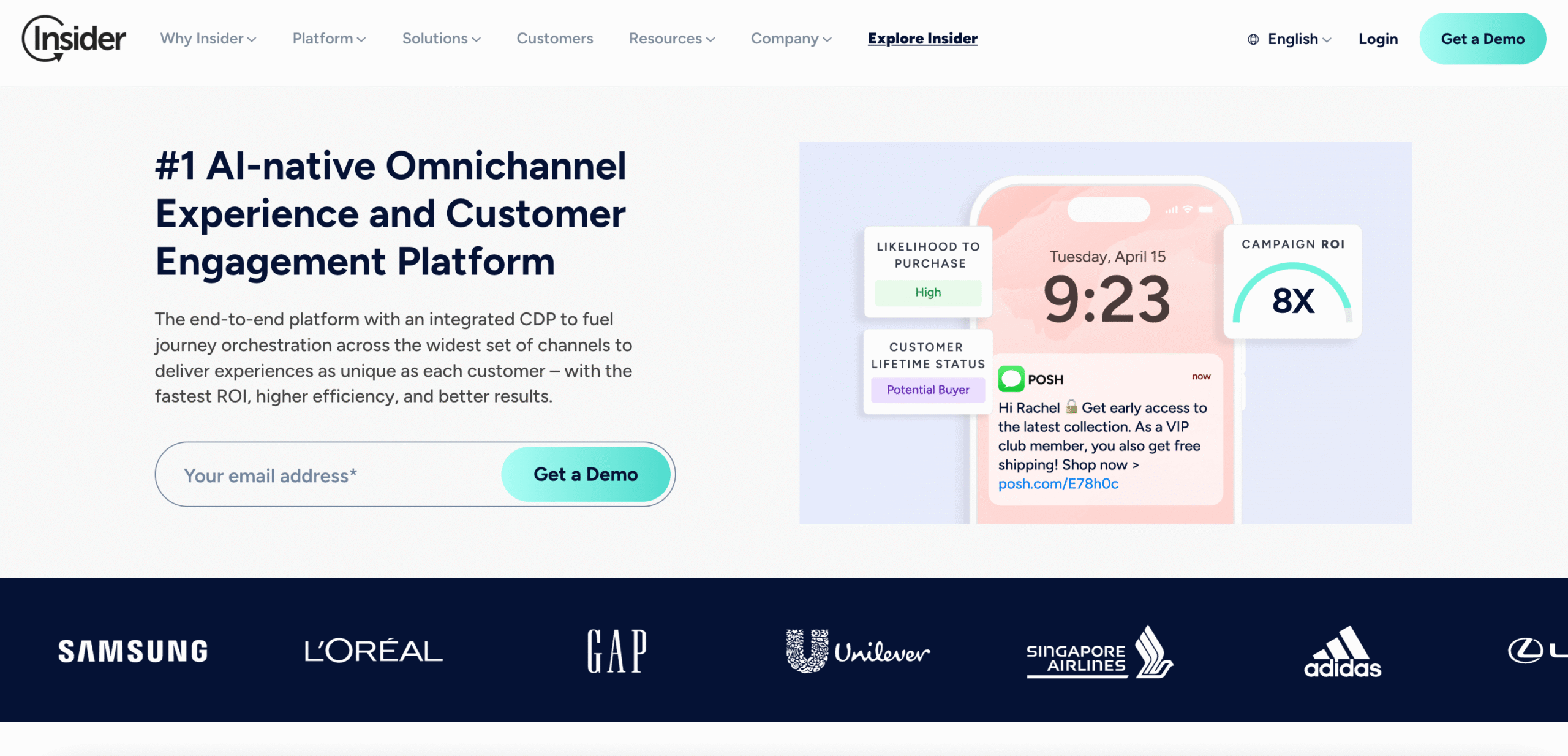
Insider One, supported by its advanced Sirius AI engine, stands out as a top-performing platform for brands looking to build smarter and faster customer journeys in 2026. This tool combines generative AI, cross-channel engagement, and actionable customer data to help marketing teams deliver relevant, real-time experiences across a wide variety of digital touchpoints.
AI-Generated Segments, Journeys, and Content Using Simple Prompts
What makes Insider unique in the customer journey mapping space is its ability to create highly targeted campaigns from just a simple text prompt. Using the Sirius AI engine, marketers can instantly generate journey flows, customer segments, and even campaign copy or images by typing a short goal—such as “promote a new product to returning users.”
This dramatically reduces the time between idea and execution, allowing businesses to stay ahead of fast-changing consumer expectations.
Table: Sirius AI Capabilities for Customer Journey Mapping (2026)
| AI Capability | Description | Value Delivered |
|---|---|---|
| Prompt-Based Campaign Creation | Generates entire customer journeys from a single prompt | Fast campaign launches |
| Content Generation | Creates custom copy and imagery based on goals | Consistent branding, reduced production time |
| Predictive Segmentation | Identifies audience clusters based on behavioral signals | Higher relevance and engagement |
| Send-Time Optimization (STO) | Chooses best time to send messages for each individual | Improved open and click rates |
| Next-Best Channel Recommendation | AI suggests ideal communication channel for every user | Multichannel personalization |
Cross-Channel Data Unification via Customer Data Platform (CDP)
Insider One supports data integration across more than 12 digital channels including WhatsApp, SMS, email, and RCS. This cross-channel alignment helps organizations maintain a 360-degree view of their customers within Insider’s native CDP. Marketers can access real-time customer insights and respond with relevant content or offers without switching between platforms.
Matrix: Cross-Channel Reach and Data Capabilities in Insider One (2026)
| Digital Channel | Data Capture Enabled | Engagement Supported | AI Personalization Available |
|---|---|---|---|
| Yes | Yes | Yes | |
| SMS | Yes | Yes | Yes |
| Yes | Yes | Yes | |
| RCS | Yes | Yes | Yes |
| In-App Messaging | Yes | Yes | Yes |
| Web Push | Yes | Yes | Yes |
| Facebook Messenger | Yes | Yes | Yes |
| Line/Viber | Yes | Yes | Yes |
No-Code Journey Design with Insider Architect
The Architect tool from Insider is a visual, no-code journey builder that enables teams to create personalized paths based on real-time data and AI predictions. Marketing professionals can build predictive workflows to identify and engage high-intent users with tailored offers, nudges, or messages. With built-in algorithms for Send-Time Optimization and Next-Best Channel selection, every customer receives the most relevant message at the most effective time.
Accessible Pricing and Scalable Implementation
Insider One provides pricing tiers designed to support both small businesses and large global enterprises. It is well-positioned to serve startups and mid-sized firms with accessible monthly pricing while also offering custom solutions for larger organizations with more complex needs.
Table: Insider One Pricing and Deployment Overview (2026)
| Attribute | Specification | Strategic Advantage |
|---|---|---|
| Startup Pricing | $600/month | Affordable for SMBs |
| Enterprise Pricing | Custom, quote-based | Tailored to complex global operations |
| Implementation Timeline | 6–8 weeks | Full setup, integration, and training |
| Segmentation Traits | 120+ prebuilt behavioral attributes | Granular targeting at scale |
Real-World Business Advantages with Sirius AI
The practical use of Sirius AI allows marketers to minimize friction during campaign creation. By simply stating what they want to achieve, the AI takes over the heavy lifting—producing ready-to-launch content and workflows within seconds. This is especially valuable in fast-paced markets where timing and relevance are crucial.
Key benefits include:
- Rapid campaign deployment with minimal manual work.
- Greater accuracy in audience targeting and content relevance.
- Smarter use of data across multiple digital channels.
- Enhanced conversion rates through AI-optimized delivery.
In conclusion, Insider One with Sirius AI delivers a well-rounded solution for brands aiming to improve customer experience through intelligent journey mapping. Its real-time AI automation, unified data platform, predictive targeting, and accessible pricing make it one of the top AI tools for customer journey mapping in 2026.
5. MoEngage – MoEngage Flows and Merlin AI
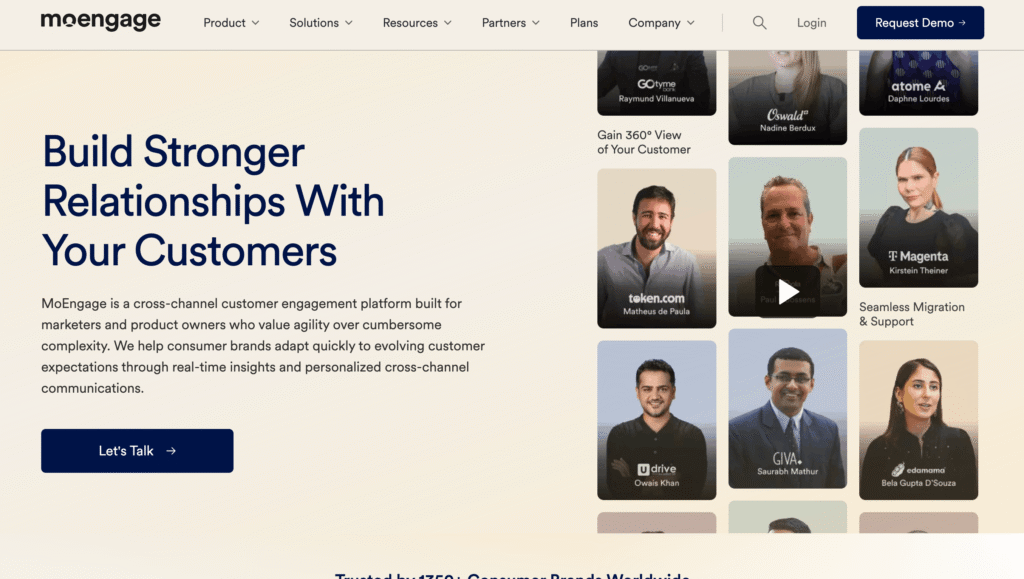
MoEngage has positioned itself as a forward-thinking AI platform in 2026, built to help brands design better customer experiences through real-time engagement and data-driven journey optimization. With a powerful combination of visual tools, predictive analytics, and AI orchestration, MoEngage is among the top-rated solutions for customer journey mapping this year.
AI-Powered Journey Design with MoEngage Flows
MoEngage Flows provides a visual, drag-and-drop interface that requires no coding knowledge. It allows marketers to design complex customer journeys quickly and efficiently. Brands like Poshmark have reported a 30% increase in conversion from casual users (listers) to active participants (sellers) by using this canvas-based journey builder.
The system is backed by Merlin AI and Sherpa AI, which provide intelligent insights at every step. These AI tools assist with performance tracking, predicting user actions, and optimizing journey stages based on live engagement data.
Table: MoEngage Flows – Visual and AI Components (2026)
| Feature | Functionality Description | User Impact |
|---|---|---|
| Visual Journey Builder | Drag-and-drop interface for campaign creation | No-code, fast setup |
| Merlin AI | Suggests optimal actions and segments | Higher engagement rates |
| Sherpa AI | Predictive analytics for customer behavior | Proactive targeting and timing |
| Flow Performance Insights | Visual performance analytics per journey branch | Informed optimization decisions |
| Multi-Channel Sync | Integration with SMS, email, WhatsApp, push, and web | Unified engagement experience |
Intelligent Path Optimizer and A/B Testing Automation
MoEngage sets itself apart with its Intelligent Path Optimizer. This AI-driven feature allows marketers to test up to five journey branches at the same time and automatically redirects customers to the path that performs best. The system continuously evaluates performance in real-time, adjusting flow strategies without manual input.
This results in faster campaign refinement, less trial-and-error, and better user outcomes across customer segments.
Matrix: Performance Optimization with MoEngage Intelligent Path Optimizer
| Capability | Description | Business Benefit |
|---|---|---|
| Simultaneous Branch Testing | A/B test up to 5 journey paths in real time | Shortens testing cycles |
| Real-Time Journey Re-Routing | Automatically directs users to the best-performing path | Boosts engagement and conversion rates |
| Continuous Learning | Learns from live data and adapts autonomously | Improves journey outcomes over time |
Flexible Plans for Businesses of All Sizes
MoEngage offers scalable plans designed for both mid-sized and enterprise organizations. The Growth Plan is ideal for smaller teams looking to build structured journeys with essential AI capabilities. Larger organizations benefit from the Enterprise Plan, which adds premium features like product catalog sync, IP whitelisting, and access to local data servers for enhanced security.
Table: MoEngage Pricing Tiers and Features (2026)
| Plan Type | Target Audience | Core Features |
|---|---|---|
| Growth Plan | Mid-market teams | Visual flow builder, send-time AI, expert support |
| Enterprise Plan | Large organizations | Advanced recommendations, IP whitelisting, catalog sync |
| Personalize | Cross-team deployments | Quote-based pricing, web A/B testing, content adaptation |
| Inform | Transactional teams | Real-time alerts via SMS, email, WhatsApp |
Effectiveness in Driving Customer Loyalty and Retention
MoEngage’s platform has been especially effective in increasing customer retention. For example, wedding brand Cocomelody experienced a 27% rise in repurchase rates after using MoEngage’s AI-powered journey flows. This demonstrates how the platform not only captures customer interest but also nurtures long-term engagement through personalized, data-driven communications.
Matrix: MoEngage Results in Real-World Use Cases (2026)
| Brand | Use Case Description | Measured Outcome |
|---|---|---|
| Poshmark | Increased lister-to-seller conversion | 30% uplift |
| Cocomelody | Boosted repurchase rate with journey flows | 27% increase |
User Experience and Limitations
MoEngage is often praised for its user-friendly design and intuitive interface, especially for entry-level marketers. However, some users note that the more advanced features—like in-depth automation logic and complex integrations—require a steeper learning curve. Occasionally, technical glitches have been reported during large-scale integrations, though these issues tend to be short-lived and are actively addressed by the support team.
Conclusion: A Balanced, AI-Powered Journey Solution
In summary, MoEngage offers a complete toolkit for building, optimizing, and scaling customer journeys in 2026. Its real-time AI automation, personalized flow optimization, and flexible pricing tiers make it a strategic choice for brands focused on improving customer engagement and loyalty. The platform’s strong track record in helping companies drive conversion and retention solidifies its place as one of the top 10 AI tools for customer journey mapping globally.
6. Qualtrics – Qualtrics XM and Experience Agents
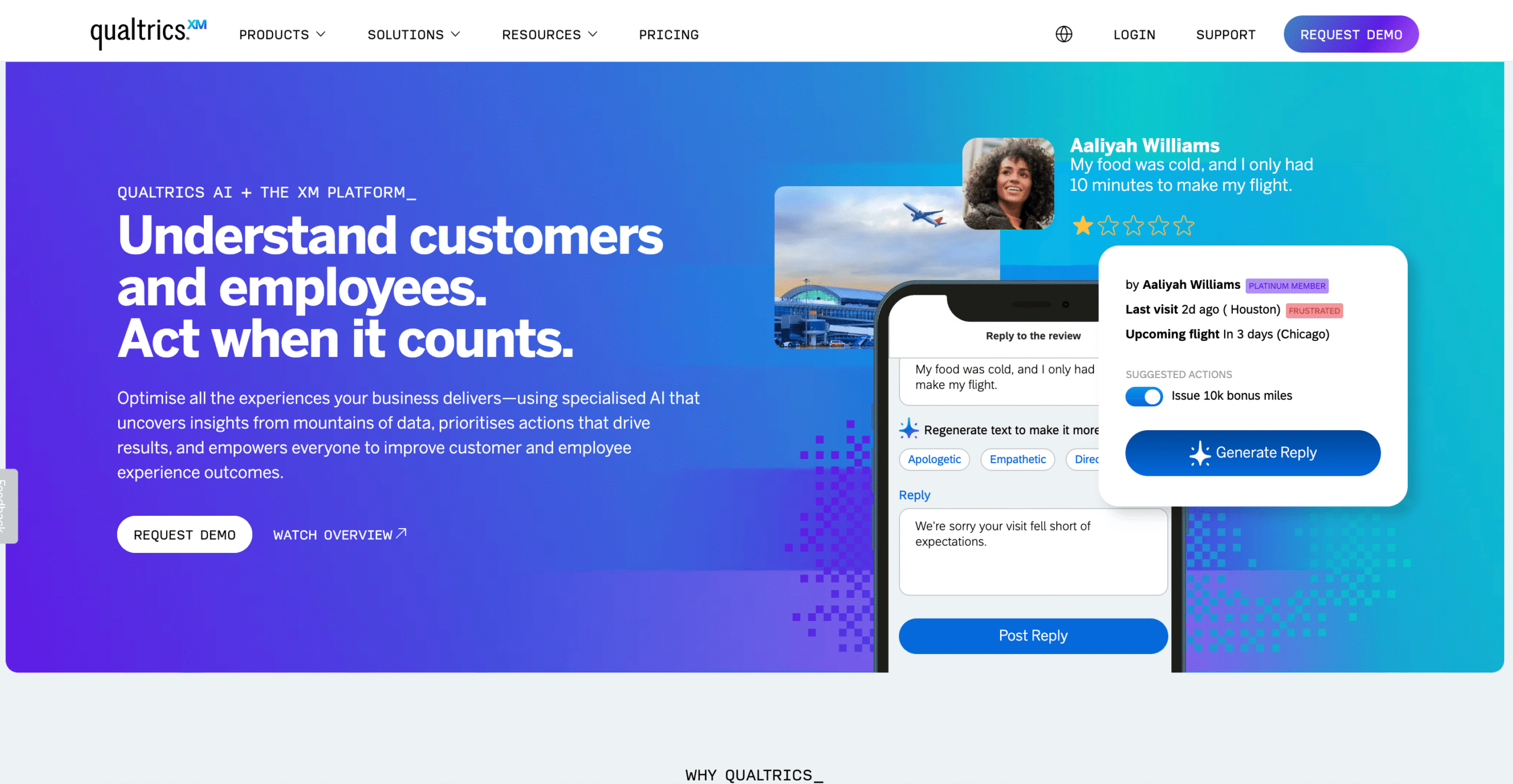
In 2026, Qualtrics has elevated the concept of customer journey mapping into a broader and more intelligent discipline known as Experience Management (XM). Through its advanced XM platform and Experience Agents, Qualtrics enables organizations to capture, understand, and improve every touchpoint of the customer journey. With more than 90% of its top 50 enterprise clients now fully adopting its AI-powered ecosystem, Qualtrics has emerged as a key global leader in the AI-driven customer journey space.
Real-Time AI Experience Agents for Friction Detection and Resolution
Qualtrics Experience Agents are intelligent AI modules embedded across the XM platform that monitor every customer interaction—ranging from contact center calls to website behavior and social media activity. These AI agents identify pain points or service gaps as they happen and automatically suggest or execute fixes. This proactive approach reduces churn, protects brand reputation, and enhances customer satisfaction.
The platform analyzes over 3.5 billion interactions per year, delivering real-time insights that help customer experience (CX) and research teams take immediate action based on behavioral patterns and sentiment analysis.
Table: Qualtrics AI Capabilities and Channel Coverage (2026)
| Interaction Channel | Captured Data Types | AI Functions Performed |
|---|---|---|
| Call Centers | Voice transcripts, call metadata | Sentiment detection, frustration identification |
| Web Chat and Live Support | Conversation logs | Escalation triggers, agent performance analytics |
| Social Media | Comments, mentions, reactions | Brand sentiment monitoring, crisis detection |
| Email Feedback | Survey responses, open-ended feedback | Experience scoring, intent classification |
| In-App Feedback | Real-time usage feedback | Feature optimization, in-product improvements |
Autonomous Research with Conversational and Synthetic Feedback
One of the key breakthroughs in 2026 is Qualtrics’ focus on automated research workflows. The platform supports autonomous survey management, synthetic response generation, and conversational feedback systems, allowing businesses to field insights faster and at significantly lower costs.
This shift away from traditional reporting models allows research teams to deliver decision-ready insights in real time while reducing workload. Synthetic responses—AI-generated answers based on historical data and known behavior—help companies test scenarios and gather insights without requiring manual survey participation.
Matrix: Efficiency Gains with Qualtrics XM AI (2026)
| Metric | Outcome for Organizations | Strategic Value |
|---|---|---|
| Monthly Active AI Users | 346% Increase | Strong AI adoption across CX teams |
| Manual Analysis Reduction | 95%+ Time Saved | More focus on strategy and action |
| Survey Completion Rate | Increased from 75% to 83% | Driven by conversational feedback |
| Research Fielding Cost | 50% Reduction | Enabled by synthetic and predictive responses |
XM Platform Benefits for Enterprise Growth
The strength of Qualtrics lies in its ability to connect stakeholder expectations with operational capabilities. Global leaders such as adidas and Stripe rely on Qualtrics to bridge the gap between customer needs and business strategy, creating smarter workflows, more aligned teams, and faster decision-making.
Key benefits include:
- Real-time friction alerts and automated corrective actions.
- Advanced research capabilities powered by conversational AI and synthetic data.
- A single view of the customer across surveys, conversations, and behavioral signals.
- Reduced research costs and faster time-to-insight for large-scale campaigns.
Table: Qualtrics XM Platform Business Value for Enterprises (2026)
| Value Category | Description | Business Outcome |
|---|---|---|
| Real-Time Experience Agents | Autonomous monitoring of journey issues | Immediate resolution and reduced churn |
| Synthetic Feedback Engine | AI-generated responses for research simulation | Reduced dependency on traditional fieldwork |
| Unified Analytics Layer | Combines data from all experience touchpoints | Holistic view of customer sentiment |
| Stakeholder Alignment Tools | Connects insights to decision-makers with dashboards | Better strategy execution and coordination |
A New Standard for AI-Driven Journey Mapping
By combining real-time data capture, intelligent automation, and predictive research, Qualtrics transforms customer journey mapping into a powerful engine for business growth. Its AI-first approach helps organizations stay connected to customer needs at every moment, creating meaningful improvements in satisfaction, retention, and loyalty.
As one of the most advanced tools in the 2026 customer journey mapping landscape, Qualtrics XM delivers not just data, but actionable intelligence that empowers global brands to move faster, think smarter, and grow stronger.
7. Contentsquare – Contentsquare Sense AI
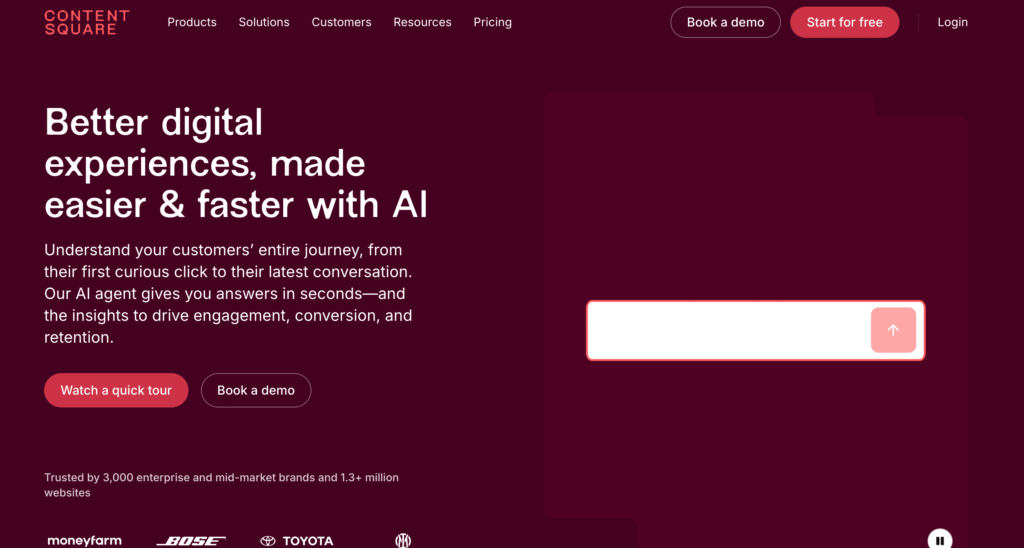
Contentsquare has become one of the most trusted platforms for understanding and improving digital customer journeys through advanced analytics and AI. Its flagship AI engine, Sense AI, enables organizations to uncover hidden user behaviors, detect friction points, and optimize experiences across web and mobile platforms. As customer journey mapping continues to evolve in 2026, Contentsquare stands out for its precision, speed, and deep integration into enterprise ecosystems.
Sense AI: Automated Journey Insights Without Manual Tagging
Sense AI eliminates the traditional need for manual event tagging by using artificial intelligence to automatically track user interactions across every touchpoint. This means marketers and product teams can gain full visibility into user journeys—including clicks, scrolls, hovers, and exits—without needing developers to set up trackers.
In 2026, the platform analyzed more than 99 billion digital sessions. It identified a significant behavioral shift: organic search traffic declined by 9%, while AI-referred traffic (such as traffic directed from AI tools and recommendation engines) grew significantly, with a 55% improvement in conversion rates.
Table: Key Traffic Trends Observed by Contentsquare in 2026
| Traffic Source | Change from 2025 | Conversion Impact |
|---|---|---|
| Organic Search | -9% decline | Lower engagement with static SEO |
| AI-Referred Sources | +632% increase | 55% higher conversion rate |
| Direct App Launch | +18% increase | Moderate rise in loyalty actions |
| Paid Campaign Clickthroughs | +12% growth | Stable conversion with high cost |
Journey Analysis and Hidden Friction Detection
Contentsquare’s Journey Analysis module allows businesses to explore non-linear paths taken by users. It can uncover behavioral patterns that would otherwise go unnoticed—such as abandoned steps, repeated page visits, or hesitation before checkout—without requiring pre-defined tracking.
These capabilities are especially useful for brands aiming to improve site or app usability. Even untagged or unmonitored elements are analyzed by AI to deliver actionable insights that enhance UX and boost conversions.
Matrix: Contentsquare Journey Analysis Capabilities (2026)
| Functionality | Description | Strategic Benefit |
|---|---|---|
| Friction Mapping | Detects drop-offs and frustration moments | Reduces abandonment rate |
| Untracked Path Discovery | Reveals unexpected customer behaviors | Supports content and layout refinement |
| Completion Rate Analysis | Measures goal completion trends | Optimizes conversion flows |
| Experience Score Benchmarking | Compares journey performance against industry averages | Improves competitive positioning |
Business Value and Financial Impact
A Forrester Total Economic Impact (TEI) study commissioned by Contentsquare showed that the platform offers some of the strongest financial returns in the digital analytics space. Over a three-year period, enterprises using Contentsquare achieved a 602% return on investment, with nearly $6.6 million in additional profits and cost recovery.
Table: Financial and Operational Impact of Contentsquare (3-Year Average)
| Metric | Result Achieved | Source/Study |
|---|---|---|
| Return on Investment (ROI) | 602% | Forrester TEI Study |
| Internal Productivity Gains | 2,914 hours saved | Workflow automation and insights |
| UX Completion Rate Improvement | 20–30% | Enhanced digital journey outcomes |
| Recovered Income | $6.6 Million | Optimization-led revenue recovery |
Integration with AI Assistants and Cross-Platform Use
One of the most powerful upgrades introduced by Contentsquare is the MCP Server, which allows the platform’s analytics to be accessed through other generative AI tools such as Microsoft Copilot, ChatGPT, or Claude. This means team members can ask natural-language questions like:
- “Why are users exiting at the payment page?”
- “Which part of the checkout process is causing delays?”
- “Which features are being used the most by returning visitors?”
These questions are answered in seconds with data-rich, AI-curated insights that come with suggestions for improvement.
Matrix: MCP Server Integration Benefits (2026)
| Feature | Description | Enterprise Value |
|---|---|---|
| Natural-Language Interface | Ask questions without needing dashboard access | Increases team-wide insight accessibility |
| AI Tool Integration | Works with Copilot, Claude, ChatGPT, and others | Cross-platform use of analytics |
| Automated Insight Responses | Instant answers with recommendations | Speeds up decision-making |
| Contextual Recommendations | Suggestions based on real-time behavior | Drives faster optimization loops |
Positioning Contentsquare as a Top Global Tool for Customer Journey Mapping
With a focus on experience analytics, Contentsquare has redefined how brands view user journeys. Its blend of predictive insights, behavioral analysis, and seamless integrations make it one of the most intelligent and responsive AI tools available for digital optimization.
For enterprises in 2026 looking to understand user behavior across websites and mobile apps, reduce friction, and increase revenue, Contentsquare provides a complete solution that combines powerful AI with practical, actionable results. Its high ROI, deep learning capabilities, and effortless integration with leading AI ecosystems firmly establish its place among the top 10 AI tools for customer journey mapping worldwide.
8. Glassbox – Glassbox Augmented Journey Map

Glassbox has emerged as one of the most dynamic AI solutions for customer journey mapping in 2026, offering enterprises a live, data-driven understanding of customer behavior. Unlike traditional platforms that rely on static visual maps, Glassbox delivers continuously updated journey insights through its Augmented Journey Map. This allows organizations to analyze customer experiences in real time, identify points of friction, and quantify the business impact of digital challenges with unmatched precision.
Live Behavioral Tracking for Real-Time Journey Visibility
Glassbox captures every user interaction—from clicks and taps to scroll depth and field hesitations. This comprehensive tracking builds a real-time behavioral map that reflects the full digital journey without requiring users to submit feedback through traditional surveys. With 95% of users typically ignoring feedback forms, this behavioral-first approach allows businesses to understand customer sentiment directly through actions.
The Augmented Journey Map automatically updates as user behavior changes, enabling continuous optimization of website and app flows. Teams can visualize where users struggle, drop off, or experience delays—and act quickly to resolve those issues.
Table: Glassbox Real-Time Behavioral Tracking Capabilities (2026)
| Interaction Element | Data Captured | Business Application |
|---|---|---|
| Clicks and Taps | Element selection frequency | UX redesign, CTA optimization |
| Scroll Depth | Page engagement and content visibility | Layout improvements, content placement |
| Field Entries and Errors | Form completions and validation issues | Checkout flow optimization, error prevention |
| Session Replay | Visual playback of user behavior | Troubleshooting and QA |
| Journey Drop-Off Analysis | Abandonment behavior insights | Funnel optimization, campaign refinement |
Quantifying Revenue Impact of Friction Points
One of the core strengths of Glassbox is its ability to assign financial value to moments of friction. When users encounter silent failures—such as broken login fields, failed form submissions, or slow-loading elements—Glassbox calculates how much potential revenue is lost and flags it for rapid resolution.
Enterprise clients across banking, insurance, and digital commerce have leveraged this feature to protect revenue and prevent user dissatisfaction.
Matrix: Enterprise Case Study Results Using Glassbox (2026)
| Organization | Identified Issue | Outcome Achieved | Financial Impact |
|---|---|---|---|
| Major UK Bank | Login form silent failure | 4% reduction in login errors | Increased application flow |
| US Bank | Fraud detection via behavior analytics | Detected $18M in fraud risks in 7 months | Prevented financial losses |
| An Post Insurance | Quote journey barrier | 6% increase in quote conversion | Higher sales conversion |
| FTSE 100 Insurer | Cookie-based session error | Fixed bug trapping users | $515,000 annual recovery |
| SoFi Loan App | Application abandonment | 546 failed sessions flagged in 1 week | $9M potential savings |
Enterprise-Grade AI Assistant and Data Security
Glassbox’s Intelligent Assistant (GIA) uses Microsoft Azure OpenAI for delivering AI insights that are both explainable and enterprise-secure. This AI system provides clear, auditable recommendations based on real-time behavioral patterns, helping organizations make confident, compliant decisions.
Features of GIA include:
- Pattern detection for user anomalies and journey blockers.
- Instant explanations with data traceability.
- AI-powered guidance on resolving UX inefficiencies.
- Enterprise-grade auditability and transparency.
Support for Accessibility Compliance and Inclusive Journeys
In addition to business optimization, Glassbox focuses on creating inclusive digital experiences. Its platform includes real-time accessibility scanning aligned with WCAG guidelines. Developers are immediately alerted to accessibility barriers such as color contrast issues, missing alt text, or non-keyboard navigable elements—helping to resolve problems before they go live.
Table: Glassbox Accessibility and Compliance Features (2026)
| Feature | Description | Outcome for Development Teams |
|---|---|---|
| WCAG Real-Time Scanning | Detects accessibility violations as they occur | Prevents compliance breaches |
| Developer Guidance Engine | Step-by-step fix suggestions | Speeds up development fixes |
| Pre-Launch Barrier Testing | Ensures compliance before feature release | Reduces post-deployment defects |
| Inclusive Journey Mapping | Flags exclusionary interactions | Expands reach to diverse audiences |
Glassbox as a Strategic Platform for Secure, Profitable, and Inclusive Journeys
By combining continuous journey mapping, fraud protection, AI-guided optimization, and digital inclusivity, Glassbox provides a 360-degree solution for managing modern customer experiences. Its ability to detect revenue threats, reduce operational issues, and enhance accessibility sets it apart in a crowded AI ecosystem.
In 2026, for enterprises that need both performance and precision, Glassbox is not just a journey mapping tool—it is a strategic platform that ensures every customer interaction is optimized, compliant, and secure. This positions Glassbox among the most essential and innovative AI tools for customer journey mapping worldwide.
9. Fullstory – Fullstory StoryAI
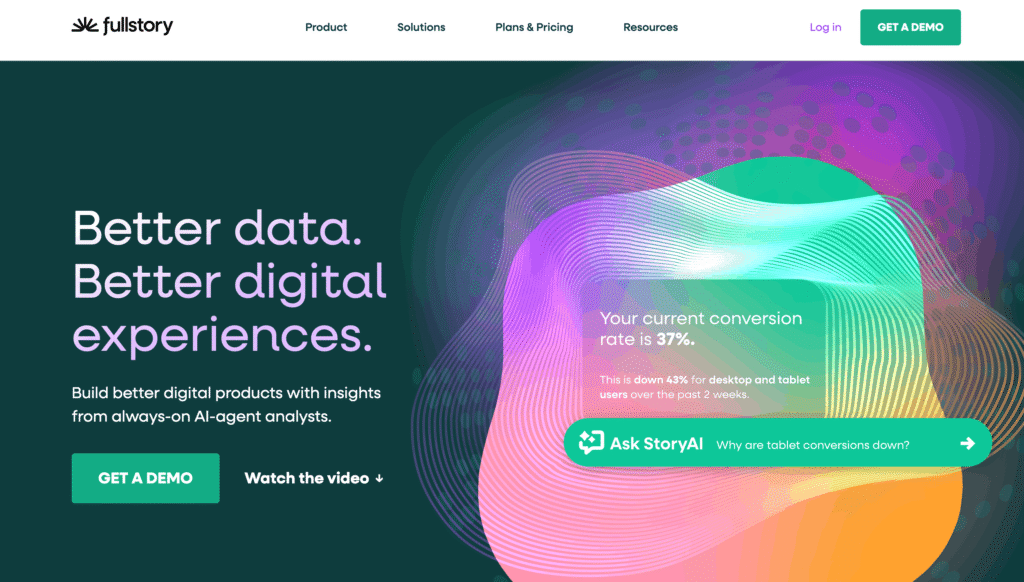
In 2026, Fullstory has redefined how organizations track and understand digital customer journeys through its intelligent platform, StoryAI. Moving beyond traditional analytics, Fullstory eliminates the need for manual tagging and streamlines journey insights through advanced automation, real-time tracking, and visual storytelling. It is one of the top AI tools empowering brands to improve user experience, reduce drop-offs, and drive product decisions based on actual behavior.
Automated Data Capture Without Manual Tagging
A major strength of Fullstory lies in its ability to record all digital activity—such as page views, clicks, scrolls, and form interactions—without the need for traditional instrumentation. Unlike older tools that require developers to tag every element for tracking, Fullstory automatically captures and structures behavioral data, saving valuable engineering time and ensuring data completeness.
This no-code functionality enables immediate retroactive analysis, helping teams answer critical questions without needing to wait for tracking setup.
Table: Fullstory Tagless Data Collection Capabilities (2026)
| Tracking Area | Captured Automatically | Benefits for Teams |
|---|---|---|
| Page Views and Scrolls | Yes | Full journey visibility |
| Clicks and Tap Locations | Yes | Detects drop-offs and friction zones |
| Form Interactions | Yes | Highlights abandoned or failed forms |
| CSS Element Actions | Yes | No manual tagging or code instrumentation |
| Historic Replay Access | Yes | Allows retroactive behavior review |
StoryAI Features and Intelligent Labeling for Deep Analysis
Fullstory’s 2026 updates introduced several innovations under the StoryAI umbrella. These include Ask StoryAI, AI Suggested Pages, and AI Suggested Elements. These tools empower non-technical users to uncover actionable insights instantly.
Ask StoryAI acts like a smart analyst—users simply type in a question such as “Where are users getting stuck in the checkout process?” and receive detailed, data-backed answers in seconds.
AI Suggested Elements and Pages automatically translate raw page structures and CSS selectors into clean, understandable labels, making journey analysis easy to understand for marketing, product, and support teams.
Table: StoryAI Feature Timeline and Functionality (2025–2026)
| Feature Name | Launch Date | Functional Benefit | Team Impact |
|---|---|---|---|
| Ask StoryAI | December 2025 | Natural language query for behavior analysis | Speeds up decision-making |
| AI Suggested Pages | October 2025 | Groups pages based on layout and purpose | Easier path segmentation |
| AI Suggested Elements | September 2025 | Converts complex selectors into human labels | Reduces technical barrier to analysis |
| Private Spaces | January 2025 | Collaboration in draft environments | Improves cross-team workflows |
| Flutter Mobile Support | December 2024 | Session replay for Flutter-based apps | Full journey visibility across platforms |
Visual Session Replay for Understanding the ‘Why’ Behind User Behavior
One of Fullstory’s core tools is its session replay engine. This feature visually reproduces how users navigate a site or mobile app. Teams can see where users scroll, where they hesitate, and where they abandon tasks. This helps stakeholders understand not just what users are doing, but why they’re doing it—or why they’re not completing key actions.
Matrix: Visual Replay Capabilities in Fullstory (2026)
| Insight Area | Visualization Tool | Business Use Case |
|---|---|---|
| Scroll and Click Tracking | Session Playback | UX troubleshooting, design testing |
| Form Hesitation Mapping | Form Replay View | Conversion funnel optimization |
| Error Reproduction | Console Log Replay | Engineering debugging and QA |
| Page Load Timing | Load Timeline | Performance monitoring |
| Device & Browser Analysis | Environment Playback | Testing across screen sizes and browsers |
Reducing Data Analysis Time and Enhancing Collaboration
Fullstory helps reduce reliance on traditional analysts by providing automated insights that are ready to use. With Ask StoryAI and AI-generated summaries, product and marketing teams can find answers quickly, avoiding the wait for BI dashboards or manual query reports.
Private Spaces allow teams to collaborate on findings and user journeys before sharing them broadly, helping validate ideas and reducing miscommunication.
Table: Productivity Benefits of Fullstory StoryAI Platform
| Area of Efficiency | Measured Impact | Strategic Benefit |
|---|---|---|
| Manual Analysis Time | Reduced significantly | Faster iteration and prioritization |
| Developer Tagging Burden | Eliminated | Saves engineering time |
| Cross-Department Access | Improved through human-readable labels | Empowers non-technical teams to take action |
| Decision Velocity | Accelerated by Ask StoryAI | Shortens time from insight to implementation |
Empowering Teams with Real-Time, Behavior-Led Journey Intelligence
With Fullstory’s combination of automation, visual playback, and AI-powered insight generation, organizations can finally understand user behavior without friction. Teams can make decisions based on actual behavior patterns rather than assumptions, leading to better product experiences, reduced churn, and increased user satisfaction.
For any brand seeking a comprehensive and intelligent customer journey mapping solution in 2026, Fullstory StoryAI stands out as a no-code, data-rich, and highly accessible platform that translates digital behavior into powerful, actionable insights. Its position as one of the top 10 AI tools in this space is reinforced by its ease of use, broad platform support, and deep behavioral intelligence.
10. Amplitude – Amplitude and Product-Led Growth
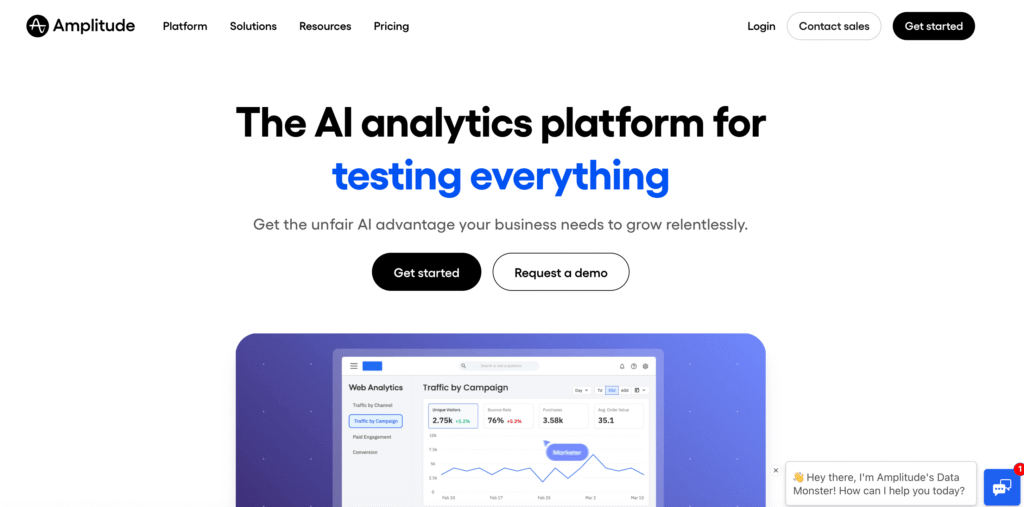
Amplitude continues to stand out in 2026 as one of the most advanced AI-driven platforms supporting product-led growth (PLG) strategies. Its ability to combine real-time behavioral analytics, AI-guided experimentation, and deep customer journey intelligence makes it a top choice for organizations looking to drive continuous digital product improvement.
With the growing demand for precise, actionable insights in customer experience, Amplitude empowers product, marketing, and analytics teams to align around shared data, test at scale, and refine user journeys with speed and clarity.
AI Agents for Continuous Testing and Opportunity Discovery
A key differentiator for Amplitude is its 24/7 AI Agents, which monitor user interactions across web and mobile products to uncover patterns and growth opportunities. These intelligent agents identify bottlenecks, suggest personalization strategies, and surface test ideas—enabling businesses to transition from reactive reporting to proactive innovation.
Rather than relying on predefined dashboards, teams can rely on Amplitude’s AI to reveal insights automatically and direct attention to areas that will have the most impact on customer satisfaction and business outcomes.
Matrix: Amplitude AI Capabilities for Customer Journey Mapping (2026)
| AI Feature | Functionality Description | Business Impact |
|---|---|---|
| AI Opportunity Discovery | Detects unoptimized paths and friction points | Increases activation and engagement |
| Automated Personalization Ideas | Suggests content variations for segments | Boosts conversion rates |
| Real-Time Journey Monitoring | Tracks flow drop-offs and value path completion | Improves feature adoption |
| Behavior-Based Cohort Building | Segments users dynamically based on actions | Enables targeted campaigns |
User Flow Visualization and Conversion Path Optimization
Amplitude provides detailed flow analysis, allowing teams to clearly see the most common actions taken after user sign-up and before monetization events like in-app purchases. These visual maps help uncover where users drop off, which touchpoints lead to conversions, and how to prioritize product features.
By visualizing every key step in the user journey, Amplitude enables teams to continuously fine-tune experiences and drive higher lifetime value.
Table: Conversion Path Insights from Amplitude (2026)
| Journey Stage | Insight Captured | Optimization Opportunity |
|---|---|---|
| Post Sign-Up Activity | First feature used, time to engagement | Onboarding improvements |
| Pre-Purchase Behavior | Click paths before completing purchase | Streamlined checkout flow |
| Retention Drivers | Features used by long-term users | Prioritize high-retention capabilities |
| Abandonment Analysis | Drop-off points by channel and segment | Re-engagement strategies |
Flexible Pricing Based on Monthly Tracked Users
Amplitude operates with a usage-based pricing model, which scales based on Monthly Tracked Users (MTUs) and event volume. While the platform offers a generous free plan ideal for startups and small teams, costs can rise rapidly as user bases grow—a consideration for scaling SaaS firms evaluating long-term ROI.
Table: Amplitude Pricing Plans and Features (2026)
| Plan Tier | Starting Cost | Included Features | Ideal Use Case |
|---|---|---|---|
| Starter Plan | Free | 50K MTUs, basic analytics, core dashboards | Startups and MVP teams |
| Plus Plan | $49/month | Up to 300K MTUs, custom event tracking | Growing apps needing flexibility |
| Growth Plan | Custom (Est. $995) | Predictive insights, behavior modeling | Mid-sized teams optimizing product usage |
| Enterprise Plan | Custom (Quote) | AI Agents, advanced security, dedicated support | Large orgs with complex data environments |
Seamless Integration Across the Data Ecosystem
Amplitude connects easily with over 100 native tools, enabling organizations to centralize their journey analytics across platforms. Integrations with Snowflake, BigQuery, Segment, and other data infrastructure providers ensure that teams can activate insights across marketing, sales, and product workflows in real time.
This makes Amplitude a central decision-making hub for high-growth companies that want to unify their data and collaborate across departments.
Matrix: Amplitude Ecosystem Integration Benefits (2026)
| Integration Type | Examples | Value to Business Teams |
|---|---|---|
| Data Warehouses | Snowflake, BigQuery | Advanced analytics and forecasting |
| Customer Data Platforms | Segment, RudderStack | Unified customer profile tracking |
| Marketing Automation Tools | Braze, HubSpot, Marketo | Data-informed campaign targeting |
| Product Communication Tools | Intercom, Zendesk, Mixpanel | In-app guidance and support optimization |
A Smart and Scalable Platform for Product-Led Teams
Amplitude’s value lies in its ability to turn customer behavior into a strategic advantage. Its real-time AI, journey visualization, and flexible integrations provide product and growth teams with everything they need to map, measure, and improve the customer journey continuously.
With tools built for PLG strategies and insights designed for cross-functional teams, Amplitude is recognized globally as one of the top 10 AI tools for customer journey mapping in 2026. It offers both the intelligence and the infrastructure required to scale customer-centric innovation at every stage of growth.
The Strategic Evolution of AI-Driven Customer Journey Mapping in 2026
The global market for customer journey mapping (CJM) software has entered a new era in 2026. Valued at approximately $19.79 billion, it continues to grow at a rapid compound annual growth rate (CAGR) of 20.2%. This impressive expansion is not simply about increased investment in software—it represents a significant transformation in how organizations manage the customer lifecycle. Businesses are no longer content with using static diagrams to visualize journeys; they now demand intelligent platforms that connect insights directly to execution in real-time.
From Static Maps to Dynamic Management Systems
Customer journey maps were once static visuals, used to align teams internally. But in 2026, organizations expect much more. Today’s platforms act as end-to-end management systems that link customer behavior data with feedback tools, analytics engines, and agile project management systems like Jira or Azure DevOps.
Instead of just identifying pain points, modern CJM software solutions help businesses act on those insights quickly. They integrate Voice of the Customer (VoC) data with operational roadmaps and product backlogs—making sure that what users experience feeds directly into what teams build next.
Matrix: Evolution of CJM Tools in 2026
| Attribute | Traditional Journey Maps | Modern AI-Powered CJM Platforms |
|---|---|---|
| Nature of Data | Static snapshots | Real-time, continuous data streams |
| Feedback Integration | Manual, survey-based | Automatic, VoC and sentiment-based |
| Execution Connection | Disconnected from roadmaps | Integrated with Jira, Azure, etc. |
| Analytics and Testing | Post-event | Predictive, AI-driven experimentation |
| Business Use | Strategic visualization | Operational execution |
Market Growth and Economic Outlook
The global CJM software market is experiencing explosive growth. Forecasts suggest that it will reach $41.19 billion by 2030, driven by increased demand for cross-channel mapping and cloud-native platforms. While the broader journey mapping segment includes general-purpose analytics and customer data platforms, the specialized submarket dedicated strictly to customer experience (CX) tools is valued at $2.3 billion in 2026, growing steadily at a 15% CAGR.
Table: 2025–2026 CJM Market Value and Growth Trends
| Segment | 2025 Value (USD Billion) | 2026 Forecast (USD Billion) | CAGR (2025–2030) |
|---|---|---|---|
| Global CJM Software Market | 16.46 | 19.79 | 20.2% |
| Specialized CX Mapping Tools | 2.00 | 2.30 | 15.0% |
| Journey Mapping Platforms (Total) | 17.20 | 20.25 (Est.) | 17.7% |
Regional Outlook and Market Share Distribution
North America remains the leading market, contributing approximately 37.5% of the global CJM software revenue. The region’s maturity in digital transformation and AI adoption, especially among financial services, telecom, and SaaS sectors, fuels this dominance. At the same time, the Asia-Pacific region is growing the fastest. Rapid digital infrastructure development in markets such as India, Vietnam, and Indonesia is accelerating the uptake of journey orchestration tools.
Table: Regional Market Share and Growth (2026)
| Region | Market Share (%) | 2025 Revenue (USD Billion) | 2026 Revenue (USD Billion) | Growth Driver |
|---|---|---|---|---|
| North America | 37.5% | 6.17 | 7.42 | AI maturity, enterprise adoption |
| Europe | 29.2% | 4.81 | 5.77 | Regulatory compliance tools |
| Asia-Pacific | 21.8% | 3.59 | 4.47 | Rapid digital transformation |
| Latin America | 6.5% | 1.07 | 1.29 | Fintech and retail sector demand |
| Middle East & Africa | 5.0% | 0.82 | 0.98 | Infrastructure investments |
Market Structure and Vendor Landscape
The competitive landscape remains moderately concentrated. Tech giants like Microsoft and IBM maintain a significant presence by integrating CJM capabilities into their cloud and AI ecosystems. However, the space is also thriving with specialized vendors offering highly tailored AI solutions for journey mapping. These niche providers are capturing market share by delivering deep personalization, plug-and-play integrations, and vertical-specific use cases.
Matrix: Vendor Landscape in CJM Software Market (2026)
| Vendor Type | Example Companies | Key Strengths | Market Position |
|---|---|---|---|
| Global Cloud Providers | Microsoft, IBM | Scalability, cloud-native infrastructure | Large-scale enterprise usage |
| AI-First Vendors | Contentsquare, Qualtrics | Predictive insights, sentiment analytics | Mid-to-large enterprises |
| Specialized Startups | Fullstory, Glassbox | Real-time behavior mapping, session replay | Agile digital-first teams |
| Open Source/Low-Code | Local players and integrators | Customizability and affordability | SMBs and regional markets |
Strategic Shift in 2026: From Mapping to Execution
The defining characteristic of CJM in 2026 is not visualization—it’s action. The journey map is no longer just a planning asset; it is a live control center that fuels execution. AI is the driver that transforms insight into immediate action. Platforms are now evaluated on how well they connect insight with delivery and how fast they help teams adapt customer journeys based on real-time input.
For organizations looking to succeed in this fast-growing space, selecting tools that unify data, personalize experiences, and integrate seamlessly into product and delivery pipelines is essential. This evolution marks a new era in customer-centric growth, where journey mapping becomes a continuous cycle of learning, adaptation, and delivery—at scale.
The Rise of Agentic AI and Generative Intelligence in Customer Journey Mapping – 2026 Outlook
One of the most transformative developments in the customer journey mapping landscape in 2026 is the widespread adoption of agentic AI and embedded generative models. These technologies are redefining how brands manage and optimize customer interactions across digital channels, shifting the focus from reactive analysis to proactive orchestration. As AI continues to evolve from content generation to intelligent decision-making, businesses are gaining unprecedented control over the customer experience at scale.
Agentic AI: From Static Strategy to Dynamic Execution
Unlike traditional AI systems that focus solely on content output or basic automation, agentic AI functions as a proactive participant in the customer journey. These autonomous agents can simultaneously monitor thousands of customer segments, detect performance issues, and adjust the customer path in real-time to improve outcomes like engagement, satisfaction, and conversion.
Agentic AI not only saves time but acts with intent, adjusting experiences based on user behavior, environmental context, and performance data—all without waiting for human approval.
Table: Key Capabilities of Agentic AI in Customer Journey Mapping (2026)
| AI Functionality | Description | Strategic Benefit |
|---|---|---|
| Real-Time Journey Adjustment | Auto-optimizes customer paths during live interactions | Higher engagement and conversion rates |
| Multi-Segment Monitoring | Manages thousands of user journeys simultaneously | Scalable personalization |
| Anomaly Detection and Intervention | Flags and fixes friction in real time | Protects revenue and customer satisfaction |
| Adaptive Triggering | Dynamically changes messages, channels, or timing | Ensures relevance and responsiveness |
Generative AI Accelerates Strategic Execution
Generative AI is also making a measurable impact in 2026 by dramatically reducing the time it takes to move from data collection to actionable customer strategies. Instead of spending days analyzing behavior patterns or drafting customer journey frameworks, teams can now use GenAI to instantly produce journey blueprints, content variations, and performance hypotheses.
This acceleration of planning and execution supports agile marketing and product cycles. However, it also introduces the need for clear oversight mechanisms to ensure alignment with brand integrity and compliance requirements.
Matrix: Generative AI Impact Across Key CJM Workflows
| Workflow Area | Before GenAI (Avg. Cycle Time) | After GenAI (Avg. Cycle Time) | Business Outcome |
|---|---|---|---|
| Journey Drafting | 4–7 Days | Less than 2 Hours | Faster launch of experiments and iterations |
| Insight Synthesis | 3 Days | Under 60 Minutes | Quicker decision-making and testing |
| Content Personalization | Manual Creation | Automated Copy + Image Variants | High-speed A/B testing |
| Segmentation Analysis | SQL/Analyst Required | Automated via AI Query | Broader team empowerment |
Human-in-the-Loop Governance and AI Trust Models
While the speed and scalability of agentic and generative AI offer enormous promise, 2026 has also seen a shift toward responsible AI practices. Executives and product leaders are increasingly demanding transparency, auditability, and brand-aligned oversight—especially when AI systems influence customer-facing outcomes.
Organizations are embedding human-in-the-loop frameworks to ensure that every AI-generated action is explainable, secure, and subject to review. This governance model is critical to building trust in AI-driven journey management systems.
Table: AI Governance and Trust Requirements in CJM Platforms
| Governance Element | Purpose | Importance in 2026 |
|---|---|---|
| Explainability Mechanisms | Interpret AI decisions for stakeholders | Enhances accountability and understanding |
| Brand Value Alignment | Ensures AI follows tone, policy, and intent | Protects customer relationships |
| Human-in-the-Loop Checkpoints | Allows expert intervention during critical flows | Prevents unintended actions and reputational risks |
| Audit Trails and Logs | Tracks decisions and actions for compliance | Required for regulatory adherence |
Financial and Strategic Value of AI Integration
The business case for AI adoption in journey mapping is stronger than ever in 2026. Companies investing in generative and agentic AI capabilities are seeing measurable returns. For every $1 invested in generative AI, enterprises report an average ROI of $3.70, with some market leaders achieving returns up to 10x.
In areas such as strategy and financial planning, 70% of companies now credit AI with helping to uncover growth opportunities that would have otherwise remained hidden.
Table: Financial Returns on AI Investment in CJM (2026)
| Metric | Value Reported | Source/Insight |
|---|---|---|
| ROI per $1 Spent on GenAI | $3.70 (Average), up to $10 (Leaders) | Enterprise reports and analyst studies |
| AI-Attributed Revenue Growth (Strategy Teams) | 70% of surveyed companies | Strategy and planning departments |
| Cost Reduction via AI-Driven Automation | 35% average operational cost decrease | CX, marketing, and research teams |
| Efficiency Gain in Journey Analysis | 80% improvement in execution speed | Real-time journey mapping teams |
AI Adoption Landscape in 2026 Across Business Functions
AI usage in customer experience and journey management has scaled rapidly across departments. While general AI tools were once dominant, the shift is now toward embedded AI—intelligence built directly into platforms tailored for journey orchestration, research, and personalization.
Matrix: AI Adoption Rate by Function in 2026
| Business Function | AI Adoption Rate (2026) | Notable Trend |
|---|---|---|
| General AI (Any Function) | 75% | Baseline use across large and mid-size firms |
| Embedded AI in Research | 66% | Rise of domain-specific tools |
| AI in Customer Service | +2000% growth since 2025 | Explosive deployment in chat, IVR, and helpdesk |
| AI for Content Generation | 42% | Applied in marketing and communication teams |
A Paradigm Shift in Journey Management for 2026
The emergence of agentic and generative AI marks a major leap forward for customer journey mapping. These technologies have transformed traditional workflows into real-time, adaptive, and insight-rich systems. However, speed alone is no longer the end goal—responsibility, explainability, and trust are now the defining traits of leading platforms.
As businesses continue to prioritize agility, personalization, and customer value, tools equipped with AI orchestration and governance controls will dominate the journey mapping space. The brands that lead in 2026 will be those that integrate AI not just for automation, but for intelligent, ethical, and customer-centered execution.
Strategic Shifts Defining AI-Powered Customer Journey Mapping in 2026
As businesses shift from traditional customer journey mapping to full-scale journey management, 2026 marks a turning point in enterprise strategy. Journey management platforms are no longer seen as optional visualization tools—they have become essential components of agile execution, customer-centric design, and data-driven decision-making. This transformation is shaped by three major forces: the compression of the customer journey, the need for seamless data integration, and the growing demand for ethical AI.
The Rise of Shorter, Intent-Driven Customer Journeys
With AI-generated overviews, chatbots, and recommendation engines handling early brand discovery, customer journeys in 2026 have become shorter but more purposeful. Consumers now arrive on websites or apps with stronger buying intent but spend less time exploring. According to data from Contentsquare, users are spending 7% less time per session, but their behavior shows higher engagement.
This shift demands that journey mapping tools become highly sensitive to micro-friction events—such as hesitation, rage clicks, and scroll loops—that can derail a conversion in mere seconds. Reducing these friction points even slightly can significantly boost page engagement and downstream conversions.
Table: Impact of Micro-Behavior Analysis on Journey Performance (2026)
| User Behavior Signal | Observed Trend | Platform Capability Required | Measured Impact on Engagement |
|---|---|---|---|
| Time on Site | 7% Decrease | AI for intent detection and session pacing | Requires faster content personalization |
| Rage Clicks | Identified through heatmaps | Real-time behavioral analytics | -1.5% rage clicks = +1 page view/session |
| Scroll Stagnation | Higher on mobile product pages | Mobile-specific journey optimization | Reduces drop-off on mobile pathways |
| Conversion Delay Points | Higher at form and checkout stages | Form field optimization tools | Faster time-to-purchase |
The Critical Role of End-to-End Data Integration
Journey management success in 2026 is directly tied to a platform’s ability to integrate structured and unstructured data sources with operational workflows. Forrester’s Buyer’s Guide confirms that organizations gain the highest ROI when their CJM tools connect customer behavior data with internal delivery platforms like Jira, Azure DevOps, and CRM systems.
This approach turns CJM from a visual report into an operational control layer. Without this “data plumbing,” insights remain siloed and unactionable, often failing to survive budget reviews or demonstrate long-term strategic value.
Matrix: Data Integration Maturity Model for CJM Platforms (2026)
| Integration Category | Data Examples | Integration Target | Business Outcome |
|---|---|---|---|
| Structured Data | CRM, transactions, demographic fields | ERP, CRM, analytics layers | Personalization at scale |
| Unstructured Data | Chat logs, feedback, call recordings | NLP engines, VoC platforms | Deeper sentiment and journey pattern insight |
| Operational KPIs | SLA, NPS, churn risk | Jira, DevOps, ticketing systems | Prioritized CX delivery in product backlogs |
| Event Streaming | Clickstream, session data | CDPs, real-time data lakes | Live journey optimization |
Building Trust with Ethical and Transparent AI
Even as AI capabilities advance across customer journey platforms, a growing disconnect between enterprise enthusiasm and consumer trust has become apparent. While 75% of businesses now deploy AI regularly in CX strategies, only about 33% of consumers trust companies to use their personal data responsibly. This trust deficit is growing: 53% of consumers cite data misuse as their top concern, a significant increase over 2025.
To succeed in this climate, CJM platforms must go beyond automation—they must also demonstrate transparency, control, and auditability. Solutions such as Glassbox, built on Microsoft Azure’s secure AI infrastructure, offer audit trails, permission controls, and explainability features that help organizations maintain both compliance and customer confidence.
Table: Trust Factors Driving AI Tool Selection in CJM (2026)
| Trust Attribute | Consumer Concern Addressed | Platform Capability Needed | Competitive Advantage |
|---|---|---|---|
| AI Decision Explainability | “Why did the system do this?” | Human-readable insights and logic traces | Strengthens customer support interactions |
| Permission and Data Control | “What is being collected and how?” | Consent management and user data portability | Regulatory compliance and brand transparency |
| AI Governance Framework | “Who reviews AI actions?” | Human-in-the-loop checkpoints | Reduces risk of error or bias |
| Audit-Ready Infrastructure | “Is this system safe for sensitive data?” | Enterprise-grade cloud security certifications | Appeals to security-sensitive industries |
A New Era of Strategic Journey Execution
The shift from mapping to management is no longer theoretical—it is being executed at scale across industries. Organizations that succeed in 2026 will be those that adopt platforms not only capable of capturing behavior, but also of orchestrating action, informing delivery, and earning customer trust. These platforms combine real-time behavioral intelligence, AI-driven orchestration, ethical governance, and seamless integration into enterprise ecosystems.
Journey mapping is no longer about drawing the customer experience—it is about actively managing and evolving it, second by second, interaction by interaction, with measurable impact across every business function.
Implementation Strategy and Total Cost of Ownership for AI-Powered Customer Journey Mapping in 2026
In 2026, organizations investing in AI tools for customer journey mapping must think far beyond the listed software license price. True cost considerations include multiple hidden components—from onboarding services to training programs, data preparation, and internal change management. For enterprises aiming to deploy these tools successfully, understanding the full picture of implementation requirements and associated expenses is critical to achieving lasting value.
Understanding the Full Investment: More Than Just Licensing Fees
While AI-powered journey mapping platforms offer powerful automation and personalization, their implementation often requires specialized support and internal restructuring. Many enterprises underestimate the cost and effort required to connect these platforms with legacy systems, clean and migrate historical data, and prepare employees to engage with AI-driven workflows effectively.
Table: Estimated Total Implementation Costs for CJM Platforms (2026)
| Cost Component | Estimated Range (USD) | Description and Strategic Relevance |
|---|---|---|
| Professional Services | $75,000 – $200,000 | Implementation setup, technical consulting, use-case design |
| Data Migration & Cleansing | $15,000 – $50,000 | Preparing, validating, and transforming foundational data |
| Custom Integration Development | $20,000 – $60,000 | Linking AI platform with CRM, ERP, or CDP systems |
| Change Management Programs | $25,000 – $75,000 | Driving internal adoption, restructuring roles/processes |
| User Training (Per User) | $500 – $1,500 | Upskilling staff on AI tools and journey analytics features |
Evaluating Time to First Insight
In addition to budget, time-to-value is a crucial metric for evaluating different platforms. Some tools like Madgicx offer near-instant onboarding with insight delivery possible in under an hour, making them suitable for lean, agile teams. On the other end of the spectrum, platforms such as Funnel.io—though powerful—often require several weeks for data modeling, schema alignment, and visualization setup, making them better suited for data-mature organizations with established BI infrastructure.
Matrix: Setup Speed vs. Technical Demands of Leading CJM Tools (2026)
| Platform Name | Time to First Insight | Technical Setup Complexity | Best-Fit Organization Type |
|---|---|---|---|
| Madgicx | Under 1 Hour | Low | Startups and marketing teams |
| Funnel.io | 2–4 Weeks | High | Data-centric enterprises and analysts |
| Insider One | 3–5 Days | Moderate | Cross-functional B2C organizations |
| Salesforce AI | 1–2 Weeks | High | Large enterprise ecosystems |
| Glassbox | 5–7 Days | Medium | Regulated industries and compliance-led |
Aligning Platform Selection with Organizational Readiness
Selecting the right platform depends heavily on an organization’s existing digital maturity, IT resources, and openness to operational change. A rigid, highly technical platform may stall adoption in companies that lack skilled personnel or a strong digital foundation. Conversely, an overly flexible, plug-and-play tool without clear governance can lead to data silos and fragmented insights.
Table: Platform Fit Based on Organizational Maturity
| Organizational Trait | Recommended Platform Traits | Rationale |
|---|---|---|
| High Digital Maturity | Deep customization, advanced integrations | Supports complex orchestration and cross-system workflows |
| Low to Mid Technical Readiness | No-code setup, guided onboarding | Accelerates adoption and reduces training burden |
| Decentralized Teams | Shared dashboards, multi-user access | Ensures collaboration and consistent insights |
| Strong Compliance Requirements | Secure, auditable AI infrastructure | Meets regulatory demands while maintaining agility |
Strategic Implementation Planning for Long-Term Success
To maximize ROI from AI-based journey mapping solutions, businesses must treat the deployment process as a full-scale transformation project. This includes allocating budget for technical services, aligning change leadership, designing employee learning journeys, and selecting tools that balance simplicity with sophistication.
When these considerations are accounted for upfront, organizations can reduce implementation risk, accelerate time to value, and create a foundation for continuous customer journey optimization driven by AI intelligence.
This operational readiness is what differentiates companies that experiment with AI from those that lead with it—unlocking stronger customer outcomes, more responsive product strategies, and scalable CX innovation in the years ahead.
Sector-Specific Adoption and Key Performance Metrics for AI Journey Mapping Tools in 2026
The adoption and performance of AI-powered customer journey mapping tools vary significantly across industries. In 2026, sectors such as Banking, Financial Services and Insurance (BFSI), Retail, and Software/IT have emerged as the most advanced in their use of these platforms. Each vertical is leveraging AI in unique ways to align with its operational goals, regulatory requirements, and customer engagement models.
BFSI Sector: Focus on Compliance, Risk, and Accessibility
In the financial services sector, customer journey management is closely tied to fraud prevention, compliance, and accessibility. Organizations must ensure every digital touchpoint is both secure and inclusive. AI-powered platforms like Glassbox are widely used to monitor user behavior in real time and identify abnormal patterns that may indicate fraud or authentication failures. These tools also support accessibility audits, helping institutions comply with stringent regulatory standards.
Table: Key CJM Applications and Metrics in BFSI (2026)
| Use Case | AI Tool Functionality | Key KPIs Tracked |
|---|---|---|
| Fraud Detection | Behavioral pattern analysis | Reduction in fraud-related financial losses |
| Authentication Flow Optimization | Session replays and anomaly detection | Completion rate of secure login/auth processes |
| Accessibility Compliance | WCAG real-time scanners | Number of accessibility violations flagged |
| Digital Session Auditing | Data replay and interaction logs | Internal compliance score and audit readiness |
Retail Sector: Prioritizing Retention, LTV, and Personalization
Retailers in 2026 are facing intense pressure from rising customer acquisition costs, which have grown by approximately 30% over the last three years. To combat this, brands are using AI journey mapping tools like Braze and Insider to enhance personalization, improve timing, and deliver relevant experiences that drive customer retention and cross-sell performance.
AI features such as predictive segmentation, send-time optimization, and dynamic offers help increase lifetime value while reducing churn. These platforms have become essential for managing omnichannel strategies and building loyalty at scale.
Matrix: Retail Sector CJM Use Cases and Benefits (2026)
| Objective | Platform Capability Used | Strategic Outcome Achieved |
|---|---|---|
| Improve Repurchase Frequency | AI-generated personalized messaging | Higher repeat customer rate |
| Boost Subscription Growth | Targeted behavioral journey automation | Increased subscriber base |
| Enhance Cross-Sell Opportunities | Real-time next-best-offer suggestions | Higher average order value |
| Reduce Churn | Exit-intent triggers and post-purchase flow | Decrease in passive customer drop-offs |
Software and IT Sector: Driving Product-Led Growth and Feature Adoption
In the software and SaaS space, the customer journey extends into product usage. AI journey mapping tools such as Amplitude and Mixpanel are instrumental for tracking how users interact with apps, identifying patterns that lead to feature adoption, and increasing user retention.
Product managers use behavioral cohorts to detect which actions drive conversions from trial users to paying customers. These insights guide roadmap planning, onboarding improvements, and UX refinements.
Table: Software Sector KPIs Driven by Journey Intelligence (2026)
| Product Behavior Insight | Tool Functionality | Key Metrics Improved |
|---|---|---|
| Trial to Paid Conversion | Journey path tracking and cohort analytics | Conversion rate from freemium to paid tiers |
| Feature Stickiness | Usage frequency and interaction timelines | Daily/weekly active users by feature |
| Friction in Product Navigation | Session heatmaps and drop-off points | User struggle score reduction |
| Retention Prediction | Predictive churn signals via user events | Renewal likelihood and user lifetime value |
Adoption Trends Summary Across Sectors (2026)
Each industry approaches journey management differently based on its priorities. While BFSI emphasizes compliance and data security, retail prioritizes customer engagement and spend efficiency, and software companies use AI journey tools to support product-led growth and reduce churn through usage optimization.
Matrix: Sector-Specific Priorities and CJM Platform Role
| Industry | Primary Focus Areas | AI Tool Contribution |
|---|---|---|
| BFSI | Fraud risk, compliance, accessibility | Real-time behavior analysis and audit-readiness |
| Retail | Retention, personalization, revenue growth | Predictive segmentation and cross-channel journeys |
| Software/IT | Product adoption, user retention, UX insights | Behavioral cohort analysis and journey replay |
This sector-specific evolution showcases how AI journey mapping tools have moved from tactical utilities to core strategic assets, enabling data-driven execution across the entire customer lifecycle. In 2026, the platforms that adapt to each sector’s operating model and measurable goals are the ones delivering the highest return on investment.
Conclusion
As digital transformation continues to accelerate across industries, customer journey mapping has evolved into a strategic necessity for organizations committed to delivering exceptional, personalized, and data-driven experiences. The landscape in 2026 is no longer defined by static diagrams or isolated analytics platforms—it is now dominated by intelligent, AI-powered ecosystems that unify insight generation, automation, and execution. The top 10 AI tools for customer journey mapping featured in this report reflect a pivotal shift in how brands understand, influence, and optimize every stage of the customer lifecycle.
Each of the leading platforms—ranging from Salesforce’s autonomous orchestration to Adobe’s experiment-first strategy, from Braze’s real-time personalization engine to Fullstory’s instrumentation-free behavioral intelligence—offers a distinct competitive advantage. These tools are not merely solving yesterday’s problems; they are anticipating future challenges and enabling businesses to act with speed, precision, and insight.
In 2026, AI journey platforms are no longer just about customer understanding—they are about organizational responsiveness. Real-time data feeds, generative models, and agentic AI are working together to shorten decision cycles, detect friction instantly, and execute contextual actions at scale. Whether it’s improving fraud detection in banking, enhancing repurchase rates in retail, or driving feature adoption in SaaS, these tools deliver measurable business outcomes across verticals.
Moreover, the rise of agentic AI and embedded intelligence means businesses can move from insight to impact in minutes rather than weeks. However, with this evolution comes a growing demand for transparent governance, ethical data use, and human-in-the-loop frameworks that build trust with both customers and stakeholders. Platforms that offer auditability, explainability, and security—such as Glassbox and Qualtrics—are gaining preference as enterprises seek to maintain compliance while scaling their CX operations.
Total cost of ownership is also becoming a key consideration. While many AI tools offer exceptional functionality, success hinges on choosing the right platform that aligns with your organization’s technical maturity, data readiness, and adoption capacity. From fast-deploying solutions like Madgicx to complex, customizable ecosystems like Salesforce and Amplitude, decision-makers must weigh speed, scalability, and integration needs carefully.
In summary, the top AI tools for customer journey mapping in 2026 represent more than technological progress—they signal a new operational standard for how brands connect with their audiences. These platforms enable businesses to:
- Understand customer behavior in real-time across channels
- Orchestrate hyper-personalized experiences with predictive accuracy
- Integrate journey insights directly into delivery workflows and product roadmaps
- Govern AI usage responsibly with clear ethical and privacy frameworks
- Measure ROI with KPIs that link customer success to business growth
As customer expectations continue to evolve, the enterprises that thrive will be those that treat journey mapping not as a static strategy, but as a dynamic, AI-powered capability woven into every function—marketing, product, support, and beyond.
Investing in the right AI platform today is not just about improving customer satisfaction—it’s about building the operational agility, trust, and intelligence required to lead in tomorrow’s digital economy. The tools highlighted in this guide are not only among the best in the world; they are shaping the very future of customer experience innovation.
If you find this article useful, why not share it with your hiring manager and C-level suite friends and also leave a nice comment below?
We, at the 9cv9 Research Team, strive to bring the latest and most meaningful data, guides, and statistics to your doorstep.
To get access to top-quality guides, click over to 9cv9 Blog.
To hire top talents using our modern AI-powered recruitment agency, find out more at 9cv9 Modern AI-Powered Recruitment Agency.
People Also Ask
What are the best AI tools for customer journey mapping in 2026?
Top tools include Salesforce, Adobe, Braze, Insider, MoEngage, Qualtrics, Contentsquare, Glassbox, Fullstory, and Amplitude.
Why is AI important in customer journey mapping?
AI automates journey analysis, identifies patterns in real-time, and personalizes experiences, helping brands improve engagement and conversion.
How does Salesforce help with customer journey mapping?
Salesforce uses AI agents and real-time data unification to optimize journeys and automate engagement across sales and service channels.
What makes Adobe Journey Optimizer a top tool in 2026?
Adobe uses predictive AI and experimentation tools to personalize experiences and test journey flows for better performance.
How does Braze support real-time customer engagement?
Braze delivers AI-powered personalization, send-time optimization, and multi-channel messaging to improve retention and revenue.
What is unique about Insider’s customer journey features?
Insider offers prompt-based journey creation, predictive segmentation, and cross-channel personalization using Sirius AI.
How does MoEngage improve the customer journey experience?
MoEngage provides a visual no-code flow builder, predictive triggers, and AI-driven optimization to enhance retention and conversions.
What is Qualtrics XM and how does it help with journey mapping?
Qualtrics XM uses Experience Agents to monitor sentiment, reduce friction, and translate VoC into actionable customer improvements.
Why is Contentsquare popular for journey analytics?
Contentsquare offers tag-free data capture and AI-driven session analysis to find friction points and improve UX and conversion rates.
How does Glassbox support journey management in finance?
Glassbox identifies user friction, detects fraud, ensures accessibility compliance, and offers real-time behavioral session replay.
What role does Fullstory play in digital experience analytics?
Fullstory captures user behavior automatically without manual tagging and delivers insights via AI-labeled journeys and session replay.
How does Amplitude help software companies with journey mapping?
Amplitude uses AI to analyze in-app behavior, track feature adoption, and drive product-led growth based on behavioral cohorts.
What KPIs do AI journey mapping tools help improve?
They help improve conversion rates, customer retention, churn reduction, trial-to-paid conversion, and lifetime value.
Which industries benefit most from AI journey mapping tools?
BFSI, retail, SaaS, e-commerce, and healthcare are leading sectors adopting AI for advanced journey orchestration and analytics.
How does AI reduce friction in customer journeys?
AI identifies micro-moments like rage clicks or abandonment points, enabling fast adjustments to minimize drop-offs and delays.
What is agentic AI in journey mapping?
Agentic AI refers to autonomous digital agents that monitor, adjust, and optimize customer journeys in real time with minimal input.
Can AI journey mapping tools integrate with other platforms?
Yes, most tools integrate with CRMs, CDPs, data warehouses, and workflow tools like Jira, Azure DevOps, and Snowflake.
What is the typical cost of implementing an AI journey mapping platform?
Total cost may range from $50,000 to $300,000 depending on platform complexity, integrations, training, and data preparation.
What is the average time to get value from these tools?
Time to first insight ranges from a few hours to several weeks, depending on the platform’s technical requirements and setup.
How do journey mapping tools support omnichannel personalization?
They unify data across email, web, mobile, and in-app channels to deliver consistent, personalized experiences at every touchpoint.
Do these tools support compliance and data security?
Yes, many tools like Glassbox and Qualtrics offer enterprise-grade governance, audit trails, and cloud-based security protocols.
What is generative AI’s role in journey mapping?
Generative AI helps create journey flows, personalized content, and insight summaries, reducing planning and execution time.
What is the ROI of using AI journey mapping software?
Enterprises report returns of $3.70 or more for every $1 spent, with improved decision-making and faster customer engagement cycles.
How do these tools support journey experimentation?
Platforms like Adobe and Insider offer built-in A/B testing, path optimization, and journey variant experiments driven by AI.
Are no-code options available for non-technical users?
Yes, tools like MoEngage and Fullstory offer intuitive no-code builders for marketers, product teams, and CX managers.
What’s the difference between journey mapping and journey management?
Mapping visualizes the journey, while management enables continuous real-time optimization and action based on live data.
Can these platforms improve mobile user journeys?
Yes, leading tools include mobile analytics, push engagement, and in-app behavior tracking for mobile-first experiences.
What are the challenges of adopting AI journey mapping platforms?
Challenges include integration complexity, data quality issues, change management, and ensuring team readiness and training.
How do journey platforms help improve feature adoption in apps?
They track user interactions, identify successful user paths, and guide teams on how to promote features with the highest stickiness.
Why is transparency important in AI journey tools?
Transparent AI builds trust, ensures explainability in decisions, and helps meet compliance and ethical standards in data use.
Sources
Forrester
Dimension Market Research
Insider One
The Business Research Company
Data Insights Market
Kapture
Markets Financial Content
Adobe for Business
Qualtrics
Gartner
Salesforce
Oliv.ai
Braze
Monday
Heltar
CampaignHQ
MoEngage
SaaSworthy
CleverTap
Contentsquare
Glassbox
Fullstory
TodayTesting
Userpilot
Amplitude
GetApp
Madgicx
Custify