























Key Takeaways
- Discover the top AI tools in 2026 that are transforming PPC and paid advertising with automation, predictive analytics, and real-time optimization.
- Learn how platforms like Optmyzr, Madgicx, and Skai improve ROAS, reduce CPA, and enhance campaign scalability across channels.
- Explore actionable insights for implementing AI tools that streamline workflows, boost performance, and future-proof your digital advertising strategy.
In today’s fast-moving digital advertising environment, efficiency, precision, and scalability are more critical than ever. With advertising platforms like Google Ads, Meta Ads, TikTok, and LinkedIn continuously evolving, advertisers are under constant pressure to deliver better results while reducing costs and manual effort.
This challenge has accelerated the widespread adoption of artificial intelligence (AI) in pay-per-click (PPC) and paid media campaigns.
In 2026, AI tools are no longer optional—they have become essential for driving measurable performance, automating workflows, and unlocking real-time optimization across channels.

Marketers are now relying on advanced AI-powered platforms to analyze campaign data at scale, generate high-converting creatives, automate budget allocation, predict performance outcomes, and optimize bidding strategies with speed and accuracy far beyond human capabilities.
From small businesses and mid-sized agencies to global enterprises, the competitive edge lies in adopting AI solutions that do more than automate—they think, adapt, and perform autonomously.
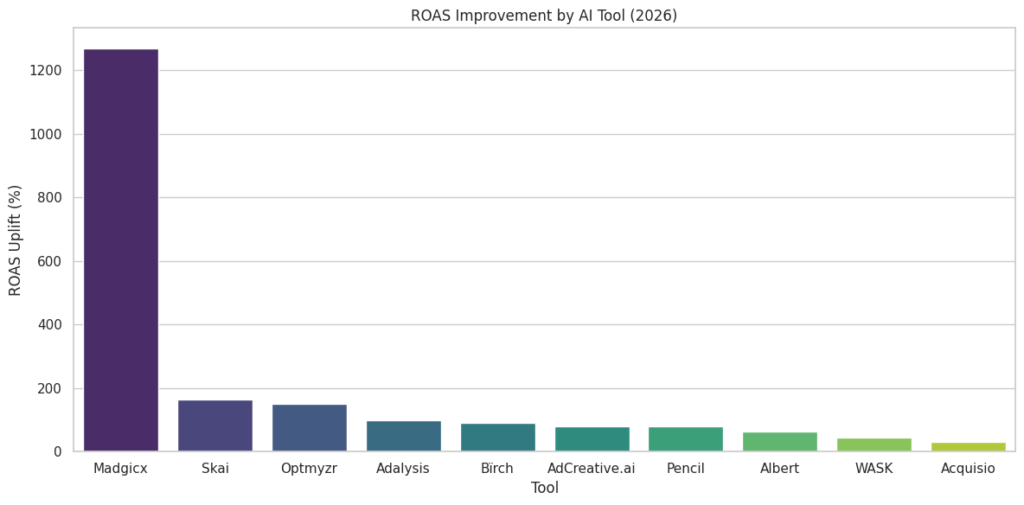
The shift toward AI advertising tools has also redefined how digital campaigns are built and scaled. Instead of manually tweaking bids or relying solely on native platform automations, advertisers are now layering intelligent systems that provide deeper insights, smarter testing, and cross-platform orchestration.
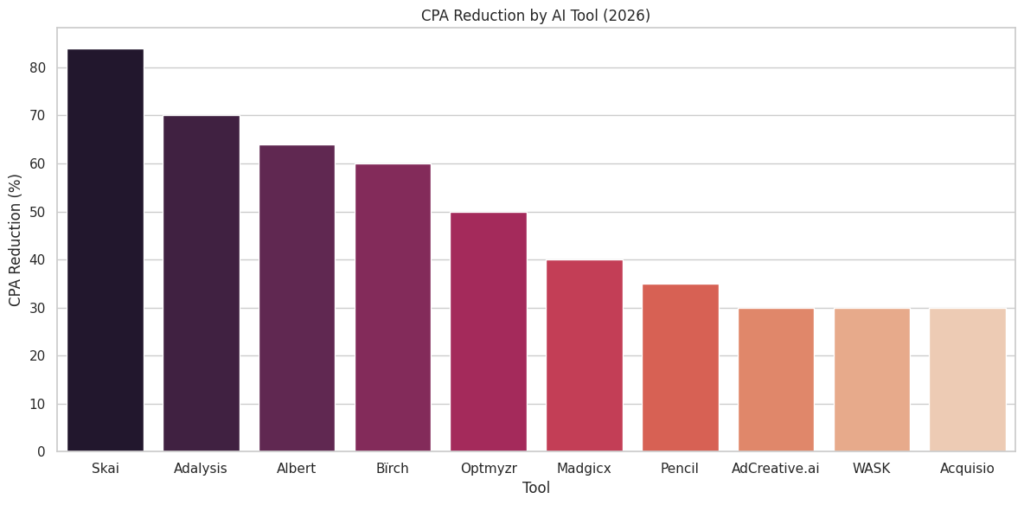
Whether it’s reducing customer acquisition costs, increasing return on ad spend (ROAS), or accelerating creative testing cycles, AI tools have proven their value across every stage of the advertising funnel.
In this comprehensive guide, we explore the top 10 AI tools for PPC and paid advertising optimization in the world in 2026, selected based on performance, functionality, user satisfaction, and technological innovation. These p
latforms range from rule-based automation engines and generative AI design tools to fully autonomous optimization systems capable of running campaigns across thousands of ad accounts.
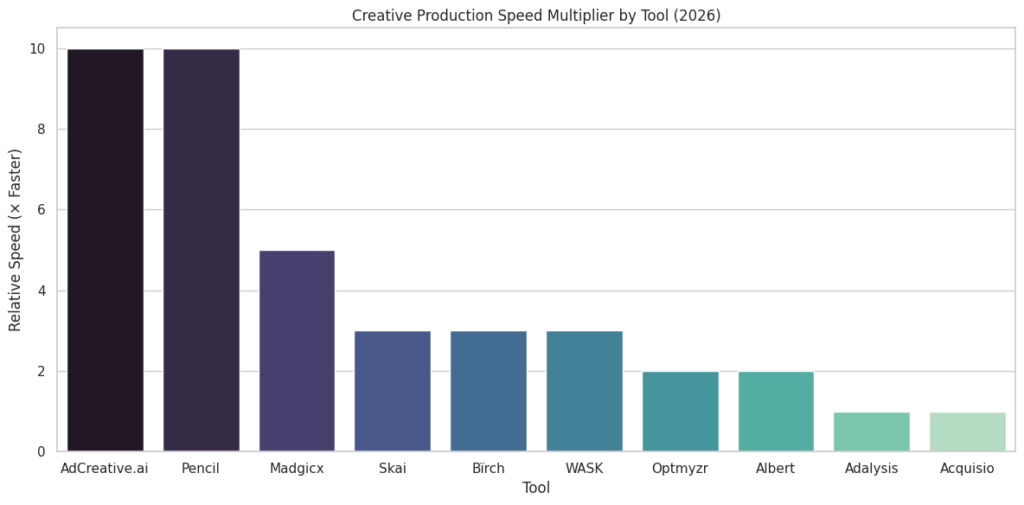
Each tool serves a specific purpose—whether it’s stopping ad budget waste, scaling creative production, enhancing account structure, or predicting the next best campaign move.
We’ll dive into how each platform works, what makes it unique, who it’s best suited for, and how it contributes to higher ROI, better targeting, and faster execution. From industry favorites like Optmyzr and Madgicx to enterprise powerhouses like Skai and Albert, and innovative solutions like AdCreative.ai, Pencil, Bïrch, WASK, and Acquisio, this list reflects the most reliable and impactful AI solutions available today.
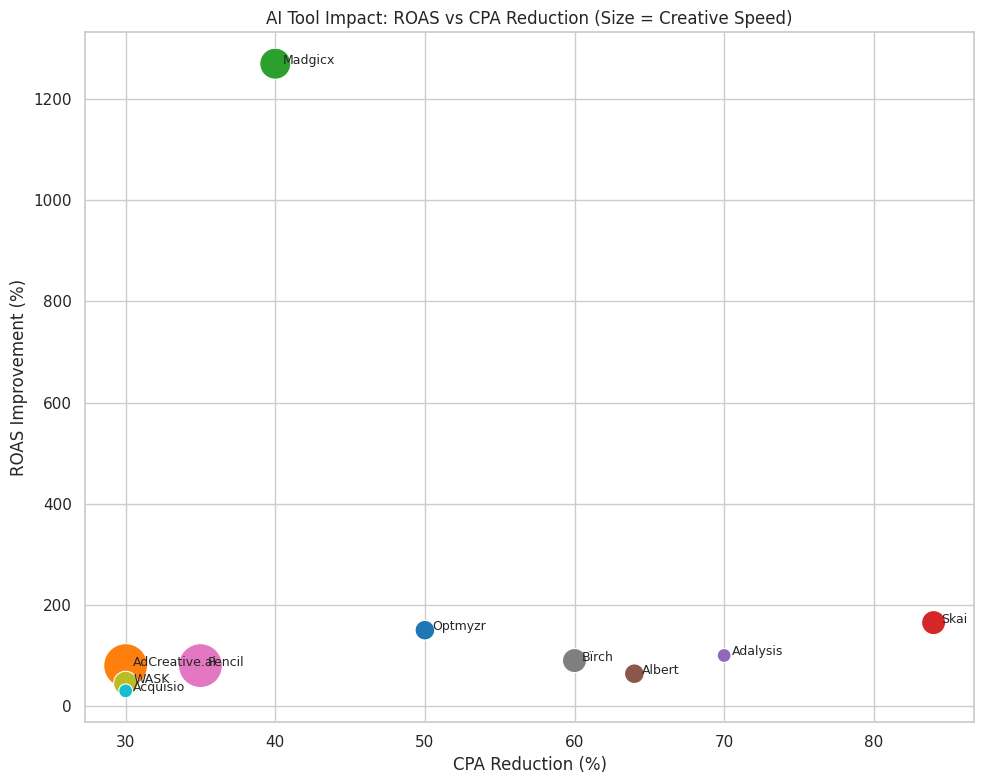
This blog also addresses the broader context of why AI tools have become central to advertising success in 2026. With the rise of privacy-first marketing, growing consumer expectations, and increasing complexity across platforms, traditional approaches simply can’t keep up. AI brings structure, speed, and intelligence to an otherwise fragmented and resource-intensive landscape.
By the end of this article, you’ll have a clear understanding of which AI advertising platforms can best support your marketing goals, what results you can expect, and how to strategically implement these tools for long-term growth. Whether you’re managing search ads, social campaigns, or omnichannel strategies, this guide will help you harness the full power of AI to dominate your paid advertising efforts in 2026 and beyond.
Before we venture further into this article, we would like to share who we are and what we do.
About 9cv9
9cv9 is a business tech startup based in Singapore and Asia, with a strong presence all over the world.
With over nine years of startup and business experience, and being highly involved in connecting with thousands of companies and startups, the 9cv9 team has listed some important learning points in this overview of the Top 10 AI Tools For PPC and Paid Advertising Optimization in 2026.
If you like to get your company listed in our top B2B software reviews, check out our world-class 9cv9 Media and PR service and pricing plans here.
Top 10 AI Tools For PPC and Paid Advertising Optimization in 2026
1. Optmyzr
Optmyzr has emerged as one of the most reliable and powerful platforms for automating and optimizing pay-per-click (PPC) advertising in 2026. Trusted by digital marketing agencies and large advertisers worldwide, Optmyzr is currently responsible for managing over $5 billion in annual ad spend. Its design is especially tailored for enterprise users and search-focused teams that need advanced control over performance marketing across platforms like Google Ads and Meta Ads.
Automation Layering for Control Over Platform Algorithms
One of Optmyzr’s standout capabilities in 2026 is its sophisticated automation layering technology. This feature is specifically designed to help marketers manage and fine-tune their ad strategies while maintaining visibility and control over the often opaque algorithms of major advertising platforms. Instead of relying blindly on platform AI, marketers can implement their own logic and safeguards.
Custom Rule Engine and Enhanced Campaign Governance
The platform’s built-in “Rule Engine” offers extensive customization. This allows advertisers to set precise rules for automated bid adjustments, budget controls, and campaign status updates based on individual business goals. This feature is especially critical for campaigns like Google’s Performance Max, where advertisers often lack granular control or visibility.
Real Business Impact and Performance Outcomes
Optmyzr’s tangible impact can be seen across its client base:
- E-commerce businesses using the platform report up to 2.7x greater efficiency in managing campaigns.
- Digital marketing agencies see an average 2.5x improvement in return on ad spend (ROAS).
These performance metrics underscore the tool’s effectiveness in scaling complex advertising operations while reducing manual oversight.
Smart Product Labeler for E-Commerce Optimization
In 2026, Optmyzr’s “Smart Product Labeler” stands out as a game-changer for e-commerce businesses that manage extensive product inventories. It helps marketers group and optimize tens of thousands of SKUs (Stock Keeping Units) efficiently.
A real-world example is BBQGuys, a major online retailer, which uses Optmyzr to manage nearly 30,000 SKUs. This tool helps the company reduce SKU management time by 50% and save 4–6 hours of labor per week—resulting in an impressive $450,000 in additional revenue.
Pricing Plans and Value Segmentation
The following table outlines Optmyzr’s pricing structure and key features by plan tier:
Optmyzr Pricing and Features Table (2026)
| Plan Tier | Starting Monthly Price | Ad Spend Coverage | Key Features and Benefits |
|---|---|---|---|
| Lite | $209 – $249 | Up to $25,000 | Pacing Insights, 1-Click Optimizations, 25 Account Limit |
| Standard / Guru | $499 | Up to $50,000+ | Access to Rule Engine, Shopping Ad Tools, Customization |
| Enterprise | Custom Pricing | Unlimited | API Access, Dedicated Success Manager, High-Volume Support |
This tiered structure allows businesses of all sizes to choose a plan that aligns with their budget and campaign complexity.
Client Satisfaction and Industry Trust
Optmyzr continues to maintain strong user satisfaction in 2026, as reflected in its 4.6/5 rating on G2. This high score illustrates its dependability, especially for teams handling large advertising volumes across multiple platforms.
Performance Efficiency Comparison Matrix
The table below summarizes performance benefits reported by users after integrating Optmyzr into their workflow:
Efficiency Gains with Optmyzr (Based on Client Feedback)
| Use Case | Improvement Rate | Value Delivered |
|---|---|---|
| E-Commerce SKU Management | 50% reduction in time | 4–6 hours saved weekly |
| Campaign Management Efficiency | 2.7x more efficient | Less manual oversight, better accuracy |
| Return on Ad Spend (ROAS) | 2.5x average lift | Higher profitability per dollar spent |
| Revenue Impact (Example Case) | +$450,000 | Result of smarter SKU classification |
Conclusion
In 2026, Optmyzr stands out as a premium AI-driven PPC optimization platform. Its flexible automation capabilities, powerful rule engine, and e-commerce SKU tools make it one of the most recommended solutions for digital agencies and enterprises aiming to improve performance while retaining control over their paid advertising strategies. As the digital advertising environment becomes increasingly automated and platform-reliant, tools like Optmyzr ensure marketers stay ahead with transparency, efficiency, and measurable results.
2. Skai
In 2026, Skai continues to be a top choice for large global companies and major digital agencies seeking to manage and optimize their pay-per-click (PPC) and paid media investments. It has built a reputation as a premium AI-powered platform that excels in cross-channel campaign management across search, social, and retail advertising ecosystems. With its robust capabilities and enterprise-grade features, Skai is now widely recognized as a centralized “mission control” for omnichannel paid media strategy.
AI-Powered Cross-Channel Intelligence with Agentic Commerce
Skai has introduced a new strategic direction called “Agentic Commerce,” led by its intelligent AI marketing agent named Celeste. Celeste is designed to simplify and automate complex planning processes. It helps marketers make better decisions across multiple advertising platforms by providing strategic recommendations and data-driven budget planning.
This innovation is timely, especially as brands in 2026 are now actively investing across an average of eight retail media networks. Skai offers a unified dashboard that helps marketing teams stay on top of fragmented campaigns, streamline performance tracking, and allocate budgets more efficiently.
Signal Enhancement and Budget Navigator Tools
Skai’s technology suite includes powerful tools such as:
- Signal Enhancement: Helps advertisers integrate external factors like weather, market shifts, or consumer sentiment into campaign decisions.
- Budget Navigator: Offers intelligent, real-time budget allocation across multiple campaigns and platforms, ensuring efficient ad spend utilization.
These tools are designed to deliver strong campaign results by aligning data signals with budget strategy.
Proven Business Impact with Real-World Case Studies
Skai’s AI-driven automation and analytics tools have helped global brands achieve measurable success across various advertising formats. Below is a performance matrix highlighting improvements achieved by different clients using Skai’s solutions:
Client Performance Matrix with Skai (2026)
| Client / Partner | Metric Improved | Percentage Gain | Channel Focused | AI Feature Used |
|---|---|---|---|---|
| Channel Bakers | Return on Ad Spend (ROAS) | +165% | Retail Media | Weather-Driven Optimization |
| Domain | Cost Per Acquisition (CPA) | –84% | Paid Search | Smart Bidding & Portfolio Insights |
| Collective Measures | Revenue Growth | +120% | Full-Funnel Retail Campaigns | Retail Media Automation |
| Inova | Cost Per Lead (CPL) | –50% or more | Paid Search Campaigns | Cross-Channel Portfolio Optimization |
| LaserAway | CPA Reduction & Revenue | –40% CPA, +25% Revenue | Social Media Advertising | Automated Campaign Optimization |
These performance metrics showcase Skai’s ability to deliver scalable, high-value results for complex advertising operations.
Positioning and Enterprise-Only Pricing
Skai is exclusively designed for enterprise-level organizations, with its annual pricing starting at approximately $90,000. This premium tier includes:
- Advanced cross-channel marketing analytics
- Custom integration support
- Predictive budget pacing across global campaigns
- Access to AI-powered features for data harmonization
Skai Pricing and Feature Matrix (2026)
| Tier | Starting Annual Cost | Ideal For | Notable Inclusions |
|---|---|---|---|
| Enterprise | $90,000+ | Fortune 500 Brands, Global Agencies | AI Agent (Celeste), Unified Commerce Dashboard, Custom Attribution, Cross-Network Budgeting |
This price point reflects the tool’s advanced capabilities and focus on global marketing operations rather than small-to-mid-sized teams.
Why Skai Stands Out in 2026
Skai’s role as a strategic AI partner goes beyond traditional campaign automation. It acts as a command center for digital marketing teams looking to consolidate data, optimize spending, and align campaign outcomes with broader business objectives. By centralizing all paid media activities, it reduces manual coordination and enables data-informed decisions at scale.
Its high client retention, paired with success stories in paid search, social, and retail media, reinforces Skai’s position as a top AI advertising platform for enterprise organizations in 2026. It serves as a blueprint for how large-scale marketing can be managed with intelligence, precision, and agility.
3. Madgicx
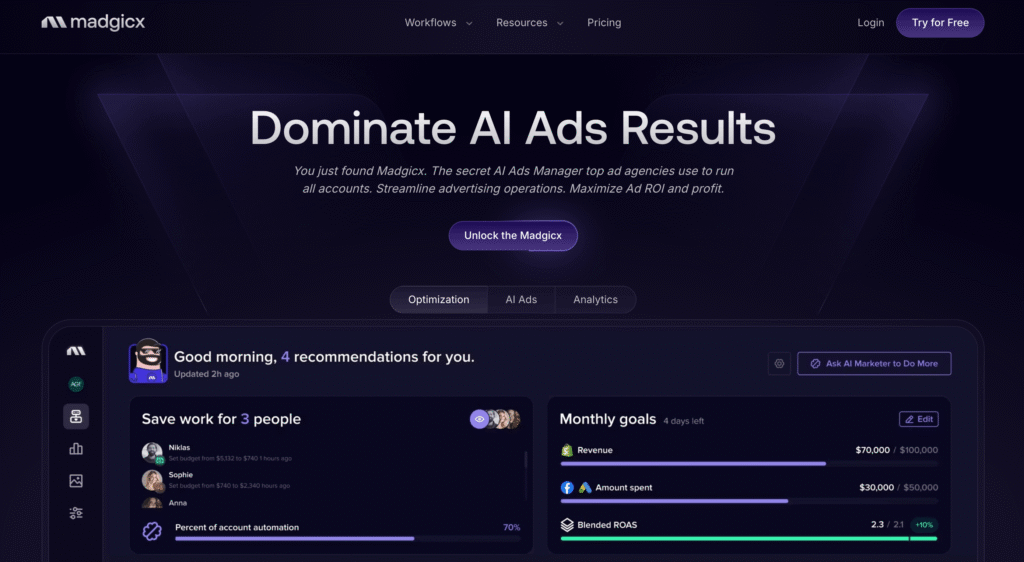
Madgicx has established itself as one of the most advanced AI tools for e-commerce-focused brands aiming to optimize their pay-per-click (PPC) and paid advertising strategies in 2026. Recognized as a centralized platform tailored for advertisers operating within the Meta ecosystem (such as Facebook and Instagram), Madgicx delivers automated, AI-driven ad management across creative generation, budget allocation, and performance diagnostics.
All-in-One AI System for Ad Lifecycle Management
Madgicx functions as a comprehensive advertising control system. From crafting ad creatives to monitoring campaign performance in real time, it applies advanced computer vision and predictive analytics to streamline and optimize each part of the advertising workflow. This allows e-commerce marketers to reduce manual tasks and improve campaign efficiency.
At the heart of the platform is its “AI Marketer” engine, which continuously scans ad accounts 24/7 to identify underperforming campaigns and automatically redistribute the budget to the highest-performing ad sets. This automation results in faster decision-making and better ad spend outcomes.
Performance Uplift and Real-Time Diagnostics
E-commerce businesses using Shopify and other platforms report rapid performance improvements with Madgicx. Within just 30 days of integration, many brands have seen an average return on ad spend (ROAS) increase of 3.66x. This is largely driven by the platform’s AI-powered diagnostics and budget intelligence.
Its “AI Chat” tool offers a more intuitive way to monitor campaign performance. Instead of relying on traditional ad dashboards, marketers can now ask natural-language questions such as “Which ad creative is getting the most engagement this week?” and receive data-rich answers instantly.
Madgicx Key Performance Gains (Client Examples)
| Brand Name | Metric Improved | Performance Uplift | Strategic Focus |
|---|---|---|---|
| Shopify Sellers | Return on Ad Spend (ROAS) | +3.66x within 30 days | AI Marketer, Smart Budgeting |
| Glamcor | Retargeting ROAS | +12.7x | Predictive Analytics |
| General Users | Conversion Rate | +4.2x | AI-Powered Targeting |
These results demonstrate Madgicx’s ability to significantly improve paid advertising outcomes through automation, personalization, and data-driven insights.
Pricing Structure and Feature Breakdown
Madgicx offers a flexible pricing system based on the user’s advertising scale, allowing small businesses and large agencies to benefit from its AI infrastructure. Below is a structured table outlining its pricing plans and included features:
Madgicx Pricing and Features Overview (2026)
| Plan Tier | Monthly Pricing Range | Key Features Included | Intended Audience |
|---|---|---|---|
| Madgicx Pro | From $99 | AI Ad Generator, AI Marketer, Server-Side Tracking | Small to Medium E-commerce Brands |
| Scale Tier | $379 – $529 | Higher Spend Capacity (up to $50K), Multi-Account Access | Growing Brands & Agencies |
| Enterprise | Custom Quote | Personalized Onboarding, Spend-Based Pricing | High-Volume Agencies and Global Retailers |
This tiered approach ensures businesses can choose a package that fits their scale, advertising needs, and growth stage.
Why Madgicx Stands Out in 2026
Madgicx’s core strength lies in its intelligent integration of AI with e-commerce advertising. Its predictive decision-making tools reduce inefficiencies and increase conversion rates, making it a vital asset for online brands striving for faster growth and higher profitability.
In 2026, Madgicx has emerged as one of the top AI tools in the world for PPC and paid advertising optimization, particularly for those who prioritize scalability, automation, and performance transparency. With tools like AI Chat, AI Marketer, and predictive targeting, it empowers businesses to move away from manual campaign management and embrace a smarter, more efficient advertising future.
4. AdCreative.ai
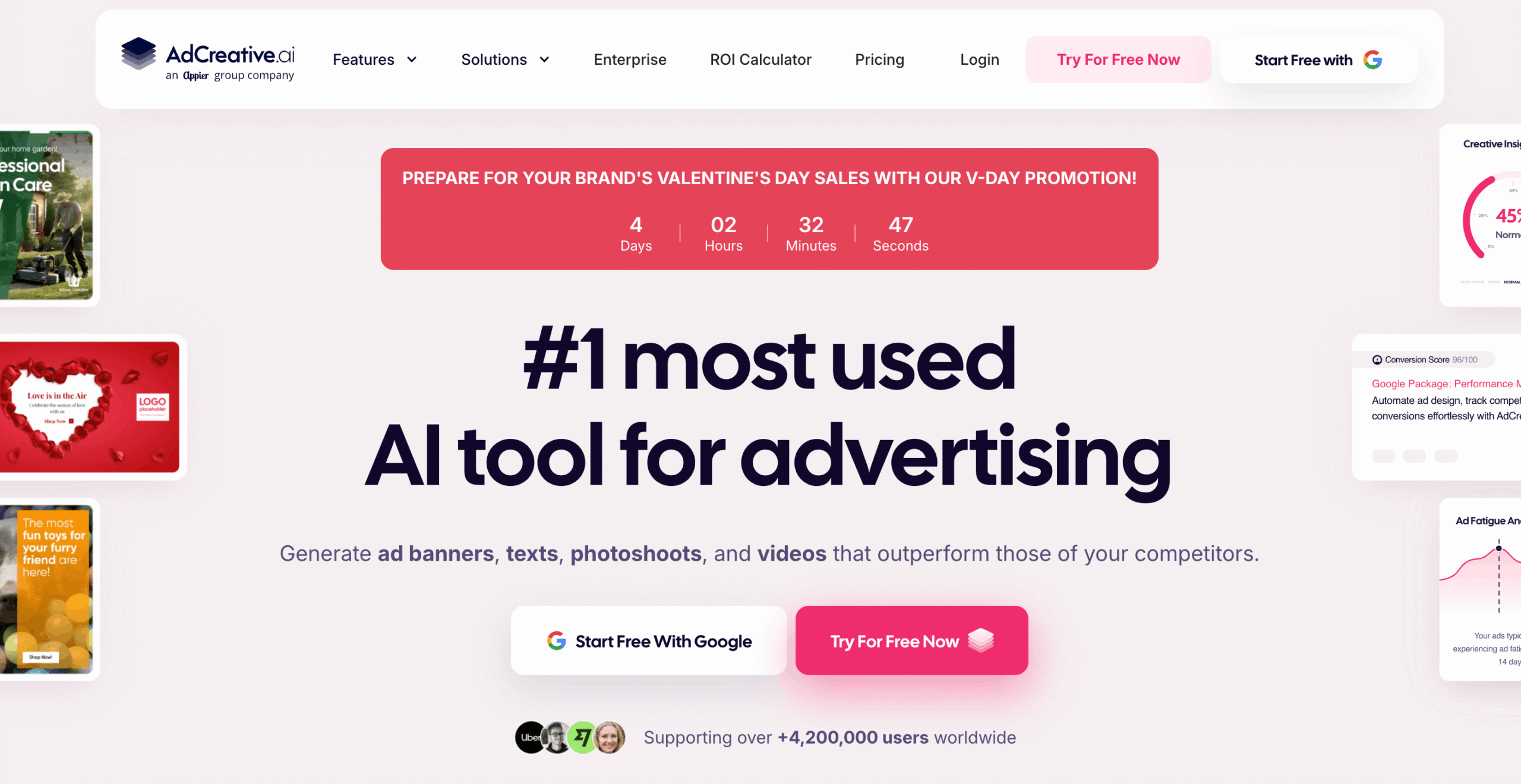
AdCreative.ai has emerged as one of the most valuable AI tools for businesses seeking to enhance their PPC and paid advertising performance in 2026. As the digital advertising landscape increasingly prioritizes creative quality—especially within platforms like Meta’s Andromeda and Google’s GEM—this tool helps brands meet rising expectations by automating the generation of visually compelling and conversion-optimized ad creatives.
Creative-First Strategy with AI Optimization
Unlike traditional ad platforms that focus solely on targeting and bidding, AdCreative.ai centers its strategy around the visual and messaging impact of advertisements. It leverages artificial intelligence to generate hundreds of unique ad creatives quickly, each designed to meet high-conversion benchmarks. The AI engine uses predictive scoring to evaluate which ad visuals are most likely to perform well before campaigns even go live.
This approach empowers businesses to reduce the time spent on manual creative design and instead focus on strategic oversight and audience testing. Brands can continuously test new angles, formats, and product messaging, thereby increasing their chances of engagement in highly competitive ad environments.
Eliminating Ad Fatigue and Improving Creative Agility
Ad fatigue occurs when audiences repeatedly see the same ad creatives, leading to reduced engagement and poor performance. AdCreative.ai addresses this issue by constantly generating new visual variations—refreshing hooks, callouts, and product display cards. This ability to deliver creative diversity helps brands maintain high performance in fast-paced digital auctions, particularly in social media campaigns.
Performance Enhancement Use Cases
Businesses that integrate AdCreative.ai into their PPC stack report noticeable improvements in campaign health and engagement. The tool has become a go-to solution for overcoming creative stagnation and scaling advertising efforts without relying on large internal design teams.
AdCreative.ai Pricing and Plan Features (2026)
| Plan Tier | Monthly Cost Range | Assets Generated per Month | Number of Brands Supported | Ideal Use Case |
|---|---|---|---|---|
| Starter | $20 – $39 | 10 Ad Creatives | 1 Brand | Freelancers, Small Online Stores |
| Professional | $125 – $189 | 50 Ad Creatives | 3 Brands | Growing E-Commerce Brands, Agencies |
| Ultimate | $300 – $399 | 100 Ad Creatives | 5 Brands | High-Volume Advertisers and Media Teams |
Each plan is designed to serve different stages of business growth, ensuring cost-effective scaling without sacrificing creative quality or speed.
Key Benefits of AdCreative.ai for Advertisers in 2026
| Feature | Description |
|---|---|
| AI-Scored Visual Assets | Predicts creative performance before launch |
| Rapid Asset Generation | Produces hundreds of creatives in minutes |
| Multi-Brand Management | Supports campaign creatives for multiple brands simultaneously |
| Ad Fatigue Reduction | Helps refresh ads regularly to sustain audience engagement |
| Hook & Product Card Variants | Enhances message testing in high-speed social ad environments |
Why AdCreative.ai is a Top Choice in 2026
In the current advertising environment, where attention spans are short and user feeds are saturated, standing out with high-performing visuals is more critical than ever. AdCreative.ai offers a scalable and intelligent solution that empowers marketers to lead with creativity while relying on data to guide decisions.
Its AI scoring engine, fast turnaround time, and anti-fatigue asset strategies make it one of the most efficient creative-generation platforms in the world for PPC and paid advertising. Whether used by solo advertisers or by agencies managing multiple brands, AdCreative.ai plays a crucial role in sustaining ad relevance and performance throughout the campaign lifecycle.
5. Albert
Albert, developed by Nielsen, has become one of the most advanced AI platforms for managing PPC and paid advertising campaigns in 2026. It sets itself apart from traditional marketing software by functioning as a self-operating digital marketing manager. Instead of relying on manual rules or rigid automation, Albert applies continuously learning machine learning models to oversee every part of the campaign process—without requiring human input.
Full Campaign Autonomy Across Channels
Unlike tools that depend on preset instructions, Albert uses adaptive intelligence to manage bids, reallocate budgets, test audiences, and refine targeting strategies in real time. It operates seamlessly across multiple advertising channels—such as search, social media, and display—while automatically optimizing each element based on performance signals.
Albert’s main strength lies in its ability to discover hidden sales opportunities. By analyzing large sets of campaign data, it identifies audience groups that marketers may overlook. It doesn’t just react to data but learns from campaign results over time to improve decision-making autonomously.
Case Study: Performance Gains from Audience Discovery
Albert’s value in real-world applications is clearly demonstrated in one retail case study. The platform found that 35% of the marketing budget delivered the best return when targeted at demographics that the human marketing team had excluded—specifically men and both younger and older age groups. This shift in targeting resulted in a 64% increase in return on ad spend (ROAS), along with an exceptional 10,000% ROAS from a specific Black Friday campaign run through Messenger ads.
Performance Outcome Summary with Albert (2026)
| Metric | Value Delivered | Campaign Context |
|---|---|---|
| Discovered Budget Segment | 35% of budget redirected for max return | Underrepresented gender and age groups |
| ROAS Improvement | +64% | Total campaign performance uplift |
| Peak ROAS (Black Friday) | +10,000% | Messenger Ads Targeting Custom Segments |
These figures highlight how Albert finds strategic ad placements and budget allocations that human planners might miss.
Intelligent Audience Targeting and Budget Allocation
Albert’s AI engine processes campaign performance and user engagement metrics to reallocate budgets in real time. Its algorithm is continuously trained to detect underutilized audiences and overlooked conversion paths, allowing it to make fast, high-impact decisions for better ROI.
Key AI Capabilities of Albert in 2026
| Feature | Description |
|---|---|
| Autonomous Optimization | Adjusts bids, budgets, and targeting across platforms with no human input |
| Machine Learning Intelligence | Continuously self-learns from new data to refine decisions |
| Incremental Sales Discovery | Finds untapped revenue opportunities in neglected audience segments |
| Cross-Channel Coordination | Manages campaigns across search, display, social, and messaging platforms |
| Real-Time Budget Shifts | Dynamically moves spend based on performance to maximize returns |
Why Albert is a Top AI Tool in 2026
Albert is highly suitable for large brands and enterprises that run complex campaigns across multiple platforms. It eliminates the need for constant manual monitoring and human bias in decision-making. With its autonomous approach, it can scale advertising strategies with remarkable precision, discovering profitable segments faster and reacting to market changes instantly.
Its high-impact results, such as identifying hidden audience value and delivering unusually high ROAS figures, have positioned Albert among the top 10 AI tools globally for PPC and paid advertising optimization in 2026. For companies seeking a fully automated solution that goes beyond rule-based systems, Albert stands as a reliable and forward-looking investment.
6. Pencil
Pencil has become one of the most impactful AI-powered tools for paid advertising and PPC campaign optimization in 2026. Designed to help both small businesses and large enterprises generate high-performing video creatives, Pencil focuses on creating visual content that captures attention and drives clicks across platforms like TikTok, Facebook, YouTube, and LinkedIn.
Unlike traditional video editing software or generic design tools, Pencil is specifically built for performance marketing. It uses insights derived from over $1 billion in advertising spend to power its creative generation engine. This makes it one of the few tools that combines generative AI with real-time ad performance intelligence.
Generative Video Creation with Predictive Performance Insights
Pencil’s core value lies in its ability to rapidly produce “scroll-stopping” short-form video ads that are optimized for performance from the start. The platform uses predictive analytics to assess which creative elements—such as format, length, color, and messaging—are most likely to deliver strong results before they are published.
This level of intelligence allows marketing teams to quickly produce a large number of video variants while reducing guesswork. The tool’s recommendation engine helps advertisers refine their creative strategy based on actual campaign data, not assumptions.
Exceptional Cost Savings and CTR Improvement
Pencil’s contribution to paid advertising efficiency is particularly visible in its ability to reduce production costs and increase audience engagement. Brands using the platform have reported:
- Up to 97% reduction in creative production costs due to automation
- Up to 80% increase in click-through rates (CTR) from predictive asset generation
These improvements are especially valuable for Direct-to-Consumer (DTC) brands and social-first marketers who require a steady flow of new, platform-optimized creatives for fast-moving campaigns.
Performance Gains Achieved Using Pencil (2026)
| Key Metric | Performance Uplift | Campaign Use Case |
|---|---|---|
| Production Cost Reduction | –97% | Automated creative generation |
| Click-Through Rate (CTR) | +80% | Social media and short-form video ads |
| Speed of Creative Output | Increased by 10x | DTC product launches, seasonal campaigns |
These results highlight the platform’s effectiveness in blending AI with actionable performance data.
Pencil Pricing and Plan Breakdown (2026)
| Subscription Level | Monthly Price | Creative Generations per Month | Key Features and Benefits |
|---|---|---|---|
| Core | $14 | 50 | For individual marketers, includes social media integrations |
| Growth | $55 | 250 | Unlimited workspaces, roadmap access, ideal for scaling brands |
| Enterprise | Custom Quote | Unlimited | Data ringfencing, BYO AI models, managed fine-tuning |
This flexible pricing structure enables a wide range of advertisers—from solo creators to large agencies—to use Pencil at their preferred operational scale.
Unique Features That Differentiate Pencil in 2026
| Feature | Description |
|---|---|
| Predictive Asset Scoring | Rates and ranks creative assets based on likely campaign performance |
| GenAI Video Engine | Produces video ads tailored for TikTok, Reels, and Stories |
| Multi-Platform Compatibility | Works seamlessly across Facebook, YouTube, LinkedIn, TikTok |
| Workspace Collaboration | Supports unlimited team members and creative workspaces (Growth & above) |
| BYO AI and Data Control | Enterprise users can integrate proprietary data models securely |
Why Pencil is a Top AI Tool for Paid Advertising in 2026
Pencil’s strong combination of generative AI capabilities and performance forecasting makes it one of the best tools in the PPC landscape today. By helping marketers produce high-quality, conversion-friendly video creatives quickly and cost-effectively, it addresses one of the biggest bottlenecks in digital advertising: creative fatigue.
Its ability to merge large-scale creative production with measurable performance insights places it among the top 10 AI tools for PPC and paid advertising optimization globally in 2026. Brands that prioritize speed, creative diversity, and cross-platform engagement will find Pencil a critical part of their marketing tech stack.
7. Adalysis
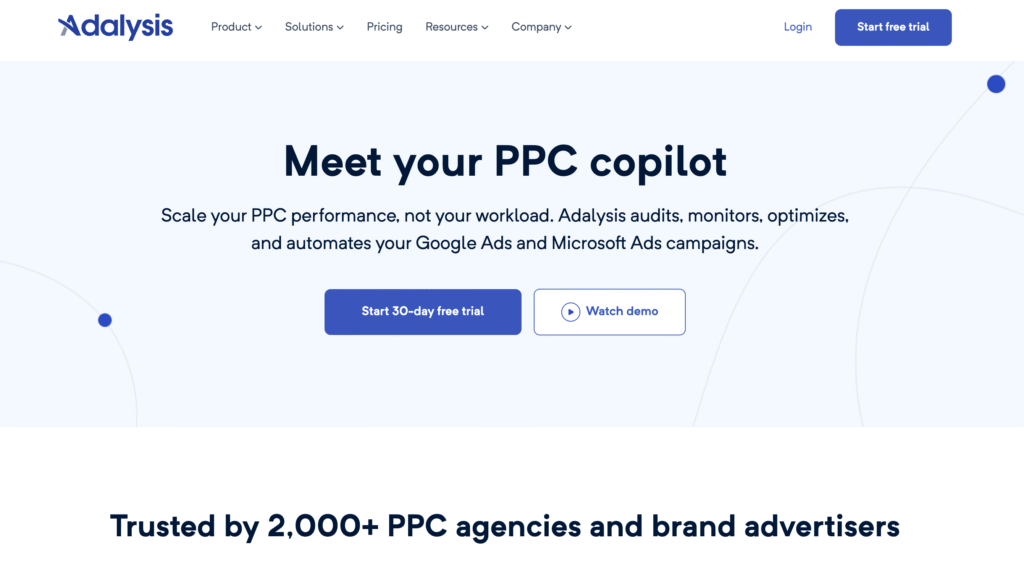
Adalysis has earned its reputation in 2026 as one of the most dependable AI-powered platforms for managing, auditing, and optimizing search-focused PPC campaigns. Unlike other tools that focus on visuals or cross-channel automation, Adalysis serves a critical operational role by acting as a 24/7 quality control system for Google and Microsoft Ads accounts.
Its purpose-built functions are ideal for agencies that manage large volumes of keyword-based campaigns and need ongoing visibility into performance metrics, ad testing, and budget pacing. By automating repetitive yet essential auditing tasks, Adalysis saves both time and money while offering insights that improve account performance across thousands of ad groups.
Automated PPC Audits with Deep Search Intelligence
Adalysis specializes in identifying overlooked inefficiencies through features like n-gram analysis. This technique breaks down search queries into word patterns, revealing hidden spending inefficiencies that are often missed by human managers. It continuously evaluates ad copy, keyword performance, and landing page relevancy, helping advertisers fine-tune campaigns with data-backed recommendations.
This constant evaluation process eliminates the need for weekly manual audits and reduces the likelihood of human error. As a result, Adalysis adds a crucial layer of structural accuracy to performance marketing teams.
Adalysis Performance Improvements and Ratings (2026)
| Performance Metric | Impact Achieved | Real-World Application |
|---|---|---|
| Time Saved on Weekly Audits | 70% Reduction | Automated QA of large PPC accounts |
| G2 Rating: Campaign Optimization | 9.4 / 10 | High client satisfaction for performance adjustments |
| G2 Rating: Budget Accuracy | 9.2 / 10 | Consistent spend control across multiple accounts |
These metrics highlight Adalysis’s efficiency in simplifying routine PPC tasks and enhancing campaign governance.
Comprehensive Testing, Insights, and Budget Control
Adalysis doesn’t just point out problems—it also provides actionable solutions. The platform’s AI conducts ongoing split testing for ads, alerting marketers when a statistically significant winner emerges. It also flags disapproved ads, irrelevant keywords, and underperforming landing pages in real time.
Another key advantage is its budget pacing system, which monitors daily and monthly spend across various campaigns. This feature ensures advertisers stay within budget while maximizing visibility.
Key Features and Use Cases for Adalysis (2026)
| Feature | Description |
|---|---|
| N-Gram Query Analysis | Groups similar search terms to reduce ad spend waste |
| Automated Ad Testing | Identifies winning creative variants and pauses underperforming ads |
| Structural Audit Engine | Checks keyword match types, ad extensions, and landing page experience |
| Budget Pacing and Forecasting | Ensures spend aligns with business goals across accounts |
| Multi-Account Scalability | Ideal for agencies managing high ad spend and multiple clients |
Pricing and Accessibility for Search-Centric Advertisers
One of the strongest selling points of Adalysis is its affordability. With plans starting at $149 per month for up to $50,000 in ad spend, the platform supports unlimited accounts—making it highly cost-effective for agencies handling multiple campaigns simultaneously.
Adalysis Pricing and Scalability Matrix (2026)
| Plan Type | Monthly Starting Price | Ad Spend Limit | Key Benefit | Intended Users |
|---|---|---|---|---|
| Professional | $149 | Up to $50,000/month | Full audit features, unlimited accounts | Search-focused PPC Agencies |
| Custom Plans | Varies by volume | $50,000+ | Dedicated support, custom integrations | Large Enterprise PPC Teams |
This pricing flexibility allows Adalysis to be used across both mid-sized agencies and enterprise-level search advertisers who prioritize campaign structure, cost efficiency, and transparent performance tracking.
Why Adalysis is a Top AI PPC Tool in 2026
Adalysis excels in a niche that is often overlooked in creative-heavy campaign strategies—back-end precision and account health auditing. It’s not designed to replace creative teams or cross-channel automation platforms, but to work alongside them by ensuring search campaigns remain clean, efficient, and performance-optimized at scale.
For organizations that depend heavily on paid search to drive results, Adalysis offers a dependable, intelligent system for keeping campaigns structurally sound and continuously improving. This makes it one of the top AI tools in the world for PPC and paid advertising optimization in 2026.
8. WASK
WASK has emerged in 2026 as a go-to AI advertising tool designed specifically for startups and small to medium-sized businesses (SMBs) that seek high-quality PPC optimization without the high price tag. It combines automation, creative tools, and campaign protection mechanisms—making enterprise-level PPC technology accessible to businesses with limited budgets.
WASK’s core mission is to democratize paid advertising by delivering a full-suite solution at an entry price as low as $15 per month. Despite its affordability, WASK delivers features often found in much higher-priced platforms, such as real-time ad performance tracking, AI-generated insights, competitor monitoring, and anomaly protection.
Integrated PPC Management for Budget-Conscious Marketers
WASK is equipped with tools that simplify every part of the paid advertising journey—from creating ads and selecting the right channels, to analyzing competitors and monitoring campaign performance. Users can manage ads across platforms like Google Ads and Facebook Ads using a single dashboard, reducing the complexity of multi-platform campaign management.
Its intuitive interface is ideal for entrepreneurs, marketers, and small teams who want to stay hands-on with campaign control while benefiting from AI-supported recommendations.
AI-Based Anomaly Detection and Budget Protection
One of WASK’s most innovative offerings is its anomaly spend protection system. This feature automatically detects unusual spikes in cost-per-click (CPC) or sudden inefficiencies in ad performance—issues that can rapidly drain budgets if left unchecked. When anomalies are detected, WASK adjusts ad activity or alerts users in real time, helping prevent budget waste.
This protection feature is especially useful for small businesses operating under strict advertising budgets and looking to mitigate risk from unpredictable platform behavior or algorithmic changes.
WASK Pricing Plans and Capabilities Matrix (2026)
| Plan Tier | Monthly Price | AI Credits per Month | Ad Account Support | Anomaly Coverage Value | Ideal For |
|---|---|---|---|---|---|
| Micro | $15 | 50 | Unlimited | Basic Monitoring (Auto Alerts) | Solo Entrepreneurs, Small Startups |
| Small Premium | $45 | 100 | Unlimited | $2,500 in CPC Anomaly Coverage | Growing SMBs with moderate ad budgets |
| Medium Pro | $165 | 1,000 | Unlimited | $25,000 in CPC Anomaly Coverage | Agencies or High-Volume SMB Advertisers |
This pricing structure allows even micro-businesses to benefit from advanced AI campaign management tools, previously reserved for enterprise-level users.
Key Features That Make WASK a Top AI Tool for PPC in 2026
| Feature | Description |
|---|---|
| AI Ad Creation Tools | Generates platform-optimized ad creatives automatically |
| Competitor Monitoring | Tracks rival ad activity and shares optimization opportunities |
| Cross-Platform Dashboard | Unified view for managing Facebook, Instagram, Google Ads, and more |
| Anomaly Spend Protection | Real-time detection and mitigation of CPC spikes and algorithmic ad waste |
| Smart Campaign Suggestions | Provides data-backed insights for bid adjustments, timing, and targeting |
| Unlimited Account Support | Manage multiple campaigns and brands under a single interface |
Why WASK Stands Out Among PPC Tools in 2026
What distinguishes WASK from many other tools in the PPC optimization space is its strong combination of affordability, functionality, and proactive protection. It allows small teams to manage advertising campaigns with a level of automation and oversight that rivals much more expensive solutions like Skai or Optmyzr.
By offering high-value AI tools and budget security mechanisms at a fraction of the cost, WASK has positioned itself as one of the most accessible and practical AI PPC tools in 2026. It is particularly well-suited for businesses that prioritize agility, simplicity, and performance monitoring without compromising on safety or precision.
As a result, WASK rightfully holds its place in the global ranking of top 10 AI tools for PPC and paid advertising optimization in 2026. It brings the future of intelligent advertising within reach for businesses of all sizes.
9. Bïrch
In 2026, Bïrch has positioned itself as one of the most advanced AI-driven tools in the field of PPC and paid advertising automation. It caters specifically to experienced media buyers, digital marketing professionals, and agencies who seek deep control over campaign behavior across major advertising platforms such as Google Ads, Meta Ads, TikTok, and Snapchat.
Unlike standard rule-based automation tools offered by native ad platforms, Bïrch introduces a much more powerful system known as “data-grounded automation.” This feature allows users to set complex multi-condition rules based on real-time and historical performance data, creating a smarter and faster way to manage ad budgets, stop losses, and scale top-performing campaigns.
Automation Built for Professional-Level Campaign Control
Bïrch goes beyond simple “if-this-then-that” rules. It empowers advertisers to build decision-making flows using layered logic (AND/OR structures), enabling nuanced responses to fluctuating campaign metrics. This includes conditions like ROAS, cost-per-click (CPC), frequency caps, and custom events.
With one of the fastest trigger frequencies available—just 15 minutes—Bïrch gives marketers the agility to act almost instantly. Whether stopping underperforming campaigns before they drain the budget or doubling down on a trending ad set, the system ensures that users remain in full control of performance outcomes.
Key Features Comparison Matrix: Bïrch vs Competitors (2026)
| Feature Category | Bïrch Capability | Madgicx Capability |
|---|---|---|
| Automation Logic | Advanced Rule Constructor (AND/OR Conditions) | AI-Assisted Real-Time Optimizations |
| Creative Testing | Structured Bulk Testing with Custom Variations | Visual Generator and AI-Based Selection |
| Campaign Launch Tools | Multi-Ad Launcher with Versioning | AI-Optimized Creative Launch Engine |
| Visibility & Debugging | Detailed Logs, Performance Diagnostics | Visual Reports, Basic Smart Alerts |
| Funnel Insights | Funnel-Based Campaign Breakdowns | Predictive Analysis with Conversion Signals |
Bïrch clearly prioritizes hands-on control and detailed campaign visibility, making it ideal for professionals managing large-scale or high-frequency accounts.
Real-Time Rules Execution with Industry-Leading Speed
What sets Bïrch apart is its ultra-fast rule evaluation cycle. Its 15-minute trigger interval is currently the fastest available, enabling real-time budget shifts, instant “stop-loss” execution, and momentum scaling. Marketers can configure rules that automatically pause low-performing ad sets, increase budgets for high-performing audiences, or test variations without manual oversight.
Pricing and Plan Tiers for Bïrch (2026)
| Plan Tier | Monthly Price | Key Features Included | Best Suited For |
|---|---|---|---|
| Essential | $49 | Rule Constructor, Basic Logs, Platform Integrations | Freelancers, Solo Buyers, Micro Agencies |
| Complete | $99 | Full Logic Builder, Funnel Diagnostics, Bulk Creative Testing | Professional Media Teams and Mid-Size Agencies |
These price points make Bïrch a flexible and scalable solution—providing powerful functionality even at entry levels, while also supporting larger, more complex media operations.
Professional Capabilities That Define Bïrch in 2026
| Capability | Description |
|---|---|
| Multi-Metric Rule Automation | Supports layered conditional logic across performance metrics |
| Cross-Platform Integration | Unified rule deployment across Meta, Google, TikTok, and Snapchat |
| High-Speed Execution | 15-minute trigger intervals for near-real-time campaign control |
| Bulk Testing and Launching | Launch and test multiple ad versions simultaneously |
| Debugging and Transparency | Historical logs, diagnostics, and detailed breakdowns for troubleshooting |
| Funnel-Based Analysis | Tracks performance through different funnel stages to improve targeting |
Why Bïrch is Among the Best PPC AI Tools in 2026
Bïrch is not for beginners—it’s a platform designed for media professionals who want full control over their ad automation systems. It is particularly effective in performance marketing environments where quick decisions and rule-based intervention can mean the difference between scaling a campaign or losing budget.
With its enterprise-level automation speed, powerful rule builder, and unmatched diagnostic tools, Bïrch ranks confidently among the top 10 AI tools for PPC and paid advertising optimization in 2026. It is a smart investment for teams that value precision, data-driven strategies, and operational speed in their ad management workflow.
10. Acquisio
Acquisio stands out in 2026 as one of the top AI tools designed specifically for local PPC campaign management and multi-location franchise advertising. It serves a unique niche in the digital marketing space by enabling enterprises to run, manage, and optimize thousands of small-scale ad campaigns simultaneously across Google Ads, Microsoft Ads, and other search networks.
This platform is especially beneficial for service-based businesses, franchise chains, and local agencies that handle a large volume of geographically distributed ad accounts. Acquisio leverages AI to ensure each local campaign is performing efficiently, while also providing a unified command center for centralized oversight.
AI-Driven Automation with the Acquisio Turing Engine
The heart of Acquisio’s optimization engine in 2026 is “Acquisio Turing,” a proprietary machine learning algorithm that dynamically adjusts bids based on auction behavior, budget pacing, and predicted conversion opportunities. This includes real-time bid shading, where the AI determines the minimum cost necessary to win high-value impressions without overspending.
The engine continuously learns from campaign data across thousands of ad sets, helping businesses minimize wasted spend and maximize cost-effective exposure. Its win-rate prediction functionality allows advertisers to allocate budgets more strategically based on which segments are most likely to drive conversions.
Business Outcomes and Measurable Performance Gains
Many enterprises using Acquisio in 2026 report significant reductions in customer acquisition costs, driven by smarter bidding strategies and localized ad performance. In one benchmark study, businesses achieved an average of 30% decrease in acquisition cost by allowing Acquisio’s machine learning system to take control of bid adjustments and audience segmentation.
Acquisio Performance Benefits Matrix (2026)
| Optimization Area | Business Impact | Application Context |
|---|---|---|
| Customer Acquisition Cost | 30% Reduction | Hyperlocal PPC Campaigns Across Franchise Units |
| Media Waste Reduction | Significant Decrease | Auction Bid Shading and Budget Allocation |
| Platform Efficiency | High Operational Scalability | Thousands of Localized Campaigns Simultaneously |
| Legacy System Replacement | Seamless System Migration | Local AdTech Integration and Management |
These metrics demonstrate the tool’s ability to streamline campaign delivery across large networks of independently operating local markets.
Features That Differentiate Acquisio from Other PPC Tools
Acquisio provides granular control over each local campaign while simultaneously offering a centralized interface for enterprise oversight. Its compatibility with legacy franchise systems makes it ideal for large businesses undergoing digital transformation.
Core Features and Capabilities of Acquisio (2026)
| Feature | Description |
|---|---|
| AI-Powered Bid Shading | Predictive cost modeling to bid only what’s necessary to win auctions |
| Local Campaign Scaling | Supports management of thousands of campaigns at once |
| Budget Distribution Automation | Dynamically allocates budget across high-performing local campaigns |
| Franchise System Integration | Works with existing CRM and advertising tech stacks |
| Real-Time Performance Monitoring | Monitors live campaign results across all regions or storefronts |
Why Acquisio Is a Top AI PPC Tool in 2026
In a paid advertising environment that increasingly favors hyper-targeted and location-aware strategies, Acquisio delivers powerful automation at scale. It brings intelligent bidding, predictive targeting, and campaign streamlining to businesses that manage hundreds—or even thousands—of simultaneous ads.
Its capability to reduce costs, replace outdated systems, and unify decentralized campaigns positions Acquisio among the top 10 AI tools for PPC and paid advertising optimization in 2026. Whether it’s a national service chain or a regional franchise network, Acquisio offers the scalability, intelligence, and operational stability that local advertisers need in today’s competitive digital market.
AI Advertising Optimization in 2026: Deep Technical Insights and Performance Benchmarks
In 2026, artificial intelligence has moved from being a novel addition to PPC campaign management to becoming an essential infrastructure for ad performance. Instead of debating whether AI should be part of advertising workflows, the focus has now shifted to how advertisers should structure AI tools and automation layers for maximum efficiency, control, and results.
AI-powered platforms like Optmyzr, Adalysis, and others enable advertisers to fine-tune automation rather than rely blindly on native ad platforms. Key technical benchmarks from across thousands of campaigns worldwide now illustrate how strategic AI configurations outperform full platform reliance—especially in bidding logic, match type selection, and budget allocation within formats like Performance Max (PMax).
Broad Match vs. Exact Match: AI-Governed Strategy vs. Platform-Driven Control
One of the most debated configurations in PPC advertising today lies in the choice between Broad Match and Exact Match keywords. While platforms like Google Ads promote Broad Match to feed Smart Bidding algorithms, data from Optmyzr’s analysis across 1,402 advertising accounts in 2026 shows that Exact Match still delivers stronger results across most key performance indicators when guided by AI-layered governance.
Keyword Match Type Performance Comparison (Optmyzr Study – 2026)
| Metric | % of Accounts Better with Exact Match | Median % Improvement (Exact) | % of Accounts Better with Broad Match | Median % Improvement (Broad) |
|---|---|---|---|---|
| ROAS | 76.03% | 113.47% | 22.54% | 64.71% |
| CPA | 74.61% | 100.71% | 24.54% | 52.52% |
| CPC | 57.49% | 77.96% | 29.24% | 36.96% |
| CTR | 88.23% | N/A | 11.34% | N/A |
This matrix reinforces that automation layering—where AI tools act as a management layer above platform algorithms—is more effective than fully surrendering campaign control to native automation, particularly when using Broad Match keywords.
AI Optimization Insight
Advertisers using advanced PPC tools such as Adalysis and Optmyzr benefit from custom rules, bidding safeguards, and testing layers that preserve performance integrity. These systems allow for human oversight enhanced by AI—not replaced by it.
Performance Max (PMax) Campaign Structure Benchmarks in 2026
Performance Max campaigns have seen widespread adoption in 2026, with 15% of advertisers using PMax in their account setups. Interestingly, this small group allocates 65% of their total ad budgets to PMax, underscoring its growing dominance.
However, despite its popularity, PMax still operates as a “black box” with limited visibility and manual control. AI tools have now become essential to add intelligence layers on top of PMax campaigns—especially in campaign segmentation, asset grouping, and budget control.
PMax Account Structure and Budget Allocation Performance Matrix (2026)
| Campaign Structure Type | ROAS (%) | Conversion Rate Rank | CPA Rank | Notes |
|---|---|---|---|---|
| Multi-Campaign, Single Asset Group | 625.03% | Second-Highest | Best | Performs best when campaign goals are segmented |
| Single Campaign, Multi-Asset Group | 491.17% | Moderate | Second-Best | Useful for simple structures with diverse assets |
| PMax Dominant (Over 50% Account Budget) | 388.42% | Low | Poor | Underperforms due to loss of cross-campaign budget control |
| PMax as Supplement (10–25% Budget) | 625.03% | Highest ROAS Performance | Strong | Best used as a supporting campaign, not the account driver |
Creative Asset Type Performance in PMax Campaigns
Despite PMax being designed to utilize rich visual and multimedia content, recent 2026 benchmarks reveal a surprising insight: in 57% of cases, campaigns using text-only assets outperformed those that used images or videos.
This indicates a continued algorithmic bias toward search-based behavior, with textual relevance and intent signaling still holding strong weight in performance calculations.
PMax Asset Performance Matrix (2026)
| Asset Type | % of Campaigns with Best Results | Primary Implication |
|---|---|---|
| Text Only | 57% | Search relevance remains key even in multimedia-optimized formats |
| Mixed (Text + Visuals) | 31% | Balanced performance, but requires strong creative assets |
| Visual Only | 12% | Lower engagement, possibly due to weak alignment with search intent |
Conclusion: Strategic AI Configuration Unlocks True Advertising Efficiency
The 2026 landscape of PPC advertising shows that while AI is indispensable, its effectiveness lies in how it’s applied. Platforms like Google and Meta offer increasingly automated systems, but advertisers who strategically layer tools like Optmyzr, Adalysis, and others on top of native automation consistently outperform those relying solely on built-in intelligence.
The data clearly shows that AI tools excel when they’re used to guide and control automation—not replace human strategy. For advertisers seeking greater return on ad spend, lower customer acquisition costs, and more reliable campaign outcomes, AI configuration and structure will remain the most critical factors in campaign success going forward.
AI Advertising in 2026: Financial ROI, Sector Performance, and Operational Realities
In 2026, AI advertising tools have matured from experimental technologies into high-performance engines that drive measurable business growth and operational efficiency. Organizations that leverage predictive AI capabilities are experiencing transformative results—especially when compared to those that continue to rely solely on static, historical reporting.
The top AI platforms for PPC and paid advertising optimization are now delivering strong returns on investment (ROI), outperforming traditional methods across revenue, cost savings, customer retention, and campaign speed. However, as businesses rush to adopt AI-powered ad tech, they also face new challenges around workforce skills and consumer trust.
Return on Investment: How AI-Driven Campaigns Outperform Traditional Models
Modern AI advertising platforms in 2026 do more than automate—they predict, optimize, and continuously adapt based on real-time performance. According to a multi-sector analysis, organizations that use predictive analytics tools in advertising report 2.9 times higher revenue growth than those depending solely on historical data dashboards.
Sector-Wise Performance Gains from AI Advertising Tools (2026)
| Industry Segment | Conversion Increase | Customer Acquisition Cost (CPA) Reduction | Retention or Engagement Lift |
|---|---|---|---|
| E-commerce | +26% | –30% | +25% Increase in Repeat Purchases |
| B2B SaaS | 2.8x More Demo Conversions | –50% | 25% Reduction in Churn Rates |
| Finance | +28% in Offer Uptake | 30% Time Saved in Campaign Execution | N/A |
| Retail (General) | +25% Average Increase | 20–30% ROI Gain on Ad Spend | N/A |
These results reflect how AI not only improves conversion rates but also significantly reduces the cost and time associated with customer acquisition and retention across multiple industries.
Operational Productivity Gains: AI as a Workweek Multiplier
Marketing and media teams previously spent an average of 31 hours per week managing repetitive advertising tasks—such as bid management, budget allocation, and performance reporting. With AI tools now augmenting 60–70% of this workload, teams are reclaiming time for strategic work, experimentation, and customer engagement.
For agencies, this shift has translated into a 44% boost in team productivity, alongside a 20–30% increase in campaign ROI.
Productivity Impact of AI Advertising Tools (2026)
| KPI | Value Delivered | Notes |
|---|---|---|
| Weekly Hours Freed per Marketer | 18–22 Hours | Through AI task automation |
| Agency Productivity Improvement | +44% | Faster campaign launch and iteration |
| Campaign ROI Uplift | 20–30% | Due to automation, targeting, and performance lift |
AI-driven automation is now a competitive necessity, helping both in-house teams and agencies scale without expanding headcount.
Barriers to Scale: Skill Gaps and Trust Erosion in AI Advertising
Despite these gains, organizations face critical challenges in maximizing AI’s full potential. Two key bottlenecks remain: the skills gap among marketing teams and declining consumer trust in AI-generated content and ads.
The AI Skills Gap in Marketing Teams (2026)
| Metric | Value | Description |
|---|---|---|
| Marketers with Role-Specific AI Training | 17% | Only a small minority have hands-on AI fluency |
| % Citing AI Complexity as a Top Challenge | 58% | Lack of skills hampers advanced AI usage |
| Emerging Need | Agent-Orchestration Training | Beyond prompting—true AI system management |
Marketers are no longer just writing prompts—they need to orchestrate multiple AI agents, manage data inputs, and interpret predictive outputs with confidence.
Consumer Trust in AI Advertising (2026)
| Trust Indicator | 2023 | 2026 | Change |
|---|---|---|---|
| Consumer Trust in Ethical AI Use | 58% | 42% | –16 pts |
| % Wanting Human Review Before Final Output | N/A | 71% | Growing concern over AI-only decisions |
| Perception Risk | High | “AI slop” and biased targeting remain concerns |
With growing skepticism around bias, misinformation, and impersonal messaging, businesses are now expected to include human oversight in AI-driven advertising workflows. Customers demand transparency, empathy, and validation beyond what AI alone can provide.
Strategic Outlook: Balancing AI Performance with Ethical Execution
As companies continue to invest in AI platforms for PPC and paid advertising, success in 2026 increasingly depends on intelligent configuration, staff enablement, and ethical transparency. The highest-performing organizations are those combining the power of predictive tools with clear communication, cross-functional training, and safeguards that protect both consumer experience and brand integrity.
By aligning automation with ethical operations and skilled human oversight, businesses can fully unlock the ROI potential of top-tier AI tools—while maintaining trust and long-term brand equity.
Future Outlook for AI Tools in PPC and Paid Advertising: What to Expect in 2027 and Beyond
The year 2026 marks a pivotal transition in the world of digital advertising. As advertisers shift from manual bid management toward intelligent signal-driven automation, the next wave of innovation is beginning to take shape. Emerging trends suggest that the future of PPC and paid advertising will be shaped not only by smarter tools but also by new operational models, privacy-first technologies, and changing consumer behaviors.
Advertisers and agencies that adopt advanced AI architectures, prioritize ethical automation, and align digital performance with offline engagement will be best positioned to succeed in the evolving landscape of 2027 and beyond.
From Fragmented Platforms to Unified Agent Architectures
In the coming years, advertisers are expected to move away from isolated, single-purpose tools toward more unified and interoperable systems. This shift will be led by a new concept known as “agentlakes”—composable environments where modular AI agents from different platforms can interact, share insights, and collaborate to achieve campaign goals.
AI Composability Roadmap: 2027 Vision for Integrated PPC Optimization
| Component | Future Role in AI Advertising | Business Advantage |
|---|---|---|
| Agentlakes | Unified AI Ecosystems | Eliminate tool silos, streamline campaign logic |
| Modular AI Integration | Task-Specific Agent Collaboration | Enable smarter automation through role-based agents |
| Cross-Platform Intelligence | Centralized Campaign Decision-Making | Optimize across Meta, Google, TikTok, and emerging ad stacks |
The move toward composable AI architectures will allow advertisers to build flexible, scalable PPC workflows tailored to specific goals—whether optimizing for lead generation, product discovery, or in-store visits.
Rise of Sovereign Cloud and Privacy-Centric AI
Privacy concerns are reshaping the infrastructure of advertising. In response to a 20% surge in class-action lawsuits over data misuse in 2026, advertisers are migrating toward sovereign cloud environments. These local data-hosting infrastructures comply with regional privacy laws while enabling AI tools to function without compromising user data integrity.
Additionally, the adoption of “AI Security Platforms” is accelerating. These platforms govern how AI agents access, store, and share data, providing safeguards against data leakage, unethical targeting, and rogue automation behavior.
Privacy-First PPC Ecosystem Matrix (Forecast: 2027)
| Trend Area | Strategic Initiative | Anticipated Impact |
|---|---|---|
| Sovereign Cloud Adoption | Regionalized Cloud Hosting | Meets local regulations and enhances trust |
| AI Security Platforms | Enforce Ethical AI Deployment | Prevents misuse of personal targeting signals |
| Consent-Based Automation | Transparent Data Sharing Protocols | Builds consumer confidence and brand loyalty |
Privacy will no longer be a feature—it will be the foundation of AI-driven advertising in the next era.
The Shift to Offline-Linked Digital Optimization
Another major change is occurring in consumer behavior. As digital fatigue grows, 33% of shoppers are expected to opt for offline brand interactions in 2027, choosing physical stores or events over purely digital experiences.
This shift will compel advertisers to find better ways to link online ad performance to real-world outcomes—using AI to track footfall, predict offline conversions, and personalize experiences based on location and engagement history.
Offline Engagement Integration in PPC Strategy (2027 Forecast)
| Channel Strategy | AI Application | Outcome Alignment |
|---|---|---|
| Digital-to-Store Conversions | Predictive Ad Routing Based on Local Inventory | Higher in-store traffic from targeted ads |
| Location-Based Targeting | Real-Time Signal Feed from Mobile and POS Systems | Smarter, geo-personalized campaign delivery |
| QR-to-Digital Linkages | Physical Touchpoints as Digital Triggers | Offline brand exposure converted into ROAS |
Advertisers that can extend their AI tools beyond screen-based metrics and into physical engagement will gain a major advantage in cross-channel attribution and consumer retention.
Looking Ahead: The AI Advertising Imperative for 2027
As the ecosystem matures, digital advertisers will need to evolve beyond simple automation and embrace full-spectrum intelligence, security, and composability. Top PPC and paid advertising tools in 2026 have already laid the groundwork—offering advanced capabilities in campaign optimization, creative generation, real-time bidding, and fraud prevention.
But the next leap will belong to those platforms and marketers who:
- Integrate cross-vendor AI systems (agentlakes)
- Operate within privacy-first, sovereign infrastructure
- Connect digital intelligence with offline experience data
The future of PPC will no longer be defined by who has access to AI—but by who uses it responsibly, strategically, and holistically. Advertisers that invest in scalable, ethical, and consumer-conscious AI architectures today will define the winners of tomorrow’s paid advertising landscape.
Strategic Implementation Plan: A 90-Day Roadmap for Adopting the Top AI Tools for PPC Optimization in 2026
For organizations aiming to successfully integrate the world’s top AI-powered PPC and advertising optimization tools in 2026, a clear and phased implementation strategy is critical. Deploying these advanced platforms requires more than just tool acquisition—it involves system integration, creative experimentation, algorithmic safeguards, and predictive intelligence.
This 90-day roadmap provides a step-by-step plan for embedding AI-driven efficiency into advertising operations while ensuring a stable transition, optimized performance, and measurable return on investment (ROI).
Phase One: Laying the Foundation (Days 1–30)
The first month is focused on creating a reliable data infrastructure, aligning campaign objectives with tool capabilities, and establishing performance baselines.
Key Actions in Phase One
| Task | Description | Tools and Resources |
|---|---|---|
| Tracking Infrastructure Setup | Deploy first-party tracking pixels and integrate platforms like GA4 and Meta Events Manager | Google Analytics 4, Facebook Pixel, TikTok Ads |
| Baseline Performance Metrics | Establish benchmarks for CPA, ROAS, CTR, CVR, and impression share | Native Analytics Dashboards |
| Tool Stack Matching | Select AI tools that directly address known bottlenecks | Adalysis (wasted spend), Pencil (creative gaps) |
By the end of this phase, teams should have a unified data stream and clear diagnostic indicators to measure tool performance post-integration.
Phase Two: AI Activation and Controlled Testing (Days 31–60)
In this stage, organizations begin using AI tools in a test environment to optimize creative production, set performance controls, and monitor feedback loops from algorithmic campaigns.
Key Actions in Phase Two
| Task | Description | AI Tools Recommended |
|---|---|---|
| AI-Powered Creative Generation | Use tools like AdCreative.ai and Pencil to create 10–15 ad variations for A/B and multivariate testing | AdCreative.ai, Pencil |
| Controlled Campaign Launch | Deploy test campaigns with moderate budgets to feed AI tools with training data | Google Ads, Meta Ads, TikTok Ads |
| Rule-Based Protection Layer | Apply stop-loss rules and account protections to avoid volatility from native algorithms | Optmyzr, Bïrch |
The aim is to build a resilient AI advertising engine that learns quickly without risking large budget loss or skewed data sets.
Phase Three: Intelligent Scaling and Predictive Automation (Days 61–90)
Once systems are stable and performance data is flowing, the focus shifts to scale. This involves enabling autonomous systems and predictive engines to take over repetitive decision-making and adjust to real-time signals.
Key Actions in Phase Three
| Task | Description | AI Tools Recommended |
|---|---|---|
| Autonomous Campaign Scaling | Allow AI engines to shift budget to high-performing ad sets and audiences | Madgicx’s AI Marketer, Skai’s Celeste |
| Predictive Modeling Activation | Use behavioral forecasting to anticipate cost spikes, auction shifts, and engagement trends | Acquisio, Albert |
| Cross-Campaign Optimization | Coordinate across channels (search, social, retail) using agentic intelligence layers | Skai, Bïrch, Optmyzr |
By day 90, the advertising stack should function as a responsive and data-optimized system, driven by AI insights and minimal manual intervention.
Summary Implementation Timeline for AI PPC Tools in 2026
| Phase | Days | Objective | Key Activities |
|---|---|---|---|
| Foundation Setup | Days 1–30 | Data readiness and baseline establishment | Tracking pixels, analytics integration, initial tool selection |
| Testing and Rule Integration | Days 31–60 | Controlled creative and automation setup | AI creative generation, stop-loss rule application, testing campaigns |
| AI-Driven Scaling | Days 61–90 | Performance scaling and predictive shift | Enable AI marketers, predictive engines, budget optimization automations |
Conclusion
Implementing the top 10 AI tools for PPC optimization in 2026 demands more than a quick integration—it requires a thoughtful and strategic rollout. By breaking down the process into foundation, testing, and scaling stages, businesses can ensure campaign stability, minimize risk, and unlock the full potential of modern advertising intelligence.
This roadmap allows advertisers to transition confidently into a signal-based future—where AI tools not only execute strategies but also evolve them based on predictive insight and measurable results.
Conclusion
As the global digital advertising ecosystem continues to evolve at a rapid pace, 2026 has become a defining year for marketers, agencies, and enterprises adopting AI tools to supercharge their PPC and paid advertising strategies. The top 10 AI tools highlighted in this report—ranging from platforms focused on bid optimization and creative generation to automation logic and predictive analytics—represent a shift toward performance-driven, data-governed, and automation-enhanced advertising infrastructures.
Today’s most competitive advertising teams no longer rely on manual bid adjustments or basic platform rules. Instead, they’re empowered by machine learning engines that analyze billions of signals, AI assistants that execute rule-based logic across channels, and generative platforms that design high-conversion creatives in minutes. From Optmyzr’s rule-based automation and AdCreative.ai’s creative intelligence to Madgicx’s full-stack AI marketer and Skai’s cross-channel orchestration, each of these tools addresses a distinct challenge in the performance marketing funnel—allowing marketers to reduce waste, increase ROAS, and unlock scalability.
Why the Future of Paid Advertising Is Unquestionably AI-Driven
The rise of signal-based campaign structures, autonomous optimization, and predictive modeling has redefined how campaigns are built, launched, tested, and scaled. Advertisers using these AI tools are not only achieving better results—they are fundamentally transforming how teams operate, reducing workload while improving agility, accuracy, and ROI.
The financial advantages are clear: businesses deploying AI solutions report up to 2.9x revenue growth, 50% reductions in acquisition costs, and a 44% increase in productivity. These aren’t just marginal improvements—they are competitive advantages that can reshape entire growth trajectories.
What Makes These AI Tools the Best in 2026
What sets the top 10 AI advertising tools apart in 2026 is not just functionality, but adaptability. These platforms are composable, privacy-conscious, and built to scale across industries and organizational sizes. Whether managing local franchise campaigns through Acquisio or launching creative assets at speed with Pencil, these tools enable advertisers to work smarter with minimal friction.
Summary Matrix: Core Value of the Top 10 AI PPC Tools in 2026
| Tool Name | Core Functionality | Ideal For | Notable Value Delivered |
|---|---|---|---|
| Optmyzr | Rule-based automation & QA | Agencies, search-heavy teams | Custom rule engine, 2.5x ROAS uplift |
| AdCreative.ai | Generative creative production | DTC brands, growth marketers | 80% CTR improvement, 97% cost reduction |
| Madgicx | Full-funnel automation and insights | E-commerce and performance teams | AI Marketer, +12.7x ROAS (retargeting) |
| Skai | Cross-channel intelligence platform | Enterprise-level advertisers | Budget pacing, agent-led optimization |
| Adalysis | PPC auditing and structural analysis | Search-centric agencies | 70% faster audits, 9.4/10 G2 campaign score |
| Albert | Fully autonomous campaign management | Large-scale enterprise advertisers | 64% ROAS increase through incremental targeting |
| Pencil | Predictive video creative generation | Short-form video advertisers | 57% asset preference (text-first), 10x speed |
| Bïrch | Advanced rule constructor automation | Media buyers needing precision | 15-min trigger logic, cross-channel syncing |
| WASK | Budget-friendly automation for SMBs | Startups and small agencies | $15 entry price, anomaly spend protection |
| Acquisio | Local-scale bid and budget engine | Franchises and regional campaigns | 30% CAC reduction, legacy system replacement |
Looking Forward: Preparing for 2027 and the Next Wave of AI Advertising
Looking beyond 2026, advertisers will need to prepare for more advanced AI deployments. The future lies in “agentlakes” (modular AI ecosystems), sovereign cloud infrastructures for privacy-first automation, and the bridging of online intelligence with offline consumer engagement. As digital fatigue rises and consumer expectations shift, the ability to integrate AI not only across platforms—but across experiences—will define tomorrow’s leaders in paid advertising.
Final Takeaway
The top AI tools for PPC and paid advertising optimization in 2026 are more than just technological solutions—they are strategic growth engines. By carefully selecting and integrating these platforms into daily operations, businesses can drive better performance, reduce waste, enhance customer experiences, and stay ahead in an increasingly competitive and data-driven advertising landscape.
Those who embrace this evolution today will lead the performance marketing frontier tomorrow.
If you find this article useful, why not share it with your hiring manager and C-level suite friends and also leave a nice comment below?
We, at the 9cv9 Research Team, strive to bring the latest and most meaningful data, guides, and statistics to your doorstep.
To get access to top-quality guides, click over to 9cv9 Blog.
To hire top talents using our modern AI-powered recruitment agency, find out more at 9cv9 Modern AI-Powered Recruitment Agency.
People Also Ask
What are the top AI tools for PPC advertising in 2026
The best AI tools for PPC in 2026 include Optmyzr, Madgicx, Skai, AdCreative.ai, Pencil, Albert, Adalysis, Bïrch, WASK, and Acquisio.
How do AI tools improve PPC campaign performance
AI tools enhance PPC campaigns by automating bidding, optimizing ad spend, testing creatives, and delivering predictive insights for higher ROI.
Which AI tool is best for ad creative generation
AdCreative.ai and Pencil are top choices for generating high-performing, platform-optimized creatives quickly using generative AI.
Can AI tools help reduce PPC ad spend waste
Yes, tools like Adalysis and Optmyzr identify budget inefficiencies and automate rule-based actions to minimize ad spend waste.
What is the best AI tool for multi-channel campaign management
Skai is a leading AI platform for managing PPC campaigns across Google, Meta, TikTok, and retail media networks with centralized control.
Which AI platform offers fully autonomous campaign management
Albert offers end-to-end automation, adjusting bids, budgets, and targeting in real time without human intervention.
Are AI tools suitable for small businesses running PPC ads
Yes, tools like WASK provide affordable PPC automation for startups and small businesses with features like anomaly detection and ad creation.
How does AI impact ROAS in PPC campaigns
AI improves ROAS by optimizing bidding strategies, targeting high-converting audiences, and reallocating budgets based on performance data.
Do AI tools support Performance Max campaigns
Yes, tools like Optmyzr and Skai help optimize Google Performance Max campaigns by analyzing structure, spend distribution, and asset use.
Can AI tools automate creative testing in PPC
Yes, platforms like Pencil and Madgicx allow users to run bulk creative tests, helping identify winning variations faster and more efficiently.
What is the difference between rule-based and autonomous AI tools
Rule-based tools like Bïrch follow pre-set logic, while autonomous tools like Albert use machine learning to make decisions without human input.
Which AI tool helps with local and franchise-level PPC campaigns
Acquisio is designed for managing thousands of local campaigns, making it ideal for franchises and regional ad strategies.
How do predictive analytics help in PPC campaigns
Predictive analytics forecast audience behavior, cost trends, and campaign outcomes, enabling smarter bidding and budget allocation.
What’s the most affordable AI tool for PPC in 2026
WASK is the most budget-friendly, offering powerful features like ad monitoring, AI creative tools, and spend protection starting at $15/month.
How can AI tools assist with keyword match type decisions
Tools like Adalysis and Optmyzr analyze performance data across match types to help advertisers select the most cost-effective option.
Is AI useful for reducing manual work in PPC management
Yes, AI automates time-consuming tasks like bid adjustments, A/B testing, and performance audits, freeing up time for strategic planning.
What role does AI play in budget optimization
AI tools dynamically allocate budgets to top-performing campaigns, preventing overspending and maximizing conversion potential.
Are AI tools compatible with both Google and Meta ads
Most leading AI tools support cross-platform integration with Google Ads, Meta Ads, TikTok, and other major ad platforms.
Can AI tools personalize ad delivery in real time
Yes, AI platforms analyze live user behavior to deliver more relevant ads, improving engagement and conversion rates.
What’s the benefit of using AI tools for ad testing
AI tools accelerate ad testing, helping marketers identify top creatives based on performance data with minimal manual effort.
How do AI tools ensure better targeting in PPC
AI tools analyze audience signals and behavioral trends to refine targeting, ensuring ads reach the most responsive segments.
Do AI tools offer transparency into campaign decisions
Tools like Bïrch and Optmyzr provide logs and reports that explain why specific decisions were made, offering full campaign visibility.
Which AI tools support predictive bidding strategies
Platforms like Acquisio and Albert use machine learning to forecast bid values that are most likely to win valuable impressions.
How fast can AI tools adjust bids and budgets
Some tools, like Bïrch, offer adjustments as frequently as every 15 minutes, enabling rapid response to market changes.
Do AI PPC tools work with video ad platforms
Yes, platforms like Pencil are optimized for video ad creation and performance across TikTok, YouTube Shorts, and Instagram Reels.
Can AI tools identify and pause underperforming ads
Yes, tools like Optmyzr and Madgicx automatically flag or pause low-performing ads to reduce wasted spend.
Are there AI tools for B2B PPC campaigns
Yes, platforms like Skai and Albert support B2B advertising with tailored strategies for demo booking, lead nurturing, and conversion.
How can AI tools help forecast PPC campaign performance
Predictive engines in tools like Albert and Acquisio analyze trends to forecast outcomes like CPA changes and conversion drops.
Do AI tools improve campaign reporting and insights
AI tools enhance reporting with real-time dashboards, performance summaries, and actionable insights across multiple campaigns.
What’s the main advantage of using AI in paid advertising
AI improves efficiency, increases ROI, accelerates testing, and enables smarter, data-driven decisions for scaling campaigns effectively.
Sources
Precedence Research
Data Insights Market
Salesforce
Analytify
Cropink
Gartner
Markets and Markets
Forrester
Akkio
Loopex Digital
ODSC
Skai
Teneo
C-Sharp Corner
Silicon Republic
Madgicx
Optmyzr
PRNEWS
G2
PitchBook
Birch
Adsroid
Warmly AI
SourceForge
WASK Blog
Admagica
Albert
Pencil
Influencer Marketing Hub
The Rank Masters
Appy Pie Automate
AI Digital
Improvado
Technology Checker
KEO Marketing
The S Marketers
Digital Third Coast
Sandyriev
SuperAGI