Key Takeaways
- Hermes Agent by Nous Research is an open-source autonomous AI framework that combines persistent memory, modular architecture, multi-platform integrations, and continuous learning to automate complex long-term workflows efficiently.
- The platform features a three-tier memory system, advanced security controls, provider-agnostic AI model support, background task scheduling, and self-improving procedural skills, making it suitable for enterprise-grade AI deployments.
- Hermes Agent stands out from traditional AI assistants by offering persistent autonomous operation, flexible deployment across local and cloud environments, comprehensive benchmarking, and scalable automation for developers, researchers, and businesses.
Hermes Agent by Nous Research is an open-source autonomous AI framework that helps users automate complex tasks, remember long-term context, execute tools safely, and improve workflows over time. It combines persistent memory, modular architecture, and multi-platform support to deliver scalable AI automation for developers, businesses, and enterprise teams.
Artificial intelligence is rapidly evolving beyond simple conversational chatbots into sophisticated autonomous systems capable of planning, reasoning, remembering, and executing complex workflows with minimal human intervention. As organizations increasingly seek AI solutions that can automate software development, business operations, research, customer support, infrastructure management, and enterprise knowledge management, a new generation of intelligent agent frameworks has emerged to address these growing demands. Rather than simply generating text in response to prompts, these autonomous AI agents are designed to interact with operating systems, execute terminal commands, coordinate external tools, maintain long-term memory, schedule recurring tasks, and continuously improve their performance through accumulated experience. This evolution represents one of the most significant shifts in modern artificial intelligence, transforming AI from a reactive assistant into a proactive digital collaborator.

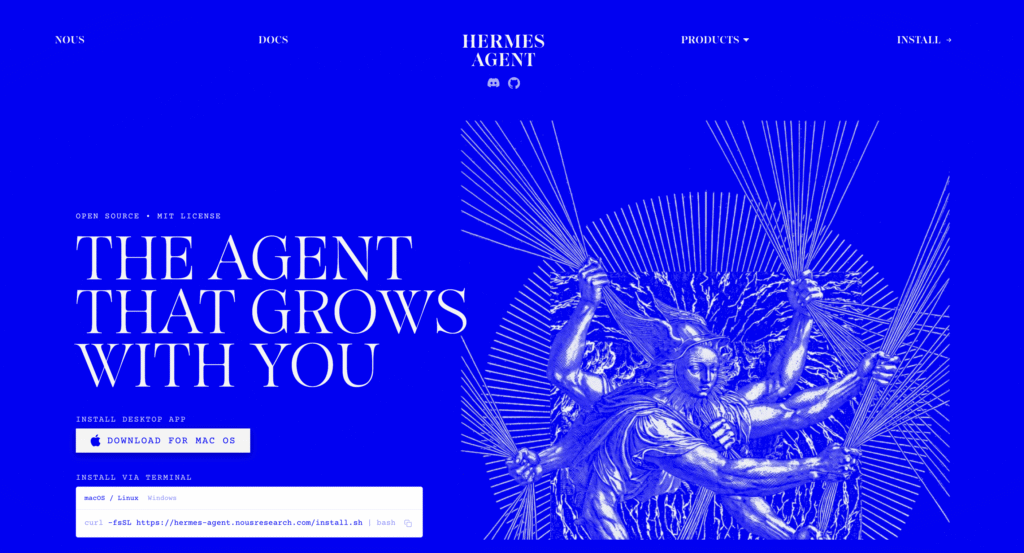
Among the most notable innovations in this rapidly expanding landscape is Hermes Agent, an open-source autonomous AI framework developed by Nous Research. Unlike traditional AI assistants that operate primarily within isolated chat sessions, Hermes Agent introduces a persistent runtime architecture that enables long-horizon task execution, structured memory management, modular tool integration, secure command execution, and continuous procedural learning. By combining these capabilities into a unified platform, Hermes Agent enables developers, researchers, startups, and enterprises to build intelligent systems that become increasingly effective over time rather than restarting from scratch with every new conversation.
The emergence of Hermes Agent reflects a broader industry movement toward autonomous AI systems that emphasize practical execution instead of isolated reasoning. While modern large language models have demonstrated remarkable capabilities in natural language understanding, code generation, mathematical reasoning, and creative writing, many organizations have discovered that deploying AI successfully in production environments requires much more than impressive benchmark scores. Real-world AI systems must interact safely with software projects, cloud infrastructure, databases, APIs, messaging platforms, operating systems, and enterprise workflows while maintaining security, reliability, scalability, and governance. Hermes Agent has been designed specifically to address these operational challenges through a modular architecture that separates reasoning, memory, execution, communication, and security into independently configurable components.
One of the defining characteristics of Hermes Agent is its emphasis on persistent intelligence. Conventional conversational AI systems typically rely on temporary conversation histories that disappear when sessions end or context windows are exhausted. Hermes Agent, however, introduces a sophisticated three-tier memory architecture capable of retaining user preferences, project knowledge, searchable session histories, and reusable procedural skills across extended periods. This persistent memory enables the agent to understand long-term projects, remember organizational standards, retain technical documentation, and execute recurring workflows without requiring users to repeatedly provide the same instructions. As organizations continue adopting AI across increasingly complex operational environments, persistent memory is becoming a critical differentiator between simple conversational assistants and genuinely autonomous AI systems.
Another factor contributing to Hermes Agent’s growing popularity is its provider-agnostic architecture. Many AI development tools are closely tied to specific language model vendors, limiting deployment flexibility and increasing dependency on proprietary ecosystems. Hermes Agent takes a different approach by supporting multiple inference providers, including local language models, cloud-hosted APIs, OpenRouter integrations, Amazon Bedrock, Ollama deployments, and custom enterprise inference services. This flexibility allows organizations to optimize deployments based on performance, privacy, compliance, cost, and infrastructure requirements while reducing long-term vendor lock-in. As enterprises increasingly pursue hybrid AI strategies, provider independence has become an increasingly valuable architectural advantage.
Security has also become one of the defining concerns surrounding autonomous AI systems. Unlike traditional chatbots that primarily generate text, autonomous agents frequently execute terminal commands, edit software repositories, manipulate files, access cloud services, and communicate with external systems. These expanded capabilities introduce new security challenges, including prompt injection attacks, credential leakage, unauthorized command execution, privilege escalation, and infrastructure compromise. Hermes Agent addresses these concerns through a comprehensive defense-in-depth security model incorporating layered authorization, command approval engines, credential filtering, prompt injection detection, container sandboxing, session isolation, and secure user verification workflows. This security-first approach makes the framework considerably more suitable for enterprise environments where operational safety is essential.
Hermes Agent also distinguishes itself through its self-improving operational model. Rather than relying exclusively on improvements to the underlying language model, the framework introduces structured procedural learning that transforms successful workflows into reusable skills. These skills can later be retrieved and executed when similar situations arise, enabling the agent to become progressively more efficient as it accumulates operational experience. Combined with optional offline optimization pipelines and human review mechanisms, this learning architecture provides organizations with a practical method for continuously improving AI performance without requiring costly model retraining or infrastructure changes.
The framework’s modular design further enhances its appeal for organizations with diverse operational requirements. Hermes Agent separates core orchestration logic, terminal execution, messaging gateways, memory providers, benchmarking tools, security controls, and user interfaces into independent components that can be customized, replaced, or extended without affecting the rest of the system. This loosely coupled architecture simplifies maintenance, encourages community contributions, and allows enterprises to integrate Hermes Agent into existing technology stacks with minimal disruption. Whether deployed for software engineering, infrastructure automation, cybersecurity operations, business intelligence, research, or customer engagement, the framework provides the flexibility needed to support a wide variety of enterprise use cases.
Another important aspect of Hermes Agent is its emphasis on production-ready benchmarking rather than purely theoretical evaluation. Traditional AI benchmarks frequently focus on isolated reasoning tasks, programming challenges, or academic question answering. Hermes instead incorporates practical engineering benchmarks, terminal automation tests, long-horizon business simulations, and multi-turn reliability evaluations that more accurately reflect real-world deployment conditions. These benchmarking methodologies help organizations measure execution reliability, workflow completion, tool coordination, error recovery, and operational consistency—qualities that often prove more valuable in production environments than raw reasoning performance alone.
As interest in AI agents continues to accelerate, Hermes Agent has also attracted attention because of its open-source philosophy. Open-source AI frameworks provide transparency, community-driven innovation, extensibility, and greater deployment flexibility compared with proprietary alternatives. Developers can inspect the source code, contribute new features, build custom integrations, extend memory providers, create specialized tools, and adapt the framework to highly specific business requirements. This collaborative ecosystem has helped position Hermes Agent as one of the leading open-source platforms for autonomous AI development while encouraging rapid innovation from both independent contributors and enterprise users.
The rise of autonomous AI agents has fundamentally changed how organizations think about digital productivity. Instead of treating artificial intelligence as a tool that merely answers questions, businesses are increasingly exploring AI systems capable of managing recurring workflows, coordinating software development, monitoring infrastructure, generating reports, conducting research, maintaining documentation, and collaborating with human teams over extended periods. Hermes Agent represents this next stage of AI evolution by providing an intelligent runtime capable of combining reasoning, memory, automation, and continuous learning within a secure and extensible platform.
Understanding Hermes Agent requires examining far more than its list of technical features. Its architecture reflects a broader transformation in artificial intelligence toward persistent digital collaborators that can remember context, execute real-world actions, interact with external systems, evolve through operational experience, and function continuously across multiple platforms. These capabilities have significant implications for software engineering, enterprise automation, cybersecurity, DevOps, research, knowledge management, and business operations, making Hermes Agent an increasingly important framework for organizations seeking to leverage the next generation of AI-powered automation.
This comprehensive guide explores everything readers need to know about Hermes Agent by Nous Research and how it works. It examines the framework’s underlying architecture, orchestration engine, three-tier memory system, procedural learning capabilities, benchmarking methodology, security model, multi-platform interfaces, enterprise deployment strategies, and real-world applications. It also compares Hermes Agent with other prominent autonomous AI platforms, discusses its strengths and limitations, and explains why it has become one of the most influential open-source AI agent frameworks for developers, researchers, startups, and enterprise organizations pursuing scalable, secure, and continuously improving intelligent automation.
Before we venture further into this article, we would like to share who we are and what we do.
About 9cv9
9cv9 is a business tech startup based in Singapore and Asia, with a strong presence all over the world.
With over ten years of startup and business experience, and being highly involved in connecting with thousands of companies and startups, the 9cv9 team has listed some important and crucial software tools in this review.
If you like to get your company listed in our top B2B software reviews, check out our world-class 9cv9 Media and PR service and pricing plans here.
What is Hermes Agent by Nous Research and How It Works
- What is Hermes Agent by Nous Research?
- Core System Architecture and Runtime Orchestration
- Cognitive Depth: The Three-Tier Memory Architecture and Pluggable Memory Provider Ecosystem
- Self-Evolution, Prompt Optimization, and the Continuous Learning Loop
- Human-Centric Interfaces and Multi-Platform Gateway Architecture
- Enterprise Security Controls and Defense-in-Depth Architecture
- Unified Benchmarking and Production Trust Metrics
- Comparative Assessment: Hermes Agent vs OpenClaw vs Claude Code
- Strategic Recommendations for Enterprise Deployment
1. What is Hermes Agent by Nous Research?
Hermes Agent is an open-source autonomous AI agent framework developed by Nous Research that is designed to function as a persistent, continuously evolving digital operating system for artificial intelligence workflows rather than as a conventional chatbot. Unlike traditional conversational AI applications that process one prompt at a time before resetting context, Hermes Agent is engineered to maintain long-term memory, execute complex tasks, coordinate multiple tools, interact with external services, and improve its effectiveness through continuous usage.
Introduced in early 2026, Hermes Agent represents a significant shift in the evolution of AI agents by emphasizing persistent intelligence instead of isolated conversations. Rather than existing solely inside a browser window or coding editor, the platform is intended to operate continuously as an independent background service capable of supporting developers, businesses, researchers, and enterprise teams across a wide variety of environments.
The project builds upon Nous Research’s broader mission of advancing open-source artificial intelligence that rivals proprietary enterprise AI ecosystems while remaining transparent, extensible, and community-driven. The framework has rapidly gained recognition among developers because it combines powerful reasoning capabilities with persistent memory, multi-platform accessibility, plugin extensibility, and support for numerous large language models through a unified architecture.
Hermes Agent at a Glance
| Category | Description |
|---|---|
| Developer | Nous Research |
| Initial Public Release | 2026 |
| Software Type | Open-source autonomous AI agent platform |
| Primary Purpose | Persistent AI automation and intelligent task execution |
| Core Philosophy | Long-term memory, autonomous reasoning, continuous operation |
| License Model | Open source |
| Primary Users | Developers, enterprises, researchers, AI enthusiasts, organizations |
| Deployment | Local machines, servers, cloud infrastructure, hybrid environments |
| Extensibility | Plugin architecture and custom skills |
| Multi-Model Support | Supports numerous AI model providers |
Background of Nous Research
Nous Research is an artificial intelligence research organization established in 2023 by Jeffrey Quesnelle, Karan Malhotra, Ryan Teknium, and Shivani Mitra. The company has positioned itself as one of the leading organizations focused on developing open-source large language models and AI infrastructure capable of competing with proprietary systems offered by major technology companies.
The organization has attracted significant venture capital investment from well-known technology investors and venture firms. In 2026, Nous Research continued expanding its financial backing through a funding round reportedly targeting at least US$75 million, potentially valuing the company at approximately US$1.5 billion. The additional capital is intended to accelerate research, infrastructure development, model deployment, and ecosystem expansion.
Growth of Nous Research
| Area | Development Trend |
|---|---|
| Company Foundation | Established in 2023 |
| Business Focus | Open-source artificial intelligence |
| Main Products | Hermes models, Hermes Agent, AI infrastructure |
| Funding | Multiple venture-backed funding rounds |
| Market Position | Leading open-source AI ecosystem |
| Strategic Direction | Enterprise-ready autonomous AI platforms |
| Community Development | Large and rapidly growing developer community |
Why Hermes Agent Was Created
Traditional AI assistants generally operate within a request-response paradigm. Users submit a prompt, receive an answer, and begin again with limited retained context. While effective for simple interactions, this design limits their usefulness for long-running projects, enterprise workflows, software development, and autonomous automation.
Hermes Agent was developed to overcome these limitations by introducing an AI system capable of operating continuously across multiple tasks and environments.
Its design philosophy centers around creating an intelligent software agent that can:
• Remember previous interactions
• Build long-term contextual knowledge
• Coordinate multiple software tools
• Execute complex workflows
• Operate across communication platforms
• Support autonomous decision making
• Continuously expand its capabilities through plugins and skills
This architecture enables the agent to function more like a persistent digital collaborator than a temporary conversational assistant.
How Hermes Agent Works
Hermes Agent operates as a persistent runtime that connects language models with memory systems, external tools, communication platforms, automation workflows, and user-defined skills.
Instead of simply generating text, the framework continuously manages an intelligent execution loop.
The overall workflow generally follows these stages:
| Processing Stage | Purpose |
|---|---|
| User Request | Receives instructions from users or connected applications |
| Context Loading | Retrieves historical memory and project information |
| Planning | Breaks objectives into manageable tasks |
| Model Reasoning | Uses selected AI models for reasoning and decision making |
| Tool Execution | Invokes APIs, plugins, browsers, terminals, or file systems |
| Response Generation | Produces structured outputs or completed tasks |
| Memory Update | Stores new knowledge for future interactions |
| Continuous Operation | Waits for new events while preserving accumulated knowledge |
Unlike stateless chat systems, Hermes Agent maintains continuity across sessions, allowing it to become progressively more effective as it accumulates information about projects, workflows, and user preferences.
Core Architecture
Hermes Agent combines several interconnected components that collectively create an autonomous AI environment.
| Component | Primary Function |
|---|---|
| Language Models | Natural language understanding and reasoning |
| Memory Engine | Long-term knowledge retention |
| Planning Layer | Task decomposition and workflow management |
| Plugin System | Extends functionality through modular capabilities |
| Tool Gateway | Connects to external APIs and software |
| Communication Layer | Interfaces with messaging platforms and applications |
| Storage Layer | Maintains persistent sessions and historical context |
| Runtime Engine | Coordinates all agent operations |
Persistent Memory System
One of Hermes Agent’s defining characteristics is its persistent memory architecture.
Rather than discarding previous conversations, the framework stores relevant knowledge that can later be reused to improve future interactions.
This persistent memory enables the agent to:
• Remember project requirements
• Learn user preferences
• Track ongoing objectives
• Retain documentation
• Maintain historical decisions
• Improve long-term productivity
• Reduce repetitive instructions
This capability makes Hermes Agent particularly valuable for software development, enterprise knowledge management, and long-running business processes.
Plugin-Based Extensibility
Hermes Agent adopts a modular plugin architecture that allows developers to expand its capabilities without modifying the core framework.
Plugins may provide functionality such as:
| Plugin Category | Example Functions |
|---|---|
| Productivity | Calendar management, scheduling, reminders |
| Software Development | Code generation, repository management |
| Web Automation | Browser interaction, data collection |
| Enterprise | CRM integration, ERP workflows |
| Communication | Email, messaging platforms |
| Analytics | Data visualization, reporting |
| File Management | Document processing, indexing |
| Custom Business Logic | Industry-specific automation |
Recent releases have significantly expanded the plugin lifecycle, provider integrations, and extensibility surface, enabling organizations to tailor Hermes Agent for specialized operational requirements.
Multi-Model Flexibility
Hermes Agent is not restricted to a single AI model.
Instead, it supports numerous inference providers and model ecosystems, allowing organizations to select the models that best fit their performance, cost, privacy, or deployment requirements.
Examples include:
| Capability Area | Benefits |
|---|---|
| Multiple AI Providers | Greater deployment flexibility |
| Model Selection | Choose specialized reasoning models |
| Local Deployment | Enhanced privacy |
| Cloud Deployment | High scalability |
| Enterprise Integration | Vendor flexibility |
| Future Compatibility | Easier adoption of newer models |
This model-agnostic architecture reduces vendor lock-in while enabling organizations to optimize AI performance based on their specific use cases.
Major Capabilities
Hermes Agent provides a broad collection of capabilities that extend beyond conversational AI.
| Capability | Business Value |
|---|---|
| Long-term Memory | Continuous learning |
| Autonomous Task Execution | Reduced manual intervention |
| Multi-Agent Workflows | Parallel problem solving |
| Browser Automation | Automated research and navigation |
| File System Access | Intelligent document management |
| Terminal Operations | Development and infrastructure automation |
| Messaging Integration | Cross-platform communication |
| Plugin Support | Unlimited extensibility |
| Custom Skills | Organization-specific intelligence |
| Workflow Automation | Business process optimization |
Business Applications
Organizations are increasingly evaluating Hermes Agent for enterprise AI initiatives because of its ability to automate sophisticated knowledge work.
Common applications include:
| Industry | Example Use Cases |
|---|---|
| Software Development | Code generation, debugging, DevOps |
| Customer Support | Intelligent service automation |
| Research | Literature reviews, knowledge synthesis |
| Marketing | Content generation, campaign planning |
| Finance | Report preparation, document analysis |
| Healthcare | Administrative workflow assistance |
| Education | Personalized tutoring and research |
| Manufacturing | Operational documentation |
| Legal | Contract review and research |
Advantages Over Traditional AI Chatbots
Hermes Agent differs from conventional conversational AI systems in several important ways.
| Traditional Chatbots | Hermes Agent |
|---|---|
| Session-based interactions | Persistent long-term operation |
| Limited context retention | Continuous memory |
| Single conversation | Multi-project management |
| Manual workflow execution | Autonomous task orchestration |
| Minimal extensibility | Rich plugin ecosystem |
| Limited automation | Comprehensive workflow automation |
| Isolated interactions | Continuous learning and adaptation |
Market Position
Hermes Agent has rapidly established itself as one of the most prominent open-source autonomous AI frameworks.
Its popularity reflects broader industry trends toward intelligent agents capable of operating continuously across multiple environments rather than serving solely as conversational assistants.
The project has also experienced substantial community adoption, with strong GitHub engagement and frequent feature releases introducing new integrations, expanded provider support, enhanced security, and improved reliability. Recent releases have added support for hundreds of AI models, expanded plugin capabilities, additional communication platforms, and broader enterprise deployment options.
Hermes Agent Ecosystem Overview
| Ecosystem Area | Primary Objective |
|---|---|
| Open Source | Community-driven innovation |
| AI Models | Flexible reasoning engines |
| Plugins | Modular feature expansion |
| Enterprise Integration | Business workflow automation |
| Developer Community | Continuous contributions |
| Research | Advanced autonomous intelligence |
| Infrastructure | Persistent AI operations |
| Automation | End-to-end intelligent workflows |
Future Outlook
Hermes Agent represents an important evolution in autonomous AI software by combining persistent memory, intelligent planning, extensibility, and continuous operation within an open-source framework. As organizations increasingly seek AI systems capable of managing long-running business processes instead of isolated conversations, platforms such as Hermes Agent are expected to play an increasingly significant role in enterprise automation, software engineering, research, and digital productivity.
Ongoing investment in Nous Research, combined with rapid feature development and strong community participation, indicates that Hermes Agent is likely to remain a major contributor to the growing ecosystem of open-source AI agents. Its emphasis on modular architecture, interoperability, and continuous learning positions it as an influential platform for businesses and developers seeking flexible, scalable, and vendor-independent autonomous AI solutions.
2. Core System Architecture and Runtime Orchestration
Hermes Agent is designed around a modular, loosely coupled architecture that enables autonomous AI capabilities to scale across multiple execution environments without introducing rigid dependencies between components. Instead of functioning as a monolithic application, the framework separates orchestration, memory, tool execution, communication gateways, and runtime services into independent modules that can evolve individually while remaining interoperable through standardized interfaces and registry mechanisms. This architectural philosophy makes Hermes Agent highly extensible, easier to maintain, and adaptable to enterprise deployment scenarios ranging from personal AI assistants to distributed multi-agent platforms.
One of the defining characteristics of the Hermes Agent architecture is its infrastructure-agnostic design. Core runtime components remain isolated from optional subsystems such as Model Context Protocol (MCP) integrations, external memory providers, inference providers, messaging platforms, and reinforcement learning environments. Rather than hardcoding dependencies, these capabilities are introduced through dynamic registration, plugin discovery, and capability validation, allowing organizations to customize deployments according to their operational requirements while minimizing architectural complexity.
Hermes Agent Architecture Overview
| Architecture Layer | Primary Responsibility | Business Value |
|---|---|---|
| Entry Points | Accepts requests from multiple interfaces | Universal accessibility |
| Agent Orchestrator | Coordinates reasoning and execution | Centralized intelligence |
| Prompt System | Builds optimized prompts | Faster inference and lower token usage |
| Context Engine | Processes conversation history | Better contextual understanding |
| Memory Layer | Stores persistent knowledge | Long-term continuity |
| Tool Registry | Manages available capabilities | Modular extensibility |
| Runtime Dispatcher | Executes tools and workflows | Reliable automation |
| Gateway Layer | Connects messaging platforms | Multi-platform communication |
| Session Storage | Persists conversations and metadata | Cross-session continuity |
| Plugin Ecosystem | Adds optional capabilities | Flexible enterprise customization |
Architectural Design Principles
Hermes Agent follows several engineering principles that distinguish it from traditional chatbot frameworks.
Rather than tightly coupling every subsystem together, the architecture emphasizes component isolation and standardized communication between services. Each major subsystem performs a dedicated function while exposing interfaces that allow new functionality to be introduced without modifying the core runtime.
The primary design objectives include:
• Loose coupling between runtime components
• Modular code organization
• Infrastructure independence
• Provider-agnostic AI model support
• Persistent long-term memory
• Plugin-first extensibility
• Runtime scalability
• Enterprise-ready deployment flexibility
These principles allow Hermes Agent to evolve rapidly while maintaining compatibility with new AI providers, tools, messaging platforms, and deployment models.
Core Design Philosophy
| Engineering Principle | Description | Practical Benefit |
|---|---|---|
| Loose Coupling | Independent runtime modules | Easier maintenance |
| Registry-Based Discovery | Automatic component registration | Simplified extensibility |
| Plugin Architecture | Optional functionality remains isolated | Faster feature expansion |
| Persistent Runtime | Long-lived execution model | Continuous AI operation |
| Provider Independence | Supports numerous inference providers | Reduced vendor lock-in |
| Session Persistence | Stores historical context | Better long-term reasoning |
| Modular Services | Specialized runtime components | Improved scalability |
The AIAgent Orchestrator
At the heart of Hermes Agent is the AIAgent orchestrator, which serves as the primary execution engine responsible for coordinating nearly every aspect of agent behavior. The orchestrator provides a unified processing pipeline regardless of where requests originate.
Whether the input arrives from the command-line interface (CLI), terminal user interface (TUI), messaging gateway, automation workflow, API endpoint, or scheduled background task, every request is processed through the same orchestration engine. This unified execution model ensures consistent reasoning, predictable behavior, and standardized task execution across the entire platform.
The orchestrator manages several critical responsibilities, including:
• Model selection
• Prompt construction
• Context assembly
• Provider resolution
• Tool selection
• Tool execution
• Session persistence
• Error recovery
• Retry logic
• Response generation
Because every execution path shares the same orchestration layer, Hermes Agent avoids inconsistencies that often arise when different interfaces maintain separate execution pipelines.
AIAgent Responsibilities
| Function | Description |
|---|---|
| Prompt Assembly | Builds optimized prompts |
| Context Management | Loads conversation history |
| Provider Resolution | Selects AI providers |
| Tool Coordination | Chooses appropriate tools |
| Workflow Planning | Organizes multi-step tasks |
| Response Generation | Produces final outputs |
| Session Persistence | Saves runtime state |
| Error Handling | Manages failures and retries |
| Callback Management | Coordinates asynchronous operations |
Prompt Assembly and Runtime Optimization
Hermes Agent places considerable emphasis on prompt engineering efficiency.
Instead of rebuilding the entire system prompt for every request, the framework separates prompt content into multiple logical layers that can be cached independently. Stable components—including agent identity, tool guidance, skills, and environment configuration—are reused across sessions, while only volatile elements such as memory snapshots, timestamps, or user-specific updates are refreshed when necessary. This layered prompt architecture improves cache effectiveness, preserves session continuity, and reduces unnecessary token consumption.
The system prompt typically consists of three conceptual layers:
| Prompt Layer | Typical Contents | Update Frequency |
|---|---|---|
| Stable Layer | Agent identity, skills, tool guidance | Rarely changes |
| Context Layer | Project files, user instructions | Changes occasionally |
| Volatile Layer | Memory, timestamps, session metadata | Updated continuously |
This separation enables efficient prompt caching for supported providers, significantly reducing inference costs and improving response latency during long-running conversations. Official release notes describe cross-session prompt caching as a key optimization for reducing repeated prompt processing across interactions.
Directory Structure and Repository Organization
The Hermes Agent repository follows a highly organized modular directory structure that separates configuration, memory, skills, runtime services, tools, and communication infrastructure into dedicated locations.
A simplified conceptual layout includes:
| Directory | Primary Purpose |
|---|---|
| Configuration | Global runtime settings |
| Sessions | SQLite databases and session indexes |
| Memory | Persistent knowledge storage |
| Skills | Built-in, optional, and community skills |
| Cron | Scheduled automation jobs |
| Agent | Internal orchestration modules |
| CLI | Command-line interface |
| Gateway | Messaging platform integration |
| Tools | Individual tool implementations |
This structured organization enables contributors to extend individual subsystems without affecting unrelated portions of the codebase, improving maintainability and accelerating development.
Agent Internal Modules
The internal agent modules are responsible for transforming user requests into executable workflows.
Major internal components include:
| Module | Primary Responsibility |
|---|---|
| Prompt Builder | Constructs optimized prompts |
| Context Engine | Processes contextual information |
| Prompt Caching | Applies cache optimization |
| Context Compression | Compresses lengthy conversations |
| Provider Resolver | Determines runtime AI provider |
| Agent Loop | Coordinates reasoning lifecycle |
Recent releases have further modularized the orchestration layer, reducing the size of the primary runtime file and distributing responsibilities across specialized agent modules to improve maintainability and performance.
CLI and Terminal Runtime
Hermes Agent includes a sophisticated command-line environment that serves as one of its primary user interfaces.
The CLI subsystem manages:
• Interactive conversations
• Agent profiles
• Configuration
• Theme management
• Model selection
• Runtime diagnostics
• Tool inspection
• System onboarding
Modern releases have also introduced a React/Ink-based terminal user interface, providing a richer interactive experience while maintaining compatibility with the underlying orchestration engine.
Tool Registry Architecture
One of the most innovative architectural components of Hermes Agent is its decentralized tool registry.
Rather than maintaining a manually curated list of available capabilities, each tool module registers itself automatically during initialization. The registry then validates schemas, tracks permissions, manages availability, and exposes a unified interface for the orchestrator.
This registry-driven approach enables developers to add new tools simply by implementing the appropriate interfaces without modifying the central runtime engine.
Tool Execution Pipeline
| Processing Stage | Description |
|---|---|
| Tool Import | Tool module loads |
| Self Registration | Tool registers with registry |
| Schema Validation | Registry validates interfaces |
| Discovery | Runtime discovers available tools |
| Selection | Agent chooses appropriate tool |
| Execution | Tool performs requested operation |
| Response Handling | Results returned to orchestrator |
Messaging Gateway Infrastructure
Hermes Agent includes a dedicated gateway layer that allows the AI agent to operate across numerous messaging and communication platforms.
Instead of embedding platform-specific logic throughout the codebase, the gateway standardizes incoming events into a common internal representation before forwarding them to the orchestration engine.
This abstraction simplifies platform expansion while ensuring consistent behavior regardless of communication channel. Official releases have steadily expanded native support for additional messaging ecosystems and transport architectures.
Gateway Responsibilities
| Gateway Function | Purpose |
|---|---|
| Message Translation | Standardizes platform events |
| Session Tracking | Maintains conversation continuity |
| Authentication | Validates user access |
| Payload Normalization | Creates unified request format |
| Response Routing | Delivers outputs to destination platform |
| Error Handling | Recovers failed message processing |
Runtime Execution Patterns
Hermes Agent supports multiple runtime execution modes, allowing the same orchestration engine to operate across interactive sessions, messaging systems, scheduled jobs, and automated workflows.
Interactive CLI Sessions
Interactive terminal sessions provide direct access to the agent, enabling users to perform conversational AI tasks, execute tools, manage files, write code, and automate workflows while preserving persistent memory.
Gateway Messaging Sessions
Messaging platforms convert incoming events into normalized payloads before passing them to lightweight AIAgent instances. These sessions retrieve compressed conversation history, perform reasoning, execute tools if necessary, and return responses through platform-specific adapters.
Background Cron Jobs
Scheduled automation tasks execute independently of interactive conversations. These jobs typically process predefined instructions, perform autonomous workflows, and deliver results through configured communication channels without requiring active user participation. Hermes continues to expand background automation capabilities, including autonomous maintenance and scheduled task execution.
Runtime Execution Comparison
| Runtime Mode | Primary Input | Memory Usage | Typical Applications |
|---|---|---|---|
| Interactive CLI | Terminal commands | Persistent | Development and research |
| Gateway Messaging | Chat platforms | Session-aware | Virtual assistants |
| API Runtime | External applications | Configurable | Enterprise integration |
| Background Scheduler | Timed automation | Minimal or task-based | Reports and maintenance |
System Orchestration Workflow
The complete Hermes Agent runtime follows a structured orchestration pipeline that integrates user interaction, AI reasoning, tool execution, and persistent learning into a unified operational cycle.
| Workflow Stage | Description |
|---|---|
| Request Reception | Input received from any supported interface |
| Context Loading | Session history and memory retrieved |
| Prompt Construction | Multi-layer prompt assembled |
| Provider Resolution | AI model selected |
| Agent Reasoning | Task analyzed and planned |
| Tool Invocation | Required tools executed |
| Result Generation | Response compiled |
| Memory Persistence | New knowledge stored |
| Session Update | Runtime state committed |
Enterprise Benefits of the Architecture
Hermes Agent’s runtime architecture is designed to balance flexibility, performance, and scalability. By separating orchestration, memory, tools, gateways, and provider integrations into independent modules connected through registry-based discovery, the framework minimizes coupling while enabling rapid feature expansion. Continuous improvements documented in recent releases—including orchestrator modularization, prompt caching enhancements, expanded provider support, faster cold starts, and richer multi-agent capabilities—demonstrate an architecture built to support both individual developers and enterprise-scale AI deployments without sacrificing maintainability or extensibility.
3. Cognitive Depth: The Three-Tier Memory Architecture and Pluggable Memory Provider Ecosystem
One of Hermes Agent’s defining innovations is its multi-layered memory architecture, which is designed to provide long-term contextual intelligence without relying exclusively on expensive cloud-hosted vector databases or large-scale retrieval infrastructure. Rather than treating every conversation as an isolated interaction, Hermes separates memory into multiple specialized layers, allowing the agent to preserve critical knowledge, efficiently retrieve historical context, and continually improve its performance while remaining lightweight enough to operate on modest hardware.
Unlike many AI systems that depend entirely on semantic vector search for memory retrieval, Hermes combines persistent local storage, structured declarative knowledge, procedural task memory, and optional enterprise-grade external memory providers into a unified cognitive architecture. This layered design balances retrieval speed, token efficiency, reasoning quality, and deployment flexibility for both individual developers and enterprise organizations.
Conceptual Memory Architecture
| Memory Layer | Primary Storage | Purpose | Retrieval Speed |
|---|---|---|---|
| Declarative Memory | Markdown files | Persistent user and project knowledge | Instant |
| Session Memory | Local SQLite FTS5 database | Historical conversations | Milliseconds |
| Procedural Memory | Skills library | Reusable workflows and expertise | Context-triggered |
| External Memory Provider | Local or cloud provider plugins | Enterprise-scale persistent intelligence | Provider dependent |
How the Three-Tier Cognitive Memory System Works
Rather than relying on a single memory database, Hermes distributes knowledge across specialized layers, each optimized for different types of information.
This separation reduces unnecessary token consumption while ensuring that the most important knowledge remains immediately accessible.
The overall cognitive flow generally follows this sequence:
| Processing Stage | Primary Activity |
|---|---|
| User Interaction | New conversation begins |
| Declarative Memory Loading | USER.md and MEMORY.md loaded |
| Session Search | Historical conversations queried if required |
| Skill Discovery | Relevant procedural skills identified |
| Prompt Construction | Context assembled intelligently |
| Model Reasoning | AI generates response |
| Memory Synchronization | New information stored appropriately |
This architecture enables Hermes Agent to maintain continuity across long-running projects without forcing every historical conversation into the active context window.
The Philosophy Behind Layered Memory
The Hermes memory architecture is built upon three key engineering objectives:
• Preserve long-term contextual understanding
• Minimize unnecessary token consumption
• Maximize retrieval speed
Instead of continuously injecting every previous conversation into the prompt, Hermes selectively retrieves only the information most relevant to the current task.
This approach improves reasoning quality while keeping inference costs significantly lower than systems that repeatedly reload extensive conversation histories.
Memory Design Principles
| Design Principle | Practical Benefit |
|---|---|
| Persistent knowledge | Long-term continuity |
| Selective retrieval | Lower token consumption |
| Layer specialization | Better organization |
| Progressive disclosure | Efficient context loading |
| Local-first architecture | Reduced infrastructure costs |
| Optional external scaling | Enterprise flexibility |
Declarative Memory: High-Signal Persistent Knowledge
The first layer of the Hermes memory system is declarative memory.
Rather than storing important user information inside opaque databases, Hermes maintains human-readable memory files that capture stable knowledge about users, projects, and environments.
These files typically contain information such as:
• User preferences
• Communication style
• Project requirements
• Coding conventions
• Infrastructure configuration
• Business rules
• Environmental details
• Long-term objectives
Because these files are loaded immediately during session initialization, retrieval latency is effectively eliminated. This allows the AI agent to begin every conversation with awareness of important long-term context.
Examples of Declarative Knowledge
| Knowledge Category | Typical Information Stored |
|---|---|
| User Preferences | Writing style, communication preferences |
| Development Standards | Coding conventions |
| Project Constraints | Architecture decisions |
| Infrastructure | Deployment environments |
| Organization Policies | Internal workflows |
| Business Rules | Operational requirements |
Memory Size Management
One challenge of persistent AI memory is uncontrolled growth.
If memory expands indefinitely, it eventually consumes valuable prompt space and reduces reasoning efficiency.
Hermes addresses this challenge by applying configurable size limits to persistent memory files. When memory approaches its configured capacity, the agent automatically consolidates overlapping information, removes obsolete details, and preserves only the highest-value knowledge.
This continuous refinement process helps maintain a concise and information-rich memory representation rather than allowing redundant content to accumulate over time.
Memory Optimization Strategy
| Optimization Technique | Benefit |
|---|---|
| Character limits | Prevents prompt inflation |
| Memory consolidation | Removes duplicate knowledge |
| Automatic refinement | Preserves high-value information |
| Continuous maintenance | Long-term memory stability |
Session Memory: Persistent Conversation History
The second memory layer stores historical conversations using a local SQLite database enhanced with Full-Text Search version 5 (FTS5).
Unlike declarative memory, which focuses on long-term facts, session memory preserves the chronological history of conversations, allowing Hermes to locate previous discussions, technical decisions, troubleshooting sessions, and research findings on demand.
Because FTS5 provides high-performance indexing, Hermes can perform keyword searches across extensive conversation histories without requiring external vector databases. Official documentation describes session search as an on-demand capability separate from always-loaded persistent memory, enabling rapid retrieval while avoiding unnecessary prompt expansion.
Session Memory Characteristics
| Feature | Description |
|---|---|
| Storage Engine | SQLite FTS5 |
| Retrieval Method | Full-text search |
| Search Scope | Historical conversations |
| Token Cost | On-demand only |
| Infrastructure | Local storage |
| Primary Use Case | Historical knowledge retrieval |
Context Compression
As conversations become increasingly lengthy, eventually exceeding the language model’s available context window, Hermes introduces context compression.
Instead of discarding older interactions, the framework summarizes selected portions of historical conversations while preserving critical information.
Recent exchanges remain intact, early foundational discussions are retained, and middle sections are compressed into concise summaries. This strategy maintains logical continuity while significantly reducing prompt size. The official architecture documents describe context compression as an integrated mechanism for managing long-running conversations within model context limits.
Context Compression Workflow
| Stage | Action |
|---|---|
| Context Growth | Conversation expands |
| Threshold Detection | Context approaches configured limit |
| Historical Selection | Older conversation segments identified |
| Summary Generation | Dense summaries produced |
| Prompt Reconstruction | Compressed context injected |
| Continued Conversation | Session proceeds normally |
Procedural Memory: Skills-Based Learning
The third layer of Hermes memory focuses on procedural knowledge.
Instead of remembering facts, procedural memory stores methods.
Whenever Hermes successfully completes a complex workflow, the sequence of actions can be transformed into reusable procedural documentation known as a skill.
These skills are structured documents that describe how to perform specific tasks, including required tools, execution steps, configuration guidance, and error handling procedures.
Rather than relearning identical workflows repeatedly, Hermes can invoke these procedural skills whenever similar tasks arise.
Examples of Procedural Skills
| Skill Category | Example Applications |
|---|---|
| Software Development | Repository setup |
| Infrastructure | Server deployment |
| DevOps | CI/CD automation |
| Data Engineering | Database migration |
| Documentation | Report generation |
| Security | Vulnerability scanning |
| Research | Technical investigation |
Progressive Skill Loading
Loading every procedural skill into the system prompt would quickly exhaust the available context window.
To avoid this problem, Hermes employs progressive disclosure.
Initially, only lightweight metadata describing available skills is presented.
When the agent determines that a particular skill is relevant to the current objective, the complete procedural instructions are loaded dynamically.
This selective loading mechanism keeps prompts compact while still providing access to extensive procedural knowledge when necessary.
Skill Loading Strategy
| Loading Stage | Information Loaded |
|---|---|
| Discovery | Skill index only |
| Task Matching | Relevant skills identified |
| Detail Retrieval | Full procedural instructions loaded |
| Execution | Workflow performed |
External Memory Provider Ecosystem
While Hermes includes a comprehensive built-in memory system, organizations requiring larger-scale persistent intelligence can enable external memory providers.
External providers extend, rather than replace, the built-in memory architecture.
When enabled, Hermes automatically:
• Injects provider-generated context into prompts
• Retrieves relevant memories before each interaction
• Synchronizes conversations after every response
• Extracts long-term knowledge at session completion
• Mirrors built-in memory updates
• Adds provider-specific memory tools
Only one external provider is active at a time, while the built-in memory system remains continuously available alongside it.
How External Memory Providers Integrate
| Integration Step | Purpose |
|---|---|
| Context Injection | Load durable knowledge |
| Memory Prefetch | Retrieve relevant memories |
| Conversation Sync | Update provider |
| Session Extraction | Store new knowledge |
| Built-in Mirroring | Synchronize local memory |
| Provider Tools | Enable advanced memory operations |
Comparison of Major Memory Providers
Hermes currently supports multiple pluggable memory providers, each optimized for different deployment models and retrieval strategies.
| Memory Provider | Storage Model | Primary Retrieval Method | Distinctive Capability |
|---|---|---|---|
| Honcho | Cloud or self-hosted | Dialectic reasoning and semantic context | Deep user modeling and multi-agent profile separation |
| OpenViking | Self-hosted | Tiered contextual retrieval | Hierarchical knowledge browsing and progressive loading |
| Mem0 | Cloud or self-hosted | Automatic fact extraction | Server-side semantic memory management |
| Hindsight | Local or cloud | Knowledge graph reasoning | Reflective synthesis and entity relationships |
| Holographic | Local | HRR algebraic recall | Lightweight local memory with trust scoring |
| RetainDB | Cloud | Delta-compressed retrieval | Efficient long-term storage |
| ByteRover | Local or cloud | Pre-compression extraction | Context optimization before indexing |
| Supermemory | Cloud | Session graph retrieval | Context fencing and multi-container support |
| Memori | Cloud | Structured recall | Tool-aware memory organization |
Honcho: Advanced User Modeling
Among the supported providers, Honcho introduces one of the most sophisticated approaches to persistent AI memory.
Rather than storing isolated facts, Honcho continuously analyzes conversations to develop an evolving understanding of the user’s goals, communication style, working habits, and behavioral patterns through dialectic reasoning.
This enables Hermes to personalize responses based not only on explicit user preferences but also on inferred long-term behavioral patterns. Honcho also injects session summaries and semantic user representations into prompts, improving continuity across conversations.
Honcho Capabilities
| Capability | Built-in Memory | Honcho Enhancement |
|---|---|---|
| Cross-session persistence | Yes | Enhanced server-side persistence |
| User profile | Manual | Automatic dialectic reasoning |
| Session summaries | Limited | Automatic contextual injection |
| Semantic search | Local FTS5 | Semantic conclusions |
| Multi-agent separation | No | Independent peer profiles |
| Behavioral modeling | Basic | Continuous Theory-of-Mind style reasoning |
Profile Isolation for Multi-Agent Deployments
Enterprise organizations often deploy multiple specialized AI agents for different business functions.
Hermes prevents these agents from contaminating one another’s memory by isolating profiles for each deployment. Official documentation explains that providers maintain profile-specific storage or configuration, allowing separate agents—such as a software engineering assistant and a personal productivity assistant—to retain independent memories, preferences, and contextual knowledge.
Enterprise Benefits of the Memory Architecture
Hermes Agent’s memory system represents a significant evolution beyond conventional stateless conversational AI. By combining declarative knowledge, searchable session history, procedural skills, and optional external memory providers within a layered architecture, the framework delivers persistent intelligence while remaining efficient enough to operate on modest hardware. Its support for local-first operation, selective context loading, progressive skill disclosure, and pluggable enterprise memory backends enables organizations to scale from lightweight personal assistants to sophisticated multi-agent deployments without sacrificing contextual continuity, performance, or architectural flexibility.
4. Self-Evolution, Prompt Optimization, and the Continuous Learning Loop
One of the most distinctive capabilities of Hermes Agent is its ability to improve over time through structured self-reflection rather than relying solely on larger language models or manual prompt engineering. Instead of treating every completed task as a temporary interaction, Hermes can analyze successful execution patterns, extract reusable knowledge, and transform proven workflows into permanent procedural skills.
This approach represents a shift from static AI assistants toward continuously evolving autonomous systems. Rather than repeatedly solving the same problems from scratch, Hermes progressively builds an internal library of reusable expertise that enables future tasks to be completed more efficiently, with fewer reasoning steps, lower token consumption, and greater operational consistency. The official Hermes documentation describes this as a skills-driven workflow where reusable knowledge is externalized into structured skills rather than remaining hidden within conversation history.
Evolutionary Learning Architecture
| Component | Primary Purpose | Long-Term Benefit |
|---|---|---|
| Task Execution | Performs complex workflows | Generates execution traces |
| Reflection Engine | Evaluates successful outcomes | Identifies reusable knowledge |
| Skills Generator | Produces structured procedural skills | Expands long-term capabilities |
| Validation Layer | Reviews generated skills | Maintains quality |
| Human Review | Approves important changes | Prevents unintended behavior |
| Skills Repository | Stores reusable procedures | Continuous organizational learning |
The Philosophy of Continuous Improvement
Traditional AI assistants generally operate with fixed capabilities determined during model training. Although they can respond intelligently to prompts, they rarely become permanently more capable after completing a task.
Hermes Agent adopts a different philosophy.
Every sufficiently complex workflow has the potential to become reusable organizational knowledge.
Instead of allowing successful execution strategies to disappear after a conversation ends, Hermes transforms proven methods into structured procedural documentation that can later be retrieved and reused automatically.
This enables the framework to accumulate operational experience without retraining the underlying language model. Official documentation emphasizes that skills are first-class reusable assets designed to capture workflows independently of the model itself.
Traditional AI vs Self-Evolving AI
| Traditional AI Assistant | Hermes Agent Learning Loop |
|---|---|
| Solves each task independently | Learns reusable workflows |
| Conversation ends permanently | Converts knowledge into persistent skills |
| Static prompt behavior | Continuously improves execution |
| Repeated reasoning | Reuses optimized procedures |
| Manual workflow repetition | Automated procedural recall |
The Reflective Learning Process
Hermes Agent introduces structured reflection after completing sufficiently sophisticated workflows.
When a task involves multiple reasoning stages, extensive tool usage, or non-trivial problem solving, the system can evaluate its own execution history to determine what contributed to success and what could be improved.
This reflection process focuses on questions such as:
• Which sequence of actions produced the best outcome?
• Which tool combinations were most effective?
• Which intermediate steps were unnecessary?
• Which instructions should become reusable procedures?
• What errors occurred during execution?
• How can future workflows become more efficient?
By answering these questions, Hermes converts temporary reasoning into permanent procedural knowledge.
Reflective Learning Workflow
| Stage | Primary Activity |
|---|---|
| Complex Task Execution | Agent completes multi-step objective |
| Execution Trace Analysis | Reviews reasoning and tool usage |
| Success Identification | Detects effective workflows |
| Error Analysis | Identifies failed approaches |
| Skill Generation | Produces reusable procedural documentation |
| Human Validation | Reviews generated artifact |
| Repository Storage | Saves approved skill |
Structured Skill Generation
Rather than storing procedural knowledge as unstructured text, Hermes organizes reusable workflows into standardized skill documents.
Each skill typically describes:
• Objective
• Prerequisites
• Required tools
• Sequential execution steps
• Configuration requirements
• Recovery procedures
• Common failure scenarios
• Best practices
This structured representation allows the agent to execute complex workflows consistently while making procedural knowledge understandable for both humans and AI systems. Official documentation notes that skills are intentionally human-readable, portable, and reusable across deployments.
Typical Contents of a Procedural Skill
| Section | Purpose |
|---|---|
| Objective | Defines intended outcome |
| Requirements | Lists prerequisites |
| Execution Steps | Provides workflow instructions |
| Tool Usage | Specifies required capabilities |
| Error Recovery | Handles exceptions |
| Validation | Confirms successful completion |
Offline Prompt Optimization
Hermes extends its learning capabilities through an external optimization pipeline that improves prompts and procedural knowledge outside the live runtime.
Instead of modifying prompts during production conversations, optimization occurs offline using execution traces collected from previous tasks.
The optimization engine analyzes:
• Successful executions
• Failed attempts
• Tool selection
• Response quality
• Resource utilization
• Token efficiency
• Prompt structure
The resulting improvements can then be proposed for review before becoming part of future deployments. Hermes documentation describes this separation between runtime execution and offline refinement as an important safeguard for production stability.
Prompt Optimization Pipeline
| Stage | Purpose |
|---|---|
| Trace Collection | Gather execution history |
| Performance Analysis | Measure workflow quality |
| Prompt Refinement | Improve instructions |
| Validation | Test modified prompts |
| Human Review | Approve changes |
| Deployment | Integrate optimized prompts |
DSPy and GEPA-Based Optimization
Hermes integrates with the DSPy framework and supports Genetic Pareto Prompt Evolution (GEPA) as part of its self-evolution tooling.
Rather than retraining language models, GEPA applies evolutionary optimization techniques to prompts and procedural instructions.
The optimization process generally includes:
• Prompt mutation
• Performance evaluation
• Cost measurement
• Pareto optimization
• Selection of superior variants
Because optimization focuses on prompt engineering rather than neural network training, organizations can improve workflow performance without requiring expensive GPU training or model fine-tuning. DSPy and GEPA are documented by their respective projects as optimization frameworks for prompt and program improvement through evaluation-driven search.
Evolutionary Optimization Process
| Optimization Step | Description |
|---|---|
| Prompt Mutation | Generates candidate variations |
| Execution | Runs evaluation workflows |
| Performance Measurement | Scores outputs |
| Cost Analysis | Measures efficiency |
| Candidate Selection | Chooses superior prompts |
| Deployment Proposal | Creates reviewable improvements |
Quality Assurance Through Validation Gates
Autonomous learning introduces the possibility of incorrect or degraded procedural knowledge.
To mitigate this risk, Hermes employs multiple validation stages before newly generated skills become part of the permanent knowledge base.
Validation focuses on:
• Functional correctness
• Workflow consistency
• Prompt compatibility
• Storage efficiency
• Semantic preservation
• Human review
This layered governance model helps ensure that optimization improves the system rather than introducing unintended regressions. Official documentation emphasizes that generated skills remain reviewable artifacts rather than automatically trusted changes.
Validation Matrix
| Validation Area | Objective |
|---|---|
| Functional Accuracy | Verify workflow correctness |
| Semantic Consistency | Preserve intended behavior |
| Storage Constraints | Maintain compact skills |
| Prompt Compatibility | Preserve cache effectiveness |
| Human Oversight | Final approval before adoption |
Governance and Human Oversight
Although Hermes supports autonomous skill generation, it is not designed to modify production behavior without supervision.
Instead, proposed improvements are generated as reviewable artifacts that operators can inspect, edit, approve, or reject.
This governance model offers several advantages:
• Transparency
• Version control compatibility
• Auditability
• Change management
• Enterprise compliance
Human oversight remains a core architectural principle for production deployments.
Human-in-the-Loop Governance
| Governance Feature | Organizational Benefit |
|---|---|
| Reviewable Changes | Transparent optimization |
| Version Control | Complete history |
| Manual Approval | Prevents unsafe modifications |
| Audit Trail | Enterprise compliance |
| Rollback Capability | Safe experimentation |
Performance Benefits of Learned Skills
As Hermes accumulates procedural skills, repeated workflows become increasingly efficient.
Instead of performing extensive reasoning for every familiar task, the agent retrieves previously validated procedures and executes them with minimal additional planning.
The resulting benefits include:
• Faster task completion
• Lower token consumption
• More consistent execution
• Reduced reasoning overhead
• Better reproducibility
• Improved scalability
The Hermes project has demonstrated through internal benchmarking that organizations with mature skill libraries can significantly reduce workflow complexity compared with newly initialized agents, primarily because procedural expertise replaces repeated reasoning. While publicly available documentation highlights qualitative improvements from reusable skills, specific percentage gains should be treated as internal benchmarks unless independently validated.
Operational Improvements from Procedural Learning
| Performance Area | Expected Improvement |
|---|---|
| Workflow Consistency | Higher repeatability |
| Response Speed | Reduced planning overhead |
| Token Efficiency | Less repeated reasoning |
| Knowledge Retention | Long-term procedural expertise |
| Automation Quality | More predictable execution |
Hardware Considerations
Hermes Agent is designed to operate across a broad spectrum of computing environments.
For lightweight deployments, the framework can function effectively on modest servers because its layered memory architecture minimizes dependence on large external infrastructure.
For advanced autonomous agents that execute complex reasoning locally, operators may deploy increasingly capable open-weight models on high-performance workstations equipped with large memory pools and modern GPUs. Recent developments in open-weight models, including dense and mixture-of-experts architectures, continue to expand the range of hardware capable of supporting sophisticated multi-step reasoning and tool use, although hardware requirements ultimately depend on the selected model size and inference configuration rather than Hermes itself.
Deployment Hardware Comparison
| Deployment Type | Typical Environment | Primary Use Case |
|---|---|---|
| Entry-Level VPS | Lightweight local deployment | Personal assistants |
| Developer Workstation | Mid-range GPU system | Software development |
| Enterprise Server | Multi-GPU infrastructure | Team collaboration |
| AI Workstation | High-memory accelerated hardware | Large local reasoning models |
| Hybrid Cloud | Mixed local and cloud inference | Scalable enterprise deployments |
The Long-Term Vision of Self-Evolving AI
The self-evolution capabilities of Hermes Agent represent a broader shift in autonomous AI system design. Rather than depending exclusively on larger language models to improve performance, Hermes focuses on accumulating procedural expertise through reflection, structured skill generation, offline prompt optimization, and human-reviewed continuous improvement. This architecture allows organizations to build AI systems that become progressively more efficient as they solve real-world problems, while preserving transparency, governance, and reproducibility. By separating reusable knowledge from the underlying model, Hermes establishes a practical foundation for AI agents that continuously evolve through operational experience instead of repeated trial-and-error reasoning alone.
5. Human-Centric Interfaces and Multi-Platform Gateway Architecture
Hermes Agent is designed around the principle that an AI agent should not be tied to a single user interface or computing environment. Instead, the framework separates the user interaction layer from the execution layer, allowing the same intelligent agent to be accessed from multiple interfaces while performing tasks across different local, remote, containerized, or cloud execution environments.
This decoupled architecture enables organizations to deploy a single persistent Hermes Agent instance that can simultaneously serve developers, operations teams, researchers, and business users through their preferred communication channels without duplicating agent state or knowledge. Whether a request originates from a terminal, desktop application, messaging platform, or web dashboard, every interaction ultimately flows through the same orchestration engine, preserving consistent reasoning, memory, and procedural skills across all interfaces.
Human-Centric Interface Architecture
| Architecture Layer | Primary Responsibility | User Benefit |
|---|---|---|
| User Interfaces | Accept user requests | Flexible interaction |
| Core Agent Engine | Unified reasoning and orchestration | Consistent AI behavior |
| Terminal Backends | Execute commands in runtime environments | Safe task execution |
| Messaging Gateway | Connect external communication platforms | Continuous multi-platform access |
| Memory Layer | Maintain persistent knowledge | Long-term conversational continuity |
| Tool System | Execute specialized capabilities | Intelligent automation |
Separation Between Interface and Execution
One of Hermes Agent’s most important architectural decisions is separating how users communicate with the agent from where the requested work actually executes.
Rather than embedding execution logic inside every client application, Hermes routes all interactions through a centralized orchestration engine before dispatching tasks to the appropriate runtime environment.
This abstraction offers several advantages:
• Consistent reasoning across interfaces
• Shared persistent memory
• Simplified deployment
• Independent interface evolution
• Centralized security controls
• Easier enterprise scaling
Because every interface communicates with the same runtime engine, users can seamlessly switch between interaction methods without losing context.
Interface Separation Model
| User Interface | Execution Environment |
|---|---|
| Terminal | Local host |
| Desktop Application | Remote server |
| Web Dashboard | Docker container |
| Messaging Platform | Cloud sandbox |
| API Client | HPC environment |
Terminal User Interface (TUI)
Hermes Agent includes a modern Terminal User Interface (TUI) that serves as the recommended interactive experience for developers and technical users.
Unlike conventional command-line interfaces, the Hermes TUI combines the responsiveness of a terminal application with the usability enhancements typically found in graphical desktop software.
The TUI shares the same runtime, sessions, commands, and memory system as the classic CLI while providing a richer visual experience. Official documentation describes it as the preferred interactive interface built on the same Python runtime as the traditional command-line environment.
Major TUI capabilities include:
• Instant startup rendering
• Non-blocking user input
• Shared session history
• Rich modal overlays
• Live session monitoring
• Mouse interaction
• Slash command overlays
• Session switching
• External editor integration
• Keyboard-driven navigation
Terminal User Interface Features
| Feature | Purpose |
|---|---|
| Rich Interface | Modern terminal interaction |
| Shared Sessions | Resume conversations across interfaces |
| Live Session Panel | Monitor tools and skills |
| Modal Dialogs | Simplified workflow navigation |
| Mouse Support | Easier interaction |
| Multi-Line Editing | Long-form prompt composition |
| Slash Commands | Interactive agent management |
| Session Search | Resume previous conversations |
Interactive Developer Experience
The Hermes TUI is optimized for software development and long-form interaction.
Developers can compose extensive prompts, edit conversations using external editors, navigate active sessions, and switch seamlessly between multiple projects without leaving the terminal.
Because the TUI shares the same underlying runtime as the classic CLI, every capability—including slash commands, persistent sessions, memory retrieval, tool execution, and skills—is available regardless of the selected interface.
Developer Productivity Features
| Capability | Productivity Benefit |
|---|---|
| External Editor Support | Easier prompt editing |
| Session Switching | Multi-project workflows |
| Rich Overlays | Faster navigation |
| Shared Runtime | Consistent functionality |
| Keyboard Shortcuts | Efficient interaction |
Terminal Execution Backends
While the TUI provides the interaction surface, Hermes separates command execution into configurable terminal backends.
Each backend determines where code execution, file management, and terminal commands actually run.
This separation enables organizations to select execution environments based on security, performance, compliance, or infrastructure requirements. Official documentation supports multiple configurable terminal backends, with interactive setup available through the configuration wizard.
Supported Terminal Backends
| Backend | Typical Environment | Primary Use Case |
|---|---|---|
| Local | Developer workstation | Direct development |
| SSH | Remote Linux servers | Infrastructure management |
| Docker | Isolated containers | Secure sandbox execution |
| Singularity | High-performance computing clusters | Scientific computing |
| Modal | Serverless cloud execution | Elastic compute workloads |
| Daytona | Cloud development environments | Collaborative software engineering |
Local Backend
The local backend executes commands directly on the host operating system.
It is primarily intended for trusted development environments where the agent has permission to inspect files, edit projects, execute builds, and perform debugging tasks.
Typical applications include:
• Software development
• Documentation generation
• Local automation
• Data analysis
• Testing
Remote SSH Backend
For infrastructure management and distributed development, Hermes supports execution through authenticated SSH connections.
Rather than copying projects locally, the agent can interact directly with remote servers while preserving the same orchestration workflow used for local execution.
Common enterprise applications include:
• Remote deployments
• Server administration
• Infrastructure debugging
• Production diagnostics
• Configuration management
Container-Based Execution
Hermes supports isolated container execution through Docker, allowing commands to run inside reproducible environments separated from the host operating system.
Containerized execution offers several operational benefits:
• Security isolation
• Reproducible environments
• Dependency consistency
• Safer experimentation
• Simplified testing
Official documentation lists Docker as one of the primary configurable terminal backends for secure execution environments.
Execution Backend Comparison
| Backend | Isolation Level | Typical Scenario |
|---|---|---|
| Local | Low | Personal development |
| SSH | Medium | Remote infrastructure |
| Docker | High | Secure testing |
| Singularity | High | Scientific computing |
| Modal | Managed cloud | Elastic execution |
| Daytona | Cloud workspace | Team collaboration |
Multi-Platform Messaging Gateway
Beyond traditional development interfaces, Hermes includes a messaging gateway that enables persistent AI conversations across numerous communication platforms.
Instead of treating each messaging application as an independent chatbot, Hermes routes incoming events into a centralized orchestration engine that shares the same memory, skills, and reasoning pipeline used by the CLI and desktop applications.
This architecture allows users to begin work in one interface and continue it from another without restarting the conversation. The messaging gateway is managed as a dedicated service through Hermes’ gateway tooling and shares sessions with the broader platform.
Gateway Responsibilities
| Gateway Function | Primary Responsibility |
|---|---|
| Message Reception | Accept incoming platform events |
| Payload Normalization | Standardize message format |
| Session Management | Preserve conversation continuity |
| Authentication | Validate users |
| Agent Invocation | Forward requests to core runtime |
| Response Delivery | Return platform-specific responses |
Continuous Cross-Platform Workflows
Because every interface shares a common runtime and persistent memory, Hermes supports continuous workflows that span multiple devices and communication channels.
For example, a developer may:
• Begin debugging from the terminal
• Monitor progress from a mobile messaging application
• Review results using the desktop interface
• Resume the same session through the web dashboard
Throughout this process, the underlying session, memory, procedural skills, and execution history remain synchronized because all interfaces communicate with the same orchestration engine.
Cross-Platform Workflow Example
| Workflow Stage | Interface Used |
|---|---|
| Start Development | Terminal UI |
| Monitor Progress | Messaging application |
| Review Output | Desktop application |
| Continue Session | Web dashboard |
Voice Interaction Pipeline
Hermes also supports voice-enabled workflows through integrated speech transcription services.
When a supported messaging platform receives an audio message, the gateway can automatically transcribe spoken language before forwarding the resulting text into the standard reasoning pipeline.
This design enables voice interactions without requiring separate conversational logic for spoken input.
Voice Processing Flow
| Processing Stage | Description |
|---|---|
| Voice Message Received | Audio captured |
| Speech Recognition | Automatic transcription |
| Text Normalization | Conversation formatting |
| Agent Processing | Standard reasoning pipeline |
| Response Generation | AI reply produced |
| Delivery | Returned through messaging platform |
Web Dashboard
In addition to the terminal interface, Hermes provides a browser-based dashboard for managing local installations.
The dashboard enables administrators to configure settings, manage providers, inspect sessions, monitor gateway status, and interact with the embedded TUI through a graphical interface.
Unlike cloud-hosted administration portals, the dashboard operates locally by default, allowing organizations to manage deployments without exposing sensitive configuration or credentials externally. Official documentation states that the dashboard runs on the local machine unless explicitly configured otherwise.
Dashboard Capabilities
| Dashboard Area | Purpose |
|---|---|
| Status Monitoring | Agent health and runtime overview |
| Session Management | View active and recent conversations |
| Configuration | Manage settings and providers |
| Embedded Chat | Browser-based interaction |
| Gateway Monitoring | Messaging platform status |
| Authentication | Secure remote access |
Nous Portal
Although Hermes Agent is fully open source and licensed under the MIT License, configuring multiple AI providers, API credentials, and external services manually can become increasingly complex as deployments grow.
To simplify onboarding and day-to-day operations, Nous Research provides Nous Portal, a managed subscription service that consolidates authentication, model access, and infrastructure services under a unified account.
The Portal replaces the need to manage numerous independent API keys and billing relationships by offering centralized OAuth authentication, access to a catalog of more than 300 AI models, and an integrated Tool Gateway. Official documentation recommends hermes setup --portal as the fastest way to configure both inference providers and managed tool services.
Core Features of Nous Portal
| Feature | Business Benefit |
|---|---|
| Unified OAuth | Single authentication workflow |
| 300+ AI Models | Broad model selection |
| Central Billing | Simplified subscription management |
| Tool Gateway | Managed infrastructure services |
| Secure Credential Handling | Reduced API key management |
| Cross-Platform Access | Consistent experience across devices |
Managed Tool Gateway
The Nous Portal subscription also provides access to a managed Tool Gateway that routes supported capabilities through Nous-managed infrastructure.
Rather than configuring multiple third-party services individually, users can enable centralized access to capabilities such as:
• Web search and extraction
• Image generation
• Text-to-speech
• Browser automation
• Cloud terminal execution
Organizations can also selectively enable individual managed services while continuing to use self-managed backends for other tools, providing flexibility rather than requiring an all-or-nothing deployment model.
Tool Gateway Overview
| Managed Service | Primary Function |
|---|---|
| Web Search | Agent-grade search and extraction |
| Image Generation | AI image creation |
| Text-to-Speech | Voice synthesis |
| Browser Automation | Managed browser workflows |
| Cloud Terminal | Serverless execution environments |
Enterprise Advantages
Hermes Agent’s human-centric interface architecture demonstrates a deliberate separation between user interaction, AI reasoning, and execution environments. By decoupling interfaces from runtime backends, the framework enables developers, administrators, and enterprise users to interact with a single persistent AI agent through terminals, desktop applications, web dashboards, or messaging platforms while preserving shared memory, procedural knowledge, and execution history. Combined with configurable execution backends and the managed capabilities of Nous Portal, this architecture provides organizations with a flexible foundation for deploying autonomous AI systems across diverse workflows without sacrificing consistency, scalability, or operational control.
6. Enterprise Security Controls and Defense-in-Depth Architecture
Because Hermes Agent is designed to interact with local file systems, operating system shells, development environments, external services, and enterprise infrastructure, security forms a foundational component of its architecture rather than an optional add-on. Unlike conventional AI chatbots that primarily generate text, Hermes executes commands, accesses files, communicates with external tools, and automates workflows, creating a substantially larger attack surface that requires comprehensive protection.
To address these risks, Hermes Agent implements a defense-in-depth security model that combines multiple independent protection layers. Each layer focuses on a different aspect of the agent’s execution lifecycle, ensuring that no single security mechanism becomes the sole line of defense. The official security documentation describes seven coordinated layers covering authorization, command approval, sandboxing, credential filtering, prompt injection protection, session isolation, and input validation.
Enterprise Security Architecture
| Security Layer | Primary Objective | Primary Threat Addressed |
|---|---|---|
| User Authorization | Verify trusted users | Unauthorized access |
| Command Approval | Review destructive commands | Dangerous shell execution |
| Container Isolation | Sandbox execution | Host compromise |
| MCP Credential Filtering | Protect secrets | Credential leakage |
| Context File Scanning | Detect prompt injection | Instruction manipulation |
| Cross-Session Isolation | Separate conversations | Data contamination |
| Input Validation | Validate runtime parameters | Injection attacks |
Security Design Philosophy
Hermes Agent follows several core security principles throughout its architecture.
Instead of assuming that every request is trustworthy, the framework verifies permissions, isolates execution environments, sanitizes inputs, limits privilege escalation, and requires explicit approval before high-risk operations.
Its overall philosophy emphasizes:
• Least privilege
• Defense in depth
• Human oversight
• Secure defaults
• Layered validation
• Runtime isolation
• Transparent governance
These principles align with widely accepted enterprise security practices while recognizing the unique risks associated with autonomous AI agents.
Security Principles
| Principle | Enterprise Benefit |
|---|---|
| Least Privilege | Reduced attack surface |
| Defense in Depth | Multiple independent safeguards |
| Human Approval | Prevents unintended destructive actions |
| Secure Defaults | Safe deployment out of the box |
| Isolation | Limits blast radius |
| Continuous Validation | Detects malicious inputs |
Container Sandboxing and Runtime Isolation
One of Hermes Agent’s strongest security controls is its ability to execute commands inside isolated runtime environments rather than directly on the host operating system.
Container-based execution minimizes the impact of compromised prompts or unsafe commands by separating the execution environment from the underlying host infrastructure.
The official documentation describes hardened container configurations that include:
• Dropped Linux capabilities
• No privilege escalation
• Process count limits
• Environment isolation
• Restricted filesystem access
• Credential filtering
These protections significantly reduce the likelihood that AI-generated commands could unintentionally modify or compromise the host environment.
Container Hardening Features
| Hardening Control | Security Benefit |
|---|---|
| Capability Dropping | Removes unnecessary kernel privileges |
| No New Privileges | Prevents privilege escalation |
| Process Limits | Mitigates resource exhaustion |
| Environment Isolation | Protects sensitive variables |
| Read-Only Credentials | Prevents credential modification |
| Filesystem Restrictions | Limits unauthorized access |
Execution Environment Comparison
| Backend | Isolation Level | Typical Enterprise Usage |
|---|---|---|
| Local Host | Basic | Trusted development |
| Docker | High | Secure application testing |
| Singularity | High | High-performance computing |
| Modal | Managed cloud | Elastic serverless execution |
Model Context Protocol (MCP) Security
Hermes Agent integrates with external Model Context Protocol (MCP) servers while maintaining strict credential isolation.
Rather than exposing the agent’s complete runtime environment to every external MCP process, Hermes forwards only a carefully filtered subset of environment variables.
By default, only essential system variables such as PATH, HOME, LANG, USER, and related runtime settings are passed through automatically. Sensitive credentials—including API keys, bearer tokens, passwords, and secrets—remain isolated unless explicitly configured for a specific MCP server.
MCP Security Controls
| Security Feature | Purpose |
|---|---|
| Environment Filtering | Prevent credential exposure |
| Explicit Variable Mapping | Controlled credential sharing |
| Tool Filtering | Restrict available MCP tools |
| Credential Isolation | Separate runtime secrets |
| Secure Configuration | Fine-grained provider permissions |
Credential Redaction and Output Sanitization
Even trusted external services may accidentally expose sensitive information during execution.
To reduce this risk, Hermes sanitizes tool outputs before forwarding them to the language model.
The sanitization engine automatically detects and redacts patterns associated with:
• API keys
• GitHub personal access tokens
• Bearer tokens
• Database passwords
• Secret parameters
• Authentication credentials
Sensitive values are replaced with placeholder text before entering the model context, reducing the likelihood of accidental disclosure.
Credential Protection Matrix
| Sensitive Data Type | Sanitization Behavior |
|---|---|
| API Keys | Automatically redacted |
| GitHub Tokens | Automatically redacted |
| Bearer Tokens | Automatically redacted |
| Passwords | Automatically redacted |
| Secret Parameters | Automatically redacted |
| Authentication Headers | Automatically redacted |
Context File Scanning
Large language models are susceptible to prompt injection attacks when processing untrusted documents.
Hermes mitigates this threat by scanning project files before incorporating them into the active prompt.
Rather than blindly inserting file contents into the system context, the framework analyzes attached documents for potentially malicious instructions designed to override system prompts or manipulate agent behavior.
This preprocessing stage helps preserve the integrity of the core system instructions during multi-file workflows.
Prompt Injection Protection
| Detection Area | Protected Asset |
|---|---|
| Project Files | System instructions |
| Context Documents | Runtime prompts |
| Attached Resources | Agent behavior |
| Multi-File Sessions | Instruction integrity |
Cross-Session Isolation
Hermes treats every user session as an independent execution context.
Session isolation prevents conversations, stored memories, and runtime state from leaking across unrelated users or projects.
In addition, scheduled automation jobs and background tasks operate within hardened storage locations that reduce exposure to directory traversal and unauthorized filesystem access.
Session Isolation Controls
| Protection Mechanism | Security Benefit |
|---|---|
| Session Separation | Independent conversations |
| Unique Session Storage | Prevents cross-contamination |
| Protected Runtime Paths | Blocks unauthorized file access |
| Hardened Cron Storage | Safer background execution |
User Authorization Framework
When Hermes operates through messaging platforms, every incoming request passes through a layered authorization pipeline before reaching the agent.
The authorization sequence evaluates multiple criteria, including:
• Platform-specific allow-all settings
• Previously approved pairing requests
• Platform-specific allowlists
• Global allowlists
• Optional global access configuration
If no authorization rule permits access, the request is denied by default.
This deny-by-default approach significantly reduces the likelihood of unauthorized interaction with enterprise AI deployments.
Authorization Decision Flow
| Validation Stage | Decision Purpose |
|---|---|
| Platform Allow-All | Platform-wide policy |
| Approved Pairing | Previously verified users |
| Platform Allowlist | Service-specific authorization |
| Global Allowlist | Organization-wide permissions |
| Default Policy | Deny unauthorized requests |
Dangerous Command Approval Engine
Executing shell commands represents one of the highest-risk operations an AI agent can perform.
Hermes therefore evaluates potentially dangerous commands before execution using configurable approval policies.
The official approval system supports three operating modes:
Approval Modes
| Mode | Behavior | Typical Deployment |
|---|---|---|
| Manual | Human approval required | Enterprise production |
| Smart | AI-assisted risk evaluation | Developer workstations |
| Off | Executes commands automatically | Trusted CI/CD pipelines |
In Smart mode, Hermes uses an auxiliary language model to classify commands according to their risk level.
Low-risk commands may execute automatically, clearly dangerous operations are denied, and uncertain cases are escalated to the user for manual approval.
Always-On Catastrophic Blocklist
Even when approval prompts are disabled, Hermes retains a hard safety boundary for catastrophic operations.
The framework blocks a small set of highly destructive command patterns regardless of approval mode, including operations capable of destroying operating systems, recursively deleting critical directories, or formatting storage devices.
This immutable protection layer helps prevent accidental system destruction while preserving flexibility for trusted automation workflows. The official documentation explicitly notes that disabling approval prompts is intended only for trusted environments such as CI/CD or isolated containers.
Command Safety Matrix
| Command Category | Smart Mode | Manual Mode | Off Mode |
|---|---|---|---|
| Low Risk | Auto-approved | Executes normally | Executes |
| Medium Risk | User confirmation | User confirmation | Executes |
| High Risk | Usually denied or escalated | User confirmation | Executes |
| Catastrophic Commands | Blocked | Blocked | Blocked |
DM Pairing Protocol
Hermes introduces a secure pairing workflow for messaging platforms that eliminates the need to preconfigure every authorized user manually.
When an unknown user contacts the agent:
• The system generates a cryptographically secure pairing code.
• The administrator approves the request through the Hermes CLI.
• The user becomes permanently authorized.
The implementation incorporates several security controls inspired by guidance from OWASP and NIST SP 800-63-4, including:
• Cryptographically secure random code generation
• Eight-character unambiguous codes
• One-hour expiration
• Rate limiting
• Maximum pending requests
• Temporary lockouts after repeated failures
• Secure storage permissions
• No logging of verification codes
These safeguards reduce the risk of unauthorized enrollment while maintaining a straightforward onboarding experience.
DM Pairing Security Features
| Feature | Security Purpose |
|---|---|
| Secure Random Codes | Prevent predictable identifiers |
| Limited Lifetime | Reduce replay attacks |
| Rate Limiting | Mitigate brute-force attempts |
| Lockout Protection | Prevent repeated guessing |
| Secure File Permissions | Protect stored approvals |
| Hidden Logging | Prevent credential exposure |
Enterprise Deployment Best Practices
The Hermes security model is strongest when multiple layers operate together rather than independently.
Recommended enterprise deployments typically combine:
• Containerized execution
• Restricted user allowlists
• Smart or manual approval modes
• Hardened MCP configurations
• Prompt injection scanning
• Session isolation
• Secure credential management
• Human oversight for sensitive operations
The project also distinguishes between lightweight terminal sandboxing and whole-process isolation. For environments handling untrusted web content, inbound email, shared messaging channels, or external MCP servers, the maintainers recommend running the entire Hermes process inside a hardened container or equivalent sandbox to provide stronger filesystem, network, and process isolation.
Enterprise Security Maturity Matrix
| Security Domain | Hermes Capability | Enterprise Value |
|---|---|---|
| Identity & Access | Multi-layer authorization | Controlled user access |
| Infrastructure Security | Container isolation | Reduced attack surface |
| AI Safety | Prompt injection detection | Protected reasoning |
| Secret Management | Credential filtering and redaction | Reduced data leakage |
| Runtime Governance | Command approval engine | Human oversight |
| Session Protection | Cross-session isolation | Data confidentiality |
| Secure Onboarding | Cryptographic DM pairing | Trusted user enrollment |
Security Posture
Hermes Agent adopts a comprehensive defense-in-depth security architecture designed specifically for autonomous AI systems that interact with operating systems, development environments, and external services. By combining user authorization, command approval, container sandboxing, credential isolation, prompt injection detection, session separation, and secure pairing protocols, the framework significantly reduces the risks associated with AI-driven automation. Rather than relying on any single protective mechanism, Hermes layers complementary controls that work together to support secure enterprise deployments while preserving the flexibility and extensibility expected from a modern autonomous AI platform.
7. Unified Benchmarking and Production Trust Metrics
As autonomous AI agents become increasingly responsible for software development, infrastructure automation, customer support, and enterprise operations, evaluating their real-world reliability requires significantly more than measuring reasoning accuracy or language understanding. Production-ready AI systems must consistently execute commands correctly, call tools appropriately, recover from failures, maintain long-term strategic coherence, and operate safely across hundreds of interactions.
Hermes Agent addresses this challenge through a comprehensive evaluation ecosystem that combines multiple benchmark suites, each designed to measure a different aspect of autonomous agent behavior. Rather than relying solely on traditional language model benchmarks, Hermes incorporates practical engineering tasks, long-horizon simulations, multi-turn tool-calling evaluations, and reliability testing to provide a more realistic assessment of production readiness. The official Hermes evaluation framework includes dedicated benchmark environments for TBLite, Terminal-Bench 2.0, and YC-Bench, enabling reproducible evaluation across different dimensions of agent performance.
The Importance of Production-Oriented Benchmarking
Traditional AI benchmarks primarily focus on knowledge recall, reasoning, mathematical ability, or coding accuracy. While these metrics remain valuable, they often fail to predict how an autonomous AI agent performs when interacting with real operating systems, software projects, cloud infrastructure, and enterprise workflows.
Production environments introduce challenges such as:
• Multi-step planning
• Tool coordination
• Error recovery
• Context persistence
• Resource constraints
• Command discipline
• Long-term consistency
• Operational safety
Hermes therefore evaluates agents using benchmark suites that closely resemble real-world deployment scenarios rather than isolated question-answer tasks.
Production Evaluation Objectives
| Evaluation Goal | Why It Matters | Production Impact |
|---|---|---|
| Task Completion | Measures real workflow execution | Operational reliability |
| Tool Coordination | Evaluates correct tool usage | Automation accuracy |
| Error Recovery | Tests resilience | Reduced operational failures |
| Long-Term Planning | Measures strategic consistency | Better autonomous decisions |
| Safety | Evaluates responsible execution | Lower operational risk |
| Repeatability | Measures consistent performance | Enterprise trust |
Hermes Evaluation Ecosystem
Rather than depending on a single benchmark, Hermes employs multiple complementary evaluation tracks.
Each benchmark focuses on a different dimension of autonomous intelligence.
Hermes Evaluation Framework
| Benchmark | Primary Focus | Typical Evaluation Scope |
|---|---|---|
| TBLite | Fast engineering workflows | Local development testing |
| Terminal-Bench 2.0 | Terminal automation | Human-verified engineering tasks |
| YC-Bench | Long-horizon strategic reasoning | Multi-year business simulation |
| Tau-Bench | Multi-turn tool reliability | Conversational consistency |
Together, these benchmarks provide a comprehensive picture of how well an AI agent performs under practical deployment conditions.
TBLite: Rapid Engineering Evaluation
TBLite serves as Hermes Agent’s lightweight engineering benchmark.
It is designed for rapid iteration during development, allowing developers to quickly evaluate the impact of prompt changes, tool modifications, configuration updates, or orchestration improvements without running lengthy benchmark suites.
The benchmark consists of 100 calibrated terminal tasks executed inside isolated Modal-based or containerized environments and is intended as a faster proxy for Terminal-Bench 2.0. Official benchmark configuration describes it as an evaluation-only environment using the OpenThoughts-TBLite dataset with cloud-isolated terminal sandboxes.
TBLite Characteristics
| Feature | Description |
|---|---|
| Benchmark Size | 100 calibrated tasks |
| Primary Focus | Engineering workflows |
| Execution Environment | Isolated container or Modal sandbox |
| Evaluation Speed | Rapid iteration |
| Typical Use | Development and regression testing |
Terminal-Bench 2.0
Terminal-Bench 2.0 evaluates an AI agent’s ability to operate within realistic command-line environments.
Unlike synthetic coding benchmarks, Terminal-Bench emphasizes practical engineering tasks inspired by real software development workflows.
The benchmark currently contains 89 human-authored and human-verified terminal tasks covering activities such as:
• File management
• Code modification
• Dependency installation
• Build execution
• Debugging
• Environment configuration
• Compiler usage
• Automated verification
Each task executes inside an isolated environment with comprehensive automated tests verifying the final system state rather than merely evaluating generated text. Research introducing Terminal-Bench 2.0 reports that even frontier agents achieve well below perfect performance, highlighting the continued difficulty of reliable terminal automation.
Terminal-Bench Evaluation Areas
| Capability | Example Tasks |
|---|---|
| File Navigation | Locate project files |
| Code Editing | Modify application source |
| Package Management | Install dependencies |
| Build Systems | Execute project builds |
| Testing | Run automated test suites |
| Debugging | Resolve compilation failures |
YC-Bench: Long-Horizon Strategic Evaluation
While most benchmarks evaluate isolated tasks lasting only minutes, YC-Bench measures an entirely different capability: sustained strategic decision-making across hundreds of interactions.
In YC-Bench, the AI agent assumes the role of the chief executive officer of a simulated startup company operating over approximately one year, with many evaluations extending across hundreds of turns. The agent must allocate resources, hire employees, choose contracts, manage finances, respond to uncertainty, and avoid bankruptcy while maintaining long-term strategic coherence. Official Hermes documentation includes YC-Bench as one of its supported evaluation environments, and the accompanying research describes it as a benchmark for planning under delayed feedback and adversarial business conditions.
Unlike short reasoning tasks, success depends on maintaining consistency over extended periods rather than producing isolated correct answers.
YC-Bench Evaluation Dimensions
| Strategic Area | Example Decisions |
|---|---|
| Financial Planning | Budget allocation |
| Workforce Management | Hiring decisions |
| Contract Selection | Business opportunities |
| Risk Assessment | Detect adversarial contracts |
| Resource Allocation | Capital investment |
| Long-Term Planning | Sustainable company growth |
Tau-Bench
Tau-Bench evaluates another critical dimension of autonomous AI systems: consistent multi-turn tool execution.
Rather than measuring whether an agent succeeds once, Tau-Bench focuses on reliability across repeated executions.
Typical evaluation scenarios include:
• Customer support
• Retail interactions
• Multi-step workflows
• Tool coordination
• Long conversations
The benchmark emphasizes execution consistency rather than isolated reasoning quality, making it valuable for production environments where dependable behavior is often more important than occasional peak performance.
Tau-Bench Characteristics
| Evaluation Area | Primary Objective |
|---|---|
| Multi-Turn Dialogue | Conversation continuity |
| Tool Sequencing | Correct tool ordering |
| Workflow Completion | End-to-end success |
| Consistency | Repeatable execution |
| Reliability | Stable production behavior |
Reliability Metrics and Passk Evaluation
Autonomous AI systems frequently exhibit stochastic behavior, meaning the same task may produce different outcomes across repeated executions.
To measure reliability, Hermes incorporates repeated-run evaluation strategies inspired by metrics such as pass^k.
Instead of evaluating only a single successful execution, repeated evaluation examines how consistently an agent completes identical tasks across multiple attempts.
Higher reliability indicates:
• Stable reasoning
• Predictable automation
• Lower operational risk
• Reduced workflow failures
• Greater enterprise confidence
This form of evaluation is especially valuable when deploying autonomous agents into business-critical workflows where inconsistent behavior can be more problematic than occasional reasoning mistakes.
Reliability Evaluation Matrix
| Reliability Metric | Measures | Enterprise Importance |
|---|---|---|
| Single-Run Success | Initial execution accuracy | Baseline capability |
| Repeated Success | Consistent performance | Operational stability |
| Failure Recovery | Recovery after errors | Workflow resilience |
| Tool Consistency | Reliable tool execution | Automation quality |
Comparative Benchmark Overview
Each Hermes benchmark targets a different dimension of autonomous intelligence.
Benchmark Comparison Matrix
| Benchmark | Evaluation Focus | Primary Metric | Enterprise Value |
|---|---|---|---|
| TBLite | Engineering workflows | Task completion | Rapid development testing |
| Terminal-Bench 2.0 | Terminal automation | Verified task success | Production engineering reliability |
| YC-Bench | Long-term strategy | Business performance | Autonomous planning |
| Tau-Bench | Multi-turn reliability | Consistent execution | Operational stability |
From Reasoning Benchmarks to Operational Trust
One of the most important insights behind Hermes Agent’s evaluation philosophy is that strong reasoning alone does not guarantee production success.
An AI model may excel at mathematics, programming, or logical puzzles while still failing to:
• Use tools correctly
• Respect output formats
• Avoid unnecessary API calls
• Preserve context
• Recover from failures
• Execute shell commands safely
• Coordinate complex workflows
For production AI agents, disciplined execution often becomes more important than raw reasoning ability.
Operational Capability Comparison
| Traditional LLM Benchmark | Production Agent Benchmark |
|---|---|
| Knowledge recall | Reliable task execution |
| Mathematical reasoning | Multi-step workflow completion |
| Coding accuracy | Terminal automation |
| Language understanding | Tool coordination |
| Single-response evaluation | Long-horizon consistency |
| Static questions | Dynamic real-world environments |
Operational Metrics Beyond Accuracy
Hermes emphasizes measuring characteristics that directly influence enterprise deployments.
These include:
• Execution latency
• Resource efficiency
• Token consumption
• Workflow completion
• Recovery success
• Tool discipline
• Long-term consistency
• Infrastructure compatibility
Collectively, these metrics provide a much more complete picture of whether an autonomous AI agent can operate safely and efficiently within production environments rather than merely demonstrating strong benchmark reasoning.
Enterprise Evaluation Matrix
| Operational Metric | Business Benefit |
|---|---|
| Task Completion Rate | Higher workflow success |
| Execution Time | Better productivity |
| Tool Accuracy | Reduced automation failures |
| Reliability | Greater operational trust |
| Resource Efficiency | Lower infrastructure costs |
| Long-Term Stability | Sustainable autonomous operation |
Building Trust Through Comprehensive Evaluation
Hermes Agent’s benchmarking ecosystem reflects a broader shift in how autonomous AI systems are evaluated. Instead of relying exclusively on traditional language model benchmarks, the framework emphasizes practical execution, safe tool usage, long-term planning, workflow reliability, and operational consistency. By combining rapid engineering benchmarks such as TBLite, realistic terminal automation through Terminal-Bench 2.0, strategic planning in YC-Bench, and multi-turn reliability evaluation inspired by Tau-Bench, Hermes provides developers and enterprises with a multidimensional assessment of production readiness. This comprehensive approach helps bridge the gap between impressive reasoning performance in controlled environments and dependable execution in real-world enterprise deployments, where consistency, safety, and disciplined automation are often more valuable than isolated benchmark scores.
8. Comparative Assessment: Hermes Agent vs OpenClaw vs Claude Code
Selecting an autonomous AI agent platform for enterprise use requires evaluating far more than language model quality. Organizations must consider deployment architecture, infrastructure flexibility, persistent memory, security controls, workflow automation, extensibility, operational costs, and long-term maintainability.
Although Hermes Agent, OpenClaw, and Anthropic Claude Code all enable AI-assisted software development and task automation, they are built around fundamentally different architectural philosophies.
Hermes Agent emphasizes persistent autonomous operation, long-term memory, self-improving workflows, and infrastructure flexibility.
OpenClaw focuses on orchestration, messaging integrations, and always-on personal or operational assistants.
Claude Code is designed primarily as an interactive coding assistant that integrates tightly with Anthropic’s ecosystem and developer workflows.
Rather than viewing these platforms as direct replacements for one another, many organizations increasingly deploy them for complementary purposes depending on their operational requirements.
Enterprise Evaluation Criteria
When comparing autonomous AI platforms, technical decision-makers typically evaluate the following dimensions:
• Deployment flexibility
• AI model compatibility
• Memory architecture
• Security controls
• Workflow automation
• Scheduling capabilities
• Tool ecosystem
• Enterprise governance
• Infrastructure requirements
• Operational costs
Evaluation Framework
| Evaluation Category | Enterprise Importance |
|---|---|
| Deployment Model | Infrastructure flexibility |
| Model Support | Vendor independence |
| Persistent Memory | Long-term productivity |
| Security | Production readiness |
| Automation | Operational efficiency |
| Scheduling | Continuous workflows |
| Extensibility | Future scalability |
| Collaboration | Team productivity |
Deployment Architecture
The three platforms adopt noticeably different deployment strategies.
Hermes Agent is designed as a continuously running autonomous agent capable of operating as a persistent background service. It supports multiple interfaces while maintaining shared memory and long-term context.
OpenClaw similarly supports persistent execution but places stronger emphasis on gateway orchestration, messaging integrations, and continuous automation.
Claude Code follows a fundamentally different approach by operating primarily as an interactive coding assistant initiated directly by developers inside development environments.
Deployment Comparison
| Platform | Deployment Model | Best Suited For |
|---|---|---|
| Hermes Agent | Persistent background runtime | Long-running autonomous agents |
| OpenClaw | Persistent gateway orchestration | Multi-channel operational assistants |
| Claude Code | Interactive developer session | Software engineering workflows |
Hermes and OpenClaw continue operating independently after deployment, whereas Claude Code generally remains user-driven rather than continuously autonomous.
Inference Flexibility
Another major architectural distinction lies in model selection.
Hermes Agent is intentionally provider-agnostic.
Organizations may connect Hermes to:
• OpenRouter
• Ollama
• Amazon Bedrock
• OpenAI-compatible APIs
• Local inference servers
• Custom enterprise providers
OpenClaw also supports multiple model providers through configurable routing.
Claude Code, by contrast, is tightly integrated with Anthropic’s Claude ecosystem, prioritizing a highly optimized developer experience over provider flexibility.
Model Provider Comparison
| Capability | Hermes Agent | OpenClaw | Claude Code |
|---|---|---|---|
| Multi-provider Support | Yes | Yes | No |
| Local Models | Yes | Yes | No |
| Enterprise Routing | Yes | Yes | Limited |
| Vendor Lock-in | Minimal | Minimal | High |
Persistent Memory Architecture
Memory remains one of Hermes Agent’s strongest differentiators.
Rather than depending solely on conversation history, Hermes combines:
• Declarative memory
• SQLite FTS5 searchable memory
• Procedural skills
• External enterprise memory providers
OpenClaw includes persistent memory capabilities, although its architecture differs and is oriented toward gateway-based personal assistants.
Claude Code primarily relies on repository context, project files such as CLAUDE.md, and conversation history rather than a comprehensive multi-tier memory architecture.
Memory Comparison
| Memory Capability | Hermes Agent | OpenClaw | Claude Code |
|---|---|---|---|
| Persistent User Memory | Yes | Yes | Limited |
| Searchable Session Store | SQLite FTS5 | Basic persistent storage | Session history |
| Procedural Skills | Automatic generation | Manual | Manual |
| External Memory Providers | Yes | Limited | No |
Continuous Learning
Hermes Agent introduces an autonomous procedural learning loop that enables successful workflows to become reusable skills.
OpenClaw generally relies on manually managed workflows and plugins.
Claude Code supports user-created skills and project instructions but does not automatically evolve its procedural knowledge through integrated self-improvement pipelines.
Learning Comparison
| Learning Capability | Hermes Agent | OpenClaw | Claude Code |
|---|---|---|---|
| Automatic Skill Creation | Yes | No | No |
| Reflective Learning | Yes | Limited | Limited |
| Prompt Evolution | Supported | Manual | Manual |
| Human Review | Integrated | Manual | Manual |
Security Architecture
All three platforms prioritize security but adopt different philosophies.
Hermes Agent emphasizes defense-in-depth through:
• Multi-layer authorization
• Command approval
• Prompt injection detection
• Container isolation
• Credential filtering
• Session isolation
OpenClaw supports configurable security but historically focused more heavily on operational flexibility.
Claude Code places greater emphasis on managed infrastructure, centralized authentication, interactive approvals, and enterprise governance under Anthropic’s ecosystem.
Security Comparison
| Security Feature | Hermes Agent | OpenClaw | Claude Code |
|---|---|---|---|
| Layered Security Model | Extensive | Moderate | Extensive |
| Command Approval | Yes | Basic | Yes |
| Prompt Injection Defense | Yes | Partial | Yes |
| Container Isolation | Yes | Supported | Limited |
| Credential Protection | Yes | Yes | Yes |
Task Scheduling
Continuous automation represents another important distinction.
Hermes Agent includes integrated scheduling capabilities for autonomous background execution.
OpenClaw also supports persistent automation through its gateway-oriented architecture.
Claude Code primarily executes workflows interactively and does not function as a continuously running autonomous scheduler in the same manner.
Scheduling Comparison
| Scheduling Feature | Hermes Agent | OpenClaw | Claude Code |
|---|---|---|---|
| Built-in Scheduler | Yes | Yes | No |
| Background Tasks | Yes | Yes | Limited |
| Continuous Automation | Yes | Yes | User-triggered |
Multi-Agent Coordination
Hermes increasingly supports coordinated multi-agent execution through isolated execution contexts.
This enables specialized agents to collaborate while maintaining independent memory and execution environments.
OpenClaw primarily routes requests through gateway orchestration.
Claude Code focuses on interactive software development rather than coordinating persistent autonomous agent networks.
Multi-Agent Comparison
| Capability | Hermes Agent | OpenClaw | Claude Code |
|---|---|---|---|
| Parallel Subagents | Yes | Limited | Limited |
| Shared Memory | Yes | Yes | Limited |
| Isolated Contexts | Yes | Partial | Repository-focused |
Configuration Complexity
Each platform targets different user groups.
Hermes provides extensive customization but introduces greater configuration flexibility.
OpenClaw similarly offers numerous deployment options for gateway automation.
Claude Code provides the simplest onboarding experience because much of its infrastructure is managed directly by Anthropic.
Setup Comparison
| Deployment Aspect | Hermes Agent | OpenClaw | Claude Code |
|---|---|---|---|
| Initial Setup | Moderate | Moderate | Easy |
| Infrastructure Control | High | High | Low |
| Configuration Flexibility | Extensive | Extensive | Limited |
| Managed Experience | Optional | Optional | Native |
Ideal Enterprise Use Cases
Each platform excels in different deployment scenarios.
Enterprise Use Case Matrix
| Use Case | Recommended Platform | Reason |
|---|---|---|
| Long-term autonomous assistant | Hermes Agent | Persistent memory and automation |
| Software engineering productivity | Claude Code | Deep coding workflow integration |
| Messaging automation | OpenClaw | Mature gateway architecture |
| Multi-provider AI infrastructure | Hermes Agent | Vendor-independent architecture |
| Enterprise research assistant | Hermes Agent | Layered memory and procedural learning |
| Continuous operational automation | Hermes Agent or OpenClaw | Persistent background execution |
| Individual software developer | Claude Code | Streamlined interactive coding |
| Multi-channel organizational assistant | OpenClaw | Broad messaging integrations |
Strengths and Trade-Offs
Strength Comparison
| Platform | Primary Strengths | Potential Trade-Offs |
|---|---|---|
| Hermes Agent | Persistent memory, autonomous learning, provider flexibility, self-hosting, scheduling | Greater configuration complexity |
| OpenClaw | Messaging integrations, orchestration, continuous automation | Less emphasis on autonomous procedural learning |
| Claude Code | Excellent developer experience, managed infrastructure, coding workflows | Limited provider flexibility and persistent autonomy |
Choosing the Right Platform
The choice among Hermes Agent, OpenClaw, and Claude Code depends primarily on an organization’s operational priorities rather than on raw AI capability.
Organizations seeking a continuously running autonomous AI platform with persistent memory, self-improving procedural knowledge, flexible deployment options, and provider independence are likely to find Hermes Agent the strongest fit.
Teams focused on multi-channel messaging automation and operational gateway orchestration may benefit most from OpenClaw.
Software engineering teams that prioritize an integrated, interactive coding assistant with minimal setup and deep integration into Anthropic’s ecosystem will generally find Claude Code to be the most streamlined option.
Increasingly, organizations are adopting a hybrid strategy in which Hermes Agent manages persistent autonomous workflows, OpenClaw orchestrates messaging and operational automation, and Claude Code serves as the primary developer-facing coding assistant. These tools are often viewed as complementary layers within the modern AI agent ecosystem rather than mutually exclusive alternatives.
9. Strategic Recommendations for Enterprise Deployment
Hermes Agent represents a significant advancement in autonomous AI infrastructure by combining persistent memory, modular orchestration, secure execution, procedural learning, and multi-platform accessibility within a unified open-source framework. Unlike conventional AI assistants that operate primarily as interactive chat interfaces, Hermes is engineered as a continuously running autonomous system capable of executing long-horizon workflows, coordinating tools, maintaining organizational knowledge, and progressively improving its operational efficiency through reusable skills and structured memory.
For organizations evaluating Hermes Agent as part of their AI strategy, successful adoption depends not only on installing the software but also on implementing appropriate architectural, operational, and governance practices. The following recommendations reflect current platform capabilities together with enterprise AI deployment best practices.
Enterprise Deployment Priorities
| Strategic Area | Recommended Priority | Primary Objective |
|---|---|---|
| Security | Very High | Protect infrastructure and sensitive data |
| Memory Architecture | Very High | Preserve long-term organizational knowledge |
| Human Governance | Very High | Ensure trustworthy automation |
| Infrastructure Isolation | High | Reduce operational risk |
| Multi-Agent Design | High | Improve scalability |
| Monitoring | High | Detect failures early |
| Performance Optimization | Medium | Reduce infrastructure costs |
| Continuous Learning | Medium | Improve long-term productivity |
Implement Multi-Profile Isolation
One of the most effective enterprise practices is separating business functions into dedicated Hermes profiles.
Rather than allowing a single AI agent to accumulate knowledge across unrelated projects, organizations should create specialized agent instances that maintain independent memory, skills, credentials, and execution environments.
Examples include:
• Software engineering assistant
• Infrastructure operations assistant
• Security monitoring assistant
• Research assistant
• Customer support assistant
• Marketing automation assistant
This separation minimizes accidental context leakage while improving reasoning quality because each profile develops expertise within its own operational domain.
Profile Isolation Strategy
| Dedicated Profile | Primary Responsibilities | Recommended Runtime |
|---|---|---|
| Software Development | Coding, testing, debugging | Docker or local development environment |
| Infrastructure Operations | Server management | Hardened container or isolated VM |
| Research | Web research and documentation | Restricted network profile |
| Customer Support | Ticket processing | Messaging gateway |
| Marketing | Content creation | Cloud deployment |
| Executive Assistant | Scheduling and reporting | Secure local deployment |
Using separate profiles also simplifies auditing, improves security boundaries, and enables organizations to assign different permissions to different operational domains.
Deploy Hardened Execution Environments
Although Hermes supports direct execution on local machines, enterprise deployments should avoid running autonomous AI agents with unrestricted access to production operating systems whenever possible.
Instead, organizations should execute terminal operations inside isolated environments such as:
• Docker containers
• Singularity containers
• Modal cloud runtimes
• Dedicated virtual machines
• Hardened development workstations
Containerized execution provides additional protection against accidental command execution, software defects, prompt injection attacks, and infrastructure misconfiguration.
Execution Environment Recommendations
| Deployment Scenario | Recommended Backend | Security Level |
|---|---|---|
| Individual Development | Local or Docker | Moderate |
| Enterprise Development | Docker | High |
| Production Automation | Docker with resource restrictions | Very High |
| Research Environment | Modal or isolated VM | High |
| High-Performance Computing | Singularity | High |
Official deployment guidance recommends Docker as the preferred production backend, running Hermes as a non-root user, applying explicit user allowlists, protecting credentials, and restricting gateway exposure through VPNs, firewalls, or secure network overlays.
Adopt Human-in-the-Loop Governance
Hermes Agent can automatically generate procedural skills based on successful workflows.
While this capability significantly improves long-term efficiency, enterprises should treat newly generated skills as proposed operational knowledge rather than immediately trusted production assets.
A recommended governance workflow includes:
• Automated skill generation
• Administrative review
• Functional validation
• Security inspection
• Version control
• Controlled deployment
This approval process helps prevent procedural errors, preserves organizational standards, and maintains confidence in automated workflows.
Governance Workflow
| Stage | Responsible Party | Purpose |
|---|---|---|
| Skill Generation | Hermes Agent | Draft procedural knowledge |
| Technical Review | Engineering team | Validate correctness |
| Security Review | Security administrators | Verify safety |
| Version Control | Repository maintainers | Maintain history |
| Production Approval | Authorized reviewer | Controlled deployment |
Implement Layered Security Controls
Enterprise deployments should activate Hermes’ complete security framework rather than relying on default configurations.
Recommended practices include:
• Enable command approval
• Configure explicit user allowlists
• Restrict environment variables
• Enable prompt injection scanning
• Isolate sessions
• Protect credentials
• Review third-party skills
• Monitor security logs
These controls collectively reduce the operational risks associated with autonomous AI systems.
Enterprise Security Checklist
| Security Measure | Recommendation |
|---|---|
| User Allowlists | Always enabled |
| Command Approval | Smart or Manual mode |
| Container Isolation | Recommended |
| Non-Root Execution | Recommended |
| Secret Storage | Dedicated credential files |
| Prompt Injection Detection | Enabled |
| Session Isolation | Enabled |
| Audit Logging | Enabled |
The official security documentation also recommends regular updates, secure file permissions for credentials, and avoiding unrestricted public exposure of the messaging gateway or dashboard.
Design Memory Around Business Functions
Hermes’ layered memory architecture becomes most valuable when organizations deliberately structure long-term knowledge.
Rather than storing every piece of information indefinitely, enterprises should organize memory around operational objectives.
Examples include:
• Engineering standards
• Infrastructure documentation
• Customer support procedures
• Product knowledge
• Organizational policies
• Deployment playbooks
Well-structured memory improves retrieval quality while reducing unnecessary prompt growth.
Memory Organization Strategy
| Memory Category | Recommended Contents |
|---|---|
| User Memory | Communication preferences |
| Organizational Memory | Business policies |
| Technical Memory | Architecture documentation |
| Operational Memory | Standard operating procedures |
| Procedural Skills | Validated workflows |
Leverage Background Automation
One of Hermes Agent’s most significant advantages is its ability to operate continuously.
Organizations should take advantage of built-in scheduling and automation rather than limiting the agent to interactive conversations.
Potential background workflows include:
• Daily operational reports
• Infrastructure monitoring
• Backup verification
• Documentation updates
• Research summaries
• Development maintenance
• Security checks
• Compliance reporting
This transforms Hermes from an interactive assistant into an autonomous operational platform. The documentation highlights scheduled automation as one of the platform’s core capabilities, enabling unattended recurring workflows delivered through supported communication channels.
Automation Opportunities
| Business Function | Example Scheduled Task |
|---|---|
| Engineering | Build verification |
| Infrastructure | Health monitoring |
| Security | Log analysis |
| Research | Daily intelligence reports |
| Operations | System status summaries |
| Management | Executive dashboards |
Continuously Evaluate Performance
Production AI systems should be measured using operational metrics rather than language model benchmarks alone.
Organizations should monitor:
• Workflow completion rates
• Execution latency
• Token consumption
• Failure recovery
• Command approval frequency
• Memory utilization
• Infrastructure costs
• User satisfaction
These metrics provide a more accurate picture of long-term operational value than isolated benchmark scores.
Operational Monitoring Matrix
| Metric | Business Value |
|---|---|
| Task Completion Rate | Workflow reliability |
| Average Execution Time | Productivity |
| Token Consumption | Cost optimization |
| Error Recovery Rate | Operational resilience |
| Tool Success Rate | Automation quality |
| Memory Efficiency | Long-term scalability |
| Infrastructure Utilization | Capacity planning |
Develop an Enterprise AI Roadmap
Organizations adopting Hermes Agent should view deployment as an ongoing transformation rather than a one-time software installation.
A practical roadmap typically progresses through several stages.
Enterprise Adoption Roadmap
| Deployment Phase | Primary Objective |
|---|---|
| Pilot Deployment | Validate capabilities |
| Team Expansion | Introduce specialized profiles |
| Workflow Automation | Deploy recurring operational tasks |
| Knowledge Consolidation | Build procedural skills |
| Enterprise Integration | Connect business systems |
| Continuous Optimization | Improve workflows over time |
Long-Term Strategic Outlook
Hermes Agent represents a broader evolution in enterprise artificial intelligence from isolated conversational assistants toward persistent autonomous operational platforms. Its architecture combines continuous memory, modular orchestration, secure execution, background scheduling, multi-platform accessibility, and procedural learning into a flexible runtime that can adapt to increasingly complex organizational requirements. As enterprises continue adopting AI-driven automation, frameworks that accumulate operational knowledge, maintain long-term context, and support vendor-independent deployment models are likely to play an increasingly important role in digital transformation initiatives.
Conclusion
Hermes Agent provides organizations with a comprehensive open-source foundation for deploying autonomous AI systems that extend far beyond traditional conversational interfaces. Its persistent three-tier memory architecture, modular orchestration engine, extensible tool ecosystem, integrated scheduling, layered security framework, and structured self-improvement capabilities collectively create a platform capable of supporting sophisticated long-horizon automation across software engineering, research, infrastructure management, business operations, and enterprise knowledge management. Unlike conventional AI assistants that repeatedly solve identical problems, Hermes continuously accumulates procedural expertise and organizational context, allowing it to become progressively more effective over time.
The platform’s provider-agnostic architecture, strong emphasis on security, flexible deployment options, and commitment to human oversight make it well suited for organizations seeking to balance innovation with governance. By implementing profile isolation, hardened execution environments, structured memory management, human-in-the-loop validation, and continuous operational monitoring, enterprises can maximize the value of Hermes Agent while maintaining the reliability, transparency, and security required for production environments. As autonomous AI systems continue to evolve, Hermes Agent establishes itself as a robust and adaptable framework for organizations pursuing scalable, secure, and continuously improving intelligent automation.
Conclusion
Hermes Agent by Nous Research represents a significant step forward in the evolution of autonomous artificial intelligence, moving beyond the limitations of traditional chatbot interfaces toward a persistent, intelligent, and continuously improving AI operating environment. Rather than functioning solely as a conversational assistant that responds to individual prompts, Hermes Agent is designed to operate as a long-running autonomous system capable of maintaining memory, coordinating complex workflows, executing tools safely, interacting across multiple platforms, and gradually becoming more capable through structured learning and procedural knowledge accumulation. This architectural shift positions Hermes Agent among the most ambitious open-source AI agent frameworks available today, particularly for developers, researchers, enterprises, and organizations seeking scalable AI automation.
One of the framework’s most compelling strengths lies in its modular and infrastructure-agnostic design. By separating orchestration, memory, tool execution, communication gateways, and runtime environments into loosely coupled components, Hermes Agent provides exceptional deployment flexibility. Organizations can run the framework on local machines, cloud servers, virtual private servers, containerized environments, or hybrid infrastructures while selecting the AI models that best suit their performance, privacy, and cost requirements. This provider-independent approach helps reduce vendor lock-in and gives enterprises greater control over their long-term AI strategies.
The platform’s sophisticated three-tier memory architecture further distinguishes Hermes Agent from many conventional AI assistants. By combining declarative memory, searchable session history, procedural skills, and optional enterprise memory providers, Hermes enables long-term contextual understanding without excessively consuming valuable prompt tokens. Instead of repeatedly asking users to provide the same information, the framework remembers important preferences, project details, workflows, and organizational knowledge, allowing conversations and automation tasks to become increasingly efficient over time. This persistent memory model significantly enhances productivity while reducing repetitive interactions.
Another defining characteristic of Hermes Agent is its ability to evolve through experience. Rather than relying exclusively on improvements to underlying language models, Hermes introduces structured self-reflection and procedural learning into its architecture. Successful workflows can be transformed into reusable skills that enable future tasks to be completed more quickly and consistently. Combined with external optimization frameworks and human review processes, this capability allows organizations to build AI systems that gradually accumulate operational expertise without sacrificing governance, transparency, or quality control. This approach represents an important evolution in autonomous AI, where continuous improvement is driven by practical experience rather than model retraining alone.
Security remains another area where Hermes Agent demonstrates considerable maturity. Because autonomous AI agents increasingly interact with operating systems, software repositories, cloud infrastructure, and enterprise applications, robust security controls are essential. Hermes addresses these challenges through a comprehensive defense-in-depth strategy that includes container sandboxing, command approval mechanisms, credential filtering, prompt injection detection, session isolation, secure authorization workflows, and cryptographic user pairing protocols. These layered protections enable organizations to deploy autonomous agents with greater confidence while maintaining appropriate safeguards against operational risks.
Hermes Agent also excels in supporting diverse user experiences through its human-centric interface architecture. Whether users prefer terminal interfaces, web dashboards, messaging platforms, voice interactions, or scheduled background automation, the framework maintains a consistent execution model built upon a centralized orchestration engine. This unified architecture allows users to seamlessly move between different interfaces while preserving context, memory, and workflow continuity. Such flexibility is particularly valuable for enterprises where employees work across multiple devices, communication platforms, and operational environments throughout the day.
From an enterprise perspective, Hermes Agent offers a compelling combination of automation, extensibility, governance, and scalability. Organizations can deploy specialized agent profiles for software engineering, infrastructure management, cybersecurity, research, marketing, customer support, and executive reporting, each maintaining its own isolated memory and operational boundaries. This profile-based architecture minimizes context contamination while enabling highly specialized autonomous assistants to collaborate within broader organizational ecosystems. Combined with support for background scheduling, plugin ecosystems, external memory providers, and comprehensive benchmarking frameworks, Hermes provides the foundation for sophisticated AI operations that extend far beyond conversational assistance.
The platform’s comprehensive benchmarking strategy also highlights an important shift in how autonomous AI systems should be evaluated. Rather than focusing exclusively on reasoning benchmarks or language understanding, Hermes emphasizes practical execution, terminal discipline, workflow reliability, long-term planning, multi-turn consistency, and operational safety. These production-oriented evaluation methodologies better reflect the challenges encountered in real-world enterprise deployments, where successful automation depends on predictable execution, robust error handling, and disciplined tool usage rather than isolated benchmark performance.
For developers, Hermes Agent provides a rich environment for building intelligent automation systems that can integrate with existing software development workflows, cloud infrastructure, APIs, messaging platforms, and enterprise applications. Its plugin-based architecture encourages extensibility while maintaining clean separation between core functionality and optional capabilities. As the open-source ecosystem surrounding Hermes continues to grow, developers will likely benefit from an expanding library of community-contributed skills, tools, integrations, and deployment templates that further accelerate AI adoption.
For enterprises evaluating autonomous AI platforms, Hermes Agent offers a practical balance between flexibility and governance. Its open-source foundation enables complete deployment control while its optional managed services simplify onboarding for organizations seeking reduced operational complexity. By combining provider-independent model support, persistent memory, layered security, human oversight, and continuous learning, Hermes creates a framework capable of supporting both experimental innovation and production-grade business automation.
Looking ahead, the broader significance of Hermes Agent extends beyond its individual feature set. It represents a new generation of AI infrastructure where intelligent systems are no longer confined to isolated chat sessions but instead function as persistent digital collaborators capable of learning, adapting, remembering, and improving over extended periods. As artificial intelligence becomes increasingly integrated into software development, enterprise operations, scientific research, cybersecurity, and business decision-making, platforms built around persistent intelligence and long-term operational memory are likely to become foundational components of modern digital workplaces.
Ultimately, Hermes Agent by Nous Research demonstrates how autonomous AI can evolve from simple conversational interfaces into comprehensive intelligent operating systems that continuously accumulate organizational knowledge, automate increasingly sophisticated workflows, and operate securely across diverse computing environments. Its combination of modular architecture, persistent memory, procedural learning, multi-platform accessibility, enterprise-grade security, and provider flexibility positions Hermes Agent as one of the most innovative open-source AI agent frameworks currently available. For developers, technical teams, startups, and large enterprises seeking to harness the next generation of autonomous AI, Hermes Agent offers a powerful, scalable, and future-ready platform capable of transforming how intelligent automation is designed, deployed, and continuously improved.
If you find this article useful, why not share it with your hiring manager and C-level suite friends and also leave a nice comment below?
We, at the 9cv9 Research Team, strive to bring the latest and most meaningful data, guides, and statistics to your doorstep.
To get access to top-quality guides, click over to 9cv9 Blog.
To hire top talents using our modern AI-powered recruitment agency, find out more at 9cv9 Modern AI-Powered Recruitment Agency.
People Also Ask
What is Hermes Agent by Nous Research?
Hermes Agent is an open-source autonomous AI framework developed by Nous Research. It combines persistent memory, tool execution, workflow automation, and long-term reasoning to help users complete complex tasks across local, cloud, and enterprise environments.
How does Hermes Agent work?
Hermes Agent processes requests through a central orchestration engine that combines AI reasoning, persistent memory, tool execution, and external integrations to automate tasks while maintaining long-term context across sessions.
What makes Hermes Agent different from traditional AI chatbots?
Unlike standard chatbots, Hermes Agent remembers previous interactions, executes tools, schedules tasks, learns reusable workflows, and supports continuous autonomous operation rather than responding only to isolated prompts.
Who developed Hermes Agent?
Hermes Agent was created by Nous Research, an AI research company focused on developing open-source large language models, autonomous AI agents, and enterprise AI infrastructure.
Is Hermes Agent open source?
Yes. Hermes Agent is released as open-source software, allowing developers and organizations to inspect, customize, extend, and self-host the framework according to their requirements.
What is Hermes Agent mainly used for?
Hermes Agent is used for software development, AI automation, research, infrastructure management, workflow orchestration, business operations, and long-term AI assistance across multiple environments.
Can Hermes Agent remember previous conversations?
Yes. Hermes Agent uses a three-tier memory architecture that stores user preferences, searchable session history, and procedural skills to maintain context across multiple interactions.
What is the three-tier memory system in Hermes Agent?
The three-tier memory system includes declarative memory for persistent facts, session memory for searchable conversations, and procedural memory for reusable skills and workflows.
Does Hermes Agent support multiple AI models?
Yes. Hermes Agent is provider-agnostic and supports multiple AI providers, including local models and cloud-hosted inference services, giving organizations flexibility in model selection.
Can Hermes Agent run locally?
Yes. Hermes Agent can run on local computers, private servers, virtual machines, containers, and cloud infrastructure depending on deployment requirements.
Does Hermes Agent support enterprise deployments?
Yes. Hermes Agent includes enterprise features such as persistent memory, modular architecture, layered security, scheduling, plugin support, and flexible deployment options.
How secure is Hermes Agent?
Hermes Agent incorporates multiple security layers, including container sandboxing, command approval, credential filtering, prompt injection protection, session isolation, and secure authorization controls.
What programming languages does Hermes Agent support?
Hermes Agent primarily targets development workflows involving Python, JavaScript, TypeScript, Bash, and other programming environments through its tool execution capabilities.
Can Hermes Agent automate software development tasks?
Yes. Hermes Agent can assist with coding, debugging, testing, documentation, repository management, terminal operations, and workflow automation using integrated development tools.
Does Hermes Agent support scheduled automation?
Yes. Hermes Agent includes background scheduling capabilities that allow recurring jobs, automated maintenance tasks, reporting workflows, and continuous monitoring.
What is procedural memory in Hermes Agent?
Procedural memory stores reusable skills that describe successful workflows. These skills help Hermes Agent perform similar tasks more efficiently in future interactions.
Can Hermes Agent create its own skills?
Yes. Hermes Agent can generate structured procedural skills from successful task execution, although organizations should review and validate them before production use.
What is the Model Context Protocol in Hermes Agent?
Model Context Protocol enables Hermes Agent to communicate securely with external tools and services while applying filtering and validation to protect sensitive information.
Does Hermes Agent support plugins?
Yes. Hermes Agent features a modular plugin architecture that allows developers to extend its capabilities with custom tools, integrations, and enterprise-specific functionality.
Can Hermes Agent work with messaging platforms?
Yes. Hermes Agent supports multiple communication platforms, allowing users to interact through messaging services while maintaining shared sessions and persistent memory.
How does Hermes Agent improve over time?
Hermes Agent improves by storing reusable workflows, maintaining long-term memory, refining procedural skills, and supporting offline prompt optimization processes.
What are the main advantages of Hermes Agent?
Its major strengths include persistent memory, provider flexibility, modular architecture, secure automation, long-term learning, multi-platform access, and enterprise scalability.
How does Hermes Agent compare with Claude Code?
Hermes Agent focuses on persistent autonomous operation, scheduling, and memory, while Claude Code primarily functions as an interactive coding assistant within Anthropic’s ecosystem.
How does Hermes Agent compare with OpenClaw?
Hermes Agent emphasizes structured memory, procedural learning, enterprise automation, and modular architecture, while OpenClaw focuses more on persistent assistant workflows and messaging integrations.
Can Hermes Agent run inside Docker?
Yes. Docker is one of the recommended deployment environments because it provides execution isolation, improved security, and reproducible runtime environments.
Is Hermes Agent suitable for small businesses?
Yes. Small businesses can use Hermes Agent to automate repetitive tasks, manage knowledge, improve productivity, and deploy AI assistants without requiring expensive infrastructure.
What industries can benefit from Hermes Agent?
Industries including software development, finance, healthcare, education, research, cybersecurity, manufacturing, marketing, and customer support can benefit from Hermes Agent.
Does Hermes Agent require cloud infrastructure?
No. Hermes Agent can operate entirely on local infrastructure or use hybrid deployments depending on performance, privacy, and scalability requirements.
Why is Hermes Agent considered an autonomous AI framework?
Hermes Agent can execute tools, remember information, schedule tasks, automate workflows, coordinate multiple components, and continuously improve without relying solely on interactive conversations.
Is Hermes Agent a good choice for enterprise AI automation?
Yes. Hermes Agent combines persistent memory, flexible deployment, modular architecture, strong security, continuous learning, and workflow automation, making it well suited for enterprise AI initiatives.
Sources
Hermes Agent Hermes Agent Documentation The Times of India Hypebeast OpenRouter TechJack Solutions AI Builder Club Medium GitHub Viblo Mintlify Honcho DataCamp Armalo AI MindStudio Vectorize OpenClaw Launch Webvise YouMind NVIDIA Blog LushBinary DEV Community Reddit