

Key Takeaways
- Macau’s 1.8% unemployment rate highlights an exceptionally tight 2026 recruitment market where employers face intense competition for available talent.
- Macau remains highly dependent on non-resident and cross-border workers, particularly across hospitality, construction, domestic services and gaming support roles.
- Rising wages, gaming workforce restructuring and economic diversification are reshaping Macau hiring trends, talent demand and recruitment strategies in 2026.
Macau faces a highly competitive recruitment market in 2026, with unemployment at just 1.8%, continued reliance on non-resident workers, rising minimum wages and changing gaming employment. Employers must strengthen recruitment and retention strategies as talent shortages, economic diversification and evolving labour regulations reshape workforce demand.
Macau enters 2026 with one of Asia’s tightest labour markets, creating a recruitment environment shaped by low unemployment, rising wage pressures, foreign-worker dependence and major changes within its dominant gaming industry. With general unemployment at just 1.8% at the end of 2025 and the local resident unemployment rate at 2.3%, employers face intense competition for a relatively limited pool of available talent.
Also, read some of our top articles here:
Top 10 Best Recruitment Agencies in Macau


The composition of Macau’s workforce adds another layer of complexity. Its total labour force reached approximately 495,600, while the resident labour force stood at 386,100. Non-resident workers remain essential to industries such as hospitality, construction, domestic services and gaming support, highlighting the importance of cross-border talent to Macau’s economic model.
At the same time, the employment landscape is evolving. Gaming employment has been declining as casino operators consolidate operations and adopt new technologies, while sectors including retail, transport and construction have recorded employment growth. Macau is also attempting to diversify beyond gaming through its “1+4” economic strategy, targeting financial services, health, technology and MICE-related industries while attracting highly qualified international professionals.

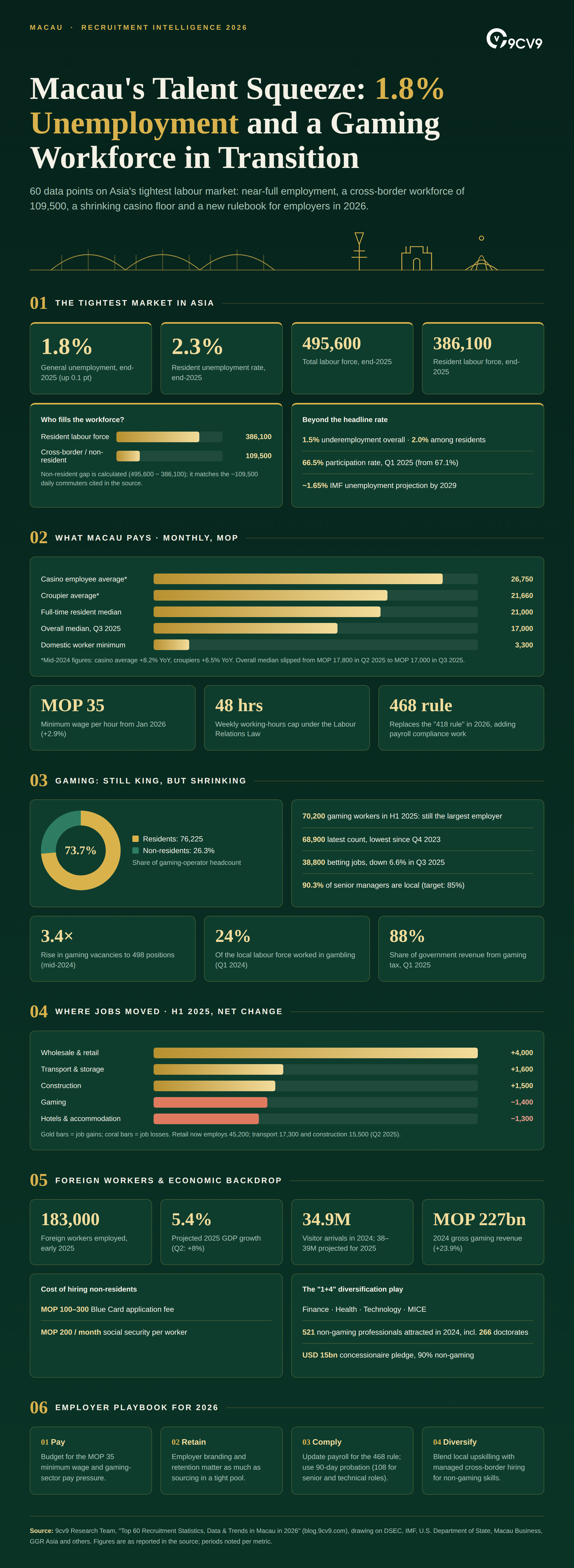
Compensation and employment regulation are changing alongside these structural shifts. Macau’s minimum wage increased to MOP 35 per hour from January 2026, while employers must also prepare for new labour compliance requirements such as the “468 rule.” These developments are likely to influence recruitment budgets, payroll systems, workforce planning and employee retention strategies throughout the year.
For recruiters, HR leaders and employers, understanding these changes is increasingly important. The following 60 Macau recruitment statistics, data points and trends provide a detailed picture of the labour market in 2026, covering unemployment, wages, workforce participation, gaming employment, foreign workers, talent shortages, sector growth and the economic forces shaping the future of recruitment in Macau.
Before we venture further into this article, we would like to share who we are and what we do.
About 9cv9
9cv9 is a business tech startup based in Singapore and in Asia, with a strong presence all over the world.
With over ten years of startup and business experience, and being highly involved in connecting with thousands of companies and startups, the 9cv9 team has access to some of the best talents in the world.
If your company needs recruitment and headhunting services to hire top-quality employees, you can use 9cv9 headhunting and recruitment services to hire top talents and candidates. Email us at hello@9cv9.com.
Top 60 Recruitment Statistics, Data & Trends in Macau in 2026
🔹 Unemployment & Labor Force
1. Macau’s general unemployment rate stood at a low 1.8% at the end of 2025, reflecting a marginally tighter labor market despite a 0.1 percentage-point uptick — signaling continued near-full employment conditions in the territory.
2. The local resident unemployment rate of 2.3% at end-2025 remains relatively contained by global standards, though it highlights a persistent gap between residents and the broader workforce in securing stable employment.
3. With a total labor force of 495,600 at end-2025, Macau’s workforce continues its gradual post-pandemic expansion, driven in part by a steady influx of commuter workers crossing from mainland China and Hong Kong.
4. A resident labor force of 386,100 within the territory underscores the extent to which Macau’s economy depends on cross-border and non-resident workers to meet total workforce demand.
5. Macau’s underemployment rate holding firm at 1.5% suggests that while nearly all workers are employed, a small but notable segment remains unable to secure sufficient working hours — a metric worth monitoring in sectors facing structural changes.
6. A local resident underemployment rate of 2.0% indicates that some Macau residents, particularly those in transitioning sectors like gaming, may be working fewer hours than desired as the economy diversifies.
7. The concentration of unemployed residents previously working in retail trade and gaming highlights the structural vulnerability of Macau’s labor market to sector-specific downturns, particularly as satellite casino closures continue.
8. The decline in first-time job seekers to 10.9% of unemployed residents suggests that Macau’s graduate and youth employment pipeline is performing relatively well, though tighter integration between education and industry remains important.
9. The approximately 109,500 SAR residents and non-resident workers commuting into Macau daily illustrates the territory’s heavy reliance on cross-border labor flows, making regional infrastructure and border policies critical HR considerations.
10. The IMF’s projection of Macau’s unemployment rate gradually declining to around 1.65% by 2029 signals long-term labor market stability, though this trajectory assumes continued economic growth and successful sector diversification.
🔹 Total Employment & Labor Force
11. Total employment of 372,700 persons in Q2 2025, with resident employment at 281,600, reflects a workforce composition where nearly one in four employed persons in Macau is a non-resident worker.
12. The drop of 5,600 total employed workers between end-2024 and mid-2025 warrants attention, as it indicates that job creation has not kept pace with economic output — a sign of productivity gains but also potential labor market tightening.
13. The Q1 2025 unemployment rate of 1.9% — the highest since May 2024 — alongside a decline of 3,100 total employed persons, suggests a soft patch in hiring activity at the start of the year rather than a structural crisis.
14. A labor force participation rate of 66.5% in Q1 2025 is solid by regional standards, though the slight decline from 67.1% may reflect early retirements, study pursuits, or discouraged workers temporarily exiting the labor market.
15. The nearly 10% rise in unemployed persons over the three months to February 2025 is notable but must be interpreted in context — with total unemployment at just 6,800 persons, even small absolute increases translate to large percentage swings.
🔹 Wages & Minimum Wage
16. The 2.9% minimum wage increase to MOP 35/hour from January 2026 reflects Macau’s effort to protect low-income workers’ purchasing power, though critics note it remains modest relative to the territory’s high cost of living.
17. The domestic worker minimum wage of MOP 3,300/month, set separately from the general minimum wage, acknowledges the distinct employment conditions of household workers — though labor advocates continue to push for parity.
18. The decline in median monthly wages from MOP 17,800 in Q2 2025 to MOP 17,000 in Q3 2025 may reflect a sectoral composition shift, including job losses in higher-paying gaming roles being replaced by lower-wage positions in retail or hospitality.
19. Median monthly earnings of MOP 21,000 for full-time resident employees working 35+ hours per week suggest that resident workers — particularly in gaming and professional services — continue to command a meaningful wage premium over the general workforce median.
20. The 8.2% year-on-year increase in average casino employee salaries to MOP 26,750 in mid-2024 reflects strong operator demand for experienced gaming staff, even as overall gaming headcount has gradually declined.
21. Croupier earnings rising 6.5% to MOP 21,660/month in mid-2024 is a positive sign for frontline gaming workers, though longer-term structural pressures — including electronic table adoption and satellite casino closures — may moderate wage growth going forward.
22. An average gross monthly salary of approximately MOP 17,000 across Macau’s workforce positions the territory competitively within Asia, though income inequality between gaming and non-gaming sector workers remains a policy challenge.
23. The 48-hour weekly working hours cap under Macau Labour Relations Law provides a standard baseline for worker protection, though enforcement and compliance in shift-based industries such as gaming and hospitality merit continued scrutiny.
🔹 Gaming Sector Employment
24. The gaming sector’s employment falling to 68,900 — its lowest level since Q4 2023 — reflects ongoing structural adjustments following satellite casino closures, rather than a demand-side collapse, as visitor numbers remain strong.
25. Three consecutive quarters of decline in betting-related jobs, down 6.6% to 38,800 workers in Q3 2025, signals that frontline gaming roles are shrinking as operators consolidate operations and automate certain table-side functions.
26. With approximately 70,600 individuals — around 24% of the local labor force — employed in gambling in Q1 2024, Macau’s economic dependence on gaming remains substantial, reinforcing the urgency of its diversification strategy.
27. Despite a reduction of 1,400 workers in the first half of 2025, gaming remains Macau’s single largest employer at 70,200 workers — a position that continues to give the sector outsized influence over wages, labor policy, and workforce planning.
28. Gaming job vacancies rising 3.4 times to 498 positions in mid-2024 reflects a complex labor dynamic: even as total headcount shrinks, specific skills — particularly in compliance, technology, and management — remain in short supply.
29. The legal requirement that only Macau residents can serve as croupiers and frontline gaming staff effectively protects local employment in the sector’s most visible roles, though it can also limit operator flexibility in tight labor market conditions.
30. The fact that 90.3% of middle and senior management positions across the six gaming operators are held by local residents — exceeding the government’s 85% threshold — indicates meaningful progress in “Macauisation” of casino leadership pipelines.
🔹 Non-Resident / Foreign Workers
31. Approximately 183,000 foreign workers employed in Macau as of early 2025 — excluded from the standard minimum wage — represent a significant dual-tier labor market dynamic that raises ongoing concerns around equitable treatment and worker protection.
32. Non-resident workers reaching a post-pandemic high of 182,307 in July 2024 signals robust employer demand for overseas labor, particularly in construction, domestic work, and hospitality — sectors where local residents are often unwilling or unavailable to fill vacancies.
33. Macau’s population growth to 688,300 at end-2024, largely attributable to the net addition of non-resident workers, underscores how workforce policy and demographic trends are deeply intertwined in this densely populated territory.
34. With over half of Macau’s total workforce comprised of non-local employees in gaming and tourism, the territory’s human capital strategy must simultaneously address local talent development and responsible management of foreign labor dependence.
35. Non-resident employees accounting for 26.3% of gaming operators’ combined workforce highlights that, despite residency-preference laws, foreign labor remains integral to casino back-office, hospitality, and support functions.
36. Resident workers comprising 73.7% (76,225) of gaming operator headcount demonstrates that Macauisation policies have had measurable impact, though sustaining this share will require continued investment in local vocational training and career development.
37. The relatively low Blue Card application fee of MOP 100–300 makes non-resident worker recruitment administratively accessible for employers, though the broader compliance burden — including annual renewals, quotas, and social contributions — remains significant.
38. The MOP 200/month social security contribution per non-resident worker provides a basic safety net contribution, though labor rights groups argue that non-residents deserve broader access to Macau’s social protection systems given their substantial economic contribution.
🔹 Sector-Specific Employment
39. The wholesale and retail trade sector adding 4,000 jobs in the first half of 2025 to reach 45,200 workers is a promising indicator of consumer-driven economic diversification, as Macau seeks to grow non-gaming commercial activity.
40. The hotel and accommodation sector shedding 1,300 jobs in H1 2025, despite strong visitor numbers, may reflect efficiency improvements or a shift toward leaner operating models rather than a decline in underlying tourism demand.
41. Transport and storage employment growing by 1,600 to 17,300 in Q2 2025 reflects increased logistics activity tied to rising visitor volumes and cross-border trade flows with the Greater Bay Area.
42. Construction employment rising by 1,500 to 15,500 in Q2 2025 suggests sustained capital investment in Macau’s built environment — likely driven by gaming operator non-gaming resort development commitments under their 2022 concession obligations.
43. Gaming tax contributing 88% of government revenue in Q1 2025 starkly illustrates Macau’s fiscal dependence on a single sector, making economic and employment diversification not merely desirable but a matter of long-term financial sustainability.
🔹 Talent Recruitment & Diversification
44. The attraction of 521 highly qualified non-gaming professionals — including 266 doctorate holders — through Macau’s 2024 talent programs is a small but symbolically important step toward building the knowledge economy workforce the territory’s 1+4 strategy envisions.
45. Scheduling a third round of the talent recruitment program by June 2025 demonstrates the government’s commitment to institutionalizing non-gaming talent attraction, though the pace of intake remains modest relative to the territory’s structural needs.
46. The consistent identification of skilled worker shortages as the primary operational constraint by foreign businesses in Macau underscores a critical mismatch between the territory’s education and training outputs and the economy’s evolving demand for non-gaming expertise.
47. The pledge of USD 15 billion in investment — 90% in non-gaming — by the six casino concessionaires provides a structural opportunity to create tens of thousands of new, diversified employment opportunities, provided implementation keeps pace with commitments.
48. An estimated USD 20 billion in US gaming investment in Macau over the past decade reflects the significant economic stakes American operators have in the territory’s labor market stability, regulatory environment, and long-term growth trajectory.
49. Macau’s 1+4 economic strategy targeting financial services, health, technology, and MICE sectors provides a clear framework for workforce development — though translating policy ambition into actual job creation requires sustained investment in skills infrastructure and talent pipelines.
🔹 Economic Context
50. Projected GDP growth of approximately 5.4% for full-year 2025 indicates a resilient economy, though the pace of growth has moderated from the sharp post-pandemic rebound of 2023–2024 as baseline effects normalize.
51. An 8% year-on-year GDP expansion in Q2 2025 — the strongest quarterly result since Q1 2024 — driven by a 13.6% rise in visitor arrivals, reinforces tourism’s central role in Macau’s economic and employment outlook.
52. Gross gaming revenue of MOP 226.78 billion in 2024, representing a 23.9% year-on-year rise, provided the fiscal foundation for Macau’s continued public sector hiring and social investment — though the pace of GGR growth is expected to moderate in 2025–2026.
53. H1 2025 GGR growth of 4.4% to MOP 118.77 billion indicates a gradual normalisation following the post-reopening surge, which may in turn temper gaming sector hiring activity as operators adopt more conservative workforce planning approaches.
54. A GDP per capita of MOP 587,922 in 2024 places Macau among the wealthiest economies in Asia, yet this wealth is unevenly distributed across a dual-tier labor market stratified by residency status, sector, and skill level.
55. Visitor arrivals of 34.93 million in 2024 — with projections of 38–39 million for 2025 — create a structural demand for hospitality, retail, and transport workers that can only be met through a combination of local upskilling and carefully managed non-resident worker intake.
🔹 Recruitment Environment & HR Trends 2026
56. Macau’s near-full-employment environment with a labor force participation rate exceeding 67% means that recruiters in 2026 are competing for a finite pool of available talent, making employer branding, retention strategies, and competitive compensation packages more important than ever.
57. The introduction of the “468 rule” in 2026 — replacing the “418 rule” — adds a new layer of HR compliance complexity for businesses, particularly in shift-heavy sectors, requiring investment in updated payroll systems and legal expertise to avoid inadvertent violations.
58. The ripple effects of the 2026 minimum wage hike to MOP 35/hour are most acutely felt in property management, cleaning, and security — sectors that must recalibrate pay scales and staffing models to remain viable while staying compliant.
59. The evolution of Macau’s recruitment agencies toward strategic talent consulting — emphasizing career development and organizational culture over salary alone — reflects a broader labor market maturation where candidates increasingly prioritize quality of work life alongside financial compensation.
60. Macau’s Labour Relations Law, establishing a 90-day general probation period and extending it to 108 days for senior and technical roles, gives employers meaningful flexibility to assess cultural and technical fit — a provision particularly valuable in a competitive hiring market where mis-hires carry significant cost.
Conclusion
Macau’s recruitment landscape in 2026 is defined by an unusual combination of near-full employment, persistent talent shortages, substantial reliance on non-resident workers and an economy gradually diversifying beyond gaming. With general unemployment at just 1.8% at the end of 2025, employers are competing within an exceptionally tight labour market where attracting qualified candidates is only part of the challenge. Retaining skilled employees is becoming equally important.
Gaming remains central to Macau’s employment ecosystem, but the sector is changing. Declining frontline gaming employment, greater automation and casino workforce restructuring are occurring alongside continued demand for specialised professionals in technology, compliance and management. Meanwhile, expanding employment in retail, transport, construction and other non-gaming industries demonstrates how Macau’s workforce requirements are becoming more diverse.
Foreign and cross-border workers will continue to play an essential role. Macau’s sizeable non-resident workforce helps employers address labour shortages across hospitality, construction, domestic services and casino support functions, while government talent programmes are attempting to attract highly qualified professionals capable of supporting longer-term economic diversification.
Employers must also adapt to higher employment costs and evolving regulation. The minimum wage increase to MOP 35 per hour from January 2026, combined with the introduction of the “468 rule,” places greater emphasis on payroll compliance, workforce planning and sustainable compensation strategies.
Ultimately, the 60 recruitment statistics and trends examined in this article point toward a Macau job market that is becoming more competitive, specialised and strategically important. Employers that invest in competitive compensation, employer branding, employee retention, local talent development and effective international recruitment will be better positioned to secure the skills they need as Macau’s economy evolves throughout 2026 and beyond.
If you find this article useful, why not share it with your hiring manager and C-level suite friends and also leave a nice comment below?
We, at the 9cv9 Research Team, strive to bring the latest and most meaningful data, guides, and statistics to your doorstep.
To get access to top-quality guides, click over to 9cv9 Blog.
To hire top talents using our modern AI-powered recruitment agency, find out more at 9cv9 Modern AI-Powered Recruitment Agency.
People Also Ask
What is the unemployment rate in Macau in 2026?
Macau entered 2026 with a general unemployment rate of 1.8% at the end of 2025, indicating near-full employment and a highly competitive recruitment market.
What is the resident unemployment rate in Macau?
Macau’s local resident unemployment rate stood at 2.3% at the end of 2025, slightly higher than the overall unemployment rate but still relatively low.
How large is Macau’s labour force?
Macau’s total labour force reached approximately 495,600 people at the end of 2025, including residents and workers commuting or entering from outside the territory.
How large is Macau’s resident labour force?
Macau had a resident labour force of approximately 386,100 at the end of 2025, highlighting the economy’s significant reliance on non-resident and cross-border workers.
What is the underemployment rate in Macau?
Macau’s overall underemployment rate stood at 1.5%, while the local resident underemployment rate was 2.0%, indicating relatively limited underemployment.
Is Macau experiencing a tight labour market in 2026?
Yes. Macau’s near-full-employment environment means recruiters compete for a limited pool of available workers, increasing the importance of compensation, retention and employer branding.
What is Macau’s labour force participation rate?
Macau recorded a labour force participation rate of 66.5% in Q1 2025, compared with 67.1% previously.
What is the minimum wage in Macau in 2026?
Macau’s minimum wage increased by 2.9% to MOP 35 per hour from January 2026, affecting labour costs and compensation planning for lower-paid positions.
What is the minimum wage for domestic workers in Macau?
The dataset reports a separate domestic worker minimum wage of MOP 3,300 per month, reflecting different employment conditions for household workers.
What is the median monthly wage in Macau?
Macau’s median monthly wage declined from MOP 17,800 in Q2 2025 to MOP 17,000 in Q3 2025, partly reflecting changes in the composition of employment.
How much do full-time resident employees earn in Macau?
Median monthly earnings for full-time resident employees working at least 35 hours per week were MOP 21,000, above the general workforce median.
How much do casino employees earn in Macau?
Average casino employee salaries reached MOP 26,750 per month in mid-2024, representing an 8.2% year-on-year increase.
How much do croupiers earn in Macau?
Croupier earnings reached approximately MOP 21,660 per month in mid-2024, representing a 6.5% increase.
How important is the gaming industry for employment in Macau?
Gaming remains Macau’s largest employer. The sector employed about 70,200 workers in the first half of 2025 despite a reduction of approximately 1,400 employees.
Are gaming jobs declining in Macau?
Yes. Gaming employment fell to around 68,900, while betting-related jobs declined 6.6% to 38,800 in Q3 2025, reflecting restructuring and operational changes.
Are casino job vacancies increasing in Macau?
Gaming job vacancies increased 3.4 times to 498 positions in mid-2024, showing that employers can face shortages in particular roles even while overall gaming employment declines.
Can foreign workers work as croupiers in Macau?
The dataset states that croupier and frontline gaming positions are reserved for Macau residents, protecting local employment in some of the gaming industry’s most visible roles.
How many foreign workers are employed in Macau?
Approximately 183,000 foreign workers were employed in Macau in early 2025, making non-resident labour an important component of the territory’s workforce.
Why does Macau rely on non-resident workers?
Non-resident workers help meet labour demand in industries such as construction, hospitality, domestic work and gaming support, where sufficient local workers may not be available.
What percentage of gaming operator employees are Macau residents?
Resident workers represented 73.7% of gaming operator headcount, or 76,225 employees, demonstrating the impact of Macauisation policies.
How many gaming managers are local Macau residents?
Local residents held 90.3% of middle and senior management positions across Macau’s six gaming operators, exceeding the government’s 85% target.
Which industries are creating jobs in Macau?
Wholesale and retail added about 4,000 jobs in H1 2025, while transport and storage added 1,600 and construction employment increased by approximately 1,500.
Is hospitality employment growing in Macau?
Not across every segment. Hotel and accommodation employment declined by about 1,300 jobs in H1 2025 despite strong visitor numbers, suggesting leaner staffing or efficiency improvements.
What are the biggest recruitment challenges in Macau in 2026?
Employers face a limited talent pool, skilled-worker shortages, wage pressures, regulatory changes and competition for qualified workers across gaming and emerging non-gaming sectors.
What skills are in demand in Macau?
The statistics indicate demand for specialised talent in areas such as technology, compliance and management, alongside skilled professionals needed for Macau’s expanding non-gaming economy.
How is Macau attracting international talent?
Macau’s talent programmes attracted 521 highly qualified non-gaming professionals in 2024, including 266 doctorate holders, supporting its push toward a more diversified economy.
How is Macau diversifying its job market?
Macau’s 1+4 economic strategy targets financial services, health, technology and MICE industries, creating a framework for reducing long-term dependence on gaming employment.
What is the 468 rule in Macau in 2026?
The 468 rule replaces the previous 418 rule in 2026 and introduces new HR compliance considerations, particularly for employers operating shift-heavy workforces.
What is the outlook for recruitment in Macau in 2026?
Recruitment is expected to remain competitive because of low unemployment, talent shortages, economic diversification, changing gaming employment and continued demand for non-resident labour.
What recruitment strategies should Macau employers prioritize in 2026?
Employers should prioritize competitive compensation, retention, employer branding, workforce development and effective talent pipelines to compete in Macau’s tight labour market.
Sources
DSEC — Statistics and Census Service
U.S. Department of State
International Monetary Fund
Macau Economic Association
Macau Daily Times
Macao News
Macau Business
Asia Gaming Brief
FocusGN
World Casino Directory
GGR Asia
Mundo Video
Lexology
Trading Economics
FX Empire
Statista
Wage.is
WageIndicator
Remotepeople
Acclime Macau
Links International
Taylor & Francis Online
9CV9 Blog
Galaxy APAC / Galaxy Payroll