Key Takeaways
- Strong Fire Department Software Market Growth: The global fire department software market is projected to reach USD 3.23 billion in 2026 and USD 4.96 billion by 2030, driven by rising demand for emergency management software, digital incident reporting, and public safety technology.
- Cloud Computing and AI Transforming Fire Department Operations: Cloud-based fire department software accounted for approximately 62% of the market in 2025, while AI-powered analytics, computer-aided dispatch (CAD), automation, and mobile applications are reshaping emergency response and operational efficiency.
- Workforce Challenges and Regulatory Changes Driving Software Adoption: With approximately 29,452 U.S. fire departments, ongoing firefighter staffing shortages, increasing wildfire risks, and the 2026 transition from NFIRS to NERIS, demand for firefighter scheduling, records management, and compliance software continues to grow.
Fire department software is transforming emergency response in 2026 through AI, cloud computing, and digital incident management. The global fire department software market is projected to reach USD 3.23 billion in 2026 and USD 4.96 billion by 2030. Explore 105 key statistics covering market growth, firefighter management, emergency dispatch, and public safety technology trends.
The global fire department software industry is undergoing a significant digital transformation in 2026, driven by growing demand for faster emergency response, improved incident management, cloud-based solutions, and artificial intelligence (AI). As fire departments face increasing operational complexity, workforce shortages, stricter reporting requirements, and rising public safety expectations, modern fire department software has become an essential tool for managing emergency services efficiently.
According to industry market research, the global fire department software market is projected to grow from USD 2.89 billion in 2025 to USD 3.23 billion in 2026, representing an annual increase of approximately 11.5%. The market is further forecast to reach USD 4.96 billion by 2030, supported by investments in computer-aided dispatch (CAD), fire records management systems (RMS), emergency response software, and advanced analytics. Although market estimates vary across research providers, the overall outlook indicates sustained growth in fire service technology adoption.

North America continues to dominate the fire department software market, accounting for an estimated 38% of global market share in 2025. Meanwhile, the Asia-Pacific region is expected to experience some of the fastest growth as governments modernize emergency response infrastructure and invest in smart city technologies. Cloud-based fire department software is also gaining traction, representing approximately 62% of the market in 2025, reflecting the increasing preference for scalable, accessible, and cost-effective digital solutions.
The importance of fire department management software becomes even clearer when examining the scale of emergency response operations. The United States has approximately 29,452 fire departments and more than one million firefighters, with volunteer firefighters representing a substantial majority of the workforce. These agencies collectively handle millions of emergency incidents annually, including structural fires, emergency medical services, rescue operations, hazardous materials incidents, and natural disasters.

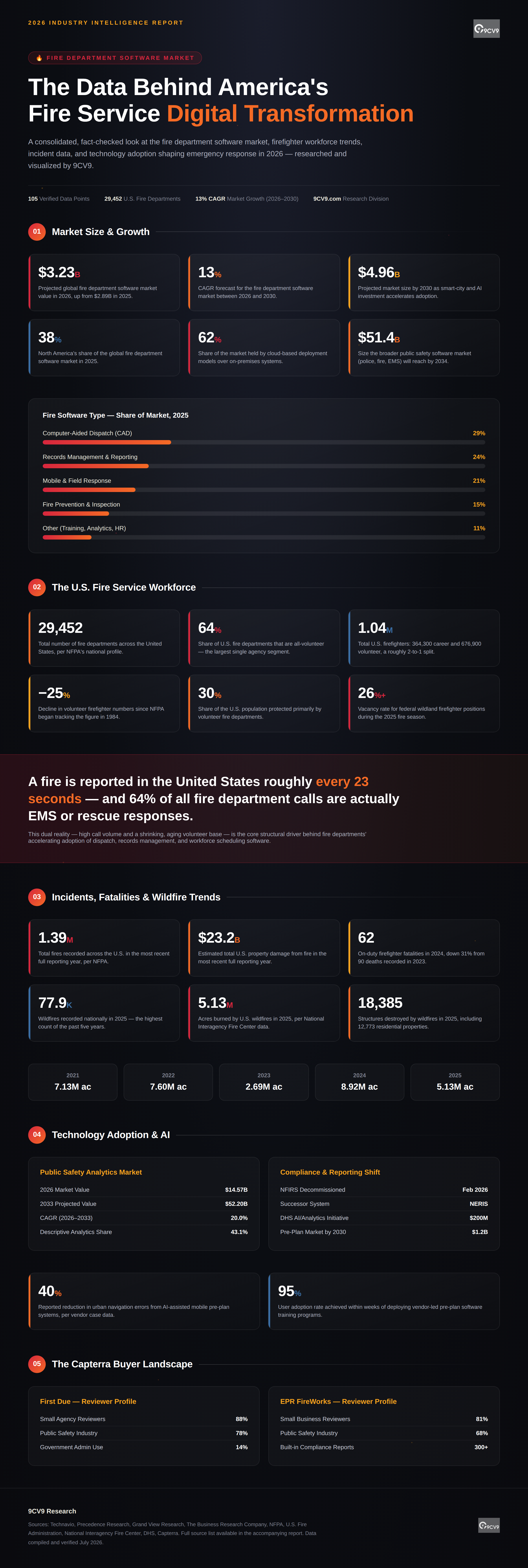
Workforce challenges are another major factor accelerating software adoption. Approximately 64% of U.S. fire departments operate entirely with volunteer firefighters, while declining volunteer participation and staffing shortages are creating additional pressure on emergency services. Consequently, fire departments are increasingly exploring automated firefighter scheduling software, personnel management systems, digital training platforms, equipment tracking solutions, and mobile communication tools to improve operational efficiency.
At the same time, artificial intelligence, predictive analytics, geographic information systems (GIS), and mobile-first applications are reshaping how fire departments manage emergencies. Modern fire department software platforms increasingly incorporate automated incident reporting, real-time resource allocation, predictive risk assessment, digital pre-incident planning, and performance monitoring capabilities. These technologies can help emergency response organizations make better-informed decisions, reduce administrative workloads, and improve coordination between dispatch centers and frontline responders.
Regulatory modernization is also influencing fire department software trends in 2026. The transition from the National Fire Incident Reporting System (NFIRS) to the National Emergency Response Information System (NERIS) is encouraging U.S. fire departments to evaluate their existing reporting infrastructure and adopt compatible records management solutions. This shift highlights the growing importance of standardized data collection, interoperability, regulatory compliance, and integrated emergency management platforms.
Beyond traditional firefighting operations, rising wildfire activity is creating additional demand for specialized software solutions. The United States recorded approximately 77,850 wildfires in 2025, burning more than 5.1 million acres. These incidents demonstrate the importance of wildfire management software, GIS-based risk mapping, resource coordination systems, and real-time emergency communication technologies.
For fire chiefs, emergency management professionals, government agencies, public safety technology providers, software developers, and industry investors, understanding the latest fire department software statistics is essential for making informed decisions about technology investments, operational modernization, and long-term strategic planning.
This comprehensive guide explores the Top 105 Fire Department Software Statistics, Data & Trends in 2026, examining global market size, industry growth forecasts, cloud software adoption, AI-powered emergency response, firefighter workforce demographics, incident reporting, safety statistics, wildfire management technology, and regulatory developments.
By analyzing these fire department software industry statistics and emerging technology trends, organizations can gain valuable insights into how digital innovation is transforming firefighting operations, strengthening emergency preparedness, and shaping the future of fire and rescue services in 2026 and beyond.
Before we venture further into this article, we would like to share who we are and what we do.
About 9cv9
9cv9 is a business tech startup based in Singapore and Asia, with a strong presence all over the world.
With over ten years of startup and business experience, and being highly involved in connecting with thousands of companies and startups, the 9cv9 team has listed some of the top and best companies/tools in this review.
If you like to get your company listed in our top B2B software reviews, check out our world-class 9cv9 Media and PR service and pricing plans here.
Top 105 Fire Department Software Statistics, Data & Trends in 2026
Market Size & Growth
- The global fire department software market is projected to grow by USD 976.1 million between 2026 and 2030, expanding at a 13% CAGR. This double-digit growth trajectory signals accelerating digital transformation across fire agencies of every size as departments move away from paper-based recordkeeping toward integrated platforms.
- North America is forecast to account for 35.1% of the fire department software market’s growth during 2026-2030. The region’s dominance reflects mature regulatory frameworks like NFPA 1221 and deep penetration of cloud-based public safety technology among U.S. and Canadian fire agencies.
- The large-enterprise segment of the fire department software market was valued at USD 636.6 million in 2024. Big metro fire departments with complex multi-station operations are driving disproportionate software spend compared to smaller volunteer agencies.
- The fire department software market is expected to climb from USD 2.89 billion in 2025 to USD 3.23 billion in 2026, an 11.5% year-over-year increase. This steady expansion underscores how urgently fire agencies are prioritizing digital recordkeeping and dispatch modernization.
- Analysts project the fire department software market will reach USD 4.96 billion by 2030, growing at an 11.4% CAGR. Smart city investment and AI-enabled emergency response tools are cited as the primary catalysts behind this forecasted expansion.
- A separate market forecast pegs the fire department software industry at USD 1.25 billion in 2025, rising to USD 1.39 billion in 2026. Even under more conservative valuation methodologies, the trajectory toward multi-billion-dollar scale by the mid-2030s remains consistent across research firms.
- The same report forecasts the market reaching approximately USD 3.77 billion by 2035, at an 11.70% CAGR from 2026. Long-range projections reinforce that fire department software is shifting from a niche public-sector tool to a mainstream vertical SaaS category.
- North America led the fire department software market with a 38% share in 2025. Vendor density, along with strong government funding for public safety modernization, keeps North America the clear frontrunner in adoption.
- Asia Pacific is projected to post the fastest CAGR in fire department software adoption through 2035. Rapid urbanization and rising investment in emergency infrastructure are pushing APAC fire agencies to leapfrog directly into cloud-native systems.
- Cloud-based deployment held 62% of the fire department software market share in 2025. The preference for cloud delivery reflects fire departments’ need for anytime, anywhere access to incident data without maintaining costly on-premises servers.
- Computer-aided dispatch (CAD) systems held the largest software-type share at 29% in 2025. Dispatch remains the mission-critical core of fire department technology stacks because it directly affects response time and life-safety outcomes.
- Mobile and field response applications are projected to grow at the fastest CAGR of any software type between 2026 and 2035. Firefighters increasingly expect real-time access to pre-incident plans, hydrant data, and unit status directly from in-cab and handheld devices.
- Large fire departments and municipal agencies held 55% of the market by organization size in 2025. Bigger budgets and higher call volumes make large agencies the earliest and heaviest adopters of enterprise-grade fire software.
- The medium and small fire department segment is expected to grow at the fastest CAGR through 2035. Falling SaaS pricing and simplified onboarding are finally making modern software accessible to volunteer and combination departments that previously relied on paper.
- Fire and emergency response agencies represented 68% of the end-user market in 2025. This concentration confirms that frontline responding agencies, not just administrative offices, are the primary buyers of fire software.
- Dispatch and incident management held the highest functionality share at 31% in 2025. Incident lifecycle management from call intake through after-action reporting remains the functional backbone that vendors compete hardest to own.
- Performance analytics and reporting is projected to be the fastest-growing functionality segment through 2035. As departments face growing accountability pressure, the ability to turn incident data into dashboards and compliance reports is becoming a key purchasing driver.
- North America’s fire department software market was valued at USD 475 million in 2025 and is projected to reach USD 1.45 billion by 2035 at an 11.82% CAGR. This regional forecast alone represents roughly a threefold expansion within a decade.
- A separate industry estimate values the fire department software market at USD 1.756 billion in 2024, rising to USD 3.055 billion by 2035. Divergent estimates across research houses (ranging from roughly $1 billion to nearly $5 billion by the mid-2030s) still uniformly point to sustained, multi-year growth.
- The fire detection software segment captured the largest share of the broader fire software market at 40.7% in 2022. Camera- and sensor-based detection tools that flag flame, smoke, and heat signatures remain the most heavily adopted category historically.
- The fire risk analysis segment is forecast to grow at a 12.7% CAGR, among the fastest of any fire software category. Building owners and safety professionals are increasingly relying on software-driven hazard modeling rather than manual inspection alone.
- Cloud-based fire department software accounted for 63.4% of deployment share as far back as 2022. The cloud-first preference in fire services predates the current AI wave, showing this is a mature, not emerging, shift.
- The on-premises segment is still expected to grow at an 11.1% CAGR despite cloud dominance. Some larger municipal departments with strict data-residency or security mandates continue to invest in on-premises infrastructure alongside cloud tools.
- The public safety software market broadly (covering police, fire, and EMS) was valued at USD 18.2 billion in 2025, rising to roughly USD 20.3 billion in 2026. Fire department software sits inside this much larger public safety technology ecosystem that is scaling quickly across all first-responder disciplines.
- The public safety software market is projected to reach USD 51.4 billion by 2034, growing at an 11.3% CAGR. This represents a 182% increase in market value over a nine-year window, reflecting just how underpenetrated cloud and AI tools still are in public-sector emergency services.
Let me continue researching a few more specific technology and Capterra data points before compiling the rest.
I have enough data. Let me now compile the complete remaining stats (26-105) and finish the chat response.
Fire Departments, Personnel & Demographics (U.S.)
- There are an estimated 29,452 fire departments in the United States, per NFPA’s most recent U.S. Fire Department Profile. This vast, fragmented buyer landscape — spanning tiny volunteer squads to major metro departments — explains why fire software vendors must build flexible, modular platforms rather than one-size-fits-all systems.
- 64% of U.S. fire departments (18,873 departments) are comprised solely of volunteer firefighters. Software vendors targeting this market must prioritize low-cost, easy-onboarding tools since volunteer departments typically operate with minimal IT budgets and staff.
- Only 9% of U.S. fire departments (2,785 departments) are all-career departments. The overwhelming majority of the addressable market for fire software is volunteer or combination departments, not big-city career agencies.
- 8% of departments are mostly-career and 18% are mostly-volunteer, forming a “combination” tier that spans nearly a third of all agencies. These hybrid departments create unique software requirements, needing tools that manage both paid-staff scheduling and volunteer call rosters simultaneously.
- The U.S. had approximately 1,041,200 firefighters as of the NFPA’s most recent full profile, split between 364,300 career (35%) and 676,900 volunteer (65%) firefighters. This 2-to-1 volunteer-to-career ratio underscores why user-friendly, mobile-first software design is critical for driving adoption among part-time responders.
- Roughly 89,600 U.S. firefighters were female, representing about 9% of the total firefighting workforce. As departments modernize their HR and scheduling software, many are also using these platforms to track diversity and inclusion recruitment metrics.
- Volunteer firefighter numbers have fallen roughly 25% since 1984, when NFPA began tracking the figure at 897,750. This long-run decline is one of the strongest structural tailwinds for fire software adoption, since agencies are turning to technology to do more with fewer people.
- The combined career-and-volunteer firefighter workforce was about 62,000 smaller in 2022 than it was in 2010. Persistent workforce contraction is pushing departments to invest in automation for scheduling, dispatch, and reporting to offset staffing gaps.
- NFPA data shows the U.S. volunteer firefighter count fell to about 635,000 in 2023, down from roughly 677,000 just three years earlier. This accelerating decline highlights urgency for recruitment- and retention-focused software modules now being embedded into fire management platforms.
- Volunteer participation nationally has reportedly hit its lowest rate in roughly 40 years. Many software vendors are now marketing mobile-first, low-friction scheduling and alerting tools specifically as retention aids for stretched volunteer forces.
- New York State’s volunteer firefighter rolls have fallen from roughly 120,000 to under 80,000 over the past two decades. State-level declines of this magnitude are prompting legislative pushes for volunteer stipends alongside software-driven efficiency gains.
- The U.S. Forest Service reported more than 5,100 unfilled wildland firefighting positions in 2025, a vacancy rate above 26% during peak wildfire season. Chronic understaffing in federal wildland firefighting is amplifying reliance on resource-tracking and dispatch software to stretch limited crews further.
- The Department of Defense has operated below minimum civilian firefighter staffing levels since 2019. Persistent federal staffing shortfalls reinforce why efficiency-focused software (automated scheduling, digital checklists, fleet tracking) has become a budget priority rather than a luxury.
- Approximately 30% of the U.S. population is protected primarily by volunteer fire departments, concentrated in rural and suburban areas. This sizable population share depends on departments that are the most resource-constrained and therefore the most in need of affordable SaaS tools.
- 82% of all U.S. fire departments are classified as volunteer or mostly-volunteer, per NFPA 2020 data. With such an overwhelming share of agencies falling into this budget-sensitive tier, freemium and tiered-pricing software models have become a common go-to-market strategy for vendors.
Fire Incidents, Calls & Response Data
- U.S. fire departments responded to approximately 26,959,000 incident runs in a recent full year, per USFA data. The sheer scale of annual call volume is the core dataset that fire records-management software must ingest, organize, and report on.
- 64% of all fire department calls required emergency medical services (EMS) or rescue response, not fire suppression. This confirms that most fire department software today functions as much as an EMS operations platform as a firefighting tool.
- Only about 4% of all reported fire department runs were fire-related. The low proportion of “true fire” calls relative to total call volume is a major reason software platforms have expanded well beyond dispatch into medical, hazmat, and rescue documentation.
- NFPA estimates approximately 490,500 structure fires occur annually in the United States. Structure fire data remains the single most safety-critical incident category that fire software must capture accurately for NFIRS/NERIS compliance.
- An estimated 173,000 vehicle fires occur annually across the U.S. Vehicle fire tracking is a standard module in nearly all major fire records-management systems today.
- Approximately 686,500 “outside and other” fires — including brush, rubbish, and vegetation fires — occur annually. This category has grown in software relevance as wildland-urban interface risk rises, pushing vendors to build dedicated outdoor/vegetation fire reporting tools.
- NFPA reports approximately 1.39 million total fires in the United States in a recent full year. This headline figure is the anchor statistic fire departments cite most often when justifying investment in better incident reporting and analytics software.
- These fires caused an estimated 3,670 civilian fire deaths and 13,350 civilian fire injuries in the same period. Every one of these fatalities and injuries must be documented through NFIRS-compliant software, driving continued demand for accurate reporting tools.
- Total property damage from U.S. fires was estimated at USD 23.2 billion in a recent year. Insurers, municipalities, and federal grant programs increasingly require software-generated loss documentation to support this level of damage assessment.
- U.S. fire departments respond to a fire somewhere in the country roughly every 23 seconds, according to NFPA. This oft-cited statistic captures why real-time dispatch and CAD software integration is treated as mission-critical infrastructure, not optional IT.
- Structure fires represent about 35% of all fires but account for 77% of all fire deaths. This disproportionate risk concentration is why pre-incident planning software — which gives responders building layouts and hazard data before arrival — has become a priority investment for departments.
- The U.S. has averaged roughly 500,000 structure fires per year over the last decade, down 42% from the roughly 860,000 annual average recorded in the 1980s. Long-term declines in structure fires reflect, in part, improved code enforcement and inspection software that flags hazards before they ignite.
- The U.S. has averaged about 3,500 fire deaths annually over the 2013–2022 period. This mortality baseline is the primary metric fire chiefs use to benchmark whether new software and process investments are translating into safer outcomes.
- Structure fires cause an average of 2,870 deaths annually, or about 82% of all U.S. fire fatalities. These figures reinforce why structure-fire pre-planning and rapid dispatch remain the highest software investment priority for most departments.
- When limited to fire-specific incidents, structure fires make up 31% of all fire-type calls, per ESO’s analysis of over 4.5 million incidents. This proprietary vendor dataset illustrates how software companies themselves are becoming major sources of fire service benchmarking data.
- Outside rubbish fires account for 24% of fire-type incidents, and natural vegetation fires account for 22%. Together with structure and vehicle fires, these four categories make up the core incident taxonomy that virtually every fire RMS platform is built around.
- Residential properties account for 80% of all fire calls, according to ESO’s incident data. This concentration explains why most fire prevention and inspection software modules are weighted heavily toward residential property risk profiles.
- Houston Fire Department alone responded to 416,122 total incidents in 2024, of which 332,206 (nearly 80%) were EMS calls. Large metro departments generate incident volumes so large that manual, paper-based systems are functionally impossible to sustain.
- Houston’s 90th-percentile first-response time was 11 minutes 5 seconds for fire incidents and 13 minutes 57 seconds for EMS incidents in 2024. Response-time benchmarking of this kind is now a standard analytics output generated automatically by modern CAD and RMS software.
- In Texas alone, roughly 946 fire departments reported data to the state’s incident reporting system in a recent year. State-level fire incident reporting systems depend on standardized software submissions from local departments to compile accurate statewide statistics.
Firefighter Safety, Injuries & Fatalities
- NFPA recorded 62 on-duty firefighter fatalities in 2024, a 31% decrease from the 90 fatalities reported in 2023. This improvement is frequently attributed in part to better safety data tracking and equipment-maintenance software that flags hazards before they cause harm.
- The 2024 fatality count was tied for the fourth-fewest since NFPA began its annual study in 1977. Long-term downward trends in firefighter deaths give fire chiefs a data-driven case for continued investment in safety-focused technology.
- Overexertion or strain was the leading cause of firefighter deaths in 2024, responsible for 40 fatalities (65% of the total). Wellness and health-monitoring modules are increasingly bundled into modern fire workforce software to flag cardiac and overexertion risk factors.
- Heart attacks accounted for nearly half of all firefighter fatalities in 2024, at 30 deaths (48%). This cardiac risk concentration has driven several fire software vendors to add fitness and health-tracking dashboards as standard features.
- Of the 51 on-duty firefighter deaths in 2024, 19 were volunteers and 26 were career firefighters. Both firefighter categories face significant on-the-job risk, reinforcing the need for safety software that serves career and volunteer members equally.
- NFPA recorded 53,575 total firefighter injuries in 2024, of which only 30% (16,275) occurred on the fireground. The majority of injuries occurring off the fireground — in training, at the station, or during other duties — is prompting broader safety-tracking software beyond just incident response.
- The firefighter injury rate works out to roughly one injury for every 85 fires responded to, based on 2024 NFPA data. Injury-per-incident benchmarking like this is now automatically calculated within many fire RMS analytics dashboards.
- 2024 recorded the highest civilian home fire fatality rate in recorded history, at one civilian death per 100 home fires. This alarming civilian risk trend is intensifying pressure on fire prevention and inspection software adoption to catch hazards before fires start.
Wildfire & Wildland Technology Trends
- The U.S. saw 77,850 wildfires in 2025, burning 5,131,474 acres, according to the National Interagency Fire Center. Wildfire incident volume significantly above the 10-year average is driving increased investment in wildland fire tracking and resource-coordination software.
- The 2025 wildfire count was notably higher than the five-year average of 61,680 and 10-year average of 62,435 wildfires. Elevated fire frequency, even with below-average acreage burned, illustrates the growing complexity that wildland dispatch software must manage.
- A total of 18,385 structures were reported destroyed by wildfires in 2025, including 12,773 residential properties. Structure-loss tracking during wildfire events has become a key output of modern incident management systems used by federal and state agencies.
- The National Interagency Coordination Center processed over 660,000 resource requests in 2025, an above-average volume. Resource-ordering software that matches personnel, aircraft, and equipment to active incidents is now core infrastructure for wildland firefighting coordination.
- Since 2000, the U.S. has averaged 70,025 wildfires and 7.0 million burned acres annually. This long-run baseline is the benchmark against which every fire season’s software-generated statistics are measured by federal agencies.
- 89% of wildfires from 2018–2022 were human-caused, according to congressional research. Human-caused fire prevention campaigns increasingly rely on GIS and risk-mapping software to identify and target high-risk areas for public education.
- Extreme wildfire activity has more than doubled worldwide over the last 21 years, per public safety technology analysts. This dramatic increase is a leading driver behind AI-powered wildfire prediction tools now being integrated into fire department software suites.
- The Forest Service lost at least 1,800 fire-qualified “red-carded” employees in 2025 through layoffs and retirements. Losses of this scale in specialized wildland firefighting personnel are accelerating the push toward automation and remote-monitoring technology to fill capability gaps.
Technology Adoption: CAD, Cloud, Mobile & AI
- The computer-aided dispatch (CAD) software segment held a 63.5% revenue share of the broader CAD market in 2024. Software remains the dominant CAD spending category over hardware, reflecting the ongoing shift toward subscription-based public safety technology.
- Early GIS-enabled CAD adopters, such as the Los Angeles County Sheriff’s Department, achieved 20-30% faster dispatch times through spatial querying. This historical case remains one of the most frequently cited proof points for the operational ROI of geographic dispatch technology.
- Text-to-911 capability was approved by the FCC in 2012 as part of the broader Next Generation 911 (NG911) modernization effort. NG911 compliance continues to be a major driver of CAD software upgrades across fire and emergency dispatch centers nationally.
- Modern CAD platforms increasingly incorporate AI for predictive analytics and automated incident triage, according to public safety technology researchers. AI-assisted dispatch represents one of the fastest-evolving frontiers in fire department software development.
- The public safety analytics market was valued at USD 14,569.4 million in 2026 and is projected to reach USD 52,204.9 million by 2033, a 20.0% CAGR. This analytics-specific market segment is growing even faster than the broader public safety software category, reflecting rising demand for data-driven decision-making tools.
- Descriptive analytics dominates the public safety analytics market with a 43.1% share. Most fire departments today are still primarily using software to understand what already happened, rather than to predict what will happen next — signaling substantial headroom for predictive tool adoption.
- Cloud-based deployment has captured the largest share of the public safety analytics market, driven by lower upfront costs and scalability. The affordability of cloud subscriptions relative to on-premises servers is a key reason small and volunteer fire departments can now access enterprise-grade analytics.
- The U.S. Department of Homeland Security announced a USD 200 million initiative in 2024 to accelerate AI and data analytics adoption across public safety agencies. Federal funding of this scale signals long-term policy support for continued public safety technology modernization, including in fire services.
- AI capabilities are now embedded throughout leading fire RMS platforms to automate documentation, optimize scheduling, and support real-time decision-making, per vendor product data. AI is transitioning from an experimental add-on to a standard, expected feature across leading fire department software products.
- AI-assisted mobile pre-plan systems have been reported to reduce navigation errors by up to 40% in urban settings, according to vendor case data. Faster, more accurate wayfinding during emergency response is one of the clearest, most measurable benefits software vendors point to when justifying pre-planning software investment.
- EPR FireWorks’ pre-plan implementation reportedly achieves 95% user adoption within weeks when deployed with vendor-led training. High adoption rates like this matter because software that firefighters don’t actually use in the field provides no operational safety benefit regardless of its features.
- A 2025 market estimate values the fire pre-planning software segment specifically at USD 450 million, projected to reach USD 1.2 billion by 2030. Pre-incident planning is emerging as one of the fastest-growing niche categories within the broader fire department software space.
- Legacy data migration during software switch-overs carries an average loss rate of roughly 20%, according to industry benchmarking. This meaningful data-loss risk is why fire departments are increasingly demanding professional migration support as a standard part of software vendor contracts.
- The average initial pre-planning software budget for a mid-sized fire department is approximately USD 15,000, often offset through grant funding. Grant-subsidized purchasing remains one of the most important financing mechanisms enabling smaller departments to afford modern software.
Government IT, Regulatory & Compliance Drivers
- NFPA Standard 1221 mandates specific record-keeping requirements that directly shape fire department software design. Compliance-driven procurement, rather than discretionary IT spending, is one of the most reliable long-term demand drivers in this market.
- NFPA 1620 governs pre-incident planning standards that most modern fire pre-planning software modules are explicitly built to satisfy. Vendors that can demonstrate NFPA 1620 compliance gain a meaningful competitive edge in procurement evaluations.
- The National Fire Incident Reporting System (NFIRS) was officially decommissioned in February 2026, with fire departments transitioning to the newer NERIS system. This nationwide reporting system migration is triggering a fresh wave of software upgrades and vendor re-certifications across virtually every reporting-compliant fire department in the country.
- eNFIRS and its associated Data Warehouse tools became unavailable to all users following the February 2026 decommissioning. Departments relying on legacy NFIRS-integrated software have had to accelerate migration timelines to remain compliant with national incident reporting requirements.
- NERIS onboarding dashboards now track the percentage of fire departments that have begun the transition process nationally. Real-time national tracking of NERIS adoption illustrates how deeply intertwined federal reporting infrastructure has become with individual department software choices.
- First Due’s platform alone reports managing NERIS, ePCR, and more than a dozen other compliance-linked modules from a single login. The consolidation of numerous previously separate compliance requirements into unified platforms reflects the broader industry shift toward all-in-one fire RMS suites.
Capterra Marketplace & Buyer Insights
- Capterra has verified over 2.5 million software reviews across its platform, spanning all business software categories including fire department software. This scale of independently verified reviews gives fire department buyers a level of vendor transparency that was unavailable just a decade ago.
- Capterra’s Fire Department Software directory lists dozens of actively reviewed products, including First Due, ESO Fire RMS, EPR FireWorks, Emergency Reporting, Responder360, and Rhodium Incident Management Suite. The sheer number of viable, reviewed vendors indicates a maturing, competitive market rather than a category dominated by one or two legacy players.
- First Due reports that 88% of its Capterra reviewers come from small public safety agencies, with 78% specifically from the Public Safety industry. This reviewer composition confirms that small and mid-sized fire agencies, not just major metros, are now the primary buyers driving fire software category growth.
- EPR FireWorks reports that 81% of its reviewers represent small businesses, with 68% specifically from Public Safety. Consistent small-agency representation across multiple leading vendors reinforces that affordability and ease of use are now central competitive battlegrounds in this category.
- Capterra’s Fire Department Software buyer’s guide highlights incident reporting, resource management, GPS/mapping integration, and training/certification tracking as the four most sought-after core features. These four capabilities function as the effective “table stakes” feature set that any credible fire department software product must offer today.
- Capterra allows filtering fire department software listings by deployment type, including Windows, Mac, and free-tier options, reflecting the category’s platform diversity. The availability of free-tier fire software listings on Capterra shows vendors actively courting the large volunteer-department segment with lower-cost entry points.
- EPR FireWorks advertises more than 300 built-in compliance and business-intelligence reports as a core platform feature. The scale of pre-built reporting templates now offered by leading vendors reflects how central automated compliance reporting has become to competitive differentiation.
- First Due’s platform integrates with third-party tools including EagleView, ESRI ArcView, and First Arriving Dashboards, per its Capterra profile. Deep third-party integration capability, especially with mapping and imagery tools, is increasingly treated as a baseline expectation rather than a premium differentiator.
- Fire and EMS agencies across the U.S. and Canada represent First Due’s core customer base, with an additional 14% coming from broader Government Administration use cases. The modest but real spillover into general government administration illustrates how fire-specific RMS platforms are beginning to serve adjacent public-sector needs beyond pure fire and EMS operations.
Conclusion
The latest fire department software statistics, data, and trends in 2026 highlight an industry experiencing significant technological transformation, driven by growing demand for operational efficiency, emergency response modernization, regulatory compliance, and data-driven decision-making. As fire departments navigate increasing emergency call volumes, workforce shortages, budget constraints, and evolving public safety challenges, digital solutions are becoming essential components of modern fire and rescue operations.
According to industry forecasts, the global fire department software market is projected to reach USD 3.23 billion in 2026 and approximately USD 4.96 billion by 2030, reflecting sustained investment in emergency management technology. Although market valuations differ across research providers, the overall growth trajectory demonstrates increasing demand for fire records management systems (RMS), computer-aided dispatch (CAD) software, firefighter scheduling platforms, incident reporting tools, and integrated public safety solutions.
One of the most significant fire department software trends in 2026 is the continued transition toward cloud-based platforms. With cloud deployment accounting for approximately 62% of the market in 2025, fire departments are increasingly prioritizing scalable, accessible, and cost-effective software solutions. Cloud technology enables emergency response organizations to centralize operational information, improve communication between stations, and provide firefighters with real-time access to critical incident data.
Artificial intelligence (AI), predictive analytics, and automation are also emerging as important drivers of fire service digital transformation. AI-powered fire department software can support incident classification, resource allocation, emergency risk assessment, and administrative reporting. Meanwhile, geographic information systems (GIS), mobile applications, and digital pre-incident planning tools are helping departments improve situational awareness and coordinate emergency response activities more effectively.
Workforce management remains another critical area of software investment. With approximately 29,452 fire departments operating across the United States and volunteer firefighters representing a substantial proportion of the workforce, recruitment challenges, personnel shortages, and operational scheduling requirements continue to influence technology purchasing decisions. Firefighter management software, automated scheduling systems, training management platforms, and digital communication tools offer opportunities to reduce administrative burdens and strengthen workforce coordination.
Regulatory developments are further accelerating software modernization. The transition from the National Fire Incident Reporting System (NFIRS) to the National Emergency Response Information System (NERIS) in 2026 represents an important shift toward more standardized and comprehensive emergency incident reporting. Fire departments must increasingly evaluate software compatibility, data accuracy, interoperability, and reporting capabilities when selecting technology providers.
At the same time, growing wildfire risks and complex emergency incidents are expanding the role of specialized fire management software. With approximately 77,850 wildfires recorded in the United States in 2025, technologies supporting wildfire monitoring, predictive risk mapping, equipment tracking, and multi-agency resource coordination are becoming increasingly relevant to emergency preparedness and disaster response strategies.
For fire chiefs, municipal governments, emergency management agencies, public safety professionals, and fire department software vendors, these industry statistics provide valuable insights into emerging investment priorities and operational challenges. Organizations evaluating fire department software in 2026 should prioritize solutions that offer reliable incident reporting, seamless system integration, cybersecurity safeguards, mobile accessibility, regulatory compatibility, and long-term scalability.
Looking ahead to 2027 and beyond, the fire department software industry is expected to evolve toward more integrated, intelligent, and cloud-enabled emergency response ecosystems. Vendors that successfully combine AI-powered analytics, real-time dispatch capabilities, comprehensive records management, and user-friendly mobile applications will be better positioned to address the changing requirements of modern fire departments.
Ultimately, the Top 105 Fire Department Software Statistics, Data & Trends in 2026 demonstrate that digital transformation in the fire service industry extends far beyond replacing traditional paperwork with electronic systems. It represents a broader movement toward smarter resource management, improved operational transparency, stronger emergency preparedness, and more informed public safety decision-making.
As technology continues to advance, fire departments that strategically invest in reliable, interoperable, and future-ready software solutions will be better equipped to manage operational complexity, support their personnel, and deliver effective emergency services to the communities they protect.
If you find this article useful, why not share it with your hiring manager and C-level suite friends and also leave a nice comment below?
We, at the 9cv9 Research Team, strive to bring the latest and most meaningful data, guides, and statistics to your doorstep.
To get access to top-quality guides, click over to 9cv9 Blog.
To hire top talents using our modern AI-powered recruitment agency, find out more at 9cv9 Modern AI-Powered Recruitment Agency.
People Also Ask
What is fire department software?
Fire department software is a digital solution that helps fire and rescue agencies manage emergency dispatch, incident reporting, firefighter scheduling, equipment maintenance, training, and regulatory compliance.
How big is the global fire department software market in 2026?
The global fire department software market is projected to reach USD 3.23 billion in 2026, up from USD 2.89 billion in 2025, representing approximately 11.5% annual growth.
What is the projected growth of the fire department software market by 2030?
The global fire department software market is forecast to reach USD 4.96 billion by 2030, growing at an estimated compound annual growth rate (CAGR) of 11.4%.
What are the biggest fire department software trends in 2026?
Major trends include cloud-based platforms, AI-powered emergency response, automated incident reporting, mobile applications, predictive analytics, GIS integration, and NERIS-compatible records management systems.
Which region dominates the global fire department software market?
North America led the global fire department software market with approximately 38% market share in 2025, supported by public safety technology investments and established emergency response infrastructure.
Which region has the fastest-growing fire department software market?
Asia Pacific is projected to experience the fastest growth through 2035, driven by urbanization, smart city development, emergency infrastructure investments, and increasing adoption of cloud-based public safety solutions.
What percentage of fire department software is cloud-based?
Cloud-based deployment accounted for approximately 62% of the global fire department software market in 2025, reflecting demand for scalable, accessible, and cost-effective emergency management platforms.
What are the benefits of cloud-based fire department software?
Cloud-based fire department software offers remote data access, centralized records, automatic updates, scalable infrastructure, improved collaboration, and potentially lower upfront IT costs.
How is artificial intelligence transforming fire department software?
AI supports fire department operations through predictive risk analysis, automated incident documentation, emergency dispatch assistance, resource allocation, and operational performance monitoring.
What is computer-aided dispatch software for fire departments?
Computer-aided dispatch (CAD) software helps emergency communication centers receive calls, identify incident locations, assign emergency units, monitor response status, and coordinate firefighting resources.
What percentage of the fire department software market belongs to CAD systems?
Computer-aided dispatch systems represented approximately 29% of the fire department software market by software type in 2025, making CAD the largest individual software category.
What is fire records management software?
Fire records management software (RMS) helps fire departments document emergency incidents, maintain operational records, track personnel and equipment, generate reports, and support regulatory compliance.
How many fire departments are there in the United States?
According to the NFPA fire department profile referenced in the industry data, the United States has approximately 29,452 fire departments, including career, volunteer, and combination agencies.
How many firefighters are there in the United States?
NFPA workforce statistics cited in the report estimate approximately 1,041,200 U.S. firefighters, including 364,300 career firefighters and 676,900 volunteer firefighters.
What percentage of U.S. fire departments are volunteer-operated?
Approximately 64% of U.S. fire departments operate entirely with volunteer firefighters, highlighting the importance of affordable scheduling, communication, and personnel management software.
Why is firefighter scheduling software important?
Firefighter scheduling software helps departments organize shifts, manage volunteer availability, monitor staffing levels, coordinate emergency coverage, and reduce administrative workloads.
How many emergency calls do U.S. fire departments handle annually?
U.S. fire departments responded to approximately 26.96 million incident runs in a recent reporting year, demonstrating the substantial demand for reliable dispatch and incident management systems.
What percentage of fire department calls involve emergency medical services?
Approximately 64% of fire department calls involve emergency medical services or rescue operations, emphasizing the importance of integrated fire and EMS management software.
How many fires occur annually in the United States?
NFPA statistics referenced in the report estimate approximately 1.39 million fires annually across the United States, including structure fires, vehicle fires, and outdoor fires.
How much property damage do fires cause in the United States?
Annual property damage from fires in the United States was estimated at USD 23.2 billion in a recent reporting year, highlighting the importance of fire prevention and incident documentation.
How many firefighters are injured annually in the United States?
NFPA recorded approximately 53,575 firefighter injuries in 2024, including 16,275 injuries occurring on the fireground, emphasizing the need for safety monitoring and training management systems.
How many firefighter fatalities were recorded in 2024?
According to the NFPA figures cited in the report, 62 on-duty firefighter fatalities occurred in 2024, compared with 90 in 2023, representing an approximately 31% decrease.
How many wildfires occurred in the United States in 2025?
The National Interagency Fire Center recorded approximately 77,850 wildfires in the United States in 2025, burning more than 5.1 million acres.
What is wildfire management software?
Wildfire management software helps emergency agencies monitor wildfire activity, analyze geographic risks, track firefighting resources, coordinate response teams, and manage incident information.
What is NERIS in fire department software?
The National Emergency Response Information System (NERIS) is the newer U.S. national fire incident reporting system designed to support standardized emergency response data collection, analysis, and reporting.
What happened to NFIRS in 2026?
The National Fire Incident Reporting System (NFIRS) was decommissioned in February 2026, with fire departments transitioning to NERIS for national incident reporting.
Why is NERIS-compatible fire department software important?
NERIS-compatible software helps fire departments submit standardized incident data, support reporting requirements, improve data quality, and integrate emergency response information with national systems.
What features should the best fire department software include?
Essential features include incident reporting, computer-aided dispatch integration, firefighter scheduling, equipment tracking, GIS mapping, training management, mobile access, analytics, and compliance reporting.
How much does fire department software cost?
Fire department software pricing varies by agency size, deployment model, features, and vendor. The report cites an average initial budget of approximately USD 15,000 for pre-planning software at a mid-sized department.
What is the future of fire department software beyond 2026?
The industry is expected to move toward integrated cloud platforms, AI-assisted dispatch, predictive analytics, mobile emergency response tools, automated reporting, and improved interoperability across public safety agencies.
Sources
- Technavio
- Precedence Research
- The Business Research Company
- Market Research Future
- Grand View Research
- MarketsandMarkets
- National Fire Protection Association (NFPA)
- U.S. Fire Administration (USFA)
- National Volunteer Fire Council
- ESO
- National Interagency Fire Center (NIFC)
- Congress.gov
- Congressional Research Service (CRS)
- Center for Disaster Philanthropy
- U.S. Department of Homeland Security
- First Due
- EPR FireWorks
- National Fire Incident Reporting System (NFIRS)
- National Emergency Response Information System (NERIS)
- Capterra
- Emergency Reporting
- Responder360
- Rhodium