
Key Takeaways
- China’s 2026 recruitment market faces intense graduate competition, with a record 12.7 million university graduates projected to enter the workforce.
- AI and technology hiring are accelerating rapidly, with AI-related job openings surging 543% from January to October 2025 amid growing demand for specialized talent.
- China’s hiring trends are increasingly shaped by skills shortages, an aging workforce, migrant and gig employment, automation, advanced manufacturing and green energy.
China faces a highly competitive recruitment market in 2026, with a record 12.7 million university graduates entering the workforce while employers struggle to fill specialized roles. The country’s hiring trends show strong demand for AI, technology, advanced manufacturing and green energy talent alongside persistent youth unemployment and major workforce changes.
China enters 2026 with one of the world’s largest and most complex recruitment markets. Employers are navigating a striking contradiction: millions of graduates and job seekers are competing for opportunities, while companies in artificial intelligence, semiconductors, advanced manufacturing, renewable energy and other specialist fields continue to face significant talent shortages.
Also, read some of our top articles here:
Top 10 Recruitment Agencies in China


The scale of the challenge is substantial. China is projected to add a record 12.7 million university graduates in 2026, following 12.22 million in 2025. Youth unemployment reached 18.9% in August 2025 before easing later in the year, while competition for secure government employment has intensified dramatically. Approximately 3.718 million qualified applicants competed for just 38,100 positions in the 2026 national civil service recruitment cycle, equivalent to roughly 98 applicants for every available position.
Yet China’s recruitment trends in 2026 are not defined by weak hiring alone. Demand is shifting rapidly toward skills aligned with the country’s technological and industrial transformation. AI-related job openings surged 543% between January and October 2025, large AI model skills appeared increasingly frequently in job postings, and more than 500 Chinese universities now offer AI-related majors. Major employers are also restructuring graduate recruitment around artificial intelligence, with Alibaba targeting more than 7,000 campus hires for 2026 and allocating a significant share of those opportunities to AI-related positions.

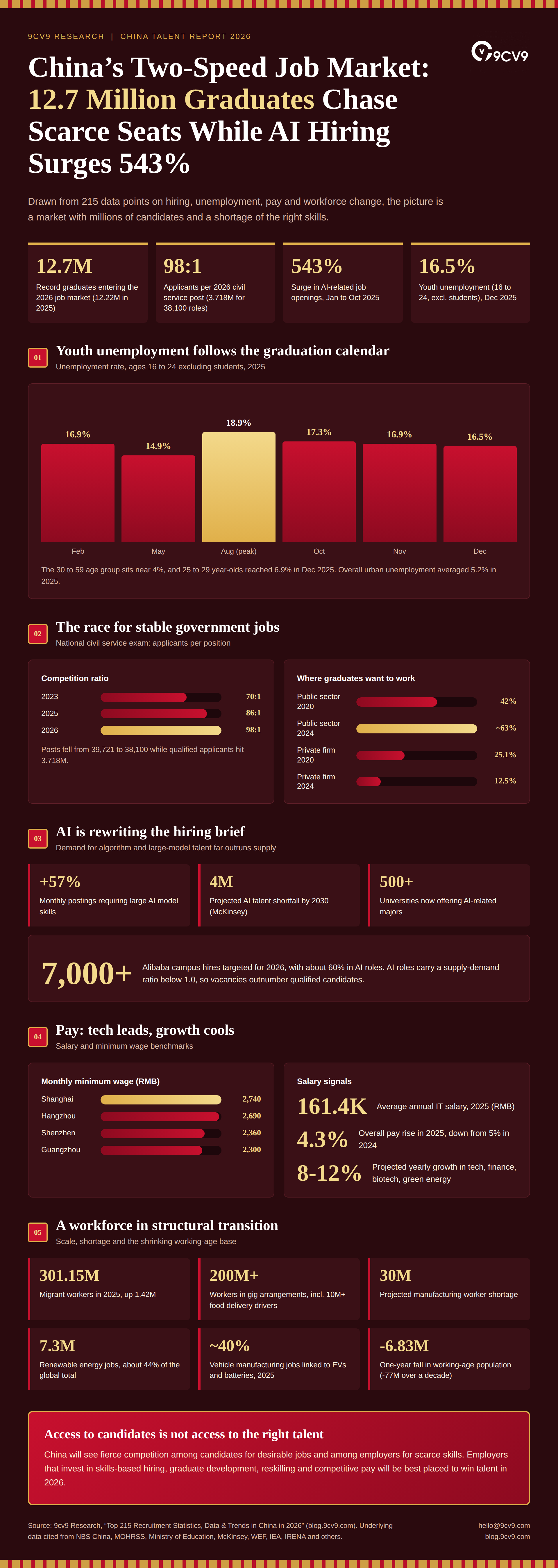
Structural changes are reshaping other parts of the workforce as well. China has more than 300 million migrant workers, an enormous gig economy, millions of renewable-energy jobs and growing demand for skilled workers across automation, electric vehicles, semiconductors and advanced manufacturing. At the same time, an aging workforce and shrinking working-age population are increasing pressure on employers to improve productivity, reskill employees and compete for increasingly scarce specialist talent.
These 215 China recruitment statistics, data points and hiring trends provide a detailed picture of the Chinese labor market in 2026. From graduate recruitment, unemployment and salaries to AI talent, manufacturing, green energy, migrant workers, gig employment and government hiring, the data reveals where recruitment demand is growing, where competition is intensifying and how China’s workforce is changing as employers prepare for the years ahead.
Before we venture further into this article, we would like to share who we are and what we do.
About 9cv9
9cv9 is a business tech startup based in Singapore and in Asia, with a strong presence all over the world.
With over ten years of startup and business experience, and being highly involved in connecting with thousands of companies and startups, the 9cv9 team has access to some of the best talents in the world.
If your company needs recruitment and headhunting services to hire top-quality employees, you can use 9cv9 headhunting and recruitment services to hire top talents and candidates. Email us at hello@9cv9.com.
Top 215 Recruitment Statistics, Data & Trends in China in 2026
1. OVERALL LABOR MARKET & EMPLOYMENT
1. China’s labor market demonstrated resilience in the first half of 2025, with the government reporting 6.95 million new urban jobs created — a figure that, while significant, still falls short of the pace needed to absorb the country’s growing graduate population.
2. China’s full-year 2024 job creation total of 12.56 million new urban positions marked a modest improvement over 2023, reflecting steady but unspectacular employment growth in the world’s second-largest economy.
3. China’s 2025 GDP expansion of approximately 5% to 140.2 trillion yuan provided the macroeconomic foundation for employment stability, though analysts caution that growth quality — not just quantity — matters for sustainable job creation.
4. Beijing’s 2025 employment target of over 12 million new urban jobs, paired with a 5.5% unemployment ceiling, signals strong policy intent, though the widening gap between graduate supply and quality job demand raises questions about whether these targets address structural challenges.
5. China’s total employment base of 734.39 million at end-2024 — with 64.5% in urban areas — reflects a workforce in gradual transition, though the net decline of 6.02 million workers year-on-year highlights the long-term demographic pressures reshaping the labor market.
6. China’s combined social insurance surplus of 9.83 trillion yuan in H1 2025 suggests the country’s social safety net remains financially stable, providing a buffer against employment shocks — though coverage gaps for gig and migrant workers persist.
7. With social insurance revenues of 4.53 trillion yuan outpacing expenditures of 3.89 trillion yuan in H1 2025, China’s pension and welfare system remains in surplus for now, though an aging population means this cushion is expected to narrow in coming decades.
8. China’s working-age population falling by 6.83 million in a single year — and by 77 million over a decade — underscores a structural demographic contraction that will have profound long-term implications for labor supply, productivity, and retirement systems.
9. The average age of Chinese workers rising from 32.25 years in 1985 to 39.72 years in 2022 reflects a workforce that is steadily aging, increasing the urgency of upskilling programs and delayed retirement policies to maintain economic output.
10. A 22% decline in graduate job postings in H1 2025 is a stark indicator of a cooling hiring market for college graduates, suggesting that economic growth alone is insufficient to generate the high-quality employment that China’s increasingly educated youth expect.
11. China’s total labor force growing to 402 million by 2022 reflects the country’s vast human capital base — yet sheer workforce size is increasingly less relevant in an economy pivoting toward automation, AI, and high-value services.
12. China’s 18% year-on-year increase in overseas labor deployments to 409,000 workers in 2024 reflects both growing international economic ties and, for some workers, a search for better-paying opportunities abroad amid domestic employment pressures.
13. As China enters 2026 with GDP growth projected at 4.5–5% — below its historic highs — hiring conditions are expected to remain competitive, with employers becoming more selective and candidates facing a slower job market than previous generations experienced.
14. The 9.8% quarter-on-quarter surge in Q1 2024 recruitment demand, and an average 5.4% annual increase across 2024, suggests underlying employer confidence — though this uptick has not fully translated into relief for job-seeking graduates.
15. The 40% growth rate in candidates advancing to the interview stage in Q3 2024 is an encouraging sign of hiring pipeline activity, though conversion to actual job offers remains the more critical and still-constrained metric.
2. URBAN UNEMPLOYMENT RATES
16. China’s average surveyed urban unemployment rate of 5.2% for full-year 2025 — marginally above 2024 but within the government’s 5.5% ceiling — suggests the labor market remained broadly stable, even as structural youth unemployment concerns persisted.
17. The December 2025 urban unemployment rate holding at 5.1% across 31 major cities including Beijing and Shanghai indicates relative stability at year-end, though this headline figure masks significant disparities by age group and education level.
18. November 2025’s 5.1% unemployment rate in major cities, described as a four-month low, points to a modest seasonal improvement heading into the final quarter — though economists warn against reading too much into short-term fluctuations.
19. The drop in urban unemployment to 5.1% in April 2025 and a 5.2% average over the first four months suggests that China’s labor market held up reasonably well in the first half of the year, supported by government job creation programs.
20. The surge to a six-month high of 5.3% urban unemployment in August 2025 coincided with the summer graduation wave, highlighting how China’s youth job market remains highly seasonal and structurally sensitive to the annual cohort of millions of new graduates.
21. Workers aged 30–59 maintaining an unemployment rate of around 4% — well below the national average — reflects the relative stability enjoyed by experienced workers in China, contrasting sharply with the far more volatile employment outlook for young people.
22. The 6.9% unemployment rate among 25–29 year-olds in December 2025 reveals that labor market difficulties extend well beyond fresh graduates, affecting a broad cohort of young adults still seeking stable, career-aligned employment.
23. The slight uptick in unemployment among 30–59 year-olds to 3.9% in December 2025 serves as an early indicator that mid-career workers, while still far better positioned than youth, are not entirely insulated from broader economic headwinds.
3. YOUTH UNEMPLOYMENT
24. China’s youth unemployment rate (ages 16–24, excluding students) easing to 16.5% in December 2025 — its lowest since June — is a welcome improvement, but the figure remains stubbornly high and indicative of a systemic mismatch between graduate supply and available quality roles.
25. The spike to 18.9% youth unemployment in August 2025 — a 20-month high — coincided with China’s largest-ever graduating class entering the market simultaneously, illustrating how the annual graduation wave creates predictable but challenging seasonal shocks.
26. October 2025’s youth unemployment of 17.3%, down from 17.7% in September, suggests a slight post-summer easing as some graduates secured positions — though the pace of improvement is modest relative to the scale of the challenge.
27. Youth unemployment at 16.9% in November 2025 being described as the lowest in several months underscores how even marginal improvements are noteworthy in China’s graduate labor market — a reflection of how normalized elevated youth joblessness has become.
28. A 16.9% youth unemployment rate in February 2025 — when the metric was resumed after a methodology overhaul — signals that the structural drivers of youth joblessness, including oversupply of graduates and a cooling private sector, had not materially improved.
29. The dip to 14.9% youth unemployment in May 2025, before the summer graduation rush, illustrates how employment conditions for young Chinese workers are highly volatile and closely tied to academic calendars rather than organic economic improvement.
30. China’s record 21.3% youth unemployment rate in June 2023 — which prompted the NBS to suspend the metric — serves as a critical benchmark: the current revised figures may not be fully comparable, making trend analysis challenging.
31. Youth unemployment remaining above 17% in major Chinese cities since July 2025, and sitting near double the U.S. rate, highlights the severity of China’s graduate employment crisis and the limitations of headline GDP growth as a measure of economic health for young workers.
32. The World Bank’s modeled youth unemployment rate averaging 15.795% for 2025 provides an internationally comparable benchmark, confirming that China’s youth joblessness is not merely a statistical artifact but a measurable and significant labor market challenge.
33. The staggering ratio of 150 applicants per role at a state-owned nuclear corporation illustrates the extreme competition facing Chinese graduates — a phenomenon driven not just by youth unemployment, but by a flight to perceived job security in a volatile economy.
34. The fact that over 70,000 Meituan and Ele.me delivery drivers hold master’s degrees is a striking signal of degree devaluation in China — raising serious questions about the return on investment of postgraduate education and the adequacy of the labor market to absorb highly educated workers.
35. With an estimated 200 million Chinese workers engaged in gig work, the platform economy has become a critical — if precarious — safety valve absorbing graduates and workers who cannot find stable formal employment.
4. GRADUATE & UNIVERSITY EMPLOYMENT
36. The projected record 12.7 million graduates entering China’s job market in 2026 — a 4% increase over 2025’s already-record cohort — will intensify competition for entry-level positions across virtually every sector, placing unprecedented pressure on employers and career services.
37. Adding 480,000 more graduates in 2026 than in 2025 may seem incremental on paper, but in a market already struggling to absorb the existing supply, it represents a meaningful escalation of structural employment pressure.
38. The 2025 graduating class of 12.22 million — up 430,000 from 2024 — set a new record while entering one of the most challenging job markets in modern Chinese history, highlighting a troubling divergence between educational expansion and labor market absorption capacity.
39. Three consecutive years of 10+ million graduates reflects the extraordinary pace at which China has expanded higher education access — an achievement in terms of social mobility, but one that now strains an economy not generating enough quality graduate-level roles.
40. The Ministry of Education’s forecast that the graduate surge will persist for a decade is a sobering long-term outlook for the labor market, suggesting that the current graduate employment crisis is structural rather than cyclical and will require sustained policy intervention.
41. Vocational college graduates achieving a 56.6% employment rate in 2024 — outperforming postgraduates — challenges long-held assumptions about the superiority of academic degrees in China’s labor market, and reflects growing employer demand for practical, hands-on skills.
42. Postgraduate employment rates falling below 45% in 2024 is a significant reversal that calls into question the value proposition of advanced degrees in China, particularly as the opportunity cost of two to three additional years of study continues to rise.
43. The sharp decline in postgraduate exam applicants — from 4.74 million in 2023 to 3.4 million in 2025 — suggests Chinese students are rationally recalibrating their career strategies, choosing to enter the workforce rather than accumulate credentials that may not improve hiring prospects.
44. The near doubling in graduates seeking public sector jobs (from 42% in 2020 to ~63% in 2024) reflects a profound shift in career aspirations among Chinese youth — away from the private sector dynamism of the 2010s and toward the perceived security of government employment.
45. The halving of graduate interest in private enterprise employment (from 25.1% to 12.5% between 2020 and 2024) is a concerning signal for China’s entrepreneurial ecosystem, suggesting that economic uncertainty is dampening the risk appetite of the country’s most educated young people.
46. Reserving two-thirds of 2025 civil service positions for fresh graduates reflects deliberate policy prioritization of youth employment — but with fewer than 40,000 total positions available, it addresses only a fraction of the millions seeking stable public employment annually.
47. The rise in graduates hired by state institutions — from under 40% in 2019 to approximately 70% by 2025 — reflects a structural shift in public sector hiring toward credentialed youth, but also raises sustainability concerns about the state’s capacity to continuously absorb graduates.
48. A Shanghai graduate accepting a salary 20% below expectations signals that wage compression is a real phenomenon for China’s new workforce entrants — one that has implications for consumer spending, student loan repayment, and generational wealth accumulation.
49. China’s plan to overhaul 20% of degree and diploma programs between 2023 and 2025 is a necessary — if long-overdue — attempt to close the curriculum-to-employer gap, though the speed and depth of reform will determine whether it meaningfully improves graduate employment rates.
50. The fact that 64% of surveyed Chinese graduates strongly prefer state-sector employment reflects not just cultural values around stability, but rational responses to a private sector seen as increasingly volatile, unfair, and at risk from regulatory and geopolitical headwinds.
5. CIVIL SERVICE & PUBLIC SECTOR HIRING
51. A record 2.83 million applicants sitting simultaneously across 250 cities for just 38,100 civil service positions is one of the most vivid illustrations of China’s graduate employment crisis — and of the extraordinary lengths young people will go to secure stable public sector work.
52. The new high of 3.718 million qualified applicants for the 2026 national civil service exam represents a nearly 9% increase over the prior year, suggesting demand for public sector employment continues to accelerate despite no meaningful expansion in available positions.
53. The reduction of available civil service positions from 39,721 in 2025 to 38,100 in 2026 — even as the applicant pool grew by hundreds of thousands — illustrates a fundamental supply-demand imbalance that policy rhetoric alone cannot resolve.
54. A 98:1 applicant-to-position ratio for the 2026 civil service exam is not merely a statistic — it represents the lived reality of millions of Chinese graduates competing in an increasingly futile race for institutional security in a cooling economy.
55. The civil service competition ratio escalating from 70:1 in 2023 to 98:1 in 2026 is one of the clearest trend lines in Chinese labor market data, illustrating how quickly and consistently the flight to public employment has intensified.
56. A single police officer position attracting 6,470 applicants in the 2026 exam is a striking symbol of the degree to which even entry-level government roles have become objects of intense competition — underscoring how distorted the public-private employment landscape has become.
57. The civil service applicant pool’s growth from 2.6 million in 2023 to over 3.7 million in 2026 — a 43% increase in just three years — makes China’s civil service exam one of the most competitive mass recruitment events in the world.
58. The 2025 exam’s ratio of 86 qualified applicants per government position, competing across nearly 40,000 roles, reflects a deeply imbalanced labor market where the allure of public sector stability far outpaces the actual availability of such positions.
59. The 2025 civil service exam’s status as the seventh consecutive year of recruitment expansion signals ongoing government commitment to youth absorption — yet the pace of expansion in available roles remains dwarfed by growth in the applicant pool.
60. One civil service position attracting 16,702 applicants in 2025 encapsulates the extraordinary concentration of graduate competition in China — raising questions about the productivity costs of millions of young people dedicating months of preparation to exams with negligible individual success rates.
61. The 4% reduction in civil service headcount for 2026 despite a surging applicant pool reflects fiscal pressures and government efficiency drives — a tension between the state’s role as employer of last resort and its need to manage public sector wage bills.
62. Dedicating approximately 66.7% of 2025 civil service positions to fresh graduates reflects a deliberate policy to support youth employment transition — though critics argue it is a short-term fix that does not address the underlying structural mismatch.
63. The dramatic rise in graduate-reserved civil service slots — from 39% in 2019 to over 70% in 2025 — reflects how youth unemployment has become a top political priority in China, prompting sustained and significant public sector employment engineering.
64. With over 3.7 million civil service applicants in 2025 — including graduates from China’s most elite universities — the exam has become a societal event rather than just a hiring process, reflecting deep anxiety about job security among the country’s most educated cohort.
65. The 66% spike in government job openings in 2020 offered a temporary lifeline during the pandemic — but the subsequent flattening of public sector hiring against a backdrop of record graduate numbers has left a structural gap that cannot be filled by policy adjustment alone.
6. WAGES & SALARIES
66. Projected average annual wages of around RMB 125,000 in 2025 reflect meaningful but uneven income growth across China — with significant variation by city, sector, and role obscuring both the benefits and limitations of this headline figure.
67. A 4.9% year-on-year rise in average urban monthly income to 15,887 RMB in Q1 2025 is broadly positive, though it masks the reality that wage growth is increasingly concentrated among tech, finance, and senior professional workers rather than spread evenly across the workforce.
68. The average annual income for urban employees of 54,188 RMB at end-2024 provides useful benchmark context, but also highlights how far below developed-world standards Chinese middle-income workers still sit — a critical consideration for consumer demand and social stability.
69. China’s overall salary increase rate slowing from 5% in 2024 to 4.3% in 2025 reflects a broader cooling of employer confidence and economic momentum — a trend that, if it continues into 2026, could dampen consumer spending and talent retention.
70. Average monthly pay in new-economy industries rising to 45,553 yuan in 2025 (up 6% from 2024) demonstrates the premium employers are willing to pay for digital and tech-adjacent skills — reinforcing the growing wage gap between new-economy and traditional economy workers.
71. Salary growth in financial institutions dropping to 2.9% in 2025 — with a further decline to 2.5% projected — reflects both regulatory scrutiny on financial sector compensation and a broader recalibration of the industry’s role in China’s economic development strategy.
72. The projected 6.8% salary growth for lending and credit platform roles in 2025–2026 stands out as one of the few bright spots in the financial sector, driven by fintech expansion and demand for risk management talent in a rapidly digitalizing industry.
73. Semiconductor and internet services sectors leading with over 5.5% salary growth in 2025 reflects the strategic importance of these industries to China’s national ambitions — and the fierce global competition for specialized engineering and technical talent.
74. Automotive sector salary growth moderating to 3.2% through 2026 signals stabilization after the EV transition’s initial talent surge, as the industry matures and competition drives efficiency rather than talent acquisition at any cost.
75. Life sciences salary growth moderating from 5.4% to 5% in 2025 still places the sector among China’s more competitive compensation environments — driven by global demand for pharmaceutical and biotech talent and China’s ambitions to become a global biopharma leader.
76. Attrition rates remaining below 9% across Chinese industries in 2025 suggest a labor market where workers are exercising caution about voluntary job changes — reflecting uncertainty about the economic outlook rather than strong retention by employers.
77. The fact that more than half of Chinese companies have raised or plan to raise starting salary ranges for 2026 graduates signals competitive pressure in targeted talent areas, even as overall salary growth cools — a bifurcation between high-demand and oversupplied graduate categories.
78. Over 80% of companies linking starting pay to educational attainment reflects both a pragmatic sorting mechanism in a market flooded with credentials and a continued belief — however eroded — that degree levels signal productive capacity.
79. Shanghai’s minimum wage of RMB 2,740 per month being the highest in China reflects the city’s premium cost of living, its role as the country’s financial capital, and the concentration of high-value industries that require competitive base compensation.
80. Beijing’s highest hourly minimum wage of RMB 27.7 highlights the capital’s role as a hub for knowledge workers and service industries, though even this rate leaves minimum wage earners significantly below the city’s average cost of living.
81. Shenzhen and Guangzhou minimum wages of RMB 2,360 and RMB 2,300 respectively reflect the Pearl River Delta’s status as China’s manufacturing and tech heartland — though these rates are frequently exceeded by actual market wages in competitive sectors.
82. Hangzhou’s relatively high minimum wage of RMB 2,690 per month — close to Shanghai’s — reflects the city’s emergence as a major tech and e-commerce hub, driven by the Alibaba ecosystem and a growing cluster of high-tech employers.
83. The RMB 7,000 monthly salary gap between a Shanghai and Chengdu software developer illustrates China’s persistent geographic wage disparity — a structural feature that is slowly narrowing as tech hubs develop beyond the coastal tier-one cities.
84. Beijing senior managers earning over RMB 35,000 per month places Chinese executive compensation well above the national average — but still significantly below comparable roles in Western markets — reflecting China’s growing but not yet globally benchmarked professional pay scales.
85. Factory workers earning between RMB 45,305 and 69,480 annually reveals the wide band of manufacturing compensation in China, shaped by geography, industry type, and the degree to which automation has already restructured workforce needs on the shop floor.
86. The average annual manufacturing wage of CNY 107,987 in 2024 represents a meaningful improvement in factory worker compensation, though it also reflects the ongoing shift in China’s manufacturing base toward higher-value-added production requiring greater technical skill.
87. An average annual IT salary of approximately RMB 161,400 in 2025 confirms technology as one of China’s most rewarding professional pathways — though access to such roles remains highly competitive and increasingly requires AI-adjacent expertise.
88. The projected 8–12% annual salary growth in technology, finance, biotech, and green energy reflects the scarcity of qualified talent in China’s strategic industries — and the willingness of both domestic and multinational employers to pay premiums to secure it.
89. Service sector salary growth of 4–6% annually — while moderate — reflects a growing and professionalizing service economy in China, where healthcare, logistics, and hospitality are increasingly important employment sectors as the country urbanizes further.
90. Expatriate senior tech engineers commanding CNY 700,000–800,000 annually in China underscores the premium placed on rare, globally competitive technical skills — particularly in areas where domestic talent pipelines have not yet matured sufficiently.
91. Salary increases of just 2–4% in China’s tier-one cities in 2025 represent a real-terms pay cut in many cases when inflation and living cost increases are factored in — a trend that is eroding the premium of working in major urban centers.
92. The disconnect between 67% of workers receiving salary increases in 2024 and satisfaction dropping from 63% to 22% reveals that incremental raises are failing to meet rising expectations — a warning signal for talent retention and employee engagement.
93. Delivery drivers earning less than RMB 7,000 per month while working longer hours is a powerful illustration of the conditions facing China’s gig workforce — where platform algorithms can suppress earnings even as labor demand grows.
7. AI, TECH & DIGITAL TALENT
94. The 36% year-on-year growth in Chinese enterprises developing or applying AI in 2024 reflects the extraordinary momentum behind China’s national AI strategy — but also raises important questions about whether the talent supply can keep pace with this accelerating adoption.
95. A 57% increase in monthly job postings requiring large AI model proficiency signals that AI is rapidly transitioning from a niche technical discipline to a mainstream employer requirement — with significant implications for curriculum design, reskilling investment, and graduate preparation.
96. A 543% surge in AI-related job openings from January to October 2025 is among the most dramatic single-year hiring spikes in any global labor market — making AI the defining employment story in China’s new economy for this period.
97. Algorithm engineers and large-model algorithm engineers ranking first and second in demand reflects how China’s AI ambitions are fundamentally reshaping hiring priorities — with employers placing technical AI expertise above virtually all other competencies.
98. AI-related roles dominating the top 20 highest-paying positions (exceeding RMB 60,000/month) demonstrates the strong financial returns to AI expertise in China — and creates powerful incentives for students to pivot toward AI-adjacent study and careers.
99. AIGC algorithm engineers earning nearly 18% more than general algorithm engineers illustrates the fine-grained premium being assigned to generative AI specialization — reflecting where employer investment and strategic interest is most concentrated.
100. AI product managers commanding over 20% salary premiums above traditional counterparts reflects the increasing value placed on professionals who can bridge the gap between AI technical capabilities and commercial product development.
101. AI roles having a supply-demand ratio well below 1.0 — indicating far more open positions than qualified candidates — makes this one of the most undersupplied segments of the Chinese labor market and a key structural bottleneck to AI-driven economic growth.
102. McKinsey’s projection of a 4-million-person AI talent shortfall by 2030 is a significant economic risk for China — one that could slow the adoption of AI-driven productivity gains and constrain the country’s ambitions to lead in global AI development.
103. The forecast of AI product demand growing sixfold — from 1 million to 6 million professionals — within five years represents one of the most dramatic workforce transformations in economic history, requiring unprecedented coordination between universities, employers, and government training programs.
104. McKinsey’s estimate that AI could unlock over $1 trillion in value for China reinforces the business case for aggressive AI talent investment — though realizing this potential depends heavily on addressing the growing skills gap in a timely manner.
105. Over 500 Chinese universities now offering AI-related majors reflects the higher education system’s responsiveness to labor market signals — though curriculum relevance, faculty expertise, and industry alignment will determine whether this expansion translates into genuinely job-ready graduates.
106. Alibaba targeting over 7,000 campus recruits for 2026, with 60% in AI roles, signals that China’s largest tech companies are actively reshaping their talent pipelines around AI — a structural shift that will influence how universities design programs and how students select majors.
107. AI roles representing 75–80% of 2026 campus recruitment at Alibaba’s major business units is a remarkable indicator of how comprehensively AI has redefined the tech company’s talent strategy — and a leading indicator of where the broader market is heading.
108. Meituan’s 2026 campus recruitment expansion beyond its prior year’s 4,000 hires reflects confidence in business growth — and signals that China’s platform economy, despite regulatory headwinds, continues to generate significant tech employment at scale.
109. Tencent’s pledge of 28,000 internships over three years — its largest-ever employment initiative — is both a talent pipeline strategy and a public signal of corporate responsibility toward China’s youth employment challenge.
110. Tencent’s 73% tech-staff composition across a 55,000+ person workforce reveals the extraordinary degree to which China’s largest internet company has become, fundamentally, a technology engineering organization — with implications for how it hires, trains, and retains talent.
111. The WEF’s projection of over 80% growth in demand for big data specialists, fintech engineers, and AI experts over five years in China underscores that the talent gap is not a temporary market fluctuation but a long-term structural feature of the economy.
112. Over 90% of Chinese organizations identifying AI as a key transformation technology — above the global average — reflects both the Chinese business community’s ambition and the national policy environment that strongly incentivizes AI investment and adoption.
113. The dual reality of 65% of Chinese organizations deploying robots and 38% citing talent shortages as a barrier reflects a paradox at the heart of China’s industrial transformation: automation is accelerating, yet the human skills needed to design, deploy, and manage these systems remain scarce.
114. China’s dominance of global industrial robotics since 2013 — receiving one in two robots installed worldwide — is both a testament to its manufacturing ambitions and a key factor reshaping domestic employment patterns, with automation creating new roles even as it displaces others.
115. Nearly 40% of Chinese vehicle manufacturing jobs being linked to EVs and their batteries in 2025 marks a structural shift in one of the world’s largest automotive industries — and raises urgent questions about reskilling for workers in traditional combustion engine roles.
116. The near-800,000 global increase in EV-related jobs in a single year — with China accounting for a major share — illustrates the employment potential of the green transition, while also highlighting the geographic concentration of these opportunities.
117. A 44% surge in vacancies for algorithm engineers in industrial automation in Q1 2025 reflects the convergence of AI and manufacturing — a convergence that is generating new hybrid technical roles but requiring educational pathways that did not exist a decade ago.
118. Nearly half of fintech company workforces in China being composed of tech specialists — rising to 60% at top firms — underscores how financial services have become, in practice, technology companies with banking licenses.
119. China’s $140 billion Phase III semiconductor fund driving massive talent demand illustrates how state investment policy is directly reshaping labor market priorities — making chip engineering one of the most strategically important and well-compensated career paths in the country.
120. The gradual recovery in new-economy job postings from June 2025 onward — surpassing 2024 levels — is a cautiously encouraging sign that AI and digital sector hiring is rebounding after a mid-year softening, though the pace of recovery remains uneven.
121. JD.com investing 7 billion yuan to build nearly 5,000 employee apartments in Beijing reflects how leading tech firms are increasingly using non-monetary benefits — particularly housing in an unaffordable market — as a differentiating talent attraction strategy.
8. MANUFACTURING & INDUSTRIAL EMPLOYMENT
122. A 40% jump in mechanical engineering vacancies in industrial automation in Q1 2025 signals a significant structural demand shift — as Chinese manufacturers invest in automation infrastructure, they simultaneously require more skilled humans to design and maintain it.
123. Automotive and general manufacturing salary growth stabilizing at 3.2% through 2026 reflects a sector in mature transition — neither growing fast enough to command tech-style premiums nor contracting fast enough to force dramatic workforce restructuring.
124. China facing a projected shortage of 30 million manufacturing workers is a counterintuitive finding in a country known for vast labor supply — but it reflects the growing mismatch between available workers’ skills and the increasingly technical requirements of modern Chinese factories.
125. With 27% of migrant workers in manufacturing and 18% in construction, these sectors remain the backbone of China’s migrant labor economy — yet both are increasingly exposed to automation and urbanization trends that may reduce demand for low-skilled labor over the next decade.
126. Economy-wide demand for applied technical workers growing 16% between 2015 and 2022 while vocational program graduations rose only 9% illustrates a persistent and widening skills gap — one that threatens to constrain China’s industrial upgrading ambitions.
127. Nearly half of energy companies resorting to cross-industry recruitment or internal training to fill skills gaps is a pragmatic but costly response to talent shortages — one that signals the inadequacy of current educational pipelines for the clean energy transition.
128. A 25% increase in young people entering energy-relevant degrees in China, Indonesia, and North Africa is a positive indicator of talent pipeline development — though this figure needs to accelerate significantly to meet the scale of the green transition’s workforce needs.
129. The IEA’s estimate that preventing worsening skills mismatch by 2030 would require a 40% global increase in energy graduates — costing USD 2.6 billion annually — frames the talent challenge not as a soft HR issue but as a quantifiable infrastructure investment with a clear price tag.
130. China hosting approximately 30% of all global energy manufacturing positions in 2022 confirms its central role in the physical production of the world’s clean energy infrastructure — and the corresponding scale of its workforce and skills development responsibilities.
9. GREEN & NEW ENERGY SECTOR JOBS
131. China’s 7.3 million renewable energy jobs — 44% of the global total — confirm the country’s dominant position not just in clean energy production but in the employment ecosystem that builds and operates it, making this a strategically vital component of its labor market.
132. Global renewable energy employment growing by just 2.3% in 2024 reflects a maturing sector in many markets, though China’s disproportionate share means that the pace of green job creation is increasingly determined by Beijing’s policy decisions and investment levels.
133. China accounting for roughly 4.2 million of the world’s 7.3 million solar PV jobs is a testament to its manufacturing dominance in the sector — though it also creates strategic vulnerabilities for global solar supply chains that are heavily dependent on Chinese production.
134. The projection of over 15 million people employed in China’s new energy industry by 2025 makes it one of the country’s most significant employment sectors — and a key policy lever for managing the labor market disruption caused by the decline of fossil fuel industries.
135. China’s renewable energy installed capacity surpassing 1.5 billion kilowatts and exceeding 50% of total power generation capacity is both an environmental milestone and an employment milestone — reflecting a generational shift in where China’s energy workers are needed.
136. The NEV supply chain’s potential to support over 10 million direct and indirect jobs by 2030 frames the electric vehicle transition not just as a climate strategy but as one of the largest planned employment programs in Chinese economic history.
137. China’s 46% share of global renewable energy employment in 2024, per IRENA, reinforces its central role in the global green economy — though it also raises questions about the resilience of these jobs to potential trade disputes and geopolitical pressures.
138. Two-thirds of Chinese businesses citing climate-related transformation as a business driver — far above the global average — reflects both genuine strategic planning and the strong policy signals from Beijing that make climate alignment a business imperative in China.
139. Over half of Chinese businesses citing climate adaptation as a transformation driver is a meaningful indicator that green hiring is not merely a regulatory compliance exercise but an authentic business-strategy-driven shift in workforce composition.
140. EV penetration exceeding 50% of Chinese new car sales in 2025 is a watershed moment that will continue to reshape automotive sector employment — accelerating demand for battery engineers and software developers while reducing long-term demand for combustion engine mechanics.
141. AI server demand growing at over 30% CAGR in China creates a compounding effect on hiring: more AI infrastructure requires more hardware engineers, software developers, data center operators, and systems integrators — multiplying the talent demand across the tech ecosystem.
10. GIG ECONOMY & PLATFORM WORK
142. Over 200 million Chinese workers representing approximately 25% of the workforce in gig arrangements is a scale of platform labor unlike anything seen in other economies — and signals both the flexibility and the precarity that define a significant portion of China’s employment landscape.
143. The projection that gig work could account for 40% of China’s total employment by 2025 raises profound questions about social insurance coverage, labor rights, income stability, and what “employment” means in an economy where platform work is increasingly the default for a large minority of workers.
144. The 2020 figure of 200 million gig workers, with 40% earning via online platforms, established the baseline for China’s gig economy — one that has only expanded since, making it one of the most consequential labor market developments of the past decade.
145. China’s sharing economy reaching approximately 3.4 trillion yuan by 2020 — with ~3% annual growth — demonstrated the rapid institutionalization of platform-based work, well before the pandemic accelerated gig adoption globally.
146. Platform deductions of up to 30% from Didi drivers and algorithmic bonus suppression at Meituan illustrate how gig platforms in China structure earnings in ways that benefit the platform while placing downside risk on workers — a dynamic regulators are increasingly scrutinizing.
147. The top platform companies controlling over 80% of their respective markets creates structural power imbalances in China’s gig labor market — limiting workers’ ability to negotiate terms or switch platforms without significant income disruption.
148. Over 10 million takeaway food delivery drivers in China make this one of the single largest job categories in the country — a remarkable concentration of labor in a sector that did not meaningfully exist 15 years ago, enabled entirely by smartphone platforms and algorithmic dispatch.
149. Women earning just 68% of men on at least one major Chinese gig platform highlights that the gender pay gap is not confined to the formal employment sector — platform algorithms can encode and perpetuate pay inequalities through opaque pricing and task assignment mechanisms.
11. MIGRANT WORKERS
150. China’s migrant worker population reaching 301.15 million in 2025 — growing by 1.42 million — confirms that internal labor migration remains a cornerstone of Chinese economic dynamism, even as growth in this segment gradually moderates.
151. The 0.7% growth in migrant worker numbers in 2024 to 299.73 million reflects a labor market where the traditional pattern of rural-to-urban migration is maturing — driven by demographic shifts, improving rural incomes, and the development of inland economic hubs.
152. The 178.71 million migrant workers employed outside their home township versus 121 million working locally reflects the gradual but real geographic diversification of China’s labor deployment — with regional development policies starting to reduce the dominance of coastal manufacturing centers.
153. Migrant workers comprising over 20% of total population and approximately 38% of the labor force underscores their indispensable role in the Chinese economy — and the enormous policy challenge of ensuring adequate social protection for a mobile workforce of this scale.
154. Average migrant worker monthly income more than doubling over a decade — to 4,780 yuan in 2023 — is a significant achievement in living standards, though this improvement must be weighed against rapid increases in urban living costs and the persistent exclusion of many migrants from urban social services.
155. Over 75% of rural migrant laborers not leaving their home province for work reflects the maturation of regional economies in China — a trend with important implications for how companies plan regional recruitment and where they locate manufacturing and logistics facilities.
156. Nearly half of migrant workers leaving hometowns without their families creates hidden social costs — including children left behind, family separation stress, and constrained child development — that are not fully captured in standard employment or wage statistics.
157. The 43.7% increase in exit-entry travellers inspected and 82.9% rise in foreign nationals entering China in 2024 reflects a significant reopening of cross-border mobility — with implications for international talent flows, tourism employment, and China’s growing integration with global labor markets.
12. SECTOR-SPECIFIC RECRUITMENT TRENDS
158. AI product managers ranking third among top non-technical in-demand roles signals that China’s hiring market is rewarding not just engineers, but professionals who can commercialize AI — bridging the gap between technical development and business outcomes.
159. The above-average 9% voluntary attrition in biopharma and life sciences reflects both strong talent demand in the sector and the mobility of specialized professionals who can command competitive offers — creating retention challenges for all but the most innovative employers.
160. The 2024 inversion of attrition norms — with company-driven exits rising above employee-initiated departures — signals a labor market under stress, where employers restructured faster than workers could voluntarily transition, reflecting economic uncertainty rather than organic talent mobility.
161. The financial sector’s drop to just 2.9% salary growth in 2025 reflects a dual pressure: regulatory caps on compensation at state-owned financial institutions and reduced deal flow in investment banking — creating a significant divergence from the sector’s historically premium pay positioning.
162. Over 200 employers attending a single Beijing graduate job fair with 4,000+ vacancies illustrates the significant logistical and institutional investment China is making to connect graduates with employers — though the ratio of candidates to vacancies at such events remains heavily unfavorable.
163. A single university job fair in Huaibei attracting 183 companies and over 10,000 positions demonstrates that campus recruitment remains a primary channel for employer-graduate matching in China — and that mid-tier institutions are actively developing employment networks to serve their students.
164. Only 50 firms offering under 900 openings at a Shanghai university job fair highlights the counterintuitive employment reality in China’s most economically dynamic city — where proximity to business does not automatically translate into job market access for graduates.
165. Over half of Hong Kong’s C-suite executives hiring from mainland China in 2025 reflects the deep integration of the Greater Bay Area talent market — and the competitive advantage mainland graduates offer in terms of technical skills, mandarin proficiency, and cost.
166. Nearly all Hong Kong employers (97%) reporting talent acquisition challenges illustrates that the hiring difficulties facing mainland China are not unique — talent scarcity at the skilled and senior level is a regional challenge across Greater China, not a problem confined to the mainland.
167. 65% of Hong Kong respondents operating in or planning to expand to GBA cities reflects the accelerating integration of the Pearl River Delta as a single talent market — with implications for wage levels, mobility expectations, and workforce planning strategies.
168. Nearly 90% of Hong Kong C-suite executives having implemented or planning to implement AI within three years mirrors mainland trends — and suggests that AI-driven talent demand is a pan-China phenomenon that will reshape professional hiring across the entire region.
169. China adding over 50 new occupational categories between 2019 and 2021 — including AI trainers, robotics operators, and digital managers — reflects how rapidly the country’s labor classification system has had to evolve to keep pace with technological change.
13. DEMOGRAPHIC & STRUCTURAL FACTORS
170. China’s working-age population projected to shrink to 36% of total population by 2100 is a defining long-run constraint on economic growth — making productivity enhancement through technology, education, and skills investment not merely desirable but existentially necessary.
171. China’s population exceeding 1.4 billion in 2025 maintains its status as the world’s most populous nation in absolute terms — though the more important employment metric is the quality, education, and age distribution of this workforce rather than its sheer scale.
172. 56% of Chinese employers being concerned about geopolitical disruption — nearly double the global average — reflects how trade tensions, supply chain decoupling, and sanctions risks are directly influencing hiring, investment, and workforce planning decisions.
173. The aging profile of nuclear and grid energy workers — with 1.7 and 1.4 workers approaching retirement for every new entrant — signals an urgent succession planning challenge in industries where knowledge transfer is slow, safety-critical, and cannot simply be accelerated by faster hiring.
174. Two in every three new energy sector hires globally being needed simply to replace retiring workers over the next decade is a sobering reminder that workforce growth projections often obscure the even more significant challenge of maintaining existing operational capacity through replacement hiring.
175. Raising the civil service age limit to 38 — and to 43 for advanced degree holders — is a landmark reform that, if emulated by the private sector, could meaningfully improve career flexibility and reduce the economic penalty currently faced by mid-career workers in China’s age-discriminating job market.
176. The informal “age 35 ceiling” has functioned as an unofficial but widely observed hiring norm across Chinese employers for years — its removal from civil service criteria is symbolically significant, but behavioral change in the private sector will require sustained cultural and regulatory pressure.
177. The target to raise skilled workers to 30% of employment by 2025 reflects Beijing’s recognition that China’s transition from a low-cost manufacturing economy to a high-value innovation economy requires a fundamentally different workforce composition — one that the current training system is only partially delivering.
178. Over 54% of China’s population being between 25 and 45 in 2022 provides a relatively favorable demographic window for productivity-driven growth — but this cohort will age rapidly, making the next decade critical for structural reforms that can sustain output with a smaller future workforce.
179. The concentration of prime working-age populations in Shanghai, Beijing, Guangdong, and Fujian reflects powerful labor market gravity toward coastal megacities — a pattern that inland development policies are working to counterbalance but have not yet fundamentally altered.
180. China’s progressive delayed retirement policy represents one of the most consequential labor market interventions of the decade — potentially adding tens of millions of worker-years to the economy while simultaneously reshaping pension expectations and creating complex generational tensions in the workplace.
181. The shift of younger Chinese workers away from construction and manufacturing toward services and gig economy work is both a reflection of changing preferences and a structural response to improving options — but it also signals potential future labor shortages in industries that lack the flexibility to compete for this cohort.
14. FOREIGN TALENT & INTERNATIONAL HIRING
182. China’s work permit requirements of a minimum bachelor’s degree and two years of experience reflect a calibrated approach to international talent attraction — designed to supplement, rather than compete with, domestic workforce development in areas of genuine skills shortage.
183. The October 2025 launch of the K Visa Policy for young foreign tech talent represents a meaningful policy evolution — signaling that China recognizes its need for global technical expertise and is willing to streamline entry pathways in strategically important fields.
184. China’s top universities — Tsinghua and Renmin — incorporating AI into their 2025 enrollment expansion plans reflects a top-down alignment between national AI ambition and educational institution strategy, creating a more coordinated domestic talent pipeline than exists in many countries.
185. Nankai University’s introduction of over 130 specialized AI courses illustrates how rapidly Chinese higher education is pivoting to address employer demand — though the quality and labour-market relevance of newly created courses will vary significantly across institutions.
186. The growing preference for localized talent over international expatriates reflects a natural maturation of China’s talent market — as domestic expertise has grown, the cost-performance calculus of hiring foreign professionals has shifted, limiting opportunities for ex-pats in roles that can now be filled domestically.
187. BOSS Zhipin’s 46 million monthly active users makes it one of the world’s largest recruitment platforms and a critical real-time indicator of Chinese hiring trends — offering unprecedented visibility into the actual dynamics of employer and candidate behavior in the world’s most populous labor market.
15. GOVERNMENT POLICY & EMPLOYMENT TARGETS
188. The Chinese leadership’s reaffirmation of job stability as a top political priority in April 2025 — backed by multi-ministry joint action on graduate employment — underscores that the government views unemployment, particularly among youth, as a social stability risk requiring coordinated state intervention.
189. Offering one-off job expansion subsidies to employers hiring 2025 graduates or unemployed youth is a targeted fiscal incentive that signals government willingness to use direct employer subsidies to move the employment needle — though the scale of the subsidy relative to the number of unemployed graduates is modest.
190. Shanghai’s 1,500 yuan one-time hiring subsidy is widely viewed as inadequate relative to the actual cost of recruiting and onboarding a graduate — a symbolic gesture that reflects the limits of fiscal tools in addressing a structural labor market imbalance.
191. The Ministry of Education hosting over 40 recruitment events and national online job fairs with millions of postings demonstrates the institutional infrastructure China is deploying for graduate employment — though sheer volume of postings does not necessarily translate into quality matched outcomes for candidates.
192. China’s plan to establish a comprehensive graduate job services network within 3–5 years reflects a long-term institutional approach to career support — though execution quality, funding sustainability, and integration with employers will determine whether it delivers on its ambitious brief.
193. China’s annual urban job creation target of over 12 million, paired with a 5.5% unemployment ceiling, serves as a policy accountability mechanism — but the absence of qualitative targets around job quality, wage levels, and career progression is a notable gap in China’s employment policy framework.
194. The 2025 government work report’s explicit support for large-scale AI model applications and smart manufacturing equipment signals that AI-driven employment disruption is being actively managed — with the state positioning itself as a facilitator of AI adoption rather than a restraint on it.
195. China’s 38% of employers citing talent shortages as a barrier — with government funding reskilling programs in response — reflects a pragmatic recognition that education-to-employment pipelines are structurally misaligned and require active, ongoing intervention rather than passive market correction.
196. Whirlpool’s layoff of 341 employees in China in February 2026 illustrates that even within a broadly stable employment environment, multinational restructuring continues — creating localized disruption and reinforcing the importance of transferable skills in an increasingly uncertain corporate landscape.
197. Over 100 government-organized online job fairs using AI matching for graduate placements represents an interesting application of the very technology disrupting the labor market to help manage the disruption — though algorithmic matching quality and candidate experience remain open questions.
198. Allocating 27,500 civil service positions to county and district level governance in 2025 reflects a deliberate strategy to staff grassroots government — and an implicit acknowledgment that public services in lower-tier cities have been chronically understaffed relative to the urban centers that attract most graduate applicants.
199. China’s 36% year-on-year growth in AI-adopting enterprises in 2024 reflects an economy undergoing rapid technological transformation — one that is simultaneously creating new roles in AI development and operations while compressing demand for routine cognitive and manual tasks.
200. The convergence of 64% of Chinese businesses citing climate mitigation and 56% citing climate adaptation as transformation drivers — both far above global averages — makes China’s job market uniquely shaped by green transition imperatives, creating a labor market where climate skills are rapidly becoming mainstream rather than niche.
BONUS STATISTICS
201. China’s “996” work culture — while still prevalent in some sectors — is facing growing pushback from younger workers who prioritize work-life balance, creating a generational tension that is increasingly relevant to how employers design talent strategies and retention programs.
202. Hangzhou’s minimum wage of RMB 2,690 per month — among the highest in China — reflects the city’s position as a premier tech hub and innovation ecosystem, where labor market competition for talent has driven base compensation levels significantly above the national norm.
203. RGF’s Q4 2024 recruitment recovery, following a slight Q3 softening, is consistent with China’s broader economic pattern of resilient but uneven growth — and suggests that companies remain willing to hire strategically even when macro conditions are uncertain.
204. The “lying flat” trend among Chinese youth — choosing minimal participation in the competitive work and consumption cycle — is both a cultural response to perceived systemic unfairness and a rational adaptation to a labor market where effort and reward are increasingly decoupled.
205. The emergence of “Pretend to Work” coworking spaces in Shanghai, where unemployed professionals pay to maintain the appearance of employment, is a poignant indicator of the social pressure and stigma associated with joblessness in a culture where professional identity is tightly bound to occupational status.
206. AI product managers commanding 20%+ salary premiums in China’s market signals the emergence of a new premium professional category — one that requires neither purely technical nor purely commercial skills but the rare combination of both, which remains critically scarce.
207. Liepin’s average candidate salary of around RMB 200,000 for skilled positions illustrates the premium end of the Chinese recruitment market — where headhunting platforms serve the professional and managerial segments whose compensation trajectories diverge significantly from the median.
208. Youth unemployment peaking at 18.9% in August 2025 in alignment with the graduation season confirms that China’s youth employment crisis has a pronounced seasonal structure — one that requires not just economic policy responses but also better-timed support interventions calibrated to the academic calendar.
209. China’s full-year 2024 surveyed unemployment rate of 5.1% providing the 2025 baseline is a useful anchor, but this headline figure should be interpreted cautiously — it masks significant variation by age, education, sector, and geography that a single number cannot convey.
210. Tencent and Alibaba together accounting for tens of thousands of new tech hires in the 2025–2026 recruitment cycle underscores the continued central role of China’s internet giants in absorbing STEM graduates — even as these companies face regulatory scrutiny and competitive pressure from AI-native challengers.
211. The gradual recovery in new-economy job postings in the second half of 2025 surpassing 2024 levels is an encouraging signal — but must be contextualized against the fact that the supply of job seekers has simultaneously expanded, meaning improved posting volumes do not necessarily translate into better individual employment outcomes.
212. The sharp decline in postgraduate exam applicants from 4.74 million to 3.4 million in two years suggests Chinese students are becoming more economically rational about higher education credentials — a market signal that could, over time, help recalibrate the oversupply of advanced degree holders relative to available roles.
213. Over half of Chinese employers being significantly more concerned about geopolitical disruption than their global peers reflects the reality that export-oriented, supply-chain-exposed, or technology-restricted businesses face unique hiring uncertainties — including workforce localization pressures and limitations on certain international talent flows.
214. China’s 18% increase in overseas labor deployments to 409,000 workers in 2024 reflects growing engagement with international labor markets — driven by infrastructure investment in Asia and Africa, but also by the income arbitrage opportunities available to Chinese skilled workers in markets where their expertise is in demand.
215. The AI-powered hiring recovery in China’s new economy from June 2025 onward — with new-economy sectors posting more jobs than the same period in 2024 — offers a qualified but real basis for cautious optimism: the structural drivers of AI-driven employment demand are intact, even if the broader graduate employment market remains deeply challenging.
Conclusion
China’s recruitment landscape in 2026 is being shaped by a powerful combination of intense job competition, demographic change, technological transformation and persistent skills shortages. The 215 recruitment statistics and trends examined throughout this report show that China does not simply have a shortage or surplus of workers. Instead, it faces an increasingly pronounced mismatch between the talent available and the skills employers need.
Graduate recruitment illustrates this challenge clearly. A record 12.7 million university graduates are projected to enter the Chinese job market in 2026, following 12.22 million in 2025. Competition for stable employment has intensified accordingly, with approximately 3.718 million qualified applicants competing for only 38,100 positions in the 2026 national civil service recruitment cycle. Elevated youth unemployment further demonstrates how difficult the transition from education to employment has become for many young Chinese workers.
At the same time, employers in strategic industries are competing for scarce specialist talent. AI-related job openings surged 543% between January and October 2025, while demand is expanding across large AI models, algorithms, semiconductors, industrial automation, electric vehicles and other advanced technologies. China’s projected AI talent shortage and its significant manufacturing skills gap demonstrate why employers can experience severe recruitment difficulties even in a labor market containing millions of job seekers.
The workforce itself is also undergoing structural change. China has more than 300 million migrant workers, a vast platform and gig economy, millions of renewable energy workers and an increasingly technology-intensive manufacturing sector. Meanwhile, the shrinking working-age population, workforce aging and delayed retirement reforms are creating longer-term challenges that employers cannot solve through recruitment alone.
For recruiters, HR leaders and businesses hiring in China, the key lesson from these China recruitment statistics is that access to candidates does not necessarily mean access to the right talent. Skills, specialization, location, compensation, employment security and career development are becoming increasingly important factors in attracting qualified workers.
Looking ahead, the China recruitment market in 2026 will likely continue moving in two directions simultaneously: fierce competition among candidates for desirable jobs and fierce competition among employers for high-demand skills. Organizations that invest in skills-based hiring, graduate development, reskilling, competitive compensation and stronger talent pipelines will be better positioned to navigate this changing labor market.
Ultimately, China remains one of the most important recruitment markets in the world. Understanding these 215 recruitment statistics, data points and hiring trends can help employers, recruiters and job seekers make better-informed decisions as AI adoption, demographic pressures, green industries and economic transformation redefine the future of work in China.
If you find this article useful, why not share it with your hiring manager and C-level suite friends and also leave a nice comment below?
We, at the 9cv9 Research Team, strive to bring the latest and most meaningful data, guides, and statistics to your doorstep.
To get access to top-quality guides, click over to 9cv9 Blog.
To hire top talents using our modern AI-powered recruitment agency, find out more at 9cv9 Modern AI-Powered Recruitment Agency.
People Also Ask
What are the biggest recruitment trends in China in 2026?
China’s recruitment market is shaped by record graduate numbers, high youth unemployment, rapid AI hiring, skills shortages, automation, green energy growth and stronger competition for secure jobs.
How many university graduates will China have in 2026?
China is projected to have a record 12.7 million university graduates entering the job market in 2026, around 480,000 more than in 2025.
How competitive is China’s graduate job market in 2026?
Competition is intense. China expects 12.7 million graduates in 2026, while graduate job opportunities remain constrained and employers are becoming increasingly selective.
What is the youth unemployment rate in China?
China’s unemployment rate for people aged 16–24, excluding students, was 16.5% in December 2025 after reaching 18.9% in August during the graduation season.
What is China’s overall unemployment rate?
China’s average surveyed urban unemployment rate was 5.2% in 2025, remaining within the government’s 5.5% ceiling despite substantially higher unemployment among younger workers.
Why is youth unemployment high in China?
China faces a structural mismatch between millions of graduates seeking professional careers and the number of suitable jobs available, alongside changing private-sector demand and intense competition for stable employment.
How many new urban jobs does China create?
China created 12.56 million new urban jobs in 2024 and reported 6.95 million new urban jobs during the first half of 2025.
Which jobs are in high demand in China in 2026?
AI, algorithms, semiconductors, industrial automation, fintech, electric vehicles, biotechnology and green energy are among the areas experiencing strong demand for specialized workers.
How fast are AI jobs growing in China?
AI-related job openings surged 543% from January to October 2025, while monthly postings requiring large AI model proficiency increased 57%.
Is China facing an AI talent shortage?
Yes. AI roles have a supply-demand ratio below 1.0, indicating more vacancies than qualified candidates, while China could face an AI talent shortfall of around four million people by 2030.
What are the highest-paying jobs in China?
AI-related positions feature prominently among China’s highest-paying jobs, with leading roles exceeding RMB 60,000 per month and specialist AIGC expertise attracting additional salary premiums.
What is the average IT salary in China?
The dataset estimates the average annual IT salary in China at approximately RMB 161,400 in 2025, reflecting strong demand for technology and increasingly AI-related expertise.
Are salaries increasing in China?
Yes, but growth is slowing. China’s overall salary increase rate declined from around 5% in 2024 to 4.3% in 2025, with substantial differences between industries and occupations.
Which industries offer the strongest salary growth in China?
Technology, finance, biotechnology and green energy can deliver annual salary growth of around 8–12% for sought-after talent, while semiconductor and internet services also show strong growth.
How competitive is China’s civil service recruitment?
China’s 2026 national civil service recruitment attracted about 3.718 million qualified applicants for 38,100 positions, producing an average competition ratio of roughly 98 applicants per job.
Why are Chinese graduates choosing government jobs?
Graduates increasingly value employment stability. Around 64% of surveyed Chinese graduates strongly prefer state-sector employment as uncertainty affects perceptions of private-sector careers.
How large is China’s migrant workforce?
China’s migrant worker population reached approximately 301.15 million in 2025, increasing by around 1.42 million and remaining a critical part of the national workforce.
How large is China’s gig economy workforce?
More than 200 million Chinese workers have been associated with gig work, making platform-based employment a major component of the country’s labor market.
How many delivery drivers are there in China?
China has more than 10 million takeaway food delivery drivers, making delivery work one of the country’s largest platform-based employment categories.
Is China experiencing a manufacturing worker shortage?
Yes. China faces a projected shortage of around 30 million manufacturing workers as factories increasingly require technical skills that available workers may not possess.
How is automation changing recruitment in China?
Automation is increasing demand for specialized talent. Mechanical engineering vacancies in industrial automation rose 40% in Q1 2025, while algorithm engineer vacancies increased 44%.
How many renewable energy jobs does China have?
China has approximately 7.3 million renewable energy jobs, representing around 44% of global renewable energy employment and highlighting its dominance in the green economy.
How important are electric vehicle jobs in China?
EV employment is increasingly important. Nearly 40% of Chinese vehicle manufacturing jobs were linked to EVs and batteries in 2025, while the NEV supply chain could support over 10 million jobs by 2030.
Is China’s working-age population shrinking?
Yes. China’s working-age population declined by 6.83 million in one year and by around 77 million over a decade, creating long-term challenges for labor supply and productivity.
How is China’s aging population affecting recruitment?
An aging workforce increases pressure on employers to improve productivity, retain experienced employees, develop successors and invest in automation, reskilling and delayed-retirement workforce strategies.
What skills are employers looking for in China?
Demand is particularly strong for AI, big data, fintech, algorithms, semiconductors, robotics, industrial automation, engineering and other specialized digital and technical capabilities.
How many Chinese universities offer AI-related majors?
More than 500 Chinese universities now offer AI-related majors as higher education institutions expand their programs to respond to rapidly growing employer demand for AI skills.
How is Alibaba recruiting graduates in 2026?
Alibaba is targeting more than 7,000 campus recruits for 2026, with around 60% expected to enter AI-related roles and even higher AI shares across some major business units.
What challenges do employers face when recruiting in China?
Employers face skills mismatches, shortages of specialized talent, demographic change and competition for high-demand workers even while millions of graduates compete for desirable jobs.
What is the outlook for recruitment in China in 2026?
China’s 2026 recruitment outlook is increasingly skills-driven. Graduate competition should remain intense, while AI, advanced manufacturing, semiconductors, green energy and other strategic sectors continue competing for specialized talent.
Sources
National Bureau of Statistics of ChinaMinistry of Human Resources and Social SecurityMinistry of Education, ChinaNational Civil Service Administration of ChinaPeople’s DailyChinese Government Official PortalXinhua News AgencyState Council of ChinaChina DailyGlobal TimesChina Daily Hong KongWorld Economic ForumInternational Energy AgencyInternational Renewable Energy AgencyInternational Labour OrganizationOECDWorld BankFederal Reserve Bank of St. LouisRAND CorporationAsia Society Policy InstituteChinese Social Sciences NetStanford Freeman Spogli InstituteStanford Center on China’s Economy and InstitutionsCenter for Human Capital and Labor Market Research, CUFEWillis Towers WatsonMcKinsey & CompanyKPMG ChinaPTL GroupRGF Professional RecruitmentINS Global ConsultingHROneChina BriefingDezan Shira & AssociatesHiredChinaYotruCTOL Digital SolutionsInedjobsTivazoStudy at ChinaSouth China Morning PostCNBCMarketplaceRadio Free AsiaThe OWPTrading EconomicsStatistaZhaopinMaimaiBOSS ZhipinLiepinCenturyscipubJournal of Theory and Practice in Economics and Statistics